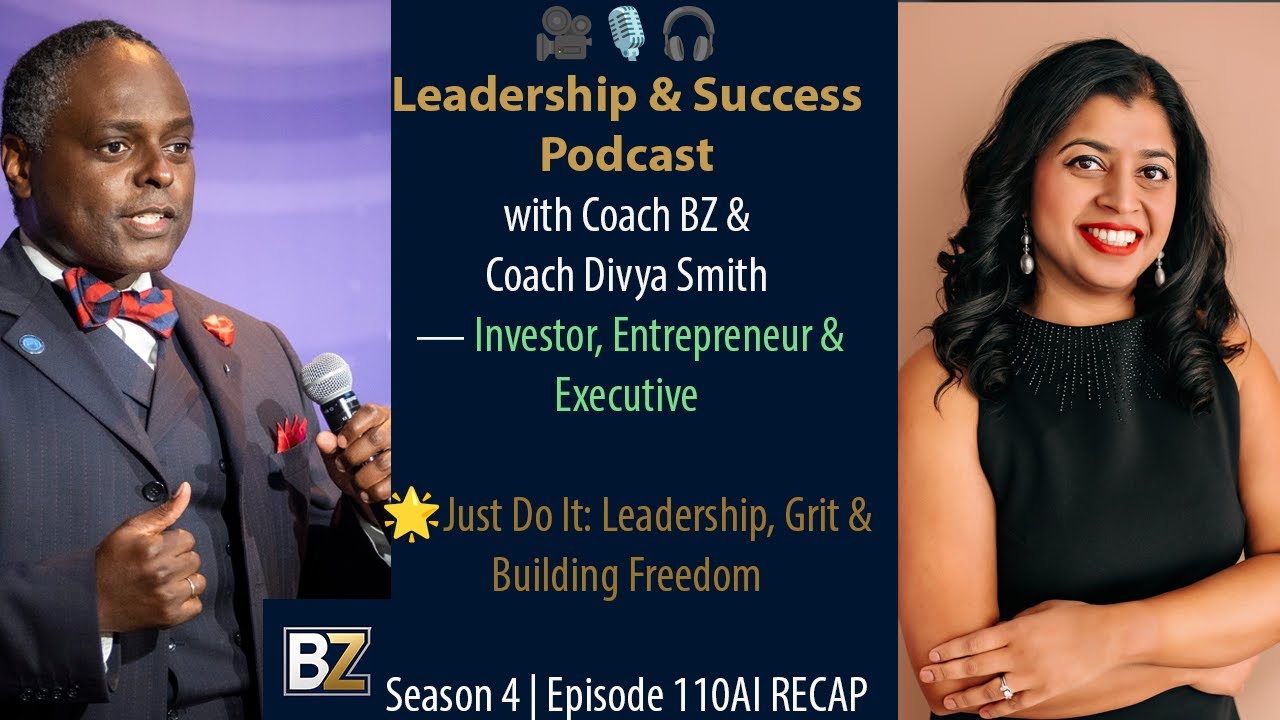
Coach Divya Smith, a former Fortune 100 executive, faced 83 internship rejections before building a $300 million real estate portfolio. She discusses designing a portfolio career, embracing discomfort as growth, and her 12-week Ascend Limitless coaching program focused on executive presence and tough conversations.
Chapters
Hi, I'm John Maxwell. When the top companies in the world are looking for trainers, speakers, and coaches, there's one name that stands above the rest, and that's Maxwell Leadership. Our certified team members have gotten proven results for companies all over the globe, and our reputation, I'm proud to say, is second to none. Some of our members have risen to the top of their profession, including the one you're going to meet today. I proudly introduce you to my friend, Bob Fabien Zinga.
Welcome to the Leadership and Success Podcast with your host, Coach BZ, where we help you lead with purpose and succeed with impact. If you're ready to grow into the kind of leader others want to follow, this podcast is for you. If you're determined to elevate your success and leave a lasting legacy, this podcast is for you. As my mentor, Dr. John C. Maxwell, reminds us, everything rises and falls on leadership. Our goal is simple: to inspire you, challenge you, and equip you with insights that can transform the trajectory of your leadership journey. Welcome aboard to another episode of the Leadership and Success Podcast with Coach BZ.
This podcast is for you.
And that's really where my intention was starting the company, is like, if I can have people maybe working 30 25, 30 hours, and then rest of their income is coming from real estate. You can still enjoy their work, go meet their co-workers, really have fun, but without overgiving their hours, and now can still use purpose and also say spend more time with their family.
That is, that is beautiful. Thank you, thank you. I, I think, um, this is an idea that could definitely revolutionize, uh, the lives of the people who are listening in right now. So you often talk about creating a portfolio career. What does that mean to you and how can professionals design one intentionally?
Yes, I feel like, Coach, like Coach BC, this is where I think you and I will align, and I would love your feedback on some of this too, maybe offline as well. So portfolio in this case is, I've always been a person who wanted to do multiple things, and for me, even every single job I've had, I've been promoted out of a job usually within 9 to 12 months. So every job I've had, I've had, you know, at Target I had 6 promotions in 8 years, then I was at US Space, like every place, like 9 to 12 months I'm getting promotion. And it was also because I'd go in, master what I need to master, and move on to the next thing.
Yeah.
So from that, I've learned these specific skills that really work in corporate America. You know, there's, there are definitely some theoretical concepts, but then there's true and applied rules from my background and perspective that have worked for me that I want to share with other people. Wow. That portfolio mindset. I do 3 specific things. So one, we just talked about the real estate investing. So I bring these investments to investors. They usually are able to invest in it. And then we all kind of like are waiting for those returns to come in. Usually we try to double their money in about 5 years. So it's pretty exciting.
So that's first.
The second one, the second one is I also do what's called executive consulting. So I worked with Cigna Healthcare last year. I helped them open up their GCC in India, the global captive in their India office. So that was really fun. And I also did strategic consulting with another big company and I'm actually Just—
that's also why you give away 50%. Okay, now to finish the show, this is going to be really rapid-fire lightning round, so don't take too long to think. Uh, one word that defines great leadership?
Great.
Okay. Uh, morning routine or practice that keeps you grounded?
Yoga.
Okay.
Book or quote that changed your life?
Atomic Habits.
Yeah, that's that book again. Hey, James Clear, we need that royalty check ASAP, please. Yeah, here he is. All right, so who inspires you the most today? That's also why you give away 50% of your income. You are crazy, but you make such a huge, huge difference. Wow, that is incredible. So as a leader, what are you learning right now? I know leaders are learners. What you learning now?
So a couple things. There are, um, couple leadership books, uh, more so from, uh, from a life coaching standpoint that I'm kind of researching and learning. There are a couple AI tools I'm learning as well. So more on that. And then there is, there's just a little bit more revolutionary sort of books, a little, I'd say, kind of puts you on the edge sort of money-making books that I'm also reading.
All right, ladies and gentlemen, I have a very, very special show for you today. Most of the time, as you know, I do this AI recap all by myself in my home. I play this 10-minute AI recap, but today will be different. I am really, really, really glad to let you know that we have one and only Coach Divya Smith in the green room. Please help me welcome her again to the Leadership and Success Podcast. All right, Coach Divya Smith, how are you doing today?
I am good. Thank you so much for having me again.
Absolutely. I am so glad. Actually, normally I would have done my AI recap for you, I think last Friday or Saturday. I try to do them in order. I think there is something wrong with me. I like for things to be exactly in order all the time. But this is wonderful. I really love the description. You said you wanted to be alive, so we moved it to Monday. So glad that you are here. I guess to get started, anything you are thankful for today, Divya?
Yeah, I'm thankful today for just the sun is shining. It's nice and warm for me. It's the simple things in life. I feel like we kind of forget some of those. And also, I try to live by gratitude. So one of the things I would share is thank you for having me again. I think this is wonderful to be here. And then, you know, I just have been— especially we had the week of Thanksgiving just a couple weeks ago, and I have gone back in time and really thought about the leaders who have helped me kind of in my journey. So I'm thankful for them. And hopefully, you know, if you're listening and watching, you know, you're able to do the same. People who have inspired you, who've kind of shared, uh, you know, or even listening to somebody, just send them a quick message, let them know, hey, thank you for those words, they helped me in a tough time. I think that, that goes a long way.
That's really powerful. Can you share a little bit more about some of the leaders who have affected you, especially those that other people might be able to follow on social media or get their book or something?
Yeah.
So these are personal to kind of my personal mentors in corporate America. So I'm not sure if I can share the specific names, but I would share kind of the characteristics, right? So there were times when I kind of doubted if my leadership skills were enough and they kind of put me in front of some big leadership meetings and I knew they supported me behind the scenes and then they were able to kind of like let me speak up instead of them kind of taking the ownership and leading the meeting, they were like, nope, she's going to do it.
She's got—
she, she knows what, you know, it takes to do it. So I hope more people kind of remember those people who gave them a chance to speak up, who gave them a chance to kind of be, you know, more representing the room than kind of taking their work.
That's really powerful because, uh, toward the end of the show, we're going to be talking about something— Ascend Limitless. That's exactly what you are doing. You are becoming to many other people what so many people have been to you. And that's, that's just wonderful, right? Paying it forward. So people watching now, you're going to have an opportunity to be mentored by Coach Divya personally. So that's going to be really, really exciting. So I try to keep this short so it's not 1 hour long like it was for our original conversation. Although with you, I felt like I could have been speaking for 2, 3, 4, 5 hours, but of course we need to put a time limit to this. So before I play the 10-minute AI recap of our conversation, is there something you would like to tell, uh, the, uh, audience, uh, maybe, uh, some, some of the, the main, um, intention or takeaway you, you really would, would like for an aspiring tech or military leader listening to the podcast, what they really should take home and try to practice?
Yeah, yeah, I will share a couple things. Probably as you're listening, you know, really understand and kind of focus on what your purpose is and what you really want to do next in life. And I think it's a lot easier said than done So really, and those purposes can change over time. So mine did, and it kind of led me to where I am, but just kind of give yourself that grace and time to really focus on your purpose, really what makes you excited to kind of spend your day, like wake up and be energized. You want to do that. So really focus on that and truly, you know, remind yourself and others that this is a journey. It's not a destination. So how do you really inspire yourself to continue on the journey instead of just focusing on the end goal.
Hmm, so powerful. Uh, thank you, thank you so much. This is a journey, not a destination. And also, for the people who are watching live right now, please let us know what you are grateful for. Let us know where you are joining us from, what city-state, and if you are outside of the US, which country, since this show is now global. And also Most importantly, if you have a question for Coach Divya, go ahead and type it in the comments. We're going to try to get to it live on the show. All right. Now what I'm going to do is I'm going to play the next 10-minute AI recap of the hour-long conversation. But really, I'm asking everybody to go back and watch Season 4, Episode 110. That's the full episode, and this is only the 10-minute recap. Here we go. And I'm going to be able to get feedback from Coach Divya right after this.
All right, today we are breaking down the incredible leadership playbook of Coach Divya Smith. She's an investor, a former Fortune 100 executive, and her entire philosophy, well, it can pretty much be summed up in two words you might recognize: just do it. So I want to start with a number: 83. What do you think this number represents? It's not a sales goal or some fancy metric. Nope, it's the number of times Divya Smith was told no right at the very beginning of her career. You see, as a freshman in college, Divya applied for 84— that's right, 84— internships. She got 83 rejection letters. But here's the thing: she didn't get stuck on all those "nos." She zeroed in on the one "yes" that finally came through, and it was from Target. That single "yes," that 84th attempt, launched a career that saw her get 6 promotions in just 8 years. It's a perfect example of how persistence can turn what feels like failure into a massive advantage. And that persistence— wow, did it pay off! Divya's story is just incredible. Picture this: she comes to the US at 18 with only $5,000 in her pocket, works 40 hours a week just to pay for school, and then goes on to lead these huge digital projects at corporate giants like Target, Hilton, and US Bank. And, you know, just on the side, she built a massive $300 million real estate portfolio. So how on earth did she do it? Well, her playbook is really broken into 3 parts. And first up is this one: mastering your mindset, or what she calls the inner game. This is the foundation, right? She believes all elite leadership starts right here with mental and emotional strength. When someone asked her for her single most critical leadership trait, Divya's answer was immediate: be comfortable being uncomfortable. She is convinced this is the number one most valuable leadership skill you can have in the 21st century. It's all about intentionally, purposefully stepping into situations that stretch you. But here's where it gets really interesting. Divya doesn't just see discomfort as this one big, vague thing. She actually breaks it down into 3 types. First, there's intellectual discomfort—you know, taking on a new role or a totally new team. Then there's personal discomfort, like stepping into the spotlight or having your ideas challenged. And finally, there's physical discomfort. Which, honestly, might be the most surprising key to her whole leadership philosophy. Divya tells this great story about training for a half marathon even though she actually dislikes running. So why do it? Because when you overcome a tough physical challenge, nobody else can do the work for you. It's all you. And that confidence, the kind that's earned through sweat and discipline, it translates directly into the boardroom. Strengthening your body literally strengthens your mind. And this brings us to a really crucial question for all of us, right? When you feel that sense of being uncomfortable, that challenge, do you see it as a warning sign to back off, or do you see it as an invitation to grow? Your answer to that question pretty much defines your leadership potential. So once you have that inner game of mindset dialed in, it naturally leads to the outer game of action. This is the second part of her playbook, and it's all about sharpening your method—how you turn all that mental strength into actual real-world results. 3. Stop Preparing, Start Doing. Now this, this is one of Divya's most powerful and, frankly, counterintuitive points. In this age where we're just drowning in information, she says we're consuming way too much and creating way too little. We get stuck in what they call "analysis paralysis," always thinking we need to read one more book or watch one more video before we can finally act. Her advice? It's simple: stop preparing and start doing. And this slide just lays it out perfectly. On one side, you've got input—all the reading, watching, and overplanning—which so often just leads to paralysis. But on the other side, you have output—doing, executing, and actually learning from the experience. Action is what creates clarity. You learn leadership in the arena, not sitting in the library. But of course, doing things without any direction is just, well, it's chaos. Great leaders need a way to connect their big, long-term vision what she calls "the horizon"—to their immediate actions, the very next step. And Divya's framework for this is just beautifully simple. She says 5-year plans? They're basically obsolete. Instead, set a 3-year vision. Then, you break that big vision down into 3- to 6-month goals with really clear ways to measure them. And finally, you break those goals down into the weekly actions you can take right now. It's how you connect the big picture to what you're doing this afternoon. So that brings us to the final and maybe the most profound part of the playbook: defining your mission. This is what she calls the higher game. It's about moving beyond just your own personal achievement to focus on your purpose, your impact, and your legacy. This is a core, core principle of her leadership. Divya's take is that in today's world, you can't just expect loyalty from your team. You have to earn it. And the way you earn it is by genuinely investing in your people's growth. When you do that, those people will stick with you through anything. People follow leaders who invest in them, not just in titles. Now, this isn't just about, you know, offering some training programs and checking a box. This is a real gut check. Take a look at your team. Do they feel it? Do they know deep down that you are truly invested in their success, both inside and outside of the company? For Divya, this higher game goes way beyond her career. Her personal goal is to give away 50% of her income, and not for tax breaks or anything like that, but because she wants her life to be anchored in service. This is the ultimate shift, right? Moving from a life of success to a life of significance. Okay, so we have covered a ton of ground. What can we take away from Coach Divya Smith's incredible journey and philosophy? Let's do a little rapid-fire summary of the most important lessons. Okay, number 1, take action before you feel ready. 2, embrace discomfort—it's your compass for growth. 3, persist past rejection—your breakthrough might be just one yes away. 4, remember to lead people, not just spreadsheets. 5, break your huge vision down into tiny weekly actions. 6, strengthen the body to fortify the mind. And finally, number 7, aim for a life of significance, not just success. And really, it all just comes back to this. This is the absolute core of her entire philosophy. If you're thinking about doing something—a goal, a project, even a tough conversation—the time to act is now. Feeling ready is a myth. Clarity comes from taking action. So, we'll leave you with this final question to really think about. Based on everything we've just talked about, what uncomfortable decision or conversation or action have you been putting off? And maybe even more importantly, why? The answer to that could be the key that unlocks your next level of leadership.
All right. That was the first 5-minute recap. What do you think? Was that pretty accurate? Yeah, that was very good. Wow. Awesome. Now, I must ask you some things that you mentioned because being an immigrant too, I think You applied for 83, right? Internships before you got one. Yes, I think I applied for at least 200 jobs before somebody finally gave me a chance. So it's a catch-22 thing. You are an immigrant, you barely speak English and you're trying to get a job, but they're like, okay, we can't give you this job unless you have experience. I'm like, I can't get the experience unless you give me the job. So, but eventually for you, it was Target. You have to tell us what it really meant for you. For me, it was the, University of Alabama in Tuscaloosa, Rogers Library for Science and Engineering. And the woman I will never, never forget, her name was Gloria Thompson. She goes by Gloria Longo right now. Mama Gloria, if you're listening to this, big love. You really changed my life. You changed the life of this man. Because this woman, she had mercy on me. She showed me favor. She gave me one job. And once I got it, I'm like, I'm going to be the best employee you've ever had in your entire career. You are never going to regret making this decision. And I did not. Like they say, the rest is History. Even when it came time to lay off about half of the employees, they couldn't lay me off because I was the best. I got there early, I stayed there late, and I was working twice as hard as everybody else. Like they say, the rest is history. I would've never been Coach Bizzy, the person I am today, if it wasn't for this woman. Nobody knows her, but I forever owe her really what happened to me. So if we go back to target. Maybe you can tell us a little bit more when you finally got the yes for your internship.
Yes, I think, you know, so I was supposed to have— and I don't think I shared this in the last, uh, podcast— but I was supposed to have 4 half-hour interviews with 4 leaders and the 5th one with the HR leader. I walked in, I had the 30 minutes with the HR leader, and then the 4 leaders walked in together. Wow. The second interview, so it was all 4 of them, and it basically went from an individual 30-minute, 4 sessions, to one long panel interview with 4 of them kind of sitting, and it was me, 19-year-old, on one side and 4 tall Caucasian, you know, leaders kind of walking in and kind of sitting. So for me, like, that was very interesting and challenging, of course. And I didn't expect that I would get the role, but when I got the call from HR person, they said, yeah, they loved you, they loved your attitude, they loved your energy, they really need somebody like that in their team. And so it wasn't even almost about my skills because she didn't mention that. I mean, I am a freshman, sophomore, how many, you know, but what I could offer that they didn't have was the right attitude and energy. So that really kind of what set me apart. And I think that's been my goal and motto in life is your energy and attitude can really shift and change how you do things. And honestly, you know, you talked about Ascend Limitless, and that's really what my goal is with that program is, you know, I decided that, hey, there is a lot of skills that people need to learn to be able to continue to grow their career. Uh, and, um, and that's kind of when I decided, um, to kind of start this 12-week career coaching program. So, um, I know, Coach, you mentioned, and I think you have the website kind of up available as well, but I want to just take a moment to mention that. Absolutely. That's a week. I think we, a lot of us kind of do different style coaching. For me, I'm a very structured person. So people who kind of like having a classroom of 12-week program, that's what I set up. We start out with elevator pitches to kind of talking about yourself, but really I work with them. So it's not just one way.
We do one-hour session talking about what it needs to look like, and then we're going to have application session that where we actually get to talk about it and people get to practice together.
Wow. So that's really fantastic. So that's the kind of format. So we have end-to-end kind of elevator pitch session. We have a module that's talking about tough conversations. A lot of us have a very hard time having those tough conversations. So really thinking about what those look like.
So that's another module.
We also talk about, hey, what does it look like for your brand?
And when you say brand, it doesn't mean the flashy stuff on LinkedIn. Your brand carries with you when you're walking, when you're talking with somebody, when you just say hello. What does that mean for your brand overall?
And then, you know, finally, I also have kind of talking about Now that you have done all of this, let's put it together.
And what does your career trajectory look like? And what are your skill sets, right? So really kind of taking and thinking about your skill sets, and then really setting yourself up for success. The biggest one that I hear from a lot of folks is they keep getting this feedback called executive presence. And of course, I am constantly kind of helping them think about that. It's a very subjective thing. Yes, you can talk about career presence, or executive presence in your career, but there's no one specific way to kind of show that. So that's the other thing that we work through. Actually, we take 2 weeks focusing primarily on executive presence. What does it mean? How do you show up? How do you start to really change yourself, the mindset, so that your executive presence truly shows up, you know, authentically? So that's kind of like very high-level nutshell, but it is a rigorous 12-week program. If it wasn't Regress, it would be me. So that's kind of the point of the program as well, is by the end of it, you really will walk away with this new version of you and kind of the grown version of you that you can then take and apply in hopefully all aspects of life.
That is really powerful. One of my primary mentors used to say, right, your attitude will determine your altitude. And many times every year, at least two dozen people from around the world, they reach out to me because they want to get into cybersecurity. And that's a big problem too, because when I first started 25 years ago, there was no degree in cybersecurity. So it's like, okay, I just want an entry-level job, but they won't hire me because I don't have the experience. And then I won't get the experience unless they hire me. But I think attitude really has a lot to do with everything, right? Because if you have a good attitude, if they feel like they can teach you, you don't know everything, but you are teachable, many times they will hire you and then train you the way they want. And give you a lot of opportunities. That is really powerful. So again, the website is Ascend Limitless, and you can go there and you can apply right now and be mentored by Coach Divya. So what I'm going to do next is I'm going to play the second 5-minute AI recap and get your feedback on that too. And then we're going to end the show. Just a moment.
Today, we're diving into some powerful leadership insights. Um, inspired by Coach Divya Smith's journey. She's built her story from humble beginnings to becoming a transformational leader in tech and military circles.
Yeah, definitely. Right. And one of the standout ideas is how leadership is less about control and more about connection, courage, and, um, taking consistent action.
Exactly. I mean, Divya emphasizes that leadership isn't about holding the reins too tight. It's about connecting deeply with people and pushing yourself into discomfort to grow.
Exactly. And that idea of be comfortable being uncomfortable, it's such a game changer, especially for, say, military leaders or tech engineers stepping into new roles. It really flips the narrative on what growth looks like.
Right. It's like when you're training for a marathon, you push through that initial pain and realize, whoa, I can actually go further than I thought.
Yeah, but here's something I found interesting. Divya's advice on mastery through action. Read less, do more. I get the enthusiasm, but don't you think there's value in reading and absorbing theory too?
Sure, there's value in absorbing knowledge, but Divya points out that too often our input overshadows our output. It's a call to actually put ideas into action.
Yeah, I see that. It's a bit polarizing though, right? Like, sometimes you need to study to avoid dumb mistakes, but I agree that real leadership is forged in the fire of doing.
Absolutely. It's all about balance. Divya's journey from starting with $5,000 and juggling jobs to leading major digital transformations at companies like Target and US Bank is testament to the importance of persistent action.
Indeed. And then There's the story of the 83 rejections and 1 yes. That's a powerful reminder that setbacks are just stepping stones. When you finally get that one breakthrough, it can transform your life.
Right. It's like if you imagine knocking on 84 doors and the 84th one opens up to change everything. It underscores the grit and persistence needed.
Absolutely. Moving on, I love the concept of build people and they will build the business. It really challenges the traditional command and control model. Instead, investing in people becomes the ultimate strategy.
Yeah, that principle is huge. Divya talks about the erosion of loyalty today. If leaders invest in their teams, then those teams will stick together even in hard times. Oh, for sure.
For military leaders and tech innovators alike, that means cultivating relationships over simply following titles or processes.
Right, because people respond to genuine care and mentorship. And then there's the approach to vision and execution, breaking a 5-year plan down to 3 years and then into 90-day steps. That's like having a roadmap that connects the big picture to everyday actions. Mm-hmm, exactly.
Absolutely. It's a tactic that both military commanders and tech leaders can use to keep momentum and accountability. Ensuring that the vision isn't just a dream but is actionable.
And speaking of action, Divya's financial advice, your money should work for you even while you sleep, really resonates. Start with one small investment a year and let compounding do its magic.
Yeah, that's motivating. I like how she parallels financial discipline with leadership discipline. It's all about making small, courageous moves that build up over time. Definitely.
And then there's the coaching aspect of her work. Her 12-week transformation program, helping leaders break out of outdated images. It's about, you know, rebranding yourself and communicating your strengths clearly.
Yeah, yeah. That bit really stood out to me. If you can't articulate your core strengths in 2 or 3 sentences, you might be losing people. Before you've even begun to lead.
Absolutely. And another poignant piece is her view on physical discipline translating into mental confidence. Like, even if you don't love running, committing to a physical challenge builds inner strength that shows up in boardrooms.
Right, exactly. There's beauty in that synergy—your body training your mind. It feeds back into that overall leadership ethos where you really need to invest in yourself first.
And let's not overlook her dedication to generosity. "I want to give away 50% of my income." That's not just about financial savvy; it's about leading with heart and purpose.
Mm-hmm, yes indeed. It pushes us to think about leadership as a legacy, how your actions, especially generous ones, ripple outwards to impact not just business outcomes but lives as well.
Right, and that brings us full circle to the idea that leadership is truly about transformation. It isn't just about short-term wins but building a lasting impact on people and society.
Absolutely, I couldn't agree more. But, um, one thing I wonder is, in our fast-paced world, can leaders really take the time to fully implement these multi-layered strategies, like breaking vision into daily steps, without getting overwhelmed?
That's a fair challenge and describes exactly the need for consistent, Iterative action. It's not about getting it perfect from day one. It's about aligning your daily actions with a bigger vision and refining as you go.
That iterative process is key. It makes a lot of sense. The idea is to act even when you don't feel ready because, as Divya says, waiting for readiness might just hold you back forever. Exactly.
And bringing in those biblical analogies reinforces that point. Commit to what you do, and over time, your actions compound into meaningful progress.
Mm-hmm, absolutely. And it's interesting how leadership lessons from such a diverse background, from military to tech to entrepreneurship, are so universally applicable. They remind us time and again that leadership is about service and, um, connecting deeply with those you lead.
Yes, and the blend of grit, self-leadership, and a commitment to serving others really defines the modern leader. Divya's perspective encapsulates that beautifully.
Sure does. She challenges traditional notions by saying leadership is, in essence, transformative and meant to elevate the next generation, right? That's powerful.
Absolutely. It's like every decision should align with moving not just yourself forward, but also pushing the generation behind you forward. Indeed.
Her insights about embracing discomfort as a sign of growth really resonate. Instead of retreating when things get hard, you evolve, and that's, uh, a solid lesson for any leader.
Right, and that ties back into the entire philosophy of "Just Do It," whether it's taking a physical challenge, making a financial investment, or stepping into a leadership role without permission.
Yep, exactly. I think these lessons, when taken together, paint a picture of leadership that's not static but dynamic. Courageous, compassionate, and relentlessly action-oriented.
Definitely. And the takeaway for all leaders, whether they're military officers or Silicon Valley engineers, is clear: step up, be bold, and never let fear dictate your actions.
So true. This discussion definitely leaves me energized to take on new challenges and to lead with a focus on genuine connection and action. Absolutely.
So whether you're building a business or shaping a team, remember to harness discomfort, act decisively, and invest in people. That's the essence of true leadership.
Yeah, indeed.
Even as they are one of the biggest companies in the world today, they still try to run themselves like a startup in some ways. But wow, that is quite amazing. So what about emerging technology, artificial intelligence, automation, and data? How have those shaped your approach to leadership and decision-making today?
Yeah, so a few different ways.
I think I'll share a little bit even entrepreneurial side, but then also from a leadership technology standpoint, I think, you know, people talk about AI now like it's a buzzword and it still continues to be a buzzword, but there's truly reality between like the LLMs, like the large language models, and then specifically say machine learning projects and automation, right? They all are different. They all have different purposes. One of the key things I— every single time I'm working with a company, my focus is to say, what is the need that you have? Because you cannot like put a solution on top if you don't have a very clear need, identify what goals you need to deliver using that technology. So that's one piece. I think that's always being very clear about what are the goals and the metrics you're looking for.
Yes, from an entrepreneurial scene.
All right, that was, uh, just a, uh, sample of Season 4, Episode 110. And I want you to go back and watch the full episode. And now what I'm going to do is I'm going to share my screen and we are going to— oh, actually, while I'm here, so make sure to go ahead and follow Coach Divya on LinkedIn. So linkedin.com/divyasmith, you can follow her on LinkedIn. And, uh, yeah, and also, uh, go to, uh, uh, business website, uh, ascendingavenue.com, and, uh, the website, uh, we, uh, just promoted, uh, Ascend Limitless, where you can apply and be coached there. Okay, so now let me go to, uh, the Wheel of Names. And, uh, before I do that, we're going to to our moment of gratitude. This is where we just take a moment. It takes less, less than a minute. We want to be grateful every time we meet on the Leadership and Success Podcast. We always, always want to do that because I think gratitude really is is a success. Okay, so take a minute and maybe you want to close your eyes, take a deep breath, or put yourself in a happy place. But think about what you're grateful for right now and Like I was telling Coach Divya earlier during the program today, I believe that, um, Everything really changed in my life when Gloria Tum Lunga really gave me an opportunity. She gave me a job, right? I was Hollywood. I pick— yeah, she gave me— yeah, so let's go ahead and in the Here we go. All right, so just so— Jackie and Singer from Denver area, and it looks like you have more than almost 8,000. That is going to end the podcast. Thank you so much for watching. I know you've built Hilton's global sites to launching Optim's virtual care solutions. What are the biggest leadership challenges in digital innovation, in your opinion?
So the digital, as you can imagine, constantly changing, right? And so it ends up becoming about how are you putting the person, the person in front of the digital. So whether that be a customer, client, guest, whatever you call it, every company I've worked at, they call it different, right? Whether it is the person who's holding the account in case of US Bank, whether it's the customer who's walking into, you know, an office or a client or a guest who is walking into Target. So no matter what, you have to see things from their lens. A lens, and end of the day, it needs to be convenient for them. It needs to be easy and reasonable for them. So in digital, we still think about step by step moving from one to the next to the next. That is all well and great when we are coding it, programming it behind the scenes and creating solutions. But that is not okay when you look at it from a user standpoint. So can 8 or 10 of those steps be combined into 2, 3? And only there's 2 or 3 steps that the person from the consumer side actually sees. So that's really the big concern.
I really like that you go back to the human, you said the human standpoint. How can leaders ensure technology transformation aligns with human transformation as well? Correct.
Yeah, I mean, that's exactly it. End of the day, technology is technology and it doesn't have much emotion. It's going to do what it needs to do the way it's programmed. Wow. How do you now take the emotion that comes with human? If somebody's looking to buy something really quick because they forgot their kid's soccer, you know, soccer match tomorrow and they need something just like as quickly as today or tomorrow, how do you kind of like facilitate that like process really quickly? Or someone who's ill and they need a quick doctor's appointment.
What's the first doctor's appointment of All right, that's it for the Season 4, Episode 110 AI Recap Show. And a quick reminder, I'm going to be back here tomorrow and I'm going to have a 10-minute AI recap from the leadership conversation I had with Brian Aron. He's an author, a speaker, and a coach. We're going to be talking about Influence from Above: How Faith and Integrity Shape a Leader's Impact. So that's going to be tomorrow. All right. So, this is it for today. And again, many, many thanks to Coach Divya. She's added a lot of value to the audience. So, I see you guys tomorrow. Bye.
Thank you for tuning in to the Leadership Success Podcast with your host, Coach BZ. If today's episode added value to your leadership journey, be sure to subscribe, share, and join us again for more wisdom nuggets on how to lead better and achieve greater success. Remember, leadership is the most critical skill of our time. The world will always need leaders to inspire others, drive innovation, and execute meaningful strategy. So why not count yourself among the bold leaders shaping the 21st century? Until next time, stay inspired, stay committed, and keep leading with excellence. Excellence.
More from Bob

S250:E4🎙️LIVE 🇺🇸America 250: President Barack Obama Leadership, Service, and the Power of Hope






S5:E157🎙️ LIVE with CMD CMSgt Dennis L. Fritz, USAF (Ret.)(Multi Tracks Audio)



S5:E156🎙️ LIVE 🇪🇸 Leadership Lessons from the FIFA World Cup 2026 Champions (Multi Tracks Audio)

S250:E3🎙️ LIVE Leadership Lessons from America’s First Documented Family of African Descent 🇺🇸📖