S4E113AI RECAP🎙️LIVE with Brian Ahearn (Multi Tracks Audio)
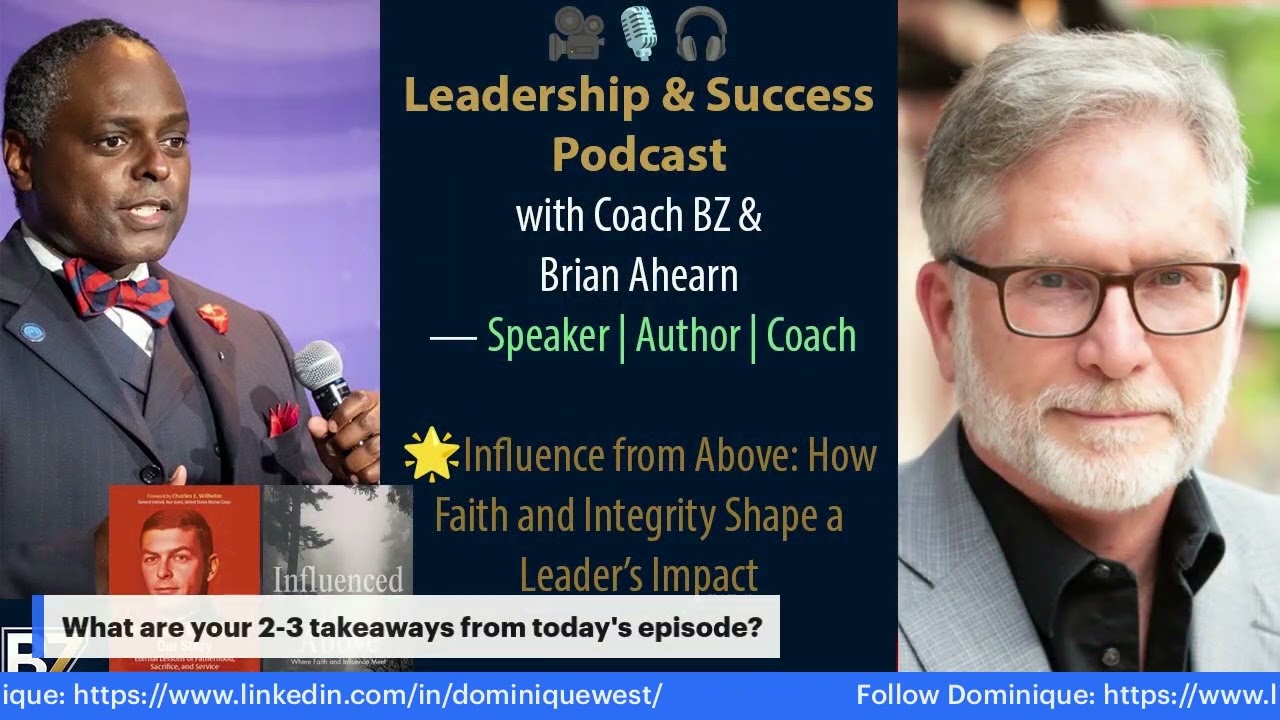
Brian Ahern explains ethical influence through three principles: absolute truthfulness, using only natural psychological levers, and creating win-win outcomes. He shares how adding "because" to a request dramatically increases compliance, and reframes his influence framework from PEOPOL to LOVEOL, linking persuasion to love for God and neighbor.
Chapters
Hi, I'm John Maxwell. When the top companies in the world are looking for trainers, speakers, and coaches, there's one name that stands above the rest, and that's Maxwell Leadership. Our certified team members have gotten proven results for companies all over the globe, and our reputation, I'm proud to say, is second to none. Some of our members have risen to the top of their profession, including the one you're going to meet today. I proudly introduce you to my friend Bob Fabien Zinga.
Welcome to the Leadership and Success Podcast with your host, Coach BZ, where we help you lead with purpose and succeed with impact. If you're ready to grow into the kind of leader others want to follow, this podcast is for you. If you're determined to elevate your success and leave a lasting legacy, this podcast is for you. As my mentor, Dr. John C. Maxwell, reminds us, everything rises and falls on leadership. Our goal is simple, to inspire you, challenge you, and equip you with insights that can transform the trajectory of your leadership journey. Welcome aboard to another episode of the Leadership and Success Podcast with Coach BZ.
You often say things like, um, small changes can lead to big differences. Can you unpack that, uh, for our audience?
Sure. Um, one simple example of this: the word 'because.' There was a study that was done where people would walk into a photocopy shop, you know, so this goes back in the day when not everybody had copiers. You had to go somewhere to get copies. And they did some research and they looked at 3 different variations. Somebody would walk up. I think they'd have like 5 pages. They'd go to the person in the front of the line and they would say, "Excuse me, may I go ahead of you? I have 5 copies to make." So they made just a straight up ask, "Could I get in front of you?" And believe it or not, 60% of the people said, "Sure, go ahead." At another time, they would go up and they would say, "Excuse me, may I go ahead of you because I'm in a rush?" And at that point, 94% of people said, "Sure." Wow. Now, thinking it's just because they said they were in a rush, they tried one more variation. The person would go up to individuals who happened to be at the front of the line. They'd say, "Excuse me, may I go ahead of you?" because I need to make these copies. Well, everybody's in line to make copies. That's a bogus reason, right? But 93% of the people said yes.
Really?
Wow.
And the social psychologists theorize that that word 'because' is a trigger. You know, I don't know about you when you were growing up, but, you know, when I'm growing up, if my dad said, 'Do something,' if I ever dared say, 'Why?' He didn't give me a rational explanation. He said, because I said so.
Yes.
And I went and did it. So the theory is that we're conditioned by that word.
Something you mentioned, it's true in leadership, we do have to be careful between influence and manipulation. Actually, I wrote an article about that maybe a couple of months back. Can you tell us more about what the difference is between Influence and manipulation.
Sure. You know, I love it when people say, well, you know, what you're doing is just teaching people to manipulate. And I can, I can then launch into my story and they recognize how seriously I take this. First thing I say is they're two different words with two different meanings. To be an ethical influencer, there's three must-haves. You have to be truthful. And it's not enough to just tell the truth. We don't hide the truth. If I know there's something that materially will impact your decision-making and I withhold that, I am not being ethical. Right? If you ever come back to me and say, Brian, why didn't you tell me? If I say, well, BZ, you didn't ask, you're not going to think that I'm an ethical guy. So we don't, we tell the truth. We don't hide the truth. The second thing when it comes to what we call the principles of influence, We only use the principles that are naturally available. So if something's not scarce, we don't try to use the principle of scarcity. If there's not lots of people doing something, we don't try to manufacture a false sense of social proof, right? So we only use the psychology that we see present in the situation. And then the third thing is, to use Stephen Covey's term, we have to create win-win situations.
Yes.
It's not It's not good enough that I get something out of the interaction. Obviously, I probably will. That's why I might have approached you. But I have to know that you're leaving the transaction well off also. And so if we can do those 3 things—
How has that helped you understand your own story differently?
I started to get a better sense of why I was the way I was. And it allowed me to start making some conscious choices. Um, when our daughter was born, you know, my wife and I were both at a stage in life where we were looking and questioning, you know, how we were raised. And not that it was terrible or anything, but why did our parents do certain things or not do certain things? And then we could start making conscious choices to do things differently. And so as an example, um, my wife in her early 30s said, you know, and I think back about being a little girl, my dad would take me to this restaurant and, and I was so proud to be there, but he just read the paper or mom and I would go on vacation with, with my older sister, but dad wouldn't come. And, and she started questioning like, didn't he really want to be with me or was work more important? Anyway, she had all this question. So when our daughter was maybe a year old, I don't remember exactly the age. I remember my wife said, hey, we're gonna go to the park. You wanna go? And I said, no, I'm kind of tired. And I'm standing at the kitchen window, I'm looking out, and I just thought, I don't want Abigail to grow up and say, why didn't dad go to the park? Why didn't he do this? Why didn't he do that? So I said, hang on, I'll go with you. And the fact that I remember that almost 30 years later shows it was significant. My daughter and I are so incredibly close because that set a tone for getting in things like Indian Princess, father-daughter things, going to taekwondo together for many years. Just, I always wanted to be with her and do things with her. I wanted to include her. I'm going to go to the, I'm going to the mall. Abigail, get in the car. You're coming with me. And so we grew extremely close. So that's an example where I—
Welcome to The Explainer. Today we are really digging into the heart of what it means to be a leader. And what is that? Well, it's influence. We're gonna break down the blueprint for being a truly impactful leader, and we're pulling all this from some amazing insights by influence expert Brian Ahern. So let's just jump right in with a question every single one of us in a leadership role has to face. It's not if you're going to influence people. You are. The real question is how. Is your influence going to come from a place of integrity or is it gonna come from your ego? Seriously, how you answer this one question changes everything. You know, when you strip everything else away, what are you left with? This simple, powerful truth. Leadership is influence. That's it. Nothing more, nothing less. It's not your job title. It's not where you sit in the office. It's just, can you move people to action? Okay, so we're diving into the science of persuasion. And look, this isn't some fuzzy concept about just being charismatic. No way! What Aharon talks about is all based on more than 70 years of hard science. We're talking about proven, researched principles here, which is exactly what you need when the pressure's on. And here's the part that's, well, it's kind of mind-blowing: you don't have to completely change who you are to be more influential. The research is super clear on this. It's the small things. Tiny little tweaks in how you say something can lead to absolutely massive differences in the outcome. I mean, how small are we talking? Well, how about a single word? There's this famous study. You've gotta hear this. Researchers went to a library to see if they could get people to let them cut in line for the photocopier, and the entire experiment boiled down to using one specific word. And that magic word was "because." Seriously, when the person asking to cut in line just added the word "because" and gave a reason—and get this, it could be a totally lame reason like, "Because I have to make copies"—the number of people who said yes just shot through the roof. It's like our brains are hardwired to respond to a "why." So what does that tell us? It tells us that influence doesn't just happen in the moment you make your pitch. It starts way before that. Experts call this pre-suasion. Think of it like priming the pump or setting the stage. You're getting people ready to hear your message before you even say it. Alright, let's talk about the big one: persuasion versus manipulation. Because once you understand these techniques, you're at a crossroads. There is a very, very clear line in the sand between using influence for good and, well, the alternative. And for any leader who cares about integrity, knowing where that line is? It's everything. And the difference couldn't be more stark, right? Persuasion—that's all about truth. It's about finding a win-win for everybody involved. It's rooted in integrity. Manipulation? That's the dark side. It's built on half-truths, maybe even outright lies. It's totally self-serving. And in the end, it just torches any trust you might have had. So, how do you make sure you stay on the right side of that line? Aharon gives us 3 rules. They're non-negotiable. First, you have to tell the whole truth. No cherry-picking the facts. Second, you can only use what's naturally there. You can't invent a deadline or pretend something's rare when it isn't. And third, and this is huge, it has to be a win for them too. It has to be a genuine win-win. Okay, so we've got the science and we've got the ethics. But that's not the whole story. Not even close. To really get to the core of what makes a leader influential in a way that truly matters, We have to go deeper. We have to talk about the heart. And what's really fascinating is that Aharon himself had this huge shift in his own perspective. He started out focused on what was ethical, but he realized there was something more. He moved from thinking about what's lasting and ethical to what is loving and eternal. His point is, if you lead from a place of love, the ethics will just naturally fall into place. And this wasn't just some idea he came up with. This change came from somewhere deeply personal. It came from the example of his father, US Marine captain. What his dad did is a story that, well, it teaches you more about leadership than any book ever could. So, picture this: we're in Vietnam. A captured enemy soldier is being brutalized. An allied officer is trying to get information out of him, and it's ugly. I mean, this is a situation with unimaginable pressure, where right and wrong can get really blurry. And Aharon's father, just a young captain at the time, sees what's going on, He steps in, he gives a direct order to the Allied officer, "Stop!" And the officer just ignores him, keeps going. So what does he do? In this split second, with his career, maybe even his life on the line, he makes a choice. He pulls out his sidearm and he puts it right to the head of the Allied officer. And he says, "If you kick him again, I'll shoot you." Just let that sink in for a second. He put everything on the line, not for some tactical advantage, but for the basic human dignity of an enemy soldier. That, that is what it means to lead from the heart. Wow. So how do we take a story like that and everything else we've talked about and actually put it into action? How do we make this real in our own lives, in our own leadership? Okay, here's your blueprint. Let's boil it all down. First, remember that influence starts before you even open your mouth. Preparation is key. Second, you have to be ethical. No shortcuts, no manipulation, ever. It just destroys trust. Third, lead with love, not just rules. Think about Captain Ahern. Remember that small changes can make a huge difference. And finally, it all comes down to who you are. Discipline and authenticity—that's what builds the trust that makes real influence possible. So, in the end, it really comes down to this: Influence isn't something you do; it's a reflection of who you are. It's the byproduct of your character. So the question I want to leave you with is a simple one, but it's everything: Who are you becoming?
All right everyone, so this was the first 5-minute AI recap from the hour-long conversation I had with Bryan. And it looks like Bryan might be watching us live right now. Okay Bryan, if you're listening, I just sent you the link to the green room. If you are willing to open for like 5 minutes just to give us your 3 to 5 takeaways. So the way I do this, if you go back and you guys listen to season 4 and then you go to episode 113, what you would see there is the full hour-long conversation I had with Bryan. So this one here is a 10-minute AI recap. So I use artificial intelligence to kind of give you in 10 minutes the essence of a discussion we had. So I just played you the first 5 minutes and I have another AI clip for the next 5-minute recap with my AI agent. So what I will do, I'm going to play the next 5 minutes and then I'm going to play 2 short clips again of the original conversation I had with Brian. And then I'm going to end with a moment of gratitude. Yesterday I wasn't able to do the moment of gratitude for— because I'm doing this for 21 days where I challenge people in my network. So yesterday would've been day 13 and today day 14. So I'm going to do both of them together. So we will do that and then we are going to end the show. Basically, this is one for the next 21 days starting Thanksgiving of this year. And I started this practice about 4 years ago. I am grateful for one thing every single day on LinkedIn. And then I challenge a member of my LinkedIn network to accept the challenge, meaning they're going to be grateful every day on LinkedIn for one thing for the next 21 days. And each day, challenge a member of their network to do the same. Okay, so now let's go to the second half of the 5 Minute AI recap. And if Bryan accepts or is able to log into the green room, we're going to have a quick conversation with Bryan about the main takeaway of the hour-long conversation we had a couple of weeks ago. Okay, here's the next 5 Minute AI recap.
Welcome to the podcast. Today we're delving into leadership, when influence meets faith and integrity. It's, um, really all about how leaders shape their impact from within and, uh, from above. Mm-hmm, right.
It's fascinating how leadership isn't just about authority, but, you know, genuine influence stemming from gratitude, honesty, and even small shifts in our communication. Exactly.
For instance, starting with gratitude and presence, leaders grounding themselves with, um, appreciation, like being thankful for personal joys and even family moments, really sets the environment. It's almost like, um, gratitude builds that emotional intelligence that holds everything together.
Absolutely. And turning to the idea that influence is scientific, it's compelling how they explain that Ethical Influence isn't just hunches. It's, yeah, based firmly on decades of research into what drives people to say yes and take action.
Yeah, and that science, the use of data and well-established psychological principles, really separates ethical persuasion from mere manipulation. And, you know, they stress that manipulation destroys trust, which is like the currency of leadership.
Mm-hmm, definitely true. But I've got to ask, don't you sometimes wonder if relying so heavily on science might risk, um, making leadership too formulaic? I mean, isn't there a danger that leaders might lose that human touch?
That's a fair challenge. Right. But I think what makes it work is that the principles are grounded in timeless values like honesty and service. It's not just about checklists. It's about creating win-win outcomes where everyone benefits. And it's like even a single word like because can transform how a message lands.
Yeah, I found that example super striking. It's almost funny how such a tiny addition can boost compliance like that. It really underscores the subtle art of influence. Absolutely.
And then there's the discussion on pre-suasion. Setting up the environment, both mentally and emotionally, before the actual conversation. Leaders prepare the stage such that when they speak, their team is in the right headspace. It's proactive, not reactive leadership. I love that idea.
It's like prepping the soil before planting seeds. If the ground is right, the results flourish. And what about the personal stories? There's that moving memory of a US Marine father who demonstrated moral courage, protecting dignity even in dire circumstances.
Yeah, that story really hit home. It exemplifies that leadership, even in the harshest conditions, must be anchored by integrity, moral courage, and above all, genuine care for others, even for someone who isn't an ally at first glance.
Yep, that story and even his shift from 'Powerful everyday opportunities to persuade' to 'loving and eternal' really shows how faith and love elevate ethical influence. It's more than just tactics; it's about heart.
Exactly. And it's intriguing to see how his faith integrates with his methods. When you lead with love for God and neighbor, the ethical boundaries become self-evident. Leaders naturally lean toward doing what's best for everyone, not just themselves.
Right. While discussing these principles for military or tech environments, it seems there's common ground. Whether you're leading a cyber team or a brigade, the same values apply— truth, mutual gain, and authenticity. True.
And the insistence on authenticity is crucial, especially in today's world where AI and polished messaging risk diluting the real human connection. Leaders need to own their voice, be transparent about everything, and, um, reveal when technology has lent a hand.
Mm-hmm. Yeah, that stands out. Without authenticity, trust simply evaporates. And trust, as we know, fuels influence. It's like the glue binding ethical leadership together.
Exactly. And then there's that powerful point about discipline. It's not just about following a set of rules; it's about developing habits that shape who you are as a leader. When you talk about discipline, you're really talking about destiny—how these small, consistent actions lead to big impact over time.
Yep, that's a neat analogy, discipline as destiny. It calls to mind how even failure or near-collapse can serve as a transformative lesson. I mean, his experiences with personal crises also show that vulnerability, when embraced with discipline and faith, leads to healing and growth.
Right. It's like, um, when you nearly lose something pivotal and you surrender to the process, you open up pathways to deeper change. And that vulnerability is not weakness, it's responsible leadership.
And then of course the ultimate takeaway: leadership is influence. It's not about the title or position, but about how you serve, love, and inspire those around you. That message really resonates in every sector, whether military, tech, or any other field.
Absolutely. So leading with purpose isn't just a strategy. It's a mindset anchored in faith, gratitude, and ethical influence. It's about showing up authentically, preparing the ground before you speak, and always aiming for a win-win. Yeah. It's a model that can truly change the world at every level. Well said.
And as we wrap up, it reminds us that every small action, every word, and every moment of honesty fuels a larger legacy. Thanks for this engaging chat. It's given me lots to reflect on.
Thanks to you too. Remember, the journey of leadership starts with integrity, and a heart full of love. Until next time, keep influencing from above and leading with purpose.
Your career spans over, what, more than 35 years or so in business, underwriting, sales, leadership, and now global speaking. What are some pivotal moments that shaped your path?
The first pivotal moment would be in college. I had already accepted a job in the retail sector, but I got a, I got a letter from the Travelers Insurance Company the last week of school. I thought, well, I owe it to them, or I owe it to the girl I've been dating. She lived in Columbus, you know, I owe it to her to go to the interview and see what it's like. Well, I get offered the job, and even though it wasn't as much money, I thought, you know, I'll be in town where she is. I will be around friends and family. And so I decided to take the job. The irony of it was I met my wife the first day of work. And so after 2 weeks, wasn't going out with the other girl. But the other pivotal thing was insurance turned out to be a great, great career. And I never would have— I never would have thought of insurance as being a career. So that was the first pivotal moment. Wow. I think the second pivotal moment was that decision to send the email to Stanford to address this moral situation. And I told Cialdini about a year and a half ago, I spoke at a conference to celebrate his 40th anniversary of his book Influence. And I started to get really emotional because here he was in the front row. And I told him, I said, Bob, I have to thank you because you didn't just change my career, you changed my life. Wow. The way, obviously my career changed because I run my own company, Influence People, but how I interact with everybody. The foundation of that is how I influence people and what I've learned about human psychology. So I, I really hope that people who hear me speak or go through my training, that they can have the same kind of life-changing impact.
Hey everyone, thank you so much for watching. So that's it for the 10 Minute AI Recap with Brian Ahern. So I want to remind you guys to purchase his book, but also the book from his mentor, Dr. Robert Cialdini. I'm trying to get Dr. Cialdini on the podcast. Hopefully we're going to make it happen early next year. But definitely make sure to purchase his book, His Story, My Story, Our Story: Eternal Lessons of Fatherhood, Sacrifice, and Service.. If you are a veteran, a lover, and definitely need to read this. And also his latest book about Influence from Above, where faith and influence meet. All right. And I also would like for you guys to please follow him on LinkedIn. Let me share my screen. So that's, let me add his LinkedIn page right here. Here we go. So linkedin.com/brianayron. Go there and follow him. He really has a lot of great posts about leadership and influence and just a great person to follow. And also go to his website where you can sign up for his newsletter and find out more about his speaking engagement and everything else that Brian does. All right, so it is that time again for our podcast where I would Take just a moment for our moment of gratitude. Oh, by the way, we have a user that says, I like the win-win. It is a strategy that has worked for me and has taken underperformer to high performance. Let me see if I can figure out who this person is. Sometimes on LinkedIn, because of privacy, it doesn't show me who these people are. And then I also add one more. I have to drop, but this is a great recap. Okay, that was Maxine Maloney. Thank you. Thank you so much, Maxine. Really appreciate that. And for those who are not able to stay for the entire time, that is perfectly fine. The good thing about LinkedIn and YouTube, as soon as the show is over, the recap, the replay will be available immediately. I really do appreciate all of your feedback. So let us know what are your 2 to 3 takeaways. I also would like to know where you are joining us from, what city and what state if in the US, and which country if outside of the US, since we have a global audience now. And also what you are grateful for. So let's go to our moment of gratitude. This takes less than a minute. And we want to be grateful every single day on the show. But right now specifically for the next 21 days, it started on Thanksgiving. My challenge is I am grateful online every single day and then I challenge someone every single day. So I didn't have a chance to do this yesterday. So today we're going to do day 13, which would have been yesterday, and then day 14, which is today. So I will be grateful for two things. Right now. Let's go ahead and get started. If you can, maybe close your eyes, take yourself to your happy place, and think about what are you grateful for right now. I think I am really grateful for my parents. So for Dave Churchill, I am grateful for my father. I guess we had a complicated relationship growing up, One major issue I had with my dad, and I am named after him, his name was Robert Zinga. So I am Bob Zinga. That's part of the reason why I love my middle name Fabien, because Fabien makes me unique, right? Bob was my father. He was Robert, but when he went to school in Germany, that's where he got the nickname Bob. And that's what he named me after. It's really when myself, I became a father in 2002, when my daughter, my first daughter was born. Where I really realized how important it was to carry his name. Because if my first child was a boy, I would probably call them Fabien too, even as a middle name or a first name. But anyway, growing up, we've had a complicated relationship. So I mostly went by my middle name Fabien and not Bob. But one major issue I had with my father was that It did provide for us, so money wasn't an issue. We lived in a very big house and we were provided for everything. We went to private school and all of that. But the thing is, I really needed my dad's time, his presence more than I did, right? His gift or whatever he could do to provide for the family. And I had always missed it. And that's part of the reason why myself, I was just a kid. I was like, no, when I grow up and I become a father, that's definitely one thing I would not do. I'm going to be present for for my children. But anyway, to make a very, very long story short, when I became an adult, our relationship completely changed. And he passed away in 2011 in France, and I still miss him to today. So our relationship was mended. He became not just my father but also a very good friend when I became an adult. And I've learned so many wonderful lessons from him, which I will definitely be passing on to my two daughters. But anyway, so for day 13, I am grateful for my father, Robert Zinga. Now for today, day 14, I am grateful for my mother. I think there is probably no person that personified, um, the love of God to me better than my mom. The unconditional love that she had for me, it's just incredible. I have never seen a human being love another human being so much. I believe I was her favorite child. I think most of my siblings would agree, but she's just gone above and beyond and done things that she really didn't have to, to care for me, to ensure that my future would be better than her past. And I am very, very grateful for that. Again, she passed away during COVID but I forever miss her. When she passed away, she deeply, deeply affected me. So I think there is still a small hole in my heart, and I don't think anything will ever be able to fill it. But I think when she passed away, for about 60 days, I really couldn't even get out of bed. It really deeply, deeply affected me. I missed her so much. But the great thing is I really remember all of the great time we've had growing up, how she cared for me, how she really protected me and loved me and really did everything she possibly could as a human being to ensure that I would do well in life. So I am forever grateful to my mother. So today I am grateful for my dad, Robert Zinga, and Pauline Kitakani. My mom. All right, so now let's get to the part where I am going to, uh, go ahead and randomly select 2 people today, uh, one for day 13 and the other one for day 14, who I'm going to challenge. I want them to accept the, uh, 21-day grateful challenge. Let me see if I can share the screen. Okay, I should see my wheel of names. Just give it a moment. I can see it. I— I am connected to online, and I'm gonna click on it. All right, looks like, um, Kati is the one. Okay, I don't know. Katika Roy, so she's an award-winning gender economist, New York Times, MSNBC, CNN, and on and on and on. So she lives in Denver, and, uh, we've been connected for a while now. So Katika is a professional speaker with the Ari Walker agency. She's also a professional speaker with the American Program Bureau, and she's the CEO of Pipeline Equity. All right, Katika, if you see this, this is my challenge for you for day 13 of the 21 Grateful Challenge. If you accept the challenge, every day starting today for the next 21 days, you are going to be grateful for at least one thing every day on LinkedIn, and then select a member of your 21,000+ network and challenge them to do the same. So that's, uh, Kartika Roy. So that's for day 13. So now let's go, uh, to day, uh, 14, which is today, and see who the wheel of name is going to randomly select. So let's click on it again. Again, normally I do this once, but because I missed yesterday, so we, we're doing it. Chaudhry, he's an information technology security architect, May 29th, 2021. So let's go to Amit, uh, LinkedIn page and, uh, let's find out a little bit more about my valued first-degree connection.
So according to LinkedIn, your altitude.
I think great, it is critical for success. And having an attitude of growth and mindset is really a master key to success. Okay, according to LinkedIn, Amish Ardhri lives in Arlington, Virginia, is an IT security architect, ServiceNow and Splunk expert, problem solver, SecOps specialist, risk management, IT audit and compliance, on and on and on. And So he is the information technology security architect for Wipro, and he has about 21,000 people following him. So Amit, I am challenging you today to accept the 21-day challenge on my 14th day of this challenge. And if you accept the challenge, that means starting today, you are going to create a post on LinkedIn every day for the next 21 days and tell our LinkedIn platform which you are grateful for that day, and each day select a member of your 21,000 network to accept the challenge. I hope both Amit and Katika both accept the challenge. That is my hope for today. So what I will do now, I'm gonna play one more clip from the hour-long conversation I had with Brian Aaron, and again, go back and watch the entire episode, Season 4, Episode 113. And this is it for today. Thank you so much for watching.
What are your best tips for that? With the publication of the new book, Influenced from Above, which looks at the psychology I teach and how it actually has like a biblical foundation. My PEOPOL acronym, as you shared earlier, is PEOPOL is Powerful Everyday Opportunities to Persuade that are Lasting and Ethical. Yes. And I started thinking about that, and I'm changing it to Powerful Everyday Opportunities to Persuade that are Loving and Eternal. It's human nature, and you know from your years in the service and all the rules that you have, right? It's human nature to say, how close can I get to the rule without breaking it, or how far can I go beyond it without really incurring a cost? You don't want somebody who says that about the rules I laid out for ethics. You don't want somebody who says, how close can I bump up to not being truthful, or maybe not telling something, or, you know, creating a situation that's not totally a win for you, but it's just okay, right? We don't want people to do that. Yes. But if we are focused on love for God, love for neighbor, then ethics begins to take care of itself. Because when I get to know you and like you, I start naturally wanting what's best for you. Wow. And you begin to sense that with all of your being, right? You can see it here, this tone of voice, all these things that register to you. Does this guy Brian really like and care for me? And when you begin to sense that I do, which I do, then you're more open to what I might be sharing or asking of you. And that's how we start moving closer to a loving type of relationship with somebody, getting to know and care and want the best for them. And then I don't have to worry about the ethics rules because I will naturally want to do what's right and best for you.
Wow, that is so powerful. All right, so one quick update for everyone. I just got Brian's free takeaway for the lesson today. So Brian says, uh, influence is something we do every day, number one. And number two, there are scientifically proven ways to do it better. And then number three, we need to understand how to do it ethically. I could not agree more. Thank you so much, Brian, for being in the audience and letting us know your 3 takeaways. So for those who are listening, please let me know what your 3 to 5 takeaways are from the lesson with Brian. And also going to remind you that I will be back today, actually, later today, I'm going to be interviewing my mentor, Commander Matthew Rhys. This is the man who really groomed me to become a program manager for Spacewar!, for 2 Spacewar! Reserve national programs. I'm so excited. Commander Rhys is going to be here. And Tomorrow I am going to have specialist Rahman Solanki. He has been selected for OCS, so he's going to become an officer. He's a soldier scholar, global thinker, bridge builder. I believe he's already graduated from Harvard. So that's going to be tomorrow. We're going to be talking from junior enlisted to OCS, Officer Candidate School. That's going to be tomorrow. And next Tuesday, I'm going to have a great pleasure of speaking with my brother from another mother, Kwame Christian. He's a world-renowned strategist, transformational and visionary CEO, and serial bestselling author of Finding Confidence in Conflict and also How to Have Difficult Conversations About Race. So that's going to be next Tuesday, Negotiation as a Leadership Superpower. And then on Wednesday, one of my greatest mentors, the man who doesn't need any introduction, General Stanley A. McChrystal, US Army retired, legendary servant leader, 4-star warrior scholar, serial bestselling author. Uh, this is the man who really made a significant change in our fight in Afghanistan, and we were able to kill the top 2, uh, 3 Al-Qaeda, uh, leaders under his leadership. So I am really, really, really glad he is going to be here in person on the Leadership and Success Podcast. That's going to be next Wednesday. And talking about legends, I also want you to go back and please watch the episode I had with Janet Foudy, and that would be, let me get it to you. So that would be season 4, episode 122. I had an hour-long conversation with her. She's the former chair and CEO of The Lotte USA. And, one more legend I want to mention really quick is the discussion I had with my mentor, Shelley Archambault. That was Season 4, Episode 97. And, I also had the great pleasure of having a conversation with General David Petraeus. So, go back and listen to that podcast as well. I am really, really grateful that so many great people, really living legends, are willing to come on the podcast and really share their knowledge. With us. It really, really means a lot to me. And one more legend I would like to mention is General Van Urk. It is really, again, amazing. I know these people are super busy even after they retire They are so busy, but they take the time to come speak with us. And I think, yeah, here we go. I have a picture of him as well. So again, watch season 4, episode 1, 18. Again, we will have a man who doesn't need any introduction, General David H. Petraeus, legendary strategist, 4-star soldier, scholar, and New York Times bestselling author. He's the one who really changed the course of the war in Iraq. Afghanistan. And finally, I mentioned General Glen VanHerck, a former commander for NORAD and US NORTHCOM. Season 4, Episode 105. All right, so that's it. These are people, I think, very living legend people you— we should all learn from. And that's it for today. Thanks again for watching the Leadership and Success Podcast. See you later today with the one and only, my mentor, Commander Matthew We're gonna be live later this afternoon. Bye for now.
Thank you for tuning in to the Leadership Success Podcast with your host, Coach Bisi. If today's episode added value to your leadership journey, be sure to subscribe, share, and join us again for more wisdom nuggets on how to lead better and achieve greater success. Remember, leadership is the most critical skill of our time. The world will always need leaders to inspire others, drive innovation, and execute meaningful strategy. So why not count yourself among the bold leaders shaping the 21st century? Until next time, stay inspired, stay committed, and keep leading with excellence.
More from Bob

S250:E4🎙️LIVE 🇺🇸America 250: President Barack Obama Leadership, Service, and the Power of Hope






S5:E157🎙️ LIVE with CMD CMSgt Dennis L. Fritz, USAF (Ret.)(Multi Tracks Audio)



S5:E156🎙️ LIVE 🇪🇸 Leadership Lessons from the FIFA World Cup 2026 Champions (Multi Tracks Audio)

S250:E3🎙️ LIVE Leadership Lessons from America’s First Documented Family of African Descent 🇺🇸📖