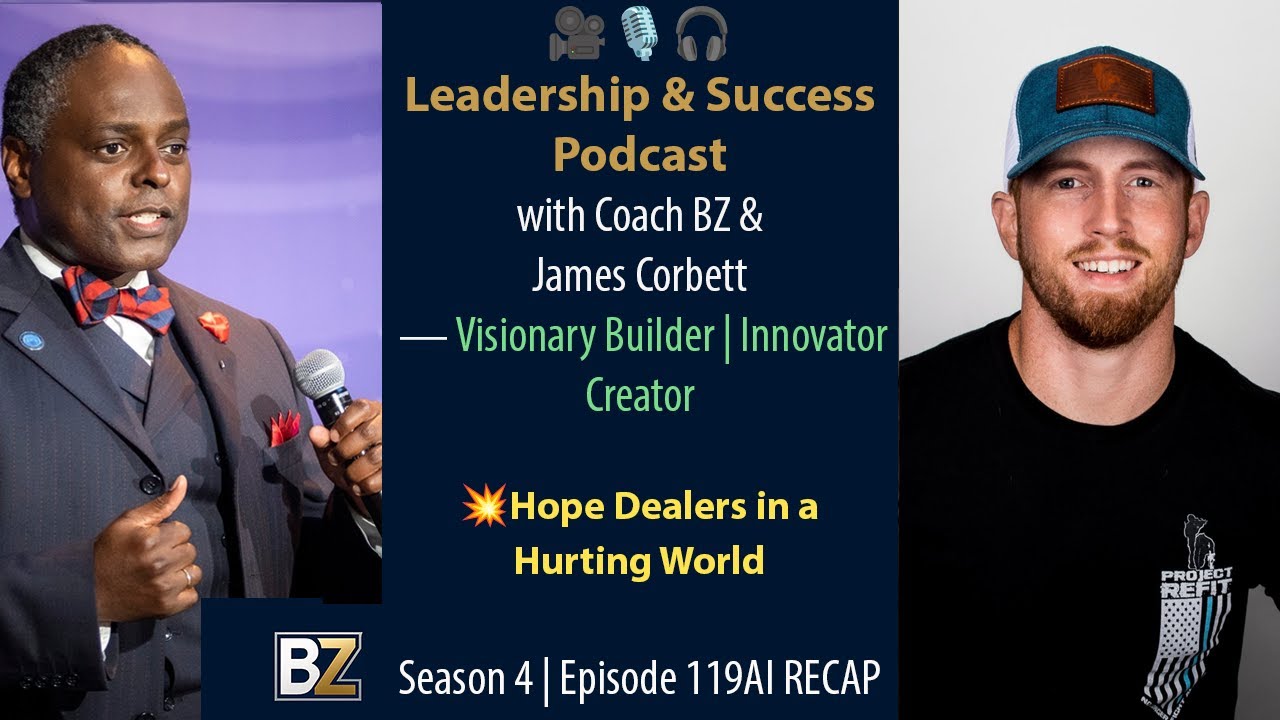
This episode of the Leadership and Success Podcast, hosted by Coach BZ (Bob Fabien Zinga), presents an AI‑generated recap of a conversation with James Corbett, founder of Project Refit. The episode opens with an introduction by John Maxwell and a brief overview of veteran isolation, highlighting the stark drop in military service rates and the mental‑health challenges veterans face. Gray Hall and Daniel Lombard share personal stories that illustrate the trauma of combat and the subsequent feelings of alienation after discharge. Project Refit’s mission—reconnecting veterans through Buddy Checks, online chats, mobile bases, retreats, and community events—is described, emphasizing that the program supplements, not replaces, therapy. Bob Zinga then moves into a gratitude segment, noting that 21 U.S. veterans die by suicide each day and sharing his personal “21‑day grateful challenge.” Two AI‑generated summaries of the hour‑long interview are played, followed by a deep dive into Corbett’s leadership framework: cultivate hope, practice strategic gratitude, speak hard truth, and commit to service—forming a servant‑leadership blueprint. The discussion repeatedly stresses hope as “the ultimate human currency,” gratitude as a “force multiplier,” and truth‑telling as essential for cultural health. A conversational segment between two hosts (H and I) reinforces these themes, debating the balance between optimism and the realities of suffering. The episode concludes with a rapid‑fire lightning round where Corbett shares concise insights—service as the defining word of leadership, coffee as his grounding ritual, Viktor Frankl’s Man’s Search for Meaning as a life‑changing book, and the mantra “keep going.” Bob encourages listeners to follow Corbett on LinkedIn, explore Project Refit, and engage with upcoming guests (Captain Michael Sugrue, Dr. Shawna Springer, etc.). The closing call‑to‑action urges listeners to apply the practical prompts (gratitude questions, service actions) in their own leadership practice.
Chapters
Hi, I'm John Maxwell. When the top companies in the world are looking for trainers, speakers, and coaches, there's one name that stands above the rest, and that's Maxwell Leadership. Our certified team members have gotten proven results for companies all over the globe, and our reputation, I'm proud to say, is second to none. Some of our members have risen to the top of their profession including the one you're going to meet today. I proudly introduce you to my friend Bob Fabien Zinga.
Welcome to the Leadership Success Podcast with your host, Coach BZ, where we help you lead with purpose and succeed with impact. If you're ready to grow into the kind of leader others want to follow, this podcast is for you. If you're determined to elevate your success and leave a lasting legacy, this podcast is for you. As my mentor, Dr. John C. Maxwell, reminds us, everything rises and falls on leadership. Our goal is simple: to inspire you, challenge you, and equip you with insights that can transform the trajectory of your leadership journey. Welcome aboard to another episode of the Leadership and Success Podcast with Coach BZ.
Well, back in the Vietnam War, just about 10% of the generation served in the military. Today, just about 1% serve. When they leave the military, they often feel isolated or different.
In our latest, latest Voices of Veterans, Gray Hall tells us about a South Jersey-based group working to reconnect veterans with their community.
I got blown up twice. I was on fire from the waist down for a minute. I had a dozen or so firefights.
Daniel Lombard didn't realize how much his time didn't realize how much his time in Afghanistan affected him till after he left.
And I guess the weight of everything happened at once, so I started having sleep issues, irritability that was uncontrollable.
Army therapists helped him with the PTSD, but he faced a new challenge leaving the Army.
But when I came home is really where the isolation started. Felt alienated from everybody.
He found James Corbett, a graduate student reaching out to veterans to just let them talk.
For some reason, we're telling a lot of our warriors that they're broken and they're hurt and they're— not capable of going forward and continuing forward, and I didn't like that narrative.
Before long, they founded Project Refit.
Combat isolation, try to build that camaraderie back up.
Project Refit uses numerous ways to connect to past or current service members. Buddy Checks, twice-weekly online chats, a mobile base for relaxing and talking.
Yeah, there's a TV, and they have the seats in here too. We show up directly to We show up directly to homes of veterans. We show up to local community events.
And there are also healing retreats.
And then during these retreats, we have fly fishing, horseback riding, whitewater rafting. We go to the range. And then at night, we have bonfires. We call them our fireside chats.
Bonfires recreate that familiar experience of sharing life stories over a burn pit or 55-gallon drum.
That's where, like, problems get solved. That's where all the intimate conversations happen.
Project Refit leaders say the programs don't replace therapy, therapy, but do offer veterans a community.
It reinvigorated my, my purpose. It makes me feel like I'm— I matter again.
What an important mission. And we can report that this year Project Refit has taken nearly 300 veterans on retreats and is organizing even more events for the year 2025. This also important reminder: to learn more about this group, visit 6abc.com/voicesofveterans. And remember to thank a veteran. For their service.
I love you said, makes me feel like I matter again. And there's no greater debt that we can pay to those gentlemen.
So important.
Thank you so much, Gray.
All right. Welcome to another episode of the Leadership and Success podcast. Today is going to be season 4, episode 119, AI. So this is going to be the artificial intelligence recap of the conversation I had with James Corbett for Season 4, Episode 119. I'm going to be showing you an highlight of that conversation toward the end of the podcast. But first, let's do our moment of gratitude and then I will play two separate AI summary, about 6 minutes each of the hour-long conversation I had with James. All right. So today I am really grateful for really all of the resources that are right now available, right, to service members. I am really grateful for the holidays, and unfortunately, during the holidays is usually when people get depressed and many commit suicide. And part of the reason why I do this moment of gratitude is because about 21 veterans commit suicide every single day. Actually, James Copeland Corbett and Project Refit are the people who brought it to my attention about 4 or 5 years ago. And since then, every single year after Thanksgiving, I start my 21-day grateful challenge. We just completed our 4th annual grateful challenge last month. But it is important to be grateful every day, to have a positive attitude no matter what is going on in the world right now. And again, I'm grateful for GEMS, Project Refit, and all of the organization and resources that are out there to help veterans who do go through a lot to support and defend our Constitution and really defend our freedom. So I'm very, very grateful for that today. All right, so what I will do now is I'm gonna go ahead and start playing the first 5-minute AI recap. And after that, I will play the second one and then I will come back and then we're going to play a short clip from the conversation I had with James. And right after this podcast, I will have another podcast back to back. We're going to have the next one with Captain Michael Sugu. I had interviewed both of them on the same day. We called it our health mental day. And today is going to be the Health Mental Day AI recap.
Here we go.
You know, in a world that feels pretty burnt out and disconnected, what does real leadership actually look like? Well, we're about to dive into a powerful blueprint for leading with hope, and it's one forged from the raw, real-world experience of James Corbett, the founder of Project Refit. So let's break this thing down. It really all starts with this core problem. I mean, this single sentence from James Corbett just cuts right to the heart of a crisis so many of us are feeling. It's not about being physically alone, right? It's that deep, internal feeling of being misunderstood, unseen, unheard. This is the silent battlefield so many people are on. But there is a way to fight back, and Corbett's experiences have shaped this incredibly clear, actionable blueprint for any leader who really wants to make a difference. It's a framework that stands on 3 powerful pillars: you gotta cultivate hope, you have to speak the truth, and you must commit to service. So let's talk about this crisis of disconnection. Look, this isn't just about remote work or scrolling through social media. It's that feeling of having 100 friends online but having absolutely no one to call when you're really, truly struggling. It's a fundamental breakdown in community, and it leaves people, especially our veterans and first responders, incredibly vulnerable. And the stakes, well, they're sobering. This number is not just some statistic on a page. It is a daily tragedy. 21. 21 U.S. veterans take their own lives every single day. This is the reality that fuels James Corbett's entire mission. And it just highlights how urgently we need a new kind of leadership. And here's what's so crucial to understand: what are we truly fighting against? Corbett calls it the "isolation of self." It's that dangerous, internal state of feeling completely alone with your struggles. It's a psychological prison that can exist even when you're in a crowded room. This is the real enemy that leaders have to learn how to fight. Okay, so how do we fight this? Well, it has to start from the inside out. Before a leader can even think about impacting their team, they have to build their own internal world on a solid foundation of two key things: hope and gratitude. Now, this isn't about just, you know, being thankful for stuff. Strategic gratitude is a high-performance tool. It's a daily practice that actually protects a leader's own mental health. And that allows them to lead with total clarity and resilience when things inevitably get tough. And wow, this just shows you exactly how powerful that tool can be. This quote right here, it frames gratitude not as some nice-to-have, but as a literal survival mechanism. It's a mental state that actively fights back against despair. And when you practice it strategically, the benefits are totally tangible. Gratitude isn't just some feeling you keep to yourself. It radiates outward. It builds your resilience. It boosts the morale of the entire team. And it acts like a shield against the burnout that is just crushing so many organizations right now. Alright, the second pillar of a leader's mindset is hope. Corbett describes hope as the ultimate human currency. It's not just a feeling; it's the fuel that allows people to keep moving forward. And leaders, he says, are meant to be carriers and dealers of that hope. See, a leader's hope isn't just for them; it's a resource for their entire team. So, think about it for a second, right now. Who on your team, in your family, In your community, who is running on empty? Who needs to borrow some of your hope just to get through the day? Okay, so you've built that internal foundation. Now what? How does a leader actually create real-world impact? Well, it happens through truth and connection. This metaphor from Corbett is just so incredibly powerful. He's saying that leaders have to be willing to tell the hard truths, to cut people open—not to hurt them, but to heal them. It's about having the courage to finally address the real issues that are holding a person or a whole team back. And that truth? It's delivered through words. That makes your language a critical leadership tool. I mean, the vocabulary you choose actively shapes your culture. The words you use can literally build a team of resilient warriors, or they can unintentionally create a culture of victims. So this is a direct challenge for every single one of us. In any position of influence. Just take a moment and really think about your default language. Are your words consistently building people up, giving life to your mission? Or could they be creating harm without you even realizing it? And that brings us to the final piece of the blueprint: your legacy. Now, this isn't about what you achieve; it's about how you endure. It's about forging lasting strength through all the inevitable hardships of life and leadership. What a brilliant way to frame adversity. Pain is inevitable, right? That's a given. But victimhood? That's a choice. Corbett's whole philosophy is that leaders don't just endure suffering; they transform it. They use that ink to write a story of victory, a story that can then guide others through their own struggles. And he gives us a simple, clear formula for how to do it. When you're facing a crisis, Don't just sit and dwell on it. First, think. Reflect on it. Second, solve. Come up with a real solution. And third, and this is the most important part, act on it. Because reflection without action is just paralysis. You know, ultimately, this entire blueprint points to one single destination: servant leadership. This is a model where your influence doesn't come from a title on a business card; it's earned through service. It's all about shifting your focus from "what can I get" to "how can I help my people win." You know, when Corbett was asked what he would tell his younger self, his answer was just two words: "Keep going." And that might be the most profound lesson of all. The very essence of resilience, of victory, of leadership, is that simple, powerful refusal to quit. Because at the end of the day, leadership isn't a destination you just arrive at. It's a continuous process of showing up, of serving others, and of taking that next step forward. Especially when it's hard. The only real question is, what's your next step gonna be?
I've been thinking a lot about these leadership lessons that emphasize hope as, um, the fuel for transformation. It's like hope dealers in a hurting world, right?
Yeah, absolutely. And it's fascinating how the idea is not to manufacture hope but to let it overflow naturally from our actions.
Exactly. It's all about modeling hope so that your team, your community, actually rises above uncertainty and fear.
Mm-hmm. It really got me thinking, like, when we talk about hope, we're talking about something so fundamental that it can change your whole leadership vibe, right?
Oh, for sure. And alongside hope, there's gratitude. You know, showing genuine gratitude is like a force multiplier. It shields you from burnout and um, really sharpens decision-making.
Yep, right. And the idea that leaders who practice gratitude are able to build resilience even in the harshest of days, that's pretty powerful.
Indeed. It's like, it's like when you're really grateful, every challenge becomes a chance to learn rather than, um, drag you down. Yeah.
And speaking of challenges, the conversation really dug into the point about isolation, not just physical, but that deep-seated isolation of the self.
Right. Isolation can, uh, sneak up on you even when you're surrounded by people. It's the feeling of not being truly understood.
Mm-hmm. Which, in turn, makes it essential for leaders to create spaces where everyone feels seen and valued, correct?
Exactly. When leaders intentionally break down those walls, they nurture community, a powerful antidote to isolation.
Yeah. That ties in so well with resilience, doesn't it? The idea that adversity forges leaders and their ability to bounce back.
Absolutely. Resilience is just— it's like the backbone of effective leadership. It's about facing trials head-on and using them as the ink for your life story.
Right. I love that analogy. Pain and suffering are the ink. It really flips the script on how we normally see hardship.
Exactly. It's a call to not be a victim but to be a victor. Turning every setback into an opportunity to serve and inspire others.
Yeah, I do have a little nudge though. Don't you think sometimes this idea might oversimplify the nuances of suffering? Not every hardship is easily reframed as a lesson.
That's a fair point, and I agree it can be challenging. But the underlying intention is to encourage leaders to actively search for ways to convert pain into growth. Not just to gloss over the struggle.
Good call. And it's also about truth, being brutally honest with yourself and your team. That truth, even when it stings, lays the groundwork for growth.
Exactly. It's like the saying, "If you want to be saved, you need to let yourself be opened up." Honesty in leadership builds trust and integrity. Yes.
And then there's the fascinating aspect of the power of words. We really are, um, what we say. Our language can build or break a culture.
Absolutely. It's like, words are not just communication, they're the very building blocks of identity and community. If you speak hope and truth, you inspire. Right.
You know, this all transitions so nicely into the concept of servant leadership. Leading through serving others rather than commanding authority.
Exactly. When leaders place service over status, they create spaces where every person can thrive. It's about investing in the success of others.
Mm-hmm. And I really admire the candid sharing about failure. Recognizing that failure is a part of the journey, not the end, really demystifies what it means to lead.
Absolutely. Failure is like the fire that refines you. It's raw, it's humbling, and every mistake is a lesson in disguise.
Yeah, but you know what? I do think there's sometimes a line where continually emphasizing failure might risk discouraging risk-taking, don't you think?
That's a valid concern. The idea isn't to glorify failure per se, but to understand that each failure is a stepping stone, a necessary part of the process to truly innovate and lead with heart.
Agreed. And then ultimately, everything circles back to hope. That hope is the currency that fuels all of these other aspects: gratitude, truth, resilience, and even service.
Yes, hope is the magic ingredient that turns a mere process into a movement. When leaders exude hope, they light up the path for everyone around them.
Mm-hmm. It's almost poetic how these elements—hope, gratitude, and truth—interlock to form a blueprint for leadership. Definitely! It's a holistic approach.
It's like each piece supports the others, and together they create an unbreakable foundation for guiding teams through adversity.
Absolutely! And let's not forget the coaching prompts sprinkled throughout these insights. They really push leaders to reflect immediately on what they can do today to strengthen their teams.
Yes, those prompts are brilliant. They're like, "What are you grateful for today?" Or, how can you serve someone better? Tiny, actionable questions that transform theory into practice.
Yeah, which in turn makes this blueprint not just theoretical but super practical for naval officers, tech leaders, and even first responders. Exactly.
It's designed to be universal. Whether you're in the military or navigating corporate challenges, these leadership principles are game changers.
Mm-hmm. I really appreciate this integrated approach. It's a reminder that leadership is about, um, humanity first. It's about being real, vulnerable, and most importantly, hopeful. Totally.
And as one powerful closing thought put it, "Keep going." That simple message is the heartbeat of resilient servant leadership. Right.
"Keep going" encapsulates so much. It's a call to persevere through uncertainty, and continue to serve, grow, and inspire despite setbacks.
Yes, and it reminds all of us that no matter the obstacles, our commitment to hope and service is what makes us leaders who truly change lives.
All right, I want everybody to please follow James Corbett. So he's on LinkedIn, LinkedIn in Jcorbett3507. And I'm also going to share my screen and we're gonna quickly go through his LinkedIn page. Let me try this again. All right, you should now see, uh, my second screen with, uh, James. So as you, you follow him on LinkedIn, he has a lot of business ventures, but The one I highly recommend is Project Refit, and you can click on it and see what they do and maybe support them as well. They really do a lot of work for veterans. And I also encourage you to read the article I wrote about our interview, Hope Dealers in an Hurting World: Leadership Lessons from James Corbett. And toward the end, you are going to have the opportunity to watch the full hour-long conversation I had with James. And then after today, I'm going to include this 10 Minute AI Recap episode as well. So, and I also want to remind everyone right after this podcast, I will have it back to back because we did this during our Leadership and Success podcast mental day. So we had James with Project Refit, but I also talked with Captain Michael Sugrue, US Air Force veteran, and we talked about relentless courage under fire. And so the AI recap for that episode, which was episode 120, is going to be played right after the conclusion of this podcast. And the good news is this coming Friday, I will be talking with Dr. Shawna Springer. She is the co-author of that book, Relentless Courage. So we're gonna going back full circle. And today I am also glad to receive and feature Captain Tess Tracy, US Army. We're gonna be talking about the psychology of command. That's gonna be today at 8:30 AM California time, 11:30 Eastern time. And then tomorrow I will have the pleasure of speaking with Zen Benfield. He's a planetary visionary, servant leader, catalyst, and a conscious integrator. We're gonna be talking about one world conscious leadership. And then this Friday we are going to have a marathon of podcast interviews. The premiere is going to be with the one and only 4-star general Gary M. Brito, US Army retired. He is known as the People's General. So that's gonna be for the premiere of season 5, episode 1, this Friday. And then I will have the pleasure of speaking with Dr. Beth Sandborn about school safety advocacy. And really, she's an RSO and a police officer. We're going to be talking about the missing piece. And on the same day, we're going to be talking with Terry Maxwell, a business architect, growth catalyst, and conscious capitalist. We're going to be talking about conscious capitalism in action. And I believe I will have one more interview Yeah, I already mentioned Dr. Springer about mental warfare and moral courage. And then finally, we will have an interview on Thursday, following Thursday, with Daya Ramesh. She's a cybersecurity leader. We're going to be talking about cybersecurity being existential. So those are the first few interviews we have laid up for season 5. In 2026. So I look forward to it. So I'm now going to play you a short clip from the conversation I had with James Corbett for Season 4, Episode 119. I am really amazed it's already the end of 2025 and 2026 is just around the corner. Please let us know where you are watching us from, what city, what country, and one thing you are grateful for today. And also tag somebody who could benefit from this episode. And I also would like to know the 3 to 5 takeaways you have from this episode. For me, really, the main takeaway is about hope, right? As long as you are alive, there is hope for you. And I like that James Corbett sees himself as a hope dealer, because if you believe that your tomorrow can be better than your today, you have a purpose. And I really love that. And also let us know what insights you will be putting in practice this week, because I believe that leadership is practical. It's not just about theory and head knowledge, but it's really with heart and what you do. That's really what makes all the difference. Alright, here is a clip from the leadership conversation I had with James for Season 4, Episode 119. Alright, so let me ask you this most important question of the podcast. If you could go back and give a piece of advice to your 17-year-old self, right? Standing at the edge of this incredible career you've had so far, what would you say to 17-year-old James? Keep going. Keep going. Wow, that's powerful.
Just keep going. You know, my mom, my mom is the best. She gives tons of great advice actually. She just drops one-liners every 5 years. One is love them where they're at. I use that all the time on the retreats. I talk to guys about that all the time. Which allows you to not be a victim to anything or anyone around you. Love that person where they are. You don't have to, you know, be a part of their life anymore. Let's say you got broken up with, they broke your heart, whatever. Like, love them where they're at. They're over there. You can, you can love them for the rest of your life. Nobody can take that away from you, but you don't have to be around them. Um, so choose love, right? Turn the other cheek. Um, and just keep going. I mean, I was, since I was born, I was actually born fighting for life. That story stays with me. I had an umbilical cord, my feet were black, I was fighting for life. I was supposed to be dead, brain damage, all of it. None of it happened. Hey, a little bit of brain damage, uh, but, um, keep going. Wow. Just keep going. There's no reason to stop fighting, man.
If that's not a message of hope, I don't know what is. Thank you so much. Okay, we are really at the end, so what I like to do is going to be really, really quick, so it's gonna be, um Lightning round, right? Uh, rapid fire, so don't take too long to— got you— to think. But one word that defines great leadership, one word.
Service. Service.
Okay. Morning routine or practice that keeps you grounded? Coffee. Very good. Meandering. One book or quote that changed your life?
Oh, uh, uh, Man's Search for Meaning by Viktor E. Frankl.
Wow, you got to be kidding me. This is at least the 12th time this year alone people are bringing this book. Okay, fantastic. All right, uh, who inspired you most today?
Lisa.
Very good.
She's, uh, she's my soon-to-be— she's my fiancée. Very good.
Uh, what did you want to do when you were a kid?
Entrepreneur. And also I wanted to be— I wanted to be a Navy SEAL, but Entrepreneur.
Yeah, you are an entrepreneur having a huge impact on yourself. So I think you are doing it. What are 3 adjectives describing you as a child?
I was always intentional. I'm a very intentional person. I was always intentional. I mean, I wrote to see how intentional I was since I was 6 years old until 14. I was writing letters to the Navy SEALs like at least 4 times a year. Wow. Yeah. Dude, I was really heartbroken. I'm not kidding. I was very heartbroken. I'm not saying I was going to be a SEAL, by the way. My goodness. But like, I— who knows? I, you know, but that's whatever. I wanted to be in the military. I know that. And my leg just— that, that really messed me up for a long time. So I get emotional.
I can tell you the work you're doing with Project Refit is really having a huge, huge impact across all of the branches. Yeah, I hope so. So that's really powerful. So intentional tomorrow.
Oh, you want me 3 words? I thought it's a 3-word adjective. Uh, intentional. That was 3 words. So anyway, uh, intentional. Um, gosh, focused. I, you know, in a little bit, and very creative.
Okay, what about as an adult?
I— nothing's really changed.
Okay, pretty consistent. Okay, this is the very last question of the show. What is one word that represents our shared experience on this podcast?
Today? Like hours?
Yes, we just spent an hour and a half speaking. What is one word that represents that to you, the experience we've had?
I mean, man, I'm just gonna say hope again. I mean, it's just— let's drive home hope, dude. Let's go.
Yes, I am so, so grateful. Thank you, thanks so much, James.
You gave us an Thank you for tuning in to the Leadership and Success Podcast with your host, Coach BZ. If today's episode added value to your leadership journey, be sure to subscribe, share, and join us again for more wisdom nuggets on how to lead better and achieve greater success. Remember, leadership is the most critical skill of our time. The world will always need leaders to inspire others, drive innovation, and execute execute meaningful strategy. So why not count yourself among the bold leaders shaping the 21st century? Until next time, stay inspired, stay committed, and keep leading with excellence.
More from Bob

S250:E4🎙️LIVE 🇺🇸America 250: President Barack Obama Leadership, Service, and the Power of Hope






S5:E157🎙️ LIVE with CMD CMSgt Dennis L. Fritz, USAF (Ret.)(Multi Tracks Audio)



S5:E156🎙️ LIVE 🇪🇸 Leadership Lessons from the FIFA World Cup 2026 Champions (Multi Tracks Audio)

S250:E3🎙️ LIVE Leadership Lessons from America’s First Documented Family of African Descent 🇺🇸📖