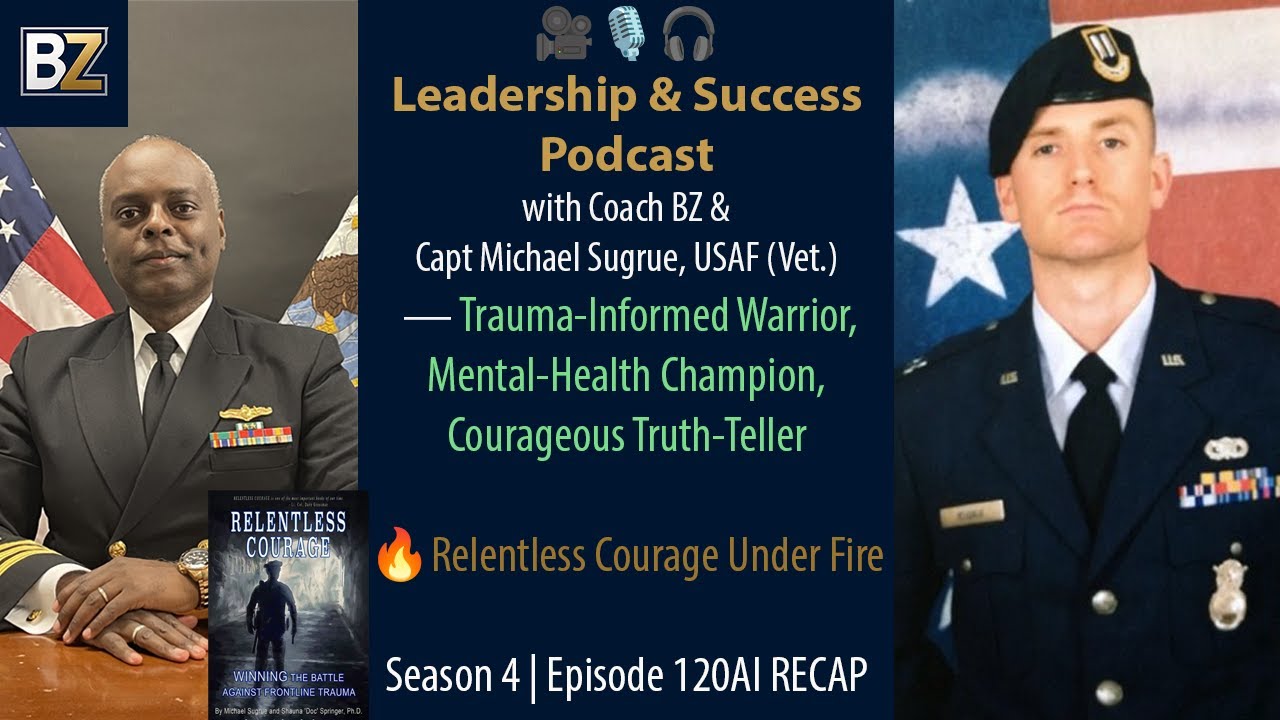
Michael Sugrue, a former Air Force captain and police sergeant, describes the aftermath of a 2012 officer-involved shooting that led to four years of silence and near-suicide. He reframes trauma as a treatable brain injury, not a disorder, and credits asking for help in 2017 with saving his life through fitness, meditation, and peer connection.
Chapters
Hi, I'm John Maxwell. When the top companies in the world are looking for trainers, speakers, and coaches, there's one name that stands above the rest, and that's Maxwell Leadership. Our certified team members have gotten proven results for companies all over the globe, and our reputation, I'm proud to say, is second to none. Some of our members have risen to the top of their profession, including the one you're going to meet today. I proudly introduce you to my friend Bob Fabien Zinga.
Welcome to the Leadership Success Podcast with your host, Coach BZ, where we help you lead with purpose and succeed with impact. If you're ready to grow into the kind of leader others want to follow, this podcast is for you. If you're determined to elevate your success and leave a lasting legacy, this podcast is for you. As my mentor, Dr. John C. Maxwell, reminds us, everything rises and falls on leadership. Our goal is simple: to inspire you, challenge you, and equip you with insights that can transform the trajectory of your leadership journey. Welcome aboard to another episode of the Leadership and Success Podcast with Coach BZ.
He shares how years of traumatic events culminated on one night in an officer-involved shooting that led to him leaving the police force and committing his life to helping first responders who are struggling.
I think there's a misconception where people think, you know, it's this one huge traumatic incident that breaks us or that really hurts us, but in reality, it's a combination of, you know, incidents year over year over year.
Michael Sugru joined the Walnut Creek Police Department immediately after serving as an Air Force officer for 6 years. Shortly after Michael was promoted to sergeant, he was involved in a shooting in December of 2012.
And that really forever changed me.
It changed my path.
He says the toll the shooting took was greater than he ever imagined.
So I suffered in silence for 4 years. Um, after my shooting, I actually ended up on trial in federal court in San Francisco. Even though we save lives, We saved a couple's lives. We saved our own lives. We were sued. Um, during that process, I lost my marriage. My health started to fail. Um, literally everything around me was falling apart. And I got to the point where I didn't want to be here anymore.
His mental health got so bad, Sugru started to put himself in harm's way at work.
I believe that if I died in the line of duty, my daughter would always be taken care of. She would never forget who her dad was. I would be a hero.
Finally, in 2018, he medically retired from the police force and turned to helping other first responders dealing with post-traumatic stress injuries.
The biggest mistake I, I made was that I thought I would protect my family and my loved ones by not bringing work home. But when I come home in a bad mood or pissed off because of these horrible things I had to deal with and I had to see, I need to communicate that to my loved ones to say, look, you know, I had a really bad day. Um, this has nothing to do with you.
He says the support is necessary as law enforcement can be a lonely profession.
You know, we train on firearms, defensive tactics, use of force, laws of arrest, all these different things, but we don't train how to prepare ourselves for our greatest threat. Law enforcement officers are much more likely to die by their own hands than any other cause in the line of duty.
He hopes his story will help destigmatize the hardened culture often shared amongst first responders.
And because of this culture, it's looked at as being weak. It's looked at as being shameful. And many officers, including myself, I was scared to talk about this stuff because I thought I would be outcasted, that nobody would want to work with me, nobody would trust me. Um, but what I found through my work is that so many are suffering in silence. And I tell people all the time, I'm not special, I'm not unique, I'm just willing to talk about it.
And the connections he forms now with the first responders he helps fills the gaps left from his time as a police officer.
And I miss it.
I gotta tell you, I miss it. It was in my heart. It was my everything. And that's what the people need to know, is that we're out there doing it all. We care. We care about you. We care about our families, and we're willing to die for you.
So Michael has written a book alongside a psychologist about his experience. He hopes others will read it and seek help when they need it. Before it gets dire. His book, Relentless Courage: Winning the Battle Against Frontline Trauma, is available throughout many online booksellers.
Hi everyone, thanks so much for joining us for our second episode today. So today is kind of the AI recap of the leadership and podcast mental health day we had with season 4, episode 119 and 120. So right now it's going to be the episode 4, season 4, episode 120 AI recap with Captain Michael Sookoo, US Air Force retired. And again, I want to encourage everybody to purchase a book, Relentless Courage. And the great news is I will be speaking with Michael's co-author this Friday, January 2nd. Dr. Shona Doug Springer. She's trusted, relentless, and perceptive. And we're going to be talking about mental warfare and moral courage. So that's going to be this Friday. So for now, I am going to play a 2-5 minute AI recap from the leadership conversation I had with Michael for season 4, episode 120. So I want to really encourage everyone to follow Michael on LinkedIn, you see his LinkedIn profile down there, linkedin.com/in/SgtMichaelSagroux. And let me share my screen. We need to support Michael and I definitely want all of us to get a copy of Relentless Courage: Winning the Battle Against Frontline Trauma. I also would like for all of you to read the article I wrote about the conversation I had with Michael, Relentless Courage Under Fire: Leadership Lessons from Captain Michael Segrue, U.S. Air Force Vet. And toward the end of the article, I will have a link to the full hour-long podcast we had, and I will also add the 10-minute AI recap, which is this episode right after the show. All right, let's go listen in now to the first 5-minute AI recap from our conversation. Season 4, Episode 120, AI with Sergeant Michael Sugrue.
So today we're going to dive into the life and death lessons on leadership from Captain Michael Sugrue. He's a decorated warrior whose toughest battle, believe it or not, wasn't on the field. It was inside his own head. And his story, well, It gives us a vital new blueprint for how to lead in the incredibly high-stress world we all live in now. Let's just start with this because wow, it's a sobering reality from the captain himself. Really getting this is the critical first step to understanding the challenges of modern leadership because it shines a light on that hidden battle so many people are fighting completely alone. To really understand how a leader can reach a breaking point, you first have to see the fortress they've built around themselves. And for Captain Zagreus, that For Chris was a lifetime of service and tradition, creating this image of a totally unbreakable warrior. I mean, just look at this resume—it reads like something out of a Hollywood movie, right? U.S. Air Force Captain, undercover agent—this is the guy you call when everything goes sideways. His entire identity was built on strength and being in control, no matter what. But you know, his leadership journey actually started with this huge lesson in humility. An early commander basically told him that real leadership doesn't start with barking orders; it starts with listening to the people who are closest to the mission. But that foundation of strength, the one he'd built over decades, was about to be shaken to its absolute core. Because even for the most disciplined, toughest leader out there, a single night can change literally everything. Okay, so December 2012, Captain Segru is involved in a fatal officer-involved shooting. And here's the thing. By every single official measure, his team did everything right. Their actions were justified. They saved lives. But the fallout from that justified act, it would kick off a battle he was not prepared to fight. And the collapse, it wasn't some big sudden explosion. It was a slow, quiet 4-year descent. You can see it right here. The incident, then the lawsuit, then a failing marriage. It was all this slow burn that led to absolute rock bottom in 2017. It's a powerful reminder that trauma, you know, it has its own schedule. This right here, this is the hidden paradox that so many leaders face. On the outside, he was still that decorated, high-performing officer everyone looked up to. But on the inside, the pain was so deep that he actually started hoping he would die in the line of duty. So, how do you come back from that? What brings a person back from the absolute edge? Well, for him, the turning point wasn't some dramatic event but a profound, life-changing shift in a single word. Okay, this is the reframe that changed everything. Captain Suguru is adamant that we have to stop saying "post-traumatic stress disorder" and start saying "post-traumatic stress injury." Why? Because "disorder" makes it sound like you're broken, like it's a permanent flaw. But "injury"—an injury is something that can be treated, something that can heal. You see, this simple change in language is everything. PTSD isn't a character flaw. It's a physical injury to your brain caused by trauma. And just like a broken arm, with the right treatment and rehab, it can actually heal. This whole perspective just removes the stigma and kicks the door wide open for recovery. So, armed with this totally new way of looking at it, in 2017, he did the single hardest thing he's ever done. Harder than anything in the military. Harder than anything in law enforcement. He asked for help. And that one act of courage absolutely saved his life. And asking for help didn't just save him, it completely blew up and then rebuilt his entire definition of what courage and what effective leadership really truly look like. You see, his experience just shattered that old-school model of the stoic, perfect leader. He realized that today's leaders have to be willing to show their humanity, to model what vulnerability looks like, and yeah, even to share their own stories of recovery. That's how you build real trust. The core lesson here is pretty simple. Your team doesn't need a flawless leader. They need a human one. They need to know that the person in charge is authentic, that they're relatable, and that they get the struggle because maybe they've lived it too. And the stakes, well, they couldn't be higher. If the people you lead don't feel like they can trust you with their pain, they will suffer all by themselves. And like we saw at the very beginning of this, That silence? It can be fatal. So, how do you actually create that culture of trust and resilience? It starts by taking these really painful lessons and turning them into practical, actionable habits. Healing isn't some accident. It's a discipline. And this is the exact framework Captain Segru uses to stay resilient: fitness to pull you out of isolation, meditation and gratitude to ground your mind, therapy for totally protected space to talk, and connection with peers who actually get it. He has since taken his own personal battle and turned it into a public mission. By co-authoring "Relentless Courage," he shares his raw, unfiltered story to give other people a roadmap. And this book isn't just a memoir; it's a tool that has literally saved lives. And this brings us to the final, critical lesson that every single one of us can apply. Whether you're leading a company or just looking out for a friend, what do you do when someone says they're fine, but your gut is just screaming that something is wrong? His answer is that real connection is the intervention. Don't just accept "I'm fine." Ask again. And this is crucial: be willing to offer up a piece of your own vulnerability first. That's how you show someone they can trust you. That is how the healing starts. And so we'll leave you with this final thought, a direct call to action straight from Captain Sugru's life-saving work. Just think about your team, your family, your friends. Who in your life needs you to be the one to break the silence and just ask again?
Welcome to the podcast. Today we're diving into some raw, life-changing leadership lessons from Captain Michael Sugrue. His journey, from learning leadership at home to facing the toughest moments in the line of duty, really sets the stage for what relentless courage is all about.
I'm excited to get into this discussion. His story is like, um, so multifaceted. What stands out for you right off the bat?
Right off the bat, it's his early life. Before donning a uniform, he learned the basics from his stepfather, a law enforcement officer he reveres. That early influence, that "my hero," my everything vibe laid the groundwork for a leadership style that mixes humility with strength. It really shows that leadership often begins at home.
Absolutely. It's like, you know, those moments that shape you before you even step onto the field. And then later, his military career in the Air Force and his transition to civilian law enforcement just amplified these lessons.
Exactly. And, um, It's crazy to think how he moved from being an Air Force officer deploying after 9/11 to navigating the tough world of police work, starting from scratch at the academy. It's all about recognizing when to lead and when to follow. Yep, right.
One of the points that really blew me away was his approach to trauma, redefining PTSD as post-traumatic stress injury. That stance, um, really humanizes the experience. And shifts the conversation from weakness to healing. Oh, for sure.
By saying 'injury' instead of 'disorder,' he's reframing the narrative. It's like, um, it's like, you know when you get a physical wound? It needs care, time, and the right treatment to heal. Trauma is no different for the brain. Absolutely spot on.
And that really presses on the idea that leadership isn't just about being tough, It's about self-awareness and vulnerability. Asking for help, for instance, was his toughest move, yet it saved his life.
Right. The courage to seek help. That's monumental. For 4 years, he, uh, kept his pain inside. Then, in 2017, he finally reached a point where asking for help became an act of bravery. Leaders, whether soldiers, police, or corporate heads can learn that real strength isn't just about facing danger. It's about, um, admitting when you're hurting.
Yeah, indeed. I agree. But sometimes I wonder, do you think there's a risk that being too transparent might blur the professional lines in critical situations?
That's a valid point. While vulnerability can foster trust and openness, there's a balance to be struck. Captain Sugrue isn't advocating for oversharing every detail. He's emphasizing that as a leader, showing your imperfections helps build connection and safety. Mm-hmm. What do you think?
I can see that. It's like having a protective shield. You share enough to inspire trust but maintain enough professional distance to keep the team focused. It's a delicate dance.
Exactly. And speaking of balance, Let's talk about his daily healing habits. Fitness, meditation, even consistent therapy. He demonstrates that resilience is built day by day. His no-excuse approach to hitting the gym and taking time to reflect acts as a blueprint for steady recovery.
That's a huge lesson. It reminds us all that leadership isn't an overnight transformation. It's, um, this ongoing commitment to self-care and being there for your team.
Precisely. And then there's his ability to lead with visible humanity. He says if your people have to come to you with their darkest moments, you need to show them you are human, not a flawless superhuman.
Yeah, I get that. That really ties everything together. When leaders reveal their vulnerabilities, they break the stigma that saying "I'm not okay" is a failure. It's actually the pathway to recovery and connection.
Yep, and it's also a call to action for all leaders. Ask your team, check in on them regularly. This isn't just a military lesson. It applies to Silicon Valley executives, first responders, even educators.
And his story takes an even darker turn when he recalls that fatal officer-involved shooting in 2012. That moment, though tragic, served as a pivot towards a new life outlook. How do you see that impacting his legacy?
That incident truly marked his journey. It brought to light how deep the wounds of leadership can be. The aftermath—personal struggles, a crashing marriage, physical and mental health issues—aren't just setbacks but stark reminders that every life in service bears hidden scars, a reality many face.
And by sharing that, he joins a broader conversation about the mental health challenges in high-stress professions. I love how he pairs his personal narrative with scientific insights from Dr. Shawna Springer, creating a compelling roadmap for healing. Right.
That fusion of personal pain and clinical clarity bridges two worlds—experience and science. It dismantles the myth of invulnerability in our protectors and shows that healing is possible with the right support system.
Something else that struck me was his emphasis on trust. Trusting your instincts and sharing your truth. It's a reminder for leaders to be present for each other, to really listen when someone says they're fine. Absolutely.
He challenges everyone to trust their gut, to ask the hard questions, and to create a culture where speaking up is safe. Yep! Because if people can't share their struggles, silence becomes deadly.
And that brings us to one of his most poignant calls. If he could change one thing, it would be the division among people, to replace separation with genuine care and understanding.
Yes, that vision of unity really underscores the broader message of his work. Leadership ultimately is about leaving a legacy of care and connection, a legacy that outlives any title or accolade. It's powerful. Mm-hmm.
Speaking of legacy, his final emphasis on fatherhood really grounds his message. To him, being a loving father, being a source of strength at home, is the pinnacle of leadership. It's as if he's saying, um, never lose sight of what matters most.
Exactly. Leadership is about nurturing and inspiring others, whether in professional settings or at home. And his journey, with all its ups and downs, reminds us that growth often comes through our failures as much as our successes. Yeah, absolutely.
It's refreshing to hear someone so vulnerable and real. But I do wonder, don't you think sometimes the focus on personal healing might inadvertently sideline the operational aspects of leadership? Like, where do we draw the line between personal healing and the demands of the job?
That's a fair critique. However, Captain Sugru's message is exactly that. It's not about sidelining the mission, but enhancing it. When you're in peak mental and physical form, you're better equipped to lead in high-stress scenarios. It's like, um, you need a strong foundation to build a sturdy house.
Mhm, that makes a lot of sense. You can't pour from an empty cup. And his daily habits—fitness, therapy, connection—aren't luxuries but necessities for responsible leadership.
Absolutely. And his call to action is striking. Reflect on your leadership, check in on your team, and most importantly, never shy away from asking for help. Yep, right. It's a radical shift from the traditional view that vulnerability equals weakness.
And I love that final word he chose to sum up the conversation— humanity. It encapsulates everything, from the raw experiences of trauma to the unyielding commitment to connect and heal.
Exactly. And it reminds us that at the core of every leader is a human heart that beats not just for the mission, but also for the people they serve. That's what makes his story so transcendent.
So as we wrap up, what do you think is the biggest takeaway for anyone in a leadership role today?
I'd say it's this: lead with relentless courage and visible humanity. Embrace vulnerability, trust your gut, and make self-care a non-negotiable habit. Only by doing so can you truly support those who depend on you.
Yeah, that's it. It's a compelling challenge to break down the archaic notions of what it means to be a leader and build a culture where every person is safe to share, to heal, and to thrive.
Absolutely. And through Captain Sugru's powerful narrative, we see that leadership is not about perfection, but about the courage to face, learn, and grow from every experience. Mm-hmm. Truly inspiring.
Thanks for this deep dive. It's made me reflect on how I approach leadership in my own way. Here's to leading with humanity every day.
Well, I would ask that anybody who reads or listens to Relentless Courage, I personally want to hear from you. I want you to reach out. I want you to send me a message. If you want to have a phone conversation afterwards and talk about it, But I want to hear how this book, my story, has helped you or has influenced your life. Again, I'm on every social media platform that you can imagine, from Facebook, Instagram, X, Truth, Parler, LinkedIn, Snapchat, TikTok. I mean, you name it, just type in Sergeant Michael Sugrue. Send me a message. I check them every single day. And I promise you I will get back to you.
Wow. Thank you. Thank you. Thank you. Thank you. Okay. Let me ask you this question before we do the final rapid fire. If you could go back and give a piece of advice to your 17-year-old self, right, standing at the edge of this incredible career you've had in the military, the police department, and as a creative, number one bestselling author and Keanu speaker, what would you say to 17-year-old Michael?
I would say always put your family and your loved ones first before any career, before any profession, before any goal or achievement. Truly know who loves you and has your back, and the priority is what's at home, not the job or the career.
Powerful. Okay, to end the show now, it's gonna be rapid fire, so don't take too long to think. But what is one word that defines leadership? Courage. Courage, yes. Morning routine or practice that keeps you grounded? Working out. Okay, a book or a quote that changed your life? Uh, On Combat. On Combat. And this is the one by your mentor right here. Wow, powerful. Okay, who inspired you the most today?
My stepfather, Mike Gormley. Yes, wow, powerful.
And, um, what did you want to be when you were a kid?
What I became. I wanted to be a military officer and then a police officer. Fantastic.
So few people actually do what they wanted to do when they were kids. So, 3 adjectives describing you as a kid.
I would say perfectionist, shy, and driven. As an adult? Now or before my recovery? Let's do now. Now I would say loving, caring, and emotional.
Okay, just a bit before your recovery, what were they? I would say a hard-ass.
I would say motivated and driven. Okay, quite similar.
All right, this is a very, very last question. Actually, before I ask you this one, is there a question I should have asked you that I haven't asked yet? Anything you wanted to talk about that we didn't have a chance to?
I don't think so, but I, I am going to challenge you on this show, and I think that if you were to read or listen to this book, you're probably going to want to do another interview, number one, but number two This book will change your life, and I guarantee it.
Yes. Wow. Powerful, powerful. Okay, this is it, the last question. What is one word that represents our shared experience on this podcast today? One word. Humanity. And for me, I am almost always grateful. Thank you so much for your time. Thank you for being one of our master teachers.
Thank you for tuning in to the Leadership and Success Podcast with your host, Coach BZ. If today's episode added value to your leadership journey, be sure to subscribe, share, and join us again for more wisdom nuggets on how to lead better and achieve greater success. Remember, leadership is the most critical skill of our time. The world will always need leaders to inspire others, drive innovation, and execute meaningful strategy. So why not count yourself among the bold leaders shaping the 21st century. Until next time, stay inspired, stay committed, and keep leading with excellence.
More from Bob

S250:E4🎙️LIVE 🇺🇸America 250: President Barack Obama Leadership, Service, and the Power of Hope






S5:E157🎙️ LIVE with CMD CMSgt Dennis L. Fritz, USAF (Ret.)(Multi Tracks Audio)



S5:E156🎙️ LIVE 🇪🇸 Leadership Lessons from the FIFA World Cup 2026 Champions (Multi Tracks Audio)

S250:E3🎙️ LIVE Leadership Lessons from America’s First Documented Family of African Descent 🇺🇸📖