S5:152🎙️ LIVE with Coach Kevin Wayne Johnson, D.H.L. (Hon.), DoD (GS-15, Ret.) (Multi Tracks Audio)
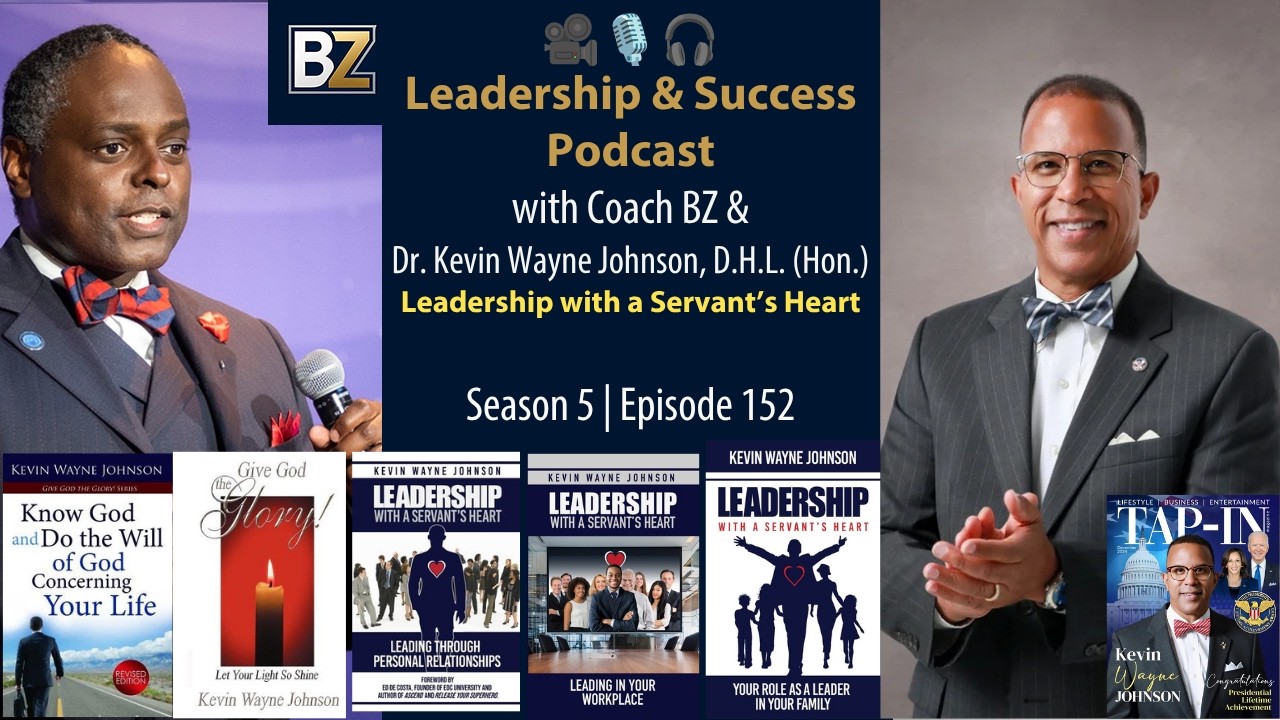
Coach Kevin Wayne Johnson, a retired DoD executive, discusses servant-leadership philosophy and coaching veterans through transitions. The conversation spans Hamburg, South Carolina's rise as an 1821 inland port, its Reconstruction-era Black leaders like Prince Rivers, and the violent backlash of 1876 that erased the town. Johnson emphasizes leadership rooted in service and freedom.
Chapters
Hi, I'm John Maxwell. When the top companies in the world are looking for trainers, speakers, and coaches, there's one name that stands above the rest, and that's Maxwell Leadership. Our certified team members have gotten proven results for companies all over the globe, and our reputation, I'm proud to say, is second to none. Some of our members have risen to the top of their profession, including the one you're going to meet today. I proudly introduce you to my friend Bob Fabien Zinga.
Welcome to the Leadership and Success Podcast with your host, Coach BZ, where we help you lead with purpose and succeed with impact. If you're ready to grow into the kind of leader others want to follow, this podcast is for you. If you're determined to elevate your success and leave a lasting legacy, this podcast is for you. As my mentor, Dr. John C. Maxwell, reminds us, everything rises and falls on leadership. Our goal is simple, to inspire you, challenge you, and equip you with insights that can transform the trajectory of your leadership journey. Welcome aboard to Welcome to another episode of the Leadership and Success Podcast with Coach BZ.
Our fulfillment as leaders is directly tied to how we treat those whom we are entrusted to lead. I'm Kevin Wayne Johnson. I've built this course that comprises of 16 segments from my experience of 34 years as a frontline, mid-level, and senior-level leader with the federal government and private industry, plus 22 years of continuous ministry leadership. This course will help all of us as leaders to to understand the importance of the alignment that is really necessary for our subject matter expertise and our intelligence and our acumen to match what's in our heart. That is how we respect, care, value, and honor people. I would like to extend to you a personal invitation. To come along on the journey on Leadership with a Servant's Heart.
All right. Welcome to another special edition of the Leadership and Success Podcast. We have a very, very special guest today, and I am really overjoyed. I will be introducing him in just a moment. Before I do, As you know, it's our custom here, we are going to have what we call a moment of gratitude. This is where we take a moment every single time we meet just to be grateful. And part of the reason why we do this is because in the military, it's about 21, 22 service members and veterans who commit suicide every single day. And we believe it's not possible to be suicidal and be grateful at the very same time. Same time. So today I do want to remember the life and legacy of Commander Gabriel Edwards. He is the 14th confirmed service member who died throughout the war in Iran, Operation Epic Fury. I believe there might be 2 others, but they haven't been confirmed yet, and I believe it's about 414 people now have been wounded because of that war. So we want to remember them and their family, keep them in our prayer and in our thought because what I celebrate here is really freedom, right? We've been celebrating freedom since June 10th and freedom is not free. Some people have to really pay the extreme ultimate sacrifice, their life, in order to guarantee your freedom and mine, supporting and defending our Constitution. And I just want to be so grateful for that gift. All right, now let me see if I can properly introduce our guest today. I believe that— hold on a second, I— oh, just one moment. I thought I was already all Set up here. Okay. Thank you for joining me today for really what's going to be an inspiring conversation, right, with Dr. Pastor Coach Kevin Wayne Johnson. He's had an extraordinary 34-year career as a senior Department of Defense leader. I believe he was the Chief of Staff for the Department of Defense as a civilian, GS-15, I believe, which is the equivalent, I believe, of a commander or cap— captain in uniform. So really grateful for his service. Now, because in the military, it's not just the people in uniform, it's the civilian, but also the contractor who really help us accomplish our mission. But combined with his work as an executive coach, a pastor, a bestselling author, serial bestselling author, and Maxwell Leadership Certified Coach, Kevin has really equipped thousands of leaders to lead with humility, with character, and with purpose. So ISLAF's mission is simple yet very profound: know better, do better, and lead better. Whether you are a sailor in the military, enlisted, a junior officer, or a cybersecurity executive, I believe that this conversation will change you to rethink what it truly means to lead with a servant's heart. Part of what we're going to be learning today is why servant leadership is a competitive advantage in today's organization, but also actionable strategies every aspiring seasoned leader can apply immediately. So without any further ado, please help me welcome to the Leadership and Success Podcast. We're gonna be talking to Dr. Coach Pastor, one and only Kevin Wayne Johnson.
Hello, hello, hello.
Good morning, Dr. Johnson.
Good morning, sir.
Good morning, thank you so much for having me on. What an introduction, I hope I can live up to it. I think I can.
You absolutely can. I'm really, really glad that you are here. What a privilege to be talking to you today. Maybe to get started, so, and again, thank you for your service. Just like the people in uniform, you've served your country, the Department of Defense, which is the department of war now. So grateful for that. What is one thing you are grateful for today, sir?
I am grateful for the opportunity to experience love, joy, peace, prosperity, and productivity, not just for me, but for all the people that I will have a chance to interact with today. Always grateful and always thankful for that each and every day.
Wow, that is really, really wonderful. One of our Actually, we have a lot of mentors in common, including John C. Maxwell, but Dr. Miles Monroe too. But John Maxwell used to say, "Your attitude will determine your altitude." And I think that is so, so powerful. Is there something about you that's kind of unique, maybe your superpower, something most people may not know when they first meet you?
They probably will know it when they meet me because I just kind of always see the glass as half full, even though at the same time it is half empty. And those are kind of the vibes that I send, but I do I do have an off-resume fact that people wouldn't know unless I told them, and that is because I'm a huge sports fanatic, my family and I, we attend and travel to the host city every 4 years for the Summer Olympic Games. Uh, the Summer Olympic Games is absolutely phenomenal because you have an opportunity to be in the company of millions of people from around the globe that don't look like you, don't speak the same language. But we communicate very, very well. Wow. And we all have a vested interest, and that is to see the best athletes win. That's an off-reserve fact about me that people wouldn't know unless I shared it.
That's really powerful. I guess the World Cup of soccer, which I used to call football, is happening right now. FIFA, are you into football too? Soccer?
Absolutely. Absolutely. I'm yelling at the TV every time.
I guess the, the US team has got much better.
Absolutely.
I've been loving it. That is wonderful. So Dr. Johnston, after more than 3 decades serving in senior leadership role across the Department of Defense, I believe your last job was Chief of Staff, which is a very, very, very big job. So many responsibilities and federal government. What leadership lesson took you the longest to learn?
I would say what took me the longest to learn was understanding the concepts and the dynamics around the fact that the human resource is the most important resource in any organization. Uh, because— excuse me— I used to wonder why some people would respond very well to their leaders and some people would not. And I come to learn over time that it has everything to do with how they're being led. How they're being treated. So that was a very valuable lesson and something that I've taken with me, uh, quite frankly, for all of my life.
Wow, that is really powerful. And, uh, many people do pursue promotion because they want greater authority, but how did your understanding of leadership change as your responsibility increased over time?
So learning the basics, the foundation, and the fundamentals of leadership, which is taking care of the people that are doing the work. So providing resources, sharing information, uh, giving a care that they showed up today, being a good listener, valuing their perspectives and their viewpoints, and showing up as human. And how do we do that? Well, having some compassion and having some empathy around some of the challenges and some of the issues that they're dealing with, because we all have them. Uh, that, that, that has been the difference maker for me. And that's why I spend a lot of time now coaching and mentoring in that place. And in that space, it really helps individuals, it helps teams, and it helps the entire organization to get a different viewpoint. Of how to be productive and how to perform at a very high level.
Wow.
It's really amazing. Even after you worked for the government more than 3 decades, you are now a pastor, you are an executive coach, you have your own business, and then on top of that, you've written, I think, almost a dozen books already. Where do you find time to sleep, sir? Wow.
Well, it's no different than what we all do in life. To be perfectly honest with you, we gravitate toward what we love.
Yes.
And always find time to pay attention to what you love doing. So I love studying the Bible as a pastor. I love speaking, but in terms of motivating, encouraging, and inspiring others. I love to write because it's all about promoting literacy first and foremost. But then at the same time, educating and heightening the level of awareness of my audience on a particular topic. I write, I write nonfiction, so I spend time studying and researching and analyzing and then putting content onto paper. So because I love it and I thoroughly enjoy it, it's therapeutic to me. It doesn't feel like work. It is work, but it doesn't feel like work. And that's how you get it done. There's no, there's no particular time of the day that you dedicate toward it. You just find time as you go throughout your day, and you get it done.
That is really, really amazing. I really love your passion, because you've also said that your mission is to create leaders of excellence at all levels. What separates those leaders who merely manage people from leaders who actually transform lives?
Well, the ones that transform lives recognize first and foremost that there is a difference between leadership and management. There, there is a difference. Those that don't understand that delineation are the ones that struggle a little bit more in terms of getting their people to move from point A to point B. And so again, a lot of the concepts that we're going to talk about And a lot of the concepts that I implement and teach and facilitate are very foundational, very fundamental, and very basic. It's not rocket science. And, uh, that, that's what really opens the eyes of organizations, because it's not that deep. Every person on the planet needs affirmation from time to time. They, they just need to know that they're wanted, they're respected, they're valued, that we care that they showed up. All of us, everybody needs an occasional thank you, well done, I appreciate you. And I'm not talking about every day, and not even every week, but just every now and again, just reminding somebody. Yes, by way of a positive affirmation. Appreciate them for showing up. And it's a big, big difference maker. So that's why I say, you know, basic foundational, fundamental leadership strategy work that team individuals and organizations know about. Then they'll see a difference. There's a difference because again, we're dealing with human behavior and people just need this they need this in their lives.
Wow, that is really powerful. You reminded me of one of my leadership mantras. I think the Navy stole that from, from the Army, but mission first, people, people always. People are really key in leadership. Wow, that is quite amazing. And probably the Department of Defense is one of the most diverse organizations I have ever seen. And like I say, it's not just the uniform personnel, but the civilian and the contractor too. So you've spent, uh, 30-plus years leading civilian, military personnel, and contractor at the same time. What is your principal work across every culture and organizational structure?
Yeah, I love, I love how you asked the question because in all three different areas there are different cultures, and, and, and I take the time to help people to understand that. Now the reason that it was relatively easy for me is because I am the son of a U.S. Marine. Wow. And so when Dad—
thank you for this again—
of course the family, because the entire family— yeah, yeah, absolutely. So of course when you receive orders, the family has to uproot and relocate to that particular area. So, you know, I was born Camp Lejeune— I was born, uh, Quantico, Virginia. Uh, dad was a drill sergeant, Parris Island, South Carolina. And my brother was born Camp Lejeune, North Carolina. And what's interesting is that all of these were military bases, so we understood as children how to live in an environment where there's a diverse group of people. You know, none of us looked alike. Different people kind of come together and, and we make things work. And I was able to take that into the marketplace, into the federal government, and kind of get, uh, indoctrinated with working with military, um, enlisted, junior officer, flag officer, and general officer. Yes, also civilians, and then of course the contractor community. And even though they're different cultures that that are operating, I was able to maneuver and adapt and flex. And each of those areas, of course, contractors show up in the government space. Those are the key personnel and the other employees that are hired by the companies that the federal government contracts with. So the federal government needs different companies, contractors, vendors, uh, to render services and to, to deliver products, and they have that expertise. We hire them, we contract with them, and then they send their personnel into the workspace, and they, they pretty much sit alongside us. And they're pretty easy peasy because for the most part, they keep their head down, they take direction and guidance, and they get it done. That company wants to keep that contract. Military side it's chain of command. So when the colonel tells the lieutenant, this is what we're going to do, it's not up for debate, it's not up for question. You, you execute. That's, that's just the way it operates. And then you have those of us who are civilians. We, we have an opinion about everything, right? Can't we do it a different way? I don't like change. Have you considered this? Nobody asked me, right? And so you're working in all those 3 different cultures, but I would say that my upbringing at home prepared me for that. And quite frankly, that's what made it really, really interesting. Uh, ended up being able to stay 34 years because you're constantly putting a foot into this culture, taking a foot out, and integrating with this person and that person. So it made it pretty interesting and pretty dynamic. So Yeah, that's how I was able to survive and thrive.
Well, thank you for your service. I know for the most part, the civilians, they stay at one location, that's where they live. But military usually have 2 to 5 years billet, depending on what the job is. And one thing I find interesting is many civilians would always say, okay, you can come here, do whatever you want, but we're going to outlast you, right? In a couple of years, you won't be here anymore. So, But just incredible. It looks like we already have someone, let me see, from the live audience. Gabriel Santos, he says, I had the opportunity to spend time with Kevin a few times last year, and his energy, leadership, and perspective had a lasting impact on me. He challenged the way I think and inspired me to grow both personally and professionally. Thank you, Kevin, for your great work. Did you pay him to say that, sir? Did you pay him?
I did not. I did not. Not at all. I did not. I did not cough up $1. No, I did not. But listen, thank you. Thank you so much. I have a, um, I have a saying that I share with a lot of people, and with my hat, my, my hat as a pastor, I do it more frequently in that capacity. And, and it's very simple. It just simply say— says that wherever you go, there you Yes, yes. And what it is, it's a, it's a message for all of us to be consistent. Be consistent in whatever venue you're in, uh, bring high energy, uh, be a good listener, give people eye-to-eye contact, do what you say you're going to do, be where you say you're going to be.
Yes.
Uh, and follow through and follow up, because it's not always what what we say, but it's people who are watching. And, uh, and so many times the non-verbal speaks much louder than what we actually say.
Yes.
And I've done my best to be consistent. So whether I'm having a conversation with neighbors, or if I'm at church, or if I'm with my family, or if I'm at work, or if I'm in my social or civic organization, wherever We are wherever we go, there we are. And it's just a matter of being consistent as you show up.
Wow.
As a way of really showing people the way and giving them some inspiration and motivation to be the best that they can be. So I'm grateful for, for the comment there, and I'm glad I was able to pour into that life, uh, in a manner that turned out to be positive.
Well, thank you so much, Gabriel. And let us know where you are joining us from. I think you came from the US, so what city and state. And if for those watching outside of the US, since we are a global show now, which country as well, because Americans, we are challenged with geography at times. Let us also know what you are grateful for. And if you have a question for Dr. Johnson, type it in the comment and we're going to be answering your question live. Actually, what you just said So it's going to be a good segue to your first series of books. You actually have more than 3 books in the series, but I didn't have the space to put all of your books. There are so many. But we're talking about Leadership with a Servant Heart, right? Leading through personal relationship. And then also your role as a leader in your family. And then the other one I picked up— no, it's not that one. Let me see. Yeah, you have so many, so many books, I can't even find all of them.
Them.
I know I have one more, uh, it was about the work, the workplace. And anyway, so, so, so many books, but I really love those three focus. And when you just answered just now, Dr. Johnston, you did mention family, neighbor relationship, and work. Why did this book series have to be written? What is it about leadership with a servant heart?
I wanted to have a conversation with business leaders, community leaders, faith leaders, book lovers, publishing insiders, and everyone else that's associated with literacy. I wanted to take the term servant leadership to another level. And I wanted to engage in dialogue and discussions around leadership. So I expanded it on purpose. Leadership with a Servant's Heart helps us to really think about and visualize the fact that we have to show up with the intellect and the acumen and the subject matter expertise. That, that's the mind. That's what people expect. That's how we gain credibility as a leader, because we, we know what we're doing. But also a matter of the heart, right? And, and there's an emphasis on the heart, right, cover of each of the book, because it's in the heart where we now show up as human. And see, when you, when you research Barna, when you research Gallup, and when you research Forbes, those are 3 main publications that I researched because they come out every year with a big global report on the workplace and leadership. And when I study it and unpack it and really read through it, I discovered that there's a very wide gap between what people are looking for in their leaders and what leaders are actually delivering. There's a very, very wide gap. So I started the Johnson Leadership Group And I started this book series in 2019, Leadership with a Servant's Heart, to see how we can, um, narrow that wide gap between what people are looking for in their leaders and what leaders are delivering. So by focusing on the heart is helping all of us now to know that we have to show up as human. So you have to respect, you have to value You have to honor people, you have to care, you have to listen, and you even have to demonstrate some empathy and compassion. Now, in some circles, people consider a leader who's compassionate and empathetic as weak. Uh, I don't. You're showing— you're showing your human side, and people like that and they value that. And so that's, that's what the emphasis is. You see, the term servant leadership, uh, was introduced into the marketplace here in the USA back in 1970.
Wow, I didn't know that.
Yeah, and the emphasis was really more along being a servant. But, but how?
We—
there's a lot of talk about the what, but how? And so Leadership with a Servant's Heart now gets into How methodologies, theories, and practices.
Yes.
Beyond just being smart and knowing your subject matter, but also moving to a place and a space where we are always going to be available for people and put them in a position to be the best that they can be.
Wow, that is so powerful. And, uh, why did you choose these three, uh, Yeah, again, I feel like it, it's, it really covers pretty much, uh, everything. But you talk about the workplace, you talk about personal relationship, and then you talk about, uh, family. Why are those three important?
Well, typically when I write my books, I always write them in a series, so there's always going to be a, a different subtitle that's associated with each. And so Leadership with a Servant's Heart, I believe, and I still believe it, back in 2019 starts with how we go about developing, cultivating, maintaining, and sustaining relationships with others, working relationships with others, because that's really how you get things done. A lot of the work that I get, it's through relationships. A lot of the repeat work that, that comes my way is through relationships. People know me, or they know somebody who knows me. And, and the same thing with you, and the same thing with everybody else that's listening. That, that's pretty much how it works. So being a good leader has everything to do with establishing good working relationships with people within your sphere of influence. Then the second book, 2022, now gets into leading in your workplace. Yeah, now that you've developed those good working relationships, let's dive deeper now into some methods that we can implement and we can execute that will take us deeper. And you'll see with each book cover there's an emphasis on the heart, that, that big, that big red heart. And then the, the most recent book was just published last year, 2025, uh, because I always remember this whole journey for me started in the home. So helping everybody to now— what is your role as a leader in your family? It starts when we're young, and it continues on when we, when we ultimately move out and go to college and start our career. And we can now take what we've learned into the marketplace. So what, what is your role as a leader in your family? So I walk, I walk the, the children as well as the adults through what that looks like and what that means on the way to preparing the next generation of leaders. Wow. Each subtitle is, is just a little bit different, but each book is a building block to the previous one.
That is really, really powerful. I really love the emphasis on family, especially for those who work, you know, in high-tech environment, like in the Navy or even high-tech, for example, Silicon Valley. Prior to the pandemic, we used to work like 60, 70 hours a week, like week after week after week, almost hardly spend time at home. And of course, in the military, when you are deployed, it's pretty much 20 hours a day sometimes. But what happened is people kind of forget, yeah, they are great and they lead and they get promoted at their workplace, but their family relationship really suffers from it. So I really love the way you put all of that into perspective. Why is it so important to really continue to nurture your family as you move up the career ladder?
It is such a fertile learning ground for everything. Manners, being courteous, respecting others, being a professional, representing your family, representing your country well, um, discipline, accountability, learning about money. I mean, I could go on and on and on and on. It's a great, um, fertile learning ground right there in the home before we launch out and try life. Because, yeah, because life will slap you around quite a bit. And, um, the more you're prepared, the better you are.
My—
I mentioned earlier, my dad's a U.S. Marine. When I was growing up, he would always say, Kevin, be prepared. Just, just those two words, be prepared. And, you know, I'm the son of a Marine, so my response would be, yes, sir. I didn't, I didn't know what he was talking about as a little boy. He didn't elaborate, he didn't break it down, he didn't unpack it. But I learned a lot later once I entered into my career. I was probably maybe 3 years into my career, uh, 1 year out of college I started my government career, so I was still pretty young. And, um, I learned much later what he was talking about and what he was saying without saying it was that, Kevin, it's always better to be prepared and not have an opportunity than it is to have an opportunity and not be prepared. Yes, that's what he was teaching me. So I learned that, and I now— and now I echo that, uh, with my family and everybody that I'm in contact with as well. So it was a very dynamic lesson, even though I didn't know what he was talking about, but I was scared to tell him I didn't know. Until here we are today. And I've shared this with thousands of people that I've had an opportunity to train and to teach and to coach. So very interesting. And guess what? Started at home.
Yes, yes, yep. Yeah, I remember like when I went through boot camp, I used to say, come to be ready. We say always ready. And yeah, there is really that thing about being prepared. I think Opai is the one who first said Success is when preparation meets opportunity, right? Because if you get an opportunity and you're not prepared for it, then it's too late to get prepared. That opportunity will just pass you by.
Exactly, too late.
Which takes me to the second book, when you talk about shifting to the workplace. Now, I believe you published a book about 4 years ago, I think, and today's organizations are facing, even in the last 4 years, artificial intelligence disruption or hybrid work. Now we add the pandemic of 2020, and burnout and declining trust. Why is servant leadership even more important today than when you first wrote this book, At Work?
Yeah, because I believe that, number one, the only thing constant is change. So things are going to always constantly and consistently change. We're, we're having challenges as Americans under a lot of the current presidential executive orders and other policies that have changed the landscape. We have to rethink, we have to get innovative, we have to be curious, we have to be inquisitive. And then on top of all that, technology is advancing much faster than it did in previous decades. Yes, AI has taken off big time because see It was back in the 1980s where we were introduced to Apple, we were introduced to Microsoft, and we were introduced to Amazon. All of that happened in the 1980s, uh, and, and now these companies are valued at— well, not Microsoft, but Apple and Alphabet and Amazon are valued at over a trillion dollars now. Yes, and that was about, that was about 4 decades ago. Now we're in the AI age and things are moving much more quickly, much more fast, whereas one of the AI companies has already had their initial public offering, their IPO, and, and they generated, if not more than, very close to a trillion dollars.
Yes.
So, you know, here's where we are. So you kind of have to get on board and really understand the rules of engagement and get involved and not get left behind. And, and part of that is the relationships that we've developed through leading with a servant's heart. Excuse me. That's going to help us all to get to that ultimate goal and being the best that we can be.
Wow, that is really insightful. So, so powerful. Because in the third book, you talk about personal relationship. We kind of talked about this a little bit earlier, but how do emotional intelligence, humility, forgiveness, and empathy influence leadership effectiveness today?
Well, you know, that's another great question because anytime you talk about emotional intelligence, the very first of the four areas that we talk about is what? Self-awareness, right? In order to be the best leader that we can be, we have to be comfortable in our own skin. We have to give ourselves a big hug. We have to understand how we communicate how we interact with others, how we solve problems, how we make decisions. So being emotionally intelligent puts us in a position where we understand ourselves that much better, so that we're in a position to be able to lead others. So I always cherish that question when it comes to emotional intelligence, because it starts with us, and You know, you've got to be comfortable in your own skin in order to be effective when it comes to leading others. Wow.
Well, ladies and gentlemen, we are talking about the book series Leadership with a Servant Heart and your family and personal relationship, but also at work. So I think this is probably the one that's probably more impactful to me when you talk about leading through personal relationship, because then you can apply it within any context, whether it's in your neighborhood, your community work, or at home or church or wherever you are. I like what you said, wherever you are, wherever you go, there you are.
Yeah, there you are. Yeah. Wherever you go, there you are. It's simple, but it's profound, right?
Really, really profound. I think a lot of what we talk about in leadership, I think is quite easy. Like you say, it's not rocket science, but Really, the key seems to be in the execution, in practice, isn't it? Actually doing it and not just hearing, right?
Yeah, yeah. And what's key about that, you hit it on the head. It takes time. It takes practice. It takes execution and implementation.
Yes.
Before it can become a habit. But before it, before it can become secondhand nature. And so the more we practice leading from the heart, um, the easier it gets because you, you get acclimated to treating people the way that you would want to be treated. You get accustomed to understanding people's dilemmas and challenges and issues that they come to work with. You know, for, for For those listeners that are still going to an office as opposed to working remotely, um, have you ever taken the time— this is just a question— have you ever taken the time to ask people, how long is your commute to get here? You're going to be pleasantly surprised to hear how many people where it may take 90 minutes or 2 hours one way to get from their house to their job. But because we never asked, we don't know. And but it's, it, it's with the asking and now knowing that leads to understanding.
Wow, powerful.
And when people know that their leader understands them and, and cares about the dilemmas that they're facing, they'll do, they'll do just about anything for for you. They really will. And, and that's, again, that's tied to the human behavior because everybody wants to feel affirmed, and that's just how we're created. It's part of our DNA.
Yes.
And people who don't— with people that don't get it, they feel like they're being taken for granted or that no one really cares that I'm here, and they typically vote with their feet. That, that's my way of saying they leave.
Yes, yes.
They leave the organization. Yeah, absolutely.
Wow, so insightful. So I guess I would consider this one the cornerstone for the series. So either in this book or any book in the series, what was the chapter that was very challenging for you to write? Which one challenged you the most?
Yeah, well, first and foremost, let me say this, um, the foreword. If you recognize and acknowledge that name on the foreword there on the—
yes, cover—
is one of our former and late and great John Maxwell team coaches. Um, Ed DaCosta, when I came through 10 years ago, uh, really, really touched me, uh, as a, as a humble servant, very, very knowledgeable in what he was doing. And I reached out to him and he was gracious enough to write that forward. Uh, I would say in that particular book there, Leading Through Personal Relationships, probably the most touching and the most challenging aspect of that particular book was I shared about my brother and my youngest son. I don't have any sisters, so I have, I have just one brother, and he was born with a mental disability. Ability, uh, about— I was about 3 and a half years old. He was born on the U.S. Marine Corps base, uh, Camp Lejeune, North Carolina. And years later, when I meet a young lady, we begin to date, we fall in love, we get married. Uh, from our union, we have 3 sons, and the youngest son there with the red tie, uh, he was diagnosed at the age of 2 with autism. So having to be instrumental in their lives as a sibling and as a father just reminded me about the importance of relationships and people needing affirmation.
Yes.
And, uh, and so that transcended over into my leadership style in the workplace in terms of how I deal with people people, having conversations with people, checking in, see how they're doing.
Yes.
And but then, but having to write about it can be a little, a little challenging, but at the same time uplifting in terms of helping me to be the person ultimately that I have become. So, wow, it was a combination of Ed writing the foreword and the fact that I'm sharing openly, uh, about how my brother helped me in my leadership style. And my youngest son helped me as well as a sibling, and then again as a father as well.
Wow. Yeah, very touching. Thank you so much for sharing that. And from the entire book series, if there was one and only one lesson that people could get from the entire series, what lesson would that be?
Oh, I loved—
I love the lesson on coaching. I love the lesson on coaching. Here's why. I mentioned earlier that one resume— off-resume fact about me being a sports fan. And my family and I, we go to the Summer Olympic Games every 4 years, right? Started in '96 with Atlanta, and then most recently 2024, we were in Paris. And by the way, we're going to Los Angeles in 2028 for the next games, which is going to be here in the United States, following North America being the host for the 2026 World Cup. So that's powerful. Um, I share that because at the Summer Olympic Games, the top 3 best world-class athletes across 33 different sports representing 115 different nations come together to compete for just 3 medals. They are the best of the best. Archery, table tennis, triathlon, track and field, fencing, um, um, all the aquatics, marathon, yes, weightlifting, volleyball, basketball, baseball, tennis. I could go on and on and on. They all have coaches. They're at the top of their game. And what's interesting in these sporting events is, as a spectator in the arena or in the stadium, you can watch them in between their little breaks interacting with their coaches. And the coaches is— the coach is telling them, you can do this better, you can jump higher, you can run faster, try this. And they're already at the top of their game.
Wow.
Well, let's take it back toward— let's take it back to the workplace and us as leaders and the people that we're leading. We all need a coach.
True.
We need a coach to help us with our blind spots because we don't see each— we don't see ourselves the way others see us. And we need a coach to encourage us, to inspire us, to motivate us, to keep us going Give it a little bit more. You've got what it takes. And what they're doing is they're just really bringing out what's already on the inside. That's what a coach does. A coach is bringing out what's already on the inside through open-ended and thought-provoking questions. That's, that's really the heart and soul of what a coach does. And, and so it is powerful. It is a powerful tool that not enough of us have in our toolboxes. So I always tell teams. And I always tell organizations, you know, I ask the question, have you considered coaching? Because it is incredibly beneficial and I absolutely love it. I happen to be, I happen to be a coach, but I love, but I also love to be coached as well.
Yes.
Yeah, that is really, really powerful. I, I want to talk about, uh, the second series on Give God the Glory. I only put two books here, but I know you've written a lot, a lot more than, uh 2 books. But before I get there, we have a question from the audience. I think it's going to be a good segue. Daniel says, grateful to hear this masterclass in open leadership where transparency is championed for our people. Are there any transition coaching tips you can give to someone breaking into the industry? This is very, very important too for the people in the military who watch the show, because when you transition from being on active duty, back into the civilian world, it can be very, very, very challenging. So what tips do you have, Coach, for transition?
Well, the biggest tip is getting to that place and that space where the person that's being coached can, at some point, articulate, what is it that you want to do, or you think you may want to do in your transition? Because that's very important. Now guess what? If you don't have an answer, that's okay. The coach's job is to help you to get to the answer.
Yeah.
And so that's why the questions have to be open-ended and thought-provoking, because you have to think about what it is that you would like to do in your transition. Now here's a tip that I always share with people, just to consider Just a suggestion. It's not a must-do, it's a suggestion. What is it that you love to do? You love it so much that you would do it without being compensated for it, because more than likely it's a gift. What we'd love to do is actually a gift that we would do without compensation. Now the good news is you will get paid to do it, but you love it so much that you would be willing to do it without getting paid. It's a gift, it comes natural, doesn't necessarily require a lot of work. I always tell people to consider that as a response. Again, it's not a mandate and it's not something that you have to do. But if you're really gifted at doing something and you love doing it, make sure you give that some consideration as a part of your transition. And then the coach is asking those types of questions so we can bring it out of that person, because ultimately it's already on the inside. We just need to bring it out. So that's, that's the tip. That's the tip that I would give.
That is really powerful. I think it's a good segue to the next series of books, right? You started the series "Give God the Glory." Now, like I said, I only show a couple here, "Let Your Light Shine," and then this one, "Know God and Do the Will of God Concerning Your Life," but you have several, I think 5 or 6. You have workbooks as well. Why did you feel the need to write this series about giving God will glory.
Um, remember now, the role of a writer, the role of an author, uh, the role of someone who loves the literary arts is to educate and to heighten the level of awareness. And everybody who knows me knows that I'm not silent about loving the Lord. They— everybody that knows me, right? Um, I am so thankful and I'm so grateful that I understand my purpose. I understand why I'm here. I understand my role, and I'm always actively engaged and actively involved in doing it. And so, yeah, so I, I, books are just another way of sharing the message because one book becomes three So you have your print version, but that also becomes an audiobook.
Yes.
And it also becomes an ebook.
Yes.
Because some people like to download, some people like to just listen, and others like me, we want a book in our hand. We still go to— I still go to the bookstore, right? But it doesn't end there. Here's how you can continue to educate. If you're a non-fiction writer— fiction writers are a little bit different— you can now take that same book and you can convert it to a study guide, and you can convert it to a workbook.
Yes.
And then that book becomes print, ebook, and audio.
Yeah.
So one book can literally become 9 books.
Wow, right?
Because you have your print and you have your audio and you have your ebook, ebook, for— because you're trying to reach a wide group of individuals. So Give God the Glory was really written right out of the gate, uh, as a way to communicate the message of how good God is yes, and the manifold blessings that shower us each and every day, and letting people know. Because everybody doesn't go to church, everybody's not going to read the Bible, everyone's not going to come across the path of a pastor. And I just wanted to do my part. And it ended up— it ended up being an 8-book series.
That's amazing.
It ended up being 8, 8 different books. So if you do the math If you do the math, 8 different books can literally become 24. Yes, because each one can be available as audio, each one can be available print, each one can be available as an ebook.
Yes.
So you and I, yeah, you and I just have to think differently. We have to be innovative and creative, exercise some ingenuity in terms of how we think. And this, this is all part of leadership as well, because we're trying to reach so many different people. And, um, and I'm grateful, I'm grateful for that opportunity, and I had fun writing it. But they're, they're all non-fiction books.
Yeah, I was like, you, you've written so many books. If I put all your books here, it's gonna take more than the space I have available on the screen. I'm like, my goodness. But, but one thing that jumps at, at me though, in Give God the Glory series, it's really about stewardship. Isn't it? You talk about talent. Where does that talent come from? It comes from God. Everybody has a different talent. So how has your faith shaped your understanding of influence?
Well, first and foremost, everything that we do each and every day is based on faith. Yes. You and I exercise faith today. When we showed up, we had faith that everything would work. Work and that we would have a successful show. That's faith.
Yes.
Uh, when we're done and we go to our respective cars, we expect to turn on the ignition, we expect the car to start, and we expect to get to our destination. That's faith. Um, anyone out there listening who may have just recently completed a job interview and you were successful because they called you back and say, yeah, you're a great candidate, we would love to have you, we're going to send you an offer letter, and they sent you an offer letter, and in the letter contains everything that you talked about— the work role, the pay, what you're going to be doing, uh, but, but the offer letter never includes any details about the financial institution that, that organization banks with. But you, you accept the job, uh, but you know, you, you, you don't verify that they have a way of paying you on payday? None of, none of us do.
Why?
Yes, because we're operating by faith. If they, if they offered the job by faith, uh, when we show up, we'll get paid every 2 weeks. So everything, everything we do is a faith walk. It really is. And that's why the scripture reminds us, uh, in the book of 2 Corinthians chapter 5 and verse 7, we walk By faith and not by sight. It's an interesting dynamic that we all operate by each and every day.
That is really, really powerful because the other thing that comes out when we read your book series is it's not just theology or theory, right? You try to make it very, very practical. How can you actually apply it today, right? Because in Let Your Light So Shine, for example, you encourage believers to live their faith publicly. Through service, right? Again, very practical. How can leaders authentically demonstrate their value without appearing performative or self-righteous?
Being authentic and being genuine. Remember what I said earlier, wherever you go, there you are.
Yes.
So it's that, it's that level of consistency that builds the trust and the respect, because neither one are given, but both are earned over time. So when people see us being consistent over time, uh, again, being where we're supposed to be, doing what we say we're going to do, follow up and follow through, we build and earn that trust and respect from other people over time. So just be genuine, just be authentic. If you try to fake it, more than likely people pick up on it because people are really, really good at discernment. But if you show up to be your real self, then they'll know and they'll gravitate towards you because it becomes a magnet and not a repellent. And, uh, and it does matter.
Absolutely powerful. And then I think this book is really, really impactful— Know God and Do the Will of God Concerning Your Life. I think for a lot of people who might be listening right now, right? It's always very challenging to balance your career ambition and then a spiritual purpose as well. How can someone discern whether they are pursuing success or just pursuing their calling?
Yeah, I think it's a matter of, of the heart. Usually your heart will tell you if you are navigating down the right road or not. You, you'll, you'll get that, you'll get that what I call that internal inclination that will let you know, you know, something feels pretty good here, or something doesn't quite feel right. And, um, that'll give you the opportunity now to make the necessary adjustments and revisions, uh, as it relates to the road that you are currently navigating. But that's usually something that's on the inside of everybody. They call it, they call it your gut, right? Yes, yes, you got, you got that feeling like, yeah, I think, I think I'm on the right path. I'm, I'm— it's a little rocky right now, but I'm gonna, I'm gonna keep going forward.
That is really, really powerful. And like you say, everything we do is pretty much based on faith, right? 2 Corinthians 5:7, we walk by faith, not by sight. I guess last question I'm going to ask in this series is, looking back over your own career, right, you've been at the DOD at the highest level you have your own business, a pastor, a teacher, a serial entrepreneur and author. But looking back over everything you have accomplished so far, can you identify a moment or moments where God's direction became clear only after you took that step of faith?
Yeah, right now, right now as we talk, right? So this is my, this is my 8th year in business. I had never dipped my toes in the entrepreneurial Waters before. Didn't, didn't have a coach, didn't have a mentor. I just knew after my federal government career and my last role as a chief of staff, what I saw and how I was observing other people that were being led well and were not being led well is I wanted to make a difference. I wanted to narrow that wide gap between what people are looking for in their leaders and what leaders are delivering. And as I dove in, it was just very, very interesting Very, very fulfilling, very therapeutic. Doors were opened. I mean, we, in 8 years, we have poured into 71 different organizations with countless numbers of people, not just here in the United States, but also in Kenya and in Rwanda, Africa as well.
Wow.
But this year, my friend, this year, uh, because of the current presidential administration and all of the changes, you know, DOJ and executive orders and how the federal government now buys goods and services. It has been a game changer, and we have had to take a look in the mirror and make the necessary modifications and adjustments. And we're doing that right now. We've been doing it for the last several months, but it has been a game changer for not just myself but countless other colleagues in the marketplace as well. But here's, here's the lesson: being adaptive and resilient and flexible, recognizing that change is inevitable, is what's going to keep the doors open and, and continuing to move forward. And so I'll, I'll be talking about 2026 for years to come. Yes, yes, it's a very, very pivotal year because we didn't see this coming. And when I say we, the, the federal government employees who were doged, didn't see this coming, these government shutdowns, um, because there were two. There was the one that broke the record, and then there was the separate one for the Department of Homeland Security that impacted Coast Guard and FEMA and TSA. Yeah, two and two in one year, and we're still kind of playing catch-up and making the necessary adjustments. So it's an ongoing thing, and it has everything to do with the faith walk. Uh, we believe in what we're doing, and we're going to continue to move forward. But you gotta— you have to be flexible. You can't, you can't keep doing the same thing that you've been doing because you get left behind.
I love it. I love it. Yeah, I think this, this verse really crystallized that. We walk by faith, not by sight.
Absolutely.
Before I get to the last segment, we are almost out of time. We have one more question from the audience. And Gabriel say, Coach Kevin, when a mentoring relationship no longer delivers on its commitment and it's time to move on, how do you objectively assess the situation, manage your own emotion to avoid letting disappointment influence your decision, and establish a strong foundation with a new mentor? Huh, good question.
Yeah, so I love the question because you recognize and acknowledge that you need to make that pivot, right? Um, anytime I use the word calibrate, and the other word is— I can't think of it right now— but when you think about what a navigator in a GPS does, reroutes. Every now and again we got to reroute. Yes, we have to change directions and we have to recalibrate. Recognize, acknowledging that the first step. So hand clap there for recognizing that you need to do that. But secondly, just, just remaining professional and diplomatic and tactful in the conversation with the coach and, and let them know, this is where I am and I need to make a change. But you're gonna— again, you're gonna do it in a very professional, diplomatic, and tactful way so that the person understands. That's the key right there, helping them to understand the why behind you, and you should be just fine. I've seen it, I've seen it happen over and over and over again, maintaining a good demeanor, professional demeanor, but at the same time helping them to understand the why, why, why the change, and, and then, and then going ahead and moving forward. Absolutely.
That's powerful. Now for this last segment, rapid fire, I'm going to ask you a question, answer as quickly as you can. The first one is, at least one leadership book everyone should read besides your own. I think you already told me which one you wanted our folks to read.
Yeah, Understanding Your Potential by the late great Pastor Dr. Myles Munroe. I read this book was published way back in 1991. One. You can probably tell, uh, it came in— it came into my hands in 1993, and the timing was perfect. The timing was good. I needed something like that. It was more than just a book on leadership though. It had a lot of spiritual teachings in it as well, which resonated with me. And interestingly enough, I know I'm taking— this is supposed to be rapid fire, I understand.
Yes, it's all right.
Yeah, I'm gonna be— I'm actually going to be at his church next week, uh, business meeting. So I kind of pulled it out and I want to— I'm going to reread it again for the 11th time, uh, for my preparation to be at his church next week for some business meetings. Yep.
That is really amazing. You also recommended this one, Positive Influence. Why should we read that one?
Well, the title speaks volumes, right?
We—
you and I, if we're going to use our influence, let's make a positive impact in the lives of others. Not negative. There's so much negativity already in the world. And let's make the world a better place.
I love it.
Positive influence.
All right. You said this is one of your favorite books of Dr. John C. Maxwell, Developing the Leader Within You. Why should we read this one?
Because you can see there at the very bottom, the Y-O-U is in all caps, right? It's very, very important. That we understand ourselves first before we even try to pour into others. And again, being comfortable in your own skin, giving yourself a— giving yourself a hug, uh, liking yourself, understanding what makes you tick is very important in our leadership journey.
Fantastic. Okay, one leadership myth you wish would disappear forever?
Oh, that's a good one. I can do this all by myself. I don't need a leader.
Yes.
Right.
We say it takes a village. But yeah, yeah, exactly. Okay. What is one daily habit every leader should practice?
Practice being a better listener. We don't get any, we don't get any training in school.
And what is the leadership practice that you will never, never compromise on? You're gonna do it no matter what?
Yeah, I'm gonna treat people the way that I want to be treated. It matters. It really does matter.
I think I know the answer to this one. Uh, who has influenced your leadership more than anyone else? Maybe one or two, two people.
Um, I'm gonna start with Dad as a U.S. Marine, and then I'm going to go ahead and transition over to Maxwell. Because I was, I was reading his books and taking his courses long before I became certified through his company 10 years ago. So, um, Maxwell for sure. And, and, and we can relate because see, he's a pastor too.
Yes. And I think, um, Dr. Miles Monroe, who was a pastor as well, I'm sure has had a huge impact. Oh yeah, on your life. And it's just amazing, Dr. Monroe, he has written so many books, he has so many teaching and training out there that even though he's no longer here He's still mentoring, he's still teaching, and he's still developing the leaders of tomorrow. It's amazing, isn't it?
Yeah, it is. I mean, that voice, that voice still resonates. If you were to watch him and listen to him on YouTube, it's like he's right there.
That's right.
And, you know, he's been gone, he's been gone now for 12 years, but that voice still illuminates in our ears. Absolutely.
So true. Yeah, I used to write for the Forbes Technology Council. They used to say, when you write an article, make sure it's evergreen. We don't You don't want something that is going to be obsolete within a couple of months or a year. It needs to be valuable no matter what. So, and I think that Miles Monroe did that very, very well.
Agreed.
Okay, so complete this sentence. Leadership is—
Influence.
Okay.
Success is—
Subjective.
Subjective. Has your definition of success changed between now and maybe 21 years ago?
No, it's always been the same for me, uh, family first, job second.
Wow, I love that.
Folks on the job didn't appreciate that, but they did. I have 3 sons, so it's important that their father be present in the, in the lives of their 3 sons. So I always put my family above the job.
Yeah.
And servant leadership is recognizing and acknowledging the strengths of others.
What is one question leaders should ask themselves every day?
Am I prepared? Am I prepared to go into this environment and pour into these people so that they can be the best that they can be?
All right. So as we come to a close, sir, and thanks so much for giving us a little bit of extra time, how can we add value back to you?
Well, I would invite all of the listeners— yeah, um, just, just go, go to the website and take a look at who we are and what we do and the clients that we have served. And, and let us know if we can be of service to you individually, your team, your organization. Uh, we're at your disposal, we're at your service, uh, to pour into your organization to help you to to be the best-in-class organization you can be. And everything that you need to know about us is right there on the website. And I look forward to hearing from you.
And of course, don't forget to purchase a copy of his many, many, many, many books. They are available everywhere on Amazon, everywhere books are sold. Well, thank you so much, sir. So before we end, I would like to ask— this is probably one of the most important questions I think looking back over your outstanding career, sir, what advice would you have for your 17-year-old self? What would you say to 17-year-old Kevin Johnson?
I would say one step at a time. Um, develop and prepare yourself for success at the next level before you try to get to the next level. And I think that would be very, very important.
Powerful. And 20 years from now, what do you hope your children, your students, and the leaders you have mentored will say about your legacy?
Hopefully they'll say something very similar to the very first comment that came up earlier in the broadcast, that what they've learned actually works, and it's been very instrumental and very valuable to them as an individual, and then their team and to their organization as well.
Yes, when someone says, thank you, Kevin, for your great work. Thank you, because you lived and you did what you are called to do. That is very, very, very powerful.
Wow.
And so we know how to connect with you and get all of your books, which are available everywhere. So the last question I'm gonna I have for you is, you've spent a lifetime proving that servant leadership is not a weakness, right? It is strength under control. In a culture that often celebrates power, influence, greed, personal achievement, what gives you confidence that humility will always outperform ego over the long run?
I think it has everything to do with the faith walk. In the scripture, we are reminded to humble ourselves. Yes, in the sight of the Lord, for he will lift us up. And so it's not easy. Let's be very, very honest with each other. It's not easy. We typically want to toot our own horn, and guess what? I think it's okay to do that, but to a certain extent. To a certain extent. So remaining humble, uh, not being too boastful, not being too braggadocious goes a very, very long way in helping us to stay focused and to stay on task with what it is we need to get accomplished.
Powerful, powerful. All right, as we end, and then I like to end on a positive note, what is something you are feeling optimistic about these days?
Oh wow, there's so much. Let's see, how can I narrow that down to one? I'm just like, like I said, I think at the very beginning, I'm just excited and always overjoyed at the opportunity to pour into somebody else and make their day that much better. That's an everyday thing for me.
Powerful.
That's powerful.
And I also love what you said about faith. People, even without realizing it, they really truly do live by faith and not by sight. And I think sometimes people, I guess, have negative faith, which is fear, but you may as well believe in something. Positive. So thank you so much, Dr. Reverend Pastor Kevin Wayne Johnson. You've been a great master teacher to my audience today. And the very last question as we close the show, sir, is one word that crystallizes our experience on this podcast today. What word comes to mind?
Exceptional.
Wow.
I am so overjoyed and really, really privileged to have had this talk with you. Thank you, sir, for being our master teacher.
All right, have a wonderful day. Thank you.
All right, everybody, please follow Dr. Johnson. And again, you can find him on LinkedIn, linkedin.com, in Kevin Wayne Johnson. And his website, if you want to hire him as a consultant or a coach, thejohnsonleadershipgroup.com. And of course, today we've talked about some of this book in this series about servant Leadership. They are available everywhere books are sold. And he also has another series about giving God the glory. And please purchase all of, all of those books. So as we end the show today, I like to end with what we call Black History Year. Year, right? That's because during Black History Month, we felt like it was just way, way too short. I feel like we just have too much to say. So two vignettes. One is July 1876. I'm going to play— I have a post about this, but it's about the Hamburg Massacre, what happened in Carolina on the centennial anniversary of our independence. And then I also want to celebrate and honor the legacy of someone who doesn't need any introduction, but Dr. Martin Luther King Jr. He has really changed the face of America and really the world. So I'm going to play two quick clips about those, and you can learn more on the post I wrote about Black History Year on my LinkedIn page. And later today, I am also going to be speaking To the one and only Lisa Davis, from CIO to Boardroom. I believe we're gonna be meeting at 1:00 PM California time, so 3:00 PM on the East Coast today. We're gonna be talking about leading with conviction in the age of artificial intelligence. And she's the best-selling author of this book, The Only Woman in the Room. I think even men should get a copy of this book. So that is coming up in a couple hours. Okay, that's all I have for today. Thank you so much for watching and have a great rest of your day. I hope to see you in a couple of hours with Lisa Davis. It's an old relic from a pastime that no longer exists. Needs to be torn down completely so we can start anew.
The tall statue sitting atop Georgia Avenue recently became the divider dividing color line for many in North Augusta, South Carolina. It honors Thomas Mackey Meriwether, the sole white man killed in South Carolina's bloodiest race riot, the Hamburg Massacre of 1876. While it has been a fixture in the city for more than a century, the argument now is that all men killed, Meriwether and 7 black men, should be honored. But what is Hamburg? Historians will argue those killed for it and the city itself are things you should know.
You have this gap, this period of long period of time for the where the people in South Carolina lived.
For 108 years, a town called Hamburg bordered the Savannah River near Augusta, and back then it was the prime of Edgefield County with steamboats and trains moving the all-time favorite Southern product, cotton. Before Hamburg's story ended, the town built with the help of slaves eventually was run by those same people once held captive. Their leadership reached the South Carolina General Assembly, and by the Reconstruction era, 4 African-American men worked to create Aiken County, an idea conceived from Hamburg's finest.
If you have 3 South Carolina state representatives living in Hamburg, 2 of the founders of Aiken County, Samuel Lee and Prince Rivers, lived in Hamburg. So you had this political concentration of power, state power, in this little town.
But let's go back to the beginning, before African Americans made up Hamburg's leadership and overall population. The year was 1813, and German immigrant Henry Schultz and Lewis Cooper began work to build a toll bridge across the Savannah River connecting Augusta to the South Carolina border.
Mr. Schultz was an entrepreneur, and him being from Europe, he realized that he knew how to build bridges.
Ads went out in the local paper wanted to hire for the ensuing year 40 or 50 good Negro fellows. The labor harvested trees and built the Schultz-Cooper Bridge, a toll bridge at the current location of the 5th Street Bridge.
There was fees for pigs, cows, carts, people. Uh, in 5 years it raised about $85,000.
But the Success was short-lived.
But the bridge got foreclosed on, and out of spite, Henry Schultz decided that he was going to create a town on the South Carolina side of the river, right, right where the, uh, the bridge was. And so in 1821, he created Hamburg.
It's hard to see now, but Hamburg which sat along the Savannah River in parts of Augusta Concrete Block Company and River North Subdivision sprung up overnight with homes filled with white families who ran businesses there too. Now a fierce competitor for Augusta in the marketplace, Hamburg used the inland port to ship cotton, tobacco, and other products to Charleston and European merchants. At the same time, a railroad was created, starting in Charleston and ending right in Hamburg.
People that had cotton coming from South Carolina, they would— could drop their cotton off with the cotton brokers in Hamburg rather than carrying it all the way over to Augusta across the toll bridge. And it became a very lucrative—
town.
For years, Hamburg served as an economic engine hauling cotton and passengers to the longest railroad in America at that time. But in 1851, Schultz died, and by that time Hamburg began to decline, becoming a ghost town. During the Civil War, there was a significant economic downturn despite slaves being sold in the town and a large number of Confederate troops troops quartered there. And after the war, historian Wayne O'Brien says a new Hamburg emerged, with former slaves now self-sufficient enough to run their own city.
So they were able to come back into a town and say, uh, these are shacks, but I can just build them back up because I was building the master's house. You know, whatever it took for, uh, planting crops, we were the ones doing it. And a lot of times they were the ones taking them to market, you know, to trade. So they learned how to barter and all these types of things.
Armed with the right to vote from the 13th Amendment, South Carolina saw its first majority Black state legislature in U.S. history, and with it, prominent men born in slavery running Hamburg. Prince Rivers, a Hamburg judge. Samuel Lee, the first Black speaker of the South Carolina House of Representatives. And John Gardner, the town's mayor. They created a new constitution which integrated schools, but all of that clout came to a screeching halt at the end of Reconstruction, just as America celebrated its centennial. July 4th, 1876, Hamburg's African Americans rejoiced too with a militia marching in town. Two white men demanded they move. And from there, a legal battle turned into hundreds of white men surrounding an old armory looking for Black men to kill.
Grabbed him, put him in a circle, took him over a hill, shot him, grabbed somebody else, took him over a hill, shot him. I mean, the testimony of Harry Mays just blows my mind.
3 U.S. senators made their way to Hamburg to get the facts.
If you want to say that I was a drum major, say that I was a drum major for justice. Those words from Reverend Dr. Martin Luther King Jr. as tomorrow we celebrate the federal holiday in his honor. He was a reverend, a civil rights leader, a husband, and a father. Dr. King would be 97 years old today, and I am joined by Dr. King's son, Martin Luther King III, along with his wife, Arndrea Waters King. Together they lead the Drum Major Institute, an organization founded to carry on Dr. King's legacy. Martin and Andria, thank you so much for joining us today. We absolutely appreciate it. Martin, I have to ask you, when you look at the current state of this country, even the stories you were hearing leading up to this, what do you think that your father would say?
Well, I think, uh, number one, had my father lived, we would be in in a different place than we are in our nation today. But one of the quotes that comes to mind is, "How do we hew out of a mountain of despair a stone of hope?" How do we bring the nation together? We are operating, it feels like, at least from the leadership perspective, not in the most civil fashion. We have lost the decorum of civility. Civility must be brought back to the landscape. It doesn't mean we will agree on every issue. We are not a monolithic group of people. We come from all kinds of different backgrounds. But Dad's message perhaps is even more prevalent today than it was even probably a little bit after his lifetime because of the divisions. And they— we— I mean, we are much better as a nation than the behavior that is being exhibited. And I think that part of our job is to challenge, to challenge us to embrace— it's not just nonviolence. That's a critical part of what we believe. But it really is how do we become the best of the United States of America to provide leadership around the world? We're not exhibiting that at this point at all.
It's so interesting that you started that.
Oh, freedom.
Oh freedom, oh freedom over me.
And before I'll be a slave, I'll be buried in my grave and go Go home to my Lord and be free.
Oh, freedom.
Thank you for tuning in to the Leadership and Success Podcast with your host, Coach Beezy. If today's episode added value to your leadership journey, be sure to subscribe, share, and join us again for more wisdom nuggets on how to lead better. Better and achieve greater success. Remember, leadership is the most critical skill of our time. The world will always need leaders to inspire others, drive innovation, and execute meaningful strategy. So why not count yourself among the bold leaders shaping the 21st century? Until next time, stay inspired, stay committed, and keep leading with excellence.
More from Bob

S250:E4🎙️LIVE 🇺🇸America 250: President Barack Obama Leadership, Service, and the Power of Hope






S5:E157🎙️ LIVE with CMD CMSgt Dennis L. Fritz, USAF (Ret.)(Multi Tracks Audio)



S5:E156🎙️ LIVE 🇪🇸 Leadership Lessons from the FIFA World Cup 2026 Champions (Multi Tracks Audio)

S250:E3🎙️ LIVE Leadership Lessons from America’s First Documented Family of African Descent 🇺🇸📖