S5:48🎙️ LIVE with Amy Leneker (Multi Tracks Audio)
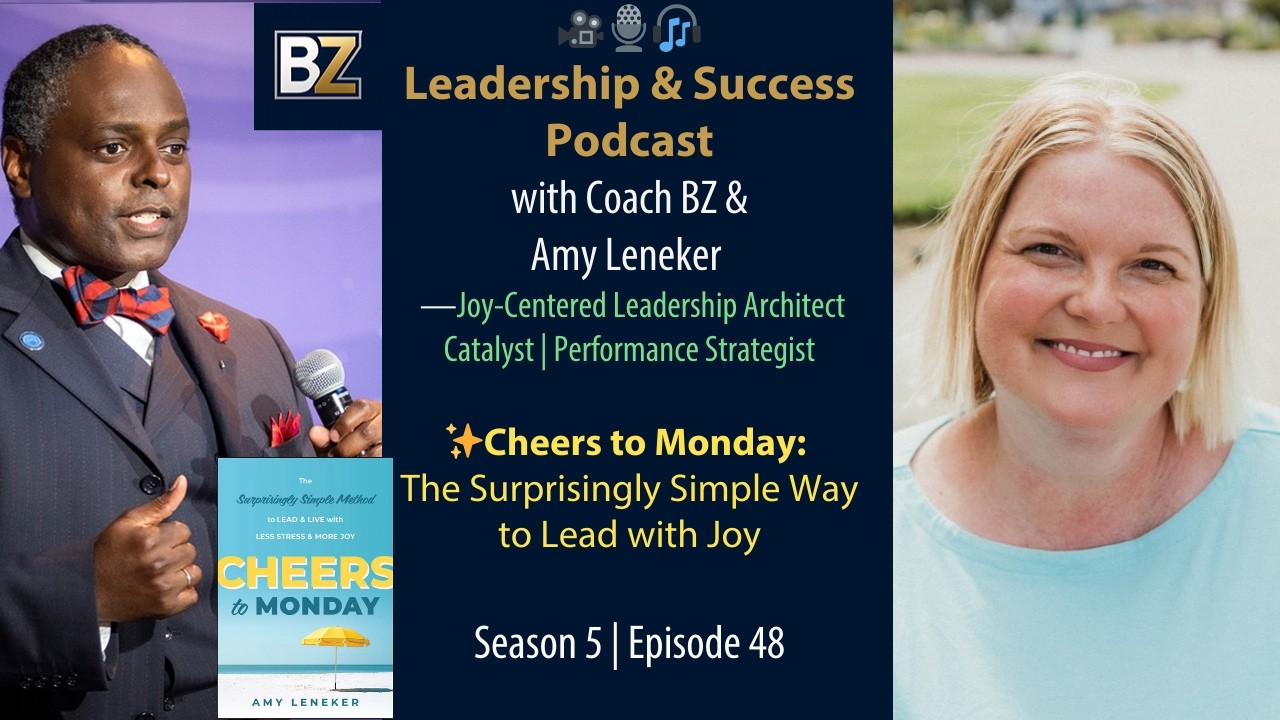
Amy Leniker, founder of the Center for Joyful Work, shares her research showing two-thirds of American workers want to leave because of stress. She describes her "Unstress the Stressing" method and warns against toxic positivity, offering leaders a way to embed joy without losing competitive edge.
Chapters
Hi, I'm John Maxwell. When the top companies in the world are looking for trainers, speakers, and coaches, there's one name that stands above the rest, and that's Maxwell Leadership. Our certified team members have gotten proven results for companies all over the globe, and our reputation, I'm proud to say, is second to none. Some of our members have risen to the top of their profession including the one you're going to meet today. I proudly introduce you to my friend, Bob Fabien Zinga.
Welcome to the Leadership and Success Podcast with your host, Coach BZ, where we help you lead with purpose and succeed with impact. If you're ready to grow into the kind of leader others want to follow, this podcast is for you. If you're determined to elevate your success and leave a lasting legacy, this podcast is for you. As my mentor, Dr. John C. Maxwell, reminds us, everything rises and falls on leadership. Our goal is simple: to inspire you, challenge you, and equip you with insights that can transform the trajectory of your leadership journey. Welcome aboard to another episode of the Leadership and Success Podcast with Coach BZ.
Hey friend, welcome to Less Stress, More Joy with Amy Lineker. I'm Amy, and I'm so glad that you're here. If you've ever woken up on a Monday already exhausted or spent Sunday night bracing yourself for the week ahead, the problem isn't you. The problem is work. And more specifically, the problem is stress. We've been sold a lie, an exhausting, soul-sucking lie that stress is the price of success. But it's not. It's the thief that steals it. There is a better way, a simpler way. And that's what this show is all about. I have made every burnout mistake in the book so you don't have to. And here's what I believe with my whole heart. You were meant for a joy-filled life. And you deserve to lead and live with less stress. In my book, Cheers to Monday, I share a simple 3-step method to break the cycle of overwhelm. And in this podcast, I'm bringing you that same honest, science-backed, laugh-out-loud, so-you-don't-cry energy. Each week, we're going to talk about the real stressors that show up at work, the kind that disguise themselves as drive or resilience. And I'm going to teach you how to see them, Sort them and solve them in a way that actually sets you free. Whether you're just starting your career, climbing the corporate ladder, or trying to remember who you were before stress took over, this show is for you. If you're ready to reclaim your time, energy, and the joy you were meant for, take a deep breath and join me. You can pre-order my new book, Cheers to Monday: The Surprisingly Simple Strategy to Lead and Live with Less Stress and More Joy. Everywhere books are sold. If you've got a question, shoot me an email, amy@amyleniker.com. I read every single message. I would love to hear what you have to say. You can also email a voice memo or a video, and we'll play those on the show. Less stress, more joy, zero toxic positivity. That's the Joyful Rebellion.
Alright everyone, I am so excited today. We have a very special guest waiting in the green room. But before I introduce her, it's our moment of gratitude. As you know, every time we start the show, we want to start by being positive and grateful for something. And part of the reason why we do this is because in the military, about 22 service members and veterans commit suicide every single day. In this country. And I believe it's impossible to be joyful, to be grateful, and be suicidal at the same time. So hopefully the guest we're gonna be speaking to today is going to help us raise our level of joy. So today I am really grateful that I have the opportunity to interview great people like the one you're gonna be listening to, people who really help us increase our level of awareness, be a better leader, and achieve greater level of success. People who have a voice. And I wanna be just, you know, a small part in amplifying their voices so that their message— and they do have a message to the world— so that their message can be heard as much as possible. Especially now, I think we need more positivity than ever before. All right. So let me know in the comment where you are joining us from, what city, what state, if in the US, and if you are international, which country, what are you grateful for? And if you have a question for my guest, please type it in the comment, and we will be answering your question live. All right, let me see if I can properly introduce our guest today. We're gonna be speaking to Amy Leniker. She's the founder and CEO of the Center for Joyful Work, leadership strategist, national workforce researcher, and author of the upcoming Cheers to Monday: The Surprisingly Simple Method to Lead and Live with Less Stress and More Joy. And you can pre-order right now. The release date will be March 2024, 2026. So in a couple of weeks. So Amy has helped over 100,000 leaders and teams, including Fortune 100 organizations, reduce stress and build healthier, higher-performing workplaces. With more than 25 years of leadership experience and advanced study in leadership, neuroscience, and stress resilience, she brings both credibility and heart to the conversation. And in today's high-tech world, especially for people like me who've been in the military or Silicon Valley and high-tech, no, I think it is really important to build resilient organization and this message matters to you. So without any further ado, please help me welcome to the Leadership Success Podcast, Amy Lineker.
Hello.
All right. Good afternoon, Amy. How are you doing today?
Great. It's so good to see you. Thank you for having me.
Such a great honor and privilege to have you here. And to get started, what is one thing you might be grateful for today?
Gosh, one thing today, our son is coming home from college this weekend. So as a mom, there's just nothing better when everybody is under one roof. So that's something I'm grateful for. How about you?
That is so powerful.
Oh, fun.
Yes, perfect timing. Yeah, like I say, today I am really grateful to be speaking to people like you. You have a very important message and I want to try to help amplify that. And I know people who follow me, especially in the military and in high tech, they need to learn how to be more joyful. And I think there is nothing— I know most people say, "Thank God it's Friday," but I want them to say, "Thank God it's Monday." Right? I have the energy, I have a passion, I have a purpose, and I'm ready to go out there and make things happen. So, hopefully, you're gonna help us do that. Let me ask you this. What is something about you that most people may not know when they first meet you?
I think most people probably don't know that I burnt out twice. I think most people see this newer version of me, this more joyful version, um, and many don't know that it wasn't that many years ago where I was just inundated and completely overwhelmed with stress and burnout.
Man, that's, uh, surprising. I guess you, you— what you're going to be teaching us, uh, you really know from experience. It's not just something you, you read in a book or studied at school, and which you I believe you went to Yale, right?
I did the Yale Leadership Women's Program. I did my graduate work at Evergreen State College.
That is really, really remarkable, your experience, your education, and your writing, all of that coming together to really help us be more joyful. I'm really looking forward to that. How would you describe yourself as an optimistic, joy-seeking, recovering workaholic? What does that mean? What, what did you have to recover from?
I had to recover from burnout. So I burned out in a really horrible way. I had finally gotten the job that I had worked my whole career to get, and I was miserable. And I would have kept going. I would have just kept doing what I was doing, but my body actually shut down on me. To where I had to stop working. And I was off of work for several months under the care of my doctor and some really great support systems. So that's what I had to recover from. So for me, part of why I put it in my bio is, well, two things. One, to encourage other people that if you're there, you don't have to stay stuck there. But I also put it there for me. It's a constant reminder that, that I'm only one or two decisions away from going back there, and that I never want to go back there again.
Wow, that's very important. One or two decision away. So basically, we can decide what our near future is going to be like by something we do.
I do believe that, yes. And I look back on how did I burn out as badly as I did, and it was just this compounding of a decision after a decision that just created a snowball that had really horrific consequences.
Hmm. Now I also understand that you are a first-generation college student, so congratulations. We already said, uh, you also went to Yale for your leadership study, which is really, really cool. But, uh, how did that kind of shape your leadership identity?
It's a huge part of who I am. I can count on one hand actually on 3 fingers the number of times that I've seen my dad cry. And my college graduation was one of them. It was a, it was a big deal that I had access to learning in a way that all the generations before me didn't. And it's why I do what I do for a living. I think when we can come together and learn together— oh yeah, there's the photo. Um, I think when we can come together and learn together, I think really amazing things can happen. And so that's how I approach my work is I don't come in with all the answers, but I'm going to come in with a lot of questions and I'm going to come in with a lot of support to help you find what are the answers that you're looking for.
So what was that moment when you realized that stress was not just personal, but really a systemic thing in organization?
For me, I— it was a really awful physical representation of it. So I thought that I was having a heart attack. I had never had one before, but I thought, clearly, this is what it feels like. But when I went to the doctor, he's like, no, this isn't a heart attack. You're having a panic attack. This is a stress-induced panic attack. So that was the marker. That was the, that was the divider. So it was the moment to say, here's everything that happens after this moment. And it was, here's everything that happened before that moment. But it really was as if my life split into a different trajectory when that happened. Because there wasn't an option to do doing before. I had to choose something else.
Wow. And especially for those who are in the military who follow me, we mostly work in very high-stressed, high-tempo environment. Now, I will say that— so you've studied leadership at Yale, neuroleadership and neuroscience at the NeuroLeadership Institute, and stress resilience at Harvard University. So what does the brain actually do under chronic stress?
It's not good. I mean, that's the short story. So under chronic stress, what we know is that it actually has huge cognitive impacts. So we don't think as clearly. We don't listen as clearly. We don't make as good of decisions. I'm a certified mediator. I specialize in workplace conflict. I mediate a lot of really hard conflict. And I see it every day where when people are under stress, they're under that strain. They're just not making as effective decisions as they are otherwise. So one of the most important things we can do is to recognize that, understand that so that we don't stay stuck.
Wow, that is so fascinating. So for the two tribes that, you know, follow me the most, people in the military and in cybersecurity, you know, they both really work in high-stakes environment. How can they regulate stress in real time?
You think there, there are several things you can do. So the most important one is to allow yourself to complete the stress cycle. So where we get in trouble is where we don't do that. So the situations you're describing, military, cybersecurity, where stress just gets stacked on top of stress. So to give ourselves time to complete that stress cycle, whether it's a quick walk or whether it's deep breathing or whatever that is, to reset our brains, to reset our nervous system. And the vast majority of leaders and teams that I work with don't do that. And not because they don't want to, but because their, their schedules are designed in such a way that it's one thing after another, after another.
Wow.
So in your experience, when does pressure become toxic stress?
I love this question because it is one of the biggest misconceptions about stress. And you just nailed it, that, that all types of stress, all types of pressure are not the same. So there's the, there's the good kind that's called eustress. That's going to help you meet a deadline or help you do something you wouldn't normally do. But then there's distress, which actually makes your performance worse. So what I coach leaders to do is how do you recognize when you're feeling eustress versus distress. If we don't understand that, if we don't have a shared language on our team, we end up talking completely past each other. Can I share a quick story about this?
Please.
This just happened really recently. I was talking with an executive who was talking about how stress had gotten him where he was.
Hmm.
I wouldn't have this job if I didn't have stress. Stress is what helps me get up every day and hit it out of the park. What he wasn't understanding is that while that was true for him, the stress that his team was describing, they were talking about distress.
Yes.
So they were completely talking past each other. And it was creating where trust was starting to go down, connection was starting to go down, because they just weren't using the same language.
Wow, that is really insightful. So with the work you do with Fortune 100 company? What do you think leaders unintentionally do that increases stress on their teams?
So much. So much, unfortunately. And here's the part that I find so heartbreaking is that many well-intentioned leaders, Fortune 100, government, nonprofits across the board, many of the things they try to do to make stress better actually make stress worse. So things like when a leader tries to pretend that they're not feeling stress.
Yes.
As humans, we are hardwired for connection. We know if someone isn't telling us the truth. And now my brain is clicked into a threat response and my stress is actually higher. Another thing leaders do all the time is they readjust workload without talking to the people involved.
Yes.
I was working with a team where a direct report of an executive had finally been honest and said, I'm burning out. I might actually already be burnt out. If I'm not, I'm close. I need some help. Wow. So instead of having a conversation, the executive took some things off of her plate. But here's the problem. One of the things he took off just happened to be the project that she cared the most about.
Oh no.
The project that actually brought her joy, the project that made her want to do the other work. So again, these really well-intentioned things that we do that actually create stress going up instead of down.
Wow. So you really have to be emotionally aware. What do you recommend for executives and leaders so they are more aware, not just of themselves, but the members of their team?
Isn't it the key? I think all roads in leadership lead back to self-awareness. And I often find it's one of the most annoying things about leadership, isn't it? Like, gosh, I've got to do more work on me before I can talk about you. But yeah, that's actually how it works. So I think one of the most important things leaders can do is to create enough trust on the team. To create enough psychological safety on the team so that when you ask for feedback, you really get it. Wow! I cannot count the number of times that I go into work with a team and the leader will say, "We're fine. We just want to be a little bit better." Well, then I do a survey, or then I start interviewing the team members, and they're so not fine. So how do we allow there to be enough trust that you don't need someone from the outside? To come in and get the truth, that that truth is something we can talk about each and every day. Wow.
So really what you're referring to is psychological safety. And that's really key if a team is going to be high-performing, isn't it?
It really is. I think Dr. Edmondson nailed it, that if we, if we can't show up and share our thoughts and our ideas and our opinions without the fear of being judged, without the fear of negative consequences, it's just not going to work.
Thank you for mentioning Dr. Amy Edmondson from Harvard University. Hopefully she's gonna be on my show this year, but I am, yeah, I am definitely hoping so because she's really said a lot of things that could really make the life so much, make work fun, right? Make it easier to do good work even when you are under a lot of stress and deadline and things may have to affect the national security of the most powerful country in the world, but you still need to show up in the best way possible. And I think that really makes a difference. So for the two tribes that I really care about, those junior officers in the military or maybe a senior analyst or engineer in Silicon Valley, they all, you know, are kind of getting ready to step into some type of management role. What stress habit do you think they should break right away?
What I would say comes from the data. So I just completed a brand new national research study on the state of stress and joy at work. And the number one stress indicator was overload. It was an overwhelming workload. So if you are on the receiving end of that, to be really thoughtful, really mindful about what is sustainable. And if you're on the management side of that, to make sure that you're helping to co-create workload that is in fact manageable. It was the number one indicator of workplace stress was when there is just too much to do and not enough time. It lines up perfectly with research out of Gallup that shows if you don't have enough time to do your work, you're 70% more likely to burn out. Wow! That's a lot. So I encourage leaders all the time to ask their teams, "Do you have enough time to do your work?" And I don't know about you, but I think about my life in when I was leading. I never had enough time to do it all. So those are the conversations that need to happen.
Wow, that would definitely make a big difference because I think sometimes at work employees don't really think that their leaders truly, truly care about them, like personally. It's like, oh yeah, we have all of this work to do. And I'm kind of like a workhorse. I have to do all of this job. Like even sometimes you come back from a weekend and say, hey, how are you doing? You start telling them how you're doing. Okay, back to work. It's like, you don't even listen to what I told you. And that's definitely something we need to do better as leaders, don't we?
I agree. And we ask a lot. We ask a lot of leaders. We ask a lot of middle managers. I know that so often I go into organizations to help middle managers with stress on their teams when they themselves are feeling stress. So we are asking them to do something for other people that they very rarely are feeling like they've got time to do on their own. So I've got a lot of compassion and a lot of empathy for people who are in management positions and who are in leadership positions because I find the vast majority of them wake up every day wanting to do right by their teams. I mean, you might have a few outliers, but they're the exception. The vast majority really want to do well for their teams.
That's so true. So let's talk a little bit about courage, failure, and pivot points. I know the global pandemic, COVID-19, I guess March 2020 is when it looks like the world stopped for a minute. The pandemic really forced you to pivot yourself, your entire business model. To virtual delivery. What did that season teach you about resilience?
It taught me everything. So I had— going into the pandemic, I had a 5-year vision of wanting to do more virtual work. I'm here in the Pacific Northwest. Our firm was entirely in person. So I had a 5-year plan. Well, that became about a 5-day plan. When the world shut down, we had to figure out how are we going to support people through this. So I think if I had to take away the most important lesson, it was not to wait for perfection. And I know we say it all the time, but it was the first time, I think, in my career that it really hit home, because at that moment of the early pandemic, we didn't have the luxury of waiting. And I think if I, if I didn't have that external pressure, I probably would have stuck more to a 5-year plan of refining and gathering more data and refining. Where this was just, we got to throw it out there and we got to fix it as we go. We're going to keep getting better, but we're not going to wait to provide help and support. We're going to get out there right now and do what we can and figure it out as we go.
Didn't you have fear? Fear of the unknown, fear of it not working out?
And 100%, yes, there's no, there's no question about it. And I felt really fortunate that I am a Dare to Lead facilitator. So I had gone through all the work with Brené Brown to understand the difference about fear versus armor. So when fear came up, and it did every day, multiple times a day, I could just hear Brené's voice in my head saying, that's OK. You can feel afraid and do the courageous thing anyway. So, yes, I did feel it. But I do not think that it— I didn't freeze from it. I was able to actually continue.
That is really, really powerful. If you are willing to share, what was your darkest leadership season?
Oh, the darkest leadership season. I think there were two. So the first one was right after our kids were born.
Wow.
I—
there is no amount of reading, there is no amount of preparation I could have done to try to prepare— there's Miles— to try to prepare to be a new mom. And returning to work. And there, there just isn't anything I could have done. Every day it felt like my heart was leaving my body. It was just— it felt impossible, honestly. I felt like I was giving more than I ever had, but I didn't feel like I was succeeding at work. I didn't feel like I was doing well enough at home. I just spent that season of my life feeling like I was letting everyone down. And now, with, with years of wisdom, I can look back and say, "God, no, the only person you were letting down was you. Your team was in good shape. Your family was in good shape. You were the only one you were letting down." But I couldn't see it. In that moment of being a new mom, I couldn't see it.
Wow.
The, the second darkest time was during burnout. I just completely lost sight of who I was, and I was on this treadmill that I couldn't get off of. And, and that was a really hard, painful season.
So how did you overcome those two seasons, you think? What, what helped you get through it?
What helped me was really having a great doctor, a doctor who said, you are unable to work. And I'll never forget it. So I had gone in that day for— I had had a panic He was like, you need to take a couple days off work. I'm like, I don't need a couple days, I'm fine, I can go back to work tomorrow. Well, I wasn't fine. I ended up being off for months, and then even after those months, I went back part-time before I could really come back full-time. So what helped me was actually having a support system, a care system that allowed me to get well, that allowed me to, to get well before I transitioned fully back into the workplace.
Thank you so much for sharing that. Was there something else that kind of anchored you through that season?
It was really my family. I was not functioning by the time I burned out. I was really sick. And so my husband kept everything going at home. My mom came over every day to help with the kids. It was— I mean, they kept our life going when I wasn't able to. So that was the anchor. And what's ironic is I look back now, and even in that dark season, that horrible, terrifying, painful season, it was really laying the groundwork for this work around joy. I didn't know how to feel joy at that time. It felt too bleak to feel joy. But my dad was the first one to say, "Let's just start with some gratitude. Let's just do a little bit of gratitude." And now I look back and I think, "OK, I see what he was doing there." Because joy and gratitude, you know, they're Velcroed together.. But at the time when joy felt impossible, I could always feel grateful. There was always something I could access to feel grateful for. So that became a really important anchor in the darkest time.
Wow. Talking about joy and being grateful, great time to kind of deep dive into your book. Why did this book have to be written? Cheers to Monday. Is it like kind of cheesy? Cheers to Monday? Who's cheerful going to work on Monday? My goodness. Why did you have to write this book?
Yeah. And I love that that was your reaction to the title because that's exactly the reaction I was looking for. Everybody says TGIF and everybody says Happy Friday. So that really was my intent, was to have a, what did she just say? But I think it has to be written because the way that we're working isn't working. It just isn't. We've been focusing on stress, but we've been focusing on it in the wrong way. We've got to flip the conversation on its head and we've got to start talking about joy. What does joy mean at work? What does it mean outside of work? And how do we let go of this narrative that it's frivolous and that it's just a touchy-feely thing? But it's not. It is a strategic wellness strategy.
Wow. Because I would say for a lot of people, yeah, they have to work, but they don't like what they do. They need to work so they can make money and pay their bills. It's not something joyful. So what you're talking about is very foreign concept for so many people. And also, why Monday? What does Monday symbolize to you?
I very specifically said cheers to Monday because when I'm working with leaders and teams, I ask about how they feel on Monday morning. And I ask about how they feel on Sunday night. Because while you can convince yourself of all sorts of things, your Monday morning mood, your Sunday night mood, it doesn't lie. And I don't know if you've ever been in this position. I have been where you're in a job and it's Sunday evening and you just start to get that pit in your stomach, that like, gosh, am I really going back in there tomorrow? How am I going to get through it? So Cheers to Monday was how do we stop that? How do we create workplaces and organizations where no one is sitting at home on Sunday night with that feeling of dread for the next day.
Wow. So someone listening to us right now, and Cheers to Monday, the surprisingly simple method to lead and live with less stress and more joy. Can you tell us about that surprisingly simple method?
I can. And it is so simple, you're going to be shocked. You're going to say, what did she just say? But it's 3 steps. And in our research, we found 96% of working Americans said, "Yeah, this would help me manage stress." So we're on to something. So 3 steps. Step 1, we've got to see it differently. We have got to take an inventory of everything that's contributing to your stress at work.
Yes.
Then we have to see it through the lens of, is this important to me? Do I have control over it? For every one of your work stressors, we put it through those 2 lenses. Then in step 2, we sort it because there isn't one type of work stress. There are 5. And so we sort it into those 5 categories. We can start to figure out, well, what in the heck are we going to do about it? And that takes us to step 3 because there is an Unstressing Matrix where, however you answer those questions, your stressor lives in one of the 4 quadrants and it gives you your next guiding action to take. So you're no longer stuck. You're no longer overthinking. You've got, here's what I can do right now in this moment to move forward.
Wow. Well, it goes back to your agency because I think people know— you said distress earlier. Sometimes they feel like there is nothing I can do. I am like paralyzed. And what you're telling them is, yes, there is something you definitely can do.
And that's right. You're exactly right. And when we look at the quadrants and we're breaking it into, is this important to me? Do I have control over it? There might be something that you don't have control over. Then what do we do? If it's important to you, but you don't have control, then you've got to ask for help. And if it's not important to you and you don't have control over it, then you accept it and you move on. So wherever it is, there's something for us to do.
Wow. And asking for help, I really love that, especially for the men I know, especially in the military. Sometimes we just don't want to ask for help. I think that's probably And that's one of the reasons too, I think we have more people, I believe, who have a lot of emotional sickness and nobody knows about it because they simply would not ask for help. So what can you tell somebody who's listening right now? They know they are in danger. They are stressed. They might be close to burning out and they really need to speak up and ask for help. What would you tell them?
I would say that asking for help is brave.
Yes.
And accepting it is even braver.
Wow.
And there is research out of Harvard that shows how much we underestimate other people's desire to help us. And so often when I'm working with the leader who has a hard time asking for help, 9 times out of 10, they're the leader that's the first to help. So we do for others what we don't often take for ourselves. And so I think just really coming back to asking for help is brave, accepting it is braver, and writing a new story around what it means to ask for help and modeling what it means to ask for help.
Powerful, man. It's so simple but so powerful when put into practice. Now, when I think about joy, one of the ways I get joy in my life is through music. I've been playing the piano since I was 7 years old. But is joy like a feeling, or is it a leadership discipline?
I think it's a little bit of both. So when we think about what does the science say about joy, it is an emotional state. And what I found, if we look at joy at work, it's made up of 3 different components. So the first one is when there's meaning and purpose in what you do. The second is mattering in your relationships. And third is when there's momentum and forward movement. So for you, when you're outside of work, that moment of joy, that levity, that feeling of wellness, absolutely, it can come from music or conversation, or it can come from a million different things. What I hope people take away from the research is how much stress gets in the way of that. It doesn't mean that joy is gone. It doesn't mean— so, for example, if you're feeling high amounts of stress and you hear music, you're still hearing the same music. But when your stress levels are so high, are you able to tap into that joy in the same way? So that's how stress and joy work so closely together. Together.
And thank you for mentioning your research. Is there anything in your research that kind of shocked you?
Oh, everything. I guess not everything, but many things. So here's just a few of them. So what I found is that two-thirds of working Americans say that they are considering leaving their career because of work stress. That is huge. That is a big deal. And over half say that I am either not managing people or I'm not willing to take a promotion because of work stress. So this idea, when we think about is stress a problem for today, I think it's the wrong question. The question is, how is stress a problem for tomorrow? Because if we don't get this right, what my research shows is we are setting ourselves up for a leadership pipeline that is not prepared to lead in the future. Because you've got people opting out saying, no, thank you. I don't want to manage people. It's not worth the stress, or I don't want to get promoted. It's not worth the stress. Wow. The sheer numbers of that were shocking to me.
Well, I must say, in Silicon Valley, we used to go, I don't know, 50, 60, 70, sometimes even 80 hours a week before the pandemic. But when the pandemic came, we were forced to slow down. And I really liked that. I felt like it was healthy. However, now it seems like we're going back to our old ways. So what would you say to leaders? Okay, let me ask you the question this way. If they preorder your book today, it comes in a couple of weeks, what is one chapter that they absolutely have to read or one principle they need to put into practice, you think? What is that one thing they need to get out of it?
Ironically, I would start with the appendix because in the appendix is the unstressing So those 3 steps that I just walked you through, they're in the appendix and I put them there on purpose. Of course, they're, they're threaded through the whole book, but they're in the appendix. My hope is that people are sharing those with their teams. They're sharing them with their families. They're actually using that process as a way to say, let's try something different. Yes, we don't have to wait. We don't have to wait until next quarter. We don't have to wait until the next calendar year. Any moment is a moment where we can choose something different. When it comes to stress and joy at work.
Now, one thing I am going to ask, originally when I was promoting this show, I put you as an instant bestseller because I really believe in your message and I think people need to buy the book. Because people don't— you don't get bestseller status by being an excellent writer, although writing is good, but it's by selling. You have to sell, sell, sell. People have to buy everywhere, Amazon, Barnes Noble. Those watching, I want you to go right now after the show, Actually, even while you are listening to us right now, go to Amazon, go to barnesandnoble.com and purchase the book right now. I think this is important. However, as an author, beyond best-selling status, what do you really want to come out of this book? What does success really mean to you beyond just being a bestseller author?
Yeah, thank you for asking that because what's most important to me is to drive different conversations about stress and joy. And I think it's It's, for me, my heart is not just about the workplace, though of course, that's incredibly important to me. What's most important to me is that we get it right during the day so that we go home at the end of our workday, back into our families, back into our communities, being the very best version of us. So that's what's important to me is, can we drive conversations in a new way so that no one goes through the hell that I went through of burning out? There just isn't a reason. We don't have to do it. You don't have to do what I did. So let's figure out a way to prevent that.
Wow. That is quite, quite powerful. So looks like we have about 20 minutes left. So what I'm going to do, I'm going to move over to the last segment of the show. That's where I try to get into your head to find out which leadership principles have helped you achieve so much success. Have you you've had and how you are able to help so many people. Maybe one of the questions I would ask is, um, what do you believe is the greatest lesson you have ever learned in life, in leadership, in general?
I think about one— can I break the rules and give you two? So I think about my parents. So I think about my dad, who always instilled in me to tell the truth, to be honest, that your word is all you have. And I have never forgotten that. And in fact, when I— many years later, when I took my first job at the legislature, our, our staff director said, if you lose credibility, you're dead to me, you'll be of no use. And it was really what my dad had said all those years before, that your word is all you have, that that is who you are.
Gotta.
And I couple that with my mom, who always talked about kindness. Yes, genuine, authentic kindness. And very different than being nice. It wasn't about people pleasing or saying what you thought other people wanted to hear. But it was about moving through the world from a place of genuine kindness. And so those two things have really— they've been the cornerstone for how I lead, but they're also the cornerstone for how I live and how I parent.
Wow, that is powerful. And what do you believe is the secret to your success in education? Went to Yale, to Harvard. You have written a book that's about to be published and your own business is flourishing. Why do you think you are so successful?
Gosh, it's such a funny question to think about. I would say, I think it's a few things. I think my work ethic is to— I've got to be careful because this is where our greatest strengths can become our greatest weaknesses. Because it was also my work ethic that drove me to burnout. So I'm always very mindful that, that any of our strengths can become a weakness at the same time. And I think the other piece is just about what I feel driven by. So I am very clear on what it is I'm trying to do and why I'm trying to do it. And so I just keep thinking, if I can do the next right thing and the next right thing, then hopefully I can look back at the end of my life and feel really proud. I think about 80-year-old me a lot. I think about when I'm 80, I just want to look back and say, God, girl, nice. You know, I just want to look back and be proud of that. So that's a motivator for me.
I've really never heard anybody else say that. I think I was about, I don't know, 15, 16 years old. That's when I made up my mind. I want to live my life in such a way I don't have any regret. So when I am, you said 80, I was thinking maybe 90 or 100 years old. Hopefully I can look back in my life and I want to say, I am so glad I made the decision that I made. No regret. Wow. That is powerful. I've never heard anybody else say that out loud. Okay. What are you learning now? I know leaders are learners. What kind of things are you learning these days?
I love learning. So I'm learning every day. I learn something new every day. I think the biggest learning for me is that I have been up to my eyeballs in the data of this National Workforce Study. So spending a lot of time figuring out what it means by generation, because stress and joy are not being experienced the same based on generations, what it means based on our roles at work. And so really trying to understand how can we package that into insights that people can use right away. So just one really quick takeaway. So what, what I found is that Gen Z right now, they're, they're facing a double whammy because they feel more stress than any other generation. And they feel it more negatively than any other generation. So it's this double impact that we have to understand at work. We've got to figure out why is that and get curious about that instead of making assumptions or stereotyping, because if not, then we're losing a huge opportunity to bring Gen Z's creativity and innovativeness into the workplace.
Yeah, I guess I am a Gen X. I think every generation always feels more stressed than the generation before. So that's, that's not new, but negative, that kind of surprises me because my daughter, she just graduated from college last year. Now she's working. Congratulations. Well, she's working 2 or 3 jobs and she can't find one full-time job that's going to give her benefits and everything else. So she doesn't like that too much, but she doesn't mind. But it's definitely a lot more difficult for them. For example, I was able to buy a home here in Silicon Valley. There is no way she's going to be able to buy a home in the next half years. That's just not even possible. So I see that negativity that you are talking about. I guess for those listening to us now, talking about college debt and having to work 5, 6, 7 jobs and all of that. What can Gen Z do to better handle the stress and maybe have a more positive attitude, do you think?
I think what they can do in part is to understand what's driving it. So to even just to recognize that, yes, this is an experience that others in this same generation are having that I am, and then to figure out what can I do differently. So if you can't control the amount of stress, and many times we can't, Many times at work, you can't control the amount of stress that's coming at you. But you do have some autonomy. You do have some agency over that second part of the equation, which is how negatively is this impacting you? So there's a place where I would encourage Gen Z to make sure that they are leveraging their networks, understanding what the impact is on them. So that way, regardless of how much is coming at you, you've got a different way of handling it without feeling that huge amount of negative force that we're seeing.
That is very great advice. So for those listening, I think this is worth the price of admittance right there. If you just get this one wisdom nugget, it could potentially change your life. Wow. So it's really about the mindset too, isn't it? The way we look and interpret what happened to us.
It is. I think there's no question. I think mindset matters so much. And And what I worry about is I think sometimes we weaponize mindset if we're not careful. And I see it a lot with toxic positivity or with forced joy, where people will say, choose joy or good vibes only. But that actually doesn't work. And what we know from our data is that it's exhausting and it increases stress. It decreases joy. So when you try to force someone to be positive, you're actually causing more stress to their So to be able to have agency over our mindset, but to never weaponize it, to never go this step further to now we're forcing someone into something else.
So how should leaders better handle that?
I think it's about being honest. So forced positivity is not authentic. It's not real. It's not true. And so to decide, we're not going to do that anymore. And I think the best way to do it is through the Stockdale Paradox, this idea. And I know you know who that is, but for anyone listening who doesn't, Admiral Jim Stockdale was a prisoner of war and survived unimaginable— it's almost 7 years of completely unimaginable conditions. And when he was asked, how did you do it? How in the world did you survive when so many people didn't? And he talked about this ability to hold these— do this duality of Things are awful. Things are horrible. But he never lost sight of that things would get better, that there was hope. And so to do both of those things at the same time, I think, is how we get through it. And I see a lot of leaders tip one way or the other. They are kind of toxic positivity. They're all gloom and doom. Neither of those work. It's doing what Admiral Stockdale said. We've got to hold this duality together. And then with that honesty, we can move, move forward together.
So powerful. Even with mental health, that's so important because I think for some people, they are so much aware of what's negative and what's going to get worse, and then it's kind of spiral down and it never stops.
Yes.
And wow. Okay. That— okay. I guess I lied earlier. This year, what you just said, that's the price of admission to this podcast. I mean, if you just get it, I mean, your life would literally change. That's why I really love having this conversation because you get to have what I call the nugget that could literally potentially change the life of someone. So thank you so much for being such a great messenger. All right. Now I do love to talk about success, but I also like to mention failure because I love this coin my skipper gave me. One side it says success, the other side it says failure, meaning that success and failure are two sides of the same exact coin. So let me ask you, if you're willing to speak about it, how has failure shaped your life?
It shaped it a lot. I think that especially early on in my career, I was so afraid to fail. The stakes felt really high for me. I, I grew up in a house with a lot of love. There was no question how loved I was, but there was never enough money. There was no question that there was never enough money. And so for For me, I was really afraid to fail because the stakes felt high. And looking back now, I think, well, you probably had a little more give than you thought. You probably could have failed a little more and been okay. So I think what it's taught me now is that— and this is also from Dr. Edmondson's work— is that there are ways to fail that actually move you forward. It's not a deal breaker. It's not a sign of weakness. It doesn't mean something's over. It means that there's something to learn from and there's something to shift. And I do wish I could have learned that 30 years ago. I'm grateful to have learned it now, but boy, I wish the 30-year-ago version of me would have known this.
Sometimes I wonder if I wish I had known what I know now back then. It would have made a big, big difference.
Exactly.
So if you could choose 3 people to have dinner with, they could be alive, dead, or even fictitious character. Who would you choose and why?
Oh my gosh, without a doubt, I would choose my grandpa. He had an entrepreneurial spirit and just spent his whole life working to build a business that would thrive and that would outlast him. It was really about a legacy. And so I would just love to be able to sit with him and share the legacy that I'm trying to build in real time. I think he would be really proud.
That's awesome. Who else?
Gosh, who else? I always think of family. I mean, I know there's so many historical figures I would want to meet too, but the first ones that come to mind are— we've lost some people really close to us in the last years, and so just that overwhelming desire to have more time, like just to, to go back and, and not even do anything extraordinary, not even to do anything unusual, but like you're saying, just a simple meal would feel like a gift beyond anything I could imagine.
Wow, that is powerful. Yeah, and for those listening, you still have your family members and friends, make sure to cherish them because tomorrow is promised to no one. But, um, thank you for sharing that. Is there maybe a book outside of the one, uh, that everybody's gonna preorder today, is there a book you would recommend to the members of my audience?
Oh my gosh, there's so many. I read all the time. So a few, uh, that stand out to me, I just read Jen Fisher's book on hope. So Jen Fisher, the former wellness officer at Deloitte, wrote a book about hope is the new strategy. Beautifully written. She actually outlines— what's so different, I think, about Jen's book is there are books about hope, but she actually gives tools. She actually says, here's how we can build hope in organizations, which I think is extraordinary. I also think Hype Women. I know that may not have been one of the, one of the ones you thought I would say, but Erin Gallagher, wrote a brilliant book earlier or late last year about why we so often compete with each other when in reality we're not in competition, that we're actually stronger together. And I think her message of Hype Women is timely and beautifully done.
Wow, powerful. Thank you for sharing that. And just so that you know, so I have a digital bookshelf and I'm going to be adding those two books as well. Your book already there. So, uh, and I think we started this last year, uh, I think it was May or June. We have more than 300 books now, so that's, that's really, really awesome. Uh, it looks like I have someone. Okay, we have, um, Daniel Young, uh, from Midland, Florida, saying hi. So Daniel, let me know if you have a question for Amy. Uh, and one reason why I love interacting with, with people is when I first did this 5 years ago, I was talking to myself. There was nobody listening. Anywhere. So it's really fun to have that interaction. So if I ask you, is there maybe a song or a book or a movie that you would choose as your life's theme or anthem?
Oh my gosh, as my life's theme or anthem. I mean, I know it's cheesy, but it kind of feels like Cheers to Monday.
Yes.
Like my anthem. Because it really is my, um, it's the story of how I was at the lowest part of my life and how I got to where it feels like I was able to come out of that. So that's for me, I think that, that, that feels pretty close.
Cool. So if you had one and only one day to live, what would you have liked your final contribution to be?
My final contribution? I would want the people closest to me to know how much I loved them. And I would want the people who didn't know me to know that I wanted to be in service of them. I think that would be my, my biggest takeaway.
That is powerful. Has your definition of success changed throughout your career?
Absolutely. Without a doubt. And I think I also don't know that the definition I have right now is going to be the same one in a few years. Our daughter is going to leave for college in a few years, and my husband and I are going to be empty nesters. And so to, to recognize that our definition of success should evolve and it should look different and it doesn't have to be what we thought it was going to be. So, yes, without a doubt, when I think about success now, I think about, am I doing work that I'm proud of and am I living into my values? Values. That's what success feels like for me. When I'm just rooted in my values, then I feel like I'm the best version of me.
Powerful. So, if you had a magic wand and you could solve any problem in the world, what is the one problem you'd like to solve first thing tomorrow morning?
There are so many. The first one I think would be loneliness. I think we are just in a loneliness epidemic. And of course, it's hard to pick one because I I was thinking water and food and security. There's a million of them, but loneliness was really the first one on my heart. I think that there's no question right now that we are in a crisis of connection and people are more connected on social media, but they're less connected in their real lives. And the impact that it's having on us physically and emotionally and mentally. I would love to see everyone feel connected and to feel less alone.
So if you are the ear of every listener right now, and for most of us, I think we feel overworked, stressed, and less joy in life in general. It looks like your book is gonna be one of the answer. What would you tell them to do tomorrow morning?
Tomorrow morning, I would say take a deep breath, first of all, first and foremost.
Yes.
And then as you're moving through the day, use the Unstress The Stressing Method. Use it. It is so simple. I have shared it. You name the person, I probably shared it. My last work trip, I shared it with the barista, with a rideshare driver, with the clerk at the hotel. I mean, honestly, if I ask how you're doing and someone says stressed, I say, I got a method for you. Yeah, so that's what I would say. Start with those 3, 3 steps. We got to see it, we got to sort it, we got to solve it, because it will make a difference. You will feel different.
Just go to the appendix. So start right there. That's right. Skip the book.
Read the appendix.
Yes. Wow. Powerful. All right. All good things come to an end. We are coming toward the end of the show. We have about 5 minutes left. How can we add value back to you?
Oh, you've already done it. Thank you so much. So I think connecting on LinkedIn is great. I just launched a podcast a few months ago. So I would love to have people join us in that community. The podcast is about less stress and more joy. It's all about how do we use real tools and use data-driven practices to make things better. I think that's one of the best ways that we could stay connected.
And if they go to Amy—
Yes, amylenniker.com.
It all works.
Yep, exactly.
Spotify, Apple, and everywhere to get to preorder day, preorder now, and you should get it March 24th. All right. So to land this plane, let me ask you this. Actually, first, is there a question I should have asked you, Amy, that I didn't get to ask before we go?
No, no, you've been a fantastic interviewer. I give you a 10 out of 10.
Thank you. All right. So let me ask you this. I think based on your website, I believe you You were about 17 years old on this picture, I think.
I was.
Okay, fantastic. So thinking about this young lady right there, I want you to, to answer this. If you could go back and give yourself a piece of advice when you were 17 years old, standing at the edge of this incredible career and this great family that you have built, what would you say to 17-year-old Amy? What would you tell her?
You know, I would say to her the same thing I would say to me at every single year of my life, which is that it's going to be fine. It's going to be fine. That it, it may not look the way you think it's going to look. It may not turn out exactly the way you think it's going to turn out, but it's going to be fine. And I think if I could have gone back and just released some of that pressure, I have no doubt that my burnout story would have been different. And so that's what I would say. Just, it's going to be fine.
Wow.
OK, we have one question from the audience. Amy, in a world that often rewards the grind, what is one practical way a leader can advocate for joy without losing their competitive edge? Good question.
I love this question. So what we can do, we can advocate for joy by reminding ourselves what are those three components of joy. And one of the components are— one of them is mattering, one of them is momentum, and one is when we've got meaning. So to actually use those 3 things as a performance edge, those 3 things can actually help us perform better. We've been sold a lie that it's one or the other. And it's not. It's not, can I be successful or can I have joy? It's, how do I feel so much joy that I can hardly stand myself? And I'm just successful as a byproduct.
Yes. And smile more. That is powerful. OK, to end, if it's OK, we have on 2 minutes left. I want to do a, um, light lightning round, so don't take too long to think. What is the first thing that comes to your mind, right? So what is one word that defines great leadership? One word.
Kindness.
Okay. Morning routine or practice that keeps you grounded?
Meditation.
Okay. A book or a quote that changed your life? Don't Say Cheers to Monday.
Yeah, I was actually— so I was actually going to say Judy Bloom's, are you there? Got it to me, Margaret, but I'm not sure how.
Okay, that's good. Okay, uh, who inspired you the most today?
My dad.
Okay, and, uh, a leadership habit you refuse to compromise on?
Integrity.
And what is the question you believe every leader should ask themselves frequently?
Why am I doing this?
Hmm, that's a good one. What do you want to be when you're a kid?
Oh, I wanted to be a teacher.
Okay, I guess you are a teacher now. You are going to be a best-selling author, so I'm going to just say it right now. Instant best-selling author, teacher to millions and millions and millions. Okay, very good. That's about to become true. So what are 3 adjectives describing you as a child?
I was curious and quiet and funny.
What about as an adult?
I'm curious, quiet, and funny. Version of me.
Many adults, they kind of know, as they get older, they lose their sense of joy and curiosity and fun. And I think we need to kind of go back to that.
But I agree with you.
All right, uh, what is, uh, I like to end on a positive note, something you are feeling optimistic about?
I am feeling optimistic about what I see as a change in the narrative. I think that we are tired of the status quo of work. And I think this message of it is time for a joyful rebellion is resonating.
I love that.
Folks are ready.
They're ready for something new. They're ready for something different. And that gives me hope.
Doing something that matters, that brings us joy. All right. The very last question. One word that represents our shared experience on this podcast today.
Connection. Good.
I think I'm so, so grateful. Amy Leniker, thank you so much for being on the podcast. Thank you. So yeah, I think we went over by like 2 minutes, but I am so grateful that you spent time here. And I want everybody who's watching to please, please go ahead and preorder the book, Cheers to Monday. All right. Thank you so much, Amy. I appreciate that.
Thank you. And if they do preorder, please go to my website because there's a ton of free bonuses. So don't miss out on the free bonuses.
Outstanding. And the website is amielenecker.com. And there you're gonna get access to our podcast and YouTube channel as well.
All right.
Thanks again, Amy. Appreciate that.
Thank you.
All right, everyone. This really was a masterclass, I think, in resilience, in leadership, and joy. And it's time for people to be joyful at work. Cheers to Monday. All right. Again, go ahead and preorder the book. It's available now. You can get it on Amazon, Bookshelf, Barnes Noble, everywhere books are sold, you can preorder. It's going to be released on March 24th. And follow Amy on LinkedIn, so linkedin.com/amylenneker, and the website amylenneker.com. All right. To finish the show, as you guys know from yesterday, I decided to extend Black History Month to Black History Year because I feel like 28 days or 29 days an entire year is not enough for Black history. And I really truly believe that Black history is American history, right? African American history is American history. And like I've said before, I really love this book, African American First. It's about famous, little-known, and unsung triumphs of Blacks in America. So For today, I am going to do this quickly. As you know, I kind of have like two vignettes I use on this day. Today is March 2nd, and I also like to focus on military history as well, something that happened in our military since the independence war, the contribution from Black people throughout up until today. So Alex says that, uh, I'm gonna share my screen here. Let me show you, uh, today's— actually, I, I, I cannot share it, which is fine. I am, I am— you can go to my LinkedIn page and my post, and what you are going to find out is, uh, for today on March the Second, on LinkedIn, I have a post going back to, looks like here, sorry, okay, here we go, 1948. So in 1948, what happened, white residents waged terror campaigns to intimidate Black voters in Georgia. There was a big sign, "No Niggas Cast Vote," at Whitesville, Georgia. That was in 1948. 1948. Again, you can go to my LinkedIn post and read more about it. And I also talked about the very first African American 4-star admiral in the Navy, and that was Admiral Joseph Paul Wilson. So 2 facts about Black history month for today, and there's gonna be 2 more tomorrow. Again, thank you again for watching me today, and I really appreciate that. So let us know in the comment in the chat again where you come from, one thing you are grateful for, and also maybe 3 to 5 takeaways from today's podcast. And more importantly, one thing that you learned today that you are going to be able to put into practice this week. All right, until tomorrow, have a wonderful rest of your week. Thank you for watching.
Bye.
Thank you for tuning in to the Leadership and Success Podcast with your host, Coach BZ. If today's episode added value to your leadership journey, be sure to subscribe, share, and join us again for more wisdom nuggets on how to lead better and achieve greater success. Remember, leadership is the most critical skill of our time. The world will always need leaders to inspire others, drive innovation, and execute meaningful strategy. So why not count yourself among the bold leaders shaping the 21st century? Until next time, stay inspired, stay committed, and keep leading with excellence.
More from Bob

S250:E4🎙️LIVE 🇺🇸America 250: President Barack Obama Leadership, Service, and the Power of Hope






S5:E157🎙️ LIVE with CMD CMSgt Dennis L. Fritz, USAF (Ret.)(Multi Tracks Audio)



S5:E156🎙️ LIVE 🇪🇸 Leadership Lessons from the FIFA World Cup 2026 Champions (Multi Tracks Audio)

S250:E3🎙️ LIVE Leadership Lessons from America’s First Documented Family of African Descent 🇺🇸📖