S5:50🎙️ Live with CAPT John P. Cordle, Dr. Eng, USN (Ret.)
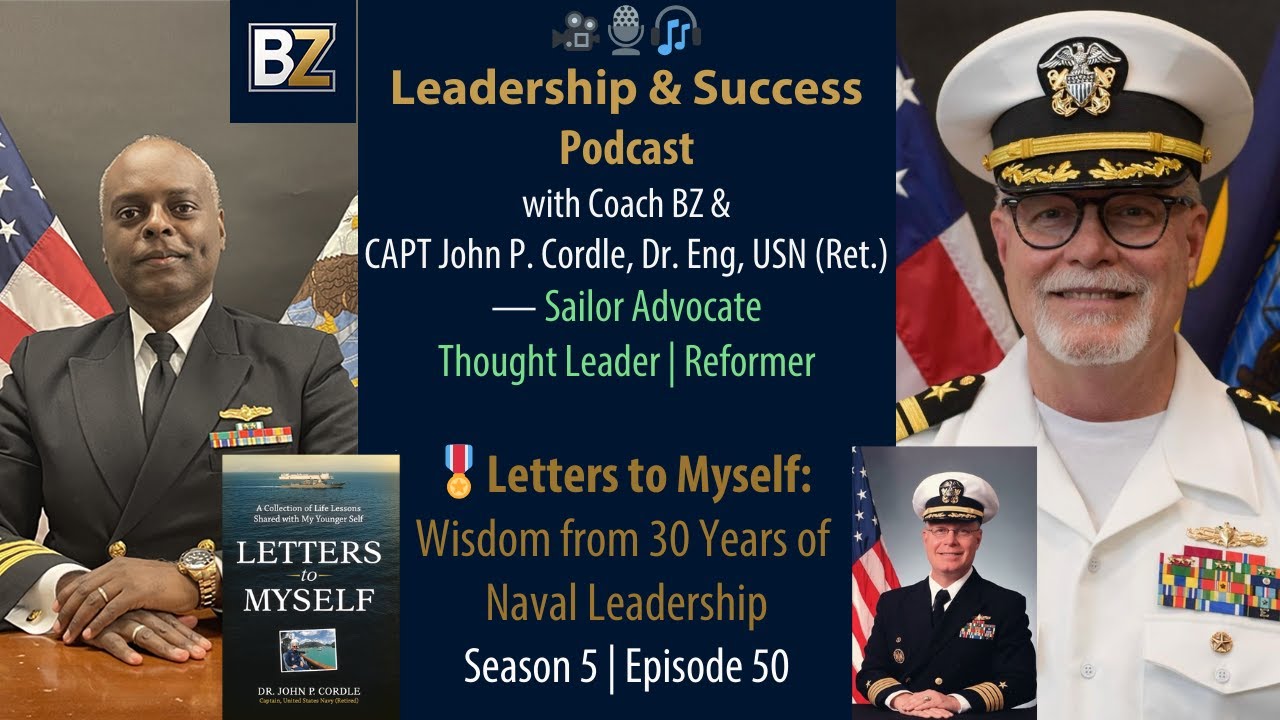
Retired Navy Captain John P. Cordle discusses his leadership philosophy centered on listening, then pivots to pseudofolliculitis barbae, a skin condition affecting Black and Hispanic sailors that the Navy's beard-waiver policy fails to address fairly. He details hidden career penalties from bias and shares advocacy work pushing leaders to enforce policy fairly and challenge bullying language.
Chapters
Hi, I'm John Maxwell. When the top companies in the world are looking for trainers, speakers, and coaches, there's one name that stands above the rest, and that's Maxwell Leadership. Our certified team members have gotten proven results for companies all over the globe, and our reputation, I'm proud to say, is second to none. Some of our members have risen to the top of their profession including the one you're going to meet today. I proudly introduce you to my friend, Bob Fabien Zinga. Welcome to the Leadership Success Podcast with your host, Coach BZ, where we help you lead with purpose and succeed with impact. If you're ready to grow into the kind of leader others want to follow, this podcast is for you. If you're determined to elevate your success and leave a lasting legacy, this podcast is for you. As my mentor, Dr. John C. Maxwell, reminds us, everything rises and falls on leadership. Our goal is simple: to inspire you, challenge you, and equip you with insights that can transform the trajectory of your leadership journey. Welcome aboard to another episode of the Leadership and Success Podcast with Coach BZ. Summer is here, and with it comes lots of opportunities for fun in the sun. But did you know that fatigue makes even everyday activities risky? Trying to cram too much driving, Putting too much partying or too much anything into your leave or liberty without getting enough sleep can be a major problem. Look, it wouldn't surprise anyone to hear that being drunk makes doing even the simplest things a lot more dangerous. But many people are surprised to hear that fatigue impairs the body too. Research shows that going without sleep for 22 hours has about the same effect on performance as being legally drunk. Think about that the next time you want to drive all night. Summer is a great time to relax and have fun. But whatever you plan to do this summer, plan to get enough rest.
All right, everyone, welcome to another special edition of the Leadership and Success Podcast. I am your host, Commander Bob Fabien Zinga. And as you guys know, every time we start the show, we want to start with what we call moment of gratitude. We just want to take a moment to be grateful. And part of the reason why we do this is because in the US military, it's about 21, 22 service members who commit suicide every single day. And here we believe that it's not possible to be suicidal and grateful at the very same time. So you know the drill, if you would just take a quick moment and think about some things that you are grateful for right now. Maybe close your eyes and take a deep breath, slow down your nervous system, and think about one thing that you are grateful for. And for me right now, I believe I am grateful with all of the tensions there is in the Middle East. I know two sailors personally, they used to work for me, they are stationed in the area Middle East or Djibouti there. And I am thankful so far that they are both safe. Nobody's wounded, nobody's dead. Thank, thank God. And I wanted to stay that way, which reminds me, I think we should take just a quick moment of silence right now for what's been happening there. 6 soldiers have passed away now, and I think, you know, each one represents not just a life but really a family that is shattered right now. So I would really appreciate if we could take a moment of silence for them. It's Captain Cody Koch, 35 years old, Sergeant First Class Noah Chietan, 42 years old, Sergeant First Class Nicole Amour, she was 39, and Sergeant Declan Cody was only 20. Especially this one, he really broke, broke my heart because I have two daughters. One is 24, the other one is, uh, 18, so the same generation as Sergeant Cody. And, uh, I can't imagine a parent having to bury their child. Uh, I just can't imagine that. So that really, really broke my heart. And then of course Major Jeffrey O'Brien, 45 years old, and Chief Warrant Officer Robert Marzon, who was, uh, 54. So take a moment of silence for these heroes, uh, they gave their life defending our country. All right, thank you. All right, so now, uh, let me see if I can properly introduce, uh, our Guys, I think we're going to be talking about a lot of things, especially if you are a junior officer or enlisted. I think you're going to get so much out of the, uh, podcast today. So I am really, uh, greatly honored and privileged to welcome Captain John P. Cordell. He is also a doctor of engineering, U.S. Navy retired, a distinguished naval leader, author, and advocate for sailor well-being. And later in the show, I'm gonna play just a short clip of some of his advocacy online.
He's a U.S.
Naval Academy graduate and surface warfare officer, Captain Colonel commanding the USS Oscar Austin, DDG-79, and USS Haseko, CG-56. Leading sailor in demanding operational environment while earning numerous leadership honors, including the Bronze Star, the Admiral Berkeley Award for peer leadership, and the Navy League and Captain John Paul Jones Award for inspirational leadership. Of course, Captain John Paul Jones is a hero in the Navy, a legendary Navy captain. But beyond command at sea, Dr. Caudle became a leading voice on human performance, fatigue management, and crew endurance, helping drive important reforms such as the Sockage and Watch rotation that improves sailor readiness and safety across the surface Navy. He wrote a book about that too, and he's also a prolific author and thought leader with several books, including his newest work, which reminds me I need to update the banner to show some of his books, which is pretty incredible how much he— I don't know where he takes time to write so many books. And there is another book that is already for pre-order right now. And I would definitely appreciate that if everybody got a copy. But like I was saying, prolific author and thought leader with several books, including his newest work now available for pre-order, Letters to Myself: A Collection of Life Lessons Shared with My Younger self. So during this episode, we're going to be exploring a leadership lesson from his 30-year naval career, reflection on command, and the wisdom he wished he could share with his younger self. This is just perfect for the Leadership and Success Podcast. So ladies and gentlemen, without any further ado, please help me welcome to the Leadership and Success Podcast the one and only Captain John P. Perry. Good morning, Captain. How are you doing today, sir?
Good morning. I'm fantastic. That was a great intro and much more than I deserve. And then— and you dug deep in my LinkedIn profile. Pictures. Probably no time to tell the story behind each one, but thank you.
Absolutely. Maybe to get started, sir, what is one thing you are grateful for today?
You know, I'm going to kind of mirror what you said. I have several former shipmates that are on the ships. And on land over there in the Middle East right now. All of them safe, and, uh, um, just, uh, grateful for their service and for their— some of those folks have been on deployment now going on 9 months. Yeah. And then to have to be at your A-game, uh, after that level of, uh, that time, that much time, uh, and their families as well, you know. Grateful for the support that my family gave me, and, and, uh, and that they're, they're, uh enduring right now.
So yes, wow. And one thing people don't understand, when you go on deployment, especially on the ship, it's not like, uh, you know, most sailors— I'm guessing most assignments kind of like 9 to 5-ish, you know, Monday through Friday. But on deployments, like, pretty much 24/7. I think last time I was on deployment, I probably slept no more than 5 or 6 hours every day, including Sundays, which is pretty crazy. But, uh, yeah, it's, uh, they really are our heroes and God bless them. And, uh, yes, I want all of them to come back safe. So, uh, let's make sure that that happens. So, uh, Captain, another question for you is, uh, what is maybe something about you that most people may not know when they first meet you?
Oh gosh, um, I guess I can give it away here in the back, is, uh, I, uh, in my free time I like to play guitar. I'm not good, but I, I can play pretty much any song that Jimmy Buffett or Willie Nelson ever wrote and, uh, and get my way through it. And I was actually a lead singer in a rock band back in high school.
Wow, that's—
that was, that was my plan until my dad reminded me that a real job would be maybe a good idea. So, uh, yeah.
And I believe during the intro I found a picture of you with a ponytail, so that would make you a rock star, or at least looking like one.
It's there. There's a story behind that too, but I'll get to that when we talk about Yes, sir.
Wow, that is really wonderful. So, uh, I guess one of the first questions I would like to, to ask, sir, is, uh, you've had quite a fascinating, uh, career in the Navy, more than 30 years, retiring as a captain. And for those who don't know ranks in the military, basically it's only one pay grade below admiral, right? When I was in boot camp, I used to think that admirals were like demigods or something. But anyway, that's very, very, very high up in in the rank. So I guess the question I have for you, sir, looking at your journey, for those meeting you for the first time, could you briefly kind of share how you went from the Naval Academy to commanding two warships and eventually becoming one of the Navy's leading voices on human performance and leadership? And again, for those listening, being a commanding officer in the Navy is less than 1% of sailors. Who gets that opportunity, and the captain here did it twice. That's just amazing. Yes, sir.
Okay, sure. So, um, I think I mentioned I started out, uh, I was a Navy brat. My dad was enlisted in World War II, then he got out and he went back in and, um, went to Vietnam as an officer, got commissioned in 1959. Um, here's a picture of me and him, uh, kind of a little bit of family resemblance there. There he is, Lieutenant JG. That's about the time I was born. Um, and, uh, He did 30 years in the Navy, served on multiple ships, uh, went to Vietnam for 2 years, almost 3. And, uh, and then when I, uh, when he retired, we moved back to Rome, Georgia, small town in northern Georgia. And I went to high school there. And, uh, when I was 18, um, you know, he kind of sat me down and said, son, you know, um, now's the time to make some decisions because, you know, you're welcome to live at home, uh, but, uh, I'm gonna have to charge you $500 a month. You live in the basement, you eat dinner every night with the family, and you're in by 10:30 on weekends. And, uh, He goes, or I've gone ahead and took the liberty of ordering applications for Georgia Tech and the Naval Academy. And so, uh, and oh, by the way, you can go to band practice when you fill these out and get them in the mail. Um, never heard of the Naval Academy. Um, my friends were all going to Georgia Tech. You know, Dad was a Mustang, so it wasn't like an academy thing. Um, and, uh, but I filled them out, sent them in, and got selected to both. Um, did my interviews with congressmen and senators and stuff. And, uh, and I, I don't know, I, I kind of, it's been a, a trait that I, uh, I'm not sure where I picked it up, maybe from my dad, but, uh, when confronted with two paths, I usually take the one that's, that's the most challenging. And, uh, yes. And plus it was getting me out of Georgia. Um, be stuck there for the rest of my life. So I went to the Naval Academy, um, called my dad about a week later and said, I'm gonna quit. They're, they're yelling at me. They're, they made me cut my hair off.
Yeah.
And, and my dad in his quiet way, he said, well, son, you're an adult. Um, I'll support any decision you make. Hmm. And so, so just think about it. And, uh, I went back to my room and kind of stewed a little bit. I said, I'll show him, I'm going to finish. And so, uh, graduated from the Naval Academy. Um, I always wanted surface warfare. I flew in planes a couple times, and, uh, I, I figured that I threw up and got airsick, and, uh, I don't like altitude, I don't like speed. So, uh, so aviation was out. I don't like being under the water, so I, uh, I chose surface. And, uh, and nuclear power was an option. I had decent grades, I was an engineer, and so I went the nuclear power route. I served on two cruisers, the California, the Truxton, in Alameda. Wow. Close to where you are.
Yeah.
Lived in San Francisco, um, and then I decided that I want to do something different, so I applied for this thing called the Olmsted Scholarship. That is an overseas master's degree. I took French all through the Naval Academy, so I'll go to France. And, uh, Uh, it's been a long time. And, uh, and so I, uh, um, I didn't get it, but I was an alternate. And then so they offered me, well, we can offer you either graduate school or Europe, which, which would you prefer? And, uh, and all of my mentors said graduate school, you have to go to— I said, okay, I want to go to Europe. And so, um, they, uh, you know, I've been deployed 3 times, uh, and, uh, and, and, you know, basically was 29 years old and had a couch and a, and a, I think a Mexican blanket were my two possessions. And, uh, and so I just, you know, they said, uh, so then he said, okay, we have your orders to the German Naval Academy. And I said, well, that's great, but I don't speak German. Um, and he's like, yeah, you do. And I said, no, you have to look at my record. I hear him typing and he's like, oh no, shoot. Okay, what if I sent you to Monterey, California for 9 months to learn German and then German And I'm like, okay. So I did that. First night in Germany, I went out for dinner and was having difficulty communicating, even though I'd been through 9 months of school. And this lady walks up to help and start speaking to me in Danish, because she thought I was Danish because my German was so bad. And next thing you know, I have her number. We started dating, and now we've been married for 33 years. So wow, I lasted one day in Germany. My wife, decisions like that, sometimes failure can be a good thing because I failed to get the scholarship. I went on to be on a destroyer, Arleigh Burke, um, uh, XO of USS Cole, um, and then selected for command, uh, of USS Oscar Austin, a destroyer named after a Medal of Honor recipient, um, Marine from, from Vietnam, and, uh, deployed Operation Iraqi Freedom in command of Oscar Austin. Pre-commissioned the George H.W. Bush aircraft carrier as a new reactor officer. As a nuclear officer, you bounce back and forth between nuclear ships and, and regular ships. And then went on to command USS San Jacinto cruiser, um, again out of Norfolk here, and did counter-piracy operations, uh, on deployment for about 7 and a half months. Um, came back and then went to, uh, Commander of Surface Force Atlantic as the Chief of Staff working for the Admiral, and, uh, and then retired. From there I went on and, uh, well, I'll get to the rest of my career. Um, just real quick, the, uh, we'll talk later about it, but the, uh, you know, fatigue thing I started to learn about that my first command tour, but I didn't really understand it or give it— it was just one of those things that's always there. You just always accept it. And it wasn't until my second command tour that I met, you know, we'll talk a little bit about people that change the whole trajectory of your life, right? And we all have those. But my first one was Dr. Anita Shattuck of the Naval Postgraduate School, who was working on a circadian watch rotation. Um, and I happened to meet her through a mutual friend, and she asked if I would work with an experiment, uh, on changing the Navy's long-standing watch rotation to one that was more based in science. And I did that and, uh, and became a huge fan and advocate. And we could talk more about that later, but yeah, that led me eventually into a human factors degree, um, from Old Dominion using my GI Bill. And I came back as a human factors engineer working for the Navy for the last 5 years.
Wow, that is amazing. Yeah, I know how much our sailors love the Midnight Watch.
Yeah, yeah, a little bit more if it's short, right?
Yeah, yeah, yeah. I know during deployment or exercises, uh, that's one watch everybody tries to avoid. Although for me it seems like it's one of the best watches because you know nobody bothers you, right?
Right, it's peaceful.
Yeah, study and read and get smarter or whatever. But, uh, yep.
Yeah, and there's nothing like the— there's nothing like that. You'll never see the sky. Yeah, like you do from a ship in the middle of the ocean. True. There's no place on land that you can get nothing like it.
Yeah. Uh, although you, you mentioned Germany, the connection with Germany for me— I've never been to Germany, but my father went to school in Germany, so his name, uh, Robert Zinga, Robert. So for the first time in his life, he went to Germany. It was nicknamed Bob, so that's the reason why that's my first name. So it's kind of crazy. And we talked about your guitar in the, uh, um, great— on prior to the show. So my father pretty much forced all of his boys to learn how to play the piano, but the guitar as well. So I've been playing since I was about 7, 8 years old. I play the piano better than I do the guitar, but anyway, uh, music kind of runs in my family. So I guess next question I have for you, sir, is You already mentioned some of the mentors or people who affected your leadership. Let me ask you, what about this man right here?
Okay, so that is—
it looks like you wrote the foreword for his book, Lieutenant Commander Ruben Keith Green, which, by the way, can you order him to come on the Leadership Success Podcast?
Yes, yes, hopefully he's tuned in and watching. So you're next. Yeah. So, you know, I talk about people changing your life and I think the other one is Keith Green. So Keith was a Navy— he was enlisted, became an officer, one of the first Black officers in the Navy. And so he wrote a book about his adventures. And it's actually— when I read it, it was sort of— it was kind of a punch in the gut. I mean, I realized, uh, you know, this was back during, um, sort of the Black Lives Matter and DEI and, and sort of, you know, people trying to talk about stuff that they hadn't talked about. I realized that, uh, one of the things that even though I grew up in the South and, and, uh, um, you know, but I had been very insulated and, uh, the whole idea of racism and, and sexism and things like that, uh, um, you know, I never had to deal with them because they weren't put in my face. And when I sort flipped the switch and saw it from his perspective, um, it really opened my eyes to a lot of things that I had, uh, had maybe not paid much attention to. So I became kind of an advocate for policies that affected women and minorities in the Navy because, you know, quite frankly, if you look at— there's Harvard studies, there's studies that show, you know, ducks pick ducks, right? And so if you look at the upper leadership in the Navy, it's very white and very male. And, uh, and, uh, and so there's just some things that, you know, growing up in that world I mean, my high school was very non-diverse, right? It was a private school. The Naval Academy at the time was not all that diverse. We were the first couple of years with women in the Naval Academy. So it was a huge learning curve. So yeah, Keith wrote that book. I highly recommend it. And but he has been a great mentor to me over the years as well.
So I appreciate you saying that. That's why after you today, I'm going to be speaking to a living legend, Vice Admiral Joanna Newman. She was the 14th, right, first female superintendent of US MMA. I went there a couple of times for school. She's also my friend in the spotlight this week. And it is really amazing how, again, I love America, very special country, but we didn't start this country right, okay? Everybody was pretty much excluded except for white male. White Christian male. And no, but what I really, really love, I think I'm copying the word from a 4-star general originally from Ghana, Ayaan Bilal. He said something that just resonated with me. He says our Constitution, it's really, it's aspiration, right? Because those words that were written for the Declaration of Independence, I don't think anybody, any country, anyone has ever said that. All men are created equal, including women, Black, white, it doesn't matter. All are created equal. That's really, really, really powerful. And I think our entire history, we've been trying to live up to that. And it is really wonderful to see, like, you know, President Abraham Lincoln says, like, a country for the people, by the people. And it is really that, I don't know, it's the culture, what America represents. Not only to Americans but to the world. I guess President Reagan called it a city shining upon the hill. It's really that aspirational aspect of our country that is just so compelling. It's just powerful, isn't it?
Exactly, exactly, exactly.
But there is another, I believe it's a living legend, and I believe it did affect your life. Can you tell us a little bit about This Arleigh and Bobby.
So, uh, um, if you're familiar with the Navy, um, the Navy sort of premier class of ship right now is the Arleigh Burke destroyer. And Arleigh Burke was a veteran for World War II. Um, he led the, uh, the Greyhounds, um, and, uh, the Little Beavers was his destroyer squadron. And, uh, he had a ship— he was Chief of Naval Operations. He and his wife were married right out of the Naval Academy. And so, uh, You know, the ship was named after him, and ship's namesakes always meant a lot to me. I don't know if we talked about it, but, you know, I— Keith and I kind of led a campaign to rename the John C. Stennis. We can talk about that maybe if we have time. But, uh, and part of it is, you know, having those— having that legacy. Um, and I got to meet him. My wife and I went up to visit him up in Alexandria while he was still living in his 90s. And, uh, man, I still recall I was sitting on the couch chatting with him, and they were legend for sure. Wow, definitely. And, uh, It was kind of funny. He asked the captain, he said, Captain, how many officers are there on the Arleigh Burke? And the captain said, about 25, Admiral. And he shook his head. He goes, that's too many.
Wow.
They just get in the way. And then I remember his wife was talking to my wife and they were talking about being a Navy wife. And she turned to Arleigh. And of course, they've been married 70 years now. Wow. And almost 70. I think it was 70. And she looks at him and says, have I been a good Navy wife? And he goes, yes, dear, for 70 years, you've been a good Navy wife. And she looks back, she says, she says, 70 years, that's half a lifetime. Wow. So yeah, he was a living legacy, both from his time in, you know, as a lieutenant in World War II, all the way through. And just a gentleman. Yes, great guy.
Then we truly stand on the shoulders of giants. Incredible. But So was there maybe a defining moment in your career when you realize that true responsibility of leadership?
Yeah, I had to think a lot about that one. Thank you for sending me the questions ahead of time, because I would have stumbled on that one. But I kind of thought of two, they're very different. The first one was, I took command of Oscar Austin in January, I think, 2001. And the first assignment was to cross the Atlantic and go on an exercise in the Baltic. Now my wife, who's from Germany, the first thing she said was, who goes to the Baltic in February? You guys are morons. You're going to be miserable. And, uh, and so we're crossing the Atlantic, and if you, if you're familiar with that transit, um, in the wintertime, it can be quite, uh, rough. And there's an area called the North Wall out there where sort of the different currents and stuff create a real stormy, uh, sea state. And, uh, and we hit some pretty fantastic storms, you know, 20, 30-foot waves and the bow's disappearing in the water. And I'm up on the bridge at night, and remember, this is— I've been in command for like 2 weeks, right? Um, and this little, uh, young JG standing next to me had the deck, and, uh, it's about midnight and a giant wave crashed over and lightning flashed, and he goes, sir, it just occurred to me we could die. Um, and I'm like, well, 'Now it's kind of a bad time to think of that, shipmate, but, uh, yes, uh, you know, ships have sunk at sea, uh, quite a few, um, but it's my job to make sure that we don't.' Yes. And, uh, I said that kind of glibly, but then it hit me that, yeah, that's a huge responsibility. And so I think that was probably that, that aha moment. Hey, this is serious, right? Yes. And then, um, I was in command of San Jacinto. I was on deployment I'm sitting on the bridge wing reading a book called Six Frigates, uh, by Ian Toll, which talks about the, the construction and then the employment of the first, uh, ships of the United States Navy. And, and I'm sitting on the bridge wing reading this book about the very first naval battle. I think it was the USS— I want to say the Intrepid. I might get that wrong, but one of those, one of the frigates. And talking about the captain, and, uh, and, and it sort of hit me that, hey, I'm him, right?
Yeah.
And, uh, and what an incredible connection and responsibility it is to have command of a ship. Wow. There are 400 people. So those were the two sort of aha moments for me.
Yes.
That, uh, that, you know, I look back and see that knucklehead back in Georgia at 18, and, and, you know, when you ask, how did you— you asked me, how did you— I have no idea. Yeah. Folks out there is, if I can do it, you can.
Yes, but, uh, wow, that, that is really, uh, fascinating. I mean, for my own self, I, I didn't really learn about the weight of command until I had the opportunity to command. I mean, it is, it is pretty heavy. Not just responsible for the mission, but every single sailor under your charge. And there are no weekends off. It's 24/7. It doesn't matter if it's midnight, 3 o'clock in the morning, somebody calls, you have to pick up that phone and do your duty. It's, uh It is quite an awesome, awesome responsibility.
Wow.
All right. And another question I have for you, sir, is, so you did command both the USS Oscar Austin, like you mentioned, and the San Jacinto as well. What were the core leadership principles that guided you when you had 300 sailors looking to you for direction?
I think I kind of tried to distill it down. You know, certainly the core values, honor, courage, commitment. I, uh, I campaigned a little bit later in life to add Respect to that list, but, uh, didn't quite get that one over the hump. Um, but I think, uh, as important, um, as— yeah, that's, uh, it's interesting that, that, that, that campaign got so close that they were actually making coins like that for the Navy, but it, uh, the, uh, the initiative died. Uh, maybe someday.
Um, but, uh, I think we're gonna talk about Respect a little bit later on. I want to hear that story. I think it's important.
Okay, thank you. Um, so I would say the first is integrity, right? If you, uh, if your people look at you and they think that you're going to do the right thing, um, then, then that's, that's probably the most important. The third, the second is, is honesty. Um, you know, I, I spoke to the crew pretty much every day and I told them, uh, whatever I knew, um, about the situation that we were in, whether it was Operation Iraqi Freedom, how long we're going to be over there, whatever. Uh, so they knew I was going to be honest with them. And the third is trust, and trust goes both ways. You know, one of the things, um, if you're a captain of a ship, you have to trust the crew, uh, down to that person cooking the biscuits at night and the person with the hand on the key that turns the missiles on, that they know their job and they're going to be full up for that day. So I would say integrity, honesty, and trust were the three sort of, um, core leadership traits that are important.
That's really Powerful. I don't have a picture of that now because I didn't get your permission, but you did send me privately kind of like your core philosophy as a skipper, your vision, your core value, and all of that. And that is so important for the JOs listening now who aspire to command. Why is it very important for them to have their own leadership philosophy?
I think, you know, it's funny, we went through the command school, and that was an exercise that they had us do was to write your command philosophy. And so the first one I wrote, the title of it was "I Care." No, "We Care." And we care about the mission, we care about each other, we care about our— And the mentor took my— he literally took my paper and he ripped it in half. He goes, "What a bunch of crap." And I'm like, "Wow, that's harsh." And he says, "We're in the Navy. We're not in some soccer club, you know." And so I rewrote it and And I kind of put mission, people, and safety were kind of the 3 priorities. But then I also— they had us write a personal vision statement, and you're welcome to share that.
Thanks, sir.
The one that I sent you. And basically it was things like, hey, I'm going to keep myself physically fit. I'm going to trust my folks but verify that they're qualified. I'm going to keep a good humor about myself.
Yes.
I'm going to start the day with a positive outlook. I think that's very important. Because the crew will reflect your, uh, demeanor and your personality. And so I think it was very helpful to me because I kind of knew all that stuff, but I think to write it down— and I think one page is kind of the max limit. Nobody's going to read more than one page of the stuff that you write anyway. Um, and, and then sharing that. So when I took command, uh, first thing I did was a copy of that went on everybody's rack, um, the next day so that everybody knew, hey, who's this new guy? And and what's important to have, right?
Yes, sir. I think no one will read more than one page except if they are your most dedicated department heads or LPOs.
Yeah, yeah.
What I used to do is I would ask questions about the second page, and if anybody got it right, I would give them like a coin or a Starbucks coffee card or something saying thank you. So we do have a couple of questions from people watching live.
Yeah, I saw that pop up. I didn't want to interrupt, so okay.
So Steven Cleaves looks like a naval officer. He says, sir, I am currently at NPS, Bravo Zulu. That's only about an hour and a half from where I am now. Do you think your time here helped shape you into a sharper naval officer? I hope the answer is yes, sir.
Uh, well, I, uh, the answer is not applicable because I didn't attend the Naval Postgraduate School. I actually went to what's called the Defense Language Institute, DLI, up the hill there at the Army base. Uh, Um, but a lot of my friends were at NPS, and Dr. Shattuck, who was my mentor, and her husband, uh, Dr. Larry Shattuck, um, were, were fantastic mentors for me. And, uh, you know, so I, I know from my friends that went there— actually, I did attend. I'm sorry. Um, behind me, actually, I moved it, but I took the NPS certificate for human systems integration.
Wow.
A 1-year sort of graduate-level certification. And just had fantastic teachers and fantastic— there was a cohort. So absolutely everything you do there, both the academic work, but I would say most importantly is the friends you're going to make and the colleagues that you work with are going to stick with you for life. And so, and the research that you do, it was a Naval Postgraduate School student who put together the first paper on circadian watch rotations. And wow, that became our experiment and that became Navy policy. And so it all started at NPS. Absolutely.
Wow. That is just wonderful. Okay. The other thing I'd like to ask you, if we can talk about it, in high-risk environment like warship at sea, you know, to me, I mean, I was a commander at shore. That's good stuff and all of that. But at sea, it's like, I mean, it's like the, the helm of Navy command, right? There is just nothing like it. So I know trust is absolutely everything. So how do great leaders build trust with their teams, especially under pressure?
You know, I think it's interesting. I got a Facebook comment the other day. I posted— I just started about maybe 6 months ago. Every Saturday, I just pull up an old sea story and post it on LinkedIn and Facebook. And it usually gets about 100 views and a couple of comments. And I posted one about, you know, the USNS Mercy, I think, or Comfort. Was in the news the other day, and, uh, I, I had a picture of us escorting them. It's on the COVID of the book. And so I posted that with the sea story about Oscar Austin, and, uh, oddly, one of the flight crew members, enlisted, uh, aircraft maintenance guy, posted. He goes, uh, yeah, I, I— when I got to the ship, I heard that you, you shouldn't expect to walk the length of the ship without running into the captain twice. Um, and, uh, and he goes, then, like, I'd been there 2 weeks, and this is all coming from some guy at you know, that was on the ship. Yeah, God, 25 years ago. Um, because I still remember the captain came down and he asked us what we were doing. Um, and he just sat there and watched for like 20 minutes. Uh, and then he shook his head and said, I just can't believe, um, the stuff that you guys accomplished down here. And he said, this is the first time that a captain has asked any question other than how quickly can you set flight quarters, right? And so that's a moment that I didn't even remember. But, uh, I think, uh Back to that trust. I mean, if they see you out there, if they see you asking questions, understanding what's the learning, sit down next to the watchtender and say, hey, what does that button do? What? And you're not quizzing them, but because they know the answer, but, you know, make them understand. And then you'll learn as well a lot about both themselves, the individuals, and also about the ship and how it works. So I think Um, you know, I have a little— I typed out a little thing. I'm taking a coaching class, um, and, uh, uh, one of the key things is to be present, right? And so, um, you know, management by walking around, call it curiosity. Um, it can get annoying. Um, my, my, my wardroom on the San Jacinto bought me a DDG model, ship model, um, and they were hoping that I would just spend my time in my cabin building the model and stop walking around asking questions. Didn't work. Um, but, uh, yeah, that was kind of my, uh, build that trust through, through personal interaction and, and also knowing your stuff, right? They're like, they'll know, um, the most dangerous thing you can achieve is overconfidence or hubris. Um, if they think that you don't know what you're doing, uh, but you act like you do, then, uh, then you've lost their trust, you know?
Yes. Wow. Let's talk a little bit about, uh, human performance and crew endurance. And I believe, um, this One book that you wrote definitely mentioned that, and you also have written a whole bunch of articles about it. I'm really grateful for that because you've been widely known, sir, as the Navy's circadian watch rotation advocate. And so what first made you really realize that fatigue was truly a serious operational risk?
Well, it took several things. You know, it started with— one was at the Naval Academy driving home and I fell asleep at the wheel. Took my exams and got behind the car about midnight. I was driving through the night about 12 hours, and what woke me up was my car hitting the guardrail going about 75 miles an hour on I-85. Fortunately, I spun around and stayed on the wheels, and, uh, and, uh, but I just crawled in the back and went to sleep. Fortunately, I had a bunch of dirty laundry in the back of the car, so I just crawled under that and slept for an hour. Um, but of course, that wasn't enough to get my attention, so, uh, Um, when I was in command of Oscar Austin, I had a pretty serious accident where I, uh, had been up all night and then was up on the bridge the whole day. Um, and basically through my own fatigue, um, lost situational awareness and flipped a rib boat, put 6 people in the water, had to rescue them. It was night, it was raining, almost, uh, almost killed one of them. And, uh, and you know, one, that was my responsibility, but I blew it. And, uh, and so, but I didn't have any answers to how to solve it. It wasn't until I was on San Jacinto that I met Dr. Shattuck and she introduced me to the circadian. So circadian watch means that you sleep and work at the same time every day. And they, the Navy had traditionally done what I grew up with was called five and dimes, which was 5 hours on, 10 hours off. It gives you time to sleep, but nobody slept because they were working or doing other stuff. And you're sleeping at a different time every single day. So So your body just gets all outta whack and there's science behind that, that your performance is degraded by that, especially over time. Yes. And so we did this watch, Bill, and it was unbelievable. I had never seen something make such a big difference in such a little time. And I came back from deployment, I'm like, I'm gonna change the world, right? We're gonna make this happen for the Navy. I became chief of staff at the, you know, type commander. And so I could teach that from there. But I was ordered not to because, um, there was a concern that it would cause a demand signal for increased manning. Um, there was a concern for, uh, telling this captain how to suck eggs, how to set their watch bill rather than let them decide. Um, and there was skepticism. You know, one of the big obstacles in the Navy, at any organization I think, is the older you get, the more you think that you've thought of everything that can be thought of in your domain. And so I continually run into the more senior folks that are like, you know, I'm a pretty smart guy and I didn't think of this, so there must be nothing to it. And so it's very— or, you know, we need more data, right?
Yes.
And I'm like, well, we have thousands of days of data that all tell us the same thing. We have research, we have everything. Um, and so I had this draft instruction that I wrote back in 2010. It would shifted the Navy. Um, I actually remember being called in in 2016 because the Admiral was going to sign out a policy, um, but it never happened. And, uh, and so I was very frustrated. I was— I went home that day walking on clouds because I'm like, yes, 6 years, it's finally going to happen. Then the collisions happened in 2017. Um, 17 sailors died on the McCain and the Fitzgerald, and fatigue was sort of the watermark of that investigation. And, uh, and so within like, like 3 months, they had signed out that policy that had been floating around for years, and it became the law for the Navy to use circadian watches. It includes naps. Um, and then so we set about training people for that and doing all that stuff. Um, unfortunately, that was the surface Navy. The submarine Navy adopted it. Um, aircraft carriers, uh, that type commander didn't adopt it until 2024. Um, and, but the Navy has never signed out, uh, an overall policy. Um, and I've, uh, you know, written about that, taking the CNO to task, the SECNAV. Um, yeah, I said, hey, the Navy needs to say these are the rules. They have them sort of in pieces. Aviators are pretty, really good about it, but there's no teeth in it. And, uh, and so I told the Chief Naval Operations at a, at a symposium back in 2 years ago that, uh, I wasn't going to cut my hair until the Navy signed out a policy. Um, so I have not cut my— I've not had a haircut since January of '24. There you go. It's longer than that now. You can't really see it here, but I'm just going to keep it growing until, uh, in a silent protest until somebody— I've drafted the instruction, I've sent it to the CNO, sent it to SECNAV. Um, yeah, there's me. Carlos Del Toro is an old friend and fantastic mentor. Um, and you know, there's reasons why they can't do that, uh, I guess. But back to the same thing as well. I I'm a smart guy, I didn't think of it. Um, but, uh, we'll continue to beat that drum and, uh, and somebody will get mad enough at me to just, you know, get me to shut up and, uh, and then they'll sign the darn—
Also, I know, sir, you are a captain in the most powerful Navy, you can do whatever you want.
Well, I'm retired too, so I can say whatever I want.
That's right.
Um, but, uh, yeah, this is a great question.
Um, yeah, uh, Daniel Young, very active member of our tribe here, so he says Captain Caudle In my work as a system architect, I see fatigue as a crack in the foundation. How do we shift leadership culture to see rest not as luxury but as a primary maintenance requirement for the human firewall?
Yeah, you just hit the foundation of this whole human factors, uh, studies that it was again, you know, um, something I didn't even know existed until I went to school and started to learn about it. But, but I think, well, I think what, what changed it for us was, was the data and the science. You know, we put rings on sailors and we gathered their sleep data and we found their average sleep was 5.2 hours, right? And then we went to the National Transportation Safety Board and said, well, what— how does your accident rate increase when you have less sleep? And it doubles at, I think, 6 hours or less, and then it goes to 14 times if you're less than 5 hours. And that was reaction times are slowed down. And so I would say, to your point, one, really dive into the science behind it because it's irrefutable, and then appeal to just common sense, right? I mean, you wouldn't drive your car drunk, like I said in the video, um, and fatigue has the exact same effect. And people just, you know, get people to believe that. Uh, the person who typed that in, happy to, uh, you know, connect with you on LinkedIn. Um, I can fill your inbox with briefs and, and data and research studies. Um, but sometimes you just have to beat people over the head with it and, uh, and, and tell them what to do. And then, uh, but it has changed the culture. I mean, I, I interact with, with prospective commanding officers now and It's pretty much the norm out there, and at least people are thinking about it because the human is the most important part of the machine. And we do planned maintenance on our rockets and our motors and our electrical things. It's like planned maintenance for your body. You have to do it or you're going to break down. So good luck. But you're definitely fighting a culture where, you know, I've heard it, sleep is a bad— you know, fatigue is a badge of courage, a badge of honor. Yeah, sleep when you're dead, right? After deployment, etc.
So, oh, you can sleep when you, when you die, right?
Um, but, uh, but I'll tell you, now that I'm retired, I moved my wake-up time by about 45 minutes, and, uh, it just changed everything. I mean, I tell people, if you want to make your life better for free, um, add 30 minutes to your sleep routine at one end or the other, and, and you'll see a difference. Absolutely.
Well, let's, let's talk about your book, which I want everybody to pre-order right now, and the, the link is going to be in the, um, podcast last note. And when is it going to be available on Amazon, sir?
I think in the next few weeks. Um, I just, you know, you have to get things reviewed by the Department of Defense, and I just got that back. And, and so it went to the printers, it takes them a couple of weeks to turn it around, and then it takes a couple of weeks to get it. So you should be able to order it via the Stone Tower. You can pre-order it now. Um, and I do have kind of an offer out there. If you pre-order the book and you send me a note, then I'll send you a card of thanks, uh, and, and kind of a little, uh, I have a little— I can sign it remotely and you can stick that in the book. Um, and so I have a little, uh, thank you for, for, uh, ordering the book ahead of time. But, uh, yeah, I'm excited. I, I, uh, um, I had done— I've been working on this for about 2 years now.
Wow. And, um, that's exactly the type of books we, we need, especially for the junior officer, right? Letters.
I hope it'll help. Um, you know, it's kind of built around this. There's a great book that I recommend strongly called Lincoln on Leadership. By Abraham Lincoln, or about Abraham Lincoln. Yes, it has little vignettes of how his leadership style, and then captures what his fundamentals were. And I tried to kind of mirror that style in here. So basically, I wrote— the inspiration for this was one, Keith Green, who just nagged me incessantly to write a book over the years. And then secondly, I didn't send it to you, but it's in the book. I have a letter from my grandfather when I went to the Naval Academy. Academy.
Wow.
Who basically, a little one-page typed letter, um, signed Granddaddy, um, that said, I'm very proud of you and, you know, please continue your, uh, your excellent, uh, work. And so I thought to myself, you know, I— that has— it's hanging on my wall now, uh, 50 years later. Um, what would that mean to somebody to get that? What would it have meant to get a letter like that? And so I pretty much wrote from my current perspective to myself as a, you know, division officer, department head, executive officer, commanding officer, um, after the Navy. So transitioning out of the Navy. Yes. Um, and then as a veteran. And, uh, and then, um, you know, I was fortunate enough to— I sent it off to some, some real great mentors like, uh, like, you know, Seknat Del Toro, Jim, um, Bill Hamlet, editor of Proceedings, and got some really nice, uh, endorsements in there. They seem to like it. So I said, hey, let's find a publisher through— I was teaching and talked about suicide. I teach a a class called Safe Talk, which is a suicide prevention class. Um, and a ship's chaplain, um, who was getting his PhD, uh, mentioned that he had a friend, a retired chaplain, who was a publisher. And I had sent the book to several publishers and, and gotten not much of a, of a response. Um, um, because, you know, they're busy and they have other things. They, you know, they're looking for the novel that's going to be a, a huge bestseller. And, uh, um, And so, uh, but, but Tim read the book and, and like the next day came back and said, let's, let's do this. And so, uh, um, so that's how it became, uh, a reality. But the whole process took about 2 years, man.
So briefly, for those listening, sir, why did this book have to be written?
Uh, you know, this is kind of a weird way to, to go at this, but somebody said it looks like it's a book you were born to write, sir. Uh, yeah, I think it was. And I wish I had done a better job of writing stuff down, you know, while I was living it. Um, you know, Stavridis did a fantastic job. He kept a journal of all of his— you know, every time I pulled into a port on San Jack, I was like, man, I wish I'd have kept notes last time, uh, when I pulled in on Oscar Austin. Um, but no, I think that book has been in me the whole time. It just had to come out. Um, and, uh, um, I— my hope is, you know, I counsel a lot of folks sort of one-on-one and, and meetings and stuff but, uh, I wanted to try to share that opportunity with a broader audience. Um, and, uh, somebody once said, you know, you're not really dead until the last person says your name. And I think it was Keith that said, you know, if you write a book, then, uh, then you live forever, right?
That's true, that's true.
And he said to me, if you don't write it down, no one can read it.
And that's right, that's right.
My motivation.
Now, you did mention Admiral, uh, Stavridis, and he did write an endorsement for you in the back. I didn't know him at the time, This book completely changed my life, Division Officer's Guide. It's only later that I found out he was actually the author of that book. When I was a junior officer, I had no idea what to do, where to go, how to plan my career. But this book really takes you through it.
Yeah, that's a great book.
It's just incredible. And by the way, if you would tell the Admiral to please come on the Leadership and Success podcast, I've invited him twice already, Cricket. So I know he's on TV, he's everywhere.
Yeah, he's kind of busy right now.
I know, I know.
But I'll ping him.
With Iran and everything going on in the world. But my junior officer need to hear from his wisdom, even if it's only 30 minutes or even 20 minutes.
Sure, sure.
That would be more than enough. But yeah, it's definitely changed my life from a distance. And I also love his book, The Accidental Admiral.
Yeah, yeah, yeah. I met him when I was— actually, that was one of my sleep lessons. He was in command of the Barry and I wrote them. Time. My friend Terry Mosher, who's passed away now, um, invited me, and I fell asleep during a briefing. Oh no. Um, and, uh, and then, um, yeah, Admiral, then Captain, Commander Stavridis called me into his cabin, um, and I thought I was about to, you know, get my head cut off. And he just asked me how I was doing, what I was, what I was up to. And, and, uh, and he says, you know, John, can you do me a favor? And I said, yes, sir. He goes, can you stay awake in my briefings? Because it just, it reflects poorly on the crew because they don't know whether you know, can you do that for me? And I'm like, uh, so I crawled out like underneath the door. Um, but he didn't yell, he didn't, you know, he just, you know, asked me politely, could I stay awake during his, uh, yeah.
So, uh, were you like standing up in, in the back of the room to stay awake?
Uh, no, I just, I just dozed off. It was my first time back at sea in years, and, uh, just, uh, at the end of the day, it was a, it was, it was a pretty boring briefing, But it was necessary.
Please don't tell him that.
But yeah, very unprofessional. He wasn't talking. It was sort of a random, you know, ops intel brief. But yeah, so, so he's a classic. He's a class act.
Absolutely. I believe this one is from my sea daddy, Captain Joel Rothschild. So he says, John, I'm sure that you have encountered toxic leaders in your career. Can you tell us about one of them and how you handle it? But please don't name them, sir.
No, I won't name any. But it's a great question because I've actually written a couple articles about it.
And yes, you tend to be a little bit of a rebel, sir. US Naval Institute, the critical examination of toxic leadership in the US Navy. Wow, that's pretty bold.
Well, you know, long story short, because we're getting close on time, but I met a woman who had worked for an infamous peer of mine called Holly Graff. And, and, and she wrote a book called The Long Way Out, which was how she, how her mental health was basically crushed by this overbearing captain who was eventually— I could say her name because she was convicted of cruelty to the crew. And, you know, but, you know, the definition of a toxic leader is tough. I just had a conversation with someone the other day that said, you know, if I yell at you, does that make me a toxic leader? And Yes. And, you know, there's certain lines you don't cross— putting your hands on someone. But I would say, you know, once in a while you're going to lose your temper, right? But the toxic leaders that I worked for had, I think, two characteristics. One, they were insecure. And they compensated for that by just snapping at everybody, snapping at everything, not entertaining questions. And And the second thing was that they were very competent, right? They knew their stuff. They didn't know how to interact with people. And so, so, you know, it was challenging. I did not, you know, I actually took issue with one of my mentors, Sink Harris, had a podcast of how to deal with a toxic, how to work for, how to survive a toxic leader.
Yes.
And how to work with a toxic leader. And And, you know, I sort of pushed back on this. I don't think you should have to, right? I mean, that person should be, should be weeded out. And we have some, some things in place, but they survived, unfortunately. And so I would say, if you're in that situation, number one, don't, don't, don't give them an opening to, to, to, you know, demean you or crush you or, you know, do your job the best you can. Make sure you have evidence. If they cross a line, write it down, document it. And, you know, I was a peer of Captain Graf, and I did not report her when I was— when she was in O5 Command. And so, you know, kind of knew where things were going, and then it kind of came to a head later. And so I think, you know, the Navy could do— they're doing some things. They've changed the way they do the command screening now. They look at personality traits and leadership traits. They have psychologists as part of the discussion. And so they've done a lot to, to weed that out. But, uh, um, I'd say the most important thing is, you know, I have a long list. I have a book that has two sides. One is things I want to emulate, uh, from good leaders. The other is things I never want to do, um, from bad leaders. Because I've had people call me names. I've had people throw stuff at me. Um, and, uh, you know, at the end of the day, you can't let your, your own value be set by someone who just can't get their act together. Yes, I guess that's the best answer I can give you. But take a look at that article if you want to dig more into that or read that book.
But actually, I also have the podcast you did with your co-authors. It's available. I think I have it in— Okay.
Okay. Yeah, they did a great job with it.
People can watch it because LinkedIn limits you to only 15 minutes a piece, but people should listen to the entire podcast. Very, very insightful. I know we are almost running out of time, but I want to ask you one more thing about the book. Book before I talk about one last subject. Letters to Myself. What about the JOs who are listening to us right now? If you had to summarize the book in one lesson for young leaders today, what would that lesson be?
I think I had an article called Leadership is— it was called Shut Up and Listen. And I think the two things that are critical, I think core to leadership at all, is listening, listening to your boss, listening to your peers, listening to your, to your folks. And keep learning, right? Hit the books, understand, be the best tactician, be the best technician. You know, your folks will understand whether or not you know what the heck they're doing. You know, one of my bosses told me, you can't manage something if you don't understand how it works. And sometimes I think people try to manage or lead without understanding the mechanics of the of the ship or aircraft or the crew dynamics or whatever. And so, you know, as my grandfather said, or my grandmother, I think, you know, God gave you one mouth and two ears, so you should listen twice as much as you talk. And I'm probably not a good example of that, but, but, you know, stop. You know, I used to tell— if I, if I could give the listeners one, I give them— I call this my gift, right? This is my gift to you. I call it the third question. We all go about our day on the ship and we say You know, we saw— passed somebody in the passageway and, uh, you know, how you doing? Um, and they always say great, awesome, good morning, um, what are you up to? Uh, and they always say, you know, either nothing or I'm about to go do training or I'm headed off to check or blah blah. Then you ask that third question, um, what's bothering you? What's pissing you off today? Um, and you better be ready because they're going to have an answer. Yeah, and it's gonna last about 10 minutes for them to explain that, you know, I didn't get paid, um, breakfast sucked, um, you know, I can't get qualified because I can't do this, something— there's something bothering them, you know. I've had, I'm living in my car because my wife kicked me out, right? Um, and, uh, you know, if you have that, that approachability, uh, and the great thing is, and this is for the JOs, here's what's pretty cool about this. Once you ask that question, you get that issue on the table, Um, 3 things happen. Number 1, you can solve it half the time. Like, you already know, hey, I can, I can solve that. Um, the other, the other half the time, you know who can solve it, and you can take that person to the chaplain or the doctor or the, or the engineer or the admin or whoever. Um, and then something magical will happen. That person will go back and tell other people, hey, that guy cares about me. He asked about— he, you know, he didn't just walk right past me. He asked me what I was And they'll go out and they'll tell their spouse, right? They'll go home that night and say, hey honey, you know, I'm, I'm in a command where the, the captain or the division officer or the chief, um, you know, when you looked at the George Washington report of suicide, uh, that cluster they had, um, a lot of that boiled down to leadership that just didn't ask questions or understand what their people were going through. You know, I don't want to throw stones, but it's in the report. Um, of, you know, you can't go, your wife's giving birth. Well, you can leave, you know, when she's on the table, you know, come on. And so, you know, that third question, I think, what's bugging you today, will draw out an important leadership trait of listening.
Yes, sir. So I know we pretty much out of time. Can you give me 5 more minutes before we close Okay, let's talk about this one final thing, but first, before I go there, on your LinkedIn, you say, "I voted." The majority of senior officers I've seen, O-5 and above, they don't even vote. I know you have a right to vote in the military, but they just don't wanna look partisan and they don't. And again, I like what you did, you know, trying to add respect as a core value. I was hoping that was going to happen, but it didn't happen when it almost did. And then of course, all of the advocacy you have also, Dancer with PFB. And before I go there, let me play this short video and then we're gonna get into this last.
Okay, yep, no problem.
Good.
Put my glasses on here. Hello, my name is Dr. John Cordle. I'm a retired Navy captain and I'm here to talk a little bit about Bump Serum and how it applies to a condition called pseudofelliculitis barbae or razor bumps, PFB as we we often call it, in the military. So I'm a retired naval officer. You can probably tell by the kind of ship stuff behind me, and I served 30 years in the Navy, and I'll be honest, I don't think I knew as much as I should have about this condition, how it affects my Sailors, and what can be done about it. And so what we're going to talk about over the next series of short videos is how PFP can affect you in a military setting, whether if you are a sailor, soldier, or airman who is afflicted with this condition, or if you're a leader and you are leading people who might be living with this, to help you understand what they're going through and how you can help them. Okay, so look forward to spending some time together, and we'll see you soon.
All right, sir. So for the amount of time that is left, of course, on the Leadership and Success Podcast, we don't do politics here, but we do do leadership, and leadership is tough decision. My, uh, sea captain Joel Hofstael, one thing he taught me was once when you become a leader, the reason why you get paid the big bucks is for you to make those hard decisions. You don't just pass it down on the line to the next captain or the next person is going to be in charge. So I guess to get this started, let's maybe frame this from, um, Oran again, leadership, empathy, and supporting sailors, which I think is the most important thing for any leader in the Navy. Most people outside of the military, they don't really understand what PFP is, right? Psoriasis folliculitis, probably. Now, just to be frank, put all of my cards on the table, I was diagnosed during boot camp, May 2005. I was enlisted back then. I went to Great Lakes, I mean ROTC Great Lakes, and that's where they diagnose me. So it's always been a problem throughout my career. And I understand now with this new administration, we can no longer get no chef's kit. But anyway, that's probably the fastest way to get rid of African Americans in the military. But, but I guess the question I have for you, sir, can you explain what it is, why it affects so many sailors, especially Black servicemen, and how it can impact a military career? Again, I'm so grateful for your advocacy in and out of the, you know, from?
No, well, thank you for bringing that up because it's still an issue and I think people misunderstand it. So first of all, I noticed you dug up some pictures of me with a beard at sea. Yes. And there's a— there seems to be throughout the military a perception that having a beard is somehow makes you less professional or less competent, or I think it's just a bias that's sort of an internal bias against beards. And I had this picture taken after I retired because actually my friend and colleague John Now when he was Chief of Naval Personnel, they put out a message that said, hey, Retirees don't have to shave your beard off when you go to an official event.
And so now admin 12422, right?
That's an official photo, it's legal. Um, and, uh, and so, but I, I, I, I posted it for advocacy. And it's funny, that, that picture became like the most commented thing I've ever put on LinkedIn. I mean, like 20,000, uh, comments. So I kept it, right?
Yes.
Um, but here's the deal. So Keith was the one that, because he's with this, and he, he sort of explained to me the pain that you take in dealing with it when you basically— so here's the deal, um, if you're African-American, um, and Hispanic perhaps, and some, you know, that your skin is different than mine and, and your hair is different than mine. My hairs are more rounded, yours are more triangular, and so they're more likely to be sharp, and, uh, and you— and they tend to grow back into the skin. They're curly, right?
Yes.
Um, that becomes a pus module, like a, like a pimple. And then when you shave, it cuts that off and become infected and hurt. And you know all this, right?
Yes.
But it's not just a trivial nuisance, it's a painful thing. And it become— it can, it can eat up a morning, right, trying to get around and shave around it. And so the medical— if you go to the National Institute of Health website, it's a very simple tree. It says, does the person have PFB? Yes. Stop shaving, right? Because if you just cut the hair about a quarter inch um, then it doesn't curl back under the skin and it resolves itself. So there's kind of a myth, it's kind of the Navy has sort of stuck to the— in it. So to be fair, the National Health Safety rules basically say if you have a, if you wear a mask, um, and you have to be clean-shaven because there are studies that have shown some degradation of a mask, um, due to facial hair. However, um, forced air masks are much more resilient to a little bit of facial hair. In fact, the studies have shown very little degradation. So we, we did a study at behest of SecNav. This all started with the Air Force did a study where they actually found that promotion rates for those with beards, they did a huge— they excluded other— they didn't look at race, they didn't look at gender, they looked at do I have a beard waiver or not. They found that, that E-6s promoted a year behind their peers if they had a beard. Beard. And it was all due to sort of the informal bias, uh, in several ways. One, um, they were just not getting— they were getting— I had a friend who got a 4 military bearing, um, with an approved beard chit, and the captain said, I just can't give you a 5 if you have a beard. And it's like, but my beard is, is, you know, I'm fit, my uniform fits great.
Yeah.
So there's this bias, right? Oh, I have to, I have to downgrade you. I think that's happening out there now, right? Um, the second thing is, um, they would be excluded from things like, uh, were not— I think there's some waivers now, but they're going to get harder, probably. Things like recruiting duty, um, or, or boot camp, pushing boots. Um, some of these career-enhancing billets are off-limits to people. Um, and then thirdly, things like awards and honors. Um, I had a friend who was the Engineer of the Year for the Navy, and they would post his picture on the newsletter because he had a Right. Wow. And so, uh, and then, um, so the Air Force found that there were definite career— they also found that retention was impacted. People were, you know, it's not the main reason they were leaving, but it was a reason. It was additive. And so they were losing the retention for folks with beards was significantly lower than folks without. Put all this together, presented it, um, to Secretary, uh, Del Toro, and he mandated a beard study. So I was part of that. We, we found 50 sailors, we let them grow beers, we put masks on them, we did all the work with the Naval Health Research Center, um, and the study was never published. So I can't, I can't tell you the results, um, but you can kind of surmise why would you not publish the results of a study? Because it doesn't back up the premise that you— yes, right. Um, and so there's enough evidence out there that, and you know, any given ship right now has 30 or 40 sailors, the ones out there right today on in the battlefront. With beards. I have a commanding officer who has PFB that doesn't shave. I have a Commodore who doesn't, right, friend. Um, and so the darn CO of firefighting school here at the base had a beard. His number one LCPO had a beard because they have this medical condition, right? Um, and so, uh, you know, personally I think that the use of that term beardo, um, is bullying, right?
Yes, yes.
And if you talk to Sailors about it, uh, you'll find that a lot of them feel that way. Um, and so my advice to leaders is, number one, you can't change the policy, right? Policy is what it is. Now, the Navy has not changed, even though the DOD has put out some guidance, but the Navy policy is you still can get a CHIT. You have to have it reevaluated, I think, every year now.
Yes, every year.
And then there's some discussion about being processed for separation, but to my knowledge, no one has been processed yet. So my advice would be, one, um, uh, Get your— make sure that your appearance is— that, that beard is exactly in specifications. Don't get fancy. Don't do— you can trim it, you're allowed to.
Yes.
Um, but shave it down, keep it down. Go to a barber and have the barber shave it down to a quarter inch, you know, once every couple of weeks or so.
Yes.
Um, secondly, um, you know, prove to everybody how good you are so that they don't notice the beard, right? Um, but don't make any career decisions. Don't, don't self-select. You know, I had a friend say, hey, some of my junior folks who decided not to re-enlist because they think they won't be successful if they have a beard. No, you know, don't let the outside bias of a, of a, I think, a misguided policy. And I think this is really a case where it's like the emperor has no clothes and nobody wants to tell him. Yes, that, uh, that, hey, people are out there right now at, in war with beards and they're doing just fine. You know, Safety Command has zero cases. We looked, zero cases of smoke inhalation or anything with a beard.
So, wow.
So, uh, yeah, I think, uh, At some point, common sense will prevail. Stay the course. But, you know, I'm hoping that someone will make a video that Navy leaders would be educated because I wasn't. I was clueless, man. I signed all those chits. They didn't bother me. You know, I did a morale, you know, beard contest. I'm sorry, I don't mean to ramble there. No, I get emotional about this one because, you know, one of my very senior friends said, no, John, it's a niche issue. Um, and I said, oh, so it only affects Black people. Uh, okay, I get it, right? Um, and it doesn't only affect Black people. I don't want to, you know, so you can couch it as a non-racist issue, racism thing. Yeah, but statistically, I think it's, uh, you know, something like 60% of Black men have it, and of those that do have it, like 80% are Black. And so when a— as the Air Force specifically said, when a policy has a discriminatory effect it's a discriminatory policy. And so, um, and you look at who's impacted by it. So anyway, um, but how can you have empathy? Sit down with that sailor and ask him how he's doing, right? How is this affecting him or her? Some women have it. Um, and what are they doing to manage their condition? Are they meeting the wickets to make sure they don't get kicked out because they didn't go to the doctor? Yeah, I, uh, that, that's— that video you made, you showed, was made for a company called the Bump Serum. A friend of mine who is coming out with a 3-part treatment that seems to be— there's a— they've done a VA study, um, and it seems to mitigate, um, many of the symptoms of PFB. So if you are being forced to shave, like a lot of our sailors are, um, despite that being against medical advice, um, the, uh, a good treatment shaving regimen and treatment can, uh, can help it. So I can send you the link to the bump serum too. But, uh, no, it's, uh, um, somebody's got to be the voice of this, and, uh You know, I'm, I'm kind of bulletproof nowadays, but, uh, but I think, you know, the active duty folks at some point kind of have to speak up and bond together and educate. If you can't change the policy, you can make sure that, uh, that people don't, you know, if, uh, if, if somebody on my ship called one of my sailors a beardo, um, I take them to mast, right? Yes.
Yes.
And so, uh, hopefully we're not, uh, you know, modeling that behavior, um, down to the deck plates. But anyway, I'll get off my soapbox here.
Thank you so much. I had about 5, 6 questions about that. You've answered all of them. So I really appreciate your advocacy in and out of uniform because that's really what leadership is all about. Sometimes it takes courage, right? Our core values in the Navy: honor, courage, commitment. That courage means something. And sometimes you may be speaking out and people may not like it. There might be some negative repercussions, which it shouldn't be, but But we are human and it sometimes happens. So it's a risk you have to take as a leader. And I just appreciate that so much. So thank you. All right. And I know we are out of time. If you just give me maybe 3 more minutes, we're going to land this plane down. Can we, sir? Sure. Do we have to?
Okay.
So this last segment really quickly, I just want to see how you got to be so successful, kind of some of the leadership principles. Principles you've been following to get to where you've been and what you've accomplished. Maybe starting with, uh, what do you believe is the greatest lesson you have ever learned, sir, just in life, in leadership in general?
Um, I think humility is probably the big one. Um, yes, is, uh, understanding your limitations. You know, it's a great quote from, I think it was Clint Eastwood, one of the, one of his, um, man's got to know his limitations. If you don't know your limitations, then you're gonna, uh, you're gonna make a mistake, you're gonna hurt somebody.
Um, powerful.
Uh, I've learned to take care of yourself, right? Uh, there was a— yes, when I was at the command school, um, you always learned ship, shipmates, self. Um, an admiral spoke to us and said, you know, in command you have to flip that. You have to take care of yourself first. You have to eat right, you have to work out, you have to sleep, because if you get yourself worn down, you're going to fail and somebody else is going to die or suffer. Yes. So, uh, and then listening to people. I think, uh, um, more than once, you know, if you take the time to listen, you're going to learn something. And then they feel included. They feel that you have their best interest at heart, and they'll follow you anywhere. Wow.
And, and so what do you believe is the secret of your success, right, from the Naval Academy to becoming captain in the most powerful navy in the world, and all of your thought leadership? I guess you've written, what, 4 books now, and if, uh, Forward, and, uh, I know, and if everything else that you are doing now that you are out of uniform What, what is the secret of your success?
Uh, I would say probably hard work. Um, you know, do the work. Uh, uh, my dad, I forgot to mention this, you know, when I joined the Navy, um, and this is, you know, probably what I would like to close with. He said, uh, hey John, the Navy's pretty simple. You know, figure out what it is you're expected to do or you're supposed to do.
Yes.
And do it. Um, and, uh, and, and that puts you in the top half cuz most people are trying to get out of it, right?
It.
Yes. Um, but that applied to the Naval Academy, that applied to Nuclear Power School, it applied to, you know, Aegis training, damage control training. Um, you know, figure out what's expected of you, um, and do your, do your best. And you're gonna fail, right? You're gonna fall short. Um, and, and accept failure and, uh, um, and learn from it and then build upon that. You know, I tried to do a Watch Bill on, on Oscar Austin. It failed miserably. Probably because I didn't know the science behind it. I didn't have the whole picture. And so I tried again, right? And it was successful. So yeah.
Wow, that is powerful. And, uh, what type of things are you learning these days? So what are you learning now?
Um, I actually, um, just started a coaching certification class, um, because I thought I'd done a lot of coaching in my life, and then I realized that was mentoring. And, uh, and so we're learning sort of the acronyms and sort of the foundations of coaching and I'm learning very quickly that it's very, that there's quite a bit of structure to it and quite a bit of science behind it. And, and so each, each coaching is a 12-week class through a company called BetterUp and executive coaching. And I'm learning a heck of a lot from both the material and my peers in the cohort. So it's pretty cool, exposing me to a lot of different things that I've not done before.
And I normally ask, how has failure shaped your life? But we already talked about a couple of failures throughout your career and what you learned from with. Maybe I can ask, is there maybe— what is one of the greatest fear you have had to overcome in your career?
Um, I would say just the fear of— the fear of falling short of expectations, the fear of letting my folks down. Um, like you said, you know, answering the phone when it rings, uh, even though you don't want to. Um, and, uh, that's my biggest fear is, uh, is letting somebody down through my own, uh, either laziness or malfeasance or, or just not not understanding something.
Okay. And if you could choose 3 people to have dinner with, they could be alive, dead, or even fictitious characters, who would you choose and why?
Oh man, I hate that question. So many people. Um, uh, okay, uh, Jimmy Buffett, um, Abraham Lincoln, um, and my dad.
Yes, yes. Okay. Yeah, you don't have to add in anything else to that. Okay. And, uh, I guess we We have a question I have for you. I was going to say a book that you haven't written, but this one you didn't write the book, but you did write the foreword. Why should people read this book, Black Officer, White Navy, by Lieutenant Commander Ruben Keith Green, who has been ordered to come on the Leadership and Success Podcast?
Exactly. Especially if you grew up on the other side of that coin as a white male, it will teach you a lot about what you don't know. And you think you know it, but you don't know You know it. And I think that reading that book will— it'll upset you, but it will enlighten you. And so I highly recommend it.
Yes. Wow. Okay. And if you had one and only one day to live, sir, what would you have liked your final contribution to be?
Golly, well, you are hitting me with some hard ones here. Being able to share like this, you know, with an audience and pass on whatever I could. And then I'd like to take my wife to dinner and probably get on a plane and fly to Monterey to spend the day.
Yes, beautiful. And if you had a magic wand and could solve any problem in the world, what is the one problem you'd like to solve first thing tomorrow morning?
Oh gosh, um, I'd like people to understand each other even when they're radically different, um, in their beliefs, and understand that, uh, you know, I had, uh, I was on a podcast and the host talked about, you know, you grow up in the world and, and your world is like a coin, and you can only see one— you can only ever see one side of the coin at a time. And, uh, and she said, uh, try to figure out what the other side of the coin looks like. For that other person and try to help them understand what your side looks like. So I think that key— I think it was Steve Reeves talks about, you know, you can't lead people unless you understand their culture and their background. And I think, you know, we wouldn't be at war right now if we kind of— if both sides did a little bit more of that. And so, yeah, that would be it.
Yeah, I guess we need to go back to civility and we need to compromise as well for the good of the nation.
Right.
Wow, powerful. Okay.
And I do need to wrap up because I got to take my wife to an appointment here in a little bit.
Yes, sir. So the very last question and thank you. Thanks so much for being with us, sir. What can we do to add value back to you?
Keep the conversation. Connect with me on LinkedIn. I post stuff on there. You know, all the time. And, uh, and that's probably better than Facebook or other places. Um, I hope you— you know, I have a— we didn't mention the transition book with Jeff Bacon. If you're in the military, um, that the proceeds of that book go to charity. Um, that's called a Broadside Cartoon, um, book. Um, and we have Oscar the Dog is about, uh, our deployment with the dog that we took on deployment. We didn't get a chance to talk about Oscar, but he's a— he has a great story. And then preorder the book and let's have that conversation. But, but let's make it, make it personal. Let's connect.
Absolutely. And the very last question, sir. What would you say to your 17-year-old self?
Don't be an idiot. Listen to your, listen to your, listen to your parents, listen to your friends, but then be your own person, you know, figure out what it is that you want to do. And do that. That's what led me to nuclear power school. That's what led me to Germany. That's what led me to retire when I did. And, you know, don't let other people define who you are. And then don't be afraid of speaking up, right? When I started writing, some folks said, hey, you're going to hurt your career. Okay. You know, they told that to Lieutenant Stavridis and then Commander Stavridis and then Captain Stavridis.
Yes.
And Admiral— Admiral You're right. So, uh, you know, if you believe in something, write it down, get it out there, and, uh, and let your voice be heard. Um, I think that's important.
Thank you. Thanks, sir. I really, really appreciate, uh, your time. This is it, very last question. Just one word that defines, uh, our shared experience on this podcast today.
Um, respect. Um, I think, uh, I respect that, you know, you put an incredible amount of work into this, um, and I really appreciate that, um, probably more than I did. And so, uh, I respect what you're doing and your advocacy for junior sailors, and, uh, and, uh, and I appreciate your respect, uh, for, uh, for, for, for my career and, uh, my voice.
Thank you so much, sir, from one bearded sailor to another. Aye, Captain, thank you.
All right, take care. Bye-bye.
Well, all right, everybody, uh, this is it. This is one for the book. Um, many, many thanks to the captain again. Preorder a copy of the book Letters to Myself, especially for junior officers out there, a collection of life lessons shared with my younger self. You will learn so much from the captain's example. Okay. Also, a big reminder, in about an hour and a half or so, I will be speaking to the legendary Vice Admiral Joanna Newman. She is the first and the only female superintendent of the U.S. Merchant Marine Academy. She's going to be here, so we are going to go live. So I hope you guys can come and join us for that. I will also continue my series on the ancient wisdom and leadership lesson on the Book of Proverbs. Again, this is not religious at all. It's just looking for ancient wisdom and leadership lesson from Proverbs. We did Proverbs 17 yesterday, and sometimes Next week we're going to go through Proverbs 18. And I am now using artificial intelligence to kind of give us a 10-15 minute breakdown of the hour-long podcast we had in January. We went through every book of Proverbs from January 1st to January 31st. So next chance we get, we're going to get through Proverbs 18. Let me see. I believe that is all I had. Oh, like, if everybody knows, I decided on this podcast we are going to be celebrating Black History Year, not Black History Month, but Black History Year. I really feel like a month is too short, especially since we get the shortest month in the year, only 28 days, and sometimes 29 days in the leap year when many months have 31 days. So I feel like it's just going to be fair if we continue to speak about Black history throughout the remaining of the year. And in that effect, let me share my screen really quick. Kind of two leadership vignettes I have. One has to do with the date, and then the other one right now, it's African American first in the military. So for the date, let me share my screen. Today is March, and I am going to go back to March 6th, 1857. You can go to, to my, uh, LinkedIn post and you can learn more. But let me select this here just a second. Okay, here we go. You should, you should see it, see it now. So it's, uh, March 6th, 1857. Uh, something really important happened in America. The U.S. Supreme Court delivered one of the most infamous decisions in American history, the Dred Scott v. Stanford decision. Definitely one that marked American history for a very, very long time. Let me read just a little bit of this here, but basically you can go back to my post and read more about this. But on this day, Chief Justice Roger Taney read the 7-2 majority decision declaring that Black Americans were not citizens and had absolutely no rights, and the white man was bound to respect. So that definitely affected our history for a very, very long time. So go back and read about it. And I think I have a picture and a short video about that decision as well. So the other thing I wanted to highlight again for Black History Year here is Michael Langley is the very first African American 4-star general in the U.S. Marine Corps. And I believe that truly, that was quite an achievement. All right. So this is all I have for you today. I will end with a short video and we see you in just a little while.
Summer is here, and with it comes lots of opportunities for fun in the sun, but did you know On March 6, 1857, the Supreme Court ruled in Dred Scott v. Sanford that Black people were not American citizens and could not sue in courts of law. Dred Scott was a Black man who had been enslaved for years by a military physician named Dr. John Emerson. While he was enslaved, Mr. Scott traveled and resided with Dr. Emerson in several several states where slavery was illegal. They eventually settled in Missouri. When Dr. Emerson died, Mr. Scott and his wife Harriet sought freedom in the Missouri state courts. The Scotts argued that because they had lived in territories where slavery was illegal, their enslavement had been voided. But the court ruled against them and authorized Dr. Emerson's widow to continue enslaving them, as enslavement was legal Missouri. When she later passed her estate, including the Scotts, to her brother, Dred Scott sought freedom in federal court, resulting in the United States Supreme Court's decision which held that Black people were not citizens even when born in the United States. The ruling kept the Scotts legally enslaved, along with millions of Black people born in the United States. Dred and Harriet Scott were eventually freed by a subsequent enslaver after the decision. Harriet Scott lived for another 20 years, but Mr. Scott died of tuberculosis just a few months after gaining freedom. Thank you for tuning in to the Leadership and Success Podcast with your host, Coach Beezy. If today's episode added value to your leadership journey, be sure to subscribe, share, and join us again for more wisdom nuggets on how to lead better and achieve greater success. Remember, leadership is the most critical skill of our time. The world will always need leaders to inspire others, drive innovation, and execute meaningful strategy. So why not count yourself among the bold leaders shaping the 21st century? Until next time, stay inspired, stay committed, and keep leading with excellence.
More from Bob

S250:E4🎙️LIVE 🇺🇸America 250: President Barack Obama Leadership, Service, and the Power of Hope






S5:E157🎙️ LIVE with CMD CMSgt Dennis L. Fritz, USAF (Ret.)(Multi Tracks Audio)



S5:E156🎙️ LIVE 🇪🇸 Leadership Lessons from the FIFA World Cup 2026 Champions (Multi Tracks Audio)

S250:E3🎙️ LIVE Leadership Lessons from America’s First Documented Family of African Descent 🇺🇸📖