S5:82🎙️ LIVE with Shanna Fougerousse (Multi Tracks Audio)
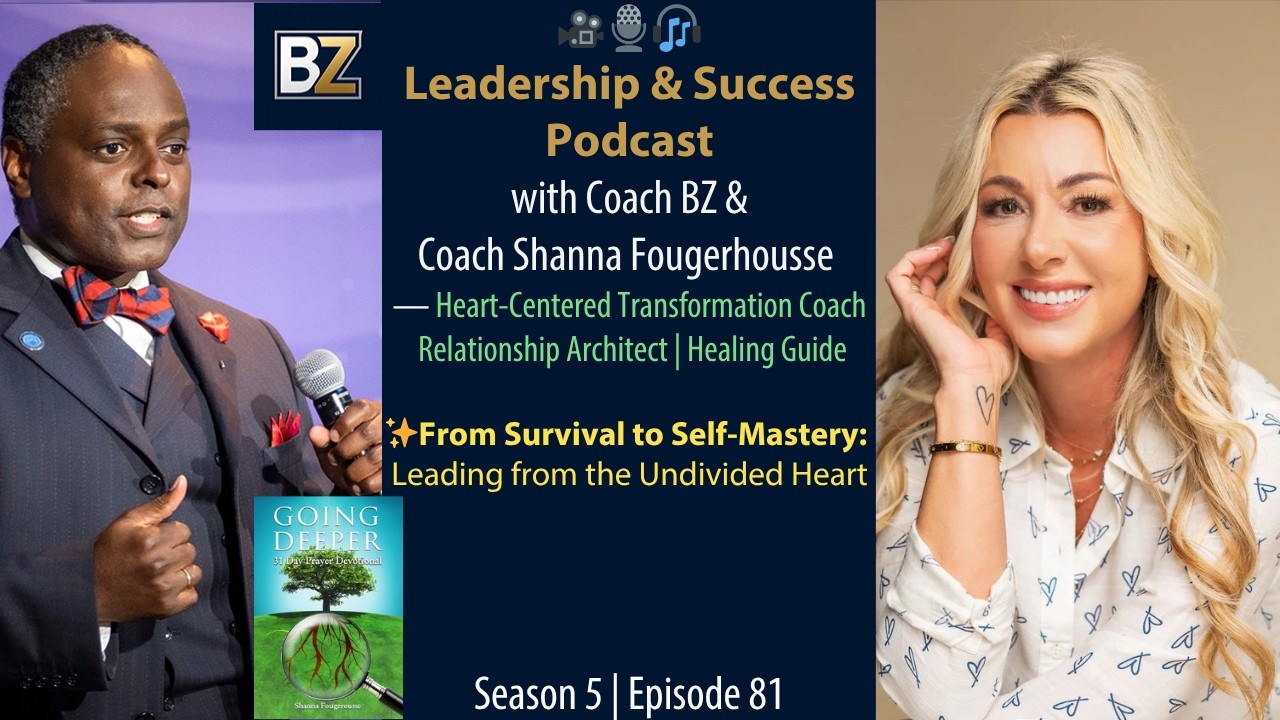
In this live episode of the Leadership and Success Podcast, host Bob Fabien Zinga (Coach BZ) interviews relationship coach and transformationist Shanna Fougerousse, founder of The Undivided Heart. The conversation opens with gratitude for peace in the Middle East and quickly moves into Shanna’s personal story of growing up with parental mental illness and addiction, losing her children to CPS, and spending decades in survival mode. She describes how a pivotal moment—her children’s removal—forced her to choose a path of deep healing rather than superficial coping. Shanna explains how childhood trauma creates limiting belief systems that manifest in high‑performing leaders as impostor syndrome, people‑pleasing, emotional masking, and a disconnect between task‑oriented behavior and authentic relational presence. She introduces concepts such as the brain’s reticular activating system, the filter of perceived value and fear, and the importance of moving from reactive to responsive states. Practical tools discussed include breathwork (box breathing, 4‑7‑8), grounding, meditation, prayer (Encounter), yoga, and frequency work. The dialogue emphasizes the transformative power of vulnerability, deep relationships, and self‑awareness for leaders in the military, tech, and corporate worlds, linking inner work to improved trust, communication, and influence within teams. Shanna also shares book recommendations (The Courage to Be Disliked), her current learning (yoga instruction, energy healing), perspectives on AI and world peace, and offers concise advice for listeners: recognize survival mode, question limiting beliefs, seek trusted coaching, and practice daily grounding practices. The later segment adds rapid‑fire reflections: Shanna’s core leadership habit of honesty, the practice of regularly asking "How am I feeling?", her childhood aspiration to be an attorney and how she now identifies as kind, powerful, and growing, and her optimism about a global healing trajectory over the next 20 years. She highlights the importance of awareness as the first step in healing, promotes her upcoming book "Going Deeper: 31 Days of Prayer Devotional", and encourages listeners to follow her on LinkedIn and Instagram. The episode concludes with announcements of future content on ancient wisdom from Proverbs and a conversation with Dr. Rachel Nutz on intentional growth, reinforcing the podcast’s mission to provide actionable leadership insights rooted in personal transformation.
Chapters
¡Hola!
Hi, I'm John Maxwell. When the top companies in the world are looking for trainers, speakers, and coaches, there's one name that stands above the rest, and that's Maxwell Leadership. Our certified team members have gotten proven results for companies all over the globe, and our reputation, I'm proud to say, is second to none. Some of our members have risen to the top of their profession, including the one you're going to meet today. I proudly introduce you to my friend, Bob Fabien Zinga.
Welcome to the Leadership and Success Podcast with your host, Coach BZ, where we help you lead with purpose and succeed with impact. If you're ready to grow into the kind of leader others want to follow, this podcast is for you. If you're determined to elevate your success and leave a lasting legacy, this podcast is for you. As my mentor, Dr. John C. Maxwell, reminds us, everything rises and falls on leadership. Our goal is simple, to inspire you, challenge you, and equip you with insights that can transform the trajectory of your leadership journey.
Welcome aboard to Welcome to another episode of the Leadership and Success Podcast with Coach BZ. Oh, sorry, it looks like I was muted there for The Leadership and Success Podcast. This is Coach Bizzy. Thank you for watching us again. So this is the second show for today. You know the drill. Let us know where you are joining us from and what you are grateful for today. And if you have a question for my guest, type it in the comment and we will answer live. So as you know from this morning, I am really grateful today for peace. Peace in the Middle East, even if it's just temporary. I am a warrior, and you would think that as a Navy commander, I like warfare, but no, I absolutely don't. I really feel like war should be the last, last, last, last resort, right? Let's talk, let's use diplomacy, and let's figure out our problem without killing anyone. But of course, if everything fails, last resort is warfare. You have to do what you need to do, but peace is so much greater. And I think most warriors will agree with me. We absolutely hate warfare and we want to avoid it at almost any cost. But I am just so grateful there is a little bit of peace in the Middle East right now. All right. Let me see if I can introduce our guest. I am so excited to be speaking with Coach Shana today. She's a relationship coach, art transformationist, coach and founder of The Undivided Heart, helping individuals break free from emotional patterns, reconnect with their authentic identity, and build deeper, healthier relationships. Her journey from overcoming trauma and addiction to leading transformational coaching and retreats is a powerful reminder that you cannot outperform the condition of your inner world. So through her work, Shanna teaches leaders how to move from survival mode into clarity, alignment, and self-mastery, the foundation of authentic leadership. And today we're going to be learning why high-performing leaders still struggle internally and how to fix it. So ladies and gentlemen, please help me welcome to the Leadership Success Podcast, Aurélie Thierry.
Wow, that was awesome.
Thank you. Your camera is black for some reason. I wonder why. I can hear you just fine.
Did that help?
No. Okay. Sometimes the camera changes to your phone or something, but I don't think that's the case for you. Let me see. I believe you had the FaceTime ID camera, right? Okay, here we go.
Yay!
Oh yeah, good, good, good.
Fantastic. Yeah, I don't know why it does that sometimes. You must have a Mac or something. It changes to your phone or your iPad. All right, you are here. So, so glad to be speaking to you today. What a great privilege and honor. Maybe to get started, I'd like to ask, is there something you are grateful for today?
It.
Oh, absolutely. I am— well, I'm grateful to be on this podcast, to be honest. I love to be invited into other people's spheres and to create new relationships. But even deeper than that, I'm super grateful for— you know, you mentioned peace in the Middle East, and you know, that's been something that's definitely weighed on my heart for many, many days. So I want to partner with that. I'm super grateful that even if it's a moment that we have peace in the Middle East, because that is something that I do believe that the world benefits from.
Yes, indeed, because my podcast on Monday, I couldn't be grateful for anything. No, when our own president is trying to execute war crimes, I'm like, no, we cannot do that. I am not in the Navy to be killing babies and children. No, that is not my job, right? I am a warrior, I am a righteous man, and I will fight, yes, but we cannot fight fairly according to the Constitution and the rule of laws and international laws, because That really matters. And I think that's really what distinguishes America from all of the other countries out there. Right. I think we have moral authority. But if we start acting like the Taliban, then who are we? That's not who I am. So, but anyway, I am just so glad we have peace there now. And I hope it remains. Man, that area of the world has known so much tragedy and conflict. It's really insane. I don't know, it seems like we human beings are so good at destroying everything God gives us. It's like, that's, that's the one thing we know how to do very, very well. Instead of building each other up and supporting each other, we just, uh, kill and destroy. And that needs to stop.
Most definitely. I think what happens, Bizzy, is that hurt people hurt people, and it just continues on through generation upon generation. And even if it's not stories that were told to us or talked down through generation upon generation, it's in our DNA. It's It's the epigenetics that flows through. And so what we're seeing, I feel like, is a culmination of a bunch of people groups that have lived in pain and, um, like honestly under oppression for so long. And I'm not saying at all that any of the radical people have rights to be radical. I'm just saying that I can understand where it comes from.
Yes.
What I do in coaching is I help people understand what mode they're in oftentimes is that survival mode. And that's what I'm seeing in these different people groups is that they're both wanting to survive in whatever way that— whatever means they feel like they need to. And so what you're seeing is this negative behavior, this, you know, not even considering anybody else. And you can look at every person from our president to the prime minister to leaders of different countries that are all kind of living in this space. And so if you take a step back and say, okay, let's, let's get out of survival mode to this powerful place where it's not just me against the world, it's like, yes, coming together and bringing more of a community-based mindset on how all benefit from, you know, the greatness of what God has given us on this earth.
Yes.
You know, to multiply and to, you know, step into these blessings. And I feel like there's— I mean, the thing is, there's plenty of blessings for everybody. Like, it's not a limited thing.
Man, I am so glad you are here. So glad you are here. This is so, so timely because I think you can help not just the individual listening now in their own personal life, but I think even region, country, and maybe even help heal the world. I think sometimes it takes just a little seed for us to view things a little bit differently, right? Because we tend to think, hey, this is my tribe, this is my stuff, don't come here, I'm gonna kill you, when we have so much more in common that we have that separate us, right? Our humanity. You know, for those who believe in the Bible, God created the entire world with just one man, Adam. Out of Adam came Eve and then the entire world. So really, in truth, we are all brothers and sisters. Really, we, we are really the same. We come from the same source. And if we can see that and really focus on what we have in common and not, you know, what separates us, this world would be such a much, much better place. But anyway, you are the right person to be talking to us about how to think correctly, maybe change our mindset and make the world a little bit more beautiful. Because I always I felt like I came to America when I was 17 years old. I'm like, by the time I am done, I definitely want America to be in a much better place than I found her. That was in 1996. Bill Clinton was president and America was quite prosperous back then. And I feel like right now we are in a much, much worse place than America was when I came here. I have two daughters and of course at some point I am going to be gone, but I definitely want them to inherit a much better country, not just with prosperity, but also with a moral compass and really values that do matter. That is really my wish and my prayer. So, let me ask you, Coach Shanna, what is something about you that most people may not know when they first meet you?
Oh, wow. There's so many facets of me. I think when people meet me, they see the person that I am today. And I've done a lot of work to become the person that I am today. I feel like today I get to show up more authentically as myself. But, you know, what people don't know is that I grew up in a very challenging environment. And, you know, my, my parents, one had mental illness, one was addicted to alcohol. And so there's just a, a lot of, um, dynamics that shaped me through those early years. And, and I didn't know it for so long, but I spent most of my life in survival mode. That's how I understand it, can see it in other people, is because I so long where I didn't even have access to the relational part of my brain for many, many years. I just showed up as an avatar, I'd say. Like, I would read a room. Um, you know, childhood trauma made me really good at that, being able to read a room and seeing what was needed and seeing what was happening and finding a place for myself. Um, so I lived like that for many, many years. I mean, 40, 40 years.
Wow.
And, um, you know, I overcame a major addiction. Um, I lost my children to CPS and to get them back. There's, there's a lot of things that I healed through on my journey, and I'm grateful for those moments. Um, to be honest, for myself, I'm not grateful that other people had to go through it with me. You know, I hate it that my kids had to go through that. Um, and we've definitely healed those places within all of us, but I felt like I was one of those people that really needed to have those things happen so that I would stop pretending. I would stop living in this state of I'm just good enough, or I could just make it to the next thing, and really get to the, the root of what was happening. And you would look at my life and you would not know any of that stuff was happening.
Wow.
Because I was really good at showing up and pretending. I was really good at showing up with the mask. I was really good at keeping people from knowing the true me.
Well, thank you so much for sharing. I really do appreciate that, especially a part of our audience. I think in the military we do live on survival mode a lot, especially when you are in combat, in a crisis. And sometimes when you transition back into your home, it's very, very difficult to make that transition. And we do go through a lot of trauma. And I feel like there is a lot of people in the military right now who may have PTSD, but they just don't know it. They haven't been diagnosed yet. And that's why, I don't know if you know the number, but it's about 21, 22 veterans and service members who commit suicide every day. Not every week, not every month, every single day. And it is part of the reason why I start the show with that moment of gratitude, right? Because I feel like you can be grateful and be suicidal at the same time. So I really feel like your story will be speaking to a great part of my audience. Thank you so much for sharing and showing us how you kind of got through this, which takes me to my next question. Because if you could take us back, you've already shared so much, but what was the defining moment for you when you realized something has to change? It seems like for most people, that's where it needs to start.
Yeah, for sure. I mean, I remember the moment like it was yesterday. It was the moment that I got the call that my kids were being taken into Child Protective Services custody. And even though I tried all I could to, you know, convince the people to give my kids back to me, they said no. And so I just remember that being the moment where I decided I had two choices. I could continue on the journey of trying to, you know, do as little as possible to heal and show up and go through the motions to get them back, or I could truly take this time to heal so that when they did come back, they had a mom that was really there for them. And, you know, it was the hardest thing I ever did was healing. Um, and I took the long road because I didn't have somebody like me that led me through the journey. But I learned a lot of things on my journey. And, um, and that was just the moment where I was like, I, I've got— I'm at a crossroads. Which way do I want to go? And I may never have this opportunity again. Do I— what do I want? And I really chose the, the path that was going to be harder, but it was going to net me more benefits and more, you know, blessings on that journey. And so that's— that was what I decided to do. So that began my deep healing journey.
Wow. That happened because I'm doing research for this program. I've seen that you've spoken about choosing yourself for the very first time. What did that decision look like in practice?
Yeah, I— it was— it wasn't a— it wasn't necessarily a decision in the moment. I think at that moment I felt like I was choosing, choosing my children's legacy, generational change. I mean, I had lived a life that really emulated my past, like my parents, the parents before them. I mean, there was always types of addiction or types of trauma that was within my family line, and So I felt like in the moment I was choosing my children, but I did eventually begin to understand that I was choosing me on the journey of healing. And what that meant for me wasn't, you know, the self-love of like, I'm choosing to go and get a massage, or I'm choosing to like have personal time. It was like, I'm choosing to get to know me for the very first time because I had never known who I was. I never— when I was, you know, growing up in the traumatic home life, I didn't have time to determine things that I liked or who I was like or what my personality was like. I did what was necessary to survive. And so Choosing Me was beginning to have a relationship with me. It was beginning to like get to know who I am and what I like and what I am like. And that was the journey that really opened up the healing process for me in a way that I never anticipated.
Wow, that is so brave because the work you do, Coach, I mean, yeah, I guess people could say it is a business or a profession, but to me, it's more like a ministry because you are helping so many people from your testimony, the things that you went through and you have learned. If I may ask, what were some of the biggest internal battles you had to overcome before you could help so many other people?
Wow. Well, one of them was that addiction mindset. That wanting to get away from those big emotions, wanting to not feel the big emotions, you know, typically like pain. Anger was one that I would let myself feel, but that was only because it kept me away from people. So it was like a protection. Um, but so that was one of them, was really looking at that and seeing that that was no longer serving me. Um, I think another one, um, that, uh, That was big for me is I held a huge part of me that felt responsible for everybody else's emotions. And I found that through my healing process and was able to really release that and understand that, you know, I'm only responsible for myself. I'm not ever responsible for anyone else. But I had lived that way my entire life. And it, it actually was rooted down deep into the relationship with my mother. My mother was a very young mom and Um, this is kind of, you know, deeper into the work that I do, but when we're younger, um, if our parents aren't able to emotionally connect to us, and emotional connection is necessary for growth as a child, and so we'll find a way to connect with them that models or mimics emotional connection. And so I created a job as a child to be my mom's emotional regulator. And that's what I did for my whole life. I helped regulate her emotions, which then, you know, caused me to erase my own.
So basically, you didn't have enough time to be a child yourself. Basically, you become almost like a mom. And wow.
Yeah. Yeah. And I think a lot of people can identify with that. I have a lot of clients that really tune into that when I share it because they feel that. They feel the responsibility for other people. And that shows up as a people pleaser in life. It doesn't mean that if that's a way that you show up, that it's always that. But a lot of people have a degree of feeling like it's their responsibility to keep the environment in a certain space. And so they, in, in essence, you know, erase themselves in the process so that they just fully be engaged with what it is other people need from them. And, you know, so many people feel like that's just the way it is. That's their personality. That's just how they are. And I'm here to tell you that it's not. It's actually a personality that was developed out of survival, but it's not necessarily your personality. And, you can easily move into a place of healing where then you can see what your true personality is.
Yes. I think it's really key, that survival mode. I think most people don't really realize this. So, for the leaders who are listening right now, how do they know if they are operating in survival mode? Instead of purpose.
Yeah, I think it masks a lot in task-oriented personalities. So, um, for me, I could look at what was needed and I would think, you know, relationship is important, but it's not as important as getting this job done. This job done is really important. And so whenever I would focus on that, um, I would kind of get into tunnel vision where I was only able to really focus on that thing getting done. And through the process, you know, there wasn't a whole lot of care for other people or care for what was going on. I wasn't—
yes—
available in the present. My mind was always somewhere else, needing something else to do. I couldn't sit in stillness. Um, and so just if you think about survival mode, it's, it's accessing like the primal part of your brain. So what are the things that are survival? So protection, shelter, food, You know, it's like if love is one of those things, then I'm surviving for love. And so I might move from relationship to relationship or thing where I feel that essence of love. So it's like at all costs I do this.
Wow, really insightful. Uh, let's talk about healing the leader within. I think for the majority of people who listen to the show, whether it's in the military or high tech, we tend to really use a lot of logic and strategy. But I've heard you say that transformation really starts in the heart, not the mind. Can you break that down for us?
Yeah, absolutely. And I'm one of those people too, because of the life that I lived. My brain wants to understand it before I want to get even close to emotional. The emotional piece of it feels very vulnerable. It feels foreign. It feels scary. You know, it's a place that we don't necessarily live in a lot because we do stay in that logical side of the brain. And, you know, I found that it's, it seems to be the comfortable thing, but the logical side of the brain is, is really interested in more activities. So like behavior modification, changing the behavior, changing the output, but it's not focused on really what's going on, say the input or where it's coming from. And so, um, we have a part of our brain called the reticular activating system, and it's like a filter for the brain. And we did, we kind of, uh, we program that by the things that we value, the things that we fear. So there's anywhere between 40 billion bits of information that can be brought into the brain in one moment, just through all the different sensations. And our brain is not able to take in but like, you know, 40 bits. And so it's got to figure out a way to filter out what's needed. And so through what we have determined is valuable to us or determined, you know, what we fear or what we're going towards, then that's what our brain shows us. And so all of us are looking at a very skewed reality based on what we fed our brain.
Yes.
That we want, uh, to see. And so oftentimes when we think about the logical part of it, well, there's no logic in that other than, um, what we've programmed is all emotional. So it's the things that, you know, easiest way to say this is like, I decide I'm going to go buy a new car. I go look at, I decide on the car that I want and I'm like, oh my God, I love this car. I've not seen this car on the road. And then I leave the dealership and I see 40 of the cars in a mile.
It's everywhere. Yeah.
So I just trained my brain on what that was. That is logical, but that's also emotional. And so when we don't get into the emotional part of our brain, we, we put stuff on top of the belief system, but ultimately the belief system is still the same. And if I quit doing those behavior modification things where if it's like, a discipline thing, or if I'm staying away from something, um, I'm not going to change anything internally until I deal with the emotional root of why that part is showing up in my life. Wow. And so that's what I had to do. I had to get real real with like, what's the emotional driver behind this behavior?
Wow.
Is, is that why you think most people, they usually don't respond to whatever happened to them but just emotionally react? And sometimes they don't even realize what they say or do.
Yeah. So that's the work that I do, is that when we have a reaction to something in an environment that is bigger than what that situation was necessary, we know that we were, I call it eclipsed by that emotional part of us. So for instance, you can be a 40-year-old person in a boardroom, in a meeting, and somebody slightly raises their voice and all of a sudden your heart is palpitating, your hands are sweaty, and you're like, what happened? Well, you're no longer 40-year-old person in a boardroom. You're a 7-year-old at home.
Wow.
Being, you know, in a situation to where you felt lost, alone, stuck, scared. And, and so that's the work that I do. But what happens so often is we don't even notice it until we hit like midlife.
Yes.
Because we're able to like push it down. We've got space within us that we can just push it aside. And then there's all of a sudden one day that those techniques don't work anymore. That stuff that I used to do, I don't have access to. It's like when I'm in these situations, this is what happens to me. I become somebody. And you're really just remembering a place within you, a state, a power, a primal state where you were alone and needed help and weren't able to really fully process through that emotion. And so it gets stuck. It doesn't just go away. We don't just push it aside and it never comes back. It lives somewhere within the body.
That is, that is so insightful, Andy, because I think for a lot of professionals out there, kind of like you mentioned, that it's almost as if you are wearing a mask and you try to hide your true feeling, compartmentalize them. And I think many men are really, really good at it. But you're right, after a while though, it's just going to burst out because you've never dealt with it. So for the leaders who are listening right now, what are some of the most common emotional patterns you see in high-performing leaders?
Yeah, I would say the most common one is where there is a, I would say, almost a double-sided kind of mindset where we want to show up and be this got-it-all-together leader who is doing all the things and being successful, but secretly they're alone. They're an avatar, so no one knows who they are. Um, they feel like a phony. Um, they're constantly hearing like the, the mindset of like, you're not good enough, people are going to find out about you, when's the when's the next shoe going to drop? And so there's this constant internal dialogue that's going on that you're having to fight because you want to be seen as a successful, got it all together person. And all the while, you're dying inside because you just want to be seen. You want someone to truly see who you are. And so that's one that I see very often. Um, and I think there's another one that, you know, uses more of a, like, uh facade of like, um, strong, powerful, um, maybe a little arrogant, or just kind of like roll over people because you don't want them to get anywhere near your emotional space. So you almost keep it in like— what I used to do is that anger burst because it keeps people away and it keeps them believing that you're the person that you, you know, want to show up as. And I don't say this to like dog anybody because I get it. I know why we show up that way. We will do anything for people to not see our pain because our pain to us feels like weakness. Nobody wants to show up and feel weak. And so I, I see these, these, you know, ways that people show up, and I, I know it comes from a place of pain. I know it comes from hurt. And my desire, just like we were talking about in the beginning, you know, it's like when people can truly be seen and those hurts can be healed, then you get to show up the way that you desire to, which is oftentimes a lot like the avatar, but you're truly being seen. So it feels like a real relationship, not just a one-sided transaction.
But isn't pain what really makes us human? Because to me, it seems like suffering is optional. But if you are a human being, you're going to have to go through pain. So you need to learn how to process it. Isn't that right?
Absolutely. 100%. I do think that a lot of us growing up were in situations where we didn't understand how to process pain. Maybe it wasn't modeled for us, or maybe it wasn't allowed in our home. Um, you know, and so we, we were having to suffer in silence. And so all we knew was suffering. We didn't understand that pain was a lesson. Pain was just information. It wasn't something to necessarily have to make sense of every time, but we could just allow it to process through and teach us the lesson. And I, I agree with you 100%. I just think that in a lot of the westernized culture, that really wasn't something that was taught and allowed, especially for men. I think men got the, the sad part of the stick. Like, they, you know, women even if they didn't get it in their home, they got it with their friends. Like, girls could get together and it was okay to talk about your emotions if you had a group. Men had nowhere. They couldn't talk about it at home. They had no friendships they could talk about it with, and they had to show up as a certain way and with their friends. Um, and so they just never got to be known. And, and I, I feel like I kind of was in kind of like the men category. I didn't really connect well with girls.
Yes.
Also, because when you have a lot that you're hiding, it's hard to get together and share it because it's like my whole life has to be a secret kind of thing. So I, I understand where guys come from with that because I felt that myself where, you know, my life had to be a secret. And so I had to compartmentalize so many parts of my life. So I really understand that, that a lot, what a lot of men have gone through, even though I'm a female, I understand it to a degree, I would say.
Yes. And I think especially in the military, for example, in the Navy, you know, lots of alpha male, I am stronger than you, I'm bigger than you, blah blah blah. But, but then also, uh, if they get physically injured, they have no problem going to the doctor and getting fixed. But if it's emotional, then they feel like, oh, I can't, I can't say that, then they're gonna think I'm a sissy or, or whatever, a girly man, or, or whatever it might be. And then they don't ask for help. So that's why also I think the number of suicide in the military is so high, because there are people, they have emotional need and they need help but they're just too arrogant and proud to say, "Hey, please help me," when in reality, especially the VA, they've spent a lot of money and resources now, now more than we did 20 years ago when I first joined the Navy, but the people would not just come and get help. It's very strange.
Yeah, I think it's just a trick, to be honest, how we can be okay with physical injuries but emotional and and mental injuries, somehow those are less valid. And I do feel like that's changing ever so slowly. There's a lot of good science coming out. Um, I, you know, one of the greatest books that I ever read was this one, The Courage to Be Disliked. It is one of the most amazing books. It's, um, so there was two psychologists, um, back in the day with the father of psychology that we know today is Freud. But this was his partner, um, what was his name? Uh, let me see.
It looks like it's by, uh, Ishiro Kishimi and Fumitake Koga.
It is, it is. That is who it is. Um, was Alder, A-L-D-E-R. That was the psychologist that this is based off of. But this book is great. It's a conversation between a mentor and a mentee. And the basis of this book— I mean, this is The Courage to Be Disliked— is to help you understand, to free yourself, change your life, and receive true happiness by understanding what's really happening underneath. And I love it because it does help you kind of walk through some of these things that I'm talking about.
Yes.
And help them come to the surface. One of the things that they talk about in here is that every thing that we do, every, um, kind of, uh, pattern that we get into, it's—
we—
it's created because it's, it's a solution to something.
Yes.
And so finding out what was the solution to helps you figure out what the ultimate root problem is. And so whenever we began to look at truly our life from that perspective, we gained so much insight And that really helps us become more self-aware, and then we're able to take personal responsibility over our actions instead of— because the work that I do, it's not about looking at the trauma, the things that people did to you. It's looking at what's happening in your life today and what do you want to change. And so then let's work on healing those roots, no matter what happened, so that you can step into that personal responsibility and self-awareness and and step into a different life.
We're going to get deeper into the root. Again, the book, The Courage to Be Disliked: How to Free Yourself, Change Your Life, and Achieve Real Happiness, Ishiro Kishimi and Fumitake Koga. Wow, more than 3 million copies sold. That's a lot. Well, thank you so much for sharing those resources with us because we also have a digital bookshelf of this podcast. I just started this, I think it was May of last year. We already have close to 400 books there, just for guests who come who recommend books for us to read. And yeah, it is really amazing. So you talked about wood and we kind of referred to childhood trauma as well. And I've seen that happen. One example you chose earlier, you are 40-year-old in the ballroom, someone loses their voice and all of a sudden you become anxious. So it's not what's happening now. You are going back to when you were 7, 8, 6, maybe your father was drunk and he did something or whatever it might be. I guess The question I have for you is, how do childhood beliefs show up in leadership decision and team dynamics?
Yeah, so our childhood beliefs are created through a child mind. So if you think about, you've got someone, you know, you're, you're you, but under the age of 7, those are where beliefs come. A belief can be changed, but it's got to be challenged. And oftentimes we don't know to challenge the belief because we just assume it's just the way it is. This is just my personality. So we don't challenge them. And so the way that I've seen it show up is different personalities, of course, show up different ways. And so maybe there's a situation where you just don't do good with confrontation. And so you just don't confront because you don't feel comfortable in confrontation. And so then things can happen in your leadership if if you don't confront situations or people or problems, then you're just waiting on someone else to fix a problem. And so obviously we know that that is— that creates a lot of things. A lot of things that it creates, um, or what I see it creates is definitely issues with interpersonal relationships.
Yes.
In the, in the corporation. I've seen it happen in churches a lot where the leader is not good with confrontation, and so negative, bad things, you know, are left to kind of be created. And then you've got an atmosphere and a culture that you never intended to have. So that's one of the ways. There's another way of like being the bull in a china closet, you know, where you just kind of roll over people because you're— you know, confrontation to you is having your way, doing it your way. And so there's not this ability to really be present with people. Maybe people don't feel safe to you because there, um, there's beliefs that we have that, you know, people, certain people will do this to me, or certain people won't step up and do this. Um, and so I've just noticed, like, with leadership, whenever we have an insecurity, we're going to lead through that insecure attachment style. So it could be like anxiousness, where, you know, that could be like, I'm not good with confrontation, so I'm just going to run away from it. Or more, more like a the avoidant who doesn't feel like, you know, they can really work with people. And so they kind of like push everybody around and it's just my way and this is the way I want it done. And there's not a collaboration. There's not an inviting experience where, and I think when people look back at their life, that's where most of the joy is, is being able to collaborate, to connect. Like what you're doing here, you're inviting people to come on your podcast that that, you know, do similar things that you do, and allowing people to learn from different facets of people's lives. I think that that's where the power is.
Yeah, yeah. I think definitely one, one key, and you do it so, so well, is, uh, really identifying the belief, right, behind the behavior. So how can someone listening right now begin to identify that?
Um, I think to start with, the easiest way to do it is just to begin to question your beliefs. So maybe you have a belief that work is hard, or making money is hard. So whatever belief that you feel like comes up for you— I think money is a big one for people. A lot of us have beliefs that either you know, money's hard to make, or, you know, money's not, uh, there's not enough of money.
Yeah. My dad used to say, do you think money grows on trees or something like that?
But yeah, I heard that too. And so even starting with something like that, okay, where did that, what does that mean? Money is hard to make. Well, because when I was, you know, growing up or as I've looked back, it's like, it's always been hard. Well, remembering what I said about that part of your brain that's a filter is like we've created that reality. So how do I change that? Well, has money ever been easy to make? Maybe it's not for me, but it's— maybe it's been easy for other people.
Yes.
If it's been easy for other people, that means it's not absolutely true that money is hard to make. Okay, so could I look at someone else's life that money has been easy for them, and could I see you know, how money could be easy for me to make.
Yes.
And so it does— it's not something that changes with affirmation. It's something that changes with curiosity. And it does help doing this with the coach because I'll be honest, when I started doing this, like, I would stop at the question because I wouldn't even know how to engage with myself. I wouldn't know how to talk to myself. I could talk to other people, but when it came to myself, it was like a black screen. It was like shutdown. Nothing. So, but I do think if you have that ability to sit with yourself, one of the easiest ways to do it is just to start challenging your beliefs to see where did this come from? Who told me this?
That is really powerful. Let's start with the inner work, which I think is really powerful for those who want to take the journey, which will lead to the outer impact. How does self-awareness translate into better leadership outcomes?
Well, I think when we become more self-aware, we actually become more aware of the environment that we're in and how we're interacting. So the interdependence with other people, which makes better leader. You know, I've talked to a lot of people on LinkedIn about their, you know, if they think that relationship is a teacher or a challenge. And a lot of people that I've talked to have said that it's been a great teacher through the challenges because it's taught them how to really be able to read people and show up as a leader for what the people need instead of just a leader, how I lead.
So, it has to do with your mindset, huh?
Yeah, I think that whenever we can take ourselves and put ourselves in the equation with other people and see it as like we're a group and what does this group need from me as a leader, then I show up as a better leader. But I can't do that if I have no self-awareness, if I have no ability to connect with the emotional side of people. Because I'm not going to see the things that they need. I'm just going to look at it as a task. I have a job to come here to teach these people this thing, and there's not going to be the connection. There's not going to be that understanding of, of what they need. And we're not going to, like, be cued into the hints that they give us with the questions that they ask or their body language. We're just going to do the job that we came to do. So I think that a great leader is someone that can, you know, move and be shaped by the group that they're talking to for that moment. And that's not to be inauthentic. It's to show up authentically you, but to serve them instead of coming as a task to teach.
That's really powerful. So being fully present, self-aware, and aware of your surroundings and your people.
Wow.
So we kind of touched about this earlier, but what's the difference then between reacting and responding? And why does it really matter in leadership?
Well, I spent a lot of years reacting, which was I would just be taken offline by the emotion. And I would just say whatever it was that came up without any filter, without any love, without any relation, without any connection. And oftentimes, I would have to come back and apologize. That's reacting. And so it's not being present in my body. It's not connecting relationally. It's being offline from the relational part of the brain and being back in that primal part of the brain. And responding is when I can take a breath, I can think about what was said, I can depersonalize it, and I can give a response that will bring connection or can set a boundary. But it's done out of love and care instead of out of protection. And so I think it's really powerful when we can become responders instead of reactors.
Yeah. I've had many coaches here before and we talked about what regulating the nervous system, I guess, something you do with mindfulness and it allows you to create that little space so you can actually respond, right? Instead of reacting to whatever is happening to you. In a way, that's what we also do every time we start the show for the moment of gratitude. Sometimes I ask people to just close close their eyes, take a deep breath, and really think about something they feel positive about or they are grateful for. So a question for you is, how can leaders regulate their nervous system, especially in high-stakes environment? For people in the military who are listening now, they may be in a combat zone or people in cybersecurity, they might be like a breach or something and they are like in high alert. How do they regulate themselves in the environments like that?
Well, real quick, I want to say one, one thing before I respond to that question. So what I do, instead of you having to do all these behaviors to remember to take that breath and respond instead of react, is I help you clear out the belief that creates the interaction, like that, that offline-ness. And so I heal the root. That's what I do. So there's not this behavior modification. It heals it and changes the behavior immediately because the behavior was just a response to protect yourself in that moment. And so, when you don't have that place to protect anymore, then you can be embodied and be yourself and stay present. But I would say for leaders who are in these high-stakes environments where it's really important for you to be able to stay in your body to make a decision or to respond, breathwork is one of the best ways to do that. And there's really simple breathwork techniques. Um, one of them is the box breath where it's breathe in for 4, hold for 4, breathe out for 4, hold for 4. And you just do that and you can just even visualize a box as you're breathing, have your eyes closed until you feel you're back in your body. Another one that will help you downregulate, so if you're really, really high and like just the box breathing is not it, take a breath in, hold it for a couple seconds, and then breathe out like you're breathing through a straw as long as you can. So it's like— so make that out-breath be super elongated. And it— in the beginning, because you're really ramped up, it may be just a little bit. But as you continue to blow out and let that out-breath be super, super long what you do is you— you're— what you're telling your nervous system is we're downregulating. It's time to change states. And so you can immediately change your state by doing something like that. It's called the 4-7-8 breath. But I like to just say that if you just take a deep breath in, hold it for a few seconds, and then just blow out like a straw, it's just way easier to remember.
That is really, really powerful. Thank you so much for sharing that. So what advice would you then give to a leader who's highly successful externally But they are struggling a lot internally.
Yeah. Well, I mean, I would first say I get it. You know, you have built an incredible life. You're super successful. And the thought of stepping into this vulnerable space can feel overwhelming. And yes, there could be the thought that I'm going to lose it all if anybody catches wind that this is what's going on within me.
But imposter syndrome.
Yeah, I would, I would say like find a good coach, find a coach that's been there that can lead you through this practice. And a good coach is going to be a safe place for you where you're not going to ever fear that this is going to get out. It's a safe place. It's, you know, a one-on-one situation because this is not something you go through by yourself. This is not something, you know, I tried to heal by myself for years and there was levels I could never get to because I was stuck with the same mindset. I can't, I can't be my own coach. I need somebody else to lead me through it. And so I would say, you know, find somebody that you can be really honest and vulnerable with. That is the only way to get past that imposter syndrome where you're feeling, you know, everybody knows me as this amazing, successful person, but internally, you know, I feel weak and sad and lonely. And those are real feelings and those need to be validated.
Well, Coach Anna, I think that is so true. Even coaches need coaches, right? Even doctors need doctors too. It's just the way it is. But the inner work you are talking about, how does this work improve trust, communication, and influence within teams for those who are willing to go through this journey?
Yeah, well, I think when we begin to, first of all, trust ourselves, a lot of us have this conflict within, you know, that of, um, turmoil that's within. That's conflict, is we have, you know, for lack of better words, a part of us that is successful, that's showing up, that's doing these things and wants us to keep doing these things. And then we have a part of us that's being real with us and saying, I'm, I'm feeling these emotions, I'm feeling this way. And so there's this internal conflict which leads to distrust. So if you have something going on within you, you're going to see that outside. We think always like the people out here, this, this, this situation out here is affecting my insides, but it's never that way. It's always a mirror for what's happening inside of us. And so I have found that when you clean up the interior part of you, when you get things aligned to truth, whenever you're able to really show up and embody, you know, the authenticity of who you were created to be, that everything outside changes. The relationships you have change, the environments change.
Yes.
And not necessarily because other people are doing things differently. It's because you're showing up differently and you're, you're, what's happening inside extends outside, as I said before. And so it's changing the dynamics of the relationships. It's making you more open. It's creating a place where I trust myself. So there were, you know, these people could be trustworthy. I can see what trustworthy people look like because I've learned it within. And so it changes, it really does change everything.
Wow. Yeah. One of my mentors says like, your inner world start affecting your outer world. It's so, so powerful. Now, I could be talking to you for hours and hours. Looks like we only have about 10 minutes left. I can't believe this. Looks like we just got started.
I know.
But let's talk about relationship. I think this is key. I do believe that we weren't meant to live alone. We're meant to live within community. Actually, no, before this modern world, you had to stay with your tribe or you would definitely die, right? So, uh, you talk a lot about the leadership multiplier. You say that the quality of our lives is tied to the quality of our relationships. How does that apply to leadership?
Yeah, I mean, I, I agree with you. We cannot do life alone, and people that tend to do life alone are less happy. I mean, that's proven. Um, we were created to be in relationship, and We were created to need people. We were created to have this exchange of values and needs and to grow. And, um, and I do feel like when you have rich relationships in your life, that you're a rich person, and that you also create more things, that your life is more abundant, and therefore abundance comes to you, you know. And I don't necessarily believe in like the law of manifestation and the way that says, but I do believe that we manifest the things that we want through the actions that we have. When we partner with having a life of abundance where we cultivate healthy relationships and we value them and we see them as not necessarily a commodity but something to be valued and held and, and protected, that what we end up getting in life is so much better. I think back in my life, I spent a lot of my life being an island, very lonely, isolated again, because when you have a lot of stuff going on, you don't really know how to connect with people because you don't have necessarily anything positive happening.
Yes.
And my life is so much richer today because I do have relationships. I do have deep conversations, and they're not surface relationships. Even business relationships aren't surface. They're heart to heart. Even though they don't always go super deep, they go deep below the surface. To where it creates— I mean, even this relationship, you and I just met through the DMs on LinkedIn, and there was a connection there where it was like, let's go a little deeper. And, and so even here, like, even looking at the richness of what this has created, and hopefully this is bringing value to everybody that's listening, it's brought value to me just being on here with you and giving me an opportunity to really talk through the things that I talk about. You know, it's just so much to that. And so I believe that that's really how you can check the health of your relationship within is what are your relationships outside? What are those like? What is, you have a partner, if you have family, and this doesn't necessarily mean that that's on you if you have a negative relationship with family, because I get it. Family's family. And sometimes we just have to work with it, but are your friendships deep? You know, do you have. People in your life that you could call if you had an emergency and they would show up? You know, that to me determines like, what have I cultivated? Have I cultivated deep relationships with people?
That is so, so powerful. It's not really that complicated. It's not rocket science, but it could definitely make a huge difference in people's life. Isn't that true?
Absolutely.
Because something you said, I'm sure for most people, the meaning of success may have changed throughout their career and life. We talked earlier about people who appear to be successful externally, but really on the inside, they are a big, big mess. Like one person, for example, great actor Robin Williams, everybody knew him. He made everybody laugh, but he was so sad on the inside, so much so that he killed himself. People are like, how is it possible? The great Robin Williams, the one who made everybody laugh, How come he was so depressed and he had to do that? I guess the question I have for you is, has the meaning, the definition of success changed in your life, the way you look at success, especially as you think about the wealth and the richness of relationship?
Oh, absolutely. I mean, success, I think when I was growing up was to have all the things that you wanted, to have status, to be working a job that other people, you know, um, saw and benefited from and thought was, you know, being an actor or being a celebrity. But, you know, I have learned through my journey of what I do, I've worked with a lot of very successful people who, yeah, they have success on paper and they have success in certain areas of their life, But if you were to— if, if I was to ask them, do you feel successful, they would say no, I don't, because there's something missing. And that's something missing is that emotional connection. And if they lack that emotional connection with themselves, then it's impossible to have emotional connection with someone else. We can't give what we don't have.
Yes.
And, and so I look at people like Robin Williams, or even people in, you know, In Christianity, we've had a lot of pastors fail and fall lately. Yes, for hidden lives. And, you know, I think that what happens when we hide, when we have, you know, this, these negative emotions or these negative thoughts that we just won't look at, then we end up showing up either like a Robin Williams where I'd— and we finally just decide to end it because we can't take the pain anymore. Or we find places where we can live out these harmful, painful, you know, things and put it on someone else. And so we become an abuser or perpetrator ourselves. And so you see it in both ways where like it's either an internal killing from within or it's an external killing outside and where we, you know, definitely hurt other people. And I feel like, you know. To truly be full, truly successful, you have to be able to feel good with yourself. You have to like yourself. You have to be able to be still and quiet and, and be with yourself. And not like, you know, an introvert where I can only be by myself. I don't think that's necessarily the healthiest way. I think learning to be interdependent, where you have relationships with the people, but you also feel fully, you know, safe and excited to go to the park and walk around by yourself and have a talk with yourself, and that doesn't feel weird, or like have to have somebody with you. It's like where you are your own friend.
But now, to have those deep relationships with people, that means you have to be vulnerable, and many people don't like that feeling. Uh, what do you advise, especially men? I think women, like you said, are They tend to have cliques and talk between girlfriends and stuff, but men, we usually do not do that. What would you advise a leader who is listening to us right now who feels like they really have shallow relationships with everybody? They know they just focus on work, task, task, and success in terms of material possession or money, but they're really, really sad on the inside. Why should they be more vulnerable in order to to really have those deep relationships we are talking about.
Yeah, and I think when we look at vulnerability, sometimes we look at it like it's an all-or-nothing type of thing. And I think vulnerability can be like steps in, so baby steps. Um, so somebody who's really struggling on the inside and wants to connect, um, something a little less surface could just simply ask, you know, somebody that they want to be in deep relationship with, um, just a simple question about like, how's your life going? Like, for real? Like, um, do you have, you know, something that you would like to share with me? And it's like, there's— is there anything, um, hurting your— you know, is there like— I don't know, I'm not a guy, so I think like a girl and I talk like a girl. But yeah, you know, it'd be like, you know, is there anything, um, in your world that's, you know, creating a lot of of like spiraling thoughts. Like, is, is there, you know, I just finding something just right underneath the surface to ask. So it doesn't have to be like, how are you feeling about this or this? It could just like, man, talk to me about like the worst day you had this week, something like that. Or, you know, what's one of the biggest struggles you have with a client or in your business? Yes. Um, just something that gets deeper in the surface where you're hitting that emotional piece but you're not necessarily going all in and, you know, tissue box and having like, you know, that fear of like the water and all of that. But you're just, you're finding out like what's really going on with somebody, you know, like, like what's really going on in your mind. What is something that you're worried about, you know? What is something that you care deeply about? So it could just be something like that. My husband was really good about— he had a group of guys and they would call their group of guys. You know, you had to call one of the guys each week just to see, hey man, what's going on this week? What's really going on this week?
Yes, yes.
Just let them share. And so just maybe you being that person that can start it where you become a safe place for someone to truly share what's going on in their week. Maybe what's the highs and lows? You know, what's one high and one low that you had this week where it's really getting into a deeper space than just the, yeah, man, you killed it in sales, or yeah, you did great in that meeting, but what's really going on?
Wow. That is really, really powerful. It reminds me, I do have a mastermind here. We meet about every 2 weeks, but of course, the rule is whatever is spoken here stays in this room. Nothing gets out of here. And you can be absolutely vulnerable and speak frankly. You don't have to pretend to be something you are not. And that really, really helps a lot. And I really wish every man would have something like that. So, so powerful. Okay. We are running out of time, but already I see in the audience, Daniel Young says, "This conversation around moving from survival to self-mastery really resonated." If it just resonates with one person, I think it's more than worth it. The entire hour we spent here is really worth everything. But since we are running out of time, can you give me an extra 5 minutes, Shana, or you have—
No, absolutely.
Yeah. Okay.
Yeah.
Let me do this because I like to spend just a little time on the last segment. That's where I try to get into the way you think, your mindset, what has allowed you to achieve the level of success you've had. And maybe you can share that with my audience so we can kind of follow in your footsteps. One question I'd like to ask is, what do you think is one of the greatest lessons you have ever learned, whether it's in life, in leadership, or just in general?
I think the greatest lesson I learned is that I can't run from my past, that ultimately, um, in order to move forward, um, I need to reconcile it. And that just, you know, that definitely changed my life. So just like trying to push through with willpower instead of healing the underlying were just not going to work for me.
So what do you think was the secret of your success going from survival mode? I mean, even having, you know, you shared your children being taken away by CPS to now self-mastery. Even beyond that, now you are a coach to so many other people and you are really bringing hope and healing so many relationships and people across America. What do you think is the secret for that turnaround for you?
Um, I think for me it was just staying curious, that wanting to learn more, wanting to understand more. I was never satisfied with just what I was taught, like I wanted to understand it and embody it so that I could heal. And so I tried a bunch of different things, but I think really for me it was that driving force of just curiosity and never being okay with just the status quo.
Really insightful. And I know leaders are learners. What are you learning these days?
So right now I'm actually learning yoga. I'm learning to be a yoga instructor. That's kind of my next journey for personal development. And also I've— and so there's a lot of reading that has to do with that, um, that certification. But I'm also, um, what is the other thing that I was reading? Um, just learning about like frequencies and how actually we can partner with frequencies to help move some of the energy. Um, and so just checking into like energy healing and things like that. I ultimately believe that we can be our own energy healers whenever we step into this work because you become more aware of what you're feeling inside instead of, you know, needing there to be that block or that separation from it. You just begin to understand that emotions are just messages. And so if there is something going on within you, like I had to walk through grief this last month and really letting myself feel that, you know, embody that and not have to push it away felt so good. And honestly, it allowed that process to really move through in a way that felt truly reconciled instead of me, that it's going to come back and I'm going to have to continue to work through that. So yeah, I think that just learning, I love to learn. And so I'm always like checking in on things, more breathwork, deeper breathwork, understanding that even in just different modalities.
So.
Everybody's talking about artificial intelligence these days. Seems like it's changing pretty much, impacting every single industry. How do you see that? Are you like more utopia, or, uh, you think it's going to be the end of the world?
I mean, I'm kind of in the middle, to be honest. I think that anytime we have like a number of people, like 5 that are in control of this. That's pretty scary because, you know, it is— hopefully their hearts are healed and they're moving with compassion and love for everybody and they're not in that.
No, I think they are moving toward profit. I think that's the number one thing.
Yeah, yeah. So of course there's pause with that, but I do believe in ultimate truth and I do believe in ultimate source, and I do believe that when, um, a few of us partner with that, nothing can stop that frequency of authenticity. It's the highest frequency in the world, higher than love, because it's truly love of self, love of understanding of that you were created by a greater being. And I think that when we can step into that and we can all resonate at that, we don't have to fear anything coming. We can actually vibrate at the, you know, the high frequency of authenticity, and nothing can penetrate that. And actually we make move on the things that would try to take humanity out or anything like that. So I don't walk in fear. I definitely walk in like, you know, making sure that I'm aware of these things and releasing my level of prayers, like releasing like that positive energy and partnering with truth, that truth would ultimately be seen. And I just think that if more of us did that, we stepped into that more more of like walking in love, truth, and light, that we would see a change in the world and we wouldn't have to fear AI. And, you know, I think AI can be a tool. Um, I think that, you know, we— it's up to us on how we choose to use it. Also, I don't think AI has a soul, and so AI can never truly make decisions based on what's good for humanity. So ultimately, it needs a leader and that needs people that have compassion, love, and lead with truth.
I really like that. I think this is so timely, especially in the era we are living in now. Rumors of war, wars in Iran, the economy going down. There's just so much bad news all around the place. How do you keep yourself centered?
Doing the things that I teach my clients to do. Meditating. I do a type of prayer where it's called Encounter, where I actually visualize myself encountering God. And then I also do breathwork, you know, I, I ground, I, you know, I work with frequency, I do the heart work. And so when something comes up that is kind of knocking me off and making me feel not myself, tells me that I'm being triggered by something and thing is trying to pull me into that primal state of mind where it's survival over over connection. And so I do the work, um, and I think that, you know, always being aware that, you know, things can come up is important. I am not ever going to be fully healed because I live in a world where there's going to be constant things trying to take me out or offend me or whatever it is. And so, yeah, you just got to stay embodied within yourself and do the work myself, you know. So all the stuff that I teach people to do, I still consistently do myself.
Wow, thank you so much for sharing that because, um, that could really be impactful for a lot of people listening right now. And, uh, if I could ask you, if you could choose 3 people to have dinner with, right, they could be alive, dead, or even fictitious characters, who would you choose and why?
So number 1 would be Jesus Christ. I would definitely want to have dinner, and I So many questions and things that I would love to talk about with him. Um, another one is, uh, Martin Luther King. I would love to talk to him. I think that he was alive in a very unique time and, um, I just have questions about like his life and, and what, just what he would think about today. And then, um, Abraham Lincoln, because I do value like a lot of his politics. And I, I mean, I got a degree in government in college, so I'm all about like, um, seeing like truth and great leadership in government. And so he would be someone that I would love to pick his brain.
Absolutely. Actually, I'm going to be in Washington, D.C. next week. I think I'm going to go to the Lincoln Memorial again. It's really something, something to see. Yeah, it did change the history of America for sure. Because if it wasn't for what he did, people like me would probably never be officers in the most powerful navy in the world. It's, it's just amazing how just one person— well, it's not just him, but people around him too— but one, one, one man figure did something which then impacted the life of so many people who weren't even born yet. It's, it's just incredible. Wow. That's why I really love to, to read so much. Is there maybe like a song, a book, or even a movie that would be like your life's theme or anthem?
Um, I don't know. I mean, there's a song— I used to be a runner, and there's a song by Carrie Underwood called Champion.
Champion.
I feel like that's really my life's journey, is not to like overcome for other— like, so that other people would see me, but to overcome so that the people behind me don't have to overcome as much. So I can break ground for people.
The champion. I love that. I love that. And if you had one and only one day left, what would you have liked your final contribution to be?
Honestly, something like this.
Wow.
Yeah, I mean, my desire for what I do is because I want people to see that they're not broken, that there is a pathway to having the life that they desire. And, you know, I know what it feels like to live in a body feeling alone, feeling isolated, and, you know, questioning, is it worth it to stay here? I, I get that, and I, I hate thinking that people live that way. And so, yeah, my last day, I would be wanting to give love and truth and, and just purpose.
Yeah, so powerful. You just made me think of something. Like, no, like I said, many people in the military have PTSD and many are not— have not been diagnosed yet, which stands for post-traumatic stress disorder. But I feel like within them, like, that people feel like they are broken and they will never get out of it. So I prefer to use post-traumatic stress injury, because if you're injured, you know, you can eventually get well and, uh, and heal it. Just one word, but it just changed your mindset. And if you had a magic wand, you could solve any problem in the world, what is the one problem you'd like to solve first thing tomorrow morning?
Oh, I would change it and we would have world peace. We would be friends.
We probably need to have a woman president before we have world peace. Too much testosterone in these world leaders. But yeah. Yes, yes. I really like the verse, no, Luke 2, right, about, no, peace for all. It's really something I think the world is just longing for, peace on earth, goodwill towards men. Yeah. Wow, okay, we are definitely out of time, so I'm gonna ask you, what can we do to add value back to you?
Well, you know, I love for people to follow me on social media. I randomly do posts. I'm trying to do better, but I do put my— I put more of my life on stories, so you get to know who I am. Um, it's a way to connect with me and to get to know me, and maybe one day we could work together.
Absolutely. So, uh, obviously, and we are live on LinkedIn now, so they need to check you out on LinkedIn and watch your post, but also on Instagram. Very, very good. So I guess one of the last questions I want to ask before we say goodbye, and I love to— actually, before I do, is there a question I should have asked you that I didn't get the chance to ask? Anything else you wanted to share today?
I think you asked really good questions, to be honest.
Thank you. And I know we didn't have time to get into your book, but you did publish this book, Going Deeper: 31 Days of Prayer Devotional. I think people should get a copy of that. And when are you working on your next book? Because you need to really write about everything you are experiencing and all of the good work you are doing, I think. So many people can be healed by what you know.
So I love that you said that because I am working on a book and I need to be more consistent with it. But yeah, I've written a couple of chapters and it is something that I have felt very deeply about doing.
Yes.
Just to walk people through my life and helping them to see the work that can be done in their life through my, you know, my life.
Absolutely.
I guess one more thing that I'll say is my husband and I lead marriage retreats. We do take couples, so 5 couples on a marriage retreat and really help them work through some of these relational things. But we have a lot of fun and a lot of connection. And so if that's something that you're like, hey, maybe I might want to meet up with this girl a little bit more, join us for that. You can check all that stuff out on my website.
So that's going to be on Instagram. Yeah, fantastic. Okay, thank you so much for sharing that. Okay, I guess this is, uh, the end. So the question I wanted to ask you is, uh, if you could go back and give a piece of advice to your 17-year-old self, right, standing at the edge of this incredible career you have had and really your life story, what would you say to 17-year-old Shana?
You know, I would, um, I would tell her it's not always going to be like this, and I would let her know how proud I am that she survived. And I would want her to know that she's not alone and that one day she's gonna have the opportunity to help people that feel like her today step in a more healed, whole connection with life and themselves. So I would just let her know that her— all that she's been through is not for nothing. Wow.
And if you could have the ears of people I care most about in the military and high tech, they may look very successful on the outside, but on the inside, they are in deep, deep pain. They feel like they've hit rock bottom. What would you tell them for like the next 60 seconds to give them hope? What advice would you give?
First of all, I want you to know that you're not broken. And it may feel like there's something broken inside of you, and maybe you've tried so many ways to fix it, um, and they've only been Band-Aids. But I want you to know that truly, by taking just a couple of steps towards yourself, you can begin that healing process. And so my encouragement is to not do it alone. Find somebody you can trust that can walk through the process with you, even if it's a peer, somebody that you you can be vulnerable with, honest with, to begin to create, cultivate that relationship.
So powerful. Thank you, thank you, thank you. I know we are definitely out of time, so we don't have to do this, but let me ask, do you have 2 more minutes?
Sure.
If not, okay. What I was going to ask, this is going to be a rapid fire, right, lightning round. So I'm going to ask a question, I want you to answer me quickly. Don't take too long to think. First thing that comes to mind, just plop it. All right, uh, one word that defines great leadership?
Authenticity.
Okay. Morning routine or practice that keeps you grounded?
Grounding.
Okay. A book or a quote that changed your life?
The Courage to Be Disliked was the best book ever.
Fantastic. And again, everybody, this is going to be added to our podcast bookshelf today. She's talking about The Courage to Be Disliked. Fantastic. All right. And who inspires you most today?
Who inspires me most today? You know, my kids do.
Fantastic. And what is a leadership habit you refuse to compromise on? No matter what, you're always going to do it.
Honesty.
And is there a question every leader should ask themselves frequently?
I would say like, how am I feeling?
How am I feeling? I think men need to do that more often. I was talking to my psychiatrist a couple of weeks ago and she was really teaching me how to just be aware of my feeling and actually name it, give it a name. And that really made a big, big, big change because I am not what I feel, right? And that's really a powerful, powerful insight to have. Okay. What did you want to be when you were a kid?
I wanted to be an attorney.
Wow. Okay. That's different than what you're doing now. Okay. 3 adjectives describing you as a child.
Introverted.
2 more.
Withdrawn and passive.
Okay. What about as an adult?
Kind. Powerful and growing.
Wow. All right. And I like to end with something positive. What is something you are feeling optimistic about these days?
I'm feeling optimistic about the trajectory. I know that right now the world feels really chaotic and scary and the unknown, but I also know that when things begin to come to the surface, that's when things get noticed. And awareness is the first step in healing.
Yes.
So I see it as the process of healing for the world. Wow. I have very optimistic vision of the way the world will be in the next 20 years.
Well, I must tell you, you are doing God's work. I really love everything you do. Waiting for that book whenever you publish it. I need you back here, please. Let's help it be a bestseller and the message you are sharing, I think the world needs it like yesterday. This is really the right time for this world to start healing and for us to become human again. And AI will not be human. AI doesn't have a conscience, so we don't have to worry about that. Okay, so to end then, very, very last question. What is one word that represents our shared experience on this podcast today?
Ah, this was fantastic.
Thank you so much, Coach Shana, everyone. And I am so much fun.
Thank you so much, Bizzy, for the—
I appreciate that—
for the conversation.
Thank you. All right, all right, everybody, this is one for the book. And, uh, again, uh, follow, uh, Coach Shana on, uh, LinkedIn and follow her on Instagram as well. So LinkedIn is, uh, Shana-Fuggerhaus, and then on Instagram, uh, Shana, uh, for girls. So I also ask that you get a copy of her book, Going Deeper: 31 Days of Prayer Devotional. And like she says, I think we need to start that healing process and start working on ourselves. You're gonna have to be humble, you're gonna have to be vulnerable, but I think in the long term, you're gonna be a much better, stronger, more resilient person. And those are the type of leaders we need more than ever before. Okay, so this is it for today. I already shared in the earlier podcast about our celebration for Black History Year. So we celebrate Black History every time, every day we are on this podcast. And I want to remind you, tomorrow I'm going to be speaking, uh, on, uh, the, um, book of Proverbs. We're gonna go back to Proverbs chapter 22. This is not a religious study or anything like that, it's just about ancient wisdom and leadership principle, right? Leadership principle in a book that's more than 2,000 years old, but those principles are still applicable and relevant today. And then on Sunday, I will have a great honor and pleasure of speaking with Dr. Rachel Nutz. She is a transformational leadership coach. Like me, she's a John Maxwell certified coach and trainer. She's an educator, a growth strategist. We're going to be talking about leading on purpose, the power of intentional growth. I know Papa John, Dr. Maxwell, he says growth doesn't happen by accident, right? You have to be intentional about it. And We're going to be talking about that on Sunday. Okay, that's all I have for today. Thank you so much for watching the show today, and I hope you're gonna join us, uh, on, uh, tomorrow when I talk about ancient wisdom from the Book of Proverbs chapter 22. And, uh, see you tomorrow.
Bye. Thank you for tuning in to the Leadership and Success Podcast with your host, Coach BZ. If today's episode added value to your leadership journey, be sure to subscribe, share, and join us again for more wisdom nuggets on how to lead better and achieve greater success. Remember, leadership is the most critical skill of our time. The world will always need leaders to inspire others, drive innovation, and execute meaningful strategy. So why not count yourself among the bold leaders shaping the 21st century? Until next time, stay inspired, stay committed, and keep leading with excellence.
More from Bob

S250:E4🎙️LIVE 🇺🇸America 250: President Barack Obama Leadership, Service, and the Power of Hope






S5:E157🎙️ LIVE with CMD CMSgt Dennis L. Fritz, USAF (Ret.)(Multi Tracks Audio)



S5:E156🎙️ LIVE 🇪🇸 Leadership Lessons from the FIFA World Cup 2026 Champions (Multi Tracks Audio)

S250:E3🎙️ LIVE Leadership Lessons from America’s First Documented Family of African Descent 🇺🇸📖