S5:91🎙️ Live with CMSgt Daniel J. Tester, USAF (Ret.) (Multi Tracks Audio)
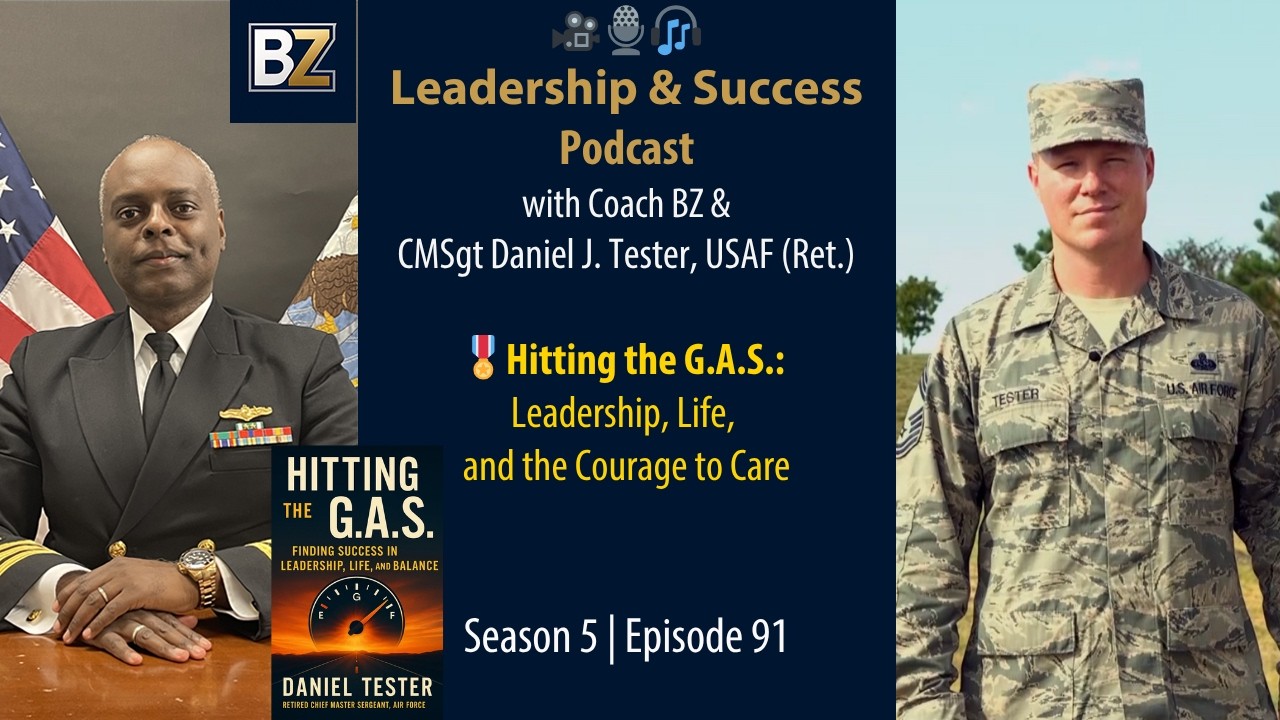
CMSgt Daniel J. Tester (Ret.) talks leadership, standards, and caring for people. He shares his weekly LinkedIn newsletter "Weekly Gas Refill," his book Eating the Gas, and the question every leader should ask: "Am I focused on the right thing?" He won't compromise on standards, even when coaching underperforming airmen.
Chapters
Hi, I'm John Maxwell. When the top companies in the world are looking for trainers, speakers, and coaches, there's one name that stands above the rest, and that's Maxwell Leadership. Our certified team members have gotten proven results for companies all over the globe, and our reputation, I'm proud to say, is second to none. Some of our members have risen to the top of their profession, including the one you're going to meet today. I proudly introduce you to my friend, Bob Fabien Zinga.
Welcome to the Leadership and Success Podcast with your host, Coach BZ, where we help you lead with purpose and succeed with impact. If you're ready to grow into the kind of leader others want to follow, this podcast is for you. If you're determined to elevate your success and leave a lasting legacy, this podcast is for you. As my mentor, Dr. John C. Maxwell, reminds us, everything rises and falls on leadership. Our goal is simple, to inspire you, challenge you, and equip you with insights that can transform the trajectory of your leadership journey.
Welcome aboard to another episode of the Leadership and Success Podcast with Coach Hey, this is Chief Master Sergeant Dan Tester out at Schriever Air Force Base in sunny Colorado Springs. I just want to give a shout out to my friends and family in Clarksville, Tennessee, and go Broncos! Like they say, success is a journey. It took me over 25 years to put these thoughts down. 25 years of failures, successes, 25 years of leading, falling short, and getting back up again. But through it all, one thing became my grounding principle, the thing I kept coming back to no matter how hard the day, how big the challenge, or how heavy the responsibility. That principle is what shaped the way I lead, the way I live, and the way I find balance. Now I want to share with the world, not because I have all the answers, Because my hope is simple, that it helps you lead, live, and find balance too. Let's hit the gas.
All right, uh, hello everyone, welcome to another special edition of the Leadership and Success Podcast. We have a very special program for you today. So let us know where you are joining us from. Okay. What city, what state? And if you are international, which country? And also, please let us know what you are grateful for today.
Excuse me.
And also, if you do have a question for the chief master sergeant, please type it in the comment and we will answer live. All right. As you guys know, we like to start with what we call moment of gratitude. This is where we take just a moment to be grateful every single time we meet. And today I am really grateful that we really do stand on the shoulder of giants. My entire career, from the time I was a seaman recruit 21 years ago, I've been mentored and taken care of by the chief mess, E7, E8, E9, and today we are speaking to an E9. That's the highest level possible for an enlisted service member, and it's such a great honor and privilege to be speaking to Chief Tester today. All right. So without any further ado, let me see if I can properly introduce the chief. So I am really, really honored and privileged, like I say, to be speaking to Chief Master Sergeant Daniel J. Tester. He's a retired chief master sergeant in the US Air Force, representing the top 1% of the enlisted force and the proven leader who has mentored thousands of airmen across high-stakes operational environment. Again, less than 1% of enlisted member end up at the pay grade of E-9. That's quite an achievement. But what sets him apart really is not just his rank, but his philosophy. Leadership is not about position, it's about presence. People before process, always. Real leaders give it down when it matters most. So as the author of Eating the Gas: Finding Success in Leadership, Life, and Balance, Chief brings a raw, authentic, no BS perspective on leadership forged through adversity, resilience, and real-world experience. This is not theory. This is leadership from the front lines of life. So without any further ado, ladies and gentlemen, please help me welcome Chief Daniel Pester.
How's it going? So happy to be here.
What a great honor and privilege to be speaking to you today. First of all, if I may, what is one thing you are grateful about today, Jeff?
I tell you what, I've added gratitude to my daily schedule and I'm grateful for the opportunity to lean into a passion of mine today with you. It's something once you retire that you kind of step away from. So, you know, my moment of gratitude this morning as I was on the front porch is my morning routine with my dog, enjoying the coffee, enjoying the sunshine. I, you know, I gave thanks for the opportunity to kind of expand on something that's very passionate, you know, a passion of mine. So thank you.
Thank you. Yes, that is, that is so, so important, especially in the military. What I normally tell my audience is it's about 21, 22 service members and veterans commit suicide every single day, not a week, not a month, every day. And I think it's really impossible to be suicidal and grateful at the very same time. So is there something about you, Chief, that most people may not know when they first meet you?
Um, what they may not know about me is that, um, you know, I'm a military brat, uh, so I, I did grow up in the service. And, uh, and one moment that I like to share with people is, uh, you know, I'm also an Eagle Scout, a Boy Scout Eagle Scout, um, that, uh, that's something they may not know about me as well.
So that's pretty cool.
I'm very proud of.
So maybe if you could take us back, uh, who was Daniel Tester before the straps? Before the title. What shaped you early on?
So I, I'd say I had a, a very normal upbringing, as, as normal as it can be when you're a military child, right? We moved a lot. My dad was in the Army for 26 years as an infantryman, uh, you know, uh, so 11 Bravo infantryman. He was in the field a lot, um, but, uh, you know, my mom held down the fort. I, I learned what it, what it meant to have strong leadership at home and strong leadership away from home. I saw— I got to see both, and that influenced me early. Moving around a lot as a military child taught me resiliency, taught me how to adapt to new environments constantly and work through tough things because it wasn't always easy. So I would say that was me as a young man. I struggled early with self-doubt, much like most people, but I also learned about myself very early before I had a title for it. I just had— I always had this deep concern for other people. Like, when they were experiencing things, I felt it. I didn't know until later that what that meant to be, you know, empathetic or be an empath by nature. So, um, that, that was me even as, as a young child, I would say. Wow.
Growing in the military family, that is really something. My, my wife is a military brat too, uh, U.S. Air Force. Her dad retired as a tech sergeant. Uh, Richie said she would never marry a military man, but I was at the military when we got married.
But my wife said the same thing, but we've been dating— we're high school sweethearts. Yeah, I've got so much time invested now he joined. So now, you know, I tricked her into it by joining after we've been dating for a long time.
Yeah, yeah, it's, uh, no, but after 9/11, I felt like I, I had to join a branch of the military. But, uh, so one thing you've You've said— I have never really quite heard it that way before. I've been studying leadership since I was about 17, 18 years old. But one thing you say a lot is leadership is about presence. What do you mean by that?
So, um, for me, presence— what separates the position obviously gives you authority, right? You're placed into a position and you, you assume a certain level of authority, especially in the military. Presence, when I talk about presence, is do they feel Dan Tester there? Do they, instead of Chief Master Sergeant Tester, do they feel that I'm there with them through their struggles, through their adversities? Am I truly present? Or am I behind the keyboard when somebody walks into the office? And I'm like, oh, yeah, that's very interesting. And I'm typing. There's a presence is something you feel, authority is something you, you see. Right, so presence you have to feel at a deep level.
Wow, like in the Navy, one of the leadership mantra, which I believe we stole from the Army, uh, you know, mission first but people always. So it's really being present with your people. Was there maybe like a defining moment in your Air Force journey where you realize that this isn't about you anymore but it's about your people?
Yes, I, I would say that early, early on in my career, I didn't think the Air Force was going to be a career, right? Much like you, 9/11 had a lot to to that because that happened during my first enlistment. Um, the moment that, that I reflect upon is I made E-5 or staff sergeant when I became that NCO tier. Uh, the next day I'm in charge of people that were my peers the day before. Um, and I immediately knew, um, through trial and error, failure on many levels, you know, trying to lead a certain way, uh, thinking that the stripe on my sleeve was going to immediately make them respect the position that I was in, but they were my peers the day before, right? So I immediately had to say, okay, the authority came from the position, but until they see me at that influential leader spot, um, and I, and I know immediately then also I was responsible for the well-being of someone else's life, and that's when it clicked for me. That's when it clicked that I, I'm like, the stripe does nothing for how these people are going to view me. You know, I'm still the guy that, that they were hanging out with yesterday that had no authority over them. So if I can't reach them at that personal level to say, hey, we're in this together, then that stripe might as well be sitting in a trash can.
That is really powerful. Now, like I said in the introduction, E-9, less than 1% of people who join the military end up at that rank. And I think for O-5 and above, it's about 4%. So you are a very, very selective few group of people. Did you always want to be a, uh, you know, Chief Master Sergeant, or, um, how did that happen? Did you have the desire to make it all the way to the top when you joined the Air Force?
I did not. Um, so my, my dad retired out of the Army as a First Sergeant, as, as an E8, um, you know, and in the infantry as well. So, you know, I saw him When I joined the military, for me, it was just, you know, I wasn't sure what I wanted to do. I wanted to— I knew I wanted to get out of the house. Not that I was a bad environment, but just get out on my own and be able to see the world. I had— I was 99.9% sure I was going to get out after my first enlistment.
Really? Yes.
And what I find is that a lot of people in our positions, a lot of people that end up going and doing 25, 30 years, say the same thing, uh, and then they find their identity within and they find a purpose, right? So I didn't have aspirations of being a Chief Master Sergeant. It seemed so unattainable. I was a pretty immature, uh, young Airman, you know. I, I wanted to have all the fun, and, you know, I was, I was good at my job, but I was also, you know, really embracing the fun side of it. And I was like, this isn't for me, I'm gonna get out and make— you know, we're in the IT field, I'm gonna get out and make all this money, and at least, at least double, if not more. But yeah, Exactly. But then I found purpose when I put on that, when I put on that stripe. And, uh, I will say I was at, I was at the very surface level of commitment to the Air Force until I put on that stripe. And not only just put on the stripe, the moment that I realized that for, for the rest of my life and the rest of those people's life, I'm going to be a part of their story. Yeah, I have a direct impact on their life and I was like, this is, this is what I was supposed to do. So whether I'm doing it at a Chief Master Sergeant level or at this direct supervisor level, I'm like, I think I can have a positive impact on people. And I felt purpose and I had no desire to get out after that.
Wow, that is really powerful. Now for the junior enlisted who are listening right now, what would you say is the secret of your success to making it all the way up to E-9? What, what made you so successful, you think?
So here's what I, here's what I like to tell people, and it reminds me of a story. One time I was doing an in-brief for new, new airmen that were coming into the squadron. I was at Combat Comm, I did the assignment here behind me, a very, very high deployment tempo, you know, cream of the crop people that serve there, the airmen that come in, get opportunities. Well, I had, you know, briefed the, the folks, uh, in the room, and then I had an airman first class, which is an E-3, Yeah, he said, Chief, I have a question. How do I, how do I sit in yours? I want to be a Chief Master Sergeant. And I look back now and I don't know if my answer was abrasive, but, but I said, what I need you to do is focus on being the best E-3. I need you to be the best Airman First Class. And then when you're a senior airman, I need you to focus on being the best senior airman, being present in the moment Leading where you're at. Don't think that you have to be in a position to lead. Lead your peers. Peer, you know, peer leadership is, is, is more important than anything. So I would say to the young airmen or, you know, that is aspiring, you know, bloom where you're planted, right? I think that's the old saying is you've, you've got just be the best at what you're currently doing. Same thing I tell my kids. I'm like, I don't care if you grow up to be a garbage man, electrician, you know, President of the United States, just be the best at what you're doing and be present and lead those that you're around.
So that is so, so powerful. Yeah, it reminds me of my parents. I was born in Central Africa, you know, it's kind of typical. They want all of their kids to either be doctors or lawyers. So when I became a father, my two daughters like, no, you guys do whatever it is God has called you to do, live out your own purpose and I will support you. And And you talked about peer mentorship and just influencing and leading your peers. That is so powerful. But even in mentorship, I know you've mentored more than 1,000 airmen, which is just so impressive how you give back into the Air Force. But I also kind of believe, I guess the older I get, into reverse mentorship where me as a mentor, I don't talk. I can be mentored by my mentees too, right? It goes both ways. So out of 1,000 people you, you've mentored throughout your career. What did your airmen teach you about life and leadership?
I tell you, I learned more from them than they learned from me. I truly do believe that. You know, they, they see everything right there. There is no— I don't remember whose famous saying this is, but you can't, you can't fake the funk. You know what I mean? Like, it's And I realized that early because I was trying to put on this face of who I thought that I was supposed to be.
Yes.
And what I learned from the airmen is they don't want your BS. They want your presence. Not to keep, you know, beating the drum on the presence, but they want the real version of you.
Yes.
Vulnerable version that says, I made mistakes and I still arrived, right? I learned from my mistakes. So my airmen I try to create an environment where they can be candid for, you know, with me. Maybe not always in large settings or whatever, but I receive upward mentorship many times where people would say, hey, Sergeant Tester, before I was chief, you know, that message you just gave us is not hitting home. It was, it came across as disingenuine. And I think if you create an environment where people can do that, right, someone's got to tell the king his pants are down. That's another thing. Like, it's, it's somebody has to be willing to do it and you have to be willing to say, you're right, my pal, and I'm not going to chop your head off for it. I'm going to thank you.
Yes, my business. So, wow, that is really powerful. Actually, I think there is a song you can take the funk. I think Danny Azen is probably the person who originated that. But you are, you are so, so true because sailors, airmen, no matter which branch of the service, they can suss it out. They know if you are just pretending or if you are real. And they can really, really tell. You cannot pretend to be something you are not in front of the troops. And they know if you really care about them or if you are just pretending like it's a checklist, trying to do what they think you think they would expect of you. Absolutely. That is so powerful. Now, In your book, you say leadership is a burden, not just a privilege. Why do so many people misunderstand that? And the book we are talking about again is Eating the Guy's Finding Success in Leadership, Life, and Balance, available everywhere books are sold. Why is that so?
Yeah. So, much like many other terms, I think interpretation is key, right? So, when I say burden, You know, some people look at it as I'm carrying this heavy weight, and that is true for leadership, right? The way I say it is, it's almost like parenting, right? Parenting is hard, and if it's not hard, you're probably not parenting. You know, I've had my kids have told me before where they've come home and said, well, you know, so-and-so, their parents let them, and they stay out all night and do all this. And I, you know, I've had to have that kind of tough conversation. I'm not going to say it to them. Well, I'm like, maybe that's Their parents don't care as much. I'm sorry, that's what I say about the burden of leadership. When I, when I say it, the burden of leadership should, it should weigh on you. And if it doesn't, then you, you're not hitting the gas. And you know what I mean? You are, you are not present. You're not, you don't have their, their best interests at heart if you don't wear it on your shoulders. It's a privilege, right? It's, it's a privilege and a burden, and it should feel like that. And if it doesn't, then maybe, maybe you shouldn't have the responsibility to have an impact on other on other people's lives.
No, that's really insightful. Uh, another thing you talk about is, uh, trophy culture and mediocrity, right? Everybody gets a trophy these days. How is that showing up in today's workforce?
Yeah, I, you know, when I wrote that section, I was like, am I going to make a lot of people mad? So, you know, I'm, I, I very much believe that what the intent behind what I was saying in that moment and what I felt, because most of these notes I scribbled down late night when I couldn't sleep or whatever. Um, what I'm talking about is, is really the compromising of standards because unwillingness to have tough conversations, right? Uh, so I'm gonna compromise my standard and say, you know what, you're doing great, um, when I know that they're, they're not up to the standard. Is it hard? Yes. That's why they're called tough conversations. That's the burden that I, that I talk of, right? Um, so the trophy culture and everybody gets a trophy— what I'm talking about is, yes, you set your standards, you lead everybody different, you set your standards. And if they're not living up to it, guess what? Much like children, they want to be— they want to be led, they want to be, you know, steered in the right direction. Um, people don't wake up every day and, you know, have their coffee on the front porch with their dog and go, you know what, today I'm gonna go into work and I'm gonna do a terrible job?
Yes.
How many people have you met in your life that say I'm gonna do a terrible job? So now your job as a leader, our jobs as leaders, is to have those tough conversations and say, I, you know, hey, I know, I know you're better than this. I'm not giving you a participation trophy. I'm going to tell you, here's the standard, you're an important member of this team, and here's where we need to be. And they'll grow and they'll appreciate it.
You know, that's really leadership. I think that's why we get paid the big bucks, right? You are supposed to do what you're supposed to do when you're supposed to do it. And not everything about leading is, you know, fun. I think you can have a lot of fun leading, but not everything is about fun. Sometimes you do have to have those come-to-Jesus meetings and have those tough conversations for sure. Now, you said that leadership was a burden. In my own experience, especially when you get to command, even as an E-7, E-8, E-9, when you have a senior enlisted leader or as an officer, you have a commanding officer or executive officer. There is a true burden to command. Now, that's, that's not made up. It, it's really something that is with you 24/7. Now, it doesn't matter what time it is, day or night, your sailors, your airmen would call you 2, 3 o'clock in the morning, something happened, and you do have to take action for your mission, for your, for your people. Is there maybe a moment in your leadership journey where leadership kept you up at night? Anything you're willing to share?
Yeah, um, I'm, I'm unfortunate in the fact that I, that I have trouble sleeping anyways. Um, and you know, I, I would say that having— carrying the weight of leadership definitely had a part in that. So there's probably more nights than not that leadership kept me up. I tend to overanalyze things because the level of care and commitment I give to folks that I lead. Many, many nights laying up thinking, did I put enough into that performance report? Did I push the right person forward for this award? Did I, you know, was that person okay when I asked them? Have I overtasked this person? You know, have I put too much burden on their shoulders? Am I dividing the tasks equitably? You know, those are the type of things. And then of course, moments where, where people haven't been okay, you know, or at, at this assignment, like I said, high deployment tempo when I was at Combat Comm. One moment that really sticks with me is that— and I told you, there's gonna be times where I might get choked up, BZ.
It's all right.
It's just who I am now. But high deployment tempo, and we leaned hard on some folks, you know, some folks that we really trusted. There was a time a young Tech Sergeant had come back from a mission. We had another mission come down. It was very important, you know, the type of mission you just can't send anybody. And we had to send him again. And, you know, the commander and I always saw off everybody that deployed. We were— we would go there and see when they were leaving for the airport. Well, this time, you know, his— it's hard because families, you know, are dropping them off. And, uh, yeah, his, his wife and young child were there. So, and, and she, you know, begged him not to leave again. So, yeah, so those are hard. That's, you know, yeah, those are the ones that keep you up at night and say, man, I didn't want to send them, and we had to. And his family's feeling, feeling the brunt of it. And, you know, if that doesn't weigh on you, like I said, yes, you might not be in the right position if that doesn't keep you up at night going, there's no way I want to see that young girl crying and asking her dad not to leave, you know.
Yes. Yeah, that's, that's really part of the reason why, uh, to me Everybody who's joined the service, they say all voluntary service in the US until they do the draft again, but they are really American heroes, right? Less than 1% of American citizens join the military. It doesn't matter which branch, it doesn't matter which rank, it doesn't matter even if it's just one day. Like, I even talked today with people who might even be, you know, CEOs, CISOs, and tech executives and all of that, but they did serve a long time ago. I always want to put a picture of them in uniform and acknowledge that service. It doesn't matter if they wear a seaman if they were a corporal, if they were a petty officer or an admiral, it doesn't matter. I want to give respect to that time of service because it's really something when you put your life on the line for your brothers, for your sisters. There's just nothing, nothing like it. And yeah, talking about sending people on mission, especially when, again, when I had the chance to be a commanding officer, No, you have to sign the orders to send your sailors on deployment, and sometimes they have to go to combat zone, right? And that's really, really heavy because, okay, this guy just got married, or they're going to graduate school, or they just got a new baby. But yeah, this is our mission, they have to go, you know? And unless you have like a medical condition or something that would prevent you from going, you are going. That's just what we are here for, right? But it does weigh on you a lot, though. Knock on wood, anybody I've ever ordered to go anywhere, they came back in one piece and back to their families. But it's possible they may not come back, though. So that is really, really heavy. And you think about all of the time, even myself, you miss all of the school plays and holidays and birthdays. It is really crazy, the sacrifice we make in uniform for our country. And for our families. So I really do appreciate that so very, very much. And again, it has nothing to do with Juan, it's just the way we are.
And I can see as you're, you know, I can see that it still weighs on you when you, like you said. So I appreciate you reflecting upon it too. I can see it in your face that you're reliving certain moments when you've sent people on these deployments. And that's the level of care that you just can't— you can't fake that. You know what I mean? It's just you care at that level or you don't. And, you know, yes, it's commendable.
So in your book, you do introduce the idea of intrusive leadership. What does that mean?
So hey, I will not pretend to be the expert on this. Our brother Marcus Kennedy, like he's—
yeah.
Um, you know, I credit him a lot, uh, to just sidebar a little bit. You know, he reached out to me out of the blue when he was writing his, uh, I think it was for Air War College, his dissertation on, on this topic. And I had been retired for quite some time, and he came across a paper I wrote about intrusive leadership, and he said, hey, can I talk to you? I'm writing this paper. And, um, you know, I, I don't want to say the spark was dead But I hadn't thought about leadership, right? I was a contractor. I was like, I'm collecting a paycheck. So, you know, everything happens for a reason. And you want to talk about gratitude? I'm grateful for Marcus reaching out to me because he sparked something in me. And I went and grabbed the notes that I had written. There he is in that book. I would highly recommend everybody. So, and Marcus and I had a long, long conversation about intrusive leadership, and it really, it really fired me back up. The concept of intrusive leadership is just— it sounds horrible. And that's what Marcus, right? You know, you're like, well, I want my leaders to be intrusive. Well, once again, words mean things, right? All it means is you don't walk by something and assume everything's okay, right? If you know your people, this is one way I broke it down to somebody. I said, you should know as much about the people that you lead, that, that his daughter has a dance recital, that his wife is homesick, or his mother has cancer, or whatever. You should know as much about that as you do about the tasks that you have assigned that person to do within your organization. If you do, then everything else will fall in place, because that is the present And that it requires intrusive, intrusive leadership equals presence to me.
Yes.
If you are not being that intrusive leader, if you're not getting to know your people through uncomfortable conversations to, hey, how are you doing today? I'm good. No, hey, let's go grab a coffee. Let's go sit down. The tasks can wait. We will get to that later. You can't, you won't know that. You won't recognize it unless you've you've used intrusive leadership to get to know that person through uncomfortable situations, conversations. And it's hard, but everything worth doing is hard, right? So it's, it's not easy. And Marcus's book really, really breaks it down at a level that I only scratched the surface on. But like I said, I give him a lot of credit for, for lighting a fire. He's a, he's a hell of a leader. And, you know, anybody that gets to work for that guy is in great hands.
That's right, Captain Marcus Kennedy, US Coast Guard. So I did talk to him season 5, episode 42, for those who want to go back and—
Great episode.
Yes. And his book, Intrusive Leadership, he has a second edition now, How to Become That Leader. So, so powerful. It's really amazing to me the way I really look at it, the military, it doesn't matter which branch, Air Force, Navy, and even our new baby branch, Space Force. It's all about leadership, in my opinion, even at the lowest level. That's really what impressed me. I was an E-1 Seaman recruit. I knew absolutely nothing about the military, absolutely nothing, zero, zilch. But even then, the Navy was preparing me to lead even at that level. If nobody else— I don't have any direct report, but I need to be able to lead myself, be where I'm supposed to be when I'm supposed to be there, in the right uniform and looking sharp. So It's like it's just embedded in our culture in everything we do. Has that been your experience, Jeff?
Yes, absolutely. You know, when I joined, I needed leadership. I grew up in a very structured house. My dad was very disciplined, obviously his Army background. So when I was out and I was out of the nest, you know, you know, I was a little, little crazy, um, and, and I had some, some leaders step in. But like you said, the structure the military provides us, uh, yes, the opportunity to, to grow. I don't see it in, in the corporate world, you know. I, I just know they, uh, sometimes people are thrust into positions because of degrees or whatever have you, and, and then people complain and they're like, wow, they're a terrible leader. And I'm like, Who?
Yes.
Where did they learn how to lead? Yeah, you know, the military affords us a great opportunity if people are willing to, to get to, to really understand what it means to lead yourself. Yeah, before you even lead others, make mistakes, watch others make mistakes, be mentored, experience tons of different leadership style, because sometimes you can be in a company for 20 years, and have the same boss. You know, in the military, you're getting good bosses, bad bosses, indifferent bosses, bosses that are just checking a box, you know. And I always tell people, I actually learned more from, from bad leaders than I did from good leaders. Sometimes, okay, that, that missed the mark, you know. If you're ever in that position, you know, don't do that.
Yes, yes. What not to do. So powerful. Because sometimes, even when we talk about intrusive Leadership doesn't mean that you really get into everybody's business, but even just asking, are you good? Like, are you really good? Because for most people, like, how are you? Fine, thank you. It's just very, very superficial. But Trent knows that, yeah, you really, really truly care. Why is sharing a moment like that where you really want to know what's going on in your people's life kind of might be able to change someone's life or even trajectory? Just caring, really.
Yeah, it's— you have to know the person though, right? That's, that's the tricky part. If you don't know the person, then you can miss it and not on purpose, right? Not— you can miss it, not because you don't care. It's because you didn't do the homework upfront, right?
You didn't—
you didn't— if you have transactional leadership throughout the, you know, throughout that relationship, when it comes time to make a difference, to, to— you won't— you'll miss that moment.
Yes, yes.
Yeah, there's, there's actually, uh, I don't know if you've watched Band of Brothers. There's, there's a moment in there that like I always— I just rewatch this part. It's one of the last episodes and Major Winters is, you know, doing his, doing his work and, uh, Swifty Powers, one of his guys, comes up, or Shifty Powers comes up, and he's trying to talk to him. Major Winters, very busy, he's a commander, he's working on paperwork and stuff. And, and Shifty just asked him a question, and, you know, uh, Major Winters looks up over his papers and he's just— yeah, he's like, okay, yeah, Shifty. And then he hears something different in his voice, and he puts his paperwork down and he stands up and he goes over and engages, and Shifty opens up to him. That is intrusive leadership.
Yes.
And it's— that, that explains everything because He was doing what he was doing, right? He's a commander. He doesn't— it's not that he doesn't care, but he knew his people at a level that he could sense something different in his voice. And wow. And you've probably had those moments. I, I know I've had moments like that where it's literally life-changing. Um, if somebody is going through something you don't know, and it doesn't, you know, it doesn't have to be their direct supervisor, it could be any, anybody, but if somebody misses that cue to say, yes, this, this person's not acting right. You can't do that through checklist leadership. You know, you just can't. You have to know those people. And you have to do it by caring and not, not faking the funk.
Yes, yes. No, that is so true. Like, even when you are a parent, there are times where your daughter can come and say, okay, Daddy, I really need help. You have to stop everything you're doing. And really pay attention. And I think Band of Brothers, I think it was an HBO original. And yeah, you definitely can learn a lot from that. I guess a question I have for you, Van, is another thing you say is people, they don't fall apart in a day, but they erode over time. What are some of the early signs you believe leaders should really be looking for and not Ignore.
So what I've seen in the military, and, you know, this is probably true for the corporate world as well, is now that I'm in that, is we do tend to, as leaders, sometimes ride, like, ride our prize horses. That's what I say is, you know, burden people if they do well, you know, you, you reward good work with more work, right? So one thing that I had to be mindful of is the people that will continue to take on those burdens without saying anything. And one thing to be mindful of is if they're always like— it's how they respond, right? It's the nuances of how they respond. Yeah. When you give them the first task, if they're like, yeah, I'm all over this, Chief, and then you give them the next one, they're like, yeah, I can probably— I can fit that in. And then the next one is like, plate's pretty full, but, you know, I'll make it work. There's— words matter, words mean things, right? So you'll miss those marks if you're, if you're not paying attention. We get caught up and being busy, you know. Early warning signs are different for everybody. Yeah, I would say for your pride, you know, your, your top performers, those are the ones that, that will carry a burden until it breaks them, you know. So the early warning signs are paying attention to the wording, checking yourself and And all right, am I choosing the easy path instead of mentoring this other person who may not be performing at this level? Am I choosing a path of least resistance and, and going to the same person over and over?
Yes.
Um, so looking for that, and you know, obviously normal, just behavioral things. Um, if they're not somebody that's been late to work before and all of a sudden they're late to work and you know they're not trying to make an excuses. They're just owning everything. Those are the, those are the people you have to watch out for.
That is so true. There is really a lot of leadership lessons in what you just said, Chief, because another thing, even as an SEL or commanding officer, sometimes we tend to get the, the burden and really carry ourselves. And I think that is very, very dangerous. So much better for everybody in your unit, in your command, to do a little bit than for one or two or three people to carry the majority of the burden because they are going to burn out. They're not going to want to come to work anymore and eventually you are going to lose them. So even as you may be responsible for everything, but you don't have to do everything. So you have to really rely on your department head. And even in my unit, I was trying to, I let my chief take care of it, but I'm like, no, I want to use those first classes. Those are E6 because I saw them as future E7. Give them responsibility and let them impress you, right? Because if they're always like, oh no, I am not in charge, I'm always looking for what if the chief isn't there, then what's going to happen, right? So I think it is really great for a unit, for an organization where people develop their leadership skills and they have that sense of ownership. I know one, one of our, um, my friend, Lieutenant Commander Joko, what's that, that book, uh, Extreme Ownership. But I think it's definitely a concept you see in the military throughout, but I think it really makes a big, big difference, don't you think?
Yeah, it's a great book, great book as well. Um, and you know, I listen to a lot of his stuff too, but those days I'm not feeling very motivated, I'm like, okay, We have a question from the audience.
Daniel Young from Midland, Florida asked a question. Let me see if I can read it. It's pretty long. It's okay. It says, Chief, you talk about intrusive leadership and the courage to care as a frontline reality. From a forensic integrity perspective, how do we make sure giving a damn doesn't just stay a sentiment but becomes a load-bearing part of the organization beyond your infrastructure. Specifically, how do we train safeguards to care enough to disrupt a technical hide before it turns into a mission-critical failure? So, how do you make caring for your people part of the culture and not just like, you know, a checklist? I think that's what he is asking.
Yes, absolutely. There, That was a late add to the book, actually. When I originally wrote out the outline for this, it wasn't in there. And then I actually added a chapter, you know, creating a gas culture. And your question shows that you understand that it can't be surface level. It has to be— and the one thing that I would say is it's modeled behavior. It can't be a PowerPoint line. It can't just be something, a motto that we follow. It has to be modeled behavior from top down. So, and it has to be— the most important time is when it's the hardest. Yes. So, will— do they see you still applying that concept of GAS, or giving a damn, you know, when, when times are tough, the cards are down, and, and like you said, there's technical things happen that could cause mission failure, do we revert back to treating things as transactional leadership, treating your, your like numbers on a spreadsheet or doing the checklist? Like, you know, if this, then that. We're not robots, right? Um, that's, that's why AI will never take over that portion of doing, doing the leadership function, right? Because it takes that commitment to the, to the culture and being top-down and, and the commitment to it even when— especially when things get hard. Um, but modeled behavior is, is the most important thing. If, if you just tell people, hey, my expectation is that you, you, uh, care more about your people, and then next thing you know, next thing you know, they're tasking you with something— they haven't asked you how your day was, they haven't asked you about your family— then you know it's PowerPoint deep and the culture is not being, you know, trickled down to where it needs to.
Wow, that is really powerful. I get back to something you said earlier about being authentic as a leader. In your book, you say, "If you are not authentic, people will not trust you." And I think that is so true. And again, I think most people, just like kids, they know exactly if you are just kidding around or if you are serious. So why do you think authenticity it's still so hard for some leaders to just be who they are and not who they think they should be. Like, I know something Oprah said a while back is, nobody can beat you at being you, right? Being Oprah Winfrey, there is only one in the world and nobody can beat her at being that. And I think that is so true. And I think it's okay to have mentors, to have people you want to be like, that you admire, But when it comes to leadership, you have to be authentic. You have to be your true self. You cannot pretend to be or act like somebody you are not. So why do you think that's hard for some people to do?
I would say the societal expectations of what we think makes a good leader, right? And in the military, you have certain examples you look at and you say, well, this person made it and they had these personalities. Um, so it forces people to think, if I don't align with exactly how they lead— and it took— it takes early intervention and leadership, like mentorship, to course correct. Um, one of my, one of my primary mentors that I— we don't talk very much, he's not very much on social media and everything, which is probably great for his mental health. But, uh, he, uh, he was a chief and I was a a young E-6 just putting on E-7. And, uh, you know, the section I was leading wasn't doing that great. I wasn't getting the response I wanted to. His style of leadership was very harsh, you know what I mean? But this guy cared at a level— once you got to know him and talk to him, it's because he cared. But that's who he was. He was just harsh, abrasive. He spent some time with Army, you know, like deployed in the field, raised by sergeant majors, different than the Air Force. So one time I was in his office and I said, Chief, I'm, you know, I need— I'm not reaching my folks or whatever. And then I crossed the line and, you know, um, because I, I was just comfortable at the moment, and I said, I, I said, maybe, maybe I just, you know, need to be more, more of an asshole like you. Literally what I said. And he, and he stopped and he got stone-faced. And I remember I was like, oh boy. I messed up. And he said, he said, you know, basically said, no, that's— I'm that because I am that. He was like, you're not that. You reach people at a different level. And like, that moment in my young NCO life was transformative.
Yes.
Because he, he told me that this is my path here, and this is how I lead, and I'm effective because this. And he said, if you go and try to be that He was like, you're the most not that ever. They're going to see right through you. So I think there's just—
wow.
Your original question. I think it's just people think there's one way to do things.
Yes.
And they confine themselves to it. And then also the mentorship doesn't occur to be like, hey, look, here are the qualities you have as a leader. Leverage those. Be yourself. Wow. Don't change.
That would definitely preach. And that is so true. So basically, you have to know yourself, and two, you have to know your people. Wow, that is really powerful. How do you think leaders can find their own voice instead of copying others? How do you do that?
It takes a lot of self-realization, right? Real conversations with yourself. You talked about leading yourself. When, when you struggle with self-doubt and things like that, you know, I, I've definitely dealt with my share of self-doubt. Um, that's what will lead people down the path of trying to be someone else. Um, yes, you have to have real conversations with yourself and, and say, um, am I effective? Like, you pay attention to the results you get, you know, when, when you're yourself or you try to do these other things, you, you have to be conscious of what what you do and the outcome and then learn from it. So finding your, finding your own voice could be, um, an exercise in itself, right? Uh, through trial and error and being willing to compromise and say, you know, I've tried this approach and I didn't feel genuine to me. We know we have an inner voice that can tell you when you're being genuine. If it felt off, then that's not who you are. If it felt off to you, it probably felt even more off for the folks you were trying to influence?
Wow. So we really have to lead with humility. And some of the best leaders I have seen throughout my career, they were very humble, which is kind of like an oxymoron because you are in charge, you are a commander, a captain, an admiral, or whatever, and you have achieved so much and so many medals and honors and blah, blah, blah. But then at the same time, you are just so humble. And that really makes, I think, a big, big difference in the people you lead, how they can still relate to you even though you've achieved so much and they feel like you walk on water, but still though you listen, even if you don't do what your people say, but at least you consider that and you treat them like human beings with respect and dignity. That really makes a difference, doesn't it?
Absolutely. And that's another thing that they see right through, you know, you can try to, you can say humble things, or you can, you can attempt to show humility. But if at your core, that's not who you are, that, you know, they'll see right through it as well. So I think humility opens the door for the ability to, for mentorship to happen both ways. And for you to learn from your mistakes and be willing to compromise and willing to adjust your leadership style based on that.
So yeah, learning from your mistake, knowing that you are not perfect, you can still make mistake, but more importantly, learning from them. I think that that really makes a big, big difference. So folks, we are talking about the book Eating the Gas: Finding Success in Leadership, Life, and Balance. You're talking with Chief Daniel Testo. So, so privileged to be talking to you, sir. Let me ask you, with all of the leadership books out there, why did this book need to be written? Why did you write it?
So this— the journey for writing this book started probably right before I retired. Uh, you know, I was sitting in the office one late night working on, working on reports or decorations and, and had one of those self-gut-check moments and said, you know, the Air Force has given you so much. I always feel like the Air Force gave me way, way more than I could ever return. Uh, so a little bit of guilt setting in. I'm like, have I mentored enough? Have I, have I left a mark? You know, are the leaders going to carry on with the things that we've talked about and the things we've worked on together? So I just started jotting down notes. Um, the, the concept of hitting the gas started back at this this, this other unit. Um, and what, what happened was I was sitting down, I was having trouble reaching my first line supervisors. High deployment tempo, the, the technical prowess and the performance, the unit always top-notch. Where I was having trouble reaching my younger leaders was, hey, we have to, we have to groom our folks, we have to put them in for awards, we have to take care of their careers, and they'll take care of everything else. Well, they were all high-performing, hard-charging folks. They didn't really believe me that that was a key component. So I went home one night, um, admittedly I poured myself a bourbon. I was, I was, you know, frustrated. I was trying to figure out how I could reach these, these, uh, younger supervisors. And I started doing a Leadership 101 training, okay? And it was the PowerPoint. I was like, here are the things that are important as a supervisor. You know, it's not just putting your name on a report, it's reaching people. These are concepts I didn't know existed. I never heard of intrusive leadership. I had never heard of, you know, a lot of these concepts. And I was just pouring my heart and soul into, hey, how do you care for people? At one point I was on slide like 10 or something, and I said— and I'll just tell you, I finally said, I sat back, I threw up my hands, and I said, for goodness sake, all I'm doing is asking them to give a shit. Yes. That is where the concept was born, is that it sounds— it's, it's simple, but it's not easy, right?
Yes.
And that's why I felt this book needed to be written.
It's—
I don't leverage a lot of leadership concepts. I mean, you were mentored by John Maxwell, if you want— I mean, that you talk leadership concepts, there's books on that. And he's, you know, there, there are phenomenal books on leadership concepts. Concepts and principles. This one was, how do I reach people at a personal level to say— sometimes when it comes to being a parent, yes, or, or a coach or a leader or, you know, a teacher or whatever, it boils down to the simplest thing, that if you care at a— and you can't fake it, it can't be like, you know, yes, it can't be surface level, it has to be a deep care and commitment to what you're doing. And that could be anything in life. So that's why I felt like I needed to write it because I didn't think that that part of the leadership spectrum had been discussed.
Yes, I think the older I get, the more I feel like really leadership is really about love, if I could say it in one word. You have to care, you have to give a damn for sure. But your book is quite unusual, Chief, because you open with a— honesty, self-doubt, struggle, even depression. Let me just— I mean, you sent me an advanced copy of your book. I couldn't even go past the introduction. You start with, "Life is a mess and so am I." What author writes like that? I'm coming to you to learn about leadership, you're telling me you are a complete mess. What is wrong with you? You say, "Let me start this book with a bold statement. I probably shouldn't be writing it." So why in the world am I reading it? And then you say, "I meant that. There are days I struggle to believe I have anything meaningful to say about leadership, life, or balance." Wow. I've never read a— I mean, I've read more than 2,000 books, but I never ever read a book like that. So my question for you, Chief, is why was it important to lead with vulnerability?
For me, because I've, I've struggled with those things in my life. If you don't acknowledge them first, and if you're not real with yourself, then how the hell am I going to get you to believe anything I'm saying? If I, if I won't even believe— if I can't look in the mirror and believe myself, then why, why would you believe me? And, and how many other leaders out there have sat around on a, maybe on a daily basis and said, I'm not equipped for this. I'm not ready for this role. Every role I ever went into, I sat there and said, I'm not, I'm not ready for this. So if I can't, if I can't be honest with myself, how am I going to be honest with my reader? And, and if they don't know, if those young leaders that are struggling with that right now don't know that somebody who's been there and, and has reached, you know, that 1%, that they struggle with it on a daily basis. Wow. How do we help them get through that? How many leaders do we leave in the wake that, that never reach anywhere because they reach a certain point and they, and they gave up when that self-doubt creeped in, or when they had health problems, or they had family problems, or they were trying to— or that parent You know, I even— I try to touch on parenting, and God knows I don't have all the answers on that, or marriage, or anything else. But what I want to do is tell the readers that nobody does. Nobody does. And the more we, we are open and honest with each other and say, I don't have all the prints, I don't have the checklist that tells you, you know, be a good leader, be a good father, be whatever— what I'll tell you is, if you care, you're halfway there.
Wow.
That is powerful. Could you break this down for us, Chief? What does eating the gas really mean? So that's giving a damn, giving a shitake. What does that really mean in practice?
So I think we touched on a lot of it. It really is that there is no half steps. Yes. You know, whatever you're committing yourself to do, um, you may not get it right, you may make mistakes, but if at the very core you have a genuine caring concern for whatever it is that you're applying yourself to— and, and I really do. I— that's why I wrote the book. When I set out to write it, I was like, okay, military leadership, but then I was like, you know what, coach, teacher. My wife is a teacher.. And let me tell you, if somebody hits the gas, you look at our teachers in the classroom, you know, um, you can tell the difference between a teacher that hits the gas, right? That this, like, here's a lesson plan, whatever, are the ones that are working on— I mean, every night she's working on some kind of special project that she can work on for the kids. That's not in the lesson plans. She has a genuine care and concern for those that she's responsible for because she's going to be part of their story for the rest of their life. And she pours into them. And there's a reason that every time that I've ever been in a classroom, there's kids that have been out of her class for 4 or 5 years, they seek her out in the hallway and come give her a hug. There's a reason that people have probably reached out to you, Marcus. People, people, leaders that have an influence on people's lives, they reach out to me. Hey, I just want to let you know I got promoted. Hey, my, you know, we just had a kid. Um, that's hitting the gas. Wow. It is not saying, "Oh, I was a supervisor. I did this. I put my name on a report and I did." I put you in for an award. It's having an impact on their life that they think about for the rest of their life.
Wow.
You know, that's really powerful. Really what you're talking about is really giving a damn, giving a care about people, about purpose, and about presence. Why is that so critical, especially today in the age of artificial intelligence, where people are so busy and they get so distracted with social media and everything else that is surrounding us?
Well, I, I think it went from— it went from important to essential, to critical right now. Um, I, I find it even in parenting. I have 3 sons, right, you know, um, and they vary all the way from, you know, 23 to 19 to now 11-year-old all of them have been completely different. The, the influence of social media and artificial intelligence and, and the, the connectedness of a smartphone that has made us far more disconnected. But as leaders, we have to adjust, right? Like, we can't, we can't ignore— it's not going to go away because we want it to, because, oh, this is how I did things. You, you— it's more important now that you have to reach people at a personal level, you know. It's because we're more connected now than ever, but we're, we're far, far less connected than we've ever been. Yeah, it's not to sound cliché, but it's, it's went from important to absolutely essential if you want to reach people.
Wow, that is really insightful. Again, everyone, the book we are talking about, and I think everybody should get a copy, Eating the Gaz, Finding Success in Leadership, in Life, and Balance. I do want to talk about balance, but before I do, Chief, something you alluded to earlier, I think a lot of people struggle with that. You said when you get a new job, usually you feel like you are not quite adequate, really not ready for the job. I guess some psychologists call that imposter syndrome, and we all go through that. What is one of the ways you've been able to successfully deal with, with that, that feeling of not being quite enough for a job you fully qualify for?
Yeah, I didn't— another concept I didn't know how to title until I, I lived it. And I started— I literally had to Google it. And I say, why? When, when I accomplished some of my greatest accomplishments, when, when I made Chief Master Sergeant, I went into a deep, dark depression. Because, because I, A, I viewed success as a destination instead of a journey, right? I was like, oh, when, when I do this, then I'll be, I'll feel accomplished. When I feel accomplished. So I started teaching, you know, teaching myself that for every stepping stone that I reach, that new job, I'm okay that I'm not necessarily 100% ready for this role. Because it's an opportunity to, to add more tools to the tool chest, right? Um, being— how are you ever 100% prepared for something you've never been? It's, it's impossible. I was putting an unrealistic expectation on myself instead of saying, all right, everything you've done to this point has, has equipped you to be ready to learn from this job, not to do the job, but to learn from the job and adjust adjust where I need to, to be ready for the job. Wow.
So that is really powerful. I think this is going to help a lot of people listening, especially young junior officers who sometimes they feel like, oh, I have an education, I have a degree, and I know it. Well, the truth is you don't know squat because, you know, if you join my community as an Information Professional Officer, we're going to teach you everything you need to know about, you know, radio communication and systems and so forth. Whatever you learn in school, you can just forget it. I mean, it's still helpful. I guess it kind of helps open the door because without a degree you cannot get commissioned. But the truth is the true learning starts when you start on your job. Even when I remember when I earned my information warfare qualification, I was so proud and really, really proud of that great achievement. But the thing is, it doesn't mean that you know everything there is to know about information warfare because you just don't know. Because not only you have to know about information warfare, but you have to learn about intel, about MITOC, about crypt— cryptologic warfare, and it's like space, it's just too much. It's impossible for you to be a master and expert in all of those things. But what it does really, it kind of gives you the license to learn. That's really what it is. So once you have that in perspective, you have that humility, then it doesn't matter which command you are sent to. You may not know all of the answers, but you know where you may be able to find the answer, who to connect to, and where to actually get the the answers you are seeking. And I think that really matters. So we said in your book, you talk about, I think it's pretty much divided in 3 sections, right? Leading other people, leading yourself, and then building a culture. So let me ask you the million-dollar question about balance. Everybody asks this question. How do you lead at a high level without losing your family? Your health or yourself? How do you do that?
Balance is something I struggle with a lot. But here's, here's what I would not recommend is I went down, you know, I went down the path of, no one was going to sacrifice except for me. So and I warn people that there's a breaking point with that as well. So I was always like, you know, when I get home from work, I'm not going to miss the practice. I'm gonna leave work if I need to. I'm gonna go to practice or whatever.
Nice.
I'm gonna spend family time with dinner, and then when they go to bed, I'm going back to— I'm Chief Master Sergeant hat back on, and I'm gonna work on reports and, you know, decorations or award packages until 3 or 4 in the morning, and then go to the gym at 5, because I'm not going to sacrifice that either. I'm not going to sacrifice work, and I'm not going to sacrifice any— so I would say that's not the way to do it. Then I started figuring out that balance— if, if you look at balance and you try to achieve some, you know, some perfect, it's not there.
Okay. Yes.
If you think about it as quantity instead of, instead of quality, you're gonna fail. You're gonna fail every time. So what I, what I tell young leaders is, you, you— the job may pull at certain times, right? And sometimes that the scale is going to start to tip, and that's okay, you know, for, for temporary. If you only get 15 minutes at home with those kids before they go to bed, or, or with your wife or whatever, then that 15 minutes, the quality— yes, the quality matters, right? Are you still on your phone? Are you still like, oh, we're trying to talk to them about work? Are you sitting down playing their favorite game?
So it goes back to leadership is presence, what we talked about earlier.
Yes, yes. Be present in the moment. So the balance, the balance that people seek, we're like, okay, it's going to be exactly 50% family and exactly 50— it's not, it's not that. It's about the quality and the presence of the time that you do have and making the most of it.
Being man— well, in your book, you are really pouring out of your heart. And if I was to ask you one question, if someone reads your book, and can only apply one thing, what should it be?
I, I would say that leadership, whether it's yourself or military, family, parenting, it really does come back to the presence and the quality of presence. And not giving that surface-level commitment to what that care looks like.
Yes.
Have that deep, genuine concern for, for what you're doing, the people you're leading, the people that, that are in your circle, your family. That's the concept. And it sounds really simple, but there's a difference between, you know, caring and hitting the gas.
Wow, that is really, really, really powerful. So, um, we've definitely run out of time, uh, but man, I could talk to you for 4 hours. So one thing I want to do now is I want to ask— oh, first, is there a question I should have asked you, Chief, that I didn't get the chance to ask in the time we had? Anything else you wanted to share today?
No, I, I really— I think we, we hit all all the, the great things. And, and I, you know, I've appreciated it. I really have. Like I said, it's, it's definitely a passion of mine that I don't get to pursue as often as before. So I, you know, I think—
thank you—
the questions were great.
So, uh, what can we do to add value back to you, um, aside from this?
Because this has been huge. Um, you know, it's, it's, it's something that really really sits home with me. I, I would say if I, you know, I do have a LinkedIn page. I do try to do a weekly newsletter, um, that's called a Weekly Gas Refill, where I kind of expand on some of the concepts from the book. Of course, you know, grabbing a copy of the book, it is, it's available on, on, you know, several platforms, um, and just, just sharing the concept, you know. Um, even if you pass the book or read, read a chapter to one of your, one of your, uh, subordinate leaders, or even You know, I've had people that have strategically sent them to their bosses.
Yes.
That have strategically sent my book to their bosses to say, you know, maybe this is why you're not getting the level of commitment, you know. So, you know, beyond just you using this platform, which I can't thank you enough, just to get the word out there. I love just speaking with people on LinkedIn too.
Yes.
People want to just message me and say, hey, I've got this situation or whatever, because I don't get it like I used to, right? I don't have direct reports now. Um, it's, it's a part of me that I miss. I'm trying to get back into that mentorship world. Yeah, you know, just helping people if I can, because I do, do think that, um, that, that's what I was meant to do. So, wow, I just appreciate that you, you using your platform to help me get the message out.
This is really wonderful. If I may ask you, uh, one question, it's one of the most important questions I ask, but, uh, I think this is a picture of you and your young son. And I want you to think, if you could go back and give a piece of advice to your young self, maybe not as young as your son, but when you were a teenager standing at the edge of this incredible, incredible career you've had, retiring as an E-9 Chief Master Sergeant of the United States Air Force, the most powerful air force in the world, and now a bestselling author and everything you have accomplished in and out of uniform, what would you say to No, the teenager Dan.
Wow, that, that's a good one. Um, I, I would say believe that you deserve the things that you've worked for, because that's something I've, I've struggled with a lot, and I still, I still struggle. Believe, believe that if you put in the hard work and you've, and you've put your heart and soul into it that the things that come your way, the successes, that you've earned them, and that's okay. And it's okay to be proud of yourself.
Wow, that is powerful. I think we need to hear that more. Okay, to end, if it's okay, I want to do a quick rapid fire. I'm going to ask a question, you answer really quickly, first thing that comes to mind. Can we do that before we close? Okay. What is one word, Chief, that defines great leadership? Care. Okay. What is a morning routine or practice that keeps you grounded?
A morning routine of mine? Every, every morning I try to go out on the front porch with, with my dog, have a cup of coffee, and then thank God for, for another day.
And, and, uh, we, we do like to, to read books here. Of course, we have asked everybody to read a copy of your book Eating the Gas. But you've also mentioned this book today, Intrusive Leadership. Why should my audience— they should already know about it, but why should they read it?
If you really want to delve into the topic of intrusive leadership, the power behind it, and, and techniques, which I don't get into a lot of in my book, I always scratch the surface. Marcus, you know, uh, Captain Kennedy, he, he gets into the details and techniques for a concept that's very difficult for some. So I— what about this one?
Extreme Ownership by Jocko Willink.
Oh, that's, that's a go-to every time that I find myself making excuses. This is one where if you need a tough kick in the pants to say, hey, this is mine, and that's self-leadership too.
Yes.
Very few people hit the self-leadership like he does.
True. And I am hoping to have them on the podcast this year. I know they are super, super busy. And what is the leadership habit, Chief, you absolutely refuse to compromise on, you will do no matter what?
I don't compromise standards, right? You can lead every— every person can be led differently. But your standards, standards is the anchor, right? It's what you come back to.
But now some people, they feel empathy for their direct report, which, which is fine and leaders should. So how do you balance the empathy you have for an airman and then the standard if they just can't quite reach it?
Yeah, you— I failed at that before too. I had somebody that realized I was an empathetic person and kind of leveraged on that. And, you know, I started seeing standards slip, which then the culture started to erode, right? Yes, you coach them up. That's, that's all you can do. And some, some people just don't have, you know, they don't have the desire or willingness to reach that standard. And you can still be empathetic with them and say, hey, I understand you're going through a lot. This is, this is a standard. And, and unfortunately, sometimes that results in them not being the right fit.
Yes, yes. I guess again, that's why you get paid the big bucks, right? The buck stops with you, and you should do the right thing for the organization and the mission ultimately? And what is a question that every leader should ask themselves frequently?
Ask themselves, am I, am I concerned with the right thing? If your focus goes back to the metrics all the time, am I focused on the right thing? You know, those things matter. You are held accountable when you're, when you're a leader. But am I focused on the right things? Am I, am I connected when I'm there? You know, am I, am I looking up from the monitor? Am I standing up to engage the person? Am I truly connected when I'm there? And, and am I, am I creating my replacement? Am I, am I growing my replacement every day? Should be growing your—
Well, Chief, I think that's the best summary for giving it down. This is, this is it. That's how you care for your people and for your mission. All right, the very last question I'm gonna ask— I always like to end, uh, you know, on an optimistic note. What is something you are feeling optimistic about these days?
I'm feeling— I, I feel optimistic, and I go back and forth with this, but I feel optimistic about the next generation, um, for different reasons, right? Uh, it's easy to look at— every generation has looked at the next generation that they're not ready Their ability to think outside of the box is going to change things. It's going to change the way humanity is. I just— we have to instill those standards so we don't get away from that. So I am very optimistic about the next generation. I see my sons, I'm so proud of them, and I see what they're able to do, and I'm very optimistic.
That's so powerful. That's part of the reason why I have this podcast for the next generation, the next military commanders, the next Silicon Valley tech executive, because this world really is theirs. And I am so, so proud of them. And the last question, and this is it, that's going to be the last one for the show. One word that represents our shared experience on this podcast, Jeff, one word.
Enlightening.
And I am so, so very, very grateful. And thank you for giving us extra time. We went almost 20 minutes over. I really do appreciate that. And this has really been a masterclass in leadership. It's really about giving a care, giving a damn, giving a shitake about your people, your mission, and doing the right thing. And I really appreciate that, Jeff. Thank you.
Absolutely. I hope to continue the conversation elsewhere. I could talk to you all day.
That's right.
I appreciate that.
Thank you, sir. All right. All right, everybody, this is one for the book. Again, I'd like for everybody to follow Chief Master Surgeon Dan Tester, LinkedIn.com/in/daniel-tester18, and also get a copy of his book. It's everywhere books are sold, Eating the Gas: Finding Success in Leadership, Life, and Balance. Now, in about 10 minutes, I'm going to come back and I'm going to be speaking with— let me see what I added here. I am doing what we are now calling Industry Expert. It's for a class. I am an adjunct professor at California Science and Technology University, and today he actually came to my school via Zoom. I think it was 2 weeks ago. When we met on a Saturday, but it was such, such a great lecture, I wanted him to come back and do it for the entire audience. I'm going to be speaking to Matthew Webster in about 10 minutes. He's a free-time CISO based in New York, Wall Street, New York. We're gonna be talking about Beyond Technical Skill: Communication, Emotional Intelligence, and Leadership in Cybersecurity. Because being a CISO or a tech executive is not always about being technical, you need to be a leader, just like we talked with Chief Tester today. And also, quick reminder, I'd like for you to also review Season 5, Episode 88. I talked to Senior Master Sergeant Joseph Koss. He also has a doctorate in strategic leadership, USAF, Air Force, just like Chief Tester. We talked about leadership beyond rank, the true measure of leadership. He also believes leadership is really about love, about caring for your people. It's really interesting how you talk to different people, but they really have the same or similar philosophy. And we also did mention Captain Mark Kennedy, US Coast Guard. And I talked to him on season 5, episode 42, about intrusive leadership, the courage to care when it matters most. Again, all of those people from the Coast Guard, from the Air Force, from the Navy, we all talk about the same thing, leadership, Leadership is about caring. If you don't get anything out of this, this is it. Leadership is about caring, caring about your people. All right. This is it. I see you again in about 10 minutes. And thank you so much for watching the Leadership and Success Podcast today. Bye for now.
Thank you for tuning in to the Leadership and Success Podcast with your host, Coach BZ. If today's episode added value to your leadership journey, be sure to subscribe, share, and join us again for more wisdom nuggets on how to lead better and achieve greater success. Remember, leadership is the most critical skill of our time. The world will always need leaders to inspire others, drive innovation, and execute meaningful strategy. So why not count yourself among the bold leaders shaping the 21st century? Until next time, stay inspired, stay committed, and keep leading with excellence.
More from Bob

S250:E4🎙️LIVE 🇺🇸America 250: President Barack Obama Leadership, Service, and the Power of Hope






S5:E157🎙️ LIVE with CMD CMSgt Dennis L. Fritz, USAF (Ret.)(Multi Tracks Audio)



S5:E156🎙️ LIVE 🇪🇸 Leadership Lessons from the FIFA World Cup 2026 Champions (Multi Tracks Audio)

S250:E3🎙️ LIVE Leadership Lessons from America’s First Documented Family of African Descent 🇺🇸📖