S5:E1🎙️ Live with General Gary M. Brito, U.S. Army (Ret.)
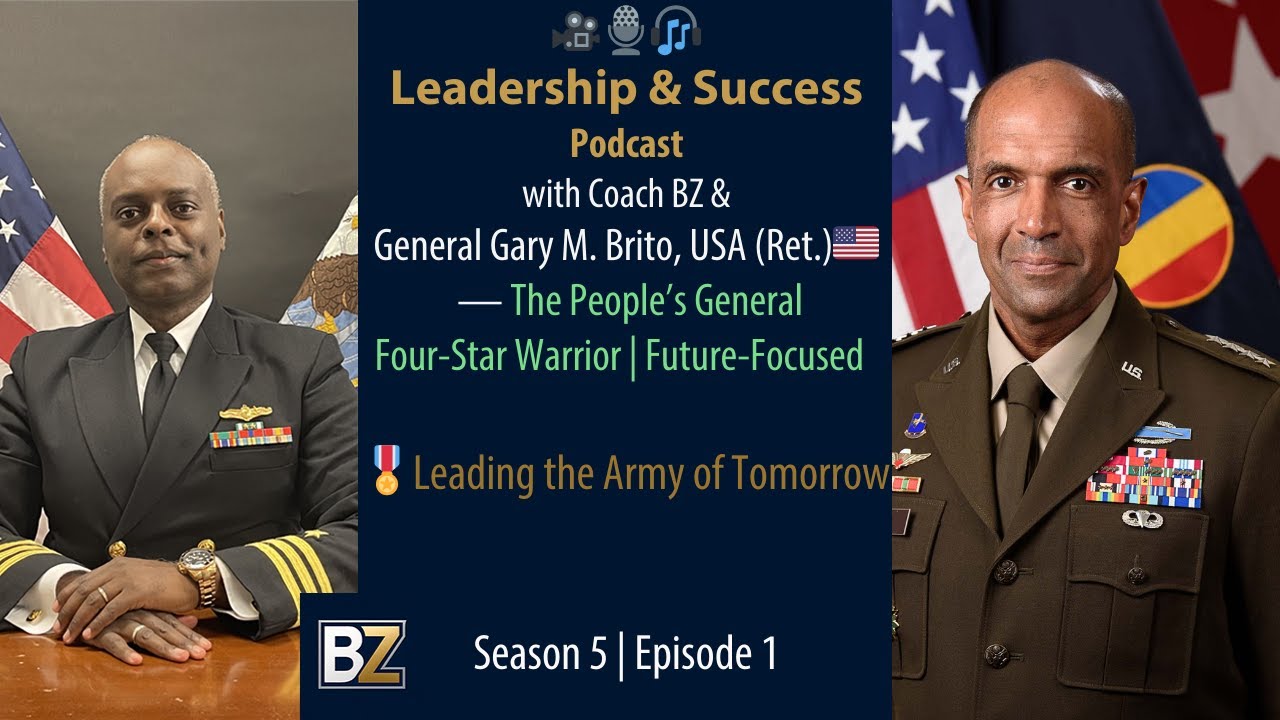
Retired four-star General Gary M. Brito discusses his 38-year Army career, from basic training commander to leading TRADOC. He emphasizes servant leadership, the critical role of NCOs, handling toxic leaders, and why people must remain central even as the Army adopts AI and data literacy.
Chapters
Hi, I'm John Maxwell. When the top companies in the world are looking for trainers, speakers, and coaches, there's one name that stands above the rest, and that's Maxwell Leadership. Our certified team members have gotten proven results for companies all over the globe, and our reputation, I'm proud to say, is second to none. Some of our members have risen to the top of their profession, including the one you're going to meet today. I proudly introduce you to my friend, Bob Fabien Zinga.
Welcome to the Leadership and Success Podcast with your host, Coach BZ, where we help you lead with purpose and succeed with impact. If you're ready to grow into the kind of leader others want to follow, this podcast is for you. If you're determined to elevate your success and leave a lasting legacy, this podcast is for you. As my mentor, Dr. John C. Maxwell, reminds us, everything rises and falls on leadership. Our goal is simple, to inspire you, challenge you, and equip you with insights that can transform the trajectory of your leadership journey. Welcome aboard to another episode of the Leadership and Success Podcast. With Coach Beasy.
I've heard many officers say they don't want to come to Training and Doctrine Command because they think it will hurt their career.
Let's just talk about that.
General Gary Britto started his time at TRADOC as Easy Company Commander, 1st Battalion, 19th Infantry Regiment at Fort Moore. He commanded a basic training company responsible for building soldiers to fill the most powerful and lethal fighting force the world has ever known. This time in command gave him the tools to succeed in a series of company and field-grade assignments, after which the Army decided he should command again. He was sent to 115 Infantry, 3rd BCT, 3rd Infantry Division, the infantry battalion he would lead into combat in Iraq during Operation Iraqi Freedom. 4 years later, in 2010, he took brigade command with 1st Army, and then in 2015 became the Deputy Commanding General of the 25th Infantry Division. In March of 2018, he took command of the Maneuver Center of Excellence at Fort Moore. The Army determined that all this experience meant he should come back to TRADOC to develop the next generation of warfighters. In August 2020, General Britto pinned his third star and moved to the Pentagon to take the role of Army G-1 and spearhead the Army People Strategy, a huge undertaking. In September 2022, he took command of Training and Doctrine Command, a position which brought his career full circle having started in TRADOC as Echo Company Commander at Fort Moore, Georgia.
All right everyone, we had some back-to-back episodes today. From the previous episode, I already told you I was really grateful that this is the new year and also for the list of illustrious guests, really people who really shake and disrupt industries and really lead at the highest level. And someone like that is already here in the green room. So let me see if I can do a proper introduction of the General. He's really somebody who doesn't need to be introduced. He's known as the People's General. He's served over 38 years in uniform with multiple combat deployments and senior leadership roles, including the Commanding General of U.S. Army Training and Doctrine Command, TRADOC. I used to work at DLI, the Defense Language Institute. I think we fell right under TRADOC. He was the Deputy Chief of Staff of the Army, G-1 Personnel, Commanding General, Joint Readiness Training Center, Commanding General, Maneuver Center of Excellence at Fort Benning. So he's a servant leader, a builder of leaders, and also a powerful voice on what it truly means to lead at scale. So ladies and gentlemen, without any further ado, please help me welcome to the leadership Success Podcast, the one and only General Gary Guido.
Coach BZ for the, uh, introduction.
Yes, sir. How you doing? Good morning, sir.
I'm doing very well. The applause in the back as well. And ladies and gentlemen, you can see I most recently retired just about 60 days ago, and I started to grow a little facial hair to give it a little test, so we'll see how it goes. Thank you so much, Coach BZ, for the opportunity.
Thank you, sir. I hope you enjoy your time now because I think you might even be busier than you were when you were in uniform, believe it or not. Offers are on their way, lining up just for you, sir. Thank you so much for your great service, outstanding, excellent service to our country. Maybe to get started, sir, what is one thing you are grateful for today?
Sure, I'm going to give you two, if I may.
Yes, please. Like I said, you are the general, you can do whatever you want.
I'm Gary. Yeah, just like the name tag says. Well, for one, my family. And I know probably everybody would tell you that, but certainly over 38 years, 6 months, and a couple of days actually of active duty service, my wife has been with me the entire time and my kids as well. And my wife and I actually met in college, so together before the military. So very much thankful, thankful for the foundation she provided. And my two sons that are grown men now. One serving actually in Hawaii.
Wow.
The other one is an Army civilian. Thank you for their support because this can be a demanding profession. Yes. Although a rewarding profession. And if I tie to that, I'm very thankful for the, uh, I'll just use the word blessed and fortunate career I had in the United States Army. The film talked, the opening video talked to the last assignment was the Commanding General Training and Doctrine Command. I was also the last commanding general of the Training Doctrine Command, because given the transformation initiatives in the military now, one of them was to inactivate that command to help stand up a new one.
Yes.
So I was very blessed to command it over 3 years. Wow. And that was the 4th tour in TRADOC, but actually full case the colors as well to enable success for the new command, which I know will do well.
That is absolutely amazing. Is there something about you, sir, that most people may not know?
That's a real tough question. Humble, if I can give one word. Yes. And I feel fortunate to have had a successful path. A hobby that I have, which surprises people often, believe it or not, I like to garden.
Wow.
And I'll tell you why, BZ. I'll tell you why. Because you can't rush it. Yes, you have to wait. And you can't rush it. And that may be a way of my personal therapy that I didn't know before, but it works.
That is really incredible. I wonder if there is a humility school they send all of the colonels and Navy captains to before they get their one star, because I've had the great pleasure and privilege to work for so many flag officers throughout my 21-year career in the Navy. But one thing that's really common among all of them is humility. And I really don't get it because when, when I was a, a seaman recruit, especially when I went to boot camp back then, if you were a flag officer, you were like a demigod or something, half god and half human. But with everything you've achieved and done, all of the praise and, and everything you've done, you think you would have a very big head and be extremely are arrogant, but every one I meet, especially the 3 and 4 stars, they're just so humble and down to earth. It's incredible. What causes that, sir? And I believe you are on mute. Okay.
Yeah, yeah. Um, for one, on the— you mentioned schools. There are, there are a lot of professional military education classes. I know all the services go through. Of course, I've been through ours. But let me— I'm going to give you an answer which you might be surprised with. If you are full of yourself, if you don't have humility, those that you've been blessed to serve— soldiers, other leaders— they don't let you know in a minute. And you're in whatever organization you're in is not going to be effective. It just won't be.
Yes.
So if you don't have that level of humility, and then do realize you're going to transition at some point, but if you don't have that level of humility, humility, you're not going to inspire, in my opinion. Inspire those in your unit, whether it's 350 or 35,000 or 40,000, which had an organization I just left, to be the best versions of themselves and get their job done every day, whether you're there or not.
Yeah.
So you're going to find out one way or another. It's just not, it's just not a useful characteristic. And being a selfless leader in any size organization. Yes. And it'll come back and get you. Personal thought.
Wow, that is so insightful. Well, talking about things that most people may not know, what is your connection with my home continent, Africa, especially Cape Verde, where they speak Portuguese?
Yes, a whole Creole language. My Cabo Verde Islands, Cape Verde Islands, it has a huge migration or population in the United States, actually more in the United States.
Wow.
Than the actual islands. I've been over there, I was over there in 2018. I spoke at their centennial. So my great-grandparents on both sides actually migrated from there and settled in New England. Where there's a large Cape Verdean population, is there everywhere as well. It was a colonized terrain for some time, just like many countries in Africa were. Now it's the 54th country in Africa since its independence in 1976. That's the connection.
Well, that is really amazing, and I believe, if my computer acts right, I add a picture of you being there in an official capacity, which is pretty amazing.
Uh, that is it.
Wow. So I have to ask you, sir, uh, because, uh, he was a senior chief, he's retired now. He says hua, which is the battle cry for the Army. In the Navy, it's ooh yeah. So I've got to ask you, Navy-Army football game, who's the best, sir? Who's the best?
Well, it's just win or lose, it's always going to be the Army, of course. We'll see next season.
Yes, sir, next season.
It goes back and forth.
Yeah.
Go Navy, beat Army. But sometimes it's the other way around. It's always, always fun. All right, we have another one saying happy 2026, Coach Bizzy. I'm grateful to be a builder creator today. I am harvesting oranges to help feed the hungry world. Okay, that's nice to know. And I garden too. Okay, that's in reference to what you said earlier, sir. I have 3 acres of oranges and a small vegetable garden.
That's really impressive.
A very, very good thing to get into. Alright, let's get into more of the serious stuff. So when you look back on your journey from the ROTC cadet to four-star general, what moments most shaped your character, not just your career?
Yes, one as a cadet, and then reinforced later on in my very first assignment. And any, any officer will tell you this. Well, I'd like to say they will. I learned the value very early on of the noncommissioned officer. Um, one was a master sergeant, was on the cadre that, as I say, as a cadet, brand new cadet. And one happened to be a master sergeant again on my very first week in my new assignment.
Wow.
I think you've seen some stuff on. So learned the value of the noncommissioned officer and the value of, you mentioned humility, of humble servant leadership up front. Yes. Um, so I learned those two things. Of course, they get reinforced as you mature. And get more comfortable in your skin, my term, just by serving for a while. And you're going to make mistakes, of course. But those, if I had to pick one, it would be that, the value of the noncommissioned officer and the relationship you need to have with him or her.
That, that, that is really, really powerful. And for the Navy, we, we call them chiefs, E-7, E-8, E-9. And really, in my opinion, they do run the Navy. I mean, all of the officers get all of the glory, the praise, the acclaim, but without them, We are absolutely nothing. Wow. And you are known as the People's General, and you've often said, you know, always work for your soldiers, never for your evaluation. Especially as a junior officer, that's a lesson I had to learn really, really quick. So where did that lesson first become real for you as a young leader, sir?
Well, if I can go back to the title first, I did not pick it. It just happened to be as a 3-star general. I was serving as the Army G1 Human Resources. And one of my subordinates, happening to be my Chief of Staff, put the nickname and it kind of stuck. Now, if I were to back up to the early career, more importantly, that one, just the ability to generally engage— I say generally engage with people, shake their hand, remember their name. You give a $3.50 Excellence coin that promote someone to do better or stay in, that's it. And that's where the, that's where the, the, the title came from. I don't own it. I won't— I didn't make it. Someone put it on me. I'm very proud, proud to have it. And BZ, if I can continue on that, it's truly— I haven't commanded every type of organization, but the ones that I have, I have had a lot of people that just had to get things done, their missions done. So It doesn't— just doesn't take a lot to talk to a person, maybe get to know them, understand them. I learned this over time throughout the years. And I think that that aspect of things can apply to military, corporate organizations, private organizations, public organizations, all of them.
Yes.
I'm not saying it's the golden answer, but just a title. But to get to your point, uh, that's where, uh, it was as a 3-star and working in the Pentagon that that came, the title came. And just, just to take the time to know people and, hey, how's your— if I could, one story, I was visiting one of our installations as the G1, talking to a Staff Sergeant, and she had just called her dad. Hmm. And purely coincidental, I was visiting this installation on my birthday. She was talking to her dad. It was his birthday. I said, no way. Let's give me your cell phone. Let's call your dad. So we called her dad, said happy birthday. It took 3 seconds. And it wasn't planned. It just kind of coincidental. But I know it meant the world to her. And it was actually that event that the title came from.
That is really, really insightful. And I think significant because I've been between the world of both the military but Silicon Valley as well. But before I do, there is another comment. Anna Wheeler made the wrong call. Always go Army beat Navy. No, it's the other way around.
All right.
That's good. But I think it is so critical to really focus on the people in the Navy. We may have stolen it from the Army, sir. The more senior I become in the Navy, it looks like a lot of what we are taught actually comes from the Army Field Manual. But anyway, we always say mission first, people always. That's how I have been brought from the time I was an E-1 to E-5. You do have to take care of your people. And sometimes, especially the higher you become, the more responsibility you have, some people tend to lose that. So I guess the question for you, sir, is what does people-centered leadership actually require, especially when you are leading at enterprise scale?
Communications, uh, for one. A level of delegation is necessary, and I, and I say that because it may be hard for someone at the top of the organization to know the private desk down working something, or the young ensign. But within your sphere, you can affect the climate and the culture of that ecosystem that you're in. And it reaches up and it reaches down. As an example, the last command I was in had a close-knit staff team, but through them, message communicated, led. Those that may be at subordinate organizations that command was geographically dispersed, because you kind of had to do that. Simple things like, you know, how you doing, it could be a birthday note, just the way you communicate at the respective echelon is important. And empower those that are either supporting you as peers left and right, subordinates within the organization, empower them to execute the mission that you gave them. Give very clear— I'll call it commander's intent— but very clear intent and purpose to allow them the maneuver space to run their organization, ultimately run it, use it well. And the leader should have the courage to underwrite some risk, some risk which can be mitigated if you give the clear intent, resources, and backing.
Yes.
And that's critical, especially when things get hard. If you have subordinates, what I've learned over the decades, you have subordinates or superiors that don't trust you, you are going to have an uphill battle all the time. And I know that can apply to any organization, military, civilian, public, Silicon Valley, as you mentioned.
Well, that, that is so insightful. And we've got one more comment. I don't know if you remember him, Senior Chief, US Navy, retired, Terence Sadler. You remember meeting you, sir, at GRTC, so he's saying hi. And then we have this question. I think I know who this person is. I believe it's Joel Rothschild. He was my primary mentor when I was a petty officer third class and got selected to become an IP officer. This man has really taught me everything I knew about being an IP officer, but I hold him responsible for really allowing me to go from '01 to '04, and then he decided to retire. So retired captain, US Navy. And I know that it's him because just of the way the question sounds. He says, I have a question for Gary. So can you talk about toxic leaders in organization? How does that happen? How do you address a toxic leader higher in your organization or a toxic leader in a peer position? How can we build better organization? And do you think we can do a better job of identifying those for leadership or command position? That's the question.
Yes, that's a big question. Yes, we have them. I think any organization— I know I definitely have seen them. Didn't— would never want to be one, hopefully. The bigger point on the toxic leader is, will he or she be effective for the organization? Probably not as much as they could.
Yes.
And two, which I think we've all seen if you've been around a toxic leader, is the, the, the corrosion that it can cause in the unit. You know, from now, whether it's a platoon or a big company of 50,000 people, big organization, 50,000 people. Now, I definitely do think there's some things we can do about toxic leaders. And in this case, of course, I'll say the command, but any organization has a responsibility to develop their leaders. And that doesn't start the day that you decide to put them in their respective organization. That leader development could start at the O-1 level, the ensign level, second lieutenant, peres, all the way through their, uh, colonel, general, and above. Uh, and, and it should be deliberately planned, whether it's professional military education, and this is a part I want to offer up as well, which I think is as valuable. Yes. I'll just go ahead and talk to it now. Mentorship, whether it's direct mentorship or leadership, it could be someone not even an organization to prevent the toxic leader from being in a position that they're just going to hurt the, uh, trust level within the command and the productivity of the respective unit. So those things can be done, the professional leader development, all the way throughout. Some is very informal peer counseling. And guys, I'll, I'll say leaders like myself in, in command, obviously not now own that. You, you, you must take some responsibility cuz it's gotta, it's a seed that's gonna grow a weed. Yeah. That's gonna grow and just not hurt, uh, help. And one last thing, uh, Coach BZ, which I offer, and I know many services and many organizations are doing this. There gotta be a level of selection criteria vetting before a person is just put in the position., to prevent that level of toxic leadership. So I wear rose-colored glasses every day. Mm-hmm. I'll admit it. It is something I've seen in my latter 5, 10 years in the Army definitely get better. Uh, because of, or controlled, uh, because of the professional development I took throughout, uh, vetting processes and selecting someone for command. And then lastly, and this is really hard, uh, for the leader that's in position, if you see it, you deal with it. Mm-hmm. You have to deal with it. And that's a hard conversation. Yes. And not— wow, I don't want that to come across the wrong way, but it's a hard conversation, whether through counseling or just the decision that is not productive in this organization, we have to go do something else.
That is really quite powerful. And on a lighter note, sir, General Milford, who I had the great privilege of interviewing on this podcast, uh, introduced you in the intro. He was wearing this big Navy t-shirt for some reason. I made him a lifetime offer, he absolutely said no. I want to know if you're going to take it. I would like to send you this shirt, sir. Just tell me your size. You're going to get it next week. Go Navy, beat Army. What is, uh, we can talk about that after the podcast.
I do know Beagle very well. Great, great person and leader.
Absolutely. I have adopted him as my mentor, but really at your level, once you become a flag officer, it doesn't matter. You have mentees, you know absolutely nothing about people who just adopt you and follow you. I know it's written in the book, When the Map Renzart, which I recommend everybody gets. But yeah, it is really incredible the impact one person may have. But I wanna talk a little bit more about servant leadership, people-centered servant leadership, because I think it's absolutely critical today more than ever before, especially with all of the changes with the technology, AI, emerging tech and all of that. We need leaders when we live in a time of uncertainty who really truly value their people. So I guess another question I have for you, sir: how do senior leaders stay connected to soldiers and family when distance, bureaucracy, and tempo increase with rank? How do you do it?
Yeah, the tempo, uh, the, the, the environment, whether you want to call it bureaucracy, technology, all things that we have to deal with, um, I'll share it quick. I won't mention the friend's name, but something he taught me at the rank of 4-star. We talk a lot about work-life balance. I know that's as important in any organization, whether you're wearing a uniform or suit and tie. But he shared with me something that I knew, but it was that light bulb moment about, uh, maybe 2 and a half years ago. And I'll give a little bit of context. The 4-stars would get together and talk to the, those who had just been selected for 1-star. We get paid for the baby general course, but that wasn't it. It was a professional development course for those who just selected. We talked a lot about work-life balance, and this peer of mine said, you know, we can call it balance, but it's really work-life prioritization. Prioritization— there's a lot packed in that word. So the senior leader, I would recommend, regardless— and I'll say this generically, depending upon the organization you're in is find time to go refill your tank, your energy tank, bring that energy level up. And it may be going to do physical training with troops. It may be walking a long time. It may be, hey guys, every quarter we're gonna have a potluck for lunch, all the staff, and just talk. Yes. Uh, so refill that energy tank and you get to connect with your people a little bit. So ATEC, mate. And Find those times where you can help prioritize. Well, I have, I'm going to the National Training Center this week, but I'm gonna do this this weekend with the family. And it is all, I, I was challenged with that personally. I know many senior leaders are because you will err on the side of being giving selfless to the unit and organization. You must. But that's ways to get reconnected. Then really take some time. I would offer up to identify those things that— I apologize, this has been a long answer— that may disconnect you. It's easy to sit at the desk and do email all day, and it's going to disconnect you from those that you may be serving. The technique is something I personally learned. Uh, what may be disconnecting you from your family, recognize that as well. But also realize that your chronological clock is going up, so Do I need to work out? Heck yeah. Maybe not as much 5 years ago, but more so now, just to maintain that level of balance. So to wrap that up, the deliberate thought on the work-life prioritization for the leader to enable yourself— and I learned this late, late in the career— to enable yourself to be the best version of you, to really make the best— those that you lead— and be the best versions of themselves. It's about productivity. And I do realize, lastly, Coach BZ, that I'm seeing— I'm learning it now— in the corporate sector, private sector, uh, output, profit margins, all that make a difference. But at some point, there's a human in the loop, which is part of the— is complemented by some of the enablers that are out there, technologies out there, artificial intelligence, things like that. Which may require some upskilling, but long and short of it, there's ways to connect to your people. And there may be times that it's a selfless profession, but there's a profession. But there's ways to balance it with the prioritization of your life.
Wow, that is really, really insightful. I'm sure my audience is picking up every year, especially my JOs. I care a lot about the junior officer who I hope will be the senior officers of tomorrow. But another thing, sir, is you've led in combat, crisis and institutional transformations. How do you personally decide as a leader when to slow down versus act decisively?
Certainly, I want to offer two perspectives, and this is actually something recently thought about, not, not in preparation for this, but post-career. As a retired general officer back in 2014 actually shared this with us,— it was at a professional development session similar to this one— said, pass the mirror test and know when you're not your best version of yourself. So that could cause you to slow down. If you're not the best version of yourself, answer why. I'm tired, hungry, something. And do the tweaks necessary to make sure you're the best version of yourself. And for most leaders, that may not happen that often. You may be at pace or ahead of the pace of your organization. But I'm gonna give you a second lieutenant story to give an illustration in a moment, which I do remember as a lesson learned 35, 36 years ago, actually. And secondly, as a senior leader though, Coach BG would also offer, take time. And it just may be walking around and listening to people, looking at emails or something to assess the productivity of the organization. And you'll know if you're at that bell curve and it's going down. You'll, you'll, you'll see it and don't ignore what you see. That could not necessarily mean, but could imply that you're moving too fast. And a couple, couple ways to hit that, either slow down, let the unit catch up.
Yes.
Or what do you do to enable the unit to keep pace with you? And it's, it's a, it's a tough leader decision because slowing down may cause you to not achieve your mission or execute your mission, but you can't do it by yourself. You're not leading yourself, you're leading the organization. And lastly, if I may add, is in this formal way, person is somebody that can help you see yourself, uh, whether it's a code name Red Team organization, 2 or 3 people to say, sir, I know you wanted to get to A, but here's what we look like. And really get some eyes on things, or a trusted friend. Could be your spouse. And my last organization was my Command Sergeant Major, who I love to death, but still great friends, several prior to that. Hey, hey boss, you thought about this? Here's what I see. And if I can tie this to one word you mentioned in the beginning, Coach BZ, and I'll stop— humility. You must have the humility to listen and take the appropriate action, if any action at all. You're so hard-headed. You're wrong, I'm right. You'll see, you'll pay for it later on.
Wow, that is so insightful. I mean, so many golden nuggets. Thank you so much for sharing, sir. I guess I'm going to ask you what I call the million-dollar question. I've had the privilege of being a commanding officer in the Navy, and sometimes you may be called to make decisions that might be catastrophic for your own career, but it's really the right thing to do for your people. I did do one thing like that for my acting executive officer who I wanted to become permanent, but my leadership wasn't seeing it the way I did. But anyway, the question I have for you, sir, is can you share a moment? Oh, and also the other thing, when you have the commanding officer for a unit or a command, right? So you have the top highest ranked officer, but sometimes you may have someone in your unit who actually technically outranks you. He is a captain or he was selected or in zone and you just made commander, like you are fresh out of, uh, of the boat, like, like they say. But for whatever reason, the Navy selected you and not, not them to, to be the leader of the command. So that's kind of weird in a, in a way, especially for somebody like me who started as a seaman recruit. No, I respect literal rank a lot, but anyway, it is positional authority for the command. So the question I have for, for you, sir, is can you share a moment when you had to make a values-based decision, but that came with real professional risk to yourself?
I'm trying to think fast. Yes, and this was the— in this case, it was a selection of a subordinate leader. I'll get through to the details and the selection was no in this case because of demonstrated character flaws, uh, demonstrated, uh, say, uh, risk and values that weren't representative of the command, or even in this case could have, it would have ended up being toxic and That decision was against— this was several, several years back, not, not in the recent command. The decision was in combat, actually. So we were deployed, and every other paper indicator would have been, this is the person that needs to be in command. So made that personal decision, no, and, and, and thought about it for a while. TT technique I would offer up especially the more senior you get, is if you don't have to make a hasty decision, don't. You know, the old cliché, take some time to sleep on it, come back, do that. I know a personal technique, I write things on a dry erase board and say, okay, I'm coming back. I'm not making a decision today. I'm coming back tomorrow and I'll, I'll give you the guidance. And it's a way to formulate your thoughts. 'Cause, uh, once that old Army term, once that towed round has shot through the missile, it's not coming back. Just like an email, once you hit send, it's out there. And you own it as a— you own a senior leader decision if the senior leader makes it. But this level, regardless of the organization, you don't have to make a deliberate— I mean, sorry, a hasty one. Don't. Think about it, weigh it, talk to some people, weigh the risks. Once you make it, you own it. And it may not be popular. And it could be a strategic insight. I'll stop there because this is a great, great topic, but you do want to— but this, they get specific. It was a personnel decision. Well, the reasons I knew I didn't do it, I don't regret it.
Wow, that's really powerful. Definitely leading at the highest level is not a popularity contest for sure. The buck stops with you and you have to make the hard decision. That's why you get paid the big bucks, right? And it also reminds me to what Joel said. Oh, have you noticed, Captain Rochelle, I called you Joel. Not Captain. It's very difficult for me to call him by his first name and become his friend because he's been my mentor and role model since I was a little bitty officer, first class. But anyway, he talked about toxic leader. In my own experience, it's very, very rare. I know we have some, every organization does, but for the most part, the Navy really knows how to select the best leaders. But I guess every once in a while, some people fall through the crack. I guess the follow-on question I have for you, sir, is what type of framework do you use to ensure that decision remain ethical when the pressure to deliver result is intense?
Oh, well, actually, I, I think, I do think that, and I'm sure I can speak for all services and organizations where leaders grow throughout time, If a profession defined by a couple of things, you have values and we have leadership spelled out also. I'm sure the other services as well. You do have ethical expected behavior. We also take an oath, which makes you a profession. So it's kind of built into the training DNA, uh, the leader DNA. I hope as you go through, as you go through up, that you have some ethical boundaries and moral this. Now, uh, how, how do you infuse that, ensure it happens? You, you own it. First of all, the leader has to have them too. If he or she doesn't have them, it's hard, hard to enforce. And if it's going against mission, if it's going to hurt somebody, uh, certainly a bad thing. If it's going to cause any level of division, it could be an ethical dilemma, but you just don't make that decision. It hadn't had one of those in combat as well with it, with it, with a different leader. So really, it's fair to expect any leader, whether it's an ensign to an admiral or lieutenant to a general, to have an ethical backbone that's going to guide his or her behavior. Will it be perfect as an ensign or lieutenant? No. Yes, it's going to mature over time. And part of that through the bumps and bruises and successes in training. But my sense, and I would offer this level of senior leadership for any leader, corporate, private, military, never allow your ethical compass to break. But you will not be effective. You will not be a good leader of organization. And you will not— and this is a personal thought, Coach Kizii. Would you want to look at a mom or dad the parent of a leader, of a soldier that you may have been leading, or something went wrong because of an ethical— this bad decision you made? No, bad decisions are going to happen, but if it's a deliberate ethical violation, you own that. And we just owe more than that to those that we've been privileged to serve. That's what selfish— I'm sorry, selfless leadership is really, really about. It matures over time. Time in the saddle, some wrinkles in your eyes. Wow, don't allow that compass to break.
That is so powerful. And for the junior officer listening right now, I think this is worth the money, right? Price to, uh, the entrance. Never allow your ethical compass to break. If you learn anything at all, you have to learn that. And I think the earlier you'll learn it, the better you will be. And I think your organization in the future will be very, very grateful. So we did say we were going to talk also about the future of the Army. Now, I was temporarily assigned to the Defense Language Institute Foreign Language Center in Monterey. I believe we used to fall under TRADOC, and you were the final commanding general for TRADOC. What leader development gaps most concern you when preparing the Army for future conflict?
I don't have any gaps, and I do want to take just a second to explain this, BZ, and If I want to go, if I may, I want to go.
You have a general, sir, whatever you'd want to do.
Well, I'm Gary. I'm Gary. You had mentioned the last commanding general, so I was, um, but we did that whether the organization was inactivating, another organization was inactivating, in order to stand up another organization that's going to help the Army in the future. So that was a major merger. A major change and put both shoulders into it and did it professionally for the organization. I'm not bragging, boasting, or nothing whatsoever, whatsoever, because I know that has to happen in order for the Army to continue to be successful. And it will, it will, because the troops, leaders, and Army civilian professionals, no doubt, right? To your question. I think you asked about, um, how do, how do you push that change? And it's part of our responsibility. And, and as the, the change is not so for that you can put something on your evaluations. It's tied to more strategic objectives. It's definitely tied to guidance. And to be simply old school, your boss told you to do something, you do it. And do it well. That does not excuse the analysis that needs to be tied to the— excuse my Harmon hand language— but those objectives need to be done and very much of a future focus. Now on the leader piece, perhaps a bad illustration, but a recognition now, like I know today at my, I'll call it seasoned age, may be a little different than a lieutenant that's coming in. They just got commissioned at Penn State University and they're a lieutenant today. Learn different, but to potentially communicate different. My generation, whatever generation is going to be, doesn't matter. Same with the troops. And I know this applies to any single organization, uh, but how do you build the culture of the environment to bring them in as an effective team pull the talents of everybody together in order to move the ball down the field and succeed at the mission. And that applies to every single rank. You know, the private that's going through basic training at Fort Jackson right now, yes, lieutenants in a whatever place, or even a colonel. And lastly, what I did learn over time, to include looking at myself, there's some things you won't be good at. There's some things that the colonel or the sergeant won't be good at in your organization, or the, the, the data scientists in your organization. How do you leverage his or her technology talent? Cool, the talent, build the opportunity for them, their talent to make the organization better. And probably more army term in the rucksack of the senior leader to do just that. There's as much value in knowing what you're not good at, and take ways to fix it. I'll stop there. I don't know, I hope I answered the question.
Absolutely, uh, extremely insightful, every single word. So let's talk about the future of that Army then, especially today. How should we be developing leaders differently in an era of artificial intelligence, data-driven warfare, and accelerated decision cycles?
Yeah, I, I'm not active duty now, uh, so I'll put that disclaimer up front. Uh, but the Army stood up 250 years ago, um, that to fight and win its nation's wars. We're always fighting when our nation's war— the country's going through its 250th birthday this year. It's always going to win its nation's wars. Uh, the rifle I had as a lieutenant is not the rifle lieutenants have today, so technology does change things. Technology moves very fast, but the centerpiece of that is a person. Uh, the soldier's the centerpiece. If you wrap everything around him or her, you'll continue to be effective. So the Army, um, is, is making, is going through some transformation, just like many services. I won't go into any specific details. The Command 9 inactivated was a part of that, all focused on ready to fight tonight.
Yes.
When the nation is at war now. Technology helps you do that. So it's as important for the soldier to be able to dig a foxhole with their rifle as is that soldier in the same foxhole knowing there's a UAS above his head, his or her head, and how do they react to it, how do they use it. So use of artificial intelligence is enabled, just as a broad example, is enabling decision-making. Machine learning. Using a robot for something you don't have to put a soldier in. It's like in a breach. And I know all the other services and organizations are doing this as well, but leveraging the technology to make our mission better. If we rise and don't and ignore that, we won't be successful in any organization. And so I'm quite proud. I can speak specifically for the Army, quite proud of the transformation initiatives that are ongoing, will continue to go on. It is hard business. Organizations are doing the same, and you can't close an eye to driving positive change and objectives that drive it. And maybe over a span of 2 or 3 years, I tied the budget, the whole bit. That's, that's the hard senior leader business, but must be done.
Wow, that is quite insightful. And something you've also said, sir, about ignoring, uh, the fact— I remember when I met Commanding Officer I reached out to all of my previous chiefs and commanding officers, the good ones, to really get advice from them. And one of them told me, as a new CEO, if you see something that doesn't meet the standard but you ignore it, that becomes the new standard. So never, never, never do that. You have to have— no, take care of your people, but really have high principles. So the last question I'm going to ask you, sir, before we go into the second half of the show— I could be talking to you forever and ever, but, uh, uh, I have one, one hour and I'm gonna keep you here more than a minute, not a 4-star general. Okay, uh, what skills, sir, do you believe will matter more in the future, and which skills are becoming dangerously undervalued in your opinion?
I want to give a broad answer and something was in my last command, we started to see it. I'm going to give— you mentioned General Beagle earlier— credit for this, for sure. There's a level of data literacy at all ranks, echelons, and specialties. And I think that applies to any organization right now because of the things that are out there, whether it's artificial intelligence, ChatGPT, or whatever. It's just data literacy ubiquitous at all levels and probably more specialized than others, for sure. I do think even with that, and think and put in this perspective, Even with all of those enablers, people do still matter. So the human touch is part of that balance as well. So we shouldn't— my personal thoughts, I wouldn't put on anybody's driver's board, but the human aspect of all of that does matter as well. So a little level of data literacy, a level of continued leadership skills, and you're not leading yourself that continues to evolve, mature over time. And it will be as important 5 years from now, 10 years from now, as it was 15, 20 years ago. And don't close your eyes to change because it's going to happen and it will bypass you and you become irrelevant, you or your organization. We don't need that as well. And that's the responsibility that the senior leader has. Wow.
So many golden nuggets. Thanks so much for sharing, sir. And I am overjoyed you've said you're going to be You are starting the process to write your first number one New York Times bestselling book. Whenever that's published, I definitely want you back on the Leadership and Success podcast. Please, please, please, please. So much to talk about. So let's talk about leadership for Ace. I guess we've always been talking about leadership, but I want to most focus on the principle that have made you a 4-star general and really extremely successful above your peers. That's just a fact. Generally speaking, so what is maybe the greatest lesson you've learned in life so far, in general, in leadership, in life? What is the greatest lesson you've learned?
Coach PZ, I want to share something that I was told as a day 5 second lieutenant in my first unit. I won't go into all the details, I'll bore you to death, but Again, it was a noncommissioned officer at this point who simply said, hey LT, take care of your troops. Don't work for your evaluation and everything's going to work out. So, wow. I shared that with a smaller audience. Now it's obviously a bigger audience. My takeaway that didn't see as much then, but definitely throughout, uh, 38 years and, uh, either combat tours or other pieces is when Christ— things get really hard and Missions get tough, but you know who's going to execute it? Those people that you've been blessed to lead, privileged to lead. So that lesson stuck with me most often. And another one is, you know, not everybody's going to like you. Hard decisions are hard decisions. And but as long as you're— you can pass the mirror test, you're going to be okay. And at some point, we're all going to transition as well. That's a guarantee for all. And that's a tough one. And I, I credit a retired four-star who mentioned the mirror test thing to us. And I was a colonel at the time. Give some thought to the decision you're going to make. And not everybody's going to be happy. Not everybody don't like you. Not everybody will be your friend. But you're doing this for the organization. Um, and I would— this would probably apply to a small startup just as much as it would a Fortune 500 right now. And then end of the day, you're working towards those objectives. Ours was combat readiness at all times. Um, Company XX might be to $5 million in revenue. I'm not sure, just for illustration. But how do you ethically get to that path? And, uh, it is not a, um— I won't say senior leadership is lonely, but it's not one where you may be looking for a popularity contest all the time. But yes, if you're humble, if you take time to recognize people and shake their hands and write a birthday card— just given a couple examples— genuinely, authentically, all of that kind of comes together, and they're on board with you if you have to make a tough decision, uh, one that's not popular. And you, you learn— personally, I learned that, and others as well. As you go up the chain. Yes.
Wow, very, very insightful. I feel like I'm becoming a spokesperson for General Biggs. General, I think you're gonna need to hire me as your spokesperson. But one thing you said was, "Rank is borrowed," and I always, always remember that. Yeah, because it doesn't matter, you can be a 4-star general, a commander, at some point the Navy is going to say, "Time's up, get out of there." So, but the impact you have on your people though, that is really significant and part of your legacy. And I also love what you've said, sir, about not everybody liking you. When I was a commanding officer, I couldn't believe it. About 1-2% of my troops, for whatever reason, they didn't like me. Maybe my accent, maybe I don't know. I don't know what the problem is. I am a very likable person. I love everybody, you know. I have great values, I believe, and I value people and I want to add value to them. But man, they made my life so difficult. But again, 98% were perfectly fine and on board with what I was doing. I guess not everybody likes change whenever change must happen within the organization. But how have you dealt, sir, as a senior leader, focusing on your mission and taking care of a good majority of your troops when, you know, 1% or 2% for whatever reason just will not get on board with what you are doing?
Sure. And again, Barry did not have to deal with that a lot, or didn't see it, but did not have to deal with a lot. If you want to take the time, whether directly or through somebody— could be through another subordinate leader or a peer— to find out, hey, what's going on? You know, what's, what's the problem here? If, if it's important to you, and it may be, and I think the person has to make that decision.
Yes.
Now, if the level of discomfort and in another person or organization is going to lead to mission failure, then you have to address it. Yes. Could be, it could be a personal problem, could be budget, could be a lack of resourcing. Yes. Worthy of doing it, I would offer Coach BZ, and depending on the organization you're with, again, military, civilian, what have you, there are ways to get it. You know, host a town hall. Hey, what's on your mind, team? Computer-based sensing sessions where you can find out things.
Yes.
Quarterly or an annual survey, that environmental survey where you can find out things and maybe valuable. Yeah. It could be something as simple, hey, the coffee machine doesn't work today. What the heck? You'll hear that.
Or yes.
Hey boss, did you know that the, um, commissary hours are such and such? Just as an example, and then act on it, either you or, or, or in the appropriate organization. There's definitely ways to get a sensing. Climate survey is a formal way of the organization. Yes. I mean, I, I had a boss that I worked for who— I was a 2-star, he was a 4-star— sent a one-pager out with a couple questions. Hey, can you answer this for me? Pick the delicate, pick the delicate to push it around. And just set the— put the feedback up, you know, 5 out of 10 people say— well, I'll put it another way— 8 out of 10 people say one thing, you probably want to pay attention to it.
Yes, yes.
It could be good as well. And I'll pause.
Wow, that is so powerful. I think one of the tools that I've used, which I borrowed from one of the best commanding officers I ever worked with when I was a junior officer, was to have that commander's inbox where people could send their feedback without being identified, completely anonymous. There will be absolutely no retaliation whatsoever. And we use technology to prove that. I wouldn't know who sent it.
That's a very important point, Mizie. I'm glad you mentioned that. You will stifle communications. Yes. And actually, some organizations have formal rules where you will not have retaliation. Wow. That's an accountability issue. Powerful.
We are quickly running out of time, sir. What are you learning right now?
Sure. Again, extremely blessed for the career that I had. I wasn't planning on it by far. I was going to do 4 years and I'm so blessed for that. Transitions happen and you got to think through it. And part of it is a cultural change and then be honest with yourself. One thing that I'll just leave, the one thing that I learned is the importance of our routines and whatever transition you're going through. Through. I was on the treadmill this morning. It's a routine, you got to keep it going. As important in the prioritization of life, and as important as my age becomes more seasoned. Yes, routines are important. And that which has, in my case, like everybody's, the family that's been there the entire time, want to keep them there the entire time. And I'll pause.
That is really powerful. And I believe, sir, this is your father. He got to see you become a commanding general in the most powerful army in the world. Wow, that is incredible.
You've been doing some data digging.
Yes, sir. So, uh, Ben, uh, I am running out of time, but I think I need to ask this one. I love this one. One of my favorite CEOs, she gave it to me. One side says success, the other side says failure. No, two sides of the same coin. We know about all of your successes, they're really legendary, but what about failures? How has failure shaped your life?
Sure, I can't say I can think of any specific one. Definitely, I might not have been the first guy to run or didn't do good, the best I wanted to in the course, but having humility to take the gut punch just for the moment. You want to go around the corner, have your 2-minute pity party, go ahead, and then come back. And what, how can you take that moment and make yourself better, make the organization better. And I used everything that way. How can you improve from that? And it could be a— you don't write well, go figure it out. Go start reading some different types of books to give you that balance. I'm just giving some general examples. But learn from every, every failure. Leadership is effective when you're a good follower as well. I think success is effective when you learn from your mistakes. Over.
Uh, that is, uh, powerful, powerful. And, uh, if you could choose 3 people, sir, to have dinner with— they could be alive, dead, or even mythical figures— who would you choose and why?
Wow. Someone I never met but always wanted to, uh, Condoleezza Rice, who's still alive, obviously. Maybe one day. Yes.
Um, actually, she's here in Stanford. Maybe somebody in my network can make it happen.
You never know. Um, you know, you actually stopped me for a change. I gotta tell you what, on our next podcast, I'll give you the answer.
All right, that's about it. Can you tell us a little bit about this young man, sir?
Yeah, way back there, my hand, uh, the Boston High School. I was the left side defensive end. Senior year in high school. That was it.
Wow. That is incredible. Incredible.
Incredible.
What a fascinating life and the impact you've had. So if there was maybe a song, a book, or a movie, which one would be your life's theme or anthem?
I probably watched way too many times purely for entertainment. I won't say motivation. It's what we call the Five Heartbeats. Don't ask me why. Yeah. But I will tell you what, when we all do professional reading, there's a— I've read all the John Grisham books, and will probably continue to. It has nothing to do with being in the Army, but just like the theme of it. And I just finished one called Mission Transition. And it was a gift given to me. It was a gift given to me at my retirement ceremony. And I wish I had it a year ago, because it talks about those things you think about mission transition. Another, another book gift a peer gave me at the retirement was called Think Again. And, and he wrote a note in there. I'll close with a quote. But here's what you've done in the military. Now you have an opportunity to think again for the next chapter. I'm only on page 3. But we'll get—
Thank you so much for the book recommendation. We do read a lot. And also, I found out after I interviewed then did the research for this person who needs to hire me as a spokesperson. General Biggs is the one person in America who reads more than I do, and I couldn't believe it. He reads like a book like every 3 to 5 days. I'm like, sir, you need to slow down, please. So anyway, I have an eye on him. Every time he recommends a book, I make sure I add it down to the digital bookshelf I created. Well, that's really amazing how much you can learn. Okay, we're quickly running out of time, so let me ask you this then. If you had one day and only one day to live, what would you have liked your final contribution to be?
Been a good leader, good husband, good dad.
And if you had a magic wand, could solve any problem, what is one problem you'd like to solve tomorrow morning?
Wow. Unity. Yes, I'll stop there.
Yes, we need to be like— I know I always say 9/11 was really a milestone for members of my generation, and it was terrible, horrible, but I really loved 9/12, the day after 9/11. We've never been so united as a community.
We'll get there.
I was so proud to be— actually, I wasn't even a U.S. citizen yet, but to be part of the American culture, part of the reason why I joined the Navy Anyway, okay, so—
Quite a success story as well.
Thank you, sir. So we are coming towards the end, and how can we add value back to you? And thank you so much for your valuable time on this podcast, sir. How can we support you?
Well, thank you. I would just commend Coach BZ, what you're doing now, not for me personally, but supporting an important mission and sharing this aspect of leadership and what have you to to your global audience is as important. Yeah, I am trying to transition and connect to people like yourself and others. I see you pulled up the LinkedIn page, which is as new, but that level of support is there, and I thank you for this opportunity.
Thank you, sir. I have a thousand more questions, like, just like you and General Biggs. I could be talking with you forever and ever, but we are not going to do that, so Is there a question I should have asked you, sir, that we didn't get to answer? Anything you wanted to share?
No, no, Coach BZ. Again, I was, uh, happy for the opportunity. We connected a week or two ago, and we'll continue to give back as long as I can talk. And this is one of those things I've been blessed to want to share that with people. Wow.
Then the very, very last question I have for you, uh, if you could go back and give a piece of advice to this 17-year-old self standing at the edge of this incredible outstanding career you've had, what would you say to 17-year-old Gary?
Wow, someone asked me that before, and I, I 1,000% didn't see that path that I've taken from that day forward. Well, that's another discussion we'll have. Um, be true to yourself, be true to yourself, and have some values and never let them go. Wow, that's something grandparents taught me early on, pulling weeds in the garden.
Powerful. All right, this, this is, this is it, sir. And the very, very last question, and this is it, uh, what is one word that represents our, uh, shared experience on this podcast this morning?
Thankful.
Yes, I'm really, really grateful. Thank you, thank you so much, uh, General Gary M. Britto. You will always be a general for us, sir, but thank you so much for your service to this nation.
Thank you for I appreciate that, and thanks for all that you're doing for this massive audience. Greatly appreciate it.
Thank you, sir. Well, everybody, that was the general. So this is it for the, uh, history books. I'm very, very, very grateful that, you know, 4-star generals are really willing to come on this platform and speak, especially to enlisted and junior officers who follow the show, and some of the people that I mentor. Some of the questions I get, I don't get it from them. Because especially when you are new in the military, regardless of the branch, and you see those people, you know, 3-star, 4-star, general, and admiral, you feel like, wow, it's just no bigger than life. Just being able to listen from them, learn from their experience and their wisdom, there is just nothing like it. So I really do appreciate that. So today is going to be a very, very busy day. This morning I talked to Dr. Sunborn. And then of course we just had a wonderful leadership talk with the People's General, General Gary Brito, who doesn't need to be introduced. But later today, in a couple of hours, I'm going to be speaking, I believe it's this one, Terry Maxwell for episode 3. We're going to be talking about conscious capitalism in action. And after her, I'm going to be talking to Dr. Shana, Doc Springer. She's about mental warfare and moral courage. She wrote a bestselling book, "Relentless Courage," about PTSD in the police force and the military. And I interviewed co-author Sergeant Michael Segru a few weeks back for our first Mental Day. Especially in the military, it's very, very important to take care of your mental health. 21 service members dying every single day, that's just not acceptable. We have to take care of ourselves. I know many, many times, long, long, long, long time ago when I was still a junior enlisted sailor, it was kind of tough for people to go out there and say, hey, I need help with my mental health, because back then it could mean you might lose your security clearance. And if you lose your security clearance, you're going to be kicked out of the Navy, right? So people didn't want to do that. But today we have so many resources out there and your clearance is not going to be affected. So we need to take care of you. You are very, very important. So I would say for today, if you could come back when I speak to Dr. Sherna Doc Springer, she's really dedicated her life for warriors and mental health. She has another book called Warrior and Beyond the Military. If you are in the service or in the police force, like I interviewed police officer Dr. Beth Sanborn this morning, I think you should be there. And then I will be interviewing Dr. Dina C. Brown. Again, that's today. She's a founder, speaker, executive coach. We're going to be talking about stillness meeting strategy. So that's going to be for today. And then tomorrow I will have— and I think I mistakenly put this picture at the beginning of the show— but I'm going to be talking with Colonel Chevy, uh, Chavez O'Cook, U.S. Army. He's a mentor-in-chief, soldier scholar, and strategist. We're going to be talking about Beyond Control. And another person I want to highlight for you all is going to be Rear Admiral Melissa Burt, United States Coast Guard JAG. She is retired now. We're going to be talking about principle, strategic, and she's empowering, especially for women in the military. We're going to be talking about leadership at the intersection of law, trust, and national security. You don't want to miss this. So I have two other people that have already confirmed this week. We're gonna be talking to Lee Jones, he's an award-winning CIO. We're gonna be talking from legacy to resilience. And also I will be speaking to somebody not many people know, Charlie Wetzel. He is the writing companion of Dr. John C. Maxwell, my primary mentor. He's helped Dr. Maxwell write all of his number one New York Times bestselling books. Everybody knows about Dr. Maxwell, but this is the mind behind all of the success. So Charlie is going to be here, uh, sometimes next week. And I think I have one more person who has confirmed, uh, that's Tembo Awe Stevenson. She's a food justice visionary, cultural engineer, scholar-practitioner, and bestselling author of the Wanda series. She's gonna be here next week. Okay, this is it for now. And, and then I want to let you know, guys, I decided to do this publicly every single day for for the month of January. I've been doing this since I was a teenager. I go through the book of Proverbs. So yesterday we did Proverbs chapter 1, today we're gonna do Proverbs chapter 2. So basically it's really about ancient wisdom, right? So again, ancient wisdom mentoring from the book of Proverbs. This has nothing to do with religion at all, but it is really ancient wisdom and leadership lesson from the book of Proverbs, a special edition of the Leadership and Success podcast. I will do it only from January 1st through January 31st, every day read one chapter from Proverbs. We did Proverbs chapter 1 yesterday, and you can go back and play the replay or go to whatever podcast platform you use and listen to it. But again, I just focus on wisdom, I focus on leadership, I focus on success, nothing religious whatsoever. And we're gonna do the last chapter of the Book of Proverbs, which has 31 chapters, on January 31st. So that's gonna be, as you can see, Season 31 for the 31 chapters in Proverbs. This way it's separate from what I am doing with Season 5. Again, uh, it would be great if I see you. I believe I'm gonna do Chapter 2 today at 4 PM Pacific time. So 7:00 PM Eastern time today, we're gonna go through chapter 2 of the Book of Proverbs. Again, something I've been doing since I was a teenager. And after I got married, my wife and I have been doing this at the beginning of the year, of the first month, we go through one chapter a day for the first 31 days of the new year. So this is the first time I've decided to go public. Again, if you wanna learn about ancient wisdom that's still applicable today, I highly, highly encourage you to attend 4:00 PM Pacific, 7 PM Eastern today. Okay, this is it for now, and I am hoping I will eventually get an Army general to get my offer, and I'm gonna send them a Go Navy, Beat Army t-shirt. So far I'm failing miserably. All right, thank you so much for watching the Leadership and Success Podcast, and I will be back very, very soon, in a couple of hours, to have a leadership discussion with Terry Maxwell, business architect, growth catalyst, conscious capitalist. We're going to be talking about conscious capitalism in action. She wrote the bestselling book Succeed on Purpose. See you in a couple of hours. Thank you so much for being with us today. Bye for now.
Thank you for tuning in to the Leadership and Success Podcast with your host, Coach BZ. If today's episode added value to your leadership journey, be sure to subscribe, share, and join us again for more wisdom nuggets on how to lead better and achieve greater your success. Remember, leadership is the most critical skill of our time. The world will always need leaders to inspire others, drive innovation, and execute meaningful strategy. So why not count yourself among the bold leaders shaping the 21st century? Until next time, stay inspired, stay committed, and keep leading with excellence.
More from Bob

S250:E4🎙️LIVE 🇺🇸America 250: President Barack Obama Leadership, Service, and the Power of Hope






S5:E157🎙️ LIVE with CMD CMSgt Dennis L. Fritz, USAF (Ret.)(Multi Tracks Audio)



S5:E156🎙️ LIVE 🇪🇸 Leadership Lessons from the FIFA World Cup 2026 Champions (Multi Tracks Audio)

S250:E3🎙️ LIVE Leadership Lessons from America’s First Documented Family of African Descent 🇺🇸📖