S5:E103🎙️ LIVE with CPT Matthew Hoh, USMC (Vet.)
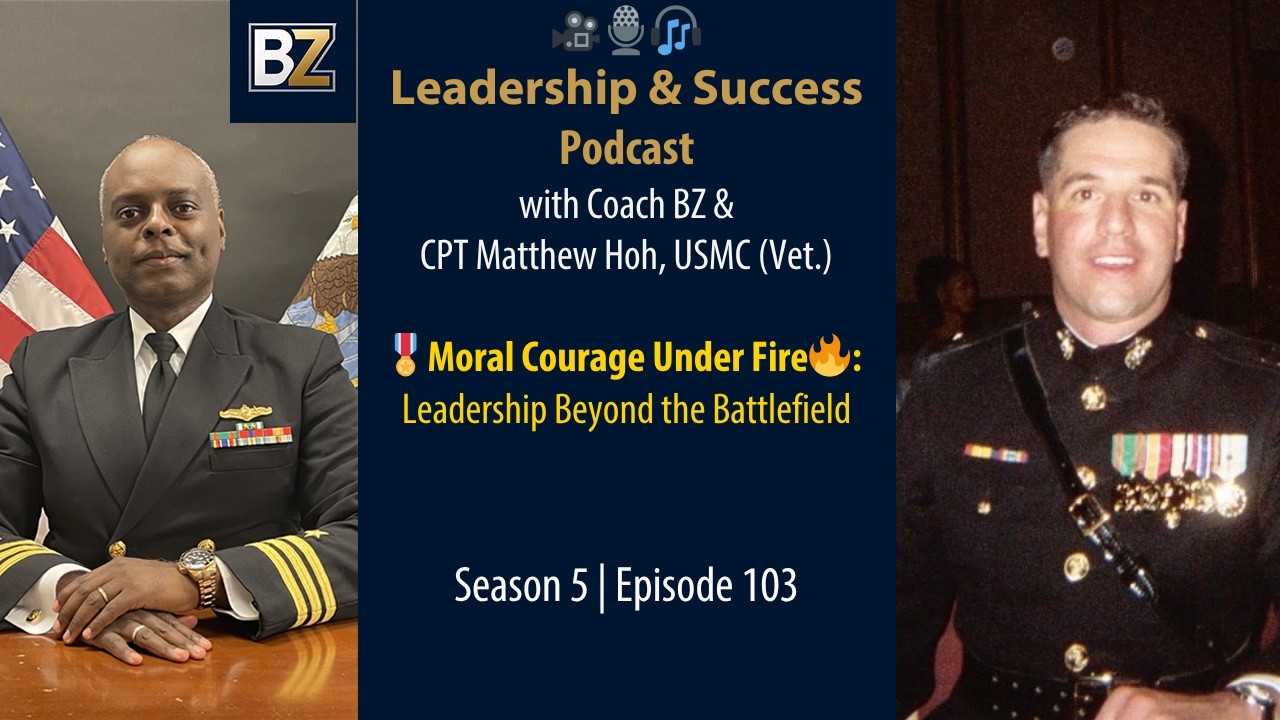
Captain Matthew Hoh, a Marine Corps combat engineer and State Department veteran, discusses his service in Iraq and Afghanistan, the invisible wounds of war like PTSD and moral injury, and why he resigned from the State Department over the Iraq war's futility. He emphasizes moral courage over physical courage and the importance of caring for subordinates.
Chapters
Hi, I'm John Maxwell. When the top companies in the world are looking for trainers, speakers, and coaches, there's one name that stands above the rest, and that's Maxwell Leadership. Our certified team members have gotten proven results for companies all over the globe, and our reputation, I'm proud to say, is second to none. Some of our members have risen to the top of their profession, including the one you're going to meet today. I proudly introduce you to my friend Bob Fabien Zinga.
Welcome to the Leadership and Success Podcast with your host, Coach BZ, where we help you lead with purpose and succeed with impact. If you're ready to grow into the kind of leader others want to follow, this podcast is for you. If you're determined to elevate your success and leave a lasting legacy, this podcast is for you. As my mentor, Dr. John C. Maxwell, reminds us, everything rises and falls on leadership. Our goal is simple, to inspire you, challenge you, and equip you with insights that can transform the trajectory of your leadership journey.
Welcome aboard to another episode of the Leadership and Success Podcast with Coach I have experienced what it's like to live in extreme survival mode, both in my personal life and on the battlefield as a captain in the Marines during the Iraq War. It's not only that I have seen terrible things, but I have done terrible things in war just so that my troops and I could survive. I and many others who have fought in war live with the moral injuries of war, and those inner battles are the biggest of all the battles we fight just to survive. At some point, though, we have to ask why and to what end. These are the questions I asked when I resigned my position with the State Department in Afghanistan in protest over the futility, the corruption, and the lack of accountability for the war. After leaving the State Department, I settled here in beautiful North Carolina, where we are all living in survival mode as a consequence of the policies of the political establishment that have concentrated wealth in the hands of the few at the expense of the many. Where the big corporations make record profits while the people can't afford to live where they work. We are witnessing our loved ones in our communities suffer. It's all connected. The choices that our government makes through the political system that we have now continue to prioritize corporations, banks, institutions like weapons companies over the needs of the people, and that's reflected in our domestic policies as well. If we come together, we can ensure the people of North Carolina are represented, and that the people power is not spoiled by the two-party system. Why would we expect those who are benefiting from the current political system, uh, whether it be the politicians in power or the corporations and banks that they represent, to change anything when those corporations and banks are making record profits? Meanwhile, working families are struggling more and more every day, every week, every month. That needs to change. I'm Matthew Ho, and I'm running for U.S. Senate because I want all of us not just to survive, but to thrive together.
All right, welcome for a very impactful episode of the Leadership Success podcast. I think this is probably going to be one of the most insightful conversations we are going to have on this podcast today. I am really honored and grateful and privileged to be speaking to the person I'm going to be introducing to you in just a moment. What a great, great honor it is. But as is our custom here, let's start with our moment of gratitude. This is where we take just a minute every time we meet to be grateful. Part of the reason being because about 21, 22 service members and veterans commit suicide in our military every single day. And I think it's not possible to be grateful and suicidal at the same time. So if you would maybe close your eyes, put yourself in your happy place, take a deep breath and think about one thing you are grateful for in this very moment right now. And I think I am really grateful for our core values in this country, what we represent to the world. And people like Captain Matthew, I'm going to be speaking to, the moral courage they really represent, that's really the spirit of America, and I'm so, so grateful for it. All right, so if you would type into the comment, let us know where are you joining us from. It looks like Daniel Young is joining us from Midland, Florida, and we have another member joining us from 7KAL, and he's saying, thank you, Matt, for your service. I'm honored to serve alongside you in the Diplomatic Corps and U.S. military.
Wow.
I'd like to know who that person is. Let me see if I can find out. Looks like that's Bill. Bill Kirsch. Thank you. Thank you so much, Bill. And also let us know what you are grateful for today. And of course, if you do have a question for the captain, please type it in the comments and we will be answering your question live. Okay. Let me see if I can properly introduce our guest today. This might be kind of a challenge. Now, myself as a former commanding officer in the US Navy, I, I really view anybody who served in the service, even just for one day, any of the branches, as a hero. That's really the way I look at it. Less than 1% of us in this country raise our hand and, you know, volunteer to wear the uniform. But There are heroes, but then there are heroes, if you know what I mean. And today I am really speaking to somebody I consider a true American hero. I'm talking about Captain Matt Ho. He's a US Marine Corps combat veteran, former State Department officer, and nationally recognized voice on war, foreign policies, and moral leadership. I first heard about him, I think I watched him, it was on MSNBC or MS— MSNOW. He's a thought leader and he knows exactly what he's talking about because he's been in combat, right? Marines in Iraq as a company commander. The few, the proud, the Marines. He served in Afghanistan with the State Department, made a defining decision in 2009 to resign in protest of the war's escalation. Wow, what courage. He was awarded the Ridenhour Prize for truth-telling. He continues to shape national dialogue on leadership, ethics, and the future of conflict. Matt represents a rare kind of leader, one who has seen war up close and still had the courage to question it. Part of what we're going to be talking about today, and I believe you are going to learn, is the difference between physical courage and moral courage. So ladies and gentlemen, without any further ado, please help me welcome to the Leadership and Success Podcast, the one and only Captain Michael Ho.
Hey, thanks. All right. Thanks for having me join you.
And absolutely.
Yeah, it's really fantastic that Bill Kurz is on the line here, Bill. I appreciate you being here. Bill and I were in the State Department 20 years together back in 2005, 2006. We were on the Iraq desk together, so it's really, really great to hear his name.
So that is really, really amazing. And one thing for sure, I mean, the military is kind of like a second family, really. I guess we call ourselves, right, brothers and sisters in arms. And I think that's one thing, you know, I will probably be retiring sometime this year. That's one thing I'm going to miss a lot, just the camaraderie, the fraternity within the military. You really meet people you didn't know at first and they may come from a completely different background or whatever, but you really become tight. I mean, they are willing to take a bullet for you. I can't say the same in the industry, Silicon Valley or Microsoft or Google. Nobody's ever going to do that. It's really, really powerful. Even you, this is really the first time we are meeting now, but I feel like I've known you forever. It's just amazing to be a member of this special fraternity. So to get started, Matt, let me ask you, what is one thing you are grateful for today?
I just— very personal— I just had we had our father's 90th birthday.
Wow.
Over the weekend. And as we talk, as we get into these, these topics, these questions, these thoughts on leadership, I'm probably gonna reference my father a lot.
Wow.
And so the gratitude I have for my family, but specifically in this moment, Andy Ho's son, I think that's, you know, if I close my eyes and What am I feeling? That's where I'm at.
That is powerful. Do you come from a military family?
No, no. We have people who were in the military. I had a couple uncles that were— great uncles that were— went ashore in Normandy. I had a cousin who was in the Marine Corps, got kicked out for selling drugs. You know what I mean? So various— you know, various— you know, uncle in Europe during the '50s. My dad was in the National Guard, New York, during the '50s. 50s, right? I mean, so, but no, no, not a, uh, a military family, uh, as most people understand that term of, of generations, uh, being in uniform.
Well, that's, that's, that's more than I could say about my, my family. I'm the one and only one, and I know none of my daughters are going to join the military for, for sure. So I might be the one and only one in my entire line, but that is, that is all right. Thank you for all who have served. Is there something about you, Matt, that most people may not know when they first meet you?
I think, you know, to get into probably the topics you want to talk about, Bob, is that I've got the signature wounds of the wars in Iraq and Afghanistan. I've got the invisible wounds, the traumatic brain injury, the moral injury, and the post-traumatic stress disorder. And the extent to which those have limited me. I think, you know, for many veterans, as well as people, you know, in other fields and occupations and industries who deal with these types of wounds, of these disabilities, it's not apparent. So people see you, you know, and they think you're okay, nothing's wrong with this guy. I know I can give them— in my case, the work I do, media work, I'll do a podcast or I'll do a radio or television appearance or what have you, and everyone thinks you look fine, and you don't see that I needed to take Orbituit that day, right, in order to get out of bed because of the, you know, incapacitating migraines I have from my TBI. I mean, so just, I, I think that is something that, in the, you know, spirit of what you're trying to do, uh, the struggles that people go through and the unwillingness— and you reference this— the unwillingness to, particularly as veterans, to put yourself first or do anything that would expose your weakness.
Yes.
And of course, the reality of that is when you don't do that, when you don't take care of yourself and you're not honest about who you are and what you're going through, eventually, you know, the diminishment, right? You know, and it's— and you're further weakened by that because you're not getting support. You're not taking care of of yourself, and others aren't able to help you. And so you actually end up being in a much weaker place if you're not willing to address your issues, your trauma, your injury, your disabilities, than if you were. And so I think that what you do is such a valuable service, because I can tell you, the reason why I got help for my issues following the wars was because there were people, other guys, men and women, you know, other combat veterans talking about what they were going through at home. And so I saw that, I recognized that myself, and that gave me the courage and the sense to go and start getting help.
Thank you. Thanks so much. I think it's a message we really need now. And to me, at least from my experience, it's mostly with male than female service members. Because I don't know about you, but I got in the Navy 21 years ago. Back then, if you saw a psychiatrist, you had some type of mental health issues or whatever, they would actually kick you out because you would lose your security clearance and then the Navy would get rid of you. That's no longer the case. Actually, now we are asking you, hey, if you're having trouble, please let somebody know because there is so much help. The VA, I mean, there's just so many resources. Out there. And like I started the show, like I said, part of the reason why we do this moment of gratitude every single time we meet is because about 22 people, service members, commit suicide every day. Not every week, not every month, but every single day. So it is really a big, big problem. And for most male I know in the service, you know, if they get physical injury, very easy for them to raise the hand, go to the medical, whatever, and get help. But if it's not, mental, then this is still somewhat taboo. It's not as taboo as it used to be 20 years ago. But I think there's still this sense of shame or I am not complete, I am broken or something. But part of what I'm trying to do with this podcast is to let everybody know, hey, it's perfectly okay. You need help, go get help and everything is going to get better. And you are not also the only one going through it. That's very, very important to know. I know when I came back from my last deployment is when I got diagnosed with PTSD. First, I couldn't believe it, but yeah. But now that I am getting help, it is getting a lot, a lot better. So there is plenty of help out there, and I think it takes some type of courage to say, "Yes, I need help, and please help me." Anything you want to add to that?
No, there's still a stigma. I don't believe it's as bad as it was, you know, when I was in, say, You know, late '90s, if somebody went to see a psychiatrist or a psychologist, it was referred to as going to see the wizard. Right. And, you know, so the ridicule. And so nobody was going to do that if they weren't forced to do it. And just as well, too, the other ways the Marine Corps handled not just mental health issues, but also, say, substance abuse issues.
Yes.
You know, I could tell you a story. We had a— I had a Marine, he was a welder, uh, and he used to cut, uh, the bodies out of the Humvees that were hit by IEDs. He spent— he did that on Christmas Eve one day, cutting bodies out of Humvees, you know. And this young man was 19 years old, he was a reservist, he was 19 years old, 20 years old maybe. And when he came home, he was medicating himself with marijuana, and he— so he popped positive, of course, on a, uh, a drug test. And they kicked him out with a bad conduct discharge.
Right.
Nobody stopped to ask, you know, was he smoking marijuana because he's 20 or 21? Yeah, probably. But was he also doing it because— did he know that he would get kicked out of the Marine Corps for it? But he realized that this is the only way I can help myself is through smoking pot. Right. I mean, like, so there is also, too, that intolerance for understanding what our Marines or sailors or soldiers or airmen were going through the trauma. And it just was, was something that, uh, it was nonsensical. It was totally ahistoric. I mean, because this type of trauma has always existed. Literature is full of this. Shakespeare writes about it. Homer writes about it, you know. So it's ahistoric, and it also is ultimately self-defeating because, you know, we lose a lot of good men and women because we're not helping them heal. If they were to fall off the obstacle course and break their leg, we do everything we can to get them back on that obstacle course, right? I mean, you know, I mean, but, but not in this case, not you go to war, you come home, not the same. And, you know, people didn't want to hear about it. And then only when it became a real problem, the services were embarrassed about it. I felt that then, then the emphasis started to be put on it.
Yeah. And hopefully we are going to bring more awareness about these issues because they are real and they do affect real people. And again, in my mind, American heroes because it really takes courage for you to raise your hand and serve your country the way we do. So I will always have a very, very special place in my heart for anybody who's ever served in the U.S. military. So let me ask you this: before the uniform, before the war, who were you as a person?
Oh, I was You know, I think I was a pretty normal, normal kid. I played sports. You know, I ran track and cross country in high school. You're, you're looking at a 6-time second-place state champion.
Wow.
I was a history nerd. I wanted to study international relations. I wanted to be a part of all the stuff that you and I have taken part in. I went to college and studied a lot of philosophy and literature and religion, and then went to work for a publishing company doing finance for them. And I was bored out of my mind, Bob, bored out of my mind. And I had, in high school, had an Army ROTC scholarship and also had been accepted into West Point and declined those because there was a part of me that was really horrified by the Gulf War. So I was a senior in high school in 1990, 1991. And I was really taken by this idea of we're supposed to be in a new world order, uh, that there was— this is not supposed to be the way that we're, we're, uh, creating, uh, uh, uh, the fruits of the end of the Cold War. Uh, I was a huge nerd, so I really did think these types of things, right? You know, and, uh, but also too, I was horrified by the idea of blood for oil. And so I decided, ah, military is probably not for me. And, and Then after being out of college for a couple years, I was bored. Like I said, I was working for a publishing company in Boston. I was doing finance for them. There was a route for me, right? I mean, do this for another couple years, go and get an MBA. You know, like there's a clear path, but I was bored out of my mind. I was bored out of my mind. And I want to be a firefighter, but at that point in the '90s, it's tough to get a job as a firefighter, residency requirements, and I was impatient. So one thing I know you want to talk about, your advice to younger people: have patience, right?
It's—
the world's not going to end tomorrow kind of thing. Um, but I was impatient. So anyway, I saw an advertisement in the New York Times, uh, for Marine Corps Officer Candidate School. And yeah, I went, and, um, I, I, I— it took about 9 or 10 months to get into OCS. And so I went in January of 1998 to OCS.
That's, that's really amazing. So what early experiences kind of shaped your sense of duty and service?
Well, you know, I brought my dad before, and certainly that was— that's a lot of it. My dad was a firefighter, uh, and growing up as a kid in New Jersey, we lived a couple blocks away from the fire station. So the, the Plectron, the scanner, uh, the radio in the house would go off and he would run down the street to the fire department. I mean, so like that type of, you know, everyone's dad's their hero, but here's my dad like being a hero. And that was back in the '70s, and they fought a lot of working fires still in New Jersey back then. And he, you know, I mean, so like, it was that, um, uh, uh, yeah, that— I mean, not just to be a hero, I think, but also too was the idea of service. It was the idea of duty. It was the idea of running to a fire to help somebody. And I think I had that very much early in my life, um, and I wanted to be part of something bigger myself. Again, I was a huge nerd. I mean, when I was a kid, Bob, the greatest thing that could happen was to get a hold of a copy of, say, like the New York Times or the Washington Post. That would've been so exotic for a kid in New Jersey. I mean, that kind of thing. So I was 15 years old, I was subscribing to The Economist. So I always wanted to be part of something bigger than myself, right? Being part of the world and be a part of history and be a small little cog in the big hand movement of time or whatever. Yeah. So I think that's how those two parts, wanting to challenge myself, be a part of something bigger than me, but also too, there is that, I've got to be honest about this. There was this, okay, I'm going to be, I need to be a hero. And that's really crass the way I'm saying that. I think people understand what I'm saying, but I want to be of service. I want to be part of something. I want to be part of a mission. I want to do something for others kind of thing. Yeah.
That is really powerful because for most people, there is a fire, they run away from the fire. But people like you and me, we actually want to run into the fire, try to save someone either physically or like what I'm doing now in cybersecurity. But where do you think that drive comes from? Where you are willing to put your own life on the line for the benefit of somebody else. Not too many people are willing to do that.
I think a lot of it comes from how we're raised. Certainly we're infused with all types of culture, all types of entertainment, history, stories, myths that teach us these things, right? But also too, I think it's how we're raised. And even outside of the family, I have to also speak about my coaches in high school. I had incredible— I had great teachers in high school. I had 2 in particular, Mr. Schmidt and Mr. Parent, history and English, who taught me how to think critically. You know, I owe them everything. And to say my coaches, Coach Roberts and Coach O'Rourke, Coach Heidecker, you know, these are men who taught me not just teamwork but leadership. And I think that idea that you can't separate teamwork and leadership, that— right. I mean, that they are one and the same thing. In many ways. And so I think that's how I arrived at the place I was as an adult. Yeah, because I was fortunate to go to a high school where you had a Mr. Schmidt and Mr. Parent, Coach Heidecker, Coach Roberts, Coach O'Rourke.
That's, that's really powerful. But now, in addition to your sense of duty and service, there is also this sense of honor, integrity, and most importantly, in my view, courage, because that's what allows you to actually stand on your core values even though it might hurt you professionally or personally. What early experiences kind of shaped your sense of honor and courage?
Again, I think it's a lot of what we consume. It's a lot of the histories, the stories, the media that we take in, the foundational documents that inform who we are. What we learn sitting in church, what we learn from watching our sports teams, right? I mean, like, just coming from all different angles, this idea of then how do you act appropriately? And, you know, I was thinking about this question of what does honor mean to me? And I think, you know, what I've settled on, Bob, is this idea that honor means when it's all said and done, you're able to open up all the doors in your mind, that you're not going to be walking around with a door closed in your head, right, or in your soul, that you won't open because you know what's there, right? So it really comes down to an issue, I think, of integrity. And so I think, you know, watching who we have as our mentors, right, who we have as our teachers, our coaches, But then also, too, you know, I recall I grew up a New York Mets fan. And so the idea that, you know, the players have faults and were fallible. The issue wasn't that Darryl Strawberry or Dwight Gooden were doing cocaine. It's the issue of what did they do afterwards, right? I mean, Dwight Gooden, who is just, you know, one of the best pitchers of all time and as a 21-year-old is, is, is you know, at the height of any type of fame, why would you not expect a 21-year-old being put in that situation to not do the cocaine when it's offered to him, right? You know, particularly depending on how— where he came from. But the question then is, what does he do afterwards? How does he— right? I mean, I mean, and so I, I think that for me was a big thing as well, seeing how people handle themselves after their faults have been demonstrated. And oftentimes, if we're hearing about it, their faults have been broadcast to the world.
Wow, that is really, really powerful. So it's not really what happened to you, but how you respond to it. And man, because there is one thing, for example, in the Navy, right, we have three core values. Every sailor knows that, no? Honor, courage, and commitment. It's really drilled into us. From boot camp and on. That's what we really live by every single day. Not that we are perfect because we are human, we still make mistakes, but really, again, the humility to learn from your mistakes, right? And then do better. That's really quite powerful. Okay, for this next segment, let's talk about leadership under pressure, leadership in combat and crisis. You were fortunate to be a Marine Corps company commander in Iraq. What was one of the hardest leadership decisions you had to make under pressure?
Oh, gosh, I'll go to before we deployed. So I was a reserve officer, volunteered, took command of a Marine Corps combat engineer company out of Lynchburg, Virginia. And this was in the spring of 2006. And we were caught in between. My company was caught in between the active duty and the reserve forces. No one wanted to take ownership for us. We were bastard children. And I could just tell you just story after story, but to give you an idea of the battalion mindset that my unit came from, first of all, it was a composite company. So we pulled from every company within that battalion. So my company was made up of essentially 5 or 6 other companies of Marines who volunteered. But then we had our corpsmen came from active duty. So it was a mishmash that we had to put together. But we had— once we detached from that battalion, they didn't want anything to do with us. They didn't want anything to do with us before we even went. And just one story of many I can tell, you know, is— and I'm sure there are people out there who had similar experiences. You know, we're going to Iraq in 2006, we're going to Anbar Province, and my battalion doesn't want my company to take our TO pistols. So for people not familiar with that, the pistols that are authorized, that, that the Marine Corps says if you have this company, this is the amount of pistols you're supposed to have. Yeah, my battalion didn't want us to take our pistols to Anbar Province in 2006 because that would have left them shorthanded for pistol qualification here in the United States.
What?
That was the type of what we were dealing with. I had— we had problems getting ammunition. I was told a couple times that, don't worry about it, your Marines can shoot their weapons when they get to Iraq. We spent more than 2 months at Twentynine Palms before we— we spent months at Twentynine Palms, but we spent more than 2 months at Twentynine Palms, uh, in unair-conditioned case bands in the summer. Case bands are these giant metal Quonset huts, essentially, because, again, there was— 1st Marine Division didn't want us. 4th Marine Division said we didn't belong to them anymore. And so that type of— I mean, all other things, too. We were significantly undermanned. I had one second lieutenant. I was supposed to have been— I was going to Iraq to support a regimental combat team, and I had essentially one second lieutenant as the other officer in the company. The company I replaced had 6 or 7 officers at least. The company that replaced me had 6 or 7 officers. I mean, so it was just across the board. This was— and that was the hardest thing. And what happened was, just in terms of— and certainly in, in Iraq it was intense, absolutely intense. But just for the sake of this conversation, and I know what you're trying to get out of here, is this idea that it was so bad that I basically had to offer myself up. And I don't think I've ever publicly told this story, but a friend of mine was the aide to the commanding general of the 4th Marine Division, and he was coming out to Twentynine Palms before we see us, and nothing had gotten anywhere. And I spoke to my friend Dave, who was his aide, and he said, have you been documenting all this? And I said, absolutely. And, you know, he said, okay, good. And when the general showed up, all my Marines, everywhere he went, my Marines just rattled off this list of issues we had. And finally, after visiting my second or third group of Marines who were out training, hearing the same things, he stopped everything. And yeah, I mean, I thought I was going to get relieved, but fortunately I had everything documented. But that's what had to be done, you know. It had to make a scene, had to cause a problem, had to— you know, I— my battalion commander should have been relieved. He should have been fired, you know. I mean, but had to like go to that extent in order to get Marines the training they needed in order to get them the ammunition they needed to qualify to go to Iraq, in order to get them out of un-air-conditioned case bands in August in Twentynine Palms. I mean, like, I mean, so is that type of pressure where you're being let down by your command and you're being sent to war? Uh, we were 50 Marines short of what we needed to support that regiment. We were 5 or 6 officers short of what we needed I mean, like, and so that type of pressure, and then of course you get to Iraq and you don't stop operating, you don't stop executing, you don't stop being on the mission, you know, until you're back home.
That is really, really powerful. Again, not many leaders would do that. You pretty much put your own career on the line for your people. What was going through your mind? At that time?
Oh, I was just terribly angry, terribly angry. Also, too, I had already spent a year in Iraq. So I have a— my biography, my background is not linear. It's, you know, I was— I went in the Marine Corps in '98. I was in— I went to Okinawa first, and then I went to the Secretary of Navy's office where I was a junior Marine officer on the Secretary of Navy staff. In the summer of 2003, I was told I would spend at least another 2 years, maybe 3 more years in the Pentagon because the war had screwed up manpower assignments and stop-move was occurring and everything else. Everyone was being extended in their current place. My thought was at that time too, 2003, was I had missed the war. I never really saw myself having a career in the Marine Corps. 5-some-odd years in the Marine Corps. Okay, good enough time to get out. And as you know, so I got off active duty when I was in the Pentagon. I went on board with the Department of the Army as a civilian Department of Army official, went to Iraq for a year as part of a State Department team with the embassy there, came back, was at the State Department as a consultant on the Iraq desk with my friend Bill, and then mobilized from there to the Marine Corps. So I had already seen a lot of the unpreparedness that units had gone through. I already seen this betrayal. I had been in a big issue, a big fight at the Pentagon due to the way that the Marine Corps casualty process had let down so many families of those who were killed in the first couple months of the war. I was involved in the midst of all that, trying to get something, you know, my boss and I trying to get something fixed and just running into that institutional obstruction, right? That running into that bureaucracy as well as running into the officers who said, I don't want to touch this because then my fingerprints are on it. Wow. I don't want to be associated with something like this and just essentially passing it on. Hopefully it would just die. I mean, I had already seen that with the families of Marines who have been killed in Iraq in March and April and May of '03. So as well as all the other things that if you're ever in the military, you understand a lot of times the slogans that are on the posters, the stuff that's on the bumper sticker, that's not how a lot of our brothers and sisters in uniform behave. So I already seen that. So there was an anger because in the short time I had with these Marines, I was their company commander. I was responsible for them. I had met their wives. I had met their brothers and sisters. I had met their moms and dads. These are reservists. So you have a lot of of, of young— and all men— young men who were college students, right, still living at home. So the people that go and see them off are their mothers and fathers. And that's, uh, you know, you know, a burden that you have there. So it was that anger, this idea that no one is going to do this to these kids, to my Marines, right? And I'll bring— I'll burn this place down if these Marines don't get what they need. And that's essentially what we had to, to threatened to do. Wow.
That is— let me take a moment to think about that because that is so powerful. So what did you learn from that experience, Captain?
One, document everything, uh, as soon as— as I mean, this is much more practical, right? But as soon as you run into an issue— and this is something I've been told years before by a mentor of mine, a retired Marine who, you know, he'd always say something along the lines of, of, of, of, of, uh, always prepare like you're going to your court martial, right? You know, so take it that seriously. Uh, but I also learned too that you have to be proactive. You have a— you have to be forceful. You have to be willing to stick your neck out for those that you are leading. You know, leadership is essentially like you're on a stairwell Right? And you need— you have to go up, but you also have to go down.
Yeah.
And so you have a responsibility, of course, to your superiors, but you have a greater responsibility, I've always believed, to your subordinates. And so, you know, taking care of your Marines, and particularly knowing what they were going to— I've already been in a year in Iraq. I knew what we were getting into, knew we were going— where we're going in Anbar, what we would do. And we'd be doing route clearance, we'd be doing cache sweeps. Uh, we'd be essentially supporting the infantry the entire time, uh, in the second most violent province in Iraq. And, you know, you would think it's impossible that the Marine Corps, 3 years into that war, over 4 years into the war in Afghanistan, would not have it together to cycle reserve units through without— no, they certainly did not have it together. And there were a lot of of officers who were just looking at the calendar, waiting for us to leave because then we certainly would not be an issue any longer. So, it's that lack of trust in the institution and also as well the unit. And then the other thing is that they don't change. They don't change. On the back end of it, we're coming home. Uh, the, uh, we medevacked a lot of Marines, uh, back to the States from Iraq. And my first sergeant said, okay, sir, you know, it'd be great if, if maybe those Marines could come up from Camp Pendleton Hospital and meet us when we get back to Twentynine Palms. And oh my God, that's fantastic! Why didn't I think of that? For, you know, kind of thing. Like, it's my first friend. I was blessed with the first sergeant I had too, you know. So, but, but, uh, so First Sergeant Miller calls back to our battalion and says, hey, this is what we'd like to do.
Sorry, for people who don't know the military, first sergeant, that's the equivalent of chiefs Navy. So these are senior enlisted, non-commissioned officer, and in my opinion, they truly run the military.
They— right, absolutely. He was responsible for running our company. That, that's— that was it, you know. I, I— yeah, exactly, that, that's the best way to put it. But anyway, so he calls back the battalion, and the battalion says, uh, no, you can't do it. It's impossible to do. Not— you, you can't do something like that. You can't get orders for that. You can't get funding for that. And so Forrest Miller hangs up the phone, starts making some other phone calls, and Within a couple of phone calls, he's connected to the Semper Fi Fund, and the Semper Fi Fund says, oh yeah, we do stuff like that all the time. No problem. You ask the names, we'll reach out, get the orders for you and the funding. I mean, so like the same unit that didn't want to give us our pistols because they were afraid they wouldn't have enough for pistol qualification, even as we were going to Haditha and hit Rawah and Al-Qaim and everything else, um, you know, Almost a year later, they were still the same way. Now we— it's impossible. You can't have your wounded Marines who were medevaced meet up with your unit when it returns. You just can't do it, you know. I mean, that was the type of mentality. So that's something else too I think is really important, is that there are men and women and there are units that will never change, and you have to understand that, and you have to figure out how to work around it. And I remember that, that, that's one of my favorite stories about First Sergeant Miller because he hung up the phone with the Sergeant Major and he just started dialing other numbers, right? Yes. And eventually we got it and it was fantastic. The Marines were there and it was a fantastic experience. You know, I'm really glad we were able to do that.
That is really, really powerful. Where there is a will, there is a way. I feel like in my experience, most government employees and the military, we are government employees too. It's almost impossible to get fired, at least up until last year, I should say. Because once you get a government job, you're pretty much there forever. You have to kill somebody or something in order for you to be removed from your position. So people, they know they can do the bare minimum and they still get the job, the benefit and everything else. So the less they do, the better it is for them. And I've seen that quite quite a lot. And that's very different from somebody who actually wants to, you know, do something, take care of the people, take no excuses, and really, you know, care for their soldiers. Right.
And for a lot of us, Bob, who were in the military, you know, as officers, you might only be in that billet for 18 months.
Yeah.
So it's only a matter of time till it's not your problem anymore, right? And so it's very easy to say, you know what, I tried and I've only got 6 months left here, 10 months left, whatever it is, and then I'm on to my next assignment. So let's not rock, let's not make waves, let's not let people think I'm some type of malcontent, right, that I have, you know, issues or I'm overly negative. Yeah, you know, I mean, like, it's very easy to fall into that sense of complacency of, oh yeah, my billet's only 18 months, I'm only on station here for 36 months and then I'm moving on, so why you know, I tried, I did my part. It's really easy to do that.
Yeah. Well, now talking about the war in Iraq, you mentioned betrayal. Now, one of your friends wrote this book, right? Uh, Deadly Betrayal, uh, Dennis Fitz.
Yeah.
Can you, uh, tell us why my audience should read this book?
Well, Dennis Fritz, uh, retired as an E-9 in the United States Air Force, uh, He was a senior enlisted advisor to a couple of 4-star generals.
And for those of you not in the military, E-9, that's the highest rank for enlisted. Less than 1% of people who join the military end up as E-9.
Right. And then Dennis also too, after he got out of the Air Force, he, for about a decade, he was the program manager for the Department of Defense's Wounded Warrior Program.
Wow.
So for about 10 years, he more or less ran a large chunk of that operation that DOD had taking care of, you know, Marines and soldiers and airmen and sailors who were being wounded in Iraq and Afghanistan. So, his heart— you can understand where his heart is and always will be. But briefly, for a couple years in between his time leaving active duty and going to the Wounded Warrior Program, because he had been in the Pentagon, he got hired on as a contractor when he got off active duty to help declassify the documents, uh, surrounding the decision-making for the Iraq War. So the documents coming out of Rumsfeld's office, coming out of Wolfowitz's office, coming out of Doug Feith's office— so the three top people in the Department of Defense. And so he saw the decision-making there. He saw how it was flawed. He saw how this was a war that had no basis for it other than an ideological basis a desire to take the Middle East, to remake the Middle East in a way that there is not opposition to American dominance, that there would be no threat to Israel. And so it's a really important book for people to read because Dennis lays out, look, this is what we have on paper from the leadership at Department of Defense as to why the Iraq War happened. Because what Dennis would say is that when he be, you know, particularly working out of Bethesda and Walter Reed, being with these wounded young men and women, wounded their families, and the question would come up about why— what was this for? What's it about, right? And if it didn't come up directly, it was implied that this was all for a good reason. And Dennis is thinking there, saying there's not a good reason here. And so for anyone who's ever had a question about what the Iraq War was about, what was it for, why did they put this thing in motion, I encourage you to read Dennis's book, Deadly Betrayal. Wow.
Very powerful. So what did you learn about leadership when lives, not metrics, were on the line in Iraq?
Excuse me, I literally just swallowed a little bug. The perils of live television, everyone, right?
Yes.
Excuse me. You know, Bob, what that was for me about What I learned about that, about the difference between leadership in combat and leadership when it's, you know, you know, back in garrison, it's based upon are you getting your training schedule complete or things like that. It's the finality of it, the finality of it. Uh, outside of combat, unless you have a major mishap, you have an accident, which does happen— military is dangerous in peacetime as, as well as in war— but the reality of that. That's it. That was the one chance you had, you know. And if someone is killed, somebody loses their legs, that's it. There's no do it over again. There's no trying it again a different way tomorrow, right? You chose to go this route, and now, uh, that Humvee got hit and that Marine lost his legs, and another one's gonna have, you know, a metal rod in his leg for the rest of his life, and like on and on. Like, those types of decisions, they're final. And I think that's— that really is what's most poignant about leadership in warfare, is the, uh, severity of it, the sincerity of it, and the finality of it.
Now, even in times of peace, there is a weight to command. I can't imagine during times of war in a combat zone. How did you deal with that heavy weight?
With the weight?
Yes.
I learned that I had to rest. I had to take care of myself. Um, so when I was a company commander, and this is '06, uh, particularly the fall/winter of that year, uh, before things— before the Anbar Awakening occurred, the Sons of Iraq occurred, and we, we entered into a political settlement with the Sunnis, which is essentially what happens in end of '06/'07. It's not about sending more troops there. It's a political settlement. Um, but the, uh, uh, uh, pace of it, right? At most nights you're getting 3 hours of sleep, 4 hours of sleep if you're lucky, right? If you're lucky. And that type of pressure and everything I had to do, uh, again, my company was, was undermanned. I didn't have an executive officer. After I was over there, I did get another second lieutenant attached to me, but I was dual-hatted as both the company commander and the regimental engineer. And so, like, it never stopped. And I had to give myself a break. I had to give myself space. Excuse me, I'm sorry about that bug. But the— what happened was a friend of mine had mailed me a box set of the television show Scrubs. People remember that show. And every night before I went to sleep, I put an episode on. I had my little Sony Toughbook or whatever laptop I had that weighed about 14 pounds or whatever, you know. Yeah, but it could play movies on a CD or DVD, and I would watch an episode of that TV show. And even if it was just, you know, 22 minutes, 23 minutes, and even if I was gonna get like 2 hours of sleep that night, I was gonna do that because I realized I needed that break. I needed to get my mind someplace else. I had to give my mind time off. And I think that's the thing that I took away from it, not just the, the need to eat well, not just the need to continue to PT, but also to, to give yourself mentally space away from what you're doing. And it's so important to put yourself on a schedule and to enforce that schedule. And you think about it, if you had Marines or you had Sailors who weren't doing what they needed to do, you'd be all over them. If you had— you're right, if you had Marines and Sailors that were not getting enough sleep, that weren't— that were only eating ice cream 3 times a day in the chow hall or whatever, you would get on them. And so you have to have that same discipline towards yourself, not just the eating, not just the PT, not just the sleep, but also to giving yourself mental space because otherwise you're going to burn out. You're going to crash really hard. And you're not going to be helpful to anybody then.
That is so powerful. That's why every time you fly, you know, they tell you, in case of emergency, take care of yourself first, put the mask on you, take care of everybody else. That is so important. But sometimes as leaders, we do forget to do that. So how did you build trust in a war zone with your Marines in an environment where uncertainty And danger, we are so constant.
Well, we are.
Oh, sorry. Before you answer that too, for people who are not military, just so that they understand, you're saying you're only having 2 or 3 hours of, of sleep. It's not like you're doing it Monday through Friday and then you have Saturday and Sunday off, right? It's like every single—
there's no, absolutely no time off. And, um, yeah, it was this, for me, it was, you know, splitting time between being a company commander, so needing to be out with the Marines doing the operations., you know, could carry these things out as well as seeing what's happening. But then also too, as the regimental engineer, and we had a major, uh, operation in RAO, uh, in November, December. It was a, a preparation, a shaping operation for, uh, the surge that was to come in 2007. But, uh, yeah, I mean, it essentially ended up, uh, commanding a 300-engineer task force. Uh, had Marines, I had soldiers assigned to me, I had a Navy CB heavy equipment platoon attached to me, I had airmen attached to me. I mean, like, and so I had this, uh, 300-person, uh, engineer task force, uh, with, uh, probably about 100 pieces of rolling stock all told.
Wow.
It was massive. And it should have been commanded by a colonel, by an O-6, right? So one level below general. That's it. And my regimental commander, who I've recently reconnected with because he's trying to help one of my Marines who went out every day looking for IEDs by driving over them, essentially, as part of a route clearance team, uh, get a Purple Heart, uh, because he certainly deserves one in the traumatic brain injury issues he's going through right now. So I've been reconnected with him recently trying to get that accomplished. But, you know, my regimental commander had that confidence in me. They— the, the higher headquarters, so what we call the Marine Expeditionary Force they said, we need to send a colonel. You can't have a captain doing this job. And Colonel Kraus said, you know, no, Captain Ho is my guy and no one's coming here to replace him. And so it was, it was that pressure there because I had that support was pretty intense, right? But also too, because I had that support, I was able to perform, uh, like that. So, um, that's powerful. Yeah, I mean, but in a sense of like, you know, Building that, you've got to listen to people. You've got to do all the core aspects of leadership. You got to listen to people. You've got to show up. You've got to be present. You've got to support them if they need something. You've got to get them, right? Get them it. But I think the biggest thing for me that year was communication. So our area of operation in western Anbar Province, it was 30,000 square miles. So our regiment covered an area the size of South Carolina.
Wow.
I had Marines across all of that. And so staying in touch with them, which was very difficult, I used probably about 6 or 7 different ways to talk to people. VHF radio, UHF radio, satellite telephone, regular cell phones, email, classified email, right, as well as voice over internet.
I mean, every place my Marines were, it seemed like one Everything, the smoke signal, right?
Yeah, exactly. Essentially that, essentially that, you know. And we, again, we were understaffed, so I had as my platoon commanders, you know, supporting this, this regiment. And so we had, uh, essentially not platoons out but elements out or detachments out led by staff sergeants, so E-5, so, uh, mid-grade enlisted. But these were supposed to be led by more senior Marines. And I didn't have that. I had boots, I had junior staff sergeants, Marines who just became— I mean, so it was supporting them and showing them that they had my trust, right? And I think that is the biggest thing, is demonstrating that you trust them. Yes, right. And I had nothing— and part of it was there's nothing else I can do. There is no one else, you know. Uh, Staff Sergeant Elsie, you are the company gunny, you know, because you're the company gunnery sergeant because there's no one else. And so you have to do it. Whether you know what to do or not, you have to do it. You know, Sergeant Booze, you are our maintenance chief. And I know this is supposed to be done by a master sergeant and you're supposed to have a maintenance officer here with us because we've got so much here.
Hmm.
But you've got to figure it out, Sergeant Booze. And, you know, and then whatever they need, however you can support them, you do. But it's that communicating and in that building that trust that you are going to be there for them. I think that's what you have to constantly do. You cannot let them down. And again, it's a stairwell thing. And you know what, it's— you've got to figure out a way to be as responsive to your subordinates as you are to your bosses. And you know, your bosses are the ones that write your fitness reports, your bosses are the ones who are gonna, you know, whatever, be— if they're the ones who are going to matter when it comes time for promotions and your next assignment and so on and so forth. You know, your junior Marines, you know, your enlisted Marines, your NCOs, your staff NCOs, they have no bearing on your future. But if you want to, as we were talking about before, have any honor in any of this, you want to be what a Marine officer is supposed to be, you want to lead, and then more importantly, you want your mission to be successful, then you have to do everything possible to support your Marines as they need it. And so that requires a heck of a lot of communication, a lot of trust, particularly when you've got Marines again spread over an area the size of South Carolina.
That is really, really powerful because you reminded me, I just interviewed General Robert Caslen. He wrote the book The Impossible Mission, the Office of Security Cooperation and the US Force Drawdown in Iraq. It really was an impossible mission that you were asked for. And again, in your case, you had a lot of junior officers, yourself, you being one, an O-3, a captain, not an O-6. A colonel who's only one promotion away from being a flag officer. But then also taking care of your people. And then it goes back to another book, the General Walton, The Character Edge: Leading and Winning with Integrity, which is what we're talking about, character and integrity, honor. Either you've got it or you don't, but definitely in the military, they put us in an environment where we are able to develop those core values. It's what, what really, um, makes me— I am so grateful because there is a big difference, right, between what happened in the industry and what we do in the military. For you to build that trust so that a junior enlisted person would follow you wherever you go, knowing full well that they could put their life on the line and still follow and still try to accomplish that mission, which is greater than all of us put together. That is really sacred. That is, that is, uh, I, I can't find the, the word to describe it.
Well, you know, and it's, it's, it's, it's necessary. You have to have that in order for the team to work, right? Uh, but I see it myself. As I said, Colonel Crowell, regimental commander, said, no, you know, Captain Ho is my guy. No one's coming here to take his job from him. He's my guy. And that trust that he put in me, yes. I mean, I mean, I'll go to my grave remembering that, you know, that he was willing. I mean, like, he could have— because if something got bad, got happened, and this captain screwed this up, right, who was that going to fall on? Wasn't going to fall on the captain. It was going to fall on the regimental commander who told the MEF staff, go pound sand, you're not sending somebody here, right? So Colonel Kraut put himself out there He could have been, I mean, but I got obviously demonstrated myself to him. He liked me, he respected me. But by establishing that trust with me like that, and then I also understood what my role was that, okay, I have to communicate to him. So just as the same thing on communicating down, you've got to communicate up.
Yes.
Okay, sir, you know, we are the main effort for the whole Corps in Iraq, like our operation, we were the main effort in Iraq. For about 2 months. I mean, that's a pretty big deal. I mean, like, so I have to communicate to him constantly, keep him informed, let him know what's going well, what's not going well, what do we need, you know, sometimes what we don't need. Because as we had success, we had some units showing up that were sent to take part so they could take part in this big operation. And I had to call him and say, hey, sir, can you call and have these guys sent home? Because I don't need them here. I don't want them here. I mean, stuff like people will think people who are in the military won't— it really does, things like that happen. Yes, literally units would show up after conducting this major operation because they want to take part in the operation, right? It's called Al-Majid, was called the operation, you know. And so like, yeah, uh, you know, so you had things like that as well.
That is, that is, uh, man, I can't believe it's, it's been almost an hour. Uh, can you stay another 15-20 minutes, or do you have—
absolutely, no, no, I've got— I'm good until, um, I'm going to 2 o'clock.
Okay. Thank you. Thank you. Thank you. Thank you. Because I think what you are sharing is so very important. So few people have experienced it, especially people on the civilian side, and you really bring a lot of insight and at the same time teaching true leadership, right? Because what you're talking about is providing top cover. The best commanding officers I've had are those officers who didn't care about their own career because, you know, I think there are two kinds of officers in the Navy, probably in the Marine Corps too. There are a few They just care about me, myself, and I, right? They want to get promoted. They want to do whatever they can to get to the next level. They're going to use their people, the department head and their senior enlisted folks in order to step on them and get the promotion. But they will never take responsibility when there is a mistake because as a true leader, anybody under you makes a mistake, you should take all of the blame, right? But if they do something right, you should share all of the glory with the entire team. But And anyway, it's easier to say that than to actually do it in practice. And the few officers I've seen, commanding officer, who've done that for me, I mean, I will follow them everywhere they go, no questions asked, because it is, it is, it is so rare to see people put their own career on the line for you. That's, there's just nothing, nothing like it. So what is maybe one of the misconceptions that civilian or even policymakers have about war or leadership from your experience in Iraq?
That there's individualism, right? That there are heroes in the sense of the way they're portrayed in the movies or in popular lore, or that it centers around one person or one name when it really had, you know, the idea of the of the team. And I think that's why, Bob, uh, TV series like Band of Brothers or Generation Kill, uh, both HBO shows, uh, got it right, you know. Uh, not, not because they, they were correct technically or their depiction of combat was, was accurate or as accurate as you can kind of get, um, you know, but be— but because it showed the depth of the experience because it showed how broad the experience is. Certainly when you're in command, there's a weight upon you. You have a responsibility and obligation, but nothing you do is of your own making. It's those who are your subordinates who are the ones who are executing.
Yeah, right.
So there's no individualism. I mean, your name might be attached to something, but certainly it is— the success is borne by those you are leading. And not by you. And in the mark of leadership, then it's like, can you engender that success? But the idea that there's some type of individualism in this, that it is one person, uh, essentially a, a cult, uh, that sort of, you know, when you get into cult personalities— and this is what I'm very critical of many of our generals from these wars, and from what I was able to observe, uh, were essentially cult of personalities, uh, that they were surrounded by sycophants And then when you look at what the results were from their leadership, these were lost wars. Wow. But we know their names though, don't we? And they go to the Super Bowl and they flip the coin to start the game at the Super Bowl, right? But they've lost the wars, right? I mean, you know, I think there's a very real connection there between those whose names we don't know and those names we do know. And who actually gets results. And so, but I think it's this idea of individualism. There's really no place for it. And, um, uh, those who were successful in combat, as successful as you can be, uh, were those who were the least individualistic, I believe.
Wow, that is, that is quite insightful. Did your perspective change between Iraq and Afghanistan?
Um, It changed when I got to Afghanistan. So I had a tough time with the wars, the reasoning for the wars. I was very much morally and intellectually broken by the time I got to Afghanistan, but I had a lot of thoughts about what I wanted my career to be. I had a lot of thoughts about continuing to contribute, that I was relatively a junior person, and, you know, when I'm a senior person, then I won't let these mistakes happen again, just like I heard all the Vietnam When I joined the Marine Corps, we still had colonels and generals and sergeants major who were, had been in Vietnam, and they all swore we would never have another Vietnam, and then we had two, right? So, I think what happened for me though, going to Afghanistan and going into the State Department, being appointed into the Foreign Service, which was really quite an honor. The year I was appointed in the Foreign Service, only one other person was, and that's because I had worked for the State Department before. I had been part of the embassy team in Iraq and then had been on the Iraq desk at State, so people knew me. But when I got to Afghanistan, my thoughts, Bob, were this hope that the war in Afghanistan was going to be fundamentally different than the war in Iraq. And it just simply wasn't. It wasn't. We can go into the details. We can go into the histories. We can go into the geography. We can go— I mean, We can lose sight of the forest because of the trees. But the reality was that that war was fundamentally no different when it comes to levels of warfare. And this is a big thing that I talk about a lot because it seems that something so simple as the levels of warfare are just ignored or thrown out or dismissed because it's inconvenient. Americans were very good at tactical and operational levels of warfare. Strategic we are poor at, and political we are terrible at. And that's the explanation, briefly, as to why United States can't win wars. And so I saw the same thing occurring there in Afghanistan.
Okay, we are going to dig deep into this. I think we're going to end the show with this. This is probably going to be one of the most impactful, I think, or insightful part of the show, because in the show I want to make sure we are honest and we talk about difficult things, right? Because we are leaders, that's what we are supposed to do, and not just pretend that everything is fine when it really isn't. So before I do, let me check the chat and see what people are saying. Uh, let me see. Uh, Daniel says, uh, let me see. Roman, Daniel Young is very articulate on all of the shows he is on and knows current events as well as anyone. Uh, that is true. And, uh, Roman also says it's amazing to see you in a different light compared to your other shows. And I believe, uh, this is my, uh, uh, sea daddy, Joel. I call him Joel now, but Captain Rothschild, like I've known him since I was in, uh, IT Free. He says, I remember reading issues of Economy with Matt and the State of— oh no, that's not him, that's, uh, your, your—
Bill, I guess that's Bill. Yeah, yeah.
So this is my CDA, he says, uh, Matt, your background and story really resonate with me. My values came from my family and Boy Scouts where we were taught to leave things better than you found them. That led me into search and rescue, EMS, and ultimately the Navy. So he became a Navy captain, my CDA Captain Joe Roussial. Now this is another thing, in the Navy we say captain, that's O-6, the equivalent of colonel.
You know what was great, Bob, when I was in the Secretary of Navy's office, Yeah, I was Captain Matthew Ho, and I would call places on behalf of the Secretary saying, this is Captain Ho. And if we call all those calling Marine units, Captain Ho from the Secretary of the Navy's office, and I get some colonel, you know, some Lieutenant Colonel, some major, and he'd be like, oh yes sir, and I always let it go. I'd always like just— I very rarely like, oh no, Marine Corps Captain. I just think I didn't hear them, you know, because I knew I was taking advantage of it. Yeah, so there was that.
Yeah.
Big difference between a captain in the Marine Corps and a captain in the Navy. Very, very big difference.
Yeah, I have a similar story. I was on board the USS Essex in 2007. I was just an ensign about to become a Lieutenant JG or two. And somebody told me, hey, Captain so-and-so wants to talk to you. I was so scared. I was out of my mind. I'm like, what in the world? I'm going to come to find out it was a Marine captain. Just, are you crazy? But yeah, yeah, that's, uh, that's, that is a good, a good one. All right, uh, okay, another comment would just say We all see the weaknesses and faults of our government at all levels. My question, especially considering that you left the Marine Corps and the State Department, do you think it is easier or more effective to effect change from within an organization? Hold on, let me continue this on LinkedIn. I believe that's Captain Rothschild is asking you the question. Let me go there. Okay, uh, hold on a second. Come on. Sometimes when I am on LinkedIn, it shows it as the most relevant, not the most recent. Let me change that just a second. Okay. All right. So do you think it is easier or more effective to affect change from within an organization or from the outside? That's the question.
I think it depends upon where you are in comparison to where the level of decision-making is being made. Brigade. Um, so if, if you're talking about on your ship, you're talking about in your battalion or in your brigade or regiment, um, you know, in your office, right, at whatever unit you're in, it depends upon the distance between you and decision-making. In terms of me, from my resignation over the Afghan War, obviously I was, you know, not gonna be able to influence that by staying in. I was actually offered the opportunity— if people who familiar with my story, I resigned in protest over the escalation of the Afghan war in 2009, and one of the reasons why I'm still sitting here talking to people 17 years later. But I was offered that opportunity to join Ambassador Holbrooke's staff, and as Holbrooke said, you write stuff for the president every week. And I had already done that at the State Department on the Iraq desk. I authored or I created coordinated the publication of what's called the Weekly Status Report. And, you know, that went to the president, that went to the vice president, that went to, uh, the, uh, Secretary of State. You know, in understanding how these institutions operate and the inability for things to get through unfiltered, or even just to, uh, have any chance against the inertia, uh, that is present as well to understanding how decisions are made at that senior level, the politics involved.
Yes.
Right.
I mean, if you go— I reckon people who want to have a good handle on President Obama's decision to escalate the war in Afghanistan 2009, I urge you to read Bob Woodward's book Obama's Wars. And you see that he is just under pressure from all sides to escalate the war. He has no support and he doesn't want to do it, but he's given no choice essentially. If people remember in the fall of '09, he's given escalation options and he throws them all back and says, "Give me something else. This is garbage." But he had no support. So understanding the inertia, and I have to point out the politics as you read that book and you read stuff that if you know this stuff, that's classified. It shouldn't be, Rupert shouldn't be publishing that. But what's not? Present in that book is the politics. Where is the discussions about the Afghan war politically that Obama would have been having with his chief of staff, Rahm Emanuel? Where is the discussions about the Afghan war that David Axelrod would have been having with the president about, you know, what are the consequences politically, boss, if you would bring— you withdraw troops, you don't listen to General Petraeus and General McChrystal and Secretary Clinton and Secretary Terry Gates. None of us who would listen to any of those people now, if you have a head on your shoulder, you wouldn't. But back then, you're going to go against them. And then what happens if somebody blows up a bomb in Times Square after you start this? You're going to be— and you're not going to win reelection because you're going to be soft on terror. And so I think, get back to this question, it's your distance, your proximity to the actual decision makers. But certainly, within organizations where you have that ability to influence change, whether through its inspiration or whether it's through just persistence, I think some of it is, like I said before, I've always got good pearls of wisdom that I can fall back on from mentors. Just like always prepare like it's your court martial. But I've got another mentor who taught me blossom where you're planted. No matter what you're doing, always do your best because you never know down the line when that reputation as someone who was given, you know, a terrible thing to do, did well with it the best that they could have, when that's going to come back up in your favor, right? As well as, dude, it's your job, do your job, any type of thing. So I think there's, you know, a lot of examples of of how to do, you know, those types of things, you know. And then the other thing I would say to the other one that I've always kind of gone by is don't die on a small cross, right? If you know that this is going to be a battle, if you know what you're up against, if you know that you are in for a fight, make it a worthwhile fight, make it a good fight, right? But don't die on a small cross. Don't exhaust the ammunition you have. Don't exhaust the capital that you have with your boss, with your boss's boss, over something that you yourself can actually live with, or it's not really causing an issue to anybody, right? So, so pick your battle.
All right. You definitely died on a big cause. So for this last segment, thanks so much for giving us time today. I don't want to abuse your time, but I do want to get through this and we're going to end the show after this. I think this is very telling and I'm hoping the junior officers listening now or senior enlisted could really learn something from your example. Because I want to shift into a part of your journey that really requires a different kind of leadership, right? One that very few people will ever face. You served your country in uniform and out of uniform. You led Marines in combat. We talked about Iraq, but you also worked at the highest levels of policy in the State Department. And in 2009, you made a decision that wasn't about tactic, it wasn't about conscience, you actually resigned, and that was on the eve, right, on the 8th anniversary of 9/11. And you wrote this, uh, letter. It's actually a 4-page resignation letter. I'm sure you will forever remember that, all 4 pages. I believe the Secretary of State was Hillary Clinton and Obama was the president, but for 4 pages, you really explain why you just couldn't stay in the State Department and you made a decision that would really affect your own life. And I am assuming, you know, your well-being as well, your personal pocketbook. So the internal conflict, I guess, can you take us back not just to the decision but to the internal conflict? What were you wrestling with in those final weeks? Or months before you made the decision, I just can't live with this, I have to resign with honor?
Well, like I said earlier, Bob, I realized that the Afghan war is fundamentally no different than the Iraq war. Um, and so here I was again taking part in something I didn't believe in, taking part in something I knew was ultimately futile, something that would, uh, possibly make things worse. Uh, and, uh, you know, so that intellectual dishonesty the moral dishonesty. I had been to, you know, plenty of funerals. I had run across the mothers and fathers traveling through the United States, you know, and you'd see them, particularly in '07, '08. You'd see— you'd be in the airport and you'd see this couple and they'd be holding that cardboard triangular box, which you knew exactly what that was. They were traveling with a flag they had been given because their son or daughter had just been buried in the middle during a military ceremony. And I mean, so those experiences and telling them that it was worth it, right? You know, and not being— I can't lie anymore about this. I can't go home and tell somebody that their son died for something worthwhile. Or, you know, I've spoken to my friends who were killed, their children, you know, and the idea that there are these kids— Trey McLeod's kids are growing up without a dad. What purpose, you know? And this idea of, of taking part in something I know is wrong. So there's an intellectual dishonesty and a moral dishonesty. And then what happens is I read a column by Bob Herbert from the New York Times. And this is, I guess, in July of '09. And it's about— it's, it's, it's at the time that Robert McNamara, who was Lyndon Johnson's secretary Feds during the Vietnam War. And John McNamara, of course, who had a very large mea culpa before he died about the Vietnam War, admitted that they lied the entire time, etc. You know, Herbert wrote about that and said that that doesn't matter. It matters in what you do in the moment, right? When something like that's— if you're in this position, it matters when you know something is wrong, if you continue doing it. This is not talking about the decisions of 19-year-olds here. We're talking about the decision of grown men and women. And so, uh, that really impacted me. And I asked my dad about it, and my dad, um, the advice he gave me would stay with me through life. Um, and, uh, yeah, that gave me the courage to remove myself from something I didn't believe in, something that I knew as professional was not going to work. Something that all those around me knew was not going to work. I mean, like, I mean, I, I, that example, example after example of after I resign and I'm public about it, of running into people from different parts of the government. Well, I'll give you one thing. So what happens is after I resign, um, The Washington Post publishes a major story about my resignation. It's front page, above the fold. It's a huge deal, huge deal. You know, a couple days later, I'm on PBS NewsHour. I'm on the Today Show. I'm on with Fareed Zakaria. It's a big, big deal. But anyway, I asked Karen DeYoung, who wrote that article, why did you give me so much space? It's like 3,000 words. Like, why did you do this? And she said, well, because I spoke to all the people, everyone I spoke to at the State Department, at the White House, so the NSC, at CIA, at Department of Defense. When I asked them about what you were saying, None of them disagreed with you. So, and I found that I could, I could give you a dozen different examples of other stories like that. So, you know, that, you know, that confidence. The other thing, though, because we are talking about leadership, I should talk about this, too. One of the reasons I was able to do it, Bob, was because I was a State Department political officer. I was on a provincial reconstruction team. And I was the co-leader of that team with the military commander. We also had a USAID counterpart. But in our— my relationship with the military commander was great, and I really was the co-leader. It was a terrific role there. But everybody worked for the military commander. You know, I had no one assigned to me. I had nobody that I was overseeing or supervising or responsible for. I didn't have any obligations personally. And so, I was able to leave in that way. I couldn't have done it if I had just even one person who I was responsible for. Couldn't have left them. I couldn't have quit on them, if you will. And so being in the role I was in, not having any responsibilities in that sense, I was able to quit. And that was my intention when I did it. My intention wasn't to become, you know, uh, this type of thing and be— get involved in think tanks and public policy, policy and things like that. My intention really was to quit the wars because I was intellectually and morally, uh, you know, broken. Wow.
And do you think your moral courage partly came from your father? I think you said his name was Andy. Is he in his 90s now? Still alive? And also, can you share the advice he gave you that would stay with you for the rest of your life, if you are willing? Yeah.
I mean, basically, it was pretty simple. The thoughts echoing what Herbert said in that column, but the fact that McNamara was an evil man. Anyone who would lie like that, uh, for his own purposes, to make that calculation that, well, for my purposes, it's better for thousands of young Americans, uh, tens of thousands, hundreds of thousands of Vietnamese and Cambodians to die in this war for my political purposes, my political expediency, my— the possibility of me taking on and getting a job at the World Bank or whatever when I retire. Like that type of thing. And that was the calculations that I often had, Bob, was like, well, if I stay in this role, then I can get this role later. And I had my thoughts. I was going to stay. My thought was actually to extend for half a year or so in Afghanistan and then go to Harvard's Kennedy School and then get a— go leave the Foreign Service. I didn't have an interest in being a Foreign Service officer., but then get a 15 position because that's what I was eligible for, uh, get a GS-15 position at, at civil service, either at State or CIA or DOD, and eventually become an Assistant Secretary of Defense or what have you. You know, that was my career path. That's what I want to do. And then I want to also get a PhD in history and teach at a community college when I retired. Like, that was my thoughts about how it was going to go. But to get there, I had to keep going along with something I knew was wrong. Also knew it wasn't going to work. You want to put more soldiers in here, what are these folks, these Pashtun areas, going to do? They're going to further support the Taliban, right? I mean, you have no interest in making a political settlement with them. This is just going to be a war until you leave. That's it. You know, I mean, put my analysis very simply, but yeah.
Well, that is really something because you definitely add something. You add to pay personally for the decision you made. And again, to be very clear, you did that because you loved your country. I guess the question, the follow-on question I want to ask is, in the letter, I think it was in the first paragraph there, you talked about, if I can get back to it, people who are watching may not be able to see, but I'm I am just going to read a portion of that. It really touched me a lot while I was preparing for this episode. What you said is you had lost understanding of and confidence in the strategic purposes of a mission. So that's not a small statement. It carries weight for every service member on the ground. How did you carry that responsibility knowing others were still deployed and serving?
It was very hard to do that. It was very hard to quit, if you will, and I felt I was letting people down, right? And, and to this day, and this is something we can get into if you want to talk about the, uh, psychological reality of groupthink and how it's a societal— it's part of our societal evolution, why we have groupthink, why we have mob mentality, why we act from peer pressure. Um, to this day, 17 years later, uh, I still expect to hear from somebody, uh, telling me off if I get an email from somebody who I was with in the Marines or, or whatnot years ago. I expect the email to be, you know, you betrayed us, you're a traitor, you let us down. I mean, that's the, that's just, that's the, the, the, the unconscious thought that comes to my head, that comes out of the back of my brain someplace that I have no control over. It just floats up even all these years later. And I can tell you that the ratio of people who have supported me versus not supporting me, you know, people saying thank you or, or, or I appreciate what you said, or hey, I agree too, you know, to those who, you know, writing, "Go to hell." I mean, the ratio is probably 500 to 1. I mean, it's very— I mean, I certainly have gotten those things, but like, there should be no reason in my head for me still to have these thoughts 17 years later that people are going to be upset with me for resigning, for quitting. But it's still there. It's still there. And that's a really important thing to understand is This idea of groupthink and the idea of leaving a community, leaving a population, leaving your clan, your unit, your whatever. It's really difficult for people to do. And that's because of evolution. Because back for our ancestors, if you didn't agree with the chief, you weren't going to be sitting by the fire. You're going to be out in the woods with the wolves. Right? You know what I mean? So that, that's one of the reasons. And there's all types of evidence out there. People are interested in this. I encourage you to look up the, uh, Asch conformity experiences— experiments from the 1950s. Just absolutely crazy, crazy things where people will knowingly say things they know are wrong to remain in the group. Um, it's an incredibly powerful dynamic, and it's something that I still, I still feel. It still resonates with me, even though there's no reason for me to think that way. It's still there. Yeah.
Wow, that is, that is really crazy. So even 17 years later, how do you deal with it? How do you cope?
Well, I mean, at this point, I'm so used to it. You know, I know what it is. But it's, you know, but it now it's more of a curiosity, right, than it is anything else. The idea that I'll see something, say, from a Marine, someone I was in the Marines with years ago, and there'll be like this little bit of anxiety. There'll be this little tremble in my chest, you know, before I open the email on this, this expectation that this is going to be negative. And like I said, almost always it's positive, you know. It has to— there have been plenty of negative things happened. I mean, wow, those— but like, but certainly the, the support, because I think, um, I, I think the, the disagreement over that war that I had, the dissent that I have. And if people are interested in an articulation of why I dissented, what my actual— my analysis of the war was, I'd encourage you to watch the film Bodyguard of Lies, which is on Paramount, streaming on Paramount. And that gets into more detail. I explained my opposition to the war, you know, from an analytical perspective. But the Yeah, I mean, this— I'll just leave it at that. I think that's probably good. Oh, I think I lost you.
Yes, I think you are back.
Okay. All right. But I was just wrapping up there. But yeah.
Yeah, you were mentioning Bodyguard of Lies.
Right. Yeah. So that's a film on Paramount I was in last year. Goes into the— explores the lies of four presidential administrations that sustained the war in Afghanistan for 20 years. And if people are more interested in my critique of the war from an analytical or professional perspective, they could— they can find it there.
Yeah. Now, again, I guess your official title was Senior Civilian Representative for the Zabul Province in Afghanistan, right there. And when we go back Again, to your letter, I think it's really a case study. One question I have for you is, there's a part of your letter that's incredibly powerful, right? Because you speak about families, sacrifice, and the difficulty of assuring that those losses really had a purpose. What was going through your heart as you wrote those words?
There is a lot of anger. There's a lot of anger and there's a lot of sorrow. So after, after the experience, after McNamara's death, and I'm kind of— this is put in front of me about the choices I am making, you know, as a political officer with the State Department in Afghanistan. You know, that doesn't compare at all to Secretary of Defense during Vietnam. But, but for me at that point, certainly was presented that way. Then it's a couple months of trying to get the courage to do what I knew was right, to leave the war. It's one example or another of things coming up. It's, you know, dead civilian kids, dead Afghan kids. You know, I remember this one teenage boy that we had to repatriate. Just the look on his face, you know. As well as another boy who I'm going up to the hospital with the governor and the surgeons got, you know, the kids' guts pulled out of them, like that type of stuff. Things you see before and that you always excuse the way, you always explain the way, you put behind a door in the back of your head. And I didn't have that capacity any longer. But other things too. One was just the— again, the look— I was a student of this stuff. I read everything I possibly could about this war, about— and that's one of the things that I will say I want to get a point across. For those who didn't take part, uh, and maybe particularly for civilians, the number of men and women I was with in Iraq and Afghanistan, or in DC working on Iraq and Afghanistan, who had never read a book about Iraq or Afghanistan is incredible. The, the lack of literacy, the lack of historical knowledge, the understanding— and most of those who did have historical knowledge, it was very much limited to our view, our experience. So people may have read about Afghanistan since 9/11, you know, and they would frame the war in that way that the war started in September of 2001. And if you talk to the Afghans, they'll— they go back to 1973 when the king is deposed, right? I mean, so it's like that, that failure to understand the context, the background, the history, as well as placing himself as a prime actor on the stage. And that's one of the things I think, one of the, the, the, uh, things I say in there in that letter. Um, but you know, also too, so it's just the fact that this is not going to work, that we are not going to win the way— by adding foreign forces and sending more money to a corrupt and predatory government composed of warlords and drug lords, we are not going to win this war. We're only going to push more people to the Taliban. But then the other thing too is just our own, Bob, our own— give you an example. I go to presidential elections in Afghanistan, August of '09, and we pushed 20,000 more troops into Afghanistan really quick. And we've got kids losing their legs, losing their testicles, bleeding out in Kandahar and Helmand and up in Nangarhar and other places. Because these elections have to be successful. They have to be free and fair elections, right? We're sending hundreds of bodies home every month for that purpose. That's the stated purpose. That's what the President of the United States is saying. And meanwhile, the elections come, I'm not allowed to go to a polling place as a State Department officer. The Afghan government says the US is off limits. It's a way to try and make it seem like it's impartial, but really it's a way to hide what's occurring. I go over the Afghan military base and I walk into a building and in the conference room, they've got the large buckets where the ballots will be put in, these big Tupperware buckets, and the Afghan soldiers are just stuffing the ballot boxes. When I report this back to the embassy, the response I got, I'm going to paraphrase it, I wish I had saved it, and this would be a recommendation for people who are in these experiences, save everything, document everything, write journals, Save your emails, you're going to want them later. Your memory is not going to be as good as it once was, let me tell you. But the response from the embassy when I told them about this ballot stuffing I observed was that what you saw was, uh, it was an unregistered polling station, therefore it was not part of the official process, so we're not concerned about this report.
Hmm.
Right, that was the— that was what the U.S. embassy said back when I reported that type of outbox stuffing. I mean, it was that type of— and then juxtaposed with, hey, how many kids died today in Kandahar and Helmand, in Pateka, et cetera, and Kunar because of these elections? Because that's the latest line we have now. We're here, we're doing this to establish a democracy, free and fair elections. We've kind of given up on the 9/11 thing. It doesn't hit, right? Yeah, and so it was all— it was those things that continue to roll when I'm trying to build the courage to do it. And, you know, it was finally enough is enough. And when I made the decision, I wasn't sleeping and I was very irritable and things like that. Yeah, yeah.
Wow. But something else you said, uh, in an interview I, uh, watched preparing for this that kind of stuck with me— you talked about how difficult it was because as a Marine You don't walk away from a fight. So how did you reconcile that identity as an American with a decision to—
I think, I think it was because of the, my, my, the, the state my mind and my soul was in, right? The state that I was intellectually. And when I broke, and I look back at myself and I said, this is what you took part in. You took part in this Iraq War, you took part in this Afghan War. You saw it as a way to progress your career. You saw it as you taking part in you know, the big events of history. I mean, all the lies I told myself about how, okay, I'm doing this because I'm a better officer than others and I'll bring guys back home alive, or I'll be a moral actor in my little— also, I'll create good around me. And I think by '09, I had come to understand that there is no, or there's very limited agency in war. You think you're going to be a moral agent, and the reality is, is that war will make you an agent for its purposes when it feels like this. This is one of the things I feel that people don't appreciate about war, particularly our policymakers, that war is a superhuman force. It always has been and always will be. And the idea of controlling or managing war for your purposes, your belief that you can, uh, uh, manipulate it to achieve an outcome. Uh, you know, the history books are littered with the examples of that. And of course, now we're witnessing this war against Iran, and the same— that same fundamental coming out: war is a superhuman force, you cannot control it. So, um, you know, um, yeah, I mean, the, the getting to that point where I was able to walk away was very difficult, and then once I did, it was very painful. And, you know, the feeling— I remember I had a friend of mine, Mike Weston, who was killed in Afghanistan not long after I left Afghanistan. And I went to his memorial service in Quantico, Virginia. We were company commanders together. And great, great guy. And the— being at the memorial service, I had to really reconcile my place now, and I had to come to, to a position where the reasons why I'm doing this is to prevent people like my friend Mike from dying. Like, here's his wife, she's— this is her life ahead of her now. He's not here. And you know, he didn't— in all the speeches made that day about how he had died for our country, died for our interests, died to protect our freedoms, all those were— that's lies, that's garbage, that's nonsense. You know, and all I know is that, you know, Mike's family and all the countless other families I know, uh, were they sustained by these lies? And I'm in a position then to at least not go along with it. And I found the ability to fight it and try and correct it and do something different and at least dissent. I was able to, to create a career that way, if you will. Hasn't always been— it's not, it's not financially, uh, fruitful for anyone who's interested in that type of thing. But, you know, um, but the anger— so, I mean, there's so much that, uh, you know, of what I do is still that same anger, Bob, right? Because it's a dereliction of duty. These men and women who lead these forces, these men and women who lead this country, who so willingly commit and cause others to sacrifice for their political gains Well, there's nothing I could— maybe it's because of how I was raised, maybe it's because of all that media consumed, all the books I read, got these thoughts in my head, you know, and now I can't live with myself if I don't dissent. Yeah, you know, and some of it's cultural. I'm a kid from New Jersey and New York, so I got a big mouth anyway, you know, that type of stuff. But, but yeah, it is, it's so, um, yeah.
Wow, that's— that is not easy because you've also shared how this decision has made you physically ill at times too, right? Right. It wasn't just intellectual or deeply personal.
And that is— and that is something you will see within— I don't consider myself a whistleblower, uh, but I— it's— it's, you know, uh, I end up in the same camp as whistleblowers all the time, and I'm part of organizations with them and everything. You see that the physical cost of being a whistleblower, of going against the group, of being a truth teller, a loudmouth, however you want to describe it.
I call it moral courage.
Yeah, the moral courage to demonstrate that. There's absolutely a financial and a career cost. There's a physical cost. People develop illness. It's this idea of the stress that you are under because you left the group. But then as well too, there is, yeah, the psychological and psychiatric costs. Oftentimes that leads into substance abuse, secondary issues like depression. But, you know, this idea— you, you'd mentioned something to me about how— what, what— I think you early on you said something about the difference between physical and moral courage. And I, I think the difference is, is that Physical courage causes you to act because you're afraid of what people will say if you don't act, right? Moral courage causes you to act because you're afraid of what people will say if you do act, right? So when I had those moments of physical courage, this idea of you're not afraid— courage is not the absence of fear, it's acting in spite in spite of fear, and that's absolutely 100% the case, you know. But I know that, uh, for me, like, if in combat, whether it be— I remember one time, I mean, Haditha, and we're on a gunfight, and I remember just thinking like, it'd be really nice just to stay here until this is over. We're up against a team-sized element. There's like one dude with like an RPK machine gun, another guy with an RPG. They're gonna leave soon. I can just stay here and it'll be fine, right? Hunker behind this wall. And then the thoughts that were there were, what will people say if you do that? As well as the other thought was like, that's not your job. Get up and do your job, right? But it kind of comes back to this idea of what are you going to say about yourself, your identity? You're a Marine Corps officer and you hid behind this wall, or you could get up and you try and lead your Marines. Or the other one was, what are people going to say about you as well because you hid by that wall? Now, moral courage is the opposite, where your fear is what people will say if you do act. So if I do say something, if I do step out, if I do quit, what are people going to say about me? Right? And that's what binds you. So, physical courage, I think the fear may be what motivates you, right? While moral courage is the fear that binds you. And the two things are different. And, you know, I'm not gonna glamorize moral courage over physical courage. I was scared plenty of times. The time I almost died and somebody said something about it. And I said, he was a major and I said, "Sir, you know what? The reality is, as I just learned, you can do a—" I was pretty, I'm sure every third word was a curse word. But like, you know, you could do a heck of a lot when you're scared like I was, you know? And that's right. You know, I mean, when you're in that position where, it is that type of life or death. But yeah, yeah. So, but the moral courage is something that, you know, we certainly don't see enough of, you know, sadly don't see enough of.
So feel the fear and do it anyway. Wow. Did you feel lonely in that moment when you made the decision?
Did you feel alone or did you feel— No, I did at first. And so what happened was my resignation letter goes to my boss in Kandahar, and my boss says, huh, I wouldn't write it this way, but I can't disagree with you, you know, and sends it to the embassy. And then it goes to the embassy, and it goes around the embassy like wildfire. And the lady who I report to at the embassy, who's responsible for all of us political officers who are out in the provinces, right, so she's taking in all the reports, she probably has the best perspective of the war and the State Department of anybody. She writes me back and says, this is incredible, you— I mean, I completely agree. Then I'm leaving, I'm going back up to the embassy, I gotta meet Ambassador Eikenberry, you know, who's the ambassador at the time. And, uh, I fly back up with my counterparts from Helmand, or from either Helmand or Kandahar, and Erzgan, the guy, USAID guy, and they're both telling me how great this thing I wrote was. The guy from Kandahar is like I would be right with you, but I got 2 kids going to college in a couple of years. You know, my friend who's up in Nuristan, she's writing me the same thing. I go in, I have to meet with, you know, the US Embassy in Afghanistan was a weird beast in '09. We had what's called a deputy ambassador, which you don't have anywhere. A guy named Richie O'Dellie or Richie O'Donoghue. I can't remember off the top of my head. And anyway, he became ambassador to Turkey or Greece or someplace. But he said to me, I've got— I have to go in and talk to him. And he says, I've got military-age children and I would not let them serve in this war. And then I go and meet with the ambassador who I met with a number of times the other day and already had a good relationship with Ambassador Eikenberry. And Ambassador Eikenberry says to me, Matt, if you— he's like, nothing here I don't disagree with. I need you to stay here and I need you to work on General McChrystal's team. And I need you to say this to him every day. And he said, if you do that for me, I will help you publish this letter when your time is done here, and I will write the foreword for it. This is the American ambassador saying about the same thing. My, my girl, my ex-girlfriend, uh, who— Bill's still here— Liz, uh, Bill knows Liz, uh, she goes into a meeting with Ambassador Holbrooke at the State Department. Ambassador Holbrooke at that point was the senior representative for Afghanistan, Pakistan. So the President Obama's guy for Afghanistan, Pakistan. And he's, you know, he's— he opens this meeting by saying, who the hell is this guy? I need to talk to him. And then I do. I am— when I get home, I have to go up to see him in New York, and he tells me he agrees with 95% of my letter, right? And so just as a— just, I say all that just to give an example of the support I had. So nobody was saying me— telling me, no, you're, you're an idiot. This is wrong. People are encouraging me. People are congratulating me for doing this. People are telling me, yeah, I wish I could do it, but A, B, and C. I mean, so I didn't feel alone at all. I was offered a position. I kept getting offered jobs, either with Eikenberry or with Holbrook. Then I realized that nothing was going to change. Also, too, again, I was morally and intellectually broken. I was suicidal before the Afghan War, because of my moral injury. So, right, I mean, so I had that and I just needed to get away. And then, uh, through a Forrest Gump-like moment, I met an editor from the Washington Post, and that's how I end up on the front page of the Washington Post. And, uh, yeah, here I am all these years later. Now, there's been many times, Bob, I've tried to get away from this. I've sold cars, I worked as a consultant, I worked at the YMCA. I've tried to do different things. I always end up back in foreign policy analysis and commentary, doing think tank type work or more activist type work. Because I have to remind myself, this is what I loved when I was a kid. Yes. And so you asked before about gratitude. And I would say another thing I'm really grateful for is it's not been easy. There's been a lot of challenges. We didn't really talk about, uh, traumatic brain injury and PTSD and everything, but I've had a, you know, I've lost a lot of paychecks because of my, uh, traumatic brain injury. So, you know, all told, things aren't where I imagined they might have been at 53 years of age. But also too, I have to realize that like that 18-year-old kid who wanted to go to college and study international relations and was, you know, who just the greatest thing was to get a copy of the New York Times. Yeah, he was to see what my life turned out— his life turned out to be. Think tanks, take— do— doing conversations like this. That's my job is essentially to read the news and talk about it. My God, you know, the gratitude. So, uh, wow. Yeah, I am very, very lucky. Um, but I think there's a lot of things why I've been fortunate to be able to do this is a lot of the things I learned in the Marine Corps. About leadership, about responsibility, about being dependable, about being reliable, right? You know, about blossoming where you're planted. And, you know, I think that's why I'm able to be in a position where this is what I'm able to do. I'm able to talk to people like you.
That's really incredible. What would you say to that 17, 18-year-old boy, knowing what you know now?
Take it. It's nothing's going to be the end of the world, you know. Nothing's good. There are other things that are serious, of course, you know. Yes, right. Of course you're going to lose loved ones and things like that, but in your personal life, nothing is going to be the end of the world unless there's a major mishap, unless you start doing hard drugs or something like that, you know. You're gonna be okay. And take it one day at a time and always weigh your options. Walk in balance, you know, walk in balance. Don't, you know, and so, but remain, you know, that thing about honor that I said before about how you conduct yourself after something happens. Yes. You know, are you able then, you know, when you are in a place where you can reasonably be expected to make a rational decision, not in the heat of the moment, right? Are you going to be able to live with the decision you made when the dust has settled and you could make a reasonable, rational, rational, right decision about something? What did you choose to do? And so, yeah, yeah, I mean, I do. I've been fortunate because I do lecture and I do get to speak to college students and I do speak to young men and women who are getting commissioned in the military. And, you know, I mean, the things I always say to them is read. Read, read, read. Don't stop reading. And stay away from the books that are blurbed by the generals and the politicians. Read the books that are critical. Read the books that no one else is going to read. But, you know, like the books you just showed, uh, particularly about how they got all that stuff out of Iraq. Read all that. Read it. Don't ever stop reading. Yeah, you know, and then the other thing too, I'd say the two other things for a young officer are have humility and show grace. You know, I would say those are the two things that I struggled with. I came to later in life than I probably should have, but humility and the ability to show grace.
That is really powerful. So we're going to be landing this plane in the next 5 minutes. Okay. But I want to refer back to something Captain, U.S. Navy Captain says when he asked Do you think it is easier or more effective to effect change from within an organization or from the outside? Having said that, when you speak truth to power, right, you did have the opportunity to stay inside the system and influence from within. Why was it so important for you to step outside and speak publicly?
Well, the speaking publicly was accidental in many ways. I wasn't planning on doing it. I certainly was not planning on doing it when I wrote the letter. And when I got a call from our director of Afghan operations, who I knew when I was still in Zabul, after he had read my letter, his first concern was, "Are you going to go public?" And that was the first time I actually thought about saying anything public. But then, again, I was intellectually broken. I just wanted to be part of it. I just saw the whole thing as corrupt and rotten and not worth my time anymore. And for my own sake, my own life, my own soul, I needed to move on. And then I realized that would be the quitting, right? So if I didn't, right, that would be the quitting. And then going to Mike Weston's funeral, and okay, uh, and my story hadn't come out in the Washington Post yet or anything like that, uh, and but the idea of like, am I just going to sit here quietly and listen to people tell lies about why my friend died? Wow. And then so when that, when that came up with the— my thought originally was I was going to post my resignation letter on Facebook. That's what I was going to do after, right? I mean, and then Washington Post thing, you know, it just did the whole story with that. Yeah. Yeah. It really was Forrest Gump-like. But, you know, I mean, but, but yeah, again, it comes down to your proximity— and how best can you go about making change? Writing for me at that point, after having been involved with the Iraq War, both in Iraq and in DC, seeing at pretty high levels for a junior person, understanding the institution, the bureaucracy, and understanding too that it's the politics that matter, and I'm not going to be able to influence that unless I speak publicly, unless I'm on the outside of it. These are all things I came to in the fall of 2009 after I resigned. But certainly, what I will say about, for those of you who are struggling with this, is make sure your own house is in order. Right? So just as important of being able to influence or make change above you, have you set the conditions within your organization, right, within your, or within your office to allow for change to happen? Right? So again, you're on the stairwell., right? You can go up and down. And are you— are your subordinates able to affect change in your organization? And that's just as important, you know, because we do have to get to this point in our lives where we do accept. We'd have to practice radical acceptance, right? And we do have to say, I can't change everything. I don't have control of everything. But what I do have control over— am I, am I creating the conditions to allow people to challenge what I'm doing, right? Just as I want to be able to challenge what my boss and their boss are doing, right? So I, I think it's— it— that's a way to, to, to get yourself— if you're in a tough fix, because I think I— we all know, we've all been in places where the conditions are terrible, the work conditions are terrible, your boss is terrible, etc., and you have to find a way to accept it. Um, and it's— that's— it's horrible, but at least what are you doing that that you have control over that makes it so that what you're trying to replicate is actually what exists within what you control.
That's really powerful. Okay, we do need to end the show, so the last question I'm going to ask you about this, this segment, really in line with what you just said, I'm thinking about the, uh, junior naval officer who are listening right now, future leaders in the Navy. At some point they're going to be waging our wars, but how do you know when it is time to stay and fight from within versus when it's time to step away on principle?
It's going to be your own decision, but you do have to talk to other people. You do have to communicate with other people. You do have to hear other inputs. Um, but it's also too— it's, have you given it all a chance? For me, it was this idea that I went to Afghanistan, it was no different than Iraq, right? Um, for me, it was across All lines, I saw, uh, just the same things over again, uh, including understanding that the Obama administration had no interest in settling the Afghan war. They had interest in victory in the Afghan war for political purposes, right? That's why the escalation occurs. And then the timeline to get out, 18 months later, no rational person thought that was going to work, you know, except for the generals who were pushing this idea because they thought this was their way to become the greatest general of their generation. And let's remember that General Petraeus, you had members of Congress around that time, 2010, 2011, saying General Petraeus should get a fifth star, right? So I mean, that was all there. That was all there. But for you personally, yeah, have you done all you could? Again, is it prepare like you're going to your court martial? Write it down, argue it out to yourself, take time to decide what you're going to do.. But it's really going to be that question then of like, when I'm removed from here a year, 5 years, 10 years from now, I look back on this. Is this something I'm going to shut the door on in my head right away? Or am I going to think about it? And maybe I'm going to wrestle with it. Maybe it's always going to bother me, but like, am I able to be able to say that I did the right thing when it's all said and done? So, you know, certainly to come to that point, you know, I would keep that, those 3 things, you know, prepare like it's a court martial, work your ass off, blossom where you're planted, even though it sucks, do your best all the time because this is not about you. It's about the men and women that you are serving by being their leader, right? It's about them and that's where your focus needs to be. Then let that be. And then the other is make sure it's not a small cross.
Yes, well, we are going to end it there, Matt, but as a Navy commander, I must say I've had to make some difficult decisions, but I will be honest, right? Most leaders will never face a moment like that, like you did, and I think that what you are showing us is that leadership is not just about mission success, but it's also about being able to look at yourself in the mirror when the mission and your values do not on the line. So if you had to define it in one sentence, what is moral courage when everything is on the line?
It's simply doing what your conscience demands of you. In spite of everything else, in spite of the group pressure, the groupthink, the institution, etc. It's doing what your conscience demands of you. That's incredible. All right.
I do like to end the show on a positive note. We did talk about some pretty heavy stuff today. What is one thing you are feeling optimistic about in 2026, sir? Oh, gosh.
I'm not feeling optimistic about the New York Mets. That's for sure. You know, I just, you know, there's so much that our younger generations are going into. And I think just because I was, you know, had, we had this big birthday party for my dad, his 90th birthday celebration, younger folks, my family there and everything. Just the possibilities for them in their lives of what they choose to do. Now there's all types of stuff hanging over them, you know, in terms of geopolitics and economics and the environment and technology and all those things that, God, certainly looks— the future looks dystopian. But the promise of what they can do with their lives if we enable them, if we provide for them, if we give them what they need to be successful. Um, unfortunately, my family is able to do that with our— with our— the children in our family. And so I'm grateful for that, for, for those kids in my family being, in spite of everything, having really good futures possibly. Yeah. And I would say actually the younger generations, the idea being is like, don't wait for it, take it. Don't wait your turn. Yes. You know, take it, take the future. Don't wait for us to hand it over to you because my generation, Gen X, is going to hold on to it for as long as the Boomers are holding on to it, right? You know what I mean? So Don't wait for us to give it to you. Just take it from us.
I must say I'm really impressed with Gen Z, both of my daughters. They've been some of my mentors in many ways too. It's just wonderful to see the way they look at the world and it's very, very inspiring. Well, thank you. Thank you so much, Matt. I guess the very last question I'm going to ask— actually, before I ask that one, is there another question I should have asked you that I didn't get a chance to ask? Anything else you wanted to share today, sir? And by the way, this is the longest podcast in the history of the Leadership and Success podcast.
Anyone who knows me, you know, anyone knew it was going to go long. I'm anything— I am not succinct and concise, pithy, or words that have never been associated with me needed to be said. I think, um, I think the one thing when I was thinking about this, and I appreciate it because you and I had a dialogue before this, it's so fantastic. This is not what I usually talk about, and I'm really grateful before this. You know, but the idea, thinking about my own leadership development, and there are born leaders, but leadership is teachable. It's learnable. One of the things that we used to have to read these books on leadership were written by like these, I don't even know if they were from World War II, but maybe before World War II, whatever. And they probably seem cheesy and dated and everything. But they're true. And one thing that stuck with me was this idea of always call people by their name. And I remember being a second lieutenant and reading this book on leadership by someone from, you know, well, whatever, you know, and being like, okay. And I started doing that. I started— your Marines have name tapes, call them by their name. And the difference was— wow, undeniable, undeniable— calling them by their name, you know, by, you know, hey Johnson, hey, uh, McDaniels, hey Smith, whatever. That type of connection then, you know. And I learned that from reading a book. Yes. You know, I mean, so leadership is teachable, it's learnable. Some people are born with it, but, you know, if people want to become leaders, it's something that they can develop. That is so powerful.
Again, that's part of the reason why we have this show, Leadership and Success Podcast, hopefully helping develop the next generation of leaders in the military and in high tech, but really in any industry. But without the tribe I care the most about. All right. The very last question, and this is the end of the show. Give me one word that would describe or crystallize our shared time together on this show today. Which word comes to mind? Gratitude. It does.
I'm very grateful for what you're doing, Bob. Thank you. I work remotely. I'm part of an organization, but I do my own thing. I work from home.. And, um, we're— you, you mentioned earlier about the camaraderie, the fraternity, and you don't have to be in the military to find that, but to have this understanding of a shared purpose, and particularly if that purpose is to develop others. I had a first sergeant, uh, in the Marine Corps, uh, who taught me that very early on. You know, so many of us come in the Marine Corps, or, or, or you have this— some of your early experience in the Marine Corps are very heavy pessimistic, you know, leadership by shouting, right? Particularly like the recruit training, boot camp experience, everything else. But also too, on the officer side, you have that as well, where, you know, you just have, you know, and remember, first Fontenelle saying to me, my job is to build people up. Yes. And that always stuck with me. And that's the purpose, you know, the, the main thing. If, if I didn't say anything else, I said about 12,000 words If there's one thing I guess I'll leave it on for people who are not familiar with the military is the military is first and foremost and always will be regardless of AI and drones and everything else. First and foremost and always will be a people person business, right? It will always be a people business. That's it.
That is so true. The other thing I will add to that, I think some of the best leaders I've had are women. The way you described leadership earlier, that's what I saw 21 years ago when I went to boot camp and in the beginning of my career, but the last 10 years, I think it was more about people. And you didn't have to shout to show that you were in charge. People knew you could be calm and you could speak, lead, and care and use emotional intelligence and all of that and really get things done. And I've learned so much from so many great officers throughout my career. So once again, Matt, thank you, thanks so much. Really, for me, I am so grateful you took the time to speak to us. Again, this is in the history book. This is the longest show in the history of the show. It's been 5 years I've been doing this, but thank you so much for, uh, your leadership, your example, and, uh, uh, really appreciate you being one of our master teachers today.
Thank you, sir. All right, thank you, Bob.
All right, everybody, so this is one for the end. I think I will have 2 more interviews tomorrow, and I will let you know shortly, uh, after the show is over who I'm going to be interviewing tomorrow. And really quickly, I want to make sure everybody gets a copy of Bob Woodward's book Obama's War, but also the other book we mentioned, Deadly Betrayal by Dennis Fritz. I think these books are going to make you think. Oh, we also like to celebrate Black History Year, not just Black History Month, so Two quick things. In California, I was shocked to find out, I wrote a post about this, but in 1943 in California, if you can believe this, I'm not talking about Alabama or Mississippi, but California, progressive California. On May 5th, 1943, California required marriage licenses to identify the race of each person applying to be married. This was not an administrative paperwork, but it was racial control. They didn't want Black people to marry white or white people to marry Asian or whatever, which is very, Very, very strange. And this is 1943. It's only like 80 years ago. It's not like 200 or 300 years ago. And that was in California. Anyway, and the other thing I wanted to mention for celebrating our Black history is about the very first African American who actually won a Supreme Court case for the NAACP. His name was Charles Hamilton Houston. All right, that's all I have for today. I hope to see you tomorrow for the two leadership conversations we are going to have. And thanks again for watching and have a wonderful rest of your day. This show should be available on all of the podcast platforms by the end of today. Thanks again. And immediately available for replay on LinkedIn and YouTube. Bye for now.
Thank you for tuning in to the Leadership Success Podcast with your host, Coach BZ. If today's episode added value to your leadership journey, be sure to subscribe, share, and join us again for more wisdom nuggets on how to lead better and achieve greater success. Remember, leadership is the most critical skill of our time. The world will always need leaders to inspire others, drive innovation, and execute meaningful strategy. So why not count yourself among the bold leaders shaping 21st century. Until next time, stay inspired, stay committed, and keep leading with excellence.
More from Bob

S250:E4🎙️LIVE 🇺🇸America 250: President Barack Obama Leadership, Service, and the Power of Hope






S5:E157🎙️ LIVE with CMD CMSgt Dennis L. Fritz, USAF (Ret.)(Multi Tracks Audio)



S5:E156🎙️ LIVE 🇪🇸 Leadership Lessons from the FIFA World Cup 2026 Champions (Multi Tracks Audio)

S250:E3🎙️ LIVE Leadership Lessons from America’s First Documented Family of African Descent 🇺🇸📖