S5:E104🎙️ LIVE with Michael P. Hart, U.S. Army (Ret.)
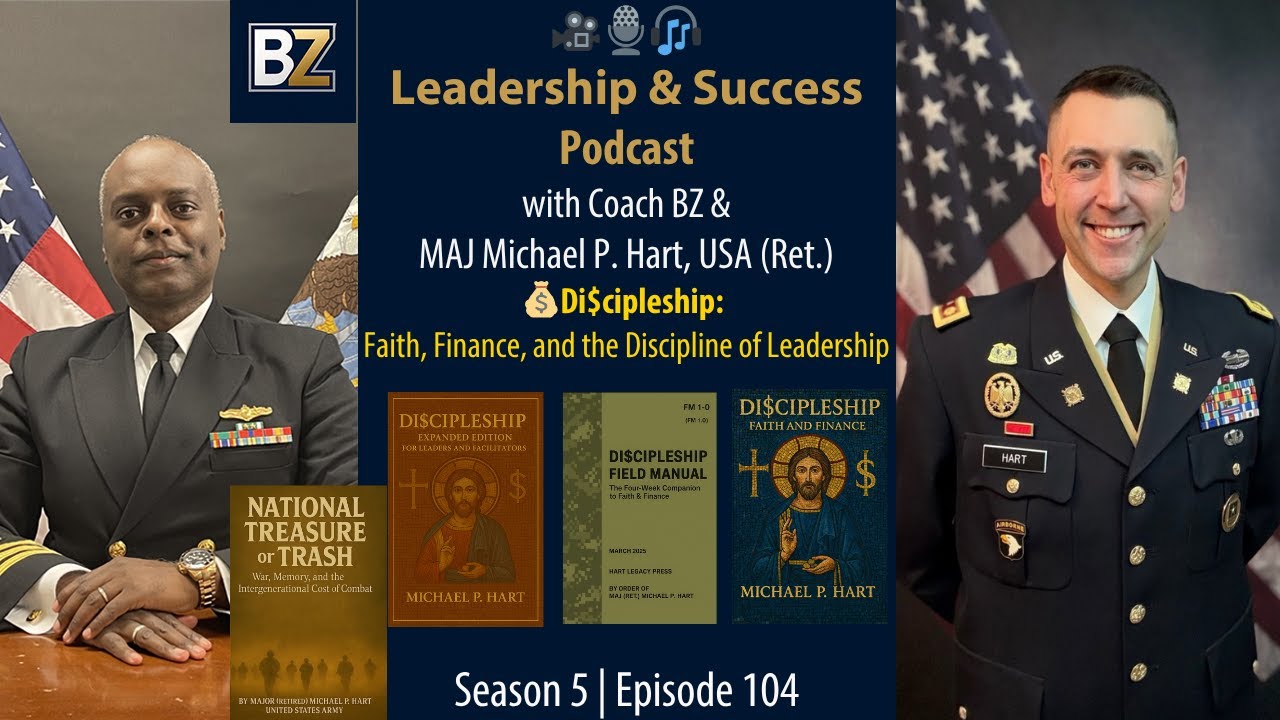
Retired Army Major Michael P. Hart discusses his four-book series on discipleship, faith, and finance, arguing that biblical principles like the widow's mite offer timeless guidance for money. He warns that small financial compromises compound into ethical failures and calls for a moral framework connecting faith to daily economics, especially for service members and young people.
Chapters
Hi, I'm John Maxwell. When the top companies in the world are looking for trainers, speakers, and coaches, there's one name that stands above the rest, and that's Maxwell Leadership. Our certified team members have gotten proven results for companies all over the globe, and our reputation I'm proud to say, is second to none. Some of our members have risen to the top of their profession, including the one you're going to meet today. I proudly introduce you to my friend, Bob Fabien Zinga.
Welcome to the Leadership and Success Podcast with your host, Coach BZ, where we help you lead with purpose and succeed with impact. If you're ready to grow into the kind of leader others want to follow, this podcast is for you. If you're determined to elevate your success and leave a lasting legacy, this podcast is for you. As my mentor, Dr. John C. Maxwell, reminds us, everything rises and falls on leadership. Our goal is simple: to inspire you, challenge you, and equip you with insights that can transform the trajectory of your leadership journey. Welcome aboard to another episode of the Leadership and Success Podcast with Coach B.
This really moved me. To, to me, that is really the summary for this entire book. You say, sacrifice, therefore concentrate predictably at the margins while the crowd moves on unburdened.
Yeah, this is a very deep one. Um, It goes into the mentality of, if we look at post-9/11, there were flags on everybody's porches and doorsteps. Everybody was gung-ho. A couple years later, as, as it starts to become unpopular, as soldiers start to come home, as the war ends, all sudden, everybody with their flags on their doorsteps were not the people that were actually out there responding. To the events. And in time, what occurs is, you know, the, the thank you for that, I appreciate you, the actual moments are left just amongst ourselves. And like we discussed earlier, that stovepipe effect of, of our military experience being shared by increasingly smaller and smaller demographic of our country has made that even more, um, worse. And, and you mentioned it earlier, and that really impacts and shows with the amount of suicides, and that's soldiers not being understood by a society that asks them to do things that this society doesn't have the courage, willing fall, and/or the politicians tell them what war actually is about and/or how they have failed those soldiers. And that's a big crux that most people don't want to talk about. It's not that veterans are afraid of what they've done. It's just that this country doesn't allow them to say and experience and process it honestly. Wow.
No, thank you so much for bringing light into this very, very important subject. Now, we won't have time to go to the other, but you've written actually 4 books. Another one is this one. Can you just tell us briefly why the audience should read this one, Discipleship, Faith, and Finance?
Sure, I'll be, uh, be really quick here on that. Yes, so Discipleship, Faith, and Finance. Schools can't touch Jesus because of the religious aspect, and that's a huge disservice to people. The churches don't by design want you to do anything but tithe. And that's— I'm not anti that. That keeps the resources pipeline. However, there are so many experiences in the Bible of business that we just completely glaze over. So what I've tried to do with Discipleship, Faith and Finance is bridge a little bit of the teachings of the man Jesus, and bounce that off of some of our contemporary leaders. I did do discipleship so that it could be turned into a group. Um, so the expanded edition is for clergy, and this is how, um, do you do a discipleship ministry and who do you have run that, um, where then everybody in your group would get a workbook that would guide you through one month, one week, with 2 hours a week reading Discipleship in a practical, safe environment that supports both the individual journey and the community that's hosting.
Hello everybody, welcome back to a special edition of the Leadership and Success Podcast. And, as you know, we start our show with what we call moment of gratitude. This is where we take just a moment to be grateful for something. So, if you would, maybe close your eyes, put yourself in your happy place, maybe take a deep breath to slow down your nervous system. And, in this moment, think about one thing that you are grateful for. And, today I am grateful that America is going to be 200 250 years old this July, right? We signed the Declaration of Independence July 4th, 1776. And I am so grateful to be an American. Home of the free and land of the brave. Now, America is not the perfect country by any means. We definitely didn't start right with slavery and all of that. But our aspirational document is really something we've been aspiring to for 250 years, trying to make America We live in a land of the people, for the people, right? A more and more just nation, right? Where everybody, regardless of your race, your gender, or where you originally come from, we are all equal under the law. It's not just a country for white men, it's a country for everybody. And that is what I stand for, and that's what I am so very, very proud of— our diversity. Even our national motto, right? E Pluribus Unum— out of many, one. Being that American melting pot. And I am so grateful for that. All right. Today we are going to be speaking to someone who was here just a few days ago. Well, before I introduce him, please let us know where you are joining us from, what city, what state, and if outside of the US, since this show is now global, which country as well. And let us know what you are grateful for today. And if you do have a question for my guest, please type it in the comments and we will answer live. So he doesn't need any more introduction. You guys already know him. He was here for Season 5, Episode 97, and I want everybody to go back and listen to that episode. So today is going to be a follow-on on the Unbooked series he has written about finances, but it's really about leadership. So Today we are really honored to welcome back Major Michael Ard, US Army retired. And during his first appearance on the podcast, we explored his groundbreaking book, National Treasure: War, Memory, and the Intergenerational Cost of Combat. We discussed war, leadership, sacrifice, PTSD, invisible wound, and the long-term consequences of combat across generations. But this morning, we are going to shift from the battlefield to stewardship. Major Art returns to discuss his powerful discipleship book series, right? Discipleship: Faith and Finance, Discipleship Expanded Edition for Leaders and Facilitators, and Discipleship Field Manual: The 4-Week Companion to Faith and Finance. So a combat veteran, former Army major commander, entrepreneur, and author, Michael Art brings a rare perspective shaped by military leadership, combat experience, personal loss, faith, discipline, and the hard-earned lesson of stewardship. This conversation is not just about money though. It's going to be about integrity, character, discipline, accountability, leadership habits, stewardship, faith under pressure, and the daily decisions that shape a legacy. Part of what we're gonna be learning today is why money doesn't change people, but exposes them, but also Why leadership without stewardship eventually collapses under its own weight. So I believe this conversation is for military leader, executive, cybersecurity professional, entrepreneur, young officer, aspiring leader, and anyone trying to align success with purpose. Because leadership is not only tested in moment of crisis, it is tested in the quiet discipline of every day. So without any further ado, please help me welcome back to the leadership Success Podcast, Major Michael Hart. Oh, there was a little delay there. Here we go. Michael, this really moved me. To me, that is really the summary. All right, how are you doing today, Michael?
I'm doing great. How are you doing today, sir?
Yeah, this is just, uh, the way you do live, uh, broadcasting. It is, it is all good. So people already know you, but I do want to ask one thing you are grateful for today.
Yeah, I'm grateful absolutely for this opportunity. Once again, it's a blessing to be able to be here and to share this information and this opportunity because really that's what this is about, knowledge and education. And so that's what I'm grateful for this morning, the ability to share.
Fantastic. Okay. Let's get into it. Again, for everybody watching, if you go back to season 5, episode 97, we spent about an hour talking about National Treasure or trash. And today we are going to be talking about your finance book series. I guess to get started, during our last conversation, we talked about war, memory, invisible wound, and the cost of leadership. This time I want to explore something different after all those experiences. Why did stewardship become so important to you?
So stewardship is, it's one of those things that it goes naturally when we think about leading soldiers. One of my first experiences as an officer, I was actually counseling a soldier and it was because they didn't pay their government StarCard, their government credit card for $20. And so it was a very quick lesson right off the bat in the military. You know, you think you're gonna be doing one thing, but we're actually dealing with our soldiers able to live through all of their moments in time—birth, marriage, illness—all of these gaps that we have, but we don't necessarily have lessons for, let alone from the church.
Hmm, it's really interesting how one area of your life could impact everything else. Now, when you think about a soldier, a sailor, their readiness, they're about to deploy and go to war, but if their finances isn't right, they won't be paying much attention to what their jobs and duties are, are they?
Yeah, that's, that's absolutely it. It's part of being balanced, uh, is having all of the different aspects of your life set. That's not just your emotional readiness, it's your secure— your physical security readiness, but your, um, financial readiness. And that's one of the things that in our society gets isolated. And I've had a real joy with bringing back with discipleship is looking at Jesus, uh, the human being, and what lessons does he have for us that we can apply today And that we've really been stripped away from that opportunity through schools not being able to touch the religious figure and churches and organizations by default and design not wanting to pull money away from direct donation, getting into talents, so to speak.
Yeah. So again, everyone, the book series we're talking about is Discipleship, Faith, and Finance by Major Michael P. Aardt. I guess from the last discussion we had, I'd like to ask, sir, you have seen war, you've seen trauma, you've seen sacrifice and loss. Why did you feel called to write about money?
So that's exactly the question. We have 7 sacraments in the Catholic Church. You have various sacraments and others And what we have occurring so much more and more today is an isolation from church, religion, and Jesus, and our day-to-day actions, and that compartmentalization through separation of church and state has worked in a lot of ways, but it has also created an expectation that people are practicing religion and those values that we are publicly participating on Sundays, uh, or once a week, but privately, are we actually applying those principles that we have in our private lives? And that's a question that, that we are all asking ourselves, is how does this fit and specifically into our day-to-day lives and a much more holistic role?
Yes. Now, I understand, I think it's more than 80% of the U.S. is, uh, Christian, including Catholic. The great majority definitely believe in God in this country, but we do have a minority that either doesn't believe in God or are simply agnostic. So that is reflected in the audience of this podcast as well. Why would somebody who may not have any faith still be interested in what you have to share today?
Sure. So what some of the things that we can talk about, you know, in discipleship, I specifically have about 32 scripture pieces from Old Testament to New. And what's unique about these is they're all experiences that Jesus has and he gives us and we get, um, that aren't necessarily based upon a supernatural event. If we look at, for example, uh, in, in the Bible we have the widow's mite, and the widow's mite represents about 50 cents. The mite is a, a an actual coin. And so you have Jesus in the temple, and people are coming through providing offerings into the bucket, and they're dropping in silver. And Jesus is watching, that's great. And a woman comes up and she gives her offering into the temple, and that's, you know, her two mites. And Jesus pauses here and he says, hey guys, um, appreciate your offerings. However, this woman here has given her, her dinner her two mites, her leptons, were everything she had. And so the lesson here that Jesus is teaching us is it's not necessarily about giving, but it's about that actual gift. Is it a generous gift? And in a way, this ties back to the Giving Pledge. Yes, you know, this is for the world's wealthiest and billionaires to say, you know, we have so many resources here, we're going to give back in such a generous way. And that is reflected currently in a Giving Pledge and in that organization there from the gates. So that's a perfect example of how we have discipleship in Jesus teaching a financial lesson, or life lesson. Yes. And compared exactly to what we have today.
I think one of the most prominent examples is Warren Buffett, right? And I believe Bill Gates as well, former CEO of Microsoft, who decided to give away most of their wealth by the time they die, which is pretty awesome, I think. It is quite— it could be really life-changing for a whole lot of people on Earth. Because the thing is, you know, when you die, you can't take your money with you, can you?
No, you can't. You can't. What's the saying? Your shirt doesn't have pockets. Yes. Yes.
So what do you think then people tend to struggle to connect faith and financial behavior?
You know, I think people really struggle to put the two together because of that isolation. You know, we have so many different things day to day in our lives where we're being bombarded and told what to do, how to spend, where to spend it. One of the gifts that we have today is the gift of information. So we have Warren Buffett, we have our Ramseys, our Kiyosakis, our, our Bogle's. So we have the ability to look at all of these different financial world personalities and different experiences. Jim Cramer is a fun one to add in there. Absolutely. Because, you know, he's excited and gets people going. And that's one of the voices. So being able to have people to reference currently with a backdrop of a biblical setting really allows us the opportunity to look at life in a much more broad and diverse, um, pointed way there when it comes to finances, uh, in a way that again, we don't have that out of school. Um, yes, can't be touched at all there.
Yeah, that is quite powerful, but that's really sad because most people, they go K-1 through 12th grade and then they even go to college and still we may talk about macroeconomics, but we never really talk about your personal economics or even how to balance a checkbook. If your parents didn't teach you that, it's really something you do have to figure out on your own. And I wonder why the education system in America is, I mean, I don't want to say broken, but definitely not complete. And many of these kids have to figure all of this out all by themselves.
That's kind of strange. Yeah, absolutely. The, the education component is absolutely lacking. If we look at, you know, what is a student coming out of high school with— home economics? Are they coming out of with, with literary skills, both traditional and with technology and sciences. And then that's a real struggle. It's even more a struggle when you start talking about, you know, do we have finances? And one of the things that's becoming a thing of the past, and maybe our viewers can relate to this or not, is who can say they've balanced a checkbook, an actual paper checkbook? Yeah, not the— yeah, right. Not the app that may or may not be telling me what my spending habits are looking like. But what do I actually have? And that's a little bit of a lost art right there.
Hmm, true. Now, uh, you said something last time we talked that was quite powerful: money reveals priorities. Can you unpack that for us?
Yeah, so, you know, again, the most glaring thing to me in, in and money is how we are tied to it. Everything we do in life one way or the other has to come back to a resource, and that resource, you know, is delicate, and the Bible gives us this term, uh, mammon. You know, you can't serve God and mammon, and mammon just is stating wealth or power, the, uh, what comes along with that, and so You know, it's important that we make sure that we can balance those things. And that's the art that gets lost, is being able to understand that the resources allow us to act or not act based on our situation. But that just shows us what we can actually do. It's like, I'm sure I can run, but do I enjoy running?
Mm, that's something. So, uh, what does financial behavior reveal about people's leadership?
How is that connected? Sure. You know, the most subtle way I, I think it presents itself, right, is when people have choices. Like the most simple sometimes advice in life is just do what you have to do. And if you're, if you're doing those things, you will find that, you know, you're, you're, you're lining up those things, you're planning, but you have to put the resources in line to those and you really do have to prioritize where do those funds go. Again, in a world where we can spend money on almost endless amounts of things, do we actually go back to the simple things, you know, our Maslow's hierarchy of needs? Yes. You know, if we've really just gotten into consumerism beyond what is actually being purchased here or given, or that's stored.
That is quite insightful. Now, I know, I think in the last few years, no, Department of Defense hasn't been able to really pass an audit. And now I believe our budget's going to be increased to what, $1.5 trillion? But really, generally speaking, in the government there is quite a bit of waste and abuse, I think, when it comes to money. And I always think of, you know, the money we get is really taxpayers' money, so we should really be great stewards of it. Again, we're talking about at an organizational level, but also at the individual level. So outside of church language, what does stewardship actually mean?
Yeah, so stewardship It really is understanding that nothing in this world is ours. And one of the gifts of being an Army officer and a leader was being able to take care of soldiers' sons and daughters, husbands and wives that have raised the right hand. And, you know, again, back to this really humbling experience of a soldier had gotten back from basic training and AIT, and they had gotten this government card, and all of a sudden, you know, they're delinquent $20, and it's coming back to them that they owe this. And what ends up happening here is this soldier that didn't even— maybe they realized, I, I didn't make that payment and I didn't get it, but all of a sudden it's showing up on their credit report. And this soldier just raised their right hand, came out of high school, um, and is doing this, and their first things that have occurred is the government's, uh, saddled them with a Star Card opportunity, but not somebody to teach them about, um, making sure that that gets paid. And so as stewards and as leaders in that system, you know, we often have to then look at that and go, what are we lacking? And you add that training in. Um, sometimes that— for that would look like for us in a normal training calendar or week, you have all your different tasks that you might do for your national mission, your domestic mission, but then you might have a working lunch and talk about balancing your budget, balancing your checkbook, utilizing your GI Bill, the different resources that allow us to become the people that— to succeed, to build and grow.
Yes. And one thing that's true in the military, we may not be making millions or anything, but we definitely have steady paychecks. And I think a lot of businesses out there, they really love that. It's a check you can count on. Many times even during shutdown or whatnot, we are sometimes exempt from all of that. But even if for a little while we don't get it because of government shutdown, because Congress forgot to do their jobs, eventually we get paid back. And it's definitely something I think that kind of puts a target on our back, especially for young people. For example, when I went to boot camp at the Secret Lake As soon as you got out of the base, you would have those people trying to give you high-income, high-interest loans and all kinds of things. And not only in the military, when you look in colleges too, right? Like my daughter, my first one, about 4 years ago, she was a freshman. And I remember myself when I was in college as a freshman, a sophomore, you would see Citibank, Bank of America, all of those big banks come to campus and they would give you like a free t-shirt if you would only you know, sign up for one of their credit. Absolutely. It's, it's really insane how in our culture they, uh, really try to meet— it's really a trap for young people who don't really understand how creditworthiness works. What, what do you think?
Yeah, absolutely. The boy, it is a dog-eat-dog world out there, and everybody is trying to get a piece of, a piece of you. Now, you brought up a great point near college towns and military towns, you have very similar things, you can have predatory lenders, banks putting out products and things that are designed to, you know, really pull from, from our less able to understand and educated populations here. And that, that absolutely is a challenge to fight. And on the negative side, but I also want to point out that there are also some really great opportunities out there tied to lending institutions. And they aren't necessarily for the military. Example, USAA offers a career starter loan And that is a personal loan with very beneficial terms to the, to the lendee. But the reality is, again, USAA knows that this person that they've created this loan for is going to be a military officer for the next 4 years or 8 total and will have an income and a paycheck. So it becomes beneficial for them to loan at a better rate to a person that they are seeing as a trustworthy investment. Yes. Now, I, I do want to pause here though and state that this isn't just a military thing. There are many industries that have trade schools, as well as the medical community is a very well-known one where going and getting your education can one be covered on the front end as you transition or two can be compensated back to you as you're hired. And often, I truly recommend that, you know, young people look at these different opportunities outside of just the military to get education covered or to have a little bit because just because you're getting a loan or go into debt does not mean it's negative. And that's absolutely a totally, entirely different topic that I think we'll be talking about here shortly.
Yes, yes. Uh, before we, we get into this, something you said earlier, uh, something about we do not own but, uh, we are steward. Some people listen to me and say, well, I do have a deed to my car, I own it. What do you mean I am a steward? Can you unpack that for us?
Yeah, sure. So we absolutely do have resources, tangible, intangible, and the things around us, and that is our job to store those things. And we can say we own them. But at the end of the day, you know, the Earth is billions of years old, and, you know, dust to dust. So we really can't not claim to own, but more just caretake in the long run of those resources.
So true. Now, how do financial decisions impact families across generations?
Yeah, a beautiful thing, and one of the things I studied and I found really enjoyable was the Jubilee year in Israel. And that was about every 50 years, everything would be— debts were wiped out and erased.. And one of the things that was unique here in the kingdoms of the time, you had Egypt, Samaria, the Israelites, and you had Judea. But the different societies at the time, if you went into debt, let's say Michael Hart went into debt, and my children, I passed away, they inherited that debt. And the lender would come back to those children and or their their children. So that was the normal practice at the time. What occurred here is the, the Israelis come out of Egypt and they go, you know, we don't want to have generational bondage as an option. So every 50 years there would be a reset, so to speak, and that would prevent that generational bondage where somebody born has no control over that situation, and so that was actually for the time pretty groundbreaking, and that came again out of the Old Testament with the Jubilee Year. That being said, it wasn't quite so everything is free. Everything became prorated at a point, so it wasn't quite ideal, but that was a very early and beautiful thing that we have coming out of the Bible and for humanity and saying, hey, that kind of debt shouldn't transcend.
Yeah, because during our last interview, we kind of talked about generational trauma, especially when you have parents or grandparents who went to war. Can poor stewardship become an intergenerational problem, kind of the same way trauma can be?
Yeah, absolutely. One of the things that we don't look at is habits. For example, if we look at the Greatest Generation and we look at the investors and personalities that we had coming out of that, we get the terms like, you know, hide our money in the mattress. And putting our money in the mattress is great because you were worried about not being able to get your money from the bank. 'Cause they were gonna run out. And that was when the bank runs. So this is the origin of the FDIC $400,000. So it's the federal government saying you don't have to run on your bank. If it's a federally backed bank, it's up to $400,000 in your account. But what occurs from trauma or experiences where people, parents, grandparents, had faced moments in time where they didn't have money. I mean, in the '30s, if you were in Germany, you could take a wheelbarrow of Dutch marks to buy a loaf of bread.
Yeah. So, and also we had the Great Depression around there in the US too, right? And that's just it.
So when we had that depression, that mindset of, of holding on and not trusting the government, resulted in a lot of people not putting their money in banks and/or into other vehicles that could allow their money to grow differently than, say, a traditional savings account or checking account. So you can have trauma of not having money or money loss result in habits in the immediate generation of what they saw and didn't see and have.
Hmm, well, one thing you've said is, uh, small compromises matter. Why are little financial compromises so dangerous?
So nothing ever starts— nothing ever starts large. It always starts with the little decisions and the principles along the way. And that's more so true than anything with money because it is a very visible, it's a very transactional element. And so it can be very dangerous that way, because it can become a transaction versus a principled transaction. And that's one of the things that I look at in discipleship, and I really talk about is benevolent capitalism. Yes, you know, it's capitalism, and business has no, uh, grace or kindness by itself inherently. However, it is what the human aspect that we bring to, uh, our business and our policies that, uh, allow us to grow there.
I, I really like that you said that, um, Because it looks like for those of us, you know, who are financially sound, it looks like we all should have a responsibility, right, to help our neighbor or improve our local community. Earlier you mentioned the idea of a tithe, which a lot of believers, whether Christian or Muslim or Jews, they tend to give at least 10% of their income back to their local church, synagogue, or mosque, or whatever, to really help their community. Why is it so important to be benevolent, as not just when you're financially established, even on your way to becoming financially sound? Why should people consider that, you think?
You know, I think one of the most important things to remember and reflect on is that we didn't do We didn't do these things alone in our lives. You know, we come into the world and we get mentored and we get gifted different opportunities. And boy, I could take this one in a couple different directions. Maybe you want to guide me here a little bit where you want me to spend a little bit more of that, uh, Bizzy.
Yeah, I guess, uh, one, one thing I am thinking about right now is, again, maybe I should add a disclaimer. There is nothing wrong with somebody starting out with nothing and trying to do everything they can, right, to be financially stable, take care of their family. Absolutely nothing wrong with that. I think for the great majority of us, that's how we got started out of high school or college. However, at a certain point, it seems to me like we need to think beyond me, myself, and I, right? Because as you kind of move up the the chain of command of the corporate ladder, you make more and more money, you have more and more responsibility. Yeah, of course. Okay. You can buy a big house. Again, nothing wrong with that, a big car and so forth. But at a certain point though, I feel like the money you have is no longer going to fulfill you. Right now, when you have absolutely nothing, yes, you want a car, you want a house and so forth. But no, how many houses are you going to have? No, how many? What kind of cars are you going to drive? So at a certain point, it's not going to satisfy any longer. And it seems to me like as a society, we really need to develop that sense of benevolence where it's not just about me, but it's about we. And I need to do something, even if it is small or seems to be insignificant, where I am giving away a part of what I make to make our society, my local community better.
Yeah, absolutely. That tithing, um, and this is where I wanted to go with it, and talking about it doesn't necessarily need to be about money. And that's something we briefly touched earlier in talents. And I want to get to the root, the word talent. Truly, in the biblical times, we think of the talent as a heavy amount of silver. You know, the, the sun goes out with, uh, the silver talent, or a year's worth or a lifetime's worth of wages, and comes back. And the father says, what is your talent? And it is, well, how did you earn that silver? And so somebody's talent, truly just like a talent contest, uh, it is what is your natural, uh, given joy. Now that talent may or may not bring something that you can immediately tangibly bring to monetization, um, but I like to use the example of a musician. You know, a musician, incredibly gifted, may not be able to monetize that, but that gift of music can be shared, and you can mentor and give that talent. Yeah, um, in your life. So when it comes to the tithing, it is important to be able to give, and that reminds us to give as to also receive. That's part of that, that reminder is to have trust, um, that we don't need to have everything with us at all times, that we can get and receive. And so there's that transactional faith in actually implementing that that's, uh, really core to that, um, that part of that.
That's really powerful. And are there any, uh, financial lies you think destroys more leaders than people realize.
You know, it destroys a lot more people, uh, absolutely, than, than you realize. And it shows up in ways in relationships, right? We talk about, um, sex, religion, money that tend to be our, our conflicts. And the money absolutely can be, um, if people don't align their values with their habits. And that's kind of, even by itself, an interesting one. And I really enjoy— Netflix had a great show, um, How to Be Rich, or Living Your Best Rich Life. But it really was about various people living their lives in different statuses, different locations, and what was rich to them. You know, for one person it was I wanted to travel, one person was a vacation home, one person it was time with family. So again, those resources, um, and money and talents, uh, can be many different things. And it's kind of, I think, part of the gift and the joy is watching people in their lives both explore, experience, and share those.
That's really insightful. Let's talk about, I guess, the Bible talks about faith without work. Let's talk about faith without performance. For some of the people listening right now, I'm like, I think actually the entire world right now is kind of going through an economic crisis. Some people are having a very hard time finding jobs, and it is, you know, I don't know, I'm in California. I just saw the other day gas is at almost like $7 a gallon. I've never seen that in my entire life. I've been living in California since 2014 now, what, 12, 13 years. It's just incredible. I wonder how some people are able to afford driving to work, but I'm so glad. Again, California, very progressive state. We have more electric cars, I think, than any other state there. So I love my electric car right now. I love it. But It is, it is, it is, it is tough, tough. So how do you maintain faith when life doesn't go according to plan?
Yeah, it can be, it can be a real challenge. Anybody that, as we start to age and experience some of our really impactful life, life, life moments and events, good and bad, And, you know, there isn't always a good answer for why things happen. And if somebody was to tell you there is, they're giving you a little bit of a half-truth. You know, you have to look at— and that's part of faith— is your glass is always half full. But There have been times in my life, there have been times where you just go, you know, I'm not really sure how this one got to be that way. And this question is going to go to the God box, because I don't know how to answer that. Because there was suffering, loss. This wasn't fair. You can turn on the TV just to see how broken our world is. However, we can look in our wallets and to our neighbors and see how we are working actively to influence and have better outcomes.
You mentioned personal loss. If we can, how did personal loss reshape your understanding of grace?
Personal loss and grace. I'll be honest, I'm a widower, um, and, and that has, uh, being both a, a combat veteran and a widower, I've, I've got, I've got, um, I've got some questions. I've got some questions someday that I look forward to asking, um, and at the end of those days, until that day comes I can only look in the mirror. And when I look in the mirror, I have choices. I can push forward the best I know how and trust and have some faith that, wow, I don't understand why this happened, or if the joke is on me. But I also have the benefit of when we have loss, that means we have experienced gain. Love, um, is the opposite of grief. So being thankful for those things, remembering that we have had those things, gives us that ability and the perspective to, to drive forward and to drive on. And it's that repetition, uh, that makes people successful ultimately. And it's not necessarily about one event in life, but it's about showing up a series of events. And so, you know, that, that humongous loss in my life, had I not had faith and people in my life at full moments, give me little nudges. It could have been a world-ending situation instead of, for me, instead of one that was profoundly shifted, um, the work into a positive way still. Wow.
Because when, when you look at, uh, different people, they may go through similar experiences. One person would just crumble, or sometimes they even want to commit suicide and just don't want to live another day and move forward. And then there are people like you, you are just so resilient and you are really, uh, you've built that foundation on your faith and you keep moving forward. What do you think makes the difference? I mean, it is really inspirational to see from afar, but why do you think somebody else going through a similar situation as yours would end up committing suicide, but you are still moving forward? And not only that, but you are impacting the next generation with your work and all of your books. You still want to give back to society. Where does that come from, you think?
Yeah, that desire comes from— and I'll, and I'll re— I'll recap this a little bit. It comes from that 10 years, be it National Treasure or, or discipleship, over 10 years of, of my lived experiences, uh, with people, peers, soldiers, and going, you know, this is a life that we're all living together. But again, we've somehow isolated, uh, you know, service and such from— it's in public and viewed, but practice in private. And, and religion, which is just again, um, practice on Sundays and expected to be practiced in private. Yeah, but I also see some, some very interesting things going on in the world. You know, and we've had a trend where the Catholic Church took quite a bit of, um, you know, controversial topics, and it has continued to grow through those and work through those things. No organization is perfect, but I have found and seen in my generation a lot of Catholics and people have— why they moved themselves away from the church. As they have become, uh, parents, uh, to children, a lot of parents are sending children back to religious schools to provide an opportunity, just that opportunity to have, um, you know, Jesus as an aspect in their life because it has been so isolated in other ways. It's become, uh, the tide, the pendulum is swinging back. Yes.
Wow, that is quite insightful. The last question I'm going to ask in this segment is, uh, what does gratitude look like after hardship?
Gratitude after hardship. I changed the way I pray, um, through a lot of loss, and, and that is instead of asking for the ability, or things in our lives to come, we really just— I ask for the power to stand in those moments when they come. So I don't ask for a certain moment to come because those experiences that I didn't want to have happen to me, I didn't want to have happen to friends and family, all of us, you know, how do we continue? And that is putting a little bit of that, that armor on and going that, you know, this is part of life and that when you get down, it's how you get back up.
Part of it. That is really inspiring. Thank you so much for sharing. Uh, great.
Yeah, you know, part of this is— and I mentioned it— I hired an editor, um, who is actually an atheist for my books. That was a great— let's do a faith and finance book with an editor who's an atheist. But truthfully, that was perfect because He was the litmus test that we're talking about Jesus as a human being, a person that somebody may or may not have much exposure to, but can now all of a sudden be a practical guide in their world. And that was something that is missing again.
So that is quite powerful, again, even for those who do not believe. In God or any gods, I think you can only get so much out of this podcast and this discussion. We're talking about the book series by Major Michael Art, now retired, uh, one being Discipleship, Faith, and Finance, the primary book, and then the extended version for the clergy, for leaders and facilitators, and then also a field manual, Just Like a Good Soldier, uh, and it's also green, so I love I love it. But I think if people follow the principle regardless of their faith or non-faith, it could literally potentially change their lives. So let's talk about the leadership habits or leadership dimension of your Faith and Discipleship and Finance book series. Let me start with this. What daily discipline keeps you grounded, Michael? Make your bed.
Yeah, so that's why Admiral— Absolutely. You had Admiral McRaven on here earlier in the week.
I have that book here somewhere, but yes, it's phenomenal advice.
You know, getting up in the morning, very simple thing, setting your stage, being deliberate. I have a friend, he's an executive coach, and one of the things that he's mentioned here, and stuck with me was, is that word being deliberate in our actions. And we do that most of the time, but we don't necessarily take the moment to pause and really make sure.
I like that because it really gives you a sense of achievement. Like one of my mentors used to tell me, the big difference between people who are successful and those who are not, it's not like they like doing what they are doing to make them successful. They don't like doing it either. However, people who become successful, they do what they need to do when they need to do it, whether they feel like it or not. And I feel like when you make your bed first thing in the morning, it gives you that sense of achievement. I have done something. This is within my control, my ability. And then you get on to do more and more.
Uh, no, absolutely. And it's that discipline that, that carries through.
So for the young officers who are listening, or enlisted What financial habits you think, uh, they should learn early?
Learning early with the financials, uh, understand everything is tied. Everything is tied to a resource, and that is something Look, so I'm in central Illinois, and I had the opportunity to get my hands dirty and work on a farm for a couple weeks. And it was a lot of fun. And one of the things I realized, and this was highlighted, nothing in farming is easy. When you, when you, when you plant, when you seed, when you fertilize, when you cultivate, when you turn the soil, when you do all the rotations, yes, of everything. And so When you're a new officer or a young leader in any organization, one of the most important things that you need to do is realize that every action around you— so this comes back to listen and listen more and look, because what you do and don't do is costing you, or that's costing the organization. And that is not just time, as time is money, but it's your effort and your energy. If there's 10 tasks to get done in a day, you know, you're going to focus on your priorities and make those happen. And you may not get through the top 10, but you're streamlined. So it's important to keep that focus on the front end.
That is quite powerful. How do you think leaders should think about generosity? These days?
I think leaders need to understand that generosity is one of their most powerful underutilized tools. Hmm. Generosity comes with that empathy. And it's showing that you can understand and you can appreciate and give something back that that, that it's beyond you. You don't have to do it. And I think, again, part of that generosity is knowing that you don't have to be generous with any just one thing— your time, your resources, your money, your talents, your skills, you know, teaching somebody a habit. Or I just wrote two books, sharing some of the wisdom on how to write a book. Is an example of giving that people might not necessarily, again, think of as a major key in discipleship.
That is really, really powerful. And if everybody did that, I mean, you can definitely change your local community and eventually even impact the world. It's, it's, it's so powerful. One of my mentors, Mike Murdoch, used to say The secret to your success is found in your daily routine. He would say, "Now, tell me what you do and I will tell you how successful you are going to be." What does daily routine reveal about your philosophy of leadership?
Yeah, daily routine for me, it is that make your bed in the morning. It is creating a list. Set myself up for success. I do my best, that is. I don't always succeed, but in planning and being deliberate, you know, I'm going to bed, this is what I'm gonna— I have on my calendar tomorrow. Am I prepped? Am I not? Uh, you know, young, young students or young people might ask me about tests, or do I ever get nervous with tests, or And the answer is yes and no, but I know if I studied or not. So it really isn't a question of am I going to fail this or pass this, it's really just how much did I learn here. I know how much I put into it.
Yes. Wow. Now, uh, we are almost running out of time again. I can't believe it. We are only talking about your, uh, financial, uh, book series on discipleship, faith, and finance. You have so much wisdom. This is incredible. Let me ask you this. What do you hope people feel after reading the Discipleship Series? What do you want them to feel?
You know, I want them to feel, and I think they will feel empowered. I think that most, many people don't realize quite the amount of resources that they have their hands on. Yes. And/or have that framed in a way that they can. And I hope that as readers go through Discipleship, they realize how many resources they have. They realize how many voices or teachers are out there. In this book, I focus on Jesus as our, our, our focal point. But again, I have balanced that off of our contemporary fiscal financial leaders out there, um, you know, Ramsey, Kiyosaki, Graham Buffett, Bogle, um, and how their lives and habits can be brought towards our own, uh, to become successful, um, disciples.
That is Powerful. And what kind of man are you trying to become now?
I am working on becoming more deliberate, humble, and aligned. You know, these books have really allowed me to stand on my two mountains, National Treasure or Trash and Discipleship, and allowing me to be deliberate to share my talents with the world, with my family, with my friends in a more humble and unique way for me, being my Christian name is Matthew. So sharing in my way. That is really, really powerful.
And last time you were on the show, again, season 5, episode 97, we did talk about emotional wound. If you had, let's say, 60 seconds to talk to the audience. What would you tell someone who is struggling, not, not just emotionally, but now with what we talked about today, financially or even spiritually? What would you tell them?
I tell them to hang on first and foremost and understand that the majority of our events in life don't occur out of the blue. Financial situations didn't happen overnight. And life situations, when they can strike, you absolutely sometimes need to take a pause. But, but the answer is, is to take a knee, to slow down, to take a look around what exactly all is going on and assess that and and be graceful with yourself. You know, the, the most important thing anybody can do truly is, is to pause. And when people make actions out of haste, um, or without looking at information, um, that's really when you can get into, uh, a challenge. So I'd say to, to hold on, dig deep, Listen, and you will see that you have resources around you, be it friends, family, the book, these books.
Yeah, like we did— that's the way I start the show every, every time, moment of gratitude. Part of it is because it's about what, 22 service members and veterans commit suicide every single day in this country. So they feel like they are boxed in and there is no way out. That's how they feel. They feel completely hopeless. So for somebody who's listening right now, how can they find hope in what they believe is a hopeless situation?
You know, that, that there is— it's a hard one. It's a hard one. Jesus, the night before he was crucified, was looking up in, in his prison cell going, you know, uh, God, you know, Dad, have you forsaken me? And at the end of the day, that lesson is you do have to have faith. And you have to push forward and trust. One of the things in writing these books, I had to have a candid discussion with myself, because when I pass away someday, I will, I'm going to have to either meet Jesus at the pearly gates with the book, these books in hand, and I have to answer to those. Or, you know, it will be, uh, whatever it is for the different beliefs out there. Yes. At the end of the day, if it— if when that moment comes, when the lights go off and nothing happens, I know I'm happy that I've lived a better day. Every day looking in the mirror, through discipleship, through a what would Jesus do? What have I done? What have— what lessons have been given and imparted to me? And that's really where, you know, these books are showing up at a time for all of us, especially now with the world's— and religion being brought back forefront, but almost in a theatrical way in which it's not genuine or sincere. People are craving for that genuine, sincere connection. And, and I think that, that these books— I know these books have that ability to bring us back to a tie that we live with every day, and that is money, resources, and assets. And what we do with those every day in our actual decisions and aligning those values. So aligning those values, sharing that alignment, and distributing it out into the world, that's who I'm working on continuing to, uh, to be for myself and for the world.
That is so inspirational, especially, uh, knowing all of the personal archetypes you had to go through. The last question I am going to ask, and we are out of time now, but, um, what has Grace taught you about leadership?
Grace has taught me, I think, second chances. Second chances are, are, are probably one of the most important things Grace has taught me, and, and that comes from listening. We think we know all of the answers. We all absolutely have thoughts, experiences. Um, but as we do get older, listening, listening and being open to those, um, thoughts, moments, or people and times, uh, is key, uh, to that growth.
So powerful. And again, we may have new, new people in the audience. I want to give them a chance. Is, uh, how can we add value back to you, sir. Thanks so much for sharing your wisdom and, uh, your inspirational life with us today.
Well, it has been my pleasure, uh, BZ. Um, I, I certainly enjoyed the opportunity to talk about discipleship and, uh, the supporting products, and I look forward to hearing feedback from, from listeners. And, uh, these books are getting out there and So it's a possibility we'll be getting some great feedback as these grow.
Very good. And people can find you on LinkedIn. You now have a growing Substack, and of course, your personal website where they can find links to order all of your books. Definitely looking forward to the next book in the series or whatever next work you are working on, sir. It is really inspiring and, and I think quite impactful to see somebody like you who's gone through so much personal hardship, but you are using that experience to help so many other people through your work. So, uh, really, really thankful for that. And thanks again for being back on the Young Leadership and Success podcast. Was there any question I should have asked you today I didn't get a chance to ask? Anything else you wanted to share before we end today?
Uh, no. Again, I want to say thank you, uh, for this opportunity. Uh, These books, they're transformational. Discipleship can be read on your own. It has cues, journals, and opportunities, and, you know, it can also again be brought to ministry with the addition of the weekly book and all the guide rails that are there in place for a ministry to lead that and guide that and grow their, their people and their communities. So that's really the gift. And I, again, I appreciate the time this morning.
Thank you so much, sir. I appreciate that. All right, everyone, uh, this hasn't been easy, but, but I think it really gives us a lot of hope. No matter what, who you are and what you are going through right, right now, I really believe that, uh, there is there is definitely, absolutely hope for you, right? You may feel like it's hopeless, but no, it isn't. And Major Michael Art is definitely one great example of that. So this has been quite a conversation with Michael P. Art. You reminded us that leadership is not only tested on the battlefield, but it's also tested in the quiet discipline of everyday life. In our first conversation, we explored the weight of war, memory, sacrifice, and the invisible cost leaders carry long after combat ends. But today, Major Al challenged us to look at something equally important, that stewardship. How we manage our time, our finances, our integrity, our faith, and ultimately our influence. So one of the most powerful lesson from today is this, discipline is not built in dramatic moment, it is built through small consistent decision repeated over time. Leadership is not merely about authority, position, or achievement, but it's also about responsibility, right? It's about alignment between what we say we value and how we actually live when nobody is watching. For our naval junior officers, soldiers, sailors, airmen, Marines out there, I believe that for those who are listening right now around the world, we need to remember that success without stewardship eventually collapses under its own weight. But disciplined leadership rooted in integrity, in humility, in gratitude and service will create something far more lasting than success alone. It truly creates a legacy. So Major Art reminded us that money reveals priorities, suffering can deepen wisdom, and grace allows us to continue going even when life does not unfold the way we had originally planned. Those lessons matter not only in leadership, but in life itself. So today I want to leave our audience with a challenge. Uh, what are you stewarding? Are you doing well right now? And what areas of your life need greater discipline? And what small decision can you make today that your future self and future generation will thank you for? To Major Michael Ard, thank you for your service, your honesty, your wisdom, and for sharing your experience with us and your willingness to continue to serve through your writing and leadership in and out of uniform. And to everyone watching around the world, keep leading with purpose, keep serving with humility, and keep building a legacy worth carrying forward. Until next time, fair winds and following sea, and God bless. Thank you.
Thank you for tuning in to the Leadership and Success Podcast with your host, Coach BZ. If today's episode added value to your leadership journey, be Be sure to subscribe, share, and join us again for more wisdom nuggets on how to lead better and achieve greater success. Remember, leadership is the most critical skill of our time. The world will always need leaders to inspire others, drive innovation, and execute meaningful strategy. So why not count yourself among the bold leaders shaping the 21st century? Until next time, stay inspired, stay committed, and Keep leading with excellence.
More from Bob

S250:E4🎙️LIVE 🇺🇸America 250: President Barack Obama Leadership, Service, and the Power of Hope






S5:E157🎙️ LIVE with CMD CMSgt Dennis L. Fritz, USAF (Ret.)(Multi Tracks Audio)



S5:E156🎙️ LIVE 🇪🇸 Leadership Lessons from the FIFA World Cup 2026 Champions (Multi Tracks Audio)

S250:E3🎙️ LIVE Leadership Lessons from America’s First Documented Family of African Descent 🇺🇸📖