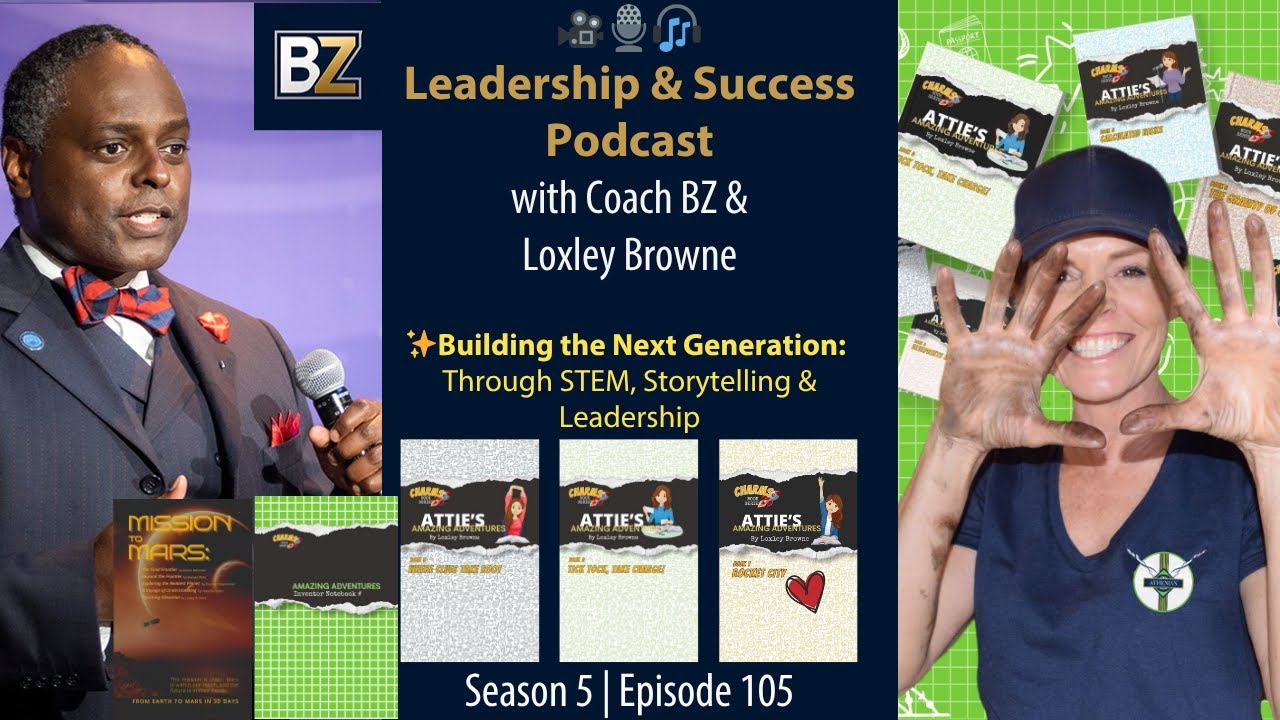
Loxley Browne, author and STEM advocate, discusses her CHARMs book series, which teaches girls life skills like communication and project management through stories about rocket science and engineering. She's built a nonprofit called Athenian to fund summer programs and book kits, and advises career changers to "jump off the cliff and build the airplane while falling."
Chapters
¡Hola!
Hi, I'm John Maxwell. When the top companies in the world are looking for trainers, speakers, and coaches, there's one name that stands above the rest, and that's Maxwell Leadership. Our certified team members have gotten proven results for companies all over the globe, and our reputation, I'm proud to say, is second to none. Some of our members have risen to the top of their profession, including the one you're going to meet today. I proudly introduce you to my friend Bob Fabien Zinga.
Welcome to the Leadership and Success Podcast with your host, Coach BZ, where we help you lead with purpose and succeed with impact. If you're ready to grow into the kind of leader others want to follow, this podcast is for you. If you're determined to elevate your success and leave a lasting legacy, this podcast is for you. As my mentor, Dr. John C. Maxwell, reminds us, everything rises and falls on leadership. Our goal is simple: to inspire you, challenge you, and equip you with insights that can transform the trajectory of your leadership journey. Welcome aboard. Welcome to another episode of the Leadership and Success Podcast with Coach Beezy.
Exploration has been a male-dominated field, but an Alabama author is devoting her work to change the norm.
Loxley Brown's new series encourages young women to dream big and chase after jobs that aren't considered the norm. News 19's Nikki Marker joins us in the studio now. Nikki, you spoke with this author. What can you tell us about the series of books? Lauren, they are all stemming from the idea of inspiring young women to enter job fields where women stereotypically would not end up. For example, fields like rocket science and space exploration. That's why the first book in the series is called Rocket City Love, and it takes place right here in Huntsville. Space travel is constantly evolving, but how do we make sure our next generation of astronauts includes the smart, talented women in our area? An Alabama author, Loxley Brown, answers this question with her new book.
In writing this book, I really wanted to get the message to little girls that you can have the courage to go out there and do anything.
It's called Rocket City Love and takes place right here in Huntsville.
They've just moved to Rocket City. Her mom is a rocket scientist. Her dad works in the FBI. The family's moved here, and this is really the introduction to her life.
It's the first book in the Charm series where the overarching theme is inspiring younger girls to dream big and consider job fields where being a female is not typically the norm.
For me, it's really about exploring and learning everything that's out there so you can match your strengths to these different possible career paths that you can go down.
In writing this book, she hopes to instill courage in our next generation.
Courage is being just scared out of your mind, but moving forward and making it happen regardless. And that's what it's really going to take for these women to get those seats in the C-suite and the space industry companies.
And her message to little girls out there dreaming of entering the space field: Go out there and get your hands dirty.
Really explore it. Learn everything that you can.
Inspiring every generation. To raise the bar for the next. Loxley says Rocket City Love is a part of a series with a new book coming out every 2 months, and the next edition is actually coming out in the next 2 weeks. You can find the link to purchase Rocket City Love on our website, whnt.com.
All right, welcome to another very special edition of the Leadership and Success podcast. And, uh, as is our custom here, we're going to start with what we call our moment of gratitude. Part of the reason why we do this, as you know, is because in the military, it's about 22 service members and veterans commit suicide every single day. And here, we believe it's not possible to be suicidal and grateful at the same time. So, you know the drill, just take a moment, maybe close your eyes if you wish, and really put yourself in your happy place and think about something you are grateful for right this very moment. For me, like I did earlier today, I am really grateful America is going to be 250 years this year in July, right? Our independence was July 4th, 1774. That's when we signed the Declaration of Independence. And again, America is not a perfect country. God knows we have our own troubles here, but it's definitely the best country I know, right? The home of the brave and the land of of the free. There is just nothing like it. We are not perfect, but we always strive to aspire to be what we were called to be, a country where everybody is one under the law, at the same legal standing. Doesn't matter if you are a white male or a Black woman or wherever you come from, we are one nation under God. And that's really beautiful to see. I don't know of any other country like it. Anyway, so let us know in the comment, uh, what you are grateful for today. Let us also know where you are joining us from. I believe I invited all of my friends, uh, from, uh, the East Coast in Georgia and, uh, Alabama to join us live today. But anyway, if you have a question for our guest, please type it in the comment and we will be answering your questions live. So let me see if I can properly introduce our guest today. I am really honored to be speaking to Loxley Brown. She's an author and entrepreneur she's an entrepreneur, a photographer, a STEM advocate, a podcast host, and founder of Books That Build Skills powered by Athenian, an award-winning STEM edutainment nonprofit empowering young people through literacy, leadership, life skills, and career exploration.
Wow.
Is there anything she doesn't do? Well, as the creator of the inspiring Addie's Amazing Adventure, uh, charms book series, Loxley is helping young readers, especially girls, discover confidence, curiosity, creativity, and leadership through storytelling and real-world learning experiences. Now, as an information warfare commander, I must tell you, to me, this is really a national security issue. I have two girls myself, and I used to joke, no, if I didn't have a male dog, I'd be the only male in my entire family. But it is true that we really need American kids to be interested in science, in technology, engineering, and math. Nothing wrong with art and history and all of that, but we definitely need more scientific knowledge in the next generation of Americans. So from motorsports and design to entrepreneurship, photography, and STEM education, Loxley's journey is a masterclass in courageous reinvention, servant leadership, and building opportunities for future generations. Part of what you're gonna be learning during this podcast is how storytelling can shape leadership and confidence, but also our leaders can empower the next generation to dream boldly and lead courageously. We'll also discuss her powerful CHAMS book series, Rocket City Love, TikTok, Tech Charge, Work Loose, Take Root, Blueprint, and Buried Truth, Calculated Risk, The Gravity of Choice, and Legacy Protocol. So without any further ado, ladies and gentlemen, please help me welcome to the Leadership and Success Podcast, the one and only Loxley Brown.
Hello everybody, all the way from the East Coast.
How are you doing today?
Oh, it is fabulous here. We've finally got a little bit of sunshine. There were some big thunderstorms rolling through Alabama, so the sun is out. I'm ready to talk about the Charms book series and getting little girls excited. Yes, excited about reading. And you are correct, that is a national security issue that we need to be really focusing on as the adults in the room. It is amazing to me how many kids don't love reading anymore. I was a complete bookworm as a kid.
So yeah, it's, it's definitely something we need to get the next generation more excited about, for sure. I know when I first joined the Navy, I used to volunteer with the Office of Naval Research. We'd go to all of the science fair and give them award and judge on what they did. But yeah, very, very few American, a lot of Asian, but very, very few American kids there. But hopefully, you are doing the right thing and we are going to change that. I guess to get started, Loxley, what are you grateful for today?
Say that again.
What are you grateful for today?
What am I grateful for? I was thinking about a whole long list of things as you said that. Primarily for people like you who take brand new authors like me and give us a stage to be able to share with parents what we're trying to do. That to me is so important to be able to, to share among, you know, a common thread, a common theme with everyone to help, to help stimulate everyone's minds and get them thinking and being creative again.
So yeah, wow, I am so honored and privileged to be talking to you today. And is there anything you do not do? It's like you into photography, STEM, business, even, uh, I think car racing too when I did the research for, for this. Yeah, you are just like bad to the bone, like, like, like, like, like they say. It's pretty amazing.
Wow. Give me anything, I can drive it. When I was a kid I was driving bulldozers. Um, give me any— that's, that's me changing the transmission on my F-150. That's crazy. I, I love getting my hands dirty. Like, I've been spending so much time behind a computer lately. I looked at one of my friends, I was like, I need to get back in the shop. I need to—
that's amazing—
the fluid in my diff. Like, there's all this stuff I gotta do. Like, I can't wait to get my hands dirty again. And that is the motto that I tried to pass on to everyone is how important it is to get your hands dirty and just learn how to do everything. That's why I've been able to reinvent my career so many times, because I get in there and I figure out how to do it before I ever ask anyone who works with me to go do it. I've already done it.
So that is just amazing. So for the people meeting you for the first time, who is Loxley Brown beyond your resume? And accomplishments?
I am still a kid at heart who just looks at the world with big-eyed wonder, and I just want to go explore all of it. Like, that, that honestly should be my title, is Explorer, because I look at everything and just want to go explore and figure out how to do it, why it was created, look at the history of it, figure out how to make it better for the future. Like, I'm that brain that wants to take it apart. That's the designer in me, that mindset that I have. I'm like, let's go figure this out.
Well, you are not just a designer but entrepreneur, photographer, nonprofit founder, STEM advocate, author, podcast host. I'm already tired. So, uh, looking back at everything you've accomplished, what thread connects all these chapters of your life, you think?
Design. I truly take When it comes down to it, I personally just want to leave the world a more beautiful place. That's really— when you get down to that one thing, it's beauty. For me, it's beauty. You know, I was taught in 4-H, always leave the world better than you found it. You always— any surrounding you go to, improve it.
Yes.
That whole, you know, we are camping or when you're trekking, because I love to go trekking. You know, leave no footprint. It's always been that, make everything better. And I've done that through designing, through, you know, now creating this book series. And this is part of my, it's part of my legacy. Like, I want little girls to know from the very beginning that they have the ability to do anything, that they're, they should not let themselves be constrained by their surroundings.
So that is so powerful. You need to say that again. And I'm gonna have both my daughters watch this show. Please say that again.
You are not restricted by what you're surrounded by. You— you have the ability, and it's all in your mindset. And there have been times when I've gone through some tough periods when, you know, I've watched things that I've worked on not succeed, and not because of me, but because of circumstances beyond my control.
Yes.
And it all comes down to that mindset of just not letting yourself be held back by what the world thinks it can push at you.
That is so powerful. Now, there's been so much progress in our history, our country, and society, but still I feel like we are not quite where we need to be. Because even today in 2026, you know, generally speaking, women make only what, 80 cents on the dollar on what comparable men do. And that doesn't make any sense to me, especially not— like I say, I am the only male in my family if we don't count our pet. But, but it's like, I want both of my daughters to go out there, do whatever they, they want to do, no limit. And I want them to be treated fairly, just like any white male. Why, why is there a difference in 2026? That doesn't make any sense to me.
And in some ways, I think it's been going backwards lately. I don't think it's moving forward the way it should be. And I'm not going to be, you know, that feminazi that goes, this has got to happen, because I truly believe men are great at one thing and women are great at another thing. And, you know, the one thing that I bring to my companies, to the girls that I work with, to anyone that, you know, surrounds me, is that I am that nurturing, let's figure this out, let's make this happen. And you got to have that nurturing person, that one who, you know, you know, you, your back, somebody's got your back. And that is what I am trying to do for those little 10-year-old, 12-year-old girls who are like, what am I supposed to be doing? Because, you know, I've had parents come to me and go, my kid is in 6th grade and they're handing them pamphlets. Telling them they need to know right now this year what they're going to be when they grow up. And that's too much pressure for a kid who is in 6th grade.
Yes.
You know, you need to get out there, you need to explore. And that's what the books, you know, I'm trying to show them all these different careers, you know, enjoy aviation, enjoy, you know, go out on a boat and see if you like to go sailing or being on a motorboat or, you know, for me, go out in an RV, you know, try RVs, try try everything. I want to go up in, uh, you know, hot air balloons and zeppelins. I haven't done either one of those yet. Yeah, I go past that. I can't remember the, the, um, the zeppelin. Is it Goodyear? I think it's Goodyear that has it. And I used to drive past that in Southern California, go, I just wish I knew somebody who could get me up in that.
So that's amazing. Now let's go back to about the time you were in 6th grade. I think it's probably influenced by your parents, the way you grew up, maybe your teacher, churches, or civic organization you volunteered with. But what leadership lesson did you learn back then that still guides you today?
Say what you'll do and do what you say. And, you know, being the farm girl that I am— yes, I was out there working when I was 5. I was driving a tractor when I was 5, and, you know, the guys were throwing the hay bales on the the trailer behind. And, you know, we had wood blocks under my feet so I could reach it because I was, I was about this tall until I was 21, you know. So, wow, you know, I was that little tiny thing up there, you know, with this big wheel, you know, just doing loops around. But that's how I learned how to drive. That's what gave me that work ethic of get out there and do it, you know. And we'd have to say, this is what I'm going to go work on today, and then you'd have to do it. And it, you know, it's, it's work ethic being shown in real time every single day. So, and that's probably one of the best leadership advice that I could give anybody. Yes, let everybody know, you know, you claim it when you say it out loud.
Wow, that is so powerful. Now, back during that, uh, age again, around, around 12, you did declare you wanted to become a designer, and you just said that's really The thread that keeps, you know, all of your lives together, all of the accomplishments you've had in so many industries, and you actually did it. Uh, I guess the question I have for you is, uh, what gave you that level of confidence and determination at such a young age?
I probably attribute it most to my 4-H leaders and being in 4-H and being a farm girl, but yet still being a city girl too. I was kind of all over the place, but being exposed to farm life and being exposed to city life and then having, you know, those strong adults in my life who— I couldn't have a temper tantrum and say, oh, I can't do this. Oh, I'm afraid of public speaking. I, I was on TV in Atlanta, Channel 5, when I was in the 6th grade.
Wow.
Giving a presentation. You know what we do in 4-H, you give presentations. So I was chosen in 6th grade to go do this and be on there, you know, Saturday night— morning, I mean Saturday morning 4-H. It was awesome.
Wow.
I— that, that gave me my first exposure to real public speaking, being in front of a camera, true, true public speaking where, you know, you don't have a fallback plan and it's live. So, you know, wow, that I've done a lot, you know, in TV and, you know, being in front of a camera. My friends who are actors are always like, how do you do that? How do you just like— it's like I grew up only having the comfort of live, never had anything recorded. So like you just have to know how to roll with it.
That is amazing.
Laugh when you mess up. Wow.
Because I think for most people in America, they say they'd rather die or pay more taxes than do public speaking. Wow. That is because, I mean, what, what is really inspiring with your life now? Again, you've worked and led across design, architecture, startup, branding, motorsport, photography. Oh no, no, no, no, no, no.
Yeah.
So how has your ability to reinvent yourself for so many industries shaped your leadership philosophy?
I think it's the fact of, you know, going from, you know, motorsports is a very male-dominated, driven And being able to work and talk with, you know, men who are just very used to this, you know, well, you've got to get out there and win, you know, it's very— but then, you know, going to construction, very similar. I grew up in a construction family. Going into the architecture firm and designing, that was around the more calm group of people. So just being able to, and The funny thing is I have actually had bosses look at me and say, you're the translator for us. You know, I would take what, you know, when I was the SVP for Medical Innovation Lab in Austin, I was the translator between the doctors, these extremely smart, smart brains and the general public. And, you know, I was the one who kind of connected the dots between the two. So Wow. Just being able to take that public speaking that I started doing as a little kid and then be able to wrap in everything that I learned in each industry. So like, I go deep dive. I'm a nerd in that regard. Like, I love to just figure out something. And so anywhere I go, when I would change industries from being in the construction crowd to, oh, now I'm a designer, I'm designing what I'm giving the men who are building and constructing, you know, being able to talk to them and explain. And I was the one at the architecture firm who always walked the plans through permitting, because I could go into the fire chief and I could go into, you know, all of the different licenses, and I could talk them through everything. And I knew everything in those blueprints.
So that is really, really amazing because, uh, we've talked in the green room, you once stepped away from, I guess, what we would call the conventional life and you travel the world. You are documenting cultures through photography. That does take a lot of courage. What did that journey teach you about your identity, purpose, and leadership?
Um, it, it was a great reset for me. Like, I totally hit the reset button because I did that, you know, right after we had that big financial crash in 2008. And, you know, my, that my very first company that I started went under because of that. And I was just like, I need to step back, go back to what I love, which is exploring and photography, and go out there and see how the rest of the world is doing things, handling things, and how they, you know, it was, it was incredible. It was the best reset for me. And, you know, everybody can't do it. I understand. And trust me, I, I don't come from, you know, a rich family. There's no silver platter. I went around the world, 5 different countries, on $5,000. Wow. Because I volunteered everywhere I went. You know, I was— I lived in a monastery in Nepal and built a website for them. You know, I was trading my ability to do what I can do for, you know, room and board. And that gave me the best view of every single country that I went to because I wasn't going as a tourist. I was going to like really dive into the culture, really see the people, like really experience that country. And it was the best thing I've ever done for my life. And I hope that shows through in the pictures that I have on my website because I just, I never stopped working. Like, other people were like, oh, you're on a long vacation. I'm like, no.
That is amazing, man. Some of people listening right now, many of them might feel kind of trapped in their career. No, they are no longer fulfilled by it. What advice would you give someone who feels called toward reinvention but they fear uncertainty?
You just have to jump off that cliff and build that airplane while you're falling. And right before you think you're going to crash out, that airplane is going to take flight and you're going to swoop on to your next. It's, it's not easy. Like, trust me, there are some nights and I have had friends just look at me and say, I have, I have a great friend who every time he talks to me, he's like, okay, so there's got to be a company out there that would want to hire you. I'm like, I'm sure there might be, and that would be great. It would be awesome to have a steady paycheck, but that's not me. Like, I'm trying to do something to help change the world, and it might— nobody knows about it yet. Like, I am so unknown. Like, I wish I could get, you know, some kind of J.K. Rowling's, you know, backing behind me, you know, that benefactor like Da Vinci and Michelangelo had that goes We need more little girls to know about this. But until then, like, what I am doing, I love it. I, I don't have a plan B. I do not. And that's probably the best thing for anyone who goes, okay, it's time for me to change. I need to do a new career. I need to do something new. I'm, you know, getting out of the military. It's time for me to go to, you know, plan, you know, the next step in my life. Don't come up with A, B, C, D, and E. Come up with A. Wow. And commit to it. And you don't have to let the whole world know what it is you're going to do, but you need to have a sign on your wall. I have a sign over my bedroom door that I look at every time I go out that door, and it reminds me what I am doing, what I am trying to achieve with all of this work that I'm doing, because You know, I work constantly, and when I'm not working, my brain's still working because I got about 8 of them up there going, "Gotta do this, gotta do that." Wow. You couldn't pay me for what my brain is putting out and going through. Like, I have basically created a whole media company similar to, you know, Elf on the Shelf or Disney. I just don't have the money and the backing that has been able to scale it yet so the whole world knows about it yet. But it's there, it's set, it's ready. It's very scalable. So like, you just have to keep believing in yourself. You're going to make this big change, you're going to get out of the military, you're going to go to your next thing, and you just have to believe that you can do whatever it is that you've decided you're going to do.
I, I really love what you said. One of my mentors used to tell me, right, you are not a tree, you've got legs, move. And many people are just so terrified, and, and I guess they feel so comfortable where they are, they know they're not fulfilled and they need to do more, but they just don't— they're not so sure about the unknown out there. So I think it really takes— we talked about courage, but it's not just courage. I think it's faith too. Like, where do you think that comes from for you?
You know, when Snoop Dogg won his award and he got up there and he said, I'd like to thank me for believing in me and doing what I had to do. I'm the same way. Like, I believe that I can do and I can achieve whatever I set my mind to. And I know some of my friends think I'm, you know, just crazy might be a word you would use, or, you know, but I believe I can. And—
but you make it look so easy, though.
Trust me, there's a lot of hard work. There is a lot. I study all the time. And that's one of the things, too. That helps me advance as fast and as quickly as I do. I work 80 hours a week. I am always studying. I rarely will sit around and just watch TV. I'm always reading a book when I'm having downtime. Wow. And that's what it takes to do this. Like, you have to commit to yourself and you have to commit to what you're trying to achieve. So You just can't. Granted, you've got to have downtime. Like, I have finally, for the first time in 10 years, started scheduling 2 days off a week.
Wow.
Because for the longest time, it was no days off a week. Then it got down to, you know, I have to take 1 day a week. And now I'm finally to the point where it's like, I've got to have my 2 days a week because I've got to have fun in order to and relaxation in order to keep stimulating my brain and my spirit to move forward. You can't just be a machine. Like, yes, I would love to be at the Elon Musk level of being able to do things the way he does it. Not there yet. I would, I would love to meet him and just shadow him for a day. Yes, just to watch how he does it all, because I, I would just love to collect that data and just like experience that.
Well, so somebody watching now might be connected to Elon Musk. I call him my African-American brother from another mother. But yeah, it's pretty amazing what one person can do. Now, as someone who has often been the only woman in the room, how did you develop that resilience and confidence in male-dominated industries?
Once again, I love to study things, and I realized that I had to know everything. I had to learn as much as I could about whatever the subject matter was. I had to get out there and, you know, get in the trenches, do that work so that the men around me would realize that I was serious, that I wasn't just a little, you know, fluff bunny in there, you know, to smile and giggle. I was there to show up and get the work done. And wow, I realized how much they did appreciate me and like me and love me. When, you know, we would go skeet shooting. And, you know, we would do all these different competitions together. And I, again, would be the only woman there hanging out with all these guys, you know, on the range, hunting or shooting or whatever. And At one point, one of my favorite guys handed me a pocket knife that was signed by Chuck Buck. Wow. And I was like, okay, I've made it into the club. These guys get me now.
So, wow, that is really amazing.
Um, wow.
Let me ask you this. Was there maybe a moment when you almost gave up?
Yeah, there have been a couple of times. You know, it's when, and it's, you know, like the circumstances beyond your control, you know, like the financial crash of 2008 and then COVID. And it's like every time I've almost gotten there and it's like, okay, I'm finally going to be able to breathe. And then one of these beyond your control thing happens. And, you know, those times I was like, am I on the right path? Am I doing the right thing? Should I just go, you know, get a 9 to 5 job? And then, you know, I'll talk to different people and, you know, I have a friend who lives in the Netherlands and we both just kind of, you know, we'll get on this call together and go, you know, yeah, we couldn't do the 9 to 5. Like, that's just not me. So every time I have those moments where, you know, like, okay, I'm down, this isn't working the way I thought it would, I always go back and it's one of one of the downloads that's on the website for little kids to use. But I do a briefing report, and I'll look at what the problem is. And I come up with my pros and my cons, and then come up with a final description of like, this is what's got to happen. And so like, I'm taking truly what I use to help keep me on my path, and developing it into worksheets for the kids to use. So that they have these tools at a much younger age so they can start to do these things and develop this knowledge and be able to use it throughout their life. You know, not just when you, you know, reach your 40s and your 50s and you go, okay, now I need to— I want them to start young. I want them to start in their teens and go, okay, I've hit a problem. I'm going to not sit here and internalize it and stress out over it. I'm going to write it down. I'm going to get it out of my head and I'm going to figure out how to make it move forward.
Yes. Wow, that is just amazing. I guess we are so glad you haven't given up because Athenian, which is what you've built, I think is truly changing lives, right? You are really building the future leaders of America, especially in STEM, but confidence and really making a real impact. What was the defining moment for you that inspired you to create Athenian and Books That Build Skills?
I was— it actually happened on April 17th, 2019. I literally, I think I woke up like having one of those lightning strike kind of moments where I had spent a lot of time around my friends who are in motorsports and realizing that, you know, so few of us women are there in that industry. And then just kind of looking at the way that kids were detaching from doing physical work, from like really truly learning how to do things, learning how to drive. Like, I love driving fun cars fast, and I compete against myself. So, you know, I, I do a lot of the SCCA autocrossing, and it, for me, it's teaching myself how to be better behind the wheel. And so, you know, I took, you know, past experiences from my life of me becoming, you know, this go-getter woman I was like, we need to turn this into a modern-day version of these other clubs that are out there for girls that, that haven't truly modernized yet. And they're not taking, you know, I, I love technology, I love computers, I love, you know, downtime and being in nature. Take all of these things that are now, you know, happening in 2020 and turn it into a modern, new, fresh outlook for little girls so that they really truly— because you see so many right now, so many parents, the kids are going back and going, the '80s were great. And I know they were because I grew up in them. Okay, I am a Gen Xer. Like all of those comedians right now that are making jokes about 10 PM, do you know where your kids are? I was one of those kids.
Yes.
Um, so like, wow, I think the kids and the parents really truly want to get back to Let's do this, you know, the old way, the analog way. Let's go some old school on a few things.
Yes.
And then bring in, you know, new technology and learn how to truly, truly, you know, develop a great system that combines the two of them. You know, don't lean so heavily on the screens and babysitting your kids that way.
Mm-hmm.
Get your kids out there digging around in the dirt. You know, building a garden. A garden is one of the best things in the world for a little kid to do because it teaches them responsibility. Because if they don't water those plants, if they don't tend to them, they die.
Yes.
And that is, you know, much better to do it with a plant than a pet. Okay.
True, true. There's nothing like how many goldfish we had to buy when my daughters were smaller. But yes, you are so, so right. And something important you've said is Girls often don't realize how many career opportunities truly exist in STEM, transportation engineering and motorsport. I remember, I think it was in 2014, I moved to the Bay Area and there was an ad campaign and they had, they made the fatal mistake of having a woman as a software engineer and most of the male engineers at my work, they just flipped out. I'm like, why? I mean, of course a woman can be an engineer. Hello? This was like in 2014, but, but yeah, anyway, I guess the question I have for you is, why do you think exposure matters so much even today?
The girls need to see a female figure so that they can follow in their footsteps, emulate what they see of, you know, that astronaut, that engineer, automotive engineer. I've, I've interviewed one of the most fun automotive engineers. She's now the assistant chief engineer at Lucid Motors. And Esther is incredible. She is such a great role model. And one of the great best stories she tells is how she French braided copper wiring to protect this one item on their e-race car that they did for SAE when she was in college. And, you know, that's a little girl there coming out and going, "French braid this." You know, none of the boys would have known how to do that. Yes. You know, there's these different things. And wow, that again, you know, all of us have all of these different things that we're really great at. And when we can learn how to highlight that amongst the whole team and collaborate together, that is when you are super powerful.
Yes.
But little girls need to see that because everybody's in this little bubble. You know, I live in Birmingham now. That's a little bubble. It's a small town compared to when I lived in San Diego or San Francisco or Atlanta. And most kids never get out of that bubble of their neighborhood, their family, their, you know, their little enclave where they live. And so they're only used to, okay, mom, my mom drives a minivan and my dad drives an F-150. And, you know, maybe he works at, you know, I can't think of anything right now. He works at, you know, the engineering company. You know, around here. My mom's a teacher, and that's the only thing that they grow up knowing and understanding. And so they go, okay, well, maybe I should be a teacher. And they don't think, oh, I really love to take things apart and figure them out. You know, the toaster broke, so Mom gave it to me so I can take it apart. Oh, maybe I should be, you know, an engineer. Maybe I should look at, you know, how boats work and, you know, get into designing and engineering boats or maybe airplanes, you know. And wow, I love being up in the sky. So, you know, give me an airplane, a helicopter, parachute. I've jumped out of plenty of perfectly good airplanes.
Wow.
Like, you know, get kids around something new and different that they've never experienced and watch them light up and then look at, you know, the people there and go, okay, she likes to do this, this and this. How does that translate to, you know, what you do, what your job is? And, you know, start having more of that dialogue and more of those questions so these little, you know, girls, little boys too, can look at something, you know, because there's so many ways you can take your passion and what you're good at and develop a career path from that. And that's what I try to show the kids in the books all the time, you know. Addie, you know, volunteers to fix her neighbor's, Mr. Collins' lawnmower for him so that she can mow his lawn. So not only is she, you know, out there wrenching and he's helping her, you know, and so she's learning how to, you know, play around with the lawnmower and fix it. But then, you know, she does that chore of cutting his grass so that he doesn't have to because, you know, he's— yeah, she, she thinks of him as her adopted grandfather. So, you know, It's showing that responsibility of being a teenager who cares about her adopted grandfather, but also learning how to wrench on something. And that's so important.
You know, just powerful. Wow.
Yeah.
So, man, because another thing I really admire about your program is, you know, you don't just teach academics, right? But your programs also teach confidence, communication, leadership, and life skills. Like we took the example of Addie. Why are those skills equally important to just academics?
You can learn how to do anything. I, I never learned how to work on my F-150 until I was in my 50s. I never would have thought I would have ever changed out a transmission in my truck. The one thing I do have is that curiosity, that ability. I have just mastered all these variety of life skills, you know, and because of that, I can then take on any task and learn how to do it really well, really quickly. So as long as you've got this great base of, of just knowing different life skills, you can take any knowledge and layer on top of it. Somebody came to me tomorrow and said, I need for you to be a rocket scientist within the next 3 years, I would say, give me the books, I will figure it out. They said, I need for you to become a doctor, I would kind of like push back on that one. Because I don't like seeing blood and guts. But I am the one person that triages and takes care of people when a disaster happens. So I can handle it. But it's because I have that, that basic, just solid foundation of life skills that I've been able to go out there and just do all that. And that's, that's what I think is important in moving forward into the future. We don't know what kind of jobs are going to be available for our 12-year-olds 20 years from now when they're out there in the market and they're out there working. We don't know what those jobs are going to be because we've watched how much the world had— has advanced since the iPhone came out. That was, you know, yeah, a little less than 20 years ago. 20 years from now, with all of the advances in AI and everything we see happening in technology right now, we have no clue. What our kids are really truly going to need to know. So getting those basic life skills and work ethic and communication— communication is key— yes, built into these little brains is going to change their ability to just look at anything and adapt and move quickly.
Yeah, talking about better preparing young people for the future, how do we do that, uh, for a future that is now shared by artificial intelligence, automation, and constant disruption?
I think parents need to set some, some guardrails on screen time, technology, even computers. I mean, granted, I couldn't work without my computer. I'm in front of it usually 10 hours a day. But you've got to have that off time where you're out there getting your hands dirty, you're exercising, you're doing a variety of things. So you're not totally focused on just the, the computer and the AI and the tech because your brain has to be able— for one thing, your brain needs to still develop. And that is one thing that has really become an issue with smartphones and laptops now is that instead of children's brains developing by the time they were 18, 19, It's now 28 or 29. So add another 10 years to brain development. And that's why, you know, some parents might get frustrated with their 15-year-old not truly, you know, getting everything or understanding time management or knowing how to, you know, just— I mean, you know, when I was 15, I was basically a chef and making great meals for everybody. Some kids still don't know how to put a peanut butter jelly sandwich together. Yes, you have to look at, you know, putting the guardrails up on the technology so their brain can do that natural development that it needs to do.
That is, that is so true. So what gives you hope about the next generation?
The fact that I can see the curiosity coming back in the younger ones and Luckily, a lot of them have that ability to, you know, talk to an adult and not be scared. I know there's been a time when basically people just didn't want to have that eye contact and communication with each other, but I think there are— and I'm going to give props to the homeschooling parents for this— I think they are taking the initiative to really get their kids back to the basics again and, you know, get back to etiquette, get back to communication, get back to— we've got to look at everything as a, as a group. As you know, we are in the United States of America. We're in one of the best countries in the world. We need to be there for each other and collaborate together. So we've got to come together and communicate well and work well together. So I'm starting to see more parents take them, and it helps that I'm back in the South, so I'm kind of back around my roots again, and I'm really seeing that, that strong Southern spirit come out, and I love that.
Yes, yes.
Wow.
Let's, let's talk about Addie's amazing adventures, uh, okay, the Charms universe. Uh, I want to spend some, some time talking about the incredible world you have created through Addie's Yeah, here we go. All of those books. I counted, you have— is it 5? 5 different books, right? Do you have more now? Is that—
I have 7 books.
7? Wow. That's—
and then the fun one, The Inventor Notebook.
Yes.
And this is where they get to write down their big ideas and then timestamp it so that— this is what I love too. There's graph paper on one side and then there's ruled on the other.
That's really, really amazing. I think it's really much bigger than just a children's fiction, right? This is really leadership development storytelling. So I guess the question I have for you is, uh, tell us about Addie McAllister. Who is she and why did you create her character?
So Addie McAllister is— and I realized this after an interview, um, a couple months ago— she's probably the younger version of me. I didn't really realize that as I was writing the book, but I wanted to be able to talk to kids on their level. And I knew that I needed to have that signature teenager. And I kind of brought in— and this, I love weaving in history and bringing in different details and Easter eggs and that kind of thing. But Addie is named Addie because of Athena, and Athena is my company, Athenian. So I wanted to be able to have, you know, the Athenian spokes-girl. And for her to be able to talk to others easily and just kind of, you know, get them involved in the story. And so it's truly Addie is, you know, the young spokesperson for Athenia, and she's the one here to like talk to young girls and help get them on the right path.
Yes. Talking about Addie, why was it important for you to create such a strong, intelligent, curious young female protagonist? In STEM?
Because our girls need to see something other than the Kardashians.
Yes.
And I am, I'm very anti-Kardashian. I am more like Mike— I tell everybody this— I am like the female version of Mike Rowe. You give me a dirty job, I'm gonna jump in there and do it and have fun and laugh a whole lot. And the little girls need to see— they don't have enough women out there who are just willing to go do the most insanely fun, silly, stupid stuff. And I do that. And I do, you know, we've taken a BMW and turned it into a driving simulator.
Wow.
Like a true car and turned it into a driving simulator. I took, you know, a couple of old bikes and converted them and added electricity to it. Now have this awesome e-bike that looks like something Ralph Lauren would have created and named it Poppins. She's beautiful. Um, but you know, they don't have enough of these women. And I love to say I'm like the favorite auntie because I'm going to be the one out there challenging them and, you know, talking to them about the things that they can't— they don't want to talk to their parents about. But you know, the trusted adult that you have that's going to just look at something, okay, let's break this down and make this easy so you can tackle it.
That is really awesome because your books, they do combine, you know, not just adventure but mystery, leadership. Engineering, aviation, and life, life skills. It's, it's just mind-blowing. Why, why was that combination important to you?
Because with all of the layers that I have woven into it, um, it's important for them to see, you know, like, part of the story is this is multi-generational. So it's not just this one little girl, you know, it's not a, a babysitter's club where they're just out there running. There's not enough, you know, modern Nancy Drew type stories to really engage the girls. And they need to see now, you know, multi-generations together, you know, the favorite Aunt Loxley who's in the story, you know, who has, you know, eventually has Jackson, you know, the kind of international man of mystery out there, you know, Joker, having fun with the girl. There's all these layers to the story, you know. The fact that, you know, book number 3, everybody finds out that Rae is Jackson's niece. You know, all these different little things come out, you know, and you find out she didn't want to tell the kids because her parents had died. She didn't want anybody to feel sorry for her. She wanted everybody to look at her and go, you know, you're a girl. And, you know, all these different things that kids are having to face and talk about right now, and they don't have that person to talk to about it. I try to put it into the story so they can read about it. And then they go, oh, okay, so I'm not the only one whose parents have died. You know, I shouldn't look at that as, you know, I need to hide it. There's people out there who are going to love me and support me. So yes, and that's— I will, I'll admit that I read my books sometimes and tear up. So wow, I'm doing a good job.
Well, For the people who are watching now, we might have people connected to Hollywood. I know Netflix is here in the Bay Area. I feel like this should be like the next blockbuster Netflix series if we were to turn this— you don't want to?
No, no, I do. I wish, I wish so much.
Who would you like to play Airi, you think? Which actress out there you feel like would be a great person to play?
That's a hard one because I don't watch enough of the little kid shows.
Yeah, yeah.
Which is funny, like I read everything. I read, I read children's books for 2-year-olds.
Yes.
I read young adult, which parents, do not let your kids read young adult unless they're over the age of 18. Because I had, I had my, my books were miscategorized for the first 9 months because I had them categorized as young adult thinking, you know, the way everybody now says young adult and they're, they think they mean 12 and what they really should mean is 20. Yeah. So I had to recently change it to juvenile fiction. It's middle grade fiction.
Wow.
Because it's for that, you know, the 6th to 9th grade, that, that those middle years where you're trying to figure things out.
So absolutely. Because that's really when I remember like my kids were very impressionable. So that's really the right age to get them to love STEM because if you miss that opportunity, it looks like they will never get back to it, right?
Exactly. And I don't want— I don't want kids to miss— these are the good fun years.
Yes.
Oh my God, I love being around that, that age range because they're smart now. They're reading to learn. They're not so sassy and so, you know, yeah, cool for school, I'm not gonna talk to you because you think you're a smart adult. Like, they're— they are these little sponges, and they just want to absorb as much as they can. And so I've made these books so they're clean. Yes, very clean. So parents don't have to worry about that. They've— there's clues, there's Easter eggs, there's a code.
Wow.
So once you really start the book series, on book 2 is where the story starts and goes to book 7 right now.
Talking about the book series, let's walk through the evolution of it. So in book 1, Rocket City Love, What foundational theme were you introducing in Addie's first adventure?
So this is where you're really getting to know Addie and the family, the fact they've moved, so there's that new girl in school, um, that you're working through. Very communication-based but also career exploration. So those are the 3 topics covered in this book.
All right, because That's, that's, that's really amazing. What about, um, book 2, TikTok Take Charge? The title alone sounds like a leadership-oriented book, does it?
Time management. And adults should read this book too. And the book series is like the movie Shrek. You know how we adults can watch Shrek and we go, yeah, certain parts, and the kid just goes, yeah. There's a lot of that in these books too. This is all about time management and learning how to really truly wrap your brain around how to truly manage your time. And there's 3 worksheets to download with it too. So adults might want those too.
Book 3, Where Clues Take Roots.
This is project management. So showing how to like truly break down what you're working on and actually teach kids about a Gantt chart, which is funny because I was on another interview and The host said, I just learned about Gantt charts last year and I'm in my 40s. I'm like, I am trying to get the little kids to understand what a Gantt chart is and how that really can help you with your life instead of feeling overwhelmed about things. So this is project management.
What book 4, Blueprints and Very Truths, code breaking.
And there is a code that goes throughout the entire book. So 2 through 7, you've got to figure out where that code is and there's a whole you'll find out what you're looking for at the end of Book 7 if you found the code.
So, all right, so the next book, Book 5, Calculated Risk. I think to me that's probably one of my favorite because, uh, my, uh, shipmate and commander Julie Vida wrote the foreword for that one.
So Julie is awesome. I love Julie. She wrote the foreword for the book She is like that true role model that every kid should have the pleasure of meeting, Julie, because she will light you up. And the stories that she tells, it's amazing. But, and the funny thing is, I, I asked her to do this before I came up with the title, or I would right around the same time, and I could not have picked a better title for her to be in this book. And this is all about, you know, this is showing the risk that we all have to take. You know, Jackson's going through something he's got to figure out. Mom is going through something she's got to figure out. There's a lot of travel planning in this book. So that's, you know, the worksheet that comes with it where you learn how to plan your travel. But there's a reason that the story revolves around Jackson as to why they're working on the travel planning. So, yeah, okay.
Book 6, The Gravity of Choice.
So this one is about business pitching. And so Addie and her friends are working on this big project with the aerospace company, and she is pitching CEOs on the idea. So this really helps show kids how to have that idea, how to be able to talk to it talk to adults about that idea. So that's the worksheet that goes with this one, is, you know, how to come up with a business pitch. And it might not even be a business pitch. It might be, you know, your teenager wants to go on some type of vacation. Maybe they want to get something for the house. Okay, download that worksheet and say, pitch me on whatever it is you want to do.
This is really amazing because so many of us, we don't really get to do those things until after we go to college. Like you mentioned, they can chart, uh, earlier, pitching for a business. Many people don't only learn about that in, in business school. So it's really amazing how you're able to bring those skills to little kids like 10, 11, 12 years old, and they can already familiarize themselves with it. That's— well, see, amazing.
The best thing about that too is that it teaches negotiation.
Yeah.
And so when you learn negotiation well— and I know there's going to be parents who are going to be like, please don't teach my kid how to negotiate a new pair of Nikes with me— but to be able to do that. And then, you know, when you go to college, being able to negotiate and, you know, get better classes, you know, get a better place to live, you know, get a better salary when you start your first job. Yes, we all need— we all need to learn these things.
And finally, book 7, Legacy Protocol.
Life planning, because you need to start at a young age. And I was that one at 16 who wrote down my, you know, this is What I wanna get done in this world.
Yes.
Kind of, you know, anthem of myself. And it takes that, you know, sitting down and planning out your life and the steps you wanna take. Mm-hmm. So that's book 7. Book 8 drops in June and we're gonna be in a new country. So I'm so excited.
This is, this is really, I mean, Netflix, if you are listening, this is a great opportunity for your blockbuster series.
Wow, absolutely.
That is amazing.
Netflix, call me, let's talk.
No, but when you talk about legacy for books, even that's something I do speak often about in leadership, because even for me, when I started this podcast about 5, 5 years ago, I think for a lot of people initially in their career, they really want to think about success for themselves and all of that. But no, again, there's nothing wrong with it, but At a certain point, I think you need to start thinking about significance, what's going to happen, because eventually you are going to, to retire. You won't have that, that job for forever. So what does legacy mean to you personally?
Um, passing along the beauty of what we can do and what we can become. Yes. And I really want for our younger generation to start you know, going back to the root of it all, you know, what am I capable of creating? How am I going to be able to do something great in this world?
Yes.
And it doesn't have to be Elon Musk. I mean, he's, he's one of a kind. He is awesome. But each one of us also has the ability in our small little part of the world of creating good change. Whether it's, you know, becoming a Master Gardener and, you know, creating beautiful nature spots around your town, or whether it's creating, you know, some new type of device that, you know, helps with the medical breakthrough. Yes, there's all of these different things that each one of us is capable of doing, and that's going to be your legacy. That's going to be your way of passing along, and it It might be like a Van Gogh and it doesn't become known and out there in the world until after your death. But if you're working every single day on doing something great for this world, the world will find out about it.
That is really, really powerful. I can't believe we are already out of time. But let me ask you, how can my listener add value back? To you?
So right now, you know, being the nonprofit that we are, I am— I've got programs set for the summer. I don't have the funding to provide the programs. So anyone who is listening who could help get your company behind what we're doing here, we really truly need that. And though— and for those who are listening who want to get these books into your local libraries. Our company puts together book kits. It's like a book club in a box. I would love to see those in every library possible across the United States. This is a great way for, you know, when they're in libraries, they're free for everybody to use. So the teachers could use them, different clubs could use them, churches, all the different organizations could you know, check out the Book Club in a Box for a month and get 50 of their kids involved in, you know, learning about Addie's Amazing Adventures. And as you've seen from, you know, talking through the 7 different books, there's worksheets to go along with each one of them. So there's so much.
Book 8 is coming.
Yes, but book 8 through 13 will be here by the end of this year.
That's amazing.
I write 6 books a year. So yeah, I stay busy. But it's so important for me to take what I'm hearing from the parents and from the kids and put it into a story format that really reaches all of the kids that are out there. And so if you do work with a company, if you do have, you know, a small business that would support us, please step up and help because we really need to, you know, get more advertising dollars out there so that Yes. That does get in front of more parents. You know, for me, it's really important to get in front of as many parents as possible. And if you can't make a financial donation, I could use any help that anyone could provide as a volunteer Social Squad, um, helper, just helping to spread the word on social media. So There's a lot of ways that people can get involved, whether it's bringing your company in, whether you want to get involved, whether you want to volunteer as a Social Squad member. We just need the help really getting people to become aware of what we're doing so that the parents really truly get behind this. You know, I kind of say that we're like Elf on the Shelf in a modern Scholastic. We just need that, that help getting it out there to the parents so that they understand what, what ADDIE is all about.
Yeah, you are definitely doing God's work out there, and you need all of the funding possible. Again, that's somebooksthatbuildskills.org, and we just have to go to the donate box. Now, we are coming toward the end of the podcast. Is there a question I should have asked you? Luckily, I didn't get a chance to ask. Anything else you wanted to share?
Oh, one more thing to share. We have a summer reading contest that is— that started this month. It's going to go until August 31st. It includes all of the first 7 books and then the 3 that will come out this summer, but it is a contest for kids to get involved to read the books. They have to register that they've read the books, and the VIP winner the one who's read all 10 books, who's registered that, we're going to choose one out of the many who, who submit, and that winner is going to get to go on a Discovery flight.
Wow, that is amazing, amazing. Uh, if it's okay, technically we are out of time. Can you give me 5 more minutes before we— okay, okay, yeah, let's, let's do this. I'm going to ask you, uh, rapid-fire questions. I'm going to ask, answer really quick quickly. Don't take too long to think. Okay. All right. What is your favorite leadership book? Not, not, not your own.
Okay. I'm not sure you call this a leadership book, but everything Harville Hendrix writes is about love. And to be a great leader, you need to, to give and get love.
Yes.
Read everything Harville Hendrix writes.
Yeah. Throughout my entire life, I really felt like if I had to define leadership with one word, it would be influence. But more lately, it's more like love, because as a leader, You really do have to love your people in order to be effective, I think.
And to love your people, you first have to have a deep love of yourself. That is the best way to be the leader, is to have an incredible self-love. So yes, everybody go read those books. I think they're awesome.
So true. And it comes from a scripture too, right? Love your neighbor as you love yourself. Powerful. Powerful. Okay. Favorite place you have traveled?
Nepal. Wow, love Nepal.
And mentor or influence who shaped your life?
Um, my 4-H leader Susan Stewart.
Wow.
One word that defines great leadership? I think I know what that is. One word for leadership.
One word. Oh, freedom.
Freedom. Okay. One skill every young person should learn before age 18?
How to cook a great meal.
That's so true. My— actually, my mother was so, uh, concerned with me. I was about 15. I didn't know how to cook or do anything. She's like, you're gonna be going to America all by yourself, you've got to learn how to do this thing. So, uh, it became a special project for me. But okay, a failure that became a blessing—
my divorce. Yeah, it taught me a lot.
Hmm.
What are you most grateful for right now?
Being able to write great books.
Hmm. And, uh, what is the morning routine or practice that keeps you grounded?
Yoga and stretching.
A book or a quote that changed your life?
Basically anything Teddy Roosevelt said. I thought he was a great leader.
Absolutely.
And Mark Twain. Mark Twain's got some great ones.
Yes, I guess I would add probably Winston Churchill to that. Yes, it's pretty Amazing.
Especially his never, ever, ever, ever, ever give up.
That's so powerful. So a leadership habit you refuse to compromise on?
What?
A leadership habit you refuse to compromise on? You're going to do no matter what?
Communication.
And what is a question every leader should ask themselves?
Frequently?
How am I doing?
Okay. Now, what did you want to be when you were a kid? I think you mentioned that earlier.
The first thing I wanted to be was a jockey.
Really?
I was, I was too big. Yeah, I grew up on a horse farm.
Wow.
Then I wanted to be a supermodel. I was too short.
Wow.
Yeah.
Okay, because I thought you wanted to be a designer.
Oh yeah, I've always wanted to be a designer.
Okay. Okay. I was going to say that shows up in everything you have done.
All of you.
It shows up in everything I've done. But, you know, I, I really, truly, when I was like a little, little kid, wanted to be a jockey. I wanted to be out there on the Kentucky Derby. And I've met some jockeys and I thought I was tiny, but man, they're super tiny. I mean, I'm 5'5". Yeah.
Wow.
Okay.
I was too big.
Free adjective describing you as a child?
Goofy, bookworm, and, uh, a little bit silly. Well, I think goofy and silly is the same. Um, a go-getter.
Okay, what about as an adult?
Um, complete nerd. Still goofy, like to crack jokes, and I love nature time.
Yeah. Oh, all right. Before I ask you the last two, let me ask you this. If you had the ear of every parent listening right now, what would you tell them in the next 60 seconds?
Please go out there and take a look at the books. Buy them for yourself and read them and give them to your daughter. I think the thing that would fill my heart—
Your sons also, but yes, your daughters.
Books That Build Skills. Go out there and buy all 7 books right now. Take a look at them, read them, give them to your daughter. And my hope is that in 20 years, she's still buying whatever new book is coming out and has saved all of these for her daughter.
That is powerful. Now, if you could go back and give a piece of advice to your 17-year-old self, What would you say to 17-year-old Loxley?
There's a lot of things I would say. The main thing would be to focus, stay focused. Don't let distractions pop up and stay true to your goals.
That's powerful. Powerful. Okay. All good things do have to end. We need to land this plane. One question I love to ask, especially with everything going on in the economy, American world today, I want to be optimistic. What is one thing you are feeling optimistic about these days?
The happiness level that I see returning in everyone. Yes, there's just— there's so much more good happening now than there has been in the past couple of years. I just am very happy to see— see, there's a new glow and this happiness.
All right. So before I end the show, I have one last question. Anything else you wanted to share on this show today?
Just go out there and join the, the summer reading contest. I want to see as many kids in the summer reading contest as, as we can reach. So, and share that, parents.
Powerful. And again, books@buildskills.org is where they can go to find more information.
And you'll find everything at books@buildskills.org.
So I'm asking all of my millionaire friends in Silicon Valley, and, uh, Loxley is one of us. She's lived here twice, so let's support her. Go to Books That Build Skills and donate. For many of them, $1,000, $10,000 is absolutely nothing. Please do it. Do it now. Thank you. Thank you. Thank you. So what is one word that represents our shared experience on this podcast today, Leslie? One word.
This has been fun.
All right.
I had so much fun reading over your list of questions, and I was just dreaming up all kinds of stuff. We could talk all afternoon. Nobody wants to listen to that, but we Yes, absolutely could.
And I believe you are definitely doing God's work, and the work you're doing is so important impacting the next generation of leaders, not only in science and technology, but I think some of them probably in the military too. So thank you so much for all you do, and anything we can do to support you, we definitely want to do that. Thanks again for being one of our master speakers today, Lexie. Really appreciate that.
Thank you, everybody. I hope to see you soon.
Yes. All right, everybody. So please follow Leslie on LinkedIn and more importantly, get every copy of her book. So that's 7 books now and book 8 is coming. And she says she's going to have 8, 12, 13 by the end of the year. So let's support her for sure. And yeah, this has really been a great, great honor and privilege for me to speak with Leslie now from Birmingham, Alabama. I spent about 15 years of my life in Tuscaloosa, so know that area pretty well and just so proud of what she's able to accomplish. And those also listening, connected to Netflix, to Hollywood, I think it's going to be a blockbuster series for sure. All right. So that's it for now. I will have one more interview today. Let me see if I can find them. Yeah, it is coming up 2 o'clock my time. So that's going to be what? 5 PM on the East Coast. We're going to be talking to Lieutenant Colonel Glenn Axelrod. He's quite special, not only a retired colonel from the Army, but he is also an actor, a model, and really a, I would say, a Renaissance man, right? We're going to be talking about, for those called to lead, lessons from war, from cyber, but from life as well. He's also a cybersecurity executive like myself, so it's just incredible how much impact he's having with this one life. So hopefully, I can see you live on LinkedIn and YouTube, 2:00 PM Pacific time and 5:00 PM Eastern time today. All right. That's all I have for you. Thanks again for watching and bye for now.
Thank you for tuning in to the Leadership Success Podcast with your host, Coach BZ. If today's episode added value to your leadership journey, be sure to subscribe, share, and join us again for more wisdom nuggets on how to lead better and achieve greater success. Remember, leadership is the most critical skill of our time. The world will always need leaders to inspire others, drive innovation, and execute meaningful strategy. So why not count yourself among the bold leaders shaping the 21st century? Until next time, stay inspired, stay committed, and keep leading with
More from Bob

S250:E4🎙️LIVE 🇺🇸America 250: President Barack Obama Leadership, Service, and the Power of Hope






S5:E157🎙️ LIVE with CMD CMSgt Dennis L. Fritz, USAF (Ret.)(Multi Tracks Audio)



S5:E156🎙️ LIVE 🇪🇸 Leadership Lessons from the FIFA World Cup 2026 Champions (Multi Tracks Audio)

S250:E3🎙️ LIVE Leadership Lessons from America’s First Documented Family of African Descent 🇺🇸📖