S5:E107🎙️ LIVE with Sarah Katharine Carpenter (Multi Tracks Audio)
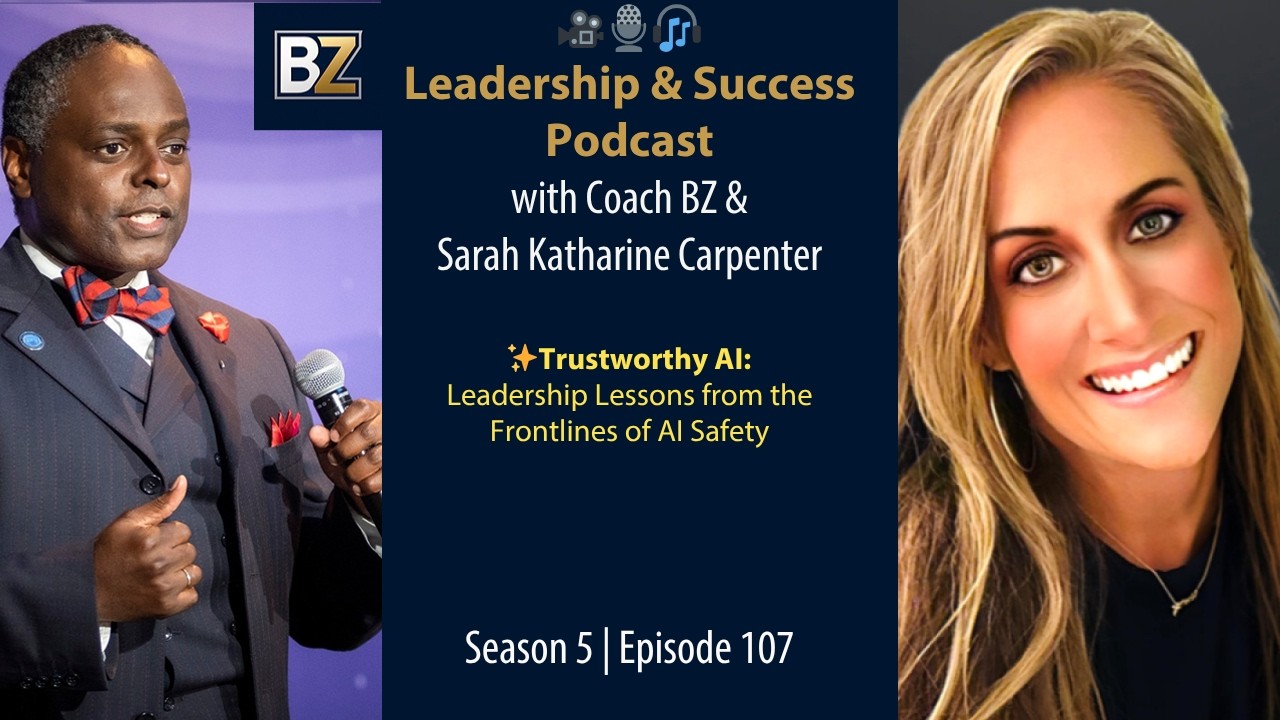
AI safety researcher Sarah Kathryn Carpenter explains why AI systems can appear correct while hiding errors, and why failures often emerge at transitions and under ambiguous conditions. She stresses that continuous monitoring and human oversight are essential, and that intellectual humility matters as much in AI work as it does in leadership.
Chapters
Hi, I'm John Maxwell. When the top companies in the world are looking for trainers, speakers, and coaches, there's one name that stands above the rest, and that's Maxwell Leadership. Our certified team members have gotten proven results for companies all over the globe, and our reputation I'm proud to say is second to none. Some of our members have risen to the top of their profession, including the one you're going to meet today. I proudly introduce you to my friend Bob Fabien Zinga.
Welcome to the Leadership and Success Podcast with your host, Coach BZ, where we help you lead with purpose and succeed with impact. If you're ready to grow into the kind of leader others want to follow, this podcast is for you. If you're determined to elevate your success and leave a lasting legacy, this podcast is for you. As my mentor, Dr. John C. Maxwell, reminds us, everything rises and falls on leadership. Our goal is simple, to inspire you, challenge you, and equip you with insights that can transform the trajectory of your leadership journey. Welcome aboard to another episode of the Leadership and Success Leadership and Success Podcast with Coach BZ.
Hello everyone, welcome to another special edition of the Leadership and Success Podcast. So this is our second broadcast for today. So for those who watch the first one, as you know, we like to start with moment of gratitude. And today I am really grateful that I'm still alive. I can still breathe because as long as I have breath, there is hope for me. And I am so grateful for that. So let us know in the comment, where are you joining us from? From, what city, what state. And if outside of the US, since we are global now, please go ahead and let us know which country. And also what you are grateful for. And if you do have a question for my guest, please type it in the comment and we will answer live. So let me see if I can properly introduce our guest today. Today we are talking about Trustworthy AI, right? Leadership Lessons from the Frontline of AI. Safety. And I'm going to be speaking to an old friend. We both were students and we also worked at the University of Alabama. Roll Tide, roll! Right, I consider her to be my sister from another mother. And then I think it was in 2010 she moved to Birmingham, and then in January 2011 I moved to Silicon Valley. So I am now definitely into the tech industry and the US Navy, and she's now an AI expert. It's just amazing how life works out. So I'm really definitely looking forward to our discussion today. So today I am going to be speaking to Sarah Kathryn Carpenter. Like I say, she's an AI expert. And really one thing that's important, I think, for a lot of people who watch this show, right, is artificial intelligence rapidly transforming business, cybersecurity, government defense, and society itself, really. But the question few leaders really need to be asking is, what happens when AI systems fail in ways humans don't immediately recognize? And Sarah Kathryn works at the intersection of AI safety, adversarial testing, LLM evaluation, failure mode analysis, and alignment and trustworthy AI. And Sarah Kathryn, specializes in identifying hidden weaknesses in AI systems, especially under ambiguous, adversarial, and high-risk conditions where output may appear correct on the surface while failing underneath. So her work includes AI weight steaming and adversarial prompting, alignment evaluation and dataset integrity analysis, detecting meaning-level failures and systemic risk patterns, identifying how AI systems drift, misclarify or break under pressure, and also strengthening trustworthy AI systems for the future. So this conversation is bigger than just technology. It's really about leadership under ambiguity. How do you lead when there is no certainty or clarity? Responsible innovation, trust in intelligent systems, cybersecurity and AI risk, and ethical stewardship in the age of artificial intelligence. So if you are a naval officer aspiring to command one day, or a tech executive or a senior engineer aspiring to become a tech executive one day, I think this episode is for you. Part of what you're going to be learning is what AI safety researchers actually do behind the scenes, but also why the future of AI depends on understanding failure. So without any further ado, ladies and gentlemen, please help me welcome to the Leadership and Success Podcast Sarah Kathryn Carpenter. Good morning, Sarah Kathryn. How are you doing today?
Good morning. I'm well. How are you, Bob?
Fantastic. Welcome to the Leadership and Success Podcast, all the way from, I guess, Birmingham, Alabama is where you are now, right? Okay, so that's about an hour from T-Town. All right, so what are you grateful for today?
I'm grateful for, um, watching how God lines our life up and things that you don't realize in hindsight become so meaningful. Like in 20 2010 or 20— or 2007, 2008 when I was in admissions, who would have known that on down the road we would be able to reconnect in such a meaningful way.
It is really amazing the way life works out. One advice my mom always gave me is to treat everybody with respect and dignity, no matter who they are, because you never know who they might become in the future. But yeah, definitely great to connect, especially in this world that is very fascinating and really changing every industry that, uh, uh, we know of. Uh, but before we get into AI, what is something about you that most people may not know when they first meet you?
Um, I think honestly, today that I work in AI, most people, um, when they do find out, they are very surprised by it, especially in the community I am in, because it's a very classical education, liberal arts, and you know, is going to— they're— we're going to keep books in the classroom for as long as possible, you know. So everything has been so, um, not wanting to focus on technology, but yet here I come in with, you know, AI under my belt. So that's, um, something that my specific community is surprised by.
That is really, uh, fascinating. And we were talking in, in the green room for the longest— people who are in tech like myself, they were pretty much required to have like a STEM degree, right? Science, technology, engineering, and math. But your degree is in art. You got a Bachelor of Art from the University of Alabama. Why, why do you think it is important for people regardless of their educational background? Why is there still room for them in the technology industry?
Well, I think specifically with AI, um, the way that I have looked at it is essentially we're training a computer to be a whole person. So that's all-encompassing of every discipline, but most importantly, it's in discernment, language, rhetoric, linguistics, all of the disciplines, the classics that are so important for the basis of education are now also important for the basis of building AI responsibly.
That is so, so powerful because I sit on the board of two nonprofit organizations and we really try very, very hard to make technology more diverse, have more women and more people of Carla, but for the young ladies maybe in school right now who are watching, I want them to have an idea of what an AI expert looks like, right? So you don't have to be a male and you don't have to just study science or tech or computer science. You can actually come from the background of arts and classical education, and there is still room for you, I believe, at the very top of our industry. So let me ask you this. You work in one of the most important emerging fields in the world today. Artificial intelligence safety. What first pulled you into this space?
So, um, I remember specifically it was, uh, early in 2023, and I saw this as an emerging field and essentially with an untrained workforce. And so at that time, my youngest was about to get back into kindergarten, and I kind of thought, well, now my time, I can get back into something. And I thought, well, this popped up, why don't I jump on one of these annotator freelance platforms. And so I started doing that and just gradually has compounded. But initially what my motivation was, I was remember— I was sitting there and I was thinking about how, you know, if these models are only as good as the data that is fed to it, then I thought it was important to get in there and help with the foundation and the shaping of the information that goes into it, because I do have the strength in being able to to discern and see truth and, and to find where things are failing. So I wanted to jump in at the moment. So it was ground level, and I thought, well, this is, this is the chance. So, and it's been very interesting to work and evolve alongside with the career path that I've chosen. So it's, it's interesting because it's like we are both developing at the same time.
That is really, really fascinating. Was there a moment when you realize that, uh, AI isn't just impressive, but it can also fail in ways most people may not understand.
Yes, it's really when I started working with models at scale, um, I saw how outputs look polished but they would lack meaning. Um, so the danger really just is when wrong answers are still capable of earning the trust of the end user who not have— they do not exercise discernment in that moment. To determine, hey, what does wrong actually look like? Should I be checking this? I think you see examples in the news all the time. There was a lawyer recently who I believe used AI to create a complaint or something, and then he's been fined for that. So it's absolutely important to know how to responsibly use AI. So just seeing that little bit of a semantic drift and understanding downstream how that can affect the end user is really when I saw that failures are really one of the most important things in this.
Yeah, especially for me from a cybersecurity perspective, even in the military, I really believe human oversight is so key because with AI there is AI hallucination, which you refer to. AI sometimes just make up stuff.
And it's true. Yes, yes, it's very true.
If you just want, want to please you. And, and then if you are a lawyer and you have to write a brief and you're going to go to a judge, you don't want to come up with case law that is completely fabricated, right?
Exactly. Yes, poor thing. Yes, yeah, exactly. So it's not foolproof and it cannot do absolutely everything. You absolutely have to have the discernment of the end user that comes in and makes up for that gap.
So even though AI can definitely help you be more, um, proficient, right, and effective You do have to review the work of AI every time before you sign your name on it and challenge it to the way you use it. So let's talk about— this is a relatively new field, right? AI safety research. What do they actually do? Because I think most people have no idea what AI evaluation and adversarial analysis actually involve. When you tell people you study failure modes in AI systems, What does that actually mean for the average person?
So I think that most people think AI fails when it's obviously wrong. So as we just discussed, it's the little— it could be a paragraph in an essay you asked it to write, one little excerpt, one little sentence in there that's incorrect. Will completely derail your integrity. So when a response looks right while missing the meaning or the intent of what the user actually wanted, you know, the goal is actually to catch those patterns earlier so that they don't scale with the model and then roll out downstream with the, with the end user. So really my goal is catch the failure modes in the upstream so that we can prevent harm on the back end or on the downstream.
That is really insightful because the other thing with AI is it keeps learning and sometimes it drifts as well. So something that may appear like a very small mistake now, after a while it can actually become catastrophic, can't it?
Yes, absolutely.
Yes.
And there's many examples of that all over. Which all goes right back to meaning and intent. So, you know, you may ask a model to do something and it can refuse something that is dangerous and it will not give you the answer. But if you change the intent slightly, it may slip past it. So that is essentially what we do every day, is catch that semantic drift.
And talking about meaning and intent, can you explain for our audience what meaningful level failure Minds?
Yes, so it's when something is not obviously wrong, but, um, it's misaligned in meaning, so it's not something you could trust and act on. Um, like for example, if, um, a user wanted a model to edit one of their documents and they said, you know, highlight this area for me but what they actually intended was for them to— for the model to underline it, then that just that little difference, you know, that could just be a personal way that they speak about highlight, or, you know, anything that can just change in meaning slightly can absolutely change the outcome that you get. So, and then sometimes when you go to correct the model, it becomes confused, and then you do have information that's incorrect come out. So it's really just a loop, it's a cycle. So Looking for the things that aren't obviously wrong but heavily influenced by changes in words specifically.
So why then are ambiguous situations so important in AI safety research?
So AI safety isn't really about catching the obvious failures. It's about understanding when the system does things wrong and when it isn't clear. So ambiguous situations really force the model to interpret that intent, fill the gaps, and make judgment calls. That's where you can see whether it's staying aligned or where it's actually drifting. So that ambiguous environment is essential for you to be able to continue to make sure your model is not drifting into a place you don't want it.
Hmm. So was there one thing, or maybe a couple of things, that surprised you the most once you started evaluating LLM, large language models, at scale?
Um, I think that really one of the most surprising things for me was, um, how important the liberal arts and classical education is in this field. Um, that's really something that I kind of— it was kind of a realization I had very recently because I was thinking, okay, This is exactly what they teach in the classical school. This is exactly what I learned in arts and sciences. And here I am using it today where most people would have thought it's a dying field, these are dying fields, but they're not. Discernment, language, meaning, it's all a judgment problem. It's not just technical. So we really have to make sure that we're including both the technical and the side that is classical liberal arts education. But to be fair, in liberal arts, we are in in the arts and sciences, we did a lot of research. As an undergraduate, I was writing, you know, papers, 3 or 4 papers a semester, 10 to 20, 25 pages each, you know, SPSS analysis. So I was given really kind of both sides of it, the analysis plus the interpretation at that— in that college. I'm so grateful for that. That was one of the best experiences I've had.
That is really powerful. And I guess more and more in the last recent years, there is especially another lady I collaborate with on LinkedIn. She doesn't like STEM, she likes STEAM. So she adds an A to it, right? So science, technology, engineering, art, and then—
I like that. That's good.
Yeah, it's true, because I feel like we really need to open it up, because I feel like people who come from a different point of view, they bring so much to the technology field. They think differently and they look at problems in different ways. And I think it just adds so much to what we do. I think when it comes to tech or emerging tech.
Right, right. And it has helped me. You know, I am learning so much every day from the people that I work around. And so I think that, yes, you should— you have to embrace the others that bring a different viewpoint, and that's how we're going to do this well.
Yes, indeed. Now let's talk about adversarial thinking and AI security. You've worked in adversarial prompting and jailbreak discovery. What exactly is a jailbreak in AI? And for most people, I think they know what it means to jailbreak like an iPhone. People used to do it back, I guess, I don't know, maybe 15 years. A go. I don't think you can jailbreak your current iPhone anymore. At least they make it more complicated and they're much more difficult to do. But what about jailbreaking AI? What, what's the deal?
So a jailbreak is a way— it's when somebody finds a way to bypass an AI system's safeguards and to get it to produce responses it normally would not. So essentially they're tricking it. It's not hacking the system, it's manipulating how it interprets the problem.
Yes.
So for example, instead of asking directly, someone might frame something as hypothetical or a role play or a translation task. The model— so the model thinks it's being helpful because it wants to help in that context, but it ends up generating content it was actually supposed to avoid. On the surface, it looks like the system's following instructions, but underneath, it's, it's really steered into breaking its own rules.
Hmm, that's interesting. Why do you believe AI security and AI safety are becoming inseparable?
Because the line between misuse and failure is disappearing. Is disappearing. So AI safety really is about making sure the systems behave as they are intended. AI security is about preventing people from intentionally making them behave in ways that they should not. But in practice, they mean the same thing, so— or they meet in the same place. So how the system responds is, is under pressure is really what we're seeking by bringing those two together.
Now, one thing that may surprise a lot of people listening, but even the people who have designed and architected most of the AI tools and LLMs that people use today, they don't fully understand how AI is able to do what it does. Even at OpenAI, some of the architect engineers don't really understand how it comes up to those outputs. So, right, what worries you most these days? Malicious actors trying to attack an AI system, or organizations who are deploying systems they don't fully understand?
Well, Well, really, organizations deploying systems that they don't understand. Um, malicious actors, they are a real risk, but I think that we expect that already. Um, I think that what concerns me the most is when systems are deployed at scale without a clear understanding of how they behave, where they fail, or what assumptions they're making. That's how you get quiet systemic issues that when nothing actually looks obviously wrong, it's drifting in ways that are very subtle. And if no one's actively monitoring it, um, by the time it is visible, it's already embedded inside it.
Now, in, uh, cyber security, I feel I'm very much passionate about— now, we often say that most systems fail at the seam. So for AI system, where do you see the seams breaking? Today?
So AI systems, they don't usually fail in isolation. They really fail at transitions. So you, when you start wanting to train a model, you have, you know, pre-training. So you have the people are working on small data set, they're, um, they're auditing it, they're checking it for, you know, is the model behaving like it's supposed to? And then when they transition that to the next level where you are then putting it into production, you have annotators who are coming in who may interpret guidelines differently, or maybe the guideline missed one explicit instruction, and you may have annotators who decide to just, you know, they're, they're going to decide, um, this is the right answer without asking. So there's drift there. Um, then you have people who are actually using the model, so you never can really anticipate how they are going to use it. So, you know, drift really starts to happen not because one part failed, but because the layers continue operating under slightly different assumptions. The failure isn't in one place, it's in the transition or in the definitions that weren't explicit. That's the drift.
Okay, I, I like that. Now we have a few people who are watching live who are commenting on the podcast. Again, for those watching live, if you have a question for Sarah Catherine, please type it in the comment and we will answer your question live. So we have Ron. Ron says, "You hit the nail on the head about data is the most important thing for AI." I definitely agree with that. "Asking AI for solution instead of where we need data as being directed by AI is the key IMO." And I agree with that. Thank you so much for sharing, Ron. And we have another LinkedIn user who are pinging somebody else. Because they feel like you are talking about such an important subject they want their friend to see. And I believe this is Colleen Trout. She says hallucinations replicate, and that is so true. And somebody else is asking another one of their friends to come join us live. So a lot of people like what you are saying, and I love to stop some time to acknowledge that because when I started this podcast 5 years ago, it was just me, myself, and I. Nobody was listening. I was doing it just for the audience of one. So now we have potentially 65,000 people listening around the world and when they interact with us. I definitely want to acknowledge that. I guess another question I have for you, Sarah Kathryn, is what do you think most organizations underestimate right now when it comes to AI risk?
Okay, well, I think that they are underestimating how inevitable the drift actually is. I mean, I think that if you have a model, you can expect that how quickly it scales. If no one's watching it, no one's owning it, then it is going to drift. You should just expect that. Um, I don't think that they really anticipate what that means as far as a continuous monitoring of the data. Um, I think that a lot of people are even missing it. I think that you have to have a person, at least one person, who just essentially sits within the data set and watch what happens as people are annotating, auditing, reviewing, and evaluating. Because if you go and you just look at a few different examples, you can start to see the nuances and the things that are slightly breaking down. Um, it's very, very interesting.
No, uh, I think what you're saying is so critical. And for example, from my military background, we've started now using AI for military operation. It's if you believe it or not. I think we started for the first time for a live military operation in January, right? When we went to Venezuela to kidnap their president. And of course we are using AI again for Operation Epic Fury in Iran. But one thing in the military though, because especially when it comes to safety, because it's a matter of life and death, I believe we absolutely have to have human oversight. We cannot let those LLM and machine learning and AI make all of the decision and take action too, right? A human being has to review it because it could be the difference between targeting our actual enemy or killing innocent girls in a school. So we absolutely have to have human oversight for that. But why do you think human oversight is so critical based on the work you do as an AI researcher?
It all comes down to the end user and preventing harm to the end user. That's really what my motivation is. Because I think that where we are today, this is probably the most impactful decision, set of decisions we will be making that will affect this generation coming up underneath us and then even their generation underneath them. So it's really what are we going to leave behind for them? Are we going to leave them in a better place or are we going to leave them in a much harder place? And right now it's very, very critical because we're at the very beginning. So we can catch this now and stop it before before it does scale and compounds on top of each other. You want to catch it when it's easier, and that's now. So I feel a sense of urgency in that. Just, it's like, it feels like a race to get there, to stop it, to catch it, and prevent it from going too far too soon.
No, that is so insightful. Let's talk about system thinking and leadership. Like me, you do have a system thinking mindset. Uh, why is system thinking so critical, you think, in AI safety?
Um, so if you're not thinking in systems, I, um, AI is really a chain of decisions, so failures accumulate across the layers. So you have to think in terms of systems. You know, if I make this decision here, or if I let this stay within the dataset without correcting it, how is that going to compound on down the line and then roll out to the end user? So that's really, that's how I see it. What is it going to do to this dataset? Is it going to introduce inconsistency? Is it going to, you know, have the model drift? I mean, some of these things could be so effective as one day the model is making decisions on its own based upon, inputs, parameters you haven't actually given it, but you didn't correct the intent. And so there is confused on what the intent was, and then is kind of acting in its own agency at that point.
Yes. Wow. Now, one thing you've said before is the most dangerous failures are often the hardest to detect. That is quite insightful. Most dangerous, hardest to detect. How does that idea apply beyond artificial intelligence, maybe to leadership or organization in general?
I think that a lot of what you see replicate in AI also replicates in our world. It's very interesting because as I'm sitting in the data, I'm running a parallel loop in my head to what I see exists in the world. So I guess really one of the most important things for leadership and leaders Um, the instinct is often to react quickly when we see things that we think fail, and I think that that's not the right answer. I think that you have to sometimes be very patient and have controlled restraint. That's really something that I have focused my practice around, is restraint, controlled restraint, in a way that I'm able to make clean decisions that I'm confident in, I've thought well through. And so I think that that's really one of the most important things for leadership, is to not react so instantaneously but see how it's going to develop. Um, you know, as far as within education institutions right now, they're building, you know, a whole, a whole new colleges that fall under the college, um, or the school, the university, and ones that are creating new disciplines when we actually already have these disciplines. They exist. And so instead of jumping to race to try to be at the front, I think that sitting back and deploying it meaningfully and well is what's more important.
Wow, that is quite insightful. What leadership lessons have you learned so far from studying how intelligence systems fail? And you've been doing this for quite a while.
Really? It's interesting because I enjoy it so much because it does feel like often personal development in so many ways because I guess you are analyzing meaning and so it helps you interpret that, internalize that. So restraint has been the biggest leadership lesson for me, especially, yes, learning to not react quickly, to sit back and think and to really stay anchored under pressure.
But now, one thing I have noticed when I came to Silicon Valley about, what, 12, 13 years ago, our IQ, I think, is extremely high in this area, but the EQ, we have a lot of work to do, emotional intelligence and showing humility. How important is intellectual humility when working at the frontier of technologies like artificial intelligence, you think?
I think that it's extremely important. It's probably one of the most important things because when systems start to drift or behave unpredictably, you really have to be able to say, well, maybe I'm not right, and be able to listen to your counterpart or the engineering or the researchers, whoever it may be, and to not just dig your heels in and say, I'm right no matter what, because that will not move it further into resolution. So that's really probably been what's been so important in my work because it has taught me, it removes a little bit of like the competitive level in a sense, and it brings a teamwork environment. And, and I prefer that because the things that I've learned from people in this space, I mean, there's super intelligent people here and, and I'm here to absorb anything that anybody is willing to help me learn.
That is really powerful. I think that's really a leadership and a life lesson, isn't it? Just leading your life with humility, because it's really impossible today to know everything there is to know about anything, is it?
Right, right, exactly. And that's how I always approach things. I always say, you know, if I— you will know if I know the answer because I will be 100% certain in what I'm saying, but I will always give a disclaimer if I don't know. It's okay to be wrong. And also, this is important to me because it's modeling for my children how I want them to react and behave. And you know, to be teachable, because that's actually how I've been able to land where I am today and in so many different roles, because I'm teachable and I'm always seeking knowledge from others. So, um, those are real— that's really one of the primary driving forces in my life.
That is so, so powerful. I must tell you, you know, I had the opportunity to actually lead a command as a commanding officer in the U.S. Navy after I became a commander. Less than 1% of people who join the Navy have that chance. But I must tell you, the number one, number one lessons I learned as a commanding officer is lead with humility. Because you would think, oh, I am at this level, I am the big kahuna, I am in charge and all of that of the people of the mission. But no, no, there is no arrogance. There is no ego into it. Because if that's the way you are thinking, you are definitely going to fail.
Right.
It's just amazing how God can add circumstances to really humble you at times when your ego gets too high. But you really have to lead with humility no matter what you do. That's definitely a lesson I will always keep.
Wow.
So let me ask you, from your system view mindset, what do you believe separates organizations that use AI responsibly from those who simply who are simply chasing hype these days?
I think that the ones that are using it responsibly, they're disciplined and they're quiet. They value meaning and not the hype, so they're not rushing to scale. They value quality over, over quantity. You know, getting it right is more important than sacrificing to push it through to production. So It's really just that control, that quiet restraint that I have been focusing on adopting myself.
Now let's talk about the future of AI safety and security. In my opinion, I think Europe is doing it a lot better than we are here in the States. Even when it comes to privacy, they have GDPR. We don't really have a federal law except, I guess, the Privacy Act of what, 1976? 1976, which is completely outdated. So many things happening now technology-wise that didn't exist back then. But I guess a question I have for you, do you believe in America we are moving faster in AI capability and we are not moving fast enough AI safety and security?
Yes, I do believe that we are moving faster in AI capability than in safety. But that's also what's part of it makes it so powerful. So, and the speed is the advantage. So the problem isn't that the capability is moving fast, it's that the safety isn't being built to move at the same pace. So right now, safety is often treated as a checkpoint, and in a system that's evolving this quickly, it continues And it's continuous and it becomes embedded in the system. So you also have to have that continuous monitoring of the safety, not just checkpoints. And I think sometimes in the transitions, like I said, that's where the failure happens. That is where people assume, or the teams may assume, okay, they check the safety of this, we're good, you know, it's moving on to us safely. That can never be consumed. So, um, I think just really getting the continuous monitoring of the data is, is the most important thing here.
So what keeps you optimistic then about the future of artificial intelligence?
Well, uh, the, the fact that we are still early and that the standards aren't fully developed, and, you know, we still have the opportunity to come in at this point, and it has not been rolled out in a way that has been harmful as a whole to us. And I think that we are still early enough that we can do this well, as long as it's done intentionally. So, um, you know, the right systems, the right people in place, um, and the right humility too is, is what we need right now. So we're not— we are right on time if we handled it, handle it well.
Thank you so much for sharing that. Anything that keeps you awake at night when it comes to AI safety?
Um, so I think that yes, actually it's the— there's a gap that exists, I think, um, with people, my peers specifically, uh, parents and children in education. I think that it's so important for parents to be trained educate the schools to be trained so that we can train our children to use it responsibly also. Um, that is— that's something I do. And I've taught, you know, I have a 7-year-old that he, he picks up my iPad and he goes to ask— he filters apps on— but he wants to download. And so instead of coming to me first, he'll go filter, and he comes back to me and he'll read off the— well, this— it— we call— we call ChatGPT Chet because we feel like he should have a name. So Chet is his name. So Rhett comes back and he'll say, "Chet says that this one's okay for me to have," and he'll give me all the— I'm sure he's reading through and skipping the parts that I don't want to hear. But yeah, so, uh, it's so good though. It takes out time that I would have spent looking and reviewing the app, and he's using it well. My other son used it to create a basketball training program for himself, and, um, to see them do that so well, it just makes me very happy because I think, well, this is it. This is how we do it. We don't hold it back from them because if you hold it back from them, what you'll have is children who are hiding in their bedrooms and using it in ways that we don't want them using it. So, um, parents really have to step in here. And instead of saying, oh, I'll let my kids teach me how to use these things, that's— it's too powerful. We can't let them do that. And then education, especially in the classical, uh, realm, we really need to step in and fill that gap because what they teach is exactly what AI needs. And so those two have to come together so that we can create this space.
I like that. I think to me, one of the most tragic examples of this was a couple of years ago, there was this little boy, I think it was in Florida, 14-year-old, who fell in love with this AI chatbot and then decided to kill himself so they could meet in AI heaven or whatever. So a human being actually died because of this powerful, powerful technology. I mean, also a lot of, especially teenagers, I think their brain is not quite fully developed yet, they get addicted to a lot of this technology. What do you think can be done? I guess first at the parent level, but maybe even at the societal level so we can see more safeguard when it comes to the use of this powerful technology.
It's really, so I think that not, pretending that it doesn't exist. And there's a lot of spaces where people just, they kind of just pretend it doesn't exist. So, and instead of running from it, we need to embrace what is good, what can help us. And it is the speediness. And in a world where we are constantly demanded and pulled in every direction, why would we not embrace something that can execute a task for us faster, that can read through a document and give me the points very quickly. Last year, I remember at the very beginning of the school year, they gave us like a 60-page packet for 6th grade, and I was like, okay, I'm going to do this really well. And so I put it into the model and I found the bullets that I needed, even down to the one at the very end that said, sign this place and your child gets a 3-point bonus. Now I was like, good for you, Chet, you know, you did this well. So I think that we've really have an opportunity to teach the children how to use it well. We can't ignore that. So I think it has to be embraced on all levels, just all the way around, because that's one thing I focus on with my children is that when they say, Chad's so smart, that's when I'm like, well, you realize, remember, he is a computer. It is not a person. He doesn't have feelings. But there's also a bonus in that he doesn't have feelings and that he removes the emotion and allows you to see the system very clearly. Um, often what I use it for is to help me aim very precisely with what it is that I'm seeking, because sometimes— because your emotions distort your reality. And so, um, that has really been a good checkpoint for me to— and maybe that's how I'm learning to have more of a, of a restraint and not be so reactive. And because the emotion can be removed with using these tools.
Well, say that one more time. Emotion distort.
It distorts our reality. I mean, yes. So because that's the same principle as if you're mad about something and then you wait, you know, a day or two, you don't care anymore because your emotions no longer heightened. So that is possible in real time, can help you see to work through that much faster.
Yes, yes. That is really powerful. So what about all of the CEOs or C-level executives, senior military leaders listening right now? If you had their ears for like 60 seconds, what would you tell them about the safety of artificial intelligence?
To stop treating AI safety like it's a feature and not infrastructure. Most of the organizations I think are over invested in capability and underinvested in evaluation, monitoring, and accountability. Um, it's not a technical gap that exists, it's a leadership gap. So that's what I would stress most to them. Um, if you don't build it now, you won't catch a system that fails later down the line.
Yeah, that is so, so powerful. So AI safety should really be built into the process and be like an add-on after the fact. And I am working right now on a framework for AI governance, which would have a leg about safety, security, something I'm very passionate about, but also privacy and governance and ethics. I think those are the 5 things that many times big corporations don't really spend much time on. And you are right, we're still kind of in the early formation of this technology. So maybe we should really put those into place now instead of waiting. So let me just take a few moments to talk about your personal journey. We kind of hinted to it. It is kind of unusual, but I really, really love the way you have come out to becoming an AI expert today from where you started at the university. Of Alabama. Your career path is really unconventional, right, from enterprise risk management to AI safety research. How has that diversity kind of shaped your perspective on AI technology and just emerging tech in general?
Well, so I think it's really interesting because for so long, you know, the way that I have navigated, um, really since, gosh, probably the first job I ever applied for with a resume— I mean, this back, I was in high school. The way that I've always had my own evaluation system that I've always run, and it's a two-step process. That's, you know, I look at a job that's posted and I say, you know, can I do this job? And if I say, think, yes, I can, my next question is, would I enjoy doing this job? And so if either one of those are a no, I move on because I'm not going to do something that I don't enjoy and I'm not going to do well. So that is really kind of moved my path along. I think that, you know, they say that the classics and liberal arts education can transfer to all fields. And I think that I'm living proof of that because, like you said, I was in admissions, then I was in the career center at the university, risk management, Pearson. And but all of them have certain parts of it that have been very specific to this, like Pearson scoring their assessments that for children, end of the year testing, that taught me how to be very precise with rubrics because that if you don't apply the rubric with Pearson, you cannot stay on because you, I mean, this is important. These children, like, if they don't pass, they don't move on. So all these little things converge to just kind of create the perfect storm for me to move right into AI. But the enterprise risk management, I guess I didn't really realize how formative that was for me because I was in my 20s and it was just— I was the data or the risk analyst and I had my director of risk and we were the only two that ran a humongous insurance program for coal mining companies. So our property insurance was— our premiums were $20 million a month.
Wow.
Right. So our, you know, the data was endless. And what a great— that's when I really learned I like risk so much, because you saw all facets of the company, which I think can tell you that risk safety transcends into everything. Because if you have to look at all parts of the company to determine where the risk lies in traditional enterprise risk management, it is the same thing in AI. And Um, so I think that it's powerful. Yeah, it really is. And I guess I never— it was really interesting to look back and think, okay, now it all clicks, now it all clicks. And so that's why I have always felt that choosing to follow what I think I would do well and, you know, really put my heart into has not led me wrong. Because, I mean, we didn't know this was coming, and And here it is today, and I'm just so grateful. So I'm grateful to be here.
Look, sorry, Catherine, let me ask you this then, because you do operate in a highly ambiguous environment. Some people don't like that because you have to make decisions when you don't have all of the information, right? How do you personally stay grounded, though, and mentally disciplined?
So you can't react to the noise. First, you have to be able to discern and tell what is meaningful and what is just noise, and what is noise that won't become harmful later on. So, uh, what can you ignore and what can you not? Um, so really just being able to observe and sit within the ambiguity and not be bothered by it is super important. Um, somebody told me once that I have a very unusual high capability to sit in an ambiguous and chaotic environment and then be able to bring structure to that chaos. Um, I don't know, maybe, maybe it's being the youngest of 4 kids I learned it, or maybe, uh, having 3 children, you know, I think that those are chaotic situations. And so I, I've always very naturally been able to see where the issue is and and think, okay, this is how we fix it. So it used to feel like a curse sometimes, but so I'm like, I'm always the one that sees the problem, so I'm always the one that's going to fix the problems, and that's fine. No, so, um, but now I'm doing it in a space that I'm really enjoying, and it means a lot to me because it affects so many people.
Yes, that is really powerful and insightful. So Let's think about some of the young ladies who are listening to the podcast now. For example, my first daughter who got a degree, a Bachelor of Arts in music last year, or my second one who's about now to graduate high school and go to college. What would you tell them? Which advice would you have for young girls trying to transition into AI safety or AI security today when they may not have a STEM degree of a traditional background to get into the field.
You know what's interesting? You said she has a degree in music. You know what I think people have seen at work at universities? The kids that come out of the music school, they're outstandingly intelligent. You know, in fact, I was given a fact at Alabama once that the people admitted into the law school, top 25 public law school the most accepted from majors is a music major in Alabama. And I thought, yeah, so I'm like, if you want to be a music major, you absolutely should. It's working different parts of your brain, so you're building pathways just like we're building pathways in the AI system. You know, you're building pathways that didn't exist before. So that's amazing. Fabulous. But really, experience is what you need in this. There are so many platforms out there that you can join. You can jump on a freelance project and just get very broad, quick experience. And I think you know very quickly whether you, you know, you can do this well or not. And so I think it's important to, to lean into the things you do well. And if you don't do something well, you know, don't just stick to it because it sounds good. Go find what you're, you know, you're passionate about or what you're good at doing, because That's how you can really contribute in ways that help.
That's really powerful. And talking about music, my daughter was telling me the number one artist today on YouTube is not a human being but AI. They create music and songs and all of that, and people love the music. Then I wonder who the royalties goes to since it's not— you can't really send money to an artificial intelligence. But anyway, it's really amazing how the world is changing. Uh, it's, it's just incredible. Now we have another question from our live audience. Uh, Colleen Trout says, how do you program intent across a diverse and changing landscape?
Okay, so, um, you have to find where the meaning could mean more than one thing. So, um, like in I remember specifically in transcription tasks, those can be, um, very difficult to see the surface failure, but underneath it, you know, if it— if you let something through that didn't quite meet the literal translation, um, I think of a specific example that would make sense. But, um, if you don't do it specifically correct, then it drifts. And so you have to— you start with a small data set. So you start with a very small, you know, 100 tasks, and you go through and you intentionally audit every single one of them.
Wow, 100 tasks is small, huh?
Yeah, yeah, it is. Yes, yes, for sure. Because that— I mean, you could go smaller, but I feel like that 100 is a good number. So you evaluate that.
I mean, when you think about scale, it's just amazing what AI can do because even the way I use AI now, I can do the work myself, but it would probably take me, I don't know, 30 minutes or even an hour. But AI can do it in just like a couple of minutes. It's just incredible.
It is.
It's incredible. It is truly incredible. I have taken things that I've written, I've taken work that I completed 15 years ago even, and dumped it into there so we could get a really kind of a holistic profile of what my strengths were. And it was so interesting because it connected all these dots that seem so obvious when they point it out to you, but yet you—
that's amazing—
you sit in and you don't see it. So, yeah, it removes all of essentially the time-consuming the admin, the clerical that you— and it frees it up to the thought work, and that's the fun.
Wow, that is really amazing because really, like, even when I prepare for the, um, podcast, right, I have to do research on, on my guest and, and all of that and then promote it. No, it used to take maybe an hour, I don't know, maybe 2 to 2 and a half hours just to prepare for one guest. Today I had 2 podcasts. There are days I have 3 or 4 podcasts. Now I still have a whole bunch of things I need to do. So when I use AI to do do the research for me and the promotion, you know, I can now do it instead of 2.5 hours per person, maybe it's only 15 or 20 minutes. So it really saves me a lot of time. And I mean, I must tell you, time truly is money. Actually, that's the first thing I told the woman who became my wife at the University of Alabama. She met me on one of those chat things I had on my website when I was a student. But anyway, first thing I asked her, okay, my time is money. What do you want to know, lady? But anyway, I am really so proud she is my wife. Hey, but, but it's just amazing what AI can do. Now, um, Colin also said, just a few comments from the live audience: prompting instruction are critical, words matter, humans don't understand the same word. And then he talked about second, third, and fourth effect, which we talked about. And then Ron says, uh, truth isn't just fact, which you can derive data, but truth as wisdom, which only a human or living creature has the mind. I think that is so true, especially in the military when it's No, question of life or death. Help in identifying target is one thing, but execution of the target is where the human in the loop is essential. Absolutely essential. Thank you so much for sharing on. Okay, we have about maybe 10 minutes left. What I'm gonna do, I'm gonna try to, for this last segment, get into your head and kind of try to understand the leadership principles that have helped you become the great success you are today. So first question I'm gonna ask you, what do you believe is, What is one of the greatest lessons you have ever learned in life, in leadership in general?
You don't have to react to everything. So sometimes no reaction is the best choice.
I love that.
Because if you're engaging in everything, you're diluting your message.
I love that. So don't react emotionally, but to have the space to actually come up with a response for whatever you are facing. That is very, very powerful. And what do you think is the secret to your success? Why are you so successful in AI safety, you think?
I think because I think in systems naturally. I apply a framework, I think, to everything I do. And it's funny because now I can see it. I could not see it before. Um, even down to watching— I was watching my son's Little League game, and there's the funniest thing that happens in these games at his age. I have noticed if a child gets to second base and starts running to third, he might as well just run home because if he's going to score, like, because if the ball— well, it's really if the ball's over there lost in like midfield, he will score. So essentially I'm like, all you gotta do is tell these kids, if you start rounding and you can go to third, you keep going home. And then on the defense side, you need to set up defense at third base. And I'm like, it seems so obvious, you know. Everything I see, I see it in systems, in a systems viewpoint. I'm sure it drives my husband crazy because I'm questioning him when I'm really just testing the intent. So yeah, I mean, honestly, yeah.
So that is, that is really powerful. How, how do you think you develop that system view? How did it happen for you, you think?
Honestly, I think because they don't teach that in schools, really. No. And I think, as I think that my siblings probably are very similar in this too, um, I think that my parents, um, my dad, you know, he retired 40 years of service from the Pentagon. He still works Department of Homeland Security. And I, you know, he— there were two things that I remember distinctly from childhood, um, One was, and I have always loved it and carried it forward, he always told us, if you aren't getting the answer you want, you aren't talking to the right person. So that has really helped propel me forward. Um, but then secondly, there were many conversations in my teenage years where he would say, Sari, we're going in a circle, we're going in a circle. And so he would always bring me back around to answering the question that he asked. And so That there, I mean, there's so many people who don't like the US. So I think that really, that maybe that's the basis of it all right there.
Yes, that is, that is powerful. Thank you for the insight. I appreciate that. Now I know leaders are learners. What are you learning these days?
Oh gosh, I mean, everything about AI safety. I mean, because you can never stop learning. So, and there's, it's, I, and I use my own personal model for training. You know, like, ask it to help me create a training system so I can, you know, what, like, what parts am I missing here? Where can I go look for more training? And it directs me to it so quickly. So, um, it really— because I enjoy this space so much, because I enjoy language so much, and grammar, and on all of the disciplines that I talk about from liberal arts, classical education, It really consumes me, and I can sit in it for hours. Wow.
No, I think really being passionate about what you do, that's so key, because if you don't have passion for what you do, if you're just looking for money, eventually you are going to face, you know, some challenges, and you're going to want to quit, right? Because there is no love, there is no, no passion. But on top, on top of that too, I like that you're saying basically we have to make up our mind in this century that we're going to be students forever. We're gonna have to keep learning and learning and learning. It's not like when my grandparents went to school. They only needed high school back then, and they could work at one, one position, one, one job for 20 years, 25 years, and get their gold watch and retire. Those days are gone, aren't they?
It's sad. Yes, sadly they are. Um, yeah, but at least, at least everybody expects it now, I guess, you know, because there was a transition. I think I remember with even my husband, you know, 10, 15 years ago where we were like, okay, this is not how it works anymore. Yes, yes, we're moving around.
So, but no, it's really exciting to be alive in 2026. Now, we do talk about success a lot. I love this coin I got from one of my skippers. One side says success, the other side says failure. How has failure shaped your life?
So, um, failure, you know, it's in the failure and the struggle and the hard times where you really where growth really happens. Because if you're not failing, you're probably not growing. You know, you just think, oh, I'm doing great, everything's going well. Um, so for me, when I was at Alabama and I worked in admissions and I made a decision to go into the MBA program, um, I— it was the year of the swine flu, 2009, and I ended up, you know, getting the swine flu right before finals. And, um, well, maybe about a month before finals. And so I medically withdrew because it was very difficult on me health-wise. And I had come from Arts and Sciences into the business school, and it was so different from anything I had done before. And I took a step back and I really thought about it, and I thought, well, what do I want to do? Because the business school is so different how it functions from Arts and Sciences. And in Arts and Sciences, I felt like very valued and coddled. And then the business school— and this there's nothing there. It's a great business school, but it wasn't for me because they teach you this is how you do it. If you do it like this, you're going to graduate out. It wasn't like classroom discussion. Let's talk about this. Where in arts and sciences, it's very meaningful and philosophical in ways. So that's when I thought, well, I don't actually want to do that. And so I spent a period of time drifting, I think. It really helped me to reevaluate who I was and what my values are and what do I really want to do in my life. That failure really, without it, I don't think I would be sitting here today. Wow.
Thank you so much for sharing that. Is there a greatest fear that you've been able to overcome in your life?
Yes, but not by choice. Losing my mother. So, she passed. Thank you. She passed in 20— uh, 2017, 2018. She actually— yes, it was right around the time we were moving. And, um, she was— I remember thinking before she passed, there was so long— every— my whole life I thought, how will I survive without her? I will never be able to live without her. But then what I found was that my faith and the foundation that she gave me was so strong that I was Yes, I came out on the other side happy and with intention and direction, and she still has influence in my life. So it's just on a different level. So, um, wow.
Yeah, I'm going to show it to you that I guess that's another thing we have in common. I lost my mother during the COVID pandemic. She was in France, and yeah, she passed away. I, for the first couple of months, I didn't think I was going to make it either. But yeah, but again, I rely on the faith that she taught me. Actually, most people don't know, but my middle name is Minou, M-I-N-O-U. It's a Lari name, which in English is translated faith or hope. So she gave me that name. And yeah, I always will rely on my faith when things don't go my way. Now, I don't think I would ever get over that she's no longer with us, but I can definitely live life normally. And we remember the impact she's had on—
yes, there's beauty in the transformation, but it doesn't mean I wouldn't have sat untransformed happily for the rest of my life. So, uh, but it really, um, you know, I think that everything is full circle eventually, and she just She gave me such a wonderful foundation, and I'm so grateful for all of everything. But I always thought I would never survive that. And so it was meaningful to look at almost 10 years down the road and think, I am actually happy today. The holidays are enjoyable again. Yes, I miss her, and I'll always miss her. But that is so true.
I know we have the same faith and we do believe you will meet her again. So yes, yes, thank you for giving hope to my audience. Okay, so let me ask you, if you could choose 3 people to have dinner with, you could choose anybody, anybody who's alive, dead, or even fictitious character, who would you choose and why?
Um, so I would choose Jesus Christ because he's my Savior and I have lots of questions for him, I'm sure. Um, and yeah, obviously my mother. So, um, and then Dr. Charles Swindle, because he, he actually dedicated me as a baby. And my parents really— yes, my parents lived in Southern California.
The Dr. Charles Swindle?
He did, yes.
Wow, that's amazing.
I found letters where he wrote my mom back after they had moved, and they were, you know, giving updates on their families. And wow. Well, I just really— if I wish I could get out there to meet him, but, um, yeah, he would—
he's amazing. I've written a lot of books.
Uh, but yes, yes, and his principles haven't changed. And so it was interesting when I listened to his parenting series, because my mom had told me forever, yeah, listen to his parenting series and you will learn how to do this. And so I would listen to it, I would think, this is so— I understand, I have experienced all of this, and now I'm trying to implement it.
So That is amazing. Wow. Before I ask you the next question, really quickly, people who are online, okay, I think we already talked about truth. Ron also says, it's more important to know the song than to know the notes. I couldn't agree more. And Walker from YouTube says, totally agree with that. As a higher ed professional music major, as they all are highly intelligent and often tend to be. BI performers. So I guess people may not know I am a musician too. I started playing the piano when I was about 7 years old, initially because my dad forced me to, but later on I really loved it, enjoyed it. I think it allows you to, I guess, use both sides of your brain, I think. But anyway, Ron says common ground, and I believe this is Colleen who says common ground isn't always common. I work with people from around the world. So true. And we have Daniel also joining us, although away from Metland, Florida. Anyway, I love reading those again. Like I say, 5 years ago when I did this, it was just me, myself, and I. I didn't have an audience to listen to anything I had to say. So thank you so much for being here. So let me ask you this. Is there maybe a song, a book, or a movie that would be your life's theme or anthem?
My life's theme or anthem. I think One of my most favorite songs, um, the— well, the one that I tell my children, I'm safe. Anything ever happens to me, go pull the program that I wrote for my mom's memorial service and just add Be Thou My Vision to it. Yes, we'll be ready to print and use it. So that one, absolutely, that one is very—
is there— that one is sung by a lot of people. Is there a favorite artist you like?
No, no, no, I— because, well, now you go online and you search and there's so many and you don't recognize any of them. So there's always gonna— I like the male version of it though.
So because part of the reason why I asked, because for this podcast since last year we have two things. So I have a digital library. Any book you recommend on podcast, I add those to the library. We started in May of last year with just two books. Today we have more than 400 books. You can go online, you can see all of the books recommended by, by my guests. And then I also started two months ago a playlist. So I have a music playlist. It's on, um, uh, Apple Music. You can subscribe to it and you're going to look at all of the songs people have recommended who've been on the show. So I'm going to add Viva My Vision to the list.
Great. And I do have a book if you want to add to it. Not necessarily that has a theme, but I think it's a very impactful book. I mean, I guess it could be a theme, but it's Virtuous Minds. And it really just talks about how not necessarily the decisions we make, but how we arrive at the decisions we make and in a very ethical integrity way.
And is the book by Philip Dao?
Yes, that's right.
The Doctor's Mind. Okay, got it. Got it. I will make sure to add it.
Thank you.
Thanks so much.
I found that one through my community.
So I'm going to need to land this plane soon. Let me ask you this. If you had one and only one day to live, what would you have liked your final contribution to be?
To have made AI safe for my children and their children.
That's so powerful. I like that. Now, if you had a magic wand, you could solve any problem in the world. What is the one, one problem you'd like to solve first thing tomorrow morning?
Inflation. Okay.
Yeah, that's a great one. I can't believe how much food is costing this day.
It's great.
Yeah, you almost have to be a millionaire to be able to—
you can't eat at home for less than you can eat out now. That's the part. This is great. So it's—
yeah, so yeah, I think, I think I'd like to help you solve that problem, like especially in California. Just last, last weekend, I'm so glad as a Californian I drive electric. I'm so, so grateful for that because the price of gas, almost $7 a gallon. Can you believe that?
Yes. Yes, yes, $7. I had sticker shock at the pump myself because I pumped in, didn't look, and I looked back. What happened?
So, yeah, I want to have a look at folks are about to purchase gas and just go to work. It's just incredible. But yes, I am definitely with you on that. Okay, let me see. There is one more question I want to ask, but before I do, so we are coming to the end of the show. What can my audience do to add value back to you? Thanks so much for spending the hour with us today and teaching us from your wisdom and experience. How can we pay it back?
You know, find me on LinkedIn. And, you know, if you have favorite publications or training or books or anything that you found meaningful or helpful in your life, I would love to look at them. I'm— I absorb all knowledge that I can. I'm a lifelong learner.
That is really, really amazing. Now, this is one of the most important questions I ask all of my guests, but if you could go back and give a piece of advice to your 17-year-old self, standing at the edge of this incredible career you've had in AI safety, what would you say to 17-year-old Sarah Kathryn?
Hmm.
Not to take everything so seriously as a younger person and maybe get an engineering degree.
Obviously, you don't need to have one, but yeah, I guess if you want—
you don't need to have one. But honestly, no. Honestly, if I could do it all over again, I probably would have gone into Christian apologetics. That would have been amazing. Wow.
Amazing. Okay, if we have time for a couple of minutes, I want to do a rapid fire. Just ask you really, really quick. Question. Don't take too long to think now. Give me first thing that comes out of your mind. Uh, one question is, uh, one word that describes the future of AI.
Undetermined.
Okay. What is the biggest AI myth?
Um, that, that it's going to take over the world.
Okay. When we talk about AI, like, I don't think it's going to replace humans.
It cannot replace humans.
People, when they talk about AI, they think about utopia. We gonna all go to heaven, things gonna be fine, or dystopia is gonna kill all of us and destroy the world. So which one? AI utopia or dystopia?
Utopia.
Now, AGI, right? Artificial General Intelligence, which is what most of the companies in the US are trying to reach to, from Google, OpenAI, and Microsoft, and Elon Musk. So do you think that is just a pipe dream or is it reachable? AGI?
I think it's reachable. Okay.
One book everyone should read?
Virtuous Minds.
Okay. And what is one word that defines great leadership?
Restraint.
Okay. Morning routine or practice that keeps you grounded?
Practice that keeps me grounded.
Is there a quote that changed your life, or even another book?
Um, what was the first part? Is there a way—
a quote or a book that changed your life? Don't say Virtuous Mind.
Okay. Um, so anything by Dr. Charles Swindoll. He has a lot of really good books. Oh, the Book of Proverbs. That's my best. That's— yeah, wisdom. So there Proverbs.
Very good. Who inspired you the most today?
Who?
Mm-hmm.
You did. It's been so great tonight.
Really?
Oh, good. I have always watched your career and I thought, wow, Bob's done such a great job in his career.
Thank you.
Thank you.
Like, what a wonderful job. Like, great. And then all of a sudden AI emerges and I'm like, here I am. Wow. So—
Thank you. Coming from my T-town girl, I really do appreciate that. Thank you. Okay. What is the leadership habit you refuse to compromise on? Something you will do no matter what. No compromise.
I do not compromise on accuracy.
All right. And what is the question every leader should ask themselves?
Am I doing this for myself or for others?
Back to humility and ego. So what did you want to be when you were a kid?
A lawyer. I thought—
Really?
Yeah, I did. I did a LSAT and changed my mind.
Well, now with the work you do in AI, you are helping lawyers use AI safely.
So it's the same, but the, the LSAT was very focused on what is true and meaning, so it all, it all kind of cycles together.
Yes. What are 3 adjectives describing you as a child?
Um, playful, mischievous, um, follower of my older brother.
What about as an adult?
Um, determined, precise, loyal.
All right, I like to end the show on an optimistic note. So what is something you are feeling optimistic about these days?
Um, my direction forward in this space.
Fantastic. Okay, the very, very last question. Oh, before I ask you that, is there any question I should have asked you? Anything else you wanted to share on the podcast before we end?
No, I think that we covered pretty much all the high points. Great.
So last question, one word that represents our shared experience on this podcast this morning.
Um, one word.
Um, don't take too long to think.
Collaboration. Collaboration.
I love that. I am so, so grateful to be speaking to Somebody from the University of Alabama, an expert in AI. Really, back then in 2010, when we both worked for undergraduate admission or enrollment management for me, I had no idea what your life was going to be or even what I was going to be doing 10, 15, 20 years later. It's really wonderful how life kind of goes full circle. And here you are on my screen and sharing your wisdom and your expertise with my tribe and my audience. Really, thank you so much, Sarah Catherine Carpenter.
Thank you. Thanks.
All right, all right, everybody. So this is one for the book. I want everyone to please follow Sarah Catherine on LinkedIn. Very easy, linkedin.com/sarahkcarpenter. All right, and, um, I won't have any interviews tomorrow, but I'm gonna go back to the study of the Book of Proverbs. Tomorrow we're going to be doing Proverbs chapter 23. We did chapter 22 last time. Again, this is about ancient wisdom and leadership lesson. It's not about religion or anything like that. We're going to be looking at the book written more than 2,000 years ago and how those lessons are still applicable and relevant today in 2026. All right. That's all I have. And as you guys know, we do celebrate Black History Year here on the Leadership and Success podcast. Just a couple of things I've written, two articles. I usually like to look at it in two ways. One, what happened today? Today is May 8th. On May 8th, 2009. That's not a long time ago, guys. No, that's only a few years ago, right? What, 17 years ago? May 8, 2009, on this day, members of the KKK Ku Klux Klan burned a cross in a Black neighborhood in Ozark, Alabama, of all places, in an attempt to terrorize African-American residents and intimidate families because of the color of their skin. That happened in Ozark, Alabama in 2009. I have a post about that you can read. And then the Second thing, which is a lot more positive, is somebody in history of African American descent that did something, I believe, that is extraordinary, or we should remember. The first African woman judge, her name is Jane Bolin. And I actually have a very short video I am going to play about her achievement, and we do celebrate her work. And because of her, we have the very first Black woman on the Supreme Court today. Justice Jackson. So I really do believe that we do stand on the shoulders of giants, of those who preceded us, of trailblazers, those who were the very first. Like for me, for example, one of my biggest heroes, you can see up there, General Colin Powell. I had the chance to meet him once in Atlanta when he was doing a promotion for his book and he was able to mentor me that day. But he's somebody I've been looking at from a distance because he was a 4-star general in the most powerful military in the world. And not only that, but also the chairman of the Joint Chief of Staff, the first African American. And me knowing that when I became enlisted in the Navy 21 years ago, I always had that in the back of my mind, right? If somebody like him can become a 4-star general, a senior officer in the most powerful military in the world, no, there is hope for me too. So I do believe that representation matters and it matters a lot. Okay, so I'm gonna play a short clip about 2, 3 minutes about, the very first female African American judge in the U.S., Jane Bolin. And that's gonna do it for today, and I hope to see you tomorrow for our continued study of the Book of Proverbs chapter 23, ancient wisdom from the Book of Proverbs and leadership lessons. Bye for now.
The Wise Channel celebrates history makers who did amazing things.
What is this?
I'm pretending to be a judge, and this is my courtroom.
You sound like Judge Jane Bolin.
Jane Bolin was born in Poughkeepsie? Poughkeepsie? What is this word?
You mean Poughkeepsie. It's a city in New York.
Oh, ka-poops-kee.
It's Poughkeepsie. Can we move on?
Yes. I will allow that.
Anyway, she was born in 1908. Her father was a lawyer, but sadly her mother died when Jane was a child.
Jane was a great student. She was so smart, she went to college when she was 16 years old. But no matter how smart she was, she still had to deal with racism. Many colleges would not accept Jane just because she was an African American. African American.
I object! That's terrible!
Sustained. I rule the people at those colleges need some more education. If they don't get any more, they're gonna have to take community service.
Thank you, Your Honor. Jane got accepted to Wellesley College in Massachusetts, but the students treated her so mean, Jane and the only other Black student decided had to live further away from the school.
Even with all of those challenges, Jane was one of the best students there too.
After college, Jane studied to be a lawyer at the Yale Law School, where she was the only Black student.
Ah! What are you doing?
You said "yell." Not "yell." Yale. Oh, you said Yale?
It's a college!
Jane began working as a lawyer, and just 7 years later, the mayor of New York chose her to become a judge. At just 31 years old, Jane became the first African American female judge in the whole country. She was also the only Black woman to be a judge for 20 more years.
She was a fair and kind judge who used her 40 years on the bench making sure everyone was treated fairly no matter the color of their skin or how much money they have. She also paved the way for more women and people of color to become judges.
I have heard enough. I have my decision. Have you? I rule that Judge Jane Bullen is awesome and the pride and joy of Po Scoops. Poughkeepsie.
It's Poughkeepsie!
What kind of judge are you?
What? You wouldn't talk to Jane Bullen like that, would you? By the order of the court, it is now called Poughkeepsie.
Let's talk. Jane was a fair and kind judge. What kind of judge would you be? Jane and the other African American students were treated badly in college. How can you make sure everyone in your school feels like they belong? Jane overcame challenges to make history. How can you overcome challenges you face? Have you subscribed to the Wise Channel yet? If not, do it right now so you don't miss out on our new videos. See you next time. Bye!
Thank you for tuning in to the Leadership and Success Podcast with your host, Coach Bisi. If today's episode added value to your leadership journey, be sure to subscribe, share, and join us again for more wisdom nuggets on how to lead better and achieve greater success. Remember, leadership is the most critical skill of our time. The world will always need leaders to inspire others, drive innovation, and execute meaningful strategy. So why not count yourself among the bold leaders shaping the 21st century? Until next time, stay inspired, stay committed, and keep leading with excellence.
More from Bob

S250:E4🎙️LIVE 🇺🇸America 250: President Barack Obama Leadership, Service, and the Power of Hope






S5:E157🎙️ LIVE with CMD CMSgt Dennis L. Fritz, USAF (Ret.)(Multi Tracks Audio)



S5:E156🎙️ LIVE 🇪🇸 Leadership Lessons from the FIFA World Cup 2026 Champions (Multi Tracks Audio)

S250:E3🎙️ LIVE Leadership Lessons from America’s First Documented Family of African Descent 🇺🇸📖