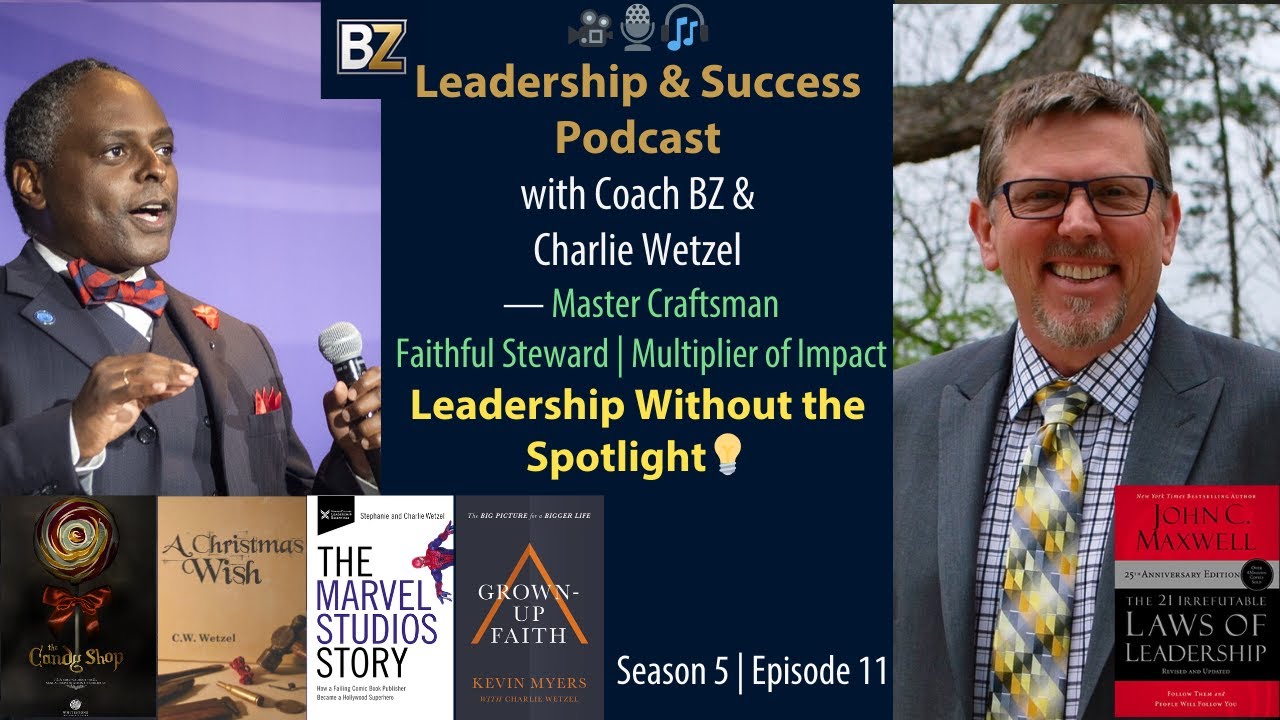
Charlie Wetzel, who has co-authored over 100 books with John C. Maxwell, talks about translating Maxwell's leadership ideas into clear language. He explains how his background as a chef and professor shaped his approach to writing as service, and describes his new course to help aspiring writers finish their books.
Chapters
Hi, I'm John Maxwell. When the top companies in the world are looking for trainers, speakers, and coaches, there's one name that stands above the rest, and that's Maxwell Leadership. Our certified team members have gotten proven results for companies all over the globe, and our reputation I'm proud to say is second to none. Some of our members have risen to the top of their profession, including the one you're going to meet today. I proudly introduce you to my friend, Bob Fabien Zinga. Welcome to the Leadership and Success Podcast with your host, Coach BZ, where we help you lead with purpose and succeed with impact.
If you're ready to grow into the kind of leader others want to follow, this podcast is for you. If you're determined to elevate your success and leave a lasting legacy, this podcast is for you. As my mentor, Dr. John C. Maxwell, reminds us, everything rises and falls on leadership. Our goal is simple: to inspire you, challenge you, and equip you with insights that can transform the trajectory of your leadership journey. Welcome aboard to another episode of the Leadership and Success Podcast. Podcast with Coach BZ.
Hi, I'm Charlie Wetzel. Most people know me as a writer. I've been the writing partner of John Maxwell for over 25 years. I wrote the Marvel Studios story, and I wrote the Crystal Heart Award-winning short film The Candy Shop starring Doug Jones. But my first love and my first career was cooking. I have always loved cooking because it was my first creative outlet, and it's still my best creative outlet. I love to host, I love to entertain, I love to serve people, and I love to cook for my family because it's probably the number one way that I show them love. If you love cooking or you want to learn how to cook because you don't really know very much yet, I hope you'll join me on becoming a cook.
All right everyone, welcome to a very, very special edition of the Leadership and Success Podcast. We have an amazing guest for you, and before I introduce him, uh, let's do what we, uh, what is our custom, right? Our moment of gratitude. So, uh, if you would just maybe close your eyes, put yourself in your happy place, take a deep breath and think about what you are grateful for right now. And really today, I am grateful for all of the illustrious guests we've had right here on this podcast, people who are willing to really share their knowledge and their wisdom with us, helping us become better leaders, but also achieve higher level of success. So I am so grateful. Especially for the guests we are going to have today. So let me try to introduce him if I can. Hopefully I am going to do an okay job here. But today we are going to be speaking with Charlie Wetzel. So he is a master wordsmith, leadership strategist, and coach whose work has shaped modern leadership thinking for more than 3 decades. He's the longtime writing partner of my primary mentor, Papa John, Dr. John C. Maxwell, the number one leadership expert in America. So Charlie has helped Dr. Maxwell bring to life more than 100+ New York Times bestselling books, if you can believe that, impacting millions of leaders worldwide. So in fact, the 21 Irrefutable Laws of Leadership, which as you guys know, was the curriculum for season 4 and season 5 of the Leadership and Success podcast, This book was dedicated to Charlie. So for the extraordinary value he added behind the scene, making him a living example of leadership without the spotlight. So I'm hoping to put the spotlight on him today. So if you would please help me welcome to the Leadership and Success Podcast, Charlie Wetzel. Good morning, Charlie. How are you doing today?
Good morning. I'm doing great. Thank you. How about you?
Great, great, great. No, I am really, really honored that you took the time to with little us today. Maybe to get started, is there something you are grateful for?
Well, I'm grateful just to get up in the morning every morning. But I'm grateful that I'm in a new season of life where I get to work with writers full-time. I love my work with John and did it for 30 years. And we did a lot of books. And by the way, we did over 100 books, but they weren't all New York Times bestsellers.
Oh, they were all bestsellers to me anyway. That's awesome. Yes, sir.
But I'm grateful, I'm grateful that I'm getting to, to invest in, in more people. And my hope is that, um, yes, altogether the people that I help sell as many books together as John has.
Yes. Wow, that is, that is, that is really, uh, awesome. And we're going to be talking about the course that you are offering for people who really want to develop as writer. And the good news now, I understand we already have a French version of, of that course and German and Spanish is coming soon, which is just amazing. I really love the way technology does that. Oh, it looks like we already have our first comment from the audience. It's great being here. So that's Professor Jeff. He's a Maxwell Certified Coach and Leader as well. Thank you so much for being here, Professor Jeff. Let us know where you are coming from, what you are grateful for, and also if you have a question for Charlie. I really love spotlighting the audience because when I first did this, what, 5 years ago now, it was an audience of one, right? Me, myself, and I. Nobody was listening to me. Nobody was commenting on anything I did or said. But anyway, is there something about you, Charlie, that most people may not know about?
Well, until you ran that promo, most people didn't know I was a chef in my first career.
Yes. That's pretty amazing.
Yeah. So yeah, so I started off as a cook and I'm looking at that promo. I was, I was less gray back then when I did that a couple of years ago.
I believe that that was your, your daughter, right?
Yeah. Yeah, that's Joy. She's, she's a really good cook in her own right. Wow.
That is just fantastic, man. Man who cook. I know my mother was a little bit worried about me. I was, I think about 15. When she realized, hey, in a couple of years you are no longer going to be here, you're going to be going to school somewhere and you don't know how to cook anything. So she's starting teaching us how to do simple things like pasta, rice, or something so I don't starve as a student. But cooking is definitely important. All right, let's get started. When did writing kind of shift from something you did to something you were called to strut?
Well, it's funny. I'm kind of a surprise writer. Um, I was not a reader. Yeah, I was not a reader growing up, and it wasn't until I got to high school that I started to read. And I didn't, I didn't like my English courses in high school, but I took a literature class in college and it captivated me, and I ended up majoring in English and getting a bachelor's and master's degree in English. But I thought I was going to teach, and I was not really a fan of writing. It took me— I did my coursework for my master's degree in 3 semesters. I took 5 years to do my thesis because I didn't like to write.
Wow.
But, but then, yeah, when I worked at a college, I had to write the self-study. So I had to write a thesis, I had to write the self-study, and that's what I fought through and actually became capable of being a writer. So when, when John hired me, I was his researcher. But what I didn't realize was that the very first project he gave me was a book to work on. And that's, that's when I realized I had the facility to do the writing. And, you know, it's like, okay, this is, this is, this was a discovery. And I was in my 30s.
Wow. And I believe the first book you worked on was The 21 Irrefutable Laws of Leadership, right? 25.
No, no, no, the first one was developing the leaders around you.
Oh, okay, okay. I had the one developing the leader with—
that was more obscure. You'll have to dig that one out of the pile.
Wow, wow, that is, that is quite amazing. And of course, for the people who are watching, they're used to this. The way I decided to go through the question, I'm going through, uh, some of the laws again from the 21 Irrefutable Laws of Leadership, really my favorite book by, uh, John Maxwell and Charlie. So right now we're talking about, right, the law of process. And for those who know is leadership develops daily, not in a day, right? You don't become a writer overnight. You have to have a process for that and write daily. Like, I love something Papa John says, right? The 5 things he does every single day, which is thinking, writing, asking questions, filing, and one more thing. But in any way, discipline in order for us to develop as— I really love this. Okay. In that case, then, success kind of showed up for you. What did discipline look like when no one was watching?
Well, the thing, the thing for me, so I started, I started off as a chef. I was a teacher, I was a college dean. I sold cars at one point, you know, I've done a lot of things. When I started working for John, I just thought, okay, it's a, it's a 9-to-5 job. I'll, I'll be at my desk, you know, actually in San Diego it's earlier, you know, at 8:30 and work till the end of the day. And it wasn't until I'd been writing for 3 or 4 years that I realized, you know, I started researching and I realized most writers are good for about 4 hours.
Yes.
The majority of them are probably right for about 2 hours. I didn't know any better. I approached it like a, like a regular job. So you know, it was the discipline of staying at the desk and working. And I mentioned that I wrote a self-study for the college. When I was working on that, my boss said, look, why don't you go home on Mondays and work on the self-study? Because, you know, it'll be quiet and you'll get something done. And I remember the first day I did that, I was sitting at my— it was the same desk I have back here. It was in my bedroom back then. And I sat at that desk for 8 hours, and at the end of the day, I had one sentence to show for it.
Wow.
So the discipline is hanging in there.
Yes.
Because it's very easy for me, it's very easy to get discouraged as a writer. And it's, it's, it's being willing to hang in there. It's just like with the writing process, you know, with the law process, the only way to learn how to write is to write. And the reality is that you can prepare yourself a great deal to lead by reading and studying. But it's the leadership process that teaches you to lead, you know, getting in there and having some successes and making mistakes and learning from those, you know, stepping back when you make a mistake and saying, okay, what went wrong? What could I do better? How do I need to do it next time? And then being dedicated to making some kind of incremental improvement.
Well, that is such a very important, I think, critical lesson in life, but I guess it applies to writing as well. So how did your early years as a chef and English professor shape the leader you became?
Well, as a chef, it taught me what not to do. I was a great cook. And a horrible leader. So when I, when I started to have responsibility for other people, my problem was I did not like asking other people to do things. So I, I either did them myself, or because I was uncomfortable, I barked orders at people. I was a terrible leader in the kitchen. I mean, if I could, if I could find the people I worked with, I'd need to apologize to them. Because I was so, I was so terrible. I had one, I had one, um, co-worker who told me that I, I spoke to her like she was a dog. And I realized it's because I, I would— I, I was, I was fast and I was on mission, and I would say, move, move, move, you know, come through. I was horrible. I was a terrible, terrible leader. When I, when I started teaching and I became a college dean. That's when I started to learn how to lead. So as a teacher, what I loved was teaching in the classroom. I hated all the administrative duties. And I was at a small business college where they wanted you to, for instance, they wanted you to call every student who missed class, and there was paperwork you had to fill out every single day. And I hated all that. When I became the dean, because I hated it as a teacher, I thought, okay, I need to take that on so the teachers don't need to do that. Let them do what they do best and try to make it better for them. And that's when the light went off for me. I went, okay, the leader's job is to make it easier for everyone they lead to do their job and thrive in a positive environment. And that's when I started to learn the lesson.
That is really amazing. We definitely talked about discipline showing up, it's clearly in the work you do, but it looks like discipline alone doesn't scale influence, right? So I guess we need clarity too. So for this next segment, I want to talk about the craft of writing and clarity. So we're going to base this again on the book, The Unlaws of Navigation and The Inner Circle. Anyone can steer the ship, but it takes a leader to chart the course. And definitely when you become in the position of higher leadership and higher impact, because now you are responsible too for all of the teachers in your department that report for you, but also the inner circle where it says that those closest to you will determine the level of your success. So I guess the first question I have for you for this segment, you did help Papa John translate ideas into more than 100 bestselling books. Maybe not all of them New York Times bestseller, but many of them were. What do leaders misunderstand about turning ideas into language? That's probably the most difficult thing in writing, isn't it?
Well, so I think you've got to, you've got to know whether you're somebody who processes internally before they, before they express, or if you're somebody who has to speak in order to figure out what you think. On a leadership level, it's a little bit dangerous to discover what you think in process while leading.
Yes.
So, if you're somebody— so I'm an internal processor and I really go through mentally what I want to do. I'm a big lover of a whiteboard because I like to write out and look at my ideas and vet them. And if I'm thinking process, I'm working it all out in my head. So by the time I'm ready to talk about it, it's all worked out. If you're a verbal processor, then you need to test your ideas in safe places before you try to use that language to lead, because people don't follow an uncertain trumpet. They need clarity. And as a writer, to me, clarity is the holy grail.
Hmm.
So I know that— I know a lot of people have different targets for their writing.
Yes.
For me, it has always been, I never want somebody to have to go back and reread a sentence to understand it.
Wow. Because something I've heard you say over and over again during the research for this, you keep saying in many of your videos, Clarity is a form of respect. That's really the way you see that, don't you? Why does that matter so much in leadership and in writing too?
Well, so some of this comes from my, my belief in the kitchen. So when you sit down at the table, and you eat a piece of fish, do you want to fish the bones out of it?
No.
Or do you want to eat a pi— No. The work should have been done in the kitchen. So, my philosophy coming in is like, okay, the work should be done behind the scenes to make the experience at the table spectacular. Well, if somebody's reading a book and they're not understanding it, it means the writer didn't work hard enough.
Wow.
So, that is respect. I'm respecting the fact that you want to be able to pick up a book and you want it to be accessible and you want it to be clear and you want it to be life-changing. Yes. And it's not about me impressing you. It's about you benefiting from what I've written. And that's all about clarity. Wow. And as a leader, it's the same thing. So I led a content team for a couple of years in the Maxwell world.. And all of my people worked remotely. And we met one day a week in my office in this— here, this is my office I'm coming to you from. And we had to cover all the ground that was needed for the week in that session. And I had one of my writers said to me, you're better prepared for a meeting than any other person I've ever worked with. I spent hours preparing to lead the meeting. And it was— that's respect because if I can set the course with clarity, everybody can hit the ground running and do what they need to do. If they don't know what it is I want, if I haven't taken the time on the front end to think that through and answer some of the questions that can be answered even before they're asked, then they can't do their work as well, and we can't accomplish what we want to accomplish as easily. So, and what— so there's another thing, and I've written this in some of John's books. Um, if I'm going to have a meeting with John, I try to put in probably 4 hours for every hour I'm going to spend. In that meeting. I have never come to a meeting unprepared, ever, um, with him. And it's— that's once again, it's respect. It's like, okay, I've done the work, I'm not going to wing it, I'm not going to just arrive and figure it out. Yes, I probably can, but I'm not going to do that. I'm going to do the, do the prep work, I'm going to do the hard work to be ready to go so that we can get go as far as we need to, as fast as we want to.
Wow, that is really, uh, insightful. I, I really can clearly see how you respect, uh, every potential reader. When you write your books, do you have a person in mind that you are writing the book for, or you just writing to the masses?
No, no. I— so when, when I first started with, with John he was writing for pastors. That was his audience. So I've never left that. I always have in mind one of the people reading. So this is kind of a— I should clarify this because this is a writer's point. When you're writing a book, you're only speaking to one person at a time. So you have to have that in mind. And speakers get this wrong all the time when they try to write a book. Yes, they talk to an audience. No, no, it's a conversation with one person. So it's one person, but I, I'm thinking of four different people. So that pastor has never left my mind. I know somebody holding this book is a pastor, and the context that they're trying to lead in is a church. So I've got that person. I— when I worked on that very first book with John, I realized, you know what, this is bigger than just pastors. This lead— these leadership principles apply outside of that small world.
Yes.
And I thought, okay, now I'm thinking of an aspiring leader, somebody who's maybe mid-level, who's trying to figure out how to lead, kind of like I was when I was at the college, going, okay, how do I, how do I do this? Because I know I didn't do it well before. So I've got that person I always try to think in terms of a stay-at-home mother, because even though— so the leadership culture tends to ignore women, I believe. And you think about where we started talking to pastors, 90% of pastors are probably men. And John's kind of a guy's guy. He played sports and he thinks, you know, thinks that way. I always want to be more inclusive. So I'm thinking, okay, I never want to exclude women and they're included in those other categories, especially in the business category. But I'm also thinking, okay, what about a mom who wants to be a better parent, who wants to work with her kids' school, who wants to do something in the community, somebody who has no position but wants to influence and make the world a better place. And then the, then the fourth person, because John is such a big name in the multi-leader marketing, direct marketing world, I think I try to include those people who are basically entrepreneurs. So those are the four. So if I write something, I want to make sure none of those four people feels like this doesn't apply to me.
Yes. Wow, that is really powerful. We have our first question from the audience. Professor Jeff says, why do professional scholar university professor write books formatted reading like dissertation? I guess I must say for a lot of professors I know, their books are not best-selling. They're best written, but not best-selling. So there may be something there.
Well, so they— well, first of all, I, I believe they write that way because they have to. They are required. So if you want to get, um, a master's degree— actually, it's not true for all master's degrees. I had to do a thesis. But if you want to get a PhD, you've got to write a dissertation, and the dissertation has to be based on, um, on research. So all of John's books are anecdotal. There's really, you know, and that was one of the early criticisms. Well, where's the research to back this up? Well, there isn't any. It's, it is, it's all of John's principles are based on the Bible, and all of his observations are based on experience, which in the academic world does not fly. So if you want to have a, a PhD, you've got to write a dissertation and that dissertation has to be accepted by a committee of other PhDs, and they want the bar really high because they— it's an exclusive club.
Yes.
And they want it— they want to make sure that you are, um, qualified to enter that club. I, I had— so when I was working on, uh, my master's degree, I had a professor telling me— and I can't remember whose advice this was— he said, when you write your dissertation and you write your first book, make it as technical and as dense and as well-researched as you possibly can so that they know you can, and then never do it again. After that, write things that people, everyday people, can understand.
Wow, that is very good advice. Wow. So before we go on to the next segment, so really what strikes me is really how clarity becomes an act of service. Not just communication. So for the next, uh, segment, Leadership Without the Spotlight, let's focus on the Law of Solid Ground, which is, no, truth is the foundation of leadership. So the first question I have for you then is, how do you define leadership when your name is not on the COVID Well, it's, it's just like leading when you don't have a title.
So you think about it, John, John came out of the church world And any team you have to lead in that world— well, first of all, anybody can quit at any moment.
Yes.
So people vote with their feet. I don't like this church, I'm going somewhere else. I don't like this leader, I'm going somewhere else. There's no barrier to the exit. You know, if I'm drawing a salary from you, If you do something I don't like, I go, well, I guess I have to do it. But in the volunteer world, everybody is volunteering to follow. And on some level, that's true everywhere. It's just a little more stark in volunteer organizations because people just stop showing up. So that's why, that's why John teaches in the Five Levels of Leadership, which, by the way, I think is That, I believe, is John's single best contribution to leadership, is the 5 Levels of Leadership. Wow. The bottom level is— it's the thing that helped me really understand how leadership worked. So, yes, if you know anybody who's not a natural leader or has no leadership experience, give them the 5 Levels of Leadership because it'll give you a context for understanding how leadership works and it gives you a roadmap for how to develop as a leader. But anyway, so the position level John has taught is the lowest. Yes, it's the starting point. It gives you a chance to lead. Well, so when your name's not on the COVID of the book, it's a very similar kind of a thing. You're exerting your influence and doing what you can, whether, whether people see you as the leader or not. So I'll tell you how I kind of settled this. So in the first couple of years I worked for John, my wife Stephanie was very bothered by the fact that my name wasn't on the COVID And John said, you know, the publisher does not— there's Stephanie— the publisher said, yeah, they don't want a writer's name on the COVID with yours. So I really had to wrestle that down. Um, but here's how I did that. I first knew John as my pastor of our church in San Diego. And you know how in some churches they'll have out— they'll have a little marquee out front and has the pastor's name on it? I thought, well, just because I'm serving in the church, I don't expect them to put my name out there with, with the pastors.
Yes.
Uh, you know, there is something we're trying to accomplish. There's a vision that we're trying to fulfill, and there are things we're trying to accomplish, and I don't have to have my name out there for everything. And besides, God's keeping score.
Yes.
You know, in the end. So, so, you know, that's, that's really— I thought, okay. And, and because of the, um, because of the integrity of it, what I said to John was, do you— are you okay if, if we put my name in the acknowledgments so people know that I'm there? And he said, sure. So start— I can't remember which book we started that with. Might have been Becoming a Person of Influence. From then on, my name was in the acknowledgments. So anybody who really wanted to know if there was somebody working with John to write these books could find it. There's no deception. And we're still, we're still honoring what the publisher wanted.
Wow, that is really powerful. So what did that kind of teach you? You know, decades of buying this in about ego and trust?
Well, it's the lesson we all need to learn. It's not about me. So yeah, yeah, I mean, the, the, what we're trying to accomplish is bigger than any one person. And it's, it's bigger than us than anybody's ego. So I just, you know, you have to kind of get over that.
Yes.
And let's face it, How many people are the point leader? Most of us are working within the context of somebody else's, somebody else's leadership.
Yes.
Um, and frankly, God didn't design all of us to be point leaders.
True.
Um, so, uh, you know, you've got to, you've got to get to a place where you're comfortable with whatever God has put in you and whatever leadership level you have and, and the influence and the, and the skill sets that God's given you and say, Okay, you know, let me do the best thing I can with what I have and do something of value.
Wow, that is really, really powerful. And from your example, because you've, you've really been, I guess, a craftsman, you've been really, really good at this. But how does a leader steward somebody else's voice without losing integrity?
Well, it's, it's funny, you know, I had no model and no mentor for how to do this kind of writing for somebody else. So I had to figure it out. And in the beginning, I would try to say exactly what John would say, how he would say it, using the words that he would use to say it. And then over time, I figured out that was the wrong goal. My goal was to make people feel the way they did when John spoke to them. John is first and foremost a speaker. He's a platform speaker. He loves getting in front of an audience. He loves to entertain people. He loves to teach people. I mean, that's really his life's blood. And I thought, If I can get people who read the book— now, I'm still trying to use John's vocabulary. But I'm not, I'm not phrasing things the way John would phrase them, because reading a book is a different experience.
Yes.
But when they finish reading it, I want them to feel like they were with him. And the experience was similar to what they would experience with him.
That's really powerful. So this is the other book you mentioned, The 5 Levels of Leadership, right? Where he goes through— you can, you don't have to have a title to be a leader. I believe level 5 is when you start developing other leaders as well. It's very strange, right? In this day and age, most people think being a leader is an influencer. Like in social media, you have so many followers, but really the job of a leader is not to have many followers, but to actually build leaders. And that's legacy. So what you really just described, really, it sounds less like just writing, right? It's really more like servant leadership applied to ideas. Which takes me to the next segment about growth, faith, and the inner work. So the Law of the Inner Circle, again, people following this podcast know about, which says anyone can steer the ship, but it takes a leader to chart the course. How has your understanding of faith and maturity kind of changed over time?
Oh gosh, um, well, it's a never-ending process, and the older you get, the more you realize you've got a— you've got farther to go. Um, so I, um, it's funny, I, I, I came to Christ when I was 12, but I didn't really start following until I was 29, and Being a member of John's church in San Diego when he was a pastor there was a pivotal thing for me. It was the first time I started to make sense of my faith. But I mean, the main thing that I've learned over time is that as a follower of Christ, you need to feed yourself. Yes. So anytime I hear a person say, you know, they leave a church because they weren't getting fed, to me, they're an immature Christian because they're still expecting somebody else to feed them. And, you know, so, so for me, it's like, okay, this is, this is my journey. I've got to take ownership of it, um, and, and engage with God as, as much as I can. And I feel like the newer you are in your faith, the more loudly God speaks, and the farther in you are, the more quietly he speaks, and the more diligently you have to seek him.
Hmm, that's powerful. Uh, actually, I misspoke earlier. So the law of the inner circle: a leader's potential is determined by those closest to him. I think I was speaking about the law of navigation, which, which I like so much. And by the way, which one of the 21 laws is your favorite law in this book that you wrote?
Oh my God. Um, Probably, probably, um, probably Leadership is Influence, nothing more, nothing less, just because— yeah, yeah, um, because, you know, before I, I became a student of, of John's, I really didn't understand leadership. It was kind of a mystery to me, and You know, one of the things about— one of John's gifts is giving clarity, you know, taking something complex and simplifying it so that it's kind of a light bulb moment or rings a kind of a bell in your mind. And that's one that when he said that, it's like, okay, yeah, you know what, that's true. And then it gives you a context to work from because then you're not trying to climb a ladder or, or, or get recognition or, or, or get a title or, or rank or any— you realize, okay, I need to do what I can with what I have.
Wow, that is so powerful. Yes, the Law of Influence, the second law in the book. The true measure of leadership is influence, nothing more and nothing less. That's so powerful. So right now we're talking about growth, faith, and inner work. So what practices helped you stay grounded while working at such a high level for such a long time?
Oh, well, I, I, uh, I, I prioritize my, my time with God. Um, so every morning, um, it's, it's pretty much the first thing that I do. Uh, and that, that always hasn't been true for me. A lot of times, uh, in my life, I was so focused on getting work done that I gave that short shrift. And probably 10 years ago, I just decided, okay, this is a non-negotiable. And so actually, my wife and I come up to my office first thing in the morning, and we spend close to an hour up here. She'll put some worship music on. I always read scripture because for me, that's what grounds me. Um, I'm, I'm slowly working my way through the Bible all the time. You know, when I finish Revelation, unless I feel led to go get something else, I'm back to Genesis and working my way. Right now I'm in the Psalms.
Yeah.
So, you know, just, just working my way through. And then, uh, I actually— because I'm easily distracted, um, I actually journal my prayers in a, in a notebook. And I've done that for 25 years, I think.
Wow.
So that, you know, doing that really is important. And the other thing is, especially now that I'm older, I've decided that my health is more important. So, my wife and I typically walk about 2.5 miles every weekday morning, and we lift weights a couple days a week. So, I'd like to be in for the long haul and do it in a healthy body if I can.
That is really powerful. So I know faith is important to you, it's important to Papa John too. Even the Maxwell Leadership DNA, faith is included. And I know like even in the Bible, for people who don't believe in God or anything, he used to say just buy it for the leadership article and lessons throughout the book. Why do you think faith is so important to success and just to life in general?
Well, I— it's a difficult question. It's, it's kind of— for somebody who believes, it's like saying, why do you think air is important? Yes, because I would die without it, you know.
Yes, yes.
My life, my life made no sense and was pretty hopeless to me until I started to live out my faith. And like I said, I became a believer young, but I didn't become a follower until I was almost 30. And it's been an ongoing journey for me to really have my values become more narrow in terms of what's important. So for me, it gives me the context for everything that I do. And, you know, if I could just be a little more like Jesus every day, that would be fantastic. Yeah.
Powerful. So what does answering the call look like for leaders who feel tired, or maybe unsure of What's next?
Oh, well, I think, I think it always helps to go back, back in time, back to square one. So if you're leading and you're worn out, I think you need to look at, first of all, maybe what your sense of calling or purpose is. For me, a lot of things start with that. And I'm actually, I'm actually working on some things. One of the things I want to do in this season is help people who have a lot of ideas and want to figure out kind of their content framework. You know, so books, yes, but I've done a lot with— I developed a coaching course for Maxwell Leadership, and I've done the roundtables that are used internationally. I developed those, wrote those with a team. So there are a lot of resources and products that I've worked on, and I want to help people figure out kind of what those different pieces are if they're wanting to do a lot of things. But it goes back to, okay, what is your purpose or calling? And then what's the vision that comes out of that? And then out of that comes these other, these other expressions of communication and messages. Well, I think for a leader, if you go back to, okay, Did I have an original calling, or did I have an original sense of purpose that I feel like I discovered or that God gave me? And what is the vision that comes from that? And then look at where you're leading, how you're leading, and what you're leading. And it may be that you've gotten off course over time because Yes. Let's face it, if you, if you get offered a promotion, you take it. You think, oh, okay, I'm on the right track. And yes, sure, I'd like a little more. Oh, I can do bigger things. Yes. But every, every promotion and opportunity doesn't lead you in the right direction. So you may be over the course of time following a course that has taken you in a direction other than the true direction that, that you want to take.
Yes.
The other thing is, I think we have to have— excuse me— I think we have to have the willingness to take a hard look at ourselves and be realistic about what we can and can't do, what we're good at and what we're not good at. Because I, I've seen a lot of leaders who wanted to be something they were not. Wow. And honestly, that's a little bit of a challenge with a high-profile visionary, fun leader like John. People look at him and go, gosh, if I could only be like him.
Yes.
But the reality is God's put some things in him that he hasn't put in all of us. So you have to think, okay, taking the inspiration that I get from him, taking what I've learned from him, how does that fit on me? And what do I have that John doesn't have?
Yes.
And how can I become the kind of leader I was created to be, not looking at one person as the only model of what that looks like, and becoming comfortable with, with the fact that I can't do that. And that's okay. But I can do this. And this is great.
Yes.
I mean, if I had tried to be the leader, like John, those books wouldn't have been written.
Hmm.
It's not what— it's not what God gave me to do.
Yes. Wow. That is very powerful and insightful. And I want to put a quick plug from Drift to Drive. Again, another member of the John Maxwell family, my mentor, Chris Robinson. I had the pleasure of interviewing, I think season 4, episode 2 last year. But as leaders, like you mentioned, it's true, sometimes you kind of drift without even realizing it, and you really need to learn how to get back on track. And when we were in the green room, we were talking. So you've written more than 100 books with John Maxwell. Which one of those books do you think is your favorite book? It's kind of like choosing which one of your children is your favorite child. But yeah.
Yeah. Well, It— so I've got, I've got 3 children. Um, or I, I love them all. Um, but they all have different qualities. So I'll, I'll tell you. So I love The 21 Laws because that's the book where I feel like we figured out our style. And it was a great book to learn from. So in all the books that I've written with John, I was the first student.
Yes.
So I love, I loved learning, learning those laws. I mean, we, we worked together to come up with the laws, but learning those laws really informed my leadership and my, the way I thought about leadership and the way I saw it. And, and I feel like that's where we really introduced the storytelling.
Yes.
And the book was the idea of John's editor. You know, he said, I think you should write a book on the laws of leadership. And John said, well, that's an interesting idea. So we, when we came together and did that, And his editor said, put— he said, don't do any teaching, lots of case studies, just the concept. So, so I wrote, uh, 42 stories for that book.
That's amazing.
But I felt like, okay, that's where we kind of developed our style. So I love that one for that. For the pure writing, I think The 15 Laws of Growth is actually better written than the first 21 Laws book. Because we made it a little bit less story heavy and there's more instruction in it. So there's a clearer pathway. So the 21 Laws is really principles, whereas the 15 Laws of Growth is a process that anybody can take to grow, which I think is great. And then I love High Road Leadership, you know, the recent one, just because I love the concept of low road, middle road, and high road leadership and encouraging people to to take the high road with others.
Well, that is really powerful. I think I saw a video of yours where you were saying that the way John writes is really in a lot of details, right? So then you, you were able as a craftsman just be able to rearrange it and kind of bring the genius out of it and make it easier for the people to read and absorb, kind of like you explained earlier. Can you say a little bit more just about the writing process?
Yeah, yeah. Yeah. So, it's funny. Over the years, the way John has worked has changed. So, with The 21 Laws, we worked really hard to come up with the laws. But all the content from that book other than the stories, which I wrote from scratch, all the content came from lessons he had written previously. Wow. So, there have been books where I've drawn from stuff that he's already written. Um, in the last 10 years, well, so he's done that. Usually he writes an outline and it's similar to his speaker's outline. So it's got bullet points, it's got illustrations. He'll have a little, you know, have a star and a phrase, which means a story, you know. So that's something I know. Okay, I'm going to tell one of the stories that he tells there. Yeah, that sort of thing. And then there have been books where he'll write a first draft of a chapter and then I'll work on it. But John thinks like a speaker. That's what he's done since he was, I don't know, 18 or 20 years old. And he lays it out like a speaker. And I kind of think of a speaker as being like a boxer. They've got punch. Somebody like John does knockout punches, knockout punch, knockout, knockout punch. But with a book, you need footwork. You need to move. So a speaker, when he's on stage, does his transitions by making a face.
Yes.
Or standing up or sitting down or walking across the stage.
Yeah, seen him do all of that for sure.
None of that's in a book. So all you've got is the outline with no sense of context or transitions because the speaker does all of that physically on stage. So I have to provide all of that. I provide the footwork so it's smooth because otherwise it can be a very bumpy road.
Wow, that is really powerful. We have about one segment left and about 10 minutes on the clock. Before we do, what can my audience do to kind of add value back to you?
Well, so if you've got people who want to write a book— so I'll talk directly— if you want to write a book, I think it's a great aspiration. And, and most people who want to write a book don't know how to start. And I know the pain because I, when I wrote my thesis and I did that self-study, I had no idea where I was going or how to do it. So I've coached writers for about 5 years and I've led writers as well. But because of that coaching, I thought, you know what, I need to develop a course that will take any person who wants to write a book step by step by step through that process. And that's how I developed Answer the Call: Developing the Writer Within You. It's 20 lessons on video. Every lesson has an assignment and it has examples from my work with John over 30 years. And anybody who goes in that course, they can actually go, okay, the first step, for instance, in the first video is to figure out your why. Why are you writing this book? And the reason that's so important is writing a book is a long process. And it's difficult for most people. And there's going to be times when you have to go, okay, I need to go back to my why. I remember why I'm writing this book. The work is hard, but it's worth it. So it's step by step. So if somebody goes to charliewetzel.com, you can look. There's a pretty good website there. Um, um, Bob's been showing it to you. It really explains what the course is and what it looks like., and you can take a look at that. So if you wanna write a book, you can do that. If you're, if you're somebody who has lots of ideas, you have an organization, you say, okay, we know we wanna do products and, and books and all these things.
Mm-hmm.
I do some consulting and coaching with that. You know, you can go to, if you go to the website, you'll see it at info@charliewetzel.com. You can email me. So, you know, that would be the, my, my admonition. I'm, I'm happy to, to help you if you need help. And you've got a vision and you've got a message and you're like, okay, I just need help figuring out how to get that into the world.
And also for my audience, you're going to remember Coach Astrid Meyer. We interviewed her for season 4. For those who don't speak English, so for our international audience, she's actually translated the same book, the same course in French. So for the people who speak Français, you can actually get the same exact book in French from the Human Values That Global and the courses. And I understand again, Charlie, that you are going to have the Spanish version coming out sometime soon, and Astrid is working on the German version as well.
Yeah, yeah, we hope to, we hope to have the Spanish version out sometime in 2026. Astrid is still working on the French version, so that's got to be completed before we start the German, but Yes. My hope is that she'll be able to work on that in 2026 as well.
Fantastic. And of course, you follow Charlie's, uh, uh, linkedin.com, uh, Charlie Wetzel. Okay. Thank you. Thank you so much for, uh, sharing this, but also you also have a few of your books, books that you've written yourself. I've highlighted the Marvel Studios, uh, story, which is really, really fun. And you have an Audible version too. And, uh, you also wrote a short film, didn't you? Of course, A Christmas Wish, that's by you, and I think that's a novella.
It was going to be a short story and it was too long. It's too long to be a short story and too short to be a novel. And yeah, The Candy Shop. So you can find The Candy Shop on Vimeo, and I think it may be on Amazon Prime. Yeah, so, uh, this was 10 years ago. I wrote the screenplay for that, and it stars, uh, Doug Jones. If you've watched, um, Star Trek: Discovery, Saru, the character Saru is Doug Jones. If you know Pan's Labyrinth, he played the faun. If you watched Hellboy, he was Abe Sapien. If you saw The Color of Water, he was the creature. So he's done a lot of stuff in effects, cost, makeup. He was the star of that, and that was a really cool experience.
That sounds really, really a lot of fun. Okay, so we are going to be concluding with this last segment on legacy. Well, so it's going to kind of connect your journey directly to leadership legacy. Again, for those who've been following this podcast, the law of legacy from the 21 Irrefutable Laws of Leadership: a leader's lasting value is measured by succession. Another thing Papa John says a lot is, no, there is no success, right, without a successor. And that just makes so much so much sense. So as this chapter with Papa John kind of comes to a close, how do you define success now?
Well, if I can help other aspiring writers to get their books out, that would be success for me. So this is my season to invest in other writers. I feel like John and I accomplished a lot. And, you know, I feel like my part of the mission with him has been completed. John's still doing, you know, his thing. He's still wanting to transform countries and he's still speaking. So that's great. But, you know, the way he's invested in leaders and taught that, I want to teach writers so that—
Yes.
I would— every time another person writes a book. So we've had, I think, Probably 3 people come out of one of our cohorts have written books. The course has been— some people started the course in April of last year. The first person in that group got their book out.
Wow.
In the fall. Yeah. So every time somebody completes their book, it's a huge celebration.
Yes.
You know, because, okay, we helped, we helped another person. And, you know, I feel like a doula. I helped deliver a book into the world.
Wow, that is really, really, really powerful. Okay, I have one more question to ask you before we end. But before I do, is there a question I should have asked you? I didn't get a chance to ask anything you wanted to share with my audience.
Oh my gosh. No, you've asked great questions. I can't think of anything off the top of my head.
All right, we have about 4 minutes left. So I'm watching the clock closely. So the last question I have for you is, what do you hope people experience because of your work, even if they never know your name?
Well, I hope it helps them have a better life. The books, the books that we've written, were designed to help people learn things. And to improve, to lead better, to live better, to grow, to fulfill their purpose. So for every person who gets sped along in the journey of life due to the work that we did, that's a huge win. My personal, if you want to call it, philosophy of ministry is I believe God puts people in my life and my job is to pay attention to who they are.
Yes.
And to look and see if there's something that I can help them with on the journey. And, and, you know, so many people of faith think, oh, I've got to take them the whole journey. No, usually you, you get to spend a small season with somebody. So if you keep your eyes open and you try to listen to God's voice and say, is there something I can help that person with in this season? And then I try to do that. Well, I feel like a book is a similar kind of a thing.
Wow.
We all have books that changed our lives. Anybody who reads, and it's usually not the best book, it's the book you needed in the season. And you read that book and it totally transforms your thinking, or it gives you a skill set you never had. And because of that, you can go farther, or the trajectory of your life changes, or you change direction, and it benefits— it benefits the person. So that's my hope, is that every person who picks up a Maxwell book or gets coached by me, or that I coach in person, they're a little bit better off than they were before that?
Well, I must say you've impacted millions of lives, including my own. I think I was 17 years old when I first started listening to, back then, Pastor John C. Maxwell. I think he was coming out of San Diego. I read his books, and back then they had cassette tapes. My kids have no idea what a cassette tape is. But anyway, I finally got a chance to meet him in 2007. He came to the church of the island, my church at the time when I was in Birmingham, Alabama. And then of course I became mentored by him with the John Maxwell team. And now I'm kind of go full circle by talking to the man behind the scene who really made all of this happen. So if it's okay, what I want to tell to the audience right now is when people think about leadership legacy, they often picture the person on the stage. That's John C. Maxwell, the name on the book cover, the voice on the podium. But those things matter. Visibility matters, platform matters. But today, really, I think we've been reminded of something even deeper than that.
Right.
For more than 3 decades, Charlie Wetzel, worked alongside one of the most influential leadership voices of our time, Dr. John C. Maxwell, not chasing the spotlight, not competing for credit, but stewarding ideas with humility, discipline, and extraordinary care. And that's why I want to close by grounding this conversation not in opinion, but in history. So the 21 Irrefutable Laws of Leadership, Papa John made a rare choice before the law, before the framework, Before The Principles That Shaped Millions of Leaders, he wrote this dedication. And if it's okay, I just wanna read this really quick, and I think it's really, really touching. It says, this book is dedicated to Charlie Wetzel, my writing partner since 1994. Together we have created more than 100 books, and I have enjoyed our collaboration on every one of them. As I have labored to add value to others, By identifying and teaching leadership principles, Charlie, you have added value to me and my effort. Your insight and skills as a wordsmith have been enjoyed by millions of readers. As a result, you have made a greater impact on more people than has anyone else in my inner circle, and for that, I thank you. I've definitely been one of those people affected by that, so I want to just say, uh, thank you so much, uh, Charlie. This has really been extraordinary speaking to you today. And I guess the very last question I'm going to ask you, what is one word that describes our shared experience on this podcast today?
What's the one word that— what, I'm sorry?
That will kind of describe our shared experience on the podcast this morning. One word that comes to mind.
Well, fun. It's been fun for me. I know that's very shallow and I'm sorry it's not more meaningful, but it's fun.
It's just been fun.
I've enjoyed it.
Thank you so much. We are at the top of the hour and I am always, always grateful. Thanks again, Charlie. We really appreciate you being here.
It's my pleasure. Thank you for having me.
Thank you so much. Wow. All right, everybody, that was Charlie Wetzel. I think if you don't get anything out of this discussion we've had, everybody really has a part to play and your name doesn't have to be on the spotlight, but you can still be effective and be influential. Like Charlie says, his favorite law is the law of influence, right? The true measure of leadership is influence, nothing more and nothing less. Okay, hopefully this was very inspiring to you. And like we said, follow, uh, Charlie on LinkedIn. So that's linkedin.com/CharlieWitzel. And get his course, charliewitzel.com. And you can get the French version at humanvalues.global/courses. All right. Um, so quick reminder, uh, in about an hour I will be speaking with Tempra Rae Stevenson. She's a food justice visionary, cultural engineer, and scholar-practitioner, and best-selling author of the Wanda for Kids series. We're going to be talking about leadership with nourishment. I can't hardly wait. And then I will have the pleasure of speaking with Colonel, uh, Ise Gibson. I call him the Colonel, the doctor. He has a Doctor of Business Administration from Harvard, but also a professor. He's a Harvard Business School professor right now. We're going to be talking about inclusive crisis leader scholar. I mean, sorry, we're going to be talking about From the Cockpit to Harvard Professor, Our Leaders Are Our Fault. So he's an inclusive crisis leader, a scholar, and a warrior. I really look forward to speaking to him. And today also, this afternoon, I think about 2 o'clock my time, we're going to be speaking to Anna Wheeler. She's a US Army and US Navy vet, former Black Hawk crew chief, cyber strategist and the change agent. We're going to be talking about going from Black Hawk to boardroom leadership under pressure. So all of this is going to be today. And this Sunday, I will be speaking to another cybersecurity leader, Daya Wamesh, about cybersecurity being existential. And then next week, I'm going to be speaking to Lisa Fan. She's a mentoring architect. She has done two bestselling books about mentorship, The Mentor's Guide and Bridging Differences for Better Mentoring. She also has a TEDx talk about mentorship. And on the same day, I will also be speaking with Commander Erica Dobbs, like me, a commander in the US Navy, retired now, battle-tested servant leader. She's a tech CEO and veteran entrepreneur. Just like me, she was a seaman recruit when I joined 21 years ago, and she retired as a commander, but now she's turned into a CEO. So that's going to be a very fascinating discussion. And also to remind you, I will also be continuing to do the study of the book of Proverbs, which I've been doing by myself since I was about a teenager. After I got married, I've done that with my wife. So this is the first time I'm doing this publicly. It's not a religious study at all. We're going to be focusing on ancient wisdom mentoring from the book of Proverbs. So today is January 8th, so we're going to read Proverbs chapter 8 again, looking for ancient wisdom and leadership lesson from the book of Proverbs. We're going to continue doing this until the end of the month. All right, that's all I have for you. And thank you so much for watching the Leadership and Success podcast. And I see you in a couple of hours with our next guest, which is going to be Temboa Ray Stevenson. See you soon. Bye. Thank you for tuning in to the Leadership and Success Podcast with your host, Coach BZ. If today's episode added value to your leadership journey, be sure to subscribe, share, and join us again for more wisdom nuggets on how to to lead better and achieve greater success. Remember, leadership is the most critical skill of our time. The world will always need leaders to inspire others, drive innovation, and execute meaningful strategy. So why not count yourself among the bold leaders shaping the 21st century? Until next time, stay inspired, stay committed, and keep leading with excellence.
More from Bob

S250:E4🎙️LIVE 🇺🇸America 250: President Barack Obama Leadership, Service, and the Power of Hope






S5:E157🎙️ LIVE with CMD CMSgt Dennis L. Fritz, USAF (Ret.)(Multi Tracks Audio)



S5:E156🎙️ LIVE 🇪🇸 Leadership Lessons from the FIFA World Cup 2026 Champions (Multi Tracks Audio)

S250:E3🎙️ LIVE Leadership Lessons from America’s First Documented Family of African Descent 🇺🇸📖