S5:E111🎙️ LIVE with Nathalie COLLOMBAT 🇫🇷 (Multi Tracks Audio)
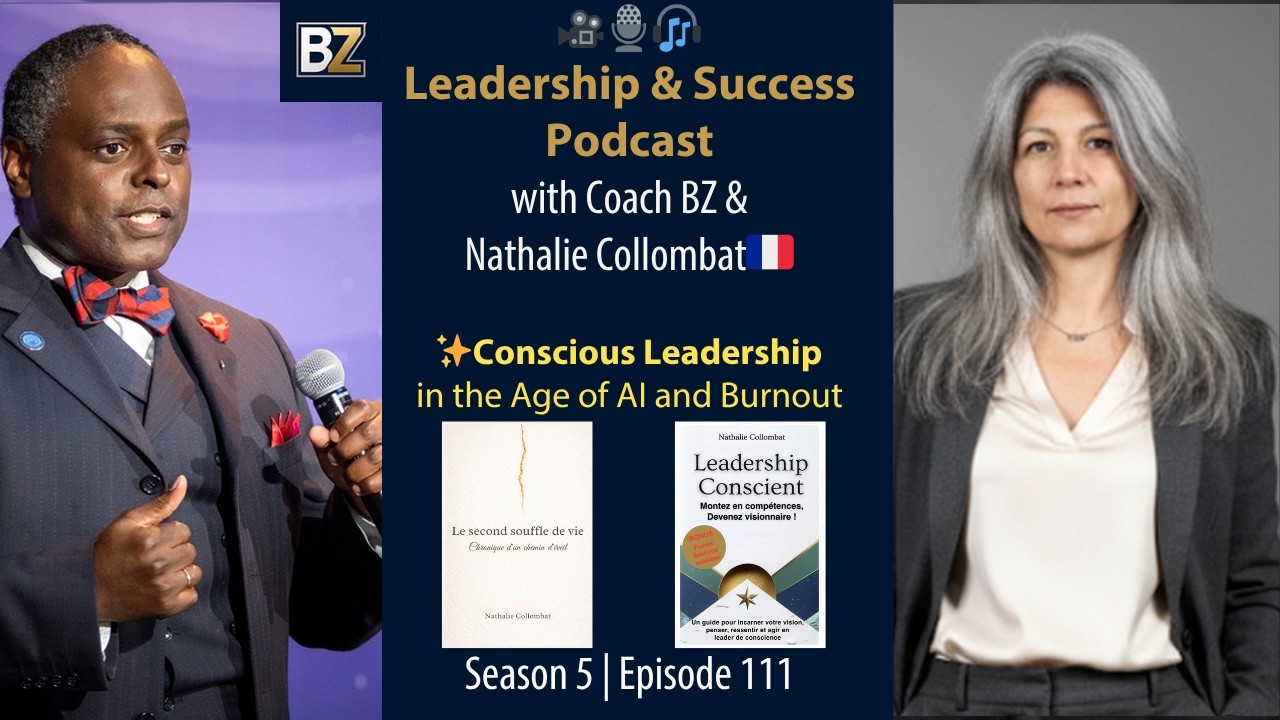
Coach BZ talks with French mentor Nathalie Colombat about conscious leadership in an age of AI and burnout. She defines it as honest self-awareness and stepping out of autopilot, shaped by her background in entrepreneurship, therapy, and raising twin daughters with severe disabilities. Her framework: Awaken, Liberate, Equip, Embody.
Chapters
¡Hola!
Hi, I'm John Maxwell.
When the top companies in the world are looking for trainers, speakers, and coaches, there's one name that stands above the rest, and that's Maxwell Leadership.
Our certified team members have gotten proven results for companies all over the globe, and our reputation, I'm proud to say, is second to none. Some of our members have risen to the top of their profession, including the one you're going to meet today.
I proudly introduce you to my friend Bob Fabien Zinga.
Welcome to the Leadership and Success Podcast with your host, Coach BZ, where we help you lead with purpose and succeed with impact. If you're ready to grow into the kind of leader others want to follow, this podcast is for you. If you're determined to elevate your success and leave a lasting legacy, this podcast is for you. As my mentor, Dr. John C. Maxwell, reminds us, everything rises and falls on leadership. Our goal is simple, to inspire you, challenge you, and equip you with insights that can transform the trajectory of your leadership journey. Welcome aboard to another episode of the Leadership Success Podcast with Coach BZ.
Hello everyone. Welcome to another very special episode of the Leadership Success Podcast. For those who were able to watch earlier today, I had the guest earlier and we did the entire show completely in French. So this is the first time we've ever done that. Leadership and Success podcast in a complete foreign language. So this time, it's all going to be in English. So as you know, this is our custom, we like to talk about what we call here, moment of gratitude. This is where we take just a moment to be grateful for one thing every single day. So if you would maybe close your eyes and put yourself in your happy place, maybe take a deep breath and think about one thing you are grateful for today. I guess for me it's two things. This morning I was grateful first and foremost that I am alive, right? Because as long as I am alive, as long as I have breath, I believe there is hope for me. But then I am also really grateful for the power of technology. It's really amazing that I am here in San Francisco Bay Area in Silicon Valley and my guest is all the way in Lyon, France, and we are able to communicate as if we were in the same room. It's just very powerful what technology is able to do. So having said that, let me see if I can properly introduce our guest today. Today I really have a great pleasure to speak to— she's a mentor, a coach, Nathalie Colombat from Lyon, France. And what we're talking about today is conscious leadership in the age of artificial Artificial Intelligence and Burnout. In an era defined by AI acceleration, emotional exhaustion, hyperconnectivity, and increasing pressure to constantly perform, how do leaders remain human, aligned, and internally grounded? So this week I am honored to welcome Nathalie Colombat. She is an author, a mentor in conscious leadership, an entrepreneur, a conference speaker, and the founder of Trans Formation and the Happiness House. She is also a dietitian, believe it or not. So Nathalie has spent more than 15 years helping leaders, entrepreneurs, professionals in transition, and individuals searching for meaning to reconnect with themselves, align their values with their action, and lead with greater consciousness, emotional intelligence, and humanity. Her work integrates conscious leadership, emotional intelligence, neuroscience, inner transformation, human-centered leadership, spiritual awareness, resilience and alignment, and leadership in high-pressure environments. As a cybersecurity executive and information warfare, uh, commander myself, I believe that, uh, this conversation could not come at a better time. Too many leaders today are silently struggling with burnout, isolation, identity loss, and, uh, pressure-driven leadership cultures. Nathalie brings a powerful message. Leadership is not just about performance, it is about alignment. It is about awareness. It's about humanity and becoming visionary without losing yourself in the process. We'll also be discussing her powerful book, Leadership Conscient, Monter en Compétences, Devenez Visionnaire. Now, as of right now, the book is in French, but she will be working to translate that in English too. But part of what you're going to be learning is the difference between traditional leadership and conscious leadership, but also how to lead without losing your humanity. All right, so without any further ado, ladies and gentlemen, please help me welcome to the Leadership and Success Podcast, the one and only Coach Nathalie Colombat. All right, salut Nathalie, how are you doing today?
Hello. Hello. Thanks. Pleased to meet you. Pleased to be here.
Good.
Thank you so much.
For me, full English in the podcast, so I have to deep—
Yes, it's going to be fine. Just think about you having a conversation with me. It's just you and me.
That's it.
Nobody else. And we're going to talk very, very slow. And it's a good thing we had the practice earlier in French, which is your native language. So this will be just like a rehearsal. Okay, so to get started, uh, what are you grateful for today?
Um, yes, nearly the same that you. I'm really— no, sorry, I have the most gratitude for the technology because like you say, you are in San Francisco, I'm in Lyon, and just think about this, it's amazing. So we live in a world that now we can communicate like this. You just have to put on the computer and just have a little internet. So I'm really grateful for this and, uh, and for the life. As well. Really, I'm each day pleased to see the sun waking up, and I'm really, yes, I'm really pleased for this.
That is so wonderful. And what about something about you that most people may not know when they first meet you?
I'm vegetarian. I'm a vegetarian person since 2013. Wow. 2013, yes. And I don't have a sofa in my house.
Wow.
But most importantly, you don't have a TV, right?
Sorry?
You don't have any television.
Ah, sorry. Yes, I don't have any television. Yes, that's it. I think that I lost something. I won't say. Thank you. That is, yes, I'm vegetarian, I don't have TV, and I don't have a sofa. Yes.
Wow, that is, that is very, very interesting because I feel like people who are glued to the TV sometimes they don't have time to read the beautiful books we have, right? And, uh, so much learning in books. But, uh, that is fascinating. So I guess the first question I have for you, Nathalie, is Uh, for those who meet you for the first time, who are you beyond your resume and titles?
I believe that, uh, above all, I'm someone who seeks to understand human nature in depth.
Yes.
Uh, I have a passion for research and for sharing knowledge. My personal journey has been varied, but above all, it tells the story of a single quest, and the quest for meaning, awareness, and human transformation.
Wow, that is so powerful, because you describe yourself as a mentor in leadership conscience. Conscious leadership What does that phrase truly mean?
Uh, for me, conscious leadership is first and foremost the ability to see oneself honestly, with clarity, with awareness, by stepping outside one's own patterns and breaking free from autopilot. I have a saying: be the entrepreneur of your own life.
Yes.
And conscious leadership is also the ability to question oneself and to constantly keep in mind that the other person is not you, and that our representation of the world is actually very different from theirs.
Yes.
Wow. As well, I like to, to say that the map is not the territory. There is a difference between reality and the representation we make of it.
Yes.
So in another way, this means that, uh, what is the other person really telling me? What they really understand and what they're really experiencing?
Yes. Wow, that is so profound. Now, number 3, you've lived many lives professionally. You've been an entrepreneur, mentor, trainer, therapist, educator, author, mother, speaker, dietitian, on and on and on and on. So many jobs, so many professions, so much knowledge. Which experiences most shaped your understanding of leadership?
Uh, in reality, um, each of these experiences has shaped a facet of the Prince, but therapeutic counseling has truly allowed me to observe many years of study do not necessarily equate the leadership. Education does not build the human being, much less humanity. One way I've developed the technical skills associated with education But those, those years, sorry, do not develop human consciousness. And this is now— I— this is how— sorry, my English is perfect.
You're doing very good.
This is how I came to understand, uh, along the way, that many people hold positions of power without true inner stability without true leadership.
Wow, that is quite profound. So you once said that you were the one who says out loud what everyone else is thinking quietly. Where did that courage come from?
I think it's the innocence of childhood, like we can say in French, I don't know if it exists It's exactly the same.
Yeah, yeah, yeah.
So not realizing that the way you understand, think about, and experience the world is actually different from others gives you a space and the freedom to speak your mind. Then afterwards, it becomes impossible to you to pretend otherwise. And overwise, sorry. And, uh, very, very, very early on I observed human inconsistencies, the unspoken collective hypocrisies, and sometimes very stubborn mechanisms of domination. And I think my brain has always had a tendency to connect the dots quickly. For a long time, that actually isolated me, because when you voice, um, certain realities before others do, yes, you cause a stir. Sometimes you hold up a mirror to people reflecting something they are rather not to see.
Yes.
And over time, I've come to understand that It's sometimes better to keep information for yourself and choose your battles.
Okay, that makes sense. So how did your experience as a competitive athlete at a young age influence your discipline, your resilience, and leadership mindset today?
So, um, I love sports, taught me something essential very early. Discipline is often more reliable than motivation. It allows you to go further. Sports shape the mind, but not only that, the body as well. And when you are young athlete, you quickly realize that visible result on countless invisible repetitions. We also learned to deal with failure, frustration, pressure, and mental fatigue. But looking back, I believe it taught me about all the relationship between the mind, the body, and identity.
Yes.
So I spoke a lot of about human behind, human beings. My English—
no, you are, you are doing just, just fine. We completely understand. Like this, this morning Daniel Young came in from Orlando, Florida, so he's back. He speaks English mostly, so he has a question for you and for me. So he says, as we automate the information layer With artificial intelligence, how do we ensure that our graduate transition playbook protocol prioritizes Natalie's inner alignment so new leaders don't treat their humanity as a system bug when performance pressure hits? Basically, what he is saying is, uh, how do we keep our humanity in the age of artificial intelligence? Comment est-ce qu'on peut conserver notre humanité dans l'ère de l'IA?
Let me think this in English.
So if you want, you can answer in French and I will translate.
Translate? Yes. There is so many things that's coming now. The essential is— is really to start to know who you are, and to remember where do you come from. Yes. And don't forget all the stuff that you learn in the way, in the journey. And for the consciousness to to believe that each things that you do each day give you more confidence, confidence, confidence, confidence, confidence on yourself. So like we say, actually, about the artificial intelligence is something that is doing that if you do wrong things in your life, uh, international artificial intelligence will amplify this.
Yes.
And if you do good things in your way and in your life, artificial intelligence will amplify this as well.
So it is neutral.
Yes, yes.
Good, good. Thank you. Thank you so much. And Daniel says, the French broadcast was a beautiful language experience and truly historic for the podcast. I am back for the English version so I can catch every nuance and apply it in our journey. So he was able to understand a little bit of what we talked about in French. I believe on YouTube they add the caption. So now he's back so he can get the full experience. Okay, thank you so much, Daniel. I appreciate that. So for Number 6, we're gonna be talking about your personal transformation and adversity. Actually, we didn't have a chance to talk about this in French because we were talking about philosophy and a bunch of other stuff. But, uh, I think this is important too because you openly speak about raising twin daughters, right, with severe disabilities. How did that experience transform your understanding of humanity, responsibility, and leadership? Numeristics. And I think this is very important because we don't really pay too much attention to the people in our world who are disabled. Like even myself now, I've been in the military for 21 years. I am now, I guess, officially a disabled veteran. I don't really like the word disabled. It feels like it's taboo. It's like, ah, but no, that is, that is, that is who I am. And I'm not the only one. There are many other people who are disabled. And many times I feel like in the world We create an environment only for people we think are normal, right? But we need to increase our consciousness to realize that there are other people who have other abilities. That's probably a better way to say that. So back to my question to you for number 6 was, how did that experience transform your understanding of humanity, responsibility, and leadership?
So for a start, I could say that especially when you become a parent. So yes, no one prepares us for parenthood, let alone for raising twins, and certainly not for dealing with disabilities. Not even Disney has made a movie about this. Yes, you just discover when it arrives. And for me, it was my first experience like a parent, so it was a great moment. So starting— so raising children with multiple disabilities profoundly changed the way we see the world. And above all, the way we see people.
Yes.
Starting with yourself is, um, it's an inner journey that takes a lifetime. With disabilities and illness, it is if a mirror shatters and you find yourself in uncharted territory. So everything is different from what we imagine parenting to be, even the relationship with your child. Yes, because what we really know about parenting is our own inner experiences as children who had parents, grandparents, adults who raised us. So there were no classes, no parenting school. At least 20 years ago, there was much less of that. So it was hardly even a topic of discussion. So disability plunged you into an extremely concrete, extremely raw reality where love becomes a daily act while taking on forms that are totally unknown and unexpected. Yes, when you live with disability on a daily basis, you understand that subjectivity of societies, you also see the limitation of systems, institutions, and human perspective, but also see the immense beauty in some people and sometimes the call dehumanization of certain systems.
Yes.
Um, it, it, it, it also taught me another form of leadership, uh, the leadership of presence. Sometimes there is no magic solution, there is just the ability to be here, love despite the fatigue, despite the uncertainty, despite the helplessness at time. So I certainly believe that profoundly change your relationship to human responsibility.
That is quite powerful.
Yes, this is so understanding of the meaning of the existence. Yes, I think disability is necessary for humanity because staying in touch with fragility help us not to lose sight of the fact that we are mortal at the end.
Wow, that is really, really simple but profound. Wow, putting you in touch with your own mortality. Actually, I feel like, uh, for those people who have, uh, watched the French version, if you speak French and English, I think you need to watch this one also because we are doing it completely different. Direction. And you're saying a lot of things that are very, very powerful. And I think people can relate to, you know, for people who have children with disability or family members and those who go through some pretty tough time, it really makes you think, doesn't, doesn't it? Okay, so for number 7, what have hospitals and institutions and caregiving systems taught you about conscious leadership and unconscious leadership?
Yes, I'm still in this experiences because my twins are need still hospital. So yesterday and before yesterday, we still were at the hospital. So it's already a reality. And so I don't know how is it in France and in the USA, and it's different countries. So, um, so they, they have taught me that systems often reflect the level of consciousness of the people who create them.
Yes.
So I've met extraordinary professionals, people who are deeply human, committed, and capable to bringing dignity even in extremely difficult situation.
Yes.
But I've also observed systems that end up crushing the human spirit— abuse, disengagement, and something like being present at work while not wanting to be there.
Yes.
So in terms of leadership, it's not pleasant when you experience firsthand. But all these moments call for resilience and understanding. They use— no, they— sorry, they force us to put events into context and to look deeper within ourselves for more comprehensive, conscious understanding of the situation. Because for the leadership, and in the— by the way, that the leadership and unconscious system always ends up leading to dehumanization, even when it starts with good intention.
Yes.
So when a procedure become more important than the human being, the people— yeah, yeah. When people become a file rather than human being, there is a kind of your unconsciousness. And I think abuse and suffering begin here.
Yeah, again, thank you for sharing that. I think again a lot of people can relate to it. But this wasn't in the question I sent you, but where do you think that strength, that courage comes from? The strength for you to keep going on and on and on.
I think it's love. Yes, for my part, in this personal experience.
Yes, yes.
I think it's love, I think it's responsibility, I think it's the way that I always try to understand. I always want to learn and to understand what is the process in the human being and the human mind. Mm-hmm. But I think that you have, when you receive, sorry my English, when you have in charge with the Soul, with this kind of Soul, this means something in the life. So you change the point of view of life.
Wow, that is powerful. Yeah, because I think I asked you in the French version, one word that defines great leadership, I believe you said consciousness or conscience. And I think that is right. But I think a word for me the last 5 years or so has really been love. Because I think even as the leader of an organization, you do have to love your direct report, the people you are so privileged to lead. Now we talk about servant leadership, it's not about me, myself, and I, it's not about the ego, but it's about service. And I think that service is based on love, that is so powerful. So if I go back to number 6, you openly speak about— no, sorry, did I miss it? Hold on a second. Just one minute. I am— okay, here we go. I was— that's okay. I'm gonna skip number 6 for now. Let's go to number 8. I was thinking about something else, but was there a moment in your life where you personally felt emotionally exhausted? Exhausted, spiritually disconnected and lost. What helped you rebuild yourself?
Yes, yes, in this kind of situation, and I think many people in complex situations go through this at some point in their life, when you carry heavy load, when you give a lot, when you take in a huge amount of emotional and human information, there comes a point when you're not quite sure where you stand in all of this. So the real key for me is learning along the way, like, like I said before. So the process is that learning along the way allow us to understand along the way. And understanding along the way allows us to create detachment and in them identify the various elements at work and the emotions that arise from them in a specific context. It is a form of Tuf engineering, of system thinking. I believe there is— I believe there are times when human beings are merely surviving rather than truly living.
Yes.
And these periods are particularly revealing of Aydan research, giving part of ourselves the opportunity to emerge, uh, so we can navigate and transform the ordeal into a learning experience. And, um, I always ask a lot of questions. I observe the cycle of the life, and I think I have faith in existence. For me, understanding is, um, has always been a way to bring order in Tao.
Yes.
Wow. So there is a little more technique. So like I say in French, being in the silence.
Yes.
And take time for you. So retreat yourself, returning to the nature and walking, taking care about healthy lifestyle. So with nutrition and sleep And reading and writing. So yes, that's— yes, elements that can help you when you, when you have a hard time.
Yes. Now, this was not in the question I sent you, but since you mentioned it, what— like, I even hear you now, you are talking about your past experiences and you have a little bit of joy and you are laughing about this. But it was very, very difficult. It was very difficult times you had with your daughter, the hospitals and all of the hardship you went through. Where do you think that sense, la joie de vivre, that joy, that strength, that resilience, that grit, where do you think it really comes from in your case? Ça vient d'où ça?
I think the faith, faith, la foi, faith, faith, yes, in the life and in the fact that all the things that you, that the life give you to, to experiences is in reality things that you have research, resource Resources, you know. Yes, resources inside of you.
Yes.
For, for, for experience this. And, um, the resilience, I don't know, maybe all the things that I study and through the meditation, through the Kundalini Yoga, and Maybe the power about when I was young, I was a high-level sport. I make high-level sport. Athlete. And say never, how we say in English, abandonner.
Yeah, don't give up. Yes.
Ah, yes, that's it. Don't give up. Never give up. So even there is a breath Breath in you, there is life.
Wow, that is powerful. So it's a mindset, état d'esprit. Don't give up. Well, thank you so much. And also, I believe by sharing your story and writing your books, I think you are helping a lot of people who are going through very similar things. So now we're gonna go back to number 11, talking about the cost of leading while disconnected from your own humanity. Because I believe it is true that many people out there listening even right now, they appear to be successful on the outside, but on the inside they struggle, right? They struggle with burnout, identity loss, emotional isolation. They are disconnected from themselves. They are out of alignment. So I guess the question for you is, number 11, what is the cost of leading while disconnected from your own humanity?
Internal and external disorganization that eventually cause collateral damage, which only amplifies the snowball effect of disconnection and the emptiness, which usually ends up having consequences. Sometimes on health, sometimes on relationships, sometimes on decision. Because a disconnected leader often ends up creating systems around them that are themselves disconnected. They can generate fear, confusion, and constant pressure, sometimes without even realizing it.
—And I think in English we have a word called FUD, F-U-D, fear, uncertainty, and doubt. Yeah.
Yes, that's it, that's it. And the problem is that when you lose your own humanity, you often end up failing to fully see that of others as well. Yes. So this means that you cannot see anymore the clarity. Yes, yes.
Wow, that is quite insightful. So let's talk about conscious leadership. You are an expert in that, and you've written a book about it. In your view, what is the difference then between traditional leadership and what you talked about, conscious leadership?
Yes, Uh, it's a long, long way. So traditional leadership has been built on control, performance, productivity, power, external mastery. Very much like the military. Yeah, yeah, sorry. Yes. And sometimes even the ability to disconnect from oneself in order to keep producing. So, uh, conscious leadership on the Overland, uh, comes from a different place. In reality, it understands that success is not personal but collective, a collective movement in which everyone exists and is nourished in this collective existence. No one is sick or drained of meaning. So everyone is heading in the same direction, and each person use their inner research and treasure— yes, their unique skills to collaborate, pull their effort, and contribute to the common goal. It stands for the understanding that human beings are not machines. It's for their autonomy and trust. Um, a leader influences an entire system through their inner state, their emotional stability, and their way of thinking, feeling, and treating people. So, um, this means that a conscious leader strives to set harmony in motion, not cow. I believe we are entering an era where technical skills alone are no longer enough.
Yes, the level of consciousness is becoming a strategy here, especially in the era of artificial Intelligence, I think we need it more than ever before, don't we? Yes, yes, yes, yes, yes, definitely. Because you also teach leaders to think, to feel, including men, and to act differently. Why are all three necessary?
Thinking, feeling, and acting. Uh, for start, I will answer that The number 3 is the key of stability in sacred geometry. There are always 3 pillars.
So for a long time, even for Christian, we talk about God the Father, the Son, and the Holy Ghost. Yeah, yes, that's it.
So you always find the number 3 everywhere. At the end. Yes. So, uh, if I have my English better, I could speak more.
No, this is good.
This is very good. Yes, sorry. So for a long time, we have valued rational tools while cutting off emotion and the body. Yet a human being cannot be broken down into small pieces of themselves. So how you can— sorry, how can you function if you are split into small pieces? So we can always go forward by removing two wheels and the engine and see if it moves. It's not— it's crazy somewhere. So we are living with the legacy of the industrial era, during which productivity was a source of empowerment and wealth, but physical and mental health— health, sorry— physical and mental health have been forgotten. Yes, thinking is the freedom of all the freedom. Feeling allows us to integrate, to embody, to ground truth in the body, to materialize them, to make them concrete. This is what enables us to take action. Thinking, feeling, and acting are deeply interconnected. Yes, our emotion influence our decision, our body influence our perception of the world, and our belief influence our behaviors. So this means that when this dimension become aligned with one another, human being gains stability, clarity, and impact.
That is really powerful. Let's go to question 16. You talked about the interconnectedness because you integrate neuroscience, psychology, spirituality, and pedagogy into your work. Why is interdisciplinary thinking important for leaders today?
Yes, it's a so important question. So it's so important for realize that we are a unity. We are unity. So because it's the symphony of life— I don't know if in English it's the same, but it's the same. Yes, because reality is systemic, engineering-based, and mechanical, which means that nothing works without the others. Yes. So human beings are not compartmentalized in real life. We are a powerful functional whole. Nature creates the human body, which is the most sophisticated machine in the Earth, and we want to cut it into pieces. So why, why the body influence the mind, the mind influence the biology, the biology influence emotion, emotion influence decision, and beliefs influence behavior. Yes. So this is mean that the, the environment influence the nervous system. And yet we have developed so extremely fragmented models of knowledge. So the point is not to say that we have to know everything and to understand everything. Um, as I said, a team is like an orchestra. Yes, you wouldn't ask a trumpet player to play a violin, but you can ask the trumpet player to understand how and in what way the violin contributes to the whole, and perhaps also how difficult it is to learn the violin. So why is it important to consciously ask this? Because this dissolve judgment and help us understand that is the complementary of the element that creates the beauty of the world. Wow, that's powerful. Yes. So I, I have 2 minutes for say more? Yes, yes, please, please. So it's, it's already that there that you create awareness because you invite overs to become aware of each other's value. Yes. And that the map is not the territory. This is the symphony of life, the harmony of the world. That is conscious leadership, uh, holistic, cross-cutting way of thinking.
That is really powerful. La symphonie de la vie. That is a great illustration because like we said in the earlier podcast, when you paint a picture, people can relate to it, right? And it's really powerful. So back to number 14, how can leaders remain strong without becoming emotionally closed? Really, no, really, the true question I want to ask is actually 15. The role of emotional intelligence in modern leadership. So what is the role of emotional intelligence? Which number you tell? Number 15.
Ah, 15, okay, the next, the emotional intelligence. Yes, because today leaders no longer just manage task or goal. They manage people, tensions, fears, nervous system, and complex relational dynamic. Yes. And yet, uh, many have learned to read Excel spreadsheets but never to read a human being. Wow. Uh, maybe the training is not the same. Emotional intelligence helps us better understand ourselves, but also better understand what is going on inside others. It is a cross-functional skill. It allows us to perceive invisible tension, unspoken messages, automatic reaction, and defense mechanism. And above all, it profoundly changed the way we communicate. In an emotionally intelligent— no, sorry, my English, one more time. Yeah, that's correct. My emotionally intelligent leader does not merely react to surface-level behavior. He also seeks to understand what lies at the root of it. Yes, that is the most important. So I sincerely believe that in the coming years, emotional skills will become just as important as technical skills. Yes, it is urgent today to nurture this balance.
I couldn't agree more, especially in the era of artificial intelligence. I think we need to see more because that's really what makes us human, right? Uh, computers cannot be emotionally intelligent. Uh, it's, uh, wow, powerful. Okay, to end this segment, number 20. 20 says, uh, how can leaders maintain clarity and peace while operating in chaotic environment?
Ah yes, that's a good question. Uh, sorry, I say through mindfulness, by consciously separating their inner state from what is happening on the outside. Yes, by understanding that not everything is their responsibility, by not seeing themselves like a savior. Say savior, I don't know in English. Sober.
Yeah, savior. Savior. Good.
Yeah, you said it just, just once. Okay, it's nearly the same that in French. So being a leader doesn't mean being a sponge or dissolve— dissolving into the chaos, even if they say, uh, the captain— sorry, Commander— yes, Captain must never abandon ship. The ship, yes. So the leader is not, uh, the be-all and the end-all. They train, so they, they train to strengthen their awareness through everything we've, uh, discussed previously. Because you don't learn to navigate in the storm. Learning happens when it's calm water. Wow, that's powerful. Yes. And see the, the importance of all different steps we've discussed before. So maintaining Maintaining clarity therefore requires a form of inner hygiene. That's why I say silence, mental rest, the body, sleep, discernment about what we allow into ourselves. That is important to have a conscious about. We what we authorize, authorize, authorizing, authorize, authorize to go inside of us.
Yes, yes. Wow, that is powerful. That includes your food as well, probably why you are a dietitian too. So I believe that really calls for more humility in leadership, doesn't it? As a leader, you have to be humble. Because you don't have as a leader.
I want to— sorry, excuse me, I, I was not thinking. Oh, sorry. I was—
no, it's fine. I was just saying what you just said, it also leads to say that if you are going to be a leader, you have to be humble as well, show humility. Ah, yes, yes, yes, yes.
Like we say, for the, for the service and for the love. Yes, this is— this doesn't mean— because it's important to, to, to balance the idea— this doesn't mean that you need to forget you and to be a sponge and, um, and to forget your voice. This doesn't mean this. So this is just, uh, mean that you, you have to be aligned with what you think what you are and what you live. And this means that if you are in peace inside of you, you can light— I don't know how to say in English, but you can light the world. So everybody outside can feel that you're rising, rising well, like the sun, you see. Your energy Lighting.
That is— no, this is, this is very, very powerful. Someone used to tell me when I was learning English, just choose a French word with a bad English accent, you are going to be fine. So, uh, a lot of words in French and English are pretty, pretty much the same. No, thank you. Thanks, thanks again. That is very powerful. So we have about 10 minutes left, so let me spend a little bit of time on your book, and I want everybody to get a copy of this book, Leadership Conscient: Monter en Compétences, Devenir Visionnaire. So based on your book, first of all, what inspired you? So that's 21. What inspired you to write Leadership Conscient: Monter en Compétences et Devenir Visionnaire? Where did your inspiration come from?
So I think that it was a crossroad in my life. Between personal, like I say a lot of things with my daughter and disability and all the stuff that we talk, and professional life. So I decided I needed to compile all of this to create a resource available to everyone. Yes, because people often ask me, but 'Where can I find this or that?' or 'How do you know all this? What do you recommend?' So I realized that interdisciplinary approaches are not very common in France. France. So I don't know how is it in, in USA, but in France it's not common. Even in book, they all discuss topic and stay focused in that topic. So you end up having to recommend 4 or 5 books. Yes. Yes. Um, or in some books, um, they will talk about a shift but won't explain what that shift is and more importantly how to make it happen. Um, I've worked with countless people in my sessions who are technically highly skilled, highly educated, and sometimes socially accomplished, but deeply lacking on the inside. Yes. And, um, uh, I wrote this book because I believe we have reached a pivotal moment We need leaders capable of thinking about the world differently and leaders capable of combining competence, consciousness, humanity, and vision.
Powerful, powerful. And 21, you, I mean 22, you say that the book is not just a manual, but it's a path of consciousness. Can you unpack that for us? What do you mean?
Yes, yes. Well, that's actually a good transition. Yes. I believe that each of us is a leader because the starting premise is be the leader of your own life and you will then be stable and at peace in any, uh, circumstance, context, or environment. So be an actor in your life. So if you are— this means that if you are your own leader, you are the guardian of your own fulfillment. Yes, be the entrepreneur of your life. Don't let anyone But yourself, be in charge of your life. You are the pilot. So I wanted to write a book that forces you to look at yourself. A path of awareness, raise question, um, it awakens, uh, reflection, realization, and often even inner discomfort. That's the goal, because it is through adversity that we transform ourselves. Yes, I think that today many people are looking for quick fix without realizing that true change begins with inner transformation. Wow. Sometimes some people come to see me after having devoured an entire library, and they are still sick. So I asked them, why? Yes, swallowing knowledge without integrating it only serves to recite a lesson learned without awareness. Reading a survival manual is not the same as practicing survival. Yes, yes, yes, yes, yes. So that's why this book was not conceived as a collection of techniques. It was conceived as a journey.
Wow, that is powerful. What you said reminded me of Invictus, the poem by William Ernest Henley. I think it was the favorite poem of Nelson Mandela. He recited this every single day while he was in jail for 27 years. I'm just gonna read the last stanza. It says, "It matters not how strait the gate, how charged with punishment the scroll, I am the master of my fate, I am the captain of my soul." That's leadership, isn't it?
Yes, yes, yes, yes, yes, yes, I can say I have the captain. I am the captain.
Yes. So, yeah. In the book, you do discuss two modern tensions, right? Number 24, tension between impact and coherence, and then tension between leading and remaining alive internally. Why are those two tensions so important today?
In reality, there can be no impact without coherence. Mm-hmm. Flatting impact is useless. Coherence is the glue that holds lasting impact together. We live in societies where the battle for attention and success is regime. Anything built in a state of war or conflict creates tension. In such situation, the quality of the inner state from which this success is built has no place. Coherence does not exist, and this creates a rift and this, this, this, this, I don't know, my English, in reality a flatting impact which ultimately serves no purpose. And the second tension is just as important: how can one continue to lead without losing one's humanity? Yes. And because more responsibility a person takes on, the more tempted they may be to protect themselves emotionally, to shut themselves off, to function solely on the mental level. But a leader who who completely cuts themselves off from their true self often ends up creating systems disconnected from humanity. Wow. And, and yes, as, as we said, just for finish, um, earlier, the true challenge of leadership is not personal success but collective success where everyone can exist as a whole, complete and authentic being for the sake of the common good.
Wow, that is powerful. So 25, we're going to talk a little bit about the framework. I think your book talks so beautifully about this. You follow 4 stages, right? Éveiller, awaken, libérer, liberate, équiper, equip, and incarner, to embody. Can you walk us through each stage and explain why transformation must happen in that order? Again, awaken, liberate, equip, and embody.
Yes, so the first step, it's very important, the first step, awaken, involves becoming aware, becoming aware of oneself, one's patterns, one's belief, and one's automatic behavior, and as well relationship to the world. Without awareness, there cannot— there can be no true transformation if you're not awakened. So, and next comes liberate. So this means that this— it starts from— because once we start to see, we learn to detach from what limits internally— fears, conditioning, inherited belief, and identities built for survival. And then after comes equipping. So this is because awareness alone is not enough. I think many spiritual or conscious people remain powerless because they don't, uh, develop their practical skills. Uh, leadership also requires, require, require, requires tools, strategy, communication, and understanding of the world, and relational and systemic intelligence. Wow. And come embodying, because deep down awareness that never manifests in the material world remains just an idea. So this means that you have to embody, or become, what one has understood. It is to bring to life in reality what one has internalized. Man, I think many transformations fail because people want to embody before they have awakened, liberate, or equip themselves.
Yes, man, that goes back to what you were talking about for coherence, right? What you feel, what you think, what you do, it's all aligned, it's all in alignment. Uh, powerful. Now, 27: What are some of the limiting beliefs that most people might have that might prevent them from stepping into this type of leadership?
Oh yes, there is many, uh, but, uh, some come up very more often. Only, um, the, the, the belief that you have to be perfect before you dare to act, uh, belief about money, um, believe that you need permission, often tied to loyalties, loyalties, uh, believe that you have to conform to certain norms to be legitimate. And, um, I also see a tremendous amount of fear of rejection. So because, uh, fully embracing your leadership often requires accepting that you will no longer be valid— validated by everyone. Yes, yes, it is a process of individuation in the true sense of the word. And then there is very deep-seated belief, uh, the idea that our value depends solely on our performance. Um, true legitimacy often comes from our inner state in reality. So I want consistency and the quality of our presence, like we said before when I talk about the leadership in the presence.
Yes. Now talking about performance, 28, I think is a very insightful question because you discuss leadership Beyond Performance. What does embodied leadership actually look like in real life? The leadership—
yes, yes, yes, yes, yes. Um, embodied leadership is someone whose words, decision, behavior, and the inner state are consistent, uh, with one another's. It is a person who is internalized stable, calm, and at peace, with listening and perceptive abilities that have become almost a second nature. It is a person who remains the same whether the lights are on or off. They are not perfect, like, like I said before. This doesn't mean that you need to have you that you have to be perfect. No, they are not someone who is constantly playing a role. They are someone capable of standing by their vision while remaining deeply human. In practical terms, this is evident in how they treat others. Handle power, communicate, and make decisions under pressure. And, um, it is also evident in their ability to create healthier environment around them. And embody— leader does not seek only to grow a project, they also seek to help the people involved in that project grow. And above all, for Finnish, they understand that they already influence over through their inner state, even when they are not speaking. That's why I say you are rising, you are highlighting, but you don't need to speak. It's just because you are here and you are stable inside. You are in presence with yourself.
That's powerful. I think that's what some people call charisma or executive presence.
It's, uh, yes, yes, yes, yes. And, and you, uh, don't imagine that when you have charisma, um, you don't work. Yes. Wow. This is something that didn't need to be training as well.
Wow, powerful. Okay, last question I'm going to ask about the book is, if a leader only remember one lesson— that's number 30, the last question for this segment from your book— 10 years from now, what would you want them, uh, to remember? What, what lesson would that be? Just one lesson from your book.
Uh, I can say maybe that the true challenge of leadership is not personal success, but collective success, where everyone can exist as a whole, complete and authentic being, for the, the sake of the common good. Cool. Common good. Yes, that's it. So I believe that each of us is a leader. That's the, the next point, important, that each of us is a leader. Like I said before, be the leader of your own existence. And maybe you can say that you are the leader of yourself, you are the guardian of your own fulfillment. Yes. And maybe I can say the true success is worthless if it distance you from yourself. A conscious, clear-minded, and internally stable human being can profoundly transform their environment.
Yes. Wow, I like that. Wow, powerful. Well, we are definitely running out of time. If you give me just a couple of minutes, we're going to end by starting with number 38. So these are going to be rapid fire, right? I ask a question, you answer quickly, and first thing that comes to your mind. So number 38, what has motherhood taught you about unconditional love and leadership?
Uh, how I say in French, um, um, the, the mind, the mindless, um, education for, for, for, for my, my children. Yes, the liberty. The liberty to think by themselves. True love is not about control.
Powerful. Okay, yes, yes, love and control. I think every parent needs to understand that, especially when your children get older and they go to college and, uh, you know, they have to live their, their own life. You don't want to control them. If you do, you're going to lose them.
So you have to love them. Yes, yes, yes.
Let them go and they will come back.
Yes, but, but you, you have already to educate this when they are younger. Like this, you build something strong inside with confidence and with autonomy and with responsibility of their life. So this means that still young, you have to transmission, transmission, that they are their own captain. Yes, yes.
Okay, yes, this is very good. So, Ferdinand, what part of yourself did you have to heal before becoming the leader you are today?
Ah, yes, strangely enough, I'd say I have to throw away my, uh, top-level athlete mindset and my machine-like way of functioning. Uh, I, I've learned to slow down, um, and because I have maybe all the people that doing sport can understand, or maybe like we say, uh, when you are military, so the part of the moment that you have to change, you carrier, you have to change. So you have to understand that you use a mechanic and systemic inside of you, and you have to choose parts of this system that you want to keep for continue the way. But you, you, you have to understand that overall system doesn't function by the same mechanic. That you use.
So that is powerful. Yeah, yeah, you have, you have to be flexible, you have to be agile. And I think everybody who's listening to me from the military, they would understand, right? For example, at your home, it's not a war zone, it's not a military operation, right? It's very different. So my wife has taught me, when I come home from active duty, I need to keep my uniform outside the door. When I come into the house, I need to be husband, I need to be daddy. It's not a military operation here, right? So you do have to change your mindset. Very, very powerful. So number 40, what do you hope your daughters— so you have 3 daughters, 2 twins— what do you hope they are going to learn from your life journey?
I hope they will take away that it's possible to go through immense trials. Without completely losing your inner light. Yes. I hope they will take away that life can be difficult without being meaningless. And I hope that everything— so I hope they will take away that everything we are given to experience in life is actually a lesson Yes. That allow us to transform our Soul, which give meaning to our time on Earth. Wow. And— Powerful. Definitely I would like that they— them to remember that they have the right to exist fully and that— and as they truly are. Wow. Powerful. If I can just say an anecdote about my daughter, One day, because I think that it's strong, one day a yoga master once told me about my two daughters with disabilities, they have no problem with who they are, they are fine, they live their lives. It is you, it is you, and by extension society who have a problem with them and who they are. So it was harsh to hear, but this was true. Yes, really. This is a really, um, enlighten something inside of me. Yes, yes, during the journey about this.
Wow, powerful. Thank you so much for, uh, sharing that. And, uh, I guess another question I have for you is, uh, number 44: What daily practice keeps you grounded?
Um, between meditation, mindfulness— for me, for me, between so meditation, mindfulness, and Kundalini yoga, um, I, I've got quite a few techniques at my disposal. So today it becomes a constant way of life, um, being slowing, slowing down my work and changing my relationship with the world. It takes more time for myself, and like I said before, uh, spend time in the silence. Yes, um, when you, when you manage To spend time in the silence, this means that you are comfortable with yourself. And this is really important because most of suffering about leaders or people generally, it's also because they don't manage to be in the silence with themselves. Themselves. Yes. Wow. To ask themselves why, why I'm not enough comfortable for being in the silence with me. Yes.
Wow, that is powerful. Uh, I think with all of the distractions we have in the world today and all of the movies, social media, and on and on and on, people don't have time to just think. And I think it's so important to just be in the silence sometimes and just get that peace back into your inner self and not be so excited and distracted by everything that is surrounding us. And that's so important. Wow. Okay. And number 45, what message would you give to someone listening right now who feels lost, exhausted, or disconnected from themselves?
Just listen this podcast a few times and a few times and then just learn. No, I would tell them there is a systemic pattern behind exhaustion. It is not inevitable. Our society puts enormous pressure on us to keep going, produce, to move forward, even when everything inside is asking for a break. So just a break to rediscover the true ability to listen to one's self, one's deepest nature. Slowing down. And I would tell her that as long as there is awareness, there is possibility. Like I say, at the time, during the breath, there is the life. Um, that's, that's all right. Yes, because as long As there is breath, there is life. Yes, that's it.
Wow, that is so positive. I really, really love it. I want to ask you one last question before we end. When people leave your presence, when they've read your book, they've attended your conferences or heard this interview, what transformation do you hope begins inside of all of the listeners?
I, I really hope they feel empowered, empowered to think differently, to break free from certain conditioning, to understand that their difference can become a strength. Wow. I hope they live with greater self-awareness. Yes. More inner freedom, definitely freedom. Wow. And I both believe with desire to build their life with greater coherence and humanity. Uh, yes, I want them to connect with themselves more deeply and to become the entrepreneur of their own life.
Wow, I love it, I love it. All right, all good things need to come to an end. So as we get down to ending this podcast, what can we do to add value back to you, Nathalie?
Actually, you can buy the book if you know how to read in French.
The English version is coming, right?
Yes, yes, yes.
You also have a second book, Le Second Souffle de Vie. Can you tell us just a little bit about this?
Yes, this is talk about, how can I say in English, la deuxième naissance, the second birth. The second birth, yeah, I have it, but I was not sure. I think birth is birthday, not the same. Yes. Oh, it's It's a journey who talk about spirit and second birth and awake. Yes. And yes, my English is not so good.
No, it's good, it's good, it's good.
So it's a journey that explain from where you start start and where you arrive when you experiment, traverser, when you flow, flow experience of life that can be a burnout and the traumatic experience. Yes. And yes, and at one point One moment, uh, you, you, you, you, you have the second birth. And I think it's also in your title, right?
Chronique d'un chemin d'éveil, Chronicle of an Awake Path.
Yes, that's it. Yes, definitely. And like I said for the first book, um, you will find technique, you will find deeply explication, you, you you will find a lot of, um, interdisciplinary, uh, um, yes, tools. Yes, tools. That's it. Uh, this not just to say, uh, for saying. You, you, you find a lot of elements inside. That is powerful. And the LinkedIn page, like, yes, like you can so we can, we can talk in English. So this is the website for Transformation where you can find my training and my teachings. So we can take an appointment and just talk about the way of life.
Well, thank you, thank you so much, Natalie. I am so, so glad that you you spent so much time with us today, and you were a master teacher to my audience. I guess I like to end on a positive note. What is something you are feeling optimistic about, positive about these days?
Oh, definitely gratitude, and thank you for having the space, the possibility for speaking about this kind of subject, and especially the consciousness in the leadership. Yes, really, thank you.
Well, merci beaucoup.
I really, really appreciate that. Yes, thank you. See you later. Thank you all, everybody. Thanks.
All right, everyone, uh, again, I think you should get a copy of the book Leadership Conscient, Maintenir la compétence, devenir visionnaire. Hopefully it's gonna be in English soon. But also our second book, which is Le Second Souffle de Vie, The Second Breath of Life, if you can have that. Okay, in about an hour, I'm gonna be speaking to Kim Palermo. She's the bestselling author of a book, Indoctrination 365. We're gonna be talking about the stories America Never Fully Told. That's going to be in about an hour or so. And then later this afternoon, I believe it's going to be, uh, 4 AM, uh, my time, so 7 PM on the East Coast, I'm gonna be speaking to the one and only CSM Yolanda Marie Tate, uh, U.S. Army retired. She's going to be here. She just wrote a best-selling book on command. I believe it's, uh, in the top 10 now in Amazon. The Command Method: Leading Through AI Disruption with Clarity. You do not want to miss it. Okay, that's all I have planned for you today. Thanks again for watching, and I hope to see you in about an hour. Bye for now.
Thank you for tuning in to the Leadership and Success Podcast with your host, Coach BZ. If today's episode added value to your leadership journey, be sure to subscribe, share, and Join us again for more wisdom nuggets on how to lead better and achieve greater success. Remember, leadership is the most critical skill of our time. The world will always need leaders to inspire others, drive innovation, and execute meaningful strategy. So why not count yourself among the bold leaders shaping the 21st century? Until next time, stay inspired, stay committed, and keep leading with excellence.
More from Bob

S250:E4🎙️LIVE 🇺🇸America 250: President Barack Obama Leadership, Service, and the Power of Hope






S5:E157🎙️ LIVE with CMD CMSgt Dennis L. Fritz, USAF (Ret.)(Multi Tracks Audio)



S5:E156🎙️ LIVE 🇪🇸 Leadership Lessons from the FIFA World Cup 2026 Champions (Multi Tracks Audio)

S250:E3🎙️ LIVE Leadership Lessons from America’s First Documented Family of African Descent 🇺🇸📖