S5:E112🎙️LIVE with Kimberly Palermo 📚✍🏽 (Multi Tracks Audio)
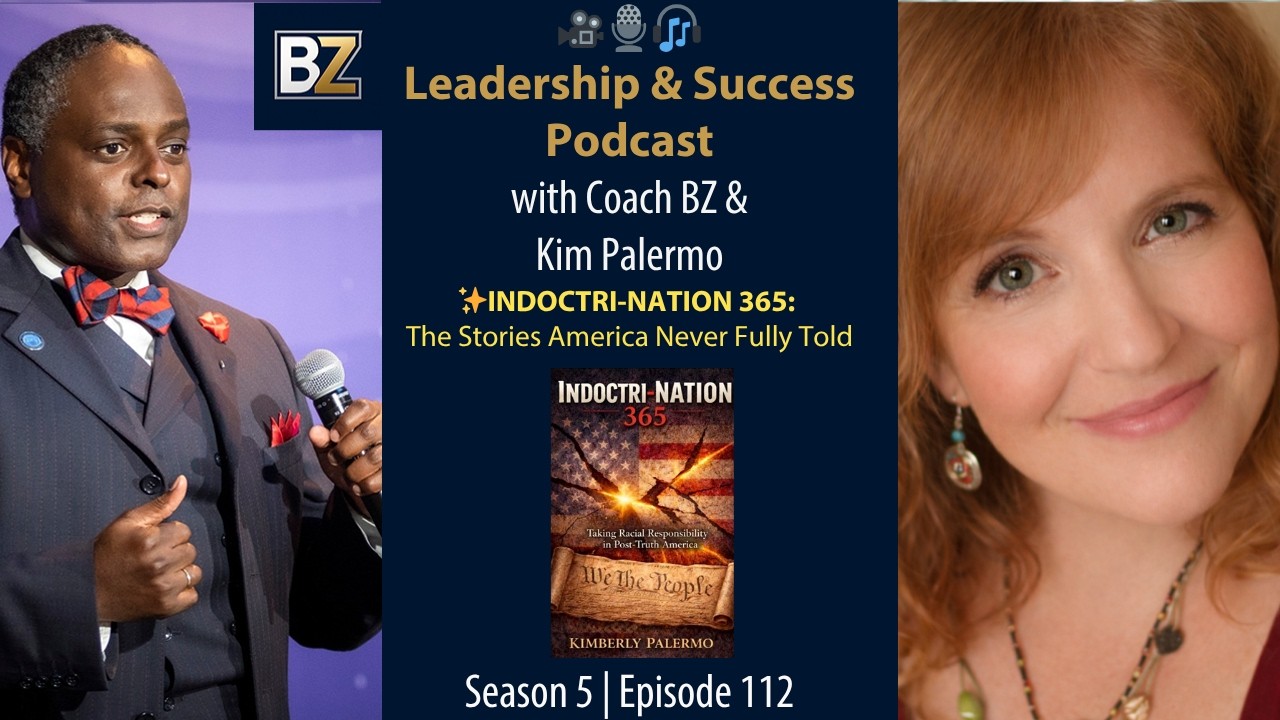
Kimberly Palermo, author of Indoctrination 365, discusses systemic racism in education and housing, drawing on her teaching experience in Compton. She describes the personal cost of speaking truth: doxxing, death threats, and police involvement. Palermo argues educators and leaders have a moral duty to protect historical literacy.
Chapters
Hi, I'm John Maxwell. When the top companies in the world are looking for trainers, speakers, and coaches, there's one name that stands above the rest, and that's Maxwell Leadership. Our certified team members have gotten proven results for companies all over the globe, and our reputation, I'm proud to say, is second to none. Some of our members have risen to the top of their profession, including the one you're going to meet today. I proudly introduce you to my friend Bob Fabien Zinga.
Welcome to the Leadership and Success Podcast with your host, Coach BZ, where we help you lead with purpose and succeed with impact. If you're ready to grow into the kind of leader others want to follow, this podcast is for you. If you're determined to elevate your success and leave a lasting legacy, this podcast is for you. As my mentor, Dr. John C. Maxwell, reminds us, everything rises and falls on leadership. Our goal is simple: to inspire you, challenge you, and equip you with insights that can transform the trajectory of your leadership journey. Welcome aboard Welcome aboard to another episode of the Leadership and Success Podcast with Coach BZ.
What if the story we were taught about America was incomplete by design? My name is Kimberly Polero, and I wrote a book called Indoctrination 365: Taking Racial Responsibility in Post-Truth America. My book is not about shame. It's not about blame. It's about the truth. For generations, many of us were taught a version of history that left out some of the most important parts: systemic racism, hidden history, indoctrination, propaganda, and the way culture quietly shapes what we believe without us even realizing it. This book was written especially for beginners, people who are hesitant, anxious, curious, and for people who know something feels wrong in America but can't quite explain it. Maybe they hear people saying things that don't sit straight with them, but they don't feel confident enough or have the language to speak up and challenge it. My book is also for people who already know something is deeply wrong and have been following a lot of this, but they want to better organize and communicate these truths so they can help other people understand. I break down complex issues in a way that's honest, compassionate, and direct, and best of all, easy to understand. Because the truth is, we can't solve problems we weren't taught to see. If you're ready to question what we've been taught, if you're ready to think deeper, and if you're ready to grow, visit indoctrination365.com and join the conversation. Because understanding the truth about our past may be the only way to save our future.
All right, welcome to a very, very special episode of the Leadership and Success Podcast. I think this episode is going to make you think. Before I bring in our guest, as is our tradition here, we like to celebrate what we call a moment of gratitude. This is where we take just a moment every single time we meet to be grateful. And I already had two episodes earlier today, so you know that today I am really grateful for America. I think America is still the greatest country that's ever been. That is why so many millions Not hundreds, not hundreds of thousands, but millions of people have come to this country from all around the world, including myself, as you can tell by my accent, right? The home of the brave, the land of the free. But the truth is America hasn't always been like that. When we started, no, we did start wrong with slavery. That's really a big spot on our history. But the ideals we had as a country, Thomas Jefferson wrote those All men are created equal. I don't think anybody has ever said anything like that before. And I think it was really life-changing. I think that's really what makes America so special. Not exactly how we started, but the aspiration we had and the country we are becoming more and more, right? Like Abraham Lincoln said, country of the people, by the people, and for the people. That one America for all people, including African American, including Black, men, women, gay, straight, everybody, all inclusive. That's the America I long to see. That's why I joined the US Navy 21 years ago. That's the America I am willing to give my life for. But regardless, again, we are not a perfect country, but I think we are still the best country out there. But I was born in Africa. I've lived in Europe and I came to the US. So I have never heard of a Congolese or African dream, of a French or European dream. But there is the American dream, and I believe I want to do everything I can to keep my country, to keep America in a— leave her in a much better place than I found her for my children and my grandchildren who are not born yet. But having said that, so let me bring our special guest today, and let me see if I can properly introduce her. We're going to be speaking to Kimberly Palermo. She's written a groundbreaking book, Indoctrination 365: The Stories America Never Fully Told. And I really truly believe we need to be honest about our past, because we cannot really build the future we need if we pretend that things that happened in the past didn't happen. They did happen, we need to talk about it, and we need to learn from it so we can do better in the future. That's really where I stand. So I am really honored to welcome Kimberly to the Leadership Success Podcast today for what promises to be a thoughtful, courageous and deeply important conversation about leadership, truth, education, history, and the responsibility that comes with understanding difficult reality, especially this time, because we're going to be celebrating 250 years of American history. And that is a moment of celebration, but it needs to be a moment of thoughtful evocation too, right? We need to think about our own lives, the life of our nation, and where we want to go. As a country. So Kimberly Palermo is an educator, a writer, a cultural analyst, and author of a thought-provoking book, Indoctrination 365: Taking Racial Responsibility in Post-Truth America. With decades of experience in behavioral science, special education, cultural literacy, and community learning, Kimberly has dedicated her work to helping even the most reluctant learners better understand their hidden histories. System, and narrative that continue to shape American society today. Her journey includes teaching in Compton during the Rodney King era, leading large online educational community, creating over 1,000 educational videos, and building platform focused on truth, accountability, empathy, and transformational learning. At one point, she even had more than 50,000 people following her on Facebook. Just incredible. Now, me as a cybersecurity executive and information warfare commander in the US Navy, I do believe that leadership requires courage to engage difficult conversation thoughtfully, respectfully, and honestly. My core values are honor, courage, and commitment. So especially in an era increasingly shaped by polarization, misinformation, and emotional division. So this conversation is not about blame. It's not about making people feel bad, but it's about understanding, it's about learning, and it's about leadership. It's about truth. So part of what we're gonna be learning is why difficult conversation require emotional intelligence, and leadership maturity, but also why truth, accountability, and historical literacy matter for future generations. I believe now more than ever before, especially when some people are trying to erase African American history, which is American history. So without any further ado, please help me welcome to the Leadership and Success Podcast, the one and only, the lead— How are you doing today? I think you are, you are on mute. I, I believe you are on mute.
Here we go.
Now, okay, there we go, there we go.
How are you doing today, Kimberly?
I am doing great. Thank you so much for having me. Appreciate being here.
Hopefully we are going to have a very frank discussion about our country, and we both love our country. We love America. I think it's the greatest country in the world. We just want America to be better, to do better, and to live up to its own ideal, right? That's all we are asking for. So I guess to get started— no, I guess before I even do that, I wrote an article about the Golden 13. I have their books right there. Those are the first 13 African-American officers in the US Navy, which is my branch of service, in 1942. It was impossible for somebody with my skin tone to be an officer in the most powerful Navy in the world. I'm like, I want to die for my country. I want to go to war. I want to fight for America. America's like, no, no, no, no, we don't want you. Why? Because I'm Black, which is definitely not right. It's immoral. It's, uh, it was legal, but just because it's legal doesn't mean it's not unethical and it is, it is not wrong. But again, we've learned through it, and today because of them, I am a senior officer in the most powerful Navy in the world. And I just love that idea of America getting better and better and better and eventually reaching out to our foundational ideal. But anyway, just to get started, I need to ask you, what is one thing you are grateful about today?
Well, I'm very grateful to be here and to get the opportunity to talk about my book. This is my very first book interview.
And—
Wow.
It means so much to me. So, Outstanding.
We already have a few people, one from LinkedIn, Harper, excited to see us. And we have Sad Leaf on YouTube. Hello, Coach Bizzy. Thank you. Thank you so much for being there. And if you have any question, please type those question in the comment, both on LinkedIn and YouTube, and we will answer those question live. And I also want to know what you guys are grateful for and where you are joining us from, what city, what state. And my show went international a couple of years ago, so we have people all around the world. So let us know which country as well, if outside of the US. So Kim, what is something about you that most people may not know when they first meet you?
Well, I know this is going to sound really crazy, but a lot of people think I'm a Karen. Have you heard of this term?
Really?
My children even have told me, Mom, you look like a Karen. And so I am not a Karen, but apparently I have the Karen look or the image. And so that's definitely, you know, I've gone to Trump rallies before, and immediately they see my color, my skin tone, and they welcome me in. They think I'm there to join in, and unfortunately for them, I suppose, I am not there to join in. I'm there to ask questions and learn, and so it's a little bit awkward.
So, yes. Wow, I guess you live your life in a very courageous way, I must say. Say that. But man, this is, I think, I don't know, it's something we definitely need to talk about more and more because, you know, if you don't understand the past, there is no way you're going to be able to build the future you want. So one thing I wanted to ask you, Kim, is for members of our audience meeting you here for the very first time, Who are you beyond your titles, your accomplishments, your book, and all of your social media?
Okay, well, first and foremost, I'd say I'm a humanist at heart. I love teaching. Before I became a teacher, writing my book, before I had an online presence at all, I was just someone who wanted to understand the confusing world I saw around me, and I didn't I didn't get it. I didn't understand why people hurt each other. My family had moved 6 different times before I went to college. I was— OK, you're not going to believe this. I was shy growing up, very shy. Not anymore.
Really?
I'm the girl who ate lunch alone in the library for all 4 years of high school. I didn't have friends. And so I spent a lot of time listening, paying attention. I felt compassion and empathy. So very early on, I was living in this permanent existential crisis because every day in school I would say the Pledge of Allegiance and I believed it and I loved, I love my country. But then I would look around and be like, why aren't people doing what they're saying they're supposed to do? I was very confused. They didn't see the cruelty, the inequality, the inequity, and I was lost. That I wanted to understand what— why people were silent when— so that question stayed with me my entire life. And over time, that became my life's work, I guess, is the only way to put it. So that's—
wow—
in a nutshell, I think.
So you've spent decades in education, behavioral science, and cultural literacy. What originally called you into the work of teaching and helping people? You just learn?
Well, I think part of why I love teaching— this is going to be a strange answer— but it's because I had a hard time learning myself. And originally, I remember struggling to learn how to read. I remember struggling to understand what's going on. And finally, I figured out how to break things into smaller pieces. And I wanted— I was like, I want to help everyone do this because it felt so great to give other people confidence. And when they felt so down, I know what it's like to not be able to learn very well. So, wow, do it.
Powerful. Because you've taught in Compton. I think that's a mostly Black city there in the LA area during the Rodney King era. I think most people remember that, but it was also around the time of the O.J. Simpson trial, if I'm not mistaken. And there was a lot of civil unrest in Los Angeles. How did that experience kind of change the way you viewed America leadership and education?
That's a great question. Teaching in Compton during the Rodney King era changed my life forever. I came from a wealthy, almost entirely white school. I knew inequality existed, but, you know, and I had gone to school for multiculturalism, but, you know, in the day, a long time ago, and, but they didn't really have what they have now. And so I I never witnessed this level of abandonment and segregation and normalized suffering. I mean, I had these— they were my first babies. These were beautiful little children living in conditions that, like, most people had never heard of. I was 23 and these were my babies. And I had 40 students in my first classroom. No aids.
Wow.
We were on constant lockdowns from shooting in the neighborhood. There was 9, yeah, 9 shootings in the neighborhood each, approximately each year.
Wow.
Where we have code yellows. I mean, and most of my kids thought this was normal. They didn't know that children, other children had safer neighborhoods and newer schools and books and libraries and resources and—
wow.
And my kids would— I told them that there are places where there are no gangs in the United States and they laugh their head off at me.
Why, why did you go to Compton instead of Beverly Hills. Like, what? Well, how did that happen?
I went there, you know, in all honesty, I went there because I really needed a job and nobody wanted to work there and they were taking people without credentials. And I was like, oh, I'll work there. I didn't. I mean, I was like, I was 23. I didn't know what I was doing. I was like, I'll teach the kids, you know? And so it was quite a learning experience. Forced me to confront the massive gap between, you know, the America a lot of people imagine and the America American communities that— what they actually experience every single day. So it wasn't theory anymore. It was, wow, like I could study that all I wanted. But once I was there, I started to question everything. Leadership, education.
Yeah, because even when you go back to the origin of our country, yeah, we talked about freedom and all of that liberty, you know, the pursuit of happiness, but that wasn't the experience of the Black enslaved in this country from the very beginning. I guess there is like a dissonance, I guess, but then we pretend like that didn't happen. Like even after World War II, which is again when America finally allowed people with my skin tone to become officers in the Navy, we would go to war, fight for our country, come back home, but all of the great benefits that came from being in the service, like the GI Bill to get an education, the mortgage and all of that, it was for white sailors only, not Blacks. Why not? What the heck? You know, that just doesn't make any sense. And the majority of society is like, we do not care. It's like, okay, whatever. Like, and also the red zoning, right? Okay, you can get a loan from the VA mortgage, zero down to get the home, but because you're Black, you are not allowed to join this neighborhood. You have to, to go— it's like, it's, it's just a lot of dissonance. I just didn't make any, any sense to anybody who's, uh, impartial.
Yeah, I can't imagine fighting overseas for your country that you love and risking your life and coming back and not having the freedoms that you fought for. It's like, it's like crazy.
And there were some people, they even wrote, people felt like they were an imposter wearing a uniform, especially an officer uniform. It's like Wow, that is, uh, unbelievable. And because of all of that, that's why I, I always vote. It doesn't matter which election it is, local, state, or whatever. Some people only vote every 4 years. I know a lot of people who do that. I think that is a mistake, especially in this day and time. And I feel like, no, too many people have died. Some, some, uh, have really, you know, uh, I guess experienced the ultimate sacrifice for the right for somebody like me to, to have this privilege to vote. So I will always, always do that because many senior officers in the Navy I've known, they don't vote at all because they try to be absolutely impartial, right? They support the Constitution, not the Democratic or Republican Party. But if you are Black and you do that, I feel like that is a mistake. That's just my, my own opinion. But going back to the experience you had in Compton, what leadership lesson did you learn from teaching in this emotionally charged environment where pain, inequality, and misunderstanding were impossible to ignore?
Oh, that's a great question. I learned that people in positions of power have a huge responsibility to those who don't have it. And the whole Spider-Man thing, where with great power comes greater responsibility. This is real. We weren't living up to that. And we're not now. We weren't then and not even close. And I believe in our country. We can do better. I know we can. We have to. So real leadership doesn't require cruel— a little soapbox here, but it doesn't require cruelty, intimidation, and dehumanization. It's the opposite. And strong leaders create accountability. While still protecting people's humanity. And I remember thinking, if we could get President Bush down here— and he was the president at the time— if we could get him down here just to spend one week with these beautiful children of mine.
Yes, that is Bush 41, right? Not W. Yeah.
And he would see what was, was done to them. And, and I thought, you know, I was very young and very, you know, oh, we should just bring him over, you know. I thought this would be a rude awakening and, and And he'd see the, the parents working 2, 3 jobs trying to raise these children in an environment that was given no infrastructure, no money, little investment, not enough opportunities. So I was very naive then, you know, but—
Well, you wrote a book that is definitely thought-provoking for sure, and the title, Indoctrination 365: Taking Racial Responsibility In Post-Truth America. I think the book itself, the title, is very provocative, but you also start this with a very provocative question. You ask, what if the story you were taught about America was incomplete by design?
Wow.
What emotional journey led you to write this book?
Well, it was a long time coming. For decades, I watched people struggle to understand I've watched, first of all, for decades I watched the cruelty, the inequality, the inequity, the unfairness, and I studied it. And then I watched people in modern time have such division and fear and racism and disinformation and cultural instability. And people would ask me online, "I just, this isn't the country that I know." I'm like, "Mm, actually it is." It kind of is, you know.
Yes.
The system's working just as planned, you just don't realize it. And they'd say, how did we get here? And I realized people were always asking me that, how did this happen, you know? And I'm like, wow. I realized that a lot of most— I hate to say it— most white Americans, they didn't understand. They didn't have a historical foundation to understand what's happening now. They were truly shocked. Because they didn't know the history, because they weren't taught it. And, and I didn't learn— I mean, they didn't learn in school about sundown towns, the Devil's Punchbowl, um, hundreds of race massacres, thousands, Black Codes, Jim Crow, how the North was participating in everything, disclaimer in the 13th Amendment, the scores of government sanctions and laws that purposely were created to harm Black people and Brown people. They didn't know a thing, so how could they understand?
Wow.
So that's after teaching so many white people, I thought I really need to put this in writing at least, um, because I've worked with people and I believe we can change. I know we can. I've seen— oh my God, I have seen changes, you know.
There's really a whitewashing of history, or do you think it's like most people, they just don't want to know? They know exactly what our country is, how it was created from the very beginning, but just pretend it didn't.
I think they think they know already. I honestly think, because what we're taught in school, people are like, I already know everything. And then I say, well, do you know about this? And they're like, what? Do you know what that's— do you know that? You know, we'll see. It's the Dunning-Kruger effect. I mean, the more— the less we know about something, the more confident we are. It's a strange thing, you know, in thinking, well, We know it. The more you know, you realize how much you don't know, so you're like, "Humble." But people come up to me all the time and say, "Oh, I know all that." And I'll say, "Oh, that's great. Then you must be able to speak quite openly about systemic racism." They're like, "What?" It's a human nature, part of our human nature. But I think people say, "I had a Martin Luther King Jr. Day. I had a month of Black history. I know everything." And I'm like, oh no, you know, because that's— it's not really, it's not really their fault. They think, they really think they know everything. They think they were told the truth. They think they were told everything.
Yes.
We were not even told 1%. It, you know, I had to learn all this.
I went to school.
I was a good little, little student and tried to listen, and I learned everything on my own. I was shocked at all this stuff, you know, over the years. Like every day I learned something new. I still do.
So, wow. Okay, let's try to set the stage because your book repeatedly says this is not a book about blame. So we're not trying to blame anyone. It is a book about understanding, which I think is really something we need to invite more people to. Why was it important for you to make that distinction?
Well, here's the thing. When you I mean, do you want to get blamed for something? No way, right? Of course not. You know, so who's going to be like, oh, I can't wait to go to class and, you know, everything is my fault. It's like, I wasn't there. I didn't— what I say to people is something that's quite strange, and it's not a perfect analogy, but I say, you didn't— just because you didn't build the pool, you see somebody drowning in it or having trouble, you don't just walk by and be like, well, I didn't build it, or just shove them in. You don't do that. But when it comes to systemic racism, oh yes we do. You say, I didn't, my ancestors, we have every excuse. We have an excellent chapter, chapter 14 goes over every classic cliché denial that people make. And it teaches you how to debunk it, it teaches you the history behind it. It's kind of my favorite chapter. But so people, it's, people get upset, they don't want to be blamed for things and they don't understand the system. Systemic part. And so you want to challenge the reader, but you don't want to attack them. I mean, who's gonna— who's gonna read a book where they're like feeling like, like, you did this, and they're like, no, I didn't? Uh, you know, so of course it's really important.
That is quite fascinating. What do you believe are the biggest myth or historical omissions Americans were taught growing up that still shape our culture today?
Um, well, the biggest omission you're gonna laugh at is we were taught practically nothing about our real racial history, which of course should be called history, but because I have to differentiate because most of us have no idea how much is left out. And also, I think Americans were— are taught in school, because I've worked in many school districts, I went to school, I have children who went to school, so, you know, I've had a few samplings here and there, you know. We're taught that all this history is an isolated moment instead of an interconnected system. We learned about enslaving human beings and then it ended. We learned about segregation and then it ended. But we're rarely taught what happened in between. And we're not taught how our nation can move through these incredible brutalities and exploitations and then act like, um, yeah, we're all good, it's all good. Well, maybe they're good, but what about, you know? So we're not taught how systems adapt when power structures want inequity to remain in place. I guess that's probably— so we're not taught that emancipation of enslaved humans, that was the beginning of a new phase of resistance and backlash and systemic control So there's— I don't know, I could go on and on. I don't want to.
No, no, that is, that is quite powerful because you also talk about reluctant learners, right? What have you learned about human psychology, defensiveness, fear, maybe identity when discussing race and history? Kind of a touchy subject these days.
Oh yeah, it's a very touchy subject. In fact, if somebody calls you racist, that's the worst. If you're a white person, that's the meanest, most horrible thing they could ever call you.
And so yet so many people act in racist ways.
It's like we have so many— we have so few racist people with so many race, uh, racial— we have so— it's so funny, I laugh because we have so many people who claim they are not racist, yet so many racial groups. I mean, that, that basically are Klan-like in their nature and they're in their nature, and but nobody's racist because see No one would say like, yes, hi, I'm a, you know, a proud racist. So it's like, we have a lot of racism and discrimination, but no racists. It's like, how does this work? So I worked with the people. I've learned that anxious, defensive, fearful people, they don't, I mean, in anything, they don't learn at their best. There's no way. I mean, do you want to like be stressed and you don't learn at your best, but when they feel judged or ashamed or attacked, of course not. And like there's all these psychological things like defense mechanisms, like the backfire effect, cognitive dissonance, Dunning-Kruger effect. These are impacting us and we don't realize it. So we want to be a good person. We want to like, I'm one of the good ones. So we get really defensive. I do this, I do it. Everybody, you know, people do it. And one of the biggest challenges is that many people do not understand that systemic— they don't understand. One of the biggest challenges is that many people do not understand racism as a system or an inherited culture, so they experience conversations about racism as a personal attack on their identity and their character. And, and once identity feels threatened, I mean, it's, it's over. So that's why meeting people where they're at is so important.
I mean, that's why I really love to learn history because I feel like it can really teach us a lot about how the world works today, but also I think help us create a better world for all humanity, not just a specific race or group of people. So in your opinion, why do some people emotionally shut down when difficult conversation about race, privilege, or systemic inequality begin?
Well, it's a really rough topic because people emotionally shut down with these conversations because it's challenging their most deeply held and ingrained beliefs about their identity, about fairness, meritocracy, and what makes someone a good person. And on top of that, I mean, that's a really personal thing. They take it personally. And on top of that, many academic terms related to race and privilege and systemic inequality have been distorted and vilified and either they're, you know, they're turned into something that's quite triggering. If you really think that's what that word means, then yeah, I understand being upset. So you'll judge, you get defensive, and then that ruins everything because you don't want to learn, you don't even want to, you know, you just want to call people names. It really turns people into the most defensive, let me tell you. So it's rough.
Yeah. And in your book, you do emphasize again accountability over shame. What does healthy accountability actually look like in practice? How can we be more accountable?
Accountability, I mean, one second. I think accountability for everybody needs to be— people, here's what they need to do. It needs to be a learning experience. Everything needs to be a learning experience. Healthy accountability isn't humiliation. You're not going to put someone down and demean them to the point where they say, okay, you're right. I mean, like, you need to teach them. This is a very complex— it sounds so simple, it's a very complex issue. This is culture, sociology, psychology, it's— oh, there's just so much involved. And you have to have a willingness to listen and reflect and learn and repair harm when necessary, but without centering our own, you know, discomfort. And that's really hard to do because you— we white folks, we get emotional about this stuff. Yes, we feel like it's attacking us. And, and also, to be honest, a lot of this, you gotta deal with the fact that people haven't been completely honest with you. And America you love is still a great place to love. Yes, but the truth needs to come out and be told. And that's a really rough thing. Like, you know, it's like hearing that grandpa was really, you know, one of those people in the Epstein files. Oh boy, I mean, this is grandpa that you like revered and loved, and you're like, how do you sit like that? Our country is not perfect. It's young and immature. Yes. Chance. We have a chance to create this incredible, you know, form a more perfect union. And yes, it's not going to happen with lies.
So yeah, I want to say, you know, it's only been about 250 years that we've been around as a country, but there are civilizations like in Iran that have been around for more than 5,000 years. That's That's a long time. Many empires have come and gone, the Roman Empire, Greek Empire, on and on and on, Babylon and so forth. But wow, I don't know, in some way I feel like as a US citizen, even as a senior officer in the US Navy, I feel like we need to live with more humility. It's true that we are very, very strong, we are powerful and we are rich, but although it looks like we're having some economic problem lately, but, But I feel like with our power, like you said earlier, comes responsibility too. Yeah, I feel—
yeah, the checks and balances have been thrown off to the point where, you know, obviously that's— do we really call it a democratic republic anymore? I mean, that's a really rough place, and the misinformation is all purposeful, and there's a lot going on. Like, I need to tell you, it's, it's a lot.
Well, in your book again, we are talking about your thought-provoking book, Indoctrination 365: Taking Ritual with Sensibility in Post-Truth America. One question I have for you is, one powerful idea from your book is intent and impact, they are not the same. Can you unpack that for us?
Yeah, intent and impact are absolutely not the same. Um, let me just get to where I'm at. I have— okay, here's the thing. People will say, I didn't mean it that way, I didn't mean it, but you see— and, and maybe they didn't mean it that way, but if they said something that's very racist or hurtful or biased or bigoted or, you know— but you see, that's centering their own feelings because it is you know, being called racist or even, you know, anything close to that is like, oh my gosh, you get so upset because it's a terrible, terrible insult because nobody wants to be racist. But good intentions by white people do not erase the harmful outcome. You still hurt somebody. And I've made mistakes. I've even done videos of me making mistakes. And you're mortified. So someone can mean well and still reinforce harm, exclusion, stereotypes, inequality. Leadership requires the maturity to hear about the impact without immediately becoming defensive and making it about us.
That's it.
It's tough.
From your book, what do you think are some, a couple, some of the greatest myths that most people believe about America which is, uh, just not true?
The greatest myths? Um, oh, I have a lot of those. Let me just—
yeah, I believe on your, on your website you have at least 14, I, I, I think, when I was doing research for this.
Yeah, um, let me gather my thoughts for a second.
Um, Oh my gosh, because I also like on your website you also have kind of like a timeline, uh, about our countries dating back to like 1619 to the present, which is pretty, pretty awesome.
Yeah, yeah, I try to, um, I try to put— present things in many different ways because many people learn differently.
Yeah.
But, um, I'm just looking at my notes. I have so many notes.
I'm going to take your time because I think this is really, uh, important. Hopefully, what I'm hoping, many other people who are listening now are going to be more curious about our own history and actually get to read books instead of banning books, actually read them and understand where we come from because it explains a lot about where we are today as a society?
Yeah, um, I mean, I want people who, who read my book to, to come away with— my ideal outcome would be I hope they come away with seeing American culture, American culture and system racism and, and their role in the system in a completely different way. I mean, I want— this is arrogant, but I want it to be life-changing. I want them to feel informed, more grounded, more curious, I'm not afraid to have these conversations. Um, my book is supposed to be about the beginning. After you're done with my book, you're ready to rock and roll for the rest of your life. It is not the end, it's the beginning. My stuff is the, just the minimal requirement to understanding.
Yes.
Um, if that would make sense.
Absolutely. Wow. That is quite insightful. For example, when I first came to the US, I lived in Tuscaloosa, Alabama, so the Deep South. I guess that's the belt of the Bible Belt down south. Everybody appears to be a Christian, or at least they confess that they are. And Many times when they think about their founding, they always felt like America was founded a Christian nation, but that's not true, is it?
No, I talk about that in my book actually a lot, and it's not— even the Founding Fathers, they had, um, Qur'ans. I mean, they, they were not— they made it explicit, you know, the First and Second Amendment, they made it explicit that like— so it's like actually the opposite, to be honest. Yeah, um, so that's a rough thing. I, I don't know how it all got so twisted. Um, but yeah, no, it is— this is not a Christian nation. Separation of church and state. Hello.
Now, we do have great respect for our founders, and I think there was definitely a lot of greatness and genius in them, but telling the truth about the way some of them had slaves and, uh, abuse and, uh, mistreated those slaves, that doesn't take anything away from them, does it?
Well, here's the thing. There's a rough question, and a lot of people get very, very defensive because we learned that our founding fathers are perfect and they're amazing.
No human being is perfect, right?
And it is— the fact is they were humans and they had flaws. For example, Thomas Jefferson. He wrote an incredible document. I mean, they— I do— Okay.
Sorry, I'm glad you mentioned Thomas Jefferson. Let me play like a 2-minute clip about our founding father Thomas Jefferson. I think he was one of the most important ones because of the Declaration of Independence. I think one of the most important documents ever written in the last 300 years. Let me play this quick video and I, I ask you a question on the other side.
This is what Thomas Jefferson saw from Monticello, the view as perfect as his high ideals.
Well, I'd like to welcome you to our Slavery at Monticello tour.
But at Monticello today, it is the the imperfect Jefferson we see.
Monticello was a plantation.
And must judge for ourselves.
Jefferson professed to hate slavery, called it an abominable crime, but he held on to his slaves. He freed only 7.
The author of the Declaration of Independence, who wrote that all men are created equal, owned 600 slaves over his lifetime. And in addition to his legitimate children, almost certainly fathered at least 6 other children with his slave Sally Hemings.
For generations, descendants of Sally Hemings have been telling stories implicating Jefferson as father of her children.
DNA proof of a connection came in 1998. Is Thomas Jefferson any less great because the understanding we have of him now is three-dimensional?
Most human beings I know are quite capable of denial and hypocrisy, and I think that Jefferson's virtues were enormous and his vices were equally enormous.
Pulitzer Prize-winning author John Meacham has just published a best-selling new biography of our third president.
Looked at in full, you find a man whose life was made possible by slavery, who had misgivings, who as a young man attempted, however feebly, to reform the institution. But in the end, he was ultimately someone who was trapped by— allowed himself to be trapped by the economic, political, and cultural circumstances into which he was born.
Jefferson said that his earliest memory was of being handed up on a pillow as a toddy a toddler to a slave on a horse. And we know that his last words were asking Burrill Colbert to adjust his pillow here in this room.
Jefferson's butler Burrill Colbert was also a slave.
There would have been an intimate relationship, really, from, from birth to death.
Elizabeth Chew is curator at Monticello. Now, are there pieces of furniture in this room that were made by slaves?
Yes.
This, um, in the joinery, or the furniture-making woodshop, um, in Jefferson's later years was run by a slave named John Hemings. And Hemings ran the joinery and made many pieces of furniture that are in Monticello today. This is an example. He was very highly skilled, and he was freed by Jefferson in his will and given the tools of his trade.
John Hemings is remembered because of his craftsmanship. Ownership, unlike so many other Jefferson slaves.
To be able to sort of have an image of Jefferson that we all know, and behind him the names of the 600 people that he owned in his lifetime, really means that we have to understand slavery in order to understand Jefferson.
Lonnie Bunch heads the Smithsonian's National Museum of African American History and Culture, sponsor of a traveling suspicion about slavery at Monticello.
And what's powerful is, quite candidly, we only know the first names, and there are some that we just have as unknown because we don't even know—
Lucy, Lucy, Lucy, Lucy— where it's almost any old name.
That's exactly right. This is Thomas Jefferson's laptop desk. This is the desk upon which he wrote early drafts of the Declaration of Independence.
The first of those drafts attacked Britain's slave trade, Jefferson writing that King George III has waged cruel war against human nature itself. The Continental Congress took the phrase out. Alongside the rejected passage, the financial reality.
Next to it is his farm book, and here is where he would list the births and deaths of the slaves. He would list the work that they did.
So in some ways, it really gives us a full picture of the reality of Jefferson, which at times contradicts the popular image of Jefferson as a benevolent slaveholder.
The nailery occupied one half of this site. Inside there were 4 forges.
One example—
all right, that is, uh, enough. I think people get the idea. I think you are on mute again. It appears that you are. Yeah, so I guess the duality of many of our founding Fathers, what we teach in school and what reality was completely different. What do you make about that?
Well, I think, you know, again, human nature, especially for people just starting to really delve into this subject matter, it's very upsetting. You know, you think of this, this is your hero, this is the person who you, you know, and, and I had to go through it as well. I, I wasn't taught about anything other than he was this incredible writer, incredible, and, and he was It doesn't mean it's not true, but nobody is only one thing. And if you go to the Jefferson Memorial in D.C., you'll see on the wall and his, you know, memorial building, you'll see his own writing. He absolutely knew what was going on. A lot of people— I've heard, you know, every classic cliché denial of everything, you know, and a lot of people say, oh, they didn't know it was bad back then. I mean, I've heard everything. It's quite, quite amusing, but not amusing, that's the wrong word. It's quite quite like— I don't know what else to make of it. It's interesting. The denial is real.
And especially for Thomas Jefferson, because he wrote the Declaration of Independence. What I found very strange is, uh, the slave that he had at least 6 children with, uh, actually she was only 14 years old, so that would make him a pedophile. Uh, but then also She was a slave and he was the master, so there wasn't absolutely no consent, so that was rape. So, and also on top of that, it gets even worse, that was the stepsister of his wife, right? They actually had the same father. So how can you enslave the stepsister of your own wife? And then when they had children, those 6 children were slaves too. How can you enslave your own children?
It's very, very confusing, and a lot of people cannot handle this fact. So they have to say, well, it was different back then. Well, I mean, evolution— evolutionary biology doesn't come that far. I mean, they were still human beings like us. They— he admittedly knew, and in much of his writing he knew, you know, not about, you know, his relationship, but he knew it was incredibly wrong. And, and nowadays a lot of people like to say, well, we cannot take the morals of today and apply them to— well, actually, yes, we can. Some of them we can. Not all of them, but a lot of them we can. I'm sorry, we— you hear a child cry and they're in pain, you— no, we cannot. So it's a very— the denial is real. It's a very hard thing to take. People like to feel, and you know this, people like to feel one way or completely the other. They want binary. They want to, you know, it is absolutely wrong or it's absolutely right. And unfortunately, that's really not— we're all in gray area in many, many areas, and that's not the way the world works.
Human beings are much more complicated than that.
Yeah, it's hard because people don't want to hear, you know, something that they really look up to. But for some reason, I'm, I'm kind of okay with was knowing that, you know, like, I mean, Jeffrey Dahmer loved his mother, okay? I mean, I'm just saying, I'm not saying, you know what I'm saying? Like, everybody—
and that is like an extreme example, obviously, but I mean, it definitely carries the, the point. Again, it doesn't take anything away from him. He did write the Declaration of Independence, and the words that he penned really, I think, have changed history. And really, it was the words that African-American really latched onto. They're like, hey, this is what it says, this is how this country was founded, but that's not true for me. And pretty much African Americans made America— forced America to become a democratic constitution. It's like, no, this is exactly, uh, what it should be. This is engraved in our Constitution. I am not three-fourths of a human being, I am a full human being, so I should have the same right as everybody else. And, uh, uh, I don't know, I guess American history is very complicated, but I really love the way you bring it in your book. What was one of the chapters that was the hardest for you emotionally to write?
That's a great question. There was no one chapter, but the hardest part emotionally for me was the hidden history sections that exposed the human suffering, the brutality, and the long-term harm that were minimized, sanitized, you know, left out very intentionally. And let me explain that, because about half my book is hidden history. Um, the truth.
Oh, also, as, as you tell us more about the Eden history, because they, they have a myth too. I've seen is many people who think that, oh, America is a white country. Actually, no, it was, uh, Native Americans who were here, and I guess there were all genocide for the most.
Yes, yes, one of the biggest genocides. And yeah, yes, at the time. And, and like, it's crazy. Yeah, you know, we want to think what we want to think because we haven't been taught And it's being taught the truth isn't about, like I say, isn't about making people feel bad. I found that it's mostly the parents who feel bad. The students who learn this, they learn everything, you know, we had the Vietnam War. Do they feel guilty of that? No, you know, we had this, maybe they should, I don't know. But it's the parents who are the ones who, because, and there's, I've written, I've done videos on this. There are many reasons for that, which is a whole nother, you know. Whole other subject, but, um, it's— people are okay with hearing real history. We hear it all the time. And then all of a sudden, when it comes to our real racial history, all of a sudden we're like, no, no, wait a second, why is this now? One of the goals— half my book is, um, is hidden history and the truth that, um, Americans were never taught, or were taught in ways that soften them, sanitize them, you know. So goals of the book was to challenge what I call the racial— and I didn't coin this term, this is an old sociological term— the racial empathy gap. People often emotionally distance themselves from historical suffering, and I get that, but I didn't want that to happen in my book as much as it normally could. So, um, we do it so we don't have to confront, you know, the pain, and it hurts us to hear these things. Even if we don't feel guilty, it still hurts us. So We— but we'll never learn if we don't know our history how these impact us today. So a lot of like white folks might, uh, dismiss taking racial responsibility because they'll say like, you know, just upsets me. I get that all the time, you know, like I cannot— my family actually, to be honest, not to throw them under the bus, not my current family, but old, you know, my, my family when I was younger, they, they don't want to hear it. They can't watch my videos. And because it upsets them. And so, and I get that, but here's the thing, our white feelings are not more important than Black lives and systemic racism and discrimination. It kills, it maims. It's so, I guess I'm trying to bring the point home that my book includes sections that are called Human Lens. And then and now. And these aren't yelp the person out sections, but they are sections that I purposefully included with the history. They were designed to briefly place the reader, if not for one second flat, into the emotional and human reality behind the history. Again, not to shame and blame, like, you know, whatever, but to encourage empathy, reflection, and a deeper understanding. These were human beings just like you. But as white people try to educate other white people, this is a huge part of the process. So going through this, back to your question, it's hard to— because when I write about this and I'm putting a human lens on it, I'm putting a human lens. I'm talking about a girl crying, you know, talking about a little girl crying and the last sights of her mother was with her mother's hand underneath, you know, as they're taking her away. And I mean, I'm talking about— I want people to get this, if not just one second, and I don't have to pretend, um, I don't feel it, but it's hard sometimes. Um, for another example of that is, um, for some reason, and I've done so many videos, but I put off doing a video on Emmett Till, okay? And I questioned myself because that's part of the process. Part of the process of, of, of living an anti-racist life as a white person is you question yourself. And I kept saying, Kim, why I mean, this is a fascinating story, but I had a child who was the age of when he was brutally murdered. And that might have been part of it because I related so much. I couldn't bear— I couldn't bear to see the picture for years. For years, this is what I do. This is supposed to be my profession, and I couldn't do a video on it. And I finally did. But this is very emotional work. It's not more emotional, not even close, to what Black people and brown people in this country handle every single day.
Yes.
So, wow.
Well, thank you for sharing that. I think it takes a lot of courage, but I think we do need to have an honest conversation about our country, our our origin and what we want to build, what we want America to be for all of us, right? Not just the white supremacists.
Right, it's only going to make it better for everybody.
Yeah.
The bottom line is, and what a lot of white folks don't know, is systemic racism is not good for us in the long run either. It's not. And we might think we are special in getting these, you know, privileges and benefits, and we are, But in the long run, it takes away our humanity. How can that be? It causes incredible dissonance. We know it's not right. We know, you know, when I take, I think, Jane Elliott, she says, one of my favorite videos she does, it's very short. She's talking in front of this all-white big audience. And she says, she's the, for people who don't know, she's the blue eyes, brown eyes experiment that, you know, well when Martin Luther King Jr. was murdered and went back to her classroom. And she— and, you know, so that's her, that's how she is, and she's an educator.
Yes.
Says in front of this audience of white folks, raise your hand if you'd like to be treated the way we treat Black people in America today. And then she says, maybe you didn't hear me, because nobody's raising their hand. And she says it again, and she says Well, so it does feel like you maybe do know a little bit about— you don't want it for yourselves, but you're okay with it for somebody else. And I'm not quoting her directly, but it's powerful. Yes, it's on my YouTube channel as well. And, um, wow. So yeah, I mean, this is powerful stuff.
So yes, yes, man. We have our first question from the live audience. Uh, Sedley on YouTube says What is the biggest lesson that the US can learn from the rest of the world, you think?
Thank you, Sedley. I know who Sedley is. Sedley's one of my very close friends. Thank you. Does he want you to speak that or to me?
No, to you. You are the expert.
I think, you know, here's my thoughts on that are that We, like I said, we are this— this— we're brats. We're like, we're like this young country, so young, and we're in our teenage stage, and we, we think— teenagers think they know everything. I mean, hello, they really do. And there's a part of developmentally that, that I guess is necessary, but we think we know everything. We know the right way to do this. Stuff has been invented. People have done incredible things. We we just came onto the scene. It's like telling your teenager, you know, like, okay, I get you think you know everything, but one of the most important things we can learn is some humility.
Yes.
Some humility that we don't know everything and that's okay. It doesn't take away from our greatness. It doesn't, you know, we have to learn vicariously from all these other incredible examples throughout history. And maybe we can form a more perfect union. If we do that, but not if we're this teenage brat country that says, "We know everything. I know it all already." You know? It's not going to work for us.
Wow.
Thanks for the question, Sedley.
Yeah, that is quite powerful. And I think that's really what makes America such a great nation. We hope that we would live up to our ideal and really truly treat each and every human being, Black, Brown, Native, or whatever, you know, have the same treatment under the law. Because I remember during the Black Lives Matter movement, which was only a few years ago during the pandemic, 2020, right, when it really blew up, many people really got a little sight, I guess, of what many Black people go through in this country every single day.
What they've been talking about for centuries. Yes, yes, we don't believe it, you know. Yes, even when we see it, we don't believe it. This is crazy, but we got to see it.
We got to see a little example, to see a lot of progressive, uh, positive change in that direction. And now it looks like it's going all the way back to, to the other side. But, but I don't know, I guess as a country— let me ask you this, and I get for everyone who's watching or listening, we're talking about Indoctrination 365. Taking Racial Responsibility in Post-Truth America, a thought-provoking book by Kimberly Palermo. And she's right here in the hot seat on the Leadership Success Podcast. And thank you for allowing us to talk about this very important subject. I think, again, especially as we are about to celebrate 250 years of this great country. I guess one question I have for you, Kim, is many leaders today fear saying the wrong thing publicly. They're really afraid of that. What advice would you give to executive military officer educator managers trying to navigate this conversation responsibly?
Well, I actually do have advice, and, and, you know, this is a tough thing. They need to know their real history, and what I mean is their— our real racial history. They need to understand the cultural indoctrination that Americans inherited without realizing it. They need to know it cold, and that's a big ask because no one— there's no hub, especially if you're white. Maybe if you're Black or Brown or Indigenous, or maybe your parents or grandparents, maybe you have learned some things here and there, maybe you've taken it upon yourself. But white folks, there's no, no hub. The school's not going to do it. Um, maybe you could study it in college as your undergraduate degree. Well, that'd be good, but there's no— that's rare, you know. Nobody— there's no hubs we're going to go to. It is on us. And you become confident. How I know this is because I was raised in the era of, in the era of colorblindness. I didn't know anything. My parents weren't overtly racist, okay? They weren't overtly, which was good. I had less to unlearn. But nevertheless, I lived in society. I know what it's like. Uh, it indoctrinates you right just from your mere existence of living here. And you, you have to take it upon yourself to, to teach yourself. And being raised in an era of colorblindness is— it means that when your parents, you know, you ask your parents questions, don't they— they shut you, they stop you. You are not to ask that question. You are not. So you right away, you know, it shuts you up. So you aren't supposed to ask, and you learn quickly that that's not something you can talk about, but you still wonder it, or maybe you shut it down. Well, so there's no hub for us to learn. We have to teach ourselves. And so I had to teach myself, and it's fascinating once you get it, and there's no going back. Once you start learning, you just— you want to know the truth. If you crave the truth like I do, you, you'll love it. And because I want the ugly truth over pretty BS lies. And so I had to teach myself. And so the leaders who want to make a difference have to be strong and they have to teach themselves, educate themselves, practice, find your voice, read a lot, practice saying things, practice talking about it. And it's risky because in this day and age, you might just get your, you're behind, booted out of, you know, look what happened with our administration now. All the Black people who were in prominent positions, uh, not so much anymore, you know. I mean, there are risks involved, um, there are.
Well, but to know that some people actually gave their life, you know, to give us that freedom for those who are Black especially.
They had their life taken, they had their life taken.
Yeah.
And so, right, and that's, that's a great point. They had their lives taken.
Yeah, but what I don't understand, though, like, once, okay, after slavery was officially over, right, so we got the freedom, so now we are US citizens, so the Constitution applies to us as much as it applies to white people. All they wanted was the right to vote. Just go and cast the ballot. And for that, many people have been killed. And it just doesn't make any sense to me.
Right.
Well, you know, especially in the Deep South.
A law will not change your heart, as we all know. And so what happened is, it was instead of ending, people come up with more very, very covert ways to make things happen. Maybe they don't name exactly it has to be Black people, but that's, they, you know, for example, maybe the people fired, not to, you know, bring up anything current, Maybe there are people who— 80% of the people there happen to be Black, but you don't say Black, you just fire that sector. And you know, that's— it's okay, that's an example from today. Sorry, I had to go there. But, but the olden, you know, in, in the olden days, uh, yeah, like I think they had like the grandfather clause, for example, right?
You can only vote if your grandfather voted, but if your grandfather voted while everybody else was a slave, that means they would never be able to vote.
Yeah, I mean, maybe you had to 'Guess how many candies in a jar,' and there are 1,000. How do you— you have to get the exact number. I mean, they had every way to try to circumvent the spirit of freedom, equity, and we still are doing it today. And that's so frustrating. And so if you don't know your— if we, as you know, if you don't know your own racial history, or what should be called history, yes, then you— it's— you cannot understand. I'm sorry, you are ill-equipped to understand what is happening today. You might be able to vote, but you don't get what's happening because you don't understand the history. So it's rough, man.
Again, your book, Indoctrination 365. I assume 365 is 365 days in the year. Indoctrination. I guess the question I want to ask about that is, as a behavioral science professional, what have you learned about how the media repetition and social environment kind of shape human belief?
Um, well, let me just get my notes back here because I have a lot to say about that. Um, you have a lot of really good questions. Um, give me one second. The social— the media has been instrumental, absolutely instrumental, in perpetuating propaganda, lies, just absolutely everything, um, especially now that we have this incredible age of communication, um, you know, the ability to just send things everywhere. And what's been going on is this post-truth era, like I like to call it, is just exponentiated by media propaganda. It's a really, really rough, rough thing. And they say that a lie goes, you know, a certain amount of times more viral than the truth. And what happens— and this is kind of a a theory, um, I don't know if it's somebody else's theory, but you know, um, I think I might have, you know, just come up with it with my family, that what happens with media is it creates apathy. Because right now we're getting so many— we're getting bombarded. The turnover is like, you know, it's not even a 24-hour, it's like an 8-hour turnover of, of incredible horrendous things. And so what happens is, take the psychology of a person and think, you know, we like to either completely understand exactly what happened and be outraged, or be like, meh, who cares, there's nothing exciting. Well, but that's not really how things work. So what happens is, if you hear a truth and then you hear an absolute lie about it, it's hard to be outraged when you don't know, you don't really know the truth. So people just feel like, uh, whatever, you know, like, I don't know, too much, it's too much, you know, I'm trying to make ends meet, I'm trying to feed my family, I don't have time for this, you know, I can't take the time to look up and find the truth. So they're not outraged, and that's exactly why the media is helping, media is helping very much.
So yeah, because when you say about isantu, really you're thinking more about the system than just specific individual, right? And you frequently discuss, you know, systems and structure How should leaders think differently about systems instead of only focusing on specific individuals? Because I think some people don't see the systemic racism that might be really baked into some of our systems. Like you said, sometimes they're kind of defensive. Well, I am not racist. I didn't do anything wrong. But not really realizing how it is embedded into our society.
Well, for an example, you can be really nice to your neighbor who's Black or Brown or Indigenous, or Asian or whatever, and you, you like them. You maybe think they're different or they're not like the others, whatever you think, you know. And then you go vote against their best interest. So that's a system you're able to help, help to control. Or you might look at your— here's an example. You're a teacher at, you're a teacher at a, um, a school, and you're— you really do believe that you want to help the children. But the tax code is, is created such that each town or city's infrastructure is what pays taxes. If people have not— if it's been redlined for years and years and years and it's falling apart because no businesses want to come in and no loans will be given because of redlining, and people who are really struggling are the only people, you know, that can buy a house there, would be able to possibly then it doesn't really matter how much you're truly believing in equity and equality. The system is destroying. You have no books. Like Compton, we had no books. We had no desks. I had 40 kids in my class. They were little. This was elementary school. They were, they were 9 years old, the children. That's, that's a systemic level. I don't care how good I am. I'm sorry, I'm not that good. You know, I can teach you But I can't be that good. We had no books. We had no curriculum. So does that make sense?
Yes, that is really quite insightful because I guess, I guess another way we could think about that is would those conditions be acceptable for an average white child in America, the most powerful country in the world?
That's the test. That's the test we use is, is you think, hmm, let's switch that around. What would we do if that happened to a white child?
Whoa.
And it really makes you think. We wouldn't stand it for one second flat. I'm sorry about the immigration that's going on and the cruelty and the way it's being done. I don't care what you think of immigration. It doesn't matter. The inhumanity. Imagine every little child screaming for his mother. If that was a blonde blue-eyed kid, I'm sorry, it wouldn't happen. Think about— I'm sorry to get into this, but think about January 6th. If that was all Black people, it would have been a bloodbath. Yes, yes, it's the truth, and it's a very hard truth.
Hmm, well, uh, we've already, um, gone 10 minutes over our time. I'm sorry to keep you so long, but you talk about so much, and we don't talk about this enough, and I feel like this is so critical and important. Can you stay for maybe another 5, 8 minutes?
Absolutely.
Okay, so let me ask you about society, democracy, and responsibility. One thing you write is the fire ended, but the damage was never repaired. Can you unpack that for us? What do you mean by that?
Absolutely. Yeah, you're right. Yeah, I mean, here's the thing. We can talk about something that happens, an event that's huge and destructive and horrendous, and then we move on to the next thing. But events that are that huge and horrendous have consequences. They have that, that follow through time. They follow us through time, um, and you cannot have something like a house burning down and then say, okay, everyone's alive, it's fine now. Well, wait a second, their house is gone, they have nowhere to live. I mean, so one example I like to use for that is In the days that it was legal to enslave human beings in the United States, in most places it was absolutely illegal for to teach or for a Black person to learn, read, write, educate themselves. Absolutely.
Like, that's probably when we talk about, uh, when they were free and able to vote, they're like, okay, you cannot vote if you cannot read.
But of course, Nayner, nayner, you know, guess who got ya, you know. It's like, and we're still doing things like that today, but I won't, I won't get into it. Yeah, don't get me started. But you know, we'll close down the place near her house, but sorry, don't have an ID. Gotta get it there, but they're closed. Oh, too bad. But anyway, that's a whole nother story. But so we take, let's say, okay, you were not allowed to read, your parents were not allowed to read, their parents were not allowed to read. I mean, not allowed, they'll be killed if they were. You know, or maybe. And so all of a sudden, wahoo, emancipation, and you have kids. Okay, so like, have you ever tried to help your children with their homework? Hello, I'm a teacher, for God's sake. And it's not— let's pretend you never got a formal education at all. In fact, more than that, you weren't allowed to learn or read. What do you think that does to your children when they need help with their homework? What does it do to apply for a job application? What does it do? I mean, there are implications of these things that travel through time and spread, and it's not good. So I hope that answers your question.
Yes, yes. So what responsibility then do you think educators, media creators, and leaders have in protecting truth and historical literacy?
Can you ask that again?
I'm sorry. What responsibility do we have, educators, media creators, and leaders across our society, in protecting the truth and historical literacy? What's our responsibility?
It's a lot. It's a lot. I mean, we've discussed some of this already, and part of it is that It's a huge responsibility and it's a personal responsibility. And especially, I hate to say it, but if you're a white person, it's way past time that we take racial responsibility. And it's been too long. We've let this go.
It looks like you yourself have paid quite a personal price for this. What does this journey personally cost you? Emotionally, mentally, professionally?
You know, it's kind of an interesting question because anything I say, anything I say about it, you have to understand I can always act like, you know, what a lot of white people do and say like, I don't know what, systemic racism? Oh, that's in the past. We had Obama as a president. Oh, show me why is Trump racist? What are you talking about? I don't, I don't Do you think I can pretend it doesn't exist? I can use the 30 classic clichés in chapter 14 and I can view every last one of them, you know. Oh, only the wealthy people had enslaved humans. Give me a break, you know. Nobody else was in on it. The North didn't do it. I can, I can come up with these lies. I can pretend and believe and I can quit any time. So nothing that could happen to me from doing this could be anywhere near what is the people who actually have to live this Hey, I don't have to live this. I'm choosing to teach this. So it's like a little bit different. But I mean, okay, the truth is, yes, I've been doxxed. I— yes, I've been, uh, my life— I've called police. I've been— I had to call police. Um, and I've had everything, you know, like not everything, but I've been told, you know, horrendous things. I've been called horrendous things. I've been— I've been analyzed. I mean, people are amazing. They'll analyze my body, my— I mean, I'm like, wow, damn, you guys are good.
Wow.
Um, I've You know, the scariest stuff has been death threats and whatnot, because I tend to think that's kind of psycho. But yeah, nothing compared to what every person who lives in this country who's Black, brown, Indigenous, or of mixed heritage has endured. Nothing.
That is really crazy.
But I wanted to go back for a second. I had something that, if you don't mind for just a minute. When you're saying what responsibility do educators and media and all that have, and I said a lot, you know, and we're the people who— we, the people who form our culture are educators, media. I mean, we're all doing it together, you know, your parents, sure, your relatives, sure, but it's our culture. And so just living here kind of influences us. And if leaders distort and ignore you know, reward disinformation and become— it's so easy to manipulate people. It becomes very easy. And I wanted to say, give a quote from Lyndon B. Johnson. Now, he's not particularly my, you know, it's a very blunt quote and it's antiquated and it's racist and rude. And at the time it was also racist. So it is not like, oh, it was those days, you know. But what he said was absolutely true. And so under the guise of not wanting to be A to Z, and you know, not everybody is perfect, but he said, if you can convince the lowest white man he's better than the best colored man, he won't notice you're picking his pocket. Hell, give him someone to look down on and he'll empty his pockets for you.
Wow.
And this extreme manipulation, white folks in the aggregate We've been fooled for generations. Every generation we've been played the fool.
Wow.
What we get— sure, you can pretend you're superior. I mean, it's something I write about in my book. You can pretend, but deep down, you know, that's ridiculous. Most people do. I mean, obviously there are some who actually think they are, but whatever, that's a whole other story. Most people aren't that ridiculous. They know that.
Wow.
You know, so it's rough. It's a rough place, but lots of responsibility to hand out to lots of people. And I call on— because I don't, I don't tell Black people what to do. I don't tell them. That would be a form of white supremacy, me thinking I know best. But I do very much educate white folks. Black folks and Black and brown folks and Indigenous people and They teach me. I learned from them everything I've ever learned, minus the books and minus the school. And, you know, I went for my undergrad, everything. Even it's the lessons that they've been gifted me that have taught me.
Yes. Wow. So, man, I'm so sorry, uh, you received some death threats. The only time in my life I received death threats, when I was, uh, at the University of Alabama of all places. First, I ran for student government senate for the College of Arts and Sciences. No problem, I didn't even win. Fine. And then I just dared, I had the audacity to run for student government president. Oh man, all hell broke loose. I'm telling you. Yes. CNN came to my campus. My mother was so scared. She was in the car.
Are you kidding me?
They saw me on CNN International, NBC, ABC, all over news channel because they said they were going to hang me from a tree. And they called me the N-word and all of that. They defaced all of my signs. I wasn't even going to win the presidency, but man, I have never seen racism in my life until then. That was real. It was personal. I had campus police follow me to my classes to ensure that nothing would happen to me. The University of Alabama was actually my mentor. But anyway, it was terrible, terrible, terrible. I have never seen that face of America in my life. My life. No wonder I no longer live in Alabama. I live in beautiful California, Silicon Valley. But yeah, it is quite—
Davis, so I know about it.
Yeah, it is quite an experience. That's got to be shocking.
Like, just shocking. Wow, I'm so sorry that you endured that. And you were young then too.
I'm like, yeah, yeah, I was what, 18 years old? Yeah.
Terrifying.
Yeah, yeah. Uh, it's, uh, but no, I, I guess one question I have for you then is what keeps you going with all of the challenges, the heartache it is causing you? Why, why do you keep going?
Oh, I— this is like, this is kind of a personal You're not gonna laugh. This is like a personal question, kind of. You gotta even— you don't even know it, but it is. Um, what keeps me going is I need to not participate in living a lie. I, I don't want to participate in it. I don't want to be that Karen that we talked about, you know. I don't want to be. I, I have such strong feeling of need to have things be just, and I don't want to live a lie. And what keeps me going is— it's kind of an arrogance, actually. It's a bit of an arrogance, and it's a bit of a— this is not the world that I thought I was bringing my kids into. Yeah, it just wasn't. And I am not going to sit here and watch and do nothing because What people don't understand, and I write about this in my book a little bit, is that there's groups of people in the United States. You know, sure, there's Klan-type people. Well, those folks, I can't really, you know, that's like too far gone, you know, like whatever. Okay.
Yeah.
And then there's people who really care and want to learn, and they're still learning, and they make mistakes, and who cares? At least they're trying, you know? And that's really great.
Yeah.
And there's everybody else, and that's a big group. And that's a big group and they need educating because they're trying to make ends meet. They're not doing it on purpose. Maybe they've given up on the system. Maybe they're too busy. Maybe they have 3 jobs. Maybe they have 10 kids. I don't know. But they are doing nothing. And what they don't understand is them doing nothing condones and allows the status quo to continue. So what I want people to do is learn and get involved and get afire. And so to do that, there's like a lot of us. So if I don't keep going— not like I'm some savior, because you see, Black America is saving themselves. They don't need me. I am no hero. They will. But God forbid white folks jump in and, you know, put up to our Constitution and help out a little bit. I mean, you don't just— like I said before, you don't walk by Slightly drowning because, you know, in the pool, and like, well, I didn't shove them in, so who cares? I didn't— what kind of person does that? I didn't build the pool.
Yes, like, hmm, because even talking about the Constitution, right, as a naval officer, my oath is to support and defend the Constitution of the United States of America against all enemies, uh, foreign and domestic. But even that Constitution, when it was first written, though, Harper G says at one point African Americans were considered be a fifth of a person. She says, what? That just doesn't make any sense whatsoever. But back then it was like, okay, that's perfectly normal, we don't see anything wrong with that. You know, it's just because it's legal doesn't mean it's moral or difficult. And, and I think really one great contribution from African Americans in this country is really, uh, again, making America live up to its highest ideal. That's why I really love Martin Luther King. He went back and talked about the Constitution and the Declaration of Independence, right? America, you wrote this check and we've come now to get that money, right? It's time for you to pay up, right? Put your money where your mouth is, right? And I feel like that is powerful. But one other way where I connect to this is, of course, I came to the US when I was 17. Years old. So my direct ancestors were not slaves. However, however, the first slave didn't come here in 1775. It was actually in 1619, August 20th, 1619. And problem is it was called Point Comfort in the Virginia colony at the time. There was no comfort for them for sure. But the interesting thing is those very first African-American slaves in this country in 1619, they were actually my kin ancestors. They came from Angola, the Congo Kingdom, where my people are from. So that's really my connection with the struggle of Blacks here in America. But anyway, it's— I really think America is a great, great country. We are definitely not perfect, but we definitely need to do better to live up to our foundational ideal. So to kind of get this show to a closing, I could talk with you for hours and hours.
Oh, I could with you too. I never stop talking.
Was there like maybe some people or experiences that most shaped your courage to speak openly about the true story of America?
That's a really good question. Um, let me think about that. Um, you know who's influenced me the most? I mean, I can say book-wise and I can say video-wise. Michelle Alexander, The New Jim Crow, um, blew me away when I was younger. Because it just hit me. And, uh, Jane Elliott, watching the blue eyes brown eyes, uh, experiment that obviously would never be allowed to be done now, um, to see those little kids, um, just turn into incompetent little, little like sad, depressed kids over a week's time because somebody told them that they weren't worth it.
Wow.
And to see the— to see how self-esteem— to see, um, this is the, the case that turned over, um, uh, allowing separate but equal for schools, um, uh, where the little— the doll experiment, the black doll, white doll experiment. I mean, these kind of things, it's just It makes me feel so much compassion and empathy, and it, it makes me just say I have to keep trying to do something. I want to take my last breath knowing I did my best. I'm— I can't change the world, I'm one person, but if I can help people to, to learn and to educate themselves and to understand Yes, then I've done the best I can. And if everyone in America took a little, just a teeny bit of trying to do that, um, yes. So my, my, like, my closing statement, not that it's, you know, people say, oh, you're people— I've been called a race traitor, I've been, you know, whatever. Wow. They don't know race is a human construct, but I've been called everything, it's fine. But what people don't get, and they say, oh, leave if you don't like it, well, that's ridiculous. Patriotic, strong thing you can do if you love this country is to help form a more perfect union.
Yes.
And that's what our military people are doing. That's what everybody is supposed to be doing, is using our Constitution as their Bible to stand together as one people, no matter where we're from or what we do. And what I tell people, what I like people to know, which is really important to me, I wrote that book not because, oh, I know everything. Oh, for God's sakes, I don't. There's not a chance. I wrote that book because I've been working with white folks for years and they love our country. And I know we can do better. This is not our best, white folks. This is not our best and we have to do better and we can, and I believe in us. If I hated this country, I would have given up a long time ago. It's the opposite. It's the opposite. I know we can do better.
That's really powerful. And the book you mentioned, The New Jim Crow by Michelle Alexander, Mass Incarceration in the Age of Colorblindness. Why should my audience read this book?
It's very eye-opening. She's amazing, the way she explains things, the way I was reading it. I read it a long time ago, so I can't be too detailed. I mean, it was a long time ago, but it makes you live it, and she teaches you so you get it. You really get it. And once you've— it's more of an experience than reading. You can't separate yourself from her words. She's really good. And, and that's part of why I added to my, um, my history section, I added the human lens. I want people to have a slight tinge of vicarious learning and feeling it.
Yes.
Wow.
Because that's— we have to bring out the compassion and the empathy that makes us human. We have to grasp it and say, these are the values that we want. Not being tough and making lots of money and hurting people. Stop looking up to that.
Yes.
Start looking up to what makes us human. And that's our compassion. And our integrity and our ability to have a feeling and be scared and be terrified and stop ourselves and say, you know what? Doesn't make sense. I'm going to stop myself and I'm not going to do that. And that's what makes us human. And let's celebrate that.
So I believe those are the values that make us great. Okay. We do need to shut down this podcast soon. So I'm going to be landing this plane, but I do have to ask you, what have you learned about yourself while writing and discussing this book?
Well, that's a really tough one for me, actually, if you can believe it. It's a tough question because I've been doing this for so long, and I wanted to put all this together and I think what I've learned about myself, and you're gonna— this might be very, very crazy and very self-centered to say, but I truly, I feel strengthened. And that little girl that's still in me who looked around and said the Pledge and didn't understand why people weren't doing it and, and felt like alone, like I really don't belong here, these people are being cruel and they're saying we have to talk about how not cruelly are, but we're being cruel. We're not doing anything. Something's very wrong. Yeah, I blamed myself, and my book reminded me every time I sat down to write it. It's not— it's not me. It's not us. It's our culture. It's our society.
Wow. So if you could sit down with your younger self, that little girl you just mentioned, or the teacher in Compton during the Martin Luther King era, what would you tell her today?
I would say everything that I went through watching the, the, my precious babies. I, I have something to— this is gonna sound really strange, but I— there's not a day that goes by that I don't think about those, those kids. I don't think about those kids. I was 23. I didn't know anything. I, you know, you would think, oh, you know everything. I, I knew nothing. Okay, and I learned something else and think I know everything. No, I know nothing. I mean, I found again, I want to know where they are, if they made it, if they did okay, if they were shot and killed, if they— I had them for 2 years and they were my first babies. And yes, I was looking back, they should have had a better teacher, they should have had a better— I was 23, what did I know? I knew nothing, you know.
Yes.
But I did my best. And I want to tell, tell my, myself that, you know what, I might not have been able to teach too much with 40 kids running around, you know, and they were wonderful kids. But if I gave them a sense of feeling like they mattered, yes, like I cared, and that their life mattered and everything like that, then maybe, maybe my work was done. And don't be so hard on yourself. Because I would dream someday that, you know, somebody like Oprah will like bring my kids on. I want to know. I mean, they're grown adults now. This was years ago. But I will never forget Juan and Leticia. And I will never forget them and Melissa and Omar. I will never forget them because they were my first baby. Powerful.
I think it's Maya Angelou who said, right, um, people will forget what you say, they never forget how you made them feel.
So yeah, yeah, absolutely. And I hope that— and I don't sit there feeling guilty, like I was, I was a kid myself, but yes, I, I love them like my children because I didn't have children. They were my first babies.
Yes, because that was back in 1991. Was it?
God, I don't even remember the date. I'd have to look it up.
Yeah, it's been, what, 35 years ago.
These guys would be in their 40s. I mean, these kids wouldn't recognize a single one.
Many of them, including Omar, you just mentioned, they still remember you. They may not know your name, but they remember how you made them feel. That's powerful.
I hope so. Wow.
Almost makes me want to cry. Okay, all right, we, we need to, to end the podcast, to end this. Let's, uh, I usually do it in a couple of minutes. This time I'm not going to let you be the professor, just go on and on and on and on. Very, very short, very, very brief, really, really quickly. First thing that comes to your mind, just let it out, right? Rapid-fire leadership question. Are you ready?
Uh, say that again.
I'm gonna ask a question and I want the first thought that comes out of your mind and be as brief as We're just gonna go boom, boom, boom, boom, and then we're gonna end the show.
I'm scared. Go ahead. Yes.
Sounds good. Okay. Question number 1, what does leadership mean to you today?
Integrity and honesty.
All right. What is one belief you once held strongly that you later changed your mind about?
That people just don't understand what they're doing and they don't mean to be cruel. They don't mean it, sadly.
Yes.
I'm jaded.
What book besides your own has most influenced your thinking?
Um, definitely, like I said, uh, I mean, I have— look at all these books. I don't know if you can see it. Yeah, um, yeah, The New Jim Crow was, was huge, and, and White Fragility was also pretty huge because it was a good, good, very basic introduction.
Okay, uh, what does courage look like in everyday life?
Courage in everyday life could be being afraid and fearful and thinking to yourself, I'm gonna do this anyway.
Wow. So feel the fear and do it anyway. That's courage. What kind of legacy do you hope your work leaves behind you?
Well, of course I hope it changes everyone's life, changes the world. You know, I'm arrogant. I'm not even a white, white privileged woman here. You know, I'm the Karen that you're all afraid of, whatever. Understandably so, so my children tell me. But yes, I want to change, I want to change the world. I'm one of those people who never grew up and never— nobody ever pounded into me, you can't change the world. So I still have this fantasy. I want people to learn and grow and say, you know what, I'm going to try something different, I'm going to think differently, I'm going to—
I really love that childhood innocence. I wish we all keep it. So what does a more perfect union mean to you personally?
A more perfect union means we're not there. Yes, our country is amazing, but we are not there. We are, we are these bratty teens. We are at the bratty teen stage. We can do so much better. Yes, so much better. Should, and I believe in us.
I love it. All right, last question before I ask you what we can do to add value to you. If millions of Americans were listening right now, probably going to be up to 65,000, 66,000 if everybody who's subscribed to this podcast listen. But especially people who are uncertain, uncomfortable, skeptical, or afraid to engage this conversation. I guess that's going to be the majority of those who don't do anything, that they are not actively racist, but they just won't do anything to help. So what would you want them to understand about truth, about humanity, and about responsibility.
And I have to say in one word?
Okay. No, no, uh, you, you can say more.
So we're talking about the silent, uh, majority that we all inherited, a culture that was never fully explained to us. Much of this was intentional. Inherited it. It's not our fault. We inherited an incomplete narrative. Our early conditioning shaped our conscious choices that we didn't even know we were making. So ask yourself this: what were you shown about race and power and history and human value before you were even old enough to question what you were seeing? That is where our real education begins. Not when you can think about it. And once you recognize those patterns, You can learn differently.
Wow.
So that's all I can say.
I think for the America 250th anniversary, this is a great, great, powerful, powerful lesson. Thank you so much. So we are coming to the end. What can we do, Kim, to add value back to you? Thanks so much for spending so much time with us and sharing your—
Oh, my honor. I'm honored to be on your program. This is like wonderful. My first book interview. It's like amazing. Seriously, I'm thrilled. You're wonderful. Um, I am so lucky to have met you. Um, what I would love people to do is learn all this stuff. If you can't learn it from me, learn it. Don't be afraid. I will personally tutor you. I mean, like, I will do whatever it takes. This is my passion. This is my life. I will help you move along. I am not here to shame you. If you feel that, uh, you're being shamed, we'll talk about it. I'm like absolutely open. Um, I have a YouTube channel that I got booted off, you know, demonetized. Maybe one person will see my video. It used to be thousands, not anymore because they kicked me off. Go to my YouTube channel, watch my videos. Some of them are obnoxious, some of them are like off the charts obnoxious, but they're all about truth. Some of them are very nice and teaching with like little spectacles like a teacher. Join my group. Join everything I do. I'll talk about this with you. I will help educate you and you will educate me through interaction.
Wow. That is powerful, powerful, powerful. Thank you so much for your time. And of course, everybody needs to get a copy of his book available everywhere books are sold, Indoctrination 365: Taking Racial Responsibility.
And guess what?
To America.
Wow. One more thing I forgot to tell you. I have a website where you can do learning. It's called indoctrination365.com, and you can go on there and learn. And I'm always adding information on there.
That's right. I have a ticker with that down there, indoctrination365.com.
Okay, thank you.
Powerful, powerful. Well, thank you so much, Kimberly. You are very courageous. Please keep up the good work. I think you're doing God's work and helping all of us Americans to be better because I think we can do better and we need to build that more perfect union for sure.
I'm still learning something every day, so thank you.
Well, I guess I should ask you, let me see, said Lisey, thanks Bizzy, really great question from you. I'll share your podcast with as many other people as possible. Thank you so much, do appreciate that. Let me ask you, because we do talk about a lot of very, very heavy subject today. Let's leave on a very positive note.
Sure.
What is something you are feeling optimistic about these days?
I'm feeling optimistic that more and more people who were dragged into this ideology of, of fear and, and whatnot are starting to open up their eyes.
Yes.
Every day I hear more people, and it makes me so happy. I don't not like them. I don't look down upon them. I think, hey, Whenever you, whenever you're ready, I'm here, and so many other people are here to— you're not losing your, your community. We— I can't speak for everybody, but I will take you in. I will help you. I will take you. You have friends. Nobody's going to like think, oh, those people. Not at all.
Yes. Wow.
And people are changing, and I know they can do this.
Wow. Thank you, thank you, thank you. Very, very last— actually, before I ask you the very last question, Was there a question I should have asked you I didn't get a chance to ask? Anything else you wanted to share today?
You were absolutely amazing, honestly, the most organized, the most incredible interviewer. Um, this is my first book interview. I am obsessed with my book, you know, of course. So this has been so wonderful, and, um, I can't thank you enough. I'm so honored.
All right, now we go back to one word Last question I have to ask. One word that crystallizes our experience today on this podcast. What words come to mind?
You're so funny.
One word.
One word. Oh, you want me? One word from me?
Yes, from you that represents our time on this podcast today.
Hope. Hope.
Yes. I think that's the same for me. I feel hope too. Most of the time I say I'm just so grateful, especially for my guests like you who took the time to teach us. But yeah, I feel a lot of hope for America. 250 years, that's a long time, and it is time for us to just step up and be all we were meant to be. Amen. Wow. Well, thank you so much, Kim. You've been a great, tremendous teacher today. Appreciate it.
You're adorable.
Thank you so much.
All right, everybody, uh, this is one for the book. Again, follow Kimberly Kimberly Palermo. And on LinkedIn, she's under Synergy Unlimited. And the website, indoctrination365.com. Get a copy of her thought-provoking book, Indoctrination 365: Taking Racial Responsibility in Post-Truth America. We the people. So it's available everywhere books are sold. And I have one more interview today. It's going to be, I think, at 4 PM California time, so 7 PM on the East Coast. I'm gonna be talking to Command Sergeant Major, which is E-9. That's the highest rank for enlisted. Only 1% of people who enlist in the military end up at that rank. Yolanda Mary Tate is going to be talking to us, retired from the US Army. We're gonna be talking about the command method, leading through AI disruption with clarity. She has written an instant bestseller on Amazon, The book is called Command. We're gonna be talking about it. I hope you can join us. Tomorrow I don't have a guest, and actually I'm gonna be speaking at 3 different security conferences across the Bay Area. So I may not have a podcast tomorrow, but on Friday I think I will come back. We're gonna talk about the book of Proverbs, not as a religious study, but we're gonna be looking at ancient wisdom and looking for those leadership lessons in the book of Proverbs that are still applicable today, more than 2,000 years after the book was written. So we did Proverbs 22 last time. We're gonna do Proverbs chapter 23. I'm planning to do this on Friday. Okay, thanks again for watching. Really appreciate all of you guys, and, uh, I hope to see you again very soon. So bye for now.
Thank you for tuning in to the Leadership and Success Podcast with your host Coach BZ. If today's episode added value to your leadership journey, be sure to subscribe, share, and join us again for more wisdom nuggets on how to lead better and achieve greater success. Remember, leadership is the most critical skill of our time. The world will always need leaders to inspire others, drive innovation, and execute meaningful strategy. So why not count yourself among the bold leaders shaping the 21st century. Until next time, stay inspired, stay committed, and keep leading with excellence.
More from Bob

S250:E4🎙️LIVE 🇺🇸America 250: President Barack Obama Leadership, Service, and the Power of Hope






S5:E157🎙️ LIVE with CMD CMSgt Dennis L. Fritz, USAF (Ret.)(Multi Tracks Audio)



S5:E156🎙️ LIVE 🇪🇸 Leadership Lessons from the FIFA World Cup 2026 Champions (Multi Tracks Audio)

S250:E3🎙️ LIVE Leadership Lessons from America’s First Documented Family of African Descent 🇺🇸📖