S5:E113🎙️LIVE with CSM Yolanda Marie Tate, USA (Ret.) 🎖️🪖💡 (Multi Tracks Audio)
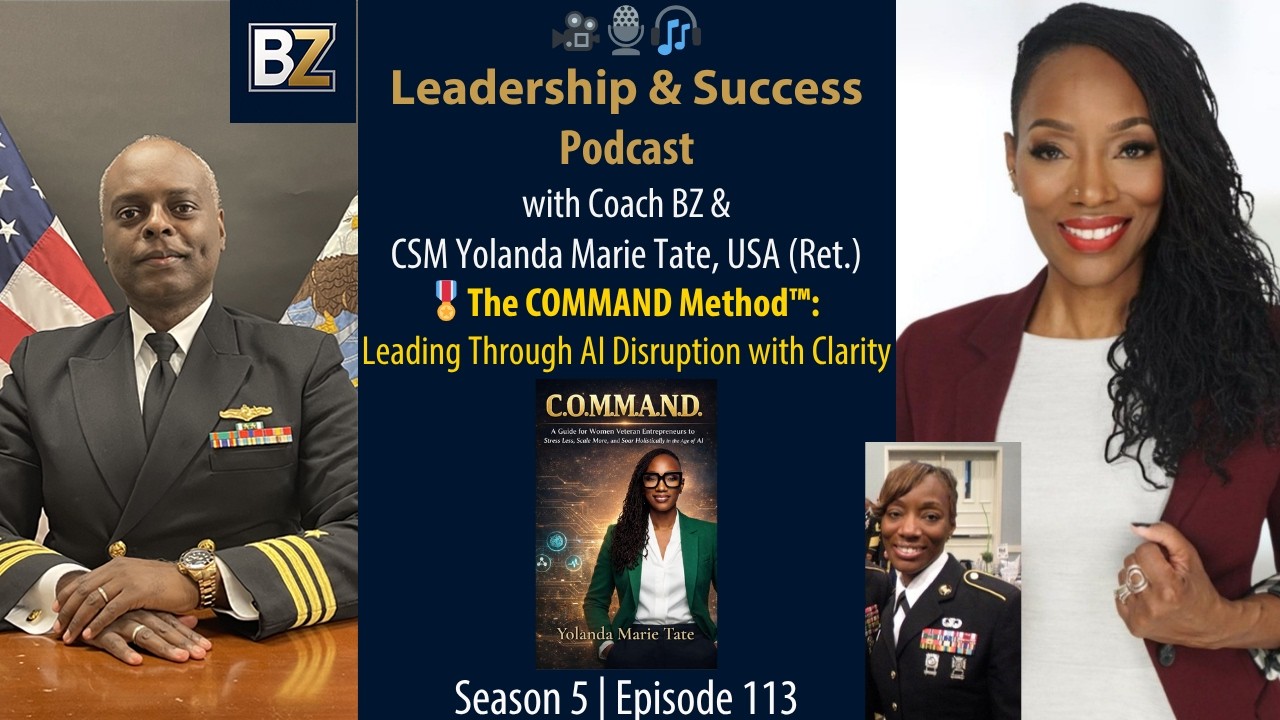
Retired Army Command Sergeant Major Yolanda Marie Tate discusses her 29-year military career, leadership lessons from serving as Garrison Sergeant Major at Fort Bragg, and her Command Method framework for integrating AI into leadership. She addresses the invisible pressures Black women face in male-dominated fields and argues that holistic wellness—physical, emotional, spiritual, social, financial—is a leadership advantage, not a luxury.
Chapters
Hi, I'm John Maxwell. When the top companies in the world are looking for trainers, speakers, and coaches, there's one name that stands above the rest, and that's Maxwell Leadership. Our certified team members have gotten proven results for companies all over the globe, and our reputation, I'm proud to say, is second to none. Some of our members have risen to the top of their profession, including the one you're going to meet today. I proudly introduce you to my friend Bob Fabien Zinga.
Welcome to the Leadership and Success Podcast with your host, Coach BZ, where we help you lead with purpose and succeed with impact. If you're ready to grow into the kind of leader others want to follow, this podcast is for you. If you're determined to elevate your success and leave a lasting legacy, this podcast is for you. As my mentor, Dr. John C. Maxwell, reminds us, everything rises and falls on leadership. Our goal is simple, to inspire you, challenge you, and equip you with insights that can transform the trajectory of your leadership journey. Welcome aboard to Welcome to another episode of the Leadership and Success Podcast with Coach Yolanda Tate.
Hi, I'm Yolanda Tate, a 29-year U.S. Army veteran, a passionate advocate for holistic health and wellness, and the founder of Elevate to Wellness, a corporate wellness firm. I help women veterans or IT professionals over the age of 40 show up consistently healthy whole by prioritizing their holistic well-being. I know the challenges faced by women over 40, especially those in demanding careers, but in the process, we tend to neglect ourselves, putting our own well-being and wellness on the back burner. I understand this struggle all too well because I've been there myself, but I want you to know that it's okay to prioritize yourself. It's not a selfish act. In fact, it's essential for your well-being and everything you care about. Through Elevate to Wellness, I offer workshops designed to empower and support women like you. We dove into the world of holistic wellness, learning to make positive behavioral changes that nourish our minds, our bodies, and our beautiful souls. Together, we'll create a safe space where you can embrace self-care without guilt, where you can understand that taking care of yourself is the foundation for taking care of others while continuing to excel in your career. So if you're a woman over 40, a veteran, or an IT professional seeking to make positive changes in your life together, we'll discover the power to elevate, transform, and thrive in wellness, unlocking the path to a healthier, more fulfilled life where we can rise together stronger, wiser, and supporting each other along the way.
All right, everybody, welcome to our last episode of today, very special episode. We have a great, great guest waiting for us in the green room. As you know, how is our custom here, we always start with what we call moment of gratitude. This is where we take just a moment every time we meet to be grateful. And from the I guess 3 episodes we've had today. You know that today I am really grateful for 2 things. One, I am grateful for the United States of America. We're going to be celebrating about 250 years in just a couple of months, and that's going to be quite a milestone. I think America is the greatest country in the world. Didn't always start right. We are not perfect, but we are definitely the best country there is out there. And number 2, I am grateful that I am still alive today. Because as long as I am alive, there is hope for me. Alright, so let us know in the comments, what are you grateful for today? Let us know where you are joining us from, what city and state, and if outside of the US, which country. And of course, if you got a question for my guest, go ahead and type it in the comments, both on YouTube or LinkedIn, and we will be answering you live. Alright, let me see if I can properly introduce our guest today. I am really honored, privileged, and overjoyed today to be speaking and to welcome Command Sergeant Major Yolanda Mary Tate, U.S. Army retired. As you guys know, I've been mentored throughout my entire Navy career of the last 21 years from E-1 to E-5 by Navy chiefs, E-7, E-8, and E-9. I have great, great respect for them. So today we are going to have a very powerful conversation on leadership. AI Readiness, Wellness, Resilience, and Sustainable Success in High-Pressure Environment. CSM Tate is a retired US Army Command Sergeant Major, AI Readiness Strategist, Mindful Leadership Coach, speaker, event host, and founder of Elevate to Wellness and Elevate to AI. With more than 35 years of leadership experience across the military, enterprise technology, and organizational transformation, she's helping leaders today navigate the future of AI without losing the human side of leadership. She's also the author of the instant bestselling book Command: A Guide for Women Veteran Entrepreneurs to Stress Less, Scale More, and Saw Holistically in the Age of AI. So during this episode, we are going to discuss leadership under pressure, human-centered AI transformation, burnout, resilience, and energy management, the Command Method framework, transitioning from military leadership to entrepreneurship, Women Veteran Leadership in Tech and Business, Wellness as a Leadership Advantage, and Scaling Without Sacrificing Peace or Purpose. Part of what you're going to learn is why AI readiness is a leadership responsibility before it is a technology initiative, but also practical leadership habits for thriving in the age of artificial intelligence. So without any further ado, please help me welcome to the Leadership and Success Podcast, CSM Yolanda Murray. Hey. Good evening. Yes, ma'am, how are you doing today?
I'm doing wonderful. How are you doing?
Great, great, great. It's really such a great honor and privilege to be speaking to you. Maybe to get started, uh, what are you grateful for today?
I am grateful for— you know what, today was a day where the sun was shining and the rain came out, and I'm thankful for the rain. Because a lot of people don't talk about the rain. They'd be like, it's a rainy day. But I've learned throughout the years to really enjoy the rain because it's a calming feeling and water is healing. And so I am thankful for the different weather that we get to see each day because it's beauty and it reminds me of God.
It's beauty. Wow, that is powerful, especially in California. We definitely need more rain here for sure. I am so glad most of the grass throughout the state is green again. For a long time it was all brown. It was so ugly.
Oh yeah.
What is something about you, CSM, that most people may not know when they first meet you?
Hmm, may not know when they first meet me, because I'm pretty open about a lot of things. Um, I would say, well, people know me know this, but now since I've been older, that, um, I used to bodybuild. I used to be really serious about it. I mean, I was— I never took any steroids or anything like that, but I mean, it was my life. I mean, I was out, you know, fitness, working out, bodybuilding, nutrition, uh, personal trainer, all that. Um, yeah. That was my early years.
So that's really powerful. But I guess part of your business entrepreneurship now, you're also helping other women get healthy and stronger. That's beautiful to see. Wow. So when people hear command sergeant major, they immediately think strength, discipline, authority. But who were you before the rank and the responsibility? And for those listening again, that's E-9, that's the highest rank for enlisted. No, less than 1% of enlisted folks end up at that rank. So congratulations, ma'am, that is a huge, huge, huge accomplishment. So who are you without the rank and without the responsibility?
So I have to go back because before I ever wore rank, before I even came in the military or anything else, I was just that little girl from Philly. I was Yanni. Nicknamed that little girl running the streets of Philly, um, just trying to figure everything out. I mean, very curious, very ambitious. Um, I knew from a young age that I wanted to see the world and to get out of Philly. Um, I didn't really understand it at the time. And when I say get out of Philly, I just mean, you know, really to see the world, because I love my city. Everybody who knows me knows that I'm a big Eagles fan. I love Philly. I'm always in green. It is, you know, It's part of my life, of who I am. But I kind of at an early age that leadership was important. And the reason why I say that is because at age 10, my grandmother passed away.
Such a—
yeah. And when that happened, as a young kid, I didn't really understand it. But my mom and her, my aunts and my uncles, they all came to me. Now, I was a 10-year-old little girl. They would come to me and just tell me their problems, like how they feeling. And at the time, I couldn't put language around it. I didn't understand that that was a part of leadership, but I just knew that they saw something in me that they felt comfortable. They felt my calmness under pressure. And now, as I'm older, I realize that now. But I had no clue what that meant. You know, I was young, but that leadership has always been there. And, and I've just heard people say that to me as well.
Wow, that is quite powerful. Now, I believe you joined the Army in 1989. What inspired you to join, and why the Army and not the Navy or some other branches?
So I'm gonna be honest, the recruiter. You know, when you're in high school, all the recruiters come and they talk to you. And then plus I had a cousin who is like my brother, and he is a year older than me, and he went into the Army first. And so he just came back and was telling me all the positive things about it, and I was just like, wow, I want to do that. And, and it was just no doubt in my mind that I wanted to join the Army.
Do you come from a military family? Grandparents? Anybody else?
To be honest, no. So I told you, it's my other cousin. I've had, I've had 3 other cousins who had joined the military, one before me and 2 after me.
Wow.
That's it. And so, no, we are not a military family. When I tell you we from, we from Philly, we from the streets. And it is just, it was just interesting that I gravitated to the Army. But again, looking back at in hindsight, it was because I kind of gravitated to structure, to leadership, to teamwork, to, you know, all of those values.
Wow, that is powerful. So was there maybe a defining moment early in your military career where you realized, I am not just here to serve, but I am here to lead?
You know what, it's not one big dramatic moment. There have been little patterns over time that I saw. Um, like when I first came in the military, um, being in basic training, doing all that, I know people were like, oh, I can't stand being in basic. We did all— I thought it was— I actually thought it was a joke at first, but then I was like, hold up, let me take this seriously. Let me take this, because I did like the discipline and everything else. So I started to understand and really watch the drill sergeants and what they were doing. And I was like, you know what, that's going to be me one day. Not because to be able to, you know, control people or anything like that, but because I saw the difference how we were when we first came in raw off the street to 9 weeks later being totally different. And I like seeing that transformation. And so it was one of the defining moments when I first joined the military. Um, being a drill sergeant for 3 years was a wonderful experience. And it's, again, like I said, to see people change when they come in and to have that respect and to see them try to emulate you as well. And here I am, I'm on my 20s being a drill sergeant.
Wow.
It's just a big responsibility that I did not take lightly. And then Wow. The other defining moment was when I was the Garrison Sergeant Major at Fort Bragg, North Carolina, from 2012 to 2015. Um, that being a senior noncommissioned officer, being a Command Sergeant Major, I had already had a battalion deployed several times, all that. But coming over and being the Garrison Sergeant Major of such a prestigious installation was wonderful. I mean, I had a powerful team just working with the civilians that were there, just seeing the impact that we were making in soldier members and service members' lives as well as civilians and their families was just really powerful. So yeah, those were—
yeah, I believe it's less than 5% of people who join, uh, any branch of the military end up being like a Garrison Sergeant major. That's, that's really an awesome, awesome responsibility. What was one of the most challenging things you went through at boot camp?
You know what, I didn't really think it was challenging.
Wow.
The physical part of it, I was— I've always been a physical person. So the physical part wasn't at all. Um, I think The biggest thing for me was the team, learning how to work in teams.
Mm-hmm.
Um, that was the big thing because, you know, when you're growing up, yeah, you ain't thinking about working together with a team and do that. You're trying to do your own thing. Um, and so I think that was the biggest challenge and maybe getting up early.
Yeah.
Wow.
That is really Something. You are the first person who told me you didn't really have any challenges. Now, in the army, you guys don't have to qualify as a broadcast swimmer, right? No, I guess in the Navy we have to because we are usually at sea. That was very challenging for a lot of people, especially Black people. But okay, let me, let me ask you this. What about, did they make you pretty much not sleep the first 2 or 3 days? Pretty much go like 24 hours? Just marching around and—
I mean, learning all that is hard. It's not challenging.
Yeah, but I think my first day I only slept maybe 2 or 3 hours at most, and then they got us up at 5:30 again.
Oh yeah, yeah, that was hard. I wouldn't say it's hard, I would just say you gotta get used to it.
Ask you that, in the army, do you have to go through the gas chamber too? I think you do have to, right?
Yes.
That didn't shake you up? Scare you a little bit or anything? No, you were fine?
I ain't gonna say I was fun. You know why? It did— well, in basic training, you know, you'd be like, oh my gosh, this is— this is hard, it's going to be hard. But I thought it was going to be worse than what it was.
Wow.
But when it did get me is when I was a drill sergeant and I had to actually run the gas chamber and bring people in and do it. And so you're going in and out of it. Then it was like, okay, yeah, it's a whole different thing than just coming in for a few minutes, taking your mask off, breathe, and then back out.
So, wow, that's cool. So I'm sure you probably broke in your, uh, uh, boots right before you, you went there, because so many of my peers, they had a lot of blisters, uh, because they were wearing those boots for the very first time in their life. And we just kept walking and walking and walking. Look at us, that's all we were doing, walking and singing and marching everywhere. But anyway, wow, okay.
Uh, no, I can say this about the boots though. Um, yes, they hurt first time to wear them and all that, but for me, I came in on the delayed entry program, so I came in a year before I actually went on active duty. And so I was in the reserve for a year, so I got to, you know, break in boots a little bit. Get used to it. But yeah, they did mess up the beat. Mess up the beat.
Yes. Wow. Now, CSM, you have led soldiers across multiple high-tech environments for nearly 3 decades, right? 29 years. What leadership lesson from the Army still guides you every day?
Um, to listen before making judgment or final decisions. Because, you know, the first— when people come to you with things that are going on, some challenges.
Yes.
It's never the first thing you hear is not always the truth. You got to be able to listen, have empathy, and really find out what the root of the problem is.
Yes.
So for leadership, to me, during that time, that still sticks with me is being able to listen. Because so many times we want to speak before you even heard what that person said. You're already formulating in your mind how you want to come back, what you want to say, what the reaction is going to be, instead of really just hearing the person. So that's a part of leadership that I got from the military that still stays with me because I've seen So many people do it wrong.
Yes. Wow, that is really powerful. Now let me ask you this, as a woman and a Black woman in the Army, you know, because to be frank, uh, the military initially it was for white men only. Now you rising all the way to the very, very top of the senior enlisted leadership, what invisible pressure did people not see behind the scene?
Oh, it's a lot. So you hit on something big when you talk about being like a female, and especially I was in the engineer branch and being the only female in a leadership position, and a lot of times being the only Black female. Yes, with a lot of challenges because it was always your male, and to be honest, some of your male part counterparts that were trying to hold you back. But then there were other ones that were there that were supporting you. That was your brother in arms and everything else. Um, the biggest challenge for me, though, was being a mother. Being a nurturer in the military is hard. And I talk about that in my book because, you know, the mission is always first.
Yes.
And when you have children, And if you don't have a good support system, that makes it even worse. But you know, there were a lot of things that I missed from my son's childhood that still— that I feel guilty about to this day. And he's 30 years old, but I've missed all of his high school years because of deployment and putting him in the military. Yes, that's my baby. Um, and so yeah, I've missed all of that. And so that was the hardest part, is putting your family— like, not making your family first, making the Army first over your family. Um, that was the biggest challenge for me. Yeah. And that's that invisible pressure that we don't see. I mean, that you're trying to be everything for everybody else, and you're carrying all of the weight of the world on you because you don't want to let people down, you know. You don't want to let your soldiers— you don't want to let unit down, um, especially if, you know, something is going on with your family. You try to hide all that and make it seem like you got it all together when you really don't, falling apart on the inside. And I've had many breakdowns. Yes, when I'm by myself, away from everybody, but out in front I was Command Sergeant Major Tate, you know, always having it together.
Wow, thanks so much for sharing that because I had the opportunity of becoming a commanding officer, but I really believe that, uh, in the military it's not just the service member, right, but it's their family, their spouses, their children. Everybody is serving, everybody is sacrificing. And, uh, one thing I enjoy more than anything else was to write letter of appreciation to the families of my people. That really made me feel so great. Uh, but wow, it's, it's, uh, yeah, I think most people— it's what, less than 1% of Americans serve in the military? So most people have No idea what it really takes. None.
Wow.
But talking about leadership under pressure, you've led thousands of soldiers, civilian, and enterprise teams. What separates leaders you believe who create trust from leaders who create just compliance?
Okay, say that, the last part again.
Uh, the difference between leaders who create trust and those who only create compliance.
Oh yeah, so I'll say this: in the military, you learn quickly who not to be, who not to be, because you know all they do— those leaders only wear their title, they wear their rank, they don't care about people at all, they don't listen to their people, they are not bring teamwork together, anything like that. So that's one thing. You cannot build trust if you do not do the things that you are asking people to do.
Yes.
And if you're sitting there as a leader and you're saying that you want me to do a standard, but you can't even make that standard, how can I trust you? And how can I respect you as a leader.
Yes.
Now I understand people get hurt, people have different things, you know, but you can't sit up there and tell somebody to do something that you're not willing to do yourself.
Yes. Wow.
So that's the difference for me. You got to build that trust. That trust has to be earned. People have to know that you care for them, that you, you still are strict, you still are making sure that they do what's right, that they're ethically, morally doing everything that's right. But at the same time, you have to be able to tell them when they're doing something wrong, and not just tell them, but show them how they can correct it and give them time to correct it.
That is powerful. But now, there are many times in the military where you do have to build that trust within your team, but do it quickly because you're about to deploy, or special operation, or whatever it might be. What, what do you do when you— the stakes are high and you have— you don't have no regular time to build trust and know your people and, and all of that? You have to do it pretty quick, quickly. What do you do?
Get to know people. Get to know your team. You have to talk to people, find out about them. So that comes back to that leadership again. How can you be a leader and you don't know nothing about your soldiers, your, your service members that are a part of your team? You don't talk to them. You don't even know about their family. You don't know what's going on with them, you know. So it's important to get to know the people that you work with, the people that you're leading. Yes, it shouldn't be a mystery at all. And I can't trust you if you don't even ask me questions about me. You don't even know about my family. So if anything happens, how can I come to you and know that you're gonna have the right decision? Or if I need to get some kind of advice or mentorship from you when you don't know anything about me. Hmm.
Well, during your time at Fort Bragg, you had a pretty prestigious, um, position there and, uh, US Air Force Pacific. How did you maintain morale during stress, uncertainty, and operational pressure?
So two different ones. So at At Fort Bragg, I was a Garrison Sergeant Major as part of MCOM, which, um, is Installation Management Command. I was the U.S. Army Pacific Ocean Division Corps of Engineers Sergeant Major over Hawaii after that. Both of those positions required you to not only be a senior leader for service members but also for a lot of civilians.
Yes.
And so you have to also learn how to operate as a leader with civilians versus with service members, which is two different things.
Yes.
As we know, you know, those civilians were prior military, but some of them may not have served in the military that long. So you can't have those same demands that you have on service members as you have on the civilians. And just same thing with leadership. My civilian— the civilians that I work with, they respected me because I came and I checked on them. When you check on people, just to ask them how are they doing, how are you feeling today, is it anything that you need from me? Actually going into the daycare centers at Fort Bragg and checking in on all of the staff at the daycare centers. It made them feel safe, made them feel like they were a part of the team. It was like, you know, the Garrison cares about us. They were coming to check what we're doing, you know. So it's like things like that. I am the type of person, I am always going to check on people. The mission is first, yes, but people come before the mission because they won't complete the mission if you don't take care of the people first.
Wow, that is really, really powerful. Really, it doesn't take very much, but it makes a huge, huge impact.
A huge difference. A huge difference.
I think it was Maya Angelou, right, who said that people will forget what you say, but they will never, never forget how you made them feel.
Yeah.
Wow, that is powerful. Now, when I was a commanding officer, one of my leadership mantra was, uh, mission first, people always. I believe we stole that from the Army. We borrowed it from the Army. Uh, so many leaders, they know how to drive performance— mission, mission, mission— but you know how to protect people while driving that performance. How did you balance mission execution with the care of your team, taking care of people at the same time?
At the same time. Okay, so again, you have to understand your people. So compliance can get people to follow— I always say that compliance can get people to follow instructions, but that trust gets people to stay committed, especially when the mission get hard and especially you're under pressure. So leadership is not just about being a good leader when things are calm. It's about showing up when it gets hard, when it gets tense. And that's when people are really watching you as a leader. I've realized that, that that's when decisions matter, you know, is when your presence can determine what happens, even after you have left a situation. People don't understand how powerful your presence is. And sometimes I think that people— if your presence is known and felt and people trust you, then they will work better under pressure because they know that you have their back. They know that you're going to make the right decisions because it always comes down to making the right decisions for the team. And, you know, sometimes you have to be— people have to be able to trust you to know that you're going to carry the team through the storm. This may get rough, but they know that you're going to be there and that you're going to carry the team all the way through. Group.
Wow.
And so that's what's important to me.
That is really powerful. And most often we really focus on successes, and you've had so many. Again, going from E-1 to E-9, retiring after 29 years, and now you're an entrepreneur, your best-selling offer, on and on and on. So many accolades. I believe you didn't— you earn an award recently, I think I saw on LinkedIn. But anyway, just doing wonderful, wonderful things, and people feel like you've never failed ever. I guess the question I have for you, if you're willing to go there, what leadership failure or painful lesson transformed the way you now lead people or your businesses or even as a civilian today?
Oh no, I failed a whole bunch of times. There are times when I look back on some of the decisions I made as a leader that didn't put people first. It was all about getting stuff done. And there were times where I'm the type of person, I like stuff to be not perfect, but I like it to be done.
Mm-hmm.
It's time to execute. Let's execute.
Yes.
And so sometimes my expectations are so high that I put them on other people, not knowing that that's not their expectation. And so there would be times where I would tell someone to do something and they didn't do it. And then I just did it just to get it done because I wanted to be done and I wanted to be done right. But then when I look back on it, or they came to me and said, well, you didn't even give me the chance to do it.
Yes.
And I learned if you didn't even give me the chance to do it or you didn't really give me the right direction, you just assumed that I knew.
Hmm.
And so I had to take a step back a lot of times on that and be like, how can I had changed that situation around? How could I have allowed them to fail themselves in order to grow instead of just going ahead and doing it for them? So things like that I've done plenty of times and felt that I've made some bad decisions when it comes to myself, like pushing myself, like you just said, like working from 0 dark 30, 4 o'clock in the morning.
Yes.
Working and don't get home until after midnight and then wake back up at 4 o'clock in the morning, you know, stuff like that, when you're not taking care of your own holistic wellness. And I'm not just talking about physically, I'm talking about mentally, spiritually, socially, all of that.
So yeah, we're going to be talking about that too because that is part of one of your businesses now too, which I think people really need to hear I feel, because sometimes people, they work, work, work, but you do need to take time off and replenish as well. We're talking about elevate2wellness.com. Hopefully we're gonna get to that also. But let me ask you this, from what you describe, it looks like as a leader, we really need to also learn to lead with humility, don't we? Because in a way, because my dream when I was a seaman at boot camp, I wanted to even become a chief, is, is 7th or 1st Sergeant for the Army, or a commander, Lieutenant Colonel. That was my dream, senior enlisted or senior officer. But it looks like the more senior you become, the more responsibility you have. There is a lot of opportunity for you to get the big edge. Your ego gets just a little bit bigger. Hey, I've done it, I'm wearing the rank, I have the uniform, or whatever. But then at the same time, it seems like you need to be even more humble, especially when you are responsible for the people. That the commander of the Navy assigns to you. How important is humility in leadership?
I think it's very important because, again, you can't wear your rank on your chest or think that your title is going to mean everything. And so that comes back to that invisible pressure that she was talking about too. Especially as a woman in the military, because a lot of times when we have to carry that excellence out, people thinking that we're arrogant. And so sometimes people will label your confidence as being arrogant or not being humble, or sometimes they'll label your standards as being harsh, or that emotions may be a label for weakness. And so I think as a leader, being humble in everything that you do, that you have to understand that there are people who went before you, there are people who are after you, they are watching everything that you're doing.
Yes.
In the military, you know, like we said, people learn from bad or good leadership. What do you want to be? And see, I was like, I do not want to be that bad leader.
Yes.
People—
wow—
bad habits and see that I'm not humble, see that I'm putting the rank before anything else, see that I'm not listening, see that I'm not a team player, see that I'm always trying to stab other people in the back just so I can get ahead. That's not qualities of a good leader, and so I never wanted to be that.
Now, I really believe you were a trailblazer in your military career. Sometimes, like you said, the only woman in the entire, uh, engineering, uh, function. Were you conscious of that, that you were really a trailblazer, that you were doing the work not just for yourself but for a lot of other women and women of color who are going to join the Army after you, you were setting an example?
Oh, yeah, definitely knew that. I definitely knew that. When I became a Command Sergeant Major. So after I did my first certain time, and I went to the Sergeant Major Academy, I was one of the few that came out of the Academy as a Command Sergeant Major. Wow. So went in as a promotable Master Sergeant, came out as a Command Sergeant Major, went straight into a battalion. Uh, and I knew that being in the engineer field where it is mostly white males, um, and it's not a lot of females, period, whether white, Black, whatever, Hispanic, whatever, that make it to Command Sergeant Major. I knew that I had a lot of people watching me, and I knew it was a lot of people that wanted me to fail.
Yes.
And for me, I'm not going to give you that satisfaction. I will push myself, work hard, do what I got to do because I know it's setting an example for other people that's coming behind me. And so one of the big things for me is that as a leader, one of your requirements is that you have to be a mentor. You have to be a coach for other people. You have to make yourself available, especially for myself, for other women who are coming behind me. Yes, just so they know that, hey, I understand the struggle, I understand the pressures that you're going through, I'm here to help you, I'm here to support you. And so that was one of the key things for me. So yes, I knew the responsibility that I had, man.
Uh, knowing that you have such a key position and there might be some people even within your own command who really don't wish for you to succeed What was kind of like the first thoughts that came to your mind at that moment once you realized that?
I'm gonna be honest, my whole military career I have been truly blessed, especially when I talk to other people, that I, I've been in some really good commands with some really good people. However, I had one situation with a leader who was not humble, with a leader who took people for granted and thought it was all about himself. And that was a bad experience for me, but in the end it turned out okay because that leader got relieved for all of the negative things they were doing. And, um, that was the only bad experience that I had in the military working with one. And, um, it was a hard thing, but during that time period, I still had to set the example for the soldiers that were in our unit, just to let them know that I was not going to fall into that trap, that I was still do the right thing, and I still was going to lead with integrity and, and be humble in all of values that myself and the Army gave us.
So, yes. Wow, that is really powerful. Thank you so much for sharing that. I can't believe it's already been about 40 minutes. So we have about 20 minutes left.
Oh, wow.
Talked about the book yet. I could be talking with you, CSM, for like 3 or 4 or 5 hours, but we're not going to do that today. So let me talk about the book, AI Leadership and the Command Method. So I guess the first question I would like to ask is this book here, Command. What inspired you to write the book? Why did this book have to be written?
It had to be written for me because first, like we've been talking about, I know what it feels like to be capable but at the same time overwhelmed.
Yes.
And there are a lot of women, you know, I talk about women veteran entrepreneurs because that's my lived experience.
Yes.
However, this book could be for anyone, but that's my lived experience. And for a lot of women who have transitioned out of the military, um, we carry, you know, we have that discipline, we have the serve, we have service, we understand all that. But I wanted to write something that spoke to the whole woman, not just you as an entrepreneur, but In order to be a better entrepreneur, in order to be a better you, how can you operate differently, especially in this world now where everything is changing and shifting, um, in the environment that we're in? A lot of women are using their jobs, especially Black women that's in government, you know, like, how can we, in all the chaos that's around us still be able to sustain and be capable and not overwhelmed by all of it.
Wow.
And so that's where the book came from.
That is really, really powerful. But really, again, congratulations, because many people write books, but your book became an instant bestseller on Amazon. That's not easy to do. And I believe this is your first book, right?
Yeah, this is my first.
That is amazing, amazing. I pray that you get some of those big, um, years now that people know that you can deliver, and, uh, that is just, uh, awesome. Congrat— congratulations again. But I guess another question I have: why are women veterans and entrepreneurs uniquely positioned to thrive in the age of artificial intelligence, you think?
Um, because we already understand systems. We understand people, processes, and systems. That's what I tell everybody. People This is the systems, you know that as a veteran. And when I transitioned out the military, that's what I did when I went into— because I transitioned, came out the military in 2018, and I knew being in the, the DC DMV area, you know, that there's a lot of tech opportunities. And I had a client, so I was like, I, I don't know tech like that, even though I do, because I've always been a techie. You know, I was like, I know people, processes, and systems. And if you do that, then you can learn the technology.
Absolutely.
Learn the technology. But what you can't learn is those leadership skills that you got to, you know, really practice, really know. And after serving 29 years in the military, you have to learn how to leverage your strengths. And those strengths are that you know, discipline, service, teamwork, all these things. And I'm not saying that the military is the greatest because there's some things you got to unlearn when you come out the military too. Yeah, but, but I will say all of those things, if you can lean into that, then AI, tech, emerging tech, all these things, if you have, you know, if it's something that you like doing, then, you know, you can be ready for it. And when they talk, talk about the age of AI, all of us, yes, have to understand AI. AI is not going anywhere. I don't care what anybody say. People like, the AI is taking our jobs.
Yes.
Yeah, there are some jobs, just like when computers first came out, you know, you gotta learn what you gotta do in order to pivot and I always say that Hidden Figures, the movie, I love that movie because it shows how as Black women, we have to learn how to shift and pivot and then learn how to program these computers. So it's the same thing with AI. It's still fairly early, even though AI has been around for a while. It's just now it's more advanced when it comes to GenAI, being able to work with agents, all this other stuff, Bob Cotten, all of these things that's happening now is true. But if you could just learn a little bit about AI, yes, it will help you out. So that's why I think we're ready. We're ready because the world is changing.
That's really powerful because also you have a great engineering background, which helps a lot, and which in Hidden Figures, there were quite a few women who did that too. Why, why do you think my audience should watch this movie?
Because of what you'll get out of it. You'll get out of Hidden Figures is one of those movies where you be like, oh my gosh, I did not know that Black women were behind this, this, this NASA program. I did not know that. And when you learn your history and when you see people, especially for young Black women, um, when you see yourself on screen or in history overcoming all of these, these things, especially in a system that has always worked to hold us back, and you see Black women overcome, it's just something powerful about it. It's just absolutely and you know that you can do it too. Yeah, it gives you—
yeah, yes, I need to watch that movie again. I have two daughters, right? Sometimes I joke, if it wasn't for our family dog, I'd be the only male in my family. But, uh, yeah, it is really amazing to me. We are like in 2026 now, and still in America, the most powerful country in the world, women make a lot less than men with the same background, same experience, same education, everything. So I think something is wrong, and I believe my two girls should be able to do whatever the heck they want to do and get paid as much as a man, right? Just being a woman shouldn't make it a liability or be a disadvantage, especially in 2026. You know, that just doesn't make any sense to me at all. With all of the great work you are doing, there are still, I would say, a small percentage of of some women, I am thinking probably the mindset, right? The mindset kind of traps them or keeps them from— keeps high-performing women veterans kind of stuck in overwhelm. I guess my question for you is, what are some of those biggest mindsets that would trap people who are definitely high-performing people but kind of stuck?
So in my book, I talk about they— a lot of us stay stuck because of burnout in the Superwoman cape syndrome. So we— yes, because we want to be that Superwoman for everybody. Like, we wear that cape, like, again, like a badge of honor. Like, burnout, like a badge of honor. But we're really working from depletion, you know. You think that you're you're strong. You think because you haven't broke down, you think because you can carry all these things that it means strength. But really, is that strength? You can't be strong and then your wellness is not where it needs to be. Yes. And so I think for a lot of us It's that burnout. And we may cause that burnout ourselves because we're always putting everything first before our own wellness, our own well-being. And when I'm talking about wellness, I'm not just talking about physically. I'm not just talking about eating right, all that. I'm talking about spiritually.
Yes. And emotionally too.
Yes. Taking time for yourself. There's so many women especially that don't take time for themselves. And I'm not talking about just, you know, uh, self-care, getting a manicure, pedicure, all that stuff, which is important, but I'm talking really taking time to sit down and just, just enjoy yourself. Sit down in silence, not meditate, just get still instead of do everything.
So, wow, that's powerful. That's why I really love the work you do with Elevate to Wellness. I think you need to hire me to be your spokesperson. I've already, uh, a couple of times, but, but I think it's so critical, so important. And, uh, I guess we have a thing too, especially for Black girls too, right? There is this thing in society that trends from time to time, like Black Girl Magic, which I guess it is a real thing. Maybe Black women have that kind of superpower. They've definitely, you know, really even carried I believe the civil rights movement, we always talk about Martin Luther King and he definitely deserves all of the credit and all of that, but there were a whole bunch of women who really carried that movement forward who sometimes don't always get all of the praise and flowers they deserve. So I guess what I'm asking you, if there are Black young women who are listening to you right now and they look at you, man, you've gone from zero to 100, uh, in a CSM in the U.S. Army. Now you have your own business, not just one, but many businesses, and, uh, Amazon best-selling author and, and all, all of that. And they are just kind of dreaming. If you had the ear of every Black girl across America, let's say for a minute or two, what would you tell them?
Don't be afraid to dream. Don't be afraid to dream and use your imagination.
Yes.
Because if you can see it, you can be it.
Wow, that's powerful.
And if you really want to be it, that means there are some things you're going to have to do.
Yes.
You may have to sacrifice some things, but if it means something to you, you can do it. Nothing can hold you back. It's Wow. Nothing is— it's the sky's the limit, but you have to first see it, believe it, and write the vision and make it plain. That's what the word— yeah, write the vision and make it plain. So see it, yeah, write it down, have a plan for it, and execute it. So dream.
So powerful.
Wow.
I think this is, um, worth the price of admission. That's That's really, really powerful because even in the subtitle of your book, you say stress less, scale more, and soar holistically. Holistically is such a key word. Why was it important to include that word?
Because especially coming from the military, the first thing we think about is physically, are you physically fit? And so for many years, I was all about being physically fit. And I say this because a lot of people, if you are female in the military and you physically fit, I don't care if you don't know your job, because people like, oh, she can run, she can do this, she can hang with the guys, she could— so that's put you above your peers if you fit. But when we talk about holistically, just because you holist— you, you're physically fit doesn't mean that you're well. Yes, because again, like I said, you could be falling apart all on the inside, and what matters is your spiritual wellness, your emotional wellness, because that's within your emotional wellness, as well as social, financial, all these other things. So it has to be a holistic approach. It can't be just one thing. And it doesn't mean that all of these things are going to be equally, because we know they're not.
Hmm.
You got to know in what season, because we have different seasons in life that we go through, different seasons each year, just like seasons change, that you got to know what season you're in and where you need to work on the most. So yeah, that's the thing for me.
That's really powerful. What was one of the hardest chapters for you to write in your book?
The first chapter, because It— the chapter 1 and 2, because it was talking about me and some of the things that I went through and those pressures of being a woman in the military. And like I said, one of those things was not being there for my son during his high school years. And I almost missed his high school graduation because I was doing that time., and, um, I had to fight to take leave and not deploy and come behind my unit a month late. Well, it was 3 weeks later, um, but yeah, and just the joy on my son's face when I came to his graduation because he didn't know I was going to be there. Wow.
And, and so, man, the sacrifice we all do in uniform, sacrifice that we do uniform is real, and people don't realize.
And it's not just with our kids, but even if you're married in the military, if your spouse is not in the military as well, that's another challenge.
Yes, yes.
You know, um, and so they may not understand why you're never home or you got to deploy all the time, and you know, they got to take on most of the responsibility as the nurturer in the home since you're not here. And so it's all these other things that you got to deal with as a woman in the military that, you know, causes a lot of pressure.
That's really powerful because on chapter 1, The Uniform That Became My Skin, and then chapter 2, The Burnout Battlefield: Why Success Is Killing You.
Wow.
Was there a moment when you were writing the book you realized this book is bigger than me?
When I was writing those chapters, because I wrote it, I was thinking about all the other women who can relate to what I'm going through. Yes.
Wow.
I, I can totally see it because I know throughout the years I have talked to so many women who have served. I have a lot of sisters in arms that I'm, um, with. I'm a part of a military auxiliary, and it is many women that talk about this all the time. Wow. So I just wanted to share my experience, my perspective. And there are a lot of people that don't want to share their story or don't talk about their story enough, and I just wanted to give my voice to it. And so, um, all of us, I mean, we all have so kind of story to share, but especially us that have led in the military and have gone through that transition and been somewhat successful on it.
So yeah, so much successful at the highest level. The thing with humility, once you, you say you humble, you are no longer humble. Now you become arrogant. But, but no, great, great job. Bravo. Congratulations. But I guess for the people who are listening right now, if every woman veteran entrepreneur read just one lesson from your book, what would you want it to be?
That lesson would be don't wear burnout as a badge of honor, because that's what we do all the time. We think that we have to push ourselves real hard in order to be successful.
Hmm. Wow.
And for me, again, exhaustion cannot run your life.
Hmm.
You have to realize that you are not weak just because you're tired. You're human. And if you need a break, you need a break. And sometimes You got to take that break and get still in order so that you can be clearer, so that you can get grounded, so that you can actually perform better. And so I would say don't wear burnout as a badge of honor because it's not. It's all right to be human.
Well, the last paragraph in your book, you talked about the final sacred pause. Close the book slowly.
Yeah.
One deep breath. Then ask yourself, what kind of life am I no longer willing to abandon myself to maintain? Why is that important?
That is so important because again, it's all about getting yourself centered and knowing what is really important in your life, what truly Matters. You can be successful, but if your relationships are falling apart— yes, because you put your, your success over your marriage, your kids, or any even friendships— yes, doesn't mean anything. So you have to take time to sit back, pause, and get clear on what it is that you want, what is important. You can still be successful, but make sure that you take time out for yourself. Make sure you take time to build those relationships. Make sure that you take time out to really get to know yourself. You love yourself, but you— do you really like yourself? I always say, do you like yourself? I like being with me. I think I'm a cool person. I can take time by myself and it's okay. So yeah, that pause is so important.
I really love what you are saying, Sia Sam, because there are some people, they become very successful, they achieve very, very high, but then they realize late, I don't even know why I did this. I don't feel happy, I don't feel fulfilled. I may have achieved great, but I've achieved the wrong thing. It doesn't do anything to me. And, uh, wow. And I really love that holistic view that you have. And of course, the book you wrote for women veteran entrepreneurs, but I believe every single person who's listening, including male, need to read this book and you're gonna get something out of it. I guess one question again, the book we are talking about today is the best-selling book on Amazon, Command, right? A guide for women veteran entrepreneurs to stress less, scale more, and soar holistically in The Edge of Artificial Intelligence. Let me ask you this: years from now, let's say in 5 or 10 years, what impact do you hope this book has on women veterans, leaders, and entrepreneurs? 10 years from now, I would say—
that's a good one. I hope 5, 10 years from now somebody still picks up this book and they read it, that that they— this book provides answers to help them to be equipped to find strength without losing themselves in the process. I hope they remember not to chase after titles or recognition, but to, to know that every room that they enter, that they can make a difference.
Yes.
And that they can make an impact.
Wow.
And to carry it with grace, honor their faith, and like you said, with humanity.
That's powerful. Wow. Well, technically we are out of time, so let me ask your permission. If we have to end here, that is perfectly fine. But I wanted to get into the AI section because you do something pretty unique. You include AI and leadership and clarity all in one. And I think especially now everybody's talking about AI. And you are an expert in the field. I would like to get your feedback on that. Can we get maybe an extra 5-8 minutes, or do you need to go?
Oh no, I'm fine.
I'm good. Let me ask this. So AI leadership and the Command Method. I think this is really, really powerful because again, you're doing something quite unique, combining AI readiness with wellness, with leadership clarity. Why do most organizations, you think, misunderstand artificial intelligence transformation?
I think where organizations and enterprises miss the mark is because they rush to get the new shiny tools that are out there without really taking into consideration that, yeah, you may buy something, but you first got to get buy-in from your teams. Hmm. You've got to understand, why is this new tool important? How is it going to help us to be more efficient. I think a lot of enterprises rush to get new technology without really stepping back and realizing how is this going to affect the team. Is it really going to make them more efficient? How much time do I have to take to train them so that they fully understand it, that they use it properly? Because we all know, if you've been in the corporate world or in —space that you got all these shiny tools that you'll never use to its full capacity. And then that's waste and abuse to me because now you're just wasting money. That's so true.
I guess that's that fear of missing out. You're afraid, oh, all of the other companies are using AI, so we should use AI too, even though you don't have a strategy or really nothing in place to ensure your people become successful. Yeah.
And the other thing is with my Kamea method, like I said, it's a framework. One of the first things is C, to clarify that mission. What is the real problem that you're solving with the AI? So if you're selecting a tool, what is it really solving the problem for? How is it going to help your business workflows? How is it going to help with delivery of things? So you got to look at the whole concept of it first before you go ahead and buy it. And you have um, within the organization. You have most CIO teams that are looking at these things, but some of them don't really do it. If you're told, hey, we got X amount of dollars and we need to spend it, you like, okay, let's just buy this shiny thing over there. Yes. Are you really solving anything? So, wow, that nature. So definitely you got to clarify that mission. And then the next thing I say is optimize with the AI. So you AI to reduce those repetitive work tasks that you do. And then so that way you can get more time back to your team, more capacity to get things done. So you want to make sure you're getting the right tool that's actually helping with all that so that the most important things can get done by the humans. So there are always going to be humans needed. I got to stress that again. AI is not going to take over everything because you still need the people to be able to give the AI what it needs, the right prompts, the right information, in order to get the right results back.
Powerful, powerful. So I like that a lot. I think it ties into the next question I had for you, because something you have said— you said that AI readiness is a leadership responsibility before it is a technology initiative. Can you unpack that for us?
So when I'm talking about it's a leadership responsibility. As a leader, you have to be able to understand— how can I say— still be a steward of, of the technology. And so you have to be able to lead your team to understand why this technology is important. Have to be able to say, this is what we're going to get out of it, be able to show them you have to set that example first before you can learn the technology. Because like I said before, you can learn the technology. That's not hard. That's not the hard part at all. The hard part is leading people through it when they need to adopt it, when they need to sustain it, when they need to maintain it, when they need to be able to use it properly. So, you know, the leadership part is always important. That leadership is always going to be the most important thing because you're dealing with people and people are important. And so when we talk about that humanity, you have to be empathetic to people's needs. How is it really helping them? How can you make it better for them? And if somebody comes back and they give you feedback after they do some pressure testing on a tool and they're like, well, this really didn't work, or whatever it may be, you as a leader, you got to be able to sit back and listen and understand it, and then be able to adjust so that you make the right decisions. So leadership is powerful.
That's, that's really powerful. And you came up with the Command framework, Command method, which you did trademark. Congratulations on that. Can you walk us through your Command method framework, and also which part do leaders struggle with the most, in your opinion?
I think— okay, so I said the C, clarify the mission. O, optimize with AI. M, merge human with tech. The other M is master energy. A, anchor your systems. Um, N, nurture longevity. And then D, deliver with presence. So the one I think that leaders struggle the most with is the master energy. And the reason why I say that, because it comes back, because it's all about people. Yes. And it comes back to, as a leader, when you are adopting any kind of new technology or tools or anything into your system, because again, you have to know people, processes, and systems. Mm-hmm. Um, not paying attention to the burnout. Of your workers, how people are feeling, what they're doing. Not paying attention to decision fatigue. Yes. Not paying attention to the human cost of change, because change can be difficult for people. You know, you've been in an organization, say, for over 10 years, and y'all used to doing something one way. And then, then something new comes in. And now everybody got to change their mindset, the way that they work, the way that they think. You know, it takes time to do that. You just can't just bring stuff new on people. And so, yeah, I think that master your energy is so important. And then the other thing is nurture longevity, because we gotta create sustainable practices so leaders and their teams don't break under pressure, don't break under progress, because even progress can break you, you know, if you're moving too fast. And we know that technology moves fast. But if you're moving too fast and you're not ready for that, then, you know, you got to be able to put things in place to help people to be able to sustain the, the, the movement.
And so, yeah, so insightful. Thank you for sharing that. Last question I'm going to ask in this segment is, do you believe artificial intelligence will make leadership more human or less human?
I think it depends on the individuals.
That's a good answer. Individual.
I mean, you a leader that understands, you know, what I just talked about as part of the Dan framework. If you understand the importance of always taking care of people, being empathetic to their needs, um, understanding, um, um, Being proactive. That's the other thing, being proactive and taking initiative and responsibility, um, especially in your circle of influence. I think it's an individual thing. I don't think that the AI is going to make you less human. You're less human because that's the way that you operate. Powerful.
Basically, always be in the driver's seat. AI can assist you. But especially in the military.
Yeah, AI is a tool. I want people to remember that AI is a tool. It is not the be-all, do-all. You are still the one, like you said, in charge, in the driver's seat. It's there to support you. It can amplify some things. It can amplify your needs, your wants. It can show you your gaps. Person, but you still are responsible for it.
So that, that is quite powerful because I know, uh, in Silicon Valley now with, uh, agentic AI, sometimes they try to have AI not only, um, provide the recommendation but actually make the decision which recommendation to follow without any human oversight, just automate the entire thing. I don't think we should do that in the military, especially when it's it's a question of life or death and all of that. We always need humans in the loop. Okay, to finish the show, we're going to do this rapid-fire question. So I'm going to ask a question, answer as quickly as you can, as short as possible. And I'm going to ask maybe 4 or 5 questions really quick. It's going to take only about 2 minutes. So talking about AI like we just did, do you believe in AI utopia or dystopia? Is AI going to be the end of the world, going to kill all of the people, or it's going to be an age of great prosperity?
And, uh, I think it's going to be a balance of it, but it's not going to take over the world.
No. Yeah. Okay. All right. What does, uh, leadership mean to you today?
Stewardship under pressure.
What Army value most shaped your life? Selfless service. Wow. What is one habit that protects your peace?
Morning check-in before the day starts. Hmm.
What is one misconception people have about strong women leaders?
Hmm, that strength means we don't need support. Hmm. What book changed your life? The 7 Habits of Highly Effective People.
Yeah, Stephen Covey. Yeah, we, we love that, that book here. What does success look like now compared to 20 years ago?
Hmm, 20 years ago was about military rank achievement. Now it's about peace, impact, alignment, and legacy.
Wow, powerful, powerful. Okay, the last question, uh, when your military and leadership journey is fully written What do you hope people remember most about Yolanda Tate?
I want them to remember that, yes, I led with strength, but I never stopped caring about people. That it was always, like we say, always people first. That I carried responsibility with discipline, but at the same time, I learned how to lead with grace Yes, faith in humanity. Wow. Yeah, that's powerful, powerful.
All right, this brings us, um, toward the end. So, CSM, what can we do to add value back to you? Thanks so much for speaking to us today. And, uh, what can we do to add value back to you?
I would say, um, of course, follow me on LinkedIn @YolandaM Tate123. That is my handle on all social medias, but I'm really just on LinkedIn and Instagram. But yeah, follow me, get the book, really support me as much as you can. But even with your support, I ask one other big thing is to write a review. Be honest about what you got out of it. Send me a DM if you have any questions, any concerns. And then my other thing is I'm all about AI readiness leadership, all that good stuff. If you need a speaker, someone to do workshop or actually just speak at an event about leadership and how we can be mindful about leadership when it comes to adopting AI and AI readiness, I would love to be a part of that conversation. Yeah, that's how you can support me.
Wow. Powerful. The other question I wanna ask you then is, as we close on this podcast today, I'd like to know, hold on, here we go. Oh yeah, here we go. If someone listening today feels overwhelmed, they feel exhausted, they feel uncertain or afraid of the future, what would Command Sergeant Major Yolanda Murray take want them to remember?
I want them to remember that they're not alone, that there are other people that feel that way. And the most important thing that you can do is, number one, like I said before, is to stop and pause. But the other thing is to get into community. It's so much better when you are in the right community that can help you get through it. And I'm not talking about people who are just there taking from you. No, you need to be a part of a community that's going to support you, that's going to uplift you, that understand what you're going through, that y'all can support one another. So finding a good community is so important to help you through it.
Powerful. Before we end, Tia Sam, is there a question I should have asked you I didn't get a chance to ask?
Anything else you wanted to share today? Um, I think we talked about a lot. Oh my God, it was good.
Yes, we did, we did. We actually went over by almost 15 minutes, so I'm very, very grateful for your time. But I do like to end on a very positive note. So what is something you are feeling optimistic about these days?
I'm feeling optimistic about womanhood. And the reason why I say womanhood is because even with everything that's happening in the world, with the shift that's happening, how they're trying to take away rights and all this and take us back, we're thriving. We're still making things happen. We're still supporting one another. I, I like seeing the support of my Black sisters that are out there now that are continuing to make a difference. We're in community. We're still out there with our heads up high, still trying to make a difference, you know. And not just— I'm not just saying Black women, but I'm just saying women in general. Women, step up, understand that you have power, you have impact, and you can always have made a difference. That's really, really powerful.
Well, for a husband of an African-American woman and two Black girls, I must tell you, you guys are part of the 92%. You're right, but the country decided to go a different way. But, uh, now we are going for whatever we're going through. But yeah, we are going to get through it, but I am pretty sure we're going to have to rely on the power of the strength of that Black girl magic again. We will get through it. Thank you. Thank you so much, ESM, Yolanda. I am so honored to be talking to you today. You are definitely one of my mentors, and it's really a great, great pleasure to be speaking to you. So the very, very last question I have for you then is, one word that represents our time together on this podcast today. One word. Insightful. Insightful. And I am so, so grateful. Thank you so much. Appreciate it. Thank you. All right, everybody, this is one for the book. This is the last podcast for today. I encourage everybody to get a copy of the book. Command. Men, women, it doesn't matter. A Guide for Veterans Entrepreneurs to Stress Less, Scale More, and Soar Holistically in the Age of Artificial Intelligence, from Command Sergeant Major Yolanda Miritet, U.S. Army, retired. And make sure to also follow her on LinkedIn and also on her two websites, elevate2wellness.com and elevate-2-ai.com. All right, so that's all we have. I don't think I'm gonna have a podcast tomorrow because I'm going to be speaking at 3 security conferences, uh, in the San Francisco Bay Area. But I will be back Friday, and we're gonna go back to Proverbs chapter 23. We did chapter 22 the other day. Again, this is not going to be a religious study at all. It's just going to be about ancient wisdom and leadership lesson from a book written more than 2,000 years ago. But those lessons, I believe, are still relevant today in the age of artificial Intelligence. So I hope to see you on Friday for our live broadcast. Until then, have a wonderful day. Actually, I want to say one more thing as we close. I think this is important because we've talked really about things that are, I think, so critical, right? This morning I'm talking about the 3 interviews I had earlier. I talked to Coach Nathalie all the way from France, from Lyon, France, and she was talking about conscious leadership, right? It's one thing to lead, but we need to lead with a conscience. And then I spoke later with Kimberly, who wrote the book about the true American story. I think it's very important for us to have the courage to know exactly our story, not just the whitewash stories or what all of the things we have omitted that we don't want to talk about because we need to know exactly who we are as a nation, where we come from, and then where we want to go. I think that is very important. So I really see kind of courage as the red thread throughout all of the podcasts we have today. And then of course, I just talked to CSM today and we talked about commanding the edge of AI, whether you are a man or a woman, I really believe you can make it. You need to decide what your core values are, right? What you stand for, and then have the courage to take the first step forward. And like the CSM says, build a community so you don't do this alone. So that's all I wanted to say. Again, thanks for watching all of the podcast today, and I hope to see you on Friday. Bye for now.
Thank you for tuning in to the Leadership and Success Podcast with your host, Coach BZ. If today's episode added value to your leadership journey, be sure to subscribe, share, and join us again for more wisdom nuggets on how to lead better and achieve greater success. Remember, leadership is the most critical skill of our time. The world will always need leaders to inspire others, drive innovation, and execute meaningful strategy. So why not count yourself among the bold leaders shaping the 21st century. Until next time, stay inspired, stay committed, and keep leading with excellence.
More from Bob

S250:E4🎙️LIVE 🇺🇸America 250: President Barack Obama Leadership, Service, and the Power of Hope






S5:E157🎙️ LIVE with CMD CMSgt Dennis L. Fritz, USAF (Ret.)(Multi Tracks Audio)



S5:E156🎙️ LIVE 🇪🇸 Leadership Lessons from the FIFA World Cup 2026 Champions (Multi Tracks Audio)

S250:E3🎙️ LIVE Leadership Lessons from America’s First Documented Family of African Descent 🇺🇸📖