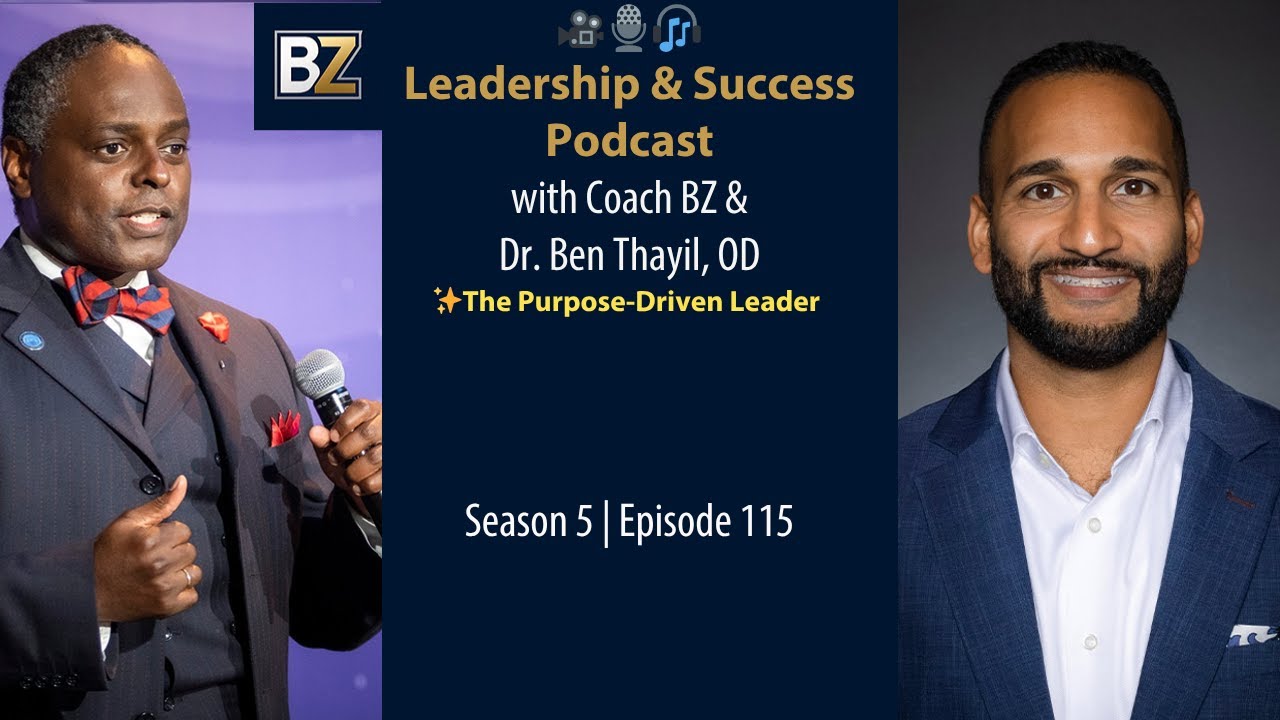
Dr. Ben Thayil, an optometrist and author, talks about purpose-driven leadership and why internal alignment matters more than external success. He'd solve universal health with a magic wand, names Phil Jackson and Elon Musk as dinner guests, and tells his younger self: be great at who you are, not just what you do.
Chapters
Hi, I'm John Maxwell. When the top companies in the world are looking for trainers, speakers, and coaches, there's one name that stands above the rest, and that's Maxwell Leadership. Our certified team members have gotten proven results for companies all over the globe, and our reputation, I'm proud to say, is second to none. Some of our members have risen to the top of their profession, including the one you're going to meet today. I proudly introduce you to my friend Bob Fabien Zinga.
Welcome to the Leadership and Success Podcast with your host, Coach BZ, where we help you lead with purpose and succeed with impact. If you're ready to grow into the kind of leader others want to follow, this podcast is for you. If you're determined to elevate your success and leave a lasting legacy, this podcast is for you. As my mentor, Dr. John C. Maxwell reminds us, everything rises and falls on leadership. Our goal is simple, to inspire you, challenge you, and equip you with insights that can transform the trajectory of your leadership journey. Welcome aboard to Welcome to another episode of the Leadership and Success Podcast with Coach BZ.
I used to be like, oh man, I'll never be an early person. Now I love the mornings, right? So it's quiet in the house. I— so, so by the time they all get up, 8, 9 o'clock, I've already been up for like 4 or 5 hours getting stuff done, you know, organizing the business, organizing my family, doing all— and then when everyone gets up, I'm like, yeah, you have my undivided attention. Right? But the support of a spouse is really important.
All right, everybody, and welcome to another special episode of the Leadership and Success Podcast. We have a very special guest today, and, um, before I bring him in, I'm reminded, let's do what we call here moment of gratitude. Every time we start, we want to take just a moment to be grateful every single day we meet. So, uh, you know the drill, uh, maybe close your eyes, take a deep breath, and, uh, put yourself in your happy place and think about one thing you are grateful for right now. And, uh, today I think I am grateful that, uh, I am still alive, right? Because I feel like as long as I have breath there is hope for me. Uh, so grateful to be alive today. So let us know in the comments, uh, what are you grateful for today? And also let us know where you are joining us from, uh, what city, what state. And if you are outside of the US, since we are now a global show, uh, which country you are joining us from. And also, if you do have a question for our guest, go ahead and type it in the comments on YouTube or LinkedIn, and we will be answering live. All right, let me see if I can properly introduce our guest today. Today, I am really honored to be speaking and to welcome Dr. Ben Fayal, OD. He's an optometrist, entrepreneur, leadership coach, keynote speaker, founder of Lead OD and owner of Lifetime Vision and Eye Care in Miami Gardens, Florida. Dr. Ben's journey is about far more than healthcare. It is about leadership, culture, purpose, personal growth, and helping people live lives that truly matter. From discovering his calling to optometry in second grade to completing residency training, uh, at the VA Medical Center to building a thriving patient-centered practice and leadership development platform. Uh, Dr. Ben has dedicated his career to creating environments where patients love receiving care, teams love coming to work, and leaders grow with purpose and intention. So as a cybersecurity executive and U.S. Navy Information Warfare Commander, I deeply appreciate leaders who understand that leadership is ultimately about people about trust, culture, and service. So part of what you're gonna be learning today is the difference between success and significance, and also how purpose-driven leadership creates lasting impact. So without any further ado, ladies and gentlemen, please help me welcome to the Leadership and Success Podcast, the one and only Dr. Ben Fabien Zinga.
Good morning. Good morning.
How are you doing today, sir?
I'm doing well, Bob. That was a great intro. Thank you for all that.
No, welcome to the show. I am so, so glad you are here. And also so that people know, so we are both Maxwell Leadership Certified Coaches. So we have the same primary mentor, Dr. Maxwell. Just so, so glad to really welcome you to the show today. I think I had a picture of you with Dr. Maxwell. Yeah, here we go. So if you can let us know, Dr. Ben, What is one thing you are grateful for today?
Uh, I'm, I'm so grateful for my family. I, I just, I just love everything about them. I love all the stress, I love all the laughter. I just, I'm just so grateful for my family.
That is really, really powerful. Well, if you don't have a family that loves you, you don't really have anything else. Actually, something Dr. Maxwell Taurus, it always resonates with me, is his definition of success, right? He says something like, it's the people closest to you that respect you the most. That's when you are successful. Because everybody out there can praise you for all of your achievements, acclaim, and all of that. But if the people who know you best, who are closest to you, don't have any respect for you, then you are definitely not successful.
Wow.
And, uh, is there something about you that most people may not know?
I was thinking about that question. I think I, I appreciate everyone who says Dr. Ben and everything like that, but truthfully, my identity is not in that. I always tell people I was Ben before I was Dr. Ben. So, um, I don't always hold on to like, oh, this is Dr. Ben, this is Dr. Ben. I mean, I'm honored and privileged to have done the work to do that. Um, but I think what— I think it's just common that we can hide behind those things, and I don't. I really don't, because to be that all the time is stressful.
Well, thank you for sharing that. Definitely shows humility as well. So we already have some early risers. So we have, uh, Dr. Robert Adams, MD, uh, from Raleigh, North Carolina. He's grateful for health and no medication. Really grateful for that. And then we have a very active member of my tribe, Daniel Young, is coming in from Metron, Florida, not too far from where you have your practice. So let me ask you this then, Dr. Ben. First question I'd like to know is you knew in second grade that you wanted to become an optometrist. That is quite powerful. So few people actually end up doing what they wish they were doing they would do when they were a kid. What was it about that experience that impacted you so deeply?
Yeah, so I remember second grade, I went to the optometrist office, and it's not— it was nothing like I got my glasses for the first time and I saw the leaves on the trees and I was amazed and wowed, although that did happen.
I—
every time I went to the optometrist, specifically the first time, 2 things I noticed. Number 1, the optometrist was really nice. He was really kind. And then number 2, the office was very calm. It was not like the pediatrician's office where the kids are snotty and sick and screaming and crying. So I was like, wow, this is a doctor's office and it's nothing like, nothing like any other doctor's offices I've been at. So you've said it before that calm is a leadership strategy, right? So I really noticed that apart from everything, every other doctor's office I've been to, it was just a calm environment. And I— and for whatever reason, God put it in my, in my mind, in my heart, like, this is something that you, you're going to want to do.
Wow, that is really amazing. And being that young, maybe what, 7, 8, 8, maybe 6, 6, 7, 8 years old, and already having such insight, that is powerful. Wow. Well, many people drift into careers accidentally. You pursued your calling intentionally. How important is clarity of purpose for leadership, you think?
So I love anything having to do with clarity, right? Obviously, because I'm the eye doctor. So if I could propose it this way, when someone's in my exam chair and we're helping them to find clarity, specifically kids, because kids are a little bit more expressive than adults are, but If a child is not seeing well and you say, hey, can you, can you tell me what letters you see on the chart? They'll start to fidget, they'll lean forward, they'll squint, they'll guess, and then eventually they kind of give up. They'll say, I just, I just don't know, I just can't see it. And there's a certain level of exhaustion that comes when we don't have clear vision. So with clarity of purpose, we, we do the same thing. We fidget, we get uncomfortable, we strain to see, we give excuses, and then eventually we just kind of give up. Like, I just, I just can't do it. Um, so there's, there's huge parallels with our physical clarity in terms of our vision as well as our mental clarity and purpose when it comes to our leadership. So when we don't have clarity of purpose, that's where burnout lives, that's where regret lives, and that's where being lost ultimately apart from external success, that's where all those things live.
That is so, so powerful. And I noticed throughout life that employees who are very clear about their goals tend to do so much better than those who are kind of confused, right? And I feel like as a supervisor, as a leader, it's really your job to bring that clarity, show everybody exactly what their role is in the big vision, the big picture what they bring to the fight or how they help the organization accomplish their mission. Now, like I mentioned in the introduction, you actually did your residency at the VA Medical Center. Now, as far as I can tell, all of the research I've done, you've never served in uniform, right, Dr. Benjamins?
I did not. No, I did not.
But you did serve people in uniform at the VA Medical Center. I guess what leadership lesson that still shapes how you lead today from your experience at the VA?
So it's a, it's kind of a silly example, but I think, I think it, it taught me a lot, right? So if you remember the last time you went to the eye doctor's office, they, we put some drops in, we dilate your eyes so we can look inside. When we put the drops in, you got to wait about 15-20 minutes for those drops to really work. So One afternoon— no, one morning, I was seeing one of our veterans, and, um, I had dilated his eyes. I said, you know, it'll take about 15 to 20 minutes for these drops to work, and then I sent him back out to the waiting room. And time went by. I finished seeing my whole clinical schedule for the entire day.
Wow.
And then my residency supervisor came in and said, Ben, 'Are you finished?' I said, 'Yeah, I finished for the day. I finished all my charts. I finished all my clinical schedule and everything.' He says, 'I don't think you are.' I said, 'What do you mean?' He said, 'There's a gentleman out there who's been waiting for 4 hours for you to call him back.' And I was like, 'Oh my gosh.' I felt so terrible that I kept him waiting, and I totally forgot, and I got so busy with everything else that it, that it slipped my attention, you know. So What I learned from that is, number one, it's okay to make mistakes. And I think what helps me rationalize it being okay is when I became accountable for it, not just to myself, like, oh, I made a mistake, but to verbalize it to the one I offended. Not just to the team, but directly to the person. So I went out there, you know, Mr. Jones, I'm so sorry. I forgot. I told him I forgot. And the fact that I just owned it, he was okay, right? He said, no, I understand. I get it. You guys are so busy. And thankfully, he had nothing else on his schedule, right? Because they would have thrown everything off. But yes, but to this, you know, thinking about it, I still feel bad. But thankfully, he showed me the kindness once I took the accountability to it. So I think when we take accountability, admitting our fault to the person we offended actually goes a long way. As opposed to circling around that.
That really shows humility and integrity, character. Wow, that is quite powerful, man. And I feel like it's also applicable in so many other areas of life, isn't it?
Absolutely, absolutely. Whether it's with a team member, a spouse, a child, a coworker, anything like that, I think that translates across the board.
Yeah, and I'm glad you mentioned child because I have two daughters and you always hope that your children would grow up to be people of integrity and humility and really add value to the world as they become adult and professional. I really wish sometimes that would be a lesson even some of our politicians would have learned by now. It does make a big difference, no, just to be humble. Because to know that everybody makes this mistake, but really to learn from those mistakes most importantly. Now, Dr. Bennett, another thing you have said is patients should love receiving care and staff should love working there and doctors should love practicing there. So when did that vision become clearer to you?
So after I had finished my residency training, I was in, I was in this, the, um, Bill Hefner VA Medical Center in Salisbury, North Carolina. So I was in North Carolina for a little bit, and then after I finished my residency training, I moved back to South Florida to start my career and everything like that. Now, I never ever ever imagined owning a clinic or owning a business. I just thought I would go to school, have this degree, work in that degree, and make my living that way. Now, when I when I moved back home, I never really signed a contract because I didn't really know outside of the VA hospital different settings, right? So when I moved back home, I, I, I kind of piecemealed my schedule together. I worked a couple days in a hospital. I worked in commercial settings. Commercial settings are like the Costcos and the Targets where they have an eye doctor in there. I've worked in private practices. I even had a, um I had a contract with the prison system, so I would go into the jails and I would do eye exams for the inmates and things like that. Um, and I noticed 3 things in all of these places. Number 1, the patients that were there, there— I didn't get a sense of loyalty, like, this is my office, or they were kind of shopping around all the time, and wherever the best deal was, that's where they're going to go next year. Number 2, the teams that I worked with in those environments they just seemed disconnected. This was just my job. I'm just here to do my job description, if that, right? And I'm, I'm tying my shoes to leave 45 minutes before we close, right? And then as a result, I noticed the doctors I worked with and myself, it wasn't really an environment where like, you know what, I love working here. It didn't really translate to that. So One day I was sitting at my counter eating some cereal, and I just thought, I want to find a place where patients love to get care, where people love to work, and where doctors like to practice. And then it just, it just struck me that if, if I want to find that place, I actually had to create it.
Wow.
So those, those, those three things became the pillars of my clinic. Now it's We're— our, our mantra is we're creating a place where patients like to receive care, where people like to work, and where doctors like to practice. So everything we do is based on— every decision we make is like, is it going to make any of those pillars stronger? And that's— it plays a big role in our decision-making.
That is really, really powerful. I remember when I was a commanding officer in the Navy, uh, two things my mentor told me as a leader, I really should focus on one is to create that environment where my seller would want to be there. They want to live on, they want to come here to work. And then number two, once they get there, they give me the very, very best they can, right? Like I think it was a Harvard Business Review study that said most people only do about 25% of their potential of what they could do at work, but really you wanted them to give 100%. Percent or have a desire to. That really makes a big, big difference, doesn't it? When you have a workforce of people who show up early and they are ready to go and they really want to add value, not just doing work because they want a paycheck. And like you said, if it's 5 minutes before closing, they already on their way out. That really makes a big difference, doesn't it?
Absolutely. Absolutely.
Man, that is Leadership. So during the COVID pandemic, many organizations focused really on protecting their revenue. You focused on protecting people. Why did you do that, Joe?
Yeah, so that was obviously all of us remember, you know, where we were and what we were doing the time of the news that broke about this pandemic and everything like that. And, you know, the financial markets, when you follow it in the business world and everything, everyone was like, well, what are we going to do? We have to close our businesses and we have to let people let let people go and things like that. So I did struggle with that, with that thought process as well, because obviously you want your business to survive because that's your livelihood. Um, but ultimately what I realized when the news was going all crazy and the world was going all crazy, um, I realized that going to work— we were, we were, by the, by the rules at the time, we were, we were allowed to be open half of the number of hours that we normally open, and we can only have a certain amount of people in the business at a time. So thankfully, we— that provided some stability to all the chaos that was going on during COVID with all the unknowns and everything like that. So what I realized was, with everything going on, work became the only stable place for myself and my team where we could— where things were a little bit more predictable, things were a little bit more controlled, and where, where where it felt like the whole world was going out of control. So I realized that if I can focus on not letting anyone go, not furloughing, not firing, not anything like that, if I can protect the number of employees I have, what that would translate to is the business financially would have been okay.
Yes. Wow.
Because I would have been able to make payroll. I would have been able to do all those things. So my target was to keep my people, and then the side effect of that was like financially, I think the business was going to be okay. So that's where I really focused on pouring into my team, pouring into my people, and making sure that they were okay. Because if I made sure they were okay, they were going to reciprocate that and make sure that, that I was and the business was okay.
Wow, that is powerful. One leadership mantra in the Navy is, uh, mission first and people always. And again, one of my mentors told me when I became a CEO that you take care of the people and then the people will take care of the mission. That is so true. And I feel like it's really universal and it works no matter the industry and what you do. You should always prioritize people over revenue or over profitability. I really wish more organizations would do that. Another thing you started, Dr. Ben, you started weekly values-based leadership meetings with your staff. What inspired that decision?
A headache. Headaches inspired that decision. No, honestly, Bob, I was sick of writing and enforcing policy. I was sick of it. All my friends that we talked to, everyone is just like, well, how do you How do you find good staff? And why can't people just do their jobs? And why can't people show up on time? And, you know, I was sick of writing a policy, enforcing it, doing write-ups, do personal improvement plans. Like, I was, I was just getting weary of that. So then I had to look at why, why do people function this way? Like, what's the underneath? Because I don't think intrinsically people want to perform bad. People generally want to do well at their job. Um, So I looked at why people come to work late, why there's turnover, why there's— why people overpromise and underdeliver. Like, on an interview and on their resume, they're amazing, and then they show up and then they're not as we hoped things would be, right? So I think what I found out, it came down to, to two things. Um, number one, values. Number two, purpose. So I think when people understand their purpose, they can do anything with with energy and enthusiasm. You can really go in and say, yes, I'm going to check all these eyeballs out and for— because I'm doing this for a purpose. Or I can, you know, I can scan all these documents because I'm doing it for a purpose. Like, you can do anything with energy and enthusiasm if you understand your purpose. And then the value piece is— and we learned this from our friend, right, Dr. Maxwell, John Maxwell. He says, when people learn and live good values, they become more valuable. Right? So I learned that I would— I started to teach outside of the KPIs. I started to teach things like communication and listening and integrity. And then all of a sudden, over time, people started to come out to work on time. They started communicating better at home and having better relationships at home. So they're not coming to work stressed out. And then they can focus on work and start doing better. So I learned that when people can have an environment where they're able to make their lives better, it makes them become better team members and employees and, and deliver, you know, be able to deliver products and services at a much higher level.
Wow, that is really, really powerful. And one of your most powerful statements, Dr. Ben, is I don't think you find good staff, I think you make them. Can you unpack that for us, please?
Yeah, so that ties directly back into teaching people and living and learning good values. So I always say that as an employer, as a leader, my job is to— I have two jobs. One is to give people opportunities. My only job is to give an opportunity. Not a paycheck, not anything like that. But my job is to give an opportunity. And then number 2, I always say my second job is for you to not need me, meaning I've trained you so well that you're confident in your job that you really don't need my input because we're kind of on the same level in our thinking and decision-making and things like that. So when I talk about not finding good staff but creating good staff, that has to do with culture and environment and how you're leading people. In terms of understanding their values and their purpose and making sure that if they're with me in my business or my organization, I have to make sure that they're progressing because if they're progressing, the business will progress.
Yes, that is really powerful. So, in such environment, how do you earn the trust of your employees? So that you have a high-performing team.
Yeah, so I think it comes from consistency and alignment.
Yes.
So whatever we say has to not just be like, oh, my boss is telling me I have to do this. You want your team to think, my superior is telling me to do this, and not only that, I've seen him or her do this.
Yeah.
So if I don't do it, but they're doing it, right, it makes me look like I'm not part of the team. And my desire is to be part of the team, part of the community, all of those things, because I want people to think highly of me just like they think highly of the rest of the team. So I think modeling consistency and modeling transparency and putting legs to our, to our words is important as leaders.
That is really powerful because even in cybersecurity, we do use a lot of technical control, but I really believe if you are going to be an executive, a leader in the field, you really need to be able to also influence the culture of the organization so that it's not just, you know, the cybersecurity or the IT department who's really focused on doing things securely, but the entire organization is. So Talking about culture, you've described culture as the environment where something grows. I really love that definition. What are some of the biggest mistakes leaders make when building culture?
So I think— so number one, I'll back up to how I got to that definition of where something grows. So in healthcare or even in the basic sciences, when we want to figure out what type of bacteria is growing in an environment, we take a little dish, right? We call it a petri dish, and it has, it has specific types of food in it. And, um, and then based on what grows in there, we see what that organism is, or we see that what that bacteria is, or what that, what that infection is. So I thought about that and, and how we think about culture in a business sense. I'm like, yeah, this is a place where we need to something's going to grow. And now I can be responsible for the food or the nutrients that are in there, or I can just let it happen.
Right?
Because every organization has a culture. It depends on who's defining it. Right? So I love that. So I've never really— I've never really looked at culture in terms of all the KPIs and things like that. To me, those are all secondary. Those are all side effects of what we're trying to build altogether. So I think the biggest mistakes that leaders can make when building culture is never defining the environment they want to build. Not just their gross revenue, not just the number of clients seen, not just what products and services are we going to deliver, but to focus on almost the intangibles. What do I want the life of my team members to look like? As they pass through my organization, right? Do I want— how big do I want them to grow? Um, do I want them to be thankful for this job, right? How many job interviews have we done where people are like, oh yeah, I left that place because of this problem or that problem or this chaos, or like the, oh, the owner never knew that I was married and have kids, they don't know, you know, my kids' names and things like that? Those things matter. Those things matter to our team. So I think building a culture where it's simply checking in with your team learning about their family, finding out what they did on the weekend, right, what they enjoy to do. Those things will translate into the tangible KPIs where we can see those things growing.
Wow, that is really powerful. I guess the next question is, how do you create such culture, such environment? I guess it's called psychological safety, right, where the people can grow and it's okay to make mistakes as long as you learn from them, but also to raise your hand and to speak up when you need to? Because like, especially in the cybersecurity field for a long time, we've created this culture of fear, right? We call it FUD, fear, uncertainty, and doubt. And people become very, very afraid to speak up if something goes wrong, because if they do, they are going to be punished for it. So how do you create those environments that are psychologically safe enough for other people to go.
Yeah, so that's a good question because it came to me kind of on accident. Um, I was with a patient and I was wrapping up, and then I had to get them back on the schedule for a follow-up visit. So I told the patient, I said, you know, the front desk will get you scheduled. And then for some reason, that phrase, front desk will get you scheduled, kind of bounced around in my head. I said, what's wrong with me? The front desk is a piece of furniture. Like, why, why, why didn't I say the person's name who's in charge of doing that? So I stopped viewing people as a job description. I stopped viewing people as pieces of furniture, right? Um, and I, I stopped viewing my team as a means to my own end.
Yes.
And I started naming people by name. Hey, this person is going to help you by name, or this person is going to lead you through the process by name. So there's that saying, you have to lend a hand before you ask for help, right? So serving your team first, and then they're going to serve you. I think that's a big key in creating psychological safety for the team and the organization.
That is really powerful. And again, we've already established since you were in the second grade, I guess, 7, 8 years old, you really showed a lot of emotional intelligence, just awareness of yourself and then your environment. What role do you think emotional intelligence plays in leadership today?
That's a good one too. So emotional intelligence, So all the things I think we're talking about are not really— we can't hold it in our hands, right? These are more of soft skills that are within people that we can develop in people. It's not just something that has to come naturally. So emotional intelligence doesn't have a direct KPI, but it is reflected in the stability and the growth of an organization, right? So the key to emotional intelligence is the power of pausing, the power of noticing, really noticing what you're feeling, noticing what your team is feeling, noticing what your customers are feeling. And in that moment of noticing, you have a split second to respond instead of react out of, you know, whatever emotions may be bubbling up inside of you. So I think reactionary leaders, um, we make the mistake of making problems worse, unfortunately, if we're just reacting to how we're feeling out of anger or spite or anything like that. And we try to force solutions at the expense of our team and our culture. But I think that leaders who, leaders who respond thoughtfully, they've taken that pause to notice what's actually going on. They can, we create more of a collaborative environment where people are eager to solve a problem rather than like, I have to solve this problem or I'm going to get in trouble, you know.
That's a big difference, isn't it? Isn't it, in the mindset. And then I guess it shows up in the performance as well. Now, the way we've been talking about leadership, you really value people, right? You have great value, you value people, and then you add value to people, including your employees. But you still have a mission to accomplish though, right, at your organization. I guess the question I have for you is how do you balance accountability for result and then compassion for your team members.
That's good, because I think a lot of times we separate that accountability and compassion. Accountability, in my experience, when I've had bosses and things like that, that's more of a heavy hand. Compassion is more of a, of a gentle, you know, coddling, if you will. Um, but I think accountability truthfully has to do with seeing the best in people. If you don't believe someone can be better than what they've performed in the moment or their subpar performance, that's not being passive. That's— that is being passive, and that's not being compassionate. Because if we just allow someone to not do their job well, if we're not holding them accountable, we're just— we're subconsciously— we're viewing them as like, yeah, they're just probably not that good, right? But if our job is to see the best in people and bring the best out of people, that leads to a more compassionate way of being accountable. So rather than coming down on them, you partner with them like, hey, listen, these numbers are down, or this result is not what we wanted. Let's look at this together to figure out why we didn't get the result we wanted. So now we're coming alongside them to get to the result rather than instead of saying, you know, come back to me when this is fixed. That's a much very different approach when it comes to accountability and collaboration.
Wow, I really love that. I think the approach really makes all the difference in the world, always treating people with dignity and respect. And I think that really makes a big difference. So Dr. Ben, let me ask you the million-dollar question. You've learned and talked a lot about leadership and management. What is the difference between being a leader and being a manager in your eye?
So I love this. I love this idea of separating them out because the old school management books and management philosophy was if you're a manager, you're a leader. But I learned that that's not true because I've tried to manage a business and I've tried to lead a business and you can't do those things the same way. So what I've learned was management has to do more with process, right? Process, like from A to B, from B to C. What are the steps to get something accomplished, right? That's the process, that's the SOPs, that's how we do things, things like that. Now, leadership has to do with people. So management is making sure a process gets carried out, where leadership is making sure the people responsible for that process are well equipped and trained and understand how to carry it out.
That's Bob.
So if a process is not— or if a product or an end result is not being met, number 1, we look at the process. Is it a process problem? Number 2, we look at, is it a people problem? So I never jump to the person first. I always look at the process. Did we run out of some supplies? Did we fail on a communication? Did we do something like that? If the process checks out, then I go to the person involved in charge of it and I say, hey, listen, um, let's look at this together and let's figure out what's going on. So you go from managing to leading in two different arenas. One is the process itself and the other is the people piece.
I love that. Wow, what a difference leadership makes. Because another thing, I think I have a book buying there on my shelf. General Powell, something he taught me about management and leadership. Like I said earlier, Harvard Business Review said most people, they only provide about 25% of what they could, of their potential when they go to work. But he said with the science of management, you can in theory get people to work up to 100% of their potential. So that's what the science of management will do. However, the art of leadership will get people like we do so often in the military to go at 110%. So above what is theoretically possible, when people go above and beyond. And that's really a huge, huge difference in leading people and just, you know, trying to manage a process or a project. But now talking about a culture, what are some of the warning signs that the workplace culture is becoming toxic?
Yeah, I think it's all the obvious things we see in the workplace, um, turnover, staff drama, declining sales, decreased loyalty from your customer base, um, reactionary decisions from the leadership, and ultimately burnout. Burnout from your team, burnout for yourself from constantly trying to put out these fires. I think that in itself points points to a culture that's dysfunctional.
That is so true. And what about trust? How can leaders rebuild trust once trust has been damaged?
So I think trust is rebuilt the same way that it was built. And we touched on it a little bit earlier of how we should be as leaders, we should be consistent over time. Our words and our actions should be consistent. So we need to work on bridging the gap between our words and our actions. So we can mess up. We can have a team meeting, apologize to the team. Everyone can forgive you. But truly, time does heal all wounds in the sense that time is what gives us the opportunity to not make the mistake again, to show that we meant— our actions are aligned with our words. So the honesty, transparency, and apologies need to be followed through by consistent action. And I think that's how you build the trust again.
Fairness, consistency, integrity, character, humility. Those are great characteristics of leadership. We have our first question from the audience. Daniel asked, how do you coach purpose-driven doctors to protect their brand when front office staff deliver poor customer care that the doctor never sees but patients feel, and the practice loses trust and business?
Let me look at that one more time. When the office— when the front office staff deliver poor customer care that the doctor never sees, um, is that impacting your customer? Yeah, absolutely. So number one, I would look at, um, I would look at the management team, right, and say, hey, listen, these are the things that I'm seeing. What are you seeing? Um, and if it's the management team that doesn't really put their best foot forward on, on delivering good care. I would, I would train. So I have this philosophy: if, if I, I, I keep people on the team so long as this question in my mind is answered a certain way. The question is this: did I give this person enough tools and training to do the job well?
Yes.
And if I've If I have not done that, I said I could have done this better, that better, this better, that better. I will keep them until I know I've delivered everything I can to make sure that they're doing their job well. If it gets to a point where I say, yes, I have, I've had the meetings, I've given them all the tools, I've done all the training, and they're just not performing well, then honestly, that's the point I let them go because they're just not going to perform well no matter how much I try. So When it comes to that question, I think looking at the training point— so again, going back to process and people, looking at the process, what does the process look like in the customer journey, in the patient journey, and where are things falling apart? If things are falling apart, what are the training points that we reimplement to make sure that that process gets carried out? Now, if you do all that stuff and it still doesn't work out, it's probably, you know, unfortunately time to find a new team member, if you will, you know.
Yeah. And I guess as leaders, uh, we do have to make tough decisions at times, don't, don't we? Mhm.
And it's been said before, the— if someone's not doing well, the fair thing is to sometimes let them go. Because why have someone in an environment where they feel like they're not doing well? They should be free to go to another organization where they may work better, thrive better, things like that. So in a lot of ways, we're doing that individual a service by letting them go.
Absolutely.
Wow.
That is powerful. Okay. Let's talk about personal growth and significance. You've said the calendar guarantees you get older, but it doesn't guarantee you get better. Can you unpack that for us?
So that also is attributed by our friend John Maxwell, right? Or attributed to, I should say. Really, I got frustrated about growing my clinic and growing my other businesses because— and I couldn't understand why. And then I learned about the leadership lid. Yes, the leadership lid would say that if I was a 5 out of 10, my organization could only be a 4. It can't— it can't even be a 5. It's all— it's going to be just below me. And then I learned exactly in the 21 Irrefutable Laws. So I learned that applies to my life as well. If me as an individual, in how far I've grown internally If I'm only a 5, everyone connected to me, my family, my team members, my, you know, my friends, they could only be a 4. So if I wanted to raise the lid of my life, I had to invest in my own personal growth journey. So then it becomes, you know, not how far can I go, but how, how much can I grow.
That, that philosophy, that is Really, really powerful. Yeah, the law of the lead, right? Leadership ability determines a person's level of effectiveness. What sparked your personal growth journey?
So that, that actually came through COVID because we had time to slow down, you know. I was, I was running on all cylinders and trying to get a failing clinic that I purchased to move. I was there 7 days a week doing all those things, and then COVID forced me to slow down so I could look at, hey, what are the things that are stopping my growth? And I looked at all— I looked at all the tangibles, the KPIs, the patient base, the products were delivered. I looked at all those things, and I said, I have all those things in place, but we're not growing. Then I had to look internally. I had to look internally and say, well, maybe there's something that I personally am not capable of doing, and that's why my organization is not capable of doing. So I had to— that's where my personal journey growth started, was the outside was looking okay but the inside was not, and I had to start focusing on the inside if I wanted to sustain growth on the outside.
Wow, powerful. And, uh, how did, uh, our mentors like Dr. John C. Maxwell influence your leadership philosophy?
So, um, out of all the gurus out there, they're all pretty good, right? Right? Um, I found John to be the most honest and transparent, and really he models integrity. Um, you know, he's, he's very open to say, hey guys, I— this is the first time I'm teaching it, I might screw it up, right? He's very honest in saying that, right? And he's not always trying to position himself as, as, as the expert and you, you can't touch him. And he's— he loves being close to his, his his people, his tribe, really. He doesn't just come on stage and then he sneaks out backstage. He's walking in the middle and shaking hands and asking, how are you doing? And he's remembering your name. And he's the one that taught me that everything rises and falls on leadership, right? And, um, he taught me what it meant for a, a leader to love people and not just to look, look at just growing an organization and things like that. He just He really taught me what it was to love people.
That, that is really something. I know he always teaches that leadership is influence, nothing more, nothing less, but I feel like the older I, I get, and I'm talking about, you know, value-based leadership, I tend to think that leadership really is love, right? You, uh, love people and you really want the very best, uh, for them. You are not a boss who wants to be served, but you actually be a servant leader who wants to serve your employee, your direct report. That is quite powerful. Now, another thing that he has taught us, I want you to expand on that, the difference between significance and success.
Yeah, so I've— that's always a good topic because I think success has to do with hitting our targets and accomplishing our goals and growing our company and Those are all external. And on paper, those things can look really good. You know, they're really good. But I think without context, that's why leaders feel alone at the top, or they feel that they got lost at the top because they've done all these things externally. They've reached success on paper. But internally, there's some turmoil, and there's that feeling of being lost. And why did I do this anyway? And then we start chasing you know, another house or another car or another thing or another relationship. We start chasing all those things, thinking that this fulfillment comes from something outside of us.
Hmm.
Significance has to do with knowing what we do is worth it and it matters.
Wow.
So significance has to do with knowing what we do is worth it and matters. So it has a meaning attached to it. Significance has to do with understanding that we're part of something bigger than ourself. And our contribution in that thing matters and makes a difference. Because if we don't feel like what we do matters, no level of success is going to give us any type of satisfaction.
I love that. Wow, that is powerful. Now, let me focus on military lessons. This is going to be the segment before our very last segment. Leadership lesson from healthcare apply universally across industries, you think?
Um, I think that the, the idea that— so this, this whole idea of servant leadership, right? You have to lend a hand before you ask for help, and getting to know your people, and then understanding that everything rises and falls on leadership. And then I think leader— that phrase of Everything rises and falls of leadership. I think this whole idea of influence, right? I think influence has two variables. I think it has the variable of attention, and I think it has the variable of agreement. So the, the more attention something gets, that's in one way good, but that, that attention has to have agreement.
Yeah.
So if the more someone agrees with your process, your policy, your things like that, then the more influence you'll have on them because they're going to agree and carry out what you're saying. So number one, influence requires that we have attention. And then number two, it requires that we have agreement. So the group buy-in, the group thinking together, the group like, hey, we're a team and we're going to win this championship, all that things matters. And I think that applies universally across all industries of leadership.
That's really powerful. Now, I know that you are writing a book focused on fulfillment, leadership, and culture. What inspired that project?
So I've had, over the years, I've had the privilege of being part of a lot of leadership forums within our industry. So I've gotten to know a lot of our industry CEOs and, and, you know, leaders and things like that. And What I found is that speaking to many of these high-powered and successful individuals, I noticed a pattern of them feeling lost at the top. You know, they started from the bottom in the, in the coat room working, and they made their way all the way up to CEO, and then they wonder, well, I did all that, and I understand that that's amazing, but something is missing.
Yes.
So, um, you know, there's, there's a there's a, there's a verse in the Bible that says, you know, greater is he that is in you than he that is in the world.
Yes.
Now, um, now we can take that and say each of us has the ability to be bigger on the inside than we are on the outside, right? And so if we want to sustain growth on the outside, we have to be bigger on the inside. So how can leaders become bigger on the inside when they're not when they're, when they're, when they are on the outside, so they can make it to the top and not feel alone, right? So they, they have to, they have to— my goal is to get people to make it to the top and recognize the person in the mirror when they get there.
Yes.
And that's what my book Big E Energy is about. It's finding alignment between your internal world and your external world, and making sure that along the journey, you're being true to who you are on the inside.
That is really powerful. Yeah, because it's true that many people say, right, it is lonely at the top, but it really doesn't have to be lonely, does it? Right? Yeah. 1 John 4:4 that you mentioned, uh, ye are God's little children, and have overcome them, because greater is he that is in you than he that is in the world. And also feel like sometimes many people, they are looking for fulfillment outside of themselves, when it is really within, isn't it? Wow. And we also have, well, another OD, Dr. Brianna Rue. She says, "Hi Ben, let's go." There we go.
I know Dr. Rue very well.
Yeah. But yeah, what you say really, really resonate because that's kind of like what I felt about 5 years ago when I started this podcast. Leadership and success, really true success. I feel like my definition of success has changed, right? Because for me, I had really reached the apex of my success, right? Everything I wanted as a kid, I have done that and so much more, right? I started as a computer technology assistant and then I became a chief information security officer in Silicon Valley. And in the Navy, when I joined 21 years ago as a seaman recruit, the lowest rank in the military, And today I am a commander, a senior officer of the most powerful navy in the world. And then after a while you're like, okay, what is next, right? Like, what do I do? So I already have a house, don't need to buy a second house. Do I need to get this second car? I mean, it's like if you have 3, 4, 5 houses, how many houses can you live in at one time? Only, only one. So there's, there's got to be something, something more, right? And that's why I love when you talked about significance, you talk about meaning. And I think that is so, so important because just going after things that are material— and again, when you are poor, when you don't have anything, yeah, of course you need to have at least enough to pay your bills, take care of your family and all of that. But I feel like once you reach a certain level though, the money and that success really doesn't mean anything anymore.
It's—
but yeah, I This is really powerful. And of course, whenever your book is published, we definitely want you to come back here and we need to talk about this. I think it's going to help a lot of people, people who are at the top of their game and who've definitely reached a certain level of success but still don't feel fulfilled. Has your definition of success changed?
I don't know if my definition of success has changed as much as my perspective on it has changed. Because I think success is important, right? We do have to build a foundational and stable financial situation, home situation, all those things. But those things in and of themselves, as great as they are, they are not the goal. And I think that, that parallels to this idea of significance is understanding that once we have things in place, that we don't just stop there. We have to go continue to live our— live out our lives with meaning and purpose. Otherwise, we can just chase the next thing and the next thing and the next thing, you know.
Wow, that is powerful, powerful. So what legacy do you hope to leave behind?
Um, number one, I want my kids— I got two boys, I got a 3-year-old and a 10-month-old, so I'm on the other side of you on parenting right now. Um, I want my kids to say my dad was awesome, you know. They don't have to say you know, my dad was Dr. Ben or my dad was this or that. I just want to say, man, I had so much fun with my dad. And then I ultimately want them to know, um, well, me first, I want to know that my gifts and my talents that were given to me were used well, that they were used to their fullest potential, that the one who gave them to me is proud of giving them to me. And then that, you know, that I can, I can be like, yeah, I did as best as I possibly could. I gave it all my God, all I got at the end of the day. And ultimately making sure the work that I do is helping people feel whole. They feel like they're in alignment and then helping leaders build healthier cultures and helping people not lose themselves when they succeed.
That is really, really powerful. I really like the idea that you want both your sons to really feel like you are awesome. It goes back to the definition of success from Dr. Maxwell, right? People closest to you respecting you the most. So when your son watch this episode 20 years from now, uh, having them say, yes, my dad is just absolutely awesome, that's probably the, the best, uh, feeling and legacy I think any, anybody can, can live. That is so, so powerful. What, what does a life that matters mean to you personally?
Um, we touched on it a little bit, but I, I wanted— I want A life that matters to me is that I lived up to my fullest potential.
Yes.
That when I look in the mirror, I recognize the person that's in the mirror. And then, um, you know, the people that know and love me the most, they admire me for who I am, and not just because I helped cure, you know, an illness, or I helped them move, or like any of those types of things, which are nice as in terms of relationship. But at the end of the day, regardless of those things, I want to know that the people are that know and love me the most, admire me the most.
That is really, really powerful. Okay, we are going to end with this segment where I try to get into your head and figure out some of the leadership principles that have helped you be as successful as you are today. I actually, um, just copied those questions from Papa John. So first one I'm gonna ask is, uh, what do you believe is the greatest, or one of the greatest lessons you've ever learned, whether it's about, no, leadership, life, or in general?
Um, one of the greatest lessons I learned was just the power of transparency and honesty, because I think it all holds— it holds true regardless of how it's stated. Is it's like, if we're trying to cover something up, we just got to keep covering and covering and covering, and soon enough we're going to find ourselves— we dug inside of a hole.
Right?
So the sooner that we can own our mistakes, address them directly, I think that takes leaders a long way. And that helps your team feel like you're real, you know? And then it models a way that they can also behave in the organization.
That is really, really powerful. And like they say, the cover-up is usually much more dangerous than the actual crime. Yeah, I feel like if you are living a life of character and integrity, it takes so much less energy because you can just be who you are no matter where you are. You don't have to spend this extra energy all the time to try to pretend to be something you are not. That is quite powerful. But what do you believe is the secret of your success? Oh, that, um, because there are so few people in the world today when they are a kid, they want to do something and they end up doing just that. So that is quite extraordinary. Now you have your, your, your own business, quite profitable. You're going to be a best-selling author very, very soon. And, and just all of the great things you are doing. Why, why do you think you are so successful?
So I think that the number one, I've defined what success looks like for me.
Mm-hmm.
I understand everyone watching and listening may have all these ideas about how great my life is because I view myself as a success, but that doesn't matter because we each have to define success individually. So I think what's helped me with my own definition of success is number one, understanding my purpose. Number two, applying the right meaning to the things that I do on a day-to-day basis. So if I'm if I'm, you know, vacuuming the house or if I'm curing an eye condition, right? I have meaning for those things that I'm doing. I don't view them as trivial or mundane. There's a purpose in all of those things that we're doing. So, and how all the little pieces add together to the bigger version of your life. So I think that applying, applying meaning is very, very, very important when it comes to breaching our definition of success.
Wow, man, this is really powerful. I remember, I think I was, I believe I was in second grade. I must have been 7 or 8 years old. And I know everybody knows Martin Luther King, "I Have a Dream" speech, probably one of his most popular speech. But There was another speech I actually heard from him. It was translated in French because I didn't speak English back then, but it was, let me see, he said something like, let me find that. Be the best no matter who you are. I think he was speaking to a to a group of high school students. He said something like, whatever your life's work, do it well. A man should do his job so well that the living, the dead, and the unborn could do it no better. That's living life with purpose, man. And he says, if a man called to be a street sweeper, he should sweep street even as Michelangelo painted, or Beethoven composed music, or Shakespeare wrote poetry. He should sweep streets so well that all the hosts of heaven and earth will pause to say, here lived a great street sweeper who did his job well. Really, that speech completely changed my life. I was only 7, 8 years old when I heard it. No matter what you do, do the very, very best you can. And you cannot do that unless you have purpose and meaning in whatever mundane task you are doing. Wow, that's so powerful. So Papa John told us that leaders are learners. What are you learning these days?
Um, what am I learning? That's— I'm always listening and reading to something. Um, I'm learning, actually, I'm learning to really fine-tune how to help people find meaning. How do we put meaning to— how do we put a definition to that so it becomes actionable?
Yes.
So one of the things in that is we get to choose what something means. We can, for example, with my 3-year-old, we may watch something on TV, right? And then my wife will say something like, you know, he might get scared about that or he might get scared from that. And I tell my wife, I'm like, let him see. And it's all age appropriate, right? I just put that disclaimer out there, right? So I tell my wife, You know, let him see it and let him decide if he thinks that's scary or not. And if he decides that's the meaning he applied to it, then that's going to be his, his kind of reference point on a situation like that. If he decides it's not scary, then he decides it's not scary. But I think that's a more powerful thing when it comes to meaning. We get to decide what something means. We don't get— we don't have someone else say to us, you know, Um, you know, even if a doctor says you're sick, you can— so I— so this is a little bit of a side note. I do a lot of disability exams and people want to come in and then they, they apply for disability based on their visual health and things like that. So I always end the conversation like, listen, just because the state says you're disabled, just know you are not disabled. Like, don't get that in your head that you're incapable all of a sudden of doing everything. Yes, um, that's just kind of a legal structure that happens. So don't let someone else decide what something means when we can decide what things mean for us.
That is so powerful, uh, because especially for those who listen to me, a lot of people from the military, uh, I came back from the deployment about a year ago, and according to the VA, I am now officially a disabled veteran, and I didn't like that term. It's like, no, I don't see myself as disabled at all. But you are right, but for the VA system or whatever they do, yeah, you are a disabled veteran. But just because that is who I am in that legal, or no, medical framework doesn't mean that's the life I need to live. So yeah, I think it really makes a big difference what you think of, yourself or how much meaning you give to that word. Wow. Thank you so much for sharing that. I think it's going to help a lot, especially my veterans out there who are listening to this podcast, just the way to reframe this and see it in a different way. What about failure? How has failure shaped your life?
So failure is a good topic. Because I used to think if I failed, I was a failure.
Mm-hmm.
And then what I learned is just because you failed does not make you a failure. Um, failure is just a learning platform. It's just a way to take an audit of your decisions and your actions and say, okay, we didn't get the result we wanted, uh, but because we took action on in one direction, we can always take action in another direction. So failure allows us to continue to move forward and move forward and move forward and retry. And we all love the stories about how, you know, Walt Disney was heard no from whatever, 1,000 banks, and Henry Ford heard no from, you know, 100 banks. And then Thomas Edison had like, you know, whatever, thousands of inventions before the light bulb came. Like, we all love those stories, but we find it hard to live it out ourselves. We find it hard to say, I have this failure and this failure and this failure, I'm going to keep going, I'm going to keep going, I'm going to keep going. I found it personally hard to live— like, I don't want to be Walt Disney or Thomas Edison and go through all those failures, but that's what it takes because they didn't have their identity in the failure. They just said, all right, that didn't work, next. That didn't work, next. That didn't work, next. So I think that's the powerful thing about failure.
Man, but that is really a mindset, isn't it? Because how do you explain some people, they experience what they call failure and then they get completely destroyed by it, but then other people like you and I, we go through the same thing, the same challenges, but then you kind of thrive and you overcome and you even achieve a lot more success on the other side. Mhm. How do you explain the difference?
I think that ties back into purpose and meaning.
Yes.
So if someone has a purpose and a meaning to do something bigger than themself, then nothing gets in the way of it. There's— grit comes with purpose and meaning. Persistence comes with purpose and meaning. All of these things that push people forward. You know, we talked about before we went live about the book, um, um, Man's Search for Meaning. Right.
Yeah.
And how, how, you know, people who survived the Holocaust, what was their psychological state in that type of dire situation and the people who held on to meaning. One day I'm going to see my loved one again. One day I'm going to get out of this. One day this war is going to end. That's what's helped people push through. But if we're just focused on the task itself and whether the task is going to be successful or not, That's easy to give up on because once it's not successful, you're like, well, that didn't work.
So true. Yeah. Viktor Frankl, Man's Search for Meaning. And then another book about failure, Papa John just wrote this one a few months ago, How to Get a Return on Failure. Really— Yep.
I got it right here.
And Return Stronger. Yeah. We really need to embrace failure because it seems to me like, you know, like I like this coin I have, one side says failure, the other side says success. It's really two sides of the same coin. And there's always that idea, another book probably Jon had written before was Failing Forward. As long as you learn from your failure, from your mistake, you can really achieve a greater level of success. That is so true. Okay, as we come to A close, uh, what, um, books would you, uh, recommend? I think you recommended this one, Be Your Future Self Now by Dr. Benjamin.
I love Benjamin Hardy. I love how he writes. I love his thought leadership. Be Your Future Self Now is a great, great book.
Why, why should my audience read this one?
Um, well, the premise of the book is you don't have to wait to be the best version of yourself. Like, you can do that now. And he outlines, he outlines the process to do that because as time goes on, we just, 10 years from now, 15 years from now, we can find ourselves very easily in the same place if we're not intentional about our daily actions and what we're trying to do and accomplish.
Powerful. And what about this one, The Meaning of Your Life?
So that is Arthur Brooks. He also wrote, uh, actually it's there, From Strength to Strength, which is also a great book, but Arthur Brooks really breaks down what it is to have meaning. He actually puts equations to it, variables to it, things like that. So it's a really excellent book to help define what meaning is.
Okay, if you could choose 3 people to have dinner with, right, they could be alive, dead, or even fictitious characters, who would you choose and why?
I would sit down with Phil Jackson, the world-famous basketball Hall of Fame basketball coach. I think I've read several of his books and he's got really compelling philosophies. Um, I would sit down with, um, Elon Musk. I want to know really what his brain does, right? And then I thought about this. People say they would sit down with Jesus, but I think I'm gonna sit down with Jesus one day, and I think I sit with him every morning. So I'm privileged to do that. But the third person I would sit down with would be, I think it would be someone like Buzz Aldrin or an astronaut to get their perspective on like when you are off this Earth and seeing Earth, What is that about? You know, what type of, what type of insight do you get from that?
Powerful. So if you had one and only one day to live, what would you have liked your final contribution to be?
Um, to my family, honestly. I think everything else would fade away. I just want to know that I was there and present and meaningful to my family, and that all the work that I did before then, whether writing books or speaking or now we live in an age where those things can live online forever, that those things will perpetuate to continue to change people's lives as I'm gone.
And if you had a magic wand, you could solve any problem in the world, what is the one problem you'd like to solve first thing tomorrow?
I think if I can wave a magic wand, everyone would just be healthy. Because I think if everyone is healthy, they can work better, they sleep better, they perform better, they think better. Like, the economy would be better. Like, everything would be better if everyone was healthy.
Powerful, powerful. All right, as we come to a close of the show, uh, Dr. Ben Faiyal, thanks so much for being our master teacher today. How can we add value back to you?
Well, you can connect with me on LinkedIn there, um, and our website is leadod.com. My, my book coming out is by the end of summer is called Big E Energy. If you find it helpful and useful, just Leave me a comment. You can sign up for more information on our website. Yeah, I just, you know, if I've helped you in some way, just let me know. I think that'll be a way you can give back to me.
That is powerful. So one question I like to ask, maybe one of the most important ones, if you could go back and give a piece of advice to your 17-year-old self, right, standing at the edge of this incredible career and life you've had, What would you say to 17-year-old Ben?
Um, I would say don't spend your entire life building something externally while neglecting who you are becoming internally, because at the end of the day, the titles fade, the money fluctuates, the recognition comes and goes, but your internal world eventually touches everything on the outside. Your business, your marriage, your relationship. So I think I would tell my 17-year-old self to focus on who you are becoming on the inside. Be greater on the inside than he that is on the outside, than everything on the outside.
Man, it goes back to that 1 John 4:4 that you mentioned, but it's true. We've spent too much time focusing on all external factors and not really paying attention to what goes on the inside, which makes all of it all of the difference. All right, to end, uh, the show— so we're gonna end in a couple of minutes, uh, if I may, I want to do like a rapid fire. So I'm gonna ask you a question, you— I want you to answer quick, quickly, first thing that, that comes on your mind. Uh, what is one word that defines great leadership? One word.
Uh, alignment. When you're outside and you're inside are together.
Okay. Morning routine or practice that keeps you grounded?
Morning, I'm up early before everyone needs me, before the emails, before the kids, before everything. So I get up early enough to where I don't get stretched in every direction as soon as I get up.
That's really powerful. I want to— have you read The 5 AM Club, the book?
I have, yeah.
Okay, okay. That is a great book. What is a book or a quote that changed your life?
What is a book or a quote?
That changed your life?
Or a quote that changed your life. So, um, our friend Ray Popham says this all the time. He says, um, be good at what you do, but be great at who you are.
Powerful.
So that always sits with me.
Who inspired you most today?
You have, actually.
Really?
I'll throw it back at you. Yeah, you've, you've done a lot as a one-man show. We talked about needing an assistant and a producer, so I think it's been excellent.
Thank you. What is the leadership habit you refuse to compromise on? You're gonna do it no matter what.
Um, I will not compromise on my purpose and my meaning. If something goes against that, I just can't— I just can't do that, you know, because it doesn't— I gotta keep doing the things that help me sleep at night.
You know, yes, I guess your purpose makes it easy for you to say no to all of it.
Exactly.
Powerful. Yeah, I believe it's Warren Buffett who says, uh, the reason why I think he's still the number one investor in the entire history of the world— he says part of the reason why he's so good at investing is because he says no to 99% of the things that are proposed to him, and he just focused on the 1%. That's powerful. So what is the question every leader should ask themselves frequently.
Why am I doing this?
Yeah.
Now, one question I ask, uh, if everyone who comes on the show is, what did you want to be when you were a kid? But we know exactly what you wanted to be, and you are doing it, which is awesome. Congratulations. So, but what are 3 adjectives describing you as a child?
3 objectives? Observant, uh, quiet, and athletic.
What about as an adult?
As an adult, probably very similar, maybe, maybe a little less quiet now that I found a message to share with the world.
Yes, so we definitely need that book. It's going to help a lot of people in your field, uh, you know, in the medical field, but I think it's going to help anybody in any other field too, because I feel like leadership is one of those things that's just universal, no matter what you do, where you come from. Those principles apply to you. We definitely want you back on the show when that time comes. So to, to, to end, I like to end on a very optimistic note. Uh, something you are feeling optimistic about these days?
Um, the future and the direction of, of my family, my companies, all of those things. I think that I've been blessed with a good trajectory, and I know there'll be downs, but there's always an up after a down.
All right, so before I ask you a very last question, uh, is there a question I should have asked I didn't get a chance to ask. Anything else you wanted to share before we end?
No, I think you've been very thorough. So thank you.
Thank you so much for your time, Dr. Ben Fadel, everyone. So the very last question, what is one word that represents our shared experience on this podcast today?
One word. I would say meaning. Purpose and meaning.
Yes, purpose and meaning. I think that's probably the lesson from talking to you today for everybody who's listening. Find your purpose and you will find meaning. Well, thank you so much, Dr. Ben Fabien Zinga, for being one of our master teachers today. It's really been a great, great pleasure and honor to be speaking to you, and I really appreciate all of the value you've added to my audience today. Thank you, sir.
Thanks, Bob. Thank you, everybody.
All right, everyone, this is one for the book. So, I will have another interview today. I am really blessed to be speaking to our coach Cassandra Light. We're gonna be speaking in about 2 hours, I believe 11 o'clock my time. So it's gonna be what, 2 PM on the East Coast. We're gonna be talking about the confident shift, leading clearly under pressure. You don't want to miss it. Again, we're gonna be live on LinkedIn and on YouTube. I don't think I have any interviews tomorrow, so I am planning to probably go back to the book of Proverbs. We're going to be studying chapter 24. We did 23 the other day. Again, this is not going to be a religious podcast, but it's going to be about the ancient wisdom and leadership lesson from the book of Proverbs, a book written more than 2,000 years ago, but whose leadership principles I believe are still relevant today in 2026, in the age of artificial intelligence. And now to end, as you guys know, we celebrate Black History Year here, and on this day, today is May 21st. One thing that happened in 1961 was the interracial Freedom Riders, they were brutally attacked by a white mob at the Greyhound bus station in Montgomery, Alabama for daring to challenge segregation. In interstate travel. So you can learn more about that. I wrote an article about this, but also in our profile in Courage, I'd like to mention the very first African American to serve a president's cabinet, and that was Secretary Robert C. Weaver. He was the first secretary for HUD, right? And again, you can read more about it in my post. So that's all I have planned for now. Again, I hope to see you in a couple of hours again, back on LinkedIn and YouTube for Coach Cassandra Light talking about the confidence shift. All right. Thank you for watching and hope to see you in a couple hours. Bye for now.
Thank you for tuning in to the Leadership Success Podcast with your host, Coach BZ. If If today's episode added value to your leadership journey, be sure to subscribe, share, and join us again for more wisdom nuggets on how to lead better and achieve greater success. Remember, leadership is the most critical skill of our time. The world will always need leaders to inspire others, drive innovation, and execute meaningful strategy. So why not count yourself among the bold leaders shaping the 21st century? Until next time, stay inspired, stay committed, and keep
More from Bob

S250:E4🎙️LIVE 🇺🇸America 250: President Barack Obama Leadership, Service, and the Power of Hope






S5:E157🎙️ LIVE with CMD CMSgt Dennis L. Fritz, USAF (Ret.)(Multi Tracks Audio)



S5:E156🎙️ LIVE 🇪🇸 Leadership Lessons from the FIFA World Cup 2026 Champions (Multi Tracks Audio)

S250:E3🎙️ LIVE Leadership Lessons from America’s First Documented Family of African Descent 🇺🇸📖