S5:E118🎙️LIVE with LCDR Terrance “Dailey” Green, USN ⚓🌊
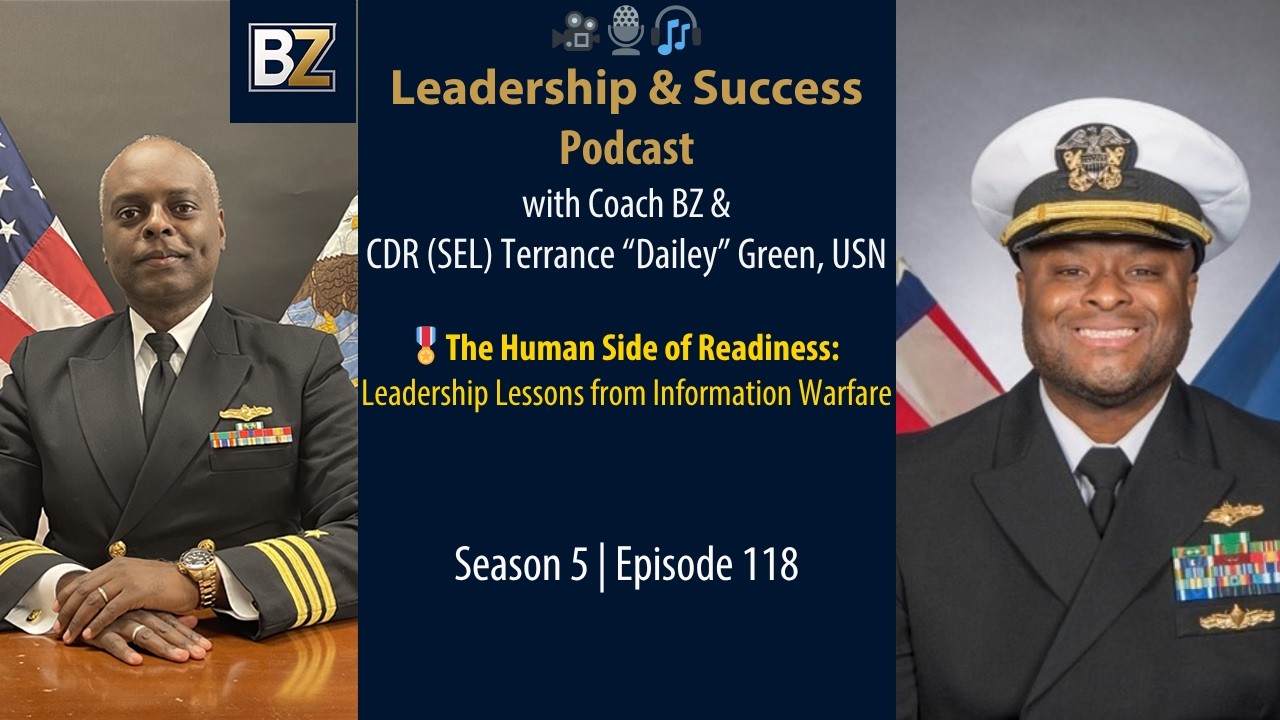
LCDR Terrance "Dailey" Green, a Navy information-warfare officer, rose from enlisted ranks to become the first non-forecaster to qualify as forecaster duty officer. He credits Captain Desmond Walker's advice to "find the gaps, fix them" and emphasizes that leadership influence works through integration, empathy, and trust, not formal authority. Green uses Robert Greene's The 33 Strategies of War for discipline and warns that AI in military operations needs humans in the loop for judgment and accountability.
Chapters
Hi, I'm John Maxwell. When the top companies in the world are looking for trainers, speakers, and coaches, there's one name that stands above the rest, and that's Maxwell Leadership. Our certified team members have gotten proven results for companies all over the globe, and our reputation, I'm proud to say, is second to none. Some of our members have risen to the top of their profession, including the one you're going to meet today.
I proudly introduce you to my friend Bob Fabien Zinga.
Welcome to the Leadership and Success Podcast with your host, Coach BZ, where we help you lead with purpose and succeed with impact. If you're ready to grow into the kind of leader others want to follow, this podcast is for you. If you're determined to elevate your success and leave a lasting legacy, this podcast is for you. As my mentor, Dr. John C. Maxwell, reminds us, everything rises and falls on leadership. Our goal is simple, to inspire you, challenge you, and equip you with insights that can transform the trajectory of your leadership journey. Welcome aboard to another episode of the Leadership and Success Podcast with Coach BZ.
All right, everyone, welcome to another episode of the Leadership and Success Podcast. I am Coach BZ and really glad to be broadcasting to you today live on LinkedIn and YouTube. I have a very special guest today, a brother in arms, a shipmate, and I will be introducing him in just a moment. But before I do, As is our custom here, we are going to go through what we call the moment of gratitude. So this is where we take a moment every single time we meet just to be grateful. And part of the reason why we do this is because in the military, as you know, there is really an epidemic of suicide. It's about 22 service members and veterans who commit suicide, not every week, not every month, not every year, but every single day. And we believe here that you cannot be suicidal and grateful at the same time. So if you would, you know what to do, maybe close your eyes and put yourself in your happy place and think about one thing you are grateful for right now. As you know, this is Memorial Day weekend and it's really not a happy Memorial Day, that's not something I would say, right? Because this is really a time for us to reflect about what our freedom really cost, right? The price that was paid from the independence war all the way to today, how many people have died in service of our country. And especially now that we are in war with Iran, I think officially 13 service members have passed away. But it looks like the number is actually 15, and I still do not know— at least it hasn't been confirmed— what the additional 2 members are. I believe it's one sailor and a Marine. But people have lost their lives in order to protect our freedom, right? Many gave some, but some gave all, and we do need to remember those who have come before us and those who gave their life for our freedom. So that is what I am grateful for today— the 1% in this country who raise their hand and say, I will wear my country's uniform, I am going to fight for the freedom of America, which I believe is the greatest country in the world. All right, so let us know in the comment what you are, uh, grateful for, and also let us know where you are joining us from, what city, what, uh, state. And if you are outside of the US, which country? And if you do have a question for my guest, please go ahead and type the question in the comments and we will again answer your question live. So let me see if I can properly introduce my guest today. Today I am really privileged and honored to really welcome Commander Select Terrence Daley Green. US Navy. He is an accomplished information warfare leader, uh, so we are both in the same, uh, community, information warfare community. He's an operational strategist and servant leader whose journey from enlisted sailor to senior Navy officer reflects the very best of discipline, accountability, resilience, and service. Again, another thing we have in common, just like I started my Navy career 21 years ago as an E-1, uh, seaman recruit, and today I am a senior officer, a Commander. So currently, Commander Green is serving as the METOC requirement officer at OPNAV N99, and Commander Green helps shape strategic investment decisions that directly impact Navy environmental intelligence, operational readiness, and warfighter effectiveness across the fleet. His leadership experience spans operational deployment aboard the USS Enterprise, USS Bataan, and USS Carl Vinson. Actually, I was on the Carl Vansmensen too, so another thing we have in common. So he had leadership role at NGA Fleet River Center Norfolk, and he was the executive officer leadership at Information Warfare Training Command in Virginia Beach. Now, this episode title is going to be The Human Side of Readiness: Leadership Lessons from Information Warfare. In this powerful conversation, we are going to be discussing leadership under pressure in operational environment. But we will also discuss why people, not technology alone, remain the foundation of readiness. So Commander Green's leadership philosophy, ARIA, A-R-E-A, stands for authority, responsibility, expertise, and accountability. It really offers powerful lessons not only for naval leaders, but also for cybersecurity executives, engineers, analysts, and emerging leaders navigating increasingly complex environments. So, uh, without any further ado, please help me welcome to the Leadership and Success Podcast the one and only Commander Select Terrence Daley Green. Good morning, Commander. How are you doing today, sir?
Good morning, I'm doing well.
Well, congratulations on being selected, uh, Commander. That is a very, very big deal. Less than 4% of us make it to O-5 and above. So welcome to the senior officer club, sir. That is, uh, such a wonderful, wonderful thing. Really proud of you.
Appreciate it.
Wow, that is wonderful. How did it feel when you, when you found out you were selected?
Well, so for this, for this particular one, you know, the results usually come out in May. And so everybody is looking. You know, this didn't hit until June.
Wow.
So I was actually, I was out on the, I was out on the deck plates. And I came back to my office and I had a group of folks in the office and it was like, congratulations. Because, yes, that's what, you know, I kind of forgot about it. But yes, it was— I was pleasantly surprised.
Yeah, because as you know, in the Navy, you really don't go to the board until you are an O-3, right? From O-3 to O-4. And the way I found out I was selected for O-4, my commanding officer actually called me. He's like, hey, congratulations, Lieutenant Commander Zinga. I'm like, what, what, what? And then I went to the list and I saw my name. It's just, just a great, great, great time. I'm sure your family is overjoyed because it's really a huge accomplishment. When you first joined the Navy, what was your initial rank? Did you come as an E-1, E-3?
Came in E-1.
E-1, just like me. And where did you go to boot camp?
Boot camp in Great Lakes.
Okay, yeah, yeah, me too. Artistic, great mistake. I mean, Great Lakes. Yeah, yeah, that was fun. Wow. Yeah, we have so much, so much in common. And I must also tell you, being African American, I really wish we had more and more senior leaders who are Black. But I think the Navy is improving in some ways. It is getting a little bit better because I do think representation matters a lot because I remember even when I was in E-1 21 years ago, General Powell, one of my Trusted Mentors has always been someone I had in mind about what was possible. Just seeing this Black man with a 4-star uniform is like, wow, that is possible, right? If it happened for him, it could potentially happen for me. So congratulations again. This is really great. Is there anything you are particularly thankful for today? I like to start with.
Gratitude? Yeah. And as you was talking about that, I was really thinking about that, you know, it's always definitely thankful for family. I would particularly say my wife. Because, you know, she's been that, you know, been by my side pretty much doing, you know, throughout this whole, this whole adventure. She was active duty also.
Wow.
Well, right. And so it was you know, it was either I was deployed and she was taking care of the kids or— man, that's right. So just that, that, that tag, you know, we were essentially tagging from, you know, time to time.
Yes.
And just, you know, just never any, you know, the support was never wavering. You know, there was never a doubt. And so those things you can't take for granted, right? Because it either works or it doesn't. And if it's not working, then, then other folks suffer because of it, right? So that never was, never was the case. So I'm definitely forever indebted and grateful, you know, for her.
That is so true, man. Even when your spouse is not serving, they still have to sacrifice so much.
Exactly.
Because when I had the privilege of becoming a commanding officer, one thing I really, really loved doing was to write appreciation letters to the families. Of my Sarah's because, uh, it's true, you know, there is no telling how many, uh, recitals, birthdays, special holidays, and I missed just because I was deployed, I was away. And yeah, my, my wife had to be both mother and father to our two daughters. And yeah, it is a great sacrifice, especially now. Of course, during Memorial Day, we really think about the ultimate sacrifice, people who actually died for our country and our freedom. But I also think about the sacrifices of our men and women in uniform. Like, there are people right now, right, right in a desert somewhere or in the Middle East, and probably right now within range of being shot by Iran or whatever, really putting their life in danger for us while we are safe at home. And I do want to remember those servicemembers, men and women, as well. Is there something about you, commanders, that most people may not know? When they first meet you?
Oh, man. Probably that I'm— I have a sense of humor. I think a lot of— I hear all the time that, you know, I have a stern face, serious face. But, you know, just from that initial account, but once, you know, of course, once they get to know me, yes, I'm really you know, charitable at heart.
That is wonderful to know. Now, you enlisted in the Navy in 1997. I did in 2004, so it was 7 years after, after you. And then let you commission as an officer. Looking back on that journey from enlisted sailor to senior information warfare leader, what experiences shaped you the most?
So I, I really believe, and I look back on it, right, because, you know, there's a whole diversity of folks and how they came in, how they end up, um, getting commissioned, right? Everybody's path is different.
That's true.
I look back on it, in particular for me, that was the best decision I think I made. Wow. Even, even from the standpoint of coming undesignated, right? And so it was that, that perspective, right? You didn't score the right ASVAB score, you know, to get, you know, get selected for certain jobs.
Yes.
But for me coming in undesignated, I got a chance to observe, you know, everything that goes on the ship, the various jobs, responsibilities. And, you know, through hard work, really pick and choose you know, which area I wanted to go and not from just reading a pamphlet, but actually observing these folks do these jobs, right? I had friends that were doing it. And so for me, that, that was huge.
And that is amazing.
Yeah. Wow.
So it's been almost 30 years for you then, 29, over 29 years ago.
It'll be 20, it'll be 29 here in August.
Wow, that is amazing. Wow, what a long time. Yeah, because when I, when I got in, I took the ASVAB and all, all of that. They said I scored high enough, actually I could have become an officer, but I wasn't a U.S. citizen yet, so that wasn't an option. And then they said, okay, because of also your civilian experience— because at the time I was a director of IT at the University of Alabama, I had about a dozen people reporting to me— like, okay, we can bring you in as an IT-3, right? So a petty officer. Third class. But they're like, okay, you are not a US citizen, you cannot, you're not eligible for the secret clearance yet, so that's not possible. So then they said, okay, the only way for you to get in is to come in as a seaman recruit. Are you willing to do that? And I said, okay, let's do it. But at least after boot camp, they promoted me to seaman. So I went from E-1 to E-3. I guess that was something. What was your last enlisted rank before you became an ensign?
First class.
Wow, that is right.
Yep, that was an AG-1.
That is pretty cool. Wow, so that's an E-5. Yeah, I, I, I, uh, I, I was— no, actually E-6. E-6. Wow, almost a, uh, a chief. That is cool. Yeah, I, I was only an E-4 when I had the opportunity to become an ensign, so I took it. Because when I went to boot camp, I was like, okay, I will either become a chief, no, senior enlisted, or a senior officer, or a commander. So Once I got the opportunity to become an ensign, I definitely ran with it. And by that time, of course, I was already a U.S. citizen, so everything worked out. But, uh, wow, that is, uh, so you are a true Mustang. So I'm sure when you are in your full uniform— I think I have a picture of you— you should have a Good Conduct Medal, right? Because people need to know. Yeah, I see that right there. Good Conduct Medal with a bunch of stars. Because officers, we do not get good conduct. It's, it's, uh, I guess, uh, it's expected, I guess. But if you are enlisted and you do your job, then you get a medal just, just for doing so. That's, that is one. Well, let me ask you a question. Which one of your medals means the most to you?
If I had to, you know, I will probably say the good conduct.
Good conduct. Why?
Right? Because there was some effort put into that. And then, you know, when I came in, it was pride in that, right? When you could put that, you know, you start stacking those stars on there.
Yes. Right.
That spoke for you, right? Because, you know, those, those medals, and there's certain ones that they speak for you, right? Long before a person even knows you. They may not even get to know you, right? They're looking at your, at your, you know, at that stack.
And so that's amazing.
Yeah, perspectives. And so that, that did mean a lot to me. Wow. Just like the right way.
And yeah, and showing that, I guess that's another thing we have in common because my Good Conduct Medal means the most to me too, because it always reminds me where I came from, right? Because especially when I became commander, that was a dream of mine, right? And then my head got a little bit big for like a minute or two. My wife had to sit me down and said, okay, I am— you may be commander in the Navy, but I'm commander of this household. You see that? And yeah, I'm like, yes, ma'am. So, uh, but, but, but, but yeah, just looking at it, reflecting, yeah, it reminds me, Simon Zinga, you came through this. And yeah, you just remember where, where you come from. It's very, very powerful. But now I see that— I guess you didn't have any— did you have any, uh, warfare qualification? As enlisted, did you have a chance to qualify in any warfare field?
So the— right, so I did. I got the, um, uh, enlisted special warfare.
Special warfare. But it looks like it's enough. So you have two warfare. So you have information warfare. What is the other one?
And surface.
Surface. Wow, so you are crazy. All right, all right, you're one of those crazy ones. Yeah, yeah, because the surface warfare is really the gold standard, I believe, for the Navy. There is no way around that. All of the other, uh, warfare communities, we, we are— I think we really steal from, from them. We built all of our capabilities off of what the surface warfare Navy does. Wow, congratulations! That's, uh, that's a very tough one to have because that's something I was gonna work on when I was a, uh, junior officer. I, I was thinking At the time I was working on my PhD in microbiology, I was like, once I finish my PhD, I'm going to go on active duty for 2 to 3 years. That's how long it takes to earn my Surface Warfare pin. But around that time is when the Navy in 2010, right, came up with the Information Dominance score.
Right.
Okay. Since we have our own warfare pin now, I am not going to need to do that. But I know it is, it is, it is tough.
So congratulations for going through And what I would tell you, that, that decision was not, uh, emotional based.
Yes.
Right. You— it didn't definitely go into it. And, you know, you have, you know, the list of, of, uh, paths that you want to take. And so MITOC was one.
Yes.
Um, but I fully understood that it was necessary to have that exposure as a surface warfare officer because, yes, you know, just from as a naval officer at some capacity, you're always going to be supporting true, the surface warfare community. And so, you know, and I'm sure we'll get into this again, but that goes into leadership, right? We're not— you're not doing things because it feels good or— yes, you know, it has immediate result. You have to make that strategic commitment and that decision.
Yes.
You know, and so I went into that and didn't anticipate enjoying it, to be honest with you. But when it was all said and done, that was one of the one of the most memorable tours that I've had, right?
That's really wonderful to know because when I was a baby ensign, uh, we used to joke in my community that in the surface warfare community, right, they eat their young, right, and spit them out. And it's kind of like sink or swim, whereas really in my experience as an IP officer, information professional, I mean, everybody was assigned a mentor. They really took care of us. They changed our diapers. They fed us. I mean, they took care of us so well, told us exactly what to do, how to do it. There was a lot tend to care and love. And our mentorship was just, just great. I know I wouldn't change that experience with anyone, but I know, uh, in surface warfare community, that's not the way they usually treated their junior officer. Was that your ex— your ex-experience?
And so it's different for me. I had a different experience, and I, and I heard that going into it. But again, if you're sitting on the sidelines watching folks get after stuff, then it will seem like that, right? Because you have to come in and you just— you have to be just as invested, right? You have to understand that culture. Uh, and so if you're getting after stuff, you're gonna— you're gonna fill in those gaps. You're going to be valued. If you're not doing that, then, you know, there's no— there's no space for that type of, uh, behavior for the most part. So for me, I never had that issue. And again, I think that's coming in enlisted and really understanding who are the folks that really add value.
Yeah.
And it's always, it always begins with enlisted, right? For me, it doesn't matter how high I go. I understand that now. I go to a new command. I'm seeking out that chief, right, within the department, because I want to have a good idea. So I have proof of what's going on.
Yes.
You know, and so for surface warfare, it was really the same. It's the same thing, right? You're going to be on that bridge, and they're going to be QMs, right? They're going to be QMs.
Yes.
They know how to drive that ship better than, you know, just better than just about anybody, right?
I love that. Yes, because for those who are watching, um, when the commandant talks about chiefs, those are the senior enlisted members of the Navy. In my opinion, they really run the Navy, right? Us officers, we take all of the glory, but really the chiefs are the ones who run everything. They take care of our enlisted, and it's, it's, it's just a wonderful job that they do. Now, which, which, um, commission route did you choose from enlisted to officer? Did you go for the OCS. Okay. Now, there is this other thing, especially in the surface warfare world, I believe it seems that people who go to the Naval Academy, they have a little bigger head for whatever, right?
Right.
They feel like they are the real Navy. Did you have to deal with any of that nonsense? As is?
Now, I will tell you now that there is some truth to that. Now, that's a different group. That's a different group. But, but they definitely do bring, they bring in a mindset that is useful.
That's a good way to put it.
But you know, it's, it's, you know, you have to bridge that connective tissue of, you know, of the, of the officer, but also connected, you know, with the enlisted, right? Because that's our foundry.
Absolutely. And also for the junior officer who follow the podcast, as an O-1, O-2, O-3, O-4, really, you are supposed to be mentored by the chiefs, right? So they are your mentors, you definitely need to show a lot of respect, just like maybe that's That's why when you go to boot camp, all of your drill sergeants pretty much are chiefs. So even, I'm sure when you went to OCS school, there were chiefs also, right? For sure.
Definitely.
I went to direct commission after school in 2009, was it? Yeah. All of them were chiefs, chiefs to both, so sergeant in the Marine or chiefs in the Navy. Now, sometimes I shouldn't have done that. I had great respect for them, and I always do. But at times when they try to push me like I'm at boot camp, as if I would sit and listen, I'm like, okay, I am an ensign, you are a chief. No, I'm here, you cannot hear. So yes, I'm gonna do what you say, but please, no, check your tone, please. No, but, but, but really, to be, to be serious, yes, they, they really, uh, run the, the Navy. But, uh, when they mentored me throughout my entire career, so when I finally became a senior officer, I was like, okay, I've been mentored by chiefs my entire career. It's not going to stop now. So even as an O-5, they still maintain— I have great, great respect for the Chief Mass for sure. Now let me ask you, Commander, you often speak about accountability, humility, discipline, and service. Were those values developed early in life or forged through adversity during your Navy career?
Yeah, the bulk of those were right out, I think, right out of the womb. Really, for me, right? So I'm an old country boy, right, from Florida. And growing up, a lot of the foods, we really weren't in the grocery stores, right, like that. So we raised a lot of our food. As far as, and even back then, we didn't really use the central, the central air that much, you know, that much. And so it was crucial for you to do things and do them the right way. And so that, that level of detail and accountability was instilled, you know, from my parents very, very early on, right? Something simple as, you know, we would grow sweet potatoes. And, you know, so you're planting those, but you have to maintain them, right? And so you got to periodically go out there and make sure you're weeding, getting rid of, you know, the weeds and the grass. If you go out there half doing that, right, you're not pulling that weed up correctly, it's going to be right back the next day. And so my father, man, would very early on— I still remember that— he would get on me about that, right? Taking that time. And you're out there, it's hot at times, right? Um, and you're out there in the elements, but taking the time to do things the right way, right, will save you in the long run.. And so I learned, I learned that very early on. And there's humility that comes with that. Because, you know, when I'm, when I'm teaching my sailors, or even my children, it's not coming from a place of something where I read. Yeah, you know, it's in a book. It's, it's from documented experience that I've seen. And so that just communicates and translates differently, right, folks. They know that. They know when it's coming from a place of, of application, vice, you know, a concept, you know, that was that you read or you were taught.
That's really, really powerful. What has that taught you about leadership and life? And how has those values really helped you through your career?
You know, I think when we were talking ownership, it's— and again, I think this is— this gets into why I don't have a book per se, or even a leader per se, right? Because I think there are foundational things, you know, like we were talking discipline, that is universal, right? I don't really need someone to tell me that. I just, I just have to be curious and want to do things the right way. And when you go through that trial and error, of yourself.
Yes. Right.
You're going to learn how things work.
Wow.
How they work for you. And then you, you know, what you'll be translating is those foundational principles, because those are the universal things. Yes, I may have to tailor them for me. But I think it's very important for me not to try to transcribe that on somebody else. The things that are going to translate are those things that are universal, right? For us, yes, on the courage and commitment, those are universal principles.
Yes, right.
You may attack them a little differently, and you have to figure that out because you have to do that and you have to be honest to yourself. Um, but I, I would say, and then just having that confidence to do that, having that courage to do that, because that takes work, right? That is, it takes work and inspection that you have to You know, you have to look within.
Yes.
As you're learning this, but you have to— you can't be afraid to make mistakes also.
Wow.
We fall behind, you know, we fall behind a little bit when we're, you know, reading this book or that book, you know, and those things are good. But at the end of the day, when it's you in that seat, yes, you got to translate that stuff and it has to make sense to you.
Powerful. Well, I like everything you've said, and when you talk about honesty, integrity, character, right, I think it's probably one of the most important core values, right? Because without it, all of the core values are completely meaningless if you cannot be a person of integrity. Now, did you grow up in a military family? Any members of your family were in any branches of the military at all?
So I had quite a few uncles that were that were in the Navy.
Oh, nice.
Some of them just retired.
Wow.
Competition, right? So it's—
that's why you— a little bit why, why you join the Navy?
You know, it was not— I really did— I did not know that they, they were— I had that many folks in the Navy until I had joined, to be honest with you. Wow.
So why, why did you join then?
So for me, it was I didn't want to be a liability for my parents. And I did not want to go to college at the time.
Yes, right.
I thought, I mean, I'm just getting out of high school, man. Last thing I want to do is, is get back into a classroom. And so, and again, this goes into, and I think we'll talk about a little later, but my preparation wasn't the best for that. Um, and so that, you know, I do think that was a reason why I didn't score, you know, like we was talking before, NASVAB. But I think all things work to the good, you know, in the end. But that was my biggest motivation. I just didn't want my parents having to take care of me, right? Because, you know, like I told you, my background— I know growing up, I know what that struggle was.
Yes.
And so I didn't want to be that liability.
Well, that is really something. Another thing that amazes me, you know, you started with humble beginning and today you are in the top 4%. A commander in the most powerful Navy in the world. It's just something about America, right? Only in America, especially when you think about the history of slavery in this country and how Black people were treated. And today in 2026, here you are in September, you will put on the rank of senior officer in the Navy. It is really wonderful to see what is possible. And I think part of why I have this podcast too is to try to inspire especially women and people of color about leadership and success and think that could be possible for, for them as well. Wow. Yeah, and when you were selected for the Enlisted Marine Science Education Program, right, before you became an officer, What did that opportunity teach you about preparation, sacrifice, and really believing in yourself?
You know, it's funny, I will, I'll link it quickly back to, you know, the, that, that culture was talking about, about swallows eating their young. And I was saying, you know, if you're not in that stream with them, heading down the river, you're on the bank just looking. Then, you know, that's a problem, right? So for this, you know, I told you when I came in, my reason, one of my reasons for coming in, because I didn't want to go to college. It almost seemed as the day I stepped foot on my ship, the USS Enterprise, I realized I couldn't do what I wanted to do without further education. So that was, that was day one, right? And so I know you probably remember PACE courses. Yeah, but, uh, I will tell you, as soon as I got my qualifications, the SHIP qualifications, I started taking college classes. And so if, if, if I didn't do that then— and we're talking, you're talking to a person who has a full-time job. And a lot of times you're taking these classes, you work the night shift. Yeah, you're getting off that next morning, you got to stay up, go through that class. Try to get some sleep.
Yes.
You know, then you have maintenance and everything else that you have to do. And so it was that preparation, though, and drive that gave me that opportunity, because one of the prerequisites was that you had to have associates to even be considered.
Yes.
Right. And so it was just that grinding. And this wasn't overnight. I mean, it— I started it on the, on the Enterprise. I went to my next command, which was in Pensacola, continue to take classes.
Wow.
We're talking over the span of probably a good 6 or 7 years, man, of really just, just being in the position to take advantage of an opportunity, right? Because it still wasn't guaranteed. But I had done that. And Wow, that really helped because if I hadn't, I wouldn't have— I wouldn't have just— I wouldn't have the prerequisites to even be considered.
Yes, man, a lot of people don't realize the sacrifice and just the resiliency, the grit, and what it takes. Uh, which makes me think, uh, early in Officer Candidate School, you experienced a setback and you were rolled back to another company. How did that experience strengthen your confidence and leadership resilience later? In your career?
Right. So it was, you know, you go into these different environments that you're not used to, right? That, that, that's just an instant test. So getting up there to, to OCS, now I'm dealing with gunnery sergeants. And I literally thought these folks were really trying to kill me, to be honest. And so even with all that experience, just being in the enlisted ranks, and I knew going up there, you know, you know, you got to play the game. I've been through boot camp. This is a little different than boot camp, I will say that.
Yes.
But I was not— I wasn't prepared. And I think my biggest limitation was that I just did not trust my training. Up until that point. And I was doing this more so as a want than a need. And I do think there's a difference, right? You know, you want things because they look good, they feel good. But again, when you get in the moment of engagement, that's gonna, that's gonna determine if you're serious, you're really serious about what you are, what you're doing. And so That, that setback, getting put back in the holes, I'm gonna tell you, I was at the point where I was, I was going to give it up, right? You know, because you go in, I'm a first class, right? I know there's other options. I could have gone to be a chief. Yeah, I don't have to sit up here and deal with all this. Um, and again, I'm at a point where I'm feeling sorry for myself, just to be honest with you. And if it wasn't for my wife giving me encouraging words, right, because I'm sitting there and Holy Company, man, I'm about to— I'm daggone near tears, man, because I'm about to give all this up.
Wow. How did that make you feel at that moment?
You, you do feel— you feel helpless because you don't think you have a purpose, really, right? But that's a— you know, for me, it was a good thing because it, for one, it wasn't true. But I just had not identified, really identified why I was doing what I was doing. And, you know, it again, it just champions that one, you're not in this by yourself. Right. And it really took my wife to say those encouraging words for me. Yes, set me back on that path to course correct my thinking. Right? And it was, it was something simple as, you know, you've worked for this, you know, your entire career, right? If you don't go through this, you're going to regret this for the rest of your life, right? And I remember exactly what she said. You know, she said, you could come home, I'll be glad, I'll be happy to have you.
Yes.
But you're not going to be happy. You're not going to be content and satisfied.
Wow.
And so when it, you know, and then that, and that's why I say I had the purpose there I just hadn't realized it because the moment she said that, that's all I needed, right, to click back in, to click back and focus.
Wow. So in that moment, how do you think that experience affected your confidence?
Right. So, and then from that point, again, when you have a clear idea of what your goals are, and, you know, and you really truly believe that, when you hit adversity, you have to have that, that awareness to go back to those things.
Yeah, right.
And that's, that's the importance of principles, right? Because they're— those are the enduring things. Because if it's something that I want, or it's emotional based, that's temporary.
Back to your core values, that focus.
Right.
And so the thing that has to be understood is you're going to, you're going to encounter adversity, you're going to encounter setbacks. But you always have to give yourself that time to pause.
Wow.
And recollect on why you're doing what you're doing.
And that's really powerful. But in that moment, did you kind of struggle with embarrassment and maybe shame as well? And were you already a father by that, by that time?
Was I what now?
A father.
Oh, for sure. Okay, you said father. Oh, for sure. 3 kids.
Because in my Navy career, a couple of times I thought about quitting, but I was thinking about my 2 daughters. I'm like, no, I cannot quit because of them. I have to set an example. So did you struggle with embarrassment or shame or what your kids might think about you if you did just quit then?
I, you know, honestly, and I guess I feel kind of bad about that, I really didn't at the time.
Okay.
And again, and I think because I was, I was in my feelings, to be honest with you. And it was really, it's really just about me, right? How I was feeling at that moment. And so maybe, I guess, to a certain extent there was embarrassment, but not enough to propelled me, you know, to continue.
Yes. So did you feel maybe betrayed by the institution, maybe, or misunderstood during that time?
No, no. And one thing that I would say is one of my probably only good attributes is, you know, when I, when I speak of accountability, I truly believe that starts with yourself. And so I instantly looked at myself. Yes. And because that's really all I can control, right? What somebody else is doing, I can control how I'm thinking, how I'm perceiving this.
That's thoughtful.
And if it's— and if it's— even if it's a wall, right, I have to figure out a plan to pivot and go around that. Wow.
So what did this experience teach you about leadership and success in life?
I—
it's, it's really all-encompassing. It's, it's really, you know, having a purpose for what you're doing. I think, I think you need to go through the stress and the engagement of refining that for yourself. So when these— when adversity hits, and it can, you know, it can be in any, any shape.
Yes.
You're gonna have to be able to fall back on that. It's important to have folks that are in your corner that are invested in you. Yes. Because it may take them stepping in and providing those words of wisdom to help shore you up.
Powerful. Wow.
You have to be— you have to accept that you don't know everything.
Yes.
That you will need help at times.
That's humility again.
Exactly. Wow.
Now, I must tell you, hopefully this is going to help, especially on junior officers who are listening to this show, because many times, leadership and success, we talk about success and all of the accomplishments and accolades and all of that, which is great. But sometimes I also like to talk about some of the challenges or failure we go through, because I think Many times we learn a lot more when we go through those. And you had referred earlier to Romans 8:28, right? As we know that all things work together for good to them that love God, to them who are called according to His purpose. Someway, somehow, it's all going to work for your good. Where does that faith come from in your life and your career?
It was definitely growing up, my childhood, my parents, they were definitely advocates of, you know, of the Bible. And so we were definitely, you know, spiritual individuals.
Yes.
And so that— but it was just synonymous with understanding what those fundamental principles are for life.
Right.
And it's, you know, there is integrity, it's, it's discipline, it's respect, it's, it's courage.
Yes.
Duty to others.
And so powerful.
That was, you know, that was always central.
And so really, it's not just a poster on the wall or a book you read, but it's something you really lived through your entire life.
I think so. And again, I think it— that has to happen because the folks that are going to be under you, they understand when things are fake, right? They understand if it's just a poster.
Yeah, right.
You're saying this, but I don't see you doing that. Um, so that has to be— and that's why it's a— it's a— it's definitely a contact sport, and it requires engagement.
Right.
And engagement always begins with yourself, right? You have to go to war, to go to war on yourself. I like that, you know, and then when you're doing that, your folks that are under you are working with you. You know, there's that, there's the open investment, I think.
Wow. So for the young junior enlisted and junior officers who are listening right now, they may be questioning whether they truly belong in leadership across all of the military branches. What would you tell them?
I think just from my experiences, you got to identify if it's a, if it's a want or it's a need. Right? Because if it's, if it's a want, and it's coming from, you know, emotional perspective, right? This, you know, officer looks good, I like the uniform, or, you know, I like to pay. Yeah, those, those— when adversity hits, all that stuff goes out the window.
Yeah.
And so then you're, you begin to compromise your ethics, your morals, things that you know are right, right? Because you don't have a true foundation to fall back on. And I would say, um, you have to, you have to head toward adversity, head toward getting out of your comfort zone. Because that's going to identify quickly to you whether you're doing what you're doing for the right reasons.
Yes.
Right. Without, without that engagement, you know, you know, we're in the, we're in the business of, of arms and conflict engagement is how we grow. Right? Whether it's mentally or physically, And so without that engagement, you're not going to know who you are, right? So we talked about in the beginning, you know, not running away from the service community. It's hard. That is hard work. That's, you know, it's a, it's a, it's a, the expectation level within that community. Yes, it is very demanding. But again, you learn who you are. When you know, when you're put in those positions, And those are things that, that I will carry with me for the rest of my life, rest of my career.
That's really powerful. Let's talk about operational leadership for just a moment because you've served in operational roles aboard the USS Enterprise, like I said in the introduction, USS Bataan, and Carl Benson across multiple fleet assignments. Which operational tour challenged you the most as a leader and why?
I would say probably the Carl Vinson. Because at that point, you know, I had been in over 20 years already.
So you could retire any day you wanted to.
You could retire, right? That's it.
That's a great feeling to have in the Navy for sure.
Right.
Right.
But going, going as a METOC officer, you have varying commitments and bosses. And so organic to the ship, you know, the CO is right, my fit rep. And so I'm on the, you know, one of the, one of the mandatory qualifications I have to get is Officer of the Deck. So yeah, that in itself is a full-time job.
Yes.
But also I have a a METOC team that embarks. And so I have a junior officer that I also have to mentor, have to help develop. He has a team that he's, he's training. And then on top of that, we have a strike METOC. And so there are requirements. Yeah, embark, right, the strike group commander has requirements. And so there's a lot of communicating and integrating. Yes, that you have to go out of your way to do, right? Not staying in your own lane. You have to go out of your way to do to ensure you understand the folks that you're supporting, what they need, limitations and capabilities are. Hmm. But, you know, again, those— I think I'm wired to just head toward the most challenging things, those things. Because I do, and I do believe those are the things that are going to help me grow. And I'm going to learn a lot about myself. And the more I learn about myself, and the more I grow, the more I can administer to others, the more I can help.
Yes, I did.
And direct those that are coming up to replace you and I. And it comes from a place of, it'll come from a place of experience and understanding.
Yes.
And then that's, and then that's when I think the additional readings, those things supplement what I'm actually seeing and doing. Well, I think that just translates more real to, to folks.
That is really something. What, what do you think during that time, what do you believe was the secret of your success? Because it is a lot, you don't have enough time, resources to all of, all of that? What, what helped you get through it, you think?
For me, it's, it's a real insatiable appetite to learn. I do. I really do think so.
Yes. Right.
Because even those times where I didn't meet the mark, I got knocked down. I would always come back to that. And, you know, and there's always a period, you know, where you're trying to lick your wounds. You know, get your bearings. But I always come back to that. Right. And the, you know, the older I'm getting, the more I'm realizing that that comes with the territory.
Right.
And what I really began to understand is that was an expectation I was imposing on myself.
Yes. Right.
Because I'm looking at other folks, and they're not perfect either. And there is an expectation that they're perfect, right? Yes, it's the intent to, to accomplish the mission, and you do it according to principles and ethics the correct way. But you got to figure out how that works, and how to do it that matches who you are.
Hmm, that's powerful.
Right. And so I think when I started to, to to understand that, I stopped putting so much stress on myself, right, to get things right. And focus more on getting out of my comfort zone, engaging with people, having conversations with people. Right? Because you learn so much just through osmosis.
Yes.
When you're doing that.
But what happened to people who feel like I am too shy? Or many times when you get out of your comfort zone, of course, you've never been there before. So it's new to you. Usually you don't do so, so well because you are learning, and then usually, you know, you're gonna fail a lot until you get better and you build your confidence. What would you say to people who are very hesitant because of those things?
Right, so, you know, I really, I really chunk it up to need versus want, right? You have to understand that you got to convince yourself this is a need.
Yes. Wow.
This needs, this needs to happen. And not, not, you know, I'm doing it because, yes, it'll make my resume look good. Because I know this person. It has to be a need. You have to, you have to believe that this process is necessary. My development necessary for mission completion or whatever the goal is.
That is powerful. Something I learned from another one of my mentors, Tony Robbins, right? Turning a should into a must. He says many people should, should, should, they pretty much should all over themselves. But when you turn a should into a must, then there is no way out. You absolutely have to do it no matter what. But if it's a should, ah, maybe I will, maybe I will not. I see how I feel. But yeah, powerful. Okay. So, oh man, we are already almost running out of time. Let's talk about information warfare. For just a second. So you are a MITOC Army Information Professional Officer, and when we earn the Information Warfare pin, basically, you know, you learn just the basics from the other, you know, tribes of IWC. It's MITOC, IP, Intel, Cryptologic Warfare, and Space, right? So you don't have to be an expert in all of them, but you're definitely an expert in your own domain. So you being the expert for MITOC. I guess the question I have for you is, as an electronic warfare officer, actually a, uh, and, uh, MITOC officer, you operated in an environment where information security directly impacted mission success. How has information warfare changed over the course of your career? And for those out there also who don't know, in 2010 when we stood up IWC, it used to be called IDC, Information Dominance Corps, and then pretty quickly we found out the Navy didn't Dominant Anything, uh, in the information warfare space. So we changed it to Information Warfare Community, which is more appropriate. But, but, but, uh, from, from, from what you have gone through, how has IW kind of changed over the course of your career?
Right, that, that's exactly where I was going to start, right? I remember there's information dominance.
Yeah.
Uh, and again, we, you know, in the very beginning we were stovepiped. I think we're still trying to work through that. Yeah, but our underbelly is integration. And that, that is a very, that is a very real process and action that we need to be doing. But initially, in the beginning, we were more stovepipe. But as you see now, we have the, the IW squadrons, right, where we have information warfare line, Yes. You know, so we have that seat at the table now.
If it wasn't, it wasn't because, like I said, we pretty much follow the surface warfare community. When I first joined the information warfare community, there was no billet for me to become a commanding officer. That was not just the plan. And of course, we are, we are line officers, but we are restricted line, and I think they are being talked now to remove the race, the restriction. So things have changed and evolved a lot. I also remember when I first joined in, it was like when I was enlisted IT up to secret only. I didn't need to get to top secret anything. But then when we merged with Intel, then we had to get top secret SCI and so forth. So a lot of things have changed. So our community has evolved a lot, right? But anyway, so sorry, I didn't want to cut you off, but just to say kind of, no. How many things have changed.
And just like, I'm the, I'm the beneficiary of cross-detailing processes now, right? I was able to be an executive officer at the Information Warfare Training Command. So right at the, at the apex of us bringing in all these, these young folks, officers and enlisted.
Yes.
Across the whole gamut of our community.
Yes.
And so those are different cultures, mindsets, Mission is focused. So you learn, right? But the more I'm educated on a particular group, the better I can leverage.
So because you yourself don't have to have all of the answers, right? Because if somebody comes to me with something meteorological, if it's pretty basic, yeah, I can answer. But if it's a little bit high, then I need to reach out to somebody like, like you will be my expert. And yeah. Wow. So people outside the military, they may underestimate the importance of meteorology, oceanography, and environmental intelligence in warfare. Affair. And you are an expert in those fields. Can you explain why MITAC matters so much to operational success, like at the high level?
Right. So every environment, every operation is conducted in an environment, right? And so the individual that knows that environment knows how you can exploit it, right? So you got to know your own capabilities. But you have to know the capabilities and limitations of those that you're engaging with. That's what we provide, right? So for every environment, right? And so we have a slogan from the, from the space to the seabed, seabed to space, right? We own all of it.
And so we're supposed to, but yeah.
So, you know, so, you know, if we're talking weapon systems, right, that the performance of that weapon system is dependent on air density, winds, various temperatures. We provide that data, that awareness, right? I was just sitting in on a brief about the Naval Observatory. And we also are responsible for the allocation of time.
Yeah, right.
So time, it plays into us being able to connect here right now.
Yes.
So just being able to, to characterize any environment and provide that awareness to a commander, to a decision maker, right, is what we bring to the fight.
That's really powerful. Because something else you said, because when we started this information warfare community in October 2010, I think it was exactly when we stood it up. At the beginning, it seems like as an information warfare officer, I was like an helper, right? I was bringing support to the warfighter. It was almost like I was a part of the, I don't know, maybe the medical corps, supply corps or something like, I am not the one fighting, but I'm just helping. I'm giving the information expertise. But then very quickly it changed where we became the warfighter. We became the people really at the tip of the spear. Can you talk a little bit about how that changed within our community, at least the way we see ourselves now.
Right. So when I was on the, on the Carl Vinson, a part of the strike group staff, there's information warfare commander there. And, and that individual owned, owned that site picture. Wow. Right. And so they were at the table with the CAG, with the CO, making decisions on where the ship, you know, where we went, what missions we could accept.
That's amazing.
And so that was really, that was really amazing to see.
Yes.
And then just with the, with the implementation of the IW squadrons, right, we are, we're really starting to take a larger stake in the decision-making process. And so it just opens up opportunities, right? As of now, I just saw the list for O5 milestones, we have an IWC on the amphib, amphib squad staff. So yeah, so it's exciting times, right? And so you have the opportunity to characterize what right looks like, right?
That is really, really powerful. Now, for all of the information warfare junior officer watching right now, I'm assuming you already earned your JPME Phase 1, right? As an officer. Oh yeah. Now some people, for whatever reason, they, they, they don't really embrace it. In the Navy, you have to be at least a lieutenant before they would allow you to do it. Me, I did it as soon as I became— actually, I tried as a JG, they said no, too, too, too junior. So I became lieutenant, I started working on it. Although in the Coast Guard, they allow them to do it as a JG. I don't know why, but Anyway, so for the information warfare JOs who are listening right now, so that's again intel, IP, MITOC, that's you, cryptologic warfare, or space. What would you advise them, at least up to O4? What do they need to focus on? I'm assuming first thing would be their full IW warfare pin. What do they need to do, you think, as in O1, O2, O3?
Yeah, I would say that that's definitely— you have your, uh, you know, you have the, uh, qualifications germane to your particular designator.
Yeah.
But then of course the IWPN, that's right, that's the— that's our foundation.
Now let me know if you agree. In my opinion, because sometimes, you know, in the Navy we always need more manpower, and sometimes we use our O-1 and O-2s just as bodies, right? We need them for exercises, for training, for supervising, and a bunch of stuff. But in my opinion, at least when I was a CO, I tried to prioritize for my unqualified O-1 and O-2, sometimes O-3s, but most of the time it's O-1 and O-2 only. Their full-time job was to be qualified in their designator. So most of them in my unit, they were all IPs. And then right after that, to earn the warfare pin. I didn't want them to be department head. I didn't want them to be division officer. I didn't want them to do anything in the unit., but really 100%, 24/7, just work on their qualification. Would you advise that? Because I've seen it where at least one person I know, she was really, really good, a great IP officer, but I think they gave us 3 to 5 years to fully qualify, and then for whatever reason she didn't. The reason why she didn't is because she was very busy. She was, you know, adding a lot of value to the fleet exercises and a bunch of stuff, but it was not her qualification. So time pretty much ran out, and then we had to kick her out of our community. Would you agree with that?
I think it, I think it depends, right? So for me, with my background, I wouldn't necessarily, I wouldn't necessarily need to just focus on, you know, the pen. I would understand how to do that in tandem with the other things that this, this person that you was talking about was doing.
Yes. Mm-hmm.
I think those reps and sets are good. It is a lot to manage, though, and fully process. But I think, again, that's where senior leaders, where we come in and we help strategically guide, right? Because there's goodness in being out there, you know, at the spear of those operations.
Yes.
To help supplement what, what they're being trained. So it would almost seem it would be a match made in heaven if you could do those simultaneously.
Absolutely.
But it is, it is a challenge. But I think what you, what you do, what you can lose, and this, this really depends on the person. But if you're just focusing on conceptual stuff, you know, when it's time for you to hold those department head jobs, you won't have the tangible operational engagement, exposure. And so you'll just be, you'll be resorting back to a PQS where it says this and that, but that's not the reality.
I love that. So do the department head jobs, go ahead and then be active within your command, but take your PQS book with, with you and learn as you do. I like, like that a lot. So Definitely get qualified in your domain, your tribe, and get the information worth your pin. What about a master's degree? Because there was a time 20 years ago, it seems like all you needed really was a bachelor's and then you were done. But it looks like it's becoming so competitive these days, I really would advise my JOs to also go for a master's if they could. For the IP officer, a Master of Science, you know, technology, engineering, and math. I think for everybody else, it doesn't have to, to be in STEM. But do you think a master is becoming like what a bachelor used to be back in the days?
Right. And again, this is the, uh, this is the champion, the opportunity that our community has given us, right? So being at the, um, the Information Warfare Training Command, Virginia Beach, I had IP officers. Yeah, so, and but I had to manage their development also. So, know firsthand, right? IP is not built into their pipeline.
Yeah.
It is not built into their pipeline. Intel is not built. I think MITOC is probably the only one where that's built into our pipeline, right? So we really don't have to worry about that. But as an information warfare officer commander at some point, IWC, I need to be aware of that. And so there needs to be a specific sensitivity to those that can't. I definitely will recommend it. Then I have to understand that unlike Meetup, where they have time carved out to get this mapped out, these individuals have to do this stuff on their own.
Yes. Right.
So as a leader, I have to give them that opportunity. And be sensitive to all those commitments. But I think it— and again, it'll go back to me coming in enlisted and having to do that myself also.
Yes, right.
So I have, I have an awareness and a sensitivity to that. And I think going forward is going to be absolutely necessary.
Wow, powerful. So now that you are about to put on O-5, what do you think is the most important advice you would give to O-4 and below in IWC? Something that really helped you, you think, be as successful as you are now?
Right? You're, you're not the, you're not the expert, you're not expected to be the expert. What you are expected to do is know the value and the strengths and the capabilities of your staff, right? Because you're always going to have folks in your staff that are SMEs in whatever you may be deficient in. Right?
So leverage that, including the chiefs and the first classes, because they know sometimes a lot more than you do.
That's, that's specifically right. Because they're, that's where you're always going to get the ground truth of what's really going on. And, you know, being a leader at that level, I'm not at the deckplate level all the time. So I'm heavily leaning on on that middle-level leadership to advise me, right? No. And so always provide an environment that folks feel free to communicate concerns.
Psychological safety. Yeah.
Right. But also, they need to have confidence that when they submit their feedback, you're going to get after and action it also.
Yes, yes. Wow, that is powerful. I think the only thing I will add for the JOs, and I really love junior officers because again, when I was one, my mentors, they took very, very good care of me, is by the time you are a lieutenant, I would highly advise all of the JOs listening to spend some time in Millington. Go to Millington, volunteer as a, what do you call it, assistant recorder, right? You are going to learn so much. You're going to know exactly how to write a fit rep, who you are writing the fit rep to, and how a fit rep will pretty much almost guarantee your selection to the next level. Because when I went there, I went a week prior to the board convening and I went through at least 1,000, more than 1,000 records. And even if you are not very smart, you're going to start seeing trends. You're going to start saying, okay, this type of fit rep, they are written exactly the same way. These people are the top of the cream. So you can tell just by looking at the fit rep, this person's going to advance and this one, probably not, right? And you really don't understand that until you are in the room where those decisions are made. So I highly, highly, highly recommend you go to Millington while you are still a junior officer. So you have a pretty good idea how the sausage is actually made and how those decisions are made.
I definitely champion that because I actually did that too. And I think that's something that we don't do a good job of socializing. I would probably say within the, the IW community, and I can only really speak for me, Todd.
Yes.
But just socializing that as an opportunity, because that was something I really had to just reach out to and try to set up myself, right? Because yes, I knew there was value in understanding and knowing that. And it blew me away, just that whole process. And like you're saying, Um, and then the only benefit is bringing it back and socializing that.
Yes.
Um, you know, and then provide awareness to, to everybody else.
Powerful. It looks like we are already 10 minutes above our time. Can you give me another 5 or 8 minutes before we, we close? If you have to go now, I—
No, for sure. No, I'm good.
So I, I, I wanna close this minute. We could be speaking for hours and hours and hours coming back. This is really stimulating conversation and hopefully it's gonna help a lot of the J.O.s who follow the podcast, but One question I want to ask you, I guess I may have asked you about that in a different way for this last segment. What do you think is one of the most important lessons you have ever learned in life, in leadership in general?
That, that adversity is necessary. Failure is necessary.
Wow.
For growth. And so don't, don't run from it.
Um, powerful. You remind me of a book written by my pastor, The Necessity of an Enemy. Uh, it says in order for you to go to the next level, you do have to go through a Goliath, because David wouldn't be king unless he had faced Goliath. And wow, that's a different way of looking at it.
Hmm.
What is one of the greatest advice, leadership advice you have received so far?
Honestly, it's really one of your guests you had on not too long ago, Captain Desmond Walker. And I just recently came in contact with him. And it's been a blessing. But taking— coming to this, this— coming to the Pentagon, which is a different mindset in and of itself. I reached out to him, you know, just asking him for, you know, advice.
He is a legend.
He really is. But it was, it was simple. Don't overthink it. Find the gaps, deficiencies. And get after them. Right. If you do that at every— really at every level, you know, you'll always take care of yourself, but you always take care of those that need you, those that are up under you.
Yeah.
And it wasn't anything that was, you know, that was, you know, that was really you know, that wasn't clear, that I hadn't heard before. But again, just hearing it from him, um, particularly, you know, the level that he's at, you know, a level that I aspire— it, it really, it really resonated with me and just confirmed really what I already knew, right? But sometimes we just, we need to hear that again, uh, from somebody else, and it just, it resonates different, right? Same with, you know, I was when I was, uh, when I was in holding company at OCS, right, to hear that from my wife. Yes, yes, it just resonated.
It resonated different, and it was so powerful. Yeah, he's a captain now, uh, Season 4, Episode 81, if you want to listen to the, uh, podcast I had with Captain Walker. And he was also a friend, uh, in the Spotlight, one of the newsletter I have on LinkedIn. Great, great, wonderful guy. It's really amazing as you become a senior officer, even without you thinking about it or wanting to, you really become a role model for so many people who just look up to you because of what you have achieved. Oh, talking about first, before I continue with this, I really meant to talk about this. You made Navy history, right? I do need to mention that because you became the very first non-forecaster to qualify as a forecaster duty officer in Pensacola.
All right.
So what does that accomplishment mean to you personally and professionally?
You know, again, it's, it's really just confirmation that, you know, when you put the work in, right, good things can happen, right? Because that's what I can take and I can build on it for myself. But it's also what I can communicate to others, right? But it's always. But it's always being able to have that opportunity, which I think is another big component. Because with that, I was— and it's funny, I've done this, I was thinking about this other day, I've done this throughout my career where I'm working on a qualification the week before I'm about to test. That's how that one was. You're right. So we talked about failure. First, my first board, I didn't quite cut it. Now, I'm about to transfer. So I could easily say, you know what, I don't worry about it. I'll do it. Because I was heading— this is when I was enlisted, I was heading to our sea school where I was going to become a bona fide forecaster. And so I could have just chucked it up, say, you know what, I'm done, right?
Yeah.
It's that, it's that drive to want to be better. To seize every opportunity.
And that's what I did.
And again, it was— I think I was transferring the next day, to be honest.
Wow.
Right. So I had that final board. But again, I was given that opportunity to do that.
Also, you are a little bit crazy, just like me. Where do you think that drive comes from? Because not everybody has that. Right.
And I, I don't think— I don't know where it You know, because I look at some of my, you know, family members and stuff, I would say probably from my father though. Because I saw that, and he demanded that from, from me growing up. And because I do think it was just something that I've always, I've always understood that I needed to do.
Yes.
Just to be able to thrive and compete.
That's really powerful because so many people, they see themselves as victims, right? Especially those who are marginalized, women, people of color, and so forth. Poor me, poor me, poor me. But when you go through adversity and like, no, no, no, I can do this, I'm gonna keep pushing forward, that really takes a lot of strength, right?
Yeah, because when I'm taking that mindset, I don't have the control, right? Somebody else has it.
Yes.
And so I take ownership of that. And I take control of what I can. And I move, I move out with that.
Control the things that you can control.
Exactly.
Wow, that is, that is powerful. And also, part of the reason why I do this show is I want to make sure sometimes people just need one insight, just one idea that could definitely change the trajectory of their life if they put that into place. And I'm hoping we are inspiring a lot of junior officers right now. You did mention Failure again, most of the time people focus on success. My best keeper gave me this coin, one side says success, the other side says failure, right? Two sides of the same coin. You mentioned failure earlier. How has failure shaped your life, you think?
So it really, it confirmed what I was doing, what my goals were. It gave me the confidence to know that with hard work, I can get past this and get to where I want to be.
Powerful.
But it also expanded my mind to what the possibilities are also, right? Because wow, in there, you know, you get to that whatever level you're talking about. Yes, there's going to be obstacles at that next level.
Right?
And a lot of times they're going to be harder than the previous.
Yeah.
So I need to take this understanding that, you know, applying these principles, I can get through anything. I got through this level, so I can apply it, I can get through the next level. And then just knowing that that, that's necessary, that's absolutely necessary.
That's really powerful. Yeah, a couple of books come to mind. Dr. Maxwell wrote a book, Failing Forward, where you always learn from your failure, right, as a stepping stone to the next level. And recently, he wrote another best-selling book, Return on Failure. Because it looks like, I think it was JFK, right, who said that success is a bad teacher, but failure on the other hand is a great teacher, right? Success has many fathers, but failure is an orphan. Wow. What about fear? What is one of the greatest fears you've had to overcome so far? Fear?
Fear, the fear of failure, the fear of failing, right? And the thing with that is, a lot of that is just preconceived ideas and notions that I'm just placing upon myself.
Yes.
Right. And so being able to just to manage that, and that's what I was trying to communicate in the beginning. My failure at OCS, I did not trust my training up to that point.
Right. I like that.
And then the why.
Wow. That is, that is powerful. Because somebody said fear stands for false evidence appearing real. It's really just in your head, isn't it? Right.
I would say one of the routine things that, that reiterated this was when I was on the call, Vincent, and your Office of the Deck. And you have these major, these major evolutions, right? And you will stress yourself out, just leading up to it and planning it. And I would say about after the third evolution, after it was all done, I'm like, you know, I thought this was gonna be— yeah, if I plan and I prepare, you've done what I do. Yeah, yeah, you, you have that confidence. That's enough. Right? So stand on that. That'll be enough. And I mean, I'm leaving, I'm leaving these evolutions, man. I mean, I got headaches, I have a headache. I'm like, I just stressed over this for really nothing.
Wow, that's, that is something. Now, since we're talking about, uh, failure and challenges, when you went to OCS, actually boot camp too, RTC Great Lakes, maybe that's, that's when you overcame it. Did you have any trouble passing the swim qual? Because Commander, Captain Walker and I did for sure.
No, I, yeah, I didn't though.
That was easy for you.
Yeah, because that's all in your mind again.
Yes, it is.
That's a mental thing.
It took me almost a year to overcome that. But I kind of add to it, kind of like you say, is it a want or a need? Is it a should or a must? It became a must for me because the Navy said, we give you 12 months. That's it. If you don't pass the swimming thing, we are kicking you out. I'm like, no, I'm not getting kicked out of the Navy. So I did what I had to do to get through it. But wow, that is amazing. So you've always been— It's really funny though.
Before I, um, I went to OCS, I knew that would be another portion. Now I'm not a good— I'm not the best swimmer now, so I know that is—
you are qualified.
The time out to take some swimming lessons before. Yes.
Wow. Did you take the time out, um, before boot camp too in '97?
No, I did not. I didn't have the opportunity to take— yeah, to take it then. And so then it was a— it was a coming to Jesus moment.
I gotta look—
I gotta relax my mind, man. Yeah, just float here for a minute.
Yeah, because in the Navy they don't actually tell you you don't have to swim a specific way. Now, as long as you can swim from one end to the other end, however you, you do it, right, you are fine. Also, some people just, I guess, acting like chickens or something, but whatever. But, uh, yeah, I, I was able to swim, but I was swimming under the water, and it's like, this is not right. But anyway, so they had to get me out of the water. No, you can't, just, just right away.
But, uh, but the biggest thing that leads to you failing that is stressing.
It's true, because our body will naturally be buoyant and be at the top, but it's all of the fear. You become tense and it just—
exactly, you are, you are uber small compared to that body of water you're in. Yes, right. There's no reason for you to sink.
Yes, right.
Absolutely. Yeah, we create, we create that in our own minds, man.
I thought that was out of my mind. One of the craziest things I ever did, I think it was both at boot camp and then officer school too, but jumping off that plank, 20 feet above the water. Man, I thought I was gonna die, but, uh, right, exactly. Okay, all right. So, uh, what are you learning now? We know that leaders are learners. What kind of things are you learning these days?
So being up at OPNAV now, it's, it's really delving into leadership influence, learning how to, how to master that. Learning how to, to navigate with and influence decisions void of a position title. Right? Because these folks really could care less, right? And ultimately, that stuff really doesn't matter, right? Because I can take that that, that responsibility from you. That job can go away, right? But your influence is enduring.
Hmm.
Right. So, and those— and again, I was, you know, we mentioned Robert Greene's book War.
Yeah.
I'm looking at, you know, reading that just to help streamline those, you know, thought processes that work for me.
Yes.
And how I attack that. But again, it's always— it's really germane to the culture of the IW community. And that's integration, right? Integration. Integration builds the trust. Integration builds the awareness. Integration, it builds the empathy that you know, you have for the other communities.
Yes.
And so that, that's the, that's the foundation. And so that's, that's forever, forever going too, right? You're constantly learning. So yes, I would say that, that's the biggest thing that I'm—
So you mentioned the, the book War by, uh, Robert Greene. Uh, actually, he's not related to you, but he has a good last name. Yeah, it's true, sure. But what, why do you think my audience should read this book, The 33 Strategies of War?
Because I think war is that it translates everything, right? From, from you, you coming out of the womb, there's an engagement, there's an opposition, right? Just doesn't happen.
Right?
So there's adversity, just with that, right? You getting up in the morning, getting up, let's say you're going to get up early and you're saying you're gonna hit the gym, right? It's that And engagement always begins in your mind.
That's about it.
So you're developing your mind to control your body, which in turn, you know, you can control your environment.
Back to discipline.
That is, it brings in discipline. So it's the whole gamut. And it's really just picking the mirror up. You're looking at yourself.
Right, because that's really powerful. Wow, powerful. Because one of my mentors, Darren Hardy, used to tell me the difference between those who are successful and those who are not. The truth is they both don't want to do what they need to do, but people who are successful, they will do what they need to do when they need to do it, whether they feel like it or not. And many times they don't feel like doing it, but they're just going to make themselves do it because they have to do it, and then you see the result.
And we've talked about that too. I think it needs to be understood. You're going to have them feelings. You're not going to want to do it.
Right?
But you have to fall back on those things that are enduring.
Right?
What are your guiding principles?
Yes.
Right.
That's what value is.
Let's correct you again.
Powerful. Powerful. And then I also mentioned the book Failing Forward by Tony Robbins.— in 2 Stepping Stones for Success. And the latest one, how to get a return on failure. Fail smarter and return stronger. Because the truth is, for the rest of our life, we are going to fail and we're gonna fail a lot. But those who are successful, they learn from their failure, they use it as a stepping stone to go to the next level. But most people, once they fail, oh, I'm not good at this, and they just give up. No, once you give up, that's it, you know, you have nowhere to go.
Well, and the thing is, because you're looking at it at the tactical level. Yeah, right. And so you see that, you see your progression stopping, right? But when you look up at a strategic level, right, you don't even see that failure, you know, through the span of time.
Yes, right.
And so it's only failure if you stop. Hmm.
Right.
That's, that's if you, you, you continue, you learn from that failure. From a strategic perspective, I don't even see that. I don't even see that, that, that stoppage.
That is tough.
So over the span of time, this individual has been just steadily, steadily increasing, right?
Wow, that is so great. Thanks so much for saying that. Two things come to mind. One is, uh, some people internalize failure. They fail, they say, I am a failure. No, you are not a failure. You may have failed, but you are not that. Right? And you keep trying. Like Thomas Edison, right? They say he tried 10,000 times before he invented the light bulb. So every time he did something that didn't work, he's like, okay, I just found out a way that doesn't work. And then he found out another way it doesn't work. And eventually he found the one way that made his dream a reality. So that's pretty powerful. Okay. If you could choose 3 people to have dinner with, who would you choose and why? They could be alive, dead, or even fictitious characters. Anyone comes to mind?
I— yeah, I don't, uh, I don't want to sit down with anybody. I would be honest with you. I, you know, I, I would sit down with my, uh, okay, now with my wife.
What about if, uh, Captain Desmond Walker only take an hour with you and have lunch with you or dinner, would you take it?
Oh, for sure.
All right. Okay, Captain Desmond, your wife, who else?
Last person, I would probably say, you say that they're gonna be something probably Moses.
Moses.
Why?
Why? Why Moses?
So Moses had to lead and motivate the children of Israel.
Yeah, 2 million. Yeah.
And, and we know how people are.
Right.
So I have a lot of respect, right, for Moses and just the temperament and the patience. Yes, the, the awareness that he had, that he had to have.
That is powerful. Powerful. Yeah, yeah, Moses is definitely somebody I would like to learn from. I think another person is King Solomon. He really fascinated me a lot. He wrote the Book of Proverbs. They say he was the wisest man that ever lived. But, uh, anyway, cool.
So, uh, and learn from failure. That's true.
That is so true. That's why I really love to read biographies and non-fiction. Now, I understand fiction is good which is kind of strange because I am in the IT tech world and a lot of people really love science fiction and all of that. I kind of do, but not really. I really love nonfiction because I feel like I learn so much more from it. So if you had one and only one day to live, what would you have liked your final contribution to be?
I would say a person that made standing on principles, you know, a cool thing. Right? Again, because that just requires thoughtful preparation, right? And you're not making decisions based off of temporary feelings are. Wow, right?
That would be a great legacy for your children, Principal. Wow. And, uh, if you had a magic wand and you could solve any problem in the world, what is the one problem you'd like to solve first thing tomorrow morning?
You know, I'm gonna go— I'm gonna go opposite of that. I, I think, uh, the— that's what keeps us employed, the problem. Right. So again, I'm not running from the problems. I would, I would ask for the, the patience and the awareness to, to want to attack the problem.
And which, which problem are you thinking about primarily?
I mean, it's just, to me, it's across the whole gamut. But just the things that I see on a daily basis, development of our sailors. Yes. Excuse me.
Yes.
I think, um, right, because we're in the age of speed and we want it now and AI and machine learning.
Yes. Right.
But the development of these human beings isn't going to change, right? Yeah. That takes time. I got to carve time out of my day Right. I have to understand that's a need and not a want, because I'm not going to do it if I want to do it, right? Because I got 13 other things that I'm trying to do.
Wow, powerful. I, I like that. You're running me something on Jim Rohn. Never— one of my mentors said, right, don't ask that it was easy, but, right, but ask that you had the strength of the understanding to go for it. So don't run away from problem, but really ask for the intelligence, the wisdom to actually solve them. That's a different way of looking at things. And you mentioned AI. So as an information warfare commander, I know I was actually surprised, but for the first time in a live military operation, when we went to Venezuela in January, we started using artificial intelligence in a live military operation. We're still doing that now with the Yanwar in Irene, epic Fury. So as an information warfare commander, how do you see the involvement of AI, especially in the military, where sometimes the decisions we make, right, are life and death type of decisions? How do you see that evolving?
Yeah, yeah, it's a— I think there's a lot of gray there. Um, because I think we got to slap the table on what the, uh, the principles for this are, right? And what are the limitations.
Um, but now being a meteorologist, I'm pretty sure you guys use a lot of AI to help with all of the, uh, EMAS data you use to analyze to predict the weather and all of that, right?
Right, right. We are, we're starting to, to really invest heavily into that. Um, but again That's a tool, right? And so there always has to be that human in the loop for judgment and accountability. That I would say that concerns me more than anything, is not putting full stake in that.
Alexan, wow, wow, powerful. Okay, we are almost at the end of the show. Thank you again for giving me extra time. Today. But I'm going to ask, how can we add value back to you? Thanks again for spending all of this time with us today.
Oh, well, I mean, you know, if, if someone watches this and they, and they find value in it, I think that's the, that's the reward for me. Again, I would think anything outside of that. I, you know, I don't really— I'm not, you know, a lot of the, uh, the celebrities that you have on here, man, with books and all this other stuff. I'm pretty simple. But, you know, if, um, you know, if someone sees this podcast and we're in— we're in the same location, they reach out, you know, just to, to sit down and engage, that, that would be of high value, uh, to me.
Wow. Well, thank you so much, Commander Green, soon to be newly minted commander in the most powerful Navy in the world. So proud of you, man. It's, uh, really, really wonderful to see. And, um, I, I guess to, to end, I'd like to ask this question. If you— actually, before I do, is there a question I should have asked you I didn't get a chance to ask? Anything else you wanted to share before we end the show today? No, no, this is going to be the last question because I know I've already taken too much of your time, and I'm so grateful for it. But if you could go back and give a piece of advice to your 17-year-old self standing at the edge of this incredible career— I think at the time you just graduated high school and you went straight into the Navy as a seaman recruit— what would you say to seaman recruit Terrence Green?
I, I would say don't, don't internalize things that you can't control, that are out of your control. Because I, I do think I did that growing up. And, you know, those things, and, you know, you brought this up in the very beginning of mental health and suicide rates. Those things are important because if you don't get control over those things, they could, they could really have a mind of their own.
Yes.
And things could get out of control. And again, a lot of it is you just putting unnecessary burden and stress on yourself, right? When it's not necessary. So I would say, yeah, keep the main thing the main thing, right? Get after your goals. Embrace the failures. Embrace the hardship. Right? Don't internalize it. Don't let it hover.
Yes. Wow.
Nice.
Powerful. Okay, uh, one thing I'm gonna start doing— I saw that on another podcast, I just stole their idea, first time I'm doing this— I want you to give me a question I'm gonna ask to the next guest. It looks like the next guest is going to be Colonel David Trotter on Tuesday. What question should I ask him?
Uh, what do you— what is your purpose?
What is your purpose? Wow, that's a million dollar question. All right. That's the question. What is your purpose for the next guys? Okay, thank you so much, Commander Select Terrence Green. I really appreciate you being on the show today, and especially I think everything you talked about is going to help a lot of enlisted and junior officers who I care a lot about, especially those in IWC like we are. Thank you for sharing your wisdom, and I really appreciate you being one of our master teachers today. Thank you, sir.
Thank you for the opportunity.
All right, all right everyone, so this is one for the books today. And I am going to end, as you guys know, we do Black History Year here. No, I felt like when we did Black History Month this year, it's 28 days. Can you believe that? It's like the, uh, uh, the smallest, uh, the shortest month, right, in the year. And that's what we use to celebrate Black History Month. So we decided to do it every single day on this show. So basically, there are two things I am going to bring to your attention, and I have written a couple of posts on LinkedIn, and you guys can read those. But one of them is what actually happened Today, right? Today is May 23rd. So on May 23rd, 1796, our first president, the father of our country, President George Washington, General Washington, he offered the reward, it was for $10 for capture of a Black woman fleeing enslavement. Two days earlier, Ona George courageously fled bondage in Philadelphia and she escaped to freedom in New Hampshire. Where she would remain free for the rest of her life. But our first president wanted her back as a slave, which is kind of strange, right? When we think about George Washington, we think about Thomas Jefferson. One thing I say, one of the most difficult responsibilities I think of leadership is to really learning to hold two truths at once, right? Thomas Jefferson, for example, he helped shape one of the greatest democratic ideals in human history, When he penned the world, you know, all men are created equal, but at that time that didn't include Native Americans, didn't include Black people, didn't include women, right? And then at the same time, he also participated in one of America's greatest moral failures, right? There's just no way around that. So I think both are true. We can still honor our founding fathers while understanding that they were not perfect and they did a lot of things that were just not cool, right? So I think as America approaches its 250th birthday, which is going to be in a couple of months, July 4th, 2026, I think the challenge is not whether we can celebrate our founding ideal— we definitely can and should— but whether we are willing to fully live them out. And I think that's what we should do, striving to have that more perfect union, a country of the people, by the people, and for the people, like Abraham Lincoln says, right? For all of their flaws, I believe our founding documents have guided generations. And I see our founding creed not as a description of a perfect past, because it was not perfect, definitely not for African Americans, but as a promise, right? A call to realize a future where liberty and justice truly, truly extend to every citizen, including women, including African Americans. Okay, and then the second thing I want to share, which is a lot more glorious, more to celebrate, is the very first lady who was elected. Let me see, just a moment, let me make sure I get her name right. We are— okay, We are actually, she too, but let's, I did write an article about her, but let's talk about the very first African American Supreme Court Justice, Thurgood Marshall. One great thing about him is without Thurgood Marshall, right, there would never be Justice Jackson, right? He's the very first African American, American justice in the Supreme Court, but his journey to the nation's highest court was built on perseverance, on sacrifice, courage, and unwavering commitment to justice. He used to be called Mr. Civil Rights. His life is just so inspirational. Again, I have a couple of posts on LinkedIn. You can read more about it and also including The one I just showed you, sorry, let me find a picture, just a moment. Here we go. Man, I really love tech, tech, tech technology. But yeah, her name was Barbara Watson. She was the very first Under Secretary in the Department of State, first African woman. To have that role. All right, on my, again, on my LinkedIn post, you can read more about them. So that's all I have for you. Tomorrow, Sunday, I don't think I will podcast tomorrow. Monday is Memorial Day. I will have a podcast. We're gonna be going back to the book of Proverbs chapter 24. I'm gonna use artificial intelligence this time for about 30 minutes. We're gonna talk about the ancient wisdom and leadership lesson from a book written more than 2,000 years ago that I believe still is relevant today in 2026. It's not gonna be a religious podcast, but really just focus on leadership. And then on Tuesday, we're supposed to have a podcast interview with Colonel David Trotter. All right, that is all I have for today and hope to see you on Monday and have a very thoughtful Memorial Day. Some people say happy Memorial Day. I don't think that's quite appropriate because it's not really happy, right? We are talking about the people who wore the uniform of our country, who really had the ultimate sacrifice, right? They gave their lives so that we could continue to be free, so that America can be that shining city on the hill like President Reagan used to talk about. So we are so very grateful for their sacrifice and for the sacrifice of the 1% in our country who wear this uniform, who stand at the bridge, who stand watch and do make sure that America remains safe. So really, really grateful for that. So take a moment of silence and think about those brave young men and women out there who are really keeping our country free and making our country great. All right, that's all I have for you today. Have a very thoughtful and memorable Memorial Day weekend. Bye for now.
Thank you for tuning in to the Leadership and Success Podcast with your host, Coach BZ. If today's episode added value to your leadership journey, be sure to subscribe, share, and join us again for more wisdom nuggets on how to lead better and achieve greater success. Remember, leadership is the the most critical skill of our time. The world will always need leaders to inspire others, drive innovation, and execute meaningful strategy. So why not count yourself among the bold leaders shaping the 21st century? Until next time, stay inspired, stay committed, and keep leading with excellence.
More from Bob

S250:E4🎙️LIVE 🇺🇸America 250: President Barack Obama Leadership, Service, and the Power of Hope






S5:E157🎙️ LIVE with CMD CMSgt Dennis L. Fritz, USAF (Ret.)(Multi Tracks Audio)



S5:E156🎙️ LIVE 🇪🇸 Leadership Lessons from the FIFA World Cup 2026 Champions (Multi Tracks Audio)

S250:E3🎙️ LIVE Leadership Lessons from America’s First Documented Family of African Descent 🇺🇸📖