S5:E119🎙️ LIVE with LTG R. Scott Dingle, USA (Ret.) 🇺🇸🪖
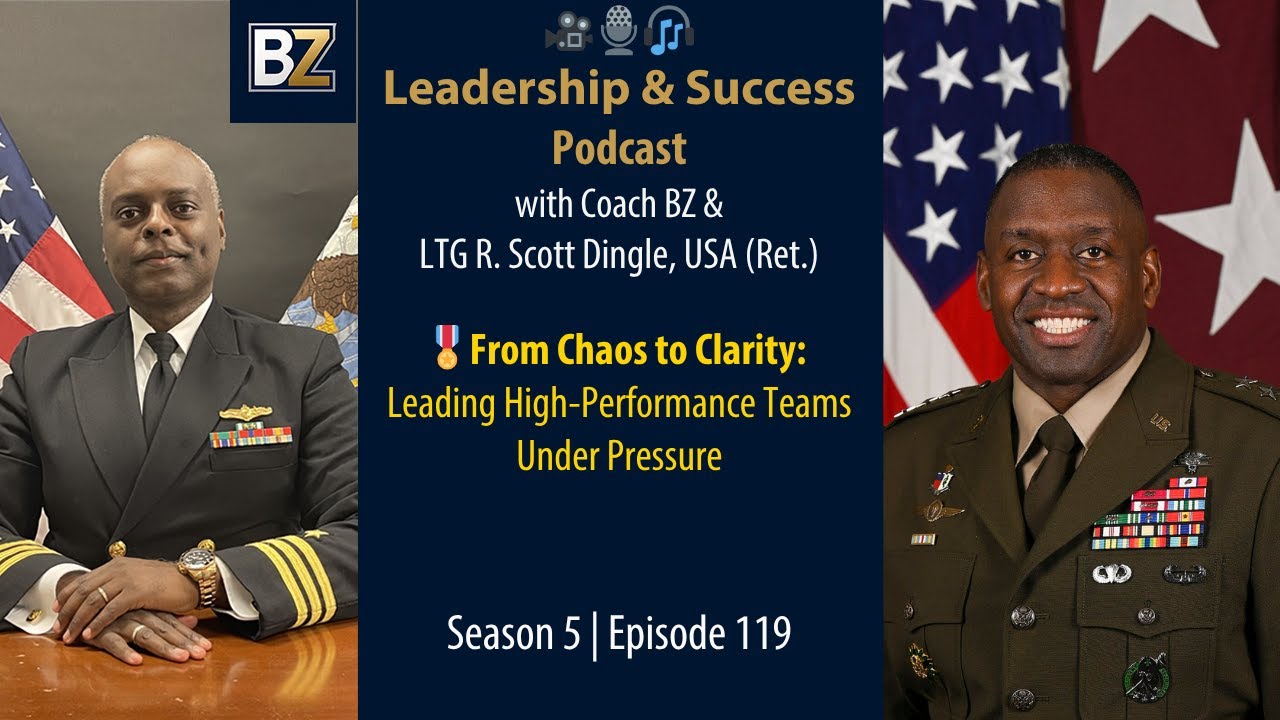
Retired Army Surgeon General R. Scott Dingle talks about leading through 35 years in military medicine, including combat and COVID. He shares the B-E-A-R-I-N-G framework for maintaining bearing and emphasizes how senior enlisted advisors shaped his leadership during massive organizational change.
Chapters
Hi, I'm John Maxwell. When the top companies in the world are looking for trainers, speakers, and coaches, there's one name that stands above the rest, and that's Maxwell Leadership. Our certified team members have gotten proven results for companies all over the globe, and our reputation, I'm proud to say, is second to none. Some of our members have risen to the top of their profession, including the the one you're going to meet today. I proudly introduce you to my friend Bob Fabien Zinga.
Welcome to the Leadership Success Podcast with your host, Coach BZ, where we help you lead with purpose and succeed with impact. If you're ready to grow into the kind of leader others want to follow, this podcast is for you. If you're determined to elevate your success and leave a lasting legacy, this podcast is for you. As my mentor, Dr. John C. Maxwell, reminds us, everything rises and falls on leadership. Our goal is simple: to inspire you, challenge you, and equip you with insights that can transform the trajectory of your leadership journey. Welcome aboard to another episode of the Leadership and Success Podcast with Coach BZ.
Lieutenant General R. Scott Dingle, the Surgeon General. During the 104-year history of the Medical Service Corps, many of its officers have served with distinction and made lasting contributions to the Army Medical Department. One of those is Lieutenant General Scott Dingle, the first Medical Service Corps officer to be promoted to the rank of Lieutenant General and to serve as the Surgeon General. General Dingle entered the Army in 1988 after graduating from Morgan State University. And commanded units from platoon to Regional Health Command. Over his career, he also served as the ground medical planner in Afghanistan for Combined Joint Task Force 180, as the chief of medical plans and operations for 18th Airborne Corps in Iraq, and as chief of healthcare operations at the Office of the Surgeon General. As a Brigadier General, General Dingle made important contributions to military medicine as the senior uniformed officer responsible for coordinating the implementation —of congressionally mandated changes to the military healthcare system, and as Surgeon General, has overseen the transformation of the U.S. Army Medical Command as it pivots from healthcare delivery to its focus on medical force readiness and a ready medical force. General Dingell has had an unprecedented career as a Medical Service Corps officer and continues to serve as an example of the contributions Medical Service Corps officers make to Army medicine.
The U.S.
Army's Medical Command supports the health and safety of more than a million enlisted, reserve, and civilian personnel. The local man leading that force is making history on the job. News 4's Jumi Olubanji sat down with the Army Surgeon General about his background and hope for the future.
Lieutenant General R. Scott Dingle commands a presence in just about every space he encounters, and it's not just because of all the medals and stripes that don the uniform he wears. His hard work earned him the respect of both his colleagues and his country.
Scott is the right officer at the right time to be the Surgeon General. And yeah, he is. Never in my wildest imagination would I thought, you know, this young African-American kid from Prince George's County, Maryland, would would grow up to be the Surgeon General for the United States Army, a 3-star general.
General Dingell is the 45th Army Surgeon General, the first Black man to hold that title, leading a corps of 120,000 Army medical personnel both on and off the battlefield.
I love leading. I love solving problems. I love accomplishing the mission as a team.
His current mission, COVID-19. The pandemic hit both the Army and the country hard. Since the very beginning, Army researchers have been working hard on their own vaccine candidate. Most of that work being done at the Walter Reed Army Institute of Research in Silver Spring, where both soldiers and civilians work side by side.
The excitement comes from— they're involved in every aspect of the success that we've had as a nation in the development of the vaccine, the testing, as well as the treatment. All right here.
And it's all not far from where General Dingle grew up. The son of an Air Force veteran, graduated from Prince George's County Schools and played football at Morgan State University in Baltimore before joining the Army as a young man. He hopes his story can be an inspiration to other Prince George's County natives to reach their highest potential and work to get a seat at the head of the table.
If I can do it, you know, they can do it. And I just want them to never give up, to keep striving, and to be all that they can be.
Jumio Labangi.
All right. What a very, very special episode we are going to have today. I am really overjoyed to be speaking to our guest today. But before I do, I'm reminded of our moment of gratitude here on the podcast. Every time we meet, we want to take just a quick moment to be grateful. So, if we can do this quickly, just maybe close your eyes for some of you, put yourself in your happy place, and think about one thing, one thing you are grateful for today. Recently, we just— I don't want to say celebrated, but we just went through Memorial Day on 2026. That's a very, very sacred time for all of us, but especially for those who've been in the military who have served in uniform, because freedom is really not free, right? America, the home of the brave and the land of the free. Somebody had to pay a price for that freedom. And I am always so grateful for my brothers and sisters in arms and those who have gone before us, who have really paid the ultimate sacrifice. Many of us, we did pay some, but some of us paid all, all that they had so that they can ensure our freedom and still support and defend our Constitution. So I am so, so grateful for that. We really do stand on the shoulders of giants today. And I believe I'm going to be speaking to a giant right now. So I am really honored and overjoyed today to welcome our next guest, Lieutenant General R. Scott Dingle, US Army retired. He's the 45th Surgeon General of the United States Army, hurrah, and former Commanding General of US Army Medical Command. Over a remarkable 35-plus-year career, General Dingle led one of the nation's largest healthcare enterprises, commanded organizations around the globe, guided Army medicine through COVID-19 pandemic, and helped modernize military healthcare systems while leading more than 122,000 soldiers and civilians. So this episode, we're gonna be talking from chaos to clarity, leading high-performance teams under pressure. As a military commander, I believe, Healthcare executive strategist and mentor and servant leader, General Dingell brings timeless leadership wisdom for today's rapidly changing world. Part of what you're gonna be learning today is how great leaders remain calm during chaos and uncertainty. And I think for people of my generation, nothing more traumatic than 9/11 and the COVID-19 pandemic. So, We're also gonna be learning how leaders can navigate transformation, disruption, and complexity with confidence. 'Cause, uh, General Dingell's story is one of discipline, service, resilience, and purpose-driven leadership. Whether you are a naval junior officer or a cybersecurity professional, a healthcare executive, or a business leader, this conversation will inspire and challenge you to lead at a higher level. So without any further ado, please help me welcome to the Leadership and Success Podcast, the one and only General Scott Dingell. Good afternoon, sir. How are you doing today, General?
I'm doing fantastic, BZ. Thank you for that introduction. Absolutely.
We are so glad that you are finally here. We've been trying for quite, quite, quite a while. What a joy to see you in the flesh, sir. Maybe to get started, what is one thing you are grateful for today?
Today I'm grateful for my health. You know, in today's time, you know, health is wealth, and I am so grateful and thankful, you know, to God for, you know, being in a good state of health to enjoy life.
Amen. I say amen to that. Yes, yes, sir. And, uh, by the way, we already have some people who are watching us live. We have Sabrina from JBL, uh, LM in Washington, and we also have Martin Taylor, excited to watch. All right, and for those watching, let us know where you're coming from and whatever question you have for the General. So, sir, what is one thing about you that most people may not know when they first meet you, sir?
Um, the one thing that people may not know about me is that I grew up in a military family. My dad was enlisted Air Force. Mm-hmm. So I was born in Albuquerque, New Mexico. But the majority of my life, I grew up in Maryland, Prince George's County, Maryland, Upper Marlboro. And the one thing that I— folks don't know is that being a military dependent, I did not like the military, and I had no intention of coming in the military, and me and my dad used to battle about this military thing. I'm like, Dad, I am not going in the military. I do not like the military, you know. And I'm sure people would be surprised to know that.
Well, that's pretty interesting because my wife was a military brat as well. Her dad retired as a tech sergeant. She also didn't like the military, and I was in the military when we got married. But after 9/11, I felt like I had a call to John, and I asked for permission, and she said yes. So very, very grateful for that. And you often describe yourself, sir, as a student of leadership. Where did your leadership journey truly begin? Well, I would say at home.
I think everybody's development as a leader, as an individual, starts at home first. You pick up the leadership traits that are instilled into you by you know, mom and dad, you know, by siblings, you know. And, you know, after that it was forged, you know, on the streets of my neighborhood, you know, in Summit Ridge, Upper Marlboro, Maryland, you know. And in the neighborhood we forged our leadership in the crucible of the neighborhood. And a lot of people like, hey, sir, well, how— where'd you get your leadership from? You know, it, you know, was home. In the neighborhood. And as I came into the military, I said that I would never change because that closeness, that bond from the neighborhood is something that I tried to integrate and put in everybody that I meet that's on the same team I'm on.
Wow, that is quite powerful. So growing up in a military family, how did your parents, especially your father, shape your leadership?
Philosophy? By the values. You know, both of them, my mother and father, instilled the values, you know, of loyalty, duty, respect, discipline, all those things that comprise service members and service to their country. And even though I would battle my dad about, I'm not going in nobody's military, you know, my dad would talk about the benefit and why military service. And how it would help me, you know, in life, you know, not just as an athlete, but in anything that I did. And so, you know, I embraced those principles and, you know, Dad, you know, inculcated those into, you know, our DNA. Wow.
And so I believe you are a musician as well. Which instrument did you learn to play, sir?
Well, growing up, Played the violin and saxophone for many years. And then I do the drums as a hobby because my best friend's a phenomenal drummer. And so I picked up the drumming just as a little habit, but nothing serious.
That's really amazing. Most of the members of my family would play the piano. So you were an athlete. And during the intro, I did show a couple of pictures of you playing football, a musician, autistic at it. And now— retired freestyle general. What leadership lessons can I get across all of those environments?
Teamwork. Teamwork makes the dream work. No matter where you are, an athlete can't do it by himself. I love sports. Sports was my dream. That was what I was going to do. But I also learned that I couldn't do it by myself, whether being a state champion in the state of Maryland in track and field or you know, all-county football and all this other stuff, it doesn't make a difference unless you have the team with you to be successful. You know, and as you climb the ladder of success, um, success doesn't mean anything unless you bring people with you, and those people are your team and everybody else that is, um, you know, in the arena.
Well, sir, I believe you know this person, Raymond Dingell. Junior, the second, Tim Dingle from Washington, D.C. And we have a free follower from Fort Hood, Andre from Washington, D.C. And we have Deliana Martinez from Fort Bragg, Stan Sanson from Houston, Texas, and Raymond Dingle, EER, MFDDC, patrol officer and honor guard officer joining in from Temple Hills, Maryland. And I mean, wow, so many people watching from all over the place, including this person from YouTube, our very first question from the audience here. Where did you come up with the phrase, maintain your bearing using the ball bearing? That's from John Wabisho.
Good question, John. As I was coming up in ROTC as a cadet, and again, my ROTC cadet story is not a fairy tale great story because I was a terrible cadet. Because I never did anything because I was always at practice, track or football practice. But the light bulb came on when I went to basic camp, Fort Knox, Kentucky, 1986. And I heard this NCO talk about, you know, maintaining your bearing. You know, as cadets, as leaders, we had to maintain our bearing, our azimuth, our direction. And that resonated with me. You know, me overhearing that one statement just stuck with me. And years later, you know, that was as a cadet. Years later, I think my first company command, that's something that I had always adopted about, you know, maintaining my bearing, you know, maintaining my cool. You know, I was a hotheaded football player and had a temper, but maintaining my cool and that bearing to get through the process, the game, the play, the series, whatever it may be, And then I just developed it over time. Took company command, and I acrostically spelled out the bearing, you know? And I took those— each of the letters and applied it to the medics that were in Charlie Med, 3rd Forward Support Battalion in Schweinfurt, Germany. And I came up with the bearing, B-E-A-R-I-N-G. B, believe in God, believe in yourself. E, endure tough times. A, accept responsibility. R, remain unconquered. I, identify with others that are excelling. N, never quit. And G, give to others, servant leadership. And that's where the bearing came from. Wow.
Well, you get a hello, my old boss, blessing to you listening in from Pennsylvania. That's Mark Migala. Wow, that is powerful, sir. What advice would you give young officers or technical professionals who are strong performers but are still learning how to lead people?
It's about the team. As you are in leadership, sometimes leaders get it flipped where they make it about themselves as the front of the organization, as the face of the organization. But it's just the opposite. And Sabrina, you know this as much as we've talked about it. The king or the queen, the leader, has the most responsibility to take care of everybody that they're leading, the king or the queendom. And so you got to make sure when you invert it and you make sure that everybody has what they need to be successful, they're going after their dreams, they're completing the mission. That is a nonstop job because all one-to-done numbers that are on your team You have to make sure that they're successful. And when you flip it like that and those civilians, soldiers, whoever you're leading, see you investing into them, it automatically turns around where they're investing back into you and the mission that you're trying to accomplish. Well, that is powerful.
Another one from Tim Dingle Giovanni, watching from Washington, D.C. Now, Iya is— she's now a major, but she was a major select when she was on the show. I don't know if you know her, but— Contessa Tracy Walzer. She's now the commanding officer of a medical unit there in Maryland. She has a question for you, sir. She says, as the Army continues balancing large-scale operational readiness, recruiting challenges, and modernize— modernization across military medicine, what competencies or perspective do you believe young field-grade, uh, 70H officer must intentionally develop now to remain strategically relevant over the next decade. Wow.
And I would say this for, um, and not just 70 hotels, but for, for every leader, you know, two words: adaptability and flexibility. Those are the characteristics that you're going to have to take in from peacetime to war, from the foxhole to fixed facility, from the desk to you know, the penthouse, no matter where it is that you're going. Um, adaptability and flexibility, because as you encounter different situations, scenarios in your profession, in your lane, if you're not able to adapt and be flexible to the situation, you can't overcome and win in that situation. Um, Admiral Brown, you know, Navy retired 4-star, a tremendous leader. She said this to me one day, you know, right as we were going through transformation, and I had just completed the interview with the Secretariat and the Presidential Task Force, and the Army went last, so I'm the last one to go, and the other Surgeon Generals took about 15 minutes. We were in there about an hour. So as we were going back and forth and I'm answering her questions about unity of effort and teamwork and here's how the Army does it. And the entire committee was like, that's right, General Dingell, we agree. Man, I thought I was hitting it out the park. And I'm like, man, oh, I got him, I got him. You know, this is a victory, you know, for the services. And at the end, Admiral Brown, she said this, she said, uh, Madam Secretary, can I, can I say something to General Dingell? And she said yes. And Admiral Brown said, you know, Scotty, um, I said the same thing that you said about unity of effort, about consolidation, about command and control, and all the tenets of military leadership. I said, "Ma'am, that's right, ma'am." She said, "I told my boss that." And I said, "Ma'am, that's right." And then she said, "You know what he told me, General Dingell?" I said, "Ma'am, what'd he say?" She said that her boss said that, you know, "Well, Admiral, if you can't ride two horses, it may be time for you to leave." Wow. He said, Scotty, you have to be adaptable and flexible to no matter what the situation is. So regardless of what chaos or complexities that you're leading in or that you're involved in, whether personal, professional, you can't be locked into one way or no way. Yeah, you got to be open and then you got it. You got to, you got to change, you know, with the, with the wind to ride the wind to success.
Well, this is a great way to introduce the next segment, Leading Through Chaos and Crisis. Nothing more memorable for members of my generation than 9/11 and COVID-19. And during COVID-19, I guess you were the right man in the right position because you led the Army Medicine during one of the most difficult crises in modern history, right, the COVID-19 pandemic. What was the weight of that responsibility? What was that responsibility like, sir?
Oh my goodness, tremendous. That was over a year and a half of high-level, you know, presidential, secretariat secure BTCs every day. So every day we were in the Pentagon. And then the main briefer, you know, was me as the center of gravity providing the update for the Army, because the Army was the lion's share of the response. That stress was tremendous. It impacted, you know, my health. I used to have a bush, you know, and all my hair. But it was— you can't put it into words. You know, it was one time after a press conference, you know, and I had said something in a press conference that we weren't supposed to say, you know, by direction of the POTUS, of the president. And my boss, the Secretary of the Army, said, "No, Scotty, say it. You know, I got it." And so I said it, you know, but then my mind automatically went to, well, I'm gonna be on Washington Post front page, the news tonight, and I'm gonna get hammered, you know, because I, you know, put this information out there by the order of my boss. As I went back to my office, I closed the door, and when I closed the door, I got dizzy. And almost fainted, and I had to sit down to get myself together. And, um, you know, it was, it was an eye-opening experience for me that, you know, if I don't take care of myself through this tremendously stressful time and I fall out, you know, the, the COVID-19 is not going to stop because General Dingell fell out, you know. Um, the Army ain't gonna stop moving and rolling because General Dingell fell out, you know. There's a whole bunch of generals and people that want to be the next Surgeon General. So I got to practice what I preached. And so, um, that stress level can't be put into words, uh, because everything that you do say is in the press. Um, you're reading about it, you're getting attacked, you know, you're getting sued, you got Department of Justice protecting you. There's so much stuff that goes on that it is just unimaginable, the weight that is that you carry. Wow.
And so you mentioned, I'm assuming your boss was the Chief of Staff of the Army at the time. So it looks like he did have your back, but what did that experience teach you, sir?
Well, you know, the one thing through it is, you talk about the Chief of Staff of the Army having my back. I had a tremendous time our tour as the Surgeon General, 4 and a half years, was phenomenal. The hardest ever. All my predecessors say, well, Scotty, man, there's no way in the world we could have done what you all been through. You've been through so much. So we can't really advise you, but hang in there. And so as I'm going through that, you said something that was key. You talked about the Chief of Staff of the Army. In order to be successful in the profession, personally, you have to have that supporting cast and that supporting leadership that is breaking the brush for you. I had the Chief of Staff in the Army, I had the Secretary of the Army, the Secretary of Defense. It was tremendous of the leaders who were allowing me to maneuver. You know, they just gave me a checkbook and said, "Scotty, you know, go take the hill." And anything that we did, they supported, you know, unequivocally, 1,000%. And that makes a difference in leadership when you have the support of the leaders that you're working for. When you don't have that support, it makes it more difficult because now you're trying to figure out the way, the how to take the hill. But when everybody is nested and synchronized, it was amazing. So that, that, that support from the Army leadership and the Joint Staff leadership empowering me to, to do things was just unbelievable. Unbelievable.
Did that, sir, have any impact on the way you now view authority, accountability, or even grace as a leader? Absolutely.
Absolutely. And I've always had the mentality that You know, it's only lonely at the top if you don't take people with you. As you ascend, you know, and drink from the cup of success and you go higher and higher, you bring people with you. You bring the team, the organization with you. A lot of times leaders don't bring the organization with them. It's not about me, myself, and my ego, but it's about us, the team, and our mission. And so bringing everybody along and giving that credit of success of the mission to the team creates a dream team of phenomenal professionals.
Wow. So I guess a question I have in mind, sir, is how do great leaders maintain calm and clarity when everything around you is operating— everybody's operating in fear and uncertainty, especially with COVID-19?
You have to. You— there has to be somebody that is keeping their head about you. Rudyard Kipling wrote a poem called "If." Yes. And it talks about being able to keep your head through the most difficult of circumstances, of keeping the faith. I am a man of faith. I'm a Methodist minister. Elder. So my faith absolutely is out front helping me. That does not mean that, that, that I wasn't, you know, rattled too, but I just don't show it, you know. On the inside, you know, inside's going, oh my God, you know. But on the outside, you know, as cool as a cucumber, cucumber, you know. In Sams, we call it the kuduwi, um, that calm, cool collectiveness under pressure in the most severest of circumstances and being able to lead through it through the intuition and the confidence, you know, that kudui, and being able to see. Because you got to be able to see through the storm in order to guide the organization. And even when you can only see 10 feet in front of you, you as the leader has to be able to take the vision that you can see with the mission you're given and then relay that to the organization to follow you. So you have to keep your head about you. Doesn't— again, but it does not— that does not mean that you are not nervous in this situation. It does not mean you have fear, but you don't allow that fear, that doubt to overcome, you know, your process in a pragmatic approach to leadership.
Well, sir, I must tell you, you are definitely one of the coolest flag officers I have ever seen. So many pictures of you just being so cool, just Amazing. I guess I must ask, especially when you go through a crisis, where do you really believe that confidence comes from?
I know you did mention your faith earlier, but, um, and it comes through, um, it's both, um, innate or in me, um, character, but it's also something that is developed, you know. Um, you know, good leadership, you know, is it born or is it trained? Uh, yes, both. So you're born with a certain level, but then when you start taking what you have and the training that you go through as leaders and start applying it and living it, you know, you find that proof of principle supports the outcome or the good outcomes of the mission, organization, leadership. And over time, your confidence builds. Like, OK, wow, man, we met that task and we did it. You know, and you follow the training, you know, with your leadership style, your art. You know, you, you can't be me, I can't be you. You got to have your own leadership style that works for you, but the same tenets of leadership— adaptability, flexibility, of collaboration, of focus, preparedness, and all those things. Yes. You know, you, you're applying but with your style, and so you develop it. And then once you, you know, you knock down the target, you know, you get a little more confident Okay, bring on the next target. Bring on the next one. And it's not me, but it's we. It's we as the team.
That is so key. And I believe a lot of the leadership maxims we have in the Navy, we completely stole from the Army, like mission first, people always, and all of that. But there is something you said, sir, and only you have said that. I only found that when I did research of this podcast. You've said a lot like conserving the fighting strength. You speak often about that. What does that mean in today's world, not only for soldiers but also for business leaders who might be listening to the show?
Well, that Army Medicine Model is applicable really to life itself. And no matter what your battle is, you know, there has to be a conservation of the fighting strength of the individuals who are at the helm so that, one, they can keep up the fight to win. Whether at home, whether on Wall Street, or whether in the military, conserving that fighting strength, you know, is threefold. It's one, it's you, you know, your ability to be healthy, to lead, and to fight. You know, number two is the people that you're leading, you know, making sure that they are ready and prepared to get in there and conserve and defend, you know, and keep those that they're supporting healthy and in the fight. And then it's the mission. And so the mission of saving life, limb, or eyesight, whether if it's yours or the people that you lead, you have to make sure that the fighting strength of the force or the people that you're leading are at the ready and resilient to bounce back after you go through some things to get back in the position to win the battle. Because there's no second place. There's no second place in combat.
Well, especially in the military, more than any other industry, sir, how do you build that trust with the people you lead, especially when you don't have a lot of time and when, you know, the stakes are very high? We're talking about, you know, matter of life, life and death, mostly in the Army or the Navy. What do you do, sir, to build that trust with your direct report?
It's by your actions. You know, the soldiers, sailors, airmen, Marine, Coasties, Guardians, it's by your actions. People can see you. People know when it's real. Yes. You're caring for them, the mission, the leadership, or as we used to say back in the day, is it Memorex? Is it fake? They know when your sincerity isn't sincere. They know when your teamwork isn't a team, but it's me. They know when you're making it about you, yourself, and your ego versus the team to accomplish something. So people see that. And then when you— when you— I mean, I love connecting with people. Um, I'm a connector. And, and as you connect with people, you know, you, you know just by looking at them, you know, hey, you you know, how's it going today, Frey? You know, how you doing? And just from a response, you know, okay, something's not wrong. That's 'cause you have a connection, 'cause you connected with the people that you lead. You have to connect. The Army talks about building mutual trust and confidence in the people that you're leading. In order for the soldiers, sailors, airmen, Marines to have mutual trust in you as a leader, you gotta show them. You got to show them that you are connected, you care about them, you know, and when you make that type of connection, the service members will, man, they'll take the mountain for you without even saying it because they trust in you. And so building it is by your actions. You have to connect with people. A lot of leadership is a people-person-ness. Are there toxic leaders? Absolutely toxic leaders. Are there bad leaders? There's absolutely bad leaders. But successful depends on the connection that you have with the people. And that's what makes a difference.
Wow, that's really powerful. Again, when I had the chance to be Commanding Officer in the Navy, I used that Army maxim, "Mission first, people always." But it seems to me like at times, though, there seems to be a little bit of tension between doing the mission of the organization or the command of the unit and then taking care of my people at the same time. Sometimes I felt like there was a bit of tension and I had to choose. I guess the question I have for you, sir, how do you balance taking care of the mission of your organization, which is why you are in charge, but also at the same time really truly caring for your people when they may not be up to it?
And it's like the yin and the yang. Yes. You know, it's connected, you know, and it kind of seems at odds, but you know, you flip that thing, you roll it, the yin and the yang are fitting together. And inside the yin, inside the yang is the opposite that attracts and connects them to make them a success, that creates that synergy. And so there's a balance. They're interrelated, they're interlocked. You know, one can't do one without the— you can't accomplish the mission without the people. Yes. You know, and, and so mission success depends on the people, but if the people are not healthy to accomplish the mission and you're not taking care of them, the mission is going to fail. Yes. You know, so it's almost like a rolling yin yang that you always got to keep together. And then one thing that you can never do is you can never forsake the resiliency or how the people feel And whether there's burnout, um, whatever the struggles they're going through, if the people's heart, head, mind, hands are not in the mission because something has impacted them, the mission can fail because they're not focusing on the mission accomplishment. So when that leader is connected and knows their organization, their team, you know, you can now balance and take the foot off the pedal because, you know, they need a break. And you never forsake the welfare of the people because of the mission and keep pressing them and running them in the ground. That's when you got to raise your hand and say, hey, boss, ma'am, sir, you know, I got to take a knee because the organization is getting ready to break. A lot of times leaders are afraid to say when the organization is at a breaking point, and they allow it to go until it breaks. No one said I want you to break the organization, but you gotta tell me so that I can also let up off the pedal at the next level up. So you gotta be truth and you gotta be honest in the assessment as you're looking at both the mission and the people. Wow, that is powerful.
The last question in this segment, sir, what did the pandemic teach you about organizational readiness that most leaders still have not fully understood? That is paramount.
It's a priority. A lot of times people only call on the medics when we need them. You know, if everything is healthy, the pandemic's down, oh, all right, we're gonna put the readiness thing back to the side, up on the shelf until, you know, the next crisis comes out and we yell medic, you know. It's something that has to be done always as a priority on the health of the force, the readiness of the force. And through the pandemic, you know, it was all about the medical readiness of the force, the people, the families of the world. It was a priority. People were preventive. They were taking the preventive measures. They were taking the actions. Health was a priority. You know, now that the pandemic is over, you know, uh, it slips back and people kind of drop it on the priority list until such time they get sick. You know, so the pandemic should have taught everyone the importance of readiness, medical readiness, of health readiness, because if the people are not healthy, they can't do the mission. If your family is not healthy, if your loved ones are not healthy, you can't focus at work on the mission because now you're thinking about home and the kids. Their loved ones. So it's a priority. It has always been a priority within the medical force. We know that, you know, we know that. But in the larger enterprise of organizations, you know, it all— it all— it automatically at times just reverts back to, all right, we're going to put medical back down here. You're important, you're important, medical. Yes, we got this other stuff here first until such time we need it. And they yell medic and expect us to be ready. And so regardless of where they put us, whether we're the priority and lesson that we learn, or if we drop down, when the force calls your name, you have to be ready to respond with your mission and your folks. Wow, powerful.
And also in your extraordinary career, sir, you've pretty much served at every level and you've also served, I believe it was in, Germany. We have a question here from John. He says, I'm headed back to Germany after this aviation command. What country did you like working with the most during your tenure overseas?
I would say all. I mean, of course, the host nation, you know, the politically correct answer is the host nation, Germany. So I love serving with Germany, the partners, all the partners in NATO. And so I wouldn't say that there's one favorite over the other. The experience of, of being in Europe, of, of partnering with the different militaries was an amazing experience, because you really are looking at the multinational force in preparation for the next combat in the war. So developing those was phenomenal. So I love working with all the countries. Um, you know, one didn't stand out more than the others. And then being able to travel to the other ones on mission, um, in conferences and coordination and synchronization meetings, um, just phenomenal experience. You know, it's— it is, um, the true essence of multinational teamwork and excellence over there. So you're going to love it when you get over there. Good, sir.
During the research for this podcast, I believe you were also invited to be a keynote speaker at the health conference in Saudi Arabia, I think it was, right, right, sir?
They're trying to get me over there, but I haven't—
Okay, maybe it was Saudi Arabia. It was one of those Arab countries. Maybe it was Kuwait. But anyway, you were one of the keynote speakers during—
Oh, gotcha. That was UAE, United Arab Emirates.
UAE, UAE, that's it. Emirate. That is kind of cool to see the Occident and the Eastern country kind of working together. What does that teach you, sir, about leadership going to a country where you maybe don't understand the language? I mean, not really the traditional ally of the US, but still we have a lot in common.
The power of the United States Army, in that particular case, the power of Army medicine and how the international multinational force sees us. And it gets back to, again, us having to set the example, the pace, not losing the bearing. Going over there, they rolled out the red carpet for my team and I. I mean, we literally— we met sheiks. The sheiks were waiting for me and wanted to sit down and talk with me. Wow. You know, 3 sheikhs, just amazing meeting the sheikh, his family, and then the admiration that they have for us as a United States military, that they are looking to us to lead the way, set the example, and to show them what right looks like. And I tell you, we spoke, I think they had about 1,000 people in there when I did my keynote speak, my Command Sergeant Major and I, but it was phenomenal. But the eye-opening experience was they look to you, to us as a US military, to be the lead and the partner, you know, for the force. And that was just an amazing experience.
It's really amazing. And I know I have some people who are watching who are thinking about maybe joining the military or not, but It's definitely an experience that you can't get anywhere else. I must say, sometimes you feel almost like Superman, right? It's really a force for good. The Army, the Navy, the Air Force, whatever branch you choose, just the impact of what we do around the world, it's very, very amazing. Now, little kid like me from Pointe-Noire, Republic of the Congo, it's just above and beyond my wildest dream what really our force does. To the world. So for this segment, sir, well, we almost out of time. We have about 15 minutes left, but I wanna talk about strategic leadership and transformation. 'Cause sir, you have helped lead one of the largest healthcare transformation in military history. How do leaders drive massive changes without losing trust across the organization?
Number one, it's, You know, sometimes people first have to realize that some things are not an option, that when you're given the mission and the directive to do something, you know, it has to be done. And then as you execute the mission, just like with all things, whether troop leading procedures, whether MDMP, whether strategic analysis, assessment of campaign plans or theater of operation, You have to make the plan to meet the directive of change, and then you got to communicate it to the people. Why? Because at the lowest levels, everybody wants to fight the battle at the senior levels and want to be all, well, my God, it's terrible. It's not terrible. Your mission hasn't changed. But let me tell you why and how the mission fits in. So communication is one of the most important things. You got to create that sense of urgency. You got to then communicate, you know, the change in the direction, and then you got to have that plan, that strategic and operational plan that's going to accomplish what you need to do to change, to meet the mission, or whatever it may be. And then constant communication, um, constant, you know, information operations campaign inside the organization as well as outside the organization. And then you as the leaders, as the officers, you gotta be 2 and 3 steps ahead thinking. Yes. Because you can't get caught up in the day-to-day thing. You gotta brief it, you gotta talk it and know it, but you gotta count on your team to handle that because you should be thinking about tomorrow, the next hour, and giving the vision, the guidance to take the next hill. And you always gotta be 2, 3 steps ahead as you come back to the pace, you know, the pace man, the pace person. Okay, here we go. All right, let me jump back out. Here's where we're going. But communication is so key in communicating the why behind it, and then enforcing and giving the standards and expectations so that the organization can meet it.
Well, that is quite powerful. I guess a follow-up question would be, sir, some people have trouble really navigating complexity. Why do you think you were so successful? What was the secret of your success, if you could say it in just one sentence?
It was the support from the military leadership, period. The support from the Secretary of the Army, the Chief of Staff of the Army, the Secretary of Defense, the Chairman of the Joint Chiefs of Staff. Their support is what made it easy, you know, because, you know, they give you the mission, you run with it. They're like, Scotty, run. And then you're educating them on the why and how you're running. And that's what— when you have the support of leadership, you can take over the world, you know. And the trust and confidence that they had in me and my team was just amazing, amazing. I always tell leaders, never forget about relationships. Relationships matter, and they are so important in everything that we do. Relationships matter. And my relationships with my bosses— you know, because it wasn't my plan to be the Surgeon General. We had just gone through a transformation breakup and a dismantling of Army medicine. And as a 2-star, as the Deputy Surgeon General, After going through that, I was like, I'm good. I need to get as far away from the flagpole, and I'm going to go to Texas and get one of them houses on the quadrangle with the porch, and the sun come down. I'm going to do that and retire, and I'm going to let you guys do this Surgeon General stuff, because we've gotten beat up very, very bad before we went into transformation. An MHS change, even internal reorganization within the military in which we were broken up, dismantled, to reorganize us in a different way. And the stress from that alone, let alone we were getting ready to go into COVID, I was like, man, I'm— yes, yeah, I'm tough, I'm ready, let me— wow, boss had other plans.
I guess one question, sir, is, especially for those who are in the military, how do you recover, recenter yourself? Because there is a lot of stress in everything we do in the US military, regardless of the branch or the rank. What do you normally do, sir, to just find joy and recenter yourself?
And it's in my family, it's in my friends, it's in the team that is around me. Um, you know, for those that work for me, you know, you know that we're going to work hard, we're going to be the best, um, we're going to win, um, but we're going to play hard too because we got to have that balance. You know, I always talk about, uh, balance of, of personal, professional, of, of, of driving hard, grinding, easing up and being resilient to recover. Um, and so The— those that are around me, close personal staff, professional staff, you know, they're my levelers. My wife, you know, my kids, they're the ones that, you know, keep me grounded, because I can come home and, "Oh, it's playtime. Let's play." You know? Whether it was me whooping up on my children in Phase 10 or whatever the thing is, I did that for y'all, you know, and them having PTSD because dad always wins in those games because we're so competitive, you know, those type of things of being able to have fun helps you reset, 'cause you can't just keep grinding and carrying the stress, you know, within the walls of the organization, you know, And then coming home with the same thing, you gotta be able to take that thing off. Let me have some fun and get a breather, you know, with my family, with my friends, you know, my, you know, man, my special personal staff was just phenomenal, all of them. Wow. Because they took care of me. They knew the stress, they knew, you know, when he's about to break down, they knew the health issues, and then they helped take care of me. And helped me to be resilient by forcing me. Oh, sir, it's time out. Power down. You know, keeping people away. And so it's a joint effort. You know, I think of both, you know, your family, your friends, and the staff, which is why it's so important when leaders— when you pick your teammates on your staff that work for you, you got to make sure that it's a fit, you know, because that could be one of the most important selections you have that person that is working in that close circle to help you help yourself be healthy.
Wow, that is really powerful. And for the junior officers who are listening now, because, you know, just being in the military, I feel like it's a 24/7 job. But then many of them are married, they have children. And, uh, as you know, sir, more and more now we are pretty much forcing our JOs to go for a master's degree. There was a time a bachelor was all you needed, but not to just be competitive, you You need to get a master's degree as well. And then on top of that, when you're a lieutenant or captain and above, they want you to get JPME Phase 1. So it is a lot of requirements we put on this. So how do they find that balance? What would you say if you had maybe a minute or two, sir, to all of the junior officers listening right now, how they can find that balance in life and in service?
There's an article that I always tell all leaders to read called Important Versus Urgent, and it's written by an old field artillery commander, Colonel Blum, B-L-U-M. You could— you can Google it and look it up. Important Versus Urgent. Um, you have to find your equilibrium. I'm going to say balance because every balance is different. You got to find what your equilibrium that is good for you your family, and your life. And it's not going to be the same for everybody. And once you find that equilibrium, you know, you got to take into account what is important in your life, personal and professional, and what is urgent, and being able to distinguish between the two. Because if you spend all the things and places that are urgent and you forsake your health, your family, and all the other stuff, you've lost balance, you know? And I tell folks all the time that as you drink from the cup of success, don't get intoxicated by the hubris therein, that cup that you're drinking from, and lose your balance— important versus urgent, getting it out of alignment. Yes. But you have to find it. And I'll tell you the truth, I didn't always get it right, you know, it took time, you know, it took time, you know. I think when I went into my brigade, my second brigade command in Germany, it was then when Sonya, my wife, said, hey, look, look, Scotty, this time, you know, this is our third tour in Europe, we're going to see Europe this time, we're traveling. Yes. Before that, man, I'm grinding, man. I'm Major Dingle, I'm Colonel Dingle, I am Major, working, working, working, working. I'm the center of gravity, I got to do it, I got to do it. And I missed out on seeing France and all the different things. My wife said, oh, absolutely not. Let me tell you now that we traveling, and, and we did, we did. And, and, you know, I was like, man, I could have been doing this the whole way. I just didn't have that balance, you know, important versus urgent. Read that.
That is so powerful. Thank you, thank you so much for sharing, sir. And all of my junior officers listening right now, you definitely need to learn this lesson now before you become a senior officer, for sure. And so I know we only have about 5 minutes left, but I do have to ask this, this question. So, um, again from John, he says from YouTube, what role did your CSM play for you during your challenging role during the pandemic? I think this is a very important question because especially for junior officer, when you come in as a second lieutenant or an ensign, you feel like you are above senior enlisted E7, E8, and E9. But the truth is, they really are your mentors. I think I really understood that because I came in as an E1, so they've been mentoring me my entire career. But I see some kids who come out of the academy or whatever, they have a rank and they feel like, hey, I am better than you. But that's really not, not true because E7, E8, E9, they really have so much knowledge and leadership and In my opinion, they really run the Navy, right? And senior officer would just take credit from it. So I feel like it's very important to give them the credit that they are due. What was the role of your command sergeant major, sir, during your career, especially during the pandemic?
He was me. My command sergeant major is me. My right-hand senior enlisted advisor command sergeant major is me. Um, they are my equalizer. They are my other half. If I split myself, literally my right hand. And I could not do it without him because he was a force multiplier of us now being in two places at the same time. Because, you know, I was taught from a very young age— my— one of my first military mentors was my company first sergeant. You know, First Sergeant Lyons, who was a Caucasian male from Kentucky. And then here comes this young kid from Baltimore, Maryland, this young athlete, you know, and he saw me after something that I did, he grabbed me by the ear and said, "LT Dingle, get over here, man, I like you, man, you're mine." And he instilled in me from the very first day the importance of the noncommissioned officer and using them as that backbone to accomplish the mission together. And so I have always empowered my senior noncommissioned officer, first sergeant, sergeant major with the full authorities and power that I have, because they speak for me. You know, and just like the picture over my right shoulder, man, that's my right hand. You know, I mean, we, we save the day, but we do it together. And we can't do one without the other. And even as we're in a civilian sector, you know, the Diamond Dingle Group, we are continuing that mode as we take the hill in the sector side of leadership and performance and business as the Diamond Dingle Group.
Wow. That is very, very powerful. And every GEO definitely needs to listen to that. To end the show, sir, just a couple of minutes, I'm gonna be asking you a question. I call this lightning round. So if you would please answer quickly, whatever first comes to your mind. One question is best leadership book of all time, sir.
Beside the Bible, Lincoln on Leadership.
Lincoln on Leadership. So why should people read this book?
It is a phenomenal book on handling and leading through tough times and good times and what the executive strategies that Lincoln exhibited through the— my gosh, one of the most important times in the history of our nation. It is phenomenal in what he does. And so I embraced this book, and if you work for me, you read this book. You know, you read this book. And then the 48 Laws of Power is another one. This is one that it teaches you about power. You see it every day you turn the news on. You know, it's about power and how to negotiate situations and leadership and not violate one of the 48 laws of power. Phenomenal book that you— that's a constant read that you read over and over and over again. A message to Garcia given to me by my command sergeant major. Phillips at Fort Bragg, North Carolina, when I was the XO. He gave me this book and said, you know, XO Major Dingle, I love your leadership. Read this book, know it, and live it, and deliver the message every day that you come into this airborne unit.
Wow, that is really, really powerful. Who is one mentor who changed your life, sir?
Oh my gosh, I've had a gazillion mentors that changed my life. The one I would pick for this venue, I would say Colonel Gore. Hmm. Yep, Colonel Gore. So Second Lieutenant, First Lieutenant Dingle, the onset of Desert Storm, Desert Shield. I come into this unit as a brand new First Lieutenant. —supposed to be the chief of patient administration. Colonel Gore and Colonel Ellis— Colonel Gore took me and said, nah, LT, you're coming from a combat unit. I need you up in the front office to be my adjutant. Wow. And everybody, you know, at the time, everybody was looking to the leadership, these 206s, as, oh my God, they're mean. They're toxic. They just fired this person, eliminated the company commander. Man, you can have Pure D, you know, AT double hockey stick working for him. And so I'm in there like, you know, like, oh my God, I'm working for this guy. And he turned out to be a dad to me. Wow. A father. And he embraced me and taught me so much about success, opportunities, and operating in excellence. And they empowered me. Like, no, I was a first lieutenant sitting in meetings with two-star generals, you know, and them not there handling the medical effort. And they were like, no, what Lieutenant Dingell says is what, what this command is going to do. Wow. They empowered me like no other. Yeah, he was phenomenal. He was, he was a dad to me.
Well, so, so grateful for your time, sir. We, we do need to stop, but the last question I'm going to ask, uh, here's a picture of your dad, I believe. I'm putting on the, uh, second, uh Lieutenant rank on you, what would you say? And I believe your son is also listening live right now, I believe on LinkedIn. What would you say to yourself? I guess you were about 20, 21 years old back then. What would you say to a 21 version of yourself, sir, today, knowing what you know now? What would you advise 17, 18, 20-year-old Scotty Dingle?
Live your dream. Don't let nothing block you. Live your dream. That's my dad. You got the picture. You got me with the picture of my dad. Don't let— it's coming, it's coming. Live your dream. Don't let anything stop you, block you, or hamper you. In reaching your goals. Don't let anybody stop you, block you, on living your dream. Live your dream and go after it and make Dad proud.
So what do you believe, sir, is the secret of your success from First Lieutenant to 3-star General of the U.S. Army? The grace of God. Hmm, thank you, sir. Well, uh, we've run out of time, so to answer, uh, Is there anything that the audience can do to add value back to you, sir?
I mean, we're out there. Most people should have seen us, D2G, Diamond Dingle Group. We travel in the world. We got a whole bunch of things coming up. Our goal is to give you the answers and let you see behind the veil of success and how to get there. We want you to be better than us. Y'all hit D2G up. We'll come to you, pour into you. And again, we want you to be better than us. Be better than us. We're working on a book. We should have a book out, I think, by the end of the year. But again, be better than Dingle. Be better than Diamond. Live your dreams.
Be better than me. Well, sir, thank you. Thanks so much for your time. What a great joy and privilege to be speaking to you. As we finish, sir, is there any question I should have asked you I didn't get a chance to? To ask. Anything else you wanted to share today, sir, before we close the show?
Um, is Sonya happy that you retired and at home getting on her nerves?
Well, we've got internet, uh, dingle, uh, with a free prayer, uh, sign, and you, you got it, sir. So people are listening and they really love what you've shared today, sir. Uh, you are a living legend, and we really, really do appreciate your time on the show today. Thank you so much for talking to us today, sir.
We appreciate you, man, and you keep doing what you're doing. You're making a difference. Thank you.
Bye. All right, everyone, this is really one for the book. This is probably going to be one of the most popular podcasts we've had, and definitely we've got a lot of reaction. I didn't even have time to really show what everybody has said on both YouTube and LinkedIn. I really appreciate all of you. So to end Today, what I must say is General Dingell really, one thing I get out of today's conversation is, is really reminding us that true leadership is really not about your rank, not about your title, and not about your authority. It's all about service, trust, humility, resilience, and the ability to bring clarity during moments of chaos. So his journey from being a student athlete to the ROTC and becoming the 45th Surgeon General of the United States Army is incredible example of what servant leadership really looks like in action. So everybody tuning in today, remember this one last thing, leadership is not the destination, but it is a daily commitment to growth, to accountability and service to others. And I really do believe that representation does matter. It matters a lot. Because I remember myself, even as a junior officer in the Navy, I thought about quitting quite a few times. But there was one Black guy who happened to have been a 4-star general in the US military, Colin Powell. I had the great privilege of meeting him one time in 2015. And that moment really changed my life. Just knowing that somebody like him was able to make it made me feel confident that I could become a senior officer in the most powerful Navy too. So that's all I have for you. Thank you so much for watching, and I hope to see you again on the Leadership Success podcast soon. Thanks again for watching. Bye for now.
Thank you for tuning in to the Leadership Success podcast with your host, Coach BZ. If today's episode added value to your leadership journey, be sure to subscribe, share, and join us again for more wisdom that habits on how to lead better and achieve greater success. Remember, leadership is the most critical skill of our time. The world will always need leaders to inspire others, drive innovation, and execute meaningful strategy. So why not count yourself among the bold leaders shaping the 21st century? Until next time, stay inspired, stay committed, and keep leading with excellence.
More from Bob

S250:E4🎙️LIVE 🇺🇸America 250: President Barack Obama Leadership, Service, and the Power of Hope






S5:E157🎙️ LIVE with CMD CMSgt Dennis L. Fritz, USAF (Ret.)(Multi Tracks Audio)



S5:E156🎙️ LIVE 🇪🇸 Leadership Lessons from the FIFA World Cup 2026 Champions (Multi Tracks Audio)

S250:E3🎙️ LIVE Leadership Lessons from America’s First Documented Family of African Descent 🇺🇸📖