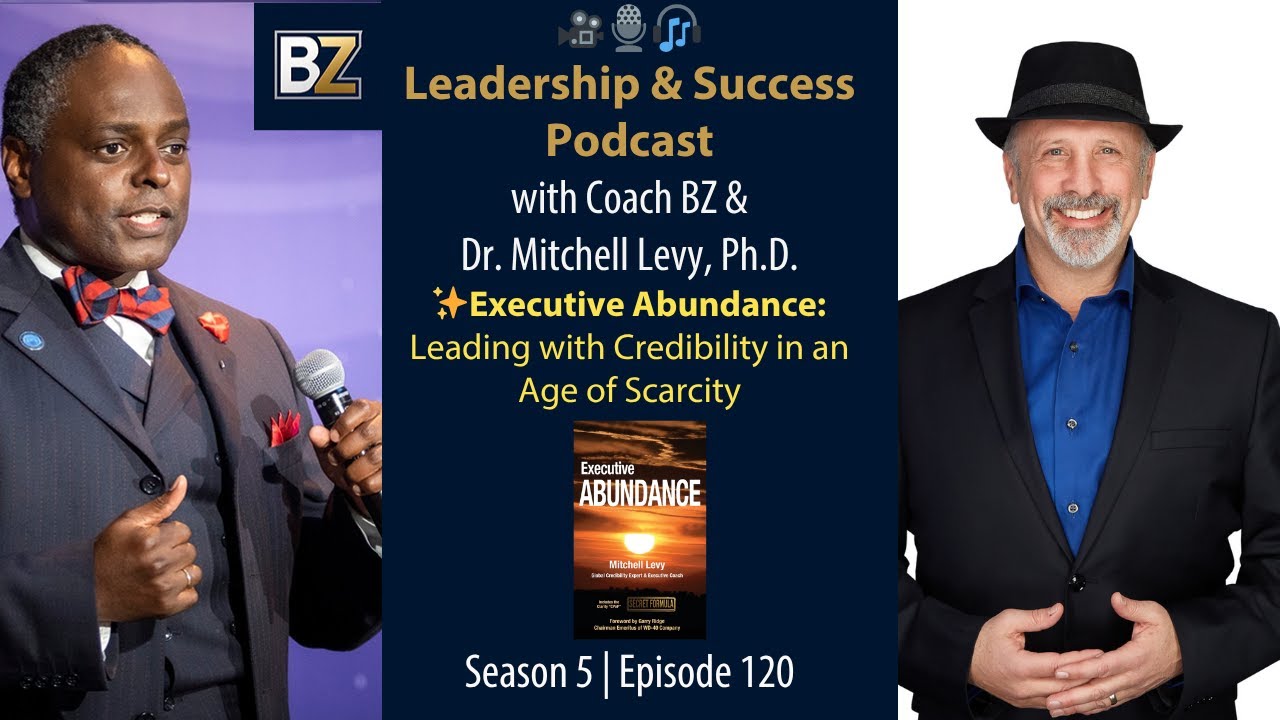
Dr. Mitchell Levy presents his Executive Abundance framework, arguing leaders must serve five stakeholders (self, family, employees, customers, investors, community) instead of chasing short-term metrics. He introduces the four C's (Clarity, Credibility, Consistency, Commitment) and the CPOP tool, which distills purpose into 3-9 words.
Chapters
Hi, I'm John Maxwell. When the top companies in the world are looking for trainers, speakers, and coaches, there's one name that stands above the rest, and that's Maxwell Leadership. Our certified team members have gotten proven results for companies all over the globe, and our reputation, I'm proud to say, is second to none. Some of our members have risen to the top of their profession, including the one you're going to meet today. I proudly introduce you to my friend Bob Fabien Zinga.
Welcome to the Leadership and Success Podcast with your host, Coach BZ, where we help you lead with purpose and succeed with impact. If you're ready to grow into the kind of leader others want to follow, this podcast is for you. If you're determined to elevate your success and leave a lasting legacy, this podcast is for you. As my mentor, Dr. John C. Maxwell, reminds us, everything rises and falls on leadership. Our goal is simple, to inspire you, challenge you, and equip you with insights that can transform the trajectory of your leadership journey. Welcome aboard to another episode of the Leadership and Success Podcast with Coach happy.
Yeah, like, what's the purpose of making your investors happy if you're in the hospital, right? Or if you're getting divorced or your kids don't know you. So that's one of the stakeholder groups. Uh, employees. If you do a good job empowering your employees and making them effective, guess what? They're going to do a good job of making your customers happy. Yes, if you do a great job of making your customers happy, guess what? That's going to turn into making your investors happy.
Yeah.
And subsequently, there's a community at large, both virtual and physical, that, that you play in, that you need to make sure you address. And so the boardroom of the future will be looking at metrics that are not just how much money, are we hitting our earnings, all of that stuff,. But the metrics we need to look at need to incorporate all 5 stakeholder groups.
Wow, that is quite comprehensive. Yeah, I, I must say that in my experience in Silicon Valley, uh, many times we have those lofty goals, or we say these are our core values. First of all, not everybody in the company knows what those core values are. But even when we say, like, one, one company I work for believe All right, welcome to another episode of the Leadership Success podcast. We do have a treat for you today. And before I talk about our guest, as you know, is our custom here, we wanna start with what we call the moment of gratitude. So if you would just take a moment, maybe close your eyes, take a deep breath, and put yourself in your favorite spot and think about one thing you are grateful for today. I think one thing I am really grateful for today is when good things happen to really good people, right? That doesn't always— it's not always the case, right? But when it does, I am so, so glad. Like today, my dear friend is now a doctor and that is very, very important. Just know the amount of time and work that you put into a thing, how you are passionate and how you really help make the world a better place. And then when you get an artist out of all of your sacrifices, I think it really means a lot and it encourages a lot of people, right? Above and beyond yourself, people who view you as a model and who are also going to make a difference in the world. So I couldn't be happier and I'm really grateful for that. So if you would, in the comment, let us know where you are joining us from, what what state, and if you are outside of the US, which country, and also what you are grateful for today. And if you have a question for my guest, go ahead and type the question in the comments and we will be answering you live. So first and foremost, I'm really excited to welcome back my dear friend, serial bestselling author, global credibility expert, and now Dr. Mitchell Levy. To the Leadership and Success Podcast. And, uh, as you know, he's coming back, so I would, uh, ask you guys to go back and watch Season 4, Episode 46. That was the first time, uh, he was on board. So, uh, Dr. Uh, Lévy is the founder of Credibility Nation, a two-time TEDx speaker, executive coach, and one of the world's leading voices on trust, on clarity, and purpose-driven leadership. With over 750 books published, and hundreds of, uh, leaders coached, uh, Dr. Levi has spent decades helping leaders become more trusted, known, and respected. Now he returned to discuss his groundbreaking new instant bestseller, Executive Abundance: Leading Through Cycles of Scarcity and Success. In a world shaped by AI disruption, burnout, economic uncertainty, cyber threats, and now declining institutional trust, this conversation could not be more timely. Whether you are a naval officer or cybersecurity executive or an entrepreneur or executive seeking greater clarity and purpose, I believe this episode is for you. Part of what you're gonna be learning today is why credibility is the new leadership currency, but also how great leaders define success on their own terms. One of Dr. Mitchell Levy's most powerful ideas is leadership is one of the most powerful forces for good on this planet. When it is rooted in clarity, in credibility, in consistency, and in commitment. So without any further ado, please help me welcome back to the Leadership and Success Podcast, the one and only Dr. Mitchell Levy. All right, Dr. Levy, that sounds great. How are you doing today, sir?
Uh, Coach BZ, thank you. I'm doing great. How could anyone not smile after an intro like that?
Thank you. No, this is really a great, great accomplishment. I know you haven't stopped learning. You're going to keep on learning even though you have a terminal degree now, doctor. But just to get started first, how does it feel to be a doctor?
You know, it's— I could simply say it feels really good.
Well deserved.
It feels good to get over the finish line. Like, it feels good to complete. And it was needed. It was needed for what I, in terms of what I thought it would be. And then, it was needed for the pleasant surprises that came along the way.
That is really, really wonderful. And what is one thing you are grateful for today, Dr. Levi?
I am eternally grateful for my family, my wife, who just— we just went to France for a month, and she was kind enough to— during the craziness of doing the dissertation, I got really this close to burnout.
Wow.
And 10 to 12 hour days, uh, 7 days a week. Some days were more, some days were maybe a little bit less. And yes, and I just thought every, every, every hour I need to be productive. I need to either do a client thing or I need to do a PhD thing.
Yes.
And so we ended up taking a month in southern France, and my wife was kind enough to stick by me, give me a little bit space during the time I needed it, and then we got to reignite who we were together as a couple.
In fact, it's really powerful. No, I remember when I was crazy enough to actually work on just one but two master's degrees, one in science, the other one in business administration. Yeah, I definitely needed my wife and my two kids to give me the space to do what I needed to do while working full-time and still being in the Navy Reserve. That was pretty crazy, crazy.
That's like a lot. That's like a lot of stuff going on. Yes.
Yeah. But, So what inspired you to write Executive Abundance? Why did this book have to be written?
Yeah, you know, I have an interesting slide with my PhD journey. So I'm gonna, if you want, I could be able to share it. Yeah, I could share this. And so what I talked about last time was that between 2019 and 2020, I interviewed 500 thought leaders on this concept of credibility. And so that's when I started focusing on, being a global credibility expert and, and spent 3 and a half years running a credibility company. I ended up— I did a TEDx that has over half a million views. I ran the company and then realized I was making money but not changing the world. And I thought, huh, clarity, that's really important. So I created a clarity certification program. And that one I ran for a year. And when I entered the PhD program in 2023, I consciously made a decision. I didn't want to do my dissertation on credibility. When I switched my businesses to clarity, I'm like, I don't want to do a dissertation on clarity. And it was about 18 months ago that I, I was slapped into the world of Executive Abundance. So let me know if I, if I covered this last time, BZ. Um, the— I had a friend of mine, guy by the name of Ken Cook, and, uh, it was about 18 months ago, and he gets, he gets on the Zoom call with me and he goes, Mitchell, he goes, I know every living marketing legend alive today and there's nobody who knows, uh, clarity the way you do. I covered this with you last time.
No.
Okay. And so, uh, problem is ego. Yeah, that's why I said something like that. Ego gets really big. He goes, remind me how many people don't have clarity. And based on the, the interviews with the 500 thought leaders and following through what I see afterwards, 98% of companies and individuals don't have clarity. 98%.
That's crazy.
I don't disagree. And, and then he goes, I'm going to say something you're not going to like. So I was trying to think about all the possible things he could say that I'm not going to like. I couldn't come up with anything. And then, and before he said it, he gave me a preface. He says, by the way, this is just marketing speak, so don't take it personally. By the way, what he said, I want you to imagine a balloon and a pin. Because in 3 sentences he stuck the pin into, into the balloon and my head just went— he first inflated my head and then he completely, uh, chopped it off. He goes, Mitchell, you're world-class at something that 98% of your audience doesn't have. They don't have it because they think they have it, they don't, or they don't think they need it. Either way, that number sucks.
Yes.
And I'm like So he saw me, I was downtrodden. And he goes, all right, Mitchell, look me in the eyes right now. What could you do for me this moment that will put money in my pocket tomorrow? And first, second, executive presence. I've been working with, you know, publishing other people's books, publishing Executive Abundance is my 66th. I've been on a couple TEDx's, did a lot of things. And I— that executive presence has grown into what is now Executive Abundance.. And then, that was my first gift was from him, was focusing on that. And then, why that came to being was my second gift that when I woke up in the morning, I got it. And when I woke up in the morning, what uttered in my head was something that I've known my whole life, but only started thinking about 18 months ago.
Yes.
And the simple thing was sell them what they want, deliver what they need.
Mm, powerful.
And so as powerful as that was, the negative piece of it— I spent a year focused on the credibility interviews, 3.5 years on a credibility business, 1 year on a clarity business.
Yes.
Add that all together, 5.5 years, and I recognized that I spent 5.5 years of my life focusing on what people need, not what they want.
Hmm.
Wow.
That's when executive abundance started blossoming. Because what if you're an executive, particularly you're an executive and you're successful and you're making money, but there's something missing in life? What do you want? What do you want? And, and so that's when I started focusing on it. And it was funny to see the interview. Because that was my thought processes after doing my first presentation on the Secret of Abundance. But then, having done the dissertation and focused in the weeds of what this is, research and other models, oh my goodness, life has changed. My perspective has changed. It's in a good way.
I really like what you said, right? Sell them what they want, but deliver what they need.
Need.
Why do you think this message is urgently needed today in 2026?
Well, I also have to— here, let me show another slide because I'm going to say that has a— that has a—
yeah, I remember this.
—that has a caveat associated with it. So I know I covered this last time. This is what the definition of credibility that came out of the interviews. Credibility is the quality in which you're trusted, known, and liked. And one of the most important things, if you look at just the top section, coachability, you need to be coachable. But the most important thing, when I make that statement, is servant leadership. Yes. So sell them what they want. So sell them, or maybe a better way to think about, listen to their dream and then sell them their dream. Right? Sell them what they want. But then what you're delivering, the reason that's important is that you need to be a servant leader. You need to have the intent and commitment to do the right thing. So, because in many cases, you've heard people who sell them what they want, but then deliver something else. So what I mean was deliver what they really need in order for them to be more successful. And it changes everything. How you get people's attention, how you get people excited is if you listen to who they are and what they want to accomplish. And I think even the clip that you shared at the end of a person's successful career. And when they look back and they look at what they've done and what they've accomplished, most people will never say, hey, I wish I made more money. What they're going to say is, I wish I took care of my customers better or my employees better, or I wish I paid attention to my family. And, you know, or I wish I took care of my health, right? It's the abundance that happens. We— what happens as we get older is we, we have more perspective. And what we've been taught is how do we optimize satisfaction today? And the only thing we care about is making more money. And, and so that's executive abundance is something completely different. So you sell them what they want, executive abundance, and you deliver what they need. And what they really need is a more well-rounded existence where they're adding more value to, to many more stakeholder groups than just the investors.
That is so powerful because you do describe in the book a crisis of credibility in leadership. What are you seeing globally that convinced you that the old leadership playbook no longer works?
Oh, well, let's, let's do something really simple. So one of the things that came out of the dissertation research is I thought the The Father of Short-Termism. My dissertation, it's through the School of Transformational Leadership and Organizational Development is sort of what it's technically called. But if you think about what I focused on, or the way I'll say it is I focused on short-termism. It's a short-term orientation we have based on, based on delivering quarterly financials. And so, the corporate world particularly public stock markets. And that has permeated into the startup world. It's actually permeated, permeated into society. We're focused on the short-term orientation of the next quarter's results. Yes, right. And, and so what— one of the things that I had when I was thinking about short-termism is I was wondering who the father of short-termism was, and I thought it was Edward Deming. Now, Edward Deming is the guy who went over to Japan after World War II and helped the Japanese figure out how to do manufacturing differently, how to do manufacturing better, how to optimize that world. And what happened is in the '80s and '90s, uh, management theory truncated what he was talking about. So what he actually talked about was doing time and motion studies so we can improve The employee experience. And if we do that, we're going to improve the quality of the product. So we'll improve the customer experience. We're all making the company better. But in the '80s and '90s, we truncated Deming's work to say, hey, let's do time and motion studies. Let's focus on optimizing employee productivity. Okay. So you asked me the question, how are we in a credibility crisis? Well, the crisis we're in if we have one and only one metric— how we're doing next quarter— and I sat on the board of a public company, I also had fiduciary responsibility to investors. We focused on one and only one metric: how do we make sure we do things quarter over quarter? If you have only one metric— how are we doing next quarter— the biggest expense for most companies is the employee line. And if we want to focus on optimizing employee productivity, we've now seen the potential of AI and robotics, and particularly robotics with AI incorporated in it. We've seen that the most optimized form of employee productivity is no employees at all.
Unfortunately, yeah.
So what happens in a world where companies continue to lay off employees? Well, we have an economic structure that's built on consumption. Well, if we don't have employees who are making money, how can they afford to pay for the things that— that are putting out there? So the entire structures, particularly in the U.S., we don't like this word called socialism. Look at the backlash on Obamacare. Look at, um, when we've talked in the past about universal basic income, look at the backlash on doing those sort of things. And And so the— we as a society are not structured for what's ahead. And so we need it. We need a solution. And that's really the— what Executive Abundance addresses is long-term. If we continue this path, we will reach, for a number of different reasons, a point of annihilation. How do we, how do we change who we are? How do we structure things different? How do we make sure that we're not narcissistic and hedonistic, focused on money, and those who make money get to tout it to everyone else? How do we focus on creating a society? You know, there are many of us who want to do the good thing, BZ. And because I sat on the board of a public company and the experiences I've had in life, I've taken the approach to give the boards and the CEOs the opportunities to make the right choice. Yes. And that choice is something that they could really buy into and create a much longer-term vision. And it doesn't take a lot, but it takes strong conviction.
Wow, that is really fascinating. Now, you have interviewed over 500 global leaders. What pattern separates abundant leaders from scarcity-driven leaders?
You know, it— thank you for that question. And I, I was not necessarily focused on abundance when I was doing the interviews. So I'm not sure the 500 leaders is a way I could answer that question directly. But I will think about it. So thank you for that. Thank you for giving me that question. I— do you mind if I share another slide? Please. So for those, for those who are listening only, all the slides that I share are things that I put out there. And, and you go to my sites and type in, you know, credibility, and you'll get those pictures. What I want to do is, is share the Executive Abundance So I want to answer the question because I'm a visual guy, right? So, and you said this in your talk in the intro to me, and I want to share that the executive abundance engine are those 4 C's. And what I was able to do in my dissertation is show that they are ordered and interdependent. And so what happens, you start with clarity. Uh, you then move on to credibility. So, so on clarity, it's, um, one of the problems is 98% of companies and individuals don't have clarity. So how can the rest work, right? You move on to credibility, and there are 10 values of credibility. And you need to do it consistently. Yes, right. And, and that's in good times and bad. And you need to have a commitment to do it when when the proverbial stuff hits the fan, right? And so what makes, what makes somebody abundant? It's when they truly have clarity of purpose and they've permeated that throughout the company. And one of the best ways to think about that, it's really interesting because you've heard people talk about employee empowerment. Yeah, right. But you know, when you read the literature and you focus on employee empowerment, it's in many cases you can empower your employees, but you could empower your employees and empower them without respect. Hmm. Right. So let me give you a classic example. And I don't want to give— I don't want to, to put companies out there, but maybe I should. But think about any company that they've empowered their employees to be successful and they have forced their employees to go back to the office. Hmm. So that's showing a lack of respect. Yes. Right. If you love what you do and by the way, if you're working for a company, you don't love what you do, find another company, find another job. Right. If you love what you do, then if an employer respected you, they would allow you to get your job done no matter where you are. But what happens is we have these old constructs of how to run companies and how to work with employees. And they happen to be like Sam, and they're doing work, right? And so, a person A leader who truly is abundant focuses on their ecosystem. That's the— if you look below, those are the, the 5, the 5 ecosystem components. And the first thing happens is they recognize the importance of their family and themselves. Yes, right. Once again, those are also ordered and interdependent. Because if you don't have a good family life, if If you don't take care of yourself, that will spew over into your leadership. You can lie to yourself for a little bit, but it's not going to last forever. You then need to— and we walked through this last time— but you need to not only empower, but you need to respect your employees. Yes. And everything else flows from there. And what's interesting is after the employees, if they're loving what they do and they're doing a good job, they're making your customers extremely excited. And if your customers are extremely excited, they're making your investors excited. Yes. And then that spills over into the larger community. And you can't ignore both the virtual and physical communities. And what's unique about Executive Abundance is that investors in this particular case are fourth, not first. Yes. You know, and that's really what's fascinating. And so, And to answer your question, what makes, what makes a leader, what makes a leader abundant is they see the bigger picture of what they want to deliver. And they share that vision with all of their stakeholders consistently. And then they empower the system to work.
That's powerful. Yeah, I like that you put family but self also because many times we forget about ourselves, our health, even our mental mental health. And once you lose that, nothing else really matters, does it?
You know, I had to tell you, the reason I took a month in France after the thing is my mental health, it wasn't wavering. It just was off. It was off-kilter, right? It was like, I thought it was okay that, you know, it was funny because it's in between the April 7th when I defended my dissertation and the time I left, there was a Sunday where there was nothing on the calendar and I still, I, I still worked for 10 hours. Yeah, I love what I do, Bizzy. I mean, I love, like, what I did was fun and interesting, but I, I, I didn't go outside and spend time with my wife and do things. We, yes, worked because, like, that's what I needed to do is the dissertation. And so I, I was, my mental health was, was at a tipping point. Right? And fortunately, I have an abundant enough life to be able to take a month and go to France, right?
So no, that is so true because especially people from my military tribe who are listening to the podcast, many times during exercises or operations, things are really high tempo. We go like sometimes 16, 17 hours a day, 7 days a week, which is fine for a while, but I feel like you just cannot sustain that forever. There's gotta need a time where you need, absolutely have to have a break because we are not machines, we are not AI, we are human beings and we do have needs. So I really like the emphasis you have on family and self. So you've kind of already talked about this, but in your words, how would you describe executive abundance in a brief way to somebody who absolutely has No Idea and how it really differentiates from traditional executive success, at least the way we've known it.
It's the focus on bringing abundance. And abundance is not necessarily money. Bringing abundance to 5 stakeholder groups. So, it's focusing on yourself and your family. It's focusing on your employees, your customers, then your investors and the community at large. That's powerful.
Wow. So why do so many successful executives still feel unfulfilled, disconnected, or burned out?
You think? You know, it's really funny. For those who are parents, right, there's not really a kid manual. Like, there are many. But The, the difference between who you are as a human, like the day before, like I remember in the hospital when my son was born, my wife and I looking at each other immediately and saying, by the way, if our son was drowning, I would let you drown and save him. And we both said that at the same time, like all of a sudden overnight our world changed. Well, that same thing needs to happen, but isn't. The manual that we're taught for success in life is to acquire assets, to acquire stuff. Yes, that quarter over quarter, if you eventually get to the point of CEO, your job is you have responsibility to make money for your investors. And quarter over quarter, that's where you're spending your energy. And every second of your day is focused on, OK, how do I make the employees build more stuff for more people to buy? Right? And when many executives, particularly many of those that I coach, when they reach the end of their career, or even when they're close to the end and they've achieved all the things that they wanted to achieve, And they look to themselves and they go, there's something missing. Wait, I did everything I was supposed to do. I followed the playbook. I was successful. I won all of these battles that were put in front of me. And I'm still not happy. Why? And then they look at their lives and they may be overweight. They may have got divorced. They may have had bad scores on Glassdoor from the employee base. They They may have had really bad scores from their customers. It's, you know, they may have done a great job of making the investors happy, but all the rest of their life is in some sort of shambles. And they say to themselves, "What did I do wrong? I followed the playbook." Well, the point is that is not a playbook that's no longer relevant in today's world. That was a playbook that was relevant when we were making the transition from the agricultural society to the Industrial Age. Now that we're moving from the Industrial Age to whatever else— yeah, by the way, we're still in the Industrial Age. We're still in the age where— because all the processes, all the, all the structure is based on us doing the types of things that, that companies have, have set up. Well, What's the next evolution of humanity? What's the next evolution of business? And that is bringing abundance to the entire ecosystem that you're involved with.
That's really, really powerful. Now, you did talk about that last time you were here. Again, Season 4, Episode 46 for everybody to watch that episode. We talked about CPOP, right? The Customer Point of Possibility. I think that's a very important concept. We need to talk about that again. So what is SIPOP and why do leaders struggle with clarity? Now, again, you spend about 5 years of your life just now working on both clarity and credibility, right?
Oh, super cool, by the way. And what I want to do is I'll put this in chat for you and you can put it in the notes. Or I'll just say, I'll say it. It's mitchelleevee.com/dissertation. So if you go to that page, mitchelllevy.com, you can actually— not that many people want to read the dissertation, but you could read the dissertation. It, it— I also did what's called a capstone. So what happened is, opposed to just the dissertation, I also had 5 artifacts. One was the book, the Executive Abundance book. I also created 2 chatbots. And then the third thing, or the fourth and fifth, is I created two courses. So for instance, I created a course for the CEO. My CEO course is 10 minutes long, right? Because what I figured would be easy is I can't teach a CEO anything new. But what I could do is remind them that this is why they picked the framework and to empower their team to actually execute on it. But what I wanted to do is say that as I created something called the CPOP Architect, and it's a free resource. Um, it's, um, I created in ChatGPT, and when I first started using AI, I tried to get AI to create CPoPs. Now I'll give you a definition of what it was, but let me finish that thought process. And I wasn't able to do it. What happened during the dissertation, I made another stab at seeing whether or not we could have AI create CPoPs, and I, I, I created it. And what happened is it started producing results I wasn't excited about. And so, yeah, the dissertation is, it's crazy, by the way. It's such a different voice, by the way. If you spend 2 minutes reading the dissertation voice and 2 minutes reading the Executive Abundance book, you're like, oh my God, those are 2 different people. But it's me, but I had to switch voices. Let me tell you what a CPOP is, and I'll come back to the CPOP Architect. A CPOP, Customer-Pointed Possibilities, is in 3 to 9 words where you are executing on your purpose. Yes. Okay. So when I say 98% of companies and individuals do not know their purpose, I'm going to say is 98% of people can't in 3 to 9 words articulate where they are executing on their purpose. And CPoP is a very simple formula. It's the who and the what. Who do you serve? And then what is either their pain point or pleasure point, right? And what's nice about the CPoP Architect is you can just go there. It's a free resource with ChatGPT, and you just start typing stuff in. It'll walk you through and ask you questions to be able to come up with your with your CPAP. When I created a clarity certification program, I started teaching other people to do it, and some people got it and some people didn't. And the problem is, I— that wasn't as important as living it. And, and one of the things that's interesting, Bizzy, is I, I talked to somebody, uh, this week that I had talked to and given a CPAP to, uh, probably 3 years ago. Hadn't talked to her in 3 years. And what's interesting is she doesn't know or remember the word CPAP. Mhm. But as she's now entered a new season of her life and changed everything, and explaining to me who she is and what she does, I heard her say her CPAP, which was 5 words. And then I went to her website, it's not there. And I'm like, so whether or not she gives me credit, and I'm not looking for it, she now has the clarity of being so singularly focused on the who and the what. On, on— wow, she serves, and it's really powerful. So can I tell you a story about the CPOP? Would you mind? So, so, so I created this. I thought it was great. And one day I, I was, uh, in a conversation with somebody And, and so it's, it's basically, you just, uh, busy. What you should do is say, hey, I do the following, what's my CPAP? And, and, and have it come back to you, right? That's it. I, I was on a call with somebody and I was trying to come up with a CPAP, and then I, I pulled up the CPAP Architect and I thought, oh, this is yucky. So, so either that day or the next, I went to AI and I said, listen, I am, I am your father. I created you, and at the moment you suck, so let's fix it, right? And so we went through a series of questions. It might have been 3, 4, 5 hours. And finally, at the end, we, we had come up with lots more rules and thoughts and triggers and focuses. And I said, what should I do now? And the AI said, well, you need to reload my memory. So I'll forget this conversation we've done. And then it says, you are now the father of this. And my suggestion to you is that you leave me alone for 3 to 4 months. Just let me do my job because once you reload this new, essentially, operating system, Let me work with it, see how it comes out, see what happens, but don't, don't, don't fool around anymore. And I'm like, yeah, that was really, that was really a very engaging conversation. Um, so created, created the system, didn't like it, updated it, and now I, I mean, I'd love you to use it, but I have, I have people who I've, who love the CPAP concept that used to call me for CPAPs, but now use the they use the CPoP architect.
That is really amazing. Again, that's mitchelllevy.com/dissertation. Wow, that is quite amazing. Can you imagine a world where you are interacting with a computer? And even it was just 20, you know, even 15 years ago, that would have been completely unimaginable. Man, it's incredible. So I guess the follow-up question I have for for you then is you do teach leaders to articulate their authentic value in less than 10 words, right? So why is simplicity so powerful in leadership communication?
You know, it's really interesting, Bizy. And before I focused on executive abundance, I really had, you know, I was struggling back and forth. What is clarity? What is credibility? And you know, you saw the 10 values of Credibility, and you know the clarity is, is your, is your, uh, CPOP, the 3 to 9 words. What I always implied but didn't actually say out loud was consistency and commitment. Yes, right. And so the problem with not having absolute focus and clarity is that when you as a leader make different decisions, if the people who are following you need to ask you questions and your answer is different based on this circumstance, right? That's not clarity. Yes. Right. And the thing that's interesting is if you want to empower and also respect your employees, they need to have their version of your clarity. They need to use their clarity within the environment they live in, and they need to be empowered to do that. Yes. And so, you need to show up consistently regardless of the situation focused on your CPOP, the playground you play in. And you need to have the commitment to do that both in times of scarcity and success. I'll give you an example of success. The person who did the foreword for the book is Gary Ridge. He was the CEO and Chairman of WD-40, which had an amazing run. He was there for 25+ years. And one of the things that can happen, his company just, I mean, incredible employee engagement scores, incredible customer satisfaction scores. And one of the things that was important to recognize is that when things are going good year over year over year, it is very easy to sort of forget to remind people who you are. And Jerry was— every time you put him on a stage, he will remind you who he is, what he's focused on. He has this concept called learning moments. So, and he's happy to share the opportunities where he made mistakes and learned from them. Right. And wants to encourage you to do the same. And so we, we need to be consistently focused and committed to do the right things in times of scarcity. So, you know, a lot of people cut corners lots of times on boards. In order to make quarterly numbers, people cut corners, right? And that's the price of scarcity. Um, if your only decision framework is investors and making investors happy, you're going to make different, different decisions than if your framework was to make all 5 stakeholder groups happy.
That's so true. Wow. You also remind me, for example, in the Navy, right, we have free core value: honor, courage and commitment. And sometimes as a leader, it really takes courage, right, if you're gonna be consistent all the time and then being committed to the mission and its people. That's quite powerful. Oh, by the way, someone I just interviewed a few weeks back, Coach Maxine, she says, I love this idea of executive abundance. So, again, everybody, I want everyone to get a copy of the instant bestseller Executive Abundance: Leading Through Cycles of Scarcity and Success. I really love that you say scarcity and success because many times when you're an entrepreneur, you feel like, you know, everything is just going to work fine all the time. But that's not true, is it?
Right? No, no. It's interesting. Sometimes things really work and you sit in this this, this space of success. And many companies have sat in that space of success and then eventually got knocked off. Take a look at what's happened with Intel. Yeah, right. Over time, take a look at what happened with Microsoft. Microsoft's one of the companies that I featured because the CEO that came back was able to take a culture that had become a really not so good culture and turn around to be such a better culture. Yes. Right. And so whether or not you have ongoing success or whether or not you have scarcity, you as a human are still and should be the same person. And the people who you surround yourself with, the employee base, your customer base, should be people that you also can empower to also enjoy their lives and who they are. Like, don't— we've been sold a lie. Yes, the lie we've been sold in the education system, by the way, it's so, uh, so bad. The education system today is to train you to be a sheep, right? Train you to follow the doctor and work for 60 years or 50 years You're going to hate what you do, but it doesn't matter because at some point in time you get to retire. You'll have the health and money to do what you want. That's, that's a lie, right? What, what— and today's generation is figuring out, well, maybe I should enjoy a little bit more myself today. Maybe I should enjoy life a little bit more. There's nothing wrong with that. Um, now they would enjoy themselves more inside a company and be productive for you if you could empower them to do that and to empower them to do things that, that you, they, you not only empower them, but you respected who they were. And so, so what we need to do as leaders is just re-envision a world. If you re-envision a world where you didn't just talk about customer or employee satisfaction, but actually lived it, that world would be different. The answer is, of course it would be, right? And so, anyhow.
No, that is really powerful. And by the way, you do have a new fan now. Good morning, I've just connected with, I'm now a fan of Dr. Levy. So, one question I want to ask, maybe this is the million-dollar question, especially in the military, when we talk about mission clarity, it could mean the difference between life and death. The Silicon Valley that could drive innovation. So how can leaders create radical clarity during uncertainty and disruption?
I'm going to say it's extremely simple and extremely difficult to do is come up with a CPOP. And the really cool part is I've now made it really simple. Go to the The CPAP Architect. And actually, it's— I think it's thecpaparchitect.com, right? And, and the, the interesting part is you need to believe it. You need to understand it. I have worked with over 1,400 companies and individuals and given them a CPAP. Yes. And what's interesting, um, it's easier for me to see it and the ramifications with a human than a company. Company just takes a little bit longer because it has to permeate throughout. But as with a human, if I could actually see somebody and feel their essence and help them articulate in 3 to 9 words that level of clarity— and I'm going to say 90% of the time they, they ignore it. Right? They ignore it because there's so much noise and chaos out there. Even when, because in the time that we're talking, the time that we, they understand who they are, they're like, oh my God, this is me. I got it. I know what to do. I need to move forward. And then they leave the conversation and they get confused. They get other marching orders from other people. They don't believe enough about themselves. So maybe, Maybe, and I'm making this up as we're talking, maybe you go to the CPoP architect, you come up with your CPoP, and then you go to your favorite AI, whether it's Claude or something else, and you go, hey, listen, this is who I am. Look, you know me, you've seen me. Is this really me? And if the answer then becomes yes, yes. How do you make sure I live this world? What do you make sure, like, why don't you create, and maybe that's the next AI I create, or maybe somebody else creates it, let me know. Because when it— asking AI, when do we violate who we are? When are we stepping outside of bounds of the playground we're supposed to be playing?
Because that goes back to consistency, right? And that goes back to—
yes.
Yeah. Hmm. Yeah, because it's one thing to know, but it's another thing to actually do. And you really don't know until you do. So that's why I really love— again, the book we're talking about is Executive Abundance. Everybody should have a Copy. Let's talk about the crisis of credibility because you say in the book, right, credibility is built on being trusted, known, and liked. Why are all three necessary?
So it's funny, when I went to B-school, likability was not even covered. It doesn't matter if you're liked or not, right? And the, the concept of being trusted, particularly if you're in the military, right? The— you follow the chain of command and the person above you, or way above you, they say something and you just act. And you— and that is your job because they're— what you know is what they're saying is in the best interest of the audience you serve. When you get to the point where if you're following the command of those that are above you and you recognize that they're giving you commands that are not in the best interest of those that you serve and you lose that level of trust, that's when it's time to do something about it. Right? And we see that today. So trust is a really interesting focus. And one of the things that I work really hard at is being someone who is coachable, being someone who is— there are 4 elements of trust: coachability, authenticity, vulnerability, and integrity. And I work really hard all the time just to be me. So, you know, if I'm in front of a group of people and I make a mistake, I will say I made a mistake. I will share things I did wrong. I will show that I'm not a perfect person because nobody's perfect. You know, and that helps engender trust. That takes humility. Yes. Now, what happens, there's a difference between what you say and who you are and how you really act. And that's when people get to know you. When they get to know you, what's important is it's important to be a servant leader. It's important to be of service to others and have the intent and commitment to do the right thing. Now, doing the right thing does not necessarily mean putting money into your personal pocket. Doing the right thing is putting abundance or putting value into other people's pockets, right? And, and so the, the thing that's fascinating, and this is one of the things I, I, I learned in the interviews and particularly afterward, is the importance of integrity, you know, in terms of the credibility crisis. We have a really big and, and, uh, crazy credibility crisis at the moment because you can't say one thing and then to one audience and say something else to the next. That's just not credible. You can't say something today and, and not be believable because you're changing your mind tomorrow and you do it consistently over and over and over again, right? So, yes. This concept called integrity is the only value of the 10 values of credibility that was listed twice. It's your external integrity, who you say you are, and your internal integrity, who you really are. Wow. And we have this— I'm touching the back of my neck— we have this feeling in the back of our neck when we're talking to somebody or interacting with somebody and we're feeling funny, right? In, in the military, it's, it's important to be cognizant of your surroundings, right? And every now and then you're feeling, oh my God, there's something wrong, I'm feeling uncomfortable. Yeah, that if it happens with a human, it's because the internal and external integrity are not in alignment.
That's, that's really, really powerful. Yeah, I think that is so true, even though in government and just in society in general. When you become a leader, you are in charge of whatever organization, the people who are under you, they really need to see that consistency and that fairness. Has your definition of success changed through the years? What does success mean to you now?
Oh yes, you know, when I was young, like many young people, it was acquiring stuff, right? It's success was, until I actually became, I think in my first job or two is I wanted to be the person everyone came to for a certain thing. And then when I realized that I couldn't take time off over the weekend because I was the person everyone came to, right? That's when I said, oh, wait a second. I want to work myself out of a job.
Right?
And that's changed. So success up front was acquiring stuff for me. That's what I was taught, unfortunately. I had, when I was in B-school, I had a narcissistic and hedonistic mentor. And he taught me Ah, he taught me so many bad lessons. And although— and I went to work with him for a year afterwards, and although I was only with him for a year, he was actually with me for 37. Wow. It took me 37 years to unravel all the shit that he put into my head. Um, and so I, I, uh, success was a little bit more about heinous hedonism and narcissism and doing things for me. And, and along the way, and particularly my wife was the best human for that because she's such a good human, is focusing on other people and being a servant leader and doing, having the intent and commitment to do the right thing. And success today for me is I saw a, I see patterns So basically what I, what I do is I, I see the world, I see patterns, and then I create frameworks because frameworks simplify patterns. And so, uh, the credibility framework is just a framework. The, the clarity, although it's technically it might be a framework, but it's really just a formula. Executive abundance is a framework. It's a framework that will allow society to move away from the hedonistic narcissistic world we live in today into a world where We bring abundance to everyone, to the entire ecosystem. And I saw it. And I realized that the person who needed to deliver that was a doctor. And so up front, when I talked a little bit about the doctorate program, there were things that I knew I was going to get. I needed to have the letters in front of me, not because I never wanted to be a doctor. It's just the person who delivers executive abundance needed to be the doctor. What I didn't recognize was all the things I was going to learn along the way. Yes. And that was— dude, that was so cool. That is really powerful.
Because one of the best definitions of success I like now is my mentor John Maxwell says, success is when those who know you the best love and respect you the most. Perfect. Love that. It's a great definition. It's, uh, yeah, because I guess it has to do with being consistent, right? Not being one person in public and then a completely different person in private, right? I'm always kind of reminded, no, I was really close to my maternal grandmother Suzanne, and I was like, what would that woman think about what I'm doing right now? In darkness, in secret, when I think nobody else is watching. And that really keeps me in line most of the time. Those who know you the best, respecting you the most, no matter what. Okay.
By the way, if you think about that sentence, think about it from the trust, know, and like. Those that know you the best, respect, and like you the most. Yes. Charles Simons.
Yes, yes, powerful. Well, we are almost out of time. I cannot believe this. Let me end with this. Let me at least talk about your book in, I guess, the age of artificial intelligence, right? So Leadership in the Age of AI and Disruption. So we are entering a world shaped by artificial intelligence, automation, robotics, cyber warfare and accelerated disruption all around the world. How does executive abundance prepare leaders for this future?
You know, probably, probably the most massive thing that the educational system across the world does not teach humans is the concept called discernment. Mm-hmm. Right. And as powerful and as amazing as AI is, the discernment it has is the discernment in many cases of the people who are programming it. And when it's programmed to work based on you and your model, what happens is it's going to produce results for you. And in many cases, the results are spectacular. Mm-hmm. Um, but it still requires you to have discernment. And, and what does discernment mean? Discernment means that within a framework, you're determining what's right and wrong and how to add value. Executive abundance represents a framework in which we can add value to society and as, as a human species move forward in a way where we are excited about those around us because we— the metrics we follow, the things that we decide are important are things that we look at. And it's about bringing abundance. It's sort of the difference between Star Wars and Star Trek. Yeah. It's bringing a Star Trek-type society, right? Where we actually do bring abundance and we do explore and enjoy who we are. And It fundamentally, though, what executive abundance does is within the framework of bringing abundance to 5 stakeholder groups, it allows you to have the discernment to do the right thing. And it's really interesting. It's a really good question. I love it. And I like that. Yeah.
So how do leaders then avoid operating from scarcity? During economic uncertainty, layoffs, or transformation?
Fall back into your CPOP. If you fundamentally in 3 to 9 words understand who is the audience you serve and the pain point and pleasure point you're bringing, that shouldn't— whether you're in super wide success or scarcity, you, you can really, um, it helps you with the lens you're focusing in. And then what happens next, BZ, is based on that lens, you need a series of metrics. Not the series somebody else gave you, but the series of metrics that allow you to deliver abundance to the 5 stakeholder groups. You then communicate those metrics to other people. And then when, when you do hit times of scarcity, you can say, listen, this— these are our metrics. This is what we're shooting for. We didn't do it, and here's why. And this is why we're, we're having a problem at the moment. And this is where we're moving towards. That level of clarity, that level of, of, of consistency, and having commitment to do it will significantly increase credibility in the eyes of those you're— that you're communicating with.
That's really powerful regardless of the trends in society. So the last question in this segment is, how can leaders maintain their humanity, empathy, and ethical grounding in highly technical industries?
I almost want to say the same answer, right? It's because remember, this CPOP is a very interesting— I'm going to repeat just the formula. Who do you serve? And from their perspective, what is their pain point or pleasure point? Now, by the way, as a company, as an organization, as an individual, those that you serve will change over time, right? So as they change, who you are and how you serve has changed. Yes, their pain points or pleasure points are going to change over time. So you're in a continuous evolution to focus on being a servant leader, determining who you serve and how best to serve them, given what's happening in, in the world around you. And if you do that, you're maintaining your humanity, you're maintaining your consistency in terms of delivering value to those that you serve. That's really powerful.
All right. We are pretty much out of time. If you can give me 5 more minutes, we are going to bring this plan down. Sure, of course. Before I do, again, everyone, the book we're talking about is Executive Abundance. Everybody needs to have a copy. What? Leading Through Cycle of Scarcity and Success by Dr. Mitchell Levy. So very, very important book. So, um, as we close, let me ask you this. One of your first, uh, mentor, as you said, you work with him for a year, but it took you 37 years to unlearn what he taught you. I guess the question for you is What leadership lesson took you the longest to learn personally?
Are we talking about from my first mentor or from—
I guess just in general.
Ah, ah. So let me do what popped on my mind because you mentioned the first mentor. My— the most important first leadership lesson was forgiveness, not just of him, but of me. Wow. Right. And, and I think maybe, maybe we'll stick with that one. Yes. Forgiveness of if you've done things in your life you're not happy with, you either did them out of ego or you were working under a framework that somebody else sort of put in place for you. Well, if you're a CEO of a company, most likely the framework you're working under are frameworks that somebody else gave you the rules.
Yes. Wow.
Why don't you forgive yourself for what you've done in the past and focus on what needs to happen in the future? And this is maybe one of the best lessons to focus on, is to be a servant leader, do what's in your heart, do what's right, and ignore the things you've done in the past. Just because it's done a certain way doesn't mean that needs to happen in the future. Forgive yourself.
Very powerful. When you know better, I think, as you say, then you will do better. Wow! Was there a moment in your career when you realized that success alone was not enough?
It depends on how you define success. Yes, yes. I'll give you a good example. And I specifically, I'll do it in relation to the book Executive Abundance. Success to me is not— I appreciate you saying everyone should have a copy. Success is not that I sell a super huge quantity of these books. I mean, I think this thing is amazing and I think lots of people should have it. Um, success is about if this book is the right book for you and it'll allow you to see the world in a different way, it's worth doing. I specifically, a lot of people would say, get somebody else to read your book. Right, so, uh, the book itself is, uh, is on Audible. I wanted to make sure it got released on Audible. It's 5 hours, and I read it myself. And, and I read it myself because there's nobody— a lot of people say, hey, get somebody else, get a professional actor to read your book, but they don't know the book the way you do. They don't know the content the way you do. By the way, the, the only person, uh, two, two people will never listen to my book my wife because she hears it every day. And my son, he immediately, he didn't, he just told me over the weekend, he did buy my book, but he can't listen to it because I'm too enthusiastic. He goes, "Dad, I just, you know." And the thing is, the concept of you reading your book success was that I did a reasonable job or a really good job of reading the book in a way that I communicated my feelings. About what executive abundance is. Success is not some arbitrary number of how many books I sold. It's the fact that I was able to effectively put this framework in place. I did it through the concept of a PhD doctoral program with research. And I'm— success to me is it's now out in the marketplace, not necessarily that, you know, the based on numbers and sales and all this other stuff. And so success changes over time. And, and if this resonates with you, for those people who resonates, I've given everything away. Now, the thing is, if I can be of service and help you a little bit more, feel free to reach out. I'm happy to, to, to allow people to move on the path of bringing more abundance into their lives and to those around them.
And how are you? Yeah, yeah, that is quite powerful. Actually, in my home, I think it's the opposite to yours because my wife and I, we are both podcast hosts and we also sing and play instruments. But in our case, we don't like to hear ourselves. Like, I love to hear my wife on a podcast or music or whatever. I hear it all the time. But when she hears us, she's like, no, turn it off, turn it off, turn it off. I don't know what it is. Maybe it's because we have money. Same thing with my daughter too. She's a musician. She just got a degree from at Sousa Pacific a couple of years ago. But she sounds like an angel to me, so I would listen to her music over and over again. She's like, no, Dad, Dad, turn it off. I don't want to hear myself. So, oh, that's great. Anyway, so which of the 10 credibility values challenge you the most in your own journey?
Hmm, sorry, let me put them up here. Which challenge me the most?
Um, As also we're talking about coachability. Yeah, I don't know. That's a great— authenticity, servant leadership, intent, commitment, integrity.
It's possible— showing respect. It's possible I don't share my stage as much as I need to. I do my best, right? And so I appreciate you spreading my credence and putting me on your stage. And I now have a lot of slots open for people who want to be interviewed. You were on my show, Leaders Living Their Values. I now have a, I've got a number of openings for this year. And maybe it's, maybe that's the thing. I haven't invited enough people. So I, sharing my stage is something that I need to do more of. And maybe that means that I'm having a harder time with it, or I just haven't asked all the right people I should be asking.
That's great. So what legacy then do you hope Executive Abundance, the book, will leave behind?
The legacy is not Executive Abundance, the book, but Executive Abundance, the practice. And that we, for the board and for CEOs, that they recognize that there now is an opportunity to choose more than just the investor as how they look at the world. Yes. I'd love to see board doctrines updated and modified to be, if you're sitting on a board, you're not just fiduciary responsibility to investors, but you also have responsibility to— and we need to come up with the other metrics. Yes, uh, that allow the other stakeholder groups to be taken into consideration. That would be the legacy.
That includes the community, society, the employees, but also your customers for, for sure, and then, uh, family and self. That is quite powerful. It's a lot more comprehensive. And I think it helps make the world truly a better place, right? It's not just about money, money, money and the bottom line. So if every listener remembered only one sentence from this conversation, what would you want it to be?
Oh, you have the opportunity to bring abundance to a much larger audience than you possibly can think of. And you just think about it, plan on it, make it happen. Wow.
Okay, we are not going to end again. We are already 12 minutes beyond our time, but give me 2 more minutes. We're going to land this plane. So this is going to be rapid-fire question. I will ask a question and you need to answer as quickly as you can without taking too much time to think and elaborate. Okay, Star Trek or Star Wars? Uh, Star Trek. Okay, best leadership book beside your own?
And also, besides the 750+ books you've published, one of my favorites is Selling the Wheel. Who's it by? Oh God, I can't remember. Uh, Selling the Wheel. Okay, Selling the Wheel. It's, it's, it's who are salespeople, how they work.
Wow. I, I will find it then.
I think I love Marshall's books too. Uh, What Got You Here Won't Get You There is one that I quote often and give away.
Okay, very, very good. We love Dr. Marshall. So what is one daily habit that creates abundance?
Hmm. I sit every— when I wake up in the morning and I go to bed at night, I sit in my chair of joy for 5 minutes and think about the day. Wow! That's good.
Good, good. Okay. One word that defines great leadership. Abundance. Okay, most underrated leadership trait? Vulnerability. Okay, one misconception about success?
It's about money. Favorite quote about trust or leadership? It's from the Executive Abundance book. A leader's success is felt in the success of their stakeholders.
Now, as we end the show, is there something my audience can do to add value back to you, sir?
Oh, um, feel, feel free to— if you like the concept but this is not your cup of tea, um, feel free to share it with one person you know is, right? Whether you're starting in your career or you're, you're somewhere along the path or close to the end or transitioning successful career in the military and now going to what's next. Listen to the book. It's 5 hours. It'll change who you are and how you show up in the world. It just, it is that simple. It is a framework that'll allow you to look at things differently. So share it with that person who you know they want the answer. You know, what is life about? You know, why are we here? And this is from a business perspective. This is a good way that you can accumulate the points that's necessary that when you're on your deathbed, you're going to say to yourself, I did the right thing. I brought abundance to all these people. And whether or not it's from a business perspective, CEO going down, or, uh, a spouse who brings abundance to family.
And, uh, what did you want to be when you were a kid? Uh, a game developer, I think. Wow, okay. Now you are developing leaders. 3 adjectives describing you as a child.
Ah, uh, uh, sleepwalking. Okay, 2 more. Oh no, I, I went through life as— in my younger years, I slept through life. Um, okay, a little awkward. Um, and one more, uh, maybe not so smart.
Okay, what about as an adult?
Oh, I, I live executive abundance. I'm, um, credible, clarity, executive abundance.
All right, so what is something you are feeling optimistic about?
For me personally, I love where I sit having just completed the PhD program.
Yes.
And I love living for today. I think we many times in my earlier years, I lived for tomorrow. Um, and At this stage, I'm living for today and what happens in the present is what was meant to happen.
That's really powerful. So Dr. Mitchell Levy, in a world filled with noise, with division, with fear and artificial intelligence, what does it truly mean to lead with humanity, credibility, and abundance? Is that a question? Mm-hmm.
Oh. Executive abundance. Am I still on the fast fire round?
That is great. So we need to end the show before I ask you a very last question. Is there something I should have asked you that we didn't get a chance to talk about?
You know, I think you did a really good job of preparing and your questions. The one thing I was going to say is I, but I did slip it in, which is I read the book because I wanted people to see me, right? It's, you know, if 1,000 people pick up the audiobook, that's 5,000 hours that I haven't spent with people and they're thinking about the world in a different way. And I, I think the, oh, there is one thing. There's this model. What I created is not something that is, is go with this and don't go with anything else. This model is very similar to a lot of the normative models that are out there, like stakeholder capitalism, purpose-driven companies. It's just what I've been able to do is create an operating system that can be deployed with other normative processes that are out there. Wow. And so it's not an either/or. It's rather there's some frameworks here, and particularly in engine, the Executive London's engine can be deployed to any normative process that's out there. And that would be one thing I'd encourage you to think about is if there's one thing you're going to be doing going forward, if you want to change who you are and how you show up in the world, just listen or read this book and it will give you enough for you to live a much more abundant life going forward.
Wow, that is very powerful. Okay, we are going to end it there. And the very last question I always ask is one word that describes our interaction today on this podcast that represents that for you.
One word. Engaging. Engaging.
Well, thank you so much, Dr. Mitchell Levy. Man, that sounds great. And the book is Executive Abundance. Thanks so much for being one of our master teachers again. Today. Really appreciate that. My pleasure.
Thanks for having me, Bizzy. Thanks for being with you. All right, everybody.
So this is going to be the end of the show today. And it was just a great, great pleasure. What an incredible conversation we've had with Dr. Mitchell today. He really reminded us that today leadership is not merely about titles, metrics, or short-term success, you know, from quarter to quarter. It's much more than that. It's about credibility, Clarity, consistency, and service. In a world driven by speed, by disruption, by AI, uncertainty, and constant pressure, leaders who operate from scarcity create fear, burnout, and distrust. But leaders who operate from abundance create trust, resilience, alignment, and lasting impact. That's regardless of whether you are in a cycle of scarcity or abundance. Being an executive abundant leader, One of the biggest takeaways for me today is really that credibility is not something you declare. It is something that you demonstrate daily through your value, your action, your consistency, and the way you treat people. You've got to live this executive abundance, right? Whether you are a naval junior officer preparing for command or cybersecurity engineer looking for a leadership role, your influence will always, always rise or fall. Based on trust. In the Navy, we learned that rank is rented, but trust is earned. And I think Dr. Levi challenged us to think differently about success. Success is not simply about making money, climbing the ladder, or achieving status or getting stuff, but true leadership success is about leaving people, organizations, families, and communities better than we found them. Not just about the investor, but about the 5 stakeholders we talked about today. It's about building what he calls executive abundance, a life and leadership model rooted in purpose, in service, and meaningful contribution. So Dr. Mitchell, thank you again for joining us today and for sharing your wisdom, your heart, and your groundbreaking work with our audience. Your message is timely, needed, and transformational. And again, I want everybody to really please consider getting a copy of the book. Executive Abundance, Leading Foo: Cycle of Scarcity and Success. It's available everywhere. Books are available. You can get it in a paper work format or the Audible version you just mentioned, or you can get it in an ebook format as well. All right. Before we end today, really quickly, we do Black History Year as well. And we actually have two quick things. We are covering today. I believe today's the 21st, right? Ida B. Wells— let me get that, just a moment. I wrote an article on LinkedIn. You can read the full article, but on May 27, 1892, a white mob destroyed Ida B. Wells' newspaper office in Memphis. While she was visiting Philadelphia, pioneering Black journalism and anti-lynching activist Ida B. Wells learned that a white mob had destroyed the office of her Memphis newspaper, the Free Speech and Headlight, and threatened to kill her if she returned. So that was today, 1892. And another one I have is about the very first person to discover the Watergate break-in. That was Frank Willis. That was on June 17th, 1972. A 24-year-old African American security guard named Frank Willis made the routine observation that would forever change American political history. So those are the two stories to celebrate Black History Year. And later today, I'm going to have the pleasure in a couple of hours of speaking with Lieutenant General R. Scott Dingle, US Army retired. We're gonna be talking from chaos to clarity and leading high-performance teams under pressure. And Lieutenant General Dingle Lieutenant General, uh, Dingell is the very first African American Surgeon General of the US Army. So I'm really looking forward to speaking with, with him very soon. All right. Uh, I hope that you can join us, uh, again in a couple of hours for our live, uh, interview with, uh, General Dingell. And, uh, until then, have a, uh, great rest of your day and thanks again for watching today. Bye for now.
Thank you for tuning in to the Leadership and Success Podcast with your host, Coach BZ. If today's episode added value to your leadership journey, be sure to subscribe, share, and join us again for more wisdom nuggets on how to lead better and achieve greater success. Remember, leadership is the most critical skill of our time. The world will always need leaders to inspire others, drive innovation, and execute meaningful strategy. So why not count yourself among the bold leaders shaping the 21st century? Until next time, stay inspired, stay committed, and keep leading with excellence.
And before I end today, I wanted to give a brief book review. One of my friends, he was here on this podcast. I have interviewed him for for Season 4. I want you to consider getting his book. I'm talking about Coach Mitchell Levy. He's an Inc. 5000 CEO leading the future, international best-selling author twice, TEDx speaker. He's written more than 70 books, but this is his most recent book. He just gave me the advance copy, right? Executive Abundance. And I believe It's available everywhere books are sold for pre-order right now. I would like for you to please consider getting this book, Executive Abundance by Mitchell Levy, right? It's really a timely, thoughtful, and deeply needed reframing of what it means to lead well in today's complexity. I believe Coach Mitchell doesn't just diagnose the unspoken tension, right, that senior leaders carry, It names it, maps it, and offers a path forward with uncommon clarity. At a time when short-term performance pressure has become the dominant operating system in most boardrooms, Coach Mitchell offers a courageous alternative, a model that balances outcome with integrity and ambition with humanity. This book reads like a leadership compass for those who feel the cost of success but are still expected to deliver it. One of the best passages for me, I believe it's chapter 15, page 125, it says, Crafting Your Executive Abundance Legacy. Coach Mitchell says, the legacy of a leader is felt in the success of their stakeholder. After a certain level, success is no longer about you, it's about the next generation. There is no success without successors. So who are you mentoring today? Who are you developing? And hopefully what I'm doing here with this Leadership and Success podcast, part of it is to really help develop the next leaders in the military and in high tech. So what stands out most in this work is really the author's credibility, not just as a global thought leader, but as a guide who knows how to meet executives in their current mindset and gently lead them toward deeper, more sustainable
More from Bob

S250:E4🎙️LIVE 🇺🇸America 250: President Barack Obama Leadership, Service, and the Power of Hope






S5:E157🎙️ LIVE with CMD CMSgt Dennis L. Fritz, USAF (Ret.)(Multi Tracks Audio)



S5:E156🎙️ LIVE 🇪🇸 Leadership Lessons from the FIFA World Cup 2026 Champions (Multi Tracks Audio)

S250:E3🎙️ LIVE Leadership Lessons from America’s First Documented Family of African Descent 🇺🇸📖