S5:E121🎙️ LIVE 🇺🇸 America 250: Leadership Lessons From African American History
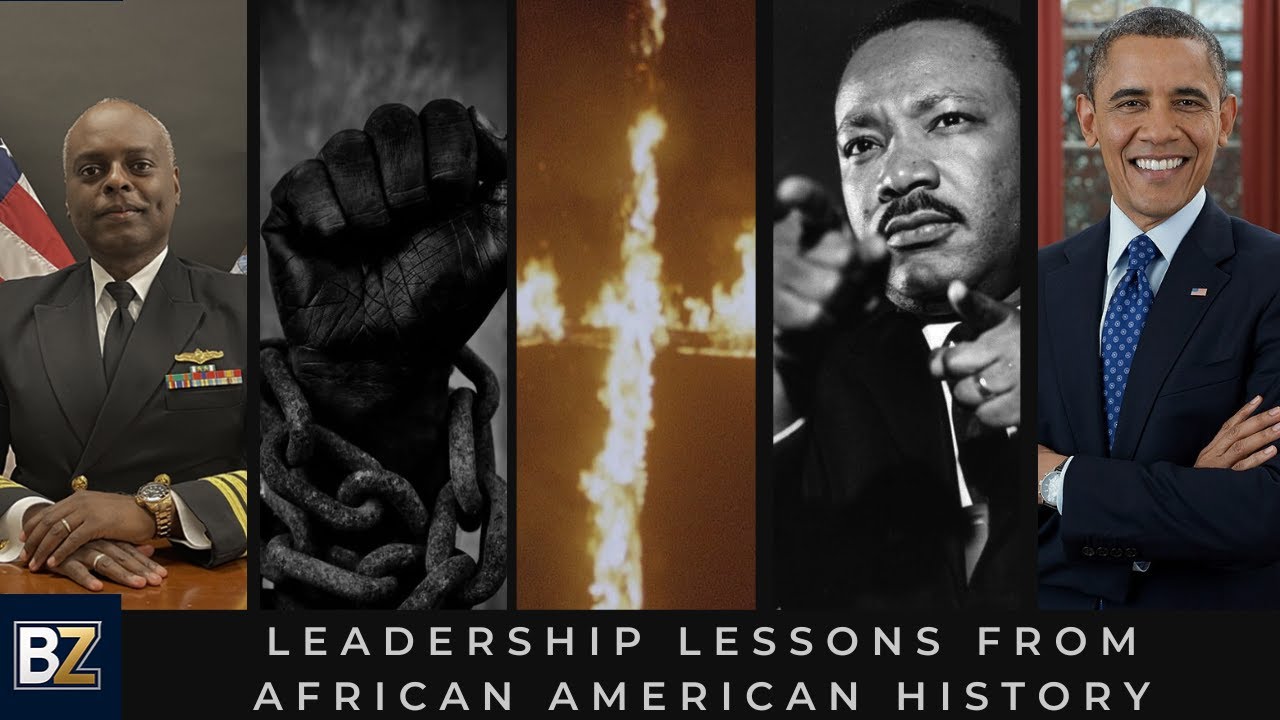
In this live Leadership Success Podcast episode, host Coach BZ (Bob Fabien Zinga) frames African‑American history—from slavery through Reconstruction, the Civil Rights era, and the election of Barack Obama—as a practical operational playbook for modern leaders. The discussion opens with a moment of gratitude and a call to vote, then moves into a deep analysis of a written article by Zinga that extracts seven enduring principles of change. Central to the analysis is the "dual‑truth" mindset: leaders must simultaneously acknowledge America’s lofty democratic ideals and its brutal history of racial oppression. The episode illustrates how this paradox prevents post‑racial complacency and drives strategic patience and moral clarity, using Martin Luther King Jr., the Selma marches, and other civil‑rights milestones as case studies. The conversation then deconstructs the myth of the lone hero, highlighting the coalition‑building tactics of Bayard Rustin (logistics), Ella Baker (grassroots organizing), and the broader alliance of labor unions, religious groups, and civic organizations that powered the 1963 March on Washington. It shows how economic leverage (A. Philip Randolph’s threatened march, the Montgomery Bus Boycott) and institutional disruption (Fannie Lou Hamer’s 1964 convention hijack) translate into modern tools such as strikes, consumer boycotts, and targeted pressure on corporate bottom lines. Narrative control is presented as a defensive strategy: Ida B. Wells’s data‑driven journalism is likened to today’s fight against deepfakes and misinformation. The episode maps historical lessons onto two eras—Reconstruction (1865‑1877) and the Civil‑Rights‑to‑2008 period—emphasizing that legal reforms without enforcement and economic power are brittle. It warns against post‑racial delusions, citing the backlash to the Voting Rights Act and the limited impact of a single Black president. Finally, Zinga offers concrete recommendations for corporate and community leaders: tie equity goals to compensation, conduct systemic pay and vendor audits, invest in organizational infrastructure rather than charismatic idols, maintain oversight after victories, and cultivate decentralized leadership. He closes with personal principles—serve honorably, build excellence, endure relentlessly—and a challenge for listeners to identify a current obstacle and take a deliberate action. The episode interweaves personal testimonies from Viola Ford Fletcher (Tulsa massacre survivor) and reflections from Patricia Roberts Harris and Sharon Pratt, reinforcing the resilience theme "we are still here."
Chapters
Hi, I'm John Mackey.
Maxwell.
When the top companies in the world are looking for trainers, speakers, and coaches, there's one name that stands above the rest, and that's Maxwell Leadership. Our certified team members have gotten proven results for companies all over the globe, and our reputation, I'm proud to say, is second to none. Some of our members have risen to the top of their profession. Including the one you're going to meet today. I proudly introduce you to my friend, Bob Fabien Zinga.
Welcome to the Leadership Success Podcast with your host, Coach BZ, where we help you lead with purpose and succeed with impact. If you're ready to grow into the kind of leader others want to follow, this podcast is for you. If you're determined to elevate your success and leave a lasting legacy, this podcast is for you. As my mentor, Dr. John C. Maxwell, reminds us, everything rises and falls on leadership. Our goal is simple: to inspire you, challenge you, and equip you with insights that can transform the trajectory of your leadership journey. Welcome aboard to another episode of the Leadership and Success Podcast with Coach BZ.
Hello everyone, welcome to another special episode of the Leadership and Success Podcast. Today is Sunday and we are going to have a very special episode today. We are going to be talking about some leadership lessons from America's history, right? African American history. And I believe there's going to be something for all of us to learn today. But before I do, let's go through what we call here our moment of gratitude. That's where every time we meet, we take just a moment to be grateful, every single time. And part of the reason why we do this is because so many veterans and active duty military members here in the US commit suicide. It's about 21, 22 every single day. And I believe that it's impossible to be suicidal and to be grateful at the very same time. So if you would join me, for those who've been watching the show for a while, you know the drill. Maybe close your eyes, take a deep breath, and put yourself in your happy place and think about one thing you are grateful for right now. And for me, it's going to be election day on Tuesday, June 2nd in California. And I think I am so, so grateful that I am a citizen of the United States and that I have the right to vote. And it is a privilege. And my vote does count. And I think our votes definitely have consequences, right? The people we put in power, then whatever it is that they do, we elect them to do, everybody in the country has to suffer the consequences. So especially if you are a person of color or a woman, I believe You definitely need to vote every chance you get, uh, because especially for African Americans in this country, so many of us had to die for us to have a privilege to vote in America. And I think it's pretty much a sin to me, uh, not to be able to vote. And I prefer to vote in person, so which is what I'm going to be doing on Tuesday. Polls in California open, I believe, from 7 AM to 8:30 PM. So I will go to my polling place and I am going to vote on Tuesday, and I hope that you guys do the same as well. And I am a senior officer now in the US Navy, and some of my fellow senior officers actually do not even vote because they really want to be apolitical, which we are in the military. But again, because of the high price of the vote of people who have my skin color in this country, There is no way I am not going to vote when it is election day, whether it's a local election, whether it's for the county, the state, or federal election for president or the U.S. Senate. I will vote every single election. There is only one election since I became a U.S. citizen I wasn't able to vote on the voting day because I was recalled to active duty, so I wasn't going to be in my area during the vote. So for that one election, I voted early, but thank God in California you can vote early by mail or in person. So I did vote in person, but not on voting day. But anyway, look forward for a post from me on Tuesday, and I absolutely encourage every single person to vote because your vote does count. All right. Now let's get started. So we are going to be again talking about this article I wrote about leadership lessons from African American history, all the way from slavery to the Jim Crow era, all the way to the civil rights, and then 2008 when Barack Obama, the first African American, was elected president. So we're gonna be trying to learn some leadership lessons from African Americans in America. All right, if you have any question for me, please type it in the comment, but let us know where you are joining us from, what city, what state, and also let us know what you are grateful for today. And hello to Daniel Young, he's a very active member of our tribe here on the Leadership Success Podcast. And I also want to say hello to Ibrahim Umar. Ibrahim, let us know where you are joining us from, what city, state, and country, and thank you so much for watching. So I am going to play you the podcast of the article about leadership lesson from African American history. It's gonna be about 28 minutes or so. So take notes and let us know what are 3 to 5 takeaway lessons for you today. And, uh, like I said, if you have a question for me, type it in the comment as well. So I'll be back in about 28 minutes. Here we go.
Get a medical diagnosis, there's this, there's this underlying expectation of absolute precision, right? It feels almost like engineering, you know?
Oh, absolutely. Yeah, it's very binary, right?
Like, you break an arm, the X-ray reveals this jagged white line right across the bone, and the doctor just points to the screen and says, well, there is the structural failure.
Yeah, the remedy is just Totally clear.
Exactly. The problem is isolated and the whole process operates on this very comforting logic. It's either broken or it's intact.
And we really crave that level of diagnostic clarity in, well, basically almost every complex system we build. I mean, that desire to see the problem isolated in a neat little box is just a fundamental human defense mechanism against chaos.
It is.
Yeah. But the moment you step out of the physical sciences and wade into the world of human history and institutional leadership, that X-ray machine just completely shatters.
Oh, falls apart. You're looking at a diagnostic landscape that totally defies that binary logic, right?
Because the fractures aren't these clean breaks you can just put a cast on. The systemic flaws are, you know, they're intertwined with the load-bearing pillars of the institution itself.
They are the pillars in some cases.
Yeah, exactly. And today, Sunday, May 31st, 2026, as America's 250th birthday is rapidly approaching on July 4th, We are wading directly into those diagnostic muddy waters. We're doing a deep dive into a really phenomenal piece of analysis today.
Yeah, this one is special. It's the Milestone 200th newsletter article by Bob Fabien Zinga, or BZ as he's known.
Yes. And he brings this incredibly rare dual threat perspective to this subject, which is what makes it so good. He's a US Navy information warfare commander, and simultaneously he's a Silicon Valley cybersecurity executive.
Right. And what's fascinating here is how that very specific intersection intersection of professional disciplines, you know, military defense strategy fused with tech sector resilience, it creates this uniquely pragmatic lens for looking at history.
Yeah, he's not just looking at it like a textbook.
Yeah, exactly. He isn't reviewing the past as some passive collection of dates or like a moralistic fable. He approaches the history of the African American struggle for liberty, justice, and equality as a rigorous masterclass in operational strategy.
Which is such a brilliant way to frame it.
It really is. He's essentially reverse engineering how marginalized groups actually managed to drive profound systemic change against institutions that just had overwhelming asymmetrical power.
And viewing history through that operational lens, I mean, it transforms this material from an academic exercise into a deeply relevant playbook for modern leadership, right?
It makes it actionable.
Exactly. The source distills 7 enduring principles of change, pulling out the actual mechanisms that historical figures use to dismantle entrenched power structures, and it connects those frameworks to the immediate realities of corporate boardrooms or, you know, local community organizing today.
Yeah. So for you listening to this right now, we really want you to bring a specific leadership challenge to the front of your mind.
Think of something you're dealing with right now.
Exactly. Think of an entrenched cultural issue at your company, or maybe a bureaucratic roadblock in your community, or just an operational bottleneck you cannot seem to crack. The strategic architecture we are unpacking today is going to offer you a completely new set of tools to dismantle that exact challenge.
So to start, assessing a nation's foundational history through this framework is, well, it's strikingly similar to conducting a zero-trust vulnerability assessment in cybersecurity, right?
That's a perfect analogy.
Yes.
Yeah. You cannot secure a network by only reading the marketing material of the firewall.
Right. You'd get hacked immediately.
You would. You have to actively hunt for the fundamental architectural flaws. You have to acknowledge the deeply embedded legacy code that's causing the vulnerabilities and really understand the entire system, both its aspirational design and its actual functional reality.
And let's apply that vulnerability assessment framework to the very foundation of this analysis, because the text starts with this massive conceptual hurdle, which is the necessity of holding two truths at once.
Yeah. Holding two competing ideas simultaneously.
Yeah.
It's tough.
It is.
The source isolates the paradox of Thomas Jefferson as the prime example. On one side, Jefferson architected one of the most transcendent democratic ideals in human history, right? The aspirational creed that all men are created equal.
Which fundamentally shifted the global paradigm of governance.
Totally. But then on the other side of the ledger, Jefferson was an active, lifelong participant in the institution of slavery, which is one of history's most profound moral and systemic failures.
Right. And the argument here is that true historical analysis And by extension, true leadership demands that we hold both of these conflicting realities at the exact same time.
You can't just pick the one you like.
No, you can't. We have to view foundational documents not as the description of a perfect past, but as an ongoing, unfulfilled mandate, while also just refusing to look away from the brutal, whitewashed reality of systemic inequity.
And the psychological mechanism behind holding those two truths is so critical for any leader aiming to enact systemic change.
It really is. The analysis points out that embracing this paradox actively prevents what is termed post-racial delusions.
Which is that dangerous assumption that just because an ideal has been stated, the work is somehow done.
Exactly. If you only focus on the soaring rhetoric of the ideal, you cultivate this massive culture of institutional complacency. You literally stop hunting for the vulnerabilities.
Right, the diagnostic clarity just completely vanishes the moment a leader decides to only look at the PR version of their own history.
Acknowledging the contradiction forces you to treat foundational values as an active operational mandate rather than just some static historical achievement to pat yourself on the back for.
And to really ground that theoretical concept in a visceral reality, The Source incorporates this incredibly powerful statement from Tennessee Representative Justin J. Pearson.
Oh, that quote is just staggering.
It is. It's so simple, but the weight of it. He just says, We are still here.
Yeah.
And he lists the legislated horrors that were designed to erase or subjugate the African American community: enslavement, the Three-Fifths Compromise, the vast economic engines of the plantations.
He explicitly calls out the deliberate destruction of entire communities, too.
Yes, specifically mentioning Tulsa. And we should point out that today, May 31st, marks the exactly 105th anniversary of the Tulsa Race Massacre.
Wow.
Yeah, the timing of that is profound.
It really is. And the text points out that despite centuries of mass incarceration, legislated terror, and systemic destruction, the resilience of the community just remains unbroken. That phrase "we are still here" acts as this relentless drumbeat throughout the whole analysis.
Because it functions as the ultimate baseline of survival. I mean, "we are still here" is not just a statement of physical presence, It's an assertion of psychological and operational resilience.
It's refusal to surrender.
Exactly. It signifies a collective refusal to surrender dignity or strategic vision, regardless of how severe the institutional pushback gets. And in a leadership context, that level of resilience is an unbreakable foundation.
You can't build anything without it.
Right.
You just cannot execute a long-term strategic vision if the underlying culture of your team crumbles at the very first sign of systemic resistance.
OK, I see the power in that baseline, but I want to unpack this a bit and challenge how this dual truth concept actually functions in a modern corporate environment.
Sure, let's get into it.
Because there is this immense, almost gravitational pressure on modern executives to project relentless positivity, right? The market demands confidence. Shareholders want the polished narrative.
Oh, totally. The PR spin is everything, right?
So if I am a mid-level manager or a CEO and I'm trying to rally a deeply fatigued workforce, Isn't it counterproductive to shine a harsh, unforgiving spotlight on our most profound institutional failures?
It feels like it would be. Yeah.
Like, how do you inspire a team to build the future while forcing them to stare at the ugliest parts of their own organizational legacy? It seems like a massive contradiction.
Well, the instinct to hide the flaws is completely natural, but the analysis reveals this really counterintuitive truth about human psychology and organizational trust. True inspiration doesn't actually come from suppressing the flaws.
It comes from fixing them.
Exactly. It comes from a leader's demonstrated relentless commitment to resolving them. Think about it. When an executive attempts to sell a purely sanitized version of reality, the workforce intuitively knows it's a facade.
Because they interact with the broken systems every single day.
Right. They see the operational cracks. So when leadership denies those cracks even exist, It just breeds massive internal cynicism.
Yeah, you lose all credibility.
But when a leader stands before a company and says, look, here is our stated ideal, here is the empirical data showing exactly where we are failing to meet that ideal, and here is the painful work we are going to do to bridge that gap, that vulnerability creates profound, almost unbreakable trust.
Which is a huge challenge to you, the listener. What uncomfortable truths or systemic inequities are currently being ignored in your own organization simply because keeping the illusion of perfection is easier than doing the diagnostic work.
It's a deeply uncomfortable question to sit with.
It really is, because once you strip away that PR narrative and acknowledge the raw reality of we are still here, the immediate strategic question becomes one of execution.
Right. How do you actually get things done?
Exactly. How did these marginalized groups, possessing virtually no institutional power, actually move the needle? How do you force change against heavily funded opposition?
And that's where the analysis transitions from the mindset of resilience directly into the mechanics of action. It identifies the first two core principles: strategic patience yields long-term victory, and moral clarity commands action.
And those two principles function as the twin engines of any successful long-term movement, don't they?
Absolutely. The source anchors the concept of strategic patience with Dr. Martin Luther King Jr., quoting his famous observation that the arc of the moral universe is long, but it bends toward justice.
And pairing that with his mandate from the Letter from Birmingham Jail, injustice anywhere is a threat to justice everywhere.
Right. And the distinction the text makes regarding patience here is really crucial because we so often conflate patience with passivity, you know, like it just means waiting out a storm.
Yeah, just sitting around until things get better.
Exactly. But drawing on Harvard Business School historian Dr. Nancy Cone, The analysis illustrates that strategic patience is intensely, exhaustingly active.
Like the civil rights workers in the Deep South.
Yes.
They spent years painstakingly registering voters in hostile, dangerous counties. They were not operating under some illusion of an instant victory.
Right. They knew registering a single voter on a Tuesday was not gonna magically flip the systemic power structure on Wednesday.
No. They were deliberately constructing a long runway for campaigns that would happen years down the line. It was this massive investment of labor and risk into a future political landscape that they might not even survive to see.
The psychological discipline required to execute that kind of strategy is just immense. It requires detaching your daily operational metrics from the immediate gratification of a win.
Every door knocked, every voter registered under the threat of violence, was a calculated microtransaction building toward macro-level leverage.
They were altering the foundational math of the system, fully aware the results would be delayed. But here's where it gets really interesting for modern leadership. We exist in this hyper-accelerated quarterly earnings culture.
Oh yeah, we want the app to update overnight.
Exactly. Modern leadership is judged on immediate ROI and month-over-month growth. Telling a modern executive that strategic patience requires planting an orchard, watering it for a decade, and accepting that the harvest belongs entirely to their successors. That seems almost impossible to pitch.
It's a very tough sell today.
So how does any leader maintain operational discipline when the promised progress is that agonizingly slow?
Well, that is precisely where the second principle, moral clarity, becomes the operational anchor. Strategic patience is just— totally unsustainable without it.
Because you'd just give up.
Right.
And the text highlights the events of Bloody Sunday in Selma in 1965 to illustrate how moral clarity actually accelerates the timeline of change. When national TV networks broadcast footage of state troopers attacking peaceful, unarmed marchers, the moral contradiction of America was laid bare for the world to see.
It fundamentally altered the parameters of the conflict. It stopped being an obscure, localized debate about municipal voting procedures.
It transcended political maneuvering entirely. The movement's leadership refused to debate the issue within the narrow bureaucratic language of state versus federal jurisdiction. They framed the conflict strictly in universal terms of human dignity and basic moral justice.
By anchoring their demands to a universally recognized human value, they transformed a local policy dispute into an international moral outrage.
The mechanism here is framing. If you fight for a minor policy tweak, your stamina will inevitably run out when the bureaucracy pushes back. But if you fight for a fundamental universal right, the sheer gravity of the cause generates the endurance you need to sustain the long game.
And the application for a modern professional here is incredibly stark. Ask yourself, when you see an injustice at work or a broken process, how are you framing the conflict?
Are you just complaining based on personal opinion? Or are you elevating it?
Right. Are you filing a grievance because it's annoying, or are you framing the issue around a shared universal value that your organization claims to hold? It forces you to reflect on your motive. Are you just trying to get a quick win for your quarterly review, or are you designing a structural fix that will outlast your tenure?
And elevating the conflict to a matter of shared values removes personal ego from the equation, which makes it exponentially harder for the bureaucracy to dismiss your argument.
Okay, so a shared moral framework is a brilliant a theoretical starting point. But, and this is a big but, a beautifully articulated universal value doesn't book charter buses.
No, it certainly doesn't.
It doesn't handle payroll for organizers, and it doesn't manage the massive communication networks required to actually execute a campaign.
Right.
Vision without logistics is hollow.
Exactly. How did these historical figures build the actual engine to drive the vision? Because a vision without an engine is just a hallucination. This brings us to a massive paradigm shift in the analysis: dismantling the myth of the lone hero and examining the architecture of action.
We love the myth of the lone savior, don't we? The historical narrative we usually get is highly compressed, preferring to assign the success of massive shifts to single charismatic individuals.
Put one face on a movement and call it a day.
Exactly. But the analysis aggressively deconstructs that, arguing that historical breakthroughs rely entirely on the complex architecture of diverse alliances.
The prime example used is the 1963 March on Washington. The cultural memory of that event is almost exclusively focused on Dr. King delivering the "I Have a Dream" speech.
But the sheer magnitude of the coalition behind him was unbelievable. That march united Black civic organizations, national labor unions, and a vast array of religious groups—groups that often had deeply conflicting secondary agendas.
And to manage that level of complexity, The movement relied on specialists whose names rarely make the frontline historical narratives.
Right, figures like Bayard Rustin and Ella Baker. The text points out that Rustin provided what's called logistical excellence. He had decades of highly granular experience in organizing mass movements. He understood the unglamorous mechanics. Yeah, transporting, feeding, and securing hundreds of thousands of people in a hostile city. He understood that soaring moral vision without rigorous logistical execution inevitably collapses.
There's a brilliant quote from Rustin in The Sorts. He said, "We need, in every community, a group of angelic troublemakers." I love that phrase. It's so good. The juxtaposition of those two words, it implies a deliberate disruption that remains tethered to a higher moral purpose. And while Rustin was masterminding the logistics, Ella Baker was executing a completely different, equally vital function: grassroots organizing.
She was embedded in the communities, identifying and empowering localized leadership. You have this intricate ecosystem where high-level diplomacy, rigorous operational logistics, and raw grassroots energy are synthesized into a single force.
The organizational design here is a direct rebuke to modern corporate silos. You cannot solve a deeply embedded systemic problem if your engineering department, your HR team, and your finance division are all fighting isolated battles.
Complex problem solving requires a coalition of diverse competencies.
But let's pressure test that because we idolize the lone visionary in business too, the Maverick CEO or startup founder. If I'm a mid-level manager trying to build a coalition across departments that have explicitly competing interests, how do I actually do that?
How do you align sales and compliance, for example?
Exactly. Sales wants speed. Compliance wants risk mitigation.
How do you bridge that gap? You build that coalition by finding the overlapping universal ideal we discussed earlier. If the mission is strong enough, it bridges silos. You approach the differing teams and ask, what is the fundamental systemic failure that is making all of our jobs significantly harder?
Find the shared pain point, right?
If you can clearly articulate that, say, a legacy data system that slows down sales and increases audit risks, you use the universal goal to subordinate the local friction. So you have to ask yourself, Who is currently missing from your coalition? Whose intense skepticism do you actually need to recruit to make sure you don't have blind spots?
Recruiting the skeptics is terrifying but necessary. Okay, so let's assume you execute everything perfectly. You have patience, moral clarity, and a formidable coalition. And yet the institution still refuses to listen. They file your memo in a drawer and maintain the status quo.
Which happens all the time. It does.
What is the escalation protocol then? Because moral persuasion has strict limits. This leads directly into the most pragmatic, hard-hitting tools of history: economic leverage and institutional disruption.
This is the precise moment where polite advocacy transitions into applied systemic pressure. The analysis introduces A. Philip Randolph and Fannie Lou Hamer to demonstrate this.
The tactical audacity of A. Philip Randolph is just staggering. In 1941, right as the US is mobilizing for World War II, Randolph threatened a massive march on Washington to force President Roosevelt to issue an order banning defense industry discrimination. Discrimination.
He didn't ask nicely. He threatened massive disruption.
Right. He identified the single point of failure: the government needed uninterrupted industrial production.
And Randolph exploited that perfectly. Yep. He understood that institutions possess an immense capacity to ignore moral arguments indefinitely. They only change behavior when external pressure creates an unavoidable operational or financial consequence.
There's a quote from him: "At the banquet of nature, there are no reserved seats." If you can't take anything, you don't get anything. Threatening to bring 50,000 workers to the White House lawn during WWII was a massive economic and operational threat.
He was threatening to jam the gears of the war machine. And it worked. FDR blinked.
It's the exact same underlying mechanism as the Montgomery Bus Boycott, isn't it?
Yes. The moral argument against segregated seating had been ignored for decades. What changed the paradigm was sustained economic leverage. Draining the transit system's revenue for 381 days made the inaction financially unsustainable.
It's like a corporate strike or a targeted consumer boycott today. A memo to HR gets ignored, but pulling your collective 401 funds or threatening a mass exodus of key talent hits the bottom line.
Suddenly, you have the C-suite's attention. Exactly. And alongside economic pressure, there's pure institutional disruption. Like Fannie Lou Hamer at the 1964 Democratic Convention.
She didn't wait her turn to speak.
She actively hijacked the procedural flow. She delivered this raw, nationally televised testimony about voter suppression, declaring, "If the Freedom Democratic Party is not seated now, I question America." I question America.
Delivering that on live television is incredible. She bypassed the entire bureaucracy.
She detonated a local dispute into a national crisis. So for the listener, the question is, where are moral arguments being ignored in your sphere because there are no tangible consequences? What collective leverage does your team actually possess?
But wielding that kind of power is dangerous. The moment you threaten an institution's bottom line, the retaliation will be fierce. They will target the leader. So how do you protect a movement when stakes get that high?
This is where Zinga's cybersecurity background shines. He talks about designing for resilience through grassroots empowerment and narrative control.
Because in network architecture, a single point of failure is deadly. Exactly.
If an adversary compromises the central server, the whole network goes down. Movements built around a single savior are just as fragile. Elle Baker intuitively understood this. Her philosophy was, "Strong people don't need strong leaders." Which sounds like a paradox.
It does.
But it means a leader's job is to systematically develop the leadership capacity of others. By mentoring young organizers like Diane Nash, Baker distributed operational capability, across hundreds of nodes.
And Diane Nash is a great example. When the initial Freedom Riders in 1961 were met with violence, she stepped up and said, we are coming to Birmingham to continue the ride.
The movement didn't die when one leader was targeted because the network instantly rerouted momentum through surviving nodes. Decentralization is the ultimate defense.
And linked to that is narrative control, because if the institution controls the story, They paint you as illegitimate. The text uses Ida B. Wells to illustrate this.
In the 1890s, she fought the epidemic of lynching, not just with outrage, but with meticulous data collection. She proved empirically that lynchings weren't responses to crimes, but tools of racial terror.
She stripped away the emotional justifications with hard facts, and the modern parallels are chilling. In an era of deepfakes and algorithmic echo chambers, her data-driven journalism feels incredibly urgent. How do we ensure we control our narrative today?
If you don't tell your story truthfully, someone else will distort it. Unchecked misinformation protects injustice. You have to ask, are you developing decentralized leaders and are you backing your outrage with undeniable data?
So we have this incredible toolkit, but these tools collided with deeply entrenched institutional power over decades. The Source maps this across two major historical eras to show the long echo of history.
Era 1 is Reconstruction. From 1865 to 1877, and the Redemption period. Era 2 is the Civil Rights Movement through 2008.
The lessons of Reconstruction are brutal. The 13th, 14th, and 15th Amendments created a brief multiracial democracy, but without federal enforcement, white supremacists quickly seized control back.
Constitutional laws mean nothing without the will to enforce them, and political rights without economic autonomy are deeply brittle. The text highlights how the promised 40 acres of land were rapidly revoked.
Without economic power, they were forced into the share cropping debt trap, which informs Era 2. The mass campaigns of the '50s and '60s seeded the huge voter turnout that elected Barack Obama in 2008.
But the source warns against post-racial delusions. Electing a Black president was a milestone, not a finish line.
Structural inequalities remained. It's like passing a sweeping company DEI policy but assigning zero budget or staff to enforce it. Frederick Douglass warned us about this in 1888, saying, "Power concedes nothing without a demand." The overarching lesson is that backlash to progress is guaranteed.
Systems of power adapt; they don't surrender. Look at how efforts to roll back the 1965 Voting Rights Act began almost immediately.
So knowing that progress is never swiftly concluded, how do we apply these brutal, beautiful lessons to our daily lives? This brings us to operationalizing history. Zinga gives highly specific advice for corporate and community leadership today.
For corporate leadership, the mandate is, "Make enforcement your policy. Tie promotions and bonuses to equity goals.
If there are no financial consequences, the metrics are just suggestions." True corporate equity has to be systemic equal pay audits, diverse vendors. You have to avoid the trap of tokenism. Adding one diverse face to the C-suite doesn't change the DNA.
And for community leadership, it echoes Ella Baker. Invest in infrastructure, not idols. Build organizational frameworks instead of relying on one charismatic headliner.
And frame local issues as universal battles, like a school zoning fight being about a child's right to education. But Zinga also says you have to protect victories immediately by staying on oversight boards.
Which is the boring, unglamorous part. Extremely boring.
People get burned out. How do you keep a team engaged in the boring oversight phase after the adrenaline of the initial victory fades?
That's precisely why decentralized empowerment is necessary. You have to cycle leaders, so the burden isn't on one person because the opposition is counting on your exhaustion. The boring oversight is where permanent change is actually locked in.
The vigilance required is relentless, and to maintain that, a leader must have an unbreakable internal foundation. The final component of the analysis is the inner crucible of the leader.
Zinga outlines spiritual and personal principles under Think on These Things: Stand firm, lead boldly, speak truth courageously. Serve honorably, build excellence relentlessly, and endure relentlessly.
Zooming in on serve honorably and build excellence, he notes that the strongest leaders are servants first. Leadership is about stewardship, not status, and excellence is a daily discipline built in unseen moments.
But the ultimate mandate is to endure relentlessly. Resilience isn't the absence of hardship. It's the refusal to let hardship define the final outcome. The text quotes that timeless message: "Troubled but not defeated, persecuted but not abandoned, knocked down but not destroyed." And Zinga issues a specific leadership challenge: "Identify one obstacle that has discouraged you this week, and instead of retreating, take one deliberate action forward. Submit the proposal again.
Make the difficult call." Resilient leadership is forged exactly in the moments when you choose to rise again. Absolutely. As we wrap up this profound deep dive, it's staggering to reflect on the journey—from the paradox of American history to the strategic masterclasses of MLK, Ella Baker, and Ida B. Wells, down to practical application today.
The continuity of the struggle is undeniable. The source weaves in these powerful closing refrains: President Obama's "Yes We Can," the protest anthem "We Shall Overcome," and Maya Angelou's defiant poem "Still I Rise." You may trod me in the very dirt, but still, like dust, I'll rise.
It all connects back to the beginning. We are still here.
And I want to leave you, the listener, with a final thought to mull over. If the leaders of the past had to wait decades, sometimes lifetimes, to see the fruits of their strategic patience, what are the seeds you are planting today that you might never live to see bloom? Are you comfortable building a legacy that will only be fully realized by leaders who haven't even been born yet?
That is the ultimate test of leadership. I want to warmly thank you for taking this deep dive with us into the resilient heart of history and operational strategy. Remember that no matter the institutional odds aligned against you, we are still here.
All right, so that is the podcast for today, and I am also going to share my screen and kind of show you Again, you can go to my LinkedIn page and you can read the entire article, right? Leadership Lessons from African American History as we approach America's 250th birthday. And please feel free to like and comment. And if you have a specific question for me, go ahead and type it in the comment. Now, for the time being, as you guys know, we do celebrate African American history here every single day, every day of the year. We've got a comment from Daniel before I go through the African American history. Daniel says, grateful for this perspective, Coach. It's a perfect case study for the behavioral infrastructure I am mapping out. This is exactly how we build a stronger foundation for the next generation. Yeah, I believe that that is extremely important to think not just about now, but really the long-term perspective, right? What leaders who are not even born yet, what we can do to help them become successful. Because in some of these things, it doesn't happen overnight, and you may not be able to see the fruit of your labor. Even Martin Luther King himself said, you know, I've been to the mountaintop and I may not be go there with you, right? But I have seen it kind of like if you look in the Bible, it was Moses who led the children of Israel toward the promised land, but he himself didn't actually get to see it. Joshua, his servant, was the one, Joshua, his protégé, was the one to take the children of Israel to their promised land. So sometimes that is what happens in leadership when something is important enough and you face a lot of challenges, you have to really think, be beyond yourself. So back to African American history. As you know, today is May 31st. So today, exactly 105 years ago, is when the Tulsa Massacre started. For about 24 hours, what was known as Black Wall Street was completely, absolutely destroyed. So what I'm going to do is I'm going to play a quick video. Actually, I a couple of pictures of what the Tulsa Black Wall Street looked like after the massacre. I'm going to play a quick video of Viola Ford Fletcher. I believe she was 104 years old at the time when she testified before Congress. When the Tulsa massacre happened, she was only like 7 or 9 years old. And she also wrote a book which I encourage everybody to read, Don't Let Them Bury My Story: The Oldest Living Survivor of the Tulsa Massacre in Her Own Words. She wrote the book with her grandson Ike Howard. Highly, highly recommend that you read this. But again, on this day, May 31st, 1921, as America prepares again to celebrate the 250th anniversary on July 4th, 2026, I talk and reflect about another significant milestone, the 105th anniversary of the Tulsa Race Massacre, which began again today, May 31st, 1921. And in the article I wrote, I argue that understanding our nation's history, both its achievement but also its failure, is essential if we are to continue building a more perfect union. So through the lens of Tulsa, I examine how fear, misinformation, prejudice, and the misuse of authority can really cause institutions to fail the very people they are entrusted to protect. That's exactly what happened at Tulsa. Rather than dwelling on the past, uh, I really try to challenge leaders to really learn from history and apply those lessons to today's military, cybersecurity, government, and business environment. So I'm going to play a quick video of Viola Ford Fletcher. And then next, in our celebrating Black History Year, I also want to talk about this lady. She is the very first African American woman to serve in a president's cabinet. That's Patricia Roberts Harris. And long before diversity and inclusion became common in boardrooms and government agency. Patricia Robert Harris was making history really through excellence, courage, and service. So she was born in 1924, uh, but what I want to focus on, in 1965, President Lyndon B. Johnson appointed her as a U.S. ambassador to Luxembourg, making her the very first African-American woman to serve as a U.S. ambassador. That is a pretty Amazing. But her story really doesn't stop there because when President Carter became president, let me see, that was in 1977, President Jimmy Carter appointed Patricia Robert Harris as Secretary of the US Department of Housing and Urban Development. So making her again the very first African American woman ever to serve in a US presidential cabinet. And again, uh, her name is Patricia Roberts Harris. So I'm gonna play a video about her as well as we end, uh, the show, uh, today. And, uh, before I play those two quick videos, uh, Daniel says, when you look at the resilience of the leaders we are discussing today, what is the single biggest logic glitch you see modern emerging leaders falling into when they face high-stakes pressure? Grateful for your insight. Well, I think part of the problem today is we kind of live in what I believe is a microwave society, right? We believe you do something today and then within a few minutes or hours or days, you kind of see significant results. That's really not the way big changes happen, right? It takes a very long time. You really need to have that long-term perspective. You have to be patient. Like I said earlier, you even have to resolve that you yourself might not be able to see what you are fighting toward, right? For example, Martin Luther King never saw President Obama become president of the United States of America, something he had dreamed about for a very, very long time. But the work that he put into place, the sacrifices that he made, eventually led to that. So I think as leaders, we really need to have that long-term perspective. And we also have to be willing, I believe, to sacrifice ourselves, sometimes even our job, up for something greater, for something bigger, right? That's part of the reason why I really love, um, people who raise their hand and who join the military, any branch of the U.S. military, because they are willing to put their life on the line for the national security, for the safety and the freedom of other people, of their fellow citizens. And that is quite, uh, remarkable, just being willing, uh, to do that, right? And I think that's really what ultimately leadership is all about you being willing to really execute on the greatest sacrifice possible for the good of the tribe, of the nation, of a people above and beyond yourself. So I believe that is what it takes Daniel. Okay, I am now gonna play those two quick videos and that's going to be the end of the podcast. So as we end, please type in the comment 3 to 5 lessons that you take away from today's podcast and also one thing that you are going to put into play next week. Now I won't have a podcast tomorrow, but on Tuesday I'm going to be back and I'm going to have a leadership conversation with Herman Brown. He's the Chief Information Officer at San Francisco District Attorney Office here in the Bay Area, and he is also a veteran. So we're going to be talking about his experience and his accomplishment and some of the leadership lessons he has learned that would be applicable to everybody who's listening and watching the show. So we're going to be live on LinkedIn on Tuesday, and I believe— let me double-check— check the time because this is the San Francisco Bay Area as well. So on Tuesday, I'm meeting with Herman at 12:30 PM. So I'm definitely looking forward to it. And Daniel says, long-term perspective, be patient and sacrifice. Yes, I think that's really what it is going to take for us to be successful, to be strategic, and to really work for, I believe, a mission an objective that is greater than yourself. All right, we're going to listen to again Viola Fletcher first and then Patricia Rice. Here we go.
My name is Viola Ford Fletcher. I'm the daughter of Lucinda Ellis and John Wesley Ford of Tulsa, Oklahoma. I'm the sister of Hughes Van Ellis, who is also here today. I'm a survivor of the Tulsa Race Massacre. Two weeks ago, I celebrated my 107th birthday. Today, I'm visiting Washington, D.C. for the first time in my My life. I'm here seeking justice, and I'm asking my country to acknowledge what happened in Tulsa in 1921. The night of the massacre, I was awakened by my family. My parents and 5 siblings were there. I was told we had to leave, and that was it. I will never forget the violence of the white mob. When we left our home. I still see Black men sin being shot, Black bodies lying in the street. I still smell smoke and see fire. I still see Black businesses being burned. I still hear airplanes flying overhead. I hear the screams. I have lived through the massacre every day. Our country may forget this history, but I cannot. I will not. And other survivors do not. And our descendants do not. When my family was forced to leave Tulsa, I lost my chance of an education. I never finished school past the 4th grade. I have never made much money in my country, state, and city. It took a lot from me. Despite this, I spent time supporting the war effort in the shipyards of California. But most of my life, I was a domestic worker serving white families. I never made much money, but to this day, I can barely afford my everyday needs. All the while, the city of this Tulsa have unjustly used the names and stories of victims like me to enrich myself and its white allies through the $30 million raised by the Tulsa Centennial Commissioner while I was continuing to live in poverty. I am— Hi, I'm Sharon Pratt.
I'm the founding I am the director of the Institute of Politics, Policy, and History housed on the campus of the University of the District of Columbia. And I suspect the reason I'm talking with you today is that I was also the first African American woman to become mayor of a major American city when in 1991 I became mayor of my hometown, Washington, D.C. And the woman who in many ways inspired me was Patricia Roberts Harris. I was very lucky. I attended Howard University. And while I was there, my humanities instructor was Toni Morrison. My sociology professor was E. Franklin Frazier. And the Dean of Women was Patricia Roberts Harris, who later became also one of my law school professors. Patricia Roberts Harris set the bar for me and for so many others. I was so excited when she became the chair of the credentials committee of the Democratic National Committee during a very intense election, and later became the very first woman to be a part of a cabinet when she became Secretary of HUD, Housing and Urban Development. Just having her, having her before me, knowing that it could be done and do it with such elegance. Such grace, such resolve, and such intelligence was a source of tremendous inspiration. She expanded my imagination and my horizon. So I'm very, very grateful to her and will always be.
I am a Black woman who even 8 years ago could not buy a house in some parts of this country. Of the District of Columbia. Senator, to say I am not by and of and for the people is to show a lack of understanding of who I am and where I came from.
Your answer is that you have no problem with this because you're a black woman.
No, that is not my answer.
Is that right or not? Well, then what is your answer?
My answer— you spoke of the unrepresented and the poor, and I said I am one I have been a defender of women, of minorities, of those who are the outcasts of this society throughout my life. And if my life has any meaning at all, it is that those who start as outcasts may end up being part of the system. And I hope it will mean one other thing, Senator. That by being part of the system, one does not forget what it meant to be outside it. Because I assure you that while there may be others who forget what it meant to be excluded from the dining rooms of this very building, I shall never forget it.
Thank you for tuning in to the Leadership and Success Podcast with your host Coach Beezy. If today's episode added value to your leadership journey, be sure to subscribe, share, and join us again for more wisdom nuggets on how to lead better and achieve greater success. Remember, leadership is the most critical skill of our time. The world will always need leaders to inspire others, drive innovation, and execute meaningful strategy. So why not count yourself among the bold leaders shaping the 21st century. Until next time, stay inspired, stay committed, and keep leading with excellence.
More from Bob

S250:E4🎙️LIVE 🇺🇸America 250: President Barack Obama Leadership, Service, and the Power of Hope






S5:E157🎙️ LIVE with CMD CMSgt Dennis L. Fritz, USAF (Ret.)(Multi Tracks Audio)



S5:E156🎙️ LIVE 🇪🇸 Leadership Lessons from the FIFA World Cup 2026 Champions (Multi Tracks Audio)

S250:E3🎙️ LIVE Leadership Lessons from America’s First Documented Family of African Descent 🇺🇸📖