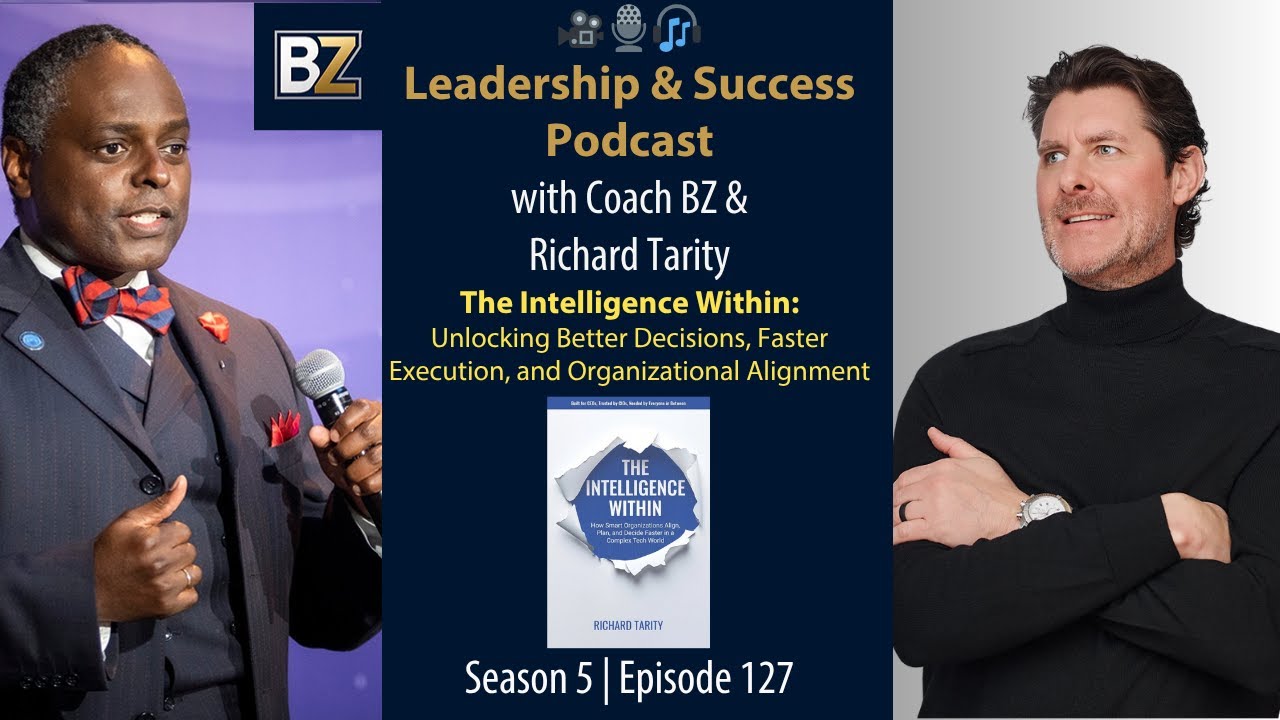
Richard Tarity, a serial entrepreneur and CEO, discusses how AI forced him to completely re-engineer his product and shares his decision-making framework from his book The Intelligence Within. He argues that success means creating value for people around you, not just revenue, and emphasizes learning from failures and staying close to customers to surface real problems.
Chapters
Hi, I'm John Maxwell. When the top companies in the world are looking for trainers, speakers, and coaches, there's one name that stands above the rest, and that's Maxwell Leadership. Our certified team members have gotten proven results for companies all over the globe, and our reputation, I'm proud to say, is second to none. Some of our members have risen to the top of their profession including the one you're going to meet today. I proudly introduce you to my friend, Bob Fabien Zinga.
Welcome to the Leadership Success Podcast with your host, Coach BZ, where we help you lead with purpose and succeed with impact. If you're ready to grow into the kind of leader others want to follow, this podcast is for you. If you're determined to elevate your success and leave a lasting legacy, this podcast is for you. As my mentor, Dr. John C. Maxwell, reminds us, everything rises and falls on leadership. Our goal is simple: to inspire you, challenge you, and equip you with insights that can transform the trajectory of your leadership journey. Welcome aboard to another episode of the Leadership and Success Podcast with Coach BZ. Welcome to TruCX, an innovative customer experience collaboration platform built around moments, insights, and a workspace hub. TruCX addresses the challenge of fragmented customer experience strategies by providing a unified collaborative platform that enhances decision-making, streamlines operations, and promotes ongoing enhancement at every organizational level. It's comprised of the following foundational components: TrueView. With our dynamic dashboard TrueView, you can visualize data and quickly view your most recent insights. Quickly manage your users and see subscription details at a glance, ensuring everyone is aligned and informed. Download the app. Quickly view top-level insights. True Moments. With True Moments, quickly capture the thoughts from cross-functional teams supporting CX initiatives within your organization. Our design thinking approach helps you baseline your current CX capabilities and innovate new CX strategies. It's about building trust, engagement, and emotional connections that drive growth and differentiation. Nurtures trust and authenticity. Fosters organizational engagement. True Insights. With True Insights, transform how you utilize data for CX enhancement. It empowers you to spot trends, boost efficiencies, and maintain a competitive edge by providing essential intelligence for well-informed decisions. Surface valuable data-driven information. Optimize deep discovery. TruWorkspace Hub. TruWorkspace Hub brings together all vital tools and resources required for CX professionals to help with business justifications, ROI tools, and deep dive templates for enhancing collaboration among your teams.
Hello everyone, welcome to another live episode of the Leadership and Success podcast. We have a very special guest today, and I want to say hello to Randy Orland joining us from LinkedIn. So let us know where you are joining us from, please, what city, what state, and also let us know if you are joining us from outside of the US, which country as well, since we have gone global now. And also, what are you grateful for today? And of course, if you have a question for my guest, please type your question in the comment and we will be answering live. So before I start, as is our custom here, we wanna start with what we call a moment of gratitude. This is where we take just a moment every single time we meet and we just wanna be grateful. And you know the drill, if you would maybe close your eyes and put yourself in your happy place. For me, it's usually by the beach and it's nice and sunny and breezy. What are you grateful for in this moment right now? And today, I think I am really grateful. I know America will be celebrating 250 years next month, July 4th, our independence in 1776. And I am so grateful for how far we have come as a country, really celebrating America. And I think one thing that's important is to look at our history objectively Don't try to create a myth or lie about our past. We are who we are because of where we have been and we have progressed so much and there is still much more we need to do. But I'm really, really glad and grateful for where we are today. For example, I am glad I was born in the '70s and not in the 1700s or the 1800s. Being a Black man in America back then would not have been fun. So really, really glad for who we are as a country, our core value. What we stand for in the world. It's about freedom, it's about liberty, it's about democracy, and really being this one country in the world that is, how do we call it, really the, like our motto says, out of many, one. E pluram unum. And I think our diversity is definitely our strength. So Again, let us know in the comment what you are grateful for today. And let me see if I can properly introduce our guest today. I am so glad we're gonna be speaking to Richard Tarridey. He's the founder and CEO and bestselling author, advisor, speaker, and serial entrepreneur with more than 27 years of experience building, scaling, and exiting successful businesses. Again, the founder of TruckX. I played the launch video a couple of minutes at the intro of this podcast. Richard really is helping organization align stakeholder, uncover meaningful insight, and accelerate smarter business decision. He's also the author of a bestselling book, The Intelligence Within. We're gonna be talking about that, how smart organization are breaking free to align, plan, and decide faster in a complex tech world. This is really a book you need to read right here, right now, in the age of artificial intelligence. So throughout his career, Richard has founded multiple companies, generated millions in revenue, and advised hundreds of organizations and built a reputation for helping leaders focus on what truly matters, creating value before chasing solution. And if you are a founder, a CEO, and Richard might just be, um, the mentor you are seeking. But part of what you're gonna be learning today is why many organizations struggle despite having talented people. And abundant data. You are also going to learn strategies for leading through complexity and accelerating business outcome. So without any further ado, ladies and gentlemen, please help me welcome to the Leadership and Success Podcast, the one and only Richard Tarrity.
Thanks, Coach BZ. Happy to be here.
Morning.
I also was born in the '70s and I'm glad I was born in the '70s.
Yeah. Can you imagine being born in the age that is not the age of artificial intelligence, the way AI technology is just imploding and taking over pretty much every industry and everything we do, which is quite exciting, isn't it?
It is. It's, it's a crazy time. I was telling you just before, um, we started here, you know, we, we started to build a product 2 years ago.
Wow.
And we're now, we're now having to pivot and start to redevelop in another framework that's AI-driven first. Because we already feel like we're behind again. I've never seen technology change this fast in my, you know, 27-year career in the space. It's just, it's unbelievable. There's so much opportunity to really do a lot with this type of AI solution.
Yeah, and I'm hoping the discussion we are going to have is going to help many members in my audience to be able to really maximize the opportunities they have. And of course, it comes with some challenges as well, and hopefully we're going to be talking about that too. So To get started, Richard, what is one thing you are grateful for today?
To play on your sentiment, a 250-year-old, being alive and free in this country. I mean, that is like by far— my success coach used to lead us in all of our sessions early on and just say, be thankful for being alive and free in America. So it really sticks with me. And also just right now at this point in time, just having a lot of, um, family and friends that are healthy, um, and thriving. I think that's just another thing that, uh, that you just have to be really, really grateful for.
Yes, and I think one of your friends that is watching us right now is, uh, Randy Roland. He says, let's go, Richard, looking forward for a great event. Uh, yeah, I think, like I told you, I think we have about 50 people, uh, in common on LinkedIn, so I've invited all of them to watch us live. And again, if you guys have any question for Richard, type it in the comments. We're going to make sure to address them. So what is something about you, Richard, that most people may not know when they first meet you? What's something about you that's kind of unique?
Um, so it took me over 23 years to get my Bachelor of Science degree.
Wow.
Yeah, so I, I went, I went into a community college, uh, spent a year and a half there and was really not doing so well. I was really bored. I just wanted to make money. I just wanted to work. That was just kind of the work ethic I've had my whole life. Um, so I, I spent a year and a half of my parents' money, um, not getting the greatest grades. So I think I had a 1.7 GPA at the time, by the time I left. And they said, you know what, this probably isn't for you right now. And I said, no, it's not. So I went to work full-time, um, for 2 years, third shift, at a, at a warehouse. And going through that process, I realized this is also not for me. Um, but it was more about maturity than anything else. You know, I just wasn't ready to take on school, but I didn't really know what I wanted to do. I just wanted to go out and make money. That was kind of my motivation. Um, and so basically I put myself back through night school over the course of like 20 years.
That's amazing.
I didn't go consistently. It was just kind of like a class at a time semester after semester, and then I would take maybe a year off, and then I would go back because I started my first business at the age of 26.
Wow.
And by then, um, I was getting, you know, all of my effort was going towards building a business. I didn't really have a ton of time for college, but one thing it taught me was when I had skin in the game and I had to pay for my classes, I had a completely different perspective on what success looked like. And I knew now I had to get an ROI on my investment. It was very different than having somebody else put the bill for me to go to class versus me wanting to be there and also having to actually pay. So I finally got my degree in March of 2020. Congratulations. From a place, yeah, thank you, Thomas Edison State College. And it was, you know, by then it was kind of fun because I had already been through a few exits and built a few companies. It was just something I had to do. And, you know, my kids were all starting to go to college at that time. And I said, I am not going to allow any of you to get your degrees before I do.
That's amazing.
Wow. Harder.
By that time, with all of your experience, the professor probably should have let you teach all of the classes. But it's really interesting. You mentioned the word success. How has success changed in your perspective from the time you were like in your early 20s to today? Has your definition of success changed at all?
Yeah, I mean, it has, because early on success feels like, you know, how much money can I make, and, and, you know, how much revenue. And you're really kind of chasing the dollar, you're chasing the profit, you're learning a lot along the way. I think, you know, as you mature, success starts to look like, um, you know, how successful are the people around me? Am I able to help people build up themselves professionally? How does that lead into their personal life? Um, you know, you have a different type of appreciation for who you are as a leader when you start getting others to participate in that success and you start to take some of the selfishness away, um, from just your own success. So, you know, a lot of times we say to people, you know, what does success look like? Let's say you're going into a new project or a new venture. I always say to people, so just tell me what success looks like. And a lot of times people just stop and go, I don't know yet. And that's okay. That is probably the best gut answer you can give. But I think as we go through this as leaders and entrepreneurs, we start to define that before we really launch anything. And that kind of guides you along with your core values and your mission to really kind of hire people, fire people, build the business, hire clients, fire clients. Right. I mean, that you have to really understand the culture of your business and attract those types of people into the business. And you also want to find those types of buyers as well. You know, a myth out there that I always talk about is early on they say, oh, the customer's always right. And I say, no, they're not. You're not always right. It's a great answer. They're not always right. And sometimes you have to fire them because they're just not a good customer. They don't treat your people good. You have to have backbone when you're in this industry. But it's a great question and it's one that I would ask up front before you really start to get in anything.
That's really powerful. So for those meeting you for the first time, Can you tell us who is Richard Tyree beyond all of your titles and accomplishments and accolades?
Yeah, I mean, you know, now an author, which was something I always wanted to do, a builder, right? I just love to build businesses. It's just something I thrive on it. I have such a burning desire to try to solve problems that I feel very passionate about. A husband, a father, a friend, lifelong learner. I mean, I never thought I'd be a lifelong learner early on, especially with getting— dropping out of college a year and a half in. But I've learned to really appreciate the value books can bring and the value books that you really love can bring if you keep putting them into your life and keep rereading them and things like that.
Wow.
That's one of the big things. And also, you know, I love to play guitar and spend time at the beach. That's probably— that's where I get my downtime. That's where I refuel and refresh.
Yeah, that's true, because I did see it on your website that you play guitar. I play the piano. How old were you when you started playing guitar? And did you take like formal classes or you just taught yourself?
So it's kind of funny. I had taken guitar in the 6th grade and I went to Catholic school K through 12. So I had to go over and walk across the parking lot to the convent with my guitar, and I had to bring the guitar on the bus with me as well. Um, and I did that for about one semester. It was— and I just thought, I like it, but I'm not really into the songs that we're doing here. It's kind of like, you know, not my favorite thing because I wanted to do Van Halen and things like that on, on electric. So, um, I picked it up again in 2012.
Wow.
And I went out, I hired a, a music teacher, Jack Gillespie, absolutely a fantastic teacher. And he made me really, really interested in it and taught me in a way that catered to how I learned. It wasn't like, hey, learn these chords. It was more like, let's start playing a song and you can fumble along the way.
Yes.
But within a few weeks you'll have that song. And that was the way I wanted to do it. I had prior to that taken a lesson locally at a music, um, store, just a retail store. And when I went in for the first 2 sessions, it was nothing but writing down chords in a book, and we didn't even play on the guitar. And I thought, why are we not getting hands-on with the guitar? Yeah, I don't want to write stuff down, this is so boring.
Wow.
And maybe it was above my head, I don't know. But when I found Jack, um, I never stopped. I just I play as often as I can.
No, that is, that is really great because music has always been part of my life. I was like 7 years old when initially my father forced me to, but then I really got into it. Now, one, one thing interesting you said, even now you see yourself as a builder. I know being an entrepreneur, that's not for everybody. You have to be a special type of person, I think, to persist and keep going through with, you know, the innovation and all of that. But for a member of my audience who are interested in becoming an entrepreneur, what is it about building businesses that excites you the most?
Um, the thrill of what's to come, right? It's just, you're chasing a dream, but it's now a dream with a deadline.
Wow.
Right? So you're, you're you— it just motivates you differently because it— hopefully you're trying to solve a problem and people want to, um, you know, take advantage of the solution that you're, you're building out or the service offering that you're building out. But the build part of it is just so exciting because it's the thrill of like the unknown. Is this thing really gonna succeed?
Yes.
You know, are we— did we really figure out how to solve a problem or provide value back to a customer? You know, I, I think with a lot of entrepreneurs, they have great ideas, but a lot of times they don't understand how to monetize it and get it into buyers' hands. You know, a lot of companies struggle with the sales part, top of the funnel, how to build the funnel, how to get it in front of people, how to audition it, how to demo it, um, how to price it. And so, you know, early on, um Those things were all things that, you know, I struggled with too, but you get much better at that as you mature as a business leader. And so the thrill of just that part of it, that hunt part of it, the early upfront and really getting the satisfaction of seeing people use the service, get on the platform is just, it's the greatest feeling, you know, ever, 'cause you know that you really solved something here. You're creating value.
That is really quite insightful. And I think the last statistic I saw, it was like 5, I believe, out of 8 new ventures end up failing. So for the few people who decide to get on this journey with you, you've had a lot of successful exits. Again, congratulations, you are a very successful serial entrepreneur. Now you even becoming a coach to so many other entrepreneurs as well. What do you think, what does it take to not give up? Because I know eventually you are going to get challenged and you're going to be tempted to just stop on your idea and go do something else. What is it in you that made you just keep going and keep—
Yeah. You know, Napoleon Hill is one of my favorite authors.
Yeah.
Think and Grow Rich.
Yeah.
Think and Grow Rich, right? It's the first book I ever got when I started my professional career at the age of 24, my first sales role. After I went to that warehouse. My sales coach, uh, who I still talk to today for, you know, over 27 years now— we've had a great friendship— he gave me a book called Think and Grow Rich, which I still have today. I actually keep it in my office, and it's got, it's got, uh, you know, pen marks in it, dog, dog hairs in it. It's got things that are highlighted. I go back to that book every year And there's one word in that book that's repeated 85 times. I actually had to ask ChatGPT because I always feel like I mess up when I try to count it and highlight it.
Let me guess, desire.
Desire. Yeah, it's desire. That's it, Coach BZ. I mean, it's desire. If you don't have a burning desire in what you're doing, shouldn't be doing it.
Yeah, yeah, not doing it. For people who've been following this podcast for a while, they know Think and Grow Rich. Uh, it's actually a book I, I have to read every single year. It's really life-changing. But wow. Yeah, because I think everybody already goes through adversity, but what is what you do as you go through it that really determines the difference, doesn't it? Yeah.
And I think, you know, we're going to go through adversity in life. I mean, that's just the way life works, right? That's like the one thing that I would say is, you know, it's okay to feel not okay. Like just just relax, take a breath, try to reset, right? Think through what's going on and what can you do to control the, you know, the output of that, right? Because we have control over our activities, we have control over our thoughts. So just, just take what you have in control of the situation and try to do your best to get through that, that adversity part of it. Because you're going to have times where You know, maybe your cash flow in your business is flowing a little lower than usual. Maybe you overhired a little bit because you got bullish on where the company was heading so fast. Because maybe when you're younger, you don't have a CFO in the business, right? You may have a controller, you may have an outsourced CPA that's helping with the books, but they're not doing the strategy part. And so a lot of entrepreneurs will kind of get ahead of themselves at times.
Yes.
And then they'll start to feel bad about it when they start to see, oh man, I made a really bad decision.
It's okay.
Make a different decision. Yes.
Wow.
That is really, really insightful. And part of the reason why I really love doing this podcast is because anybody could be listening and sometimes you just need one or two insights to literally change the remaining of their life and career. And so one other question I have for you then is what experiences have shaped your leadership philosophy?
You know, I will say that overcoming any setbacks throughout the business. I always say fail it forward. You know, the first business I had, I got a lot of things wrong. I even incorporated the company wrong within the state.
Wow.
Through doing the paperwork. So I did it wrong from the very first start, right? Um, but over the 4 years with that first business, as I got a lot of things wrong, I learned from them, and the second business got all of it right.
Wow.
And some. And then the third business got a lot of stuff right.
Yeah.
And now we just get a lot of things right, which is we're very blessed that way. But it's— that's one of the things that I would say. Um, and, you know, lean into your customers and learn from buyers. Learn from the customers. Don't ever get out of the trenches. Every business I've owned and built, I've always been out with customers solving problems. In the arena, not just building the business, but actually out getting the revenue, bringing them new ideas, creating new ways to create value for them. And I think that that's really important for entrepreneurs. Um, there's businesses where the entrepreneurs kind of get disconnected.
Yes.
From what's going on in the business, um, because they deem themselves as having enough success. There's a lot of businesses that, um, entrepreneurs are in the weeds maybe too much Um, but I would say stay in the arena. I mean, that's one of the things, uh, I, I just love working with customers because customers will teach you a whole bunch about the things they go through in life and the stuff they've got to do internally to try to get you a sale, um, and who they have to answer to and how they buy. Um, I think it's fascinating. The more you know the DNA of a customer the better off you are in being able to have success with them.
Let's talk about that. You just talked about being in the arena, so you reminded me of the famous speech. I think it was President Theodore Roosevelt, right? 1910. I think the speech was "Citizen in a Republic," but there is that phrase you talk about, the men in the arena, which you just mentioned now, and you do talk about that a lot. What does it mean to you to be in the arena rather than watching from sidelines?
Um, staying integrated into everything that's happening, you know, in the business, um, from a business perspective. I mean, there's a, there's a personal side to that, and then there's also, um, you know, a professional side. On the professional side, it's definitely, um, you know, keeping your employees really, really happy, you know, um, not make it a country club but treat them fairly, help them gain the skills they need, do the coaching, get them additional coaching, coach them up, you know, give them opportunities to succeed, give them opportunities to fail and learn from it. I think, you know, that type of stuff, if you're integrated into the DNA of the business, um, I, to me, that's like being in the arena, right? That's not— you're not taking a vacation while everybody else is doing it. You know, Richard Branson, who I also really appreciate, and which is an incredible human being. I always say, you know, his thing is if you treat your employees really, really well and they thrive, your customers will be really, really happy. You know, and there's a lot of truth to that. I think it's harder to execute that than just say it, but I understand exactly what he means by that because, you know, I do deem myself as somebody that stays in the arena and really builds up the people that work for me.
That is really, uh, powerful. What do you think then separates leaders who create value from leaders who simply manage activities?
Um, if you're a value creator, people come to you, they seek you out, right? If you're, if you're just doing the activities of something, you may or may not have any success. Um, and what I mean by that is, if you think about how do we create value for our customers, It's showing up, it's asking better questions, getting better answers, right? They're talking to other consultants, they're talking to other companies, but if you're asking better questions, getting better answers, chances are they're going to keep coming back to you, right? It's that level of thinking, right?
You—
there's a lot of the CIOs I talk to are like, if you don't add value to me personally, and help me grow in my role, yes, I, I can't hang out with you, right? It's just, I might like you, but I can't hang out with you because I have to be adding value back to my business. Therefore, it's a transfer of value that goes through that process. Um, and I think, you know, that's, that's the big thing when it comes to, you know, creating value, in my opinion.
That is really quite insightful. And, uh, With all of the experience you've, you've had, what do you think are maybe a couple of mistakes many new entrepreneurs make when they're trying to start on this journey?
Um, you know, not really knowing if what they're building is something that people want. Maybe not doing enough of the upfront, you know, Q&A before you go all in on something. It's really good to go out to your network, people you know, former customers, existing customers, family members, and just ask questions that will help shape what you're trying to do, the offering, the service, the product. Um, you can't, you can't underestimate that. I mean, we're still doing that, and we're 2 and a half years in and have already built a product, taken it to market, and we're still asking our partners and our customers, what more could we be doing? What more do you want to see out of this? How else can this be creating more value to you? And we just don't stop because that's really what creates the product vision and the roadmap for where we're headed. Who better to build it than the folks that are using the service, right? So the biggest thing there is just, um, don't assume that you're 100% right on your thought or what you're trying to do.
So let me ask you another question then. As a serial entrepreneur, especially as your team gets bigger and bigger, how do leaders create alignment when teams may have competing priorities?
Um, you know, you see that a lot out there, you know. Um, part of what I would do is when you have misalignment get a broader audience to surface their opinions and their thoughts. Try to isolate the silos that exist inside a business. You know, part of what the book talks about that I wrote is that a lot of companies remain status quo because they're indecisive.
Mm-hmm.
And they're indecisive because there's probably a misalignment in what's going on between their teams and their stakeholders. But if you get everybody involved in a process and by the way, a traditional discovery process is what scares them because it takes so long to go through for many midsize to large enterprises. It takes 10 months, 12 months at times.
Yes.
We're speeding that process up and we're not slowing it down. And they can get a broader group of people's opinions and thoughts on the transformation they're trying to get through.
Yes.
And that's the beauty of it, is we can get it done in days and weeks versus months, you know. And if you go out to a larger audience, then all of a sudden consensus starts to build. When you build consensus and you get clarity around what you're trying to accomplish, now you have the confidence as a team to move forward with the project. And some of it's also just fear, fear of making a wrong decision. You know, and I think that by getting a broader audience, you do take a lot of the fear and a lot of the risk out of it as an individual when you bring a lot of people together. Yes. And then start to bubble up what's most important to the organization.
Yeah, I like that you just mentioned fear of making the wrong decision. And sometimes I think, especially when you are an entrepreneur, you do make difficult decisions with incomplete information.
Yeah.
So how did do you do that? What, what would you advise to a burgeoning entrepreneur? How they should make decision when they don't have the full complete information? And in my, in my opinion, they never will have a fully information, but they still have to make those tough decision. How do you do it?
You know, I think some people are really good with going with their gut, you know. So, so truly follow your gut because that's, you know, that's going to get you promoted. It might get you fired, but it definitely will get promote it. You know, you have to get stuff off the whiteboard. Your company wants you— they're paying you to think. They, you know, I think most companies really enjoy— most of the entrepreneurs I know, they are most impressed with the people that get their ideas off the whiteboard and start to implement. Most of them are okay if they start to fail a little bit because there's enough people usually that can help you pivot out of that failure before it becomes a disaster. And you can make different choices and upgrade where you want to go with it. But I think the stagnation of making no decision is, is really going to cost you big time, especially now with how fast we're all moving. I mean, companies are competing for consumer spend like we've never seen before. A digital experience with one brand could differentiate them leaving another brand that they've been with for many, many years. And to me, it's all about how easy we make it for customers to interact with us.
Wow, that is really powerful. So basically what you're saying is making the bad decision is better than not making a decision at all. But even if you make a bad decision, you can always make a better decision.
Absolutely.
Wow. Always learning. That is quite fascinating. Now, looking back on your career, you already shared with us the very first business venture you started. It was pretty much like a learning lab for you. I think you said 3 or 4 years, all you did is really just learning what not to do, and then you use all of those lessons and you apply them several ventures later, and you are so successful now. So looking back, what do you think was one of the most difficult business setbacks, and what did it teach you about leadership and resilience?
It was a misalignment between the partners at the company. You know, one of us wanted to go in a direction to services, one of us wanted to to stay very product focused. Um, we just couldn't get aligned, you know. We tried to meet a few times. Um, it just— we just had very, very different core desires and beliefs around where we should take the business. And so, um, I ended up resigning from the business that I started as founder, uh, after 4 years and left it to the other 2 partners because I was just convinced I was right and they were wrong. Um, and so I went and said, hey, I'm resigning. I gave him a separation agreement. It was very fair. Um, they agreed to it. And then, um, a year later I started another business and ended up quadrupling the revenue that they had done, um, in just, you know, in their time together. Um, you, you know, it's all, it's all a little bit of a crapshoot, right? Um, there's no guarantee for success in anything that we do. We create— we have to create our own luck, right? When people say, hey, good luck, it's like, I will. Like, we create it, right? That's what we do. We create our own.
I guess to be an entrepreneur, you do have to be stubborn at times. Like, there you were, like, no, I know I am right. And you proved that. You, you made more than quadruple what they were making. But it's kind of very risky too. I'm sure you were kind of afraid to takes a jump, right?
Oh, totally.
How do you deal with that, the fear of maybe, oh, I think whatever I'm about to do, I might be messing up everything, or actually I might actually hit the jackpot? I guess there's that, no, risk and reward type of thing as an entrepreneur. But like, how do you deal with that?
Um, through the support of your friends, family, mentors, people like that, right? Just ask the question, am I crazy? Is this, you know, And, and you'll— you have to believe in yourself.
Yes.
You, you know, I, I think so much of an entrepreneur's success is that they truly do believe that they're going to change whatever it is they're after. And that belief is, is, is catchy, and that belief bleeds over onto people you talk to and customers, and then they believe. And so, you know, a lot of times you're successful just because of, of kind of where you're at with that, um, with that belief in, in success. And so, you know, it's, it's gut-wrenching. There's no doubt about it. It's very, very scary to do stuff when, you know, especially at that time, because I was only 4 years into my first business and we were successful despite not being able to get on the same page. And that's, that's, that's the way the world works. There's a lot of that go— that goes on. Um, so walking away from something that I also built with them for 4 years was tough. But I just knew in my gut if I didn't do it, I'd probably have more regret. And I really didn't want to have to live with the regret. So I made— I just made the choice. I put together the dynamics to take it out of their hands, all the fear of having to do a separation. I managed it, and then I brought it to them and sold them on why this was the best move forward. Wow. And they agreed. And it was done really well. We all were still friendly with each other. There was no animosity. We just had different ideologies on where we wanted to go in our lives and with our business. And, you know, that's just the way it worked.
That takes a lot of courage. So I guess throughout all of the experiences you've had, now it's time for you to become a coach. And also, you've written this bestselling book, which we're going to get into, The Intelligence Within, right? How smart organizations align, plan, and decide faster in a complex tech world. This is definitely the book we need for the age of AI. But before I do, we have our first question from our live audience, from LinkedIn, Daniel Say. When you look at founders and executives, where do you see a decision costing them big time, and what one move they can make this quarter to get out of stall mode? And back into intelligent action? He's even using the title of your book in the question. That's pretty, pretty cool.
Yeah, no, that's perfect, Daniel. I appreciate the, uh, the question there. So, you know, when you see indecision inside your business, I would immediately look up the chain of command at what's going on, because it's sometimes, and most likely the case, there's some misalignment from the executives on where the business strategy should go. And it's really hard if you're not a decider in a business, but you're, you know, a champion of a decision or you're somebody that's mentoring a decision, but you're not the ultimate decider. Really hard to sit there and watch the company stay stalled.
Yes.
So one of the things that you could do is go up the chain of command and start asking questions around, you know, what— where are we at with this type of thing? And how critical is it for us to make some decisions now around, around this? You can also work in the background, um, to gather as much data and research and be prepared for when it gets unstuck, or to add value to the conversation that is going to inevitably happen there. Because one thing's for sure, you can't stay stuck forever right now. Um, I mean, regardless of the situation, companies have to make decisions, good, bad, or indifferent. They're being forced to make decisions with the evolution of where we're at in the technology space in particular. So just a few things I would look for is the misalignment and maybe team up with a few folks that are also ambassadors of wanting to see the change. Because one of the things that happens is, you know, when, when people within the organization come together, it makes it hard even for an ultimate decider to block changes going on when all of the people want to initiate the change and are behind the change. You know, it gets really hard. And that, that leader, if not the CEO, then you have a real problem. If it's a CEO and the founder, you have a problem. But if it's not the CEO and the founder, those folks will inevitably start to see that there's bottlenecks within the chain of command, um, and they will value the fact that people are still trying to do the right thing and make the changes needed to advance the business.
Wow. Okay. So let me ask you then, why did this book have to be written, The Intelligence Within?
You know, so it really mirrors a lot of what we've built at TruCX. But a lot of the foundation that's in there is also just the approach and the methodology that I have as a coach and as a, you know, an entrepreneur. I spent, you know, and I, I'm considered— there are all types of data and stakeholders. And after 10 months, there was a lot of political shuffle inside the organization, and my EVP and sponsor for the The challenge with that is that when that person was let go, I had to, you know, sit there and say, man, 10 months of work. How do we speed this process up? It's just taking all of us too long. It's taking Deloitte and Accenture and McKinsey and all types of consultants, smaller consultants and boutique consultants, It just takes us too long to get through discovery process with our clients to gather requirements for a project. So we, we built a platform that allows us now to do it in days and weeks with teams. And regardless of the size of the teams, you can have 80 people, 100 people, 200 people going through a process at the same time. And it's timeboxed and it produces all types of insights. And back to Daniel's question, it starts to remove indecision and status quo and fear because you're casting the net big enough that everybody's involved in that process.
Yes.
You know, and the one thing we've learned is that rather than making decisions and pushing technology on your users at your business, if you get people involved in the actual decision, they'll adopt the change faster. They felt like they were a part of the decision. They feel empowered to take on that transformation. And that's what you need to have success inside the business from a tool standpoint, a platform standpoint. And so my whole philosophy is I think you should get more people involved because the people inside the business really understand the pain points. They understand the customer friction. They really do. They don't always, they don't always feel empowered to necessarily speak up about it. But this process allows us to start breaking down silos and fiefdoms inside businesses so that the business can start moving forward faster and accelerating decisions quicker around any type of transformation that they're doing.
That's really powerful. But let's go back to the title, Intelligence Within. What did you mean by that?
Tapping into the people. It's an inside tapping into the people's thought process, you know, really getting after interviewing your own folks, getting them through process, engaging them to go through what we call journeys or gamified journeys that allow them— we educate them along the way on what's available, what's possible, and then they get to score their organization on where they're at. I mean, that intelligence within is really the internal intelligence. This isn't an external voice of customer type program. This is let's get after all the people internally and really make sure that we're getting into that tribal knowledge that exists out there, right? Let's tap into that first. Let's get ourselves straight on what we're trying to accomplish. Let's get organized before we go out into the marketplace and try to figure out who can help us solve the problem from a, from a supplier standpoint. Before you go out and get demoed to death for the next 6 months or 8 months, Go in with bird in hand, requirements in hand, and say, hey, we went through a process internally, this is our requirements, and now start bringing in the different types of Amazon or Microsoft or Zoom and others to help you address the problem. But with the requirements you have, you're in a much better place of negotiation and getting to see what you want through there, and it just shrinks that entire process down.
I, I really like that. And again, the book we're talking about is The Intelligence Within by Richard Tahiti. Actually, based on what you just said, the next question I have then, you do argue in the book that many organizations, they don't really understand what they need before they actually start pursuing solutions. Why is this such a common problem, though?
Um, it's, it's some of it's just know-how, right? And, and the time it takes to really understand what's available in the marketplace. Um, you know, companies that are trying to go through a transformation, what we see a lot of times when they say, hey, we had a failed project We start to go back to, okay, so was there a consultant involved? What did you do internally? How did you bring people together to get through a discovery process? And a lot of times what you find is all they did was make a decision to buy new technology, but repeat the same old workflows, the same old diagrams, everything that they were doing today, they reprogrammed into a new technology.
Yes, yes.
And so nothing really changed. There was really no innovation through the project. They didn't think about all the things that were possible beyond where they're at today. And so you have to get through that process first, right? What's the art of the possible first? Then adhere everybody else to— from a supplier standpoint, force the suppliers to come back and actually have to do what you want them to do. It's not about what they can do from a product set. It's about what do you want to do first? Now, they might not be able to meet all of your needs, but at least they know and you know where the gaps are. And if you can live with those gaps, then you've got yourself a successful partnership. But that's really what we're talking about there.
That's really powerful. It reminds me of the difference, right, between just symptoms and then the root causes. So how can leaders distinguish the two?
Keep asking why until the real issue becomes clear.
Wow, I like that. Wow, powerful. Keep asking why until the real issue becomes clear. So, you do discuss discovery as a discipline, right, rather than just one event. Explain that concept to my audience, please.
So, discovery to me is not a one-time thing. It's not a one-time project. It's not a single point in time. Discovery to me should be an ongoing continuous improvement process. Did what we decide— what we decided to do 6 months ago, how did that have an impact to the business now?
Hmm, right?
How do we continuously improve upon and iterate on what we made decisions to do? Far too often, you know, a project, whether it's a little rocky or rocky or successful, a lot of times once it's up and running, the organization starts to live with it for a while and then everyone deems it a success and they move on to the next thing. And then it's a few years later before they really rethink and retool. How did that decision impact us? How did it impact our revenue? How did it impact our ROI? How did it impact— reduce churn? Are customers getting a better experience now with all of the new platforms and tools we did versus previously? So that's really the biggest difference there is it's around this, this notion of continuous improvement, trending and comparison, right, which we do on our platform. It's all about trending and comparison. Like, go back and take credit for making that decision and ask for the money and show that you made the right decision, right? And also identify new opportunities that can arise and where you can continue to implement change Those are the organizations winning now. I mean, Amazon, if you just look at them as one company, the iterations and the amount of technology and the decision that goes on on a regular basis, it's just, it's amazing. I mean, they're just constantly, you know, re-innovating, constantly rehashing decisions, re-tweaking, re-tooling. And that's kind of the world we're gonna live in. It's not gonna go back to, easier decisions, stay on a platform for 10 years, iterate through software upgrades. Those days are gone. It's now all in the cloud. Everything's coming at us so fast. We have to be constantly looking at how do we take advantage of all the things that are available to us and how does it impact the metrics and things that mean the most to us as an organization.
That's really powerful because I think one consistent theme or string I see throughout your, your book and what you just said is really I think that curiosity as a company, even Amazon, they are no longer a startup, they really, really big now, but even so they still have that startup mentality.
It seems.
So what role does curiosity play in organizational intelligence?
So from a, like, from the book standpoint, organizational intelligence, I mean, we've seen for years in going into businesses and consulting and interviewing and doing all this, people won't always necessarily speak up but have really, really, really good ideas. You gotta get downstream a little bit, right? So for an example, in a call center, generally the decision sits with the chief experience officer, the CIO, CTO. And maybe the operational lead. Those are kind of the general ultimate deciders.
Yes.
Then you go down into the director level and then you get down into the supervisor level. But when you get out on the call center floor, you're meeting with agents, you're living inside their cube with them and really understanding what's happening on the day-to-day basis, how custom orders are getting processed, how customers are getting orders, are getting delivered, the friction points. Everything, right? You really get to know what's happening. That's the organizational intelligence. Mm-hmm. Where we want to really dig in as we're going through a process, because the folks up top, while in those roles and they're very important, they're not down in the weeds understanding exactly what's going on every day. They're looking at reports, but reports are always put together in a way that allow you to see things for what they are, but doesn't mean it's actually what's happening.
Yes, right.
It might— they might not be in the trenches really understanding what they can do to better impact the experience for the employee as well as also for the customer. So that's that organizational intelligence, is get deeper, deeper, and deeper inside the organization.
I really, really like that. I mean, as leaders, you still need to know your business and, uh, I think again, everybody needs to get a copy of the book. It's available everywhere books are sold. We are talking about The Intelligence Within. Okay. So let me ask you this, for a CEO or an executive listening to you right now, after reading your book, if they could implement one and only one lesson immediately, what would you recommend?
They do invest more time understanding problems before selecting solutions.
Hmm.
Right. That's, that's the number one thing is really understanding the problems that exist before you try to solve them.
Yes.
Right. We're in the instant gratification world of I want to solve the problem immediately. But a lot of folks don't really understand the root cause. Of the problem before they go after the remedy.
So simple, yet so powerful. So what chapter of the book challenged your own thinking while writing it?
Um, so the part that I found pretty fascinating, the thing that I wanted to get across to people, is the area of paradox of choice. It's, it's in, it's in, I believe, chapter 3. And so the paradox of choice really talks about simple, right? You ever hear the keep it simple, stupid kind of a thing? There's so much to the KISS principle, you know, and I compare the paradox of choices. We have to make it simple and we can go much further. If we create complexity, then it's going to be tougher, right? There's just going to be complexity. And I compare it to like, if you ever go to like, um, a diner and they give you the menu and it's 6 pages long and the waitress comes over and you're like, we're not ready yet.
Yes.
And then they come back a second time, we'll just have waters, we're not ready yet.
Yes.
Yeah, there's 6 pages of options and now you don't know if you want breakfast, lunch, dinner, dessert. You're just all over the place. But if you go in there and there's one sheet of paper and there's 8 options, you're ready to order.
Yeah, yeah, so true. Because I remember the first time I come to California, we have In-N-Out here. Basically they only have 4 or 5, 6 on the menu. That's That's it. So you make a decision.
It helps get people off go so much faster.
Wow.
And I think that principle still applies and it's called the paradox of choice. It's just something that's been out there for a while.
Fantastic. The last question I have for you, for the book actually, before I ask you that, is there a question about your book I should have asked you I didn't get a chance to ask? Anything from your book you wanted to share with my audience?
No. I mean, For any leader that's out there that wants to really kind of understand the problem context as we see it around stalled deal, stalled decisioning, status quo, fear of making decisions, risk factors, things like that. There's, you know, 4 chapters of how to kind of bust through some of those challenges you might be having. There's a lot of ideas in chapters 7, 8, 9, and 10 that will really help you kind of get through thinking through that process, even if you're not an ultimate decider. Like I said, it's going to get you in a position to be, you know, you're going to gain skills there that you're going to need as you continue to advance through your career. So I would definitely pick that up and or take a listen on Audible. But I think there's a lot of cool tips in there that we gave that just kind of cut right through the clutter and get right to the point.
Yeah, and another thing I love is your book's available not just as a paperback version, but you have a digital version and Audible too, which is really good because more and more now, most of my books are all digital, either I am listening to them or reading them on my phone. So from all of the feedback you've received so far, what feedback from readers has impacted you the most?
The folks that just kind of comment either in the review or have reached out, or folks that have read it that I know and have come back and said, hey, thanks for kind of breaking this down the way you did. Um, you kind of really made it linear instead of complex and just kind of went right at the issue at hand. You know, I'm a big believer in making decisions. I don't sit around and wait to make decisions. I just— I'm not built that way. And I know not everyone's built the same way. But I think the book will help people that generally are a little more cautious or wait a little longer to make a decision. There's some, there's some tips and tricks in there that will help you maybe unlock some of the ideas that you have and help speed you up a little bit in your process. You know, we're in the age of now speed, right? Speed is our new currency. I mean, that is what, what we're, where we're at right now, especially in the technology side of the business and transformational, um, side of the business. So, um, I just love getting the feedback from people like, hey, it really helped me on this problem I'm having right now. Hey, this really hit the mark with something that I'm dealing with right now with one of my VPs. Or, um, and I'm happy to collaborate, you know, with them on anything. Uh, I'm easy to get a hold of If people want to reach out and set up a little one-on-one, they can do it right through richardtarity.com. But that's probably it. Coach is really the big thing there.
Yes. And people can follow you on LinkedIn, Tarity, and then can go to your website, richardtarity.com, and where they can also follow you or even hire you to help them with their business venture, which is really great. And of course, we already said that We want everybody here to please consider purchasing a copy of your best-selling book. Now, as we come to a close, we have about 5 minutes left. I want to end with what I call lightning round. So I'm going to ask you a question. Don't take too long to think. Rapid fire, first thing that comes to your mind. So let's start with what is one of the best leadership book you've ever read?
Think and Grow Rich.
Yeah, Think and Grow Rich. That's really a classic, that's for, that's for sure. Okay, uh, another one is, uh, your, your business hero and why is he or she your business hero?
Um, I would probably say, I would say Napoleon Hill, but I already mentioned his book. Um, but I'll probably say, um, Bruce Morrow, who has just been a friend and a success coach for me for over 27 years. Took a chance on me as a kid when, um, the owner of the company said, I don't think he'd be good at sales. Bruce said, if you don't hire him, I will. And so then the owner got jealous and hired me. Um, Bruce's— Bruce had a big impact.
That's amazing. Uh, one word that defines great leadership? Teacher. What is one of the most important habits for entrepreneurs?
Focus.
Okay, one thing leaders should start doing tomorrow?
Get it off the whiteboard.
Okay, one thing they should stop doing?
Talking too much.
All right, so as we end, let me ask ask you this, uh, how do you want people to remember Richard Tarity like 5, 10, 15 years from now?
Um, leader. Um, somebody that gave back to his employees, his associates. Um, somebody that gave people the opportunity to grow at all times. Somebody that invested in them. Um, Great husband, great father, you know, great, um, family member, you know, somebody that really challenged the status quo in life, both personally and professionally.
Wow, that is so powerful. And also, uh, I noticed that it's not about me, myself, and I, but it's about your family, your community, your employer, your partners, and everybody else. That's really true influence. That is true leadership. So As we close, I always like to leave our audience with something meaningful. So if you would please imagine, Coach Richards, that a founder, entrepreneur, military leader, or cybersecurity executive, or aspiring leader— those are people who normally listen to my show, they're listening right now— and they are facing uncertainty, especially now on the edge of artificial intelligence, complexity, and difficult decision. What is one piece of advice you would give them to help them lead with confidence, create meaningful value like we've talked about, and build something that matters?
I would say don't wait for certainty to act. And I would say the leaders who create the most value aren't the ones with all the answers right now. They're the ones who can make informed decisions, learn quickly, and adapt faster than anyone else. And confidence doesn't come from knowing the future. It comes from the courage it takes to take the next step. That's how you build something special and that matters.
Wow. So, so powerful. I'm going to have to hear that again. Okay. As, as we, we end on just so my audience knows a little bit more about you, what did you want to be when you were a kid?
Probably like a sports athlete. I played tons of sports. I was always I played, you know, we were able to play lots of sports when we were younger. You could go from one sport to the next to the next. So I would play 3 sports a year religiously. I just, I just loved it. That was what I wanted to do. It's what I always wanted to be. At one point, I probably thought I'd be a professional skateboarder because I started taking it on for 2 years, but realized pretty quickly that was probably not in the cards once I saw what the halfpipe actually felt like when I fell. Wow. So yeah, probably an athlete. That was probably like my, my vision of what I wanted to do.
3 adjectives describing you as a child.
Active.
2 more.
2 more. Hard worker.
1 more.
Determined.
Okay, what about as an adult?
Um, Entrepreneur.
Okay, uh, before I ask you this last question, is there a question I should have asked you at all about any other subject we talked about today? I didn't get a chance to ask. Anything else you wanted to share with my audience before we end the show?
Um, I think you did a great job of asking not just questions but getting a conversation going, so I appreciate this podcast and you for that. I think the conversations is what's missing a lot of times, um, out there. So having a good old-fashioned conversation for 270s, you know, born babies is a good thing. Um, but no, I thought you did a great job. Um, the one thing I would say, you know, people always ask like, what are some of the things I would say, you know, ask better questions, get better answers.
That is really great.
Yeah, keep that in your mind at all times in life, personal, professional, things like that. I think that's, I think that's the key.
That is really good. Actually, uh, 2 days ago I interviewed a woman, she's a coach, she wrote a book about asking better question. And that is so key, regardless of your field and what you're doing. Okay, as we come to a close, I like to end on a positive note. So what is something you are feeling optimistic about these days?
The future of where we're headed with AI. I think, um, I think there's a lot of positives there. I'm really excited about the good it can do. I know we talked earlier about, you know, you've got to have some guardrails, like there's got to be things there. But I do think there's a lot of, a lot of good things. I mean, it's, it's very exciting. We're interacting with it all the time. It's helping us accelerate our coaching, our consulting. It's not, in my opinion, it's not going to replace the human if the human's adding value. Um, and so I think, you know, it's exciting that way.
Yes.
Um, but we have to, we have to proceed with caution, uh, and make sure, you know, we're, um, we're using it in the right way.
I really like what you are saying. So staying positive, it looks like most Gen Zs— I have two Gen Z daughters— they don't like AI too much because it's taking away a lot of their entry-level jobs. So I think this past commencement season, every time someone talked about AI, all of the kids were booing the speaker, including the former CEO of Google, if you can believe that. But what would you say to young kids, Gen Zs, that are just finishing school, and they are starting their professional career, what would you say to encourage them how to deal with it?
So besides, you know, working really hard, find something that you do love to do, right? If the goal is to make money, which it should be, in addition to that, find something you're really passionate about. Because regardless of a lot of the other stuff going on in the world, like, if you're passionate about it, you're gonna feel fulfilled. It's gonna feel good. And, and to me, that's— you gotta love what you do, right? It's the famous Steve Jobs thing. You gotta love what you do.
Yeah, I believe passion is really what's going to allow you to persist even when you face incredible challenges and be successful. Powerful. Okay, this is it. I've already taken too much of your time. Thank you so much for being one of our master teachers today, Richard Tiede. So the very last question I'm going to ask, uh, one word that represents our shared experience on this podcast today. One word?
Educational.
I love that. And I am almost always very, very grateful for you taking your time and really teaching us some of your experience and wisdom. Thank you so much, Richard.
Really, thanks, Coach BZ. I appreciate it.
All right, bye. All right, everybody, uh, this is one for the book. So, uh, like we said, uh, Follow Richard, let me put his info here. So on LinkedIn, that's linkedin.com/tarity, very easy. And then follow him on his website, richardtarity.com. And also go ahead and purchase a copy of his bestselling book, The Intelligence Within: How Smart Organizations Align, Plan, and Decide Faster in a Complex Tech World. I think in the age of AI, everybody needs to read this book. It's also been added to the digital bookshelf for the podcast. Okay, so that's all I have for today. I should have another guest tomorrow. I will let you know on LinkedIn who our mystery guest is. And as we finish, as you know, we like to celebrate Black History Year here now, not just month, because we felt like in February it's only 28 days, it's the shortest month in the year. So we wanted to do it every single day. So For the two things today, one is today is the 11th, right? June the 11th. So we're going to be talking about June 11th, 1963. Vivian Malone and James Hood, they integrated the University of Alabama in Tuscaloosa. As you know, the University of Alabama, that is my alma mater, and back then the governor of this, of the state, George Wallace, I think he's the one who said segregation now and segregation forever. He stood at The door of Foster Hall at the University of Alabama and said there will be no Black— and didn't use the word Black— student coming to the United— to the University of Alabama. And then 33 years later, I was a student at the University of Alabama. So it's quite incredible how our country keeps progressing. So I'm going to play a really quick video about that, but I also wanted to celebrate today It actually happened. It was confirmed on June 9th, 2020, but I think he's an American hero. I am talking about the very first African American service chief in the U.S. military history. He was the Chief of Staff of the U.S. Air Force. That's General Charlie Q. Brown, General C.Q. Brown. And we are going to play a short video about this extraordinary man, and he ended up also becoming the second African American chairman of the Joint Chiefs of Staff, right after my mentor, General Colin Powell. So really a terrific life. So I'm going to play two quick videos about that. Thank you for watching the show. And again, I hope to see you tomorrow for our next episode. Bye for now.
I think we don't want to feed what some see as a culture of complaint, of grievance, of claimants of things. So I think it's an evasion and it's a fear that it might give rise to some debt that we don't want to pay. Some injustice that we still might have some obligation to correct. A lot of people would think that all we're doing is dredging up all this old past that better stay there, and all it can do is get people agitated and upset again. That is a very significant point of view in these parts. Certainly the dominant group in society always prefers silence. Rabble-rousers, complainers, carpetbaggers, agitators, civil rights leaders, street theater impresarios, to have a venue for all of their objectionable activity, that sort of thing.
Uh, okay, you can watch the entire video, it's about 10 minutes, on my LinkedIn page. One thing I'm going to say about this, Cleo Thomas, uh, I met him when I was a student at the University of Alabama. I was, I believe, a sophomore when I decided to run for SGA senator for the College of Arts and Sciences. No problem, I didn't win, okay. And then when I became a junior, I decided to run for student body president. So SGA president. And of course I am Black and that was the first time in my entire life where I really faced racism. And people told me they were going to hang me from a tree. I mean, it was really crazy. All of the news stations came to the University of Alabama. Actually, my mother was in the Congo. She watched me on CNN International and she was afraid her baby was going to get lynched or killed or something. Again, I've never really experienced that in my life, but I did. Cleo Thomas, he was the very first Black African American SGA president and he contributed to my company. He didn't give a lot of money. I think he gave me maybe $500 or something, but it was very symbolic. And yeah, so that's how I am connected to Cleo Thomas. I will never, never forget that. University of Alabama, that's my alma mater. I love those people there in Alabama. But yeah, we were pretty racist in Alabama. In the '60s. Now things are much better now, I hope, but part of the reason why I think it's important to talk about this thing is so that we don't repeat these evil things from the past, right? We need to move forward. America is a country for everybody, including African American, right? Our founding document says all men are created equal. That includes Black people too. We should have equal citizenship. Being Black shouldn't make me a second-class citizen. Again, like I said in the introduction, we've come a long way and we still have a way to go, I think, but it's important to understand the past and know it. Don't sugarcoat it. Don't try to pretend it didn't happen because it did. And now the next generation can do much, much better than our ancestors did. Okay. And now I wanted to come back just to show my connection with Cleo Thomas. And now I'm going to play a short video again about a I believe he's an American, really outstanding man, General C.Q. Brown Jr., the first Chief of Staff of the United States Air Force and the second Black man Chairman of the Joint Chief of Staff.
So thank you very much, everybody. This is very special. Charles Q—
I like that—
Q. Brown Jr. and your family Your family is very proud of you. Your wife is very proud. Your sons are very proud. And I'm very proud. And I'm proud to have you in the Oval Office. This was going to be in a different location, and there's only one Oval Office. I said, "This is the big leagues, and we have to have you and your family over to celebrate." This is an incredible occasion. There's only one thing I worry about. Charles was confirmed 98 to nothing. That makes me a little bit concerned. I've never heard—
I've never heard that before.
You understand what that means. 98 to nothing. So that's an achievement. But you have had an incredible career, and this is a capper. And I just want to congratulate you. And it's an honor to have you in this very fabled office and to have you in the White House. And thank you very much for being here. And congratulations to you and your family on a job well done. Thank you, Mr. President. Fantastic job. Thank you. Thank you very much. First of all, would you like to say something, General?
Well, first of all, appreciate the honor to be back in the Oval Office. It was back on January 15th, I remember it well, when I came here for my interview. And I appreciate the trust and confidence from you, the Vice President, Secretary Esper, Secretary Barrett, General Goldfein, and the rest of the Air Force leadership. It is a distinct honor for me to to have this opportunity. And so I feel very honored and blessed. And I enjoy serving. So I really thank my family because they get a vote— It's a great family.
—on this.
And my parents and my sister, in-laws, brother-in-law, and those that aren't here today for all they've done to help me be who I am.
Well, you know, this is your last chance to get out of it.
In a minute, that won't happen.
All right?
This is it. Okay.
Well, you're a great gentleman, a great man. And congratulations. And to your family, it's an amazing achievement. Amazing achievement. Thank you very much. Please, Mike. I'll administer the oath of office. General, please place your left hand on the Bible, raise your right hand, and repeat after me. I, General Charles Q. Brown Jr., do solemnly swear—
I, General Charles Q. Brown Jr., do solemnly swear—
That I will support and defend the Constitution of the United States— that I'll support and defend the Constitution of the United States against all enemies foreign and domestic— against all enemies foreign and domestic; That I bear true faith and allegiance to the same—
that I bear true faith and allegiance to the same; That I take this obligation freely—
that I take this obligation freely without any mental reservation— without any mental reservation or purpose of evasion— or purpose of evasion; And then I will well and faithfully discharge—
I will well and faithfully be discharged.
The duties of the office upon which I'm about to enter.
The duties of the office upon which I'm about to enter.
So help me God. So help me God.
Thank you for tuning in to the Leadership and Success Podcast with your host, Coach Beezy. If today's episode added value to your journey, be sure to subscribe, share, and join us again for more wisdom nuggets on how to lead better and achieve greater success. Remember, leadership is the most critical skill of our time. The world will always need leaders to inspire others, drive innovation, and execute meaningful strategy. So why not count yourself among the bold leaders shaping the 21st century? Until next time, stay inspired, stay committed, and keep leading
More from Bob

S250:E4🎙️LIVE 🇺🇸America 250: President Barack Obama Leadership, Service, and the Power of Hope






S5:E157🎙️ LIVE with CMD CMSgt Dennis L. Fritz, USAF (Ret.)(Multi Tracks Audio)



S5:E156🎙️ LIVE 🇪🇸 Leadership Lessons from the FIFA World Cup 2026 Champions (Multi Tracks Audio)

S250:E3🎙️ LIVE Leadership Lessons from America’s First Documented Family of African Descent 🇺🇸📖