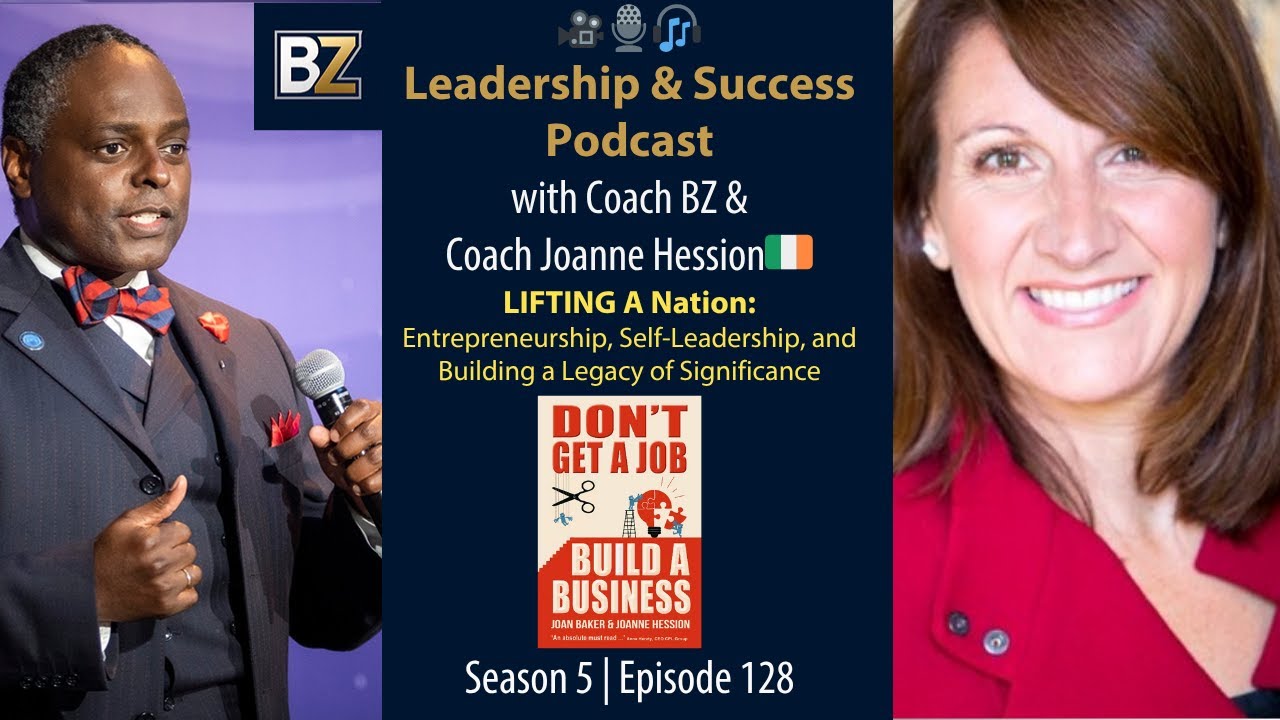
Coach Joanne Hession, an Irish entrepreneur and leadership coach, discusses building a business that runs without you, the importance of courage and integrity, and why perfectionism and poor cost structure sink startups. She shares her journey from Dublin to Rwanda to founding the Entrepreneurs Academy, and her message that small daily actions create lasting legacy.
Chapters
Hi, I'm Hello, I'm John Maxwell. When the top companies in the world are looking for trainers, speakers, and coaches, there's one name that stands above the rest, and that's Maxwell Leadership. Our certified team members have gotten proven results for companies all over the globe, and our reputation, I'm proud to say, is second to none. Some of our members have risen to the top of their profession. Including the one you're going to meet today. I proudly introduce you to my friend, Bob Fabien Zinga.
Welcome to the Leadership Success Podcast with your host, Coach BZ, where we help you lead with purpose and succeed with impact. If you're ready to grow into the kind of leader others want to follow, this podcast is for you. If you're determined to elevate your success and leave a lasting legacy, this podcast is for you. As my mentor, Dr. John C. Maxwell, reminds us, everything rises and falls on leadership. Our goal is simple: to inspire you, challenge you, and equip you with insights that can transform the trajectory of your leadership journey. Welcome aboard to another episode of the Leadership and Success Podcast with Coach BZ.
Lift is really important because leadership is really important. And leadership isn't just important to the people that we think of as traditional leaders in positions, but leadership is important to every single one of us. And a really good foundation of a good leader is good values. So LIFT is about lifting the values of everybody in the country, lifting leadership in the country. That's LIFT Ireland. Wow, that's a good question. What values have influenced my life the most? Many, many have influenced me, but probably top have been firstly integrity and honesty. Integrity is about living by your principles, living by knowing who you are and living by those. And honesty is all about being, being self-honest. For me anyway, that's what it's about. It's about being honest with yourself and knowing what your values are, what you stand for, and being able to speak up about them. Courage then is another one that is a really important value for me. Courage is about being able to admit that these are your values, that these are your principles, being able to ask the questions at the right time even when maybe it's difficult to ask them, and being positive and true to who you are. Yeah, I've needed courage for that too, so that's another value that has driven me throughout my life. There's no doubt that with LIFT, because LIFT is all-inclusive, everybody is welcome, it's completely diverse. Because it's for everybody, there's no doubt that we're going to get lots of impact in lots of different ways. But for me, if we get small changes happening all over the country, we'll be able to create great change in the end.
What do I like most about LIFT? What's not to like about LIFT? I love LIFT.
It's great. The people involved are absolutely fantastic.
The way that it's so diverse and so inclusive, and we have opened doors to absolutely everybody for Lift.
It doesn't matter who you are, what you believe, it doesn't matter where you're from, it doesn't matter if you were born here or not born here, but once you are here on the island of this country, you're welcome to Lift.
And I love that.
I love it. I love it that it's the people of Ireland, we're all getting together and we're saying, we're a really great country, but let's get get even better. Let's lift Ireland.
All right, thank you so much for being here, this very special edition of the Leadership and Success podcast. Actually, we are going to have a great offer for you toward the end of the show. Hopefully a lot of you are going to participate again, and I am so grateful for the people who watch the show. I remember when the war in Ukraine started, I'd ask everybody to chip in like $5 only and we ended up raising more than $2 million American dollars and we raised so much money. It wasn't just us, it was a lot of people all around the world that we were part of it that the people who were raising money for Ukraine decided to raise the amount so they went from $2 million to $3 million so it was just awesome. I think at the end we ended up raising almost $4 million for the people of Ukraine. So I am so, so grateful for those of you who watch the show, who listen, who purchase the books we recommend here and really help us make the world a better place. So I am reminded, like we do every time we start the show, it is our tradition here, it's our custom, and we're going to start with what we call a moment of gratitude. So you know what to do. So that's where I really ask you guys to think every single time we meet, what is one thing you are grateful for? And we really like to set the stage and start with an attitude of gratitude. My primary mentor, I remember when I first met him in 2007, something he said over and over again is, "Your attitude will determine your altitude." And there is nothing better than an attitude of gratitude. So if you would close your eyes, maybe put yourself in your best place and take a deep breath, slow down your nervous system and think about what are you grateful for in this moment right now. And I think right now I am really grateful for the kindness of the human spirit. I know as an information warfare officer, human beings can do a lot of very, very evil things. We can destroy the world and kill people and do all kinds of atrocious things. But there is a part of us, I believe, that is divine, and there is a goodness in humanity. And I am so glad people who watch this show, one of our goals is to be the very best version of ourselves, no, try to help make this world a better place. We have that goodness in us, and I'm so, so grateful for it. All right. I am so excited about the, the person we are going to be speaking to today, all the way from Ireland. We're gonna be speaking with Coach Joanne Hession, and, uh, she's one of Ireland's leading voices in entrepreneurship, leadership development, and personal growth. She's the founder of the Entrepreneur Academy. She has helped train more than 40,000 entrepreneurs to start, grow, and sustain successful businesses. As founder of QED Accreditation Advisor, she has worked with leading business schools around the world to achieve excellence in management education. She's also the co-author of the number one bestselling book, Don't Get a Job, Build a Business, and the highly sought-after keynote speaker, TEDx presenter, government advisor, and leadership coach. Most importantly, her and myself have been mentored by the one and only John Maxwell. And in 2018, she launched Lift Ireland, Leading Ireland's Future Together, a groundbreaking social enterprise dedicated to improving self-leadership, character, and positive influence across schools, businesses, sports clubs, community, and organization throughout Ireland. And today, more than 180,000 people have participated in over 1 million Live Leadership conversation. One thing I really loved about leadership is those principles are absolutely universal. Whatever leadership principle works in Ireland will work in the US, in Africa, and Europe, and everywhere in the world. And if those principles even work for men or for women, it doesn't matter. It will work for you as well. So I really hope you will listen because Joanne's mission is simple, yet very profound: to create positive change one person, one conversation, and one action at a time. So today, part of what we're gonna be learning is why leadership is not a position, but it is a behavior, and also how small daily actions create lasting leadership impact. So without any further ado, please help me welcome to the Leadership Success Podcast, the one and only Coach Joanne. Eshon.
Good morning, Coach.
How are you doing today, Joanne?
Fantastic. How are you?
How are you? Lovely.
Welcome. And all the better. I am grateful for being with you here today.
No, you've really made my day all the way from Ireland. I'm so grateful for technology as well, being able to talk to you live from across the pond. It's just amazing. So just to get started, what is one thing you are grateful for today?
Well, as I was watching the start of this podcast and listening to you, what really comes to mind is I'm so grateful for you. I'm so grateful for you reaching out and sharing what you're doing with others. It's only by you and people like you doing things like this that we don't just stay in our own little areas. So, yeah, I'm very grateful for you today, Bob.
Well, thank you so much. I think I read it on LinkedIn that we are only maybe, what, 3 or 4 degrees of separation away from anybody else in the world. Anyway, part of the reason why I really love LinkedIn, I don't know when we actually connected, you and I, but we have so many people in common, more than, what, 42 people? And I have invited all of them to come watch the show. And then on top of that, everybody was part of the John Maxwell leadership team, about 150 of them around the world, I've been invited to come watch us live too. I don't know, I'm just so grateful that in the world we really have so much in common. There is more that we have in common than we have that separate and differentiate us. Now that's kind of weird coming from me since I am in the US military. I'm a senior information warfare officer, but really in my mind warfare should be like the very, very last resort because there is so many ways for us to be able to communicate and to use diplomacy and solve whatever problem we might have. But anyway, I am so, so grateful to be talking to you today. Now, is there something about you, Johan, that kind of unique most people may not know when they first meet you?
I think that, well, I'm a, most people think of me as an entrepreneur and a business person, but I'm a mom of 3 amazing young daughters that are 19, 22, and 23, Hannah, Leah, and Megan.
Yeah.
And I'm the daughter of 2 of the greatest leaders that certainly I've ever met in my whole life, Dorian and Ted, who are my parents. So, um, yeah, I suppose there are lots of things that people don't necessarily know yet. Uh, they might know at the end of this podcast, but they, but they, but they don't know yet. Um, but yeah.
Wow. That is powerful. I wonder why they think you are an entrepreneur.
Hmm.
I wonder. I just wonder why they think that, but yeah, uh, I have two daughters, so they are Gen Z as well. One of them just graduated from high school yesterday. And my first one graduated from college last year. It's just amazing. I feel like these youth, they are our future, and I feel so optimistic about what they're going to be able to do. I think go a little further than my generation was able to. It's quite exciting.
Yes, it is. It is. It is. There's no doubt about it. They're certainly better than I was at that age.
Yes.
Yeah, they are. They're amazing.
But I also think that they are facing a lot of challenges that my generation didn't have to face. And with AI and everything that's going on now, but yeah, but I know they are going to carve their own way and come up with great solutions. So for those meeting you for the very first time, who are you beyond your titles and all of your accomplishments?
So I grew up in Dublin. I'm Irish through and through. If you cut me in half, it probably says Ireland in the middle of me. My parents are Irish. My grandparents are Irish. My great-grandparents are Irish. So I'm Irish through and through. Went to school here, very influenced by both my parents who are people of good values, my school, which was a school of good values. I went to an all-girls school here in Dublin that I loved. And I think probably things that have shaped me along the way— I was going— I think most people think that you sort of go on this straight line in life, you know, this straight line to success, but it doesn't really go like that. And I had a good friend of mine that passed away when I was 22. And that had a profound— yeah, yeah, it, it— well, it had it— was— I look back now, 30-something years later, you know, that had— that really shaped who I am now because it made me, it made me really think, whoa, I, I may not be here next year. Um, and so every, every day counts and every year counts. Um, so that, that really, I think, has probably shaped who I am today, um, and shaped a lot of the decisions I made before I even set up my first business when I was 27. Wow. It shaped a lot of the decisions I made before that because I decided to leave business and volunteer in the charity world, the international charity world, and headed off to Africa actually to do that in my 20s too. So a lot of that has shaped who I am today.
Man, that is really, really Amazing. I know we're going to be talking about a couple of books by John Maxwell, but it looks like Change the World has your name all over it. When I think of you and all of the work that you are doing, it's really amazing how just one person can have such a huge, huge impact. And now with the technology we have, you can even have a global impact just by staying out there in Highland. And you can have a TEDx talk like you did. Many of those videos, they have like more than 20 million views. It's just amazing. People all around the world can listen to you speak about leadership or whatever great ideas you have. And I think that's just fascinating.
Yeah, it's a funny thing about a TEDx talk. When I was invited to do that, I hadn't actually intended to do one. I was invited to do one. And I think most people expected me to speak about leadership. And in fact, in my TEDx, I start off by saying— most of you that know me will think that that's what I'm going to speak about. But I actually talked about legacy and and the importance of being a good human. And it's a funny thing when you're preparing for a speech like that, and you will know this from all the work that you've done, that when that work is going to be left out there in the world to be looked at when you're long gone, it's sort of like, okay, well, what do I actually have to say? And what is it that I want to say that's going to be left behind? So yeah, It took me a long time to— it's only 11 minutes or something, but it took me a long time to think about what I wanted to say in that short period of time.
That is really something, and there is nothing more important than legacy, really. Now, my TEDx talk was never published. I probably need to do this again, but it's really amazing how they told me, "You have no more than 17 minutes max." Because I am an adjunct professor, I tend to go on and on for 2, 3 hours, but they're like, "No, no, 17 minutes max." If actually they say if it's less than 17 minutes, the better, because they really want you to go to exactly what you want to talk about and not add all of this fluff and a bunch of nonsense, which was a really, really great experience. Hopefully I'm going to do this again. And but yeah, it's— can you tell us a little bit more about legacy, why it is so important? Because I feel like for most of us, our definition of leadership kind of changes as we get older. Most people I know, when you're just starting your professional career in your 20s, you think about making money, having enough resources, getting married, having cars and houses or whatever. Again, nothing wrong with those things, but it's very much focused on me, myself, and I. But the older you become after you've achieved all of those, you kind of realize it doesn't really fulfill, there's got to be more. You kind of move from you know, success to significance like Papa John likes to talk about. Anyway, can you tell us a little bit more about legacy and why it is important?
Yeah, I think it's huge because, you know, that little dash between 1970 when I was born and dash between the date that I'm going to finish my life is really very short. You know, to fit a whole life in there, it's really very short that we're here. And so the legacy that we can leave behind in the people that we have met and touched and influenced along the way, our children and our children's children, as well as other things that we can do. I mean, isn't that— for me, that's what we're here for. I think it's funny, I was only talking the other day to somebody about— we have an end of school exam that's on here at the moment in Ireland, and everybody knows about it. It's called the Leaving Leaving Cert, and it's your final school exam. And my mother is— my mother's 88, Bob, and she still dreams about her Leaving Cert exam.
Really?
Wow, it's a big deal here. But, um, because it gives you— that exam gives you the points to get on to university here. It's a point system. So, but when I— I was talking the other day to somebody because in, in my exam, uh, an essay title came up that was A Jog Through the Fog: A Modern Paradox. And I remember coming out of that, deciding to take— do that essay, and I took what was probably a pretty risky move at the time in that I wrote about life being— we think that it's all about success, and we think that it's all about achieving things and perhaps getting a house and a car and, you know, success in a job and so on, but that that's really— it's a modern paradox because it's actually really all about the legacy we leave behind and being a good human. And I remember coming out of that exam and all my friends that had done geography at the time going, "Oh, I love that title because I wrote all about pollution," because they wrote about the smog, a job through the smog, whereas I'd taken a very different approach And I had written at the end of my exam, and I didn't know the— I didn't know that you might know, but I didn't know what scripture or anything it was, but it was that whole piece of, you know, if you do the right thing, you'll soar on wings like eagles. You'll soar on eagle's wings.
You'll—
'You'll run but you won't be weary, and you'll walk and you won't get faint.' That's in Isaiah 40:31. Yeah, and I didn't know necessarily what the quote was, but I put it in the essay as, 'This is what life is about,' you know, like it's a bigger— there's a bigger purpose, there's a bigger purpose, and a big part of that is thinking about the legacy that we leave behind. It's so important. If I'm cross and cranky, I don't know if you use those terms, but if I'm, you know, cross and cranky and angry in my house all the time, then that's the legacy that I leave behind of who I was.
Man, that's really amazing. And you must have been what, 17, 18 years old?
I was 17. Yeah, I was 17. In fact, it was probably The anniversary, it's probably around this date. It was June.
That's just amazing, man. You really showed wisdom way, way beyond your years. I don't see a Finnish 17-year-old who's thinking about things like that. Because usually, the 17-year-old I knew, it was about, "Hey, I want to get married. I want to have not just a car, but a fast car and make a bunch of money and all of that." And wow, that is amazing. What wisdom. So it's, "They that wait upon the Lord shall renew." Their strength, they shall mount up with wings as eagle, they shall run and not be weary, and they shall walk and not faint. Isaiah 40:31. That is amazing. Where do you think that wisdom came from?
It's a funny thing because I wouldn't have been reading the Bible around that time, and I had read that quote in a book that I just really liked, and I was always a pretty deep philosophical kind of thinker, but definitely the, I suppose the value of it or the values behind it came from my parents.
They're extraordinary.
That's amazing. They're amazing people and they just, they feel there's one rule. The rule is love everybody no matter who they are and just do your very best when you're here.
So extraordinary. I love it. I love it. So looking back over your journey from being an entrepreneur, educator, founder of a national leadership movement. What experiences most shaped the leader you've become?
So I suppose firstly it would have been my parents and the home that I grew up in, the school and the good values. Truth was our veritas, and truth were our number one value within school, so integrity was really important. My friend Mark passing when I was 22, that gave me a big surprise. I was working for one of the big corporates, one of the big American corporates, EY, at the time. And I sort of— it made me stop in my tracks and go, hang on, what am I doing here? You know, I— so, so, so that really made me get quite courageous about, about coming off that what traditional success trajectory was. And then the economy really started to heat up in the world. It was in the '90s, heat up in Ireland, and business was all about money. So I worked for the Graduate School, the top graduate school here in Ireland. I worked there for a while, and then I thought, you know what, business sounds like it's all about money. Maybe business isn't for me, even though I loved business and I would have a natural flair for business. So I decided to volunteer and go, well, if business isn't for me, maybe let's catapult myself off into the volunteer world and got sent to the Rwandan border after the Rwandan genocide in the mid-1990s. Wow.
No, that is so unusual, especially for an average American kid. Even my own daughter, I think they have really, really good value, but if they have a chance to make a bunch of money in a business, I think they will take it. What was it about you that felt like there was something more than just money back then?
I think it was probably my inner teacher. And it was just my gut, or some people might call it their soul or the divine wisdom, or for some people it's just their inner truth. Mine has always been very strong, and so it kind of bugs me It bugs me until I listen to it. That's what makes sense to me. I'm not sure if that makes sense.
No, as a 17, 22-year-old, that doesn't make any sense at all. If you want, I want to pause that for just a second, because no matter what you do, even if you become an adventurer, you want to go to Rwanda, you want to change the world like you are doing now, you're going to need resources. You're going to need a lot of money to be able to help the most number of people. So even if it's not just for yourself, which I think most 20-year-olds, they think about me, myself, and I. I want to have not just a car, the best car. I want to have not just a house, the biggest house. They just want to go big and splurge on themselves. So that wasn't you. But even if that wasn't you, didn't you see you could have used that money to actually do a lot more, be more charitable, philanthropic, or make the world— maybe get rid of malaria or something big with the resources? I guess I'm trying to kind of get how you were thinking.
Yeah, great question. Actually, I didn't need any money at all. Um, I got— I, I, I went as a volunteer with an aid organization called Concern Worldwide. I got paid the princely sum of, uh, $60 a month. So, uh, so I, I, I didn't get— it was voluntary, didn't get paid. Um, so I didn't need any resources to go and do it. So I, I, I went and landed on the border but was part of an international organization over there. And there were about 13 of us. Um, yeah, so, um, so, and I, I think, why did I do that rather than— I had a real— I think I, I, because I had been in corporate, uh, a corporate world, um, and I was feeling it, it just wasn't— it didn't have the purpose or at least it didn't seem to me. Of course, organizations like EY and others have purpose, but it didn't feel to me that it had the purpose that I was looking for. I just—
yeah, that's amazing.
I think I just have a big courage muscle, Bob Fabien Zinga. So I, so I—
wow.
I don't believe in wasting time. If there's something else I think I should be doing, I move pretty quickly.
Okay, you are definitely very, very unusual. Again, I think way ahead of of your peers. But that is really, really amazing. I can't remember even myself. I felt like I was a little bit different, but not as different as you. It's like, wow, I am really amazed, impressed. Where did that courage that you mentioned— because courage is not the absence of fear, right? Because I'm sure there is a lot of uncertainty and you feel like this is what you are called to. It's like your purpose, but still everything isn't quite laid out clearly in front of you. And there is also that question mark, no, what if it doesn't work out? Where that courage you had demonstrated at such a young age, where do you think that came from?
Yeah, it definitely came from— I was given a very strong safety net by my parents. That's amazing. So even though there were no mobile phones, I could only contact my parents through writing letters that would take weeks to get back and forward. So, you know, there was no calling somebody to get sorted or saved in anything. But they always, no matter what decisions I made, even if they thought they were crazy, and to be honest, I think going out to the Rwandan border, they did probably, they were very worried, but they never, they always just smiled Wow, that is amazing. They gave me the greatest gift and have continued to do so my whole life. They just— wow, they just gave me the greatest gift of trusting, um, that I knew what I was doing even when I didn't. I mean, talk about laying out a plan and, and fear. Um, this was a real sort of dislocating yourself from any fear because I was heading out to the Rwandan border. I didn't know the language, I didn't know the people, I didn't know That's amazing. And I, um, and, and, and also I was one pair of hands. I mean, it— wow, you know, there's not— you're doing the best that you can, but you're a drop in the ocean for what needs to be done after a national genocide.
Yeah, so it's, um, a couple more ideas come to mind. One is also your gender, right? Just to be frank, you know, the world isn't exactly made for women. For a long time, even here in the US, women couldn't even vote. They couldn't even have a checking account without the permission of their husband or their dad. Even now, I am the father of two daughters. Sometimes I joke, my wife is a woman, my daughters are young women now, and if it wasn't for our family dog, I'll be the only male in my entire family. But did you feel less than? I don't think you did, but really, again, like I say, the world for the most part is really meant for men to take over and to lead and to be in charge of everything. Did you— I guess the question I am asking, did you ever think or feel about the fact that, hey, maybe this is not exactly meant for me, I'm gonna be excluded just because of my gender, and then decide, no, I am going to do exactly what I was called called to do no matter what and take kind of like—
yeah, certainly. No, I didn't ever think there wasn't anything I couldn't do.
Wow, that's amazing.
That a guy could do. I did find myself in a couple of situations that were a little bit hairy as a female.
Wow.
In those situations that it would have been definitely safer and easier to have been a male, but it didn't make me think that I couldn't do what I wanted to do, and I think that probably came from the school that I went to. Wow. The school that I went to, I went to a school called Muckross Park run by the Dominican nuns, and I know often in Ireland anyway, and around the world over time, because of individual behavior, sometimes the clergy can not have a positive name, but these women ran our school were phenomenal. They were absolutely phenomenal. And certainly I, in that school and from that school, felt, oh, I can do anything that any guy can do.
That is amazing.
Yeah. And in the '70s and '80s, that was kind of unheard of. I mean, my mother here in Ireland, when she got married, we had a marriage bar, so she couldn't work. You weren't allowed to work. Um, and that wasn't—
that doesn't make any sense at all.
I know, but that's the way it was at the time. It's obviously not now, but so I'm sort of the first generation of women where we're all working and we've got kids.
So no, that is just so inspirational because even today in 2026 in America, which I think, no, I guess we're still kind of one of the most powerful countries in the world, at least for now before China takes over. But what I'm saying is even today, twice, right, we had the chance to elect a woman president. America's like, ah, we are not ready. I don't think most Americans believe women are actually equal to men. And the reason why I know that is because my daughters, even though they may have more qualification or the same qualification as another male, they're going to make only 80 cents on the dollar. They're not going to get paid equally. So that doesn't make any sense. Now, there are more women, most women in America today Women are more educated than men. They have more master's degrees, more PhDs, but they have jobs where they make a lot less money. They're just not valued as much as men just because they have the wrong gender, which doesn't make sense. Again, I would have understood in 1700, but we are in 2026. And like I say, I'm a father of two daughters. I feel like any opportunities I have, my daughter should be able to do that and even much, much more. So that doesn't make any sense. To me, and you going back there in the '90s and everything you were able to accomplish as a woman, that's just extraordinary. That is fantastic.
I think, yes, there's definitely— we have further to go, there's no doubt, not just in the US but elsewhere with the gender pay gap and other things. But if I just take my own personal experience, I never let it get in my way.
That is fantastic. I really love that mindset. I think that's really what makes people successful, because many people, they go through the same exact circumstances like you, you would go ahead and thrive and succeed, and most other people, they would just give up. And if you gave up, then there would be no change, and it's going to be kind of like status quo. Now, another thing that you said I think is important for the young people listening to the show, I really believe young people need to think about doing some type of volunteering, public service, or something. For me, it was for the military, I don't think you have to join the military, but if it's the Peace Corps or volunteer for a nonprofit organization, something you are passionate about, even just for a year or two before you go back into your career, I think that would help us have a much better world, I think, where it's not just about money, but it's about what can I do for my fellow human being and serve the public.
Listen, it had such a huge impact on me. It really humbled me. It really humbled me in that I thought going over there I was going to be able to contribute a lot and realized when I got there that, whoa, you know, like there's so much need here.
Yes.
You know, if I can do this tiny bit and actually I ended up getting so much more from the experience that I think I ever could have given. I met the most amazing people and people that I'd never have crossed paths with nationalities, differences, backgrounds, um, and continue now, uh, to meet— sat at a Maxwell conference the year before last. You know this, that Maxwell conference is 3,000 people there.
Yes.
Happened to sit beside this beautiful young woman, and it turns out she was— when I was in the camps, in the refugee camps, she was hiding in Rwanda.
Wow.
Yeah, and we just happened to sit beside each other at a Maxwell conference and have become great friends.
Wow.
So she's unbelievable.
Yeah, it is, it is. She's a trauma-informed coach now. She lost 9 of her siblings in the genocide, um, and she is, she is now working, uh, back in Rwanda, um, living in Canada, going back to Rwanda and helping her, her people.
Just to stop for a minute and to think about that. And for those who are listening, it's really amazing to me how one person, one person can have such a huge impact. Yeah, again, that's why I think of all of the books of, um, Dr. Maxwell. I have the one that comes to mind when I think about you and your story is Change Your World. That's just amazing.
Wow.
So you've started businesses long before entrepreneurship became fashionable. What first sparked your entrepreneurial mindset. Like, even now you are like in charge of at least 3 organizations. I don't know if you have time to sleep at night. It's like amazing, the work that you do. Just, it's just incredible.
Look, let's not kid ourselves. It's amazing people that are around me. So it's, yeah, like I have amazing people that I get to work with. And yeah, that's what makes it work.
But what first sparked you on? Interested in the entrepreneurial mindset?
I don't know, because my father wasn't an entrepreneur. He was an accountant. My mother stayed at home and worked in the home. So I didn't even know what an entrepreneur was. But I think I was always very determined. And in school, I wanted to make some money in school just to buy things. So I made jewelry. It was awful jewelry. But that's what I did. And then when I went to college, I needed to earn some money and I didn't want to work in the bars because it was very unsociable hours, so I put leaflets into a new housing estate and I said I'll clean your house, but I didn't want to clean very dirty houses, I wanted to clean houses that weren't too dirty, so I'd look in their windows beforehand and then I'd leave in the leaflets and I'd start to do that and I got two of my friends to to help me, and that's how we earned the money that we needed to get through college. So I was, I was always pretty determined, um, and I always felt there was going to be a way. So, um, you know, and I think that's probably what made me, when I was in corporate world, say, this isn't working out, I need to, I need to reverse out of here and do something else.
Um, wow.
I think courage and determination are probably two of my core values.
Yes. Wow, that is really, really amazing. So what lesson from building the Entrepreneurs Academy have stayed with you for nearly 3 decades?
Um, the, yeah, the, the first one is, is people. Um, I have people, Noel, Lorraine, Suzanne, uh, Denise Carter, that work with the Entrepreneur Academy and have been there, um, for years and years. I mean, Noel must be there 15, 16 years now. And so one of the lessons with the Entrepreneurs Academy is just, you're never doing it on your own. And they're family, you know, especially Noel, Lorraine, and Suzanne that have been on, you know, the journey with me. They're as close to me as family are. Like, I absolutely love them. So that's been a very big, big journey for me. And another one, I mean, the Academy is nearly 30 years old now. And actually we have like, we've well over 40,000 people now that have set up businesses.
That's amazing.
Amazing. It's amazing. I think it's nearly 100,000 now. It's a huge number. Wow. The impact that helping one person to start a business the impact on that person, uh, both from their financial well-being but also their, um, you know, their, their mental well-being, their emotional well-being, is huge. And the ripple effect on a family and the ripple effect on a community, as well as that business meeting needs of customers, is huge. So, um, it's a very worthwhile— um, the Entrepreneurs Academy has been a very worthwhile business to be part of.
That's amazing.
And learning. I love education. So that's a little bit of it.
Well, let me tell you just a quick paradox, at least it appears to be, for somebody who doesn't follow after money and profit. Because in America, especially capitalism, the way we do it here, it's all about money, money, money, money, money, money above everything else. But you are a serial entrepreneur and you've affected more than 100,000 people around the world, you know, developing those great businesses, being an entrepreneur, and really having a huge impact on their own families and legacies and society. But it looks like it's much more than money for you, much more than just profit. Why is it so important to you for someone to start and be successful at a business? What is important beyond just the money talk?
Money is amazing, and we need money to do good things. But it's important that we don't get fooled by money, that money isn't the end in itself. Money can help us to do things, and it's the fuel. It fuels the engine, but it is not, it's not the end in itself. And if money, if money becomes the award only, then it starts to get very shallow very quickly. So in any business owners that I work with, even to this day, I'm very very interested in them making money because we need money for the businesses to be able to exist. They can't exist on fresh air. Once they, once they do exist and they make money, then it's okay, great. What are you going to do with that money? How can we take that money to do other great things? And that's whether that money, every dollar or every euro, generates more dollars and euros, or what is it that we can do with that money to create greater impact. It's the impact rather than the money that's so important.
That is just so amazing. I love it. But now, some people listening right now, they may dream of starting a business, but they never take the leap. I think in America right now, the last statistic I saw was about 5 out of 8 businesses end up failing within the first 3 to 5 years. What fears do you see holding aspiring entrepreneurs back?
We see lots of different ones. One is perfectionism, where people are trying to get it exactly right before they start. And the thing about it is, is a bit like our friend and mentor John Maxwell says, just if you're going to write a book, just start. Same with starting a business. You know, you don't have to have the perfect name, the perfect logo, the perfect website. Just, just start. And I think that, that that getting really comfortable with failure, getting really comfortable with making mistakes, because I certainly have made so many. And you just pick yourself up, you just move on. If you, you know, if something's not— you find out you've done it a little bit wrong, you just correct it. You just keep moving forward all the time. I think that what's really important for aspiring entrepreneurs is that they get focused on two things. One is, is there a demand or is there a need for what it is that I'm going to provide? Okay, because there needs to be some kind of a demand or there needs to be some kind of need. And then secondly, is there going to be margin? And what I mean by that is, I do mean financial margin. Is there going to be profit on what it is that I'm going to do? So, you know, I might want to set up a, you know, a slipper shop or a, you know, or but it doesn't mean anybody's gonna buy any slippers. So it's really important that there is a need for what it is that I have, or a demand for what I have, and that also if I am going to set something up, that my income, that the money I charge for it, the price that I charge for it, is going to be more than it costs me to actually provide it. Because that margin is what is going to enable me to fuel this business, to get bigger, to hire other people, and to do things the way that they should be done. On in a business, and without that, um, it's useless. So we always start people off getting them to do a graph on, okay, how much demand is there for what you have? And you find that out by doing market research, and that's how you find that out. But how much demand is there for it? And then, okay, what price can I charge, and how much, how much of a margin? Because if I can only make a dollar on every product that I have, I need to sell an awful lot of those.
Yes, yes.
You know, in order, you know, sell 100 of them and I make $100 profit. That's not very much if it's going to take me a week to sell them. So, you know, those simple, simple concepts are extremely important to people starting up in business. But, you know, a lot of people, the other thing as well is that a lot of people, they don't take the leap because they don't necessarily know other people that have started a business. So, you know, join networks or groups online or offline to, uh, be able to listen to and talk. Join the Maxwell organization. There's lots of people there setting up in business. Um, join organizations where you can learn, where you can talk to other entrepreneurs, because entrepreneurs love talking to entrepreneurs.
We love—
so we'll always find each other in a room, and, um, and, and, and we love to help help each other out as well. So, um, what I'd say is just, just do it. Just do it.
And thanks so much for also mentioning failure earlier, because we tend to only focus on success. Uh, looking back, what was one of your biggest entrepreneurial failures, and what did it teach you about leadership?
I've had, um, I've had many, many, many uh, entrepreneurial failures. Um, I, many, I, I, you could probably pick out 15 headings and I'd be able to give you a failure under every heading. Um, one that comes to mind is the structure of the organization that I set up for the Entrepreneurs Academy initially. The structure had, um, had an awful lot of cost in it that even if I didn't have much training, many training programs being sold, I had very high costs.
Wow.
So they, you know, the fixed costs in it were very high, and that was a mistake. So I realized that after a while, because I was working so hard just to kind of pay the bills. And so I changed the structure in the organization after a couple of years, and it made the organization much easier to manage and to run. And that, that was one, but you know, was it the biggest one? No, I'm sure I've got plenty of other absolutely enormous ones. And you know, um, I look, I, I make mistakes all the time, all the time. Um, I, I tend to have one of those minds that goes, "Ah well." You know, "Ah well, pick yourself up." You just don't give up. You just keep going.
Wow.
I mean, we've launched products and services that haven't worked. We've learned from them. And then we've just moved on. I have made bad hires. Or at least I have hired people and then probably not held them accountable enough and had good enough discussions along the way so that they ended up wasting their time working with us and it wasn't good for the organization either. I think it's really important that everybody that works in an organization gets— that they— because they're giving their time and their lives to the organization, I think it's really important that they can flourish and grow in that organization. And part of that is our responsibility to make sure that people are learning and developing and being held accountable. I think in Ireland, I don't know, I think you're better at this in the US than we are in Ireland. In Ireland, we're not great at holding people accountable. We don't like having those difficult conversations. But look, I wouldn't say they were the biggest, the biggest at all that I've had because I've been very fortunate and I have to say I've loved every person that has worked with us. It's been amazing. But yeah, have I had sleepless nights? Absolutely. Did I have them in 2025? And did I have them in 1998? Absolutely I did. And will I have them in 2026? Yes, I probably will. So if you're going to start a business, if you're going to push things, and if you're going to strive and you're going to take risks to move ahead, then it's, um, yeah, you, you, you, you're, you're going to sometimes trip up and fail and, and sometimes it's going to be hard, but it's worth it.
It's worth it.
That's how you break through. That's how you get there. It's amazing.
Wow.
So the, the mindset you have, I guess one of your countrymen, prime minister of the time, Sir Winston Churchill during World War II, I think he really gave a lot of hope and courage to people that faced one of the greatest challenges you've ever faced in your history when he says, no, never, never, never, never give up. For the entrepreneurs who are listening right now, because I'm sure when you start a business and you venture, eventually you are going to find a thousand reasons to just give up because it is not easy. What would you advise them? Just starting a business and it's a little bit challenging right now. I'm thinking maybe I made the wrong decision? What would you tell them to encourage them right now?
And, and, and I, and I will get to that, but before I do, and, and, and said in the most lovingly way, because everybody makes this, this, um, assumption that Winston Churchill is—
but he's English and we're Irish, so, uh, I was talking about the United Kingdom.
Oh, but we're still, we're still a republic. Uh, oh, okay, okay. So, uh, so an easy—
I stand corrected.
An easy mistake to make, but for my fellow Irishmen, it's important that I, that I, that I mention it. Um, and, and a great— and, and, uh, but, you know, the tenacity of not giving up, um, is, you know, if if we could equip all of our young people and not so young people, if we could equip everybody with the tenacity and courage and belief not to give up and to keep on going, we would have a better world.
Yes.
It's— and I think Your question was around how do we encourage people not to give up. It is by surrounding, by me surrounding myself with other mentors that have gone before me and have done great things. And I have great female role models and mentors both here in Ireland, in the US, and internationally. That have— male and female, male and female— most amazing male mentors that, that have, um, supported me along the way. But we, we need that. We need to keep learning. We need to keep growing because, um, it's only by doing that that we realize that— that's well, yeah, all, all success is uphill, uh, all of it is. There, you know, there is, there is no book written, how I freewheeled downhill on my roller skates to success or on my bicycle. There is no, there, there is nobody saying, whoa, this was so easy how I've done this. Nobody at all.
Man, that is powerful. Cause you just made me think, I think for me too, that resilience, I think I mostly got it from my mother because it's one thing to know, get a book and you, you read it and you get the knowledge. Wisdom from it. It's another thing to actually see someone up close go through life challenges. And then it's kind of like, uh, in America we have that ad many people have seen, uh, of the Energizer Bunny. It takes a licking and it keeps on ticking. And when you see it over and over again, it's almost like the spirit kind of, you know, is imparted into you. It's like, no, I have seen my mother, she really had a lot of adversity, but she was able to get through it. So I am her son, I'm gonna get through it too. It's, uh, quite powerful. Wow. Okay. We do need to talk about your book. We are already running out of time. I can't believe it. I could be talking to you for hours and hours and hours. I do have to talk about your book, Don't Get a Job, Build a Business. The title of your bestselling book is quite provocative. So I guess, where did that title come from? What inspired you and Joanne Baker to write it? Why did this book have to be written?
Yeah, Joan and I, yeah, we absolutely love the title of the book because it is provocative. And in fact, the editors didn't want us to put that title on the book because it was too provocative. Whereas we absolutely loved it because, you know, it's not saying don't get an employed job and instead set up a business. What it's actually talking about is many people when they start their own business, they actually set up a business where it doesn't make enough money, and so they end up working 60, 80 hours a week or more hours a week, and they're in this awful job that they're not even being paid for. So the book is all about don't end up with this really awful job. Instead, structure things and follow what we have got, follow the tips in the book so that you end up setting up a business that you can retire from, a business that you can take holidays from, a business that if you get sick will run without you. Um, so don't set up a job that is just you in the business and just exists because of you, but instead set up a, a, a business. So don't set up a job, set up a business. And that's how You know, in the Entrepreneurs Academy and in QED, that are two separate businesses, I, I, I was able to step out of both those businesses that do not need me. I mean, I, I, I probably do a couple of hours a month, uh, only.
That's amazing.
On those businesses. And that freed me up then to start Lift Ireland. So, um, yeah, that's an insight.
Like, I believe it was Tony Robbins who taught me, don't work in the business, but work on the business. Very, very big, big—
Yeah, he must have read my book.
Yeah, so I was gonna ask you, so the book was, I think, about what, 13, 12, 13 years ago? So if you were writing the book today, 2026, what message would be even more important now than it was 13 years ago when the book was first published, you think?
I think the same message is extremely important because it's kind of a fundamental principle for people starting a business, not to build the business just around themselves, but to find a way of them getting out of it. I think the second message that is extremely important today for anybody starting a business is Absolutely have, have, just have an iron-held belief, a firm belief in yourself. A firm belief. Do not look, don't look back. Don't, don't question yourself. Just believe in who you are. That mindset is everything for the entrepreneur because the world is so extremely negative at the moment. Setting up a business is hard anyway. You need to keep a really positive mindset.
So that would be one. I think confidence is probably another one of your core values. We talked about courage and integrity for you, and I think confidence is another one of those. For those who are listening right now, especially if you're going to run a business, how do you develop that confidence? Sometimes people go through the imposter syndrome. They're just not sure they have the right personal, they have everything. I'm thinking of Matt Whyte, so many businesses fail. How do they develop that confidence, you think?
Yeah, it's ongoing learning and self-awareness. So the more we can become aware of who we are, our good points, our struggles, our failings, the more then we, we get confident in who we are and we can work on who we are. And change doesn't happen quickly and doesn't happen easily. But if I wasn't aware that listening a number of years ago was one of my absolute weakest characteristics then I couldn't ever work on it. So once I became aware of it, then I needed to really start working on it.
Wow.
That is so insightful. Thanks so much. Part of the reason why I have this podcast is because sometimes people need just one idea, just one insight that could potentially completely change the trajectory of their lives. Thanks so much for taking the time to talk to us. I know we are pretty much out of time in a couple of minutes, but let me at least finish this segment about your book, because I think everybody who's listening right now needs to get a copy. It's about 14 years old, but I think it is just applicable today as it was 14 years ago. Don't Get a Job, Build a Business. And what I want to talk about, let's talk about Gen Z for a minute. I think you and I, we are both very passionate about the next generation. I think they are really one of the greatest hopes we have for the world right now and for the young people. But my daughters and your kids' age, in their 20s. What do you think is one of the biggest myths society teaches young people about careers and success from your book?
Um, I, I, I don't know that it is. I think that our young people are Absolutely amazing. As I don't know if we were saying this before we came on or, um, since we've come on, that they— our future is definitely in safe hands with them. But what we— what is really important for our young people to know is that they are extremely gifted and extremely talented, and the more that they can do to develop their character and their self-leadership.
Yes.
They are unstoppable.
I love that.
It's not about somebody else giving them a leadership title. It's not about, you know, it's about their own self-leadership and strengthening their core. And our young people are doing a lot of going to the gym, you know, physical strengthening, also doing some mental strengthening, but it's about doing some personal development on their own leadership core, like what we're doing in Lift Ireland nationally, get people strengthening their self-leadership. That's, I think that's really, really important. And they'll be unstoppable.
I couldn't agree more. I think leadership is probably the most critical skill of the 21st century. People are afraid of AI technology, and all of these fast changes. And there is a lot of instability in the market sometimes. But I feel like One thing that's for sure is leadership skills because nobody can take that away from you. I love it. But also in your book, what I find fascinating when you talk about starting a business, building a business, people will immediately think about investor, technology, or massive capital. What do they understand, misunderstand about building a business when they think like that?
The who factor. The who factor. It's, uh, there is so much that you can do with the people that are around you in your network that you're meeting. And, and for Gen Z, uh, like, it's so much easier for them all to connect with each other than it ever was when you and I were younger. But being, you know, that people can help you to get your business up and moving whether it's talking to somebody to get another skill set, whether it's sharing a resource, whether it's a collaboration, whether it's a trading, whatever, whatever it might be, people can make things quicker, make things easier, open doors. And that who factor is as important as capital and investment or anything else. It's huge.
Wow. Yeah, I think many people completely don't even think they overlook it so often. So a follow-on question would be, what are maybe 2 or 3 of the most important entrepreneurial lessons from your book that every listener should remember?
One is don't fish in a dry ditch. That I see a lot of people, you know, setting up in business and they love their business and they love what they're doing, but they're actually fishing in a dry ditch. There is there, there isn't any sales there. There's no demand for what it is that they have. So that would be the first thing. The second thing is there's a whole piece in the book about the Pareto principle and focus. Focus has been probably one of the things that has helped me be— get the success that I have had over the years, because we all have the exact same amount of time, but it is about what you do with that time. It's about spending the majority of your time on the things that are going to give you the biggest results and the biggest impact, because we can all get extremely busy. There's so much activity, so many things that you can do, especially when starting a business, and it's to get rid of all that noise and just focus, focus down. A third one would be, be really clear on the end, on what goal you're looking for. For. Get as clear on what am I trying to do here with this business? What do I want it for? Is it a wealth-creating asset for me? Or is it going— is it because it— so is it going to generate income for me? And that I'm going to do something with that income? Is it that I'm going to have a certain impact in the world with this business? What is it that I'm trying to do? Is it that I'm breaking through some research?
Wow.
With this business, that's another great learning that comes out of it. But we need to, and it's in the book, the book is divided into 3 sections on working on ourselves, working on our organization, and then other people. And that's the who side of things.
That is so, so, so powerful. Okay, we are going to need to end the podcast. I have so many more I even wonder maybe I should have you back here, but this was just so fascinating. Thanks so much for being one of our masters and teachers today. Now, someone watching live on LinkedIn, let me see who that person is, they say, "Focus, follow one course until successful." And that is so powerful. And then someone else on LinkedIn, let's see, Vajira says, "Go, Johan." Great to see you here.
A great mentor and friend of mine from college.
Wow, that is really powerful. And the one who said focus is Jennifer Rogers from Zurich. So she says focus is follow one course until successful. And fear, I heard, was false evidence appearing real. And there is really, I don't know, in my opinion, it looks like to be successful in business, yeah, there's a lot of tactical things you can do business-wise and things. But it's very much mental too, isn't it? It looks like you have to have a specific mindset if you want to sustain success in a business. Okay. As we are running out of time, if there was one thing and only one thing our listener could get from your bestselling book, which is Don't Get a Job, Build a Business, what would that be?
Well, um, there, yeah, look, there are a lot there. Just do it. Just go and just, just do it. Just do it. But, but do good with, with that, uh, do good with it. Do good with it. And please have a look at Lift Ireland and what we're doing there, because it's really out of what I did initially with my business that I was able to, uh, then step out of there and have impacting growing leadership in the whole country. And we're growing self-leadership to build the resilience of our young people. And that's just, it's so, it's so important. Our young people are, are struggling, you know, our younger people, be younger than Gen Z, they're struggling. So it's important that we equip them with good self-leadership, which is what we're looking to do in Ireland.
One question about that, the LIFT roundtable process, has impacted more than 180,000 people, generated over 1 million leadership conversations. What has surprised you most about the result?
I'm not sure, I'm not sure that I'm so surprised. I think I probably intuitively knew it starting off, and it was in that initial video at the beginning, which is that it's Small actions create great change. So this is one person at a time, one conversation at a time, one day at a time. That, that by doing that on a continual base— we started Lift with no people involved, no funding, nobody at all. And less than 8 years later, nearly 200,000 people have now done Lift Roundtables. Taking over a million positive small actions. And that might be— a small action might be listening to a colleague or a fellow student or a classmate or a child.
Yes.
It might just be on a certain day listening to them. That small action, that small action has a ripple effect on that person. A small action might be heightened empathy, um, when I'm dealing with somebody not understanding. I heard a great, great saying yesterday: you never know who's wearing tight shoes.
Wow.
You know, like, everybody has got things going on, so we need more, more empathy. And, and these million positive actions— and it's more than a million now, and we're looking to double that in the next few years and get as much of this happening. We have a great country here, but we We could be better, as you do in the US and elsewhere. So it's, I think what has not surprised me, but I think I'm really pleased about is that it isn't seismic change. It's small, tiny actions cause great change.
That is really, really, really powerful. So how can our people support you, add value to you, but especially give support to what you're doing with Lyft? How can we do that?
Yeah, listen, you've just pulled it up there. Thank you so much. Every, every about $18, um, that we get helps us put another young person through an 8-week Lift program. So it, uh, going to liftireland.ie, uh, for on the donation page there, uh, every little amount helps. Every little helps. So thank you so much.
And also, it doesn't matter where the people come from on your website, whether it's from the US, from Europe, people are able to donate, right?
Absolutely, yes, absolutely.
Fantastic. And also, your LinkedIn page, so I want everybody to follow you on LinkedIn. Joanne Eshun is your moniker. And also, of course, we want them to get a copy of your book. Is there anything else my audience can do to support your great work?
Yeah, absolutely. If there's anything that I can do to share any of the learning that we have had in Lift Ireland, or just reach out to me, I'd be only delighted to help in any way that I can. And whilst I'm focused on lifting Ireland, there are Lots of places that we can lift. So I will share and will be delighted to share so that we can do this elsewhere and do it around the world and get less war and more peace.
Wow.
Now, I know we are out of time. I wonder, can you give me a couple more minutes before we close?
Of course.
Okay, let's do this quickly. You mentioned two books when we were in the green room. Why should my audience read this book, The 66 Unabrochable Laws of Communication.
Do you know what? It's so funny, isn't it? The way you're like, I was the only Irish person at a John Maxwell conference a number of years ago. And then I turned up. Really? Yes. Yes. The very first time I went, I was the only Irish person there. And then a few years later, chapter 3 of that book is written about me and Lift Ireland. It's the law of conviction. In the 16 Undeniable Laws of Communication. It's about having conviction. And so John contacted me and wrote chapter 3 about what we're doing in Lift, which was so good of him to do. And I got to meet the great Charlie Wetzel, who is John's co-writer. And if anybody is ever thinking about changing their world and writing a book and about what they're doing, you must get in touch with Charlie Wetzel. So get in touch with me if you would like to, uh, be put in touch with Charlie Wetzel, because he— that's what he does. He helps people write about their callings and their purpose, and he is phenomenal, as he has helped John do, uh, for 30 years.
Absolutely. And actually, for those, uh, following the show, I did have a great, great privilege to interview, uh, Charlie, um, the beginning of this season. So if you want to listen to that podcast, I like to listen to that quite often. I think it humbles me more than anything else I have listened. He's such an humble man. He stays in the background. But yeah, there would be no John Maxwell without him. It's just incredible.
Wow. Yeah, he is a beautiful human and an extremely skilled writer and communicator. Yes.
Wow. So as we land this plan down, I want to do a quick lightning round. No, it's going to take less than 2 minutes. First thing that comes to your mind, speak it, don't take too long. What is one of the best leadership books you've ever read?
Good Leaders Ask Great Questions.
I knew that. How did I know that? Here we go. Everybody needs to read this book. It's just That's fantastic because if you can ask great questions, you won't be— actually, like I was in a PhD program, I didn't graduate to my PhD, but one thing I learned when I was a PhD student at the University of Alabama is if you ask the right question, that can take you up to 50% toward the answer of whatever problem you are facing. So powerful. Okay, best entrepreneurial advice you've ever received?
Just do it.
Just do it. That's the Nike thing. Okay. Most underrated leadership trait?
Kindness.
Kindness. Wow. Powerful. One daily habit that makes you a better leader?
Getting up early.
Wow. Actually, there is a book called The Five AM Club. They say if you wake up early in the morning, you're probably gonna be more successful than those who don't. A person who has influenced your life the most?
My parents.
Absolutely. And one thing every young leader should start doing today?
If they don't brush their teeth, they should brush their teeth.
But that's probably boys, I think. Boys more than girls, in my opinion.
But yeah, they should invest in themselves, and I don't mean financially. Invest in themselves. It's the greatest investment that, that, that the greatest investment that you can make. Invest in yourself and then look around and who else can you invest in and pull along with you. Yeah, fantastic. Yeah, it's brilliant.
And to complete the sentence, leadership is everything.
Leadership, leadership is is everything. I mean, you and I are great friends of John, and John says everything rises and falls on leadership. How I lead is how I behave and act and cause everything to be good or bad around me. It's so important.
So what did you want to be when you were a kid?
A psychiatrist.
Wow. Okay, 3 adjectives describing you as a child.
Talkative, happy, and bouncy.
As an adult?
Silent, thoughtful, and tenacious.
Wow, okay, I'd like to end on a positive note. What is something that you are feeling optimistic about these days?
Oh, the world. Um, I, I'm very optimistic about human, uh, about who we are as humans and about what we can do. Um, and Yeah, and I'm very optimistic about what we're doing in Lift and sharing that with as many outside of Ireland as we possibly can. So thank you so much again for this opportunity, for inviting me to do it. I really appreciate it.
And the great work you are doing, especially with the youth in Ireland, which I really believe the youth, our children, are truly our future. I know that they're facing a lot of challenges now that my generation didn't have to face. And I think in the first time in American history, you know, they're saying our children, they feel like they would get it worse than the previous generation. It's always been in America that the next generation always feels more optimistic and more positive about the future. But even now they're like, I won't be able to afford a home like my parents did, or whatever. It's kind of grim and dark. And many of them are hopeless. Like even my daughter, she had a degree since last year. I haven't been able to get a full-time job yet. She only has a bunch of part-time jobs, maybe because of AI or changes in the economy or whatever it might be. What word of encouragement would you have for the next generation, Gen Z, listening to us right now?
There's always a way. There's always a way. You know, I really believe, like, if I lost my job today, I would go and I'd work for someone. I'd go in and I'd work for them for free. I'd learn something out of being there. I'd see what I could do to help. And it always leads on to something else. And it's that whole who factor again, you know, just keep meeting people. People are amazing. And people want to help.
No wonder you have a personification of conviction, because that's really who you are. Determined, convicted, like nothing is going to stop you. This is just amazing. And just quickly, in this book, The Law of Conviction, the stronger you believe it, the more people feel it. And that is just so powerful. That's a great way to end our show. Thank you. Thanks so much, Johan, for making time to talk to us today. Sorry, we took about an extra 18 minutes, but you've been a great master teacher to us. So the very last question I would have for you is one word that represents our shared experience on this podcast. Has today? One word.
Uh, joyful.
Yes, I am overjoyed and really, really humbled and privileged. Thank you so much for speaking to us today, Joanne. I really appreciate that. Thank you.
Thank you so much. Thank you so much.
All right, everybody, uh, this is one for the books. And again, uh, follow Joanne on, uh, LinkedIn and also support Lift Ireland. And if you go to, uh, donation, like we've we've shown you, you can donate about, I think it's $15 American to the work she is doing. And really, I think we can change the world one youth at a time. And of course, get a copy of number one best-selling book, Do Not Get a Job But Build a Business. What powerful, powerful. Okay, this is it for now. I'm going to have another podcast today. I think it's about 1:00 PM on the Pacific Coast, so it's going to be what, 4:00 PM on the East Coast. I am going to be speaking to a command, uh, Master Chief, uh, Jody Fletcher, US Navy retired, and he's written a book about Good Humans Make Great Leaders. We're going to be talking about inspiring others, which begins with you. So I hope you can join us live and ask questions. So Being a Master Chief, uh, that's E-9. It's the highest rank for enlisted in the military, and less than 2% of the people who join the Navy end up at that rank. So we're going to be learning a lot about the lifetime of leadership and experience. I hope to see you there. And also tomorrow, I don't think I have a guest, so I'm gonna go back to the book of Proverbs. We are studying the book of Proverbs. We started January of this year. I believe we're doing chapter 26. It's not a religious podcast, but it's about ancient wisdom and leadership lessons from the book of Proverbs. We're going to be getting into that book to understand what are some of those universal leadership principles that were true more than 2,000 years ago when this book was written, but still relevant today in 2026. All right, that's all I have for you, and I hope to see you in a couple of hours with Master Chief Jody Fletcher. Thanks again for watching the show. And, uh, bye for now.
Thank you for tuning in to the Leadership and Success Podcast with your host, Coach BZ. If today's episode added value to your leadership journey, be sure to subscribe, share, and join us again for more wisdom nuggets on how to lead better and achieve greater success. Remember, leadership is the most critical skill of our time. The world will always need leaders to inspire others, drive innovation, and execute meaningful strategy. So why not count yourself among the bold leaders shaping the 21st century? Until next time, stay inspired, stay committed, and keep leading with excellence.
More from Bob

S250:E4🎙️LIVE 🇺🇸America 250: President Barack Obama Leadership, Service, and the Power of Hope






S5:E157🎙️ LIVE with CMD CMSgt Dennis L. Fritz, USAF (Ret.)(Multi Tracks Audio)



S5:E156🎙️ LIVE 🇪🇸 Leadership Lessons from the FIFA World Cup 2026 Champions (Multi Tracks Audio)

S250:E3🎙️ LIVE Leadership Lessons from America’s First Documented Family of African Descent 🇺🇸📖