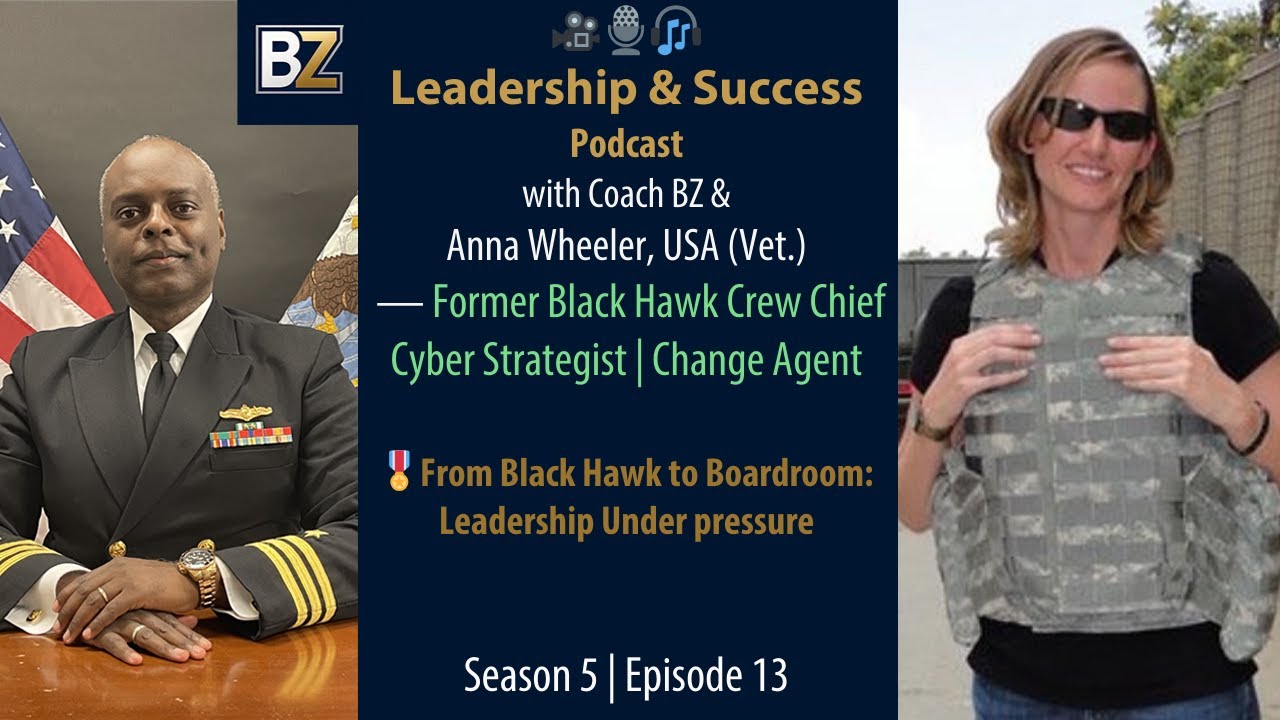
S5:E13🎙️ LIVE with Anna J. Wheeler, USA (Veteran)
Colonel Ice Gibson, retired Army officer and Harvard Business School faculty, discusses 25 years of military leadership in Iraq and Afghanistan. He argues that pressure builds character, failure drives growth, and pausing to make decisions with incomplete information matters more than speed, especially as AI accelerates everything.
Chapters
Hi, I'm John Maxwell. When the top companies in the world are looking for trainers, speakers, and coaches, there's one name that stands above the rest, and that's Maxwell Leadership. Our certified team members have gotten proven results for companies all over the globe, and our reputation, I'm proud to say, is second to none. Some of our members have risen to the top of their profession, including the one you're going to meet today. I proudly introduce you to my friend Bob Fabien Zinga.
Welcome to the Leadership and Success Podcast with your host, Coach BZ, where we help you lead with purpose and succeed with impact. If you're ready to grow into the kind of leader others want to follow, this podcast is for you. If you're determined to elevate your success and leave a lasting legacy, this podcast is for you. As my mentor, Dr. John C. Maxwell, reminds us, everything rises and falls on leadership. Our goal is simple: to inspire you, challenge you, and equip you with insights that can transform the trajectory of your leadership journey. Welcome aboard to another episode of the Leadership and Success Podcast. With Coach Beezy.
My name is, uh, Colonel Heiss Gibson. Okay. And I got— that's how I got, uh, first connected with West Point. And then I got recruited by West Point, um, during spring football my junior year, so going into my senior year. Now you said your dad did 2 years in the Army in the early '70s. Did he go to Vietnam at all, or was it all stateside? Or all stateside? Uh, he was in for 2 years, and he was an actual air defender. Now I understand what he was doing. He went from E-1 to E-5 in less than 18 months. And be fully transparent, so if I don't like you, I know you don't like you. I know you don't like me. However, if we're playing on a sports team, we're trying to win for the team and the town. So during those instances, it's not about you, me liking you. It's about we're representing the school but in Texas sports, you're representing your town. So I'm really smart in East Texas, and I wasn't very smart in prep school, and I was the most improved student for prep school.
Okay.
And so, but a lot of work. And so I learned how to study, I learned how to manage my time better. And had I not went through that prep school, there's no way I would have made it through West Point. Impossible. I want to back up just one second. Okay. The kicker of Iraq was that we were the first unit to be extended.
Ah, that's right.
I forgot about that.
So we were back in Doha for a week. First Cav—
Oh yeah.
First Cav was flying overhead and aircraft dropping out of the sky over Baghdad. I still had an aircraft back flying General Dempsey because we flew General Dempsey and Hertling.
Right.
And those guys. And my flight crew back then, back there with General Dempsey, knew we were being extended for an undetermined amount of time. Right. And so— This is bad. So we got, so a very, a leadership developmental experience was, what do you do when you have to tell a group of people who've been in combat for a year that they're going back to combat for an undetermined amount of time, they have 48 hours to get there. And so that was pretty developmental. Because I had to tell my team, and I already had people back in Germany drinking beer and hanging out with their families. They had to come back. Oh, it was just some crazy stuff. And as I think back, um, I write the experience that I had as a junior officer. We were making stuff up, and so that was the cool part. In Korea, having a lot of autonomy as a junior officer, as a company commander, I was made— I made decisions as a company commander that I could only make as a battalion commander over 10 years later.
Yeah.
But we were given full license in ways that we wouldn't give captains license today. Okay. Captain figured out. There's a lot of that. And it worked out more times than not, obviously. And then I went to grad school after we got back.
Yeah.
I mean, that's a big shift though. And after Germany, I went to Air Command and Staff. At Maxwell, and then while I was there is when I applied to grad school.
Okay.
Uh, I would say almost like an out-of-body experience. And I say that because, um, when you're in the environment, like any educational environment, you feel smarter. But when you're, uh, bebopping around with a backpack between, uh, Harvard's campus and MIT, which is where I spent my coursework time you feel like you should be smarter. And you're kind of wondering, like, how did you get here?
Kind of thing.
Imposter syndrome. Yeah, thing. I only went there because my wife made me apply. I mean, I applied to like 9 schools, 8 schools. Harvard was the 9th one at the last minute. Okay, I'm like, there's no way I'm getting in this place. What are you talking about? Why would I even waste $100, like, freaking interest fee? That school is expensive. Flight pay, whatever. And so, but I got in, I got an interview, I got in, right. And so And I chose it because I felt like it.
All right everyone, uh, welcome to another episode of the Leadership and Success Podcast. And, uh, like they say, the rest is history. I am really, really excited today, um, the guest we are about to speak with. And like it's a custom, we start with a moment of gratitude. And this is actually the third show today, so you guys know, for today I'm really grateful for the caliber of guest, uh, we have, uh, the Leadership and Success podcast, and we are going to be learning so much from them. So let me see if I can do a proper introduction about our guest today. We're going to be talking to Colonel Ice Gibson, uh, DBA, that's Doctor of Business Administration, from Harvard and U.S. Army retired. Dr. Gibson brings a rare blend of experience, 20+5 years military service including battalion command in the 82nd Airborne Division, very famous division in the Army, combat leadership in Iraq, Afghanistan, and also is a master aviator and operational strategist, Harvard Business School faculty teaching technology, operation management, crisis leadership, and team effectiveness. So he has led soldiers in war and taught future CEOs in the classroom and advised organizations navigating complexity at scale. Another thing we have in common is we are both proud graduates of the Black Corporate Board Readiness Program from the Levy Executive Center Business School at Santa Clara University in Silicon Valley. So without any further ado, would you please help me welcome to the Leadership and Success Podcast Colonel Ice Gibson. Good afternoon, Colonel. How are you doing today, sir?
Doing well, Coach Bizzy. How's it going?
Good, good, good. Really, really glad you are here. Maybe to get started, uh, what is one thing you are grateful for today?
Oh, that's, that's easy. Grateful to be able to wake up and have a coffee date with my wife. That's a daily occurrence.
Can you believe it's 2026? Happy New Year. Wow, time is flying, isn't it?
And 2026 is already flying. So Happy New Year. In a blink of an eye, we'll be back. It will be in 2027.
That's really crazy. So what is something about you that most people may not know when they first meet you?
I think that I'm far less serious than my bio might suggest.
Okay, and one thing you have often said is West Point is hard, but it's supposed to be. What did add teach you about leadership that comfort never could?
I think the reality is that you only, you only get better when pressure is applied. And so we think about, you know, how are diamonds made? You know, start as a, you know, a brittle piece of coal, and then pressure over years and decades create this thing that we find so valuable. I think leadership is the same way. You really don't know who you are as a person until you're in the crucible, whatever that crucible might be. I think in our experience, it's very much more acute in a military experience, which you can learn about yourself quicker. But by learning about yourself faster, you also have time to recover, learn and get better. There are some who might not find themselves doing hard things until they're much older and have little time to react. So I really think West Point as an initial crucible, along with playing football there, really laid the foundation for the ability to do harder things later in life.
Wow, that, that is really powerful. I remember I had this gun, one of my best people gave it to me. One side says success, and we know all about your successes, but it also says failure on the other side, right? Failure and success being two sides of the same coin. You talked about pressure. How has failure shaped your life? In my experience, it looks like I learn a lot more from failure than I do from success. And talking about West Point, I don't know if I had it in the clip, but I also learned that you first, you went to prep school and at one point you almost felt like quitting, and I can't believe that. And now you are a colonel in the most powerful army in the world with pirates? Like, what did all of that experience teach you? I believe that's also where you, you learn how to really study and do so well at school, so well that you are now Harvard Business School professor. Can you believe that? Wow. Can you tell us about that journey?
And so I think, uh, I think failures are really important. I think there's a lot of folks who run away from their failures. I mean, I can I can think back to failures in the 7th grade, not making the student council. It happened to this student government my whole time in high school. But I learned from that failure of not getting elected, not knowing what that meant, to go to the prep school where, you know, it's— it was back then, it was just math and English. Same stuff I was just doing in high school. But for some reason it wasn't clicking. And it could have been a lot of factors, being away from home, playing football, trying to figure out Army stuff. Everything happened at once. It just wasn't clicking. Uh, and so, uh, doing really poorly that first grading period, uh, you, you had two options. Either you, either you move forward or you leave. I can tell you I saw a lot of people leave over my time at grad school. And so, but when we think about options, remember this is 1992. So think about options. There's no NIL yet. There's, that doesn't exist. And so if I leave school now, what am I going to do? And so it, when it, again, pressure, when you're pressed against the wall, what do you do? You got it. You have to figure it out. And that's what I remember my dad telling me, uh, in no uncertain terms to, you know, you got to figure this out. And so, but that mantra continued throughout my time at West Point. So after that experience, quitting never entered my mind. So when you go to West Point, it's normal for folks to want to quit. That's a very normal thing. Any service academy, quitting is a, that's a standard thing.
Yes.
But for me, after that first grading period and figuring out how to manage, I never— quitting wasn't a thing. It was only graduating was the North Star.
Wow. That is really amazing. Actually, there is somebody we both know, General Biggs, Milford Biggles. Right there, very happy to wear his beat Navy t-shirt. I want to make him an offer. Actually, it's going to be much worse because Not only you are in the Army, but you actually played for the Army school. The offer I wanted to make you, sir, let me see, maybe you're gonna take it. I would like to send you this t-shirt. Just tell me what's your size. You're gonna get it next, next week. Is that a good offer or what? Yes or no?
I'm an XL. I have plenty of Navy shirts. One of my daughters, one of my youngest daughters high school classmates, is a plebe at the Naval Academy now. So her father's an alum, so are her three brothers. So I mean, that's wonderful. Naval people who will gladly wear that proudly.
Very, very good. Okay, so you growing up in East Texas with limited exposure to elite institutions, what internal belief kind of Kegidjufu environment where you were often the only?
I think, well, it's weird because when I think back to that period of time, you know, where I'm from in East Texas, it's pretty much a probably a 60/40, 50/50 split, not so much now, but between different demographics. And so, but you start to get separated in academics. So if we think back to how education was in the '80s and '90s, where you had different tracks, yes, once you started to get in the honors track, or AP track, as you call it now, the separation immediately happened. And so that's when, at least for me, I started being the only, or being fewer, which is fine, you know, you kind of go through working harder and figuring out your, your way and finding your space. And so that kind of helps mold, and then it's all about the goal. I mean, what's your end goal? I mean, I was fortunate to have my great-great— my great-grandfather, who actually went to college, 1925 to '26. So he came out of high school in 1925. The Negro high school in Lufkin, my hometown, only went to 8th grade. He went 30 miles away to another town where he met my great-grandmother, who also graduated high school. So if we think about the '20s, this is a very not normal thing.
Yes.
So I had the opportunity to talk to him, and he kind of pushed all of us to do the best we can. And not be deviated. Pick a goal, go for the goal, and don't be distracted by the noise.
Wow.
The internet allows a lot of noise now.
Yes.
Versus being violently focused on what is the goal, what are you trying to accomplish. And if you do it early, by working hard early makes your life easier later. I didn't understand that at the time.
I do now.
But, uh, you know, when you're a teenager.
Yes.
And an 80-year-old man is talking to you, just kind of like, okay.
Wow, that is— say that one more time. There is really a lot of wisdom, uh, in what you just said. So basically, you start out now, you do it early, but then later in life it's gonna make your life easier.
Yeah.
Wow.
Doing hard things early creates the opportunity to have a less hard life.
Life. Wow, that is powerful.
Think about— if we think about mentors and friends and people we admire, you start to unpack their life, you're going to find that all of them did massively hard things early. It didn't just happen when they turned 40.
Wow, that is, that is amazing. So let's go back to football, because I feel like with sports, especially team sports, there is a lot of leadership lessons you can get. Out of this. So how did football at West Point kind of shape the way you later led soldiers, faculty, and executives?
I think playing any team sport, playing any sport generally, is really good. And if we look at research around senior leaders and organizations, on average, you start to unpack, you'll find that most senior leaders of any type have played sports. In college or somewhere. The sports are in the background. And so, and then team sports is even more dynamic. And when you think about football, uh, college football, where everybody's good, and all of a sudden you're on the field and not everybody can start and play, you have to really get good at playing your role, whatever that role is, thinking about what's in it. West Point is the betterment of the team. And reality is you don't have to play. You— I could, I could have quit and went on and just been a cadet. Kept moving, and not subject myself to 6 hours a day at the football stadium, and early morning workouts, and not leaving. I think my senior year, I did not leave school. I did not go home for like a year, for 12 months straight.
Wow.
Because we had workouts, and we as a senior group decided we're going to stay here. And so So dealing with people, dealing with different personalities, working through, you know, yeah, you're on the same team, but you know, you're all different people. You learn how to deal with different personalities and motivate in different ways.
Wow.
Again, figure out your role, whatever your role is, that makes this engine go is really important.
That is really fascinating. So as a battalion commander, You've been responsible for lives, for mission, and hundreds of millions in assets. What kind of separates leaders, in your experience, who perform under pressure and those who fracture?
I think that's a great question. I think what really separates people under pressure— the difference is how they manage, or if they have, a tactical pause. Normally, as a leader, I've learned the first report is always wrong. Yes, no matter what it is, the first report is always wrong. And so if that is true, maintaining a calm demeanor, allowing people to do their job, ask a lot of questions, not making any decisions too hasty unless life, limb, or eyesight are at bay. Are massively important. There are some leaders who just run to the sound of the guns. If we think back to a great movie, and a great book, We Were Soldiers Once and Young, you see the difference in lieutenants who were in that organization, one who was looking for glory, unfortunately, get— make an ultimate sacrifice, versus the sergeant who cared about taking care of his his team when he was a separate entity during that period. Two different people about the same age, right?
Yes.
A sergeant and a lieutenant about the same age, but one looking for glory and one focused on protecting his team.
Yes.
And making sound decisions. A lot of leaders, especially now because information's coming so fast, are really quick to move versus pause and analyze what you do. Take in some feedback. Now you can't do that for everything. But once you have enough pattern recognition, you know when you should run and when you should just sit.
Yes.
But that's a train— I think that's also a trained, a trained behavior that fortunately, in the military environment, You learn over time.
True. Hmm. So in the combat and crisis, what kind of decision did you make with incomplete information? Like you said, the first report is almost always wrong. That kind of still guides you today as a leader, even as a professor?
Well, I think that's a great question. I think one, just thought of one. So one is being comfortable and being uncomfortable and taking massive risk. And I think back to a time in Afghanistan when weather was bad, and we had to, unfortunately, had to medevac out a young Marine who had just been injured. But the weather was bad. And so how do we get this guy? What do we need to do? And fortunately, I had one of my captains who was very resourceful, knew a guy. There's always a guy when you're in combat. It's kind of like being— if you remember the show M*A*S*H, any kind of weird old '60s or earlier kind of war movie, you just kind of know people and just kind of make stuff happen. And we were able to redirect Air Force assets.
Wow.
To show up at a specific airfield at a specific time and launch aircraft from two different areas to meet this aircraft in order to transport that, that soldier, that Marine, in order to get him to the next level of care. Had we not done that, yes, worse would have happened in that time. And wow, that'd take a lot of risk. And had to make decisions very quickly. And almost hope that the people in the aircraft will take a little bit more risk in order to make this mission happen, because it was so important.
Yes.
And so trusting your decisions, being accountable for those decisions, are things that I've learned over time, and very comfortable with. I asked a lot of leaders, corporate leaders, what, how much information do they need to make a decision? It's normally, normally a lot. And I'll, and I will always say, well, I'll make a decision. You give me at least 30% of information. Yeah, I'll make a decision.
Okay. I think General Powell said 45%, right? 45% to 70%, you should be able to make a pretty good decision. But wow. Yes, that's true. Because I think so many leaders kind of, no, I guess they get through what is it called paralysis by analysis, analysis, and, uh, they just do not move and don't make a decision. Sometimes they just, no, like General Powell says, you miss your opportunity when you do that. Wow. But now for the junior officers who are listening now, and of course the decision has to be, you know, legal, ethical, and moral, but, uh, we do need people to be more proactive and resourceful. I think that's the, the, the word you, uh, chose. What would you advise junior officers who are listening right now, maybe they aspire to command one day, because I've seen a lot of officers where they want to be so careful to follow the rule and stay within this black-gray thing where they don't really do very much to advance the mission of their organization. And it's almost like paralyzes them even where they could have done so much more, but because no, they just want to stay within the line. But anyway, which advice would you have for JOs who might be listening now?
Well, I think, I think that's a great question. I think for junior officers, what I would recommend they think about, and again, different time, we were built in different, in different times. And so, uh, for example, when I think about the amount of latitude I had as a first lieutenant flying in Korea, all over that country on the DMZ, uh, the latitude I had as a company commander in Iraq, uh, to make decisions, the kind of risk that I assumed every day in Iraq were the same similar decisions I was required to assume as a battalion commander.
Wow.
10 years later. So that's practice. And so staying just inside the box isn't good enough, because there's going to be moments where you have to know when to push the boundaries. Here's a great, here's a great example. It's kind of a funny example. When we deployed, because we deployed to Iraq in '03, at the very beginning of the war, we followed the 3rd Infantry Division. So if we remember, 3rd Infantry Division ran through up to Baghdad. They had been in country for a long time. 101st had come in to help with the invasion. Then 1st Armor comes, 1st Armored Division comes to clean up everything. And so we, we missed all the hard part, which means we deployed without uniform, tan uniform, one of the things, tan boots didn't exist yet. So we, deploy what we had, which meant by the summer, that kind of heat.
Yes.
Pilots and crew chiefs there, and we didn't, you know, didn't have a quartermaster platoon to wash clothes. So their uniforms are starting to break down, their shoes are starting to break down. And so I'm like, okay, I got to— this is ridiculous. We got to figure this out.
Yeah.
So I tasked one of my first lieutenants whose father was a warrant officer deployed with the South Carolina Guard to Doha, and who knew of a, a supply area. And I was able to launch my helicopters to—
wow—
and sign legally Yes. Or uniforms. When they arrived, I had to go see my division warrant officer and add them to my property book because they now become part. But so not doing anything. So, mm-hmm. Not operating or more unethical. But hey, here's a problem.
Yes.
We need to solve it for the betterment of our soldiers and our pilots for comfort because it's hot. Yes. Leather boots are about to fall apart. So I went to my first sergeant. Who found on Baghdad International Airport, the one quartermaster platoon.
Wow.
Did laundry. So my, so my first sergeant became Instacart before there was Instacart for 50 men and women.
Wow.
And get their laundry done once a week.
Yes.
Nobody told him to do that. He's like, I need to take care of my soldiers. Man's thinking outside the box. In really austere environments. If we think about— yes, what, what if we can envision what Baghdad was in the summer of '03?
Man, that is really incredible. Really always focusing on the people. And you also mentioned earlier, right, many times in those environments, you were the only one, and you've led diverse teams throughout your career. Leading diverse teams, especially in high-stakes environment, how do leaders move inclusion from just a value statement into an operational advantage?
I think— well, great question on broadly inclusive leadership. I think unfortunately, when we think about diverse teams, in our minds, we quickly go to, the things we can see, which obviously makes sense. But in the military, in my opinion, especially in aviation, where it's on the face, highly homogeneous. The difference is the unique mosaic of the US and what serves the soldier from Arkansas, you know, the same as the, the aviator from Illinois, which is not the same from the crew chief from Washington State. Those are vastly different people. Yes, vastly different backgrounds and understanding. And having empathy to pull all these voices in, especially in critical times, is really important. And so there are moments where it needs to be my way or the highway. Yeah, I became more seasoned. And because in aviation, I have this unique weapon called a warrant officer, who's an expert, you got to take their, their voice into account. Yes, that's what they do. You know, and when people see you're listening to them, and taking their opinion, and then maybe not taking everything they say, but sometimes giving them feedback on, hey, thanks for your contribution. This is the decision I made. Yes, this is why I made it that way. I really appreciate your, your, your feedback. Yes, they're going to continue to give you feedback.
Wow, that's powerful. Hmm, talking about aviation, because in aviation, mistakes can be quite unforgiving, right? One thing people don't understand in the industry is when we make certain mistakes in the military, you know, people might actually die. So how did that kind of shape your risk calculus as a leader in general?
That's interesting. I think, luckily for me, a lot of that risk tolerance foundation happened in Korea when we weren't in any war. Korea was the hard tour in the late '90s. The— flying on the DMZ every day, having to take things into account, helped shape how I thought about being in Iraq, where we What is the mission and what's the leader's intent? Whatever that commander's intent is kind of shapes it and ensuring everyone recognizes why the intent is laid out this way and being and putting the best team available forward to complete the mission. I think, I think it comes from a lot of practice and a lot of failure. You're going to make mistakes. But fortunately for us, if I'm honest, a lot of the mistakes that I got to make were doing large training exercises in Grafenwöhr, Germany, and Fort Polk, Louisiana. If I made mistakes, luckily, those mistakes were made in a training environment.
Yes.
Which— so a lot of practice. So when you go to the big game, you're going to make mistakes, but they'll they'll be less impactful, hopefully.
Yes, yes. Wow, that is quite insightful. There's definitely big differences between, uh, you know, the military and, uh, the civilian industry population at large. But looking back at your time in Iraq and Afghanistan specifically, what leadership behavior matters most to soldiers but are rarely written in doctrine? Because as you know, we have a lot of leadership classes and teach about doctrine, and it's a lot of theory. But right there in practice, high pressure, where life could be on the line, what behavior actually matters most for your soldiers? Empathy.
Hmm. And on the face of it, I'm probably not the most empathetic person you're going to meet, just generally. However, in certain times where empathy was actually most needed and required, that's where the connection came. If we are honest, people don't, you know, you know, it doesn't matter if the people like you as a leader.
Yes.
I mean, likership is kind of important because people will listen to you if they like you. But what does matter is if they respect you and understand that the decisions you're going to make are in their best interest. And so they trust your decisions, even if they're ones they don't like. Hmm. And so there were many times where, in the moment of bad things happening, I always took a pause and looked at the person most impacted.
Yes.
Are you okay? Hmm. How are you? How are you doing? First?
Yes.
Okay, you're good. All right, now let's focus on this problem.
Hmm.
That was the most impactful learning that is carried with me throughout. And that's directly transferable in the corporate, where bad things happen all the time. Someone sends a, you know, someone's an email tough guy, to the email that they probably shouldn't have sent, that may impact revenue in some way.
Yes.
You know, and then having to manage that personality is really important. But you don't know what's going on behind the scenes. You don't know what's happening in a person's home life. You don't know what they dealt with today or yesterday, which is impacting how they show up in this moment. And taking a moment just to ask is really important.
Are you okay? Powerful. Wow. And the other thing too, right? Especially when you compare the military with what people do in the civilian world when it comes to leadership, especially high-stakes environment, how do you kind of build trust? Because sometimes you don't have a lot of time, right? You have this mission and you have to build trust pretty quickly and there is a lot at stake. What would you advise an incoming leader to do in order to kind of build that trust as quickly as possible before things start flying all over the place?
Well, I think doing initial research on what you're about to get into is really important, and figuring out who's who in the arena, like who's on your roster, is really important because not everyone on your roster really cares about your success. And so you have to work through that. So you have to build trust with people quickly by pulling them in and hearing what they have to say. But, but, and through asking a lot of questions, which is really important. And then sometimes organizations, the person who you're pulling in, they're good. But what's, what's interesting is that a lot of times, their second, this person behind them, is better.
Hmm.
So is that— is the person who, who needs development getting enough opportunity as well? So as the leader, figuring out who are the— who are the players, who are— who's in the arena? But then, are they mentoring someone else? Or who's next in the organization? And how do you make sure that person gets validated? And gets some kind of high fives for what they're doing. Because they may be the anchor, the foundation of the success of that division. But you'd never know it if you don't ask, which means, as a leader, you need to do a walkabout and leave your office and leave the email and go hang out. We both know, military organization, the most truthful person in the organization is like the E3, the enlisted 3, enlisted 4.
Yes, they're the most truthful.
If you want to know what's happening. And if your intent is driving down, oh, just go ask the private first class, or the specialist. Yeah, you might not like what you hear. But you're going to hear the truth.
So true. When I became a commanding officer, one of my chiefs told me to do just that. Once a quarter, I will speak to E5 and below, no chiefs, no officer, just me. And, uh, I didn't have any rank. I was just another sailor. Just speak, speak to me, tell me the truth, what's going on in here. And they always appreciate that very, very much. Wow, that is powerful. So let's talk about your transition. Uh, when you arrive at Harvard Business School, what did you notice, um, business leaders misunderstood most about leadership under pressure?
Uh, well, I arrived in 2021 And I think what is consistent is that most leaders don't have the same development that is resident in the military, which means they've learned, they've learned through on-the-job training, they had a way of operating, they have one hammer.
Yeah.
And everything's a nail. And so when they arrive at the Harvard Business School is a great opportunity to increase their leadership tool bag and maybe throw a wrench in there, a power tool, you know, a ratchet of some type. And so I think really recognizing that their one way is not the only way. Because a lot of successful leaders, which is great, have been successful through a Peter Principle, you know, well, I've always— this always works for me. This one way always works. Well, in my experience, one way does not always work. So is your playbook that you have agile enough to be generalizable enough to do many different things? Most leaders don't have that.
Wow, that is quite insightful. Because another thing that you teach is crisis leadership. So the question I have for you is, how does system thinking kind of help leaders avoid simplistic solutions to complex human problems?
Well, I think that's a great question. I think what— how systems thinking actually helps, it helps breaks down the complexity. And so if we look at any large challenge or problem, well, what's the first thing you care about? You got to pick and prioritize what you care about and focus there. Once you get that under wraps, under control, then you can move on. Unfortunately, sometimes in crisis we try to take care of everything, which spreads you too thin. You're not ready, you're not prepared, versus, versus focusing on the things you can actually control and not worry about the noise. And so if we think about any combat area, what's the first thing you want to do? Well, you gotta provide security. Well, but before you do that, you need comms. Because you don't have communications, you're just camping. Yes.
Hmm.
Wow. That's, that is really a great way to think about this. Let's talk about modern leadership in this tech, AI-driven world and the complexity that comes with it. So in an era of artificial intelligence, cyber risk, and constant disruption, what leadership skill do you think is becoming non-negotiable?
I think a leadership skill is becoming non-negotiable is the skill of having a pause. Because so much information is coming, you're challenged at doing all the analysis. And people are quick to make decisions.
Yes.
Without first asking the question, what's the second and third order effect?
Hmm.
And so, in that pause, does that mean you're waiting an hour, 30 minutes, 5 minutes? That pause could be 60 seconds. 60 seconds of silence is a long time. Yeah, just for you to capture your thoughts, to figure out where do you want to go, to decipher what's most important. That's it. And I would call that Leadership 101.
Yeah.
But in the current environment, where things are moving so fast, that is almost a forgotten art.
Wow. Yeah, there's definitely an art and a science to leadership. Our first question from the audience, Nicola Mueller is asking, when do you as a leader in the Army decide who to trust to take over your leadership, or leadership responsibility, especially when it comes to life and death? And in situations where you are forced to give up leadership without really 1 and 2? Good question.
I think, one, that's a great question. So thanks, Nicholas. I think mainly because of the structure of the military, and we're a service-based organization. So service-based organizations have the same kind of servant leadership ideology, which means we want to, when we come to an organization, So like, I've been in command of a number of things. When I was a company commander, I would always say, this is not my company.
Hmm.
This is the Army's company. I am just a custodian for the time that I'm here. And then I want to make it better than when I had it. Now remember, we have so much rotation. By the time I leave 2 years later, it'll be a different organization anyway. And so it's on me in those moments. To focus on development. And so who do I trust? The folks I'm developing is my charge to fill the gap. We don't have the luxury of just firing people and finding a new one. Whatever lieutenants I get issued, whatever senior leaders I get issued, I can't fire them. So I got to figure out what's their best and exploit it for the betterment of the organization.
Wow. That is quite insightful. During the research for this podcast, I know that you've written about T as in Tango-shaped leaders. What must leaders go deep on and where must they stay aboard? And also, what do you mean by T-shaped leaders?
Okay, great. So I appreciate that. So when I, when I write about T-shaped leaders, just for context, T-shaped leadership is not a new concept. It's been around for over 3 decades. And so, and what that means that you have depth and breadth. And if we're honest, when we come out of college, we all have a little depth. When we first enter the military, you know, we got a degree and yeah, that's about it. So we're kind of an I, we're not a T yet. But as we have experiences, we start to gain breadth and we understand how the organization works. And so I think what's really important is for leaders early especially when you go into your first organization, to get really good at whatever your trade is. For me, it was being a pilot. So when I showed up to Korea, I didn't fly for 10 months. I was an Apache AA-64 maintenance platoon leader. What is that? I didn't know what that was either. Uh, but it was a captain's billet, not a second lieutenant's billet. And so I had to learn. So I didn't fly at all. I had to learn maintenance. On an aircraft I don't fly, that, you know, don't care about. But I had to learn how to care about that. So I got really deep in maintenance, maintenance, not just the patchy maintenance, but maintenance. Well, that would serve me when I became a platoon leader, Black Hawk platoon, that deeply understood maintenance. But what do I need to get deep on? How do, how do I fly this thing? Well, I fly it by myself. So that's became my— you become an expert or something. What are those things that you would say you want to get your 10,000 hours in so you can be good at it? Because that's what it takes. That is amazing. Over time.
Yes. Wow. That's, that's, that's amazing. I guess that's what also really allows you to really have that big picture, right? I guess as a leader, you have to have the big picture. You have, you have to see the jungle, but then you also have to see the trees individually kind of at the same time and not kind of lose sight of it. It's It's incredible. Okay, so, uh, you've really been, uh, successful in, uh, many areas from the military, from the prep academy to becoming a colonel, which for those who don't know, that's only one promotion away from becoming a general officer. So that's a very, very big deal. And then now you got your DBA from Harvard and you are now at Harvard Business School professor. Why do you think you've been so successful? What do you believe is the secret your success?
So I think that's a, that's a great question. I think one is family, having a very supportive family. That's really important. And a wife who's been willing to move around a lot. And then I think having the fortunate opportunity to be on a lot of great teams. And engaging a lot of great folks. I mean, you know, as a lieutenant, my first flying battalion commander was a guy named Lieutenant Colonel Stephen Dwyer, Class of '80. I still talk to Stephen Dwyer. I send him Christmas cards. I taught one of his sons math at West Point. Wow. And so, and so, or having leaders like Major General retired Barry Price, or current General Ron Clark, or recently retired Lieutenant General Beegs, Mm-hmm. Ofer Beagle. So having a lot of great folks, yes, who poured into me and showed me how to be a good mentor. Hmm. And also how to be a good mentee.
Yes.
Was massively important. Because when I think about folks who have shaped me, I think of guys like Colonel, Colonel D.A. Harris, who was my brigade commander in Iraq, who I just talked to last week. And so, and so again, these relationships stay for a long time.
Yes.
But, and they want to see you succeed, but they're also modeling what success looks like.
Wow, that is Powerful. So just in general, in life and in leadership, what do you think is one of the greatest lessons you've ever learned?
I think the greatest lesson is the old analogy: if you take care of your people, they'll take care of you.
Yes.
But remember, in the Army or military, it's not about us, it's about the organization. It's about the institution. That's what it is. And so, but the foundation of the institution are the people inside of it.
That's so powerful. Yeah, my chief taught it to me, mission first, but people, people always. It's incredible. And we've got Dr. Ryan Scott who says, great question and exceptional responses. Leadership does not stop when you take off the service uniform, just transform. That's so true. And Nicola says, great conversation, thanks. He has to leave now, but God bless you too. All right. Thank you so much for the audience. If you have more questions, we have about 10 minutes left. Type it in the comment, and we're gonna try to answer live. Okay. What are you learning right now, sir? I know leaders are learners. What are you learning these days?
Well, what I'm focused on now is more around as we think about— so I care about operational leadership, I care about people, process, technology integration. And so As we think about— I mean, if we think honestly, we've cared a lot about cybersecurity broadly. But what about AI-enabled cyber? And so really thinking about and trying to better understand ways in which to help leaders tackle the reality that you're in a world that's moving so fast.
Yeah.
And how do you prepare your organizations for the AI reality, and how do you think about security? And then how do you consider, is your organization ready for what you're trying to implement? Do you have— are your people inside ready? And then how are your customers going to, or consumers, respond outwardly? So there's a, there's a tension there that is not mutually exclusive. One would say AI AI and cyber separate. Yes, I'm thinking about it together and then thinking through what are frameworks to help leaders manage their organizations in this new reality.
That is powerful. And, uh, if you could choose 3 people to have dinner with, they could be alive, dead, or even mythical figures, who would you choose and why?
I think that's a great question. To be honest, I think I would love to have a conversation with Brigadier General Charles Young. He's the third African American graduate of West Point. He's the first Black colonel. He just became a general officer posthumously a few years ago. Because I think a lot of things that he was dealing with, not only during his West Point time, 'cause he almost failed math, almost got kicked out for that, and had to fight through his career and help others. I think there's eerie similarities to what he went through at the turn of the century and what we're going through now, that's one. Number 2, I honestly think I'd want to have dinner with—
let's see—
I'd want to have dinner with President Obama.
Mm-hmm. Yeah, right there.
Just to mainly just gain his insights. On where we were, where we are, and where does he think we're going. And because of the scope of his role, yes, the ability to see strategically is super important. And then I would love to have dinner with Buffett.
Yeah, Warren Buffett. I think he's retiring this year, I believe, right?
He is retiring. But him because he's been, he's been really focused his entire life. And that level of focus is inspiring. Yeah, I'm just, you know, and I'd be curious to understand. He's seen the markets change over decades, but has always won.
Wow, that's powerful.
What, what is this playbook? And what can we learn in the fast-paced world that we're in right now.
Another thing I really love about him is he's very humble, still living in the same house he lived in a long time ago, still driving a regular car even though at one point he was the richest man in the world. And he's also getting rid of his wealth. By the time he dies, he's not going to be wealthy anymore, really giving it away for good causes. That's really impressive, very inspirational. Wow. Okay, let's talk about books a little bit. We do read a lot here and we were in the green room, you recommended this book? Why should we read this, Responsible AI?
Well, because I think one, one, I think it's a good book, because I'm in the middle of it right now. And two, I think because this is the question, right? I mean, if you think about artificial intelligence, as we think about what's happening in the world, but before we integrate AI, before we start building models, we need to think about what's the ethical implications. And how do we train people to really be ethical? So some would say you can't build leaders. Well, yeah, you can. West Point does it like every day.
Yes.
West Point has been building leaders of character since, you know, 1802. So, but part of that character development is ethical development.
Hmm.
Okay. And it's super important, especially as the leader of an organization, to be able to ask The right questions.
Wow, that is powerful. What about this book, Friends of the Good?
I think this book is, is going to be amazing. Because as we think about our journey over time, not all friends are friends of the good. Some friends who are there to— friends of pleasure, some friends who are very transactional. And I think Damon, the author, He's going to do an amazing job at telling his story, but really making us, making us think about what, what is a friend? What really is a friend? And what kind of friend am I? So I think it's going to really cause a reflection in a meaningful way to really cause a lot of thought.
And this book is going to be published soon. It hasn't been published yet, but people can preorder right now.
Correct. Yep. And then get published, I think, on May 31. Okay, May 31.
Definitely gonna be looking for it. And maybe if I can find Damon Martin, I can have him on the show too. And one final book, We Were Soldiers. Now, people I know, they've watched the show on TV. Can you tell us about this book?
Well, this was, it was required reading when I was a cadet. And when the movie came out, it was also really good. But I think it really shows all the different levels of leadership. Because we think about General Moore when he took over and created the, the cavalry, uh, Custer's nomenclature for the cavalry at that.
Yes.
That was the first, one of the first integrations of helicopters into Vietnam.
Wow.
And so if we— and so he was really creating the way in which we would fight with helicopters in a jungle environment that would translate to urban environments.
Yes.
You know, and so, and then how does he grow a team, build a team, invest in teams, partner with peers, partners with his senior enlisted advisor, there's all the levels of leadership in that book. And if you think about it, hmm, he did deep study. Before he went to Vietnam, he read about deeply the French mishaps in Vietnam 10 years prior. So, wow. Yeah.
So that's pretty amazing. So if you had one and only one day to live, what would you have liked your final contribution to be?
I think for me that my family is able to continue to make a positive impact on the world.
So if you had a magic wand, you could solve any problem at all. What is the one problem you would like to solve first thing tomorrow morning?
The one problem I would like to solve is the, the socioeconomic inequity that just exists broadly in the world.
Yes. And so we are coming toward the end of the show. How can we add value back to you?
I would just say continue to, to follow, engage, and provide feedback. Reach out if you have questions. I'm pretty easy to find. And that'll be about it.
All right. Is there a question, sir, I should have asked you that I haven't got a chance to ask yet?
I think the one question may have been, how much more does geography matter? Meaning, I think there's a lot of folks who may run away from wherever they came from and not appreciate your foundations of who you are. Growing up in East Texas is built who I was. So when I think about how did I become whatever I've become, it doesn't happen if I don't grow up. Yeah, in East Texas, in Lufkin, in Angelina County, in the family that I was— that I grew up in. Yes, none of it exists, or the drive is not imprinted without that environment, uh, that I was fortunate to be born into.
That is really powerful because, uh, next question I was going to ask you, sir, is if you could go back and give a piece of advice to your 17-year-old self, what would you tell the 17-year-old Ice Gibson standing at the edge of this incredible career you've had both in the Army and at Harvard Business School, what would you tell him?
Definitely go to West Point because that's the best decision you're going to make in your life.
Yes.
Wow, powerful. Wow. Wow. Okay. We are at the end. I think we are on the top of the hour now. I guess the very last question I have for you, sir, is what is one word that represents our shared experience on this podcast? Today? One word that comes to mind?
Uh, I think impactful.
Thank you. Well, I am so grateful for your time, and thank you for being one of our master teachers today. Thank you so much, Colonel Gibson. Really appreciate that. Thank you.
Appreciate it.
All right, everyone, that was the Colonel, the Doctor, the Professor, uh, Ice Gibson. And, uh, thank you so much for watching. Actually, in about 20 minutes, I'm gonna come back this time with another helicopter crew member, Anna Wheeler. She was the former Black Hawk crew chief. She's gonna be on the podcast in about 15 minutes. She's also a cyber strategist. So we're gonna be talking from Black Hawk to boardroom leadership under pressure. And this Sunday I will speak to another cybersecurity expert, Daya Ramesh. We're gonna be talking about cybersecurity being existential. And then next week I will have the pleasure of speaking with Commander Erika Dobbs, US Navy retired. Like me, she got in as a seaman recruit, E-1, lowest rank in the military, and she retired as a commander. And now she's a tech CEO too. So we're gonna be talking from seaman recruit to Navy commander to CEO. And on the same day, I will also speak with Lisa Fan. She's a mentoring architect. She has two bestselling books on mentorship, the latest one, "The Mentor's Guide." She also has a TEDx talk about it. So I can't hardly wait to speak about mentorship with her. And also today I'm continuing my series, special series on the Book of Proverbs. It's not religious at all, it's just looking at ancient wisdom and mentoring from the Book of Proverbs. We are focusing on ancient wisdom and leadership lesson. Whether you believe in God or not is not important, it's the leadership lesson we get from ancient scripture like the Book of Proverbs. So today we're doing chapter 8, tomorrow we're going to do chapter 9, and we're gonna finish at the end of the month with the 31st chapter of that book. Okay, that's it I have for now. So see you in a little bit. We're gonna be having again Anna Wheeler next on the Leadership Success Podcast. Thank you so much for your support and for watching. Bye for now.
Thank you for tuning in to the Leadership Success Podcast with your host, Coach BZ. If today's episode added value to your leadership journey, be sure to subscribe, share, and join us again for more wisdom nuggets on how to lead better and achieve greater success. Remember, leadership is the most critical skill of our time. The world will always need leaders to inspire others, drive innovation, and execute meaningful strategy. So why not count yourself among the bold leaders shaping the 21st century? Until next time, stay inspired, stay committed, and keep Keep leading with excellence.
More from Bob

S250:E4🎙️LIVE 🇺🇸America 250: President Barack Obama Leadership, Service, and the Power of Hope






S5:E157🎙️ LIVE with CMD CMSgt Dennis L. Fritz, USAF (Ret.)(Multi Tracks Audio)



S5:E156🎙️ LIVE 🇪🇸 Leadership Lessons from the FIFA World Cup 2026 Champions (Multi Tracks Audio)

S250:E3🎙️ LIVE Leadership Lessons from America’s First Documented Family of African Descent 🇺🇸📖