S5:E130🎙️ LIVE with Coach Lorna A. George🇨🇦 (Multi Track Audio)
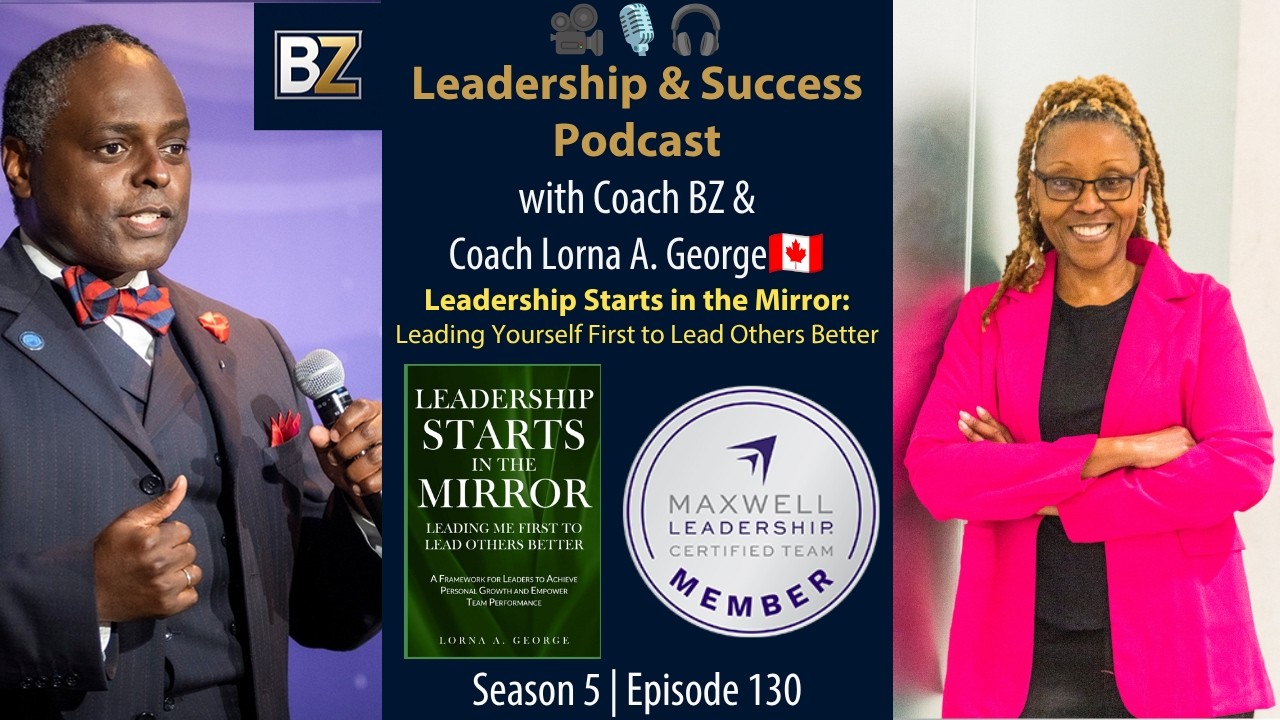
Coach Lorna A. George left a 20-year law career to become a leadership coach, driven by hearing loss and burnout from family law. She built the VIP framework (Values, Impact, People) and the STATSS model for organizational alignment, and now runs a scholarship for Black women in STEM. Her core belief: leadership starts in the mirror, and most people block their own potential with limiting thoughts.
Chapters
Hi, I'm John Maxwell. When the top companies in the world are looking for trainers, speakers, and coaches, there's one name that stands above the rest, and that's Maxwell Leadership. Our certified team members have gotten proven results for companies all over the globe, and our reputation, I'm proud to say, is second to none. Some of our members have risen to the top of their profession, including the one you're going to meet today. I proudly introduce you to my friend, Bob Fabien Zinga.
Welcome to the Leadership and Success Podcast with your host, Coach BZ, where we help you lead with purpose and succeed with impact. If you're ready to grow into the kind of leader others want to follow, this podcast is for you. If you're determined to elevate your success and leave a lasting legacy, this podcast is for you. As my mentor, Dr. John C. Maxwell, reminds us, everything rises and falls on leadership. Our goal is simple: to inspire you, challenge you, and equip you with insights that can transform the trajectory of your leadership journey. Welcome aboard to another episode of the Leadership and Success Podcast with Coach BZ.
Many organizations assume that if performance exists, alignment exists, but that is not always true. A company can be profitable and still struggle with disengagement, leadership fatigue, communication breakdown, and inconsistent decision-making. Because organizations do not rise or fall only because of strategy, they rise or fall because of leadership alignment. Hi, my name is Lorna A. George, and I partner with women in senior leadership positions who are seeking greater alignment between their values and their leadership role. Because when leadership becomes misaligned, even high-performing organizations begin to feel the impact. And that is why I created the stats framework and the VIP framework. The stats framework help organizations identify where they are operating in stagnation, transition, aspiration, or significance. And the VIP framework focuses on the 3 critical leadership pillars Values, Impact, and People.
All right, everyone, welcome to another very special episode of the Leadership and Success Podcast. Do we have a treat for you today. So before we get started, as is our custom, we like to start with what we call, you know, moment of gratitude. So you already know what to do. So If you would please close your eyes and put yourself in your happy place. And while you are there, take a deep breath and think about one thing you are grateful for today. Well, today I am really grateful for the power of technology. It is really, really amazing to me that I am here in San Francisco Bay Area, Silicon Valley, California, and I am able to talk to somebody all the way on the other side of the world in Canada, Ontario, and we can talk in real time and share knowledge and collaborate. And that is just so, so wonderful. I am so, so grateful for technology today. So let us know what you are grateful for. Let us know where you are joining us from, what city, what state, and if outside of the US, which country. I know I have invited all of my friends who live in Toronto. I think about 100 of you. Hopefully you are watching live. So let us know you are here. And, uh, let us know what you are grateful for. Also, if you have a question for my guest, go ahead and type the question in the comments on YouTube or LinkedIn, and we're gonna be answering live. All right, without any further ado, let me see if I can properly introduce our guest today. I do believe that leadership doesn't begin with a title, it doesn't begin with authority, it doesn't begin with a corner office. A command, or a position. According to executive coach, corporate facilitator, author, and Maxwell Leadership Certified Coach Lorna A. George, leadership begins in the mirror. So Coach Lorna is the founder of Equipping to Thrive and author of a powerful new book, Leadership Starts in the Mirror: Leading Me First to Lead Others Better. So after practicing law for more than 18 years, Lorna dedicated her career to helping leaders move beyond achievement and into significance by aligning their values, impact, and people through her transformational VIP framework. We're gonna be talking about that today. In this, uh, thought-provoking conversation, we are going to explore what it truly means to lead yourself before leading others. Part of what you're gonna be learning is why self-leadership is the foundation of effective leadership, but also practical strategies to lead with greater clarity, Confidence, authority, and purpose. So, but what if a great leadership breakthrough begins with developing ourselves? This is a conversation you would not want to miss. So ladies and gentlemen, uh, without any further ado, please help me welcome to the Leadership and Success Podcast, the one and only Coach Lorna George. Hello, how are you doing today?
Hello, you. Thank you so much for that introduction. Oh my goodness, you let me so So thank you. Thank you. Thank you. I do appreciate it. Thank you.
It's really, really great to be seeing you today. I guess we really never met in person, but the first time I talked to you, I think it was a couple of weeks ago, I felt like I've known you all of my life. And I think it's because we pretty much have very, very similar values. So maybe to get started, is there something you are thankful for today, Coach Lerner?
You know what? I'm thankful for freedom.
Yes.
You know, I am so— when I look about all what's going on around the world, Coach Bob, I am so thankful for freedom.
That is so powerful. And I know in the US we are going to be celebrating on June 10th, this Friday, when African Americans were finally set free from the bondage of slavery. So definitely going to celebrate that. There is absolutely nothing like freedom. Is there something about you maybe that most people may not know when they first meet you that you're willing to share?
Well, um, I've got a hearing disability. I messed my hearing up, you know, while I was in law school as an adult, which is kind of sad, you know, playing headphones really loud and it ended up damaging my hearing. So yeah, that was, that was a struggle, you know, something I had to deal with.
Yes.
Yes.
Sorry to hear that. Is there any technology today that can help you hear better?
Well, I do wear a hearing aid, and sometimes, you know, back in the day or, you know, recently, sometimes when I'm in court, I remember on one occasion it was going off and the reporter said to me, well, can't you take it out? And I'm like thinking, if I take out my hearing aid, I can't hear. So, and that's the problem with having a disability that's invisible. Yes, you know, people see you and sometimes you're talking to you and you don't hear, and they may make some assumptions. So, so that's, that's one of the things. So, you know, so if you're talking to me and I ask you to repeat— I'm not wearing them now because I've got, I've got these headphones in, but, but yes.
Well, thank you so much for, uh, sharing that. I know a lot of people who watch these shows are in the military, and I also know there is a lot of undiagnosed PTSDs in all branches of the military. I ended up being diagnosed myself a couple of years back, but I guess the way I look at it is maybe leading with other ability, I think. But yeah, thank you, thank you for sharing that. I guess many people, they do know you today as an executive coach and a leadership facilitator, right? So, but your career really began in law, like you just mentioned. Tell us about your journey from litigator to leadership coach.
Yes. So, so I'm still practicing law, but I'm out of private practice. So I, I'm still practicing, still in the field of law because I've got to tell you, it is something that I love. I, I really do love it and I will find it hard to leave it behind.
Um, which, which part of the law do you practice?
Um, well, right now I'm in the criminal— I'm doing the criminal part of it. But the backstory in how I actually get into coaching has to do when I was in another area of law, family law. And for anyone who is on the podcast who has practiced family law, you know how emotional draining that can be. And that is one of the things that, that start my pivot. But I'm getting ahead of my story. But yes, but, but I, I love law. And, um, yes, so it's— I've been called now just over 20 years. Wow. Yes, that I've been— because I went back to school as a mature student, um, after leaving the bank, which the bank was really the genesis for writing the book. But, um, yes, so in 2018, I actually, you know, there's a discomfort that's started in 2018, you know, when I said, you know, maybe it's time to start making a change, you know, and I started to feel that discomfort. And, um, 2020 came with COVID and it just kind of propelled me to make the jump to start making change, to moving forward, you know. When I started practicing law, my desire was to always ensure that I'd be a blessing to people.
Yes.
And I do things to uplift them. And I do see coaching and facilitating as the same thing, as the feel, as trying to add value and uplifting people.
Wow, that is powerful. And I'm assuming that's around when, after COVID, you become a Maxwell Leadership Certified Coach?
Yes, I, I am telling you, um, you know, and, and I say this I want to be careful just how I say it. I know COVID was difficult for a lot of people. Yes, extremely difficult. But you see, for me, it was a blessing. I am telling you, because it was like the real turning point that pushed me to stop tolerating some of the things that I didn't like. I found myself in a situation where you are comfortable doing something and you know you didn't like it, but you know what, you stay there, you know, because I had a fear. I want to move forward, but COVID just kind of pushed me. And that's when the first person from Maxwell that actually came to my purview was Valerie. Hmm. Yeah, you know, I saw a Live to Lead with Valerie. And for those of you who are not part of the Maxwell family, yes, you know, yeah, Live to Lead is part of Maxwell. And that's how I started learning about, uh, Valerie, and then it led me to John, and then to Mark, and then obviously you as a Maxwell family, and Chris, you know, and all these people. So yes.
Wow, that is really awesome. Actually, it was during COVID that I got, um, certified as well. It was during the August IMC in Orlando, Florida. So you might have been there too, but no, I got certified in 20—
I got certified maybe 2023.
Okay, okay.
Because I, I started my journey then, but I didn't actually, um, got certified until 2023, but I started making the change. Yes, that's when I started making the change.
Yeah, because I believe they have more than 80,000+ people now. It's just incredible how it is, uh, going. But the good thing is, no, if you have been following, uh, Papa John, Dr. John Maxwell, we know exactly what type of value, uh, you, you are and how you lead. So looking back then over your career What leadership lesson did practicing law teach you that you think still shapes, uh, your coaching today?
I, I think a couple would be— one of them is owning your decision and owning the choices that you make. Yes. Um, another one would have is, I should say, is valuing people, you know. Um, I am an introvert, I must say. And, um, if I can stay back, I can stay back, you know, and trying to avoid people. But I have learned, you know, it's a journey that I'm on, that you've got to build relationship. You're going to value people, you've got to build relationship. And that's also, that's one of the leadership lessons, dude, that, you know, I take from law in the sense that because with law You know, I said, you know, God, I'm leaving my house today, help me to be a blessing to somebody.
Yes.
You know, in the courts or somebody that I'm representing, just help me to be a blessing to them. And it's the same thing now with the coaching, you know, you want to be a blessing, you want to help people make changes in their life, you want to help people move forward. And, and it's the same thing because it's so emotional with some aspects of it. So it's just really to remember that it's not only about me, about you, it's about, you know, the person that you're leading.
Yeah, that is really something because, uh, you've really reinvented yourself multiple times throughout your career, right? Being a lawyer, a coach, but also a teacher, a trainer, and, um, uh, you're also a best-selling author and all of that. So And because you also have a terrific course, which I was actually able to take this last couple of days. So you really do a lot. So what advice would you give leaders who feel called to a new season but are afraid to make the leap? Kind of like how you felt after COVID in 2020. What would you tell someone?
Well, thank you for the best-selling title. I'm not quite there yet.
Well, you're gonna get there.
But I thank you. I thank you for forecasting it, please. And you know, Hopefully after this podcast, yes, I'll become a best-selling title.
Yeah, the thing is we've already helped a couple of people become at least Amazon best-selling authors, so you are going to be next.
Well, there you go. I am hoping. I know I totally forgot your question.
Yeah, so yeah, it was what advice would you give to someone who feel called to a new season but are afraid to make the leap, kind of like where you were maybe in 2020 after COVID.
So, you know, you can either reinvent yourself voluntarily or it's going to be forced on you.
Okay.
And, um, even though I wanted to make some changes, I wasn't doing it. And like I said, it started in 2018, and then COVID comes around, and it begins to the point where I was practicing family law at one point, and I found myself in the parking lot of the courthouse sitting in my car crying. You know, I end up calling my sister too, you know, one of the occasions. And I was at the point, you know, Lorna, you're either gonna take care of your mental health and get out, or it's gonna kill you. You know, you have to make some changes. And, and that's also where the VIP framework started to evolve. It didn't quite have the, the picture, you know, and all the answers. But, you know, I had to stop and look at my values in terms of, you know, what I want to do. So if based on the changes in your life, you know, not everybody can reinvent themselves as, as you say, because, you know, you've got responsibility. So, you know, you may be in a job that you really find out that it's not aligned with what you want to do. But at the same time, if you've got a kid in college that you've got to support, you know, now is not the time to be thinking about, well, it's out of alignment, you know, I'm gonna do something else, because you've got to make decisions. So your circumstances sometimes will help you decide, you know, what's important to you at this season in your life.
Yes.
But I can tell you, you know, if you decide that you do want to make a move you're gonna have to stop focusing on the outside world, you know. Know the things that are important to you, you know, who is relying on you, you know, the values you want to make, you know, the people you want to impact, you know. So those are some of the things that, you know, you have to stop and look at. You've got to look at the cost. What is it costing me to stay the same as opposed to what is it costing me really to make a change and do something else.
Yes. Wow. Now, from what you, you just shared, if, if I may, so you were outside of the, uh, family court, you said in your car, you called your sister and you felt like crying at that moment. And you, you—
I didn't feel like crying, I was crying.
Wow. Can you, can you maybe, if we can go back there, uh, what other emotion hit you at, at that at that time?
Um, you know what, failure. That's something that, that came to mind. Um, the fact that I probably didn't speak up that, that I should have. You know, um, practicing law, um, it's a lovely thing, but, but it, it has some difficulty. And sometimes when you're actually in the courthouse or you're actually in the courtroom and you are speaking to the bench, so to speak, you know, or those individuals that wear the robes, you've got to be careful just how you say things. And I really wasn't one, you know, I've learned, and over the years, you know, sometimes you've got to know how to say things. I'm not always perfect in terms of what I say, um, but sometimes at that point in the courthouse, I didn't feel like, um, I was given the opportunity to represent my client to the fullest, you know. So failure, you know, why am I doing this, you know, you know, what kind of benefit, you know. So, so there was a lot of things running through my mind, you know. And one of the things that probably I was more upset about is that I felt I did not have a choice because I didn't see a way out and not a way to go. I, you know, I have responsibility, um, so I need to work, I need to get a paycheck. And I think that was more of a problem than just the circumstances of what happened that day. But, um, it kind of helped me to move forward, so it In retrospect, it was a good thing. It was a good thing, Bob. So yeah.
Thanks again for sharing that. Did that experience affect your mental health at the time?
Yes. And like I said, and that's why I, you know, I decided that, you know, you gotta get out, you know, you, that was the end of it. That's when I changed practice area, you know, because I was doing family law. And like I said, anybody I don't know if there are any lawyers on, you know, listening, but if you do family law, it can be extremely emotionally draining because sometimes people blame you for their problems when it's really not your fault. And sometimes you got to understand, you know, you're the closest person to them, you know, you're dealing with. And sometimes the bench doesn't help sometimes because even when the bench knew that one party is causing a problem, sometimes they don't really, you know, call it up because they want to be neutral. You don't want to take sides. So yes, most definitely, you know, um, you know, not sleeping and all of that. I say, you know what, so wow. And that's when I started making, you know, making the change. And COVID came around and I met Valerie, Velet, Leda.
Yeah. Thank you so much for sharing that. I think my wife wouldn't mind me sharing this. She's a teacher and there was one school specifically she was working at and I was trying to encourage her, but she was like, no, I have to quit this job because if I don't, I am going to die. Because she was under a lot of stress. Sometimes she wouldn't even be able to sleep well at night and wake up early in the morning, coming very, very late. And it was just way, way, way too much. And the moment she decided to quit the job, I've never seen her happier. And just like, of course she had to find something else to do, but that was really a decision she needed to make. So thanks so much for sharing that. And we're going to be talking about your book, Leadership Starts in the Mirror. So I feel like in that one experience, you really talk about facing a mirror, looking back into your own life. What did this experience kind of teach you about leadership?
Well, at that point in time, leadership was not on my radar. You know, because, um, the first time the whole idea of leadership came to me was in 2018. You know, I was taking a course, and a bit of backstory: before coming into law, I had worked in the bank, you know, for several years. I work in the bank.
Always reinventing yourself. Wow.
Yes, you know, I worked in the bank for several years, and my last position in the bank was that of a client service manager. No, that was something I was so happy to get, you know, that job, because it came with a title, you know, because to be in the bank, you know, you're Black, they think you're a teller, and I hated that. Anybody think I was a teller, said no, I was a manager. So I had arrived, you know, I was so excited I had this position, I had this title, but I had no idea what leadership meant. Okay, because coming up in the bank, the people that I was interacting with, you know, supervisor or bosses they would call them at that point in time, you know, tell you what to do, when to do it, and how to do it. So now that I know what leadership is, they weren't a leader, I wasn't a leader. And so those were the examples that I had.
Yes.
And you know what, I am not blaming them because I had a responsibility really to take charge, take ownership of my choices and my values and my growth. But I had no idea what it is.
Wow.
So when I left the bank, I said I would never be a leader again. No, that's— no, I'd never do that again. I don't ever want to have to deal with people again. That's it. So went to law school. 2018, I was in seminary. That's another story. But I was in seminary, and one of the course, it was a mandatory course, leadership development. So I had to take the course. My— I don't want to be a leader, okay? I had to take the course. And to show you how ignorant I was about the meaning of leadership, the, the professor was talking about, you know, leadership, an example, and I said, I don't ever want to be a leader. I don't ever want to be a leader. And he looked at me and he said, Lorna, everybody has to be a leader because you have to know how to lead yourself. That was where the seed was planted. Yes, that was when I realized that there was a difference. And that was 2018. I did not write the book until last year, man. So as you can see, it's been a journey. That's when I realized that. And when I met Valerie in 2020, Veer Lift to Lead, and the term growth mindset— that's the first time I heard about that term growth mindset in Valerie's book Successful Women Think Differently.
Yes.
Wow. That's when things start to percolate.
So yes, that's great, because the last— the next question I was going to ask you is, was there maybe a conversation, a book, or a mentor, or a prayer, or a moment that kind of changed everything for you? It looks like you, you just—
it was a series of things. It was a series of things. But wow, my professor planted the seed that I've got to learn how to lead myself. And, and that really kind of explained a lot of the decisions that I made in my life that was against my interests. Okay, so prior to 2018, you know, growing up, you know, I grew up in Jamaica. So, you know, a lot of the decisions that I made, it was because I didn't know how to lead myself. A lot of the decisions that I made in the bank, I didn't know how to lead myself. So it's been a series of things that actually took me there. Yeah. Wow.
And, uh, What strength do you think was, uh, forged through this experience? I guess, how are you different today because of what you, you went through, you think?
Oh my goodness. I mean, um, let go of my ego.
Yes.
You know, one of the things that John Maxwell talks about is that you don't have to be the smartest person in the room, and that is something I am trying to live on a daily basis because, you know, it was important to me not for people to think that I'm not smart, you know. It was extremely important, important for me. I mean, good, I hated school growing up, you know, and I didn't do it. But you see, once I made it to the bank, um, I went to university, got a degree, and became a lot— it was important for me not to fit the stereotype that people may have. Yes, of me. Okay, wow. So I had to let go of my ego, open to learn, um, not to be afraid of failure even though it hurts sometimes. Yes, you know, but just not to think about myself so much, you know, I'm worried about what people say. And it's a journey, I'm not perfect. And that's really what started me on this coaching, because I think that I'm not the only one. I'm sure there are other women out there like me who have gone through the same thing or going through the same thing.
That's, that's really powerful. We, we are going to, um, move on, but I think the last question I wanted to ask then, now that you've gone through this experience and you become a certified coach, uh, how will this kind of shape the legacy you leave behind? Because now you are helping so many more people. Especially women, but you're having quite an impact. How, how is, how is that shaping up your legacy, you think?
So legacy, that is something that is extremely important to me, you know, um, and that is since I came to the John Maxwell. I've always had a desire actually to, to help, um, Black women, to help Black girls. And one of the things that I've done is that I've created a scholarship It's called the Sandals Trap, where I sponsored university— women in university who are in science and architecture. So that's something I'm extremely proud of, that— so I'm building the legacy as I go along. But at the same time, I'm just trying to impact people, to add value to them when I see them. I don't always get it perfect, you know, but that's what I'm trying to do. So I I'm not worried about what I have to give them when it comes to material things because, you know, we're gonna go and leave that behind.
True.
But, but John said, you know, legacy is not what you leave for someone, it's what you leave in them, right? And that is what I, I try to do. That is what I try to do with my coaching. You know, I, I now develop a love for the next generation. You know, initially when I started my coaching, I wanted to focus on women 50 plus. Because I went through such a difficult time at that season in my life.
Yes.
And Rory Vaida— I don't know if you know Rory Vaida— he had spoken at John Maxwell too. He has the book Wealthy and Well Known, and he said, you know, um, you're best positioned to help the person you once were. So, you know, started focusing on women, you know, 50+. I said yeah, because I've been through such a difficult season, that's what I, you know, I want to do. But another Maxwell individual, you know, you know, having a conversation, and you said, you know, well, you want to help them before they get there, you know. I said, you know, that makes sense, you know. If I can help another woman not go through the same thing that I went through, let's get her before she get there. Don't wait until she's there, you know, say, okay, let me pick you up now that you fall down. I want to prevent you from falling.
Yes.
Okay, I want to let you know some of the things that I've learned, you know, some of the mistakes that I've made along the way. So building a legacy, that's extremely important to me, you know, as I move forward to try and impact, you know, those I come in contact with.
Wow, that is really powerful. So like we said at the beginning, we are both Maxwell Leadership certified coaches. How did John Maxwell's teaching influence your leadership philosophy today?
Well, I think it kind of take me to another level because, you know, he defined leadership as influence. And that's really true. You know, you're either going to influence for the bad or for the good. And it, you know, if you really stop and think about it, you know, how are you making somebody else's life better? You know, we all want to reach to the top, but then as John said, you know, You reach to the top and you're the only one there, you know, really, you know, what benefit is that? Yes, you know, and do you want to leave because you have a title? And there is a difference between, you know, just having authority.
Yes.
And just having someone really trust you as a leader. And that's what I want to find myself in a situation. I want to have someone say, you know what, I can trust Lorna. That's what I want.
Because that's the ego again. Yeah, yeah.
I mean, we all have it, you know. And, you know, I said, you know, stop and think about your motives for why you want, you know, to be a leader. Why do you want to be in charge? You know, why do you want to be a manager? What do you— why do you want to have the title? So you've got to stop and check your motives. Yeah.
Wow, that is so, so powerful. Well, uh, I wanna talk about your book. And by the way, Daniel, who's watching live from YouTube, says, we speak best-selling into existence. Bestseller. I say amen.
So thank you.
Talk about your best-selling book, your book that's becoming a bestseller. Leadership Starts in the Mirror: Leading Me First to Lead Others Better, a framework for leaders to achieve personal growth and empower team performance. Why did this book have to be written? You wrote this book last year, I believe. Why, what did you have to write it?
You know what? Um, I, um, I was in an event with, um, another Maxwell person from Copy and Content. Now Jim, Jim Edwards.
Yes.
And you know, Jim kind of say what Jim wants to say, right? Jim, Jim doesn't have any filter.
True.
But he's a lovely guy, lovely man. Um, and I really had no desire to write a book because I didn't think it, it was in me. Number one, you know, I don't think I'm a good writer. I mean, I mean, I should not be saying that, you know, if I'm trying to sell the book, but, but I want to be honest. So it's not something that was in me to do, but I started to think about my story. Yes, right. And I wanted to get that out in a way that people can understand. So it's not an eyebrow book, you know, it's a really simple, you know, framework book, something that people can follow.
Yes.
And I realized that I didn't know to lead myself. And I know there are a lot of women out there who are middleman— in middle manager's position, leading a team and they don't know how to lead themselves because they're worried about targets, you know, you know, meeting the deadline, you know, matrix, you know, somebody else in the C-suite make the decision.
Yes.
And they have to implement it. So I know there is a lot of learner running out there who are in leadership who don't know how to do that, who don't know how to lead themselves. And it's not only in the workplace Because as I said, this also, you know, personal life, you realize you don't make the right choices, you don't take ownership of your values. Because of that, you cannot impact people.
Wow.
Right? So that's how it all came about in terms of saying, you know what, let me just kind of put this down on paper.
That's powerful.
Wow.
So why do you believe so many leadership failures based on your book can be traced back to a lack of self-leadership.
So, so I, I want to be clear, I don't think that all failures are a result of self-leadership, okay? Because things happen, and you know, you use COVID as a perfect example. Yes, um, you can plan as well as you can plan, but there are events that outside your control. Yes, okay. And some— they call it black swan events, you know. So those are things you cannot predict, they're outside of your control, right? So, so that's not necessarily a leadership failure, okay? But there are other things that are within your control, right? White swan events that I said, you know, things that you can plan. And I think with some leaders, they rely on their past success, you know, well, you know, at my last job I crushed it, you know, I met all my targets, so I'm gonna do well this time. But they don't realize that the circumstances have changed. We're leaving— we're living in a time that is really unsettled, you know. Here in Canada, we're dealing with tariffs and all of that, and things are changing. So as a leader who was successful in the past, you can't necessarily rely on those things to keep you successful. And that's when you're gonna have to stop and think, okay, so based on what I'm going through now, what are my values now? You know, my values are the same, but I'm gonna have to change my method.
Wow.
Who are the people that I'm gonna be impacting? Because it's not only about my ego.
Yes.
You know, I'm successful in what I'm doing, but there is somebody else at the end who I, I need to be concerned about. So I, I think that, you know, those are some of the reasons, you know, that some leaders, when it comes to self-leadership, you know, we're so focused on ourselves.
Yes.
You know, are we gonna get ahead, my success, that it doesn't really translate with the team. And if you can't build that trust with the team, they're not going to stand behind you. When things are falling apart. Wow. It's not gonna happen.
Actually, two questions came to mind because the title of your book, when you say leadership starts in the mirror, you say leading me first, leading me first. What do you mean by that? What is the practical way of doing that? Talking about self-leadership.
I think for me, leading me first is really taking the discipline ownership of, you know, your values. You know, values are so important. You know, the choices that you're making and your personal growth. You know, personal growth is so important. So if you're going to impact people, you're going to have to take ownership of those three things, because those are the things that are going to set the direction in where you're going so that you can impact the people that you need to impact, right? Not everybody wants self-leadership, you know, so Be clear, it's not for everybody because there are some people who want success and that's it, and there's nothing wrong with that. You know, if that's what you want, that is fine. But I think it's important for you to be clear, and that's why I said if you want to be a manager, you've got to be clear. If you want to be in charge of people and leading people, you've got to be clear why you want to do it. Do you want to do it because you want to positively impact them? You really believe that you can add value? You really believe that the people who you're leading, you can help multiply it, or you're seeing these people as a stepping stone to where you want to go. When I was in the bank, I wanted to be a manager because those people were stepping stone for where I wanted to go. Yeah. And it was a total disaster. It was a disaster for them and it was a disaster for me.
Wow.
Okay, well, let's talk about that just a little bit because you, you mentioned trust, uh, earlier? Let's say somebody's listening, they have a brand new job, they're a new manager, but they don't have a lot of time to build that trust, but they really need to do it as quickly as, as possible before, uh, they really face a lot of challenges at work. What would you advise them? How do you build that, that trust as quickly as you can?
Well, you know what, trust come with time, and if individuals don't have as you would say, a lot of time, you know, people can sense you're gonna have to be authentic in terms of what you see. So your actions really have to, um, speak, follow what you are saying, okay? You don't have the luxury of years to deal with these people, but you're gonna really have to be authentic in terms of what you are seeing so that people can say you know, okay, I mean, yeah, maybe I can give her the benefit of the doubt because, you know, I've had a conversation with her and just the way she come across, or the way he comes across, there is something a bit authentic about them. You also have to realize and leave your ego at the door, realize you don't have all the answers. Yes. So for those that you're trying to lead, you know, sometimes you're gonna need for them to take the lead. You know, that's one of the best way you can, you know, build trust is forget about the title, but for those who you are supposed to be leading, give them the opportunity also to display their leadership skills. You know, leave your ego at the door.
Yes, yes, don't feel threatened.
Yeah, yes, sometimes it's really about ego You know, we don't want to feel embarrassed. You know, we're worried about other people gonna say, yes, you know, Rory Veda said, you know, you experience fears because you're thinking about yourself. How am I gonna come across? And we do that, you know. Yes, I'm talking to you about the podcast, and I wanted to make sure, okay, you know, I do this right and I do that, you know. Am I thinking about the audience when I'm worried about how I look?
No.
If you're thinking about your audience, you're not worried about how you look, you know. You're worried about, okay, how am I going to reach the people? Yes, that I'm talking to. Wow. How am I going to make sure I add value to them? So as a leader, you don't have the luxury of time. Don't worry about yourself, just worry about the people that you're leading. Okay, with a short period of time that I have, how can I add value to these people that I'm leading?
Wow, that is powerful. So being authentic and really valuing people, because I've been in so many companies where they say they call values to value people and all of that, but they don't really mean it. And the reason why you know they don't mean it is how they treat their employees. It's very, very clear they do not. But it looks good on the wall though. It's nice value.
Of course, of course. But yes, it does.
Based on what you, you just said again, the title of your book Leadership starts in the mirror. So it looks like you're looking in the mirror. It's really about self-awareness, but also awareness of others. What do you think are some of the biggest blind spots leaders have when they evaluate themselves?
When you look in the, in the mirror, I think sometimes we believe the press clippings, you know, because we surround ourselves with people who think like us. And tell us how great we are, okay? And, and sometimes we kind of believe that. Um, sometimes we're afraid to ask for feedback. And, and you have to, you have to be careful also about feedback because not everyone who gives you feedback is doing it in your best interest, okay? So, you know, yes, it's good to have feedback, but you're sometimes, you've got to take it with a grain of salt. You know, from some people, because not everyone has your best interest, you know. They may start and say, I don't want to offend you, but— and you know, well, don't bother offending me, you know, just keep it to yourself. So there's something, but it comes back again, be humble, you know, realize that you're not perfect. So be willing to evaluate what you have done you know, and think about how is the person on the other side feeling based on what you have done. You know, I remember a situation up until this day, and I wish I, I can interact with this lawyer again, but I went to an event and I was not having a good day, and unfortunately for her, she sat beside me and she was trying to have a conversation with me and I was so rude with her, you know, because I was not having a good day and I'm— I was just not communicating with her, you know. And it took a while, years later, because of John, to realize that, you know, you have to treat people with respect.
Yes.
So you're looking in the mirror, you're gonna have to be honest and evaluate what you have done. Don't beat yourself up. Okay, so if you say, you know what, this wasn't right, I'm gonna try and make it better, you know. So from what I did today, how can I make tomorrow better? You don't want to make the same mistake over and over, so you've got to be honest. It starts with self-awareness that something is not right.
Yes. Wow, that's really powerful. So you talk about humility, honesty, integrity, character, but also empathy.
Wow.
So, uh, for those who aspire to lead, how can they identify when they are completely out of alignment with their values?
And, and that's where one of the things I did earlier, I had a series I call Get Off the Nail series that, that I, that I had. And, um, you know, there is this discomfort, okay? You know what you want to do because you know what your values are. You know, the things are important to you. But there is this discomfort that you feel and, um, you don't want to move because it's fear. If you're getting up every day doing something that is eating at your soul, it's not in alignment with what you want to do.
Yes.
If you are getting up every day, you are barking at those people you're supposed to be leading there is something that is out of alignment. If your emotional intelligence— you know, there are times that you go off, yes, you know, but if you find that you're a lightning rod, you've got to realize, okay, there is something wrong here. Wow. You take a position for the wrong reason, eventually it is gonna happen. You know, it's nice to get paid, you know, it's nice to have a job, but at the same time, you know, the money is not gonna make you come in alignment with what you need to do. There are some people can operate in misalignment and don't have a problem with it, right? But it's not gonna give you the peace that you're looking for.
Man, that's really powerful because that leads me into your VIP framework, right? Values, Impact, and People. How did that evolve?
Um, part of my journey, and it has evolved over the last, um, 8 years because, you know, sitting there going through what I was going through, I had to ask myself, ask myself, you know, what is important to me? You know, what are my values? Why exactly am I doing what I wanted— I'm doing? Why is it important to me? And also, what's the change that I want to make? You know, how do I want to change people's life? You know, you know, how do I want to make life better for people? Okay, yes, so I'm practicing law. Yeah, you know, how is that making others' life better? So I have to think about that too. And at the end, you know, who are the people at the end that is going to impact? How am I changing those people's lives, those individuals' lives? So that's where the values, impact, and people came from, the VIP framework. And it's a framework that you can use in your personal life. Yes, it's a framework that you can use in leadership. You're leading a team, that is something that you can use too. There are two frameworks that I work with. One is the STATSS, which is stagnation, transition, aspiration, and significance, and that is more likely more for, for corporation, use it in a corporation. But the VIP framework, use it in your life. The values are the filter through which you make your decisions. So you're making a decision, going through different seasons in your life and changing. The values are the filter.
Wow.
That you're going to filter your decision to, to make sure that you're making the right decision.
That is really powerful because it reminds me of what Papa John taught us, right? He says, I have great value, right? I value people and I add value to people. So that's your value and that's your people and the impact. So it's the VIP framework. Why is that so powerful when people don't just understand it but actually put it into practice?
Because you know what, it is so simple. Yeah, it is so simple and it gives you the peace of mind. Yes, you know, it gives you the peace of mind. Yeah, the decision may not turn out the way you want it to turn out, but the fact of the matter is that, you know what, because you make that decision based on your values, you are not gonna regret that part. You will not regret it because it is so simple and it is a guideline. It is a compass, tell you where you start. Because every day we're faced with a mountain of decisions that we have to make, and it gives you a starting point.
And that's where—
where do I start in terms of evaluating how I move forward?
When have you ever dealt with a client, they come to you and you coach them and you tell them something so simple, but they're like, no, this is not complicated enough, you need to tell me something much more complicated. It's like, it's too simple, I don't, I don't want to do it. I don't know why people always look, try to do something that's very—
I know, I know, it's too easy. Yeah, yeah, that cannot work because it's, it's too easy. But honestly, you know, when you really stop and you think about it and you start to filter it out, you realize, you know what, yeah, because if you think of yourself as a leader, you want to impact people.
Yes, yes.
You're building relationship. Leadership is influence. At the end of the day, who are you influencing?
You know, that's really powerful. So if every listener looked in the mirror tonight after they read your book, what question should they ask themselves?
Um, you know, it depends on the season in their life, but I would say one of the questions that I ask myself is What did I do today that could have done better?
Wow, that's powerful.
And I don't ruminate over it. You know, John said, give yourself 24 hours to celebrate, give yourself 24 hours to beat yourself up.
Yes.
But you know, how would I change what I have done today? Tomorrow I've got a new 24 hours. Coming tomorrow, how am I going to make that difference?
So knowing what I know now, yes, could I do—
wow, how am I going to make that difference?
Wow. So was there a chapter that was more challenging for you to write?
Um, I, I think probably the one about growth, um, in terms of just— in terms of investing in your, your growth, because, um, it is expensive.
Yes, but it's really expensive not to, isn't it?
Personal growth is expensive. But, um, I think in— I think also in that chapter, that's where I also had the two frameworks, you know, laying out just in terms of moving forward. So it was kind of difficult in that respect, but I think the, the entire book, as you know, just in terms of looking back on it now and I am going to have to update it as I move forward. But the entire book was such a learning for me in terms of— because I'm kind of telling people how I screw up.
Yes.
And what not to do.
I think it makes people really relate to you. So they know that you're not a fake and they can definitely learn from it. And that's going to make it easier for your next book, right? So the book we are talking about, ladies and gentlemen, is Leadership Starts in the Mirror, and everybody listening should get a copy. It's available on Amazon, everywhere books are available. Last question I'm gonna ask about the book. Man, we're almost running out of time. We just got started.
Uh-oh.
Let me ask you this. If someone reads your book, what is the one lesson, the one concept you really want them to get out with, if they can only remember one thing?
From the Bible, you reap what you sow.
Yes.
So the leadership, the decision that you're making today, you're going to reap the reward tomorrow, and it does compound. Okay, so make sure that the decision that you're making today, you're thinking ahead. How is this decision going to affect me 25 years, 30 years from now? How is that going to affect the people that I'm trying to impact 25, 30 years from now?
Wow. That is so, so powerful. You did mention Get Off the Nail Segment. I do want to talk about that before we end today. It's a course that you have available. And I think I have permission to say this, everybody who's listening right now, get a copy of the book and you're going to get access to this course absolutely free. This course could literally, literally change your life. And I know originally you really marketed this thing for women, But yes, I took your course. I'm not a woman. I think it helped me. So I think anybody can, can get the book, read it, and it is— yeah, okay.
So, you know, that's true. And like I said, you know, I'm trying— I, I built this because I said I was my perfect client.
Yes.
Okay, so that's why. But anybody, because, you know, there are a lot of men out there who are lying on nails. Okay, so Anyone can do it. Yes.
Okay, before we talk about that, I think we have our first live question from LinkedIn. Okay, Benjose, when a new manager or a leader is walking into a tough environment with low trust and a lot of concern on the table in their first 30, 60, 90 days, what values and action start speaking as loudly as their words that need alignment?
Well, that's a tough question because again, I would say that it comes back to, um, the situation that you're walking into. So I think within the first 30 days, um, you really want to get to know the people.
Yes.
That you are going to be leading with. Okay. Um, you want to be making decisions, um, based on not only what is expected in the C-suite or the, the targets or whatever you have to make. But you want to make decisions based on the people that you're working with in terms of communicating with them and let them know what's going on. Communication is so important in terms of going on because a lot of times people don't know, things are done in a vacuum. And managers sometimes out of fear, you don't want to communicate. And what happens is that people make up their own story. Wow. Get to know your people within the first 30 days. Try and build some kind of communication with them, you know.
Yes.
And by then you're, you're coming around in terms of 90 days, you would kind of have an idea, okay, what exactly am I dealing with? Because especially if you take over a situation where there was some challenges, you may not be able to fix everything. Okay, so I said before, you want to keep your values the same. So your methods of how you attack the challenges that you are facing will have to be— will have to change. Okay, so you're going to have to be flexible.
Yes.
You know, you're going to have to ensure that you're open. You have to be authentic as much as you can. Communicate with those that you are leading. And don't take things personally, you know, leave your ego at the door because it is so easy, you know, to stop and, you know, take the failures personally, and it's not.
Wow. I think this is a good segue to talk about, uh, Get Off the Nail. Can you tell us kind of the origin story where that came from?
Um, you know what, I think it was Les Brown originally talked about Get Off the Nail, but that's not where I got it. I got it from Darren Hardy. Wow. Yes, yes. Oh, you have The Compound Effect too, right? Yeah. So I listened to Darren Hardy, and at that time, you know, I was going through a difficult time where fear, you know, okay, I'm comfortable, I don't want, you know, the pain is not there, you know, the pain is there, but I don't want to move. So he told the story of the dog lying on the nail And I'm like, oh my God, I am that dog. I am the one that is lying on the nail. Wow. And that's where the series came from. And I realized there's a lot of us out there who are lying on nails, okay? And we stay on the nail because it doesn't hurt that bad. So we get up and we shift a little, okay? We shift a little and we move a little. And that's where the series came from in terms of Getting Off the Nail, because we are in situation— and I also think about relationship, you know, you may be in a relationship, it could be work, it could be personal, where it is causing you pain and discomfort, and out of fear or for whatever reason, you decide that you're going to stay there because it's not that bad. So that's where the Get Off the Nail series came from.
Well, but I guess I must ask, a lot of people are very smart and logical, and maybe they understand it, uh, in their mind, but why do smart people, even accomplished people, stay stuck even when they know they need change?
The security. It's easy to stay where you are because this is what you know.
Wow.
And it also can be insecurity too, right? You are an accomplished leader in your department that you are. You meet all your target. Another position open. Well, you're not quite sure that you can do it. So you know what? Yeah, you know, I'm not too happy here, but I am successful here, so I don't want to move. Okay, wow. So a lot of accomplished leaders, you know, it's fear, it's worried about what other people gonna say, you know, if I take that or make that change and I'm not successful. Hmm. So we stay where we are because that's what we know, that's what we know, you know. We may be miserable in it, but that's what we know. So we sit in the pain and we shift on the nail from time to time. But that's what we know, so we stay there.
So that's the first session of your class, uh, Get Off the Nail. But then you get into what we've talked about a lot, growth mindset, which you said really made a difference in your life. So you teach that past success can sometimes become a limitation. Can you explain that?
Yeah, because, you know, with someone, we think about it, and like I said, I, I knew nothing about growth mindset, okay, at that point in time. But for a leader who has been successful all the times at what they have done, they may find that they don't push themselves to do something else because they may think that they can't do it. Okay, this is what I know, I've learned this, this is what I know, so I'm gonna stick with this. I'm not gonna try something else because I'm not sure that I can do it. Or it could be a leader who is so insecure Yes, that— because someone who is insecure is someone with a fixed mindset. So they would— fixed mindset, they don't want to be challenged, okay? So they want to stay, they want to be around people who are going to tell them how good they are. But if you've got a growth mindset, you're willing to try, you're willing to fail, okay? It may be difficult, but you're willing to put yourself out there so that at least you can move forward, so that you can help somebody else.
Hmm. So it looks like fear really can have quite a gripping effect, uh, even on people who are experienced leaders, doesn't it?
Yes. And, you know, I'm speaking, you know, from, from personal experience. You know, it's a journey, you know, and this— I'm not saying that I've totally overcome, you know, obviously there, you know, there are things that, you know, you worry about and you're concerned about. But yes, fear Fear keeps you stuck. Fear, comparison, worry about what other people gonna say, you know, it keeps you stuck.
So for those who are going to be taking your course, what do you advise they do when they feel that fear? They know they need to do it, but they feel paralyzed by fear, the fear of failing, sometimes even fear of being successful, believe it or not. But what, what should they do to overcome?
Well, the first thing you're gonna have to do is make the decision that you want to get up. And if you make that decision, the next thing you're gonna have to do is look at the cost. Because believe it or not, there is a cost lying on the nail. There's a cost staying where you are. So you're gonna have to stop and look at what is this costing me by staying where I am? Whose life am I not changing? What am I not able to do because I am staying here? It is costing you something. That pain is comfortable, but it's also costing you something. So you're gonna have to make the decision, and then you're gonna have to look at the cost.
Wow, that's really powerful. Because the instance I mentioned, my wife, where she wouldn't sleep very well, she would have some issues with her mental health, and sometimes I could even manifest as a physical symptom too. And is it, is it worth it? Why? Okay. And then the last session in your course is about self-care. Why is self-care so important?
Oh my goodness. I, you know, I talk about, you know, sitting in the parking lot and crying, but if you are not in a good place as a leader mentally, you can't lead others, you can't impact others. Your emotional health is shot, um, your physical health is shot. So as a leader, you know, I, I look at self-care as one of the competencies. You know, it is so important, both physically and mentally, in terms of your self-care, in terms of leading people. So if you're going to accomplish great things You have to be in a good place health-wise.
Wow.
And, you know, self-care takes on a lot of things. You know, we're talking about financial, emotionally, physically, socially, building relationship. I told you before that, you know, I'm an introvert and I had, you know, tried to avoid people, and that is something I now have to try and get out of my skin. Because I realized that it is not good for me.
Wow.
You see, so it's extremely important that you take care of yourself.
That is really, really, really insightful because I know people when you're younger usually just want to focus on work and work, work, work, and you're chasing that success. But eventually that's going to break you if you don't take care of yourself, right? Like even when you get on the airplane, they always say if there is an incident, put the mask on yourself first and then take care of everybody else. Wow. Okay. So everybody who's listening, again, get a copy of the book. Everybody needs to get a copy everywhere books are sold, Leadership Starts in the Mirror, and you're going to get for free, absolutely free. She's going to give you access to this wonderful course, which I believe has really the potential to change your life. This is so powerful. I guess the last question I'm going to ask about this, and sorry, we're already out of time. Can you give me like 5 more minutes? Do you have—
that's fine. Yes.
If someone is listening right now and they realize, okay, I am really sitting on an L right now, what do you tell them? What should they do in the next 24 hours?
Well, I think I said it comes back to me, just really assess what the cost is.
Yes.
You know, you're going to have to make that decision, right? You know, do you really want to change your circumstances? You know.
Wow.
And just look at the cost and make the decision that, you know what, yes, I am going to have to do something. I'm going to have to get off the nail.
Has, has the meaning of success changed throughout your life?
Um, you know what, I stopped chasing success because, you know, as John say, you know, you need to get to significance. Yes. And it was Mark Cole that I first heard him put it in words that I really could explain. He said, success is what happens to you. Significance is what happens through you. Wow. And for me, say that again.
Say that again.
That's success is what happens to you. Significance is what happens through you.
Wow.
Oh yeah. You're reaching somebody else. And, and I talk about the scholarship that I've created in terms of with Saddle and Strap. Yeah. You know, I'm a lawyer, but how can I use what I have or what I've accomplished to help somebody else to move forward? There's nothing wrong with success, but if you want to impact others and change people's life, you have to move from success because success is personal to you. But how are you making somebody else's life different, which is the bottom line? I think we should all be striving to do, to add value to people.
Wow. From success to significance. That is really powerful. How do you want people to remember you 25 years from now? Describe your impact.
I hope they will remember me as, um, someone with integrity, someone with hope who did our best to add value and change people's life for the better.
Powerful.
That's what I wanted to remember.
All right, in addition to your book, you've already mentioned a couple of books here. One book you mentioned was Successful Women Think Differently. Why should my audience read this book?
You know what, um, I, I just love the book because like I said, it's my turning point. Because it really, you know, let women know that, um, we think differently from men, you know, in terms of that. And I think Valerie did a really good job in terms of motivating people— in terms of inspiring people, sorry. Yes, breaking down the whole issue of a growth mindset and fixed mindset, you know, how to not get paralyzed within decisions that you have to, to make. So I just think it's an excellent book. At least I found it to be an excellent book just in terms of help me to move forward.
That's really powerful. In Toronto, you guys, you don't speak French, do you?
No, I don't. I'm going to learn Spanish. I know.
I know in Quebec you do. So we have someone, I don't know where he's coming from, but he's talking in French. He's probably originally from French Africa, but I'm going to translate for you. It says, Coaching without knowledge. Le coaching sans la connaissance de la vocation. Okay, so can you coach without being an expert in the field of the people that you are coaching? Is that possible? Do you have to be a leader in their field in order to coach people?
Oh no, oh please. And you're coming to coaching, you're not coming as an expert.
Yes.
Oh no, no, no, no, no. I mean, coaching really is to help people get from where they are to where they need to go. So you're not, you're not an expert at all, you know. They are leading their life and they have it in them, and you're just there as a coach to inspire them. You can relate to their story sometimes, okay? And you know, obviously you ask their permission, you know, to step out of the coach's role to say, you know, I understand, you know, but no, you don't have to be an expert at all. Trust me.
No, I just checked his LinkedIn page. So Shamik Kassongo is coming from Africa, the Democratic Republic of Congo. That's why I say I really love this technology. I'm talking to you from San Francisco and we have people all around the world.
Well, that is amazing. That is so amazing.
Quite amazing. So there is another book that you mentioned. Why should my audience read this book? Wealthy and Well Known.
You know, that's, that's about branding. And, and it's not branding as we think of branding, but it's really how do you go about building your reputation? Because that's where he, he takes it from, the start of a reputation.
Yes.
So it's not about branding yet. As first thing, I said I'm not gonna get it because I'm not into branding and stuff like that, but it's about your reputation. How do you go about building your reputation? And he does a very good job just in terms of breaking it down, you know.
And the repetition is really what you use to also build trust with your team.
And that's why they come back again full circle. That's how you come back in terms of building trust. Yes.
Wow. Okay. And then the last book you mentioned, The Compound Effect by my mentor Darren Hardy. He used to be the publisher for the Success Magazine. Bye.
I know, I know. I read Compound Effect several years ago and then I I, you know, meet up on Don and, um, Dan Hardy podcast, and then I started listening to him. And I mean, he's another one that just tells you straight, okay? Yes, if you listen to him when he talks. And yeah, because yeah, you know, it does compound. It does compound. And that's why I talk about the decisions you make today, you know, you suffer, you think about it, how is that gonna, you know, affect you? And just making little changes, little changes in your, your habit. Wow. Makes a difference.
We are about to end the podcast, so as I'm ending, what is one daily habit that makes you a better leader?
Hmm, I would say, um, forgiving myself, you know, when I make a mistake. Because it can keep you from growing if you just sit there. Wow. And don't, and don't evaluate it from a place that, okay, fine, yeah, I screw up this time and I really screw up really bad. How can I make this different tomorrow?
Wow, man, that takes a lot of awareness and honesty too. Integrity, for, for sure.
Well, that's how you're going to move forward if you're not honest, you know. You're gonna repeat the same mistake over and over. And believe me, so learn from it.
I've been there.
Powerful.
So as we are ending this, one question I'd like to ask, uh, if you could go back and give a piece of advice to your 17-year-old self standing at the edge of this incredible career you've had— you were a lawyer, a banker, a coach, an author, and all of that— what would you say to 17-year-old Lorna?
It gets better.
It gets better.
I like that.
It gets better. You have screwed up really bad. You've made some bad choices, but it gets better.
Wow.
You know, because 17, coming out of high school, I can say the only reason I graduated from high school is because they didn't want me there for another year, you know. Wow. So, um, it gets better.
It gets better.
It's get better.
Powerful. Okay, as we come to, to the end, what can we do to add value back to you?
Ah, you know, it would be nice to buy my book, but you know what, just go out there and try and do, do good for somebody else. Okay, just try and lift somebody else up because people— I think it's Brené Brown who said, you know, people are doing the best they can.
Yes.
And we're really going through difficult times now, and sometimes you don't know what someone is going through by just looking at them, you know. So just try to, you know, give some compassion to someone, add value to them. You may be having a rough day too, but at the same time, you know, just try and add value to someone. You never know how you're gonna change their life.
Yes.
For the best.
And if someone wanted to hire you as a speaker, a leadership coach, or facilitator, how do they reach you?
Please, you know, you can check me up on LinkedIn, or you can go to my website equipmenttothrive.com.
Fantastic. All right. So as we come to the end, and thanks so much for giving us a little bit of extra time today. As we close, I wanted to ask you, uh, what did you want to be when you were a kid?
Oh, you know what, um, I love geography, you know, as a kid, and I don't know where I could have taken that. Um, law was the next thing because, you know, growing up in Jamaica, um, you know, either a lawyer or a doctor, and the medicine, the doctor thing wasn't just happening for me. But, um, yeah, you know, so I love geography growing up. Um, don't know where that would have taken me, but you know, law was the next thing.
Well, at least you are a lawyer now, so congratulations. What are 3 adjectives describing you as a child?
What is the what?
3 adjectives describing you as a child.
Describing me as a child? Okay, so as a, as a child growing up in, you know, primary school, um Pretty mouthy. Okay, um, I wouldn't say I, um, I can't think of it. Some of them is not things you can say in polite company, but, um, okay, one more. And that, and that's why, and that's why sassy.
Sassy. Okay. And that's why, um, okay, what about as an adult?
As an adult, um Speaker:MI, someone who is hopeful, someone who is always, um, willing to help.
Okay.
Someone who is stuck up, they, they sometimes they'd say, I don't know if you know, you know, stuck up, full of themselves, you know, even though that's not a good thing, you know, think I'm standoffish and stuff like that. So, okay, but it's because I'm quiet. You know, I'm like I said, you know, I'm a very reserved person.
And unless I know you, you are very, very honest. My goodness. It's like you don't want to make yourself look better than you actually are.
Oh, good Lord.
No, that is a great—
I'm too old for that. I'm too old for that. No.
So I always like to end on a positive note. So one question I have for you, since you've been coaching for a while, After coaching leaders, entrepreneurs, executives, and professionals for as long as you've been doing it, what have you learned about the human potential that most people still don't understand about themselves?
We get in our way. Our mind tells us what we can do, and it gets in the way. That's what it is.
And why do you think even a coach should have a coach?
Oh, good. I am telling you, I've got a couple because, you know, you never know. You know, you think you know everything. Yes. And you realize just in terms of talking to people, humility again. Yeah. Just realize in terms of talking to people. Wow. Yeah.
That is powerful. All right. I want to end on a very positive note. Again, thanks so much for giving us extra time today. Something you are feeling optimistic about. These days?
Um, I would say the next generation. You know, I just started, you know, working with some of them in, in that respect, as I mentioned, in terms of with my, um, my scholarship foundation, um, initiative. And they are really, really pumped. They are go-getters. They want to make changes. They're filled with hope. They are not the type who is going to sit in a job for 25 years. So the young people that are coming up, they're changemakers. So that kind of gave me some hope.
That is really, really good to hear. Yeah, I have two daughters myself. One just turned 18, graduated high school this weekend. She's going to college next semester. Yes, yes, yeah, I have a lot of hope and, uh, yeah, good vibe from the next generation. So something I started, uh, recently, I'm gonna ask you to ask a question to my next guest. What question should I ask them?
Your next guest? Well, I guess probably it depends on, on who your next guest is gonna be, but any guest. I mean, it comes back again, um, to My, my framework— how are you going to add value to someone you are going to meet tomorrow?
Powerful, powerful, powerful. That could really, really, really change your life if you put it into practice every day. All right, so, um, before I end, is there a question I should have asked you I didn't get a chance to ask? Anything else you wanted to talk about today?
Um, I can't think of any really. Um, what's my— what do I see myself doing 10 years from now? Another love of mine is real estate. Real estate development, because, um, and that's one of the things why part of my scholarship is architecture, because, wow, having a roof over your head is so important. So that is something, something that I love, and I'm looking into, you know.
What do you think about artificial intelligence? Everybody's talking about that these days.
You know what, I would tell you, if you would ask me like a year previously I was worried about using AI because my thing is it would take over my mind, and as practicing law, I don't want that to happen. So in the interest of full disclosure, I mean, I also— I use AI to help put my book together for me, and I can tell you I do think it's a game changer. You've got to be careful, yes, because, um, it is not perfect. And, um, you've got to make sure that you know what you are doing.
So human oversight.
Yeah, human intelligence. We can't forget that part of it. Yes, we cannot forget that part of it. But I think it does make work a lot easier just in terms of moving forward. Wow. So you're either going to move with the change or it's going to leave you behind. So true. You know what? Wow. Because everything now has a bit of AI in it. Yeah.
All right. Very, very last question. And this is the end of the show. One word that represents our shared experience, this podcast today.
One word? Values, of course. Come on.
Yes. Yes.
Oh my goodness.
I have great values. I value people and I add value.
Add value to them. Yeah. Oh man, it is so important.
Coach Lonna, I am so, so glad to be talking to you today. And thanks again for giving us extra time. And everyone, again, get a copy of the book. Everybody needs to get it. Leadership Starts in the Mirror. This could be life-changing. Thanks again. I really appreciate it.
Thank you so much. I do appreciate it. Thank you.
All right, everybody. So follow Coach Lorna on LinkedIn and you can reach out to her. And that's on LinkedIn, Lorna-A-George, and her website, equippingtothrive.com. And again, purchase the book and you will have access to her course, her online course for absolutely free. Thank you. Thank you so much for supporting our guest on this show. And as we are ending, as everybody knows, I've been celebrating Black History Year every day of this year because I felt like 28 days was just not long enough. So for today, there are a couple of things. The first thing is the first African American to serve a full term on the New York highest court. That was Fritz W. Alexander II. Here he is. And I've written a post about him on LinkedIn. You can learn all about him. Now, the other thing about Black History Month I'm going to mention really, really broke my heart. This is today, right? Today is June 16th, 2026. This was June 16th, 1944. George Stinney Jr., he was only 14 years old, and a racist judge in South Carolina executed this young boy in the electric chair. He's the youngest person executed in the U.S. during the 20th century. I'm gonna play a short video about that. Really, really, really breaks my heart. But, uh, one thing I— one reason why I think it's important for us to know this history and not deny it is because if we don't know that history, we are going to repeat this again. But if we know it, I think we can all do better. So I'm gonna play a short video about this young man, and that's going to be the end of the show today.
On June 16, 1944, a 14-year-old boy named George Stinney was executed in the electric chair in Columbia, South Carolina. 3 months earlier, 2 white girls disappeared and were later found dead. George Stinney, a Black boy, had volunteered to help and joined the search party with his father. He mentioned to a bystander that he had seen the girls briefly the day they went missing. Though there was no evidence connecting George to the murders, he was immediately arrested and subjected to hours of interrogation alone. The sheriff later claimed that George confessed to killing the girls, but no written or signed statement existed. George's father was fired from his job, and his family was forced to flee after receiving death threats. Nearly a month later, George Stinney faced a sham trial virtually alone. No Black people were allowed inside the courthouse, and his court-appointed attorney did not call a single witness to aid George's case. The sheriff's testimony about George's alleged confession was the only evidence presented. An all-white jury deliberated for 10 minutes before convicting George Stinney of murder. And the judge sentenced the 14-year-old child to death. Despite appeals from Black advocacy groups and evidence that George was innocent, Governor Olin Johnson refused to intervene. During the execution, state officials forced George to sit on a book. At just 90 pounds, he was too small for the straps of the electric chair. 14-year-old George Stinney remains the youngest person person executed in the United States in the 20th century.
Thank you for tuning in to the Leadership and Success Podcast with your host, Coach Beezy. If today's episode added value to your leadership journey, be sure to subscribe, share, and join us again for more more wisdom nuggets on how to lead better and achieve greater success. Remember, leadership is the most critical skill of our time. The world will always need leaders to inspire others, drive innovation, and execute meaningful strategy. So why not count yourself among the bold leaders shaping the 21st century? Until next time, stay inspired, stay committed, and keep leading with excellence.
More from Bob

S250:E4🎙️LIVE 🇺🇸America 250: President Barack Obama Leadership, Service, and the Power of Hope






S5:E157🎙️ LIVE with CMD CMSgt Dennis L. Fritz, USAF (Ret.)(Multi Tracks Audio)



S5:E156🎙️ LIVE 🇪🇸 Leadership Lessons from the FIFA World Cup 2026 Champions (Multi Tracks Audio)

S250:E3🎙️ LIVE Leadership Lessons from America’s First Documented Family of African Descent 🇺🇸📖