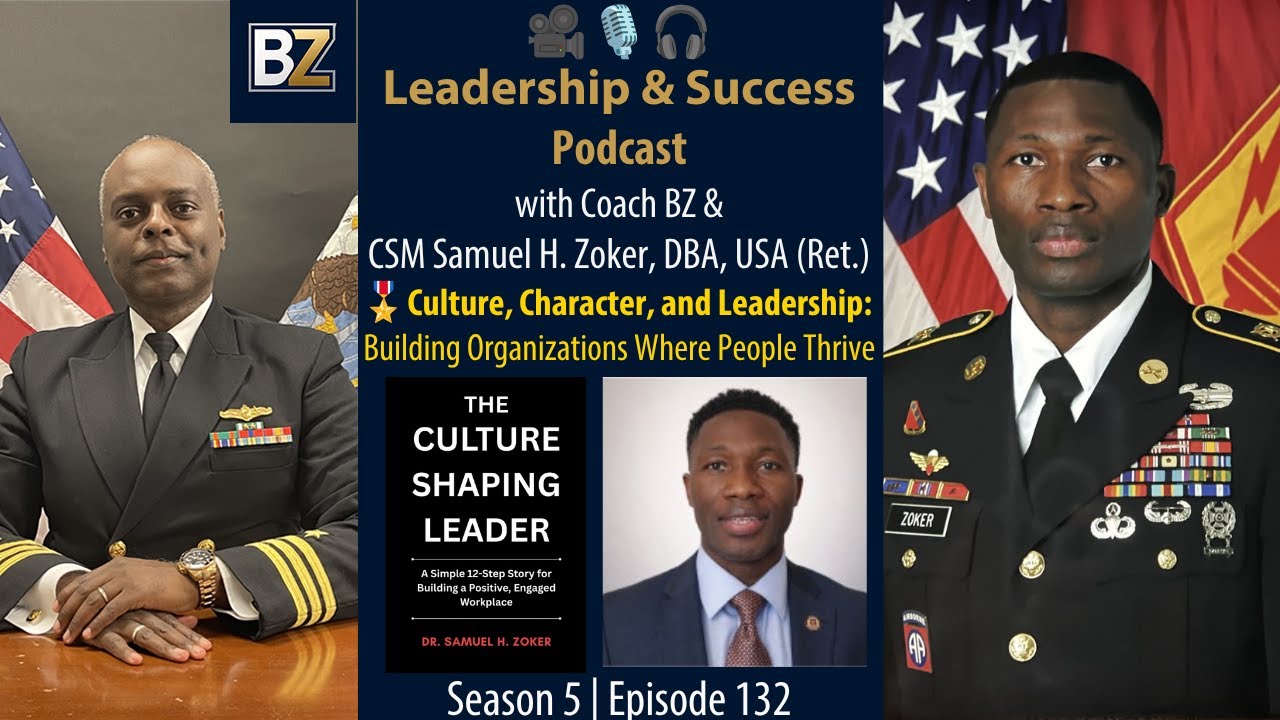
Retired Army Command Sergeant Major Samuel H. Zucker discusses leadership philosophy shaped by combat deployment, higher education, and mentors like Colin Powell. His book The Culture Shaping Leader outlines a 12-step approach to building engaged workplaces through respect, humility, and asking why.
Chapters
Hi, I'm John Maxwell. When the top companies in the world are looking for trainers, speakers, and coaches, there's one name that stands above the rest, and that's Maxwell Leadership. Our certified team members have gotten proven results for companies all over the globe, and our reputation, I'm proud to say, is second to none. Some of our members have risen to the top of their profession, including the one you're going to meet today. I proudly introduce you to my friend, Bob Fabien Zinga.
Welcome to the Leadership and Success Podcast with your host, Coach BZ, where we help you lead with purpose and succeed with impact. If you're ready to grow into the kind of leader others want to follow, this podcast is for you. If you're determined to elevate your success and leave a lasting legacy, this podcast is for you. As my mentor, Dr. John C. Maxwell reminds us, everything rises and falls on leadership. Our goal is simple, to inspire you, challenge you, and equip you with insights that can transform the trajectory of your leadership journey. Welcome aboard to another episode of the Leadership and Success Podcast with Coach BZ.
Hello, I'm Colonel Seth Knezovich, Commander, 41st Field Artillery Brigade. I'm Command Sergeant Major Sam Bezilka, Command Sergeant Major of the 41st Field Artillery Brigade. This Monday, May 25th, we observe Memorial Day. Please take a moment to honor the more than 1 million men and women who have given all in defense of our great nation. We honor those who died securing peace and freedom, who served in conflict to protect our land, and sacrificed all to preserve our freedom. We owe them our thanks and our honor. It's important not only to recognize their service, but to respect their devotion to duty and to ensure the purpose for which they fought will never be forgotten. We encourage you to Go get outside this weekend and take advantage of the beautiful weather. Please maintain 6 feet of physical distance and ensure you are staying within the guidelines of General Order Number 1. I tell soldiers who aspire to do things that they think is highly difficult, whether it's special operations or going to flight school or going to be a Warrant or going to OCS, the only really thing that I see Right? A lot of times that separates a person is the level of commitment that they're willing to give to get there, right? I mean, everybody's same flesh and blood, put their pants on the same. But when you really look deep down, are you really to sacrifice your body to get in the shape you need to be in? Are you really to sacrifice your time to really learn what you need to learn? So it's, I think the first thing, tenet of something like that is a person has to really say, I'm fully committed to doing X, and then they'll be successful.
Right.
All right. Welcome to another edition of the Leadership and Success Podcast. So excited to be with you today. Now, uh, this is our second podcast for today, and hello to Daniel Young from Fern Park, Florida. Uh, great for you to be here. So before we get started, let me remind everyone, uh, if you do have a question, please go ahead and type the question in the comment, and we're going to be answering those questions live. Let us know where you are joining us from, what city and what state, and also let us know what you are grateful for today. All right, so before we get started, as it is our custom here, we are going to start with what we call our moment of gratitude. This is where we take just a moment every time we meet just to be grateful. So I would ask you maybe close your eyes, put yourself in your happy place, and take a deep breath and think about one thing you are grateful for right now. And for me, I think I am grateful for those who have come before us, right? I believe we stand on the shoulders of giants. The short video I've shown you of CSM Zucker, they were talking about Memorial Day, right? A lot of people have died for the freedom we have today in America, especially people of color, right? People have died to give you the right to be free and to give you the privilege to vote. And I am so, so, so grateful for that, for their sacrifice. So I am grateful for those who have come before. So let us know in the comment what you are grateful for. Now let me see if I can properly introduce our guest today. I am really honored and privileged to be talking to Command Sergeant Master Zucker retired now from the US Army, and he also has a doctorate, so I'm gonna call him Dr. Zucker for this one time. But really, really glad to have him on the Leadership Success Podcast today for a very inspiring conversation on leadership, organizational culture— that's his expertise— military service, and building workplaces where people thrive. So Dr. Samuel H. Zucker is a retired U.S. Army Command Sergeant Major with more than 3 decades of military— well, actually 23 years, so 20-plus years of military service and leadership experience. Throughout his distinguished career, he has served as a senior enlisted advisor, leading soldiers and advising commanders in complex high-stakes environments across the U.S. and European theater. Today, Dr. Zucker is a respected leadership and organizational culture expert, workforce strategy leader and executive advisor, veteran advocate, author, and host of the Open Discussion podcast. His mission is helping leaders intentionally create culture built on trust, accountability, engagement, and high performance. He is also the author of the outstanding book, The Culture Shaping Leader: A Simple 12-Step Story for Building a Positive, Engaged Workplace. We're gonna get all into this, but, uh, it's really a practical guide for leaders who want to build organization where both the people and performance thrive. Part of what you're gonna be learning today is leadership lesson from more than 23 years of Army services, but also why character remains a leader's greatest competitive advantage. So whether you lead in a military unit or cybersecurity team or a startup or a nonprofit, this conversation will challenge you to think differently about culture, you are creating every single day. So without any further ado, please help me welcome to the Leadership and Success Podcast, the one and only, Sia Sam, Samuel H. Tucker.
Coach, how you doing?
Good. Such a great privilege to be talking to you today, Sia Sam. So my first question for you is, what are you grateful for today?
First of all, I want to say thanks, man. Thanks for really inviting me onto your platform. It means a lot to me. Thanks for the introduction. I've not seen some of those pictures and videos in a very long time. So thanks for bringing back some of the old memories of mine. But, uh, what am I grateful for? Really, life itself. You know, as you talked about earlier, we have men and women currently in harm's way. We have people all over the globe doing different things, and we have veterans, uh, you know, out here going through life. And, uh, I'm very grateful, really, you know, for life and having good folks around me, really, to keep me, to keep moving forward. So I'm grateful for just life, grateful for my friends and family, really.
Yes, that is so, so powerful and so important. And what is something about you, Dr. Zucker, that most people may not know when they first meet you?
I am a big Chelsea fan. I know Arsenal, if you watch soccer, I'm a soccer guy, right? We call it football, but I'm a big Chelsea fan. And folks, yeah, yeah, I grew up back in West Africa. We play football, we call it, they call it soccer over here. But I'm a big Chelsea fan, and I'm just a guy who loves soccer. That's also— some folks may not know that, but yeah, that's who I am.
What do you think about Lionel Messi? I think he had scored 3 points. Was it yesterday, the day before?
Yeah, I've been following the World Cup. It's pretty early, right? It's pretty early to really determine who's going to be on top. I mean, all the teams— so for me, right, I look at entire World Cup, really. It's amazing the amount of teams that are in the World Cup because I think soccer is the only sport, in my opinion, that bring the whole globe together, right? I mean, on one stage, put away our differences, just focus on, on sports. So I mean, I like Messi, uh, he's okay. Ronaldo, I mean, those guys are pretty good. So, uh, yeah, I mean, yes.
I remember when I was growing up, it was Diego Maradona. I was a huge, huge fan.
And then of course, you see, you see, you see, here we go again. I am a Kempélé guy. Kempélé is my guy.
Pele, yeah. Pele is definitely the GOAT, the greatest of all time.
He's the king, you know. He's the king.
King Pele. That is right. That is right. I will not argue on that. So let's do something much less controversial. So for those meeting you for the very, very first time, who are you without all of your achievement and accolades?
I am, first of all, I'm a God-fearing person. You know, with all my imperfections, I tried to, uh, to do what's right. Uh, but second, I just love people, man. I love to— I love to be around people, love to help people. I'm— I'm— I just— I just— I mean, people just give me joy, you know. My, my wife always remind me every time we go out, the first thing she said, please don't embarrass me, right? I talk to everybody, you know. So I'm just a people person, but rather God-fearing person. But I just love to be around people, really. Yeah, yeah.
I think your wife and my wife must be related. But, uh, so looking back over 23 years in the US Army, what— actually, first I must say, so you went from E-1 to E-9, right? Uh, CSM, Command Sergeant Major, which is quite incredible. No, I believe the statistics are less than 2% of people who join the Army or the military end up at that rank. So that is huge. But, uh, looking back at your, uh, career in the Army, what experiences most shaped your leadership philosophy?
Well, it is, it is a lot. I can tell you it's not just one experience, really. It's been a combination of, of years over years over years. But most importantly is, is the people, you know, from my first, you know, section chief or squad leader up to my last command, now commander, and every subsequent command as far as, you know, section chief, squad leader, platoon sergeant, first sergeant, folks you come in contact with really, really shape who I am because I'm very inquisitive. Folks say I'm kind of nosy. I love to ask questions, but I love to observe, you know, because sometimes what the eye sees can tell a good story, really, you know. And so in terms of shaping my, my leadership philosophy, it was— is there's a guy who I'm not going to call his name because a lot of folks out there who had a very profound impact on me. He was a platoon sergeant of mine and he invested a lot into me. Well, I mean, not even knowing about it really. Well, I know about it. I'm giving an example. He used to call me, well, invite me to his house on the weekend, on the weekend to his house while folks, you know, I'm a young guy back then, I'm folks going out, you know, whatever. He used to invite me over to his house on the weekend, uh, and classes, training at his home during the weekdays when we go home. Prior to going home, he would call me to his office and give me an assignment.
Wow.
So initially I was kind of upset. Hey man, what— what— as time progressed, I realized as well, so he was preparing me for something that, you know, so I said all, all the— wow— commission officers, all the soldiers, all my— in my first time, but he had a profound impact on me because he invested in me where I I mean, I didn't even know about it, but as time progressed, as I reflect, I said, oh, okay, I got it, you know, I got it.
Wow, that is so powerful. And what is one of the lessons he taught you that you still carry?
Today?
He told me to be— to learn how to be— he told me to be patient, you know, because sometimes I was tough to happen just like that, right? As I progressed through, through my military career, he, he always in the back, Zoka, slow down, you know, Zoka, slow down, you know, because I'm an old Airborne guy, you know, the Airborne timeline, we have to meet those, those benchmarks, we have to keep going. So one thing that he told me to do, you know, slow down, it should be a gradual process, slow down, you know, assess what's going on. You know, and when you— once you slow down, everything works in slow motion, really, believe it or not. So he taught me to really be patient but slow down. So that's something that I've taken, uh, all the way through my entire career, really.
That's really powerful, something I'm still, still learning today. I think my wife has been the one who really taught me how to do that, but, uh, it's, it's really incredible. So throughout your entire career in the Army, when did you start to realize that really leadership was not about position and title, but really more about the people?
Yeah, so I grew up, I guess, within the military. I was very, very fortunate. Not gonna lie to you. I had some outstanding noncommissioned officers and officers who invested in me. And along the way, when I got to the 82nd Airborne Division, folks who are familiar with 82nd, you know, uh, the idea of performing at the highest level does exist. There's no ifs and buts about it. If you don't perform, we're going to find some way for you to PCS. And, and the competition was there. We trained, we have the best equipment, but those noncommissioned officers who invested in me was something that money cannot buy. Really, you know, it was, it was something that was ingrained into you. You know, a lot of you in garrison or combat, you know, they provide you an idea or just a foresight to see things way beyond your overall expectations. So it was amazing how those guys and girls really invested in me. And I've taken that along the way myself, you know, through my leadership as far as experiences. And, you know, but it was, it was an idea of putting people first. Really. Wow. It's all about the soldiers, you know.
That is really amazing because you serve not just as a battalion command sergeant major, but as a brigade command sergeant major as well. What do you think people outside of the military, what would surprise them to learn about the role of a command sergeant major?
They just don't know, right? So most of the public, they know, you know, a lieutenant or captain or sergeant, you know, just the basic, just those rank of opposition position. But so at every, you know, 6 branches of the US military, right, at every key leadership position, there should be— there is an officer and a senior enlisted advisor or noncommissioned officer, you know, to complement that officer. And, and that senior noncommissioned officer or that senior advisor, whoever he or she is, the primary role really is to advise the commander on all things regards to the organization. You know, that's your primary responsibility. You're a senior enlisted advisor because the commander is the commanding officer. He or she does not have the capacity to be all over the place at one time. Your primary responsibility to assess the organization, to give that commander the best advice possible to make decisions that can preserve life or take life, you know. So that's, that's the role of that senior noncommissioned officer, that senior enlisted advisor, is to advise the commander on all things pertaining to the organization. When I mean all things, all things that you mean when it comes up to the organization. So that is the role of the, uh, the senior enlisted advisor slash Command Sergeant Major. And, uh, Hopefully folks can get on board.
That is quite a serious responsibility.
Wow.
Yeah. Yeah. For what you can share, I understand some things you cannot talk about in public, but what is one of the most difficult leadership decisions you've ever had to make as a Command Sergeant Major?
Hmm. I wouldn't say difficult, right? Because relieving someone is not something you take lightly.
Mm-hmm.
You know, because the Army is a performance-based organization, right? First, you have to perform, and, and, and someone who is not performing, you know, it is our responsibility to bring them in and try to help coach, guide, and, and help him or her. But removing someone from a position, say, hey, you need additional training, we'll bring you back. That was, that was the decision we had to make, you know, as far as me removing folks from different positions, say, hey, we'll give you the best training we can to make sure you are on track. You know, not to fire you, but we need you to get some kind of training. So it was not a difficult, difficult decision. You know, of course I had to consult with my commanding officer, but it's to make sure that he or she is adequate enough or had the right training to make sure that one given second opportunity, he or she could perform properly. So I think that was— that was Brigadier C.S.
Yeah, yeah, that is, that is quite, uh, powerful because I had, you know, the great privilege of becoming a commanding officer in the Navy, and I think as the CEO, you actually have ultimate command authority. However, as a senior enlisted leader, you do influence the culture. I guess the question I have for you is, how do great senior enlisted leaders influence the culture without having ultimate command authority?
Get out of the offices. Get out of the office. You know, because just think about it, right? Think about it. If you look at just the disposition of the US military, you know, 3 major rank category: officer, noncommissioned officer, and warrant officer. Noncommissioned officer, your job rather to assess and continuously assess the organization, understand the pulse, we call it, of the organization, understand exactly what's going on. You cannot accomplish that hanging around your office all day. You have to get within the formation. You got to talk to soldiers. They have to see you. You have to be present. Understand exactly what he or she is going through. You know, when I was going through my PMP certification a couple years ago, it talks about the program manager responsibility to make sure that he or she remove all obstacles for the team to be successful. That's what you're supposed to do, you know, to create that culture, to really understand exactly what's going on. You have to talk to people, you have to get out there regardless of their, their position, time, and place. You have to be there. And I will give you an idea to come back really in the back to our commanders, hey sir, I recommend XYZ. Because changes take place, right, when you have a buy-in. If you think about it, right, when I talk to soldiers, because they understand exactly what's happening, they understand this. I think Colin Powell once says— I'm paraphrasing— he said his staff is always wrong, the men on the field always right. Yes, because think about it, it makes sense, right? They're the one there, we call it in the trenches, putting in the work. They understand exactly what's going on. They can tell you exactly what's happening, and then that's how command make those, those overall changes.
So Man, that really takes humility. It's, uh, but it is, it is so, so powerful. So in your experience, what do you think separates those organizations that merely comply from those that truly excel, especially when you affect the culture, right? So many organizations have toxic cultures these days. What, what do you do? What do you recommend for you to have a thriving culture where your soldiers can really excel?
So every organization is different. A lot of you in the military, outside the military, every organization is, is overall different. Every organization is on a different glide path. So I'm gonna give you an example, uh, for the Army, from our experience. Sometimes a new commander coming in, he or she coming in with their, their vision. This is my vision, this is the direction we're going, XYZ. But sir, you have not even conducted some sort of analysis to determine what we are currently, to determine, you know, what as far as vision you want, you want to implement. You know, so don't be too fast to make decision without consulting the senior advisor, talking to folks first. So the difference between as far as a thriving organization, organization that be facing some problem, is because commander and senior advisor failed to analyze and assess what's happening before implementing policies and, and, and standard to affect the organization. You have to fully understand exactly what's happening, and then if, if there's any, any changes happening You know, include the folks that are going to be as far as executing those changes. You know, talk to them. I'm not saying you have to do a survey on it. I'm saying the Army is not Walmart, you know, do a survey and submit it, you know. But, but talk to folks and ask them, hey, this is the direction we're going, what do you think? You know, that was, that would allow folks to be part of the process. You know, that made you create inclusion. You know, you were there to receive feedbacks and recommendations to make things much easier. So when you do implement those plans, is executed properly because you have Bob and you have those we're calling change ambassadors to make sure those change are implemented. So that's the difference in my opinion from a thriving organization and an organization that faces some problems.
So, so powerful. Now you, you did say like it, a lot of questions when it comes to leadership, it really depends on the organization, the industry, the size and, and all of that. But during your time leading soldiers across Europe and multinational environment, What leadership lesson transcends culture, nationality, background, industries, and all of that? Which leadership, I guess universal leadership principle, you feel like work no matter where you are?
Because the Army or just the US military is a very diverse organization. Folks from different backgrounds from all over the globe. You and I were having this conversation now, and no matter if you in combat or in garrison, you know, we all aspire to do well. We all seek the same thing for our families. You know, you have to be humble. You have to be, because your position or your rank is not, you know, justify who you are or tell someone I'm better than you and whatever the case may be. What transcends that is about you being humble, looking at somebody for who they are, and treat folks the way you want to be treated. It's a simple concept of life, really. It's very simple but very, very profound, right? Treat folks the way you want to be treated because we all aspire for the same things. We want our kids to be successful, we want our kids to be okay, we want to be well. So it's the same concept. But I've seen in the past where, you know, commanders are just— I don't want you to turn commanders around, your officers get pretty, pretty kind of shaky when I say commanders. People in leadership positions sometimes, you know, lose the core aspect of what leadership is all about. It's about service to others. It's about service, really.
Yes, yes.
You know, I told somebody a long time ago, once you accept a leadership role, you have relinquished your ability for self-interest.
Hmm.
It's not about you anymore. It's not about you, it's about the folks for which you were leading. Yes, it is your job to make their life better. So really, you have to be humble and make sure you treat folks how you want to be treated.
Wow, so simple but so powerful. Yeah, but in the Navy we say— I think we stole that from the Army, right? People always—
was new, right? Navy always.
Yeah. And also somebody we, we both know, I consider it my mentor now, uh, General Biggles, one thing he really talked about that really, really stuck is rank is rented, but trust, um, so powerful, isn't it?
It's temporary. That's what it is. The rank and positions are temporary. Wow. You know, that's what it is. You're not there for life.
Yes. Wow.
You know, people never forget how you make them feel.
So If you could give a piece of advice to a newly promoted First Sergeant, a Sergeant Major, or a new Command Sergeant Major, what would it be?
So there's a difference between the commander and enlisted advisor because sometimes the line is kind of blurred, right? So senior enlisted leaders believe they are the commander. You are not the commander. You are not. You were not the commander. You have no command authority. You had general authority. So my advice would be, you know, have a sit-down as a new incoming first sergeant, sergeant major, whatever you are. Have a sit-down with that commander. Understand exactly which direction they're trying to go. Yes, you know, uh, and, and I've been very, very fortunate. All of my commanders I've had, we have no issues. You know, my best buddy, uh, uh, Colonel Seth Konasiewicz, I talked to him rotationally. His wife is my stepmom. I about her. That just tells you, just, you know, the testament of our relationship. You have to have a good relationship with that commander because it's considered a command team for a reason. And then secondly, you have to talk to the soldiers, you know, you have to. You can't come in trying to change things without talking to people first. Understand organization, walk around, talk to folks, collect consensus, be open for feedbacks and recommendation. And then your job is to package that, say, hey sir, this is what I've heard this is what is going on. I recommend we do XYZ. You gotta come together as a collective team and try to place the organization on the right path.
So now, usually in the military we talk about the triad, right? Not just the senior enlisted advisor and the commanding officer, but also the XO, the executive officer.
Yeah, it's the same process. It all depends on what level you are. You know, if you had a battalion, you have an XO, and then brigade, you have as far as DCO. It depends on the disposition of the organization. But XO plays a huge role, you know. But, and as that senior enlisted advisor, you have the staff as well. You have to somewhat contend with, meaning within a good way, right? Because you're there to advise and coach, mentor those staff officers as well. It's just not just the commander, because we also serve as a buffer between the commander and everybody else. You know, if folks start coming to you with problems, that means you're doing your job. If they come to you, hey coach, 'You know, I want to talk to the commander about this, but can you—' Whatever, you're doing your job. If they stop coming to you, you might want to question— you might want to ask yourself, 'What am I doing wrong?' Yeah, General Powell talked about that too.
The day the soldier stops bringing you their problem— exactly. But also, sometimes I feel like some junior officer, you know, second lieutenant in the Army, first lieutenant, captain, even major, they don't always realize that even though by rank they outrank, you know, all of the sergeants, but in reality they're still being mentored by the sergeant. Can you, can you tell us something about that?
Yeah, that's a unique relationship. That is a really unique relationship because you have a new lieutenant coming in, just graduate, whatever the case may be, right, to an organization. They may probably work on the staff of the platoon leader, you know, he or she is the platoon leader, and you have, in terms of the years of experience, a big gap. You know, you may have a platoon sergeant who may have 10, 11, 12 years or 8 years in. A lieutenant may have, you know, when you consider when he or she goes to college, graduate, commission, you know, they're pretty brand new. So it is your responsibility as that CO, non-commissioned officer, without that person who worked alongside a lieutenant, to grab him or her, say, sir, ma'am, come on, you know, and tease the right way. But never forget, are the platoon leader You are the platoon leader. Your job is to protect the platoon leader from that captain or whoever, right? Hey, sir, you know, whatever the case may be. So, and I've seen in the past where there's somewhat of an issue with that NCO and that officer, and I think it's unacceptable. He or she is the officer. You are the enlisted advisor. Your job is to enlist, to teach, guide, coach, and mentor that new officer, make sure he or she is successful. That's when you know if you have done your job, if he or she is successful.
Powerful, powerful. Yeah, throughout my entire career, I don't know what I would have done without the Surgeon or any of them because they really got me out of so much trouble. Oh yeah. Let's talk about culture. That's really your expertise because you often speak about organizational culture. How do you define culture, let's say in one sentence?
In one sentence, I would just give you one word. This is what I want to say. Inclusion. Inclusion. What I mean inclusion here is that, you know, an organization has to be— because an organization culture is not defined by one person, right? It's everyone's responsibility. It's all about responsibility, really. And when I mean inclusion, when I mean inclusion at the command level, it is your responsibility to create an atmosphere right, that is acceptable to feedbacks, criticism, recommendations. You know, I tell folks, I say, hey, I have no problem you and I having a discussion on something. We can disagree, but you have to respect my position. I'll respect your position. So create an atmosphere where folks can have a good dialogue. You know, let them have an argument. That's okay because we all have different, difference of opinion. We have our direction we want to overall lead. So You have to create an organization that's very, very inclusive, that accepts everybody for who they are. That's about to bring in new ideas, you know, because sometimes you're seeing commanders say, okay, I'm the commander, I'm the guy or girl, it's my way or the highway, it's what's going to happen. Well, you're not going to build good conducive culture because now folks are reluctant to tell you things. So if you create that inclusion, it provides the atmosphere for your organization to be very, very successful, in my opinion.
That is so, so powerful. I think it takes humility, is definitely the right thing to do. Because when you were talking, something else came to my mind. I think it was Peter Drucker, right? He's the father of modern management. He used to say that culture eats strategy for breakfast. So you can have the best strategy in the world, but if your culture's messed up, you are not going be successful.
Do you agree? Yeah. Oh, absolutely, absolutely. Because we look at culture, right? We all have different, different, uh, different approach to establishing a robust culture. All right, you may have some folks who may have all these, uh, bumper stickers, you know, the things they're going to write. You walk within the, uh, the command suite or whatever, and within a company, right, they have different quotes on the wall, this and that, whatever, but it's not being practiced. You can put stuff up all day, but if not, if it's not being practiced adequately with intention, you create a problem. Yes. Don't just, don't just talk about it, right? And say be about it. Don't just talk about it. It has to be within the organization. It has to be the foundation of the organization. Believe it or not, because the culture plays a huge role. Without a suitable culture, you cannot perform adequately. Folks will perform. Okay, okay. I will come and do my work and go home. But if the culture turns robust, a place where I know I can express my concern and leaders would listen, I can provide ideas, you know, uh, it would create a place to where folks want to get up in the morning, go to work, you know.
Yes. Wow. Because, Commissioner Major, one, one thing that you said, I guess most people call that now psychological safety, creating that environment where people feel like it's okay for them to let their voices be heard. And sometimes that can really save the organization from making some really, really critical mistakes. What do you advise as an expert? What should leaders do to create that type of environment where people don't fear retaliation, but where they can really speak truthfully?
So open communication, right? So open communication leads to trust. We will, we will convey what's happening. We will communicate, and then you will build relationships. And through relationship building, trust will be established. Yes. And once there's trust between you and I, I can trust you, you can trust me, things will be much better, really. But you have to communicate pretty well. You know, I talk about in terms of one of my, my, my— communicate with, with clarity, right? This is our vision. This is the direction we're heading. If for some reason someone in the organization does not understand that vision, it is leader's responsibility to make sure they explain or convey that vision to that person so he or she can fully understand exactly what's going on. If we communicate properly, we build good relationship. With good relationship building, we build trust. An organization that trusts each other within the workforce can be very, very, very, very, very— perform very, very well, you know.
So that is so, so true. Now, what do you do when you join a new command but you don't have much time, you're about to get deployed, so you need to build that trust quickly. So how do you accelerate trust? So if you're speaking for—
we could look at two parts, right? Let's say the Army, and then— wait, you said deploy, so just focus on the Army. The Army is not a big organization, right? It's pretty— it's not too big. So prior to you coming into any position, you know, you know exactly who the commander is, and you and her, him or her, whatever, have communicated So there's ongoing discussion going on. Yes. I can give you an example of my last organization where I work as a brigadier CSN. Prior to me getting there, the commander was always already on ground and he reached out to me. So that tells you something. Yes. You know, he's a commander. He reached out to me, introduced himself, explained to me because he was already on ground. This is the direction we trying to go. He sent me some documentation, digest this, conceptualize this, let me know what you think. So right there, You know, we, we were somewhere pretty, pretty good, you know.
But I, I love that you didn't say this is where we are going, this is where we are trying to go, and where we— what you think. That's, that's very powerful. Wow, absolutely.
So right there, you know, it, it, it is something that you may not look at it too deep, but we think about it. He or she take the time to say, I'm gonna reach out to him or her, this is the direction we're going, this is what I want. What do you think? What do you propose? What do you recommend?
Yes. Wow.
Simple concept, but very, very profound. Wow. You know, it's, it's, that's just how it's supposed to be, really, you know. And I gotta say, uh, my command, I love that guy, really. I love him. And I have no— all my command officers, I still talk to them, but Seth Kanasave is the guy.
Yes.
You know, that's all.
Yeah. Amazing. Now we have our first question from the live audience. Uh, Daniel says, uh, Dr. Samuel Zucker, we appreciate the relinquish self idea. From leadership design perspective, the challenge is creating structures that keep service from becoming optional when pressure rises. So, and then he says, what protocol help ensure leaders stay anchored to their people, not just their deadline, especially peak demand? What a good— what a great question, right?
Because Most organizations focus on metrics because most organizations are performance-based. You know, we have a product, we have a service, no matter what it is. And in the military, it's the same process. Yes, you have to stay connected with the men and women for which you lead. They might be working at Amazon or the Army. You have to talk to people. You have to talk to people. I'm gonna give you an example. I had a commander, uh, of, uh, he's a 2-star now, back in Germany. You know, when he speaks to you, you feel like you're the only person in that room. Wow. Hey, Coach, how you doing? Hey, how's the family? But I mean, it's little things that count. Yes. Wow. You know, that connection you build goes a long way. Hmm. I mean, it's not possible, right, for a commander or a CEO of a large organization to go around shaking everybody's hands. I got it. But the little things you can do here and there, because that trickles down, right, to those, those regional directors, those first-line, you know, managers, whatever the case may be. Because that's how a culture works. What they see you doing, they will implement the same thing, they will emulate the same thing and make things much better, really, to make sure the organization is on the right path.
Powerful, man. We are already running out of time. Let's, let's get your book. I do need to talk about this. The Culture Shaping Leader: A Simple 12 Steps Story for Building a Positive, Engaged Workplace. Why did this book have to be written? What inspired you to write it?
I have always been fascinated with culture, organizational culture. As I told you, I'm very inquisitive. I love to just observe, and within all of the organizations I serve, I was always observing. Yes, how leaders operated, how we operated, how things going, both deployment and non-deployment. So It was something that I've always had in the back of my mind to write a book about culture. And then when I did my doctoral, as far as dissertation, it focusing on culture and leadership engagement, you know, it's a leadership as far as a degree. So that somewhat kind of energized me, but really it's my experience working in different culture. And I said to myself, I need to put something together to help folks out there. They can grab and hopefully, you know, gain something from it. Really.
That's, that's really powerful. And one thing interesting about your book, I've read a lot of leadership book, but Yours chooses a simple 12-step story format, right, rather than a traditional leadership textbook. Why did you choose that? That's a little different.
Yeah, so as I told you earlier, I'm an old Airborne guy, I'm an old jump master. And jump masters, we go sequence. It's all about sequence, right? So we have— you got a guy or girl who's going to exit the high-performance aircraft, we have to inspect you, whatever, it's from top to bottom. So it's an easy concept to look at 12 different steps, very short, straight to the point. So you don't have to use all in sequence, you know, you can go around, whatever the case may be, but it's designed to where a manager with 2 people can grab it and hopefully get something from it. You know, it's just straight step by step by step to make sure you, you, you can do the best you can with it.
Yeah. So what do you think is the, uh, uh, central message you really hope everybody takes away from the book, all of our listeners?
As I talked about earlier, you know, culture is the center ground of any organization. True. And it is your responsibility to make sure that you create a culture for which you want to operate in. You can't sit aside, be like, oh, it's just, you know, the supervisor or my manager or my commanding officer. It is your responsibility as well to create a culture for which you want to operate in, because it goes a long way. Because when you leave, the organization still remains, and our culture you already built, believe it or not, stays there, you know. So yeah, for the book, it's just about making folks understand, you know, culture is everyone's responsibility, and you have to make sure you create and build a culture for which you believe is suitable for everybody else, not just for you.
Yeah. Wow. Because one thing you argue in the book, it's pretty much a— I think a line throughout is, uh, culture doesn't happen by accident, right? So what does intentional culture shaping actually—
it is, it is, it is an incremental process. You cannot change a culture one day, you know. It's incremental process. It has to be, you know, we go from, from paper to words and then action. This is who we are, this is where we want to go, this is how we can implement it. In the meantime, you're talking to folks, okay, this is the direction we're trying to go, how you think you can help us to go this direction, you know what I'm saying? Because end user are the people you want to talk to. So that'll be the best, the best approach in my, in my opinion. Yeah.
And of the 12 steps in your book, which one do you think most leaders struggle with the most?
Ah, that's a tough one. Um, which one I think leaders struggle with the most? I would say, I would say the first, I would say the first one though, I would say, I would say number 6. And talk about grow, uh, let me see, grow people, not matrix. Hmm. You have to invest in people. Yes. Not the matrix. I mean, the matrix there, if you invest in people adequately, the matrix is going to show itself. But we are so central and focused on productivity. Of course it's important, but you have to invest in people to make sure your productivity is where you want to go. So sometimes we kind of somewhere, you know, push one to the side and work, work, work, work and forget about people aspects.
So it's all about people. Powerful. Because I remember when I became a CEO, when I was selected to become one, I reached out to all of my mentors and one of them told me something I would never forget. He says, don't worry too much about the mission, although you're responsible for it. He says, take care of the people and people will inevitably take care of the mission. That's really another way of thinking about it. Yeah, man, that is powerful. So which chapter was one of the most difficult or most challenging for you to write?
Chapter 6. Why? Yeah, like I said, you have to invest into people, though. You have to invest into people. And sometimes some folks have a good thing. You cannot be a leader introvert. You have to be a leader, be an extrovert, or a balance of both. Yeah. You have to talk to people because talking to folks build relationship, build trust, build friendship, and it goes along with across organization to give you the capacity where you can fully understand, okay, I have to make this decision, but this is why I've gathered, these are the recommendations that I have, you know. So it's all about people, but then you have to put service first. Your job is to make sure that you're here to serve. It's not about you. It's not about you.
Okay, now one question that comes often when we say that is you are still responsible for the mission of the organization. And then the question becomes, how do leaders balance, right, accountability and compassion for the people without sacrificing either? How do you balance that out?
Yeah, you don't have to sacrifice either of them. It's about, you know, I don't— the term balance can be somewhat taken out of context, right? I would say manage, because sometimes once it's going to be here, the next one be here. You know, like in the military, sometimes your family is here and sometimes the mission is here. You're not as far as getting rid of one of, one or the other, but it's about how do you manage both of them while assessing risk to determine that, or making sure that both are accomplished at the same time. You know, it comes down to being patient. Making the right decision, getting the right information, talking to folks. Now I keep going back to talking to folks, right? Because in order for you as a commander to make a good decision, you have to talk to folks. You got to get all the right information first. And there may be some time you may not have the time to do it, I understand that, but at least you have the experience. Yeah, but you don't have to get rid of one of them. It has to be as far as how do you manage both of them without dropping the ball one of them and making sure that, that both of them can happen at the same time.
That is so, so, so powerful for those who are listening, especially those who are just starting to command. I think that's one of the best leadership insights I've had during my tenure because I had a problem. It took me almost 90 days. I couldn't figure it out. I reached out to my senior leadership team. We couldn't, and then I reached out to all of my department heads. It took almost 90 days. We couldn't find the solution. And then I opened it up to the entire command and this junior enlisted Folk and E5 came up with a solution. We implemented it, and within a couple of weeks, all of the problems were solved. So that really taught me a lot. No, it's true, in the military, rank really means a lot, but sometimes when you are leading, you have to forget about the rank and just focus on the problem. And no, because that's what folks—
that's what folks, some come out of the field to realize, right? You have to go to the end user. They're the one who's there. They see what's going on. They have an idea, have a recommendation. Be open to it. If it works, give them the credit. Yes, because when you, when you do that, what happens? You create competition, a good competition. Oh, Coach just came up with this idea. I'm gonna start thinking. I write a critical thing coming in place, and my brain's all stimulated. Okay, I gotta, I gotta, I gotta provide something as well. So it's a good environment to overall work in. So do not by all means push away your lower enlisted folks who have a great idea to make sure the organization will operate. I, I love it.
So the last question I'm going to ask about the book: if a listener only implemented one lesson from the book tomorrow, just one, what would you recommend?
I would say decide the culture that you want. Decide on the culture that you want. You know, not going into long, long speech here is that, you know, treat folks the way you want to be treated. Yes, by all means necessary. Speak up if somebody's being, you know, as far as treated inappropriately. You know, be respectful. You know, come to work with a good attitude, really, because sometimes we have some rough days, but just be a genuine person to everybody else. We all have some tough days, but you have to create a culture that you believe that is suitable for everybody else, because it's not about you, it's all about the team. It's all about the team.
Hmm, I like that. So for this final segment, I want to kind of get into your head, Dr. Zucker, and I want to see the principles that help you become successful. One of the first questions I want to ask is, what is one of the greatest leadership lessons you've ever learned, whether in life, in No, one of the greatest lessons you've learned in life, in leadership, or just in general.
You know, my grandmother, back in, back in Africa when I was younger, she taught me something that I've had a profound impact on me my entire life. I didn't even know it back then. She was in her village, she was the midwife of her village, about 5'2", 5'3". Every time she prepare food, she would keep a plate on the side just in case someone come by and they are hungry. Wow. And Coach, it used to piss me off. Like, hey man, I'm still trying to eat over here. Why, why would you keep the plate for somebody else? Yeah. But, but that little gesture, right, it, it sparks something in me. And, and she was always there to help people. Wow, that's amazing. So my idea of always people first and taking care of people, or be, be, be, be a public servant, or be a servant to somebody else, you know, that's where it came from. But it took me years to learn that.
That's so powerful, you know. Yeah, yeah, both of my grandmothers were very, very similar. But, uh, wow, what an impact that is. So you went from E-1 to E-9 again, that is the highest rank for enlisted. What do you think made you so successful? What's the secret to your success, you think?
So it's not just me, as I said earlier, it's about the people who invested in me, people who pushed me. Who saw something in me that I didn't see myself. Because no matter who you are, we all have somewhat of a doubt. No matter who you are, you will question yourself here and there. But people along the way, at every rank, at every position, invested in me. People say, hey, Zoka, we're going to put you here. Zoka, we're going to send you here. Of course, I know I put in some work. Yeah, well, based on their recommendation, based on their sacrifices, based on the work— like I told you, up to doing— sorry, I took his time from his family to teach me how to do something. You know, having discussion with senior military leaders, you know, when I was in Germany, you know, one-on-one discussion, believe it or not, with military spouses. Yes. So those are things that we take for granted, but those are all the combination of things, really. I will not sit here and say, okay, I did it all by myself. No, no, of course I work, but the people who invested in me, I give them all the credit, really.
That's really powerful. So if you had a minute, Command Sergeant Major, for all of the E-5 and below, who are listening to this podcast right now, what would be your advice to them?
Treat the soldiers with respect. Treat the soldiers with respect. Take care of them. Take care of them.
Yes. Wow, powerful. Okay, uh, what are you learning these days? I know leaders are learners. What are you learning?
I'm trying to get into AI going on now and, and not just ChatGPT, but I'm trying to really understand this whole AI stuff that's going on because I do believe here within the near future it's going to be something that we'll have to have to adapt. I mean, we'll have, you know, the ChatGPT here and there, but I want to really want to understand it because I'm a lifetime learner. I'd love to learn new things and, uh, and I'm trying to run to AI classes, start learning more about AI really. You know, because it is the future, it's here, it's here.
That's a good point. So how do you believe that leaders can maintain connection and culture in increasingly digital workplaces with all of this automation, artificial intelligence?
We talked about earlier, Rob, we talked about connection and engagement, right? You have to engage with people. You know, we talk about LinkedIn, right? People have different platforms, but LinkedIn is one place that you can engage folks, you know, ask those questions. We call it an information interview. But you have to have— because the people ask questions, it stays there. It's tangible. You still have to be a person who talk to people, you know, engage with folks, ask questions. At the same time, once you ask for information, well, one fee, one whatever to say we in. And Bob said it's engagement, it's about networking, about relationship building.
Because one time that was very difficult for me personally is when we went through COVID, right? 2020 to like 2021, 2022. And I became a commanding officer right after COVID. So all of my folks were working from home and now they were trying to learn again how to come back to the office and work. So it was quite a transition and it was a little bit of challenge to really keep that that human connection when people were so used to working remotely, you know, on their laptops and all of that. What is a tip you would advise even on the civilian sector? There are still companies here in Silicon Valley where they still work remotely. I feel like that's okay, but you are missing a lot of mentorship things that happen at the water cooler and just a lot of that. What is your Advice for all remote culture organizations.
We have so many different, different platforms you connect with people on these days, you know, that what we're doing now, you know, the idea of Zoom and Google Meet, whatever the case may be, you know, you may not be able to, to meet somebody face to face, but you know, the digital communication piece works, not just a phone call, but the face-to-face stuff on the Zoom, on Teams, or whatever, Teams. Yes, or whatever the case may be, you know, because it shows that you care. Talking to fish like I'm there, like they're off on these days. We have FaceTime, you know, I have friends who are not in the flesh but FaceTime. So I would say use those, those techniques at your disposal to maintain going.
Yeah, I am really, uh, jealous of the sailors who joined the Navy now because when I joined 21 years ago When I was deployed, I could only call my wife maybe once every 3 or 4 days and you had to use like AT&T phone and only after midnight. I mean, it was terrible, terrible, terrible. No communication whatsoever. But, uh, yeah, things, things have changed quite, quite a lot. So we talk a lot about successes and that's, that's fine. We do celebrate success a lot in America, but what about failure? How has failure shaped your life?
So I changed the terminology. I don't call it failure. I call it shortcomings. You know, because it's because you learn from your failure. If you, if you're not learning from the failure, you're gonna have a problem. It's always shortcomings, right? Because we all have experienced something, you know, failure, no matter if it's professionally or personally, whatever the case may be. You know, I was, I went to a drum master school back in, back in Bragg, and I didn't passed the first time. What's, what's, you know, this Army school, it's not that difficult. But it sparked something. I had to go back to the drawing board, be like, hey, you're not as good as you think you are. So it was a shortcoming. So I had to go back and readjust and ask some questions and learn and come back and we're overall successful. So those are all just as far as, you know, those are all just, just shortcomings that you can overcome. You know, you can overcome.
I like that. If it's a shortcoming, you can overcome it, but if it's failure, could be fatal. So it's really the way you look at it. Is there maybe— can you share one of the greatest fears you've been able to overcome?
The best one, the fear I've been able to overcome? Jump out of a perfectly good airplane.
Yeah, yeah, I guess you ran drills and stuff.
I'm telling you, it was, you know, it sounds good. I want to be airborne until you up there, that plane, the plane take off and the doors are open, they say green light, go. You'd be like, oh, what the heck? What am I doing up here? Yeah, but after a while you get, you get used to it. So that was one of my biggest, as far as fears, that I, that I overcome, you know.
Uh, that's, that is something. I guess once you do it once, then you kind of get, get over it, right?
Well, it, it is sort of kind of, but you still have in the back of your mind that something can go wrong, man, you know. It's, it's, that's what it is, you you know, but because you're doing it, you want to keep doing and keep doing it and keep doing it. But there's always somewhat of a back of your mind that if something can go wrong, but the training is there. You are trained with some of the best guys and girls. You respect your equipment, you trust your equipment, you trust the training, and you just execute, really.
Yeah, I remember when I went through boot camp, I had to learn how to trust my gas mask. Oh, la la. Yeah, the worst time of my life when I was there. But yeah, the gas mask mask actually worked. So I would be confident of that. So we've already talked about some of the mentors and people who've had a huge impact on your life and career, although you refuse to name them except for one. But let me ask you a different way. If you could choose 3 people to have dinner with, right, they could be people who are alive, people who are dead now, or even people who are just a fictitious character, not real human being, who would you choose and why? 3 people.
3 people, not in a particular order. So I would say General Colin Powell first. Yes. You know, he demonstrated what it means to be a leader, meaning, you know, he was all about his soldiers and he was all about people, people first and soldiers. It's not about you. But he's a public servant, you know. He served 30-some years in the military, came out, served in the government, and really places his country first with all his imperfections. Nobody's perfect, but he did something. If you read his, his story, it tells you a lot who he is. And a God-fearing man, a family man. So he demonstrates some of those characteristics you look at, you say, okay, I think that's a good guy. Second would be, believe it or not, I would say Abraham Lincoln. Hmm. From a leadership standpoint, you know, the United States have had two major combat, right, on this story, you know, Revolutionary War and Civil War. Just imagine what he had to manage. Yes. Just imagine the decision he had to make. You know, I would have loved to be on the side of war, just let's just, just see that, you know, what he's going through his mind, the process, and, and how does that work really. You know, I think that was a great leader. And I would say my man Bob Marley. I'm a big Bob Marley fan, believe it or not. You know, how he wrote those songs and all his songs is something that had a profound meaning. If you listen to the words within the song, it's something, you know, it inspires you no matter what it is, you know. So I would say, you know, I mean, that's a long list of people, right? And my wife is going to get mad at me while her name is not on there, but my wife, of course, is top of the list. Yeah. Those 3 folks are people that I would say, yeah, I would love to have dinner with.
All right, so what are some of the books that you've read that we should read? Now, while preparing for this, I did see this on your LinkedIn page. Yeah, that's my boy, Command Sergeant Retired Barry.
He wrote an outstanding book. That book is amazing. His life story, a profound, profound story. Yeah, he has a good book that he wrote. We talked about General Beagle, how his book is out there. Command Sergeant Retired Irish Williams.
I have that one over here that was on your LinkedIn page. Okay, that's the top.
Yeah, yes, exactly. Those, those are the good books that, that really, no matter who you are, what capacity you serve in, you know, uh, Who Moved My Cheese is a very simple read, but I'm telling you, talk about change and ability to adapt to change, but just, you know, some critical decisions made in that book. So it's an amazing book. And my brother Johnson wrote a book about life and faith and stuff like that. So, and so those are all good books that I've been, I've been reading over the last probably year or so. Yeah.
And then I've already interviewed, uh, CSM Aldridge Williams, great, great, great guy, uh, Navigating Transition. Now I'm trying to get, uh, General Tawanda Young on this podcast. Hopefully I'm gonna be able to get her this, this year. I've met her once or twice.
She's, she's amazing. She's amazing. Her spouse as well, husband, is an amazing person.
Yeah, good people. That's amazing. Okay, is there maybe like a song, a book, or a movie that would be your life's fame or your anthem? Uh, I can't tell you.
Bob Marley, brother.
I mean, it's all about Bob, you know. Which, uh, which song? He has so many hits.
He has so many hits. It all depends on the mood I'm in. So Buffalo Soldier is a historical anthem. You know what I'm saying? It tells you, if you listen to it, it tells you about it really. And, and no woman don't cry. Yeah, it's so many hidden messages into it if you just sit and listen to it. So those are what I'm— when I want to relax and just listen to something. But if I'm in the gym working out, going for a quick run, walk, you know, become an old guy these days, I, I'm into a lot of, a lot of afrobeat these days, you know, something to crank me up.
But, uh, yeah, one thing, when I was a kid listening to Bob Marley, it's like His songs were almost like spiritual, at least that's the way I would describe it. It's not just good music, but it's actually saying something that's important. Yeah, it's incredible. Okay, so what is one action that you have taken that has positively impacted your life?
Quick story, you know, I'm a storyteller, right? If you don't mind. Please. I came back from a 15-month deployment.. And then I was given assignment to serve as an instructor, ROTC instructor, over in Omaha, Nebraska. And I got there, I'm fresh off about a few 15 months deployment, combat operations, whatever the case may be. Went to the university, completely different atmosphere for what I've been used to. I've been 82nd all this time, right? It's like a different place. Now I'm a civilian now, but I'm staying in the Army. And what happened here is every year that the president of the university bring together all of the new, you know, professors and faculty, whatever. We went to a, it was like a dinner. And what happened, it was amazing. And he asked all the new professors, the new faculty members to stand up and introduce themselves, you know. And this person would stand up, "Oh, my name is Coach blah blah, I have a PhD in this, I have a doctorate." And everybody stood up. I think it was like 15 or 20 of us. They came to me and I stood up. I said, "How you doing? My name is Sergeant First Class Zocher, US Army. I'm happy to be here." Something clicked. Hmm. Something happened. Because at that time, I do believe I was the master of my own universe. Being in the Army, I thought I was the best field artillery 13 Bravo guy. I knew it all. But now I'm in a different environment. Now it's all academia. Now I said to myself, he can be a doctor, if she has an MBA, I think I can do it.
Yes.
The following week, I went, started my first class, and I never stopped since then. You know, but for me, it was not just the title itself. I do believe that by pursuing higher education will make me a better leader, a better person, critically, you know, to think critically. So that was something that really had a profound impact on me.
That is amazing, amazing. Okay, uh, Comencé a Arremenderar, if you had one and only one day to live, leave, what would you have liked your final contribution to be?
War, peace. War, peace. Across the globe, there's so many things happening, you know. We take things for granted, you know. For anybody who's been deployed overseas and seen some things at different places, and, you know, sometimes we don't appreciate what we have. There are people out even in our own country here is happening. And but just, just peace. Just peace. Because we're all inspired for the same thing. Like I said earlier, we all have one— our kids to be, to be healthy, to live a good life. And I think world peace, for me, that's really powerful.
I think for those who are not in the military, they may think it's a paradox because most people I know in the Navy, in the Army, all of the branches of military, we really don't like war. It's like war is a very, very last resort. But, uh, Yeah, it's really, really crazy. You're a soldier, a sailor, you are a person of war, but that's the last thing you actually want. Just one piece. Just one piece. So this is kind of related. So if you had a magic wand or something and you could solve any problem in the world, what is the one, one problem you'd like to solve first thing tomorrow morning?
I will abolish the US Navy.
Only in your army dreams, huh? You know that the Navy beat the Army this year, right?
We're gonna see what's up. Yeah, you see, I know you're gonna say that. You guys won one game. Yeah, you guys going around talking trash, you know. Sure. Yeah, if, if I would, I would go back again, man, to just, you know, I'm a peaceful guy. I do believe that, that collectively we are the same, no matter what country you were, no matter who you are, we are the same. You know, and we all have to do a better job, you know, taking care of each other because this earth is all we have. This is all we got. And it's important that we look at other people in our own image. No, they are— no, we are the same. Yes. You know, we have to have peace. We got to have peace.
So powerful. So powerful. Okay. We are getting toward the end of the show now. So the question for you is, how can we add value back? To you?
Just connect with me, really, you know, connect with me. I love to connect with people. I love to engage. I love to learn. And hopefully we can exchange some ideas. I have, like you say, you know, my LinkedIn. I don't have Facebook. I have a podcast, Open Discussion Podcast. I took some time off the last 30 days to get things together. I will start doing some recording here. But, you know, just connect with me, really. So let's, let's engage and exchange ideas and help each other out.
And where can people find a copy of your book?
Oh, the book, it's on Amazon. If you type in, you know, the Culture Shaping Leader, you have my name, Sam Zokor, it's going to pop up. It's on Amazon, you can get it from there. And then hopefully you gain something from it, you know, hopefully you gain something from that book.
Powerful. Thanks so much for sharing that. So as we end the show, one of the most important questions I want to ask, actually, so you said you were born in Africa. How old were you when you came to the US? Um, almost, I was 20, I think.
20. Okay.
I came when I was 17. So it's about that age. So the question I'm going to ask you is, uh, if you could go back and give a piece of advice to your 17 or 20-year-old self, standing at the edge of this incredible, incredible career you've had in the most powerful army in the world, what would you say to 17 or 20-year-old Sam?
Never, under any circumstances, doubt yourself. Hmm, powerful. There's nothing you cannot accomplish.
All right, so now we get into the lightning round. It's going to take a couple of minutes, so answer quickly, first thing that comes to your mind. Okay, so one word defines great leadership, one word. People. Okay, morning routine or practice that keeps you grounded. Humbleness. What is the book or a quote that changed your life?
Colin Powell book, uh, yeah, it works, it works for me in life, yeah, in life and leadership.
Yeah, yeah, of course, number one New York Times bestseller. Who inspired you most today?
I will give you two names, my mother and my wife.
Powerful. A leadership habit you refuse to compromise on, you're gonna do no matter what?
I would treat people with respect, always.
And the question every leader should ask themselves?
Why?
Hmm. Can you expand on that?
Why am I doing this? Why am I making this decision? How's it gonna impact the folks that are involved with it? You know what I'm saying? So you gotta have that, that why.
Again, it's not about you, it is about—
no, it's all about the people. Yes. Wow. Yes.
Because the thing is, when you are a leader, when you are put in charge, when you get that privilege, you also usually get a bunch of extra benefits. Sometimes you have, you know, the corner office, a special parking area. So you get a bunch of stuff and that I'm afraid sometimes people want to get the title so they can get all of the extra benefits, not really about the people that report to them. And, and sometimes you, you, you may forget why you are actually in charge.
Yes. And I think some— I don't know who said this— to fully understand the character of a man or a woman, give him power.
Put him in charge. Powerful, powerful. All right, what did you want to be when you were a kid?
I want to be a pilot. My uncle worked for the airline. I saw him living on that. Well, he worked for Nigerian Airways, and he had a uniform on. Pretty tall guy. I mean, He didn't flew the plane, but he worked, so he dressed like a pilot. I want to be a pilot. But when I got on the plane from Africa to the US, I said, no, no, no.
Well, I guess you got close. You've been jumping out of perfectly good planes. Tell me about it, right? Let's close it up. 3 adjectives describing you as a child.
Polite. Mm-hmm. Domo. I started to try. I didn't get my butt whooped. My sister got her butt whooped all the time. Yeah, accommodating, believe it or not. And, and sometimes I was pretty hot-tempered.
Sometimes. What about as an adult?
Um, I have calmness. I'm pretty calm, you know. Things don't get to me that easy. Yeah, yeah, it is. Things don't really get to me that easy. Okay, two more. Uh, inquisitive. I love to ask questions.
What about highly educated.
I mean, you can add that there. I've always been very, very inquisitive. I love to ask questions and figure out why, why we're doing this and how and whatever. So it's just been something that I've been pretty, pretty, pretty good for me.
So I like to end on a positive note. What is something you are feeling optimistic about?
My family. My family. I'm blessed to have a, a wife that, that is the best.
That really makes up all of the difference in the world. I wouldn't be where I am today if it wasn't for my wife, that's for sure. But, uh, as we come to a close, is there a question I should have asked you I didn't get the chance to ask? Anything else you wanted to share to my audience today?
Um, I think you asked all the right questions so far. I mean, I've laid everything out for you. Uh, if it would be one question would be why I didn't join the Navy, I would tell you absolutely not, you know. Yeah, it's really strange.
After 9/11, I looked at all four branches and pretty quickly I knew the Army and the Marine Corps was not for me, absolutely Not the time for you, huh? The Navy and the Air Force. So I'm glad I actually got in the Navy. But, uh, okay, so as we come to a close, something new I am starting. I want you to ask a question to the next person I am going to interview on this podcast. What do you want me to ask them? Ask him or her. It's gonna be this guy. Oh, okay, okay, okay. Now I must tell you, he's a veteran, Sergeant Allen from the US Air Force.
So that's the question I usually ask folks on my podcast: why did he serve?
Why? That is, you know what I mean?
Why did you— what was the contributing factor that really encouraged him or her to serve? Because that's a huge, huge thing, right?
Let me ask you, Command Sergeant Major, why did you serve?
Because twofold, I had a friend who was about to join the military and they told me about it, but it was my way to give back to what this country have given my family and myself.
Yes, that's powerful, powerful, powerful. I love it. Okay, we are at the very end then. Sorry, I took an extra 10 minutes. I jumped into it. This has been really wonderful and insightful. Conversation. So to end, what is one word that represents our shared experience on this podcast today? One word. Engagement. Well, Dr. Command Sergeant Major Samuel H. Zucker, MBA, MA, and PMP, and it's just like credential after credential after credential. We have a life together. So proud, so proud of all of your achievement and accomplishment, especially giving back. That's really what is most important with all of the knowledge you have. So thank you for your service, and we really appreciate you being one of our master teachers on this podcast today.
Thank you, sir. I appreciate you, bro. Thanks a lot again for having me on.
All right, everyone, this is one for the book. Again, I want everybody to get a copy of the book. It's available everywhere books are sold. The Culture Shaping Leader: A Simple 12-Step Story for Building a Positive, Engaged Workplace. I think anybody can really learn from that, whether you are a C-level executive or someone just starting your work career. Okay, and also, uh, follow Dr. Zucker on LinkedIn. So that's linkedin.com/Samuel-Zucker. Very, very easy. Now, as we, we end, as you guys know, I've been celebrating Black History Month because I felt like 12, uh, 28 days in February wasn't long enough. And also it's, uh, Juneteenth week. So, uh, today I spoke at the Juneteenth Economic Forum for the 8th Annual Juneteenth Legacy in Tulsa. It was at Black Wall Street. What a great, great honor. I'm going to be speaking again tomorrow. If you go to LinkedIn, you can register. You may be able to catch me live there. And sometime, I think it's gonna be on Saturday, I won't have a guest, so I'm gonna be talking about the book of Proverbs. We're gonna go through Proverbs chapter 26. That's not a religious broadcast, but it's about ancient wisdom and leadership lesson from a book written more than 2,000 years ago, which I believe still has impact today. And also, Tomorrow I should be interviewing Sergeant Alan Lauer, a U.S. Air Force veteran. We're going to be talking about why are you here, what is your purpose. He wrote the best-selling book Breakthrough Leadership. So I'm looking forward to that. And then on Sunday, I'm going to be speaking to a living legend. Her name is Dr. Ariel King. She's, she's just so awesome. She's written the book Humanity Unveiled. This woman has met all the greatest people in the world, from Madiba Nelson Mandela to Maya Angelou to Oprah to Pope Francis, on and on and on. So she's really gonna be teaching us a lot, and I'm really, really looking forward to that. So for our Black history, really quick, let me see, today is June 18th. What I want to share is on June 18th, 1963, and again, I have the A LinkedIn post about this officer in Gadsden, Alabama, where I used to live. They tortured civil rights protesters with cattle prods. That was on June 18th, 1963. More than 450 Black Americans were arrested in Gadsden for peacefully protesting segregation and voter suppression. Their crime was exercising their constitutional rights to free speech, peaceful assembly, and equal treatment under the law. That happened in 1963. And then I also like to have somebody I call profile in courage, and that person for today is going to be the very first African-American woman to serve on the state high court. That's Juanita "Kid" Stout. And I'm gonna play a quick video about her to end the show. And hopefully I'm gonna see you again tomorrow when I'm going to be talking to Alan Lowe, and then again on Sunday when I talk to the legendary Dr. Ariel King. She doesn't just have one PhD, she has two PhDs and another doctorate. So highly, highly intelligent, highly educated, and I really, really look forward to speaking to her. Thank you so much for watching.
Uh, tell us about becoming a judge. How did that, how did that come about?
Well, I became I became a judge in a very peculiar manner. I suppose peculiar is the only word to describe it. I was working in the district attorney's office at the time when one of the judges in the system unfortunately died. The district attorney sent for me and said, "Juanita, I think you should have that vacancy." I thanked him kindly, told him I could not get it because I had no political connections. Connections. He said, "Well, you let me talk to Congressman Green," who was the chairman of the Democratic City Committee here. The Attorney General, who was a woman, Ann Alpern, sent for me and asked the same question, or she said the same thing, said, "Juanita, I think you should have that vacancy." And I gave her the same answer. I, "No, I cannot get it. I have no political connections." She said, "Well, let me talk to Governor Lawrence. So Mr. Blank, the district attorney, talked to Congressman Green. Judge Alpert, who was the Attorney General at the time, talked to Governor Lawrence. And a few days thereafter, Congressman Green sent for me, and he said to me, "Wow, I have heard many good things about you, but I thought I should at least know what the person I'm going to recommend looks like." And I heard nothing else until one morning the paper hit the porch, and it said, "Governor Lawrence is to appoint Assistant District Attorney, Staff Judge." Just like that, I got the appointment, which was in September, and of course I had to run in November. And I ran in November and was elected to a 10-year term and have been retained twice, so I am now almost at the end of my third 10-year term. But that's how I got to be a judge.
You remember, uh, thank you for tuning in to the Leadership and Success Podcast with your host Coach BZ. If today's episode added value to your leadership journey, be sure to subscribe, share, and join us again for more wisdom nuggets on how to lead better and achieve greater success. Remember, leadership is the most critical skill of our time. The world will always need leaders to inspire others, drive innovation, and execute meaningful strategy. So why not count yourself among the bold leaders shaping the 21st century? Until next time, stay inspired, stay committed, and keep
More from Bob

S250:E4🎙️LIVE 🇺🇸America 250: President Barack Obama Leadership, Service, and the Power of Hope






S5:E157🎙️ LIVE with CMD CMSgt Dennis L. Fritz, USAF (Ret.)(Multi Tracks Audio)



S5:E156🎙️ LIVE 🇪🇸 Leadership Lessons from the FIFA World Cup 2026 Champions (Multi Tracks Audio)

S250:E3🎙️ LIVE Leadership Lessons from America’s First Documented Family of African Descent 🇺🇸📖