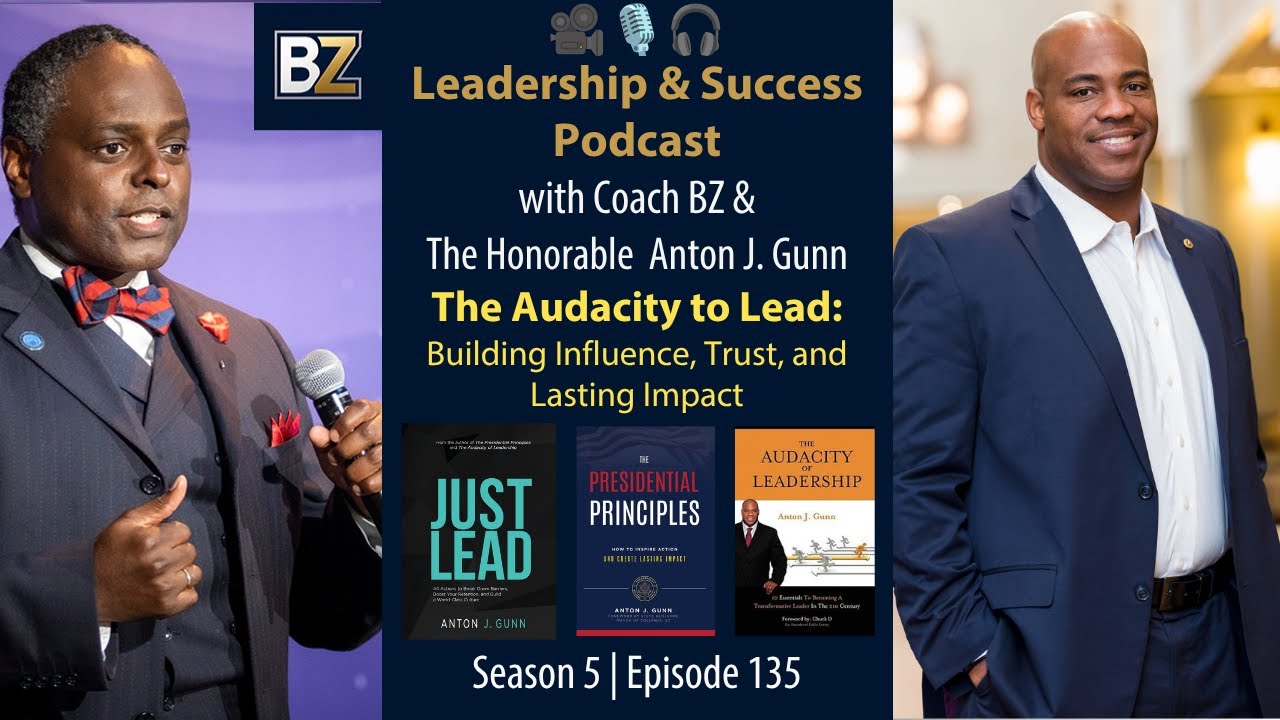
Former White House advisor Anton J. Gunn argues that legendary leaders build through mentorship, not trophies. He credits Bill Walsh's diversity coaching program as a model and pushes the idea that significance comes first, success follows. Start looking for your replacement the day you step into a role, he says.
Chapters
Hi, I'm John Maxwell. When the top companies in the world are looking for trainers, speakers, and coaches, there's one name that stands above the rest, and that's Maxwell Leadership. Our certified team members have gotten proven results for companies all over the globe, and our reputation, I'm proud to say, is second to none. Some of our members have risen to the top of their profession, including the one you're going to meet today. I proudly introduce you to my friend Bob Fabien Zinga.
Welcome to the Leadership Success Podcast with your host, Coach BZ, where we help you lead with purpose and succeed with impact. If you're ready to grow into the kind of leader others want to follow, this podcast is for you. If you're determined to elevate your success and leave a lasting legacy, this podcast is for you. As my mentor, Dr. John C. Maxwell, reminds us, everything rises and falls on leadership. Our goal is simple: to inspire you, challenge you, and equip you with insights that can transform the trajectory of your leadership journey. Welcome aboard to another episode of the Leadership and Success Podcast with Coach BZ.
Every leader is struggling with the challenges that employees deal with in the workplace, and they have no idea how to make it right. I have a framework that I have developed that will help leaders to revolutionize your workplace culture and remake it in a way that adds value to every person in it. I want you to pay attention to the 3 fundamental questions that every employee every person is asking that leaders fail to answer consistently. But if you figure out how to answer these 3 questions, you will not only make it right, you will become the most admired leader, the most admired executive that anybody has ever seen.
All right, are you in for a treat today? We have a very, very special guest and I am so, so excited. And we're going to be speaking to him today, is going to be our master teacher today. And you want to pay attention, write some notes, and if you have any question, please type those in the comments and we are going to be answering live. And also let us know where you are joining us from, what city, what state, and if outside of the US since we are now a global show, which country. And also let us know what you are grateful for. As you know, every time I start the show, we really like to think about, right, what we call here a moment of gratitude. What are we grateful for? That is so, so important, especially for those who are in the military and first responders too, right? It's about 21, 22 service members and veterans who commit suicide every single day in this country. And we believe it's impossible to be suicidal and to be grateful at the same time. So as is our custom, maybe close your eyes and put yourself in your happy place and think about one thing, one thing you are grateful for right now. And today I am really grateful for people like the person I am about to speak to right now, who are really willing to share all of the knowledge that they have with the public. They write books, they do speaking engagement, and they freely share what they know so they can make us better. And I am so, so grateful for that. All right. So if you have a question for my guest, please go ahead and type your question in the comment. And we will be answering you live. So without any further ado, let me see if I can properly introduce our guest today. Today we're gonna be talking about the audacity of leadership, the audacity to lead, building influence, trust, and lasting impact. I believe that few leaders have experienced leadership from as many perspectives as Anton Gunn, from becoming the first African American elected to the South Carolina legislature from his district to serving as a senior advisor to President Barack Obama. Can you believe that? To advising boards, C-suite executives, and organizations around the world, Anton has dedicated his career to helping leaders build trust, strengthen culture, and create meaningful impact. His bestselling offer of Just Lead: 44 Actions to Break Down Barriers, Boost Retention, and Build a World-Class Culture, also the author of a number one bestselling Amazon book, The Presidential Principles: How to Inspire Action and Create Lasting Impact. And he is also the bestselling author of The Audacity of Leadership: 10 Essentials to Becoming a Transformative Leader in the 21st Century. So most importantly, I believe Anton is a leader who understands that true leadership is not about position. It is about service, influence, and empowering others to succeed. Part of what you're gonna be learning today is leadership lesson from serving President Barack Obama, but also building a leadership legacy that outlives your title. So without any further ado, please help me welcome to the Leadership and Success Podcast, the one and only, the honorable Anton Gunn.
Thank you, Coach. So happy to be on with you.
Yes, such a great, uh, pleasure and really privilege to be talking to you. So, uh, To get started, what are you grateful for today?
Oh, so many things I'm grateful for. So number one, I'm grateful for my family. I have a beautiful wife of 26 years and a daughter who's 21 years old and is flourishing in her life and career. And without those two ladies, I would probably be bouncing all over the place. But they're great guideposts for me. And so I'm definitely grateful for both of them.
That is so wonderful. Is there something about you that most people may not know when they first meet you?
So many things. They— I think the first thing they probably— people just don't know because my background is so vast and diverse. The things that they don't know is, is, you know, I'm a NASCAR fan. I'm a hip-hop fan at the same time. And I also am an avid traveler. I love to travel. The fourth thing I would say— this is one, probably the biggest secret that people don't know— is that I sometimes write treatments for television shows and, and screenplays for movies. Like, those, those are the things that, that interest me. So I have a story bible that I'm putting together for a series that one of these days I'm going to finish it and hope that somebody at Netflix gives me a deal Wow. Bring the show to reality. So I'm a jack of all trades and a master of a few. So I do lots of things.
That is so, so wonderful. Well, your friend and former boss may just know somebody at Netflix.
Yeah.
And help you with, with that deal. Now, many people, they really know you as the leadership expert, and few know your full story. What experiences shaped the young Anton Gunn into the leader you are?
Yeah, great question and a great place to start. Because I think, you know, to really understand me as a leader and the philosophy that I bring to the table, you have to understand the origin for me and leadership. And that really goes back to my family. And when I say family, I want you to understand that I'm a fourth-generation military brat. Wow. Now when I say fourth generation, my great-grandfather served in both World Wars. My grandfather served in World War II in the Army. My father was in the Navy for 22 years. Wow. My uncle was a Korea War veteran in the Marines. My other uncle was in Vietnam in the Army. And my dad's baby brother was also in the Army. My mom's sister was in the Navy for 20 years and commissioned as a lieutenant in the Army after serving as a nurse in our local community in Virginia. And my mom was a teacher. My mom was an educator. So she spent 20 years educating kids. I have uncles who are social workers, who are counselors, therapists.
Amazing.
So I come from a family of people who spent their entire careers serving other people to protect them and to make them better.
Yes.
So whether you're a teacher, social worker, nurse, or in military service, it was all about other people. So the value system that I was raised with is service is the prerequisite of leadership. You have to serve first before you can ever even think about leading. And so as a young kid, I had all of these examples of people around me. I didn't know any entrepreneurs, I didn't know any business owners, I didn't know people who made profit. I just, I wasn't connected to that. I was connected to people who served. And I came up in a family who was willing to give their shirt off of their back for other people. And what do I mean, shirt off their back? I'm the oldest of 4 boys. So my parents had me and my 3 brothers to raise. But almost my entire life, we may have had a friend or a relative that lived with us. Yes, for a point in time, because my parents were not at all concerned about opening their doors to their friends and other family members, and displacing me out of my bedroom to make me sleep on the couch. So my uncle could, because his wife could stay in my bedroom, or, you know, a relative can stay in my room. So, so we came from a family who was open and giving. And so, so for me, those are fundamental things around the leadership journey. Yes, critical things. But I want to give you the other big piece. If I had to bookend these. So it's a service aspect in my family. But I also want to give you the role that hip-hop music and culture played in me understanding my personal responsibility to become a leader. And I was a young adult. And when I say young adult, I was a teenager, 12, 13 years old, hanging around the wrong people in the wrong neighborhood. Doing the wrong things, getting in trouble the way that I shouldn't have. And God saw fit to direct me into a record store. And when I walked into this record store— and I'm dating myself when I say record store— some of your young Navy leaders, military leaders, will not have any idea what a record store is because all of their music is available on their iPod or on their—
yes, right. Although the LP made a comeback.
But yes, yes, yes, right. But back in the day, we didn't even have, have them. We had to go to the store.
Yes.
And buy long play albums. That's what LP stands for, long play albums. And I bought this album by a group called Public Enemy. The album was It Takes a Nation of Millions to Hold Us Back. And when I bought that album, I didn't understand Why were they a public enemy? What nation is trying to hold them back? And what are they really saying? And when I first listened to that album, I heard music that spoke clearly to my spirit as a young Black man in America. And the music said, Anton, the world is inherently unfair and broken. And you as a Black man, if you choose to educate yourself, develop yourself, and build yourself up. Some people will see you as dangerous, but you need to be prepared because the world is cruel and harsh.
Wow.
And then the cornerstone was 2 years after that album came out that Chuck D, the lead singer of the group Public Enemy, the lead rapper in the group— this is a Hall of Fame, Rock and Roll Hall of Fame rap group today— but in 1990, a reporter asked Chuck Hey Chuck, you went platinum on your first album, you went platinum on the last one. Now your next album is coming out. Is your goal to go platinum? And Chuck D responded and said, no, my goal is not to go platinum. I don't care about going platinum. What I care about, I care about creating 5,000 new Black leaders in America.
Wow.
And when Chuck D said that in the interview, I raised my head and raised my hand to say, I'm going to commit myself to be one of those leaders that Chuck D would be proud of. Wow. And I'm so grateful that literally 20 years after that moment that I made that decision, I got a chance to tell Chuck D what his words meant to me, how they inspired me to be a leader and to show up in the world the way that I did. And then I asked him a simple question: would you do me the honor of writing the foreword to my first book, The Audacity of Leadership? Because I want to give words to the next generation of leaders the way you gave words to my generation. And he said yes. And he wrote the foreword to my first book. And so my leadership journey is connected to service and connected completely to hip-hop.
Wow, that is quite a story, man. It almost gave me chills. Thank you. What— going up, what, what did your, uh, father tell you, uh, about, uh, growing up now as a Black man in America?
Yeah, so my dad, you know, I love sharing my dad's story because it's really important for, for me to let people know about him. So my dad grew up in Portsmouth, Virginia, a place called Cavalier Manor. And if you're not familiar with Portsmouth or Cavalier Manor, this is not a shining light on a hill, upper middle class city. This is a working-class city. There's a lot of poverty, a lot of crime. And my dad, um, the Navy turned his life around because before he joined the Navy, uh, he was pretty much a delinquent and was getting in trouble with the law. And my grandfather said, I'm tired of coming to pick you up out of jail, you know, I'm taking you down to a recruiter's office, and made my dad join the Navy.
Wow.
And that was the time that if you were arrested, the Navy would take you because it was Vietnam. They were happy to take everything And so my dad joined the Navy and it changed his life. It changed his life, gave him discipline and focus and maturity and all kinds of other things. And then he met my mom, and then that's when, you know, me and my brothers came along.
Wow.
And so from my dad— my dad was a, was a, was a— like, if you looked up the word cuss like a sailor in the dictionary, it would be a picture of my dad right beside it.
Wow.
He was a big man, 6'3", 250 pounds, deep raspy voice, huge intimidating character. But what I learned from him is that you got to be who you are. And my dad did not pretend to be anybody else other than him. He didn't try to fit into a box. He didn't try to conform to be anybody else. He was as big a personality as you could have. And so when he walked into a room, he commanded the room before he said 10 words.
Yes. Wow.
I will be honest with you that most of those words were 4-letter words. But nonetheless, he showed me that you got to be you. You only can be you and do you.
That is so, so powerful. And another interesting thing happening in your career, you became the very first African American elected to the South Carolina legislature from your district. And by the way, my wife are from my mom's side, they are originally from South Carolina, so which is pretty cool. Manning, I think Manning, South Carolina is where they were from. So what leadership lesson did you learn from being a pioneer?
Yeah, so, so first of all, I will say this to everyone. Today's politics has become very divisive.
Yes.
And hurtful in so many ways. And I'm anti all of that divisiveness and hurtfulness. And so in 2006, this is, this is really the lesson. In 2006, I was a person who worked in the community, had relationships in the community, and was inspired to run for office to make positive change in my local community. I ran for office and I lost. So the first time I ran, I lost by 298 votes.
What?
14,000?
Yes. Yes.
Wow. It was very, very close. And I ran against an incumbent who was in the other party and. He was popular. And so everybody told me, Anton, you don't have a chance. You're not going to get close. They're going to wipe the floor with you. You just don't know what you're doing. You're going to lose miserably.
Wow.
And I came close by 298 votes. And the first lesson that they showed me is never let people's opinion of you determine your destiny.
Yes.
Don't believe everything that you hear, right? And so when I got close, I said, well, if I got I probably could win if I do more. And I said, but here's what I need to do differently, is that my district, I was the first African American, so it was majority white. My district was majority white.
Yeah.
I was also the first Democrat in 24 years, which means it was heavily Republican, the other party. And I was like, well, I can't win if I'm uncomfortable talking to people who are different than I was.
Yes.
So I was comfortable going into other places, other communities, and having conversations. And what it learned— what I learned in the process is that we're all people who care about the same things. Yes, we care about life, liberty, and the pursuit of happiness. We care about, you know, wanting to have opportunities for our children. We want safe housing, we want paved roads and clean water. We are— all of us want all of the same things. Yeah, and we just may have different philosophies on how to get there, but the end goal is the same. And so what I learned in the pioneering process of getting elected is that no man is an island. You can't get there by yourself. And if it wasn't for the voters in House District 79, the people in Kershaw County, the people in Richland County, the people in rural communities, the people that— if they didn't believe in me yes, then I wouldn't win. So what do I mean, believe? This is the lesson for every leader. I really believe that this is a lesson for every leader, that you have to show people who you really are. If you want them to trust you, you have to really show people how you think, what you care about, what your values are, what makes you tick, what makes you angry, what you love, and what you hate. The more you show people who you are, and what you will do for them, the more they will trust you.
Wow.
And that's what I got breaking that barrier and becoming the first person to ever do what I did. And it's amazing, very honored by it.
That really takes a lot of courage, doesn't it, to be vulnerable?
Yeah, it's a tremendous amount of courage. And, you know, you— there was like, there were some days that I was very afraid. I mean, like, That's the point around courage that people don't understand. Courage is not fearlessness, right? Courage is being afraid, but doing it anyway. Right? Wow. Yeah, I remember going to knock on doors in communities that were unfamiliar with me. And a woman pulled a gun on me because a man came to her door. Right?
Wow.
And it was because she— her husband had been called away. To be a part of the Gulf War, in Iraq and Afghanistan. She has a home, and I'm just going to the neighborhood going door to door, and there's a strange car sitting outside on her street while I was sitting in my car going through my notes and getting my courage up to get out. And then a strange man walks to her door, right? So I went into other neighborhoods where there were wild dogs running around and chasing me and And, you know, I played football at the University of South Carolina, and I'm in a neighborhood where Clemson fans are, and that's our archenemy, our rival enemy. So, so you're afraid and you got to do it if you really want something bad enough. And I wanted to win, I wanted to serve, I wanted to be the leader for the future of my district. So I was afraid at times, but I had to do it anyway.
Wow, you just reminded me of a time when I was learning how to drive. I was in Tuscaloosa, Alabama at the time. That was before we had GPS, so I completely got lost and I thought maybe I can ask for some direction. I pulled into somebody else's house, it was kind of in the countryside, a little bit dark, but anyway, he came out with a rifle. I'm like, okay, I'm not welcome here, it's time for me to go. But wow, that's incredible. Let's talk about your number one Amazon best-selling book, which is The Presidential Principle: How to Inspire Action and Create Lasting Impact. What inspired you to write this book? Why did this book have to be written?
Yeah, so that's a great, great question. This is why that book had to be written. And this, I want to really, really for us to think about this. If we think about the 250-year history of our country. When we think about leadership, the apex of leadership in the United States of America historically has been the President of the United States.
Yes.
So when I say the following names, when I say Washington, Jefferson, Lincoln, Roosevelt, Kennedy, when you hear these names, We know that these men are all dead and gone, but the decisions that they made, the leadership that they showed, has had a lasting positive impact on our nation even until today. And so when I was thinking about the apex of leadership, I was thinking about how inspiring most of our presidents have been, how they lift us up to our higher selves and they help us to go to a higher level. So when I was thinking about that, I just said, let me think honestly about the presidents that have had a personal impact on my life, that their decisions have had a lasting impact on my decisions. And so that's George H.W. Bush. Yeah, that is George W. Bush. That is Bill Clinton. That is Barack Obama. And so I was real clear that I wanted to share with people the stories of the presidents in my life, particularly Barack Obama, who I worked for, for 41 months.
That's amazing. Wow. So I guess the next question is, since you had that front row seat to history, serving as a senior advisor to President Barack Obama, What leadership qualities made President Obama such an effective leader? Actually, right now, I believe, according to polls, he's the most famous former president of all time. What made it so?
Yeah, so he's the most famous president, former president of all time. In addition to that, historians say that he's in the top 10 of presidents in our history. Some say he's at 7, others say he's at 5. And so He's in the top 10. We know he's good. And that's a bipartisan, unified view of, of his stewardship of America. And that's really the point around stewardship. So there's several qualities that I would name to you. I'm going to try to keep them short because I wrote a blog post. It was back in 2017. It was called Be Like Barack. And the point of the blog post was the following, is that we all remember when Michael Jordan was in Chicago playing for the Bulls. Gatorade ran this commercial that says, like Mike, I like to be like Mike, and then people wanted to be like Michael Jordan. And I said they should make another commercial to say that, be like Barack, we should want to be like Barack. Now, what are those qualities? Here's the first quality that I would always point out about Barack Obama, because I've had firsthand experience with this, is that he prides himself on surrounding himself with people who are smarter than he is, who know more about subjects than he is. He doesn't have to be the smartest person in the room. He wants to put the smartest people around him and let him— let them debate each other and give him the argument, give him the pros, the cons, the perspectives. And he'll listen and take that information in. And then he uses his judgment based upon sound knowledge. So he listens to wise people. And that's quality number one. A second quality that I found to be the most valuable for me. And, you know, this is one that we don't talk about a lot when it comes to leadership, is that Barack Obama unquestionably loves his wife and his children and was unafraid and un bashful about showing his love and affection for the women in his life. And so as a leader, it's important for people to know that you're not all business all the time, that you are human, that you, you care about other people. And the reverence that he has for Michelle Obama, the role that he plays for his daughters Sasha and Malia, was powerful example and a powerful quality that you have to be a whole person to be a great leader. You can't be just great at work and terrible and irresponsible at home. You can't be, you know, the boss and the commander-in-chief in this area, but not supporting your family and creating an environment for them to be positive. So that would be quality number 2.
So powerful.
Now the third quality I'll give you, and I'll stop with this one. The third quality is this. You really have to have some unmitigated audacity and boldness for your name to be Barack Hussein Obama and believe that you're going to be President of the United States. Yes, like his belief system was off the charts. Yeah, but it wasn't just the belief. But it was to be able to have that personal belief and translate it into a vision that other people could see themselves a part of helping you make it a reality. Like, when I read his book, The Audacity of Hope, I finished that book and I said, this man has to become President of the United States. I gotta help him. I gotta help him. Like, I was convicted. So, so that's the power, I would say, is that you got to have a great belief system, but more importantly, to be able to paint a vision where other people can see themselves as a part of that vision. And that's a supreme skill and quality that Barack Obama has.
That is so, so powerful. Can you share maybe a specific moment during your White House service that fundamentally changed your understanding of leadership?
Yes, easy question for me. I could give you 100 moments. But I'm going to give you one that I share with my audiences in my keynote presentations that I deliver all over the country and all over the world. And that is, it was in 2013. I was invited to the White House to meet with the President in the Oval Office. And we were in the Oval Office to take a photograph. To take a photograph in front of the Resolute Desk. And I asked the President, I said, Mr. President, why did you want to take a photo with me? He says, well, I want to thank you for the work that you were doing on the Affordable Care Act. And I said, yes, I'm not the only person. I mean, there's a lot of people working on the Affordable Care Act. I mean, we got 250 people at HHS who are all working on the Affordable Care Act. So, you know, why, why me? He said, well, your colleagues told me all of the work that you were doing, and they thought you deserved the recognition. So I wanted to bring you here to say thank you. And he said, I want you to know, Anton, what we're doing here today will matter to people who are born after we're gone. Wow. And when he said it will matter to people who were born after we were gone, it really hit me like a ton of bricks what a presidency is all about. And that is the legacy of what you do today and how it will impact tomorrow. That we are all stewards, temporary stewards. Mm-hmm. And the question for most of us should be, no matter what role you play as a leader, will that place be better off because you were there after you found it than it was before you found it. And so many people come into an organization, they do whatever they want to do in leadership. But the team and the company is not better off when they leave.
Yes.
And so I learned the lesson about stewardship and about the presidency is that you should make the country, the organization more better after you're gone than it was before by how you show up. And that's the true measure of a leader's legacy is, is how better off we are after.
Now, we've always seen President Obama as always being cool under immense, immense pressure. Can you tell us how did President Obama handle criticism, pressure and uncertainty.
Yeah, so I will tell you this about Barack Obama, that he has an uncanny ability to not allow criticism and negative energy affect his decision making. And you know why I think that is, now that I'm really reflecting on it? The reason why I think he was like that is because the purpose to serve was so clear. The mission to serve was so clear that he knew that it wasn't about him. You being angry with him, or not liking him, or criticizing him is irrelevant. The mission is, how do we make America better? How do we solve the problems in America? How do we make healthcare better, the economy better? How do we create more jobs? Like, the mission—
yes—
is so important. And so he was comfortable brushing the dirt off his shoulders. And he never let it bother him. And like, even in— and there was— it bothered me. So let me just be clear. As someone who worked for him, and was very protective of his legacy and his history, that I was angry a lot at people for the things that they said about him, and, you know, how they showed up. And And I would go into meetings with him. And he could care less about what they were saying.
Wow.
He wants to know, what are we doing to make it better? What are we doing to solve a problem? What are we doing to get to the next level? And so he was an amazing human being to be able to compartmentalize purpose away from criticism and negativity.
Yeah, I think in my lifetime, I've never seen a president so criticized. And Also, his ability to just reach out to the other side, right? On the other side of the aisle. How did you think, as a leader, how did he build and maintain trust, especially with people who were from a different persuasion?
Yeah. So, you know, the lesson from Barack Obama is he sees people as people first. You know, he knows that, you know, you got your partisan agenda, or you may have your special interest agenda. He knows all of that. But the evidence is to try to figure out who you are as a human being. Like, who are you as a person? Like, what matters to you? Like, not what policy matters to you, but where'd you grow up?
Yes.
How did you grow up? How does that shape the decisions that you want to make today? And so he was comfortable going into the lion's den. I'll never forget when, you know, when the debate was around the Affordable Care Act. He went to the Republican House Caucus, or really the House Caucus that the Republicans controlled, and was happy to take questions and happy to debate. And, you know, and like, we all remember the moment when, when he was in the, in Congress, and he was talking about the Affordable Care Act, and somebody called him a liar. And he didn't react. He didn't, you know, he didn't get negative. He just responded, that's not true. You know, that's not true. And so So he was comfortable just meeting people for who they were and going right to them wherever they were.
Wow. So as America continued to discuss leadership, inclusion, and opportunity, what part of President Obama's legacy do you believe history will appreciate even more over time?
Yeah. So, wow. And this is on the heels of the Obama Presidential Center opening last week.
Yeah.
And I had the opportunity to visit and tour the museum.
And I think it was really prophetic on June 10th too. That's just—
absolutely, absolutely. But there's so many things in the museum that will be enduring parts of his legacy. But there's one that I particularly and keenly forgot about. Now I could talk about healthcare reform and the Affordable Care Act, that 50 million people today have health coverage that didn't have it before he was president. I'm not going to talk about that. I'm going to talk about what people don't realize. Barack Obama was the first digital president.
Hmm.
He was the first digital president, the first president of the United States to do a town hall meeting on YouTube, on Facebook, to use Twitter, to have a Twitter account, to really make the White House accessible outside of the press corps.
Hmm.
For Barack Obama, you had to go to the press briefing room and go to CNN or Fox or to the Wall Street Journal to find out what the administration was saying and what they were doing.
Yes.
Barack Obama's enduring legacy is that he set the blueprint of what every president after him has done in terms of digital footprint and how you engage with people. Yes, on Facebook, on Instagram, on X, and all of these platforms. And so he invented the digital presidency and, and digital government service. And how do we make government accessible? Like, think about it. Yes, you had to call government agencies on the phone before the Obama administration. But after Obama, they had email addresses, they had forms on their websites, they had digital ways for you to interface, you can watch video content. It was so many things that he did, that really became the pioneer of what we know from our government and from the presidency around digital access.
That's really powerful. So on, on this book here, what is one lesson you think everybody needs to take home if they read this book? If they could take one and only one lesson, what should that be?
Yes. The one lesson from, from my book, The Presidential Principles, that I think is valuable for people to take away is that I want you to understand, and this is something that I said earlier, and I'm gonna give it to you this way. Service is the prerequisite of leadership. But empowerment is the essence of leadership. Wow. That as a leader, your job is not just to feed your team of fish. But your job is to teach them how to fish. Give them the tools, the information, and the resources to determine their destiny. And you, you don't get to choose their destiny. They get to determine their destiny. Your job is to give them the tools, give them what they need to succeed, give them what they need to be great, give them what they need to be the best. And that is the cornerstone of my philosophy as a leader. And that's the one lesson that I think is most important for people in that book.
So powerful. Thank you so much. Was there a chapter that was very most challenging for you to write in that book?
Um, yeah, so there, there were a lot of challenging chapters. I would say the one that was most challenging is to talk about the difficult years of my career. Like, I, I played college football at the University of South Carolina. And unfortunately, at the time that I played football, I played for some very bad coaches. I will put it to you that way. The culture was toxic and hostile, and it wasn't affirming. It wasn't valuing for me. I really went into a very dark place from depression and just not really feeling worthy, that I, I didn't think I was good. I didn't think I was qualified. I didn't think I was going to be able to do anything. And so it's hard to talk about those dark moments, those times where, where we feel less than, when we feel least valued. And, and it was hard to write about those things. But the reason why I had to write about them is because it led to the greatest legacy that I could create. Like everything that went wrong in college is now what I try to correct in every organization. And for every leader that I get the privilege to work with. And so, so it was hard to talk about those hard, bad days of, um, you know, playing in a culture that, um, was, was really toxic, um, not just for me but for a lot of my teammates. It was hard for them. We didn't win any games a lot. We had a player revolt, like we tried to get our coaches fired. Like, it was, you know, it was all kinds of things that you would never see in college football. Could you imagine a whole team of football players? Wow. I'm not going to practice because we don't like our coach. We want him to resign and appoint someone else as the head coach. That was my sophomore year in college.
Especially in the SEC, because Tuscaloosa, Alabama, where football is pretty much God over there. Wow. What did you learn through that experience?
So I learned a lot of lessons. Number one, Everybody is not ready for senior leadership. Lesson number 2 is just because somebody offers you an opportunity doesn't mean you need to take it.
Yes.
And the third lesson is, you know, it's hard to win when you don't have trust.
Hmm.
And I didn't trust my coaches. Yes, they didn't trust us. Um, my coach was offered a head coaching job but wasn't ready to be a head coach. Like, he was, he was too young and too experienced to be a head coach.
Yes.
And on top of that, um, you know, if you're going to take that job and be a head coach, you really got to do a better job of surrounding yourself with people like Barack Obama did, with people who are smarter than you. Who are better than you.
Right.
And so many head leaders think that they have to be the smartest person, that they— because I'm in charge, I gotta have— I gotta be the smartest. And we all know that the greatest innovators, like Henry Ford, for instance, had a 6th grade education.
Yes.
He surrounded himself with people who had much more education and brilliance than he did. And, you know, we now get the automobile and, you know, all of these innovations because A leader recognizes that I don't need to be the best.
And I don't know if I can do that.
So powerful.
Yeah, it really takes humility and that can be so impactful. Now for this next segment, I'm watching time. Looks like we have about 15 minutes left. You gave me permission to do so. I want to play a video. It's about 1 minute of you. And then I'll be back on the other side.
Sharon was like 5'10", and so that ain't really small, but yeah, but in our household amongst the men, he was the smallest. My dad was 6'2", 6'3". So Sharon was more like my mom than anybody else. And what I mean by that, he was, he was very caring and very nurturing. And my mama used to say, yeah, he was her, he was her child, even though we all were her children, because he was born on Valentine's Day. So he was like her Valentine's Day gift. Um, but Sharon had this— he couldn't stand for something to be wrong. Like, if something wasn't right, he would say, that's not right. He was always like, that's not right, that's not right. And whenever my dad would do stuff that was wrong, Sharon would say say that's not right. He would confront my dad, and he was more outspoken. Me, I would never say anything. I would be passive-aggressive in my behavior, maybe, or slow to do it. But Sharon would literally stand up and say, uh-uh, that ain't right, I don't like that.
Okay, we really wanted to, uh, respectfully honor the, um, courage and bravery of your brother. That's why I wanted to, to play, uh, this first. And I think many people now know, um, if you are comfortable talking about this, I, I definitely want to honor him. Your brother, U.S. Navy signalman apprentice Sharon Gunn. Yes. Especially as a senior officer in the Navy, uh, this is something that's definitely very, uh, important, uh, to me. Can you tell us, uh, about Sharon and the kind of person he was. Yes.
So just to make sure everybody understands that when I said at the beginning, I was a fourth-generation military brat. I'm in that fourth generation. I did not serve in the military. I put on a football uniform and went to college. But my brother Sharone joined the United States Navy in January of 2000, and unfortunately was killed in a terrorist attack aboard the USS Cole on October 2000. It was 25 years ago this past October. My brother was second in the birth order. I'm the oldest of four. He was 5 years younger than me, so I was 27, he was 22 when he joined the Navy. And he had only been in the Navy, like I said, 9 or 10 months when he was killed. And, um, you know, Sharon was Um, he didn't get a chance to live a full life. He didn't get a chance to do all of the things that I now get the privilege of doing. And, um, Sharon and I were close. So like when I say, uh, we were close, he was my first responsibility, my first leadership responsibility. I'll, I'll never forget when my mom had my baby brothers, the twins, she had to go upstairs and feed the twins. And she came and put Sharon down on the couch beside me and she said, Your brother is right here beside you. He's your responsibility. Don't you let him fall. Don't you let him get in anything. Don't you let him get hurt. Don't you let him put anything in his mouth. He is your responsibility. And that's when I knew that I was a leader because I, I was the big brother. So, you know, I kind of shaped his life. I told him what music he could listen to and what clothes to wear, you know, all of those things. And so I was the consummate big brother. And Sharon and I, you know, bonded a lot over music. Over hip-hop. Like, we would, we would sit on the phone. Like, when I was in college, a new album would come out and we would get on the phone and stay on the phone for an hour playing the record over the phone and listening and talking about the music. And so, um, so Sharon was a great warm spirit. Like I said in the video, he was born on Valentine's Day. Uh, he loved people, he loved life, he loved serving people. He took after my parents' genes of serving people. I never forget this story, and I got to share this one. Yes, when Sharon was in the Navy— excuse me, before Sharon joined the Navy, it was right before he joined the Navy— he was living in Atlanta, and, um, the neighbor across the street was a husband with 3 young children. And Sharon was taking the trash out one day, and he saw the neighbor across the street, and he— and it was, it was a Friday And my brother said, you know, so are you taking your wife out to dinner? And the neighbor says, man, I got 3 kids under 5. I don't have time to take my wife out for dinner. I got babies. And my brother felt so bad that he couldn't take his wife out on a Friday night. So my brother volunteered to babysit 3 young kids while this man took his wife out to dinner. Now I want you to think about this. My brother was 21 years old. Wow. What 21-year-old man who could be out partying, hanging out himself?
Yes.
Would say, you know what, I care enough about my neighbor and his relationship with his wife, I'mma babysit your kids for you, you know, I, I'll babysit your kids so y'all can go out and have a good time. And so that shows you the spirit that he had, the love that he had for people., and that he was willing to do, you know, whatever to serve people. And those are values that we all carry in our family and that I carry today.
That's really amazing. Uh, because of those who don't know, Sharon was one of the 17 American sailors killed during the terrorist attack on USS Cole, October 2000. I still remember that, it was in the news everywhere. How did that tragedy change your perspective leadership, service, and purpose?
Yeah, so great question. Very, very poignant and difficult question. So for me, before that, I had a narrow view of what leaders do. Leaders were command and control. I'm in charge, I'm supposed to do this, you're supposed to do what I say because I'm in charge. That's kind of some of what I saw I learned in the military, you know, you know, when you're commanding officer, everything rises and falls on your shoulders. And so you tell people what to do, their job is to execute. Nobody questions orders. Nobody does it. You do what you're told.
Yes.
But I honestly believe people doing what they were told was one of the reasons the Cole attack happened.
Right?
There was no challenge or thought process around Do we have enough information about this port that we're traveling into? And what should we be doing? So the Cole tragedy made me expand my mindset around leadership. And the first thing a leader needs to do is to listen to the people that they lead. Yes, listen and learn from the people that they lead. The second thing a leader needs to be willing to do and able to do is to make a different decision. If your people give you information contrary to what you know.
Yes.
Like, you cannot be committed to go down one path just because you're in charge. You got to listen to the people that you lead and make a different decision.
Wow.
Another aspect that I, that I believe that I took away from this is that leaders always need to be held accountable. Yes, like you need to share the responsibility. So like, when we win, we all take credit for the win, and you want to share the credit with everyone else. But when things go wrong, you have to own the accountability that this happened under your watch. And you should be responsible for what happened. And those are the things that were, were now, you know, permanent lenses for me around leadership.
Wow. Because I believe during the time in a Time magazine profile, I believe it was this one, you shared that after losing a brother, you became even more committed to public service. Yes. What motivated that decision?
Yeah. So, you know, I think that, you know, we, we have a nation of laws, nation of government, and we love to point the finger at government. Like so many people will say, Oh, the government is broken. The government is flawed. All politicians are bad. People will say those things. But here's what they're saying. They're saying we are flawed and we are bad because we are the people. You know, we, as the, as the preamble says, we are the people of the United States of America. So government is broken. That means we're broken. And so my commitment to public service was around showing people that government can work, that good people can do great things, and that there's nobility in serving others. There's nobility in wanting to be a part of making a difference and, and having an impact in a positive way. And there's so many things that we can do to do good that I wanted to be an inspiration for a whole new generation of young public servants who are willing to make a difference in the world. And, um, that's, that's why I was so committed. I'm still committed. Like, I'm not running for office, don't plan to run for office or any of those things, But I support people to run. Like, I talk to candidates on a regular basis. I talk to elected officials. I like— I just text with the mayor of Little Rock, Arkansas, just 2 days ago and told him how proud I am of him for being a young leader who ran for mayor, got elected, served 2 terms, and is now seeking his 3rd term. And I told him, I'm just proud of you, how you're leading and serving. And so I don't have to be in public life. But I can support other people who are doing good things.
So powerful. And for some of the leaders who are listening right now, they may be carrying grief or setback or personal adversity. What advice would you offer about continuing to move?
Yeah, we all will face adversity. We all will have setbacks, we all will have challenges. But there's healing in serving others. There's literally PhD-level research that says that people who are going through grief, trauma, and tragedy, that when they commit themselves to volunteer service, it helps them to heal. And I'm the proof point of that. Like, when I was at my darkest moments after losing my brother, um, my commitment to serving other people is what actually brought me healing. It actually brought me more excitement and support because other people are hurting. And everybody needs somebody sometimes. And sometimes you might be the most important person that they can learn from and grieve alongside because you've been where they have been. So my, my message to people is that when you're grieving, find some good to do in the world, find somebody to help, somebody to serve, make a difference in some way, and your healing will come as a part of it.
That is so powerful. Thanks again for sharing this. And you've really turned this grief, this pain into purpose. How can my audience, even those who really didn't know, know him personally, how can we honor his legacy?
Yeah, I would say the best way for you to honor my brother's legacy is to always be supportive of our men and women in uniforms who serve in the United States military and their families. Let's be clear, when someone is serving in the military, their family is also serving. I will also tell you, if you would like to make a contribution to an organization, I'm going to give you an organization that I think will be valuable to contribute to. And that is the American Gold Star Mothers Incorporated.
Hmm.
It's soon going to be a 100-year-old organization that is made up of mothers who have lost sons and daughters in service to the military. My mom is a past national president, the first African American president in the history of the organization, first Navy mom in a very long time. And so that organization supports moms. And as they approach their centennial year, we want to make sure that a mom who's never supposed to outlive their children—
yes—
is supported in a way. So I would tell you If you want to contribute somewhere, make a contribution to American Gold Star Mothers Incorporated.
Wow, that is so powerful. And I am going to put the link in the notes of the podcast. And like you guys have known on this podcast, we really like to be active and to contribute, but I never ask people to give more than $5. I think everybody, even poor people, can afford a Starbucks cup of coffee. And we've already proven on this podcast during the war in Ukraine when it started, we raised, I mean, not just the people who follow me, but all of us, more than $2 million. Initially it was $1 million, I asked for $5 only, and then we reached that, and then the people who organized the GoFundMe said, okay, let's double that to $2 million. We ended up raising almost $2,200,000 for the people of Ukraine. So I do believe in very, very small donations. You don't have to be a millionaire, you don't have to give a lot of money, although some of my friends in Silicon Valley are very, very wealthy. And I want you to give more. But if everybody who follows me on this podcast, about 66,000 of you, if we all give just $5, that's going to be more than $300,000, and that can make a difference. So please give again, American Gold Star Mothers Inc. That is a very, very good cause. And on top of that, for some of you, you are going to get a tax deductible donation as well. I don't want you to give for the tax deduction, but do give $5, please. All right. Thank you. Thank you. Thank you so much for sharing today, Anton. I see we are rapidly running out of time. I do wanna ask you a couple of quick questions. I think this is a book that you are writing. I read your Forbes article about becoming a leader that people would follow, right? Become legendary, building leaders nobody wants to leave. A recent Forbes article was titled Anton Gunn Builds Leaders Nobody Wants to Leave. I believe that's, that's your next book. But that's a very, very powerful statement. What does it mean to become the kind of leader people never want to leave?
Yeah, it means becoming a leader who cares about them, who helps them to be successful, and is willing to be authentic and transparent about all of the challenges. My greatest boss was not Barack Obama. It was a woman named Lenore Reese, who first cared about me, and then wanted to help me to not just be good at the job, but to be good at life. And then she helped me to grow by giving me new opportunities. And so if you work in an environment with a leader who cares about you, who's willing to help you to be good at life, and not just the job, but more importantly, create the space and opportunities for you, they become legendary. Like the, the legend for Lenore is that she moved out of the way as CEO, and I succeeded her as the chief executive of the organization. And so that is what a legendary leader does. And I believe that all of us have the potential to become legendary. We cannot hoard power and hoard leadership. We have to hoard how we create opportunities for people and then share those opportunities liberally. And that's what becoming legendary is about.
So powerful. I know in the Navy, I think the Army too, we say, you know, mission first, people always. And sometimes it's nothing but a slogan, but you're saying it has to be much more than just a slogan. People have to feel it. Wow. You often say that leadership and culture, they affect everything— performance, trust, innovation, and even how people show up for their families at night. Why do so many leaders underestimate the impact they have on people's lives beyond the workplace?
Yeah, I think many leaders are overwhelmed and burdened in the workplace. Burnout is a real thing. High turnover. A lot of my clients have high turnover, low retention. They have all these challenges. And, and then they put so much on leaders to say, you got to meet these goals, these KPIs. You got to focus on this. And then the uncertainty in the environment, leaders are overwhelmed themselves. And so when they're overwhelmed, they don't have time. They say that they don't have time to focus on their people, like, I got too many things I got to do. And what I want them to understand is they need to flip that mindset. And that if you don't have time for your people, then that means you don't deserve to lead. Wow. And so if you focus on your people, empowering them, helping them to be successful, they will run through walls for you and they will never let you fail. And that's the lesson that— about Barack Obama is that he cared about us so much and empowered us so much that none of us wanted to let him fail. So we would be willing to do whatever it took to make sure his policies, his programs, His presidency succeeded. And I think that's the greatest part of his legacy is that it was people-powered, people first. They mattered first. And that's what we executed on. And that's why he had a presidency that was flawless. No scandals, no blemishes, no pain. None of those negative things is because, yes, you know, we all treated it like our last name was Obama. My last name is Gunn. When I worked for him, I was Anton Obama, and I was not going to, you know, let down the family. I wasn't going to embarrass myself by the family, by making the family look bad. So I did my part to make sure that I stay flawless. And all of us had that same mentality, that our last name.
That is so, so powerful. That's exactly what happened in the military too. Unfortunately, you don't see it very often. But when you do, you're right. You would run through hell for a leader like that. That's why when we go in times of war, people are willing to put their life on the line for the sailor to their right, to their left, and they follow their fearless leader. It's so powerful. Wow. So you've said in the article that leadership is service, culture matters, and people deserve to be led with dignity and humanity. How can leaders balance accountability and performance while still leading with humanity?
Yeah, so, so a lot of people think accountability and performance means that you have to be mean and bad to people. This is what I, I fundamentally believe, that if you are clear about the goals, if you're clear about where people need to perform, they don't mind being held accountable. Yes, at all. So you can be a human being and say you're doing it right. You can be a human being saying you're doing it wrong. You can be nurturing and supportive and still hold people accountable.
Wow, powerful. Because many organizations, I feel like they kind of treat culture like soft, soft, like a soft issue. I think it was Peter Drucker, right, the father of modern management, who says culture eats strategy for breakfast. I think I agree with, with that. And you, you do argue that culture is business and economic issue.
Yeah.
What is the true cost of toxic leadership?
So here's what I found out. I did a research study 2 years ago. And we surveyed almost 1,000 people across the United States of America about why they quit, why people leave a job, and what does mistreatment look like in the workplace.
Yes.
And what we found is that American employers lose almost $1 trillion a year due to toxic workplace culture and mistreatment in the workplace. When I mean $1 trillion, it's $136 billion in turnover costs. And it's another $777 billion in disengagement. Like when people check out, like a lot of people think that an employee that quits is costing them a lot of money. It does, it costs sometimes 2 to 3 times their salary. But what costs you more is an employee that mentally quits long before they physically quit. They didn't just go through the motions, they just show up. They don't even care enough to focus on their work. And that disengagement is expensive. So, so you having a broken, toxic, unfair culture— yes, it's costing the American employers across the board almost $1 trillion a year. Wow. $914 billion a year.
That is just amazing. Now, technically, we are out of time. Can you give me 5 more minutes before we land this plane? Absolutely, I'll give you 5. Because I want to talk about this book you are writing. And please, whenever it's ready for preorder, sometimes next year, I guess, I really want you to come back here. Maybe we can help you become a number 1 bestselling author again. But you are developing this new keynote and book called Become Legendary. I love that title. What does legendary leadership mean to you?
Yeah, so legendary leadership is unforgettable leadership, unforgettable in the positive sense of the word, like the leader who, long after they've left the organization, people are still talking about their impact, their positive impact, the difference that they've made. And so, and we use the term legendary mostly attached to sports. So when we think about legendary coaches, we'll say Nick Saban. Um, we talk about women's basketball, we'll say Dawn Staley is a legend. Um, when we talk about football, we'll say names like Lou Holtz and Steve Spurrier. We, we know Bill Walsh in the NFL, all legendary coaches. But if you really unpack who these coaches were and you unpack what they did, it's not about the wins and the losses, but it's about the people that they have developed in the process. And I use Bill Walsh as an example. So here's the example. Bill Walsh is dead and gone now, but do you know that if you are an African American who is a head coach in the National Football League, you only came through the ranks of something that Bill Walsh provided?
Wow.
Bill Walsh had a diversity coaching program, the first ever, that if you became a minority coach outside of Art Shell— I think he was the only one that did not— but Mike Tomlin and Lovie Smith and, you know, um, even Tony Dungy, all of them have come through the Bill Walsh coaching program. So his legacy is tied to theirs, and their legacy is tied to his. And there was another stat that like 50% of NFL coaches who coached in the Super Bowl all can trace their opportunity to working for Bill Walsh or somebody that worked for him.
Wow.
And so, so legendary to me is not about the wins or how many Super Bowls you got or how many, you know, KPIs you pass, but it's about the people that you develop along the way and how they remember the opportunity that you gave them, the opportunities you created for them. And so for people in business, my keynote really lays this out, that everyone can become legendary. But it requires you to master a few key skills, some traits, and to show up in a certain way as a leader. And if you do that, you will become the leader that people will talk about into perpetuity.
Wow.
The same way they talk about Martin Luther King Jr. Nelson Mandela, Mother Teresa. We know these leaders. They are all legendary because of how they showed up and how they served people.
That's really powerful. Because I think in your article, that's where you make the distinction, right, between chasing success and creating significance. Yes. Can you explain the difference between the two?
Yeah, that's a great, great question. See, Dr. Miles Monroe, has this quote, and that's where the quote comes from. He says, "Success without a successor is a failure." Yes. And I believe that if we don't use our gifts, our talents, our time, and our leadership opportunities to leave an organization better than we found it, we might be successful.
Yes.
But we will never be significant.
Wow.
And if we focus our time saying, how can I become the most significant person in the lives of the people that I lead. That if we become significant, success will be an automatic byproduct. That you don't need to chase success, you need to just chase significance. And that's what I believe we should be doing.
I could be talking to you for hours, but I am going to end this segment here because one of the most powerful quotes from the article is, stop spending your career trying to protect your seat at the table. Legendary leaders use their seat to make room for other people. That's so, so powerful. Where did that philosophy come from?
Yeah, so that, that came from what Lenora, my boss, did for me, that she got out of the way for me. It's the same thing that I've done in every organization where I've worked, is that I bring in people— the day I get hired, I start looking for my replacement.
Wow.
Think about that. Think about that. If you got into a CEO role, the day you get into the CEO role, you start looking for your replacement, you start developing your replacement. And then you understand that the longest I should be in this position is 7 years. It's time for me to move on.
Wow. You know, so powerful. So powerful. I love it. So as we end, because we do love to read books here, except for your own books, which everybody is encouraged to, to get. If you can tell us, I think one of your buddies wrote this one, why should we read this book, Employability?
Yes. So Joe Mull is a friend of mine. He is a professional speaker and expert on helping people to be better bosses at work. And so that book, Employability, the reason why it was so important to me is because everybody thinks that book is about employee loyalty. No, it's not about employee loyalty. It's about how do you build a workplace that is a destination that people want to come? Because of how you all show up as a leader. And so Joe is a thought leader, very cerebral person. We're good friends. You know, we both spoken at the same organization at different times. Just a phenomenal human being of how he shows up and teaches people how to boss better. He actually has an academy called the Boss Better Academy. If you want to become a better boss, Joe Muller is someone. So that book is great.
Now, another book, Team of Teams about Abraham Lincoln. And by the way, President Obama just wrote an excellent, excellent article about Abraham Lincoln. Everybody needs to read it. Why should people read about that book?
Yeah, so A Team of Rivals is a book that really talks about diversity in a way that we don't usually talk about diversity. And that Abraham Lincoln— that the 1860 presidential election was the most divisive and political presidential election in our nation's history. It was over this, over Civil War and slavery and everything else. And all of the people who ultimately ended up in Lincoln's cabinet were his rivals during the campaign. They did not get along. Lincoln picked people who he did not get along with, and he took time to learn who they were, get to know them.
Amazing.
And ask them, would you be willing to help me to make sure that the nation doesn't fall apart? And so how powerful is that, to be a leader and to bring your rivals together and say, I trust you. I know we don't agree. I know you don't like me. I know we don't agree on anything. But I trust you to be in charge of my State Department. I trust you to be in charge of my Treasury. I trust you to be in charge of the thing that could get me removed as president.
That's really amazing, kind of like what President Obama did by putting Hillary Clinton in charge of the State Department when they were rivals for the president.
Absolutely, absolutely amazing.
Country before party. Okay, maybe a couple more. There are So many, I'm gonna add all of those to our digital bookshelf. But I want you to talk to me about Think and Grow Rich. I think this is a classic. Napoleon Hill. Why should we read it?
Yeah, so Think and Grow Rich really is a book that helps people to understand your mind matters more than anything else. What you think about will help you to become what you want to be like. If you can't think it, then you won't be able to see it. If you don't see it, you won't be able to believe it, right? So the other concept in Think and Grow Rich is really powerful, is the concept of a mastermind group. And this is something that I think more people need to partake a part of. And that is, how do you build a group of 6 or 8 like-minded people, where you are going to gather together at some regular frequency, to help each other to get better, to not only be better at business or be better at leadership, but to be better at life.. And I am privileged to be a part of a couple of incredible mastermind groups that help me to be better as a speaker and as a professional speaker, but also to be better at life. And so Think and Grow Rich is powerful to teach people about the concept of masterminding together. And that's how some of the greatest leaders achieve their biggest goals is because they're in mastermind with people who push them who prod them, who take them to the next level.
The last book we have time for is The 21 Irrefutable Laws of Success by my mentor, Dr. John C. Maxwell. Why should we read this one?
Yes, so that book is cornerstone. Like, if you're trying to figure out leadership 101, that book is leadership 101. And I've had the privilege of meeting John Maxwell. You know, also being on the Maxwell team as well in the past. And so John Maxwell is a dynamic author. And he breaks down leadership in simple terms for you to understand it. And that book was the first leadership book that I read when I was really trying to learn how to lead people and lead teams. And it was just kind of became like a Bible for me. And it's a great book.
All right, we are definitely out of time. So how can we add value back to you?
Yeah, two things. Number one, if you are looking for a speaker at your organization, and you feel like anything that I've shared here on this podcast would be valuable to your team, I want you to contact me at antongunn.com/contact. Send us a contact form. I would love to come and share a message, insights with your team and your organization to help you all to be better. The second thing you can do is connect with me on LinkedIn. I would love to be connected to you. And if you're interested in speaking, having me speak at an organization or executive retreat, just send me a direct message and I'll respond and we'll make sure that we get to work. But LinkedIn and contact me about any speaking opportunities because again, I want to transform you, your leadership, your organization, and help you to build a better culture.
Alright, as we come to the end of the podcast, Anton, is there a question I should have asked you? I didn't get a chance to ask anything else you wanted to share today.
Yeah, you didn't ask me who my top 5 rappers of all time.
All right, who are they?
Yeah, very easy. Number 1 is Rakim from the group Arabian Rakim. Number 1. Number 2 is Nas, Nasir Jones, the second greatest rapper of all time. Number 3 is the Blastmaster KRS-One, um, third best on the list. Number 4 is Eminem. He is the greatest lyricist.
Really?
He's just like— he's a tactical technician lyricist. And number 5 is Big Daddy Kane. Uh, those are my top 5 rappers of all time. Um, top 5 lyricists, the people who are the prototypes. You don't get a Jay-Z without having Big Daddy Kane. You can't get Jay-Z without having Big Daddy Kane.
I believe you on that one. I guess the very last question I'm gonna ask, if you could go back and give a piece of advice to your 17-year-old self, standing at this incredible career you've had, working for the White House, President Obama, being in Congress, and I think you were also a health executive, we didn't have a chance to talk about that, but being a keynote speaker and everything. Wow, what a life, what a life, what a life. What would you say to 17-year-old Anton?
What I would say to 17-year-old Anton is, Always chase the opportunity that will give you more opportunities.
Wow.
Don't get excited about anything else, but find the opportunity that will give you more opportunities. Money will come later. But focus on the opportunity first.
Powerful. And what is something you are feeling optimistic about? I like to end on a positive note.
Yeah, well, you know what I'm feeling optimistic about more than anything else? I'm feeling optimistic about the number of young people in Gen Z who are really stepping up and stepping into leadership and, and feeling like that this is their country, their opportunity for them to own. And so I'm feeling optimistic about, about the future. I'm really feeling optimistic about the future.
I think that's definitely the way you would feel if you went to the Obama Center Presidential Library in Chicago. It's just amazing. That's really the America I am willing to die for, why I joined the US Navy 21 years ago. So to end, I ask all of my guests one word that represents our shared experience on this podcast today. Sir, one word.
One word is legendary.
Wow. Thank you. Thank you. I am so pleased, so overwhelmed and privileged to be speaking to the one and only, the honorable Anton J. Gunn. Thank you so much, sir. I really appreciate it. Your wisdom and expertise today. Thank you.
Thank you, Coach BZ.
All right, everybody, this is one for the book. Again, follow Anton on LinkedIn. Very, very easy to find him. So www.linkedin.com/antonjgunn. And he just told me if you ask to connect with him, he is going to say yes. And from my saying, I think he can connect to about 10,000 more people. So go ahead and connect with him and go to his website. You need the keynote speaker, uh, make sure to reach out, antongun.com. Just go to the contact form, very easy. You put in your name and your info and also make a donation to the American Gold Star Mothers. I will also say, get a copy of all of his books, starting with this book, The Audacity of Leadership. And again, the foreword by Chuck D from Public Enemy, if you can believe that. And of course, the presidential principle book, the only one we're able to talk about today, but also his latest book, Just Lead. All right, thank you so much for watching. I should have another terrific interview tomorrow, and I am really, really grateful for the time Anton spent with us today. So until then, have a wonderful rest of your day. Bye for now. Thank you for tuning in to the Leadership Success Podcast with your host, Coach BZ. If today's episode added value to your leadership journey, be sure to subscribe, share, and join us again for more wisdom nuggets on how to lead better and achieve greater success. Remember, leadership is the most critical skill of our time. The world will always need leaders to inspire others, drive innovation, and execute meaningful strategy. So why not count yourself among the bold leaders shaping the 21st century. Until next time, stay inspired, stay committed, and keep leading with excellence.
More from Bob

S250:E4🎙️LIVE 🇺🇸America 250: President Barack Obama Leadership, Service, and the Power of Hope






S5:E157🎙️ LIVE with CMD CMSgt Dennis L. Fritz, USAF (Ret.)(Multi Tracks Audio)



S5:E156🎙️ LIVE 🇪🇸 Leadership Lessons from the FIFA World Cup 2026 Champions (Multi Tracks Audio)

S250:E3🎙️ LIVE Leadership Lessons from America’s First Documented Family of African Descent 🇺🇸📖