S5:E138🎙️ LIVE with Captain Timika “Timi” Lindsay, USN (Ret.) (MULTI TRACKS AUDIO)
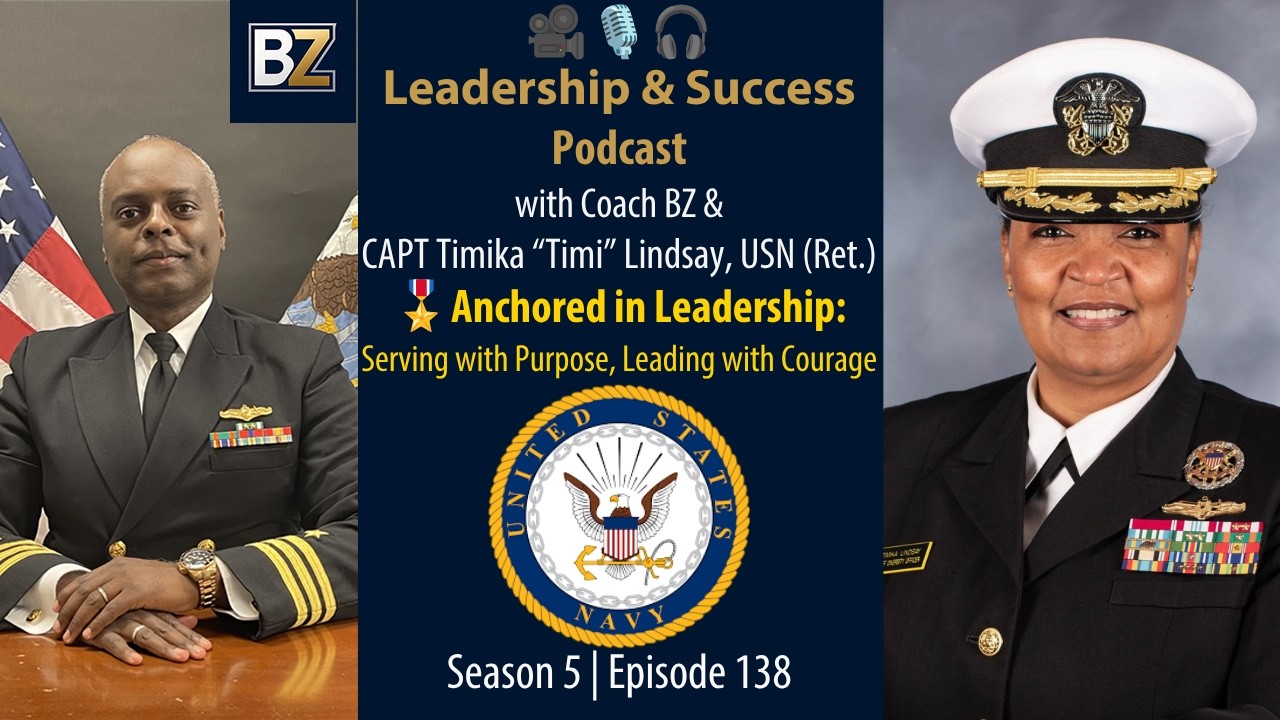
Retired Navy Captain Tamika Lindsay discusses her 30-year career in communications and cyber operations, founding Anchor Leadership Solutions, and being the first African-American mother-daughter duo to graduate from the Naval Academy. She emphasizes servant leadership, psychological safety, and PACE planning for building resilient teams.
Chapters
Hi, I'm John Maxwell. When the top companies in the world are looking for trainers, speakers, and coaches, there's one name that stands above the rest, and that's Maxwell Leadership. Our certified team members have gotten proven results for companies all over the globe, and our reputation, I'm proud to say, is second to none. Some of our members have risen to the top of their profession, including the one you're going to meet today. I proudly introduce you to my friend Bob Fabien Zinga.
Welcome to the Leadership and Success Podcast with your host, Coach BZ, where we help you lead with purpose and succeed with impact. If you're ready to grow into the kind of leader others want to follow, this podcast is for you. If you're determined to elevate your success and leave a lasting legacy, this podcast is for you. As my mentor, Dr. John C. Maxwell, reminds us, everything rises and falls on leadership. Our goal is simple, to inspire you, challenge you, and equip you with insights that can transform the trajectory of your leadership journey. Welcome aboard to another episode of the Leadership and Success Podcast with co-host Coach Beasy.
A mother-daughter duo is making history as they graduated from the U.S.
Naval Academy.
Yeah, Elise Lindsay followed in the footsteps of her mother, retired Captain Tamika Lindsay, and together they will go down in history as the first African-American duo to graduate from the United States Naval Academy in 177 years. Mom, Captain Tamika Lindsay, who served in the Navy for like 30 years, was one of the highest-ranking African-American female captains before she retired. That was back in 2021.
Yeah.
And Elise said that seeing life as a midshipman, living on the yard and attending events all influenced her decision to follow in her mother's footsteps. How proud is that family? Probably of one another, you know, probably daughter proud of the mom. And now, you know, the daughter has flipped and made this a career as well and graduated from the Naval Academy, which I'm sure is pretty rare.
All right. Welcome to another episode of the Leadership and Success podcast. Do we have a treat for you today. I am so privileged and honored to really have a great leader from the U.S. Navy talking to us in just a moment. But as you know, we always start our show with what we call here the moment of gratitude. And today, I am really grateful for two things. One, for freedom, right? 10 days ago, it was Juneteenth, and July 4th is right around the corner. And I am also grateful for public service. Just men and women like the one we're going to be talking to today, who are willing to really spend their entire life serving the public. That really takes a lot of courage and It is a great thing we should all emulate, and I'm so, so grateful for that. So before we get started, before I bring her on board, let me see if I can bring her to— introduce her to you guys really quickly. So today, I am really honored to welcome an extraordinary leader whose career exemplifies servant leadership, operational excellence, and a lifelong commitment to developing other people. Okay, she's the founder and CEO of Anchor Leadership Solutions, founder and board member at Pegasus Rising, executive leadership consultant, enterprise technology and workforce transformation, and retired US Navy captain. Wow, I wonder where she even has time to sleep sometimes. More than 30 years of distinguished service in the US Navy, Captain Lindsey continues her mission of service by helping organizations strengthen leadership culture, communication, and organizational performance. From leading global communication and technology operation to advising the superintendent of the US Naval Academy on leadership and organizational culture, her career demonstrates what it means to lead with both competence and character. Today, she's the founder and CEO of Anchor Leadership Solutions and founder of Pegasus Rising. We're gonna be hearing a little bit more about that nonprofit. She's empowering leaders, transforming organization, and investing in communities through purpose-driven leadership. Just last year, she was able to feed more than 1,600 people during Thanksgiving. It's just amazing the work she does in and out of uniform. And during our conversation today, we will explore how leaders can remain anchored in their value while navigating change, complexity, and uncertainty. Part of what you're gonna be learning today is leadership lesson from more than 3 decades of naval service, but also why your greatest legacy will always be the leaders you develop. So without any further ado, please help me welcome to the Leadership and Success Podcast, the one and only Captain Timmy Lindsey.
Good morning. Good morning. How are you?
Great. Such a great honor to be talking to you today, ma'am. Maybe to get started, what is something you are grateful for today?
I'm grateful for another week, although it's going to be a hot one. I'm okay with it. I am grateful right now at this moment for my dad. My dad is in poor health right now, so I'm actually at his house helping him out. But I tell you, without him and my mother, she passed away 17 years ago. But without the two of them, I would not have made it to 30-plus years in the Navy. Um, their support for me all the way, uh, when my husband and I were both deployed to the Middle East in the early 2000s. I mean, they have been, uh, my coach, my cheerleader, my supporter, my mentor, my confidant, everything. So, um, I'm just glad to see him up today. Um, he's sitting down, sitting in the room behind me here, and I'm keeping an active ear open for making sure that he's okay.
Yeah, we wish him well. It's really incredible how when one person serves, you know, in the military, it's really the entire family that is serving. Yes. During times of deployment, you really need that, that support. So grateful for that. Is there something about you, Captain, that most people may not know when they first meet you?
Ooh, I think it's my love for sports and teams. So I'm the American football, the NFL type of sports person. I grew up here in South Jersey. We are Eagles territory. But I'll be honest with you, they're my number 2 team. My number 1 team is the Pittsburgh Steelers.
Really?
Wow. Yeah, Franco Harris was from South Jersey, so we loved him. But coming home as a kid growing up, you know, my mom would get the food started and we'd go to church and then we'd come home and we would eat around the television watching football. So, you know, we love football. We do love, you know, playoffs of every sport, you know, basketball, baseball, even, you know, ice hockey. And now we're watching the FIFA Cup, you know, just enjoying that. So it is definitely a family event. We can definitely circle around talking about— sports all the time.
Yeah, I was going to ask, how do you feel about true football, what you guys call soccer?
So it's, it's a little long for me. You know, I think 100 minutes is a little long, but I do enjoy seeing them. I don't know, you know, I, of course, I know Messi. You know, I, I really can't wait to watch him in action. And I am watching the dynamics of our American team. You know, just seeing how they come in and play. So, um, yeah, it was hard seeing them lose the other night, I'll tell you that much. That was a horrible kick at the end. But, uh, yeah, yeah, it's good.
But it's pretty amazing to see because the US soccer team is relatively new. We kind of still babies, but we play really, really good now. Yes, it's improved quite, quite a lot. So Captain Timmy Lindsey, who are you? Beyond the uniform, titles, and all of the great accomplishments?
So I consider myself a servant leader. Um, I know that's typically assigned in the male roles in the church, but, um, I, I am a God-fearing Christian woman. I believe in, you know, values of, you know, ethics and morals and, and truth and integrity. I believe in service. I've taken that Discover Your Strengths quiz some time ago, and the word was administration. And I'm like, what does that mean? And they were like, you like to serve. And so my dad jokes around, and he says that I'm not really retired because, you know, I'm still doing a lot of work, but I'm not, you know, I'm just not in uniform as much, but I still serve.
Yeah, I was just saying in your introduction, do you even have time to sleep? My goodness, you're the CEO of Anchor Leadership Solutions. Founder of Pegasus Rising. And I mean, you're just working, working, working, working, making a difference in the world. And I believe you're also working on your PhD, aren't you, ma'am?
Yes, I just finished my first year of PhD work in business psychology.
Where do you find the time? My goodness. Wow.
So this was a— I give it all to my mentor, Captain Mary McAdams, US Navy retired. And she started dropping a seed in me probably around 2019, 2020. And, um, and at that time my daughter was at the Naval Academy and my son was in the process of applying. And, um, she was like, so what are you going to do with that GI Bill? And I was like, oh my gosh, I don't know.
She's—
you need to go back to school.
Wow.
So I, I decided to do some research and I just thought that this was a time— last year was a time for me to start really researching that. And I really had a a liking for industrial organizational psychology, and I also liked organization leadership. So I found out that business psychology just kind of covers both of them, so that's what I signed up for.
Amazing, amazing. You are definitely, uh, a great role model for your family, your son and your daughter especially. And of course, I'm speaking to an historic figure, right? The first mother and daughter graduate from the Naval Academy. That's just Amazing. Wow.
We didn't know that that was the case until, like, literally, I think until it was close to her signing up.
Wow.
Oh, wow. Um, because, you know, at first she, she wasn't even thinking about the Naval Academy, but I think it was our time in Japan when I was the 7th Fleet N6, her seeing fleet actions, her talking to other, um, children and stuff in high school, her leading, her being abroad, and she was actually a leader within the teen center. And she's just like, hey. And then I came to the Naval Academy and living on the yard, and she goes, I think I like this place. And I had already done the college road trip with her, and she said, she said, Mom, I think I want to go here. And I was like, they don't offer interior design at the Naval Academy. And so, you know, I sent her in, you know, for a candidate visit weekend, and, um, she came home and was like, I loved it. And, and it just picked up from there.
That is really amazing. And when I think it wasn't really that long that we really had our first African American graduate from the Naval Academy, it's just amazing how far we have, we have come. But wow, that is amazing.
Now I just want to add on, I cannot forget, I have a son.
Yes.
Um, who also graduated from the Naval Academy in 2025. He is now a second lieutenant in the Marine Corps.
Wow.
Um, now in in flight school, um, down in Pensacola. That's a picture of my dad there as a Marine sergeant. He was also stationed in Japan in communications. So we didn't know that these things would be— our lines would be so similar.
A family of public service, the legacy continues. Wow. I have two daughters. I was hoping one of them would join the Navy or the Air Force, but it doesn't seem like that's gonna happen. But, uh, that's— that is all right.
But I, I didn't want— I just wanted them to be themselves. That's all I've said for them. Yeah, I never said for them to be like me, do like me, be like somebody else. I'm like, you have to find you.
Yes.
And it was very important for them going through that journey at the Naval Academy to find themselves.
And they did it. Yes, yes. I am originally from, from Africa, like most African, African parents, like, no, you're gonna be a doctor or a lawyer. And, uh, but yeah, but I'm like, no, my kids are gonna do whatever God is calling calling them to do it. That's right. Yeah, that's how it should be. But when did you first realize you were not just managing people but really developing leaders?
I guess it was early in our career, in my career, when I started seeing recurring feelings of angst. I am an information professional, and so I was in charge of the information systems technicians, or former radiomen. And we had a 24-hour watch. And it was just that watch bill. Anybody on the watch bill, you know, absolutely hates it. And we could be in 3 or 4 section watches and things like that. And so I started talking to them like, you know, what can I do to make your job better? After, you know, just hearing the murmurs and complaints. And the answer back to them was, that's just the way it is. Choose your rate, choose your fate type thing. So I think I had to figure out a medium, you know, so understanding the present culture, but the present generation, you know, and how can we make these things fit. So, you know, I empowered them, you know, and that's understanding how your team works. And so I had some trusted advisors and they started having meetings and they came back, you know, with a proposed solution and I asked to execute it. And it went well. It went well. And so when I realized that, you know, that, you know, the people aren't our system, but they're not a machine. They are human beings that actually make the whole system of systems work. Yes. Through team and listening to them and understanding where the problems are. And, and then me as a leader trying to make their job trying to make sure that they understand their job, trying to make sure they have the skills to perform their job, and trying to make sure that they, they know that they're important to the job.
Wow.
Um, understanding those things are important for them to make their situation and our overall cultural situation better.
Yes, that is, that is so powerful. Was there one defining moment, Mom, uh, that kind of shaped who you became as a leader?
I'm sorry, could you say that again?
Was there one defining leadership moment that shaped who you became as a leader throughout your career?
Um, I can't think of necessarily the first one. I'm sure I've had them before, but I would probably say my time in Baghdad when we were receiving rocket fire every night. Wow. And we did not have a system in which to communicate. Um, our cell phones were dispersed. It was belonging to the Ministry of Transportation. They decided to give it to my office in the C6 department at the Coalition Provisional Authority. And, um, we had a whole bunch of expats and other people like throughout the Green Zone that we didn't have coordination with.
Wow.
And so I stood up and I said, communication should be your most important piece here for us be able to communicate and set everything up. There were people who were trying to call CNN to get their 15 minutes of fame and things like that. So I had to be able to manage the phone system to register who they were, where they were, and then also, um, do a tiered system to where key people can contact us and let us know their location, you know, how we could talk to them, because we had not had our full, um, satellite, you know, program up or anything where people could talk throughout Iraq. Man, in fact, we were working off of a middle school science project called Internet in a Box. That's the way we communicated, via earthlink.net throughout the 18 governance. So that was the way that we communicated in early 2003, and we had to get a better system going to understand, you know, when the railroads were being bombed, to when, you know, to, uh, if there was any type of infiltration in the Green Zone or Camp Victory. That was going on and how could we best respond.
Man, that is just, uh, amazing, just the sacrifices and the work that the U.S. military did during the War on Terror.
But, uh, so understanding that whole of system things, that was definitely a leadership moment because it required, it required different services, it required civilians It required contractors. It required my National Guardsmen. It required all of us to come together and not just make unilateral decisions. So, man, you know, we pulled it all in and that's when I stood up and said, we have to have this. And I had the support through the communication that I had, the literally, you know, talking communication piece that I had to be able to make that happen.
That is really amazing because you've led communications, cyber, satellite, and information system. In high-stakes environment like the one you just described. What did those roles teach you about trust and decision-making?
Yeah, I learned from someone in high school. I think he was my— I think it was my— it was my PE teacher. And he was like, I'm going to give you this, but it's up to you to keep it. And I'm talking about trust here. And then if you give me anything to take that away, Um, it's gone. And so I let them know that they belong. Like, you were sent— you were sent to this group that I'm in charge of for a reason, um, and you have the skills and capabilities on paper, and you're gonna have to show me that you can perform that. I'm going to trust you with this, and unless you show me otherwise, you know, you're going to execute. And, um, I think some people were surprised by that. I think when I talked to some of my sailors and letting them know where they fit in the picture, because, you know, they might have been seamen or IT-3s and letting them know where they fit in the picture. And this was especially important in my last operational tour in 7th Fleet when I showed them our responsibility and they thanked me. They were like, I didn't know what I was here for. I didn't know what I was supposed to do. I didn't know why I was doing this job. Letting everybody know where they fit into the whole of it, the entire piece or the system of systems to make these things happen made them feel that they belong. I'm a big believer in psychological safety and while the high spot being able to contribute, in a respectful manner and having or empowering people to contribute knowing that they belong and knowing they have a leader that doesn't micromanage them but actually lets them put forth the work. Then also having after conversations, how did that work? What did we do good? What did we do bad? How did we learn from this? Those are important pieces to make sure that we continue to go. Forward.
Man, especially as a tech executive, it— I think it makes a big difference, right, when you are people-centered and not just, uh, focusing on the technical function of the job. That is so critical. And what did you keep—
if I can add to that, when we went into the yards, when the Blue Ridge went into the yards, my challenge to them was to improve themselves. And I told them that I will not let them sit idle. We're not on a ship running, you know, uh, pumps. So I said, you are going to improve yourself some way, shape, or form, either personally or, or, um, in your rate, in your professionally. And I want to hear what you're doing. And I challenged every one of them to go forward and, and go like, tell me what you're doing. I had one person that was in the bodybuilding I had another person pursue their associate's degree. Wow. I had another one get, you know, their certifications. Yes. And, and they were just doing things that made them constructive to better themselves and how that makes them show up in the workspace.
Wow, that is really amazing. I mean, talking about gaining trust, when your people know that you truly care about their own development, man, they're going to trust you like nobody else. That's really— yes.
Powerful.
But how do you think today's executive— well, I guess I should ask, what leadership lesson from operating in Iraq, Japan, Bahrain, and the Western Pacific apply to business leaders today who might be listening? They may not have any military experience, but everything you've learned, how could that apply to the industry as well?
So we see businesses, executives coordinating at a global level. Uh, I don't think that we are using it to our best advantage. Uh, it seems to be more, uh, more on the heavier side of transactional. Um, and, and it also seems to be more outsourced. How can Americans actually become part of this global footprint? So when I communicate with— in the military, you know, I'm communicating, say, in Japan with my 35 allies and partners, and we're talking about how do I— how can I help you respond to humanitarian assistance or disaster recovery, or how can I help you protect yourself from our adversaries in, in that region in the Western Pacific. I'm talking to them because, you know, we, we have a partnership, we have an agreement, we have a, um, something to where we can support one another. On the corporate side, I feel as though we could do a little bit more in that communication to where we can both bring something to the table and not necessarily outsource all of our needs, where we can help each other.
There.
So it kind of depends on the company that we're talking about, but I think for the most part, having just an opening conversation— okay, where, where are your pain points? Um, how can we optimize this to be global? And I understand this is all about, you know, competition, but, you know, in the military, we're competition too. We're trying to be the, the, uh, the strongest defender, if you will. So, you know, how can— what can we do to make things a little bit better and congruent with all the partners involved.
I really love what you've said, ma'am, because it seems to me like in the military, yes, there is some competition as well, even within sailors or peers. But more than that, I feel like there is a lot of collaboration, right? Like, for example, for one thing, as you know, in the Navy, when you get a new billet, it's like 2 to 5 years. So, you know, for sure, once you get a job, in a couple of years you won't be there anymore. So there is really a huge focus on making sure you train your relief and all of that. And I don't really see that much in the industry, especially in Silicon Valley. Looks like people, they tend to really fight each other to the top and they don't like to share information as much. And I think that's a really big difference and that could really hugely impact the mission of your organization, right? When people within it actually collaborate more than they compete against one another.
Absolutely. Yeah.
And, uh, another question I'd like to ask, ma'am, is, uh, how do leaders build resilient teams when the mission is complex, fast-moving, and unforgiving like it is in the Navy?
So building resiliency, it relies on practice, repetition. We train in the military to practice for either unforeseen events or brewing events that we know how to respond. And so we, you know, there's, there are several sayings in the military: we train as we fight. Or, um, so it is important for us to understand what the roles are. It is also to under important when you do this training that you, you present real realistic vignettes to what's going on. And, and that was one of the things that I really pushed for in the communications realm, because communications is a critical infrastructure. And you lose communications, you know, what is your primary, what is your alternate, what is your contingency, and what is your emergency, your PACE plan for what goes forwards. So, so you, you just can't go in with a Plan A. Um, you have to have backup plans to be able to do these things.
Wow.
Yeah, go ahead, please.
No, no, I, I love that. The PACE plan— no, primary, alternate, contingency, and emergency. Yes, yes, we do, we do train a lot in the Navy. That's another thing I see in, in the industry they probably could learn from us. But wow. Now let's talk about your time at the Naval Academy. You advise on culture, inclusion, equal opportunity, and leadership development. What did that experience teach you about institutional change?
So I reported to the Naval Academy in 2017, which was 25 years after graduating from the academy. So my, my quest was, you know, trying to understand what has changed, what has not changed since my graduation. Were things any better? Were things worse? So from the better side, we saw the number of women grow from 10% of the brigade of midshipmen to almost 30%. It actually did hit 30% while I was there, which was great.
Amazing.
Um, but we, but we also still saw some, uh, problems, um, across cultures, across races. And we, um, there were just issues that were, that really with some education could have been mitigated. But there are some things that happen, it's like, that's the way it always has always been. That's, oh, you don't understand what that means. And I'm like, I do understand, and I want you to understand how it's relating to not just me, but to groups of people. Yes. So my job was to speak for the underrepresented. And when I say underrepresented, I'm not just saying underrepresented from a physical standpoint, I'm saying underrepresented even in thought. Diversity of thought. There were things that, you know, the Navy or the military likes to hold on from a traditional standpoint that some of the younger generation doesn't understand. Why do we have to hold on to that tradition and stamp? Yes, but that's— and, and, you know, when I heard— I heard a leader come back and speak, and they asked the leader, um, what— how could, um, they best understand or become multicultural, like understanding the multicultural. And let me just dig a little bit deeper on that. You know, it was a female, and, and she had to work with different countries on her job. And so her response was, um, why don't you take a chance and go down to DC and experience the different cultures? And in my head, how about just going down the hall in the dormitory and talking to somebody.
Yes.
And, and so, you know, being on the senior leadership team, one of the, you know, the top 12 on the, on the yard in the institution, I wanted to know, you know, what these— what some of the problems were. And so when they became problems or if things were brewing, um, I brought it to the superintendent or the president of school's attention. Yes, I also had a responsibility, um, as the EEO overseer from the civilian side to understand what type of barriers are in place that keep people who, um, by gender, by race, um, by disability, from being able to be hired, retain, and actually promote in the system. And, uh, so these things, when it was Barrier analysis is what we call it. These types of things not just applied in the civilian realm, but they applied across military who were coming back to serve there. They also applied for, most importantly, our midshipmen, our students who we were training to become officers. There were some things that really came up, such as how you evaluate females. Females were considered gossips. Or sassy or abrasive, you know, things like that. And men were considered, you know, outspoken, you know, or very—
stereotypes. Yeah.
Yes, yes, yes. So we had to, you know, really take a hard look at those and seeing how that was there. And how does that come about? Is that taught? Is that othering taught, you know, at the academy and the institution? Or did they bring their own views with them when they came to the academy? So it was, um, definitely, um, uh, an eye-opener, uh, to see this. A lot of things were— there were some things that were still the same. It was, you know, and disappointing in some standpoint, like, okay, how do we change it?
Yes.
And for some people, it's, it's a hard thing and it's a long process to change. And considering that we are in a microwave generation, we want things to change overnight. But the crux of it all was in 2020. The pandemic was huge because I brought to people's— of course, I'm in cohorts of diversity officers in higher education. I said, hey, just sending midshipmen home and expecting them to be available to go get on their computers to chat or do different things, while fighting a pandemic is going to be problemsome. And it was actually kind of brushed a little bit hard and said, well, they can just come back to the schoolhouse. Well, you know, they would be sitting in a schoolhouse probably alone. Yeah, no real support because we're in isolation, everybody's self-isolating. And then the other part was they may not have homes to go home to. I had an individual whose mother was a truck driver. So when she was on the road, she shut off her utilities at home so the midshipmen would, um, they would, they would drive at night and then get— and, um, so that in the day she could, um, stop and go into a hotel room and connect to the internet where she could do her classes, distance learn. And some people just did— some of our leadership or some of our Professors did not understand individuals, you know, what their things were, what their problems were. So it opened up conversation. And then unfortunately in May, the George Floyd murder happened. And so not only were we already in isolation because of COVID and people were losing family members, But now we have the George Floyd murder where it was just like, oh my gosh, like, this is— enough is enough. Like, why do we have to keep enduring this? And it caused not only a lot of people to speak up and speak out, but it also created a great allyship to where people were just seeing, like, reflecting on what they see in their own daily lives as far as dismissiveness, as far as, um, lack of communication, lack of understanding, and they wanted to help. And it was just an eye-opening piece that was going on there. It was amazing.
Absolutely. And why, why does representation matter so much?
Yeah, so, you know, I'll be honest with you, I didn't use representation a lot because people called me the Chief Diversity Officer, although I had a larger role than that. Representation is huge for me personally and professionally because let's say, for example, the news clip that you showed at the beginning. That was 3 years ago and they're still reporting on that.
Yes.
It matters to people who don't see those things happen. And it creates possibility for that to be able to be experienced. Okay, and I want to say that this is a difference from tokenism, where you may have one and being the only, and it's more insular, if you will, kind of being that one person there. The representation represents more of action, more of belonging, more of diversity of thought at that space. And then again, like I said, more opportunity. So, you know, that, that, that's very important to me. And I didn't really realize that because what, what my family has created is a space within an institution that hadn't had it before.
Hmm.
And then there is another piece to that, and I don't think that you have any pictures here, is that my children are actually the great-niece and great-nephew of the Navy B-1 Band.
Wow.
They're called the Forgotten First. So the Navy B-1 Band is a group of band members from the Greensboro, North Carolina area who were recruited because of Eleanor Roosevelt in 1941 timeframe to play music for the troops. So they signed up thinking that they were just going to be playing locally. Little did they know they would be shipped to Hawaii, to the Pacific, to go entertain troops during World War II.
Wow.
So they were the first Blacks to be in the Navy outside of the messman rating, because that's all that Blacks could actually serve in was in servant roles. So they were musicians, very talented, skilled. They were— some of them were professors in the college at North Carolina A&T or at Bennett College, or young people. So they joined. So when you see Uncle John and Uncle Walter Carlson in this role, and here they are 3 generations later, or 2 generations later, They're— um, Elise, my children's father was a lieutenant colonel in the Marine Corps. He retired from the reserve. Um, and seeing that happen, to go from not being able to come in, um, into the military in any possible rating to their grandniece and nephew becoming military officers— wow, it's a breakthrough. It is a— it creates a legacy that other families are able to enjoy. That we haven't necessarily had. So that's, that's not tokenism. Do you see the difference now between a tokenism and a representation? This representation, this celebration that, that our society is taking today, 3 years after the fact, are they still celebrating legacy and they're celebrating representation? Somebody representative of me has taken this step.
That is so powerful. Of course, you are now an historic figure. I didn't know about your uncle in the Navy B-1 band. That's just amazing. I'm going to do more research on that. We have such a great rich history, you know, in the military and really in our country that just most people just have no idea. It's—
they don't. And, and these are the stories that we need to maintain, that we need to keep going. There is a period of erasure that's going on, or attempts of erasure going on. But this is all America's story.
Yes.
It's very important to understand your past to be able to move well into the future. So to erase or to diminish or to re-story something that has happened is not a fair assessment of how people are supposed to be moving forward.
Mm-hmm. Wow. That is so, so powerful. And of course, as you know, no Black Navy officer until January 1st, 1944, right? The Golden Thirteen, the very first Black naval officer. What do they mean to you? I think I have their book up there on my shelf, but yeah.
Yes, so they mean a lot to me. I was a young lieutenant junior grade and I got to meet some of the Golden Thirteen members, and I'm part of the National Naval Officers Association So I met them at one of their conferences. And what they represent is— there's actually 16 of them. And again, through the orders of President Truman of EO 9— Executive Orders 9980, 9981— to allow the integration of Blacks into the military services. And if you haven't seen the documentary, I want you to see The Blinding of Isaac Watard. That is like what has made the— where the NAACP and Isaac Watard and President Truman to say enough is enough. These people are in our uniform serving to fight in our country for just to be seen when they come back home. But many, especially from the South, were murdered after fighting in a war. So These things— so the, the going to the Golden 13, um, these 16 officers, these 16 men went into the military, into the Navy, and surpassed all officer aptitude tests. I think they still either have the highest or one of the highest rankings of scores in their aptitude and proficiency.
I believe it was 3.8 out of 4. Yes, yes, yes.
And for some reason, it's not written anywhere They would only allow 13 of us.
Actually, we know it was because of white supremacy and racism.
Thank you for saying that, but we know—
Because it would have been the first time in naval history where they would have 100% pass.
Yeah, it was 100%.
Blacks would pass 100% when whites couldn't, barely like 80%.
So I'm glad that you said that, because it is true. I'm trying to be nice and politically correct here, but yeah, I get it. It was white supremacy and they decided only 13 of them because they were considering attrition and they did not think that all 16 would graduate. And they sent 3 of them back to the fleet. So the other 13 were commissioned either as ensigns or LDOs or one warrant officer into the Navy. And they all did very well. And in fact, there is a House resolution that has passed thanks to Congresswoman Eleanor Holmes Norton of Washington, D.C., to actually put in a Congressional Gold Medal for their achievements. There.
Wow.
Um, we are— we would love to see it be pushed forward. We're just not sure at this time and place, um, that it's happening. Um, I, I do want our military legacy, um, to continue, but their barrier breaking— because understand, that was only 13 officers who were sent off into the world.
Wow.
In the United States Navy to go serve in this place. Now they, they were also in love with Wesley Brown, who joined the Navy in 1946 at the Naval Academy, breaking barriers.
The first one.
How he was the first one— well, he was the first graduate. He is actually the sixth, um, Black midshipman since 1849, I believe was the year, to actually come here. James Conyers was the first, from South Carolina, and we just put a headstone on his grave in 2020.
What a history, I believe.
So understanding like the legacy and then understanding what— and I've had a chance to meet Wesley Brown. His daughter Billie West is a very good friend of mine. Hearing her story of what her father went through and the nuances of people saying that they would never allow for a Black man to get through their institution, they would not be the first It is amazing. And that's what the Golden 13 went through. That's what James Capers, who just got the Medal of Honor recipient 2 weeks ago or 10 days ago.
Yeah, yeah.
Finally got the Medal of Honor.
Finally.
So just having these people recognized, unfortunately not in due time, but for the things that they did and the burden that they carried. The absolute burden that they carry to be the only. It's hard and it's still hard when there's a small number of the underrepresented or the marginalized in a, in a space.
Wow.
Because you carry a lot, a lot of unhidden attributes on, on you, on your shoulders.
So true. But without the Golden 13, there is no Captain Timmy Lindsey and there is no Commander Bob Fabien Zinga.
That's right.
We really stand on the shoulders of giants. We have so much to talk about. We already running out of time, ma'am.
Uh, oh my goodness.
I'll just ask you, what can we do to add value back to you?
So I started a, um, consultant business, Anchor Leadership Solutions. I did this because there are many people, um, who want to know how they can look at their culture of their organization and see how they can improve. And this work experience and leadership experience that I bring from 30-plus years of military into the space, combined with my academic skills now, not just in IT, but in my business psychology degree, I'm able to look at things through actual organizational diagnoses and things like that. I am also available for, you know, board positions or speaking positions where I can go.
Can you tell us about Pegasus Rising?
I'm sorry?
Oh yes, ma'am. Can you tell us about Pegasus Rising?
Yes, yes, that's the other thing. So this has become a passion. I take this from my mother who always said, if you don't like the way things are, fix it. So coming back to my home of Paulsboro, again, similar story for me returning to the Naval Academy, coming back to Paulsboro, I saw a lot of things that had not changed, in fact have gotten worse. So I came back and, uh, family— several family members got together and we want to create economic development and better opportunities for those in the, uh, Paulsboro and Southern New Jersey area. Our actual, um, incorporated name is Uniting for Progress because we do want to expand, but, um, we're going to start here at home first. We had a huge event at Friendsgiving where we fed 1,600 people. Wow. That, that's me giving props to all the people who donated that day and getting people to come down and see us and things.
Wow.
Um, it was— and we did it in the rain. We had a flash flood in that day, but people were able to come through. We had great sponsors. Um, it was just overall just pleasing. And, and this— we, we want to focus on a few things: economic development, financial literacy, STEM education for our youth, and career development. We want to create these different things, and I'm in a coalition now to where we can look at creating safe communities. Anything we can do— environmental justice is huge too because we come from huge oil refineries. We're actually in a center right across from Philadelphia. Environmental justice is very important to us too.
To.
So being able to give that literacy and knowing what people need to do, how they can make themselves healthier, how they can make themselves amazing financially, well, etc., is important to us.
Where do you find the time, Captain? Wow, incredible.
Um, I, I am learning, um, I'm relearning time management. Um, but I, I, uh, yeah, it's going well. We're balancing it pretty well, and I'm really happy that, um, I'm able, physically able to do this work. And, and I'm not doing it alone either, so I'm very thankful for partnering with other people and, and doing these things so we can share ideas and we can share responsibilities and executing.
And, uh, the website is pegasus-rising.org, or you also have the link to the Facebook. They accept donation, and I'm sure volunteers as well. So Thank you so much for everything you do, Captain. What a great pleasure and honor and privilege to be talking to you today. As we end the show, can you mention one book that my audience should read?
Okay, so my favorite, favorite book is The Prayer of Jabez.
Oh, I love that one.
Yes, my absolute favorite book. And I think that it is— yes, bless me indeed and enlarge my territory, that your hand will be with me. That I may not cause pain. And I'm sorry, I should have recited it from the beginning. That's my Naval Academy memory. Like, I have to start from the beginning. But no, that's very important to me. The last book that I actually read was When Affirmative Action Was White. It was a powerful book, and it talked about the introduction of our military into— of Blacks into the military and how it, um, it was done basically because white Southerners did not want the Blacks to be left at home with their wives and children. And so things came in and then they realized that they had to educate Blacks, and then they realized that they had to give them benefits and Social Security and things like that. These were things that were not allowed. They wanted the Blacks to continue to work but not have these benefits or not have any skills but they needed it. So, you know, these things were, were offered and expanded.
Wow.
And, and, um, it's just important to understand that context and that these things happen less than like, like 100 years ago. So that means that we have generations, um, here that have experienced more of those things, like my father, that more of those things than, than not. And everybody keeps saying, oh, it'll go away with time and the cultures will go away. It's not going away. It is hitting our youth right now who may be carrying this legacy. So the things that are going on right now in society, whether because of political pressure or cultural upbringing that make them feel that people who don't look like them are bad or others or whatever it needs in order for us to have a greater union. To reach the unity that Secretary Hicks says, to be able to be the nation that we, our forefathers, always envisioned as we, you know, celebrate our 250th.
Our aspirational creed. Yes, ma'am. Yes, yes. Yeah, we're going from June 19th to July 4th. Actually, there was a reason why we need to have a second national Independence Day. I think people need to think about that. So we're going to become that more perfect union. Very, very proud to be an American. And it's being a patriot to tell your country, hey, you are not what you're supposed to be. This is where we come from. This is what we should be. And that's the America I am definitely willing to die for. Not a white supremacist America, not an America that excludes Black people or women or others, but really being one country, one country under God. That's who we are. And that's what our values are. And that's what I want to celebrate on this July 4th. But I also want our people to really reflect, because on July 4th, 1776, a great percentage of our people were slaves, and that is not acceptable. Yes, we are glad America was free from Britain and we fight for freedom. Patrick Henry says, right, give me liberty or give me death. And that's what he said. And at the same time, 3/4, I believe, of the founding fathers owned people as slaves. Just not acceptable. And we do need to be better and to do better. And that's what we accept. For America to do, right? Not to exclude anybody. And African American and women should absolutely be included in the American dream. Amen. All right. I'm not going to preach, but thank you so much, Captain Timilinde.
Thank you so much for reaching out to me. It's a pleasure meeting you. And thank you for everything.
Thank you. Thank you. Thank you so much. And again, the two books, I'm going to add them. We do have a digital bookshelf here. So it's Bruce Wilkinson, The Prayer of Jabez, and also Ira Catsnelso, when affirmative action was white. I will add those. Last question I have for you, uh, what would you say to the 17-year-old version of yourself standing at the edge of this incredible—
You saw that picture? Okay, so that 17-year-old girl was just aspiring to make it big, you know, and didn't know where her impact was, but her love for sports, her love for teams has been able to carry her far in understanding how everybody fits into the equation to make it better. So don't change, don't change who you are. The journey is going to be rough, but you're going to make it.
Absolutely wonderful. And now you—
and there's a lot of good times in that roughness too. Don't just focus on the bad, there's good that comes out of it.
So wise. Retired as a captain, that's only one promotion away from being an admiral, a flag officer in the most powerful navy in the world. Thank you for your service and your contribution. Not just but your family. Thank you so much, Captain Lindsay. We really appreciate that.
Thank you. Have a blessed day.
Thank you. All right, everybody, please follow, uh, Captain Lindsay on LinkedIn and nonprofit and also consulting firm. And as we come to an end, actually, I'm going to have back-to-back, uh, podcast today. I am speaking next to, uh, the one and only— let me see, uh, Major General, uh, JAG, uh, Officer, uh, Steve Lepper. He's gonna be next on the Leadership and Success Podcast. And right after him today, I am going to be talking to Scott Zuckerman. He's a financial expert. We're gonna be talking from financial disaster to financial freedom. And then tomorrow I will be speaking to Coach Richard Vickers, bestselling author, brand new, newly released book, Getting Smarter Every Day. And after him, I'm excited, I'm gonna be speaking to TED speaker, Dr. Elizabeth M. Adams, and she's written more than 6 books now. It's just incredible lady. You don't wanna miss this. That's gonna be tomorrow. And then I'm also gonna speak to a Command Sergeant Major, Jason Smith, about the backbone of leadership. That's going to be tomorrow. All right. Hopefully I see you in just a few minutes. We're gonna be speaking live with Major General Steve Leiper, former JAG, US Air Force. See you in just a moment. Bye for now.
Thank you for tuning in to the Leadership and Success Podcast with your host, Coach BZ. If today's episode added value to your leadership journey, be sure to subscribe, share, and join us again for more wisdom nuggets on how to lead better and achieve greater success. Remember, leadership is the most critical skill of our time. The world will always need leaders to inspire, inspire others, drive innovation, and execute meaningful strategy. So why not count yourself among the bold leaders shaping the 21st century? Until next time, stay inspired, stay committed, and keep leading with excellence.
More from Bob

S250:E4🎙️LIVE 🇺🇸America 250: President Barack Obama Leadership, Service, and the Power of Hope






S5:E157🎙️ LIVE with CMD CMSgt Dennis L. Fritz, USAF (Ret.)(Multi Tracks Audio)



S5:E156🎙️ LIVE 🇪🇸 Leadership Lessons from the FIFA World Cup 2026 Champions (Multi Tracks Audio)

S250:E3🎙️ LIVE Leadership Lessons from America’s First Documented Family of African Descent 🇺🇸📖