S5:E14🎙️ LIVE with Diah Ramesh (Multi Tracks Audio)
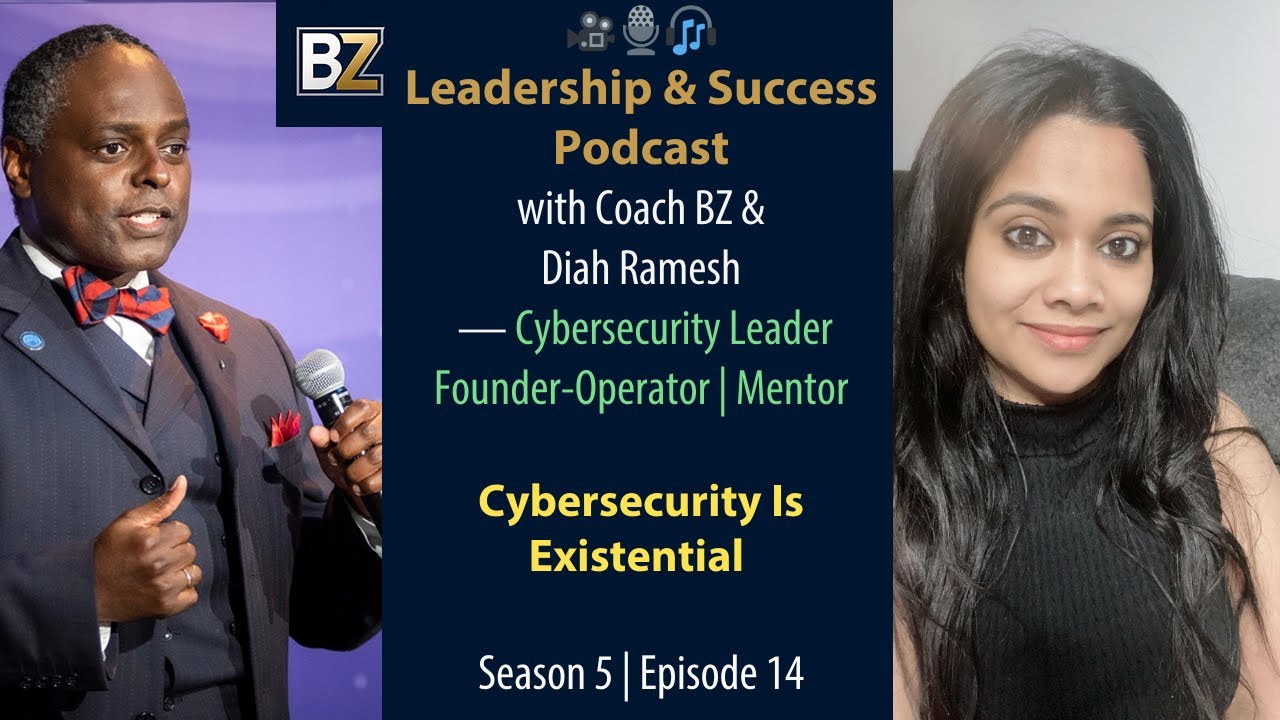
Diya Ramesh, founder of Shiro Cyber, argues that cybersecurity is a leadership and cultural issue, not a technical checklist. She built her company on trust and safety across two decades in regulated sectors, and advises security leaders to develop emotional intelligence and self-awareness alongside technical skills.
Chapters
Hi, I'm John Maxwell. When the top companies in the world are looking for trainers, speakers, and coaches, there's one name that stands above the rest, and that's Maxwell Leadership. Our certified team members have gotten proven results for companies all over the globe, and our reputation, I'm proud to say, is second to none. Some of our members have risen to the top of their profession, including the one you're going to meet today. I proudly introduce you to my friend Bob Fabien Zinga.
Welcome to the Leadership and Success Podcast with your host, Coach BZ, where we help you lead with purpose and succeed with impact. If you're ready to grow into the kind of leader others want to follow, this podcast is for you. If you're determined to elevate your success and leave a lasting legacy, this podcast is for you. As my mentor, Dr. John C. Maxwell, reminds us, everything rises and falls on leadership. Our goal is simple, to inspire you, challenge you, and equip you with insights that can transform the trajectory of your leadership journey. Welcome aboard to Welcome to another episode of the Leadership and Success Podcast with Coach BZ.
Hi everyone, I am Diya Ramesh and I'm honored to join Coach BZ's Leadership and Success Podcast. I am a Certified Chief Information Security Officer an AI strategist, and a founder with nearly 2 decades of experience in some of the highly regulated, highly complex industries including insurance, healthcare, medical device, and enterprise technology. I have been blessed to get opportunities to build cybersecurity and compliance program from the ground up, lead global teams, work in multinational consultancy companies. I am also a founder of Shuro Cyber Technology Group, where we design tools and services that accelerates organizational growth and revenue. I'm very excited to be here. Share openly and learn together and give some insight to all of you that you can use in your career or in personal life, whether you are leading in uniforms, in technology, or just getting into a new responsibility. Thank you for being here. Let's get into it.
Alright everybody, welcome to the Leadership and Success Podcast. This is your coach Bizzy, and thank you so much for being with us today. For those who watch the special edition of the ancient wisdom and leadership lesson from the Book of Proverbs this morning, you know that today I am grateful to still be alive, grateful that I am still breathing. Because as long as I have breath, there is hope for me. So, uh, happy New Year, uh, 2026. We have a very special guest today, so let me see if I can properly introduce our guest. Uh, from the intro, uh, we're going to be speaking with, uh, Daya. She's a visionary cybersecurity executive. She's a founder and standard leader whose career spans highly regulated mission-critical industries from healthcare and medical devices to insurance and enterprise technology. She lives where failure is not an option and her insights are invaluable for today's leaders. So ladies and gentlemen, please help me welcome to the Leadership and Success Podcast, the one and only Diya Ramesh. All right, good afternoon, dear. Can you hear me?
Yes, Bisi, good afternoon.
Fantastic, thank you so much for being here. I know we've been working on this for quite a while. I'm really excited to have you here. I guess to get started, what is one thing that you are grateful for today?
Being alive and having this wonderful life and feeling peaceful and happy.
Yes, yes, that's really something we can all be very grateful for. 2026 is here and we are still here and we have so much to contribute. Is there maybe something about you that most people may not know?
Something about me that most people may not know? I think I am a very spiritual leader and for me, Spiritual leadership has a very deep meaning, and it's not always in the frameworks or books. So only if you get to know me personally, you will understand what does that mean by spiritual leadership. And I think that is one thing you can't tell just by looking at me.
Wow, thank you so much for, uh, sharing that. Talking about leadership, so for those people who meet you for the first time, How do you define leadership today?
That's a great question. So when I think about leadership today, especially in the environments many of us operate, such as healthcare, cybersecurity, national security, regulated industries, I see leadership as the discipline of creating environments where people feel safe, trusted, and valued. So it's not just managed into silence, or, you know, pressured into compliance. As you know, you know, our industry has a lot of complaints and regulation. But genuinely safe to think, speak, and contribute. For me, leadership shows up in the daily behaviors long before it shows up in the big decisions, right? Because How do you model integrity when no one is watching? And, you know, it's in how you protect psychological and emotional safety. I am a big, you know, advocate of psychological, you know, version of psychological understanding of employment and, you know, leadership development. And leadership is also about making decisions that are very ethical, fair, and transparent. I am a big advocate of that too. I will talk about that when I mentioned about my organization, Shiro Cyber. Leadership is about building system where compliance is natural outcome of clarity. Because I think when people understand why, why I am doing this, You know, when the expectations are very clear, yes, when communication is very honest, for example, if a leader is providing a task to an employee, if you are, you know, sharing your expectations very clear, and you are communicating honestly, compliance becomes a shared commitment rather than a forced behavior. Leadership is integrity in action, doing what is right, not what is easy. Because if you think about, especially cybersecurity, it's not always easy. And sometimes you have to stand for what is very right. So it is consistency in your behavior, and psychological safety as a standard and clarity that removes fear. And in environments where complaints truly matters, real leadership ensures that people feel safe to speak up, that ethical decisions are the important basics, and the communication is transparent, that, you know, power is used responsibly, of course, right? So, so sure, I would say in shorter, for me, leadership is clarity, fairness, elevation, and accountability.
Wow, thank you so much for sharing that. That is, that is quite insightful because also on looking through your career, right, because you've gone from enterprise cybersecurity to founding Shiro Cyber, which you mentioned, and it looks quite intentional. Was it planned or did clarity, which you, you talk about your meaning of leadership, or clarity come later?
Uh, that is a good question, and I am always happy to talk about Shiro Cyber. So, um, from the outside, my career may look like, uh, intentional because, you know, I worked in total product life cycle, like, um, you know, from being a developer, a quality manager, cybersecurity manager, compliance, privacy, AI strategy, risk leadership, and the formation Shuro Cyber. But the truth is, I did not plan every step. But what I thought about, it was not even a planning, was the standard I wanted to lead by as a person who always wanted to help others to become their better self. And that is one of the purpose of founding Shuro Cyber. So I was not clear about everything what I want to do with the Shuro Cyber. But the thoughts and ideas came from many experiences, such as, you know, different experiences that tested my integrity, also failures, of course, and environments that showed me what leadership should and should not be like. And every role, every challenge, every misalignment I witnessed, you know, helped me understand the kind of leader I was committed to being. And the impact I meant to make to the society. So, wow, um, you know, I thought I was meant to build something that centered in trust, um, safety, integrity, and, uh, helping human beings. Um, so, um, you know, Shero Cyber was not an accident. It was the natural outcome of, you know, years spent seeing what was broken, trust me, and advocating for what was right. And realizing that sometimes the only way to build the culture you believe in is to build it by yourself. Yes, exactly why Shuro Cyber evolved from a consultancy and advisory frame. So to the people who don't know me before, I started this company in 2016, but it was only a consultancy and advisory firm. So now, um, you know, Shiro Cyber evolved from that consultancy and advisory firm into a product-driven company to design systems that protect organization and the people inside them. So I want to mention one example is the HR product Shiro Cyber developed. And launched in Asia already, created to help organization hire and retain the right talent with full transparency and number-proof visibility. So, you know, it was not an accident, but it was a result of many years of experiences and understanding what is the industry lacking.
Yes. Wow, that is really the meaning of true leadership. You find the need and then you feel that need. Man, it must really be something going from concept to now the implementation. And again, hopefully with this podcast, we're going to be putting the spotlight on you and all of the good things that you are doing, and people who are interested will be able to reach out to you. So looking at your background, so you've led in highly regulated and high-risk industry. How do you make decision when the cost of being wrong is high, but speed still matters like it does in Silicon Valley?
Sure thing. So, you know, it's like I combine my entrepreneurship knowledge and my business understanding to helping the enterprise security. So I make decisions from, you know, good clarity and what is important for the organization. And of course, I am dealing with the products that are, you know, there for patients, there for humans. So I should be very careful. So when I make decisions, I see both sides, the organizational sides and the user side. And I will make sure that I am very clear about the, you know, ultimate goal of this product and also making sure that we comply with certain regulations and standards because You know, nowadays certifications and regulation, it's not just a thought process, but it's mandatory to prove the industry that you are compliant and your products are value, you know, in regards of using and customers are safe while using your product. So my decision making, you know, is from a, you know, clear understanding of the goal and clear understanding of the product features and the expectation of users too.
Wow. So clarity is definitely a foundation we built on every single day. And I do wish that more leaders would be very clear about the expectation. I think it really takes a lot of confusion out of the way where people can focus on really building the requirements. So in your experience, what separates leaders who thrive under pressure like you have been doing and those kind of get overwhelmed by pressure.
Can you please say that again, Bisi?
The difference between leaders who thrive under pressure, leaders like you do very well, even when you are under a lot of pressure and stress, and those who don't do so well, they kind of get overwhelmed by pressure. What's the difference?
Yeah, so the thing is, we always have to understand that in industry like healthcare and cybersecurity, we are going to face a lot of pressure run stressed because there are every single day there are new things happening like a new technology, new tools, new vulnerabilities, new regulations, new standards, things like that. So understanding that, you know, no matter what you have to deal with it. So I would say when you are pressured, you know, sit back for a moment and understand or reanalyze why are you doing what you are doing. And when you find that purpose, you will understand that, okay, no matter what, you have to do it, and you have to do it in the right way. So I think that is the difference between the people who get, you know, under pressure and stressed out, and people who survive. Because as long as you see the long-term goal and the bigger picture, you are going to tell yourself that this is going to be okay, and this is your purpose to do it in the right way. And Stress and pressure is part of this. And then, you know, sitting back and talking to yourself, that is one tactics I do for myself. You know, I talk to myself when there is stress and pressure and I look at the bigger picture. So that is going to calm me down and I will move forward.
Yeah, I know in cybersecurity, we tend to be in an industry that is extremely under pressure. We tend to be overworked and many cybersecurity professionals end up really, I guess, wearing wearing out, right? They just get overwhelmed with the amount of work there is to do. When you lead your team, I guess for you personally, what kind of things do you do to kind of recharge your battery? What do you do to keep yourself centered in this industry that is so highly under pressure?
That is a great question. Sure thing. That's a great question. And I think, you know, for me, spending time with my dog and, you know, then as I mentioned, spending time in nature and talking to yourself. And I would say self-analyzation, self-awareness is one of the important aspect in every single day things that we do, right? It's not just about the career, it's in personal life as well.
As well.
Self-awareness. If you are feeling pressured and stressed out, talk to yourself and figure out the triggering points and see what you can do opposite to calm down that triggering points. And to recharge myself, um, meditation. I know people have different definitions of meditation, but for me, my job itself is my meditation. I love doing what I'm doing, but it doesn't mean that I don't get stressed out or my career is always easy. As you know, you know, I work in cybersecurity, and it's always stressed out. But the thing is, as I said, looking at the bigger picture and seeing the long-term vision, and, and, you know, feeling that I'm doing something that is beneficial for the world, that is very important thing. It's like, you know, one-on-one relationship with yourself as well, right? You talk to yourself and you know, you connect the dots, what you are doing, and the purpose of what you are doing, and your life purpose as a leader, as a contributor, how is that impacting or influencing the rest of the world. So when you think about those kinds of stuff, that is the self-motivation. I get, you know, battery by doing those kinds of stuff. And, you know, as I mentioned, you know, talk to the similar, you know, people who has the similar mindset and who has the similar purpose in life. And of course, if you have a pet, spend time with them. You know, small things like that, you know, enjoy the small things, and that's going to help a lot.
Well, I really love that you tie your work to the mission of the organization and the big picture, what you are accomplishing, the difference you are making. Just beyond just making an extra dollar. I think having that sense of purpose is very helpful. That's probably one reason why in the military we tend to do very, very well, even though it's extremely difficult, because we always think about the big picture. Thank you so much for mentioning that. Now, when I looked at your background, the title I got of this episode was Cybersecurity is Existential. It's something that you say a lot, and one question I have for you about that is, Okay, if cybersecurity is existential, why— what do you think most executives still misunderstand about cybersecurity as a leadership responsibility?
That's a very good question, and I am happy to talk about that. You know, if I have enough time, I might talk about that 2 hours. But I'm coming back to the question. When I say cybersecurity is existential, I mean, you know, it's quite literally because what, you know, what most executives still misunderstand is that cybersecurity is not just a technical issue. It is a leadership responsibility with enterprise-wide consequences, right? And one of the biggest misconceptions is believing cybersecurity belongs to IT security teams or compliance. For me, it is not. And, you know, I see cybersecurity as a business risk, and a cultural risk, and ultimately a leadership risk. As a trained Chief Information Security Officer from Carnegie Mellon University, I learned cybersecurity as a broader business scenario. So technology may detect threats, right? But leadership determines whether an organization is resilient or not. So cybersecurity is fundamentally about people, I believe, not systems. When I say it's fundamentally about people, many leaders, many executives who is in cybersecurity may be like questioning, what does it mean by it's fundamentally about people? But let me tell you why I say that. So most of the executives often focus on tools and frameworks. But the real vulnerabilities live in culture. So what is equal to culture, right? So culture, you know, the people are a biggest important aspect of the culture. Fear, silence, and inconsistent leadership behavior will impact the culture. So that will impact cybersecurity. So if people don't feel safe to speak up, report issues, or challenge decisions, the organization is already compromised. And I talk so much about this kind of things in my podcast, which I recently started.
Yes.
So, you know, second thing is, I would love to say cybersecurity is a trust function. You know, as we know, trust is the backbone for every security program, right? When leaders create environments where employees feel intimidated, unsupported, or unclear, They unintentionally shrink to themselves and create a perfect condition for risk to thrive. Because if you think about insider threats, I don't remember exact examples, but there were a lot of insider threats happened in the industry which cost millions, right? Yeah. Breaches often begin with that silence. I think not malware, right? And that comes from the leadership behavior, that comes from the culture. So the reason that I say cybersecurity is also a leadership behavior but not a checklist, your security posture is shaped by how leaders communicate, how they make decisions, and how they model accountability. So let me tell you this, because I am a biggest advocate of right leadership behavior. So a leader who cuts corners, hide mistakes, or avoid hard conversation, the entire system, no matter how many tools, how many vulnerability tools, like, you know, there are many tools that I can list, or how much technology you buy, Culture is the strongest control, or just vulnerability, right? Just, I gave you an example, you know, how culture can be a strongest control, or if it is not built thoroughly, it can be a biggest vulnerability. You can invest millions of dollars in tools, but if your culture is built on fear or inconsistency, you remain exposed. Trust me, I have witnessed this for many years and in many companies, and I talk to people who have similar, you know, experience and feedback. So a psychologically unsafe culture is a cybersecurity risk. So your question, cybersecurity, why I say cybersecurity is existential, because it touches everything. It's not just a technology, it's not just IT, it's not just cybersecurity or compliance. It touches everything. Technology, uh, culture. And, uh, you know, a breach doesn't just impact data, right? So yes, yeah, I think cybersecurity requires ethical leadership because it is very existential.
Well, that is quite insightful, and I like you talked about a culture of fear, uncertainty, or doubt. I know, you know, 25, 28 years ago when I first got into this field A lot of cybersecurity leaders would just say, "Hey, the sky is falling. Hey, we need to spend a lot of money because it's going to be the end of the world." But they didn't actually come up with any plans to actually enable the business. So I really like the way you align the business with a cybersecurity program and the values of the organization. So when you are speaking to boards of directors or senior leaders within your organization? How do you kind of get them to shift from seeing security as a cost center to seeing it as a trust enabler within the company?
That is a very important question, BC. So I would start with one fundamental truth. Security is not just a technical expenses. So, you know, I am a business owner and I have been all, you know, I always had this business mindset that helped me in my career a lot. So, you know, I would say cybersecurity is a strategic trust engine. And of course, in today's environment, trust is one of the most valuable assets an organization can possess. So, you know, Most boards still see security as a line item, a cost center, or a regulatory obligation. Um, and one of the other reasons I started Shiro Cyber— at Shiro Cyber, I help them see it as a business advantage, um, a driver of revenue, resilience, and long-term credibility. So to your question, how I connect this, right? So I do that in several ways. First thing which I learned, um, many years ago when I was a business analyst, I learned to translate, um, any technical, um, use cases into business impact, not technical language. So I do that in cybersecurity as well. I translate security into business impact. So, um, trust me that I have witnessed cybersecurity leaders with the senior level titles like senior directors and senior vice president of cybersecurity present PowerPoint slides with vulnerability metrics to show the complaints or impact of cybersecurity team to the board. And I, I'm like, the board is not cybersecurity engineers, and that we have to show. So the matter is, executives don't make decisions based on alert counts or tool names, right? Yes, they make decisions based on risk, revenue, and reputation. So instead of saying we blocked 200 threats in last month, I would say without these controls, we wouldn't have been able to onboard half the deals in next quarter's pipeline. So when you frame cybersecurity in terms of business outcome, the conversation changes instantly. Wow, yeah. Then the second thing that I show how cybersecurity unlocks revenue, um, it's of course protect our organization, protect our asset, um, you know, it, you know, but the thing is it's not just to protect us. Security is now embedded in every sales cycle and every customer trust conversations. So companies cannot close deals without a strong security posture, right? For example, think about a medical device product, you know, I am just sharing that example because I work a lot with medical devices, right? Because there are regulatory, you know, requirements and certifications and controls. And, you know, transparency are no longer a technical requirements. None of the certifications control transparency. There are— these things are not just a requirements but kind of a growth enablers, right? So for example, when you go to the industry and, you know, announce your product, the users might be thinking, okay, do you have ISO 27001 certifications? And if we say yes, we are certified, then maybe there are a chance that the customer is going to be happy about the product. So that Security is a growth enabler. So when boards see that security clears the path for the business to grow, they stop viewing it as a, you know, drag on innovation. Then I think the third thing I would definitely do, I connect security investment to return of investment and risk reduction. So as I said, I have witnessed many leaders who just build cybersecurity programs, okay, there is, you know, we are building from scratch and now we have a cybersecurity organization. We are going to hire like 5 cybersecurity managers and we are going to give them 5 different areas. For example, product security, for example, compliance, for example, governance, things like that. But what they don't do, they don't, most of the time they don't see this return of investment aspect of it. Okay, I am hiring this many people, ask this, you know, personalities, and I am going to give them, build these teams to cover all these areas. But how much am I investing and what is that return of investment? And trust me, I have witnessed this for many years, and I connect security investments to return of investment and risk reduction. So when you present to board, they want to understand the return because they are not going to look at how many vulnerabilities you have found in last month. They want to know, I invested this much millions in this program. So what is the return? So what risk are we reducing? What revenue are we protecting? What opportunities are we enabling? So that is, you know, important aspect of, you know, the copy do you present to the board. And then another thing, I think, you know, You can place security as a competitive differentiator, right? So I just talked about the medical device, but if you think about, uh, startups like mine, right? So I am building, um, products like using AI, things like that. I, I have compliance product, I have HR products, um, so I am building a lot of products. My startup is building a lot of products, so when you have to present to a board, or you have to present to an investor, use cybersecurity as a competitive differentiator. Because, you know, there might be 700 competitors in the, you know, in the industry that is developing the same type of product. And I'm sharing this from my own experience, building this HR product. And I had to compare with the 700 products. Trust me, 700 products, similar features. And I picked 5 products out of that, uh, top 5 product. And then I compared that my product with those 5 products, and I added something they don't have. And so that— and also, um, you know, I used the cybersecurity as a competitive differentiator between my product and their, you know, the other products. So that is another thing that I would suggest, you know, if you are presenting to a board or an investor, play cybersecurity as a competitive differentiator because it is. And then as I mentioned, I am a big advocate of good culture, good work ethics, things like that. So I would say I reframe security as a cultural function as well. You know, many people, even many executives nowadays see cybersecurity as a technical one. Of course it is, but same time, it is a cultural function, which I gave you one example already. So, you know, place that as a cultural enabler as well to, you know, promote a good culture. And then, you know, when you place cybersecurity as a cultural, you know, promoter as well, that is going to build trust, increase trust. So I would say position cybersecurity as a trust enabler as well, internally and externally, if you think about it, right? So everything that what I mentioned now, you know, placing cybersecurity in culture and building good leadership teams, things like that. And, you know, sharing the site, you know, the certifications and regulatory requirements, complaints, and all as a business enabler, increasing the trust externally, right? Internally, when we place cybersecurity as a, you know, cultural function, that is enabling the trust internally. So, yeah, thank you, BC. So I see cybersecurity in multi different ways. And, you know, that is one of the core pillars of my Shiro Cyber Technology as well. You will see things that many people don't see the way I see, and that is the power of my products that I am building. And that is how, you know, if you get some consultancy or advisory service from Shiro Cyber, this is what you are going to get. Because, you know, thank God, I have seen the industry enough. I am a You know, I'm a person who read a lot, who observe a lot. So my product and technologies, my thought process are going to see things that the way that many of we don't see most of the time.
Thanks so much for sharing that. And I'm gonna ask you a little bit more question about, uh, you being a founder of Shiro Cyber. And thank you for the work you do because I think we definitely need that in the industry. But before I get there, one other question I have for you, for people who are listening right now, especially those who just started into cybersecurity or who want to get into cybersecurity, and maybe they are an engineer or an analyst, and one day they would like to be able to lead a security program. What are the foundational habits you think they should build now if they want to one day lead a world-class security program?
Sure thing. That is a great question. So, you know, I won't provide like shortcuts because I truly believe there is no shortcut for success and no shortcut to achieve your goal easily. So, you know, I would say be true to yourself. One advice I always give to my mentees, you know, Invest in yourself. As I mentioned, I am a reader, you know, I always self-educate me. And then of course understand the system well. For example, if you want to work in cybersecurity area, when we say cybersecurity, it's just one word, but it has multiple aspects of it, right? So it has product security, it has compliance, it has governance, it has applications. So much, so much is there. So of course learn the system And more importantly, so the, some of the things that I shared with my mentees, you can learn systems, you can learn technology, as you know, always, but your character, that is one of the important aspects of your success. So self-discipline, self-awareness, as I mentioned earlier, and emotional intelligence. So these are some of the things that I always practice, and I am always going to practice, right? So Self-aware, self-awareness is one of the important aspect because if you do not understand what is your strength, what is your weakness, you can't really, you know, you know, really get where you want to get in an appropriate way. Because think about this, if you want to be a doctor but if your strength is in building something as an engineer, even if you go for, you know, medical training, at some point you are going to get bored. So self-awareness, that is very important. And these are not soft skills anymore. They are strategic skills.
So I like that.
Yeah, of course, they shape every decision you will make, right? Every relationship you will build and every crisis you will navigate. Let me tell you, so if you are self-aware of Okay, I am not very good at dealing with multiple people at the same time. So if you strategically think, a person like that, you have to put more effort to be a people manager, right? So you understand why I say this is strategic skills, it's not soft skills. And if you cannot lead yourself with clarity, self-awareness, and integrity, um, it's going to be hard for you to lead anyone else because, you know, there will be situation that you face, uh, you know, so much stress, or you have to make a decision right away, but that is— that may not be really, you know, you may not be very happy to make that decision, but it is important for your organization. So in those kind of scenario, um, you know, being disciplined, self-aware, and emotional intelligence is going to really help you.
Wow.
Yeah.
So then I would say never confuse confidence with the competence. Because, yes, you know, youngsters, when they come to the industry, you know, I'm talking about this from my own experience, like, 10-15 years ago, I was like, oh, I want to do this, I want to prove this, I want to get this validation. But trust me, after some time, you will realize there are more in the picture than, you know, proving yourself. You proved yourself first. If you are confident, if you are happy, and if you think that you are doing the right thing, you are good. And so that is what I say, never confuse confidence with competence. Competence is built through curiosity, humility, and repetition, right? But confidence, that is also part of self-awareness, is built through preparation and integrity. So, but you need both, don't mistake me, you need both, but competence must come first.
So, um, I like that a lot because in the military we talked about confidence, competence, and connection, the 3 C's. That it's really powerful what you are saying now for aspiring cybersecurity executive, what do you think is the role in your experience of certification, technical certification, industry certification, and education? Because I know, you know, you just said you went to Carnegie Mellon, one of the best programs in the world, and you have a few certifications yourself. Do you think it's something aspiring security leaders should invest into?
Oh, that is a— yeah, Shivarthi, that's a wonderful question, BC. Excuse me. So again, you know, my, uh, my thought process is might be a little bit different than what you hear nowadays. So yes, I like certification, but I would say this from my own experience. When I started my career, uh, almost when I was just 19 years old, I did not have bachelor's degree, right? Because I just finished my associate degree and I was going through a bachelor's degree program. But I was able to build an organization at the age of 19, and I was able to build people at that age. So education is very important. But I am a person who like the, you know, who like observe, like to observe successful or failure people and self-educate from experience and observation. So to your question, certification is valuable. But if you can't put that in practice, what's the point of having a paper copy of a license number or something like that? So I see education in a very different way. Education not only comes from college or school or certification, but it comes from your observation, um, your self-awareness, um, your self-learning. And self-learning in the sense not just learning the technology or leadership books or tools, learning your society, learning the people around you, learning the system you are in, learning the culture you are in. And take, uh, positive from everywhere and learn from the negatives, negatives, right? You know, you will be in an industry where you will find everything. You know, you can't— there is nowhere we can find 100% perfect environments or organization. So, you know, everything positive and negative is going to educate you. So certification is valid as long as you can use it in the right way. Otherwise, I won't pay money for just for the sake of having a certificate.
Yes. Yeah, that's, that's really good. Thank you. Thank you so much for, for sharing that. So let me ask you about, uh, Shiro Cyber. Uh, what did founding Shiro Cyber really teach you that no enterprise role ever could?
Um, that is a great question. Um, uh, BC, so Shiro Cyber, as I mentioned, um, you know, It's not like something that happened to me in a day. You know, I had— I started Shiro Cyber like 2016, and when I started, it was just, you know, a consultancy and advisory firm because I came from a business background, as I mentioned. I you know, started my first company when I was— I mean, small company, I won't say like a big company— when I was 19 years old, and I was able to provide opportunities for a few people.
Wow.
So coming from that background, I always had this business mindset.
And that's quite, quite impressive.
Thank you. So when I started working with the, you know, multinational consultancy companies like TCS, HCL,. And, you know, started working for different clients from, you know, different areas, right? Like healthcare, insurance, transportation, and medical device, things like that. I started learning different things. I started noticing what are we missing. So founding Shiro Cyber was the answer for what are we really missing. And that is what I'm trying to, trying to provide. So Some of the important lessons that no enterprise role was ever designed to teach, that was one important thing, lessons about leadership and courage and responsibility, that this kind of things only happens when the safety net disappears and the vision is yours alone to build. If you think about working in an enterprise, You know, leadership is often like a theoretical, theoretical or stuff about framework, and it lives in framework, right? It lives in competency models, and performance reviews. Think about that, right? It's a huge subject. I, you know, if I start talking, I will talk like hours. So, but when you build something from the ground up, and that is your product, right? Your organization, every decisions you make has an impact, whether positive or negative. So every choices that you shapes, you know, every choices, right? Every choices that you take is going to shape the culture of your organization and impact the people and impact your decision.
So that's why you go back to clarity being the foundation of how you lead, doesn't it?
Yeah, exactly. So, you know, one important thing, maybe the first things that entrepreneurship taught me is that integrity is not optional, to just say that, right? It is the kind of operating system for my organization. You know, if you look at the large organization, you can sometimes mask that misalignment because there are multiple layers, right? You know, there are hierarchies. But as a founder, you can't do that because your decisions, your thought process, your standards, and your ethics and integrity that shows up every day, you know, that is like there right in front of all of the people you are working with. Yes. So, you know, that is one thing I learned. And another thing, I think purpose must be, you know, stronger than fear. Because if I think about my entrepreneurial journey, I did, you know, build this organization in 2016, and then I moved to full-time jobs because at some point I was like, I had a lot of responsibilities and I was kind of a little bit of afraid of losses, you know, being open about financial losses. So, so I thought, okay, being in a corporate position is more financially stable it's safe. But then I thought about my purpose. And so then I kind of— that is also part of self-awareness, right? Then I kind of told me, if you are going to be always afraid about the risk, then you are not going to, you know, make your purpose, you are not going to be an entrepreneur. So, you know, enterprise roles, like corporate roles, full-time jobs comes with predictability, safety, and protection, where business like Shiro Cyber comes with so much uncertainty, exposure, and risk. But my organization forced me to lead with purpose. And I think when we talked last time, I mentioned, yes, my Shiro Cyber is not just there to make money. That is, you know, we all need money, be honest. But same time, I want to help people, help society, help organization. I have a purpose behind what I'm doing, and that is a good purpose. And, you know, so that is another thing that entrepreneurship taught me, that you can't be afraid of everything.
Thank you so much for sharing. That is very, very inspiring. And again, That's part of the reason why I have this podcast to really put the spotlight on people like you who are doing great things that some people may not know about. So one more question I'm going to ask you before we go to the last segment is you do contribute to national and industry standards quite a lot. So why do you think, why should leaders care about shaping the ecosystem and not just their own organization? Why is it important to contribute like to NIST standard or or some of those other industry and national standards out there?
Oh, that is a really important question, BC. Because, you know, I think no organization succeeds in isolation, right? The strength of a company is directly tied to the strength of the ecosystem it operates in. For example, the standards, the regulations, the culture, the expectations, And when we contribute to things like this, as an ecosystem, as an industry, we collectively mature. So I think if you want resilient organization, you must help build a resilient ecosystem. So I, you know, I think leaders must care about shaping that ecosystem. Because your organization is only as strong as the ecosystem around it, right? Example, if nobody is trusting a specific type of medical device because they, you know, it is not compliant with the standards, things like that, it's a failure for the industry. It's not just a failure for one organization. So a single weak link, for example, it can be a vendor, it can be a partner, it can be a medical device manufacturer, as I mentioned. Can create a cascading risk. So when leaders contribute to standards, I think they are not just protecting their organization, but they are strengthening the entire chain. So it's like interconnected industries. So from that simple example, I can tell you something, right? For example, if there is a vendor who is producing certain part of the medical device, right? If we are, say, shared, you know, working force, we contribute to strengthen that, you know, vendor products. Like it can be a small valve, for example. I'm just thinking, you know, there are millions of examples. So if that meets standards,, then as a medical device manufacturer, we can be sure that, oh, this product, this, you know, part is complete. So we can trust and buy that. So it's a chain. So shaping standard is, uh, I think it's an act of service, um, and that is exactly why I contribute to it. Uh, you know, I spend a lot of my personal time for these contributions, like, uh, you know, HSAK, HSSA, IMI, NIST, I contribute to as much as, you know, working groups as I can. Because, you know, for me, it's an act of service. I'm not getting money for that. And I don't want money for that. I'm, you know, when you contribute to national frameworks like that, you are helping thousands of organizations you will never meet. Nobody may not know my name, right? But I am behind what they are using, right? So And that is protecting patients, consumers, and the communities who will never know my name. So it's a legacy.
That's really powerful. And thank you for bringing that up because for those who are watching, it really doesn't take very much. NIST, for example, every so often they would say, hey, we have this new standard and we want, you know, the industry to provide feedback. You can just volunteer and provide your feedback. Sometimes they will take it, sometimes they will not, but at least you can contribute to a standard that, like Dia says, could affect the entire industry. So thousands and thousands of organizations, and you can be doing something really, really good for this industry. So thank you so much for saying that. So let's go. So in the last segment, I want to kind of get into your head to kind of see the leadership principles that have helped you be the person you are today. One question I want to ask is, what do you think is the greatest lesson you have ever learned? Just in general, in life, maybe in leadership. What do you think is the greatest lesson you've learned so far?
Um, that is a wonderful question, BC. Um, there are a lot of lessons, but, uh, yeah, of course. Uh, so I want to share, um, you know, one thing about a decision that I made early in my career, that came from one of the lessons, and that actually fundamentally changed my leadership journey. So, I think, it's like, common for many of us. We try to go with the familiar aspect of life, like whether, for example, if you are staying— if you are in an organization that you work for a few years and maybe you don't find any growth there, but because it is, you know, familiar you try to stay there, um, and, uh, just because of it's familiar. So it's like that I learned, um, you know, no matter what, if the safety is there or not, um, you know, you find yourself, your purpose, and, uh, you know, uh, you understand your strength and it's okay to leave the familiarity. It's, you know, sometimes that people think, you know, if I am not talking about certain things, when, you know, everybody else is talking, I am somebody not aligned. But it's okay. It's okay not to align in certain situations. Because not everybody thinks the same way, right? So I would say, you know, one of the most defining kind of experience or setbacks that in my career, that was not like a technical failure or anything like that. Or I didn't miss a milestone or anything like that. It was like a moment that I realized, oh my God, I stayed in an environment that no longer aligned with my values. I, you know, it's like if you are a person who observe, you will see the early signs. But as I said, because of the familiarity, you tend to stay. And, you know, I also saw the early signs, like psychological safety was disappearing, and widening gap between what the, you know, boss said, or publicly, or what was practiced privately. But Instead of acting quickly, I stayed, stayed like, I am sharing openly, worked like 13-14 hours every day. So I later realized staying too long was the failure. And then leaving, leaving with integrity was the lesson and that built who I am today, you know, that built me.
Wow.
So, you know, I would say, you know, anybody who is listening to this, you know, it's okay to feel that misalignment. And, you know, if you are still keeping quiet about the misalignment, it's a form of self-betrayal. So you cannot lead well when you are constantly negotiating your integrity. So That lessons, if you know, that lessons made me who I am today. And now when I turn back and think about that, I am proud that I did that. That is what made me as successful as I am today, as independent as I am today, because I learned from it. And you know, it's like, as I mentioned earlier, positive or negative, you have something to learn from it and use that learning for your fuel, just to take the fuel from everything. And that's going to change your life. And yeah, I think—
That's really powerful. Thank you so much for sharing that. So I am sure for people who are listening right now, they know where they are right now. It's time for them to leave because it's no longer aligned with their purpose, right? It's not aligned with their core value. They are losing their integrity by staying there. However, Like every human being, I'm sure you felt the same way. I've been there too. You are afraid, right? Because right here it's very comfortable. I know what to expect, right? They may not be treating me right, but I know I'm going to get a paycheck in 15 days or at the end of a month, and I know what's expected of me tomorrow. But if you ask me to go out there and do something I know I am called to do, but it's kind of scary. How do you overcome your fear? Because sometimes fear can be paralyzing, right? Can you share a little bit about what you— some things you've done in the past to kind of overcome the fear of trying something new when you know it's the right thing for you to do?
Uh, sure thing. So it's always like, um, fear will be there because we are just normal common human beings, and it's about overcoming that, right? It's not about, um, you know, not feeling anything. Okay, trust me, So people, whoever think that feeling something or being sensible or being weak is a failure, no, I am telling you guys, it's not a failure. It just means that you are a human and leaders can feel fear, leaders can feel stressful, you feel it, can feel anxious. It's all part of human life. But how do you reset that is the important part of it. So for me, when I feel fear, as I mentioned, I think about the bigger picture and, you know, why I am doing this and where I am going, where I want to go, and what is the purpose of my life or what I am doing in this universe. And then I think about some of the things that I invested in me, my past. And I'm saying you don't have to live in past. But the thing is, you can always use your learning from the past, or use your experiences from the past to fuel your today's drive. So whenever I feel fear about something, I just think about the path I walked through, and the personal time I invested in learning, learning not only technology or tools, but learning people, learning psychology, learning business, you know, learning from people's failures, and all that. And the time I spent for this journey, and the purpose— why did I spend that much time? And when I think about that purpose, the fear will gradually, naturally go away. So that is a fuel. And then, you know, as I mentioned, I spend a lot of time with my dog, and she shows me unconditional love. And that gives me a kind of motivation to overcome fear. Because if an animal can show you unconditional love, you can put this, you know, unconditional love, service mindset, and others helping organization, all this into a perspective. So When you always think about, okay, job and titles and, you know, money and all that kind of things, it's all part of life. I'm not saying this is— you shouldn't think about that, it's all part of life. But same time, when you see a different purpose or a purpose bigger than all this materialistic aspects of life, then the fear will naturally fail. Yeah, that is my experience.
So that's really powerful. So your purpose will draw you in. So technically we are out of time, but we're talking to Green Research. You can give me another 20 minutes, right?
Sure.
Yeah. Okay. Thank you. Thank you so much. Because you are sharing so much. You have so much wisdom. I really do appreciate that, especially for those who aspire to one day lead in cybersecurity or even like me, information warfare in the military. I think what you're sharing can really change the life of someone. Potentially. So thanks, thanks, thanks again for sharing with us. So as a leader, what are you learning right now? I know that leaders are learners. So what new things are you learning now?
Uh, sure thing. So before I mentioned about what I am learning now, um, I want to say thank you to one of my well-wishers who introduced me a wonderful book, uh, maybe 11 years ago. That book was the Tribal Leadership And that talks about leveraging natural groups to build a thriving organization. And I forgot the— I think it was written by 3 people. I remember Dave Logan, but I don't remember the 2 other people.
But I think John, John, John King is the other one.
Okay, very nice. Thank you, BC. So it was a very wonderful book. And I still follow, you know, the important 5 stages, that theory in my leadership, you know, journey as well. So thank you to my friend who introduced me that book many years ago, which shaped some of my leadership behavior. And what I'm learning now, I just finished an AI strategy and leadership training from MIT. And it was a wonderful journey. I you know, got an opportunity to get to know some wonderful leaders. And I really appreciate and respect, you know, relationship. Every, every day we have something to learn from everyone, not just from human being, from the universe, from the animals. So I do, you know, appreciate the relationship very much. So that is about what I learned recently. And I am, if I call it learning or reading, I'm reading actually a book now. So the book called Thinking in Systems by Donella Meadows. So it's like a very important book for anyone who wants to understand how organizations actually work. So I would see that as a learning, because every time when you read some good books, you know, you are learning from it, you are understanding a certain aspect of business or technology or psychology or human, uh, in different ways. So that is what I am, you know, going through now.
Wow. Thank you so much. Thinking in Systems by Donella Meadows. Thank you so much for sharing that. So let me ask you this, uh, can you tell us about a failure or setback that shaped your leadership more than any success? Because you know about All of your success, things you did starting as a software developer, now becoming a cyber leader who's actually contributing to a national and industrial standard. So you've had a whole lot of success, but what about failure? Anything you can share that might help those who are listening right now?
Sure thing. So, you know, I won't call it failure, but the recent example I mentioned, you know, It's like an experience or a setback that made me see leadership or employment in a very different way. So it's like, you know, when I stayed with an organization for long, knowing that, okay, I am not getting any support, I am not feeling satisfied as a contributor, human being, but I am forced to stay because of the situation, because I needed money. So things like that. So that was a failure, kind of a failure to my soul, you know, soul ambitions. But it was not a failure in regards to anything else. But it was a setback, right? It was a setback where, which, you know, triggered a lot of thoughts in me, which, you know, which actually helped me to understand who I am, helped me to better understand who I am. So I always had this entrepreneur mindset, I was always business-minded. I always knew, like, you know, for some reason, I, when I see a technical requirement, I can connect that to the organizational profit, revenue, return of investment, all that things. But I never really acted on that. Because, you know, as I said, I just wanted to have that familiar space and stay where I am, you know, with the predictable outcomes. But that setbacks, every day, you know, it started questioning me, like, you know, why are you not using your potential? Why are you still here? And, you know, what is the gain that you are getting from stagnating your own soul? So, you know, I would say that is a kind of you know, soul failure that shaped my leadership journey. And also when I say that, right, it's like what I got from a person that I thought is capable to lead me, guide me to use my better, best potential, to bring the best out of me, didn't act the way he is supposed to. So that taught me I shouldn't be this way. So I just, I just took the negative experience and it turned into a positive, positive outcome. So that's one thing I want to share to the people who is listening to this. You are going to face negativity, uh, at that moment, of course you are going to feel something. You may feel sad, you may feel frustrated, and it's normal. But, you know, take that to fuel your positivity and find the real you inside in yourself. So yeah, so I learned what kind of leader I shouldn't be from that manager. So I think everything is experience, BC, everything is good experience, actually, you know, it's about how you take it. So I won't call it failure. It was a setback that taught me a lot of things that, you know, reshaped my way of looking at employment, looking at leadership, looking at organization, looking at people and society. So I am glad that it happened the way it happened.
That's really powerful. One of my mentors, Dr. Willie Jolly, used to say all the time, a setback is a setup for a comeback. So it's really a mindset, right, how you look at it. And one thing you, you mentioned, I think many people who are listening in now, they may have that entrepreneurial spirit in them as well. But, but even if they, they don't, as a cybersecurity leader, it seems to me like it's really important to also be good at business, right? Like you said, not just talking about vulnerability and be technical, but also talk about risk and how it affects the business and how you enable the business or protect the revenue. Do you think it's a good idea for a cybersecurity leader to also maybe get a degree in business, like a Master of Business Administration, or do you think— That is not something you would recommend?
That is a very important question, BC. But as I mentioned earlier, my thought process might be different than many other leaders. It's all perspective, right? So from my perspective, being an entrepreneur and being in cybersecurity and being a mentor, Um, I would say you— it is important to have the business knowledge, but I am not a big fan of, um, you know, having paper copies of license or degrees to run something. If you want to understand the business, um, you look at the system, you learn the company, you learn the people, and you learn the purpose behind that business. And that is what have been helping me a lot. Um, but in regards of strategy and revenue, things like that, uh, having a business administration degree of course going to help you to understand, uh, for example, many methods are there, right? Many business methods are there, many frameworks are there. Uh, for example, when you talk about just risk management there is many enterprise risk management frameworks, right? COBIT, things like that. And it depends on different companies. So I would say if you learn, if you go through some training and imagine like you get an MBA, there might be some framework that introduced you to introduce the concept, right? But that doesn't mean the company you will end up will be using the same framework.
Yes, yes.
So it's all about understanding the bigger picture. And you can learn one framework, but you should be able to analyze and, you know, put that framework into a different way to match, align with the business goal, the organizational goal. So that is what the connect, right, connection.
So yeah, I'm not basically use your, your background as a starting point, but have an open mind and be looking for ways to add value by learning specifically what's needed in your environment and your company and your specific industry. That's very wise. Thanks so much for sharing that. So let me ask you this then, if you could choose 3 people to have dinner with, who would you choose and why? They could be alive, they could be dead, or they could be mythical figure. Basically, I'm trying to understand what type of people you admire from history or from current living.
BC, you know, I'm going to be very honest. The first two people came to my mind, um, that is my mother and my grandfather. They passed away, but you know, I wish if I can rewrite everything, I would love to have them sitting with me, have dinner with me every day. But if you want—
I'm really sorry, sorry to, uh, hear that. I'm sure they were very—
that's okay. Um, yeah, they are part of me always. Uh, you know, soul won't leave the universe, right? Uh, I'm— at least I believe in that. So, but if you ask me from outside of my family, uh, yeah, so I like Mother Teresa. You know, we all—
you don't, you, you don't have to say why for, for that one. She's a saint.
Sure thing. Yeah, that is one person.
And, uh, I like Elon Musk because, you know, okay, that one we need to know why.
Oh, we need— oh, you need to know why. Okay. Yes, of course. For service.
No, for Elon Musk. I— because he's originally from South Africa. I am originally from Africa too, so I call him my brother from another mother. But why would you like to meet with Elon Musk?
Oh, of course. I see him as an innovator. You know, whether I agree with all the innovative ideas he brings or not, that is a different question. But he is a smart, innovative person. And why not have dinner with him? And he's very jovial as well. He's very friendly, seems like. So yeah, why not? It will be great, right? It will be a great experience to get to know a person like him. And I think I gave 4 examples.
Yes, you did. Thank you so much. Yeah, people like Elon Musk are quite controversial these days, especially when he started to get into politics instead of just doing his innovation and scientific endeavor. Okay, thanks for sharing that. So you've already shared about the book. So just to remind people, why should people read Tribal Leadership?
Say that again.
Oh, why should the audience read Tribal Leadership?
Yeah, sure thing. So as I mentioned, Tribal Leadership teach you some very good leadership behaviors. As I mentioned, there are 5 stages. So, and it is very good for leaders who wants to build a team because it classifies like in 5 different, you know, stages. It classifies how you see organization and which stage you become a mature, wise organization. So, yeah, so, you know, I think that's very important for anybody who gets into leadership or, you know, growing as a leader to know, because that will help you analyze your own team, yourself as a leader, and then improve from there. And most of the corporations, I don't believe they are even in stage 3. But when you get to stage 5, your voice, you are doing the— your organization is actually a service enabler. And I'm sure that you can relate to that being an executive leader from military, right? So at the end of the day, tribal leadership teach a lot about how do you treat your tribes and how do you find your tribes, how do you build your tribes and how do you sustain them. Yeah.
And what about thinking in system? By Dandala Meadows.
Um, yeah, so Thinking in Systems, I, as I said, I am just reading that. But, uh, um, I think it's like, uh, actually, you know, a couple of days ago I had an interview with one of, um, another cybersecurity leader. He mentioned about thinking in system. Like, uh, I will give you just his example, right? Let me give you that before I talk about the book. So he mentioned he started as a help desk analyst or something like that, and he became an architect and then a cybersecurity leader later on. So something that changed in his life, um, when he started, he saw like some checklist, uh, about third-party risk assessment and all. So he started thinking, okay, if I convert this checklist to an automated format, how is that going to help the organization? So that is a wonderful example in Thinking in Systems that changed the revenue, that changed the human labor, uh, that changed the process completely, right? So I only started reading the Thinking in Systems, but, um, I think, yeah, I think it is important for anyone who wants to understand how organization actually work. And, uh, you know, uh, I think when I read more and more, I may find this like, okay, not only about the organization work, but how do you make the organization work better than before. So that is another leadership, you know.
That's powerful.
Yeah.
Well, thank you so much for sharing that. We are running out of time. Let me ask you really quick. If you had one and only one day to live, what would you have liked your final contribution to be?
Final contribution, that is a very tricky question. I want to do so much for the universe, but final contribution to the world.
What's the most important thing you want to do?
I mean, it's not like if I get a superpower or anything, right?
Yes, if you did.
Okay, if I get, if I have a superpower, I wanted to provide light and peace to the world, BC. And if I have superpower to do that, Um, you know, it's a big important subject when I say light and peace. That can be, um, you know, broken down into thousands of different scenarios, like heal people emotionally, physically, and, um, you know, wow, okay, from poverty and stop wars. So I will just say in two words, you know, provide light and peace to the world.
Yes. Wow, thank you. But you are definitely doing your part even with Sheroes Cyber, and hopefully we will get there. It's kind of heartbreaking how much, even in this country, in the US, all of the division we have right now. It really breaks my heart. I don't know if you were in the US during 9/11, but that was one of the most terrible days of the people of my generation. But the day after 9/11, on 9/12, 2001, this country was more united than I've ever seen it in my entire life. We are truly one nation under God. But, uh, hopefully we're gonna find our way back there. Thanks. The next question I was gonna ask you is, if you did have a magic wand, what is one problem you would like to solve tomorrow? But I think I already know the answer, unless you want to add something else.
Yeah, you know, it's the same thing, right? You know, I don't want war, I don't want poverty, I I don't want people to suffer.
Light and peace.
Yeah, yeah. I am a big, uh, you know, I'm a spiritual person, so wherever I can provide light and peace and happiness and make this beautiful world look better and enjoyable, more enjoyable, and, uh, you know, yeah, we all have to do that, you know. I don't know if I can do it in a bigger way if I don't have a magic power, but I am trying, you know. If you help just one person, just just, you know, make one person's life better, if I can do that. So I am trying, and I think anybody who is watching this—
yes, actually, you remind me, uh, one of my favorite verses in the Bible is, you know, peace on earth and goodwill towards men. And, uh, White Knights, it's a, it's a dream, but I hope one day it's going to be true. Because we have so much more in common. One, within this country, doesn't matter if you are Black, white, male, female, gay, straight, it doesn't matter. But also within the universe too, right? Because it doesn't matter if somebody is living in Africa or in South America or in Asia, we all have the same humanity. And anyway, thank you. Thanks so much for sharing that. Okay, so we are coming toward the end. Let me see if I can share my screen because I want to ask you, what can we do to add value back to you? Thank you so much again for spending over an hour with us and sharing from your wisdom. I'm going to try to show your LinkedIn page. Okay, it works. I hope it's gonna work. But what, what, what can we do to add value back to you?
Uh, thank you so much for that question, BC. So as I mentioned, the purpose of Shiro Cyber is not to make money. Uh, you know, we all need money, but I have been a very successful employee as a full-time employee too, but I started Shiro Cyber mainly to make a change in the society. And there are a lot of services coming up. For example, I have— I'm collaborating with the— just for example, right? There are a lot, but one example, I'm collaborating with the lawyers to support, to give answers to people, especially minorities, and, uh, you know, people who doesn't know how to deal with the certain issues even in work— workplace, right? So give some guidance and it will go through me. I will filter your problems. And if you need legal advice, you know, we are doing it for free. And then, you know, as I mentioned, um, uh, you know, I, I'm collaborating with the some wonderful leadership coaches to provide leadership. And, you know, for minorities and people who is in need, it is again free service.
And you see, you are already bringing a lot of light and peace to the world already.
Thank you, thank you so much, BC. And then, you know, um, especially for women who wants to get into a higher designation— and again, I am not a person who believes in titles, but when I say designation, if you believe that you have some qualities and you are unable to utilize that for different reasons. It might be because you have a bad manager, you are in a wrong system, you are in the wrong place at the wrong time. Whatever it is, you know, if you need kind of somebody to talk to, you know, I will give my, you know, the company email. So BC, you can provide that to anybody, whoever is listening to this session, contact me. And, you know, I will listen to you and I will connect you with the right people to help you move forward. And again, it's free, you know, it's not to take money from you. But if you need executive coaching or anything like that, that costs money. And because, you know, that I have to hire, you know, I have a team who am I paying to, to provide that executive coaching. And then about the Shero side, we are building some products that is good for organization. And it's not just you know, you know, I am developing product because everybody is developing product. It is based on my years of understanding and observation about certain organization and what they are missing. If I introduce a product like this, how that is going to help the organization. The example I mentioned about the HR product, so like that product that we are building, and one of my product already released in Asia. So contact me and I, I will provide the you know, uh, company email address and everything will connect with you. And then other thing that I am doing, the Power Leader Podcast, as I mentioned, this is a movement because I want to help people. And because I have my own story, I have, you know, I went through, um, you know, a lot of, uh, struggles, happiness, and positive and negatives, and I learned from it. So anyone of you, if you have any issues or if you want to just share a positive or negative story, just to contact me and I can be your voice. And there is no expectation. The reason for that, there are millions of people like you and I out there who needs this voice, who wants somebody to tell their story and gain some insight from that to help themselves or help their family. So this is a pure service. I am not expecting any monetary benefit from that. So if you want to subscribe and listen to this Power Leader Podcast channel, and if you don't want to come to the camera, no worries at all. Just send me an email, say, this is my experience, can you talk about that? And I'm going to be your voice, by hoping that that is going to help many people like you and I. So these are the things that you can do for me When I say me, for the society.
Well, thank you so much. And best way to get in touch with you on LinkedIn, LinkedIn.com, Dia-R. And from there they can contact you about Shiro Cyber and also your Power Leader podcast. Wow, that is very powerful. Thank you so much for sharing that. Okay. Is there a question I should have asked you that I didn't get a chance to ask?
I think you asked almost all the questions. And but, you know, you and I can talk about leadership and the industry for maybe 7 days continuously.
So, but we do need to stop soon. I've already used too much of your time. So I'm going to end this in a couple of minutes. But first, let me ask you this. If you could go back and give a piece of advice to your 17-year-old self standing at the edge of this incredible career you've had in cybersecurity leadership, what would you say to 17-year-old Daya?
17-year-old me was—
actually, maybe I should say 19, because you started being a boss when you were 19 years old. What would you tell to 19-year-old Daya when you first started your business and getting into the industry?
Yeah, sure thing. So maybe understanding people better. Um, at that age, you know, I only started, uh, observing a lot about people around me maybe at the age of 23 or something. Um, 19, I, I, as I said, I built a team, I had a company, I had like people working for me, I was training people in software testing at that age. But still, one thing I missed at that age, I didn't personally understand people. So that is another thing maybe, you know, will be helpful for the people who is listening to. Always try to connect with your employees or people around you in a personal way. I'm not saying you have to be friend, friends, friends, but to understand their weakness and strength, understand what is, what are they going through, what, what motivates them. That's very important because You know, as a business leader as well, if you do not know what motivates the person sitting in front of you, it can be a customer, it can be your employee, it can be your boss, you are going to, you know, lose something. I mean, you are not going to find the truth as early as you can. So that is something that I wish if I knew when I was 19. I was so young to not know that.
Wow, yeah, that's really, really powerful. I know in the Navy we learn Mission first, but people, people always. Take care of your people and they will take care of your mission. Well, thank you so much. So we are getting toward the end here. If it's okay, I'm going to do a quick lightning round. In 1 minute, we are going to be done. So don't take too long to think. Whatever comes to your mind, just blurt it out. What is one word that defines great leadership? One word.
Integrity.
Okay. Morning routine or practice that keeps you grounded?
Say that again.
Morning routine or practice that keeps you grounded.
Um, you know, talk to the universe.
Okay. A book or a quote that changed your life?
Uh, book? Yeah, of course, The Tribal Leader.
Yes. Okay. Who inspires you most today?
Uh, I think the universe.
Okay. Uh, a leadership habit you refuse to compromise on?
My ethics and integrity, never.
Yes. Okay. What is a question that every leader should ask themselves frequently?
Oh, that is a tricky question. There are thousands of questions. So, are you doing the right thing? And the right thing. Yeah, right thing.
Because many times people do very well, but they are not doing the right thing. So thanks for sharing that. So what did you want to be when you were a kid?
What I wanted to be when I was a kid? Um, you know, I, based on my age, my wishes changed all the time. Very early I wanted to be a teacher, and after that when I was 16 I wanted to be a doctor. Finally I became an engineer.
Well, but I guess you are kind of a teacher now as a cyber leader. You are teaching the next generation with She Holds Cyber Too. Okay, so free adjective describing you as a child.
Say that again.
Free adjective describing you as a child.
You know, a reader, always read books and participate in everything, sports and dance and music and school topper. And yeah, the other thing I will say, pampered child, little, you know, little pampered child.
Okay, what about—
That's why I miss my parents a lot.
What about as an adult?
Um, as an adult, you mean after 18?
Yes, free adjective.
Um, very clear and purposeful and spiritual.
Okay, the very last question, and this is it. This is the end of the show. Again, thank you so much for being very, very generous with your time. You've taught us a lot today. What is one word that represents our shared experience on this podcast today? One word.
Very unique and inspirational.
Good, thank you so much. I'm so grateful to you, Daya Ramesh. Thank you so much for being one of our master teachers today. I really appreciate your time and everything you've taught us. Thank you.
Thank you so much, BC. The type of questions you asked and the conversation we have, I am really, really grateful for that. This moment stays with me always, I think.
And I'm gonna make sure to share this podcast with, with your YouTube channel, so it's gonna show up as a collaboration. From the Power Leader and Leadership and Success podcast. Thanks again.
Thank you so much, Christy. Thank you. Thank you for having me.
All right, everybody, that was Daya Ramesh. What a wonderful, wonderful discussion we had, and she's really teaching us a lot about cybersecurity, but it really does apply to life as well. So just a quick reminder that tomorrow is Monday. I'm going to be here at 6:30 AM, which is 9:30 on the East Coast. I'm gonna be talking about ancient wisdom mentoring from the book of Proverbs. This is not a religious podcast, it's just focusing on ancient wisdom and leadership lesson from the book of Proverbs. Today, the 11th, we did Proverbs chapter 11. Tomorrow we're gonna do chapter 12, and the day after tomorrow, on Tuesday at 6:30 AM, we're gonna do chapter 13. Okay, we're gonna be doing this every day, reading one chapter of Proverbs until the end of the month. And then on Wednesday I will have the pleasure of speaking with Commander Erika Dobbs, US Navy retiree. Like me, she joined the Navy as a seaman recruit, which is the lowest rank in the military, and she retired as a commander, which is my current rank. So as a senior officer, only 4% of US Navy sailors end up in the rank of O-5 or above. And today she's become a tech CEO. So it's going to be A great conversation. And on Wednesday, I will also speak to the one and only Lisa Fan. She's a mentoring architect. She's the bestselling author of two mentorship books, The Mentor's Guide and Bridging Differences for Better Mentoring. She also has a TEDx talk about mentorship. So Lisa will be here on Wednesday. All right. Thank you so much for watching the Leadership Success Podcast. And many, many thanks to Daya Ramesh. I know we had to reschedule this for 2 or 3 times, but I'm so glad we did this. She's added a lot of value to the audience. So make sure to follow Dia on LinkedIn and also YouTube and Shiro Cyber. And thank you so much for watching and see you tomorrow. Bye for now.
Thank you for tuning in to the Leadership and Success Podcast with your host, Coach BZ. If today's episode added value to your journey, be sure to subscribe, share, and join us again for more wisdom nuggets on how to lead better and achieve greater success. Remember, leadership is the most critical skill of our time. The world will always need leaders to inspire others, drive innovation, and execute meaningful strategy. So why not count yourself among the bold leaders shaping the 21st century? Until next time, stay inspired, stay Stay committed and keep leading with excellence.
More from Bob

S250:E4🎙️LIVE 🇺🇸America 250: President Barack Obama Leadership, Service, and the Power of Hope






S5:E157🎙️ LIVE with CMD CMSgt Dennis L. Fritz, USAF (Ret.)(Multi Tracks Audio)



S5:E156🎙️ LIVE 🇪🇸 Leadership Lessons from the FIFA World Cup 2026 Champions (Multi Tracks Audio)

S250:E3🎙️ LIVE Leadership Lessons from America’s First Documented Family of African Descent 🇺🇸📖