S5:E140🎙️ Live with Scott Zuckerman (MULTI TRACKS AUDIO)
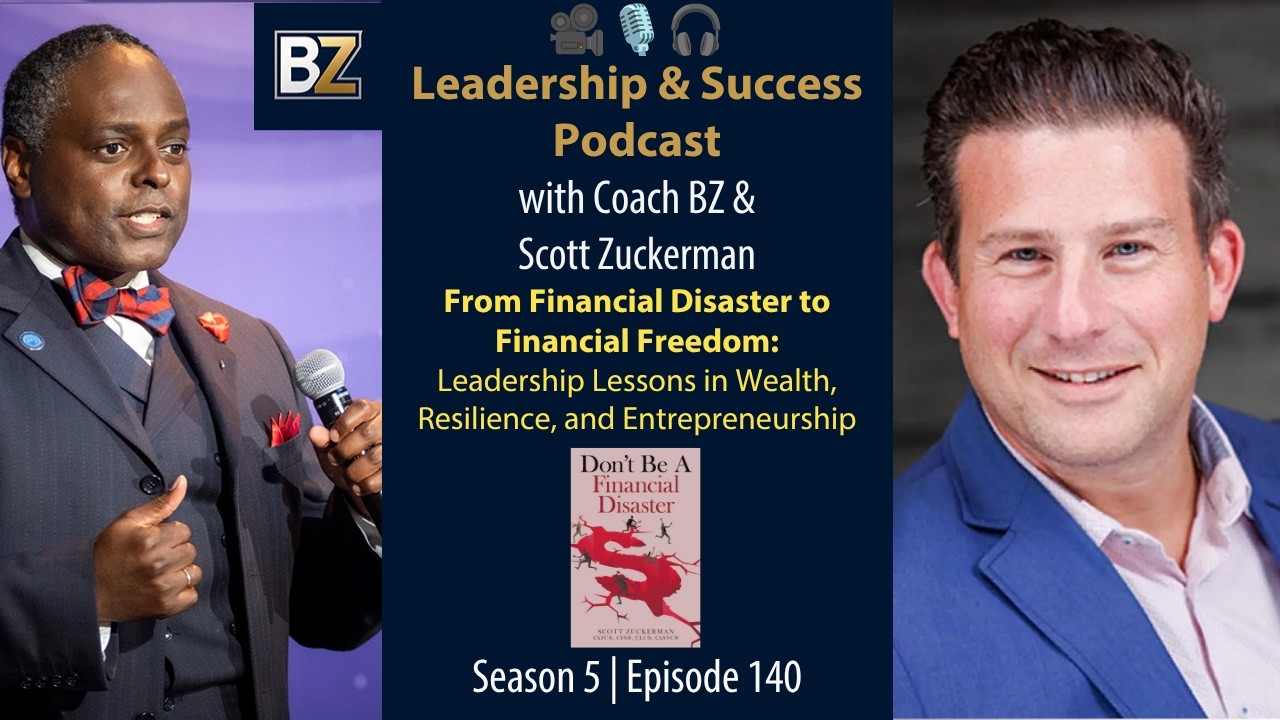
Scott Zuckerman, a fintech entrepreneur and financial planner, filed for bankruptcy at 23 after accumulating $250,000 in debt from a failed dot-com startup. He built Wexford Financial Strategies around a planning-first philosophy and created an AI tool called the Financial Fitness Passport that gamifies financial education and helps users manage cash flow, protection, and wealth building.
Chapters
¡Hola!
Hi, I'm John Maxwell. When the top companies in the world are looking for trainers, speakers, and coaches, there's one name that stands above the rest, and that's Maxwell Leadership. Our certified team members have gotten proven results for companies all over the globe, and our reputation, I'm proud to say, is second to none. Some of our members have risen to the top of their profession, including the one you're going to meet today. I proudly introduce you to my friend Bob Fabien Zinga.
Welcome to the Leadership and Success Podcast with your host, Coach BZ, where we help you lead with purpose and succeed with impact. If you're ready to grow into the kind of leader others want to follow, this podcast is for you. If you're determined to elevate your success and leave a lasting legacy, this podcast is for you. As my mentor, Dr. John C. Maxwell, reminds us, everything rises and falls on leadership. Our goal is simple: to inspire you, challenge you, and equip you with insights that can transform the trajectory of your leadership journey. Welcome aboard to another episode of the Leadership and Success Podcast with Coach BZ.
I'll always remember the first time I stepped out onto the mat. And I couldn't wait to get my black belt. It was like I wanted it the next day. And my heel comes up on one side, heel comes up on the other. But I knew that if I worked hard, I trained hard, I got myself into the gym, that one day I was going to become that black belt. All right, time! And I wake up every day and I have that same drive and ambition and tenacity in my business so that I can help my clients make smart financial decisions and guide them to reach their dreams and their goals.
How are you?
Hey, how are you? Can I get you anything? Let's say hypothetically we were able to start out with $100,000. I don't care if you have $5, $50, $500, $500,000. We are in business to help people. You'll see the multiple carriers that we have on our platform. We are an independent firm. That means we have zero ties to any insurance or investment company. We have zero quotas as it relates to sales. This really allows us to focus on what is truly best for our clients' best interest. The death benefit amount, you're gonna notice, stays flat the entire way. That's guaranteed never to change. I believe in an educated client, right? We want to make sure that there's enough money for the children. Wexford is a team. Our philosophy here is not just trusting me, but trusting our staff, trusting our experience, trusting our knowledge. And we wanna earn that from our clients. We don't expect it. I get to really know my clients, and my clients become friends, and friends become clients, and that's really important— the relationship. By the time they finish our process, I want them to walk out of my office feeling satisfied and fulfilled and excited on what is to come. We want them to have their black belt.
All right, welcome to another edition of the Leadership and Success Podcast, our third broadcasting today. And before I start with the guest who's waiting for us in the green room, Let's start with what we call our moment of gratitude. As you know from earlier today, today I am really grateful for freedom. 10 days ago, it was June 10th, and in a couple of days, it's gonna be July 4th. And freedom is so important, so critical. And I think America is still the freest country in the world. And I think freedom is not free. And I am so grateful for every man and woman who has ever served in the US Armed Forces. Because those are the people who have absolutely earned our freedom. We are free today because of their sacrifices, and I'm so grateful for that. So let me know in the comments, uh, where are you from, where are you joining us from, what city, what state, and what are you grateful for today? And also, if you have a question for my guest, type it in the comments. We will be answering live. And hello again to Daniel Young. He was there earlier for our previous podcast. So glad that you were able to join us again. And let me see if I can properly introduce our guest. So we're gonna be speaking, like I say, to Scott Zuckerman. He has so many credentials in the fintech world. I believe a CHFC is a Chartered Financial Consultant, and he is also a CFS, which I believe is Certified Fund Specialist, and also CLU, which is a chartered life underwriter, and also CHS— man, my goodness, so many credentials— chartered special needs consultant. So, very, very certified in what he does. He's the president and CEO of Wexford Financial Strategies, an entrepreneur, a fintech founder, and author of "Don't Be a Financial Disaster," to the Leadership and Success Podcast today. And we're gonna be talking about his bestselling book as well. So, Scott's story is one of resilience, reinvention, and purpose. After experiencing his own financial setbacks, he transformed adversity into a mission to help individuals like you and me, families, business owners, and financial advisors build financial confidence and long-term success. Actually, he has a special product which is actually available free as well. We're gonna be telling you about toward the end of the show today. So as president and CEO of Wexford Financial Strategies, and founder of several innovative fintech platforms, including the Financial Fitness Passport we're gonna be talking about in just a moment, and also Advisor Marketing System. Scott is helping people simplify financial complexity and make better decisions for their future. And I think this is quite relevant, especially for military families and those who are about to transition back into civilian life. So part of what we're gonna be learning today is how personal adversity shaped Scott's mission and entrepreneurial journey, but also practical strategies for building wealth and achieving financial freedom. So without any further ado, please help me welcome to the Leadership and Success Podcast, the one and only Scott Zuckerman. Good morning, Scott. How are you doing today?
Good afternoon.
I'm on the East Coast.
Good afternoon.
That's right.
Good morning to you, but good afternoon to me. I mean, let me tell you, that was some introduction. Thank you. I've never been introduced that way. That was amazing. Thank you.
Thank you. All the way from Wall Street to New York, and I am in Silicon Valley. This is really fantastic. I really love how technology can bring us together. So what is one thing you are grateful for today?
Well, I'm going to tell you, I'm going to frame this just based on what you're grateful for, and that is this amazing country, our men and women who fight every day for this country. I couldn't do what I do, and you certainly can't do what you do without them. Thank you for your service. And that, that, that's really something that's near and dear to me, even though I personally haven't served, definitely have had family members who have, and it's the greatest gift that anyone could give to their country. So I just want to start out by saying that.
Thank you so much, always very much appreciated. Now, we knew from the intro video you actually are a black belt in mixed martial arts, which is really, really cool. Is there something else about you that's kind of unique most people may not know when they first meet you?
Sure. I'm one of these people who takes interest in a lot of different things. And I look to excel in anything that I do. So one thing about me that a lot of people probably don't know, when I was 16, I was a professional magician.
Really? Yes.
And, and I am also an instrument-rated pilot.
That's pretty amazing. Wow. Where do you find time? My goodness.
Yeah, my wife says the same thing. I don't know. I just managed to make it all happen. I don't sleep very much.
Man, you are CEO, founder of multiple ventures. So you've received so many accolades already. Beyond all of your accolades, titles, and everything you've done, who is Scott Zuckerman?
So I, if I had to define myself, I'm going to say that I am a hardworking, passionate person who enjoys helping people, teaching people, and figuring out ways that I can help change the world.
Wow, that is quite powerful. Yes, I, I like that. So looking back on your journey, sir, what experiences shaped the leader you are today?
I think anyone who considers themself a strong leader can really only be a leader through failure. So I think my greatest lessons that I've had in life is when I've failed. Um, and that's what makes me always stronger and come out more on top, are those failures in life.
Well, that's really powerful. Actually, it's a question I ask a lot of the people I talk to. I have this coin, was given to me by Musk Keeper. One side says success, the other side says failure, meaning that success and failure are two sides of the same coin. And many times on the show, Leadership Success, we talk about success. In America, we like to glorify success, but the truth is many people, they don't achieve success until they've gone through failure. I, I really like what you say, how failure shaped your, your life and your, uh, success. It's very specific, um, times that you, you felt like you had failed that comes to, to mind, and also kind of what you learn through it and how you were able to turn that around.
Yeah, sure. Um, I would say that one of my biggest failures in business was declaring bankruptcy at the age of 23. I had graduated from Syracuse University, originally thought I was going to become a lawyer and go to law school and then realized that really, I have entrepreneurship running through my blood.
A—
my grandfather was an entrepreneur. And I don't know, it's just business was in my blood. And I wanted to start a business right out of college. And it was right during the time of the dot-com era. So I had started a dot-com and was working a full-time job in Manhattan. And I knew that the job I was in was going nowhere. It was literally just to pay my bills and to fund my business venture. And I also knew, because my parents had saved money from my bar mitzvah, and they— I didn't really know how much was there. But when I told my parents that I wanted to start a business, of course, when you start a business, what do you need? You need money. So I went right to my parents first. And they said, look, we wish you the best of luck. You want to do this? Here's your bar mitzvah money. And back then, you know, you're, you're talking 26 years ago. I think I had about $60,000, which was a lot of money. And I took all of it and I invested it into a dot-com. I did a ton of marketing. I was just— every dollar that I had, I was pumping into this business. And it was fairly well known. And right at the time that I was looking to start raising capital is right when the NASDAQ crashed. And when all the venture capital was drying up, dot-com became dot-bomb. And there was just no more money. It just completely dried up. And I also got a bunch of business and personal loans. And then I just said, all right, well, what can I do to make this work? I was literally trying to do anything in my power, like, okay, well, I have a website, but how can I remarket this? And it was in the event space, in entertainment. And so I dropped the dot com, I started doing private and corporate events. And then 9/11 happened. So the first budget that any company cut was their entertainment budget. So I was really in the wrong place at the wrong time twice, plus the fact I was young and didn't really know what I was doing. And I got to a point where I was a quarter of a million dollars in debt. And wow. And there was just no way out of it and had no choice but to declare bankruptcy. And then I had no idea what I was going to do for the rest of my life. I also, at the same time, was witnessing a very successful family business also have their own financial troubles. That business ultimately closed. Again, that was started by my grandfather.
Wow.
Very well-known institution on Long Island. That, that went out of business. So certainly the family business wasn't for me either. And I just kind of thought to myself, you know what, maybe what I should do is learn the— learn how to be financially responsible, learn about taxes and investing and debt, and maybe I could become a consultant and help other businesses not experience the same thing that I did, both personally and through my family. And that's what led me into financial services.
Wow, that is really quite a story. I'm assuming— did you go to, uh, college?
I did. So I graduated, uh, from Syracuse University.
And what was your degree?
I was pre-law, actually.
Oh yes, yes, you said you were going to go to law school first. Wow, that is really—
so yeah, I was pre-law, and then I, I got all of my debt designations through, uh, the American College, which is in essence its graduate program study.
Yes. Wow, that is amazing. Well, thank you so much for sharing that. 23 years old, more than half a million dollars in debt. It might as well be $1 trillion, right?
I know.
And really, it's beyond your control, just things happening to the economy. The dot-com, everybody remembers that. 9/11 after that. What was kind of the first thought that entered your mind then when you felt like, I have to go through bankruptcy? What, what were you thinking?
Um, I was just thinking this is just a little bump in the road, and, um, I need to figure out what I'm going to do for the rest of my life. And whatever it is I choose to do I'm going to be successful.
Okay, that surprises me. When I was 23 years old, I didn't think like you. I was more like almost like a teenager. Half a million dollars? Are you kidding me? It's like the end of my life. Wow.
What—
why do you think— where, where did that come, come from? You think resilience, that positive outlook in something that looks so big, such a huge challenge, especially for 24-year-old?
Uh, again, I just think it's in my blood. I mean, at 13, at 13 years old, I had started my first business. I was incredible stringing tennis rackets and selling, uh, tennis supplies, uh, out of my house. So for me, I, I, I, I just, I don't know, it's, it's just It's in my blood. I truly, I truly believe that. Not that I don't want to say that anyone doesn't have the potential to be an entrepreneur. But I do think it's something that is inherent in someone. Very similar to being a professional athlete. I kind of relay it, relay that same thing. Look, I can never play in the NBA or the NFL. It's just not in my DNA.
You know, Yes, but you can definitely kick ass with mixed martial arts.
Exactly.
That's just incredible. I guess, no, remember the movie Only in New York? It's, it's, uh, incredible, just the resilience of people, because it is not for, uh, everybody, especially when you start a new venture and it looks like, you know, you are going to fail. Most people would just give up, count their losses, and be done, but you You just come back and have a venture or something else, and eventually here you are, very successful CEO and founder of multiple enterprises, which is just fascinating. But back then, how did that experience affect your confidence at 23 years old?
Oh, it was definitely a shot to the ego for sure. And I truly, I was scared. I didn't know what I was going to do. I'm like, and what was, you know, I forgot about this, but during the time, obviously we'll talk about the fintech stuff, but I've— and I mentioned how I had a dot-com, so I was always good in technology. So while I was trying to figure everything out, I created this company called The Town Geek. And so I printed out— and this is actually one of the ways I wound up in financial services, actually— but I printed out about 10,000 5x7 postcards. And at the time, I was living near a— pretty close to one of the train stations in the Long Island Railroad. I mean, they're all easy to get to anyway. But the way I started was right after— right during rush hour, I would go to a different train station every day and hand out the postcards. Wow. Geek on the platform. Then after rush hour was over at around 9 AM, The parking lot was packed with hundreds and hundreds of cars. So then I went in under each windshield. I hate when people do that to me.
That's commitment. My goodness.
Under each windshield, I put the flyer. And people after work, then I'd get phone calls and they'd say, oh, I got your flyer. And I'd go over to people's houses and fix their doors and stuff like that. It was Amazing. In my pocket.
So I must, I must ask you again, where does that resilience, that force de vie, come from? It's like, wow, unstoppable.
Exactly. Well, that's what it is. I just, as I mentioned, I want to, I always, I want to make a difference. I, I, my brain operates in a way that it just doesn't sleep very much, and I'm just constantly thinking. And I'm thinking of, you know, when you watch, watch Shark Tank and you look at these inventions and you're like, wow, like, why didn't I think of that?
Yeah, yeah.
It could be something so simple that is just a genius idea. And my mind just always goes trying to come up with new things that I can do and create Uh, and it also keeps me from being bored.
Yeah, no, that is definitely a gift. But now I must ask you, your parents gave you $60,000. Back then, that's a lot of money. Now, now that you know you are going through bankruptcy, you've completely lost everything and then some. What, what did your parents, your family, your close friend, what did they say to you as, as you were going through the process of bankruptcy? Back then? Any encouragement in trying some— something new, or what kind of feedback did you get?
Well, here's what I will tell you. I think you— like anything, you have to know your children. And my, my parents knew that. My parents always believed in me to the point where before I declared bankruptcy, um, my parents believed in me so much that my father— at first, I— after I spent the money, um, and I was bleeding, I needed additional money. And my parents knew that, like, if anybody can do this, Scott can. And they took out a second mortgage on their house.
Get out of here!
I swear, they paid off a whole bunch of debt or so that I could free up credit so that I can borrow additional money. And interestingly enough, and obviously, look, then what happened? I declared bankruptcy. But I, to this day, I worked and worked and worked until probably, let's see, I would say probably 6 years ago, thereabouts, 5 or 6 years ago. And paid my parents back every single dime that they gave me.
My goodness. So, wow, I must say that must be a real motivation for you not to give up when people trust in you that much. Yeah, that's amazing. Thank you, thank you for sharing that. What did that experience teach you about life, leadership?
Well, I think again it goes back to the whole success and failure. You hit the nail on the head. You have to have failures in order to be successful. Most people unfortunately fail. They give up and, and that's it. Uh, you know, if you're riding a horse and you get bucked off, you got to get right back up on that horse. And I think, I think a lot of people also want a, uh, get-rich-quick scheme. Um, so they're willing to try anything and try anything once. And I just think people typically do things for the wrong reasons. For me, so— yeah, leadership is about working hard, perseverance, uh, never giving up, and that, uh, non-quitting spirit, so to speak. Uh, and I think that's what breeds success. And unfortunately, in today's day and age, I just think more and more people, especially the younger generation, just have so much of an entitlement complex. Why? Because of things like this. We have information at our fingertips all the time, um, and it comes easy and fast. Yes, that's, that's not what life is about.
Wow.
And that's what I try to teach my children, is life is about working hard. Life isn't easy. And if you want to take the easy way out, you certainly can. But there's only so much that you're going to get in return.
Wow, that is so, so, so powerful. Of course, this wasn't planned, but I feel like people who are listening right now are really going to learn so much from you because it's true. You can learn from success, but I feel like success doesn't teach very much. I think it was President JFK who said, "Failure is an orphan, but success has many fathers." But most of the time, we don't really learn much when we keep succeeding over and over again. But when you go through a period of failure, I think you really get to learn some of life's, I believe, most valuable lessons. And during that time period, was there maybe a decision that you made that shifted your trajectory or maybe a conversation maybe with your parents or a book, a mentor, a prayer, or a moment that kind of changed everything from you going from $500,000 in debt, going to bankruptcy to becoming the successful entrepreneur you are today?
Not really.
I—
and just to clarify, it was, it was a quarter of a million in debt. Still a lot of money, not half a million, but quarter. Um, what did my parents say?
Yeah, to me it might as well be in a trillion. Exactly, it's just too much money.
Um, again, not really, because I knew that no matter what, I was gonna work hard. I was— I'm like, I'm in debt to my parents, they believe in me. Um, but I believe in myself more important. So, uh, I, I, if you, you have to want it for yourself, you have to want the success. Um, and I, I, I also, I like nice things, and you need money to buy nice things. But I don't just go in the backyard and walk the money off the tree. I, I work hard.
That's what my mother used to say, money doesn't grow on trees. No, I like that you believe in yourself. I think that's what we need more and more now, to build that confidence. Where do you think that confidence came from, as far as you are concerned? Why did you believe in yourself so much, you think?
Well, part of it I think is human nature, but the other, I will say my time that I spent in martial arts. That was something that really teaches you how time— if you put in the time and the dedication, uh, and you work hard, uh, you can accomplish your— what— whatever goals you set out to. And what I said in the video is the truth. I'll never forget the day that I walked into the, uh, into the karate studio. I walked in off the street, and there the gentleman who was at the desk, he had his black belt, and I looked up on the walls, weapons and all this stuff. And, oh, well, you know, how long does it take to get your black belt? But I didn't, you know, and, and then when you have everyone who's in the class and you look at everybody's belt level You're there in your white belt, and you know, then in this discipline it's all right, now I'm blue. It's like you looked at me in the class, you're like, well, no, I, I think I'll look really good in the green or the red.
Wow, that's amazing. Wow. No, I, I— that really speaks to me, uh, because it is, it is true. There are things you, you do not even know military training, you're talking about martial arts and all that, it teaches you a lot about yourself and about life, life too. And I think about, uh, success. What has martial arts taught you about life and leadership?
So this is the best part of the story as it relates to martial arts. So you probably can't tell on the camera, but my nose is a little crooked, and that's because— and, and it goes one way, it goes towards the left. And why? Because I had my nose broken twice.
Wow.
And it was both times by a righty. At least one time, like, it should have been a righty and then a lefty, and I, you know, I know it can still be a little straight. But look, that's, that's one of the best lessons. Um, you get punched in the face, but you just keep going. You know, I had my nose broken, had my nose broken twice, and it didn't keep me from training. It didn't scare me.
Wow.
What it did is it made me stronger. And I'm like, all right, yeah, so That's amazing. You know, so, and that, that's in anything in life. So again, kind of like those successes and failures.
Um, never, never, never give up, right?
Never give up. You get a beat down. I had blood dripping down my face during my black belt test. This was— this is another good one. Uh, so it was during my black belt test, and back then we had to, uh, wood breaking was part of the, uh, the black belt test. So whatever it was that, uh, however many boards you could break when you were at your black belt test, they added one more. So let's say you had— you broke 5. Well, at your black belt, you consistently broke 5. Your black belt test, now you need to break 6, right? And then there was a station break where you had different people holding the wood, and in one turn in without stopping. You had to go to each of the people to break the board.
Wow.
And my very last kick was a round kick, and I split my foot open. I did break the board, but I split my foot open.
Oh no.
Now I'm bleeding all over the place. And the next thing that I had to do was fight for 15 minutes.
Wow.
And I went over— they brought me over to the little triage area that they had, and they said said, um, look, you can't fight. You have to go to the hospital. You need stitches. I said to them, I said, I'm not leaving here without fighting. I said, I'll fight for 15 minutes. Bandage me up as, as, you know, just tight.
Wow.
I said, I'm going out there and I'm fighting. And I fought for 15 minutes. I got blood all over every single person that I fought, but I took home my black belt that day. And then I went from the test Went from the test to the hospital to get my stitches, but I wasn't leaving.
Wow. I don't know. I feel like there is something supernatural in all of us, kind of like this feeble woman who when there's danger or child, she's going to be strong enough to lift a car or do whatever it takes. There is that thing. It seems like in martial arts you can access that part of you much easily. I remember I'm not in martial arts or anything, but the first time I had to break a board, one of my mentors, Tiav Eker, that was I think in Atlanta. I didn't think I could do it, but I did. And what that taught me is, okay, I thought I couldn't do it, but now I have confidence I can, therefore there is nothing that can stop me. And again, Tony Robbins, another one of my mentors, is a little bit crazy. He makes you walk on fires and break boards and stuff. But yeah, but it just teaches you that there are things that you thought 2 minutes ago was completely impossible, but now I've done it. And no matter what comes my way, I'm going to be able to.
Absolutely.
Wow. That's powerful, man. So how different are you today because of all of your experiences, what you went through, the bankruptcy, but also your experience in martial arts?
I just feel like I can't stop. I just, I need to keep going. When I put my mind to something, yes, I just need to go with it.
So powerful.
And I'll tell you, even if I fail, I sleep at night because I tried.
Wow.
You can't fail.
That's possible.
Yes, you try. And I think that That's something that I live by every day. The same reason why someone can't tell you yes or no if you don't ask the question.
Mm.
So, right. I, so I just live by that every single day of my life. And I come into, I'm excited to get up in the morning, come into the office. I don't know what the day is going to bring. But I know that every day is going to be different, especially when you're innovating. And I just love to innovate. So for me, it's like, okay, what is today going to bring?
That's powerful. You remind me of our President Theodore Roosevelt, right? Man in the arena. He says, it is not the critic who counts, not the man who points out how the strong man stumbles or where the doer of deeds could have done them better. The credit belongs to the man who is actually in the arena. Wow, that's powerful. I'd rather try and fail than not have tried at all. Powerful, powerful. So you didn't mention your children, and I have two daughters myself. How will this experience kind of shape the legacy you leave behind? What lesson do you hope your children learn from watching you survive all of this and becoming the man you want to be?
So there are two things that I can't stand as it relates to qualities of human beings, and that's laziness and mediocrity.
Yes.
So what I instill in all of my children— and I have four of them, I have, uh, two of my own, my wife has two, we're a little bit of the Brady Bunch, so, uh, we're, we're four together and the kids grow together and it's great. But that's what I instill in all of them. I say, just don't be lazy, don't be mediocre. And it doesn't matter, uh, I, I don't— when it came to school, I said, I don't care if you got a failing grade, but if you didn't study and you didn't work to your best potential, that's what bothers me more than anything.
Yes.
But if you bust your ass, then you know what? You tried.
That's powerful.
You tried and failed. And you're going to hopefully learn from that experience.
Wow. Be the best no matter what you do. That is so, so powerful. Yeah. I like to tell my kids that I am allergic to mediocrity. But if I'm going to do something, I better do it well.
It looks like we have a couple of people who are on here and Daniel Young, he said, speaking of loving to innovate, what's the ethical line between using AI as a support tool and letting it shape decisions that still require human accountability and, and the moral business and mediocrity? Look, I think, I think that's an excellent question, Daniel. Here's what I'm going to tell you. It's those who fear— and we'll talk about this when we get into the fintech and what I created— but those who fear artificial intelligence, those are the ones who are, in my opinion, going to be the ones who are more lazy and mediocre because they just feel like they're going to be set aside. I think about just when the internet came out, right? We didn't have it. We didn't have the internet. And if you wanted to go somewhere, you had to pull out a regular map. Then when MapQuest came out, think of this, right? You used to go on MapQuest and print it out, and then people would say, oh yeah, but you know what, now I have MapQuest, it spells it all out. No one's going to learn how to read a map anymore. And look, there's some truth to that, the same way how in schools they don't teach cursive writing anymore. And people don't use it and people don't know how to sign checks. So look, are there certain things that, uh, we're— that people are just going to become reliant on AI?
Sure.
But those are just tools that are going to make our lives a little bit easier, not necessarily make us lazy or mediocre. If you allow it to make you lazy, for example, if you allow your kids To be sitting like this all day long, right? Sure, that's gonna create that laziness mentality, the mediocre mentality. But if you use it in the right way and you teach everybody how to use it the right way and you use it as a tool, it's gonna actually make your life easier from the standpoint of you don't have to do it yourself because you now have a tool, and that tool is gonna make you that much more efficient.
I love that. I love that.
Okay, so I look at it, the— at these tools like AI, not from, from the standpoint of, okay, being unethical or whatever. I'm saying, no, no, I'm gonna use the tools that I have in my— it's just another feather in the cap, another tool in the toolbox that's gonna hopefully help me more successful, make me be more successful by having access to these tools. So, that answers your question.
Absolutely. I love that. So, let's talk about leadership and building Wexford Financial strategies. But you've built Wexford Financial strategies around a planning-first philosophy. Why was that?
Well, the reason is, and I was, in my opinion, when I came into this industry, there were at the time getting rid of the titles in the industry. The titles in the industry were you had your banker, you had your insurance salesman, your stockbroker, and they became dirty words. And everybody just became a financial advisor. But the reality of it is, when you actually learned what somebody did, they really were only planning one aspect of someone's life and calling themselves financial advisor. I took issue to that, uh, because if you're just selling somebody life insurance, or you're just selling somebody long-term care, or you're just managing somebody's investment portfolio, you're not a financial advisor. You are an— you are an investment manager, you are an insurance advisor, you a life insurance advisor, a disability insurance advisor, whatever you want to call it. You're not a financial planner. Okay. And so I took issue to that. And that was one of the reasons why I said, I'm going and getting my, I'm going to go get my designations. I want to learn planning. I want to learn everything there is to know about somebody's, about how someone's financial life operates, how a business operates financially. I want to become educated in that. And then once I get educated, then I can kind of put my own flavor behind it, so to speak, and then be able to educate the public. And so what I did when I started out, when people asked me what I did for a living, I said I help people organize their junk drawer because most people have one.
Why?
Because they go, they have, they buy home insurance when they buy a home, get a car, you need auto insurance, you have a family, I'm gonna be responsible, I'm gonna buy some life insurance. Oh, I started working, I'm going to invest in my 401. I'm going to open a Robinhood account and I'm going to buy some shares of Nvidia, you know, whatever the favorite stock is of the hour. And before you know it, you just have this big conglomerate of all these financial products that have no rhyme or reason, no connection, there's zero integration. And that's where waste happens. Uh, and that's not only just waste, but that's also where you have the potential to be what I call derailed from reaching your financial goals. Um, and that's why I built Wexford Financial Strategies around a planning-first philosophy, putting it all together, looking at things macroeconomically rather than looking at something through, uh, just like a horse with blinders on, being very microeconomic. Tunnel vision. And I say I want my clients driving down the road in a Humvee, not a motorcycle. I think most people fly by the seat of their pants.
Yes.
And that's what I set out to educate.
Hmm. That's really powerful. And I know for those who are in the military who follow, we know the difference between being tactical, right? Operational. But really, you're talking about being at the strategic level. How can leaders who are listening right now think more strategically about wealth creation.
So this is the number one point, and I bring this up in my book. You want to build wealth, you have to start somewhere. And I'm not ever going to be the person that tells you, oh yeah, spending too much money in Starbucks. Oh, you can't go out for a sushi dinner tomorrow. I hate the word budget. Budget does not exist in my planning vocabulary. What does exist is cash flow management, and they're two different things, in my opinion. Nobody ever wants to live by a budget. But when you understand your cash flow and you understand the difference between fixed expenses and variable expenses, and you understand that, and then set aside some level of forced savings, the power of compound interest— Albert Einstein said that, right? That, that, that is— it is extremely powerful. And once you start and that compounds, and you're making smart decisions because you're educated, that's where you're going to wind up building wealth. And It's just got to be strategic.
Really, really powerful. And you did mention your book. We're gonna get to it in a moment, but I want everybody to get a copy. Don't Be a Financial Disaster. Uh, we're gonna get to that, but before we do, let's talk about your entrepreneurship and all of the innovation you've been a part of, because you didn't just stop at financial planning. You also built fintech companies. Why did you have to do that?
Uh, I wanted something else to do. No, I'm good. Um, why? I saw a gap in the industry and I said, I'm gonna solve this gap. But then on top of that, there was this little thing in the back of my mind, like a little, you know, the parrot sitting on my shoulder saying You failed the first time with the dot-com.
Mm-hmm.
Now let's take advantage of the fact that AI is here. And how can I— how can I utilize that AI to enrich people's lives? But everything that I have, my 22-year experience, and train an AI engine on how to really help people.
Wow.
And I did a— I looked at the industry and I looked at all of the apps that were available. And there is a ton of them, by the way. And they're, and they're great. But there's one thing that all of these apps have in common. And the one thing they all have in common is that they solve one problem. Maybe two. None of them put it all together.
Yes.
And so what I—
again, that strategy and being, uh, exactly integral.
Yeah, exactly. So you can have tons of budgeting apps, apps to help you with investing, apps to help you with, uh, debt, uh, but no one puts it together. Um, and so I said, I'm gonna do this and I'm gonna be the pioneer. I'm gonna put it out there, uh, to the entire population because I'll tell you something else. That I think is critical here, and that is that most financial advisors are working with the top 5%— 5 to 10% of the US population. And the underserved, who are that 0 to 90%, the pe— the kids who are graduating from college with jobs and know nothing about finance, uh, the people who are just told, okay, put money in your 401 so you have money in retirement, but don't have a distribution strategy. Any of these things people don't know, and they're not going to financial advisors, that 1 to 90% of the population. And so I set out to come up with something, a, a, uh, a platform that was going to solve that problem.
And I did. That is really quite remarkable because it's true, in American schools, I mean, we have some of the best colleges, but they don't teach you about anything about microeconomics. Even when I went to college, I took an economic class, but it was all about macroeconomics only. They didn't teach me how to manage money, how to invest, or even how to write a check. I was like 17 years old when I came to this country. I had to learn everything all by myself. That's kind of strange. So one such app you've created is Financial Fitness Passport. Can you tell us about that? Please? Yes. What problem were you trying to solve there?
Yeah, so that's exactly what I was just alluding to. So Financial Fitness Passport is a gamified, rewards-based financial education and guidance system that takes the user through all 7 pillars of financial planning, from cash flow all the way through to estate planning. All driven by my AI agent Penny. And what Penny does is Penny gets to learn the user behavior. She has a memory so she can remember where the user is within the process. She educates and guides appropriately to really help people learn about their finances, every aspect. The state— she can analyze any financial document and explain it in layman's terms. How many people go and get a job with their employer and get handed a packet of benefits package? So you could take that benefits package, upload it into the system. Penny will read it and tell you exactly what benefits are available to you. Based on what you've completed already in the system, she can help guide you as to what benefits may be available to you or not. And it's pretty much anything like that across the board. Insurance documents, investment statements. She's going to learn your cash flow. She's going to learn what debt you have. You're going to learn how to build emergency funds. You're going to learn how to— how to invest. You're going to learn about estate planning. You're going to learn about taxation and one of the ways that you can can lower the amount of taxes that you pay. And it's all built under one umbrella. And as you accomplish your goals, then you get rewarded along the way. So this way it keeps you coming back, and Penny will hold you accountable to the process.
That is really, really amazing. I wish your tool existed when I was a college kid. And you can get also your free Passport Score, and actually you can get started for absolutely free. They don't even have anything, right? Financialfitnesspassport.com.
Right.
Wow.
Yeah, you get— all it takes is about 90 seconds, and in 90 seconds, amazing, your passport score, uh, from our questionnaire, and, um, also interact with Penny.
That is really amazing. Most entrepreneurs, they wouldn't even give you a free option even to just test the platform. Why are you giving it away? For free?
I'm giving it— I'm giving away the free Passport Score because I want people to really give themselves a self-assessment to see where they think they are. Um, and, uh, I can tell you from just looking at, uh, the users— by the way, this platform is 8 weeks old.
Wow.
It's, it's brand new, hot off the press.
Um, and from the first mention here, guys, the Leadership and Success Podcast. Thank you.
Yes, yeah, that is, that's true. And, um, any of the Passport scores that have been generated, uh, it's, it's quite interesting to see. And it is kind of along the lines of what I would expect, uh, where I would expect people to be. Um, and I think that most people are ranging between that, uh, 25 to 50-ish range. Um, but the idea is everybody should be 100. There's no reason why you can't be 100.
I like that. I, I, I like that. Now, for the people who are listening, there is a portion of my audience, they do want to become an entrepreneur. Now, as you know, most businesses when they start, they end up, uh, failing. What do you think separates entrepreneurs who succeed from those who quit too early? And also, what leadership lesson have you learned from your own ex— experience and, uh, innovation career?
I think a lot of people get discouraged because, like anything else, um, you need money. And I think that's one of the biggest things that may discourage people. Is, well, I have this idea and I know it's going to take money to move forward with this idea, um, and I don't have the money to do so. Uh, and that is a real problem. But here's what I will say: if you truly believe in yourself and if you work hard You can succeed. And that's not to say that every idea, every idea becomes a hit, right? Not every song that, um, that an artist may write becomes a number one single.
Yeah.
Um, and I think a lot of times entrepreneurs, sometimes they don't know when to give up, um, which kind of goes against what I was saying before, that you keep going. Um, but that does sometimes also get you into trouble when you realize, you know what, um, I gave it a try, uh, and, um, it's— I just gotta, as Mr. Wonderful would say, I just gotta take it in the backyard and shoot it, right?
Um, you got to know when to cut your losses.
You have to know when to cut your losses. You don't want to take good money and put it after bad. But like anything else, if you work hard, at least if you fail, you learn something from it. And maybe the next one is a success.
Wow, that's quite insightful. Yeah. And I also like, basically you're saying to be resourceful. Another thing that Tony Robbins taught me, because sometimes you may have a good idea, you don't always have to have the resources in front of you right now, but if you are resourceful, then you're going to attract the people who will have the money or the resources you need to make that become a reality. Can you tell us a little bit from your experience? You are definitely a very resourceful person. Are there maybe some books or some mentors or some things that kind of helped you have the mindset of always trying to find a way out of what most people may think is a no-go or it's impossible, how you always keep going and always find a way to go from, you know, like we said, bankruptcy to now becoming a successful serial entrepreneur. Anything helped you along your journey?
You know, I know this is gonna sound very, um, what's the word I'm looking for, uh, I'm gonna sound uneducated when I say I hate reading. I really don't read very many books and not because I don't want to learn, because obviously I learn every day. I just have a different style of learning and I just find by reading books, even if I'm interested in it, I just tend to zone out and I get bored. I need, I need the next page, the next page. You know, it's just too, too slow. But the one thing that I— so for me, I love listening to podcasts, watching YouTube, um, believe it or not, even following some, uh, people on TikTok, uh, looking for different coaches, um, whether it be on just business management, sales, whatever the case may be. And I look for that content, and I like to say I'm a plagiarist, so I have no problem if someone has a great idea and it works for them. Well, look, maybe it'll work for me. So, um, but there is one particular book, um, that I did read many, many, many years ago, um, and I forget who, who the author is, but you can look it up, called The Experience Economy. And what's great about that book, and a lot of it is about Starbucks and how Starbucks became so successful.
Yes.
The biggest thing with that was walking into a Starbucks, they all look the same, they all give you that same feeling. No matter what, if you get a cup of coffee in Seattle or you get a cup of coffee on Long Island, it all tastes the same. It's providing that experience to the end user. And that's one of the things that made Starbucks so successful. Wow. So when I run any of my businesses, I always think about the client experience first.
Yeah.
So what is it that the client is going to get out of either a meeting with me by being my client? What are they going to get when they utilize Financial Fitness Passport? What is the user experience? So I try to take user experience into account as it relates to anything that I do within my business.
Yes. Wow. That is really, really powerful. And the Experience Economy, we do have a digital bookshelf of this podcast. It's by Joseph Pine II and James Gilmore.
Ah, yes.
That's it. Yeah. Okay. Time, attention, and money. Thank you so much. And which podcast or YouTube channel would you recommend to my audience who really want to get into becoming Entrepreneurs?
Well, of course this one, Bizzy. Come on, man.
Uh, um, my podcast? Okay, no, some— somebody else's podcast, please.
Yeah. Um, well, there's— I'm gonna say there's no, no, none in particular. There is one, um, that I like, which is— I think it's called Wow Women on, um It's a woman's— do you know what I'm talking about? Yes. Yeah, and that's great. That's successful entrepreneurial women. There is one that is— hold on and I can tell you exactly what the other one is. This is another great one. The Trailblazers podcast, that one is really good. There's a bunch, but what I like to do is, and I don't just sit and listen to one, I will listen to many and I do searches and I also will just scroll. You know, if you watch even YouTube Shorts, one short's going to go into the next.
Yeah.
And I'll subscribe to them and then I'll just get pop-ups and I'll just go and listen. So there isn't anything that I specifically civically sit that I'm dedicated to because I like to be worldly and get a little bit from, from everybody.
Best, best on what, what challenging you are, you are facing. Thank you so much. Again, the book, The Experience Economy. Would like everybody to get a copy of that too. So this, this is a good segue to come to your best-selling book, Don't Be a Financial Disaster. Why did this book have to be written?
It had to be written because a lot of people I come across are financial disasters. Um, and I wrote the book during the time of the pandemic, and this was my way of, uh, letting people know that there are a lot of talking heads out there when it comes to finances, and I like to call them financial myths. And the reality of it is, is that every person's individual situation is different. And I don't like making blanket statements. So I figured if I can give the financial education inside of a book and make it simple so that people can actually understand what they're reading, it needs to be written so that a middle schooler can understand the book. I love that. Give you an idea, I talk in the book, I compare the stock market to sunglasses and umbrellas. I swear, uh, I mean, that's how easy I make it. Still to this day, 20-plus years later in this industry, when I do my investment education meeting with my clients, we talk about sunglasses and umbrellas and I have clients for— since from 20 years ago, and when we do reviews and we talk, we talk about sunglasses and umbrellas. So it's, it's making it simple. And when you can do that, it makes it much better, easier for people to understand. And when you do that, then it helps them take action.
I like that, the focus on taking action. But also, I like that you say it's customized to the people, right? Whatever their financial environment is. That's why I like your financial fitness passport, because it's really based on your own individual— exactly— issues. So you mentioned some, uh, financial myths earlier. What are some of the biggest financial myths people believe in that they should no longer take into consideration?
Well, the— some of the financial myths out there is, uh, I I don't need an estate plan. That's one. I don't have enough money to do estate planning. That's one of the biggest myths out there. Myth number 2. This is one of my favorites. I should load up money in my 401 because when I retire, I'll be in a lower tax bracket. Hmm.
Yeah. Yeah, that's pretty crazy.
Yeah.
Yeah. I mean, think about that. 'Oh, when I retire, I'll be in a lower tax bracket.' You know the number one question? And by the way, I've had people come to me and say, 'Oh yeah, well, when I retire, I'll be in a lower tax bracket, so I do this, this, this, this.' And I ask them two questions. The first thing I do is I hand them a pen and paper, and I ask them to write down all the reasons why they think taxes are going down in the future. Do you know, to this day, I still haven't had a piece of paper with anything written on it. They've all been blank. So that was number one. And the second question I ask people is, do you want to be in a lower tax bracket when you retire? If you're living a certain lifestyle today, don't you want to maintain the lifestyle, if not increase it, because you want to live off the fruits? So, you know, just— that's just a couple myths, right? You know, just— yeah, the book to learn some more.
Because earlier we also talked about planning, that being one of your, uh, critical philosophy, right? Why do people buy financial products without having a financial plan? Why do people keep doing that?
Because it's just what they see on TV. It's what's advertised. Uh, people, they, they, they're sold, or they go see a fine— like I said, to kind of come full circle— to see a financial advisor, but the financial advisor they're seeing is there to sell them to sell them some financial product. You walk into a bank, you're gonna— they're gonna try and sell you some financial product.
Yes.
Um, we lead with process, um, and that's really what it comes down to. Um, anyone tries to, to sell you a product, run the other way. Um, start with process and end with product.
So what surprised you most while writing the book?
What inspired me the most?
No, uh, what surprised you?
Oh, surprised me. What surprised me the most? I don't think I really had any surprises.
Was there a chapter that was more challenging for you to write? And if yes, which one?
Um, not necessarily. I think the hardest part was actually getting started. Uh, that was the hardest part. Uh, I stared at a Word document, a blank Word document, for about a week. Um, and then once I started writing, like, then that was it. I was off to the races. But that's awesome, getting the first couple words on the page, that was, that was hard.
Yes. And is financial success more about knowledge or behavior?
Behavior?
Oh, it's a combination of both. Uh, you have to have the— you, you definitely have to have the knowledge to then have the behavior to implement what it is that you learn.
Yeah, right.
So it is definitely a combination of both, but absolutely there's a lot of behavioral finance. Um, uh, I, I talk about that with clients all the time. Obviously, that goes back to mindset. And there are some people who are spenders and others who are savers, and you have everything in between. So behavior is definitely—
So, but why do you believe— why do intelligent people still make poor financial decisions? I mean, people with PhD, with 2, 3 masters, they still don't understand this financial thing. It's like a black box. They may have great title, great job. They make a lot of money. But at the end of the day, at the end of the month, at the end of the year, they have nothing to show for it. Why do you think that's the case?
Because I think they're educated in what— they're educated on what they're educated in. Yeah, um, they're not educated on basic financial planning principles, uh, and that— I, I can't tell you how many smart people I know doctors, lawyers, um, business owners, um, that just are not financially savvy. Um, and it's not to say that they're not smart, they just don't know.
Yes. Is that part of the reason why you're creating all of these tools, your, your book and the Financial Fitness Passport, to help people really get to not only have the knowledge but also have the habit? Because I think one thing you said Financial Passport is, uh, it encourages you, right? It gives you rewards and really gets you to take action, doesn't it?
Exactly. And that's the behavioral aspect of the application. Yeah, because you can go and enter the data, and that's your discipline. So a lot of people ask me, oh, uh, why don't you have an integration like with Plaid or whatever where the AI can just— if you have the AI in the program, the AI can go and connect to my bank account and do the cash flow for me. That defeats the purpose.
Yes, yes.
All right, that's what I was bringing up with Daniel earlier and answering his question. That defeats the purpose. Can I do that? Absolutely. But the whole point is for you to learn what you have. So when you're looking at those bank statements and credit card statements and you go, holy shit, I'm the one who's keeping Amazon in business.
Yeah, right. Yeah.
So that, that's why. And that's the discipline, the behavior.
Hmm. Because there's something else incredible in the book. You really talk about incremental change, right? Why is consistency so powerful?
Because the minute you stop something, look like going to the gym. You, you can work out, you go and train martial arts, uh, whatever it is that you do in life, you need to stay consistent. And if you're not consistent, that's where you're gonna have regression. Um, so that's why those incremental steps and starting off small— that's why with one of those financial myths, I don't make enough money to even start. Well, that's just a financial myth. Incrementally, small. I start with $5, $10, it doesn't matter. But then once you get into that habit, that's when you can really start to see change.
Yes. Yeah, like, like I said, we never learn about, uh, money even in the best colleges here in the US. I think your book should become a curriculum, at least for high school, definitely in college. People need to learn about that. If you could rewrite America's financial education system, what would you teach every high school student? I—
if I were to teach high school students, or anyone for that matter, when you build a house, you need a solid foundation. The foundation for all financial planning is cash flow management. And in this country, we tend to credit and forget it. And that's the worst cash flow management that you can have. So yes, you buy what you can afford. Most people live beyond their means. And I think what is really going to— if I were going to teach anything to anybody, business owner, entrepreneur, young person, older person, understand cash flow management. And once you do that, then you can start building the house.
Yes, that is quite insightful. And if someone read one and only one chapter from your book, which chapter would you want it to be and why?
I'd want it to probably be the financial myths. That's probably where I would suggest people start if you were to only read one chapter, um, because, uh, you know, I put my personality into the book too.
Yes.
So, um, I, I love The Financial Myth.
I like that. And many people just don't realize it. But if you had a couple of minutes with every American family, what—
yeah, I have 3 minutes left for you.
Hey, which— what would you tell them? And we are ending the show.
I tell— go ahead, ask one more time.
So if you had, uh, 2 minutes with, uh, every American family, what financial advice would you give them?
Don't spend more than you make. Start off small, incremental savings. Um, and this is a big one. Please have an emergency fund, at a minimum 3 months. It is a known fact that nearly 30% of the US population cannot afford a $400 emergency.
Wow.
That's a staggering statistic. And that's why I am educating people with my book, with Financial Fitness Passport. Um, these, these— utilize these tools. Um, you don't need to download 5 different apps. You could do it all in one. Um, and utilize it. Use the tools that are available to you. Um, and, you know, I wish everybody, uh, out there the the most financial success, uh, work hard, um, save, save, save, make smart financial decisions, and don't spend more than you make. Credit card debt is the worst thing that you can possibly have, and that can really derail you. And one last thing, um, Uh, that is really important is making sure that you have proper insurance in place, whether it be for your home, your business, your car, your life. Um, that's, that's really important. It's what we call the protection component of your financial plan. So the cash flow is the foundation, but even before you have that foundation, we need to build a moat around the castle. And that mode is that protection. So protect yourself, understand your cash flow, start off small, and before you know it, you're going to see that success.
Well, thank you so much, Scott. You've been our master teacher today. As we end the show, what can my audience do to add value back to you?
Uh, to add value to me, um, all I would say is, uh, Go get your financial fitness score. It's free. Spread the word. Help me, help me educate the population.
Yes. Well, thank you. Thanks so much again for your time. Sorry we went about 15 minutes over, but I really appreciate you teaching us today. It was really fascinating. I'm going to hear this podcast again. Any last word before you go?
All I want to say is thank you to you, Bizzy. You do an amazing job. Um, you're a great interviewer, and once again, thank you so much for your service.
Thank you. Thanks so much, Scott. Bye-bye for now. All right, everybody, so I would like for everyone to follow Scott. Uh, he is on LinkedIn, right? I have this, uh, LinkedIn address here, linkedin.com/ScottZuckermanWexfordFS, Financial Strategies, and financialfitnesspassport.com, completely, completely free. And everybody should get a copy of his book. I think it should become a mandatory curriculum in high school and in college. Don't Be a Financial Disaster. Learn about all of the financial myths and how you can really build your life on a secure foundation. So thanks again for watching. I appreciate that. Tomorrow we are going to be back. We have 3 interviews tomorrow. I'm starting with Coach Richard Vickers. He is the author of the newly released bestselling book, Getting Smarter Every Day. We're going to be talking about Gang Smarter Every Day, leadership, communication, and becoming your best self. And after him, I'm going to be talking to the excellent Dr. Elizabeth M. Adams. She is a doctor in business administration. We're going to be talking about Purpose Before Code. She's written 6 books now, and I think she is writing more. She's had a TEDx talk. I mean, she's just amazing. She has a nonprofit as well. We're going to be talking about Purpose Before Code: Leading Humanity in the Age of Artificial Intelligence. And then we're gonna end the day tomorrow with Command Sergeant Major Jason Schmidt from the US Army. We're gonna be talking about the backbone of leadership inside the noncommissioned officer corps. You don't wanna miss it. All right, as we end today, we are celebrating Black History Year on the Leadership Success podcast. I have actually written a couple of posts yesterday and today about that. Yesterday I wrote a post, it actually came from the book, I think everybody should read that book, Caste by Isabel Wilkerson. And then a movie was made by Ava DuVernay called Oh shoot, I just watched the movie yesterday, Origin. Origin. I think everybody needs to read the book and watch the movie, but in there they mentioned the story of Al Bright. Again, you can go on my LinkedIn post and read more about this, but this was not too long ago, right? 1951, the summer of 1951. 11-year-old Black boy, his name was Al. He had just helped his Little League team win the Youngstown, Ohio city championship. Okay, and this is definitely way above the Mason-Dixon line. I want you to think about the US. His team celebrated the trip to the municipal swimming pool at South Park, but there was one problem. Albright was Black, and the lifeguard and pool supervisor refused to let him into the pool because he was Black. Think about that. This is in 1951. And today you are going to see a couple of posts from me. One was about an incident that happened in Florida, right? St. Augustine, Florida. And what happened then, it was on June 18th, 1964. The Monsoon Motor Lodge swimming protest that really changed America. 62 years ago today, one of the most shocking images of the civil rights movement was captured in a swimming pool in St. Augustine, Florida. A group of Black and white civil rights activists staged a peaceful swim-in at the segregated Monsoon Motor Lodge to challenge its white-only policy, and among them was a 17-year-old Mimi Johnson, who courageously entered the pool knowing she risked arrest and violence. And a lot of them were arrested that day, but the unthinkable happened that day. The motel manager, again, this was in 1964, not that long ago. My father was born in 1943, so he was almost 20 years old at the time. But the motel manager, James Brock, furious that Black Americans had entered the pool, began pouring muriatic acid. Into the water while shouting that he was cleaning the pool while people were still swimming. Think about that. And then the last thing I like to talk, right, about our profile in courage and the one person today I would like to honor is actually from Birmingham. I lived in Tuscaloosa about an hour from Birmingham when I came to the US. So he's quite the hero in Alabama. We're talking about the Reverend Fred Shuttlesworth. Few leaders in American history really demonstrate more courage than Reverend Fred Shuttlesworth. Dr. Martin Luther King called him the most courageous civil rights fighter in the South. Wow. We're gonna learn a little bit more about this history, and again, you can read those posts on my LinkedIn page. So I'm gonna end today by playing a couple of videos of what I just talked about, again celebrating Black history because Black history is American history.
On this day 62 years ago, the civil rights movement in St. Augustine climbed to another level. June 18th, 1964, this photo was taken of young Black people swimming in a motel swimming pool reserved for white people. The motel manager, so outraged aged, he poured acid into the swimming pool. It was a civil rights demonstration. Now, off to the side of the swimming pool was a group of rabbis. They were praying and supporting the civil rights efforts. The swimmers and the rabbis were arrested for disturbing the peace, for having a demonstration. Today, there is only one of those rabbis still living, and he's returned to St. St. Augustine this week.
Hello, everybody.
Rabbi Alan Setcher traveled to St. Augustine this week to a host of friends and admirers. His first visit to St. Augustine was 62 years ago with a group of rabbis from all over the country. They came at Dr. Martin Luther King Jr.'s request.
16 rabbis and a layman came here in June of 1964. I am the last survivor of the 17.
King wanted help from the Jewish community as the civil rights movement in St. Augustine picked up speed and reactions to it from segregationists and the KKK turned violent.
Clergy are supposed to be not just saying things They're supposed to be walking the walk.
Setcher and the other rabbis literally walked the walk, peacefully marching then through the town with Black demonstrators.
And walking for a couple of hours, the scariest 2 hours of my lifetime, because we were told there had been shooting.
The 1964 visit that climaxed when he and the other rabbis stood to the side of a downtown St. Augustine swimming pool for whites only. Some young Black swimmers jumped in, part of a civil rights demonstration. Furious, the motel manager poured acid into the pool. The swimmers were arrested, and so were the rabbis for holding a demonstration. It was the largest mass arrest of rabbis in the U.S. The 16 rabbis and a layman were put into the same cell at the St. Johns County Jail.
Standing up for something that was right is right.
62 years later, all the other rabbis who were in that jail cell have died except for Rabbi Setcher. At 91 years old, he has returned to St. Augustine to see a play about his life performed on stage, to visit the building Thursday that was the jail where he was booked 6 decades ago, and he and his wife want to do one more thing.
We want to see if there's changes. What's changed in 60-some years?
He is disappointed that the country still seems divided politically and socially, but he sees a ray of hope. St.
Augustine will have its first Black woman mayor this year, which is really exciting.
And the rest of his visit to St. Augustine will reveal what else has or hasn't changed.
I'm anxious to find out.
Imagine getting jumped just for trying to enroll your kids in school. That was Fred Shuttlesworth's reality in Birmingham back in 1957. Klansmen holding chains, bats, brass knuckles— they beat Fred almost to death. Even his wife Ruby was stabbed, but somehow they survived. He doesn't go home angry. He doesn't retaliate. He literally just drives himself and his bleeding wife to the hospital. Then when he sits down with his kids to talk about what happened, he tells them to always forgive. And that's just who he was, you know, tough as steel, rooted in faith, and somehow guided by grace in the middle of all that violence. But what happened that day really wasn't a one-off. Fred was the pastor of Bethel Baptist Church, which was basically the headquarters of the Alabama Christian Movement for Human Rights.
Whites.
So he was already this big target. His church was bombed 3 times. His house was bombed on Christmas night with 16 sticks of dynamite. And when a police officer who was also a Klansman told him to leave, Fred just looked him in the eye and said he was not raised to run. And he wasn't just fighting for Birmingham. His aim was to change the entire country. He co-founded the Southern Christian Leadership Conference with Dr. Martin Luther King Jr. But Birmingham was his battlefield. When the Freedom Riders were beaten nearly to death and hospitals refused to treat them, Fred opened his church doors. And in 1963, he was actually the one who told Dr. King, "Come to Birmingham. Force the confrontation." What followed—the marches, the jailed children, the dogs, the fire hoses—forced the world to see what was happening here. Birmingham became the turning point because Fred made sure nobody could look away. Fred Shuttlesworth was chasing real change. He stayed put when it was dangerous, and he pushed forward even when allies hesitated. Laws eventually shifted, but Birmingham shifted first because he refused to back down. History remembers the big moments, but Fred is the reason they—
Thank you for tuning in to the Leadership and Success Podcast with your host Coach BZ. If today's episode added value to your leadership journey, be sure to subscribe, share, and join us again for more wisdom nuggets on how to lead better and achieve greater success. Remember, leadership is the most critical skill of our time. The world will always need leaders to inspire others, drive innovation, and execute meaningful strategy. So why not count yourself among the bold leaders shaping The 21st century. Until next time, stay inspired, stay committed, and keep leading with excellence.
More from Bob

S250:E4🎙️LIVE 🇺🇸America 250: President Barack Obama Leadership, Service, and the Power of Hope






S5:E157🎙️ LIVE with CMD CMSgt Dennis L. Fritz, USAF (Ret.)(Multi Tracks Audio)



S5:E156🎙️ LIVE 🇪🇸 Leadership Lessons from the FIFA World Cup 2026 Champions (Multi Tracks Audio)

S250:E3🎙️ LIVE Leadership Lessons from America’s First Documented Family of African Descent 🇺🇸📖