S5:E142🎙️ LIVE with Dr. Elizabeth M. Adams, DBA (Multi Tracks Audio)
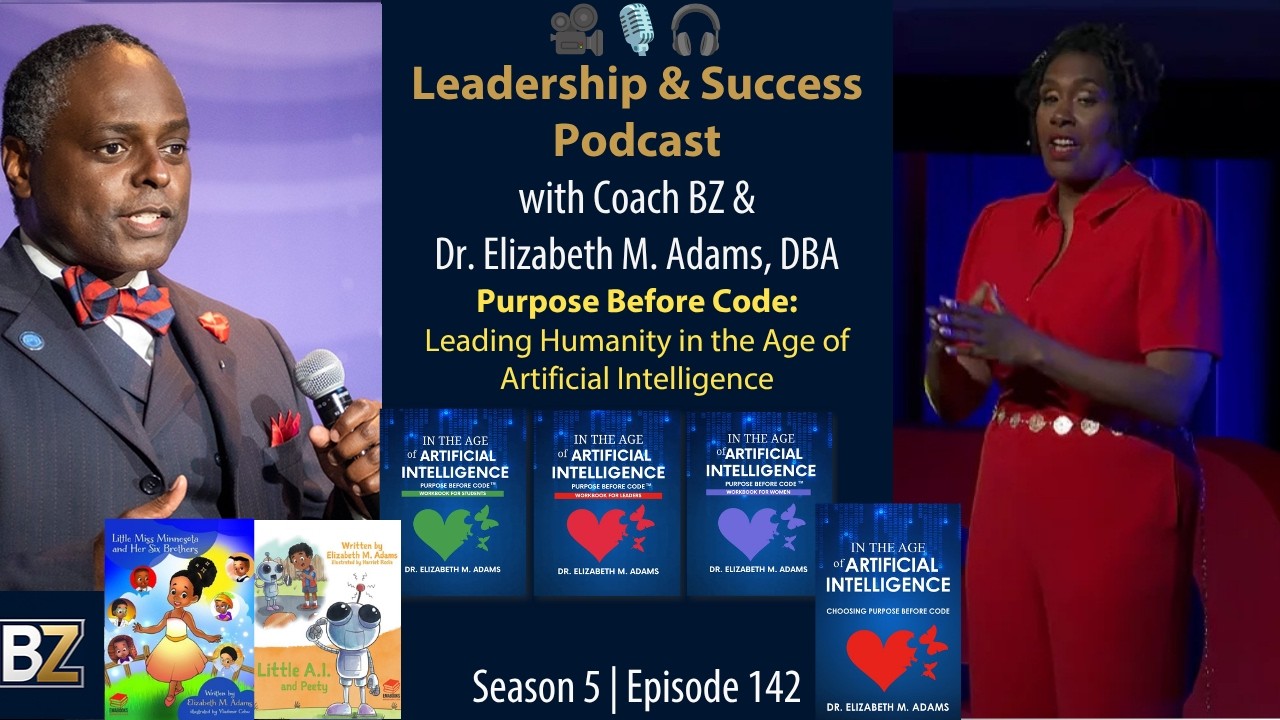
Dr. Elizabeth M. Adams, founder of the Minnesota Responsible AI Institute, argues that AI must serve people first. She wrote a bestselling book series on choosing purpose before code and created children's books to spark early AI literacy. Common pitfalls include treating AI as a silver bullet and neglecting employee engagement.
Chapters
Hi, I'm John Maxwell. When the top companies in the world are looking for trainers, speakers, and coaches, there's one name that stands above the rest, and that's Maxwell Leadership. Our certified team members have gotten proven results for companies all over the globe, and our reputation I'm proud to say, is second to none. Some of our members have risen to the top of their profession, including the one you're going to meet today. I proudly introduce you to my friend Bob Fabien Zinga.
Welcome to the Leadership and Success Podcast with your host, Coach BZ, where we help you lead with purpose and succeed with impact. If you're ready to grow into the kind of leader others want to follow, this podcast is for you. If you're determined to elevate your success and leave a lasting legacy, this podcast is for you. As my mentor, Dr. John C. Maxwell, reminds us, everything rises and falls on leadership. Our goal is simple: to inspire you, challenge you, and equip you with insights that can transform the trajectory of your leadership journey. Welcome aboard to another episode of the Leadership and Success Podcast with Coach BZ.
If you can see that there, you see my screen?
Yes.
All right, all right. Well, thank you again. Thank you everyone. I am Elizabeth Adams. I'm super, super excited to be here. I live in Minneapolis, Minnesota, and I work at the intersection of cybersecurity and AI ethics. As mentioned before, I'm a Race in Tech fellow at Stanford University, where I am pursuing a civic tech project, which includes ethics in AI, data collection, and surveillance, which we'll talk about. And I'm curious, so if people could just kind of drop a note and let me know where they are watching from. And feel free to add questions, and I hope that I'll be able to get to them throughout my presentation. I'm also going to set my timer here so I don't go over. So my fellowship consists of 3 very different or interconnected parts. So it's not so much different. So there's a civic tech piece which I'll talk about, which is around public oversight of surveillance technology. There is the piece in the middle, which is a tech insertion model that I designed really for conversation. And it's used as more of a litmus test on When technology is being implemented and adopted in the Black community, is it going to help uncover or eliminate racism? And so these are conversations that I'm hoping, hoping to have around my tech insertion model. And then third, my intern at Stanford is working on a presentation on a community response command center. So when we have another pandemic or a flood or a fire or some sort of homelessness issue, This particular effort is really centered around how do we get the community involved to help make decisions that are fair and equitable about what services are provided.
All right, I just gave you a small taste of Elizabeth M. Adams, and we're going to be talking to her in just a moment. And before I bring her to the show, please let us know where are you joining us from, what city, and what state, and if outside of the US, which country. And let us also know what you are grateful for today. This is the second show I am recording today. Like I said in the show before, that I'm really, really, really, really grateful. One, for freedom, right? July 4th is around the corner this Saturday, and just this past week we had June 10th. So from June 10th to July 4th, I am really celebrating freedom, freedom, Freedom! Free at last! Free at last! Free at last! Thank God Almighty, we are free at last! And it really means something. But I am also grateful for great leaders like Dr. Adams who take time out of their very, very busy schedule to come to talk to us. And also, if you have a question for Dr. Adams, please type it in the comments. We will be answering you live. So let me see if I can properly do the introduction of our guest today. So we are speaking, like I say, with Dr. Adams, and I think, no, it's not a surprise to anyone, artificial intelligence is really transforming every industry these days. But one question I believe matters more than ever before: how do we ensure that technology serves humanity and not the other way around? And I'm really honored to talk and welcome to Dr. Elizabeth Adams. She's a doctor of business administration, but really one of the world's leading voices on responsible artificial intelligence. She is the founder and CEO of EMA Advisory Services, founder of the Minnesota Responsible AI Institute. She's the chief AI ethics advisor at ParaVision, network affiliate at Stanford Human-Centered AI Institute, faculty director at the University of Minnesota, formally recognized AI ethics leader, and TEDx speaker, author, and global advocate for human-centered technology. Man, where does she find the time to sleep? My goodness. Through her groundbreaking work, Dr. Adams is helping leaders, organizations, and communities answer one of the defining questions of our time: How do we remain deeply human in an increasingly artificial world? We will also discuss her bestselling book series, In the Age of Artificial Intelligence: Choosing Purpose Before Code, right? And she has a workbook for leadership, for students, and also for women, and her inspiring children's book, Little AI and PD, and also Little Miss Minnesota and her 6 brothers. Part of what we're gonna be learning today is why responsible AI is a leadership imperative, not simply a technology issue, but also what it means to lead with humanity in a world of accelerating technology. So without any further ado, please help me welcome to the Leadership and Success Podcast, the one and only Dr. Elizabeth Adams.
Wow, that was fantastic. Thank you so much.
You're welcome.
Thank you. Thank you.
Dr. Adams, what are you grateful for today?
Oh, I'm grateful for earning peaceful money.
Yes, I love that.
I haven't always earned peaceful money. It's— I've earned stressful money in the past, but now I have designed my life so that I get to earn peaceful money. I get to do things that I enjoy, work with people that I enjoy and do things that feel really, really good to me.
That is really fantastic. You have accomplished so much. I was expecting to see like a 60 or 70-year-old woman here. Beyond all of your accolades, your titles, and your degrees and everything you've been doing, who is Elizabeth Adams?
Oh gosh, if you would have asked me this 10 years ago, it would have been a different story. If you would have asked me 10 years before that. But, um, I'm a woman that lives through purpose, and that purpose is to collect stories. And what that means is I love to talk to people about how they're navigating life, how they're orienting life, whatever challenges or projects they may have going on. And then what that does is it fuels me. And from all of those stories, I somehow get the next idea of what to do. So maybe that is starting the fellowship through the Minnesota Responsible AI Institute. Some of that is how the books are formed or how I might decide to do a topic for a presentation. But those stories help inform how I decide what to do next.
That is so powerful because you are definitely associated with artificial intelligence ethics, and I think most people, when they hear that, they automatically think about technology. What do you want them to think about instead? AI ethics.
Yeah, I want them to think about people first. And so, and ensuring that technology can help us thrive and not harm. And we have to, in order to humanize AI, we have to humanize the conversation. And that's a quote from Bryan Brackeen. But the reason for that is so many times we talk about the ones and zeros. What are the checklists? What are the frameworks? What's the infrastructure? How do we design the infrastructure? And then we rarely, and maybe so we're starting to now, talk about the people who are engaged in all of that work, not just the work for an organization, but what is happening to them outside of work? What is their lived experience like and how might their lived experience inform the work that they do or how they would desire to shape the future of their organization? So for me, that's what the stories do. I get to hear from people about how people are, as I mentioned, navigating. Things. And I also get to work with organizations to help them understand how their employees are navigating life and life at work.
That is really insightful because you do work at the intersection of artificial intelligence, leadership, and humanity, especially humanity. I love that. Why is this intersection so important right now?
It's important to me, and hopefully it's important to others. And it was an evolution to get to this. I have a doctorate in leadership of responsible AI. So I want to explore how leaders were making decisions that were impacting people and impacting their organization. I want to— I mean, I've been in the AI space for the past 10 years plus, and so I've evolved several times, um, from that perspective. So obviously that's a hot topic, it's impacting people's lives. And then of course, how do we thrive? How does humanity ensure that we stay human in all of this? So for me, Those are the 3 top components that map to something that I think can be really beneficial for an organization if we kind of orient our conversations around it. We want to make sure that we have technology that's safe and that can work in organizations, but we also want to make sure that the people who are helping to implement policies, processes, the technology also have a voice in shaping their future.
That is so powerful. Now I wanted to talk about your leadership journey, and in your popular TEDx talk, you do talk about— you start with a story that is deeply, deeply personal about losing your mother. So sorry to hear that. The question I have for you is, uh, how did that experience shape your leadership philosophy of empathy and advocacy?
So that's really a great question. And I love taking personal questions. So it's the first chapter in my book where I talk about growing up with 6 brothers, a grandfather, and a father, and how that male-dominated kind of experience shaped my leadership in terms of being able to walk into mostly male-dominated environments and being very successful because I've had those experiences growing up. But what also happened was I didn't quite get some of the feminine side of who I am nurtured as well. And so that took years for me to understand that my operating model is really about caring for people. Yes, I can have a conversation with anyone around the world about whatever topic we're talking about as it relates to AI, humanity, and leadership. But where I started to care more was when I started to choose purpose before code, and I started caring about myself first so that I could then extend that care to others. So that experience shaped me in terms of really being able to be successful in highly masculine, masculine environments, technology environments. But then now, now I'm able to really, really operate through purpose. And share my life and my work with those around the concept of care.
That is so powerful. And you've already said that even now, and you usually say that technology should serve people, which it kind of makes sense. But where did that conviction come from?
Which conviction?
That technology should serve people, not the other way around.
Well, I have been working in many technology environments, and I just started to see that there was less concern about the people and there was more concern about metrics, ROIs, KPIs, OKRs, and whatever other metrics. And people were really feeling like they weren't engaged. And so another part of my empirical research is the employee experience in responsible AI. So I got a chance to see how organizations that advance AI well or responsible AI well, how they bring their employees along as stakeholders and key constituents. And they include them by using valuing language— asset, collaborator, as I mentioned, constituent. And for those that don't do it as well, meaning that AI stalls or responsible AI stalls, employees are less engaged. They don't have an idea of what the vision is. They're left trying to figure things out on their own. They're trying to be ethical on their own. And so, and having done that work as well as work that I did with the city of Minneapolis, and you had that in your intro, I just began to really have an appreciation for how hard it is for many people to show up in life every day and try and do a good job and then also try to take care of themselves and their families and thrive. And it can be very, very difficult. So what could I do to help organizations and leaders think about that? And that was part of my evolution and my leadership journey so that I could be a strong advocate for people.
Wow.
Quite insightful. Was there maybe a pivotal moment in your life when you realized responsible AI would become your life's work?
I won't say it's my life's work. People are my life's work and stories are my life's work. It happens to be the avenue that I'm pursuing right now. Perhaps again, because I'm collecting stories, there might be something that emerges in the next 5 years that takes me in a different direction. But I will say that having spent years working on leading technology teams and I ran a systems integration lab with 200 people, $54 million operation, I left that environment and began to see how AI really wasn't working for everyone. And in that environment, we really called it math and statistics. And so I started to see some things, and this was around 2014 through 2016, and I wanted to understand why. So that was kind of how my AI journey started, was really exploratory and out of curiosity. And then I felt like I was really well positioned to continue the work because I was concerned that technology wouldn't wasn't working for everyone. So that was kind of like how things started, and then they just evolved. But many of the friends that I started and colleagues that I started with way back then, 2015 or so, we're all kind of— it took us about 5 years to kind of figure things out for ourselves, to then branch out across the world and do many different things as it relates to AI ethics. So some are in policy, some work in with environmental concerns. Some are working at the state level. Some are working in organizations at universities. And it's just been wonderful to see all of our work being cascaded in different ways across the world so that we are all helping to march towards, you know, our basic human right, which is technology that works for us and in ways that we can thrive.
That is powerful. So Technology working for humans. That— I, I love it. So what, what would Dr. Adams today, uh, what advice would you give to the younger Elizabeth beginning your career back to, let's say, 2015? What would you tell her?
Oh, 2015, I would tell her, define your own operating model. And what I mean by that is so many times we have mentors and guides that mean well, but they're guiding us into a path that worked for them. I had to discover my own path. And so what I would say is continue to be curious and find people that, that celebrate that curiosity and continue with that. And that eventually helped me find my own operating model, which is I like to do different things. I'm tapped into academia, I'm tapped into corporate, I'm tapped into nonprofit. And civil society. And so that's what works for me. And so that's what I would say back in 2015 is find your own operating model.
That is really beautiful because you really are involved in so many things. But I guess the connecting tissue, like you said earlier, it's really about the people and the stories that surround them, isn't it?
Purpose.
Purpose, yeah.
Yes. And purpose happens to be people and stories right now.
Wow, that is amazing. So let's talk about leading in the age of artificial intelligence. That's all everybody talks about these days. I know. So AI is really moving at incredible speed. I don't think we've ever had a technology that moves so fast. What keeps you optimistic about the future?
Oh, good question. I think because I get a chance to talk to so many people around the world, I am seeing people who may not quite understand all the nuances of technology, but they're finding ways to help themselves, help their families, help their organizations, even if the technology wasn't necessarily designed with them in mind. And so because of that, we think about democratization, where people who might not have had access to tools, various AI tools, are now creating businesses, or maybe they're finding diagnoses, or, or, um, Putting things into an AI to help a doctor see maybe some symptoms that a family member is having so that they can get to a diagnosis of, of something. But I'm just seeing some incredible stories, and I'm also seeing that there are a lot more people who are thinking more deeply about it, whether it's students who choose not to engage for whatever reason, or students who are choosing to engage. For various reasons. And so I am a person, like I said, I love, I love the data, but what keeps me optimistic is that people are, are— I'm seeing people start to make their own choices about how they want to engage with AI.
That is powerful. Okay, what then keeps you awake at night when it comes to AI?
Nothing.
Well, that's the best answer I've ever heard. Okay, so let me ask you this. So, uh, I guess we kind of have two visions of AI, right? One is, I guess, say, utopia AI. We're going to get to AGI and it's going to solve everything and the world is going to turn into a little paradise. And the other one is really the end of the world. It's kind of apocalyptic, right? AI is going to become like the Terminator, start killing people and end the world as we know it. What is your vision and why?
My vision, I suppose, starts with that I don't live in the space of fear or urgency. So what some of the headlines are saying don't necessarily move me. So my vision is that we get as many people as possible to understand how it can be used in their life and let them choose whether they want to engage with it. Maybe that's at the policy level. Maybe that's at, you know, teaching. Maybe that's at the agriculture level. It just really depends. And then I think if people find their perfect lane with AI or using AI, then we'll be in a much better place and we can move society forward in a way that works for all of us.
That is quite powerful. I don't live in a state of, you said, I don't live in the space of fear or urgency. That is so, so powerful. I wish my younger self had known that back then. Because it's true, we just react to everything that happens, but we don't actually get to actually think about what our vision should be. So what do you think then are the 3 biggest mistakes leaders make when adopting AI these days?
Oh, that's a great question. I don't know if I would call them mistakes or just maybe some hard lessons. One is thinking that AI can solve all of your organizational challenges by just having the conversations with— at the executive level. That's, that's one. The second thing I think from a leadership perspective is, is maybe not necessarily appreciating the support that you could have in moving your AI adoption forward if you engaged your employees. And the third thing I think is being afraid of transparency, like being afraid to let your employees know that maybe you don't know as much, but you're trying. And so there's this, this concept of feeling like Some leaders I've talked to, they have to know everything in order to lead in this space. And that's impossible because none of us know everything. And so what AI has done is it's made us feel like we are behind, or what some of the headlines are making us feel like we are behind in this technology. And so I would say that, and like I said, I talk to a lot of leaders about what keeps them up at night, and a lot of it is that they don't necessarily know how to engage with the technology, or they're afraid of making decisions that will cause irreversible harm. And so, um, again, not being transparent, leveraging their employees and their employees' knowledge, um, and then of course a vision for, for AI.
Well, that is quite fascinating, especially right here in Silicon Valley, right? It's always about innovation, and sometimes we don't always do technology in a responsible way. So that's why I think the work you do is quite critical. How can leaders balance innovation with responsibility?
Yeah, that's a great question. So the first thing that I do now when I'm working with a client is I help them map typical responsible AI principles to their organizational values so they don't see that they're separate. You've already been thinking about integrity and quality and whatever your mission and values are. And we just do a quick map. Maybe we use AI, maybe we don't, so that they can see, oh, we're living these values, or at least we should be living these values. And they're not that far from a departure from how the organization should think. And then we start with thinking about governance. Who should be involved? What does that— What does that look like? And I can't remember the other part of the question. I apologize because I got so much in my head.
Yes, it was about innovation and risk responsibility.
Oh, yes. But let me just start with what the definition or the definition from that I tend to use around responsible AI. And it's designing and developing AI with a set of responsible AI principles that guide that design development. And that could be Explainability, transparency, trustworthiness, unbiased, auditability, human-centered. There's a number of them, and every organization that I've worked with defines for themselves which principles they adopt based on their culture and based on how they're planning to use AI. Some organizations are not thinking about designing or developing, they're thinking about procuring. So that's a different set of principles that we think about. Maybe not a different set, but it engages more teams, a procurement team around data. And then there's a responsible use. So if you're going to integrate it or you're going to adopt a tool, what does that mean for the organization? So kind of really helping them think, think through that, but really mapping to some sort of external framework, whether that's IEEE, NIST, or some other framework to their organizational principles. Organizational values and mission, and then that creates a great foundation for them to start their AI ethics or responsible AI journey.
I really like that you mentioned some of the security framework out there because sometimes I am a little bit scared for some organization, it's all about the compliance exercise. Why do you believe responsible AI should really be a strategic imperative and not just simply checking the box?
Well, it has to be because if you are thinking about bringing in technology or designing it, there's so many possible impacts and risks that need to be thought about. So it's absolutely an imperative if— but again, it aligns with the values. So I don't really separate it with the organization's values. So if you are thinking about doing— creating some other technology or using some other technology, just like cybersecurity. So for me, it starts with, um, if you say that you are an organization that has values around, I don't know, protecting society, or as I mentioned, data quality, or quality to your stakeholders or your clients, then that is your imperative, right? To make sure that you are meeting the needs of your stakeholders, whether they're clients, vendors, or your board. And so building responsible AI really should align with that. What I have found over the years is starting with responsible AI creates this chasm in the organization because then you've got this responsible AI team doing a bunch of different things, whether that's inventoring models or running things through a task force or a committee. And it can end up being separate from how the organization is communicating their vision. So it all should tie together. And that's how I like to work with organizations where we can make— think more holistically about it.
Wow, that is quite powerful. Let's talk about your bestselling books. I believe it's actually a free workbook I mentioned earlier, one for leaders, one for students, and one for women. The book is Artificial Intelligence. So I guess the, the question I have for you is, why did this book have to be written in the age of artificial intelligence?
Yeah, that's, that's a good question. So, um, I'll start with when I graduated from— with my doctorate in 2024 of August, I started to experience a responsible AI drift, meaning just what we were talking about before. I started to see responsible AI be more about a checklist more about frameworks, more about the tools that could help an organization manage the design, development, and ultimate use and adoption. And I saw less about people, humanity, the second and third order consequences of it. And so I was trying to figure out what, what does that mean to me? And right about the same time, a few months later, I was invited to spend time in Sweden Umel Swedon as a visiting scholar at the AI Policy Lab. And that work changed my leadership philosophy. It helped seal it, I should say. And when I was there, part of what they said is, you know, don't necessarily come here every day. Go to museums, go spend time in nature, go to the market, go to different things because all of that should inform how you think about AI policy.
Wow.
The way people are living, the way people are working, the way people are connecting and communicating. So I walked around campus. I saw a lot of students gathered, talking, connecting about different projects. I went to museums, as I mentioned. And that really changed me when I came back. And I said, this is what I want, the model I want for the Minnesota Responsible AI Institute, a place to think, a place for leaders to pause from all of the things that they have going on to really sit with these questions. I think that AI has— what AI has done is it's, in a sense, kept us from being quiet with the questions so that the answers can come, because AI can provide answers really quickly. But as a leader, we still have to sit with these things because we have a greater responsibility. So the book came about from that. So I spent the next year, most of 2025, up until about October when I started writing the book. Listening internally. And then I listened to— I went and talked to about 50 different organizations about how they were experiencing AI. And that's when I realized, yeah, I can't do a framework book. I'd love to. Or 40 questions for every AI leader. I couldn't do that. This is a lyrical memoir. I had to write about my own personal journey in a way that works for me. So it means there are parables there. There's a leadership assessment. But it's just really the emotional account of my struggling with leadership. And after I've read several books when I was an emerging leader, there was one that stuck out, which is Palmer— excuse me— Palmer Parker's book, Let Your Life Speak. And his book was very similar where he had gone out and gotten some insights not necessarily leaders telling him what to do, but more asking him and probing him so he could come to those answers themselves. And that's what I realized I needed to do for my book is really get it out. These are the questions I've wrestled with. These are the things that shape my leadership. And then maybe after that, I could do a framework book if I decide to do that. But the workbooks are companions to that because after talking to leaders, I realized maybe everyone might not get into my journey, and that's fine. But there's still some principles of that that can be transferred or that we can work through in the workbook. So for leaders, it's like 100 pages, lots of scenarios, lots of things, space for leaders to work on their own or in a group where they're asking themselves certain questions about leadership. Women, the women that I've worked with and from my study want space to reflect. About the choices that they're making, the way that they're combining home life and work life and what that means. And then students, there are also scenarios in there where maybe they're working on a class project and someone asks to use AI, but they don't want to use AI. How do they work through those conflicts? So giving students a chance to kind of work through that. And yeah, so that's how it came about. And it's been fantastic. The book is made, it's all over the world. It's in a museum in Sweden now. And so, yeah, yeah, very happy.
But one thing that jumps at you when you look at the title, right, you say, Purpose Before Code. Why did you choose that subtitle?
Well, it was going to be Leading purpose before code. But I did not want to assume that that was what every leader wanted. And so by the time I got to the end of the book, I said, this really is my journey, and I'm choosing purpose before code. There are stories in there about me witnessing certain people engaging with life as an observer, and no one even knows that they're there, or no one's even paying attention to them. And they're off making decisions that will affect these people. And I was like, wow, I can't do that. That's not me as a leader. I'm going to think very deeply about every person that I come in contact with and how my work then could be an advocate for them. And maybe it could look different. Advocating is sometimes working with an organization to create a vision for AI, and sometimes it's doing a workshop for an organization or sitting on a panel or a podcast like this. And so, but all of those stories, all of those experiences are part of who I am, and I carry them with me whenever I'm chatting with someone.
That is so powerful. So if readers take only one lesson away from your book, what do you hope it is?
That we're all wrestling with something and that it is okay. And that whatever we're doing, you're not behind. And that really just take it one step at a time. But more than that, own your own story. It was Octavia Butler who said sometimes we have to write ourselves into our own stories. And that's what I have done. I've written myself into my own story. And for people And people will see that in the book. If they get through the whole book, they'll sense that I've written myself into my own story as a way to help others not feel so alone in their journey. And so what I would say is write yourself into your own story. Be okay with that. Be okay with where you are. We're not in a race. And enjoy the journey.
Wow.
Because, uh, I mean, it is quite amazing the work you have done, but what leadership principles you think are most important in the age of artificial intelligence based on your book?
Yeah, so this is a great question as well, and the reason why I think these principles that I'm about to name are important is because AI has a tendency to make us feel like we can outsource certain things. And some leadership principles are: one, critical thinking, communication, people and human centricity, and ensuring that we are not outsourcing any of that to AI, outsourcing our decision-making, outsourcing our creativity, outsourcing the thinking, outsourcing the visioning to AI. Because when you do that, you're really outsourcing it to whoever is the ultimate designer of that tool, and you're giving your power away. You're giving your voice away. You're giving your leadership thoughts away when you allow that, when you allow AI to make those decisions for you. Now, as a thinking partner and as a partner, that's completely fine. Like, like you and I could sit in a meeting and we could chat and come up with some ideas. To me, that's no different than asking AI a particular question. But from a leadership principle, ensuring that you are owning your own decisions and thoughts and critical thinking and creativity in decision-making.
Wow, that is really powerful. And of course, uh, you have created companion workbook, like you've already mentioned, for leaders, students, and women. Uh, why was it important to develop different learning pathways?
Uh, I don't know that I thought that it was important as much as it was what emerged. Does that make sense? Because I spend so much time talking with people. I've talked to thousands of students I've lectured, and some of the same questions come up. What if I don't want to use AI? What if someone I'm working with on a class project wants to use AI? Or how might I leverage AI? How do I help my university think differently about AI in terms of thinking about my data privacy? So there were lots of questions that were coming up for students, and so it made sense to me to to offer a support guide for that. But I also have a ton of leadership guides on my website as well. I've been doing leadership guides for a while. And for women, part of my empirical study showed that while men tended to think that AI, the work that they were doing was saving the world, women tended to think that it's just like any other day for us. So why don't we just spend some time figuring out the best way to ensure that our work continues the way that we're doing and our family work continues and the way that I engage with my friends continue, or that I learn about this tool to help amplify and support those things. And so for the leadership book that crosses people who are in leadership capacities, maybe mid-managers, maybe senior leaders. Where we go into a workshop and maybe we just take one chapter or one area and we just kind of work through it. So that came about because I've hosted several workshops and I ask questions and then the conversation ends up being about the question. Like I might ask, who's fearful of AI? And so I wanted to put that in a workbook so that anyone in the organization could help continue that work after I left, or even if I never even show up.
That is really, really powerful, man. I wish I had like 2 or 3 hours with you. I mean, it is just— I think this is a book whose time has really come. I mean, couldn't have come at a better time. But you've also written a couple of children's books, haven't you? And really trying to build the next generation, which is just awesome. You talk about Little AI and Pidi, right? What did you decide to write a children's book about artificial Intelligence. That is so— yeah.
So in 2020, where my Stanford fellowship kicked off, there were two major things that were happening in our world: COVID. And then, of course, we were dealing with the unimaginable murder of George Floyd. And so we were kind of stuck inside— not kind of, but we were stuck inside. And I was exploring the work in the city of Minneapolis around AI surveillance. And there were many people who were not able to go to libraries, or go to the physical location of their schools. And writing the book, as I mentioned, helped me process all the heavy work that was happening in my life at the time with working with the city of Minneapolis, the city council on advancing bills around AI surveillance and so forth, having those very, very tough conversations. And so the book really met an internal need, which was I need a soft place to land for this work. I need some joy here. And then, of course, the, the thinking about the children around the world, how they might be learning and engaging with AI, especially during COVID And so that's how that book came about. It came about to— about, um, yeah, to kind of help parents and caregivers, uh, think about safe technology. And also there's a song. I had two teenagers write a song. So on the website EMA Books There's a version and I've gone into classrooms where children know the song and my gosh, it just brings tears to my eyes.
That's amazing.
Thinking about it.
Man, talking about parents, what conversation do parents have with their children after reading the book?
Reading Little AI and Petey? Oh, maybe just a way for them to ask their children, are they using technology? What do they think about technology and ensuring that they help students understand about safe technology, making sure that it doesn't cause harm. So the book talks about a robot that enters into a community with kids, but it's not quite safe yet. And so one of the parents finds out— little, little Petey's parents find out— and they send the robot off. And the robot goes out to the global community and says, please make me safe so that I can be with the children. And then when it comes back, it's helping little Petey with It's homework, his homework and some other things. And so what I want parents to really do is just have a conversation with, read the book to them and let them ask questions about the pictures or the words and let it just be a place for conversation over dinner or after dinner.
That is powerful. Now, one thing with technology, is, no, it's been studied, it is true that it can be quite addictive, not just children but teenagers too. And I guess the question I have for you is how can we teach our children to embrace new technology while also thinking critically about it?
Yeah, that's a good question.
What age group are you talking?
It could be any, any age, I guess little kids, but I think even teenagers too. I don't know, when my kids became teenagers, they felt like they knew everything, but of course they didn't.
But, uh, yeah, yeah, I, uh, I, I don't know because I don't have children, but I just talk about the importance of having conversations. I do teach two AI courses, and I'm teaching juniors and seniors, and they are brilliant. They are asking questions about about engaging with AI and technology in general. And I feel grateful to be there to help them not only through curriculum and their assignments, but just as a sounding board for how they're thinking about it.
And that's wonderful.
And what I love, though, is that at some point in their lives, they got to the point where before the class they were able to start asking these very important questions. And I want to help encourage that. And so I guess I would say that for any age, just ask questions and have the conversation about what it means. And if there are no answers, look together for answers, maybe on the internet. Maybe there's a YouTube video that can help. There are plenty of videos about what is AI, what is responsible AI for every level. There are also organizations. I know that Microsoft has a path. I think Salesforce has a path. I don't know. There are some organizations that have a path for children learning. And then there's organizations that work specifically with children. I can't name the, the names right now, but really around children and AI. Get them engaged. Join a robotics team.
Powerful. But now you've written another children's book, but I think this one is very— Yes. To you, Little Miss Dinosaur and the Six Brothers. Can you tell us the story behind that?
Yes. So as you mentioned early on, I lost my mother when I was 6 years old. And so I come from a very loving family. And this book is a book about words. And so I give each one of my brothers a word that they are, whether it's studious or adventurous or intellectual. And it's a book about— siblings who have great respect and have fun and who have love for each other. And what I love about this book is the Savannah Book Festival picked up my book as a pilot. They brought me down to Savannah to go talk to about 110 students in 7 different classrooms at I think 4 elementary schools. And many of those students had not seen an author that looked like them. So they asked me lots of questions about my brothers because The children have wild and fun imagination. So if they saw one of my brothers on the skateboard, they wanted to know if he still was on a skateboard, even though my brothers were adults at this time. So this was about— so they didn't know, they had questions like, well, if you're your age, how do you have brothers our age? Wow, it was really fun to interact with the students and do some reading. So that book is one that I love to also— I've been to elementary schools with Little AI and Petey as well, but that one brings out the most because it's each brother has their own word in the story about how I feel about their word. And we get to engage that way.
That is really, really powerful. I am married. I have two African American daughters. And why do you think is representation in children's literature so important? Especially now?
Well, that was important to me because I wanted children to see images of themselves, especially as AI was happening. Now, those books were written in 2020, so I actually hired someone. What was interesting though was, um, for one, it was important to me because I have two other books that are online. One's called I'm Beautiful and one's called Circles. And, um, and I worked with artists all over the world, many who had never created for African, that the shade tones that I wanted, the skin shade tones that I wanted. So I thought it was important to work with them so that they could also understand, because I'd say, no, I need the skin tone darker. Yeah, I need the skin tone darker. And I felt like it was a great way for all of us to start thinking about representation, not just the children, but also the artists that, um, that I hired. But I just, again, from Being in the classrooms, yeah, and children seeing them, seeing people that look like them. Like one little girl said that my hair looked like her hair.
Wow.
Boys thought that my brother's hair looked like their hair. That to me was just incredible. I hadn't thought about that.
Yes.
So I didn't— I hadn't thought through why it would be. I understood it was important, but I hadn't thought through the questions that would come about because Wow. Different versions of my brothers, and they could find themselves in my brothers and/or me.
Man, that is so touching. You might just be changing an entire industry. Wow. Thank you for everything you do. What lessons from your childhood continue to influence your leadership today?
Oh, what lessons from my childhood? I would just say I grew up in a very strong community. Like we could go to someone's house and not worry about not having dinner. Like they would feed us. Or if it was story time at their house, we got engaged. No one would say, oh, it's time for you to go home. You got to engage in whatever it was. And so for me, I think I carry that, which is wherever I am, I want to make sure that people are included in the journey if they so choose. And so family was very important. My neighborhood, the church that I grew up. And I actually have a billboard coming up in my community on the 3rd of August for my book that I'm so excited about because it's the— it's one of the streets that I played around. And so I wanted the young people in the community to be able to see another image to say, maybe I can be an author growing up. So I'm excited about that.
That is just amazing. Amazing. Amazing. And there is no stopping you. My goodness. This is incredible. Incredible. Okay, we are going to run out of time very soon. So let me skip to the lightning round. That's just— actually, before I do, once we do the lightning round, try to answer as quickly as you can, the first thing that comes out of your mind. But before we do, if you could go back and give a piece of advice to your 6-year-old self, knowing what you know now, what would you say to little Elizabeth?
I would say the world is is absolutely unlimited in terms of where you might end up and what you might end up doing. I only had two choices: a nurse or a teacher.
Wow.
Never saw this for me. So the world is unlimited. The possibilities are just unlimited.
But what if I say, well, I am a woman?
Say that again.
What if they said, I am a woman? The world must be limited for me, right? I—
well, maybe, but I wouldn't say that. I would say, like, when I tell you I have contacts and connections all over the world, never saw that for myself growing up. That just wasn't what we talked about in my elementary school. It just— even, even in my own family. And things started happening. I started traveling, started engaging, started loving it. And it's been— yeah, it's been wonderful.
That's powerful. Powerful. I think part of the reason why I do this podcast, of course I would talk to anybody, but I definitely want to put the spotlight on women and people of color because I feel like it's very, very important to understand, one, you are not alone, but there are many people out there who are so brilliant, but for whatever reason they don't get celebrated enough. So hopefully my show can make just a small difference In that, but yeah, that is so, so very, very powerful, especially now, even being half African American in this country now, we've had a very, very long struggle. It's gonna be 250 years now. We're gonna be celebrating America and we must and we should, but in July 4th, 1776, my ancestors were not free. They were in slavery, actually my kin ancestors for my case, because I come straight from Africa. But it's been a very, very long, long way. Really, in my, in my mind, African Americans made America become a democracy. Without us, this country would still be pretty much an apartheid, white supremacist state. But anyway, having said that, I think it's very important to really see people like you doing so well and really breaking every ceiling that is out there and showing the world that really nothing is impossible. And I really appreciate that.
Thank you. Thank you so much.
All right, I'm not gonna cry, so let's, let's go. We're gonna be ending with the show in a couple of minutes, so let's do the lightning round. So as quickly as you can, uh, leadership is—
oh, leadership, oh my gosh, choice.
Okay. Artificial intelligence is—
here.
All right. The future of work is—
evolving.
Okay. One leadership trait every AI leader Critical thinking. Oh yeah. A book everyone should read is Palmer Parker.
Palmer— oh my God, yes, I believe you just mentioned this one, right? Yes, Let Your Life Speak. Oh my gosh, yeah.
Wow.
Why should people read this book?
Uh, because it unpacks us as humans, and it also gives us humans as humans agency. It doesn't treat us as if we're all the same. And I think it just can really help people think individually about what it is that they want out of life and how they can serve.
Wow, that is so, so powerful. Okay, one person who inspires you the most?
My father.
Your favorite quote is?
Ooh, the one I mentioned earlier, "If you're going to humanize AI, you have to humanize the conversation." Brian Brackeen.
Powerful. And your definition of success is?
Oh gosh, doing things your way.
I love that. Droga King. All right. As we come to the end, how can we add value back to you?
Oh, well, purchase the books, invite me to speak. Thank you for asking that question. But yeah, I'd love to come out. I already mentioned that stories are my life. Story is data. Stories are data for me. So, um, yeah, invite me out. Let's have a conversation. Let's, uh, let's work through some of the workbooks and let's have a good time with light.
And, uh, your best site or way to reach you is eadams.tech, right? In addition to LinkedIn?
Yes. Mhm.
Very good. I'm gonna make sure it's in the, uh, uh, show notes. Now you do have two books that have Amazon. I couldn't find find them? You said they are online only. Where can we go to find those?
Oh, the children's books, they are not in hardcover, so they're available online at emabooks.com, and they're read-alouds or they're downloadable PDFs.
That is, that is powerful, powerful. All right, is there, um, before we end, is there a question I should have asked you?
We didn't get a chance, uh, No, I think you did a phenomenal job with your research and a phenomenal job with this interview, and I want to thank you.
Thank you. But before we, we end, I want to ask you a question. Uh, if you could leave one message for every CEO listening right now, what would it be?
Start thinking about your legacy. And what do you want to leave the world with as it relates to how you led people, teams, and organizations and yourself?
What about for every student listening now?
Oh, think about your future. Start thinking about purpose and thinking about what brings you happiness and joy and start there.
Okay, what about their parents?
Uh, for them or for their, or for their children?
Uh, for the parents, meaning what could they do or what, how can they support their, their, uh, yeah, one message for them when, when it comes to AI, because I'm sure a lot of parents are very confused about AI, what it, what it can, can do and what some of the possibility might, might be.
I would say build in time for exploration and curiosity.
Okay, what about for a young woman just coming out of college? I'm talking about my daughter.
Same.
Yeah, build in time for exploration and curiosity and follow that. That's kind of how I got started.
But now, for one of my daughters, she just graduated from college, right, last year, May of last year. She has a degree, but a lot of these entry-level jobs are being taken away by AI. How should she feel about it? What would you tell her?
Find her own path. She's gonna have to— she's gonna have to find her own path.
Yes.
Like, if it's not working, if you go left and it's not working, you might just need to turn the compass a little bit, and that might be your window. All of the times I've had challenges, um, there's something in that book— it called— in that book that I mentioned, Way Closes, Way Opens. So when a way closes, that means a way automatically opens. Sometimes we just have to turn a little bit to find that way that opens.
That's so, so powerful. So what does it mean then to remain human in an increasingly artificial intelligence world?
It means staying connected. It means, for me, it means laughing. It means feeling the pain of life. It means being honest. It means family. It means community. It means using AI as a companion and not the sole source for anything.
So, so, so powerful. If you had one and only one day to live, what would you have liked your final contribution to be?
I want— I would want every hungry child in this world to have a fabulous meal.
Wow, powerful.
I want them to eat and eat well.
Yeah, I still don't understand why America, the wealthiest country that's ever been in the history of the world, how we can still have children in this country.
Well, in the world.
Yeah, yeah, yeah.
Every hungry child, I want them to have one fabulous.
Well, thank you, thank you so much for, for, uh, talking to, to us today. I'd like to end by asking, uh, what did you want to be when you were a kid?
I wanted to be a runner. I saw Wilma Rudolph in the Olympics and I said, oh, that's going to be me. Wow. That's what I wanted to do, but didn't happen.
Well, I guess you are running, you know, emerging technology all around the world. People are reading your books and getting to be familiar with your work, which is very, very important. Okay, 3 adjectives describing you as a child.
I don't know. These questions are getting very hard. I don't know. You got something else?
Okay. What about as an adult?
3 adjectives. Um, did I mention curious?
Yeah, curious. Definitely.
Uh, oh my gosh. Curious.
So I was—
oh, oh, I don't know how to explain this in an adjective, but I was always, yeah, curious. I was told I was nosy as a child, but I was always interested in what people were saying. And so curious, I'm still curious. I would say that.
Okay, that's good. I think you are fabulous. Thank you. All right. I do like to end the show on a positive note. What is one thing you are feeling optimistic about?
I think we've talked about this before. I'm, I'm earning peaceful money and I'm optimistic that others will be able to get there. So many people I talk to are weathered from their jobs, from life. They're stressed out. They're, they're living with golden handcuffs. They can't leave their job for whatever reason. And I'm fortunate and blessed to have navigated life and it wasn't easy. To a point where I have multiple things going on. And so I'm earning peaceful money. So I'm optimistic that I'll continue to retire that way.
That is so wonderful. And also, being a Black woman, I think you are an example to so many, many people. Just live your life, shine, and all of the changes you are making to the world, I think it's very impactful. So thanks so much for everything.
Thank you.
And I'm going to end with one word. That represent our shared experience on this podcast today? One word.
For me?
Yes, one word that comes to mind.
Beautiful, fascinating, incredible.
I am so, so grateful for your example and your work. Thank you so much, Dr. Adams.
Thank you.
Really appreciate it. Bye. All right, everybody, so that was Dr. Adams. So I want everybody to follow her on LinkedIn. You should already have the link on the screen. So that's linkedin.com/LizAdams and also a website eadams.tech. And of course, get a copy of her bestselling book, which is about In the Age of Artificial Intelligence: Choosing Purpose Before Code. And for all of the leaders out there, get the workbook for leaders. And for your student, get the workbook for student. And for all of the women who watch the show, the workbook for women. All right, uh, thanks again for watching. I'm gonna have two, uh, shows for you, um, tomorrow, later today. I will let you know on, on LinkedIn who those people are. And as of this week, our friend in the spotlight is Major General Stephen Lepper. He was on the show yesterday. What a very insightful show we had. We really talked a lot about things we need to talk about today, all of the things happening, uh, around the world. And sometimes, I believe next week on July 3rd, I will also have Sergeant Alan Lower. He is a veteran from the US Air Force. We're gonna be talking about Why Are You Here? Leadership, Legacy, and Living a Life of Service. He has a bestselling book, Breakthrough Leadership. We're gonna be talking about that. All right, thanks again for watching and have a wonderful rest of your day. Happy 4th, and I'll see you again tomorrow. Oh, actually, no, not tomorrow. I will see you today in a couple of hours. I almost forgot. I'm going to be talking to Command Sergeant Major Jason Schmidt, US Army. We're going to be talking about the backbone of leadership inside the noncommissioned officer corps. That's going to be in a couple of hours today. So I'm going to be talking to him. So hope to see you there live on LinkedIn and YouTube. All right. Bye for now. Thanks again for watching.
Thank you for tuning in to the Leadership and Success Podcast with your host, Coach BZ. If today's episode added value to your leadership journey, be sure to subscribe, share, and join us again for more wisdom nuggets on how to lead better and achieve greater success. Remember, leadership is the most critical skill of our time. The world will always need leaders to inspire others, drive innovation, and execute meaningful strategy. So why not count yourself among the bold leaders shaping the 21st century? Until next time, stay inspired, stay committed, and keep leading with excellence.
More from Bob

S250:E4🎙️LIVE 🇺🇸America 250: President Barack Obama Leadership, Service, and the Power of Hope






S5:E157🎙️ LIVE with CMD CMSgt Dennis L. Fritz, USAF (Ret.)(Multi Tracks Audio)



S5:E156🎙️ LIVE 🇪🇸 Leadership Lessons from the FIFA World Cup 2026 Champions (Multi Tracks Audio)

S250:E3🎙️ LIVE Leadership Lessons from America’s First Documented Family of African Descent 🇺🇸📖