S5:E146🎙️ SGT Alan Lowe, USAF (Vet.) (MULTI TRACKS AUDIO)
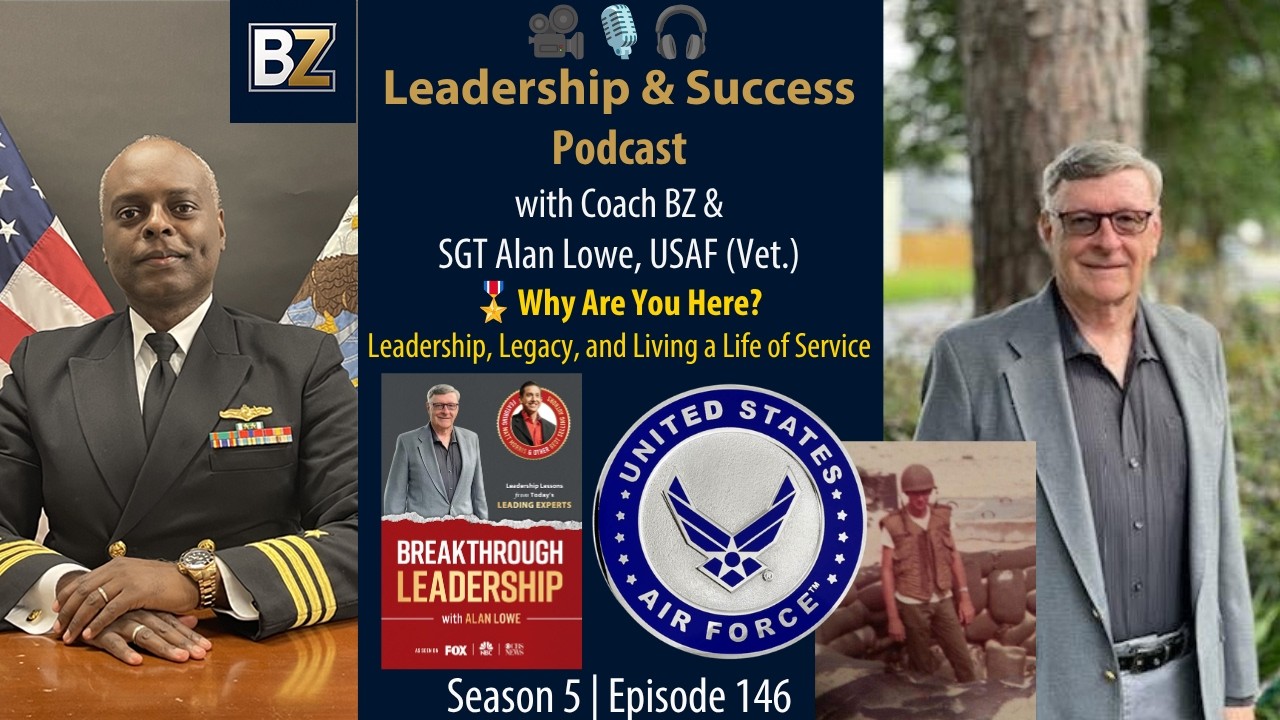
In this episode of the Leadership and Success Podcast, host Coach BZ (Bob Fabien Zinga) interviews Sergeant Alan Lowe, a USAF veteran, business executive, nonprofit founder, and bestselling author of Breakthrough Leadership. The conversation begins with a promotion of Lowe’s book, encouraging listeners to purchase it on Amazon and support his Liberian nonprofit, Helping Urks for Children. The dialogue then delves into Lowe’s military background, the purpose‑driven leadership philosophy he developed, and the role of faith in his life. The hosts discuss pressing veteran challenges such as suicide, homelessness, and navigating benefits, underscoring the need for societal support. Lowe’s nonprofit work in Liberia is highlighted, illustrating how leadership can be applied to global service. The episode shifts to a historical segment commemorating the 50th anniversary of Boston’s 1974 court‑ordered school desegregation busing plan, describing the violent backlash, personal anecdotes, and ongoing community memory. A short tribute follows to Justice Thurgood Marshall, the first African‑American Supreme Court Justice, emphasizing his legal victories and constitutional legacy. The host shares his own experience reading the U.S. Constitution for citizenship, urging listeners to do the same. The episode concludes with a synthesis of civil‑rights history into leadership lessons and a final call‑to‑action for listeners to subscribe, share, and embody bold leadership.
Chapters
Hi, I'm John Maxwell. When the top companies in the world are looking for trainers, speakers, and coaches, there's one name that stands above the rest, and that's Maxwell Leadership. Our certified team members have gotten proven results for companies all over the globe, and our reputation, I'm proud to say, is second to none. Some of our members have risen to the top of their profession, including the one you're going to meet today. I proudly introduce you to my friend Bob Fabien Zinga.
Welcome to the Leadership and Success Podcast with your host, Coach BZ, where we help you lead with purpose and succeed with impact. If you're ready to grow into the kind of leader others want to follow, this podcast is for you. If you're determined to elevate your success and leave a lasting legacy, this podcast is for you. As my mentor, Dr. John C. Maxwell, reminds us, everything rises and falls on leadership. Our goal is simple, to inspire you, challenge you, and equip you with insights that can transform the trajectory of your leadership journey. Welcome aboard to another episode of the Leadership and Success Podcast. With Coach BZ.
Welcome back to the Success Publishing Videocast. My name is Jessica Soto, and I am here with one of our co-authors today from Breakthrough Leadership, Alan Lowe. Welcome to the videocast. Good morning. Excited to be here. Yes, good morning. We love interviewing our authors so that we can shine a light on their work and their amazing stories. So, Alan, can you give like the Cliff Notes of who you are and where you are in the world? Sure. I'm from Spring, Texas, which is just outside of Houston, a native Texan, and I'm the vice president of a multimillion-dollar manufacturing company in Houston. My dad was a World War II Army Bronze Star recipient, and he taught me that If people can't trust you for your word, they really can't trust you for anything. And my mom taught me that if you can't say something good about somebody, don't say anything. And she also taught me what Ivory soap tastes like when I told her to shut up. Oh, there you go. Yeah. Still makes me nauseous today. But I'm a United States Air Force Vietnam veteran. And I had a top secret clearance. And I think one of my first life-changing moments was when I was in Vietnam and I was walking across the sand and I got stopped by an officer who told me my boots weren't shiny enough. And it kind of awoke me to the fact that everybody's priorities aren't the same as mine. You know, I kind of valued my life more than shiny boots. Yeah. So Been married. My wife and I will celebrate our anniversary June 5th. It'll be 50 years. Congratulations. Thank you. So we met when I was in the Air Force. Her dad—
Oh, I do. We have a show for you. First of all, happy birthday, America. Tomorrow will be the celebration of 250 years since the Declaration of Independence. Wow. What a joy. What an achievement. Well, thank you so much for being here with us. As you know, Adriel, we're gonna start with what we call here a moment of gratitude. We always want to start the show by being grateful. And part of the reason why we do this is because every single day in this country, more than 21 service members and veterans commit suicide every single day. And we believe it is not possible to be suicidal and to be grateful at the very same time. Uh, before we do that, please let us know where are you guys joining us from, uh, what city, what, uh, country, and let us know what you're going to be doing tomorrow to celebrate our 250th anniversary in the US. And if you are from outside the US, also let us know, uh, which country you are joining us from. And also, uh, if you would type in the comment what you are grateful for today. And then if you do have a question for my guest, uh, veteran Sergeant Allen Lowe, United States Air Force, go ahead and type the question in the comment and we're gonna be answering your question live. All right, you know the, the drill. For our moment of gratitude, we really like for you to just take a moment and, uh, really, uh, think about one thing you are grateful for right now. Maybe close your eyes, take a deep breath, and, uh, put yourself in your happy place and think about one thing you are grateful for in this moment. And for this podcast, really almost every day since June 10th, we've been really grateful for freedom. I think there is nothing more important than that. Freedom, freedom, freedom, freedom. And tomorrow again, we are celebrating the freedom when America was finally independent from the United Kingdom. And we really want to celebrate that. But one thing I would like to add, though, Yes, go ahead and barbecue, celebrate however you do. And I think everybody should, but we also need to be reflective tomorrow, I believe, because on July 4th, 1776, there were about half a million African Americans enslaved. So the home of the brave, the land of the free had enslaved more than 500,000 people. And then on June 10th, right before the Civil War, it grew up to almost 4 million people. But even when I say 4 million people, we actually know the exact number because of the census. It was 3,953,760 African Americans were enslaved before the war. And it's kind of like 9/11. That's part of one of the primary reasons why I joined the Navy. People say about 3,000 Americans died. Well, Each number means a lot for a family. Many of them, they were married, they had children, they had grandchildren, and that means the world to them. So if you say 3,000, that's not exactly true. It was 2,977 people who died on 9/11. That was part of the reason why I joined the US Navy 21 years ago. But all I'm saying, yeah, our history is very difficult, right? It is not easy. It's very, very complicated, but I think we need to embrace all of it, right? It doesn't make sense to erase our history. We need to learn from it, and we need to know it. Every American should. So yes, go ahead and celebrate freedom tomorrow, and I definitely will. I will have barbecue, spend time with my family, but also have a moment of reflection of why in the world did America, the home of the brave, the land of the free, need a second Independence Day? Just think about that. All right, now today I'm gonna be speaking to somebody I've been trying to speak to for at least a month now. I think it's gonna be an inspiring conversation. We're gonna be speaking with Sergeant Allen Lowe, United States Air Force veteran. He's a business executive and author, nonprofit founder and servant leader whose life has been defined by service, by integrity, and the commitment to helping others succeed. Now, what I am going to also say, we're gonna be talking today about why are you here? It's really about your purpose, isn't it? We're gonna be talking about leadership, legacy, and living a life of service. Right. Uh, Alan Lowe's journey really is a powerful reminder that leadership is not measured by title or by accomplishment alone, but it is measured by the lives we impact. He's a Vietnam-era US Air Force vet, like you heard in the intro video, but he also, uh, a very successful business executive, right? He's a published author, actually a bestselling author on Amazon, and he's the founder of Helping Uggs for Children. Alan has really spent decades helping organizations grow while dedicating his life to empowering vulnerable children and families around the world. And his nonprofit actually is very special to me because it's definitely helping children in Africa, especially in Liberia. And if you know your history, Liberia was actually made up of African Americans who decided to go back to Africa and they formed the country of Liberia. So Liberians are African American basically, but Anyway, it is just amazing the work he is doing there. And this book, Breakthrough Leadership, challenges readers with a profound question: why are you here? And I think that question really became the catalyst for personal transformation that ultimately led Alan to redefine success through service, purpose, gratitude, and giving back. So part of what we're gonna be learning today is leadership lesson from military service and executive leadership, but also practical lessons on leadership, family, faith, and legacy. So without any further ado, please help me welcome to the Leadership and Success Podcast, the one and only Alan Lowe. Good morning, Alan. How are you doing today?
Morning. How are you? It's great to be here.
Good, good, good. And, uh, uh, happy birthday, America. What are you grateful for today, Alan?
Uh, probably the leadership and direction and knowledge that I get from the Holy Spirit.
Wow, that is powerful. I love that. Uh, and I don't know, I feel like for a lot of people, times are kind of tough right now, and I really couldn't imagine living my life without faith. How has faith been important to you?
Well, I start today and end the day with it, so every day. And always ask for knowledge, wisdom, and guidance in the decisions that I make. So, wow.
And also, again, thank you so much for your service, uh, you know, Sergeant in the United States Air Force, and you are a Vietnam, uh, veteran. I know that was quite a troubling time for our country back, back then, but, uh, I always think, no, only by the grace of God. No, I'm so glad you came back to us though, in one piece, because so many of your fellow veteran service members did not make it back. And, uh, no, we— I guess we don't have all of the answers, we're never gonna understand everything, but I am so glad that you came back because the work that you are doing, I think the purpose for your life and all the impact you are having, uh, in after— in that in Liberia and with your book and the work you do, you know, it is very, very important. So I definitely want to celebrate that. Is there something about you, Alan, that most people may not know? Like maybe something unique or a superpower when they first meet you?
Yeah, it's to me one of the important things is to have an open mind. You know, uh, I don't know who said it, but somebody said that your mind is like a parachute, works a lot better when it's open.
I love that.
Yeah, and I've seen a lot of people who aren't like that. Uh, so, you know, that and something I learned just a couple weeks ago from my life coach, uh, which I've always had a coach because I'm always trying to get to The next level. And, you know, we might discuss it later on, but it's about learning how to speak other people's language.
Wow.
It's not necessarily a different language. It's how to learn what people say, or really, it's learning how, how to learn what people mean by what they say.
I love that. It reminds me of the Five Love Language by Dr. Gary Chapman, which encourages you to know exactly the love language, not just for your family, your spouse, your kids, but also your co-worker. So you know exactly kind of how to fill their tank, what is important to them. It's, it's, it's, it's, it's quite, quite an idea. And yeah, and I do believe I'm learning to speak other people's language. That really puts you in the, you know, the level of leadership, which is really caring how to be effective no matter who you try to influence or add value to. Wow, that is, that is really insightful. But, uh, if we kind of went back, kind of strip you from, you know, all of your achievement and your title, the rank you've had in the military, and you are a very successful, uh, executive in all of the nonprofit work you're doing, which is having a real impact on people. Who are you without all of that? Who is Alan Lowe without the title and without all of the achievement and accomplishment? At your core, who are you?
Well, that's a deep question. Yes. Uh, you know, I guess it's my whole goal and drive has always been helping other people, uh, whether it's in their daily lives, some support that I can give them, uh, in their business lives, making their job easier, you know, because I feel that, you know, we should go through life trying to, I guess, contribute to other people instead of taking away from them. So it's kind of the, uh, pay it forward mentality. And so, you know, that's, that's what I kind of live by, irregardless of where I'm at. And sometimes I have to remind myself.
Man, yeah, I really think in its essence, leadership is really service. But where do you think that desire to help other people, to add value to people, where do you think that came from?
Well, no, one is it comes from my faith. You know, what was given to us, uh, you know, how do you repay that?
Yes.
So, and it's through service.
That is really, really insightful, and I think the world would be such a much better place if everybody, you know, had the mind of just, uh, helping even just one person every single day. Wow, powerful. And what lesson from growing up in Texas kind of shaped the leader you become?
Uh, well, you know, Texas— sorry about that— yeah, it, uh, taught me that, you know, the value of hard work, faith, resilience, and taking care of people around you. In Texas, there's a strong sense of community and personal responsibility. Yes. And you learn early that your word matters. Mm-hmm. And that if you help your neighbor when they're struggling and that challenges are something you face head on and you don't run from them. Yeah. So they've kind of shaped the way I lead today, whether in the military, the nonprofit, or in everyday life. I've tried to lead with integrity, humility, and a servant's heart. So, you know, it's also taught me to remember where I came from and appreciate the people who helped me along the way. And, you know, understand that real leadership isn't about recognition, you know, it's more about the impact that you make on other people's lives.
Wow, that is really, really powerful. I feel like it is simple, but But it is so powerful, especially, you know, when you put this into practice, you know, uh, every single day. And was, was that mostly due to your parents? Because your, your father was a World War II Bronze Star recipient, right? And your mother kind of taught you powerful lesson about integrity and kindness growing up. What values from your parents kind of still guide you today?
Uh, you know, one was, you know, the, uh my mom in particular and my sister also, you know, about caring for others and, you know, having the compassion for other people. And, you know, today we find out that most of it, the world is all about me. Yes. What I think I deserve instead of, you know, how can I help other people. So, you know, those aspects, integrity, you know, kindness, and, you know, caring for others. So that still leads me in basically everything that I do. Wow. And the taste of Ivory soap. So that's, that's something that I'll never forget, and I can still taste it today when I told my mom to shut up, you know. So wow, that was teaching me respect.
Yes, man. Because you, you always say, and I really love, love this, right? If people cannot trust your word they can trust you with anything. Yeah, I remember that was my dad's generation too. Uh, he was born in 1943, kind of like your word is your bond. That doesn't seem to be something that people in this generation tend to really stand behind, even in our government. You can't hardly trust your, your, your own elected official these days, which is really very, very sad to to say, because I know some people, like, they'd rather even trust a regime like Iran than trust what our government is saying, because it looks like they seem to be just lying about what's happening, which is very, very, very sad to think like that of your own government. But it's just so true in our society today. It seems like that's not really something that most people are committed to, like I said, including our elected official. Why, why is trust the foundation of leadership, you think?
Well, you know, if you tie it back to what you just mentioned about Iran, you know, Iran is all about me. You know, it's not about anybody else but me. Yeah. And, you know, in my faith in that, it's, it's not about me. It's about what can I do for you?
Hmm, that's powerful.
And so You know, once you get out of that mindset, and you start thinking about other people and how you can help other people, taking away is gone, and giving back is always there.
Wow. So, so powerful. Yeah, I think there was a book that was written, I think, with— I was like, everything I know about life or leadership, I learned in kindergarten. I think there are some things that just makes sense, and that's why I think you really need to have a strong family, just learning those core values that hopefully are going to guide you through your entire life. So let's talk about some of the lessons you've learned from your exemplary, outstanding military service. You served in the U.S. Air Force during the Vietnam War. With top secret clearance. I did, I did play that during the intro. How did military service kind of shape your leadership philosophy?
I guess it was an introduction to discipline and consistency. For sure, because when I went in, you know, I was 6 foot 1, weighed 130 pounds, and like a 28-inch waist. And no matter what I tried to do, I could not gain weight. But, uh, wow, during the basic training, you know, with the discipline and the consistency of regular meals, regular exercise, you know, I put on 20 pounds in basic training.
Wow.
It wasn't fat. So, you know, uh, so, and it, you know, it also taught me that, you know, everything is not about me. Make it through difficult times, teamwork really makes a difference. You know, things seem to be a lot better when you're working with a team and you've got somebody that's watching your back. And in the military, that's what it's all about.
Yes, yes. So true. And I really wish every American once they become of age 18, 19, 20 would consider serving in the military, even just for a couple of years, or if not the military, you know, some type of nonprofit, but kind of give back and have a different perspective. And like you said earlier, me, myself, and I, it's all about me. This way they kind of know there is much more in the world than just, you know, selfishness and just taking care of your own issue. The world is so much bigger than that. But from the introduction video, I was actually shocked. You relayed a story about being criticized by an officer. I don't know where this guy went to learn his leadership. Unshined boots in the middle of a war, it's like a matter of life and death, and he's really concerned about your boots. What did that teach you about perspective and priorities, for crying out loud?
Yeah, you know, it kind of forced me to reflect on what truly matters. You know, being criticized over something as simple as that Kind of felt out of place compared to the realities that we were facing, like you mentioned. But looking back over time, it was about discipline, standards, and attention to detail, even in difficult situations. I think you could have probably presented it a little different, but You know, I don't know if you've seen the commencement speech of Admiral McRaven for Texas in 2014. If you haven't seen it, you got to watch it.
Make Your Bed. That's when he had written that book, becoming number one bestseller. Yeah, I love him, and he's written so many other books since. But yeah, it's just incredible. Yeah, perspective.
Yeah, it also, you know, you speak of perspective, you know, there's a difference between maintaining standards and moving sights. Of priorities. And in life and leadership, it's easy to focus on outward appearances or minor imperfections while overlooking the bigger picture, which is people, person, and what truly matters.
That is so true.
It shaped how I lead today. And I value discipline and excellence and accountability, but I also try to lead with understanding and perspective. And, you know, recognizing when to uphold standards and when to extend grace. Yeah, you know, a little bit more grace for the shiny boots would have been nice.
Absolutely.
Yeah. Wow.
Because looking back over your exemplary military career, what leadership lesson from the military you think still apply to you today in your business life and all of your nonprofit Bob.
Yeah, going back to the teamwork and prioritizing, you know, priorities in that, uh, prioritizing your team's well-being, uh, they give you their trust and trust keeps everyone moving forward. You know, you also have to make decisive decisions even when you don't have the full picture because you're never going to have all the information. So you have to make the best decisions you can at the time in an expedient manner and then go from there. Once you start doing that and people recognize you do that, you begin to get trust, and that's done every day. At its core, leadership isn't about titles. It's about responsibility, trust, and showing up when it matters most.
When you were still in uniform, I have to imagine during your deployment, even going to Vietnam, you kind of had to build trust pretty quickly with all of your peers, your unit, and the other airmen going there with you. Actually, it was a joint war. You probably know, working with people from the Army, even the Navy, and the other branches. What, what do you think that helped you build that trust when the stakes are very, very high, but doing it quickly when you don't have, you know, a lot of time? What helped you do that?
Well, one is, you know, in the military you have a filtered population. Yes. So, you know, that helped for sure because, you know, it's just not everybody that's in there. In fact, I think it was at 1% of the people joined the military.
Mm-hmm.
Uh, and the camaraderie that you build while you're there with the people, uh, you know, and, you know, going through the day-to-day situations that you go through. Uh, yes, you can find out real quick who you can trust, you know, who's got your back. And, uh, the ones that don't, uh, you know, they're usually not there, you know, because that's what the military does. It builds that trust and camaraderie for the common force or the common, you know, uh, goal. So, so true.
I still have a lot of friends from my time in boot camp. That was in 2005. All right, that was what, 21 years ago? Just, uh, amazing. You, uh, it is really a new brotherhood. And no, I know in the Bible it says a friend who's closer than a brother. There are some people in the military I would definitely be glad, uh, or willing to put my life in danger for, you know. Basically love them even more than I love my, my own biological brothers and sister, just because of what we went through. And that's, that's pretty amazing, I think.
Yeah, yeah. Willing to give up, you know, your life.
Yes. And they willing to do the same. It's incredible. Yeah, because that also talks about what greater love— uh, there's no greater love than to give your life for your friend. It is powerful. Yeah, because I don't really know in any other industry where people would do that. I live here in Silicon Valley, you know, we have all of those big high-tech companies, Microsoft, Google, Facebook, or whatever, but nobody there will ever give their life for anybody. It's quite selfish. It's mainly about making a profit. But in the military, we have a greater vision, a mission that is greater than yourself. And I think that really means a lot, doesn't it?
Yeah, that, that doesn't go away because I remember when my son got, you know, graduated from Navy boot camp, uh, we went there and you can actually feel it.
Yes, yeah, yeah, really a military family. What a legacy. Your father was in the Army, right? And you were in the Air Force, and your son in the Navy. Now, in my opinion, the best branch was your son, the Navy, but of course I am biased. But it's just incredible. I just wish— no, I don't think you have to make a career out of it because I think they say what, uh, it's a very small number. I can't remember exactly the percentage, but I think it's like less than 10%, I believe, stay for the entire 20 years and get a pension. So it's not for every— everybody, but If you serve, even if it's just for 1 day or 2 years or 4 years, and then you get out, I feel like you would really learn a lot of skills, and it's gonna help you not be so focused on yourself and be so greedy, just thinking about the bigger picture.
Yeah, absolutely. Yes.
Wow. So let's, let's talk, uh, about the transition. A lot of people who listen to the show, they are in the military. Of course, at some point, everybody's going to transition out of military back into civilian life. How was it for you? Do you have at least one tip you can give to the enlisted folks and the junior officers who are listening, who are about to transition back into the industry?
Yeah, yeah, I was thinking that, you know, I can remember when I got out, I don't have— I don't remember how long this went on. Waking up thinking, am I in a dream? Or am I really home?
Yes.
Yes. I don't know if everybody goes through that or not. Uh, and I'm assuming the transition would be different for me that spent 4 years and from somebody that spent 20 years, you know, the dream might last a little bit longer.
Yes.
Yes.
It's very difficult to turn that off, no, being on active duty and then coming, coming back, um, to a completely different world.
Yeah. Yeah. Yeah. I mean, yeah, the transition can kind of seem overwhelming if you haven't prepared by having some kind of exit strategy.
Is there one tip, one thing that helped you end a little bit better?
Yeah, I guess, you know, it's— you have a tendency to have that fear factor, and that comes from not knowing what's going to happen.
Yes.
But if you kind of embrace the fear and learn what it is, you can work through it, because anything that you do, any transition you go through, You know, we have a tendency to look at the top of the mountain or where I want to be. Yes.
Yes.
And if you take that away and you just look at, okay, what's my next step? Hmm. And it's just like when you went into basic, you know, the first morning I woke up after our drill sergeant was screaming at us, you know, I got to thinking, what the did I get myself into? Hmm. And so it's just, okay, what do I have to do to survive this? You know, one step at a time.
Yes.
You know, one day at a time. One week at a time until you get to where you want to be. So don't get overwhelmed with the size of the mountain. Just look at the next step.
Yes. I think it's also important to reach out to anyone you know who was in any branch of service who's now successful in the industry, just to get advice, mentorship, and tips. I think that helps also. But what about— I've seen it, I don't know how it was in the Army, especially during the Vietnam era, but I feel like there are many people in the service today. I can only speak of the university experience that I have. Sometimes they kind of feel guilty for their entitlement with VA benefit and so forth. To me, those are not, uh, benefits, they are entitlement. I think there is a very, very big difference. You served your country. This is something that less than 1% of people in this country do, and you are entitled to a lot of these, uh, uh, benefits. And sometimes people— I mean, I've seen some, uh, Sara was like, no, I'm not going to claim that because I feel like somebody else deserves it better than I do. Or they feel kind of ashamed or afraid to really claim what is owed them by their country. Like one thing, for example, it really breaks me. I live here in San Francisco, and from time to time we see homeless people, and many of them, they are veterans. I can tell just because they have the US Army jacket or a sea bag or something. So I know it's someone who has served. Their country with distinction and honor, and now for whatever reason they are completely homeless. To me, that's just unacceptable. We cannot be the most powerful country in the world and have people who served in our armed forces who have absolutely nothing to show for it. I don't know how that's going to be solved, but that's one thing I would like to spend my life trying to figure out. But basically what I'm saying is, if you served any branches of a service, those are not just benefits, those are entitlements for you, and you should absolutely claim them. Do you have any thought on that?
Yeah, you know, it's like I took advantage of my college, you know, GI Bill. So I got my degree with that, and I haven't used— I'll take that back. I'm also a disabled vet from some of the issues that I got working on the flight line in the cold, and that I do have a disability that I do receive. And I feel that if you need it and it's there, then it's your right to have it. Absolutely. I don't use the VA hospital. If I needed it, I would use it. But I've got other things that I can use. But yeah, I'm fully supportive of if there's a need that you have and there's a benefit that's available. Absolutely. Yeah.
Because in my experience, I've seen a few male in the Navy. I guess it's called the survival syndrome, I think is the name for it. You go to war, conflict, and all of your buddies die except for you, and you kind of feel guilty about that. So you refuse to live your life, but I feel like you should live your life in their memory and take full advantage of whatever entitlement that is due to you. But okay, let's talk about your executive leadership and business. Success quite extensive because you've spent decades helping multi-million dollar companies improve operation and profitability, which is just huge. What separates good leaders from great leaders when it comes to business and enterprise?
Yeah, yeah, what, what comes to mind, uh, you've probably met some people like this, and, uh, it's not walking into a room and thinking you're the most intelligent person in that room. Yes, you know, because once you do that, humility, you totally lose any capabilities or opportunities to learn. So, you know, to put it short, uh, get out of the mindset and learn that your ego ain't your amigo, you know.
Wow, say that again. Learn that your ego—
yeah, your ego ain't your amigo.
Wow, I love that. I've never heard it quite put that, that way before. That is so powerful. My primary mentor, Dr. Maxwell, says if you have the smartest person in the room, you are in the wrong room. And I love that.
Yeah, that's another one. Yeah. What's bad is some people don't even realize that. What advantage is it to you other than being able to share? Yes. No way of learning anything else. Powerful. Because your mind's already shut.
Man, any, any lesson from your military career that still impacts the way you do business today?
Yeah, you know, it's, it's the teamwork and learning. I guess the combination of accountability and there's a— I've got a picture on my desk that some people take accountability as an insult, uh, and they oppose it. So learning how to, uh, get those two to work together.
Yes.
Uh, so, you know, there's a picture on my desk behind me, and it's, it's a hand. It's a painting of a hand pointing at you, and, and there's a title below it that says, uh, accountability as a mechanism to learn and grow. So, you know, and it's how you approach it, you know, holding people to standards because I believe they can meet them and wanting them to grow and recognition and acknowledging the people when they do hit those goals and the extra mile. And so the balance comes from leading with both structure and heart and demanding results while investing in people and helping them as a human first.
So I love that. No, I think we stole that from the Army. But in the Navy, we've learned the mantra, right? Mission first, people, people always. So, so powerful. And that's also the reason why I think every employer out there should really consider hiring veterans. It doesn't matter how long they've been in the military, the Army, the Air Force, whatever branch, enlisted or officer, it doesn't matter. So that's really something I think we learned, being accountable, being a leader, being influential, and being responsible. And I think every business out there needs people like that, people you can trust. Like you said, their words is their bond. What they say, they will do. Not that they are perfect, but that's really what is ingrained into you throughout your military service, I think.
Right. Yes, absolutely.
Wow. So what leadership mistake do you kind of see many executives out there make repeatedly, especially new executives in the industry?
Would you repeat that one more time?
What type of leadership mistakes do you see executives make?
Yeah, the main one is thinking they already know everything.
True.
I mean, because, yeah. It's once you do, once they have that, your opinion and your thoughts don't even matter.
Yes. Yes.
You know, it's so true. Why the hell am I even here?
Yeah, especially those who don't have real life experience, they go to a fancy school, even Harvard, Yale, or whatever, they have this shiny degree, and now they think they know everything. But so true. So true. How do leaders kind of balance achieving results why genuinely caring for people? Now, earlier, you say leadership was about service, taking care of people. But how do you balance that out, the people and the obligation for your mission?
Yeah, it goes back to, you know, considering the objective and the people involved. You know, because there's no way you can know exactly what they are thinking of. So you have to really try to make an effort to get to know who they are, you know, what are they going through now that makes them make the decisions that they're making. Yes, because we have a tendency to create our perception of their problem through the life and the filters that we have lived, uh, and that's not what they've lived. So, you know, it might be that they can't even relate to do that.
Wow.
You really have to get to know the people that you're working with, you know.
I like that.
Wow.
Leadership is really about people, isn't it?
Yes, absolutely. Yeah. If there's nobody behind you, you're not a leader.
That is amazing. Now, you've been a best-selling author, and I do want to talk about your book, Breakthrough Leadership with Alan Lowe. Leadership Lessons from Today's Leading Experts. And I guess it's been featured on Fox and NBC, CBS. You are like a very big celebrity out there. Why did this book have to be written? Why did you write it?
Yeah, I guess the question comes up to me is, you know, why are you here? You know, and, uh, you know, that's one thing that everyone should be able to ask themselves and find out because it defines what your purpose is.
Yes.
You know, and without clarity, you know, it's easy just to drift and react and take whatever comes your way. So I found out that when you truly discover your why increases a deep emotional connection that strengthens you and keeps you focused, especially in difficult moments. For me, faith helps keep me focused on my why. It keeps me anchored during challenges and gives my leadership meaning and reminds me to lead with intention and conviction. Honestly, I can say that probably at least once a month, if not more, I have to go back and look at what is my why? Why am I doing this? Because when you figure it out, that's the only thing that'll take you back to where you want to be. Yes.
That is such a crucial question. It reminds me of a book by Simon Sinek, right? Start with Why.
Yes.
Man, that's really critical, knowing why you do what you you do. And isn't that also part of the reason why— because not everybody's going to go through tough time and challenges eventually— does knowing your why kind of help you stay the course and keep moving forward regardless of the opposition or the challenges you face?
Yeah, yeah. You know, and when you find it, uh, you have— it creates an emotional bond. You know, it's not just something I got to do because I got to do it. You know, you'll feel an emotion when you find out what your true why is.
It's powerful.
Wow.
I guess for those listening, if you don't get anything else out of, uh, this podcast today, find your why. I think it's going to make all the difference. I think that's probably the reason why you take two people about the same background, similar experiences, they're going through the same challenges, and one of them comes completely fumbles and fails and just, you know, almost dies and, uh, completely paralyzed by whatever challenges. And somebody else, they just keep thriving and they just keep going through it. I think it's really having the mindset and knowing exactly why am I doing this, why is this important, why I would not give up. It's, uh, wow, amazing. Now, in your book, you also write that many people feel something is missing in their lives. What was missing in yours?
You know, at the time, I guess it was a sense of purpose. You know, I felt that I was here to make a difference.
Yes.
What it was, I didn't know, you know, and I felt that, you know, just doing a 9-to-5 job, collecting a paycheck and going home, that to me, that wasn't it. I didn't know what it was, uh, but that wasn't it, you know. So I felt that there's got to be something more worthwhile, and I know I didn't want to just do this the rest of my life. So you have to actually seek what your purpose is.
So if you can take us back to that moment, physically where were you? I believe you were sitting at, at a desk, right, in your office? When that happened. So how did you feel? Because I think so many people feel that way. Yeah, they have a job, and they have this routine. They go to work, they come back, but it's like they're not really living out their purpose, are they?
Yeah, yeah, it's kind of a— I guess it was a hollow feeling. You know, like, I wasn't doing what I was supposed to do, but I didn't know what I was supposed to be doing. And so it was, you know, if I was created in God's image, you know, I didn't think what I was doing was something that God would create me to do. Wow. So it— and like I said, it had to be something more meaningful. And looking back, that one thought actually changed my journey over the last 14 years, which has brought me here.
That's amazing. And during that experience, how did that affect your confidence?
I guess to the point that, you know, I know I didn't know everything. I don't think, you know, and so once that started, and you don't really realize it until like a couple of years later where your journey changes. Yes, but, uh, knowing the fact that, you know, creating that thought and that question can bring the answers that you're looking for, not even knowing what they are.
Yes, so true. Because I am, uh, ABD, I haven't earned a PhD, but not all but the dissertation. But one, one thing I learned from my the PhD program when I was a student is, uh, we don't know all of the answers, but asking the right question will probably get you up to 50% toward the answer, even though you don't know what it is. And like me, I know you are a person of faith. How did this experience affect not just your mental health but also your spiritual journey and your worldview?
Yeah, and you know, I'd have to say it strengthened it a lot, and because I have always had some kind of coach, you know, one way or another, whether it's physical health or life. And so working with my life coach, I also now have a spiritual coach, which is really great. And that particular change in my life, once I started recognizing what it was that was changing, uh, you know, it kind of reminds me of, you know, you Used to, whenever I'd get some money, there would be something come along that took it away, you know, and I'm going, why does that keep happening? And when you change the mindset of it was given to you before it happened so you would have it when you needed it. Yes.
Wow.
So yeah, changing my, uh, outlook on the way things happen and creating a bigger awareness of when they happen.
That is powerful. So did that ex— what, what, what did that experience teach you?
What was that?
What did that experience teach you? What did you learn from it?
Yeah, don't be afraid to ask. Wow. Yeah.
Go back to humility.
Yeah, the answers might not come in the microwave mindset that we have, where we expect the answer right now. But the answer might, you know, and the answer doesn't come until you're ready for it. So I think it was Confucius that said, you know, when the student is ready, the teacher will appear.
Yes.
And when the student is really ready, the teacher will disappear.
So what, what was the, the pivot point for, for you in that moment? You are at your desk and you're asking, what in the world am I doing? What is my purpose? What was I born for? How did you find your answer?
Yeah, I guess within 2 weeks, a friend of mine who our son was in Scouts together, he approached me and my wife about something that he and his wife were doing, and it happened to be, you know, travel. So, you know, I said, that sounds like fun to me. So, you know, we did that, had some great vacations, went to some of the top resorts. And met another lady through that connection that introduced me to an organization called Landmark Worldwide. And, uh, that is a transformational education process. And through that, I met another lady that was in the humanitarian work, and, uh, she got me inspired to, you know, figure out, okay, there's a lot of stuff that needs to be done and can be done out there. So she's the one that actually inspired me to become the humanitarian of helping other people.
That's amazing.
So that's the journey, you know, real quick journey of how my thought transformed into helping homeless children.
That's really amazing. So what role did discipline— I think you learned that in the Army— but faith as well, and coaching, and just humility, what role did they play in you discovering why you are here?
Yeah, the humility in that. It's— I'm not the one doing what I do. I'm just the, I guess, the whatever you would call it, the vessel. Yeah, the vessel that allows this to happen. And that's amazing. So yeah, going through that you know, there's always more that can be put in your vessel. And so, you know, if you go out there and seek it, you can find it.
So how are you different today because of this experience?
I guess I used to jump to conclusions a lot, and, you know, humans as we are create all kinds of stories. So, you know, why did this happen? What's going to happen? Uh, so I worried a lot. And, uh, you know, the Bible tells you that's— you're not supposed to worry. If you do that, uh, that's actually a sign of your weakness in faith.
Mhm.
Uh, because if you have true faith and strong faith that, you know, everything is under his plan and will happen when he decides it's going to happen. So it's actually created my faith to be stronger. Uh, it's not that I'm not concerned or don't care about what happens, but what happens is his plan. So I agree with it and I accept it for what it is.
Powerful, powerful. But also, I guess, kind of looking forward, which we talked a lot about your, your son who did join the Navy, how will this experience kind of shape the legacy you leave behind? Especially with the work you do with a nonprofit.
Yeah, I was kind of— I wasn't expecting him to go in the military, you know. We never really talked about it, and he just told us one day he was going to join the Navy, you know. Wow, that's pretty cool. So I don't know where his inspiration came from, but, you know, hopefully I had something to do with that, and You know, that's really something. Yeah, if you think of, you know, the power of the word, spoken word, uh, you know, it actually has the power of life and death.
Yes.
And in what I deal with in the children, uh, you know, if you encourage them, you can create a mindset for them that, um, realizes possibilities are there. Whereas if you discourage it, it actually kills the dreams that they would have.
True, true, man. Legacy of service. That's, that's just awesome. Maybe whenever he has children, if you have any grandkids now, one of your grandkids might join the Marines, then you're gonna go full circle, all four branches of the military. Dad being in the Army, you the Air Force, your son the Navy.
I'll share the advice my dad gave me, and I'll give it to anybody else. He said, being in the Army, he said, you know, if you join the Navy or the Air Force, you'll always have an education Yes, dry bed and a warm meal to eat.
Yes, indeed. And if you join the Air Force, you will also have a golf course to play. It looks like you guys, uh, built the Air Force— I mean, the golf course first, and then, uh, a strip for your planes and everything else. But it's just, uh— and you seem to have the best food too, by the way. I don't know what time they feed the airmen, but it's so good. So, uh, back to your book, uh, you describe sitting on— sorry, uh, one, one of your most powerful insights in the chapter you wrote is that our choices, they largely determine where we are in life today. It's really the choices you make today that will determine where you will be tomorrow. Why is personal accountability so important?
Yeah, it's— I mean, today it's lacking is, you know, from what I see. And if you have the mindset that I'm here because of everything else that everybody did, you know, that's, that's farthest from the truth. Because if you wait on them to do something to help you improve your situation or wherever you're at, Uh, they're not going to do it. You know, if you're fortunate enough to find somebody that will help, you can do that, but you have to go out there and put the effort out to find that. And so you have to be responsible for the decisions you make in your life and the actions that you take and the results from those. So blaming other people for the situation you're in, you know, you can see where that's getting everybody in today's life. Uh, doesn't really solve anything. You you just end up wallowing in the mess that you've created. And it goes back to the picture on my desk, you're responsible for your decisions.
So that is so powerful. And again, I'm so glad you put this into writing. And I think everybody should really consider about writing a book, because in many ways, I think all of us, we do have something to teach based on our experiences on this earth, you both, you know, in the military as an executive, but also in the philanthropic world. And the process we talked about, right, you went through a transformational process that really helped you discover who you really were versus who you thought you were. And I feel like so many people listening right now, they might be at that moment, that crucible where they really have to make a decision. What was one of the hardest truths you had to face about yourself? What did you discover?
Uh, people didn't think of me how I thought they thought of me. And it wasn't from direct words or communication. It's just looking back at what I had been doing and the reason I had been doing it. And I found out that, uh, you know, it, it was pretty selfish, you know, because I didn't take into consideration the sacrifices and that that other people were making while I was doing that. And going back, and if you really have the, I guess, the kahunas or whatever you want to call it, to look at yourself in an honest, respective, or reflective means, you can see that, okay, everybody probably has somewhere where they can improve. And that, that really hurt. Yeah.
Wow. And I think another thing that, that jumps, uh, in your book— and by the way, for those listening or watching, we are talking about Breakthrough Leadership with Alan Lowe. I think everybody should get a copy of this book for sure. And one, one thing I think where you can even help my audience more is you openly discuss, right, realizing that your pursuit of success chematic cost to your family. Uh, that level of vulnerability is rare. Why was it important to share that? Because I feel like a lot of people can definitely relate with that.
Yeah, if you know, the way I look at it is, you know, I'm sure you've heard that your mess can become your message. Yes. So it's kind of a way for me to plant seeds in somebody's mind that, uh, take a really in-depth look at who you really are, not who you think you are. And like I say, be, be prepared to be disappointed in yourself.
Wow.
That's simple, but it's so profound. Be prepared to be disappointed in yourself. So always growing, always learning. Because another quote you, you share in the book by Ray Kroc, right? As long as you are green, you are growing.
Yeah, absolutely.
Especially in the age of artificial intelligence, it seems like we really have to keep learning, don't we? Because I know my, my grandparents, they probably only had to have like a high school education, they were done with learning. And my parents, maybe a bachelor was really all they needed. They really never had to open another book in their life. But for my generation, it's like we're gonna have to keep learning over and over again. Is Isn't that right?
Oh yeah, yeah, it's, uh, yeah, I'm always learning something new, whether it's in the field that I'm in or epigenetics or, you know, spiritual research or quantum physics. I mean, it's all just, you know, like you say, we don't know what we don't know, and that's where usually you get, uh, caught.
So, you know, powerful. Hmm. So for the listener right now, last question I'm going to ask about the book: if there is one primary lesson one main lesson you would like for people to remember after they read your book, what would that lesson be?
Uh, be honest with yourself. Yes. You know, and that's, that goes back to the integrity.
Yeah. Honest integrity, the most, uh, important core value, right? Because I said without it, none of the other core values matter.
Yes.
Yeah.
Wow. Integrity is where all foundations start. So yeah.
That's powerful. I really would like to talk about your nonprofit. Very excited about that, the work you, you do, the, the impact you have. But tell us the story about founding and helping Uggs for Children. What caused you to, uh, found this wonderful charity?
Yeah, you know, it goes back to being involved with other people and having an open mind, uh, trying to find out what my purpose really was.. And having those people, uh, cross my journey in my life, and, you know, looking at, uh, what interested me and what could I stay focused on and what really mattered in life, not necessarily what my priorities were, but, you know, why was I put here? So in founding that, that allowed me to do that. And I, it wouldn't have happened if I hadn't asked that one question. You know, there's got to be something more. So it still happens today, you know, and that's amazing. Yeah, another thing that I've learned recently through my life coach was learning how to pray for favor, which I wasn't familiar with that. If you're not familiar with it, I suggest find out what it is and learn how to do it.
That is powerful.
Wow.
Can you tell us more about the work you are doing with your nonprofit, especially in like Liberia and the surrounding region?
Yeah, we help, I guess, approve what we would call approve, what we approve, NGOs that already have an organization and need help growing what they're doing. In Liberia, the guy Morris Matadi, the founder of IDEFOCS, has an amazing personal story. Talk about going through some hard times, but So I crossed his path through the lady that I had mentioned when I went through Landmark Worldwide. The lady that was doing the humanitarian work actually went there to Liberia to help him, his mission. And so what we do is we support their NGO through education and financial support and I guess providing hope for the kids that don't have any. So this is something that goes on just about every, every week. I get messages from him.
That's amazing.
Yeah, so, you know, Liberia, I think, is the third poorest country in the world, so they don't have a lot of opportunities and possibilities of people that can help them. So, you know, when I get comments of, you know, well, we need to help our own people here, I ask they don't have any millionaires in their country, let alone trillionaires. So, you know, if somebody doesn't step up outside of their country, they don't have any help. So, yeah, but, uh, so anyway, that's how I got started with them. And our purpose over there is to create possibilities and opportunities for children that they don't see any that exist.
Yes. And I think, uh, when we had our pre-call meeting, you told me you have a special project that you're working going on now in Liberia. Can you tell us more about that?
Yeah, in March they had, they had a business where they created income to support their organization, which was packaging bottled or potable water in bags, and they had a generator and the supplies and that to do that. And in March all of that went up in flames. So right now they don't have any way to create an income, and we're raising money, which is on the website. Of to replace that generator and go with solar power so they don't have to buy gasoline, which is very expensive. And that way they can start regenerating the income that they lost to support their organization. So right now that's our main goal, is to replace that equipment and the, uh, supplies that they need to start that business over again. So the budget and everything is on the website, so it's under the donate page.
So how, how can my audience help if they want to volunteer or donate?
Yeah, if you go to helpinghugsforchildren.org and go to the donate page, uh, on that page there's a lot of things that we are on our bucket list, and I believe the water generation business is there as well. Any contribution can help. And I mean, if you even want to have a school named after you We're doing that. You can donate $53,000 and get the school named after you. So it goes from there all the way down to a dollar. It doesn't matter.
That really goes a long way, especially in a country like Liberia, doesn't it?
Yes.
Wow, that is amazing. Well, thank you really for the work you do. I believe it is God's work, and you're definitely making a difference. And like I said in the introduction, Liberia is a very— I am originally from Africa, but Nigerian are African Americans who decided to go back to Africa and they created their own country. So they are American too. And, uh, yeah, whatever you guys listening can, can do. And for those who know, I, I ask people so that we have maximum participation. I don't think philanthropy should be reserved to the millionaire or the billionaire, but just think about even just giving $5. If everybody who's listening to me right now give, give only $5, I reach out to about 65,000, 66,000 people, that would be about $300,000. And I think it's going to be more than enough money to take care of that generator. That's the price of a Starbucks cup of coffee. Just don't take coffee for one day and give that money away for such a worthy cause. And again, just so that everybody knows the website where they can find more information, it's—
yeah, helpinghugsforchildren.org.
Nothing Hurts for Children.org. Wow, powerful. Thank you, thank you so much for the work you do. So we are already running out of time, I can't believe it. Before I do the lightning round, which is the last segment today, is there a question I should have asked you, Alan, that I didn't get a chance to ask? Anything else you'd like to share to my audience?
No, we actually covered, you know, the, the kind of emergency fundraising that we're doing, which that's really high on the priority. They're getting ready to start a new school year, and then not having any money is kind of difficult. But, uh, yeah, and the property for the school has already been purchased, so now we just got to get the funds to build a school. But, uh, so we're, we're on our way, and I appreciate your opportunity. So again, my prayer for favor. This is—
yes, yes, yes. Well, uh, before I go for the, the last segment of show. Uh, one important question I like to ask is, knowing what you know now and having lived out your life and having this incredible success both in the military as an executive and now your philanthropic work, what advice would you give out to your 17-year-old self knowing what you know today?
Uh, get over the fear of who you think you are.
Powerful.
Powerful.
All right, for this segment, just mention the first thing that comes to mind. Don't take too long, too long to think. Whatever thought that comes to your head first, I want to hear it. How has your faith influenced your leadership journey?
Definitely made me a non-quitter.
Wow, I love that. Okay, leadership is the definition. One word.
Oh, yeah, yeah. Seeing potential in other people that they can't see themselves. Okay, success is, is finding as many people as you can while you're here and helping them to the next level one step at a time.
For some reason, I'm pretty sure that's not the way you thought of success in your 20s. What has changed?
Yeah, uh, back then it was, you know, keeping up with the Joneses.
Yes, I think that's where most people start their career. But the truth is, like we talked about in, in your book, it comes a time where that doesn't fulfill and satisfy anymore, does it?
Yes. Yeah, exactly. Yeah, well, that'll come— that come— usually comes to somebody's mind eventually. Yes. Hopefully it's not when you're on your deathbed taking your last breath and you think, yes, I'm glad I did instead of I wish I had.
So true. So true. Yeah. Because one of my mentors told me in any city, the cemetery is the wealthiest place in town because so many people died with their dreams, not having the courage to try or do what they were really called for. Wow. That, that could really be life-changing. One book every leader should read.
The Bible. Okay.
And is there a book you recommend that you didn't write yourself?
Yeah, there's so many of them, uh, you know, like David Goggins and, uh, his book that, uh, You Can't Hurt Me, uh, if you learn or you read it and learn where he started from. Yes.
Wow, powerful.
Yeah, if you looked at the mountain that he had to go through, he never would have started.
Wow. What is one habit that changed your life?
Uh, yeah, my morning and evening prayers every day.
Powerful. And one person who influenced you the most?
You know You know, that would have to be my Creator.
Okay, okay, uh, I accept that. But one human being who influenced you the most? But I definitely agree with you.
To me, that changes, uh, because it depends on what time phase in your life and what season you're going through.
Lately?
Yeah, right now it's my life coach, you know.
Fantastic. Okay. What is next for you, Alan?
I guess meeting the next person that don't think they're good enough.
All right, before I ask you the very last question, we do have a question from the audience. Daniel has a question for you. He's on LinkedIn. He says, why are you here is the ultimate audit of a leader's core genius. In my work with Arnold We found that without a system to translate that why into daily operational behavior, it remains abstract. How do you both ensure that the why is integrated into the daily how of organizational governance? That's a good question. Actually, not both, you, Allan. How do you integrate that? So once you know why you are here, how do you actually work it out every single day? How do you put it into practice?
I guess it— in the difficult times, uh, that you face, which you will face those on a daily basis.
Yes.
You know, sometimes I get kind of lost in, you know, the decisions and not trying to gather all the information, but it all boils down to a, a 4-word question is, uh, you know, what would Jesus do?
Yes. Powerful, powerful. If only everybody could do that, we'd be living in a much better place, wouldn't, wouldn't we?
Yeah, it takes practice, and it also— you always have to remember to ask that question.
Yes.
Wow.
If, if it's okay, I want to get one more question from the audience from YouTube. Uh, this time I'm really excited about this because when I first did this podcast 5 years ago, it was just me, myself, and I. Nobody heard my first podcast, but now I get people from all around the world, um, chipping in. So he says, Alan, how much of your success in that transition was about adapting your military operating system to a corporate environment versus building a completely new one from scratch? I guess from you, from Vietnam, and coming back home and transitioning into the industry.
I guess it was more or less learning to deal with people. And, you know, I mentioned earlier about learning how to speak their language.
Yes.
And it's in the military, there's still, you still run into all kinds of people like the guy that was worried about shiny boots. You know, I didn't understand his language at the time, but had I watched the commencement speech by the Admiral, I would have understood what he meant.
Yes.
And it could have changed my whole life because at that decision, at that point in time, I decided this ain't for me.
Yes. Yes. That's so true. Well, thank you. Thank you for your service. And again, We are on the eve of the 250th birthday of America. America really represents a lot. You know, one of our founders, I guess Thomas Jefferson was the one, when he wrote, "All men are created equal," that really changed history. I mean, no country on Earth has ever been written on a creed like that. It was always about, no, hey, I am born noble and you guys are going to be slaves or my subjects, or whatever, but no country in the world was really created out of the idea that all men are created equal. Freedom, freedom, freedom. That's so, so, so powerful. All right. So the very last question I am going to ask you, Alan, is throughout your life, you've been a veteran, an executive, husband, father, author, bestselling author, I should say, nonprofit founder, and servant leader. If there is one, one message you want every listener around the world to remember after today's conversation, what would that message be?
Yeah, it's got to be find your purpose, because without that, you know, why are you here?
Wow.
And once you find it, like I say, you, you, you'll develop an emotional attachment to it.
Yes, so powerful. Well, Thank you so much for being one of our master teachers today. I'm going to be listening to this podcast again. Really, really appreciate that, Alan. Do you have any final word before we end the show?
No, thank you for the opportunity.
Thank you, thank you, thank you so much. Really, really appreciate that. All right, this is one for the book. Thanks, thanks again, Alan. So everybody, please consider making a purchase today. Let's Uh, it's already a best-selling offer, but let's get more copies of the Breakthrough Leadership with Alan Lowe. It's available on Amazon. Uh, go ahead and purchase the group, and if you can also support his nonprofit, I think he's just doing God's work, uh, there in Liberia, helpingurksforchildren.org. And follow him on LinkedIn.com in Alan-Lowe-310174 4:49. All right, uh, thank you again for all of the support you provide to all of our featured guests. So as we end today, um, we are celebrating Black History Year here on the Leadership and Success Podcast, as you know. So, uh, two things today. One, I'm gonna play a really quick, uh, video about what happened in Boston in the '70s, remembering the Boston busing crisis. So that was, again, I was really shocked to find out about this because this was not Alabama where I have lived, the Deep South, Georgia or Mississippi or anything. That's Boston, Massachusetts, right? Most people were supposed to be Yankees. And but what happened in the '70s, it was a crisis about busing. In 1974, the U.S. District Court Judge Arthur Garrity ruled that the Boston School Committee had intentionally maintained segregated public school system. White in one school system and the Black in the other. Usually the white schools were very well funded and the Black ones were underserved. So they decided that violated the constitutional rights of Black children. So the court ordered a desegregated plan that required students to be bused across neighborhood lines to create integrated schools. And then hell just broke loose in Boston. That really shocked the world. And there is especially one picture, I think I have it here. They thought people were going to die. This man was using the flag, our ensign, not to be thankful for what God did in America, but to use it as a weapon to try to kill or injure and beat a Black lawyer. And again, this is not in Mississippi, it's not the KKK, it's not in Alabama, not in Mobile, Alabama, but in Boston, Massachusetts in the '70s. So I'm going to play a short video about that as we take off today, but I also want to honor one man, one of my personal heroes. He is Justice Thurgood Marshall, the very first African American Supreme Court Justice in the US. Without him, there is no Justice Jackson. On July 2nd, that was yesterday, 1908, he was born in Baltimore, Maryland. He would help transform America Thurgood Marshall, the first African American Justice of the United States Supreme Court and one of the most influential civil rights attorneys in our nation's history. He was also the founder of the LDF, which is still in operation today. But ironically, Marshall's passion for the Constitution began as a punishment. As a mischievous student, his principal required him to memorize sections of the Constitution. What was intended as discipline became his destiny. I'm gonna play a very, very short video, like 1 minute, uh, honoring this, uh, giant. It's really amazing. As a naturalized U.S. citizen, I was required to read the U.S. Constitution, so I have, I have read it and I passed the citizenship test. And of course, in February 2006, I became a U.S. citizen. It's really amazing to me how many people in America are patriots but they actually have never read the Constitution themselves. It's not that big of a document. I think everybody should read it at least once. Okay, so I'm going to play a short video, one about the Boston busing and then one honoring a giant for good, Marshall. Here we go.
Today marks 50 years since school buses started shuttling schoolchildren across Boston.
It was part of a court-ordered plan to desegregate the district, but it sparked violent protests.
And to this day, it remains an event that influences how Boston is viewed.
NBC 10's Malcolm Johnson's joining us live from Boston with a violent story that followed that court's decision. Malcolm.
Colton, we know that there was a lot of violence and anger throughout the city after the court made that decision to desegregate the schools. In fact, I spoke with one man today who says it is still traumatic for him today to think about what happened 50 years ago just considering all he went through. When Boston schools were court-ordered to desegregate in 1974, things got ugly quickly.
I remember as a young kid being spit on by white boys, you know, going to Cub Scout, and it was very difficult to go into Cub Scout singing 'My Country, 'Tis of Thee, Sweet Land of Liberty.' But I was—
I remember smelling the liquor and spit. Buses for Black students to get to the newly integrated schools were met with racial violence. Community organizer Lou Finefer is now leading a tour marking historic locations of the 50th anniversary of the fight for school desegregation.
This is the most important event, I think, that's happened in civic history in Boston in the last 75 years.
Black Lives Matter banners hang in the window here at South Boston High School in 2020. 2024. But on this day back in 1974, of the 1,300 Black Roxbury students that were assigned to come here, only 100 showed up because they knew they'd be facing difficult circumstances.
We had concern that someone would be killed that day, and if someone had been killed that day, Boston would have had a civil war.
Ira Jackson was then Boston Mayor Kevin White's chief of staff, who supported integration.
All of the school buses were hit with bricks, and the Black children were greeted with racial epithets. Bananas were thrown at some of the children.
The children at the now-named Excel High School are under Principal Nichelle Gordon's leadership.
I was raised in, don't walk through South Boston, right?
And I just took that as fact.
And she values how far education in Boston has come.
It's important for students to understand their history and where they stand in history and the strength within the history itself.
And this is history that so many here in this city remember as if it just happened yesterday, Colton. So if you're interested in going on this tour, you can do just that.
It'll begin this Saturday, starts at 10:00 in the morning, just A towering figure who became the nation's first Black United States Supreme Court Justice, Thurgood Marshall devoted his life to ending legal discrimination. Marshall joined the NAACP soon after graduating from Howard University Law School and in 1940 founded the NAACP Legal Defense Fund to fight segregation using the courts. Marshall argued 32 cases before the Supreme Court and won 29, including the landmark 1954 Brown v. Board decision, which outlawed racial segregation in public education. In 1967, President Lyndon Johnson appointed Marshall to the Supreme Court, where for a quarter century he worked to advance affirmative action and reproductive rights and to abolish the the death penalty. Marshall told graduating college students, this is your democracy. Make it, protect it, pass it on.
Thank you for tuning in to the Leadership and Success Podcast with your host, Coach BZ. If today's episode added value to your leadership journey, be sure to subscribe, share, and join us again for more wisdom nuggets on how to lead better and achieve greater success. Remember, leadership is the most critical skill of our time. The world will always need leaders to inspire others, drive innovation, and execute meaningful strategy. So why not count yourself among the bold leaders shaping the 21st century? Until next time, stay inspired, stay committed, and keep Leading with Excellence.
More from Bob

S250:E4🎙️LIVE 🇺🇸America 250: President Barack Obama Leadership, Service, and the Power of Hope






S5:E157🎙️ LIVE with CMD CMSgt Dennis L. Fritz, USAF (Ret.)(Multi Tracks Audio)



S5:E156🎙️ LIVE 🇪🇸 Leadership Lessons from the FIFA World Cup 2026 Champions (Multi Tracks Audio)

S250:E3🎙️ LIVE Leadership Lessons from America’s First Documented Family of African Descent 🇺🇸📖