S5:E2🎙️ Live with Dr. Beth J. Sanborn, DPA (Multi Tracks Audio)
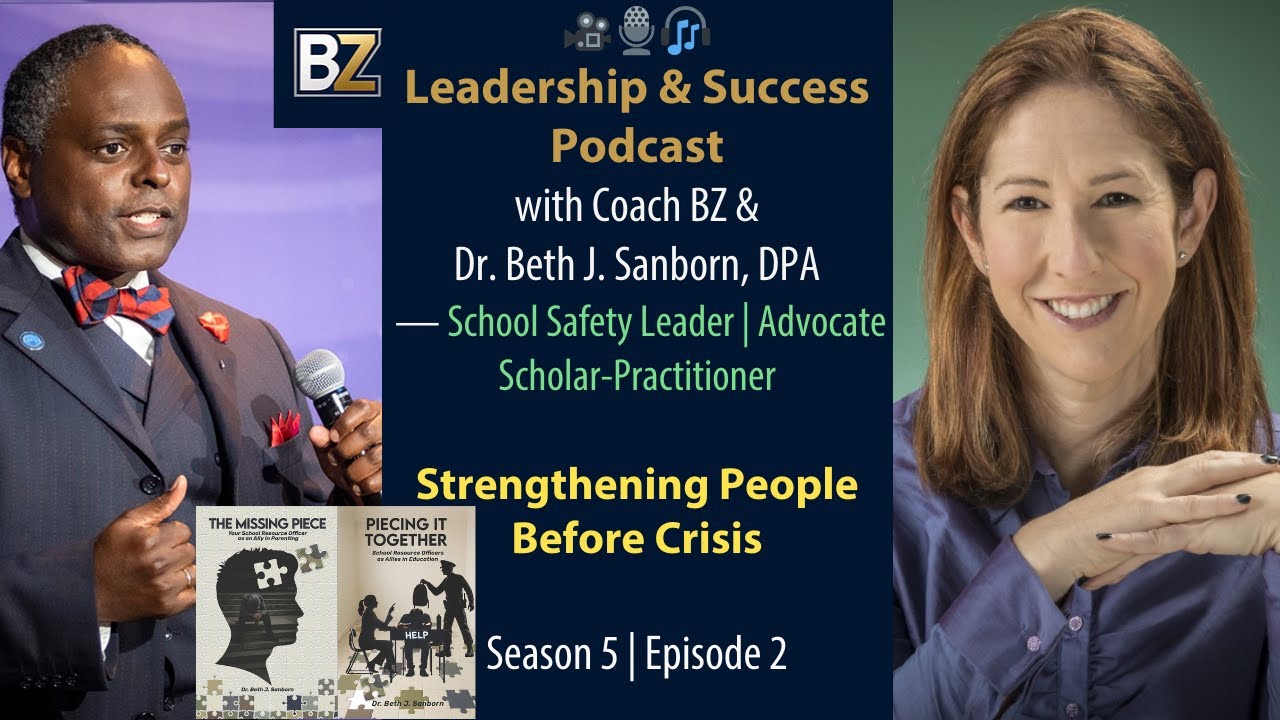
Dr. Beth J. Sanborn, a retired police officer and school resource officer, argues that school safety means strengthening people, not adding buildings. She spent 26 years in law enforcement before writing two books to counter the school-to-prison pipeline narrative and educate the public about the real role of SROs.
Chapters
Hi, I'm John Maxwell. When the top companies in the world are looking for trainers, speakers, and coaches, there's one name that stands above the rest, and that's Maxwell Leadership. Our certified team members have gotten proven results for companies all over the globe, and our reputation, I'm proud to say, is second to none. Some of our members have risen to the top of their profession. Including the one you're going to meet today. I proudly introduce you to my friend Bob Fabien Zinga.
Welcome to the Leadership Success Podcast with your host, Coach BZ, where we help you lead with purpose and succeed with impact. If you're ready to grow into the kind of leader others want to follow, this podcast is for you. If you're determined to elevate your success and leave a lasting legacy, this podcast is for you. As my mentor, Dr. John C. Maxwell, reminds us, everything rises and falls on leadership. Our goal is simple: to inspire you, challenge you, and equip you with insights that can transform the trajectory of your leadership journey. Welcome aboard to another episode of the Leadership and Success Podcast with Coach BZ.
Let me share a little bit of my story because that might give you an idea of who I am and why I do what I do. So from the time that I was little, my career path was set out for me. I knew exactly what I wanted to do. There were never any questions. It was a very specific and direct career path. I knew that I wanted to work with sharks. I was going to be a marine biologist living on a boat out in the ocean. And fast forward a little bit, I got on a boat and I realized just how seasick I get. So you would find me at the stern. Yeah, it wasn't a good scene for anybody. So I realized I had to come up with a plan B. At that point, I went to college on an impulsive decision to focus solely on sports because when I was a senior in high school, that's just what you do. You make impulsive decisions. So I went to Widener University because I was recruited recruited for multiple sports, and that's when I realized I was a good high school athlete and a mediocre at best college athlete. So that didn't work out well either. So now we're up to Plan C. I started to take some sociology classes, some criminal justice classes, and that's when I'm like, "Oh, this is kind of cool." I realized I like studying people. I like learning about who they are and why they do what they do. And I was like, "Ooh, this is kind of interesting." And I found myself as a sociologist at heart. So while taking some criminal justice classes, I really liked it. And I'm a little bit of a nerd in case you can't tell. I'm like that front row center sitter. And I'm like, me, I, you know, ah. That's when I decided after taking some criminal justice classes and learning, you know what, I can really do good in this world. I want to be a policeman. I, you know, I want to help people. So nose to the grindstone, did a lot of work. Graduated early so that I could put myself through the police academy, which is kind of funny for a suburban Jewish girl who comes from a household of like doctors, lawyers, accountants. Like, I want to be a policeman. I was fortunate enough to have graduated from the police academy and find myself with Lower Gwinnett Police. I've been there, I'm coming up on completing 25 years, which is just amazing for me to even consider. I still have 3 years before I can retire, waiting for for that age 50 to come about, but I had been in patrol and I realized that I wanted to help people. I wanted to do good in the world, but that policing isn't always about that. It's a lot of bureaucracy. It's a lot of checkboxes. It's a lot of red tape. It's a lot of just going through the motions. And I wanted to do good and I wanted to help, but it was kind of difficult in that patrol mode. So fast forward some, 2014-ish, my lieutenant sends me a text message. I have the day off and it went something along the lines of, hey, our school district is considering starting this program, school resource officer.
Don't know what it entails.
Not really sure, but Monday to Friday, 7 to 3. I think it's really gonna be a good fit for the department, for the school, and for your personality. Are you interested? So I'm walking through Wegmans, I'm reading this text message, and like a crazy person, I responded in all caps, YES, with lots and lots and lots of exclamation points, like way more than any grown woman should use.
All right, like they say, the rest is history. We're going to be starting— this is the very first podcast of 2026 with a guest. So I am so glad that you are here and we have a very special guest in the green room right now. Without any further ado, let's start with our moment of gratitude. This is something we do every time we meet. And part of the reason why we do this is because in the military, about 21 people, service members, veterans commit suicide every single day. And I know it is an epidemic, not just for the Navy, but for first responders and police. Officers as well. So if we can just take a quick moment, it's going to take less than a minute. If you would maybe close your eyes, take a deep breath, put yourself in your happy place. For me, it's always a beach. I just love the waves, the sun, and the sand. And I, I'm just so happy to be there and so grateful at my core. And today I am really grateful for the brand new year. Today is January 2nd. The day after the New Year for 2026. I can't believe I am still alive, and I'm so grateful for all of the illustrious guests I had in for Season 4 and those who are gonna be having a conversation with me for your benefit in 2026, starting with Dr. Beth Stanford. So I am so grateful, so grateful for that. All right, without any further ado, let me see if I can properly introduce our guests today. So we're gonna be speaking to Dr. Beth J. Sandborn. She is a nationally recognized school safety leader, retired police officer. She's a bestselling author, two books so far, and servant leader. So with 26 years in law enforcement and a doctorate in public administration, man, looks like she just has too much time in her hand, doesn't she? What achievement. Dr. Sandborn now serves as the Uncanny School Safety Coordinator, President of the Pennsylvania Association of School Resources Officers, and the trusted voice helping community protect children through relationship prevention and trust, but not fear. I don't know if there is a job more important than that. So our message is very simple, powerful, and timely. School safety is about strengthening people, not adding buildings. So ladies and gentlemen, would you please help me welcome to the Leadership and Success Podcast, the one and only Dr. Beth Sandborn.
Thank you so much, Bizzy.
I love it.
That was the best introduction I have ever seen.
Well, thank you so much. I appreciate that. We are really excited to have you. I've been waiting for a while, but I guess just to get started and get things rolling, what is one thing you are grateful for today, Dr. Sanborn?
Well, in your introduction, when you had these beautiful tropical sun and waves, I think what you're going to find is the more we talk, the more we have in common. And the beach and the water fills me with so much gratitude and peace and just a reset. So watching that introduction was a way to make me feel calm, connected, and, and really just at peace. And that makes me so much more grateful than the snowy, icy background that's behind me in Philadelphia, Pennsylvania, because it is just gray and icy outside.
Wow, thank you so much for, uh, sharing that. Really appreciate that. Is there maybe something about you that most people may not know?
There is one thing that I do to take care of myself, to really recharge my batteries, because when you dedicate your life to helping others and your cup constantly fills up with others' trauma and other weights, it's important to release that every so often. What you may not know about me is that regardless of the time of year, on my downtime, most weekends, you will find me along a waterway, whether it's a river, an ocean, a stream, or a creek. And I like I like to go mudlarking or sea glassing, which means I look for tidal waterways where old trash may have collected, and I'm looking for little treasures.
That is quite amazing. Uh, I, I did play a clip of you for the intro, but can you take us back briefly to the beginning? What originally called you to public service and law enforcement?
You know, it was, it was a class when I was in my undergraduate studies at Widener University, and I'll never forget the instructor, Dr. Michael Markowitz. We have a relationship still to this day, and I remember sitting in class and learning about sociology and different theories and why people do what they do, and it, it sparked an interest in me that I had never been aware of. And I realized figuring out why people do what they do and how they think and how they act and how they react was fascinating. And I loved studying people and hearing people's stories. When you stop and you take a moment to ask a truly introspective question, or just ask someone, what was your path that got you to where you are today? I'm amazed at some of their experiences and stories that just reveal some of the incredible connections and experiences.
Well, that is really quite fascinating. And at what point did you realize that your purpose wasn't just policing but also protecting children, really our future, through relationships?
Believe it or not, it came about relatively recently. And I say recently realizing that 2015 was still, wow, 10, 11 years ago. I was in patrol. I, I loved what I was doing. I was a police officer. I was doing good for my community. I had been a patrol officer for 18 years by that point. But at the same time, I realized that I could do more. And I had gone back to school and I earned my master's degree. And my mentor at that time, and also still to this day, Darren Stocker, We had been speaking, we were talking on the phone one night, and I, I kind of complained that I was bored. It was the middle of the night, I was on night shift, and I was just, I was bored. And he said a few words that changed the direction of my life. He said, why don't you write an article? I said, what does that mean? He says, you're a career police officer, you're married to a police officer, why don't you write about something that you know and get it published. Lo and behold, my first publication was about surviving police marriage. My husband and I have been married for over 26 years now.
Wow.
And it changed the trajectory of what I wanted to do. So I, I took that step of publishing, of writing, of getting into the academic world And then when I transitioned into becoming a school resource officer, my position within the K-12 school district, it was as if my career were reinvigorated, were reignited. The passion that came about was unlike anything I had experienced before, and I realized this work with kids was where I could make the most poignant difference in both students' lives, in my life, in my community. This is where I could do the most good for my community.
Well, that is really amazing. And for the people who are watching us live on LinkedIn and, uh, YouTube, please let us know where you are joining us from, what city, what state, and if outside of the US, which country. And also, what are you grateful for today? And if you have a question for my guest, uh, for Dr. Sanborn, please type it comment as well. We will answer live. Man, it's really amazing how life just works out sometimes. So you've spent 26 years or more in uniform. So what moment most fundamentally changed how you viewed leadership, you think?
When I started in policing, I'm going to make myself a little vulnerable here. I was 21 years old. I didn't have a tremendous amount of life experience. And I was a female going into a relatively male-dominated industry. I came from a sheltered, middle-class environment. And I realized I have a lot to learn. And as I started to observe people, remember, I told you I was a sociologist at heart. So I had good supervisors, I had bad supervisors, I had those who exhibited traits that I would love to emulate, and others So I said, you will never find me doing that. And what I realized was that the supervisors that I most resonated with and who helped guide my leadership abilities didn't necessarily have that formal rank. They may have been the informal leaders who, number one, were willing to help others succeed and who were willing to do anything that they had asked me to do, but weren't standing along the sidelines with their arms folded and closed body language saying, you go do this because I told you to do it. The leaders that I resonated with and who I have chosen to emulate are those who are willing to do anything that they would ask someone else to do.
Wow.
I don't know if there's a better definition for servant leadership. It's really amazing how in life you could impact the life of others. Just for being in their presence, right? Good or bad. It looks like we have our very first chat from the audience. That's Terence Sadler. I know him. He's going to be on the show soon. He says, "That's awesome." And he also says he's coming from Alexandria, Louisiana. "Grateful for another day sharing and being part of this crazy adventure we call life." Thank you so much for sharing, Terence. And I think I am almost addicted to the interaction from the audience. 'Cause when I started this show, what, 5 years ago now, it was the audience of one, right? Me, myself, and I. And now I am speaking to potentially thousands of people and I like to hear back from them. So Terence, again, if you have a question for Dr. Steinbaum, please let us know. Thank you so much for being part of our community today. So let me ask you this then. You often say, and I think I mentioned that in the intro, School safety is about strengthening people, not adding building. I think parents will definitely relate with that. What does that look like in practice for, for leaders?
When I was in uniform, and let me back up for just a moment because I want to make sure that folks understand who school resource officers are and what their role is. So there is a definition of the school resource officer, and that's a sworn law enforcement officer who's trained in community policing directives and who is assigned to work in conjunction with a school, school department. So when I was with my school district, I was still a uniformed police officer. I wore the formal traditional police uniform with my vest and my duty belt. And that's how my students saw me from kindergarten to the superintendent. To parents, to school staff. And I was trained to serve 3 essential functions in no particular order. I love that. I love that picture of my former classes. We are informal mentor counselors, which means we get the luxury of time with our students 180 days over the course of a school year and then repeated that over and over again.
Where—
that is really awesome.
I, I loved it because most police interactions are very short-lived. It's solving a problem and making a plan moving forward. But when you get to work with students day in and day out, you get to learn their names and their passions and—
wow—
their best friends are, and you get to connect as people.
Yes.
So the second role that we serve is as a public safety educator, which meant that I was a teacher.. So I could teach lessons on the Constitution or what to do when you're pulled over by police or the dangers of drug and alcohol or sexting. So I got to look at the school district through a different set of lenses. And then the third, third role that we serve is as law enforcement. So much like I just said, I wore a traditional formal police uniform every day to keep my school safe.
Yes.
Now, when I talk about strengthening people as opposed to facilities, you can't have one without the other. However, when we're talking about our schools, most often folks talk about this concept of safety and security. Well, they don't mean the same thing. Safety is that feeling that's empowering people to say something if they see something. It's that ability to be able to listen to that voice inside of your inner monologue or that pit in your stomach that said something feels off, but I don't know what it is.
Yes.
And encouraging folks to be mindful of what's normal within the community so that they can be aware when something is out of the norm for the community.
Wow. That is really, really key, right? Preventing. I think it's Benjamin Franklin Dwight who said that an ounce of— was it an ounce of prevention is better than a pound of cure? But especially when it comes to safety, that really means a lot. And I also see a lot of overlap between the police force and the military. In general, just with the things we do and things we go through. So we have our very first question from the audience. Ramesh is asking all the way from New Jersey. And also, Ramesh, let us know what you are grateful for. He says, what is your perspective on safety versus privacy from school communities? That's a great question.
That is a fantastic question. Thank you for bringing that up. There's a couple different aspects to look at here. Number one, I think it's safe to say that we all recognize that schools have an obligation to create a safe learning environment and a safe environment for our students to thrive and to really become the people that they are meant to be. The one thing that I want to be very careful of and mindful of is that there's this concept of transparency where information is shared very freely and openly. And I think at some point there's a danger to too much transparency. Because we don't need to share what every aspect of every element is happening at every given moment. Yes. I don't know. I don't know about you, Coach, but if you call, if you call someone to your home to perform a repair, I'm trusting in these professionals to do their job. I'm not second-guessing my doctor, my plumber, my electrician, my mechanic. I'm not asking where they got their parts from, where they got their training from.
Yes.
Putting my trust in their expertise. And when it comes to both elements of safety and security, to some extent, we have to trust in the professionals who have spent their lifetime devoted to this craft, as opposed to someone who has read an article online and then is now presumably an expert in a field with which they have no background. So I trust my schools to be able to maintain a safe and secure learning environment, to put the needs of the whole over sometimes the needs of the one. Yes, because we have to make sure that our entire community, our student body, our staff, our administration, and our visitors are safe and secure.
Well, that is really something. Can you take us through your journey through publishing both of your books. I think I definitely want to talk about the latest one you did, but I believe the very first book you published, Pissing It Together.
So that's my second book. If I could go back to The Missing Piece for just a moment, because this was my first book, and how this came about was I realized how school resource officers were trained. But if you are ignorant to the role of the school resource officer, you may have a perception that it's just simply a uniformed police officer in a school. And if you're unfamiliar with how they're trained, you may have this perception that, well, police officers arrest, so they're going to arrest every kid who does any little silly thing that's a crime in a school. And that could not be further from the truth. A properly selected and a properly trained school resource officer will often divert away from the juvenile justice system because we know what a negative impact that criminalization has on someone's future. What I wanted to do with this book, and I had already earned my doctorate, I was already a national speaker at this point, but I wanted to educate a new audience. So I thought this book would be perfect for parents or for educators who really wanted to know What is a school resource officer? What does it mean to have a police officer in my child's school or in my school? How are they trained? And what does it look like in daily interactions? How does that translate? Because it's one thing for me to tell you and to show you how I interact with students, but you know what's even more telling? To watch and see how students react to their school resource officer.
Well, I think that is so insightful and critical. I guess one question I have for you. Unfortunately, in America, all schools are not resourced the same way, so some schools may not have a resource officer. What would you recommend for parents who may want to have that resource as well for the safety of their children? Is there anything a parent can do?
Absolutely. They can advocate for it at all times. They can talk to their local police jurisdiction, to their local school board, to share the good work that we do. Listen, there is nothing special about me, and I say that kind of tongue-in-cheek. When I was a school resource officer, I loved my kids, and you know what, I still do to this day. But there are about 20,000 of me across the country, and we love our kids in a totally appropriate way, and we want to help them achieve their success because every kid defines success in a different way and everyone takes a different route with which they take to achieve that success. And if we can be part of the team, then we are that public servant. We are part of the community that helps keep our kids safe and allows them to become these healthy, successful, productive members of society, and there's no greater reward.
That is so key. Like I said earlier, there's a lot of overlap between the police, I believe, and the military. Like, for example, during the time of Vietnam, I wasn't around, but I know most people in America didn't like the military very, very much. That has really changed, especially after 9/11. When I'm in uniform, I can almost not travel because every 5 minutes somebody says, "Thank you for your service." So you, you really see that appreciation. I feel like with the police, it's kind of like that in some community. They are afraid of the police instead of embracing them as protector and really serving the community. So I think it really makes— it goes a long way when you have a resource officer, a policeman, a policewoman who actually comes to the school, who builds those relationships before there is an incident, who— and it really changes the perception. So I think that is so key. Thank you so much. I believe you are doing God's work and we need more and more of that and not less. But I guess another question about the book though. One thing you argue is that the school resource officer can be a powerful ally in parenting, which I think that's true, but not authority figures, right, to fear. And again, in some communities, especially Blacks and maybe some other marginalized communities, they kind of have that fear of the police, which I think we definitely need to change across our culture. But I guess my question for you is, what is the missing piece most parents don't realize they already have access to?
It's knowing who is a part of your team and understanding that the school resource officer is there to help be that parent, to serve in the role of, to some extent, in loco parentis, in lieu of the parent. When I was in uniform in my schools, I treated all of those kids as if they were mine. They were my children, even the goofy knuckleheads that made me go gray up here. I did reach 50, so I do have a whole lot of grays that are happening, but they were all my kids, and I wasn't going to let anyone take advantage of them. I wasn't going to let anyone hurt them or harm them. And it wasn't until I spent time in my schools and I was out in my community and folks got to hear my ideology and see how I acted and interacted with the students and how in turn they interacted with me. And they saw my smile and realized that it was genuine. It reached my eyes and I was there to help and to teach and to protect. And that was what really transformed, because I noticed something very important. I wanted to make very high-level changes. I wanted to change the perception of police across the nation, and I wanted to showcase all of this positive policing. But here's the thing. What I realized was easier was making ground-level changes within my own community.
Yes.
Improving the relationships between the community and the police at the ground level where I worked in my own community. And if I can get one police officer and one community member to create a relationship and then have the police officer bring a friend and the community member bring a friend, that network then grew exponentially, and our network was that much stronger, that much quicker in our own community. So as much as I want to make broad-level changes across the country, yeah, I'm starting in my own hometown.
That is so powerful. So one, one more question about the book, because your career is very, uh, interesting, to say the least. Not only are you a police officer, you happen to be a woman. We don't see too many women in this, just like in the military, but then you also earned a doctorate. So you are an academic. And then on top of that, you are a bestselling author, not just one, but two books. So this being the first book, Your School Resource Officer as an Ally in Parenting. The question I have for you is, can you share maybe a real-world moment, right, from your time as a resource school officer or juvenile detective that crystallized why this book, The Missing Piece, needed to be written.
I can picture it like it was yesterday. And we had— and forgive me for some of your listeners if you've, if you've heard me tell this story before, but it's, it's meaningful to me and I can picture it. I can see it, smell it, hear it. The intersection in our high school, we had an intersection called the Knuckle. And if you're, if you're interested in art, it was like an M.C. Escher painting, the stairways where there were so many stairs coming from different directions. And I was standing in the knuckle beyond class change. Everyone had gone to their classes and there were still the wanderers who were walking through. And one of my students who used to come see me regularly, he would stop by my office for snacks or just to talk or just as a place to decompress. He walked past and he said, Officer Beth, I'm really glad that you're here. And it was just a very simple comment, very brief. And I said, I said, I'm really glad that you're here. And I went back and I, I did some digging and, um, I took a look into the student's background. And what was a surprise, what was unbeknownst to me, is that he had every right to dislike and mistrust police. He had had experiences in his lifetime that should have caused him to dislike me, be fearful of me, or avoid me. And yet, because of our experiences, because of my smile, because my actions reflected my words— when I told my students that I was there for them, and I was there to help them and to be the bumpers and the guardrails for them, when my actions reflected that, they felt it. Wow. And he overcame those biases that police were bad, that police were targeting people, that police were, were looking to jump out from behind somewhere and catch you doing something wrong, and was able to change that perspective through a single relationship.
Wow, that is really powerful. You reminded me of what Maya Angelou said. I heard it through her mentee, Oprah. "People will forget anything you say, but they will never forget the way you made them feel." Really, when it comes to it, leadership is personal, isn't it? Before we go to the second segment, I have one more question from you, from our friend Terence. Terence asks, "I've got a friend who bounced around from job to job until he became a school resource officer." Wow, good to know. "Now he's been doing it for about 10 years and will likely do it until he retires. So if you are going to mentor other officers who might be ideal candidate for this role, what would you look for the most? Interpersonal skills or their career ladder or something else?
Interpersonal skills. You can teach the tactics all day long.
Mm-hmm.
In order to be a good school resource officer, not only do you have to have those hard skills and the tactics to be able to keep your kids safe, but you have to genuinely like kids. Yes, you have to want to see them succeed. I think about it, in patrol, when are police officers encountering kids? Yeah, on a Friday or Saturday night at an underage drinking party. And, and we have these, we, we call them curbside lawyers, you know, I know my rights and you can't talk to me and you know who my father is. So typically you'll find kids don't like cops and cops don't like kids. But here's the thing. I love that picture. Here's the thing. When you get to work with students in school and it's in a time period where I tend to call it emotional neutrality. Let me explain for just a moment. When we're all there and we're sharing that same home turf and there's no real crisis going on other than the fact that it's 7 o'clock in the morning. Nobody really wants to be there. Everybody's tired. It's still dark out and it's cold, but we can share that experience together. It's emotional neutrality. That's when we can really and truly engage with each other. So we can ask questions about a shirt that a student walks in on. We can have a conversation about their favorite restaurant, or did you see the game last night? Or BZ, I see you have Michelle Obama's book behind you. What did you think of it? We can have that conversation and engage. Maybe you see the Philadelphia Love Statue behind me and realize that I'm from Philadelphia. When we can have these conversations during a time period where no one is in crisis, yes, that's when we can build the relationship so that when a crisis does ensue, or when there's a deviation from the norm, or when someone says or does something, that SRO is primed to have that information because the relationship is already built. And that's what makes a good candidate, someone who's older, who's mature, perhaps a parent or a coach who genuinely wants to see their community flourish.
That is really, really fantastic. I think if people don't get anything else out of this podcast today, it's really how important it is to have those school resource officers around kids because you can really prevent a lot of damage, especially now that almost every other day somewhere in America there is a school shooting or something. I mean, if we say that our kids are our future and we really prioritize them, I mean, we have to show it. So again, thanks so much for the work you do. I believe it is God's work. We're running out of time, so let me get over to the second part where I really focus on leadership lessons that you've learned so far. Maybe the first question I would ask: what do you think is the greatest lesson, leadership or not, in life in general that you have learned so far?
To share a smile. That's typically what I lead with. My leadership style, uh, is trust. I have very high expectations. However, it's based more on a strong moral compass. Listen, things happen. Your kid is going to get sick and you're going to need to take a day off from work. You're going to have to go to a doctor's appointment. The dog needs to go to the vet. Your car breaks down.
Hmm.
I expect that obligations be met, timelines be met. However, if it has to happen during non-traditional times, that's okay. I have very high expectations for those who I work with. However, as long as it gets done, as long as you have a good, strong moral compass. Yes, I'm okay with how and when it gets done. Again, I'm never going to ask anyone to do anything that I wouldn't do. And as far as I'm concerned, we're in this together. We will go across the finish line together. We will succeed together. And I surround myself with loyal, like-minded people who are interested in succeeding as a team.
Wow, that is really powerful. And in the green room, we were talking and you gave me an example of one of the leaders who really impacted you positively. From what you said, you will never ask someone to do something that you yourself wouldn't do. Where did you learn that? What characteristic do you think best leader should possess in order to be impactful?
I learned that from my favorite sergeant in the police department. And when you've worked there for 26 years, again, you see good leaders and bad leaders. And my favorite leader was the one who stood beside me at all times. And by the way, wasn't afraid to say, I don't know, what do you think?
Yes.
And he treated me like a peer, like an equal. He was the sergeant, I was a patrol officer. He outranked me, he was my supervisor. There was no question about it, but he didn't have to assert his dominance to share his leadership. And I was willing to do anything for him that he would have asked.
Wow, that is really powerful. Again, another thing I believe that's very similar between the police force and the military. We have this chain of command, and it's very rigorous, hierarchical, and all of that. But one thing General Milford shared with us last year, I will always remember. He says, "Rank is rented," and that is so true. Today I am a commander under Vinny, but I won't be a commander forever. At one point, I'm going to say, "Okay, it's time for me to retire," or Vinny is going to say, "Commander Zinga, we don't need you anymore, get out of here," which is perfectly fine. So you only do that for a season, right? But really, the impact you build, your legacy really is forever, the way you treat people, isn't it? Wow, that is powerful. Let me ask you this too. What do you think is the secret of your success? You've been successful in academia with your PhD, in the police force, but also in publishing as a bestselling author. What do you think makes Dr. Beth J. Sandborn successful? Over and over again.
Mental health and mental illness doesn't have to be a bad thing. And having a touch of obsessive-compulsive disorder and having a touch of a perfection complex doesn't have to be a terrible thing. Yes, I set my mind to a goal and I have yet to fail to reach those goals.
Wow.
Which will actually lead me to— I'm hoping that you're going to eventually ask me what are my next goals, because I do have some that are still unmet. But I— when I decide that I'm going to do something, if it's going for my doctorate, if it's writing a book or turning it into a bestseller or retiring and taking on a new career and a new challenge or leading a nonprofit organization, I just decide— or giving a TEDx Yes. Oh, it's just, I set my mind to it and I will achieve it.
It's just incredible. You are so inspirational. I am a father of two daughters. So my wife, my two kids, I always joke, if it wasn't for our little dog, right, I would be the only male in my own family. But it's really wonderful to see a role model like that. So really, the next question I was going to say is, what are you learning now? It's New Year. Most people have goals for the New Year. It's the season for it. So what are you learning?
I'm learning more about— I want to hone my skills on behavioral threat assessment and management because we focus so much on the behaviors and on leakage and this pathway to violence. I want to make sure that if I'm entrusted with helping schools maintain both their safety and their security, that I am operating at the highest level that I can, so that I can help bring them up to that speed as well. Because you can have a secure school, but not feel safe. And you can have a safe feeling school that is not secure in the least. So you need to have both, you need to have empowered people and a strengthened environment. You need to be able to identify leakage. You need to be able to identify concerning behaviors and conversations and identify weak points in your exterior.
Wow, that is quite insightful. And what are some of the goals that you are still working toward? It looks like you are a super achiever type of person. I love it.
I have two goals, and if any of your listening audience is able to help me achieve these, I am not above asking for help, but my one goal is to eventually reach the White House. One time I would love to be invited to the White House to advocate for the role of school resource officers. Yes, across the country, the great work that we do when you have someone who's carefully selected, specifically trained, and properly equipped to police in the proper manner. That's the first goal that I have.
I know.
Well, you, you, you, you're gonna be glad to know a lot of people in my audience are in the military, all branches, and we do deal a lot with the DOD and the White House. So maybe somebody in my extended network's gonna help you make that happen. What is your second goal?
My second goal is to have some higher exposure opportunities, whether they're national news sources. Again, to be able to promote this work of school resource officers to combat that mindset that we are just uniformed police officers who are put in a school to criminalize student behaviors and to perpetuate this perceived school-to-prison pipeline when that couldn't be further from the truth. So any opportunity, any audience that I can get to be able to share who we are, how we're trained, what our ideology is, what factors come into play prior to making an arrest, which is, by the way, part of my second research project that's in peer review right now. But wow. I keep going, I keep working. And if there's anything that I can do to help your listeners, if they have any interest in this field, please don't hesitate to reach out. Because again, I said I surround myself with good people, I surround myself with leaders, with winners who are loyal and dedicated and who really want to do good for their community.
Well, it looks like this is how we are flowing normally, our way toward the end. But, uh, this is your LinkedIn page, right? Dr. Beth J. Sanborn. So we want people to definitely follow you there. But you also have a wonderful website, uh, I believe it's, uh, yeah, bethjsanborn.com, uh, where you have, uh, your books. And you've been in the news, and we believe you are— we definitely need your message to go across the country. Is there anything else people in the audience may want to do to support your work?
I encourage— check out the programming that I offer. I do a really fun interactive drug and alcohol awareness program for adults to teach them what drugs and alcohol— that we're— drugs and alcohol in our schools look like these days so that they can understand what it is that they should be aware of, what behaviors, what paraphernalia, what language, and what these drug devices look like these days, because drugs are very different than when you and I were younger. And our kids are unfortunately susceptible to a whole brand new series of pitfalls.
So true, because some of those drugs, they look like candy at, at times. And wow, that is so powerful. Thank you so much for sharing that. Let me ask you this then. What are some of the books that you have read that you would like to recommend to my audience?
Predators, Posers and Pained Personalities by my friends, Dr. Matt Talbert and Dr. Bruno Diaz. You want to talk about behavioral threat assessment and threat management, this is a fantastic book. I could not recommend it any more highly. And then the other book is The Anxious Generation by Jonathan Haidt. You want to talk about the mental health epidemic that social media and phones is creating amongst our kids and the rewiring of the brain and the neural pathways. It's fascinating information. I encourage you, other than my books, I mean.
Yes, of course. And of course, everybody already knows your latest book, Piecing It Together. But I really, really like this first one. It's very meaningful, The Missing Piece. I've read it and I recommend everybody to get a copy. So let me ask you this. If you could choose any 3 people, dead, alive, or even mythical figure, 3 people to have dinner with, who would you choose and why?
Okay, I— this is, this is my hot take here for just a moment. 3 people that I want to have dinner with. I realized that with all of the opportunities in the world and all of the people who are available, I would choose my husband, my son, and my daughter.
That is powerful. That is powerful. I love it. I love it.
My kids are getting older. They are becoming their own people. They are carving their way in the world. And sometimes there's just something so powerful and so grounding about spending a quiet night with my 3 favorite people in the whole world.
That is so beautiful. I love it. So let me ask you this then. If you had one and only one day to live, what would you have liked your final contribution to be?
I am 50 years old. I've been in public service since I was 21 years old.
Wow.
I've lived much of my adult life serving others. If I had one day left, I think I would take care of me. I know that sounds terrible, but I have this beautiful mosaic that's just over my shoulder here, which is made of wire glass that was very popular in the 1950s. It was used in schools and hospitals. It was the glass in doors and windows that has the wire on the inside of it.
Yes.
And it was manufactured under the, the precipice, that it would make glass stronger and more secure, but that wasn't actually the case. So these are all pieces of glass that I have found along beaches and rivers and waterways, and I made this mosaic as a visual for me and my obligation to keep schools safe. I've taken something that's broken and put it back together again. Just like me, I would want to take all of the broken pieces of me and just put that back together again.
That is so powerful.
The more I take care of myself, the more I can serve my community.
Well, thank you. Thank you so much for sharing that. In my own experience, I've seen especially women, they tend to take care of everybody but themselves, and you do need to take care of you so you can take care of others. Thank you. Thank you. So we are quickly running out of time. Before I ask you this last question, is there a question I should have asked you that I didn't get a chance to ask?
Oh, I think we covered— I loved everything we got to talk about, and seeing some of those clips from when I was so much younger and skinnier, um, was so fun. Thank you so much for this magnificent opportunity.
Yeah. All right, and we have one more comment from Terence. Again, I agree, phones are toxic piece of equipment. Kids should not have regular access to them. Okay, I think I agree to that. But the thing with phones, especially smartphones, I've seen them as a thing for safety as well. I don't know about you, Dr. San Bob, but when I was growing up, to make a phone call, you had to find a telephone booth and all of that. So if my daughter, she's in trouble or something, she can just call me on her cell phone and I am right there. But I guess you need to do it and have some boundaries because there is a lot of ugly things out there. In the dark web and parents and adults need to be concerned about for our kids. Do you have anything else you want to say about phone?
I just, I see phones doing more harm than they do good. I most recently got the opportunity to testify in front of the Pennsylvania House promoting a bell-to-bell cell phone ban. Just what we're seeing amongst our kids, the anxiety, the depression, the suicidal ideation, the mental health piece, declining, the mental illness piece that's increasing, and just all of the problems that we're seeing, whether it's using phones to coordinate fights or to order DoorDash that comes to our schools to have random doors open up. The inclusion, the exclusion, the communicating with strangers— I see it as such a dangerous tool that is changing the way our community acts, reacts, the way they grow, the way our brains are wired. The need for constant attention and dopamine. And it's just, it's doing so much more harm than good. And I just, it pains me for our kids in that they're not getting the opportunity to experience some foundational life lessons.
Thank you so much for sharing that. I know in my own kids' school, uh, today it's pretty incredible. During lunchtime, they are offered to call DoorDash if they don't like the food in the cafeteria, which Which is pretty amazing and crazy to me, but at least at my school they have what they call phone hotels. I'm like, what in the world is a phone hotel? But that's where their phone goes to sleep every time they have class. But now after class time, yeah, they are allowed to use their phone. Okay. So let me ask you this, and this is gonna be the final question, maybe one of the most important questions I think on the show. If you could go back and give a piece of advice to your 17-year-old self, Beth, standing at the edge of this incredible career you've had as an author, as a police person, and as a doctorate candidate and having earned that, what would you say to 17-year-old Beth?
Ooh, try it. I would say try it. I knew what I was going to do from the time I was a very little kid, and I knew that I was going to work with sharks and be a marine biologist, but that didn't work for me. So instead, I had to try something new. Don't, don't get stuck into this rut that this is the only thing that could be of interest to me and this is what I'm going to do, Ellen. Just explore, experience, be receptive. Make sure you have boundaries and you do things safely. But it's okay to try something, an activity, an experience, learning something new because you may just find your brand new passion.
Wow, that is really, really awesome. Thank you so much, Dr. Sandborn. We need to have you back on the show. I really appreciate everything you do as a resource officer, keeping our kids safe because they truly are our future. Thank you. Thank you. Thank you. And I guess the very last question I'm going to ask you is, what is one word that represents our shared time together on this podcast today to end the show?
Grateful.
Yes, I am almost always grateful. Thanks again for your time and for being here with us. So this show is going to replay. On LinkedIn and YouTube, and in about a couple of hours, or maybe by the end of the day, it should be available everywhere people find their podcasts. So thank you again. Really appreciate that.
Thank you so much, Bizzy.
Wow, this is awesome. All right, everybody, this was Dr. Sanborn, and I am really glad we had the chance to speak with her. But now I need to shut down the show really quick because I have another guest that's waiting in the green room in about 7 minutes. We're going to be talking to the one and only General Gary M. Britto, US Army retired. He is the People's General, and we're going to be talking about leading the army of tomorrow. So see you in about 10 minutes. Bye for now.
Thank you for tuning in to the Leadership and Success Podcast with your host, Coach BZ. If today's episode added value to your leadership journey, be sure to subscribe, share, share, and join us again for more wisdom nuggets on how to lead better and achieve greater success. Remember, leadership is the most critical skill of our time. The world will always need leaders to inspire others, drive innovation, and execute meaningful strategy. So why not count yourself among the bold leaders shaping the 21st century? Until next time, stay inspired, stay committed, and keep leading with excellence.
More from Bob

S250:E4🎙️LIVE 🇺🇸America 250: President Barack Obama Leadership, Service, and the Power of Hope






S5:E157🎙️ LIVE with CMD CMSgt Dennis L. Fritz, USAF (Ret.)(Multi Tracks Audio)



S5:E156🎙️ LIVE 🇪🇸 Leadership Lessons from the FIFA World Cup 2026 Champions (Multi Tracks Audio)

S250:E3🎙️ LIVE Leadership Lessons from America’s First Documented Family of African Descent 🇺🇸📖