S5:E23🎙️ LIVE with COL Khallid M. Shabazz, Ph.D., D.Min., USA (Multi Tracks Audio)
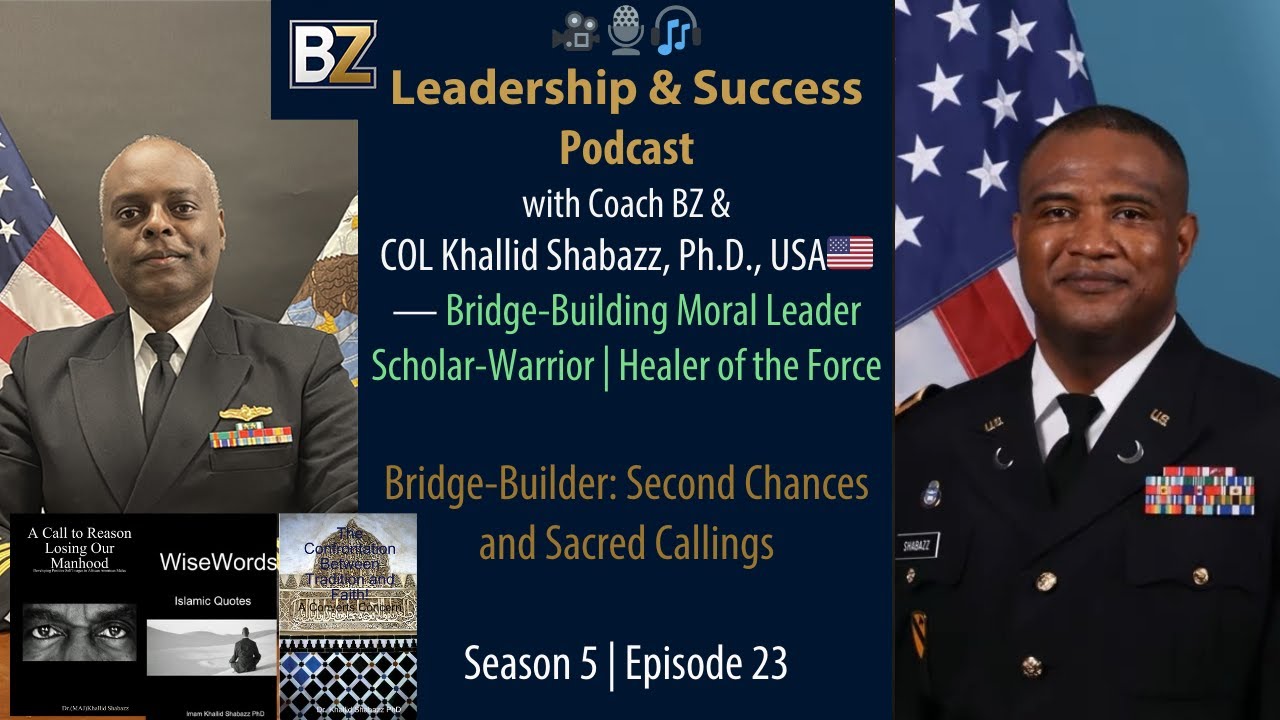
Colonel Khalid M. Shabazz, the first Muslim division-level chaplain in U.S. Army history, survived childhood sexual abuse, academic failure, and near-suicide before earning two doctorates. He believes leadership is a sermon and that one person's belief in you can reshape your entire life.
Chapters
Hi, I'm John Maxwell. When the top companies in the world are looking for trainers, speakers, and coaches, there's one name that stands above the rest, and that's Maxwell Leadership. Our certified team members have gotten proven results for companies all over the globe, and our reputation, I'm proud to say, is second to none. Some of our members have risen to the top of their profession, including the one you're going to meet today. I proudly introduce you to my friend, Bob Fabien Zinga.
Welcome to the Leadership and Success Podcast with your host, Coach BZ, where we help you lead with purpose and succeed with impact. If you're ready to grow into the kind of leader others want to follow, this podcast is for you. If you're determined to elevate your success and leave a lasting legacy, this podcast is for you. As my mentor, Dr. John C. Maxwell, reminds us, everything rises and falls on leadership. Our goal is simple, to inspire you, challenge you, and equip you with insights that can transform the trajectory of your leadership journey. Welcome aboard. Welcome to another episode of the Leadership and Success Podcast with Coach Beezy.
Most people die at 25, but they're not buried until they're 75. I want to inspire you this morning. Molested at 10 years old by a family friend. Went to special education in the 8th grade. Failed the 9th grade. Failed the 12th grade. Yes, when I was trying to recover my life, went to college, but I was drinking because of the trauma. Got shot in the back, beat with a shovel, almost lost my life. Came back to school fighting out of control, went to jail 2 times, kicked out of school, decided to come in United States Army, found trouble there because I was still dealing with a little trauma. Chapter 2, Article 15. Chapter paperwork in hand. And once I was trying to recover my life, I decided I wanted to give my life to human beings. Decided I was going to become an officer. Failed the ASVAB 4 times. I want you to hear me. 5th time I passed it. But listen here, most people die at 25, but they're not buried until they're 75. I dedicated myself to dedication. 25 straight years in school, and there's the results. 1, 2, 3, 4, 5, 6, 7, 8, and I got one at home. Most people die at 25, but then I buried into the 75. God has a message through me this morning: don't give up. Be who you're supposed to be. Dedicate your life to all that is good, and he will reward you with what you strive for. Faith without works is dead. Mere belief counts for nothing, unless carried into practice. Let's get it, baby! I'm young, I'm pretty, and I can't possibly be beat. Woo! I must be the greatest. I shook up the world!
All right, I think that sounded like Muhammad Ali. We've got greatness in the green room right now, and I am really privileged to have the Colonel speaking to our audience today. But before I do, as is our practice here, we always want to spend just a moment to be grateful. Every single time we meet, we want to be grateful. Part of the reason is because about 21 service members commit suicide every day. And I think it's impossible to be suicidal and to have a grateful heart. So if you would right now, maybe close your eyes, take a breath, and put yourself in your happy place and think about one thing you are grateful for. Like many other days, I am really grateful for the people who came before me, the people whose shoulder I stand on today, because I didn't make myself. The reason why I am who I am today is because of so many people. Who were trailblazers. They really set a trail for me to follow, and I am grateful for that. All right, so let me see if I can do the introduction justice. Like I say, greatness is in the house today. We're gonna be speaking with Colonel Khalid Shabazz. He's the first Muslim division-level chaplain in US Army history, senior strategic advisor to combatant commander Distinguished scholar, author, and mentor to thousands of soldiers and leaders across the globe. His journey from adversity and discrimination to senior command influence offers timeless lessons on faith, ethics, resilience, and moral leadership in the most demanding environment on earth. Please help me give a warm welcome to the highest-ranked Muslim chaplain in US military history. That includes the Navy, the Army, the Marine Corps, the Coast Guard, the Space Force, all of it. Let's welcome the chaplain, the doctor with not just one but two doctorate degrees, PhD in higher education from Trident University International and a doctorate in divinity from North Texas Theological Seminary. Welcome the professor, the U.S. Army Colonel Khalid Shabazz. Here you are. How are you doing?
Wow! That fired me up.
That fired me up. Thank you so much for being here, sir. We are so grateful you made the time. What an inspiration you are.
Wow.
Maybe to get started, what is one thing you are grateful about, sir?
Yeah, I'm honestly 100% grateful to be alive. I mean, if you know my story, I mean, I was shot in the back at 21 and At 25, I was an hour away from suicide. So I'm grateful every day to get up and be alive, to be honest with you.
That really is a true miracle. Wow. So I guess it's just something about you that most people, when they meet you, they may not know.
Yeah, most people don't know because they see the rank, they see the accomplishments. But let's start back at the beginning. As a young boy, I was molested at 10 years old. Um, I, I, it was about a family friend. Of course, I didn't know how to deal with it. My mom was a single parent. I wasn't going to tell her because she was going through, you know, I was always kind of a mature kid. She was going through so much, I wasn't going to lay that on her. But it set off some continuous destructive behavior in my life. I went from being an extremely extroverted kid to now going to special education in the 8th grade. Failed the 9th, failed the 10th, and failed the 12th, 12th grades. Uh, I was fortunate enough by God's grace that I have this big humongous body, like, like I'm 6'5", about 265. So I went to college to play ball, but I still never got over the molestation. So everybody who looked at me with a jaundiced eye, I gotta be honest with you, I would just beat them to a pulp because I didn't know whether I was a man or a woman. I was struggling because of the molestation. I thought everybody was looking at me and everybody saw the stain of molestation on me. So that came to a head one night, uh, and then, uh, I was, you know, being my normal self, fighting every weekend, and some guys jumped me, shot me in the back, beat me with a shovel. I almost lost my life. They airlifted me out to West Tyler Medical Center where I almost lost my life. You know what's interesting about that? You know, that should have been a wake-up call, you know, but all I could think about in the hospital bed was being angry that this happened to me. And so much has happened to me. You know, where is God? So I go back to the campus after about 6 months. And this is the importance of good friends. So I go back to the campus and the kid is there. So I said, hey, you, I'm going to eliminate this kid. Let me tell you something about friends. Wow. This is important point about friends. All of my friends, so-called friends, I should say, said, yes, eliminate him. And so they handed me a .45 and a sawed-off shotgun. Really? Yeah. So I'm, I'm going to eliminate this kid. I'm gonna get emotional here, but one of, one of my friends, his name is Ace, he has passed on. He said, he said, he said, man, if, if, if you shoot that kid, your mom is going to be disappointed in you, man. It's not a man on earth that loves his mother more than I love my mother. Yes, and I thank him for mentioning that because that— he, he stopped me in my tracks. I did go and fight the kid and I ended up in jail that night, but I didn't kill that kid. Wow. And so that, that to me, what a blessing that is. So fast forward now, I'm still in this trauma, you know, I still hadn't learned my lesson, but I can— now I gotta kid on the way, and I just wanted to change my life. So I come into the United States Army, still don't know how to deal with authority. And from 1991 to 19— before 1992 was out, I received my second Article 15.
Wow.
Chapter paperwork in hand. They're about to put me out of the military, and this sergeant major came down and said, hey, I, I want you to be My driver, I'm going to be your mentor. And this man saved my life. He doesn't know I was an hour away from suicide because I was drinking myself to sleep at night. I saw myself as a complete failure. I was a bad father, even worse husband. And so this man, a man at 27 years old, I want your audience to hear this. He told me 4 words that I hadn't heard in 27 years of life. He said, I believe in you. Wow. Wow.
Amazing.
You know, that, that saved my life. This is the importance of having men in your life. Yes. This guy spoke life into me, and people criticize me for being on the internet all the time, but I'm trying to speak life into those people who may not have a father, you know. And so I get a lot of disrespect and disregard from sometimes, you know, those who are more important than me. They have no idea why I'm on this internet. It's not a point at me, me, me, me. It's a point at them, them, them, them. To see a person like me, just the sight of a person like me of this rank and this status and my education, it gives people, it gives people hope, man. And people really just don't understand that.
Wow. Thank you. Thank you so much for sharing, sir. Uh, hopefully that's for somebody who's listening right now. I know Colonel Chabaz has a lot of things to do. He's a very, very busy man, but he took the time to be here. But I think this is definitely the message if you're listening: we believe in you. Wow, that is powerful. Thanks again for sharing, sir. Let me ask you this. You often say that leadership is a sermon. What do you mean by that? And what sermon are leaders preaching today without even realizing it?
Yeah, your leadership is a sermon. Be careful how you preach it. That's— that means you have to be a plausible example to those who follow you, you know. And what I, what I mean by that, you know, you have to be competent, you have to be authentic, and you have to be empathetic to those people who may not have had your level of education, your level of cultural competency, and sometimes those people who may not even believe like you. I had a kid the other day that I put into the Chaplains Corps, and he was very emotional. He said, I just— I don't understand. We don't even believe the same things. And I took him by his arm because he's in tears. And I said, son, I don't have to believe what you believe to believe in you. Wow. You see, this is, this is what I mean when I said your leadership is a sermon. Be careful how you preach it. Your plausible example can change somebody's life. And so that sermon is on display at all times. That's what I mean.
That is quite powerful. So from what you've just shared with you, right, you've lived inside Christianity, Islam, rank, rebellion, failure, maybe several multiple failures and restoration. So how has identity shaped your understanding of leadership more than position ever could?
Yeah, identity is everything, you know, because, you know, we have to— leaders have to be honest with themselves. Yes. All of us have biases. All of us have improprieties and shortcomings, but oftentimes when we're judging people that we're writing NCOERs for, OERs, we kind of, you know, want them to be perfect people. I mean, this is a very hard word, but that's hypocritical. You know, we have to teach, we have to coach, we have to mentor. See, that's real leadership. And sometimes teaching and coaching And mentoring comes in the form of cultural competency. I was working out at Tampa, Florida, CENTCOM. And so this young man comes into my office. He's a young E-5 from the South where I'm from, out in Louisiana. And he's crying. He says, you know, the first sergeant will give me an Article 15, Chaplain. He doesn't understand me. And so, you know, I went to talk to the first sergeant. One first sergeant is Caucasian American, soldier African American. So I said, first sergeant, I understand that you took him looking away from you as disrespect. So the first sergeant said, hey, I told him to get at attention and look me in my eyes like a man. Hmm. African American soldier. Looked down to the floor and the first sergeant was giving him Article 15. So when I went to talk to the first sergeant, I say, first sergeant, I know this is, this is the military and I understand, and you're well within your rights to punish this soldier, but let me give you some inside information about those of us from the South. If we look a person in the eyes while we're angry at that person Yes, we were taught to look to the ground to show respect to that person.
Mm-hmm.
I said, you can punish him, but these are some things that you need to know. So being able to be a leader and try to get inside of cultural competency, he was still punished, but he didn't lose his rank. And First Sergeant and him had a nice talk, and me and the First Sergeant, you know, gained a great friendship because of that. Because he said, Chaplain, thank you for educating me. Yeah, I thought the soldier was just being disrespectful. So that's a part of leadership, having those hard conversations. Yes, cultural conversations that don't— that go unheard. And then, you know, he's on one side, the other person is on the other side, and we can never come to a shared understanding.
Wow, very powerful. So we have, uh, Daniel is an active member of our community. He says leadership is a sermon. Because your life is the message. The applause isn't clapping, it's seeing your team operate with the same confident empathy you showed them. Excellence is infectious. I agree to that. And Daniel also asked a question. He says, Colonel Chabaz, how do you keep your internal motherboard from crashing when the trauma of the past tries to override your current command?
Hey David, thank you. That's a great question. One of the things that gives me life because of my trauma is helping people. I love to just go sit at the food court with my big full bird on and go sit next to a private and have a conversation with them, give them my phone number and say, hey, now you have a personal mentor. And these kids are looking at me like I'm an alien because no full bird colonel will go and just kind of sit down with a private. I get energy from going in the gym and seeing those soldiers work out and take pictures with them and put it on the internet. And these soldiers, absolutely, it transforms their lives. So I take my trauma, my— this— you see this picture right here? The picture of that, me and that Lieutenant Colonel. This guy was a PFC when I was a captain.
Wow.
I'm in the motor pool and, and he didn't salute. So I said, you know, it's the proper customs and courtesy in the Army.
Yes.
Salute. And he said, oh, I'm sorry, sir. I didn't know what that was was on your uniform. I told him, I said, I work for NASA. Don't worry about it. But we were able to have a conversation. I said, why don't you go to OCS? He saw me the other day here at USAPAC and he said, oh my God, it's you. You encouraged me. Wow. So it was my— it's my trauma response. Like, when I had all my trauma before, I was drinking myself to sleep at night.
Yes.
Now, because of my trauma, I go out and seek people to help, and it gives me energy.
Wow, powerful, powerful. This is one of the most inspirational shows we've ever had. Here is Chief Duane Hart, US Navy retired. I know that because I'm going to be interviewing him tomorrow. He says leadership has to look outside the box and be open to cultural differences. What's so great was that Colonel Shabazz educated the officer on cultural norms. That is so, so important. And also, Colonel, I know even as a commander now in the US Navy, O-5, I have great, great respect for the E-7, E-8, and E-9, right? In the Navy, we call them the chiefs, the chief mess, because They are really truly the anchor, I guess, the sergeant in the army, because without them, I think our Navy would be in big, big trouble. Because senior officers like me, we don't really do very, very much. But if we didn't have those chiefs, I mean, we would be in really, really serious trouble.
How—
what do you advise the junior officer? Because technically they outrank the E-7, E-8, and E-9. When you're an O-1, O-2, O-3, Technically you do, but the truth is the E7, E8, and E9 are the ones who mentor the junior officer throughout all of the branches of the service. Why do you think that is important, and how should JOs really treat the anchors, the sergeants and the chiefs?
Well, I think first of all, we have to be honest with them. I'm always honest with them. I said, I said, the military has lied to you. You don't outrank them. They actually outrank you.
All right.
And so, you know, if you can, uh, lower your wings of humility, I would always tell them, you'll be successful. Because those guys have the experiential knowledge. You went to college, great, and you got the book knowledge, the technical knowledge, but they have the experiential knowledge. Just listen to them. And the third part of that stool is be strong enough to listen.
Yes.
It takes a lot of humility to listen to somebody who you outrank, who has to salute you and call you sir or ma'am. It takes a lot of, lot of courage, intestinal fortitude to actually listen to them and let them teach you things without you getting into your ego, into your feelings.
Yes.
Wow.
Powerful, powerful. So Colonel, was there a moment in your career when you realized that your calling was bigger than chaplaincy and truly about healing institution and not just individual.
Yeah, I tell you, I was, I was getting promoted to major. I was having a tough time. I was, I was an E-5 before in this, and so I switched over to the Chaplains Corps. I wanted to help people. I was having a hard time because the Chaplains Corps wanted you to stay in this box. No disrespect to the Chaplains Corps, but they wanted me to keep in this box. And my personality was so big that I couldn't be in that box. Right. And so I was getting promoted to major and I was just so sad. And so because I was sad, I told the story about molestation, me getting shot. And just like then, it still makes me very emotional. And so I get back to the office. And this guy comes to the office. He like, in the Navy, he would be a Navy SEAL. In the Army, he's a Ranger. He's Special Forces. I mean, he's a meat eater.
He's a savage.
And he comes in the office and slams the door. He got crying and snot everywhere.
Oh my goodness.
And he is like, what the eff? Why did you tell that in front of all of those people? I'm like scared. I don't know what's going on. I'm thinking he's about to take me out, right? And this, this guy, Master Sergeant E8, said, that is my story, that is my story. What gave you the courage to say that? This, this guy, me and him in the office crying together. And I said to myself, this is the epitome of strength. This guy is the man that we all want to be.
Yes, yes.
And I said to myself, wow, I'm going to tell that story until the air leaves out of my lungs. So I— that intro that you sent in, I told that story, um, about 11, 12 years ago. 17 million hits.
Wow.
The first day I put it out, and that's when I knew my calling was big. End up, man, Wall Street Journal, Washington Post, New York Times.
Yes.
All of these people calling NPR for interviews. I was like, what is going on?
Wow.
You see what I'm saying? Like, it's just incredible. Yeah.
So another thing you say a lot is something like Really, you feel like your purpose is to inspire until you expire. What do you mean by that?
Yeah, I think I have personally been put on this earth to inspire human beings. And so when I say I'm going to inspire until I expire, I will continue to elevate people until I die. Wow. I will continue that every morning. I get up at 3:00. I swipe my card in the gym at 3:30 and I'm working out, putting up videos just with quotes on there trying to inspire people. Right. And so I can go anywhere here in Hawaii. Sometimes I'm in Qatar, I'm overseas, and they like, Colonel Shabazz! I watch your videos! Wow. Yeah. Just inspiring people all over the world. You know, at 57 years old.
That's amazing.
Yeah, at 57 years old, still getting after it. Yeah, I went to, that's amazing. Just people are so inspired by stuff like that.
Yes. Wow. That is just amazing. What do you think it is that really drives you? Because you are so inspirational. It's really very difficult to be depressed around you, sir. Like what is the source of your strength and that drive, you think?
Yeah, part of the drive is the trauma. And the second part of that drive is, you know, I have a quote that I said. I was speaking at the Pentagon. I wanted to provide a life for my children that they didn't have to recover from.
Wow.
I'm going to say that again. I wanted to provide a life for my children that they didn't have to recover from. You know, so many times In our lives, we're looking for role models. I said, you know, I'm tired of looking for a role model. I'm going to become one. Wow. My children will have in their presence an inspirational figure that they can look up to. Was never a smart man, was never an intellectual, but I said it took me 25 years to mess up my life. I'm going to spend the next 25 years in school to recover my life. That's where the 2 PhDs and the 5 master's degrees come from. So last summer was my 25th year in school, and that's where all the education comes from.
Wow, that is just amazing, amazing. Well, uh, you've been open about your lowest moment, disciplinary setbacks, discrimination, even despair. So what do leaders misunderstand about redemption? In high-performance cultures like the military?
Yeah, in my humble opinion, I'm just a chaplain. In my humble opinion, we have a lot of Type A personalities. And those Type A personalities are seeking perfection. And so when one of us in the formation are not necessarily perfect, Sometimes leaders, not all the time, sometimes leaders look down on those people. And so one of the great opportunities that I have as a leader/chaplain is to go and pat that young man or that young woman on the back, clean them up, let them, you know, in your words, be redemptive, right? Get forgiveness for their shortcomings and improprieties and get them back in the fight. The second part of that is the chaplain's job is amazing. I don't know. It's such a power in this job, right? I can— I don't need an appointment to my commander. I walk in the office. Hey, chaplain, the commander is busy. I say, yeah, I know. I want to talk to the commander, right? I go in and say, hey, sir, this is what's happening. I can't tell you all of it, but I can tell you Yes, this is what's happening in the formation. Could you please take a look out? I'm going to give you a story, and I won't call his name, but he was my commanding general about 7, 8 years ago. So we have a young lady— it was during COVID— we have a young lady, her parents died during COVID and she's in the hospital. So she's doing bad, right? And she's sad that she went home. And her parents died. She thinks it's because of her. Now she has COVID. So I'm like talking to her. I said, hey, I'm going to talk to the commander. She said, well, he ain't going to care about me, Chaplain. I said, I'm talking to commander. He will call you when he's free. So I go up to the commander, you know, they got all these gatekeepers and they won't let you in. I said, I need to talk to the commander right now. Yes, I go in, bust into the commander. I say, hey, here's the situation, sir. Here's the number. Will you call her? He said, Chaplain, I'll do one better than that. I'm going to see her. Wow, man, you do. Oh my God.
Commanding General.
Yes, yes. 3-star. He went to see her. And I'm saying to myself, man, that's power. You know, the problem sometimes when you talk— let's talk— you're talking about leadership. Yes, leadership takes courage. I could have been worried about my career. I could have said, oh my God, this guy is so important, you know, you know, he's going to not like that. I'm just walking over his staff like that. But I needed to get to him.
Hmm.
And thank God he was receptive to that. And I'm going to tell you, I'm going to tell you a second story. It was— I go in, you know, it was my first job as a colonel. And so I need to see, uh, the 3 stars, my first 3-star command. And, you know, I get in there and he is talking. He's— I'm, you know, I'm, I'm, I'm looking at those stars. I can't even look in his face. I'm like intimidated by those stars, right? And he says, Chaplain, I just want you to know All of us are green, right? And I said to myself, oh my God, I don't want to lose this job. This is my dream to work for General. Yes. I said, I said to myself, I took a deep breath, I started sweating, and I got to be honest with you, I said, son, have some testicular fortitude.
Wow.
So God put you here to speak to speak to power. Yeah, do it in a way that is, uh, conciliatory and humble. I said, sir, first of all, let me tell you, I really want this job. Yes, I really— this is my dream job, but I know you mean world— mean right by saying we are all green. But the correct language should be, I don't care if you're Black, I don't care if you're white, I don't care if you're a woman, I don't care what religion you are. I say, sir, that's called microinvalidation. I said, it would be appropriate for you to tell me and anybody else, we don't care about your color, your gender, your cultural stance. Yeah, we are a family. So this is funny. So he sits back in his chair. It seems like it's 8,000 hours. I said, boy, you are so dumb. You just You just lost the best job you ever had. Wow. But he said back, he said, Chaplain, you're going to work out fine here.
Wow. That's amazing. That's amazing because you've also once said that the Army really was a place of second chances. So how can leaders, people listening right now, how can they create environment where accountability, discipline, and all of that we do get it, but also grace coexist? How do we do it?
Yeah, I think that, to be honest with you, that comes through personal relationships. Yeah, it's easy to, you know, push somebody out of the army that you don't know. But it's very difficult if you're a leader to push somebody out of a space that you know. And so as a leader, you know, like everybody here at UCOPAC, I've been in every office. I talked to every one of the people, and that is my mission at any duty station I go to, to shake every hand in that building. There's some, you know, a lot of people in that building. But I think leaders, as busy as we are, commanders especially, they have to be able to touch those people's hands because those people are living, breathing examples of why we are successful. Right.
Yes.
So if you, if you're touching those people's hands and you can identify them as human beings, man, that's a powerful testimony. When they fail, you can actually go in, hold them accountable. We're not suggesting that people are not held accountable, but going in to say, hey, you messed up. We're going to take care of that. Yeah, through, through whatever means it is. But, you know, we love you. You're part of our team. Keep dreaming and don't give up.
Actually, I want to talk about moral courage for just a minute. And we have Professor Jeff Hazell, Senior Sergeant. Yeah, that's my guy. He says, "Leadership takes courage." And that is so, so true because you've advised 4-star commanders in CENTCOM, for example, in moments of geopolitical tension. What role does moral courage play that technical expertise cannot replace?
Moral courage is everything. Because I tell you, man, I tell you, I don't care what people say, when you're looking at them stars, it's intimidating, right? And so I was in CENTCOM working, it was my first 4-star command, this is my second. And I was working for a general who was hard, he was tough on everybody, including me. But, you know, when you say leadership takes courage, sometimes you have to tell the important person some things that they don't want to hear. Right. And so when October 7th happened with, with, with the Israelis and Hamas and the Palestinians, I'm the chaplain, so I have to do certain things. And so the first thing that I did was I went to all of the foreign officers The Israelis first, the Muslims second, and I just sat with them and listened. Okay, listen. Took my notepad out. Uh, we asked about their families, we asked how this was affecting them.
Yes.
And listen, I don't need an office call. We— I know you're busy, sir. I need to come in and give you this information. And so we sat down and I gave him that information and You know, he kind of looking at me like, hey, man, I'm busy. And I got to say, sir, I know you're busy, but these people care. When you get time, if you get time, if you don't have time, we need to send the chief of staff. We need to send some stars over there.
Yes.
Let these people know that you care. Right. Those conversations don't always go over well, and they might not talk to you for a month or two. But the bottom line is you still have to be courageous enough to go into that office and tell that person who is extremely busy, intelligent, and got his eyes focused on operations. But the operations of the people are most certainly equally important.
True. Wow. Powerful, powerful. And the other question I have, sir, is how should leaders navigate faith in pluralistic environment without compromising either conviction or inclusion? I know, Martin, when you are in Benin, most chaplains I've seen were Christian, but even with Christian, right? You have Catholic, you have Protestant. Even within them, you have Methodist, Baptist, Anabaptist, Pentecostal, Charismatic, non-denominational, on and on and on and on. So how do we, uh, navigate that?
Faith actually should be the foundation of everything, right?
Yes.
In the, in the military, in leadership. I remember walking into my first duty station as a captain Muslim, and I reached my hand out to the commander and he said he won't shake my hand. He says, we have some problems with your religion and how you guys treat women. What? Nice day. Oh my goodness, this man didn't talk to me for 9 months. What? And by God's grace, I'm a sports guy, so I was coaching his son in basketball. Him and my son became friends and, you know, My son, his son was getting jumped one day and my son helped him. And so we were in the field and I said, hey, sir, I know you don't want to talk to me. I'm a jokester too, which don't help. I said, I know you don't want to talk to me because I'm Muslim, but my Muslim son helped your Christian son fight today. And so he looking at me with disdain. He said, what? I said, yeah, you know, your son got jumped. My son helped him. And, you know, to his credit, right? And this is why you got to have tough skin when you have faith. To his credit, that was the first time he talked to me. We talked for about an hour. Wow. Right. And so because of that, man, I respect him so much. He came in front of the formation when we got back, Battalion Commander, and he said, I have wronged one of my officers. And he gave me a coin in front of the formation.
Wow.
And I used to pray at his house on Sundays for dinner.
That's about—
devout Catholic. Yeah, devout Catholic.
Wow.
So faith, but faith transcends— faith can transcend.
Yes.
You know, all of our impartialities. Faith can transcend our own religious bias. If you would just have faith, you know, love thy neighbor as you love yourself. Well, your neighbor ain't gonna always be the same faith you are.
True.
Yeah. So I, I think in the military You know, we need to do a better job at that, right? My family has suffered greatly because of our faith, right? We don't get invited to all of the stuff, right? So we have suffered, but we maintain faith because it has some people who, who can move through that type of almost insanity, uh, and, and accept us for who we are. I, I love that part about it. It is a struggle, but I love that part about it. Uh, I remember becoming the first Muslim chaplain and it just, it went viral, right? And so it was people on the internet, if you go back and look at it, it's in the documentary, they was like, he's a demon, Oh my goodness. Yeah, go to the— find out where he's at in the mosque and murder him.
What?
And so I was at JBLM and it was—
it was—
it's amazing just loving people. So nobody on post— none of the people on post would counsel these two women who were married, right? And so a sergeant major who I know, uh, very well, he said, I know who will counsel them. Right. So these women come in, we counsel them, you know, we give them the tools, whatever they need, because it's really about communication. So when these people were making threats on my life, guess who was on the internet fighting for me? Those two ladies. Wow. Yeah, they were like, he's amazing, man. You heard him, we gonna kill you, you know.
Oh my goodness.
Yes. So Faith— wow. Being good to people transcends all of that, all of that foolishness.
Yeah, I tell you, that is unbelievable. I, I mean, I can't believe this. It's like 2026, the 21st century. That's right. Well, I am very, very sorry for all of the abuse you and your family had to go through, but you are such a shining light and, uh, so inspirational, always smiling, and like I say, really a force to be reckoned with. It's almost impossible to to really be upset, angry, or depressed in your presence. This is crazy. So one thing that you've also said is really religious counseling, right? Only takes a small percentage of your job.
Yes.
The rest is human struggle. Yes. Okay. What does that teach us about leadership in corporate or military setting? Human struggle.
Well, you know, If you want to really touch people, you have, you have to feed them, right? If you want to really touch people, you have to help them. So, you know, religious counseling, that's when people are in trouble, or premarital counseling. How do you get after those people before those things happen, right? So I have In every job I went to, I created a program called Lunch, Laugh and Learn. Right. So I go to every office, I provide lunch for that directorate. Wow. We just sit down and talk. Right. And so when I brief it to the commander, I say, sir, this is a preventive measure strategy.
Hmm.
So when these folks get in trouble, they already know who I am. Before they get in trouble, they know who I am. If trouble is sneaking up on them, I've already established myself in their life as a spiritual advisor, right? You see, leadership needs to be insightful enough to get out front of things, hmm, right? When you get out in front of things, I have I just talked to a young lady today for an hour, right? Uh, a high-ranking person. And she just said she hadn't been able to talk to anybody like that in her life. What?
Amazing.
Amazing. Because you're able to do that because of the relationship.
Yes.
Because of the trust. And they trust you as a leader to not tell anything of their business. That's real leadership.
Wow, that is quite powerful. Okay, let me ask you one question. I think a lot of my friends— I do come from a Christian background, but I think it doesn't matter if you're a Jew, Muslim, if you do believe in God, I think most people, they really don't want to commit murder or even kill, even if it's an ethical, lawful, and moral war. For example, in my opinion, for my generation after 9/11, it looks like America had to do something about it. Part of the reason why I joined too. Now, I do thank God that I personally, I've never been put in a situation where I had to take a life, but if I did, I would have to. For those who are spiritual, how do you maybe not justify, but How do you, I guess, appease your conscience that you've taken away a life of someone I believe is made in the image and the likeness of God, but because of my job, because of national security, I absolutely had to do what I did. Have you ever had to counsel people about that?
Oh my God. Yes. I mean, it was one of the toughest times in my life because You're in a space because I've been deployed quite a number of times. You're in a space where these young men and women are killing people. Right. And so, again, you establish those relationships. So they're in my tent, a mobile home, wherever, 2 in the morning. Hmm. Chaplain, I just killed somebody. You know, how would I I killed a mother, a father, you know, whoever they killed that day. And they're in my place of business crying. Right. And so for me, you know, you talk about restorative redemption. You know, that's why when I went to war college, I wrote a paper on moral injury. Right. You know, moral injury is when you're doing something out of obligation, but your conscience still can't handle it. With it, right? And so what I advise all those folks when they get home— because you're still in the fight— when you get home, you need to go to a restorative process, to your preacher, to your imam, to your, uh, uh, a priest, and beg God for forgiveness over a sustained period of time. This is how, this is how you heal, or attempt to heal that type of trauma. I mean, because those, those thoughts don't go away. I remember, man, you're going to make me cry again. I remember a young lady coming to me and I'm a really— I'm an ambitious person. I want people to do well in their life. This young lady was about to get out of the military.
Right.
And I sent her, I sent her to the recruiter. We were at war. I sent her to the recruiter, man, and the bomb dropped on her and knocked off all her— right, right. Hmm. You know, how do you, how do you live with that? You know, and wow, you know, you know, the interesting part about that. You live with that, and now you're the spiritual head of the unit. Yes. Ain't nobody for me to talk to, right? Ain't nobody for me to go and cry to. I gotta internalize that and keep that and be strong for everybody else, right? Nobody— wow. So, you know, I went through my own PTSD and moral injury because I'm thinking I'm doing a good thing, right? And you don't know, but it's God's will. You're sending a person to their death. It's very difficult. I mean, it just is all the way around. And I know we are and we have to be focused on what's ahead. And I think that's why the chaplain behavior health could be so much more important in these units. And I don't blame it on commanders. I don't blame it on sergeant majors. That chaplain, he has— he or she has to know their self-worth and have to get out there in those formations. I don't care what your rank is. Sometimes when we're moving up to these high ranks, you know, we begin to think we're special. No, God sent you there on a special mission to take care of people. Wow. Yeah, I don't care about no rank. I go out into the weeds to find people to help.
Yes. Well, thank you so much, sir, for sharing. Hopefully that's going to help a lot of people. I think there is a lot of underestimation, in my opinion, of people suffering with PTSD and traumatic event, especially in this field we are in. Like, for me, again, I thank God I've never really been in a position. I've been assigned, right, ordered to go to combat zones like Iraq, Afghanistan, and, uh, Djibouti. But me myself, I never really been in a place where I had to shoot someone, but some of my friends and fellow sailors have. And the only time I saw someone die, I was a Lieutenant JJ. I was actually on board the USS Essex. I was, uh, in the South Pacific Sea. One of my sailors, uh, he was enlisted, he got bad news from, from home. I think his wife decided to cheat on him with his best friend, and he felt like worlds were closing in. He didn't talk to the imam or the chaplain or even the commander or me. He just jumped, jumped, jumped off the platform. By the time we recovered his body, it had turned from white to like purple. I mean, I am still traumatized by, by, by that today. So it is, it is a very, very tough world. And I believe you as an imam, as a chaplain, You really are playing a very, very critical role for the spiritual formation for the soldiers, those sailors, those service members, especially in times of war. And I'm very, very grateful for that, sir. Thank you.
Thank you. Thank you, guys. Just glad to be able to wear the uniform to help be able to help people, because a guy like me with all of my trauma You know, I thank God for me being in a space where people, I can help people who have trauma. Right. So I'm so happy to wear the uniform. I've been doing it for 35 years. I'm gonna have to take out my uniform in a couple of years to my chagrin, but you know, it's been a great ride.
Wow. And maybe if I, if I can ask one more question about this, for those who are listening right now, like I say, I think it's underestimated. I think more people are dealing with trauma than we actually have the numbers for. Especially in the military. What would you tell to them right now? What can they do to at least start the process for healing?
I think the process of healing— you think when I say your life is a sermon, be careful how you preach it. That's just not talking about courage. That's not just talking about being a leader. Part of that sermon is being able to find help. Being able to find somebody that you respect.
Yes.
And pour into your life to help you get through to the next level. Because I know that just having somebody who believes in you, yes, will help you without judgment is so powerful. Wow.
So powerful. I think for those who are listening right now, if you don't get anything else out of this, I think This is worth the price of admission. I believe in you. That could literally change your life.
Wow.
Let's talk about manhood. Well, we are already running out of time. I could be talking to you for hours and hours, sir. You are so inspirational. Let's talk about—
Yeah, I'm here for you. Whatever time you have, whatever time you need, I'm here.
Thank you, sir. A Call to Reason: Losing Our Manhood. Let's talk about this. I think it's almost become an epidemic in our society. So, uh, in your book, you, uh, what I guess— what does healthy masculinity look like in leadership today?
Well, all of us, in my humble opinion— I'm not a psychologist— but all of us are sometimes leaning towards our younger selves. Whatever drove us to this point. Sometimes we're still living in our younger selves. I wrote that book, uh, on self-esteem, self-efficacy, and locus of control because I struggled into my 30s with self-esteem because of my molestation, right? And so the book explains, um, um, that the only way to overcome self-esteem issues is to do hard things. So all of these hard things that you see me with, all the education and all that stuff, the research said this is how you overcome those things. So if you, if you are a leader that's not self-aware, that has poor self-esteem, that doesn't understand locus of control, you actually become toxic because you think everyone around you is, you know, trying to take you down. You think if you allow your subordinates to do something or delegate something, you think they're going to do it wrong to the derogation of you. And so when I see toxic, you know, leadership, I always know where it comes from. It comes from that little kid inside who maybe was teased by bullies at school and never got over it. Now he's a commander. Now she's a commander and she is whipping people's butts because now they're in charge. And I'm powerful. Well, that's not real leadership. Real leadership is teaching and informing and helping people understand what we're trying to do and treating them with dignity and respect.
Wow, so powerful. Because one thing I've seen, and thank God it's really changing in the military now, 21 years ago when I first joined, especially men, I don't know why we do that, but we don't want to ask for help. We think we can solve every, problem by ourselves. But really, if you are going through something, it's okay to ask for help. Go see a chaplain, go see a counselor, go see a psychologist. It's perfectly fine. Now, I also know back then there was a time when, uh, if you said you saw a psychiatrist, no, they probably would take away your security clearance, which means your job in the Navy would be over. But that's no longer the case. Now, as long as you report it, we definitely want you to be getting better. Anything you want to say about that, sir? Especially for men. I don't see that problem with women much. It's men, they think like, I am this, you know, Rambo, I am so masculine and strong. And when we just need help, we— it is okay.
Yeah, it's really, it's really an identity crisis, you know. So, you know, a lot of ladies come in to me for counseling and they always say, you know, my husband needs to talk to you. Right? You could help him greatly, right? And I always tell them, please don't go home and tell your husband you saw me and that you want him to come in here for help, right?
Yes.
What you need to do is let me meet him by happenstance or show him a video. He'll have respect for me and then he'll want help from me. Because when— as men, we need to see somebody that we can respect.
Yes.
And then you can ask for help for those persons. You know, men are a strange bunch because most of us, even in our younger days, got teased by other men. And some of us still have friends where they don't say anything positive about you, especially when you have a weakness, right? And so you don't want to expose that type of weakness to another man. But if you can find a man that is a safe place where you can actually explain some things to him and he can help you out, what a great avenue that that person can have for you for healing. And they'd be non-judgmental. I, I love talking to guys because that's really where the impetus of the problem starts, because we think we always have to be the toughest, the baddest. And this is why, honestly, I don't do marriage retreats alone. I do them with my wife, and I let her tell them my improprieties so the mask could come out. I like, I like her to tell, hey, you know, I gotta tell this guy 4 days. Yes, wow. Everywhere he goes, he leaves crumbs on the table.
Chaplain, man of God.
That's right, that's right, that's right. I need them to hear that because, you know, this, this facade, this rank, this status with all the books and the education— see, guys, guys begin to think, unfortunately, that that guy is perfect, that I can never be that guy. Well, you're wrong, because that guy— the only difference between me and you is experience and a decision. That's the only difference.
Say that again, sir.
That's the only difference between me and you is experience and the decision. Wow. And I tell soldiers that all the time. I say, hey man, listen, I am a colonel, I am a doctor, I am a chaplain, I'm all of that.
Double doctor.
Double doctor.
Right, Professor?
Professor, I'm all of that. Hey, we were at Jarvis Christian College. The guy would read my bio, he got like halfway down, he said, I'm not reading no more, you've done a lot.
That's right, that's right. Yes, sir.
Yeah, but I bring my wife in because they need to hear that, brother. They need, they need to see that there's nothing special about me. I did some special things right? That's the difference. You start to think people are some angel sent down from heaven and you can't accomplish that, you're crazy. And so I always try to lower my wing of humility, uh, to people to show them that I got a lot of improvement.
That is so, so powerful, sir. Thank you so much for being humble and vulnerable, because that really takes away the stench, you know, the stigma, the shame. That's why people never talk publicly, especially men, that they've been molested. Because yeah, maybe women get molested more than men, but some men do too. And because they are so ashamed and they keep that in and they cannot heal, right? Because if you do not take care of that wound, you don't talk about it, there is no way you're gonna bring healing. And people like you really are encouraging men everywhere to really step up, you know, ask for help and start the process. Of healing. Thank you so much, sir. One more question I want to ask you before we go into the last segment. Technically, we are out of time, but you've given me more time. Yes, sir.
Yes, I'm here for you.
I'm here for you. One more question before we go to the, to the last segment. You have mentored countless soldiers into officers and leaders. What separates those who advance in rank from those who advance in wisdom?
Psychology. Right. I put 84 people, 84 soldiers to officer school.
Wow.
Right. My goal before I leave the military, I'm a little bit behind, was 100, right? I get 100 people, uh, to officer school, right? That's my mission. I was, I was as young E-4, come to my office and she's broken. I mean, she's broken. I'm like, listen, you know, She came in with some problems. I said, hey, you need to become an officer. She said, are you, are you listening to me? I said, listen, you need to become an officer. And I'm telling her my story, and I walk over to the wall and I say, you see all of these degrees, right? She said, yeah, you bragging about yourself? I said, no. And I tell her I was in special education, I was failed in 9th, 10th, 12th. I was telling her the story.
Wow.
And she's crying. And I said, the only difference between me and you, young lady, is a decision. Hmm. That's it. Wow. I can tell you, God is my witness, she is down in 25th ID right now as a W3 warrant officer. Wow. Yes.
Unbelievable.
That is the power, man, of being able to speak into people's lives even when they think they are broken.
Yes. Wow.
You see what I'm saying? So to me, to me, being able to make yourself vulnerable enough as a leader to show your shortcomings, that didn't take anything away from me.
Man, that is, that is amazing. Just a big shout out to Dr. Roy Walker, he's in the house. You are a great friend, a leader across diverse communities, proud to call you my And also, Professor Jeff asked, can you talk about Jarvis Christian College?
Jeff, Jarvis Christian College, man, I tell you, I went there because I got thrown out of University of Texas for fighting. So I went to Jarvis Christian College. It's a small HBCU. We call it the 13th grade because it was just like it was so small. But, you know, it had, it had African-American teachers there. You know, they were really kind of just kind of taking us in like the father figures. You know, I was so messed up in the head. I went back there 30 years last year after 30 years. Wow. I was led. They took me off campus. In handcuffs. Wow. 30 years ago, right? And so 30— fast forward 30 years ago, I just went there and apologized through a speech. Um, and I— it was— it was the kids just all gathered around me and we talked to like 12 o'clock that night. They couldn't believe that I was a colonel in the Army and I got thrown out of Jarvis, you know, by— wow, he took me out. But George Christian College, a small Black college. Uh, brother, it— that back then, we didn't even— they let us in. We didn't even take SATs. We didn't take ACT. They just let us in.
Amazing.
So those, those places like that, you know, really give you an opportunity to make something out of yourself when you're not even competent enough to be in college, in my humble opinion. Wow.
Yeah, that is amazing. 30 years ago they take you out in NCOF, and today you can go there and be the professor and teach. Yes.
Wow.
Yeah, if that's not grace, I don't know what is.
Yeah, they want, they want me to be there, but you know, that was my dream to be a college president. Uh, they wanted me to be the president there, but I got about 3 more years in the military, so they— the president just left. And they just hired somebody. So I want to finish my time in the military.
Amazing, amazing, amazing, amazing. Well, so let me ask you this for the last segment. What do you think is the greatest lesson you have ever learned in life, in leadership in general?
Yeah, the greatest lesson I learned, I could, I could put it to you like this. You are not a product of your environment, you're a product of of your thinking, right? So many of us get caught up into where we come from, what we went through, and it, it deters us from where we need to go. You see, until you change the way you look at things, the things that you look at will never change. I'm going to say that again. Wow. Until you change the way you look at things, the things that you look at will never change. Yes. You know, I changed my environment, not physically, but mentally. I started hanging around different people. I started going to workshops. I started doing anything that I could to make sure that I can stop the generational curse, right? My children needed to see a champion in the house, not a person that was whining about racism, discrimination, uh, Islamophobia. Whatever the ism is, and it's present. I get it, it's real. I get it. But that has nothing to do with me striving with every ounce of blood that I have in my body. It's not a duty station that I go to where people are saying, oh my God, we welcome you. No, I understand I'm a little different. I understand I'm the Muslim chaplain. But I can tell you this, as I tell my children, I go in there the first 4 months at every duty station I'm in, it's unbearable. Hmm. Because of who I am. But the last 4 months, like, I'm gonna leave here in 4 months, that courtyard is gonna be filled with people crying, saying, oh my God, we love you, we can't believe you're leaving. Every place that I've gone Literally the last place, it had 200 people out there hugging and kissing me because they knew I loved them. So I'm not a product of my environment. I'm a product of my thinking. And when you love people, you know, the majority of people will give you that love back.
Wow. That is, that is so touching, man. I think we need to end this show right, right now. I'm going to try to keep my composure. But this is powerful.
Wow.
Yeah, man. What do you think is the greatest leadership advice you've ever received, sir?
Yeah, the greatest leadership that I've received was from that Sergeant Major. He said, man, he said, he said, most people die at 25, but they're not buried until they're 75. I was like, Sergeant Major, what are you talking about? What does that mean? He said most of us at 25 years old start thinking about a false narrative of reality. He said there's no reality, there's no limitations about what you put upon yourself. And he said most of us are just waiting till we're 75 years and somebody throw the dirt on us because we lived a life of regret. He said young PFC Specialist Barnes, because I changed my name. He said, do everything you can to be the greatest soldier and father that you can. He was at my Lieutenant Colonel promotion. You'll like this. He whispered in my ear, he said, I'm proud of you, but you know you owe me half of that paycheck. Wow.
Actually, this, this is great because I can ask you the next question. Why do you think you've been so successful, sir, going from a private to a colonel? And for those who are not aware, that's only one promotion away from being a one-star general. And then you have what, 9 degrees now, including, uh, 2 doctorates, a doctorate in ministry, and then a PhD. Why, why are you so successful, sir?
I think I'm successful because I love people. I mean, people literally give me energy. And so it's no person that's in my orbit— God's orbit, but my orbit— that doesn't feel a sense of love for me. I could, I could tell you that 100%. And my philosophy is that every person that I meet should leave from me stronger than they came in. I don't care about your faith. I don't care about your gender. I don't care about your religion. I don't care about any of that. My job is really to ensure that you become a stronger person when you leave my presence. And I think, and I know, people know that about me. And I think that's why I've been wildly successful. I had a, I had an interview with the lady in the Wall Street Journal. You'll like this. After we finished the interview, kind of like this, when the cameras was off, she said, we've interviewed Senators, congressmen, presidents. You are the most interesting person. Yes. She said, how did you become a colonel in the United States military working at a 4-star command in the— in the military has been at war with Islam for 20 years?
Yes.
She said that's impossible. Wow. I hadn't even really thought about it. I'm just doing my job.
Yes.
Wow. She said, she said, we've been in the Middle East for 20 years.
Incredible.
You're a colonel working at a 4-star command. How did that happen? Hmm. This was all off camera. And you know, I just, I told her, hey, I love people. People give me energy. Wow. I think that's why I've become successful.
That is powerful. I think the oldest I get, the more I realize leadership really is all about love. You have to love the people you are called to serve. It makes all the difference. So what are you learning now, Colonel? I know leaders are learners. What are you learning these days?
Well, for me, the psychology of self is the most important thing that a leader can learn, to be self-aware about who you are, where you are, and where you need to be, not where you think you're going. Where you need to be. And I say that because we have a stigma in the military about rank, right? I went down, I was doing a— I do LPDs all over the, the country, right? And so this young lady said, she said, I ain't never seen a colonel doing no LPD. And so I said, well, You've seen a colonel do an LPD. And so in the, in the newspaper, when I was— when I left, she sent it to me. You'll, you'll love this. I, I tell you, I started crying because I'm a baby. She said, leaders like this don't come around too often because leaders like this don't come around too often.
Hmm.
Right. I sit in the middle of about a 250-person privates at Fort Lee doing an LPD. Wow. Kind of just like this. And they got the picture with me sitting in the middle of all of those privates and drill sergeants. And so for me, being able to literally wear the rank but actually transcend the rank, transcend the, the, the religion transcend leadership and be able to pour into people is everything for me. It's everything.
Well, if that's not love, I don't know what is. Uh, incredible. So, uh, if you could choose 3 people to have dinner with, and they could be alive, dead, or even fictional characters, who would you choose and why?
Well, now think about who I am I'm the chaplain, right? People need to put this in context before they start throwing spitballs at me. Yes. I, I thought, I thought about this question a great deal. I would like to sit down to dinner with the president, right?
Yes.
I'm, I am the chaplain. Put that in context and we'll leave it right there.
Yes.
I'd like to sit down at dinner with the the Secretary of War. I'm the chaplain.
Yes, sir.
And we'll leave it right there.
One more, right?
And then, honestly, I literally would like to sit down with John F. Kennedy. Hmm. The reason I want to sit down with John F. Kennedy And obviously I know he was murdered, but he was the first Catholic to hold the office of the president. I'm the first in a lot of things. Yes, right. I would like to know what was on his mind. Hmm, right. I— that, that's what I would like to know. Like, people ask me all the time, you know, you're in this fishbowl you got pressure. You can't do nothing wrong. You can't do this, you can't do that. I don't feel that pressure because I'm in my purpose. Wow. I, I'd like to sit down with him to understand if he felt pressure. Yes, right. That's, that's why I'd like to sit down. Now, then don't get me wrong, you only gave me 3. Now most certainly like to sit down with, uh, um Martin Luther King.
Yes.
Muhammad Ali is my mentor.
Yes, I know you, you quoted him in the, uh, video. Yeah, that's right.
He's my mentor. I know him probably, even though he's passed, I know him better than I know myself. Wow. And then my last one, um, I just took the liberty— see, this is leadership— I took the liberty.
Yes, sir. You are the colonel. Whatever you want, sir.
I'd like to sit down with Malcolm X. Yes, because Malcolm X transformed his life and became Malcolm X. I transformed my life because of Malcolm X. Wow. So Malcolm X— the reason why I admire Malcolm X so much is because he had a belief. Like, he was, he was a thug. I considered myself that, right? When I read his book, he was in all kind of trouble. He went to jail. He transformed himself into the Nation of Islam. Yes, that's what he believed. He was willing to die for that. Then he made another transition when he went to Mecca and he took on the name Shabazz.
Yes, yes. Wow.
I said to myself Oh, he strongly believed in something. Yes, he transcended that even though he loved it and was still able to be critical of that. I said, that's the person that I want to be. That's, that's who I want to be. And so when I said I'll change my name, and my name was Michael Barnes, I changed my name to Khalid Shabazz. Khalid means ones whose ideas live forever, and Shabazz means an eagle that flies above all eagles.
Wow.
So I took that name after Malcolm X because of his courage. So I most certainly would like to sit down with him to understand the type of courage it took to leave an organization basically that you helped create, and then you transcended that to criticize it. But that takes some time.
Wow.
I loved it. Wow.
Powerful, powerful, man. That's amazing. I could be speaking with you all day, sir. Now, is there a book you might recommend, but not one of your own? Of course, people who are watching now, I want them to get A Call to Reason, Losing Our Manhood, especially men, and also Wise Words, Islamic Quotes, and also this one, The Confrontation Between Tradition and Faith. Uh, very, very good book. But which, which book would you recommend?
It was a book, uh, I don't remember the title, but it was a book by Jack Canfield that I read.
Is it by any chance this one?
That's it right there. Yes. The first chapter, he said his mentor told him to take 100% accountability of everything that happens to you in your life. Yeah, that was the book, The Soup of the Soul. So that book There started me off to stop blaming everybody externally and to take control of my life. That was 30 years ago. I read that book. And I hand it out to people when I meet them, or they will set up for mentorship sessions.
Amazing. Yeah, Extreme Ownership. That makes all the difference. Again, what you said earlier, how you look, look at things really defines, uh, what is going to, uh, happen to you or how you're going to react to, to the world. Is there maybe, uh, a song or a book or a movie that would be your life's theme? Or—
and a, a movie or would be my life theme?
Yeah, a, a movie or a song or a book.
Uh, it's kind of, it's kind of, uh song, right? Uh, my wife, my wife gave it to me the other day. It's called, it's called The Goat, right? But it's, it's not just about being the best at something. It was about a Black, the, uh, the Black sheep of the family, right? And so therefore, the Black sheep of the family, uh, is the person that traditionally becomes more successful.
Yes, right.
So I, uh, I can't remember the theme of the song, but that was the song that, that she gave me. And then the, the movie, um, Muhammad Ali's movie.
Yes, um, the one with Will Smith, or another one.
Yeah, a large part, a large part of who he was in his essence was actually when he went through the Supreme Court case.
Yes.
And he fought against, uh, the government. Uh, it showed who he was as a human being. And so I think we are who we are in our darkest, uh, hour. So I love that part about the movie. Not that he won the championship and all of that stuff. I like how he overcame um, his darkest hour and then went on to beat George Foreman. The part in the movie, yes, uh, that was— that, that just— it, it, it was— it encapsulated who I want to be, is nobody believed him that he was going to beat George Foreman, except for the people in my country, because he fought in the Congo.
The Congolese, he lives in Hollywood. We said Ali Bomaye. Ali Bomaye. Yes.
But his team in the corridor, they— he said, what do you guys look like? You're going to a funeral. I'm the one that's fighting.
Yes.
Like, you guys don't have any belief in me, but I believe in myself. So when I go out and do my speeches, you know, I always think about that movie. I said, yeah, I said, they're going to be thousands of people in this world who don't believe in you. You shouldn't be one of them. Wow. Yeah, I love that movie.
Powerful. Well, it all goes back to our moral courage with Muhammad Ali, with Malcolm X. It's, wow, powerful. Okay, I do need to land this plane pretty soon. I've already taken more than 20 minutes of your time, sir. But let me ask you this. If you had one and only one day to live, what would you have liked your final contribution to be, sir?
My final contribution is have my family around them and tell them to carry on the legacy of inspiring people. That'll be it.
And, uh, if you had the magic wand and could solve any problem at all in the world, what is the one problem you would like to solve first thing tomorrow morning?
Poverty. Yes. Yeah, poverty. Thank you.
All right, uh, so we are getting toward the answer. Uh, all good things come to an end. I could speak to you for hours, but what can we do to add value back to you.
And my value is not of me, just the video that you showed in the beginning. Send it to every corner of the earth, because that in that video is about overcoming everything that you think you can't overcome. There's a saying that when God takes something from you, he's going to give you something better. All of those things that I was going through, I thought that I was cursed. I thought that God didn't love me. I thought that I would never be any— anything in the world. Now God has taken that situation from the mud and has made it sunshine all over the world, internationally, where when I go and speak, people know that story. So, uh, I, I just— I don't need anything, but if, if you can share that video with your sons, your daughters, or anybody in the world that needs it, man. I tell you, I'm— and I— the other day a lady called me with her son on the phone. She saw that video, let him see it, and she wanted to have a FaceTime with me and her son. I tell you, wow, it's the best feeling.
Amazing. And also, I understand that you are a TikTok sensation, sir. How many followers do you have on TikTok? I believe your videos have been watched almost a billion times, right?
Yeah, 1.3 billion views.
1.3 billion views. Wow.
1.3 billion. They get about 1.5 million a month.
Uh, amazing.
Amazing. And that's what I do. You know, I know some people are annoyed that I repeat that story once a week.
Wow.
But you know, it's reaching so many people and I think, I think that's what's important. To help people. And that's my life. Amazing.
Amazing. So as we get toward the end of the show, unfortunately we do have to end, and I'm so grateful for your time, sir. Is there a question I should have asked you I didn't get a chance to ask?
No, I think we covered it. I'm just grateful that you gave me an opportunity to be on your show.
Well, not quite done yet. 2 more minutes and we're going to be done. Probably the most important question I ask all of my guests. If you could go back and give a piece of advice to your 17-year-old self, standing at the edge of this great, incredible career you've had, what would you say to that 17-year-old?
You're not dumb. Hmm.
Powerful. Wow. I believe in you.
You're not dumb. You know, you just— You haven't, you haven't had the experience. You know, life is, life is continuous, you know. But when you go through what I went through, I just had 30 years of thought thinking that I was an idiot, that I was dumb, that I couldn't achieve, that I couldn't be confident. You know, I thought something was wrong with me. But I would tell, I would tell, I would tell that 17-year-old, you're not dumb, man. Just keep living, man.
Failing high school, failing college, now you have 9 degrees, 2 doctorates, and the colonel in the most powerful US Army, USA.
Wow. Amen. Amen.
Wow, that's, that's powerful. That is, that is powerful. I think we need to end this show right now because I'm gonna start crying. This is, this is— wow. All right, all right. Uh, I guess the very last question. Okay, let me ask you 2 questions and this is it. I like to end the show on a very positive note. We did talk about a lot of heavy things today. What is one thing that you are feeling optimistic about, sir?
Yeah, I'm feeling optimistic. You know, I have 4 grandchildren.
Wow.
And they love me and their grandmother, man. I tell you, it's so great. To see my children's children. I mean, I love those kids. So, uh, it's been hard being in Hawaii for the last 2 years, but I'll be leaving soon and I get to spend a lot of time with my grandkids.
Wow, that is amazing.
And I have more followers than them on TikTok. They don't like that.
Yeah, I can imagine. Wow. All right, then the very last question again, sir. I'm so grateful for, for your time. What is one word that represents our shared experience in this podcast today?
Uh, understanding.
Right. And again, I am so, so grateful. And, uh, thank you, sir, Colonel, Doctor, Doctor, Professor. So grateful. Chaplain, the highest-ranked Muslim chaplain in the entire United States Armed Forces history. Well, Chaplain Shabazz, thank you, sir.
Thank you, thank you, thank you for having me on your show. I appreciate it.
Incredible. Well, everybody, this is really one for the books. This is just incredible, incredible. I am so, so grateful. Wow, this is amazing. I think I am gonna be listening to this show again and again myself. So many nuggets of wisdom. So I really hope this is going to add value to you. And tomorrow we are going to be speaking on— he's in the audience right now— Chief Dwayne Art, US Navy retired. He's now a cybersecurity leader, tech visionary, and a keynote speaker, and also the author of 3 bestselling books: CISSP Practice Questions, which is the gold standard for security professionals, The Cybersecurity Mindset, and Cybersecurity Leadership. I can hardly wait to speak to Chief Art tomorrow. And then I will be speaking on Friday with Colonel Thomas Gordon, United States Marine Corps, retired. He's principal formative and resilient, and we're gonna be talking about Marine Maxim in action, building character that withstand command. All right, that's what I have planned for you this week. And tomorrow I will be back. We are speaking about the Book of Proverbs. We're doing it every day this month. So we're gonna finish it on January 31st. So tomorrow is gonna be January 22nd. So we're gonna read the book of Proverbs chapter 22. Not a religious podcast. We're gonna be speaking about ancient wisdom and leadership lesson from the book of Proverbs. All right, that's all I have planned for you. And thank you, thank you, thank you so much to the Colonel for really being one of our master teachers today. So until tomorrow, have a wonderful rest of your day. Bye for now. Thank you for tuning in to the Leadership and Success Podcast with your host, Coach BZ. If today's episode added value to your leadership journey, be sure to subscribe, share, and join us again for more wisdom nuggets on how to lead better and achieve greater success. Remember, leadership is the most critical skill of our time. The world will always need leaders to inspire others, drive innovation, and and execute meaningful strategy. So why not count yourself among the bold leaders shaping the 21st century? Until next time, stay inspired, stay committed, and keep leading with excellence.
More from Bob

S250:E4🎙️LIVE 🇺🇸America 250: President Barack Obama Leadership, Service, and the Power of Hope






S5:E157🎙️ LIVE with CMD CMSgt Dennis L. Fritz, USAF (Ret.)(Multi Tracks Audio)



S5:E156🎙️ LIVE 🇪🇸 Leadership Lessons from the FIFA World Cup 2026 Champions (Multi Tracks Audio)

S250:E3🎙️ LIVE Leadership Lessons from America’s First Documented Family of African Descent 🇺🇸📖