S5:E24🎙️ LIVE with Chief Dewayne Hart, USN (Ret.)
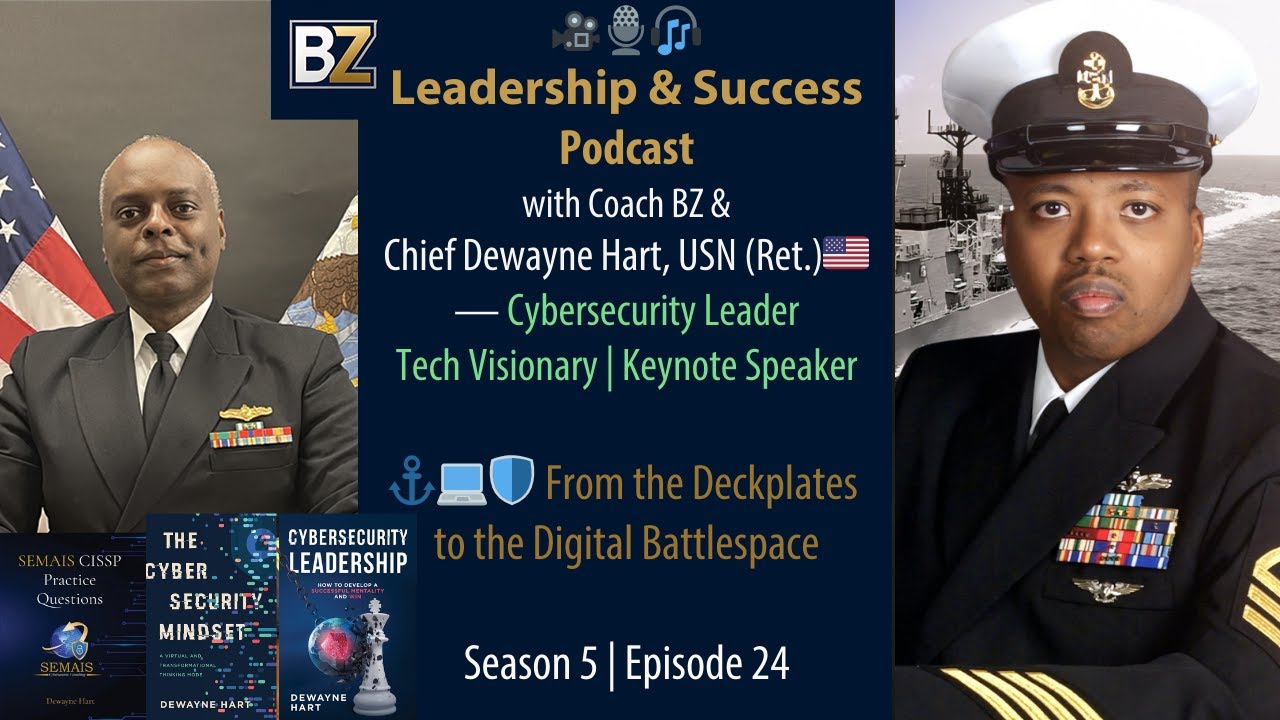
Retired Navy Chief Dwayne Hart talks cybersecurity leadership, his 20-year military career, and why cyber is a leadership problem, not a tech one. He built the Leadership Triangle around responsibility, authority, and accountability, and wrote two bestselling books on the subject. Hart stresses listening over speaking and learning from failure.
Chapters
Hi, I'm John Maxwell. When the top companies in the world are looking for trainers, speakers, and coaches, there's one name that stands above the rest, and that's Maxwell Leadership. Our certified team members have gotten proven results for companies all over the globe, and our reputation, I'm proud to say, is second to none. Some of our members have risen to the top of their profession, including the one you're going to meet today. I proudly introduce you to my friend, Bob Fabien Zinga.
Welcome to the Leadership and Success Podcast with your host, Coach BZ, where we help you lead with purpose and succeed with impact. If you're ready to grow into the kind of leader others want to follow, this podcast is for you. If you're determined to elevate your success and leave a lasting legacy, this podcast is for you. As my mentor, Dr. John C. Maxwell, reminds us, everything rises and falls on leadership. Our goal is simple, to inspire you, challenge you, and equip you with insights that can transform the trajectory of your leadership journey. Welcome aboard to Welcome to another episode of the Leadership and Success Podcast with Coach BZ.
So this is what CyberTalk does. It's focusing around if you have a risk management program, you have a vulnerability management program, maybe asset management program, which a lot of people forget about, or your configuration management program and other type of programs that may be in place for your organization. It's going to allow you to understand how those programs operate, but at the same time, how do you connect those programs together? The main nugget for me that he dropped was the fact that with AI, it is, um, it is the thing of the future, and it's time for us to get on board and get ready for what, what is about to take place and what is taking place. See, what CyberTalk does is teach you how to channel the cybersecurity landscape. It teaches you how to transition cybersecurity from typical practices over into your working roles and your jobs. This is what CyberTalk does. It was amazing.
I love Mr. Hart's presentation. He explained the history and the experience behind having an AI, getting to AI in cybersecurity.
I just became friends with him on LinkedIn. He was amazing.
I learned about that we all need AI. We all need to put a barrier around our information and around ourselves.
So thank you, Mr. Hart, for everything you've done.
See now.
The wait is over. Dwayne Hart's new release transforms cybersecurity leadership. In 2026, cybercrime operates like an industry. Free, fast, automated, and AI-powered. Static security isn't enough. Master the leadership mindset required to build adaptive teams and protect digital systems. Dwayne Hart delivers the definitive playbook for cybersecurity leadership. Take charge of your cyber future. Order your copy today at DwayneHart.com.
All right, everybody, this is Coach Bizzy. Welcome to another edition of the Leadership and Success Podcast. I have a terrific guest for you today. He's waiting in the green room. Before we bring him in, let's do our moment of gratitude. So for those who follow the show, every time we meet, that's what we do here. We want to just spend a moment to be grateful, grateful every single day that we meet, because it's impossible to be suicidal and be grateful at the same time. Impossible to have anxiety or depression and be grateful at the same time. So if you would just take a quick moment, maybe close your eyes, Take a deep breath, slow down your nervous system, put yourself in your happy place, and think about something you are grateful for today. Earlier today, I said that I was really grateful for the simple things in life. And I have to add something to it. My daughter, our last one, I know it was what, 4 or 5 years ago before the pandemic, one of the biggest K-pop groups, BTS, they came, I believe it was to the Bay Area, Los Angeles, and Las Vegas. We almost flew to Las Vegas just to get tickets and to go see them. But anyway, it didn't work out. She didn't see them, but it looks like they are coming back. They're coming back to the Bay Area in May. So she just got confirmation. She was able to purchase not one but two tickets today. So she's very happy. As a father, I am very happy too. So just those simple pleasures in life, waking up in the morning, smelling the coffee, the roses, looking at green grass. The grass has been so brown in the Bay Area. So I am just grateful. So let me know what you are grateful for. And also let us know where you are joining us from, what city, what state, which country if outside of the US. And if you have a question for my guest, please type it in the comments and we will answer those questions live. All right. Before I bring him in, let me see if I can do a proper introduction. Today we are going to be speaking with Chief Duane Ard, retired US Navy Chief Petty Officer, cybersecurity leadership strategist, bestselling author, keynote speaker, and founder of Semise. With over 20 years of military leadership and decades of cybersecurity experience across government and Fortune 500 organizations, Chief Ard has a clear message: cybersecurity is not a technology problem, it is a leadership responsibility. I couldn't agree more. He's the author of 3 bestselling books, including Cybersecurity Leadership: How to Develop a Successful Mentality and Win, Cybersecurity Mindset: A Virtual and Transformational Thinking Mode, and he's also the voice behind the Chief of Cybersecurity platform, helping leaders translate risk into action and culture into resilience. Please help me welcome to the Leadership and Success podcast, Chief Duane Hart. All right, good afternoon, Chief Dwayne Hart. How are you doing today, sir?
I'm doing great. Um, glad to be here. First of all, thank you for having this podcast so we can talk about those great topics, because leadership is somewhat something that's always overlooked. So Yes, I'm glad to be here. I'm glad to share my information, my history, my journey, and all my knowledge of 20 years in the Navy and everywhere else, everywhere else that I've been. And yes, what I learned that can make people do great things.
So true. And you are a retired chief. You wear that anchor proudly. But really, throughout my entire career, chiefs have mentored me. I wouldn't be where I am today if it wasn't for the good lookers. So Thank you. Salute. You guys really run the Navy. Without you guys, I think this Navy wouldn't be anything it is today. So thank you for that. Is there something that you are grateful for, Chief?
Oh, well, I'm grateful for, for one thing in life is to be able to have great family members. So I got to say that to my family members, all of them that came in. Secondly is, you know, to be able to go through the world and to learn. And the last piece is to successfully complete 20 years in the United States Navy.
Yes.
Because, because there are plenty of people that joined the Navy and never made it past 3 or 4 years because of circumstances. But I made it through 20 years because I wanted to be there. But, but I'm not holding that against others. Yeah, everyone, everyone has their own destiny. Everyone has their own path to follow. And just to let you know, I was supposed to only stay in the Navy for 5 years. Wow. For 5 years. But for some reason, I feel I was doing great. And I was doing great things for the Navy. So I said, you know what, let me just re-enlist. And then And then my chief petty officer said, hey, well, you know, the Navy has a $15,000 signing bonus, right? So I took the signing bonus and I got promoted. And then from there, things just started to expand.
Yes. Yes. Wow. That is incredible. When people first meet you, Chief, is there maybe something about you that most people do not know?
Oh, what most people do not know? Is that I'm normal. Right? Most people would think that I'm very techie, right? Very, very techie, that I don't do basic things in life. And I'm gonna be honest, I go to the Golden Corral to eat, like many other people do. Right? And, you know, that is, that is honored, because one of the things I think that people have to realize that when you see the word cybersecurity, and you see someone that writes cybersecurity, you don't have to put yourself in the box of fear, right? Because I met people before, and I had some great conversations. And then they asked me, what is it that you really do? And I tell them what I do, immediately they grab their cell phones and start— and then the conversation changes. Seem like they're afraid of something. So I always like to say that I'm a normal person. I'm just like the next person who's trying to live life and to move to the next level, to have fun and to see what the world has to offer.
Well, you've definitely made this significant contribution to the cybersecurity subject with all of the books you have, for example, the CSSP practice question, which is pretty cool. I used to be on the board that decided which question would be on the test. It's really, really tough. Cybersecurity Leadership, which is your newest book, but also the Cybersecurity Mindset. And on top of that, you also have a podcast. I don't know where you find time to do all of this. And you also have a huge YouTube channel where you really bring cybersecurity down to the folks. It's just incredible, your passion with cybersecurity. How did you get into this field, Chief?
Well, first of all, I let people know that I put in 8 hours a day for everything I do. Now, the reason it's so easy to manage all of these lanes here, as I may call them, because I'm in so many lanes, is because as you move through the industry and cybersecurity, you begin to understand things a lot better. And you begin to understand how to operate efficiently. Books are written, are written based on something that I'm thinking about. And what I do is that I take everything that I've known for 20 years in the United States Navy, that I can sit here and talk about for 5 hours. Yes, I take my college experience. I take my speaking events, I take everything I've done and make it all work together. This is the reason why it's so easy to have a podcast. Just like I was explaining, explaining to you before, is that for most of the podcasts that I do, I pretty much don't have a script now. Because when I first started my podcast, uh, one of the podcast hosts told me, he said that you need a script. And I used to go through this script and just read it. Reading the script. And then I got to a point where I said, you know what, I'm trying to follow a script, why don't I just— and so, and so to get back to your question, you know, I came into the world of cybersecurity by, by kind of a default, because when I retired out the military, I was supposed to be a leadership coach. Because Because I taught leadership for my last 3 years of the military.
Wow.
And I used to travel around the Southeast region to all the naval bases. And I used to teach leadership, plus I used to help write the curriculum. And so when it came time to leave the Navy, you know, the first thing I thought about was that I could be a leadership coach.
Yes.
And then I started to do my research and realize that You know, I can just take leadership and transition that into other areas. And, and my first job out of the military was an IT job, and I was pulling cables through a ceiling. And then I started to realize some of the other areas of IT. So I finished my college degrees and my certifications. And I said, okay, I want to be a software programmer.. And when I was taking these courses in college, I did not like sitting at a desk, just hitting a keyboard. So that wasn't gonna work for me. So my second job that I had, I was on the night shift, and I saw someone that came into the data center with a CISSP book. You know, that's, that's kind of interesting. So I picked up the book and read it. And it was intriguing because Sean Harris was the one that was advocate for the CISSP certification.
I've got plenty of books here.
Logical Security.
Yeah.
Okay. So I picked it up and I read it. And I said to myself, you know what, I'm going to study this. And I'm going to— and I studied for 6 months. And I passed the test. And then after that, I started to gain some government contracting jobs. Wow. Then from there, I just started to like cybersecurity. And then that's amazing. One day I was talking to a friend of mine's, and he said, Dwayne, what's your next step? I said that I don't know. And I was sitting down on a Sunday afternoon watching my favorite football team, the Pittsburgh Steelers. Play. And immediately at halftime, something kind of resonated with me and said that you can write a book. So I went upstairs. And I just wrote down a couple of things. And I said, a book? Me? Write a book? About what? And I started to do my research. And the first major book I wrote was The Cybersecurity Mindset. And I went through a couple, couple changes. And Then I wrote The Cybersecurity Mindset. And then after I wrote the book, then I started the podcast. And then so after I started the podcast, and you know, I started to speak. And then after going on the speaking trail for so many years here, I decided to write my second book on cybersecurity leadership, which was just published back in December of last year. So, you know, the book has only been on the shelf for 30 days.
Wow.
And here I am today.
Amazing.
You know, just trying to make a difference in the cybersecurity industry and also people's lives. I say people, because I like to share information with people that, yes, I do want to build their careers or to do better things in cybersecurity.
And that is really amazing. And the lady you mentioned, Shawn Harris, she's helped more people passed the CISSP than anybody else. I know when I was on the board for ISE Square deciding on those questions, that's one person we didn't like at all because she would take the test over and over and over again every year. She would take it and then she would see the new question on the test and then update her books, but they couldn't prevent her from doing so. But anyway, she's been the best. I think she passed away a few years ago, but she's really— and then she's also an Air Force veteran too, which is pretty Amazing.
Here's a secret for you. I still have those audio files from Shaun Harris. And you know, when I was studying, and I used to drive long distances on the highway, I used to have those audio files playing in my car. So you know, when I took the test, it was like I was hearing Shaun Harris talk to me.
Yeah, incredible. Because I know the 5-day boot camp I went to, I thought they were going to teach me live, but all they did is play Shaun Harris videos for 5 days, 8 hours every single day. So, we pretty much went through the entire book, and once I did that, I felt like I was ready for the exam. It's really one test I don't want to take again because I made us take it again maybe, I don't know, 7 years ago. Almost everybody failed. The best of the best, the people at the top of the cybersecurity industry, but we got rid of all of the easy questions, and some of those questions, they really, really make you think. But anyway, now let me ask you this. You said the last 3 years on active duty, you were really part of the leadership team, teaching leadership and helping with the leadership curriculum for the US Navy. When I was just an E-1, Seaman Recruit, the lowest level possible in the military, Chief, they mentored me, they took care of me, and they taught me about this leadership principle. Why in the world do you wanna teach leadership to an E-1? I didn't have any direct report. Nobody reported to me. It was just me. I was doing all of the grunt job, any jobs that people didn't want to do. Why was it so important, even at the lowest level possible, for the young gutlocker to actually instill those leadership lessons to the lowest-ranked person in the entire command? Why? Why is that critical?
Well, well, we have to start early rather than late because, because the way I used to examine leadership is, is that every person has to understand the big picture concept.
Yes.
When we look at the E-1 that has just joined the Navy, That particular E-1 has to understand what is it that the chief is experiencing every day? What is the chief talking about? Why is it, why is it important to follow the Navy regulations? All right. And because if you start early and as a sailor begins to build a career, they, they've, they already understand the nature of leadership. Right. So we can easily now place them in a leadership role. And it's— because if we start late in the ballgame, now someone doesn't understand the nature of leadership, and they don't understand how to lead people. So you have to start early rather than late. And this is the reason why I state that everybody is a leader.
Yes.
Okay. Because someone somewhere led another person, even if you take a 7-year-old that actually has a brother or sister at 4 years old, and that 7-year-old takes the responsibility of making sure that they get up every morning, make sure they got their clothes, make sure they eat.
Yes.
Making sure that they do the smaller things they need to get done. That's leadership. And it starts early.
That's powerful. Man, I was so proud when I finally made Petty Officer Third Class. My goodness. But yes, it's true, really throughout the military, even the other branches, leadership is so key in what we do. And that really makes the difference, I think, between the US Armed Forces and all of the other militaries out there. So maybe, Chief, can you take us back to the moment you realized that leadership was more about people than position? What did the Navy kind of teach you early that still guides you today?
You know, I will say that I really did not learn more about leadership until my, like, you know, the last 6 or 7 years in the military. Right. And see, that story resonates because I probably should have been promoted to chief earlier. And, you know, you learn.
So you are telling me that it took you like 16 years, right?
Right, right. And I should have been in khakis, maybe about 12 years. Part of that was because of the fact is that as a sailor, I was more into doing the work, right? Because I enjoyed working on $65 million worth of equipment. And you know, I used to fall asleep next to equipment on board a ship.
And I used to walk around and say, oh, sorry, for those who don't know, SME is Subject Matter Expert. We have so many acronyms in the Navy.
Yeah. So, so immediately, what, what dawned on me was that one of my chiefs had pulled me to the side. He said, what do you want to be in the next 5 to 10 years? Right? And I said something technical. And he said, you know, everybody likes you. I said, yeah. He said, you easy to get along with. He said, you're a perfect leader. And so what happened was that as I transitioned through the Navy, and I found myself talking to sailors about things that they don't talk to others about, I used to be sitting down eating on, you know, a couple ships. And people would just come up to me and start talking and tell me the most secretive things and things that they needed to know, especially about their life, that, that they wouldn't talk to anybody else about. And so it dawned on me that, hey, but Dwayne, it's something about you that they like. So, you know, with leadership, trust is very important, right? Do, do people trust you? And second is, can you influence people?
Right?
Because people come to you and talk to you for a reason. So you just can't sit there and say no. And I found out that that is probably one of the problems with leadership is trying to understand cultural norms, is to think outside the box. But during that time, I learned that it was time for me to leave. So exactly one of the things I thought about was this. I said, hey, if If I am supposed to lead, then I need to have some power, right?
Yes.
Because I can't be an E-5 forever. And I started to look at the rest of the chiefs. They would walk into the captain's office and make a statement and the captain go, yes. And I'm like, okay, I want to be that person too.
Yes.
What I did was that I find ways to get myself promoted by doing work.
Wow.
But also too, I actually learned the rules of the road. You know, the rules of the road are that you have to be important. And one of my last ships that I was on was the USS Spruance. And I remember I had came aboard the ship and like the first commanding officer told me, he said, I'm going to depend on you a whole lot. I said, why? He said that if my guns ain't working, he said, I'm coming straight to you and not your chief. And immediately it dawned on me, hey, you know, you are here for a reason. And then I started to pick the ball up a little bit. And I've seen that others would come to me for questions. And, you know, I give greatness to one person, which was on board the USS Princeton, came to me one day and said that you need to take over the first class petty officer Association. Now, now, for the people that don't know what the First Class Pet House Association is, it is a group of E-6s that work together to increase the morale for the ship. So you do things together as an E-6 community, but no one wanted to take over the group.
Because it's all volunteer, you don't get extra pay. And it's a lot of work. Yes.
And it's a lot of work because you spend more time in the captain's office talking to him about the E-6 community. This is the reason why nobody wanted to take over. And I was coming to a meeting.
Wow.
And, you know, I'm coming to the First Class Pet Officer meeting, and I was going to sit down, and that's when someone said, you need to take over. Me?
Take over?
And if, you know, I kind of took over the group, and then after that, things things just start to expand.
Wow, that's really amazing because in my experience, nothing prepares you better at the anchor than being the leader of the First Class Petty Officer Association because you really learn how to deal with people. And of course, it's going to be reflected on your annual eval too, because it is a lot of work and some practical leadership. So, Chief, you have served across multiple ships like you've mentioned and command. What was maybe one deckplate leadership lesson that still shapes how you lead cybersecurity teams today?
Oh, yes. You know, one of the things that I learned is that when it comes to problems, someone somewhere, or some people had resolved that problem. So I carry that same concept into the cybersecurity domain. Yeah, because you have problems. It has been resolved before by somebody somewhere. Here's a great example of me telling sailors how to resolve problems. I was on, I was on a ship. And so what happened was that one of the systems was down, and it had been down for 24 hours. So I gathered my my whole division, and I said that we need to get this up and operating. And one of the sailors came to me and he said that, I know what the problem is, but you know, we don't have any parts for it. And so they kept coming up with all these excuses, especially about parts. So I said, come here for a minute. So we went to the fantail of the ship and I said, okay, how many ships are in this basin? So everyone looked, and so they said, 10. So I said, 10 ships in the basin. I said, out of those 10 ships, somebody has to park.
Yes.
Somebody has to park. And so each one of the sailors picked a ship, and they went to the ship, and they came back with 3 parks. Wow. You know, the lesson was that somewhere, somehow, somebody has an answer. Yes, somebody has done this before. So when I look at the, the cybersecurity field, always state that we can resolve problems. And because there are protocols, and there's rules, and there's regulations, we can resolve problems because we don't have to have cyberattacks. Yes, because cyberattacks happen because there's a lapse or that someone has not followed a certain rule or regulation, because technology has a standard. And that's where the rules or regulations comes into practice.
Wow.
People are flexible. Very, very flexible. So what I tell individuals is that understand the protocols and follow the protocols. There's a, there's a reason why you're supposed to put a certain setting on a Windows desktop. There's a reason why you're supposed to patch your systems within 2 weeks. Because you want to beat threat actors to the finish line.
Yeah.
And you know, that is my motto. I always use it as a motto, is that if hackers are in lane A, and we're in lane B, the one that makes it to the finish line will win. That's all. It's very simple concept.
Wow, that is really powerful. You reminded me of the time I was at boot camp, RTC Great Mistakes, I mean Great Lakes in Chicago. Really, even then again, I was a seaman recruit, E-1, lowest rank in the military, but the mindset of leadership was really embedded into us. Things like, you know, are you ready? Always ready. So you have that mindset that I am always ready and no, Easy day, every day is easy. It may not be easy, may not look easy, but that's what I think. And therefore there's got to be a solution to whatever problem or challenges I am facing. I am a United States sailor and nothing is going to be able to resist me. That's really a mindset that will allow you to pretty much accomplish almost anything instead of being like, oh, what do I do? I'm depressed. I don't know where to go. When you think there is a solution, eventually you are going to find your path. To that solution. That's really powerful.
Well, you know what, I just want to make a statement here is because, is because military personnel have a strong advantage when it comes to cybersecurity because of your, of the way you're trained, because military personnel are taught combat warfare, combat warfare and cyber warfare are best friends.
Yes.
You know, the other part of the house is that Military personnel understand how to protect data because we know that confidential information should be— right? So OPSEC is taught to us. Operational resilience is another factor because you're on board a ship and you have to sustain operations. So you've been through that training before. Even, even so in the Army, you know, operational resilience plays a factor as well, too, because in a combat zone, you have to keep the equipment working.
Yes.
And so military personnel have a strong advantage for, for cybersecurity, because of the term cyber warfare and combat warfare, which is best friends.
That is powerful. Great way of looking at it. Now, let's talk about you becoming Chief. That's such a great achievement, milestone. Like I told you in the beginning, when I was, uh, at boot camp, I was like, you know, one day one or two things gonna happen. Either I make chief, you know, E-7, senior enlisted, or I make commander, senior officer. And it just happened when I— right after I met, uh, E-4, I was a petty officer third class, I had the opportunity to, uh, become an ensign through the Direct Commission Officer program. But, uh, when you became chief and you wear that anchor. Did that change kind of the way you viewed accountability and responsibility? Not just for the mission, but for the people as well?
Yeah. If, if, per se, my Command Master Chief at Center for Naval Leadership, Mayport, would listen to this podcast, and he would be falling out of his chair. And he would say, He would be saying, yeah, yeah, you learned well. Now I share a little story with people is because there was times in my career where I was not supposed to advance to the next level. One was boot camp, because my company commander told me I was this far, this far away from sending you back to Macon, Georgia. Why? Why? It's because because I had a smart mouth. Okay, see, so you can't do that in boot camp. So the second part after, you know, boot camp was that when I, when I became a leadership facilitator, you know, my OSC had the hardest time trying to train me. He was like, how did you even get through school? So when I got promoted as the chief petty officer, And I started to go through the initiation and to play the little games. You know, the games had a meaning to themselves.
Yes.
So, so one day, well, well, you know that when you become a chief, so you have two anchors. Now, on the first day of your initiation, you are always given that first anchor. I had to go and to find my second anchor. And so what's done on to me was that one of my greatest mentor, you know, retired Master Chief Abin Crawford, I, I had to go to his ship and to get my anchor. So, you know, now you are a selectee, and you're getting promoted. Uh, so I came aboard the ship and I asked the officer, where's the chief mess? So he said, you can, you can go see the chiefs down, down the hall to the right. Now, instead of knocking on the door and asking for permission, I opened the door and said, hey, I am here to see Master Chief Adam Crawford. Every chief jumped out of their chair, broke me apart, and sit me outside the door. Right. And then I was able to knock on the door. And I asked respectfully to come in. Now, the lesson was I was used to having things done my way, because there is a level of respect that you have to feel for people. Because you just can't force your way upon people. So So eventually, I, I went in and Master D.L. Crawford sat down and told me, now what you gonna do to get these anchors? He said, because I don't give things up easy. And he sat down and talked to me. And he said, hey, he said, I want you to do one thing. I want you to come by my house. And I'm gonna sit down and I'm going to give you a conversation about me, Chief. And what he taught me still stays with me today because Amazing. We live in a society where sometimes you make decisions that are not respected. But you have to value the consequences behind those decisions that you make. Because you have to take ownership of those decisions, because you may find people that don't like you, people that may say that you're selling us out. And, and if you are not being liked by certain chiefs, then guess what? Those chiefs may not help you. So what you have to do is to realize that there are, there are unwritten rules in the world.
Yeah.
And that's one of the things I learned as a chief is that the unwritten rules are a lot more powerful than the written rules. So what you have to do is to learn how to strategize and learn people. And what I learned when I transitioned over, over to chief was that everything I had done in the past represented the anchor. Now, I was not perfect. And that's why we call it the foul anchor. Because you're not perfect, but you are good at what you do. Hello there, USS Lawrence.
Yes.
Wow.
That was my day of transition, I may call it. And I remember after the initiation. And, you know, once I got promoted, the first day I walked into the classroom, and I started to teach, you know, my OSI, like, what happened to you? I go back, he said, you are 180 degrees different person. And I was energized. But, but it takes certain things from certain people. And it takes a person to take a self-evaluation of themselves to see where they are. And, you know, sometimes that will motivate you to actually go to the next level.
Man, that's leadership. Amazing. Let's talk about your instant bestseller, Cybersecurity Leadership: How to Develop a Successful Mentality and Win. Now, one of the first questions I want to ask you, uh, about this is, you know, you often said, right, cybersecurity is not a technology problem, it's a leadership problem. What do most executives still get wrong about that? Can you unpack?
Well, well, we get it wrong because the fact is that, that we have a million technical gurus on the planet, all right? So we can have technical gurus at a dime a dozen, but who's going to lead the technical gurus? All right. Now, this is where leadership comes in. So, so the premises of the book is to have anyone that is interested in cybersecurity leadership, because, because you don't have to work in the tech industry, because the language is written in a format that is not too, too technical, but it is technical. And it also has a leadership spin to itself. So the So the book teaches individuals how to transition cybersecurity into a business solution. Or if you're with the federal government, you want to transition that into a national defense strategy is what you want to do, because the government doesn't per se use the word business. So it's national defense or national strategy. That's pretty much what you're trying to do. There are there are 4, there are 4 parts to the book, because the book itself is a model. So you start off by actually learning the purpose of cybersecurity leadership, because you exist for a certain reason. Yes, one of the, one of the strongest points I push is that you have to have human interaction, because you have to be able to deal with people.
Yes.
Then I kind of move on to the second section, and focus on what are the requirements to lead. Because I have a chapter called the Leadership Triangle, which is something I got from the Navy, which is on responsibility, authority, and your accountability. Yeah, and learning how to enforce those into leadership practice. Afterwards, you're going to move into Section 3, where you talk about yourself, right? Where you learn about what does it really take for a person to lead based on, based on making the right decisions, based on the way that you communicate. Because you have to be decisive. Now, there's no right or wrong way for a person to lead. I'm just giving you tools in Section 3. And the person has to decide on how is it that they want to communicate to executives and their different team members and so forth, because everybody has a voice. And so I put scenarios in the book as well, too, so that individuals can see actual things that happen. Because a lot of times, especially with leaders, you always forget about the junior person, because the junior person that comes on board may just tell you that they seen something on a report that makes sense. And you go, listen, you're, you're young, and you're just coming out of the door, man, you don't particularly know what you're talking about. And you overlook that, and it could cause a cyber attack. So everyone has a voice. And you know, the last section, it focuses on activating cybersecurity leadership. So when everything is done, and everything is in operational mode, what, what really should be occurring? You know, I start off by stating that as a leader, you always need to start with the end state in mind. Yeah, this is something I grabbed from the Navy. Because the captain told me once, he said that, what is the end state of, of, of this ship? And I said, I said, you know, to go into the ocean. He said, yeah, he said it partially right. But he said, the end state is for us to go across that ocean with 400 people, and to come back with 400 people.
Yes.
So when you think about cybersecurity, you know, the end state is that you want to secure the environment, but you want to keep your customers happy. And I also bring up in the last chapter is that you either know your environment, or you're going to risk failing. And this is something that A lot of leaders have to understand, even so, cybersecurity community, because if you don't understand the different threats, if you don't understand the way that system operates, if you don't understand the organization policies and all their philosophies and the bureaucratic things you have to deal with on a daily basis, guess what? You set yourself up for failure. So you have to learn the team and your people. And, and that is the last chapter of the book is to go and learn your environment, because everything is based on the big picture concept. I always use that word concept because cybersecurity is like a puzzle. So we had 20,000 moving parts. You as a leader has to, has to know how to put the parts together.
Yes.
You know, once you really learn, learn, learn the different programs, and learn different operations and learning people and learning policies, and, and learn how threat actors operate, you just really solved about 75% of your problems.
Wow, that is so insightful, Chief. So let me ask you this. When boards or executives ask for better tools, what question should they be asking instead?
Okay. You know what, when they want some better tools, you know, the question they should be asking is, who is, who is going to use these tools? That's, that's the, that's the major thing that needs to be looked upon. Because we can buy tools all day long. But if we don't have the right people in the right place, see it, see it, see it cause a problem. Here's, here's an example. Most, most organizations have, have multiple tools that they buy. And there's some of these tools overlapping each other. So I always have that question. And to say that, where was leadership in this process? Because before you start to buy tools, you always want to test it out. And I've seen organizations in my past years ago that purchase tools for $2, maybe $3 million, and it has taken them 2 years to re-engineer those tools to make it work on the environment.
Wow.
So I have to ask the question, was leadership there stating we need to test this out first? And see, I take that same strategy from the Navy, you know, because the Navy gonna test, test things out first before a ship is certified to go on, go, go on a deployment. To really be in operation, you're gonna have to go through some testing phases first, and pretty much pass, pass the testing phases. You know, the blue water testing is what they call it, right? So you got to go through these phases, and test things out. And I think that in this society, more tools, more tools, more tools, more tools, is really coming about now. I am not against tools. I just, I just think that every organization or a person that purchases tools needs to go and do their research first. Because sometimes you don't need to purchase tools, maybe just the process of taking your workforce and training them, meaning training your people how to look out for certain cyber attacks. Or like, for instance, most of the time, when you have tools, then, you know, a lot of these tools give you the same functions, right? Yeah. And so what I'm seeing is a trend here where, where AI is making a difference in these tools as well, too, because most organizations are like purchasing 20, 22, 25 different tools. But at the same time, they are trying to find ways to integrate those tools together, because each tool is going to give you a different type of data, data source, or pretty much something like your intelligence is going to be different. So your data may be different from all those different tools. But if you can compound all that together, well, well, now what you have is a consolidated view of your threat picture. And so organizations have started to move there and to really think about tools, because tools are the heart of cybersecurity. But at the same time, we always got to strategize the way we use tools. Because I write in my current release called Cybersecurity Leadership, is that an organization have strategy planning, this is when you start to look at tools. Right? Because, because you have to do a data collection throughout the year. And start to do some benchmark testing and to do some metrics on how these tools are operating. And then, so at the end of the year, you can do a strategy meeting and just say, okay, 2, you know, for 2.1, we only use it 10, but maybe 5, maybe 10% of the time. Well, for 2.2, but we're still trying to fix it. Well, we have 2.3 here that does everything we need. Well, guess what? We're not going to purchase a license for tool number 1 and 2. But see, but see, you want to be able to capture all that data throughout the year. So you can make a decision on which one of the tools that you want to operate under and to use.
Now, you've mentioned AI a couple of times, I believe we are definitely living in the age of artificial intelligence. I guess one question I have for you is, as AI accelerates both offense and defense in cyber, what leadership behavior you believe matter more now than ever before?
Oversight. Oversight is very important. Someone has to take the lead and have oversight. Because if not, we're going to have AI operating in the wild. So you know, the wild is saying that there are no limitations, there are no standards. Leadership has a responsibility to govern AI in a way to make sure that it's ethical, making sure that it's standardized, and to make sure that different vendors are pretty much on the same page, I mean, because, because we live in a, a technical area now, where, yes, AI has its strengths, And it's going to help all of us out. But at the same time, there are some weaknesses too, because, because AI can cause a lot of issues. Alright, so, so we have to think about the limitations. And how far do we want to take AI? About 2 years ago, I actually was on a speaker's panel up in Canada.. And I spoke about AI and the modern warfare. And how far should we ingest AI into military warfare? Right? Where do we want to go with that? Because it's, you know, because weapons are lethal. Do we really want to have a machine that takes over 100% of warfare? Because if you're on board a ship, so that means sailors are down there asleep. And there's an AI platform, right? We don't— that's, you know, I always talk about the limitations, because I think that as a leader, when we look at the possibility of data collection, and making sure that we can capture data with AI, and it can give us data, and, you know, we can absorb that data, and we can exactly use that data at a rapid pace, we are spot on with that. So that next stage is when it comes to humans, then how far do we want to go? All right. Okay, do we want to have a hybrid environment? Do we want to take some of the environments and just make them 100% automated? Or is this— some of those environments have to stay manual? These, these are the questions that leadership has to really look at. And part of that is just doing our homework now. All right, because certain things in the future state, we already know what can happen. Some of those things we don't know, but at the same time, it actually requires us to do a lot of research. And it requires us to make sure that we collaborate, talk, And also to set standards, because leadership, leadership has a strong responsibility now because, you know, AI itself has, has a lot of risk within itself as well. But that's a strong benefit for, for the cybersecurity community as well too, because of all these different data feeds that are being utilize AI platforms can take that data, and it can manipulate the data, and it can correlate it. And it can provide you that data in a rapid speed, right? So I say speed, speed and accuracy is very important now. So quite—
well, that's, that's quite an opportunity. In, in that case, what do you think about entry-level position in cybersecurity right now? Because With the advanced use of AI, a lot of those positions are becoming almost obsolete with automation and all of that. What would you advise someone who's listening to us right now, they want to get into cybersecurity, what should they be doing in order to prepare for this AI age to get into cyber?
You know, a couple years ago, I had a 4-part podcast series on this topic. And I'm just going to brief over it. Now, I am going to take the mindset of someone who is now in college, or someone that's thinking about going to college. Alright, cybersecurity and AI is going to be the future. So you have to learn as much as you can, and special college, but you know, the, the better part is that when you get the certifications and the training now, so, so if you want to transition, open to this new tech area of AI and cyber, start to network. But you don't have to wait until you graduate out of college. There are job fairs, there are technology events that go on every day. Individuals can go to those technology events and start to network with the recruiters and, and also the corporations and to just let them know that you're interested in in the field. The, the other part is stay up on YouTube and learn as much as possible because there's so much free, it's so much free information on YouTube. Set some labs up in your house, practice training. You know, the other part after all of that is, you know, you need to learn, learn how to do a resume because that's very important because that's the only way you're going to get yourself through the door. And you need to also learn learn exactly how to do the, the, the job interviews. Yes, all of that is very important. But at the same time, making sure that you do your research, make sure that you do your homework, making sure that you network with the right people. Because there are plenty of people out here that are willing to share information. And I've done some speaking engagements where I went through and shared information on AI and what is coming, coming up in the future. And also too, now, this is not a sales pitch. But I had a couple of people call me and tell me that my book, The Cybersecurity Mindset, they read it a couple of times before going into a job interview and did well.
Now, wow, that's beautiful.
I just had someone, you know, a couple of people to tell me that because it gave them an idea of how cybersecurity operates. And so they was able to figure out exactly what is it that the recruiter wanted, and also to align their skill sets over and to do well in the job interview.
That is so powerful. And of all of the YouTube channels out there, I definitely highly recommend the Chief of Cybersecurity, very easy to find, and you share a lot of great information there, Chief. Okay, let me ask you one more AI question, then we're gonna go to the last segment. What does ethical leadership look like when AI can outpace policy, law, and training?
Oh, so that's a, that's a really great question there. Ethical, ethical, ethical leadership is really, is really looking at AI based on the fact of how how, when, and whether it's going to affect humans. Okay, because see, that's the end state of AI there, right? Is it, is it built to a level that, that we can say that is safe? Right? And also, too, can, can we rely upon AI? And at what extent? This is, this is where leadership steps in here, right? And actually have that certain mindset to think that, okay, if I took AI, and if I used it for my environment, how safe am I?
Right?
Yes.
Okay. What are the ethical things that could or could not happen as far as privacy, as far as data leakage, as, as far as organizational proprietary information, right? Because a lot of these platforms have to use, have to use that information to correlate other pieces of information. Yeah. So as a leader, you always have to be thinking ethics, because, because AI itself is supposed to mimic humans to a certain level. But it doesn't have all of the, all of the bells and whistles yet to completely take over and do things that humans— but it can do some of the functions that, that humans do now.
Yes.
So when we think of AI, so we think of taking a person and actually replacing them with AI. And think about the things that humans do, because humans can be ethical, and they can be unethical. So when we have these AI platforms, then they're going to take on the same characteristics. So what you have to think is that, what if a person was doing this, right? See, I always, always like to equate it to humans, right? Okay, because, because AI to me is nothing more than robotic software. That's all it is. All right, because a physical robot was standing up, and it was to talk and mimic and do everything we do. But that's— but the digital area now with AI is just having a robotic software, and it's supposed to mimic us. But, but there's still a lot of work to do. Leadership, and I'll say this again, because I put this in my book, is that when you strategize and try to design different platforms, and you're thinking about AI, think, think about ethics, think about the future state, think about the fact of what if a normal person was standing here next to me? And what are some of the things I need to think about? Do I just take over? And I don't completely know, you know, whether they can be trusted or not. But it's the same concept with AI. Like, you don't completely just transition over because everything has to be in stages, right? In stages.
Makes sense. Well, thank you so much for sharing. So technically, we are out of time now. But you said you could give me another 15 minutes. Yes, Chief.
Oh, yeah. Yeah, I'll give you another 15 minutes.
Hey, thank you. Let's, let's, let's— oh, please go ahead.
Yeah. You know, when you use the word chief, you know, my family still call me chief.
The better. Yes, it's, uh, I think once I retire from the Navy, I don't think I'm gonna make captain. Yeah, I think I want to be called commander for the rest of my life because, uh, that is quite an achievement. It's, uh, uh, incredible, man, being a chief petty officer in the most powerful Navy in the world. It's incredible. So for the last segment then, I'd like to focus more on leadership and leadership principles you have learned that have helped you succeed up to this point. What do you believe, Chief, is the greatest lesson you have learned in life in general so far?
Well, what I learned is that you don't know everything. So you only as smart as you smart, smart as you know, because the world is big. And if you, and if you think you're the smartest person in the room, then you need to leave the room. Alright, so, so I, so I believe in that. Because You know, me, as I grow up and have grown, I was a talker a lot, right? And I wasn't really a listener. So, so I transitioned myself into listening more because the reason, reason I think a person should have that thought is because everyone has something to tell you. Let's just say, for instance, if if I took 100 people, all right, and all of the 100 people really didn't have too much to talk about that actually interests me, right? I guarantee you, I could find 3 to 5% of whatever they talk about could be of interest. Now, I just went through 100 people. And I got 3 to 5% of interest from 100 people. And if you calculate that up, that is a whole book.
Yes.
Wow.
So with me, I'm always thinking that we always have to think outside the box. There's a bigger world. Because this is how leadership becomes successful. Because you have individuals or groups and teams that have a large dependence upon you. If you can think outside the box, if you can grab more knowledge, and you can be a resource, then you just help your team out.
Wow.
Because—
powerful.
Because cyber defenders have questions. About their careers. And they may have technical questions. So you just can't look outside the box and say, oh, well, that's just a junior person. So they don't know anything. You know what? Well, if that junior person wanted to know it, then well, you know, they can go pick up a book. Well, certain times you need to sit down and have a conversation with that junior person so you can get to know them, so that you can understand their strengths and their weaknesses. Because every person that is on the cyber team has a strong skill set. And they all can contribute. So what you have to do as a leader is to understand their strengths and their weaknesses. And, and formalize things in a way that they can contribute to the team. And that's right. And also just try to remove all the silos out of the way, because you have people that will work on their own. Yeah, I just want to be in a corner. So you have to have people to come together as a group so they can share their ideas.
And that's really a mindset, isn't it?
Wow.
But what, Chief, what do you think you've been so successful, right? You've gone from E-1 to E-7 in the most powerful Navy in the world, a podcaster, best-selling author, security speaker, YouTube influencer. You have a lot more people following you on YouTube than they do me. So you are doing all of these things. You even have Pastor Jamal Bryant from Atlanta talking about you, meeting you, your books, all of these celebrities. Why are you so successful, you think? Cybersecurity, your own business consultant, and all of that.
It is a lot. You know, I think it goes back to upbringings. I was one of the persons in life that was— that could never do wrong. Now I call it wrong was because nobody would allow me to do wrong. Because I think friends, family members, and everybody else that I've been around, they already seen the vision in front of me. You know, I was speaking to a friend about 3 weeks ago. And he said that when you came aboard the ship, he said that we wanted to get you to play dominoes and to play cards with us. But he said you were not interested in none of that. He said that I just left you alone. And he said that— he said that you were something special. And, and, you know, the driving force was that I've always wanted to escalate to the next level, because I've never been satisfied with just being mediocre. And I remember when I came to boot camp, and I remember all the studying I had to do and the reading. And I tell people the same stories that throughout my 20 years in the Navy, I cannot remember a time that I was not studying for something or reading something. I was always motivated to move to the next level. Even so, after getting out of Navy, I still read, I still have goals to meet. And to meet those goals means that yes, that I continue to go. But at the same time, I'm always about balance too. Yes. Go to goals. But at the same time, you know, like you really have to have a social life and you got to find others, other things to do. And, you know, like my new hobby is, is cooking different meals.
Nice.
New hobby, trying to make some casseroles, right? It's to make different juices. And, uh, you know, to do those things as well. And to, and to do something I've just been doing for years is always listen to music.
Wow.
Because you have to have balance. Balance is going to help you move, move to the next level. But, but I've always believed that the world is big, you know, the world has a lot to offer. Hmm. Yeah.
So since you, you mentioned, uh, music, is there maybe a song or a book or a movie that would be your life's theme or your life's anthem?
Oh wow, you know, you know, there's so many great artists, uh, that sing songs, and I'm, I'm a fan of Maxwell, and I listen to some of his music. One of his songs called, uh, I think it's Lake by the Ocean, is really good. And also too, I'm a Marvin Gaye fan.
Yeah.
Conscious music, you know, was what's going on, you know, and listen to Marvin Gaye music. But I think before it was a book, you know, in college, I was introduced in one of my courses I had, and I was studying African cultures.. And there was an author by the name of Chinwe Achebe. And, and for his book, it was called Things Fall Apart. And, and I still resonate with that book, because one of the, one of the things I learned was that when you establish a norm in a culture, and if you're used to doing things a certain way, and if it works for you, continue to do that. Because others will come and tell you that it's wrong and that, that you need to change. And as I remember in reading that book, most of the, uh, things that were talked to different tribal members and, you know, so forth was to change, change, change their life because they were happy, right?
Yes.
And, um, I still keep that book around and I go through it once in a while. One of the other books too is that by Omar Tariq. It's called The Four Indisputable Things That You Need to Know as a Business Owner.
Okay.
Love over art plus support equal business because, because you have to have love for what you do. Art means that you created. And the word of support means that you can't do things yourself. Because as most people may say that they are 100% independent, no, you're not. Because, because you can't survive by yourself, even a business owner, right? You can talk all day long about what you did. But, but your staff is the one that put in the work as well, too. And I And I like those two books outside my own. You know, for my new publication, every, every once in a while, I go pick it up off of the table, and I flip through it. And then I'll go look at a paragraph and read it. I said, wow, you know, and just to just keep going through it. So I keep a copy by my bed as well. So if I wake up and just kind of want to read, then I go and browse through it and read and to find better ways to educate the community on cybersecurity. Because wow, to succeed, right?
That's really powerful. Again, the books, Things Fall Apart by Chinua Achebe. And you also mentioned The Equation, The Plan of War, and Disputable Component of Business Success by Omar Tyree. Wow, thank you so much for sharing that, Chief. So what are you learning right now? I know leaders are learners. What kind of things are you learning these days?
Oh, okay, then I am, I am learning more so about AI governance is the stage.
Yes.
In fact, I was over YouTube yesterday, going through a video and learn about AI and some of these security risks and governance, because that's the hot topic now. And, you know, for me, as a person that writes and a steward in the cybersecurity arena, I want to be able to figure out ways to make AI governance work.
Wow.
Yeah, yeah, yeah, I want to be able to find ways to make it work. But part of the way that I think I can make it work is to build a message, and also understand what other leaders need to know and want to know, and to kind of be that person that can deliver that information to them. Because see, because see, that's a responsibility.
Yes.
Of like someone that is involved with the cybersecurity field, because, you know, the code of ethics that you take for the CISSP, right? So you're trying to build others.
And powerful.
You know, that's my passion is to build people, is to, is to make people smart. You know, when it, when it comes to tech leadership, and all the careers, I'm always open to share, share information. You know, I find myself as a teacher, because I made a statement once. I said that if I had not joined the Navy, where would I be today? I would have probably been at a university as a dean.
Right?
Yes.
I can see that. Yeah.
Yeah.
Huh. But it looks like what you've just shared, what you're learning, looks like that's going to be the topic of your next bestselling book for For sure. Yeah, that's it. That's wonderful. So we've talked a lot about your successes. What about failure? How has failure shaped your life?
Oh, failure, failure has woke me up. Okay. When you, when you think that, that you're ahead, well, guess what? You are behind because failure tells you that. I've actually, I've actually seen failure from, from several angles. Failure with people, failure, failure with making bad decisions, failure with being gullible, failure with just not doing my homework. And I'm going to talk about that for a second, is that homework is very important. Right? You know, before you make a decision, you always have to do your homework. Even so, even so in the business world, right? Even so, when it, when it comes to your own personal well-being, because once you, once you commit yourself to something, or if you sign something, right, you are held liable now. So you have to do your homework, and you have to make sure that you dig deep and do your homework, because homework is very important. Because we've been doing homework for 30— like, for instance, all our life. Even in grammar school, even in kindergarten, we were always taught to do homework.
Yes.
And see, as adults, see, we still have to do homework. But see, the grade we get behind homework is not putting ourselves in a failing situation. All right, see, that's the grade you get. Right. You know, I've actually made some failures when it came to starting, starting a business, right? Because, you know, trying to do things the right way. And I have a million calls from different smaller companies, like, we can help you do all your certifications, and we can help you win government contracts, and so forth. Right?
Nice.
And, um, you know, I found out that it was a money scheme, right? But I never fell into that trap because when it comes to money, you know, I was a little bit more, more cautious about it.
Yes.
And homework is really just going out there and doing your research because information is available. Uh, patience is very important because you have to have patience because if you don't have patience, then you could and you're a failure.
Powerful, powerful.
Yeah. You know, the idea is that, is that sometimes failure has to happen, right? So somebody get waking up. Because if a person is on the road of success all the time, and you never see failure, that could be detrimental. Because when they have failure, they don't know how to react. See, they break apart because it never happened before. So unless you had some type of failure, or pretty much if you seen failure through others, because some of us probably have not had failures in certain areas, but we've seen what others had to go through, right? And I've seen what certain people have to go through. And I'll say to myself, no, I don't want to go through that already. You already know the outcome.
That's really wisdom. So let me ask you, Chief, if you could choose 3 people to have dinner with, they could be alive, dead, or even fictional figures, who would you choose and why?
Huh, 3. All right. I would say the first person is previous President Barack Obama. Yeah, that would be—
I think you'll have to say why for, for that one next.
So, you know, hopefully, so hopefully he gets a copy of my leadership book and want to talk to me. So that would be very important. Uh, let me see.
I think he's right over here somewhere, right? But yes.
All right. And the next person And the, and the next person that I highly, highly admire so much, um, you know, I'm a fan of the Pittsburgh Steelers and I've been a fan for a while. You know, the current coach, you know, he just stepped down, uh, you know, after 19 years. He's such a powerful guy. You know, I used to sit back and listen to his, uh, interviews you know, uh, you know, the news conferences and watching him speak. Okay, he's such a great speaker. That, that would be one of the person I want to sit down with a second too.
Wow, now that you mentioned that, there are so many similarities, right, with especially team sports, right, with military life, even business, and just life in general. Those leadership principles, they pretty much apply no matter what, don't they?
Yes. You know, uh, Mike Tomlin of the Pittsburgh Steelers would be a great person. And, um, the last person is someone that was on your show yesterday.
Huh.
I wonder who that is.
Colonel, uh, Colonel Shabazz. Is that his name right? Yeah. Yeah.
Khalid Shabazz. Yes.
He is awesome. He would be, he would be a breath of fresh air for sure. Oh, yeah, he would. He and I could sit down and talk about leadership all day long because I was on that podcast and I was listening to it.
Wow.
Very, very powerful person. Very, very powerful.
Yes. He is the highest ranked Muslim chaplain in the United States Army history.
Shabazz. Yeah, yeah.
He has like 9 degrees, 1 PhD, a doctorate. It's just incredible, especially seeing where you started in life and what is now, it's like, wow.
Oh yeah.
Yes, that is incredible. That's why I really love to speak to people. Like I said, I could talk with you for hours and hours, but we don't have all of that time. So let me ask you, uh, if you had one and only one day to live, what would you have liked your final contribution to be?
Um, peace. Yeah, you know, my final contribution would be to teach people how to be peaceful and to live through peace, right? Because if we have peace, you know, then comes love, then come happiness.
Yes, yes.
You know, it's the reason why Al Green made that song.
Yes, yes, that is, uh, especially this day we need it more than ever before. So if you had a magic wand, you could solve any problem at all, What is the first problem you'd like to solve first thing tomorrow morning?
Oh, okay. If anybody's out there starving and you don't have no food on your table, that's my, that's my first thing to solve.
Okay. Yes, powerful.
Solve it.
All right, so we are coming, uh, to the end of the show. All good things should come to an end. So what can we do to add value back to you? Thanks so much for, uh, giving us extra time today.
Well, but the value is, you know, I just kind of want my name to resonate with people and their networks. I am open for speaking events and some book signings. And also too, I want individuals to go to my YouTube channel and to subscribe to my YouTube channel as well. You know, those are the, those are the basic things that I want from, um, everyone because my new book is out and I'm gonna be doing some book signings and especially at HBCUs. I am now trying to see if I can come to some of the HBCUs and to have some book signings because, uh, at the HBCUs, that's a great place to promote cybersecurity leadership, but it's, but it's more, more than the book, but it's about the students learning about cybersecurity leadership, because a lot of these students are going to be transitioning into the tech community.
Yes.
So I want to be one of the ones that could probably help them get off the ground in the right way. And they can read my books,. And they can stay tuned to me on the speaking trail, because I have a, because I have a couple of speaking events that are coming, coming up. Oh, look at there, you got me almost standing on stage. Okay.
Yeah, I've been at GDS before. It's a great organization. Wow, this is powerful. Now, I know we've already gone over time, but is there a question I should have asked you, Chief, that I didn't get a chance to ask during our time together.
Oh, no, no, you did a great job. I think that— I think we did a great job together here.
Yes.
It's so much information here. And what, what I'm going to do is to go to LinkedIn and to see how many people are now subscribed, or followers, YouTube, You know, the book itself, I am definitely looking out for some book signings, because I stay in Atlanta. So I can come to your office, I can come to a lunch and learn session. We can go and talk about cybersecurity leadership. And we can put things in the right perspective so that you can grow your career and so that you can do great things.
Yeah, and that's on linkedin.com, in Duane Art, very easy. To remember. All right, so let me ask you, uh, one of the final questions then. If you could go back and give a piece of advice to your 17-year-old self— I think you're about 17 years old right there— what would you say? You know, standing at the edge of this incredible career you've had in the Navy, in cyber security and everything you do, what would you say to 17-year-old Dwayne?
You made a great choice, dude. Uh, right. And you followed through and you did exactly, exactly what your family wanted you to do. Because see, it wasn't about you because see, I left home and, uh, and I remember when most people were afraid of me joining the military because, because I had never really been to bigger cities and it was like, oh man, you're going to join the military, man. They're going to use you up, man, because you're quiet. So they was nervous about me joining the military, but, but I made great choices because, because I put the right people around me in my circle, and I made great decisions. And I stayed committed to the process.
Wow, that is amazing. From E-1 to Chief to Cybersecurity Leader. Well, thank you. Thank you so much. Chief Art, I guess I'd like to end at a high note with some positivity. What is something you are feeling optimistic about?
Oh, I'm feeling, I'm feeling so optimistic about my book is going to do well.
Yes.
One, and I'm feeling optimistic about many other people out there that are probably unemployed.
Mm-hmm.
Uh, and, um, also the people that are probably starving for food, guess what? There's going to be some food coming to your table and there's a job waiting on you. The only thing that's hanging you up from getting a job is that corporate America don't know who you are. Right? Because see, that's a chair sitting now in corporate America waiting for the person that is unemployed. But the problem is that corporate America don't know who that person is. And that's you.
Wow. That is hopeful. Yeah. It looks like we've really gone through some pretty tough time in 2025, especially for African American, especially women. But, uh, yeah, 2026 I think is the year everything needs to turn around. So thank you for the optimism. I appreciate that. And the very last question of, of the show, and thanks again for staying with us, uh, over time. Uh, what is one word that represents our shared experience in this podcast today?
Oh, one, one word. Stay happy, be happy. You know, you continue to commit yourself to the next level. And just remember that if we're in lane A and hackers in lane B, we need to beat them to the finish line. So if you read my books, and you go to podcasts and all my speaking events, I'm going to show you how to, how to beat them to the finish line.
Well, thank you so much, Chief Duen Art. Really appreciate you being one of our master teachers today and for your wisdom and everything you've taught us, not only about leadership, but cybersecurity, and also the US military. Thank you, Chief. I appreciate that.
Okay, take care.
All right, everyone. So that's Chief Duen Art. Please follow him on LinkedIn. And his YouTube channel is really, really Very cool. It's much bigger than mine, right? Chief of Cybersecurity. Make sure to follow him there. And of course, we talked about his book, his latest one, Cybersecurity Leadership. I think even if you're not in cybersecurity, this book will still be important for you just to understand principles of leadership. And CISSP practice questions for those who want to take the CISSP, I believe the gold standard for security professionals and the cybersecurity mindset. All right. We are so grateful. And quick reminder is that tomorrow morning, I think 9:00 AM, 12:00 PM Eastern time, I will be speaking with Colonel Thomas Gordon, US Marine Corps retired, principal of Formative and Resilient. We're gonna be speaking about his book, The Marine Maxim. So Marine Maxim in action, building character that withstand command. That's gonna be tomorrow. And I'm gonna be back tomorrow again with our study on the Book of Proverbs. Tomorrow will be on Proverbs chapter 23, since it's going to be January 23rd. This is not a religious broadcast, but we're just going to be focusing on ancient wisdom and leadership lesson from the Book of Proverbs. All right, I hope to see you tomorrow, 9 AM Pacific, 12 noon. And until tomorrow, have a very wonderful rest of your day. Bye for now.
Thank you for tuning in to the Leadership and Success Podcast with your host Coach BZ. If today's episode added value to your leadership journey, be sure to subscribe, share, and join us again for more wisdom nuggets on how to lead better and achieve greater success. Remember, leadership is the most critical skill of our time. The world will always need leaders to inspire others, drive innovation, and execute meaningful strategy. So why not count yourself among the bold leaders shaping the 21st century. Until next time, stay inspired, stay committed, and keep leading with excellence.
More from Bob

S250:E4🎙️LIVE 🇺🇸America 250: President Barack Obama Leadership, Service, and the Power of Hope






S5:E157🎙️ LIVE with CMD CMSgt Dennis L. Fritz, USAF (Ret.)(Multi Tracks Audio)



S5:E156🎙️ LIVE 🇪🇸 Leadership Lessons from the FIFA World Cup 2026 Champions (Multi Tracks Audio)

S250:E3🎙️ LIVE Leadership Lessons from America’s First Documented Family of African Descent 🇺🇸📖