S5:E32🎙️ Live with Lt Col Keil Hubert, USAF (Ret.)
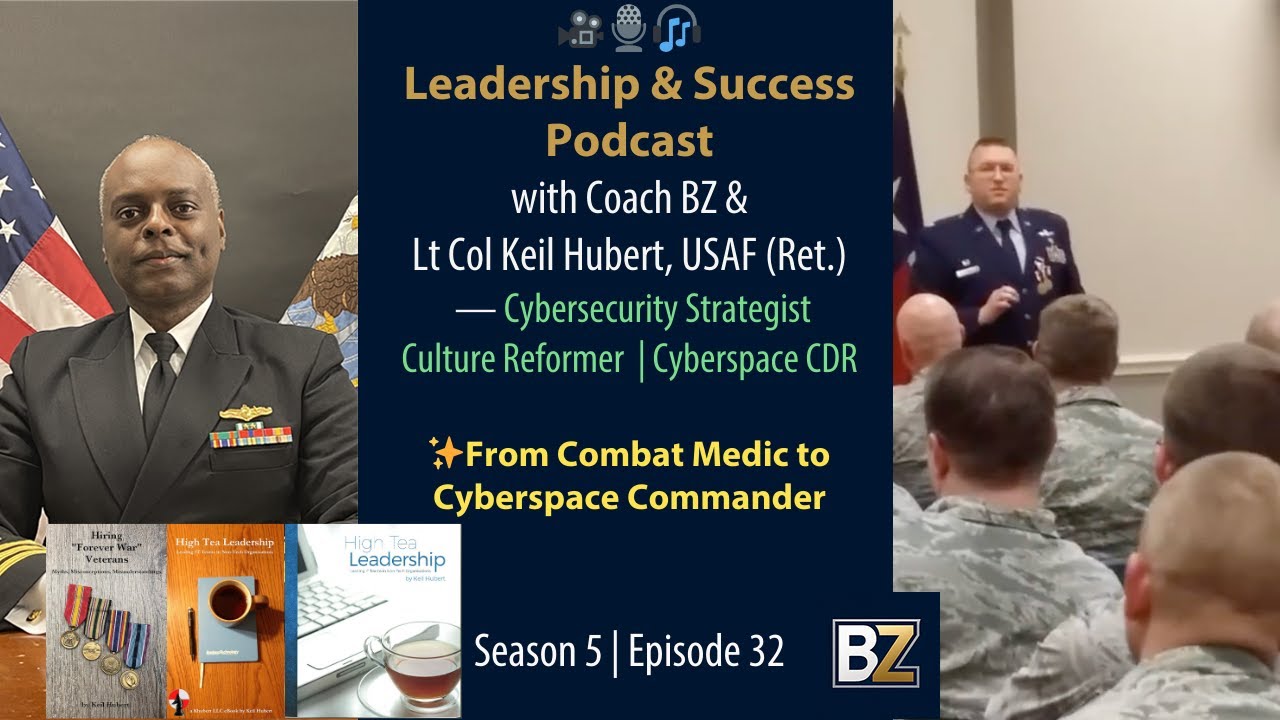
Lt Col Kiel Hubert, retired Air Force officer and current security training head, argues that people, not technology, are the biggest security risk. He emphasizes empathy and clear communication over punitive training, and warns against AI hype in security awareness without human oversight.
Chapters
Hi, I'm John Maxwell. When the top companies in the world are looking for trainers, speakers, and coaches, there's one name that stands above the rest, and that's Maxwell Leadership. Our certified team members have gotten proven results for companies all over the globe, and our reputation, I'm proud to say, is second to none. Some of our members have risen to the top of their profession, including the one you're going to meet today. I proudly introduce you to my friend, Bob Fabien Zinga.
Welcome to the Leadership and Success Podcast with your host, Coach BZ, where we help you lead with purpose and succeed with impact. If you're ready to grow into the kind of leader others want to follow, this podcast is for you. If you're determined to elevate your success and leave a lasting legacy, this podcast is for you. As my mentor, Dr. John C. Maxwell, reminds us, everything rises and falls on leadership. Our goal is simple, to inspire you, challenge you, and equip you with insights that can transform the trajectory of your leadership journey. Welcome aboard to another episode of the Leadership and Success Podcast with Coach BZ.
Biggest threat to IT security is absolutely going to be people. Bottom line is people are wonderful, alright, love them to death. However, they've always got a perfectly valid reason to ignore or circumvent one of the rules or protocols we put in place. In place to protect the enterprise. And that's why we've got to pay particular attention to human factors when it comes to a security plan and not rely only on technology.
Welcome to another edition of the Leadership and Success podcast. I have a very special guest for you just waiting in the green room. And before we get started, I do want to acknowledge Joe Blowinski. Thank you so much for being here. And Joe, let us know where you are joining us from, what city, what state, and if you are outside of the US, which country, and also what you are grateful for today. And of course, if you have a question for our guest, the Colonel, please type it in the comment and we will get to your questions live on the air today on both YouTube and LinkedIn. So for our moment of gratitude for those who've been following us this month, every single day this month, I am really grateful for Black History Month, right? For the role that African Americans have played to build this country. And I really highly recommend this book, African American First, Famous Little-Known and Unsung Triumphs of Blacks in America by John Porter. Really, it is amazing just the contribution that Black have made to this country. They really have built America, made it what it is today, and I am so grateful for that. All right, so before I bring in my guest, let me see if I can properly introduce him. So my guest today is, uh, going to be a retired Lieutenant Colonel and cybersecurity expert. So we do have a lot in common. Uh, Kiel Hubert is a leadership cybersecurity and organizational culture writer in Fort Worth, Texas. And Kiel is currently the head of security training and awareness for the Option Clearing Corporation, OCC, the world's largest Equity Derivative Clearing Organization headquarters in Chicago. Prior to joining OCC, Kiel was a US Army combat medic, so enlisted in the Army since high school, and a medical IT officer following university graduation. He later served as a US Air Force public affairs officer during 9/11 and later as a cyberspace operations officer during the Forever War, spending over 10 years commanding the IT support organization for Combat Airlift Wing. So Keith is a battle-tested cyber leader whose career spanned the US Air Force, the US Army, humanitarian communications support during disaster response, enterprise security awareness, and human risk management leadership, corporate consulting across telecom, cloud, and media sector, and is the author of multiple cybersecurity and leadership books. And he's also an international speaker on culture, leadership, and cyber behavior. Man, he's done so much. From commanding communication unit Supporting combat airlift mission to transforming security culture inside global financial institution. Kiel brings a rare blend of mission leadership, human psychology, and cyber strategy. So ladies and gentlemen, please help me welcome to the Leadership and Success Podcast, Lieutenant Colonel Kiel Huber. Let's see. All right, uh, Colonel Kiel, can you, can you hear me?
I can just fine, yes.
Okay, I cannot see you, your screen is black for some reason.
Uh, I have no idea, I'm showing video on my side, I can see both of us.
Uh, can you maybe turn off the camera and turn it back on. It should be the little camera icon at the bottom of the screen.
There we are. That help?
No, it is still black. Uh, that's strange. I was just able to see you a minute ago. Okay, hold on, let me, uh, get you completely off and you're gonna come back in. Just a moment. Okay, just a moment.
Here we go.
So let's try this. Okay, Kael, you can hear me, right?
Yes, I can.
Your screen is still black. I cannot see you. Hmm, that is very strange. Uh, do you have more than one camera by any chance on your computer?
Only this one, unfortunately. Let me, hmm, let me try changing browsers.
I was able to see you earlier. Yes. Yeah, because my computer is connected to 3 cameras. If I use the wrong one, sometimes it turns black, but that's not the case with you. Okay, this has never happened before.
That's okay, let me drop another browser, see if that helps.
Okay, very, very good. Yeah, one time I've had a, uh, let's see, All right, uh, Kiel is going to come back in just a second. Oh, by the way, uh, Joe, yeah, I am a commander, so, uh, Commander Bob Fabien Zinga, and my call sign is BZ. And usually if you go to my LinkedIn page, I think my rank is at the very top of, of, uh, my profile. And actually, talking about rank, uh, Kaleo is a Lieutenant Colonel, so like me, he's an O-5. And I think it's a very big deal in the military since only 4% of us make it up to senior officer, but he doesn't talk about it at all. So, uh, okay, Kaleo, I can see you now. I don't know what, what you did, but, uh, everything is fantastic. So what I'm gonna do, I'm gonna remove those first 5 minutes before I upload it to all of the other major, uh, pod podcast, uh, of course, platform. But normally I just go live and everything works. So, okay, this is fantastic. And just so that I know, I'm gonna do this and I will know to cut it off. Okay. All right, welcome to the Leadership and Success Podcast, and I'm going to do this one more time. Uh, hold on a second, man. Don't you just love technology? Uh, Let me do this here. Perfect. Okay. All right. So everybody, please help me welcome to the Leadership and Success Podcast, the one and only Kyle Hubert. All right, here we are. How are you doing today, Colonel?
I'm doing great. And just so everyone knows, right, I'm Kyle Hubert. And yes, my name is supposed to be spelled that way. I don't know why.
Oh, Skyle.
I assume my parents may have been drunk. I don't know because no one else in my family uses that vowel combination that way. But it does mean I stand out in search results.
Yes, yes. Very easy to find for sure. So Kyle, sorry, sorry for that. So welcome to the show. We are really excited to be speaking to you, especially now. Like I said, we have quite a few things in common. You started as enlisted and then you ended up as a senior officer in the most powerful military in the world. That is quite an accomplishment. And on top of that, you are also into cybersecurity and technology, which is just fantastic. What a career you've had. Maybe to get started, what is one thing you are grateful for today?
Honestly, I'm grateful that the world didn't end. And what I mean by that is, when I was growing up, I was absolutely convinced that World War III was going to happen, right? All of the, the Cold War hysteria, um, I believed it. And so my only goal was to get old enough to join the military because one of two things was going to happen. Either the whole world was going to be incinerated, in which case, who cares? And the other option was that, kind of like the way, um, Sir John Hackett's book The Third World War as they planned it, we would be able to hold the Soviets long enough in their invasion of Western Europe. There'd be limited nuclear exchange, then maybe we could sue for peace and there might be a future for humanity.
Hmm.
My thinking was, okay, that's the only thing that matters in the grandest scale. So I need to join the army and then get sent to Germany and probably die there, but whatever, at least I'm doing my part to try and save the species. So I never had a plan on a career, a family, living past school. And so I was completely flummoxed when the Soviet Union collapsed.
Wow.
And there I was. I was only in college to kill time before World War III started. So I wasn't taking any classes that would have been good for a career. I was taking classes that interested me.
Yeah, because you joined the Army when you were just 17 years old, right?
Correct. Yeah, as soon as I turned 17, uh, it was actually allowed back then. You could join and then do your basic combat training between your junior and senior years of high school.
Wow.
And then you drill with your unit for a year, and then you'd go on to your actual technical school. And so that's what I did the moment I enlisted.
So you were a medic, so it made sense once you got your degree, then you came back as a medical officer for the Army.
The way that worked was, um, about the same time that the Wall fell, um, my scholarships ran out, and it had hit the point where the, the school registrar had called me in and said, listen, you've got a week to come up with all of your tuition for the next year. Well, the school's ROTC battalion, Reserve Officer Training, had been trying to get me to sign on with them for 2 years.
Wow.
And one of their reps just happened to be— just happened to be in the office and said, well, you know what, if you just sign here, we'll cover all the rest of your tuition. It's like, oh, oh, you opportunistic fun people.
Yes.
And so I signed up and that when I graduated, I did get commissioned as a second lieutenant. And when I was going to go into graduate school at that stage, cause I didn't know what else to do. And the Army then tried to branch me, that is, assign me to a career field as a medical doctor.
Wow.
I was not in medical school. It turns out someone in personnel had confused when I said I wanted to go on and get a doctorate that that meant I was an MD.
Wow.
And when I explained that's not a thing, they put me on hold and said, we'll get back with you at some point during the year. So I had to go get a corporate job. I relocated. I moved.
Really?
And then about 3 weeks after I got engaged to the love of my life, the Army called and said, hey, remember us? Um, we found what we want you to do, and it's because we're very short in this career field, so we'll bring you on active duty in October.
Wow.
Thanks. Again, all unplanned.
Yes. That's amazing. So that's when you became a medical officer then?
Yep. Operations officer at first, and then again, through a series of wacky misadventures, wound up getting moved over into the medical IT field.
That is pretty amazing. Because initially, when I was enlisted, I was thinking about even becoming a medic, doing IT. Because back then my dream was to go to medical school. I was like, well, maybe the Navy may just pay for it, but I ended up doing IIT. So like they say, the rest is history. Now, how in the world did you end up going from being a medical officer in the Army to becoming a PAO in the Air Force?
Tell your story there. That would be a family thing. It turns out the family that I married into, right, my wife's family, Her grandfather, her father, and her baby brother were all serving in the same Air Force unit. Wow. And they had been continuously since the 1950s.
That's amazing.
When her grandfather got off active duty after World War II, he joined the Texas Air National Guard and rounded out his career. Her dad joined in the 1960s as the guy with the giant Q-tip that would clean out the rocket tubes on the F-86s. And then later worked his way up after 40 years to be like the command chief master sergeant of the wing. And her brother is still serving, right? He is in his— I believe he's going to be retiring this year after a full career as first, uh, essentially the work loading and unloading the planes until he finally, after incredible determination, made it into becoming a navigator.
Wow.
If you think about the way inter-service rivalry works, every single family dinner. One grunt, three zoomies.
Yeah.
And they would lay into me with every Army joke they knew.
Yes.
Which are true.
For example, what you already shared, what the Army doesn't know how to read. They think a doctorate is a medical doctor.
Exactly. Exactly.
And so, okay, I have a lot of Army folks who are watching. I'm just kidding. I'm just kidding. But go Army. I mean, go Navy, beat Army.
And so one night, um, I'm, I'm over at, uh, the in-law's house, and father-in-law hands me a stack of papers and says, hey, we have a bunch of jobs open. Why don't you put your resume on one of these, send it in, and apply? I'm like, okay, sure, why not? I did. And almost a year later, I got a call out of the blue. Hi, we're with the 136th Air Wing, and, uh, you applied for a job with us. And so we'd like you to come out and chat.
Wow, chat?
Are you kidding? I'm a grunt. Like, yeah, show up here at this time or I'll hit you with a stick.
Yes.
Okay, chat. And sure enough, I was like, well, look, I've got a job in Dallas I have to be at, I can't miss. Can we do it early? So they set up a 6 AM chat for me.
So at the time, so that means you were in the Army Reserve then? Right.
At that point, yeah, I was finished my time in the Army Reserve.
And what was your rank there at the time?
I had made it to Captain. Captain.
So that's O-3. Yep. Lieutenant of the Navy. Very good.
Yeah. And so, you know, I show up at this Air Force base, and I go to this area where all the buildings are under construction, and there's only one light on in one building. So I figure that's where I'm going. I go through this empty building, I find the command suite, And behind this amazing hand-carved wooden desk that looks like it costs more than my car is a young airman.
She's so— talking about the airbase, did you see the, uh, running strip and the golf course before you got to that building?
I did, yes.
They have the best food, don't they, the Air Force? Oh yes. Anyway, another thing we have in common, my father-in-law was in the Air Force. He retired as a tech surgeon. But anyway, very nice. I have a lot of jokes for airmen too.
Good. I probably resemble them. So I asked her, I said, hi, I'm Captain Hubert, I'm here for a chat. She's, oh, you're here for the board? Wow, the board? She said, oh yeah, they're ready for you, go on in. Well, okay. I go knock on it, and I, I put on my dress uniform exactly as it had been in my last unit before coming to Texas. Um, I open the door, there's these 3 angry diet colonels sitting around the table. Sorry, Lieutenant Colonel for the civilians. We call them diet colonels because they have all the pretentiousness but none of the authority. And the first one looks at me with this, just this look of disgust and says, well, what qualifies you to be our public affairs officer?
Oh my goodness.
And first thing that came to my mind was, oh hell, you got me. I don't know. I honestly didn't know I'd applied for that. Um, I really didn't. So I said, all right, well, I'm already here and this is a performance, so what have I got? What have I got? What have I got? Oh, sir, it would be the symbolism in this patch right here on my left sleeve. You see, the twin lightning bolts of U.S. Army Civil Affairs and Psychological Operations Command represent the use of the truth itself as a weapon system, a weapon system I am fully proficient with. You bring to bear on your strategic problems.
Wow.
I thought I would be thrown out immediately for shoveling such an amazing amount of horse manure. Yes, they start writing that down.
Oh my goodness.
Oh God, I'm so cooked. And somehow I got the job.
Wow. Well, amazing, amazing. So like we said, the rest is history. So you started as a PAO. So how did you get into technology, cybersecurity, and IT?
I had already been working in IT informally in the Army. I was the battalion information management officer because at, down at Fort Hood, because I was the only one that knew how to fix computers. In fact, our company was the only one that had a computer, so I got a whole bunch of scrap from the hospital and rebuilt it into a functioning PC so that we were the only ones that could type. Our weekly reports, and they were impressed by that. Then I got made the deputy group information management officer, and I got to be part of bringing in the very first computers that the organization had ever had.
And then, amazing.
And then that's what got the attention of a, um, a fellow from the 70 Delta career field. He just happened to be visiting one of his old college friends, and we struck up a chat. He said, you You want to do this for a living? I said, yeah. And next thing I know, I'm getting transferred to Fort Rucker, Alabama to be the department chief of IT for Lister Army Hospital.
That's amazing.
So I had the background at that stage.
Wow.
That is different because in the Navy, you actually go through a whole bunch of training before they give you an IP or IT billet. Wow. That is pretty cool. Once you are in the Air Force then as a PAO, when does the transition happen from PAO work to cyber stuff?
It was post-9/11 after we got done with the airport security mission. And the very first commander of the communications, the IT support flight, had retired and they were looking for a replacement. Well, of course, I put my name in the hat because, well, two reasons. One, I just wanted the interview because I love to interview. But also because I knew I could do it. And as it turned out, my— one of my best friends in the world, Wayne Sanahan, he was a, a civil engineer by trade, and he also wanted the job, so he told me. And I knew, first off, he is, um, incredibly charismatic. People just adore him. They find him lovable, and he's incredibly smart. So I'm like, okay, I have no chance of getting this. I'm just doing it for fun. And sure enough, it took so long to get to the, the actual interview. It happened on a weekend when we were doing, um, chemical warfare survival training, and I volunteered to be an instructor because I'd gone to the nuke, bio, and chem school at Fort Hood. So I'm interested, man.
You've pretty much done everything now.
A little bit of everything weird. Yeah, I'd also talked my way into the, um, medical aspects of chemical and biological warfare school Wow. At Fort Hood, which was fabulous. Anyways, so the day comes, Wayne go— I run into Wayne in the hallway and I said, hey, good luck, man, you got this in the bag, but you know, do your best. He said, well, no, I, I can't. What do you mean? He pulled out this letter from his coach and look, the state told me that they, they mistakenly said I was qualified because they thought computer engineer. I'm not.
Oh my goodness.
And so according to this, I can't do this job. I said, well, what are you gonna do? Well, I have to tell them. I'm honor-bound to report. Yeah, they're going to ignore it. He said, but they can't, the regulations are a lot. Dude, they love you. Find a way. Just— sure. Went into his interview, he gave them the letter, they looked at it, folded it up, looked at their book, and never mentioned it again.
Wow.
And knowing that, when it was— when I knew it was my time, I knew that what I was supposed to do was leave the training, go take a shower, put on my dress uniform, be all spiffy, and then go in and pretend I'm having a real interview instead.
And what, what, what was your Air Force rank then? You were— you a captain?
I was a major by then.
Major. Okay, very good.
And I decided, no, I'm gonna stay here and train another group of 40 airmen how to survive, because that to me is more important. Yes, looking good. And so I went into the interview in the, the mop suit, the chemical battle suit, with my harness on, helmet, you know, under one arm. And when I came in the room, you would have thought that I brought in a goat and slaughtered it on the table. I mean, the inner— their eyes were wide, their jaws were agape, like, how dare you? Like How you doing?
So you didn't have your service dress uniform this time?
Yeah, I just, I said, you know, it's not even worth the effort.
Yes.
And I gave the interview. It was very clear they didn't care.
Wow.
But then when the time came to actually award, the protocol back then was you had to tell all the people that had not been selected first and then tell the selectee. And so because I was former Army, there was this kind of idea that I was some sort of mad murder monster, you know, inner service, um, yes, yes, prejudice and legend building. And so the poor colonel, they got to come in and tell me.
I could—
I knew, I knew it was fine. I wasn't upset. He comes to my office and says, hey, I just wanted to let you know that we picked— and I swear to God, he flinched like I was going to hit him. And that insulted me. So we picked Wayne Santa Fe. I said, hey, you know what, that's exactly who I would have picked if I were you. You made a great decision. You're gonna be happy with him. He's a great guy. Again, I already knew. They went into— and he said, oh, you know what, that's— I'm so glad that you're mature that way. You were our second choice. No one else came close. I said, whoa, whoa, Colonel, do you— we can take that. We can completely say that you never said that. I am willing to pretend you didn't say that.
Wow.
No, no, it's true. It's true. Like, oh God, you're gonna be in so much trouble. And sure enough, they went to tell me, said, oh yeah, thanks, I was just interviewing for fun because I've already moved my family out of state. I won't accept it. Two weeks to try and figure out how to disqualify me, um, and they couldn't. They screwed up so badly and they got stuck with me.
Wow, that is amazing.
I told you, my life has been unplanned and a series of wacky misadventures. I honestly wonder sometimes if I'm actually a Looney Tunes character.
Wow, that is quite, quite amazing. And I'm guessing at this time you were also doing IT work as a civilian, right? Okay.
I was working for, uh, yeah, I was doing, at that point I was in, I just gotten done helping to install the maintenance system out at Dallas.
That's amazing.
And then I was doing troubleshooting work for one of the, uh, in KPMG Consulting, going all over the country trying to fix stalled projects.
Fascinating, fascinating. Because, uh, what I've seen, especially when people after they go on active duty, even they join the reserve or the National Guard. Sometimes what they do as a civilian has absolutely nothing to do with their MOS or their billet. Like, I've had a lot of people in IT, even chiefs. He does IT for the US Navy, but as a civilian, he's like, I don't know, a social worker or something, which has absolutely nothing to do with technology, which is pretty crazy. But for the people like me who do the same job for the industry and for the military, I mean, you really get to learn so much, right? Because it kind of built on its own. So let's see, when was the first time you realized, I am responsible for people's lives, their careers, and mission success? And how did that moment change you?
Yeah, that would have been 1988. It was— so it was the summer. I was on— we in the Army National Guard, you did just like in the reserve, you do a 2-week, um, muster, usually in the summer so that, you know, students can attend, where the unit goes out and practices the war games and whatnot.
Annual training.
Yeah, I had missed annual training in January up in, um, they were going to do Arctic weather training, and because I had school, so they sent me out with, uh, me and 4 or 5 other people with another brigade, and I got loaned out to, um, a battalion to be an ambulance, uh, squad leader. So me and one other guy had our armored ambulance. You want to get down, little man? There you go.
Yeah, I love how the military does that. Sometimes they just need the body, they don't care what you can do, right?
And so it was just the two of us and our M113 little armored ambulance attached to a battalion aid station to run casualties back and forth to the medical company. Well, one day, I mean, this is— it's Texas. It's August, so it's hot as fuck.
Yeah, yeah.
And my driver and I, we were bored, so we turned on the tactical radio and just scanned channels until we could listen to some unit somewhere doing an exercise.
Hmm.
And they were in the midst of a full battalion-sized armored assault, right? They had all their vehicles screaming across the land, throwing up big rooster tails of dust, and, you know, something very cinematic. Which is good training, right? You have to know how to do this. Anyways, while we're listening, one of the, um, one of the vehicles calls into their battalion commander, says, hey, we just had a soldier fall out. Oh no, collapsed in his vehicle. We're like, huh, that's weird. So we listen, we turn up the volume, said, yeah, you know, everyone's in their chemical battle suits, which wearing mop gear in the summer right, when it's over 40 Celsius, 100 degrees Fahrenheit, is brutal. And doing it in a giant metal box, right, is even worse. And so what the commander told the soldiers on the line was, oh, he's probably just hungry. Have him sit down and eat something and continue the attack. Now, we knew, right, no, this guy's probably in severe heat stress on his way to heat stroke. He's dehydrated. But if no one does something, this guy has a good chance of dying out there. This is terrible. What do we do? I realized there is no one else doing it. So thinking fast, I grabbed the microphone, put on my best grown-up voice, and said, uh, such-and-such commander's call sign, this is, um, Medical over command. We have been monitoring your exercise. Belay that last order. Take that, get that man out of his mop suit and get him to battalion aid station immediately.
Order.
Medical command out. And like, okay, I'm gonna get court-martialed and probably shot for that. But as it turned out, 15 minutes later, an M113 comes screaming up to our battalion aid station. Wow, with that guy in the back. He was out of his outfit, he had soaked through all of his clothing. He was— they were trying to get water into him.
Wow.
And there's the commander, the XO, and the sergeant major all telling our physician's assistant, yeah, are you gonna let medical over command know that we complied with their orders? And he just looks at us like, what did you do? Hmm. We went and hid in the woods. But also it turned out that the, the guy that had collapsed was one of my squadmates from our home unit, and he was in fact in danger. I mean, he was going to heat stroke.
Hmm.
I like to think we saved his life by essentially on the spot improvising, innovating a way to try and correct a potentially lethal decision. And wow, as an 18-year-old That just— it, it really hit home. Someone's got to do something, and that someone is whoever is closest to the problem, regardless of what it costs them. And somehow we got away with it.
But wow, that's— that is really something. Like, in the military, you know, we do a lot of deployment exercises and things. Now, I guess throughout my career, I guess I've, I've seen 3 people die. One was a man overboard, and then two people actually died during the physical test, just running, whatever. Yeah, they had a heart attack or something went wrong. I knew them and they just, uh, fell and died. So that can be very, um, traumatic, right? I don't think there is any other jobs out, out there where you have this probability of seeing so many people dying around you, especially during wartime. If you are assigned, let's say, to Afghanistan, Iraq during the war on terror, knock on wood, people I knew that went there, they all came back, but they didn't always come back mentally all together. So what have you done throughout your military career to kind of ensure your mental health and just keep keep your focus and your health as good as you could, relax or whatever, just take care of yourself. What type of things have you done?
Well, the most important thing I did was one of the rules I live by is take your mission seriously, never take yourself seriously. You cannot get so wrapped up in your own drama that you let it sway your judgment or negatively affect other people. So what I tried to do was focus on who can I help, whether that's a member of my own squadron that I have command authority over, or just a— you know, had a great friend who worked down in the, um, Equal Opportunity Office, uh, just absolutely fabulous colonel who was going out of his way to help everyone in the wing especially those who felt that they were being potentially discriminated against.
Yes.
And so I would constantly go check on him, make sure he was doing okay. And in turn, to this day, he will still reach out and ask me how I'm doing.
Wow.
And I found that's the best way is instead of internalizing, wallowing in whatever your own drama is, put a lid on it. Not hide it, but just Set it to the side, and the satisfaction you get and the encouragement you give helping other people—
yes—
to lessen your anxiety and stress.
Wow. Now, I, I would say that you are a scholar warrior, a thought leader. You write a lot about leadership and culture and technology as well. I'm gonna highlight just 3 of your books. You've written so many, but this is one, IT Leadership. And you have that one available in ebook as well. And also this one, Hiring Forever, or that one. So I believe it's about 6, right? 6, maybe 7 books you've written so far. And of course, hundreds of columns. So why is it important for leaders to write, you think?
The reason why I find it important is because by what it does, it requires you to really interrogate what you believe. And then it— it— you need discipline to be able to communicate precisely, clearly, and accurately what you believe, which then again gives you feedback on, okay, is this what I really believe, or to what extent? What are the nuances? Um, and for me, the whole reason that I started writing for, um, Business Reporter back in its old Business Technology, uh, brand They were auditioning guest talent and I volunteered. I realized I can reach a much wider audience of people that maybe if I can tell a story that educates while it entertains, maybe that's going to help someone.
And also, they are based out of the United Kingdom, right?
Correct. They're based out of London. I've been there. I've gotten to meet the staff. I've also got to present at one of their annual symposiums, which is absolutely fabulous. In fact, this article that just went live this morning is the history of why I wrote each of the books.
Wow.
So it's free, doesn't require any kind of a membership, or there's no paywall to it. But again, what I wanted to do with each story was try to find a point that might register with someone, and if not change their mind, at least get them to consider, what do I believe? And why. What does it mean to me? How does it affect people? And books, honestly, I just did those as, oh, each one was designed to help a single person.
Yes.
And then once I got the content done, I said, well, it costs nothing to, you know, self-publish it. I don't intend to make money off of it. And I do tell people, if you want one of my books, let me know what it is, and I will buy it and gift it to you. If you're going to take the time to read or listen to the audiobook version, That's an investment from me to you. I just want it to help. Yeah.
No, that is, that is powerful. Let's talk about— I especially like this one, IT Leadership. This is the Leadership and Success podcast. Anyway, Leading IT Teams in Non-Tech Organizations. Why did this book need to be written? Why did you write it?
Yeah, so It was specifically for a friend of mine who was going to do exactly that. I had already had the experience, you know, both at being the department chief of IT at Lister Hospital and then all the work at Fort Hood and all these other things where I was working doing IT support for people or organizations that IT was just a support function. It wasn't integral to their business. And so they were particularly interested. And the experience that gave me the title, it was, I think it was after the first time I was laid off at Verizon or at Yahoo back in the day. And I had gone to a convention over in Irving, you know, where you get to meet a bunch of HR reps, give me your paper resume. And I just stopped for a moment by a booth to organize my paperwork. And a young lady said she was the representative for some company. She said, hey, are you interested in being, uh, and it was something like an entrepreneurship kind of role. Like, oh no, no thanks, I'm, I'm, it's not really what I do, but thanks for asking. She said, well, what do you do? I said, oh, I'm looking for a role in IT leadership. And she just kind of thought for a minute and said, what's IT leadership?
What?
Yeah, she misheard, but that's okay. Uh, and my My first instinct was to say, oh, it's just like regular IT, but it's done by the British. Instead, I clamped down on that and realized she's not dumb. She misheard, and God knows I've got enough hearing damage. I mishear things all the time. But also, how do you not know what this is? So I talked to her about it. I explained. She said, oh, okay. And I realized just having that small chat with her dependent upon tech, but she had zero interest in it. Didn't care how the computer works. She just wanted it to do its thing so she could finish her task and go home because her work was just something she does to live. It wasn't part of her core identity. And that's really what got me thinking about it is how do you actually provide IT services in an organization where, as far as they're concerned, you're just talking nonsense with made-up words.
Yes.
What do you mean I have to reboot the router? So yeah, okay, press the red button. And actually have empathy and respect for your customers, your critical stakeholders. You need to meet them where they are and not be upset with them because they're not as technical as you would like them to be.
Powerful. No, this is great. So the other book I wanted to highlight is this one, Why did this need to be written? Hiring for war veterans— I really love the title— myth, misconception, and misunderstanding. I guess there are quite a few.
So I wrote this for two people, actually. One was for a friend of mine who was going to transition out of the military and wanted to know how difficult it was to actually get a job offer. And there was a lot— this was back during, um, the Afghanistan kerfuffle, and there was a lot of unconscious, but even conscious at some point, bias against returning veterans. And if you remember back then, it was the classic, oh, soldier comes home from Vietnam and he's a psycho killer now. 8 o'clock on CBS every Friday. And the idea that we would all, all of us, everyone would be unstable or psychologically damaged or unable to work because our legs would suddenly fall off. It was ridiculous. It was harmful. And it also completely missed the point of what a veteran brings to the table. Yes. Sometimes a civilian doesn't. And so I wrote it from both perspectives, from the job seeker, how to overcome that bias and really sell yourself, but also for hiring managers, especially. Remember, most people don't know how to interview successfully. Especially on the hiring side, which is why you get so many questions like, if you were a tree, what kind of tree would you be? Yes, the kind you carve into a club to beat you senseless with.
That was a good question.
Yeah, trying to actually present arguments, I, I figured what most people would do is someone would take like one section one block of text from that book and give it to someone in their organization to help them improve. And again, if it even helped one veteran get hired when they otherwise might not have, then the whole project was worth it.
Wow, that, that is really, really fascinating. And thank you so much for doing so, because I think a lot of people need to hear it. Right. And there's so many people, especially when they Now, if you go from the Reserve or National Guard, that's not such a big leap, but from active duty and then you come back home and getting a job in the industry, I mean, that could be quite a traumatic experience because it's completely a different world. They may just as well just drop you in the jungle and in a country where you don't speak the language or something. Right. But yeah, so that's really helped.
And that's one of the things that I've tried to mentor people on, again, both sides. I used to have the most wonderful interview opportunities in the military because you could do things there you can't do in a regular corporate environment, like have live actors interrupt the event to essentially make an interactive encounter that the interviewee, the candidate, is not prepared for. We were, when we were trying to hire a new Chief Master Sergeant, right, an E-9 for our squadron. Um, one of the things that we wanted to deal with was we had had a real sexual harassment encounter that had cost an airman— well, two of them— their, their respective jobs because we couldn't tell who was at fault, and by regulation they both had to go. So we wanted to stage that exact scene. So I got two of our people to practice and do the role of essentially an illicit couple that were flirting in the workplace. We designed it to where we bring the candidate in, we're asking them all the regular questions, but we had measured everything out to where we knew exactly where the average person's peripheral vision would cut off as long as they were looking at me. And the actors had their marks where exactly where to stand to be noticeable, but not— they couldn't be actually seen without turning your head to the side. They had their— they had practiced their lines, uh, and got louder. And I mean, I am— I am doing the, um, Hannibal Lecter thing of not blinking while just staring directly at the person's eyes with the world's longest run-on sentence. It's like a good 60 words long, and I never stopped for breath and never got to the point. Basically buffer overload at that stage. And then finally, once the shouting and the shoving starts, oh, I'm sorry, didn't we tell you you Yeah, you have the job, uh, and this is your problem. Fix it. And that's how we figured out who was the best candidate for the role. Yes, was a former MP, military policeman, who knew how to suddenly put on that persona, God bless them, project in something they didn't understand in order to prevent physical harm. Yes, uh, that was a much better selection than the person who looked over and just collapsed in hysterical laughter.
Yes.
Because they realized what was happening and just thought it was hilarious.
Wow, that is quite a way to interview. You definitely see the qualities that you need, if they have what it takes, because de-escalating is important. Wow. So because you are a tech executive SME, subject matter expert, let's talk about AI and human risk just for a second.
Sure.
How will AI reshape security awareness and human cyber risk, you think?
About the same way that a truck reshapes a bakery window and plows through it at 100 miles an hour. Now, keep in mind, I'm not anti-AI. I am very much anti-AI hype and misuse. There are definitely use cases where it has potential value.
Yes.
However, it needs to be done ethically and cautiously and never— I believe agentic independent AI is a terrible mistake. I think there always needs to be a human in the loop that can look at it and say, you're hallucinating, this is garbage, we're not doing that. But right now, the hot thing for everyone who's doing security awareness as a service is to build AI into their products or services just because it's the, it's the hot new buzzword.
Yes.
And I think this is a terrible idea. We already had really great machine learning tools to be able to do like anomaly detection. Why is Coach BZ logging in at 3:30 in the morning from Ulaanbaatar when he's based in Chicago? Hmm, that makes sense. This could be a hacked account, could be a breach, or he could be on vacation, but he knows he's not supposed to log in from overseas. What the heck?
Hmm.
Those kind of tools are really good for presenting potential evidence that a human can then judge and investigate, verify, act upon.
Yeah, I like that.
Nice. AI, though, it has no memory. It has no sense of context. It has no judgment. And so the idea that you're going to let it now choose what training to deliver to people and when and to determine whether or not they're successful, what I believe is that A lot of well-meaning companies are going to roll this out. It is going to cause more harm than it provides benefit. And then we will go right back to having an educated, experienced professional human running the program using AI to supplement and maybe speed up some of their activities.
I couldn't agree with you more. Like, right here in Silicon Valley, I wrote a couple of articles about it. Big companies like Meta, Google, initially they said, oh, AI is not going to take away your job. Make it more efficient. But then when they had the chance, they fired a whole bunch of software engineers. But then, like Google, I'm sure everybody knows about it, their AI decided to delete an entire hard drive and they couldn't get it back. Now, the AI algorithm was sorry about it. But anyway, needless to say, they started hiring those software engineers back because it might have worked in a small controlled environment in a lab or something, but going out in production, it just was a disaster. So they needed that human oversight for sure. Now, I don't know if you've heard, this morning I wrote a post about, I believe it's the first time in our history that we've actually used AI to enable a military operation. Operation Absolute Resolve, where we, it was in Caracas, Venezuela, January 3rd, where we extracted the president of Venezuela, it was actually aided by artificial intelligence. Claude, FOP Claude, was definitely one algorithm that helped them design the operation and execute on that. What, what are your thoughts about the US military now using artificial intelligence to enhance our military operations?
Absolutely terrible idea for the same reasons mentioned. I'll bet you $100 that the using AI for the mission could barely be justified by taking things out of context. I'll bet it was probably someone was told to use it because they needed to brag about it. And just like every soldier's, you know, EPR, OPR, the performance review, I did an amazing thing that no one else has ever done. You should promote me. And the thing they did was, oh, I saw using AI. I checked the time on it and went about my day.
Yes, yes.
I, I, I really believe was probably overblown. Um, but again, I don't know, I wasn't there.
So, but I don't know, I do have a lot of concern about ethics, right? And I know our laws, especially in this country— Europe is a little bit more advanced, I think, when it comes to privacy law and just upgrading the law to the 21st century. Because for example, in America, right, our privacy law is what, 1974? I mean, before we had really the use of computers, cloud, AI, and emerging technology. So we are so far behind. Basically, we are using technology now that our laws really don't have any say. So we need to upgrade a lot of our laws in this country for sure. And then again, thinking about ethics, just because you can do it doesn't mean that you should, right? Thinking about what is the right thing to do and what the impact is going to be on the community. Definitely the human oversight, like you mentioned, I think, especially in the military when it could be a matter of life and death, right? It is absolutely, absolutely critical. So what would you advise then? What skills will tomorrow's cyber commanders need that today's leaders lack, you think?
More than anything else, they need a deep understanding of how behavior affects security risk. I'm not just saying that because I'm a security human risk management person. But no matter what technology you deploy, you cannot engineer your way out of risk. I mean, yeah, you can put constraints and protocols and kill switches, all these other things in your tools. But anything that you create and give to people, they will find an amazingly creative way bypass all of those controls, especially if they think that they need to for some reason. And this is why you got to get into what are people going to use your solution for? How, where, when, why are they going to employ it? What are the things that they could try and misuse it for with the best of intentions? And you really have to do this. If you are so hidebound that I am officer, I give order, my robots obey, First, you should not be an officer at all. You should be, you know, compost. Second, you've got to have empathy for, respect for, and interest in the people that are going to be using your tech. And this goes the same, not just in the military, but in the corporate world. As Joe from Tucson put in the chat earlier, you know, how do you communicate the need or importance of a security issue to people who don't want to know or just want the thing to work so they can get on with their day?
Yes.
And the answer in both cases is you've got to address the person's concerns and mindset directly, show some empathy, say, yes, I know you just want to get it to work. Here are the things that can go wrong. And I'm telling you this so that you will get the result and be able to leave without any drama. I'm here to help you succeed and lessen your work, not to annoy you or get in your way.
Wow.
And usually once people see that you're genuinely interested in their success, yes, at least then open to listening. If you can keep that up, build that rapport, yes, they're more likely to want to hear what you have to say because you are giving them an advantage they wouldn't be able to secure on their own.
That is leadership. No, I think it was Oprah who first said it, uh, people don't know how much you People don't know how much you know until they know how much you care. Something like that. So powerful. And of course, you've written a lot and you've learned it, I'm sure, in the Army, in the Air Force, in the Navy. We talk about that too. When I had the privilege of being a commanding officer, it was really one of two of my leadership maxims: mission first, people always. What does that really mean to you?
Absolutely. The task you have to do must be done. You're going to figure out a way to do it. But at the same time, you are also trying to conserve and improve the lives of everyone, not just at work for you, but that you come into contact with.
Yes.
The idea that you should ignore risk to people or long-term harm to people just for the sake of accomplishing a mission is criminally negligent, I believe. Sure, in the military especially, there are times you have to order someone to their death, and it is— it's devastating. It's almost unrecoverable. But at the same time, you know, even though that is a requirement and you will do it when called upon, you want to minimize those, uh, those encounters. You, you want to send people home to their family intact if possible. At the end of whatever conflict you're involved in.
Yes.
There's no excuse for squandering people's lives or putting them in danger or acting irresponsibly. One of my friends was in a medical battalion at Fort Hood, and during one exercise, um, because of some severe mismanagement, a bunch of the internal perimeter guards at their maintenance base were exhausted. One passed out. Just in the middle of a road. Hmm. Commander came back and they are required to have a ground guy, that is someone walking in front of the car at night to make sure they don't hit an obstacle. This captain was too busy. He didn't want to get out of the car. So they ran over this kid's head.
Oh God. Oh my goodness.
Exactly. That was 100% preventable if they just done what they knew they were required to do. Wow. They chose not to, and it was a catastrophic result.
Hmm.
That's the people factor.
Yes.
And I'm sure I had met that guy. Um, I'm absolutely sure he had rationalized why it was okay for him this one time to not follow the rules, blah, blah, blah. And the answer is no, actually.
Mm-hmm. Wow, that is really, really terrible. Now, when I had again this great opportunity to become a commanding officer, I probably sent about 12 or so of my sailors, some of them in armways, combat zone. Knock on wood, all of them came back in one, in one piece while I was still there. But yeah, it's, it is a huge, uh, responsibility, uh, when you sign orders and you know that this person is going to a place where, you know, potentially they could not come back to their spouse and to their children, but it is something we have to do. There is just no way around that. And I guess earlier, you know, I asked, you know, being a Lieutenant Colonel in the U.S. Air Force, a senior commander, I guess that, I guess it's a heaviness, I guess it's a burden of command. How do you deal with it. Because I think part of it, I think it really never goes away because you never know. You could get a call at midnight or 1 or 2 in the morning, some, some something happened, and you would definitely feel at least partially responsible. Although everybody who's in the military has volunteered to join, nobody was forced to, and they are doing this because they love their country and they want to serve and sacrifice for their fellow fellow citizen, but it is, it is quite a responsibility though.
It definitely is, especially when you get into the really fringe cases where you've got, say, someone who is violent or someone who is suicidal or severely injured. Um, what I found is most of the commanders would commiserate and, and use mutual support because only another squadron commander or someone who had done the job before could really understand what you were going through. And so that's why you'd see the commanders getting together to get as much coffee in them before their next meeting as possible.
Absolutely. Your networking, your peers, and your mentors that really make a big, big difference. Thanks so much for sharing. So we have one question from Joe. Joe is asking, what— hold on. Yeah. Is there a particular piece of advice you have for effectively communicating the need or importance of a security issue to those who don't know or think about the jargon but just want it to work? That's a good question. Yep.
And that's what I was alluding to earlier with you've got to actually communicate with the person, understand their perspective and how they feel, not just what they think about whatever the equipment is they need to work on, the process they need to follow. Good example of this that I'm allowed to talk about from my time at OCC, which ended back in January of this year. One of the things we tried to do was get people to really get interested in scam defense. So instead of just doing phishing tests, we made them scrimmages. And the idea was, if you— even if you fell for one of our completely made-up scam emails, If you still reported it afterwards, not only did you not get in trouble, we sent a letter of thank you to your supervisor. Talk about how great it was. Yeah, Bob is living our corporate values and is doing the right thing, even though it's embarrassing. They deserve praise for demonstrating what it means to truly be a valued member of our community.
Wow.
And this completely turned around people's attitudes towards all of the practical stuff that we would do. And we got an entire community online inside the organization that would share the scams that they found or that happened to people on the outside. They discussed articles they'd read. And there was also people who would call us after a scrimmage. Ha! You didn't get me. I saw that and I saw this. You got to be better next time. And that's exactly what we wanted, for people to embrace it. And treat it as a challenge, but an enjoyable one that they could win, rather than as something that was either an annoying interruption or something designed to make their life worse, getting in trouble.
Which is powerful.
You should approach almost all practical training— you got to get people to want to participate.
Yes, yes. Wow, that is quite powerful because I know back in the days Most security executives would kind of lead by fear and all of that. But when people actually engage and they want to do something positive, you really can impact and shape positively the culture of your organization. Okay, we are almost running out of time. Let me ask you this. What do you think is the greatest lesson you have ever learned, just in general, in life, in leadership? Greatest lesson you've learned so far?
I—
no question about it, it's what I started with when we were first talking. Take your job seriously, never take yourself seriously.
I like that.
You got to have humility and realize everyone else is probably smarter than you in some way. And it's— instead of being resentful or feeling competitive, learn from them.
That is, that is quite Powerful. Because now looking at your background, everything you've done, you've been everywhere. You've been a medic, a medical officer, you've got into PAO, public affairs work, and cyber, cyber commander, and all of that. And then you are an author, and I mean, it's just on and on and on and on. Why do you think you are so successful in so many areas? What do you believe is the secret of your success? And then of course, getting in at the lowest rank possible, as a 17-year-old and then retiring as an O-5 Lieutenant Colonel in the US Air Force. That is huge. Why were you so successful, sir?
Well, because I learned very early on after the Soviet Union fell and World War III didn't happen, I had to adapt very quickly. That meant learning as much as I possibly could in as short a time as possible, and then very quickly getting good at whatever I was called upon to do. And that's what I've been doing ever since. Whatever I get thrown into, learn as much as possible, leverage my network, get all my resources, constantly study and expose myself to new ideas so that I can dive in and figure out how to deliver value.
Hmm, that's good. And talking about the, the end of the world, I think many of us growing up during that time, we felt the same way. But what about Y2K? Did that impact you in any way? Because it's It seems like in 1999 the world was going to end, but all of a sudden looks like nothing happened. It was just a little glitch and it wasn't very consequential. Did you learn anything from that Y2K experience 25 years ago?
So I was on call for that, obviously, because I was a PAO at the time. But I remember the week before Y2K happened, I was in a bookstore with a couple of friends of mine and we were in the computer section back when that was a thing. And this, this older couple came up and they asked if we knew about technology. And yes, one of the fellows with us was an actual corporate sysadmin at the time. And they said, well, what do you think is going to happen? Are all the satellites going to fall out of the sky? Will the buildings catch on fire? And he said, what's going to happen is that on the 1st and 2nd of January, you're not going to be able to buy tires. And they just stopped, just He said, let me make it clear. Small companies don't use technology. They're not dependent on it right now. So they're not going to be affected at all. Medium-sized companies are dependent on it, but don't have internal IT resources to mitigate the problem. So for them, their software breaks, they won't be able to use their, you know, computerized cash register or their order system. So places like, you know, the gas station, the corner markets, the small hobby shop, they're going to be affected. But corporate entities, they've been preparing for this for years. They've already got it fixed. And they also have the ability to just turn stuff off. And they have backup systems to work from because that's all part of their redundancy. So you really don't need to worry about gangs of roving cannibals in the streets.
Yeah, the sky is falling, the sky is falling.
It's not. You're just going to have a little bit of inconvenience. Well, people that got caught off guard roll back to their old manual processes. And I realized, yeah, that's actually a perfect way to think about it. Think about the human side first, as opposed to buying into all the hype.
So I guess if I take you up, I guess, 26 years later, where we are living now with artificial intelligence now being used in the military, robotic, you know, potential nuclear war, and all of that, what would you advise someone who's listening right now who might be afraid that the world is going to end again, maybe climate change or whatever, there is always something. What is your advice for an aspiring leader who's living in this world where there are potentially, you know, a thousand ways of this world ending in another war or catastrophe? What should they focus on, you think?
Do something, anything. Obviously, I can't influence Congress. They don't know I exist. I like to keep it that way. But what I can do in a role, maybe I can reduce water consumption in my data center, or I can buy more power-efficient computers, or I can shut down unnecessary systems. Or I can, you know, there's always going to be something you can do incrementally improve the problem. I can also use my platform online to advocate for policies and changes and improvements that we need to see in the world. I can use my voice. I can use my authority that's been delegated to me by my employer. And I can use essentially any opportunity that pops up to make a difference, take advantage of it, and do it.
Wow. Powerful. Powerful. So what are you learning right now? What are you learning these days?
So studying a lot right now, just for fun. I've been doing a lot of reading on theology, but again, that's just for fun because I like understanding how people think. But also I'm trying to understand a lot more about how to influence people. All the— I've read, you know, back on the shelf over my shoulder. Ecology of Fear in Organizations, Digital Evidence in Computer Crime, all the, all the greats. But there's always new stuff coming out about how we influence and manage to impact people intellectually and emotionally that can be turned into actual programs and products and systems.
Yes.
Try and, again, completely transparently help people become better at whatever they do, negatively impacting them, because that's where security human risk really makes a difference to an organization. Yes, you're not ticking boxes on like a, um, a checklist, right? Like a NIST CSF audit. Instead, what you're trying to do is inspire people to do what's good for them that incidentally is also good for you. Without hurting or misleading or worse, threatening them.
Yes. Wow. That is really powerful. I think this is worth the price of admission right there. Thank you so much for sharing that. We talked a lot about your successes. What about failure? I love this coin. It was given to me by one of my best skippers. One side says success, the other side says failure. So two sides of the same coin. How has failure shaped your life?
Oh, I fail a lot. But you learn from it. One of the things I found important, though, was also learning when you need to fail and how to fail in such a way that you achieve your objective. And one of my favorite examples of this— this was back in 1999. I was consulting out at Dallas Area Rapid Transit, people that run all the light rail and the buses and whatnot for the city. We were putting in a new maintenance system. It was a product that wasn't finished yet, and we were just the consultants that were supposed to liaise between the client and the developers to make it all work. Well, there was a huge function test setup where all the different people in Dart that were supposed to use this system were going to come in and actually put it through its paces and find where it was going to break so the developer could go back and fix those things. On the morning of the exercise, we get an urgent call from the developers in Europe saying, yeah, the software doesn't actually work right now. We have— we know you spent weeks setting up all these labs and deploying the software manually, but we just realized there's a bug. It just won't even run. We're going to send you a patch that you have to manually apply from this Git on all these machines. And so, okay, I figured out how to actually get it downloaded because for some reason no one else on my team knew how to do that. We were tech consultants. Anyways, I got it down. Back then you could get a freeware compression decompression utility. I got that and I made the little .zip archive and I made the decision to name it OSHA. Oh, shit, as in, oh, shit, it doesn't work. Then I took it around and got some friends. We got every single machine updated just in time. But this is why it worked right now. My boss, who knew nothing about technology, but she actually had once told me, well, I'm a good manager and a good manager can manage anything. You couldn't manage a rock to fall off a cliff. She was furious. This is unprofessional conduct. I said, where are we? We are in a bus maintenance facility with blue-collar workers. Yes, you should stop looking down on them and realize they're people just like us with a different specialization, a different life path. They recognize that this is a catastrophic screw-up on the developer's part. And so those developers are in Europe. We represent them. This is how we take ownership of the problem. Let them know we're sorry, and we're gonna fix it. And that is exactly what happened.
Wow.
Our employees were fabulous people. They all realized, okay, yeah, this is ridiculous. And instead of being angry, they looked at our response, chuckled, and then just, okay, we're gonna be an hour late. We'll make it happen.
Wow.
Now, was it a failure? Yes. I mean, that, that manager absolutely despised me. But it was what was right for the client. And in the end, who do you want to succeed with? The client who's paying you, or the temporary grumpy puppet master that's going to be your supervisor for 9 months?
Yes.
I'm gonna go with the client every time.
Yes. Wow. That's really a masterclass in leadership negotiation and really trying to deal with a lot of pressure and challenges unexpected, which is really what is happening now more and more, all of the challenges we are facing in the world today. Things are moving so fast and so quickly. But I really like that you always go back to taking care of the people, knowing where is your true north and where you really need to focus on. Wow, that's something. What about maybe, is there a a fear that you were able to overcome? What is the, the greatest fear in your life you've been able to overcome?
Well, probably the fear of the future, because remember, once I got— once I realized we weren't all going to be instantly vaporized, um, all of a sudden I had to figure out what I was going to do with my life. And most people I knew, my friends, said, well, I'm going to be a computer programmer, I'm going to be a dentist, I'm going to be a chartered accountant. They at least had some idea what they thought they wanted to do. Now, they were almost all wrong. Yeah, because that's just how life tends to work out. But at least they had a goal to work towards.
Yes.
At that stage, my goal was, well, I need to be paid so I can continue to sleep indoors and eat regular food. And that meant having to take on whatever opportunities I had rather than go with some plan, and which is why I got into the process of constantly— come on, buddy— adapting, learning very quickly, and then figuring stuff out on the fly, kind of like pitching cards at highway speed. And I realized after the first couple of career jumps, um, because like I didn't want to be a consultant, but this was the best paying job I could get leaving active duty. So I'm going to learn how to do it. I had never any, had no intention to become a public affairs officer, but once I accidentally got the job, well, let's do it well. And that made me realize, just like right now, right? My program came to an end after 10 years at OCC. Internal reorganization, and it was completely normal. So now me and my partner Chris are looking to go do something else. Yeah, realize we want to stay in security human risk because it's a fabulous field that helps people. And if you want to sleep indoors and eat regularly, you take what's available. And if that means reinventing yourself again, fine. Let's do it.
That is quite powerful. And I think more people need to hear that, especially these days, because when my grandparents were alive back then, they would just get high school degree and that's all they need. Never have to open another book for the rest of their life. And they're gonna do one thing until they retire. But that's definitely not the world we live in today.
Not anymore.
Wow.
So what would you advise to the people who are listening to, especially younger people who are aspiring to maybe lead in IT or in the military? How should they kind of view or prepare for an uncertain future?
Well, 3 things, right? Number 1, find people smarter than you and genuinely listen to them. I mean, obviously filter it, right, because everyone has their biases. But at the same time, if someone knows one thing more than you, they're the expert in the room at that point. Yes, that's how I learned to do IT support. I accidentally got a job as a lab manager checking IDs and drinks out of the Macintosh lab in college. One day when a girl couldn't get a printer to print and she was desperate, ah, class, and I called the help desk, they taught me how to fix it. I fixed it. She said, oh my gosh, you're a computer god.
Wow, that's not amazing how life works out.
One thing more than you do, go find out what it is and learn it. Second thing is read way outside your field. And I try to devour a lot of everything, fiction, nonfiction, but a lot of stuff that's just on the fringes of what I know. So I at least have the vocabulary and maybe the ideas behind whatever it is to at least put things in context. And third, get involved in the community. I mean, I admit I spend a lot of time doomscrolling because right now I have the time for it. Most of what I do is making, you know, family-friendly jokes with different artists and other people on Twitter. I've got one fellow I just keep— I keep captioning his AI artwork, silliest ideas possible. It's a game we have going back and forth. But the rest of the time, I'm listening very carefully to all of my idols and heroes. So you get people like, you know, Jeff White, Jenny Radcliffe, Lisa Forte, Sarah Armstrong-Smith, Lance Spitzner. These people that are— they're out there representing our entire career field and doing a fantastic job at it.
Yes.
I want to see not just what they say, but how they say it.
Wow.
And learn how to do better, trying to, you know, imitate their superior performance.
That is powerful. Thank you so much for sharing that. Now, I know we've gone over time. Can you give me 10 more minutes before we shut this?
Absolutely.
Thank you. Thank you so much. I mean, this is so fascinating. I think people in the audience are learning so much from you right now. So if you could choose 3 people to have dinner with, they could be alive, dead, or even fictional characters, which person would you choose and why? 3 people.
So I just mentioned 3 of them, and I'm going to say it again. Lisa Forte, uh, and Jenny Radcliffe, both of whom I've known for a long time and have actually worked with in some capacity, and then Sarah Armstrong-Smith, who I met through them. They are some of the most brilliant women in cybersecurity today, um, and their experience, their perspective, and most importantly, their approach I greatly respect. It's so different from what I would do and how I would do it. Yes, I know I get better when I say, okay, why did that work better than what I did? And how can I— because I can't imitate it. I don't have nearly their level of charisma or their experience, but I can take something away from it and get better. And I would sit down for a couple of hours, um, keep the wine flowing and just get them to talk.
Yes.
What they're concerned about, what they're doing next, what bothers them while I shut up and listen.
Wow. Actually, I think you just recommended them to come on this podcast. I'm going to be reaching out and that's going to be wonderful. Especially now. Another reason why I do this is because I really like to elevate voices that are many times suppressed or people don't pay much attention to. I want to kind of put the spotlight on you. But yeah, especially women and people of color, generally speaking, they don't really have a platform where people can actually know all of the brilliant things that they are actually doing. So thank you so much for sharing that. Now, you did mention reading as the second point for people who are listening right now to try to figure out what to do in a world that is always changing with the future. That is uncertain. And you do have a lot of books out there. Outside of your own books, and again, I've only highlighted a few of your books here, which book would you recommend to my audience? Which one should they read, you think?
So there's one book in particular. Well, there's a series, right? I designed my own— started as a senior NCO professional development course back in the '70s. And then I evolved it over time to be my intern training course. So for the last 10 years, every summer intern I've had, they've gone through this deep curriculum that focuses more on understanding organizational culture than just straight security skills, because you can learn those anywhere.
Yes.
And one of the, the core textbooks I use is James Hoopes' book False Prophets. It is all about the history of the major business movements that shaped how we think companies should be run today.
Hmm.
Going all the way back to the Revolutionary War and Washington— George Washington's arguments with the early gunsmiths. Um, you know, the fact that the, the first professional management class was the, um, slave overseer in Civil War America. They were the first ones to actually publish regular journals about their techniques for doing their job, which is horrifying. But also it shows you the same problems that they were having are some of the same problems we have today. How do you satisfy your boss?
Yes.
Who is, you know, overly demanding, but also motivate your workers and cut a balance? Who do you represent? How do you undermine your own position? Yes, Hoopes goes into great detail about things that we still take as for granted, as the way things are supposed to be, because they've always been that way. They're not. They're, they're, they were ideas developed at a certain time in a certain place for a certain community, and they've just carried on with momentum. And he goes all the way up to like the Tom Peters types and their, you know.
Yes. Wow, that is powerful. Is this a book by any chance?
No, it's James Hoopes. H-O-O-P-E-S.
Okay, I will find it. And also, I think you may have already shared it with me, but if you can share your entire book library, what I'm going to do is I have a digital shelf where I keep books that people should read, and I can have all of those books available. For people to really get to read because—
Absolutely.
We do read a lot here. Is there another book you wanted to mention? If not, that's a good one. There is.
Stephanie Coontz's The Way We Never Were. All right. And again, it goes back to the whole idea of the contemporary family and how that was an artificial creation post-World War II in the transition from the wartime to the civilian economy. And so many things that, again, why do we live in a little ranch house with a nuclear family in a suburb? The whole idea is if you can get people, I believe, wherever they are, to ask, why do we do this the way that we do it?
Hmm.
And then very skeptically interpret the answers. You're going to find out that most of the time things are done be in a dysfunctional way, well, we've always done it that way, or it's the expected standard, or this is what the model says we should do, even when it is actively detrimental to employee morale and operational efficiency. And the first step towards rebuilding the dysfunctional culture is to make it make sense for the people that are trapped in it.
Yes. Wow, that is powerful. And I believe the book you just mentioned by Stephanie Coons, hold on a second.
The Way We Never Were.
Yeah, my computer is a little bit slow right now, but it should show up. Yeah, here we go. It's this one, right? Yes. Fantastic. All right, so what I'm gonna do is because I do have a digital library of books recommended by my illustrious guests on this podcast, I started that May of last year. We already have over 300 books that have been recommended. So I'm gonna make sure to add those too. And then I'm gonna have a separate library just for you, for the books that you recommend to your intern. Because I think I really love these books, right? Because like this one was written by my mentor, 16 Indeniable Laws of Communication. He's a very, very old man now. He's been doing leadership for at least 50 years, maybe more. 'Cause this is in his 70s, late 70s. So his entire lifetime, he spent, I don't know, maybe a year or two to write this book. I can read it maybe in 2 hours or 5 hours or a couple of days, and I can get all of the wisdom he's gained throughout his lifetime just like that. And I'll spend what, $15, $20, or $30 for a book. So that is extremely, extremely valuable. And we do read a lot here. Thank you so much for sharing that. Is there maybe a song or a book or even a movie that would be your life's theme or anthem?
So there's two movies that I, believe it or not, I also use them at the end of intern professional development as a way. It's like, we're going to watch this. It's going to be funny. But I want you to pay attention and tell me what these characters want, what they believe, what their perspective is, why do they fail. First one is the 1985 Val Kilmer vehicle Real Genius, one of my all-time favorite movies. And the second one, I believe it was 1998, um, with Cary Elwes, uh, is called The Pentagon Wars.
Yes, I remember that one.
Yeah, because they are great case studies. I mean, I mean, one is the first is fiction, the second is fictionalized reality. Yes, again Putting yourself into the character's places, would you make the same decisions based on how you perceive not only the problem but also how you understand the other actors and how they are presenting to you?
Powerful.
And this really starts to get people's— their brains firing, and they realize this is kind of like a scrimmage, practicing boardroom politics, and you're trying community, trying to work with bosses and stakeholders and suppliers.
Yes.
When everyone is their own complicated, unique entity with their own desires and biases and everything else, how do I do the right thing given all the constraints I'm under?
Wow. That is powerful because I think I was a Lieutenant JG when my commanding officer back then kind of taught me how to pretty much watch movies, right? But really be looking for leadership lessons in them. That's really changed my entire life because since then, like even now, I write a whole bunch of articles on LinkedIn. I was looking for leadership lessons in this, leadership lessons in that. That's really where it started. So I started looking at the world a completely different way, even history. What can I learn from what happened 200 years ago? That might still be relevant today. And I believe a movie, one of the movies you just mentioned is this one, the Pentagon Papers.
Not Pentagon Papers, Pentagon Wars.
Oh, Pentagon Wars. Okay.
Terry Willis and Kelsey Grammer.
Yes, I remember that one too. I will get that. Thank you so much for sharing. Okay, we are getting toward the end of the show. It's another couple of minutes. So let me ask you, if you had one and only one day to live, What would you have liked your final contribution to be?
I'd like to find someone that could take all the things I've written, all the things I've published or taught, and make it available to as many people as possible in the hopes that at least one person gets something beneficial out of it.
Wow.
Powerful. And if you had a magic wand and you could solve any problem in the world, What is the one thing you'd like to solve tomorrow morning?
Uh, if I could do it, I would do it right now, and that would be to halt and reverse the, um, encroaching fascism that's, uh, messing things up in the United States.
Yeah, yeah. Thank you.
Sorry, I should have had a funny answer for that, but, uh, no, kind of hard to look outside and find anything amusing about all this.
Yeah, especially for those of us who have served or who are serving in the military, because our oath is to support and defend the Constitution of the United States. It really means a lot to us, and we are willing to die for it. Amen. I've been seeing it being trampled almost every day. Just doesn't make any, any sense. So thank you. Thank you for sharing that. Okay, we are coming toward the end. Thanks so much for all of your time and your wisdom and sharing with, with us today. What can we do to add value back to you?
Well, directly, um, read some of my stuff. And again, you don't have to pay for the books. I'll send them to you.
Just—
I have 655 columns published, most of which are still up on the, on the internet. So have fun, get a laugh, maybe share them with someone. Again, I don't make money on this, so it's not like I'm trying to trick you into buying me a yacht. But the other thing is what you can do on my behalf, and that is bring empathy and respect to your workplace. Treat people as people and try to help solve their problems and make their lives better. Because honestly, that's what we should be doing as our mission in life is make life better for everyone that we can, I believe.
Yes. Yes. Wow. That is powerful. Okay. Is there a question I should have asked you? I didn't get a chance to. To ask?
Oh, always a good one. I like doing that in interviews.
Anything else you wanted to share? Yeah, we've covered a lot.
Probably the number one question you should have asked after listening to all this is, how come you're not in jail? And the answer is, I don't know, other than the fact I am extremely good. Yes, at covering my tail administratively. Never do anything that you don't have a get out of hell free card, a memo locked up somewhere that you can use to avoid getting guillotined?
Yes, yes. I guess I always remember something I learned when I was younger. I always imagined that my grandmother is watching me no matter where I am and what I'm doing, even though I think nobody is watching. The truth is people are always, always, always watching. So just be on your best behavior no matter what. And if you don't believe me, just ask Jeff Epstein. So Eventually, whatever is done in the dark will come to the light, whether you like it or not. So be on your best behavior no matter what. All right. Powerful, powerful. I really learned that lesson when I became a commanding officer because everybody has those binoculars. Everything you do, it's just incredible. But anyway, okay. So to end now, let me ask you, if you could go back And give a piece of advice to your 17-year-old self at the edge of this incredible career you've had in the Army, in the Air Force, in tech, and everything you've done. What would you say to 17-year-old Kyle?
Maybe join the Navy instead.
All right. I hear you. Navy. Yes. Well, I think the Air Force has the best food. They have the best golf courses. They have the best time, it seems like. But yeah, the Navy isn't bad. I guess JFK was one of our major presidents who served, and yeah, he said there was nothing more important than, or to be proud of, right, than serving in the United States Navy. But really, all of the branches of the military, I love all of you guys. Sometimes I make jokes about the Army especially, but no, we like all of you. So if you've served, I really salute you, no matter how long you've served and your rank and what you've done. Done for your country. Because like we said, no less than 4% of Americans volunteer to serve in the armed forces. So thank you for your service. All right, so we are coming, uh, to the very end. And to end this, I'd like to do a quick, uh, light round where you don't take too long to think, but you just give me the first thing that comes to our mind. Uh, what did you want to be when you were a kid?
A paramedic. I was absolutely addicted to the TV show Emergency in the '70s, watched every episode every time it came on. And I really think that was gonna be the coolest thing in the world to be.
Well, I guess as an army medic and medical officer, you kind of did that. So close enough. Yeah, close enough. Okay, 3 adjectives describing you as a child.
Ooh, as a child. Introverted, antisocial, and inquisitive.
Okay, as an adult?
Um, snarky, cavalier, and funny.
Okay, what is one word that defines great leadership?
Hmm, authenticity.
Like that. What is your morning routine or practice that keeps you grounded?
Ah, we have an absolute standard. First thing in the morning, you know, get up, take meds, get your blood pressure, feed the dog. Elmo first, every time. Uh, and then he and I sit down, we have breakfast, and then I bring my coffee into my office, go through my email, and he always sits on my lap while I'm doing it.
Yes.
If I, if it for any reason I deviate from that routine, he is quick to remind me, no, Dad, Daddy lap time, get in your chair.
Wow, that's wonderful. Our dog is too much energetic to be doing that. He'd be bouncing off the wall everywhere. But anyway, I don't know what my kids are feeding him. Okay, what is a book or a quote that changed your life?
It was, uh, what I actually found a battered copy of without a cover in, um, elementary school, but it was an autobiography of a Marine who served in the Peleliu invasion. And, you know, as they're talking about, you know, coming in from the beach into the interior of the island, um, and there was a moment where the, the, the author and one of his best buds were— ran into, um a small cluster of Japanese soldiers. And as the author relates, he said he went to fire and he just got the, you know, the click of, oh, something's broke. And he recorded himself saying he called up to his buddy, Buck, Buck, my Tommy jammed! And his buddy Buck just laconically, with like no stress, which is, well, if you ain't got the cards, buddy, you can't play. And just that moment, which Um, I admit it does sound like it might have been made up or exaggerated, but the idea that in life-or-death situations, even when you were at the most stressed that you could possibly be, one of the best things to do is just keep your cool and think your way through a problem and don't let panic overtake you.
Yes.
And for like a 10-year-old, that was— it took a while to actually internalize the lesson, Wow. I can still quote that book at this age is how deeply it stuck with me, that one scene.
Wow. After the show, send me the name of that book too. I definitely would like to read it. That is quite inspiring. That's really part of the reason why I do this show and I really love it, getting different perspective. And I've read a lot of books since I was about 17 years old, maybe almost close to 3,000 books by by now, but there are still some books I haven't read yet, and I definitely want to learn more. So thank you, thank you, thank you so much for that. What inspires you most today?
Oh, the chance to come and talk to you.
Well, thank you.
I've been so looking forward to this since we first reached out, because I like talking about this stuff.
Thank you. Yeah, you have a lot to teach for sure.
If people can get a laugh at my expense, I'm totally fine with that. If I can even reach one person and get them to have a little more empathy, then yeah, my life's been worth it.
How much we need it, especially in these days.
Wow.
There's that.
Respect, dignity, empathy. Yes. So what is the leadership habit you refuse to compromise on?
Oh, I absolutely loathe bullies, people who will abuse their authority specifically to be able to make others miserable. Yes, I, I have a long track record of going to guns with those folks in one way or another. And by the way, if you read through In Bob We Trust, Lost Illusions, and Office Cowboys, those three collections of stories about dysfunctional workplace include a lot of run-ins with bullying bosses.
Wow.
And I did see that title, In Bob We Trust. What does Bob stand for in that book?
So when I talk about different, you know, terrible bosses, terrible employees, whatever, I don't want to name and shame, right? That's not the point. I mean, I know who they were. I could, in fact, some people that were there at the time will have no problem figuring it out.
Okay, very good.
So Bob, I just used Bob as a stand-in. For everyone.
Okay, it just happened to be my first name, so I don't appreciate that very much. But yeah, I know exactly where you come from because I know in the Navy we also use BABAs, now Back to Basics or something, but whatever. Anyway, we use all kinds of acronyms. I'm sure in the Air Force and the Army you guys do the same thing. Okay, so we are at the very end. What is the question every leader people should ask themselves frequently.
Why do we do things the way that we do them?
True. And actually, when you shared that earlier, I was reminded of a story. There was a lady, she learned from her mother, every time she cooked the Thanksgiving meal, the turkey, she would kind of, you know, cut the legs out and then put it in the oven, right? So Many, many years later, I think her granddaughter was doing the same thing for Thanksgiving meal. She would cut the legs out and put it in the oven. And then the great-granddaughter asked, why in the world do we do it that way? She's like, oh, that's just the way my mom taught me how to do it. And then they come to find out the great-grandmother was doing it because whatever plate she was using was not big enough. The turkey was too big, so that's why she had to cut out the leg and make it fit in a small oven. But of course, no, Many, many years later, they had big, big, huge oven, but they were still doing the same thing exactly the same way without realizing why it was done that way in the first place. But anyway, and you're right.
And you know what? That's the exact same reason why to this day, human resources people across the world take on the role of like a benevolent mother figure.
Yes.
Because the rise of HR due to the Harvard Business School in the 1940s as a reaction to the trauma inflicted by Taylorism in the early 20th century. Goes back to Hoopes. The way things work now are based on things that happened decades ago.
That's crazy.
Just like the turkey.
Wow.
We keep doing them without understanding why.
Wow. That's powerful. Well, I guess for those listening right now, if you can take but one thing out of this podcast today, I mean, that could potentially change your life.
Why?
Do we do the things the way we do them. And, uh, and I know in the military, many times when you are a commanding officer, you just got in, usually you have a tendency of changing everything the way things we use— people used to do them. But I like to kind of wait, just, you know, observe and see what we're doing, why we are doing it. And then if something that makes sense, of course you have a right to change it or improve it or whatever. But, uh, yeah, understanding why we do what we do, that's, that's really key. All right, so we are at the very end. Uh, what is, uh, something you are feeling optimistic but I like to end on a high note.
I am really looking forward to finding another security human risk role and getting to build a new program over again.
Yes.
And my partner said he's willing to follow me anywhere, even if it means relocating, because it was so much fun to work together.
Well, I believe it is coming your way. You've given so much and you've learned so much. You have so much to give, you know, experiences and skills and wisdom, really, from everything you've done for your country. So thank you. For that, the Army, the Air Force, and in tech and industry, actually internationally too, in England and everywhere. So I believe your perfect job is coming your way. 2026, I think, is the year for that. Okay, we are going to end with this. This is the last question. What is one word that represents our shared experience on this podcast today?
Optimistic.
Optimistic. Thank you. And I am so grateful for your time. And thank you for giving us an extra almost 40 minutes. So I really appreciate that. So this is available immediately as a replay on LinkedIn and YouTube. And by tonight, it should be available on all of the major podcast platforms. So thanks again, Colonel Kiel Ubert. Kyle, Kyle Ubert, thank you so much for your time today and your wisdom. I appreciate it.
Thank you, Bob. It's been great talking with you.
Thank you. All right, everybody, this is it. This has been a little bit long, but I feel like we needed to take our time. We've learned so much from the Colonel today. So again, please get his book. They are available on Amazon. I like this IT Leadership. I was wondering why it was IT, so he gave us the backstory on that. And Hiring Forever, War Veteran, is a good one too. And he also mentioned In Bob, we trust. So I will definitely pick that one later today. So I'm going to be back in about, I think, an hour or so. I didn't do the podcast on Proverbs chapter 16 yesterday, so I'm gonna do it today. So we're gonna have two back-to-back episodes later today on Proverbs 16, and then for today, Proverbs 17. So I am going through the books of Proverbs. We did that in January. We went through one chapter a day for the 31 days in January. We read all 31 chapters. And what we're doing now is the AI recap, right, for those. So I should have done yesterday the AI recap for Proverbs chapter 16, but I'm gonna do it today. And then I'm gonna do the AI recap for Proverbs 17. So it's about 10 to 15 minutes recap video, all done by Artificial intelligence, just going to the essence of what we talked about on January 16th and 17th. So if you want to join, you are welcome and share your thought as well. It's really amazing to me how a book like Proverbs written more than 2,000 years ago is still relevant in 2026. So that is coming today. And tomorrow I'm going to have a free interview. So I'm going to be speaking to Professor Melissa Bowie. She turns curiosity into courage., and, uh, she's the best, uh, selling author of Fast Plants. You don't want to miss that. That's gonna be tomorrow morning. And then I'm also speaking to, uh, Chervon Maxwell. Uh, she's an Air Force veteran as, as well. Uh, she lives in, uh, uh, Mobile, Alabama. She's a federal execution partner and she works with tech founders who want to get federal opportunities for qualified proposal and call. So you do not wanna miss this. And then I will also be speaking tomorrow morning We've done Sodagrand all the way from England. He's an AI expert, so you want to be here. And last time I was here, I also mentioned this book, Executive Abundance. My friend Coach Mitchell just wrote that book. I think it's a book he was born to write. It's available for pre-orders and the launch date will be May 7th. And during that week, Coach Mitchell is gonna come back on the Leadership and Success podcast. So I can't Hardly wait. All right, that's all of the announcement I have. And for those who can, I see you in a couple of hours again for Proverbs chapter 16 and Proverbs chapter 17 artificial intelligence recap. All right, bye for now. And thank you again for watching.
Thank you for tuning in to the Leadership and Success Podcast with your host, Coach BZ. If today's episode added value to your leadership journey, be sure to subscribe, share, and join us again for more wisdom nuggets on how to lead better and achieve greater success. Remember, leadership is the most critical skill of our time. The world will always need leaders to inspire others, drive innovation, and execute meaningful strategy. So why not count yourself among the bold leaders shaping the 21st century? Until next time, stay inspired, stay committed, and keep leading with excellence.
More from Bob

S250:E4🎙️LIVE 🇺🇸America 250: President Barack Obama Leadership, Service, and the Power of Hope






S5:E157🎙️ LIVE with CMD CMSgt Dennis L. Fritz, USAF (Ret.)(Multi Tracks Audio)



S5:E156🎙️ LIVE 🇪🇸 Leadership Lessons from the FIFA World Cup 2026 Champions (Multi Tracks Audio)

S250:E3🎙️ LIVE Leadership Lessons from America’s First Documented Family of African Descent 🇺🇸📖