S5:E33🎙️ LIVE with Dan Södergren (Multi Tracks Audio)
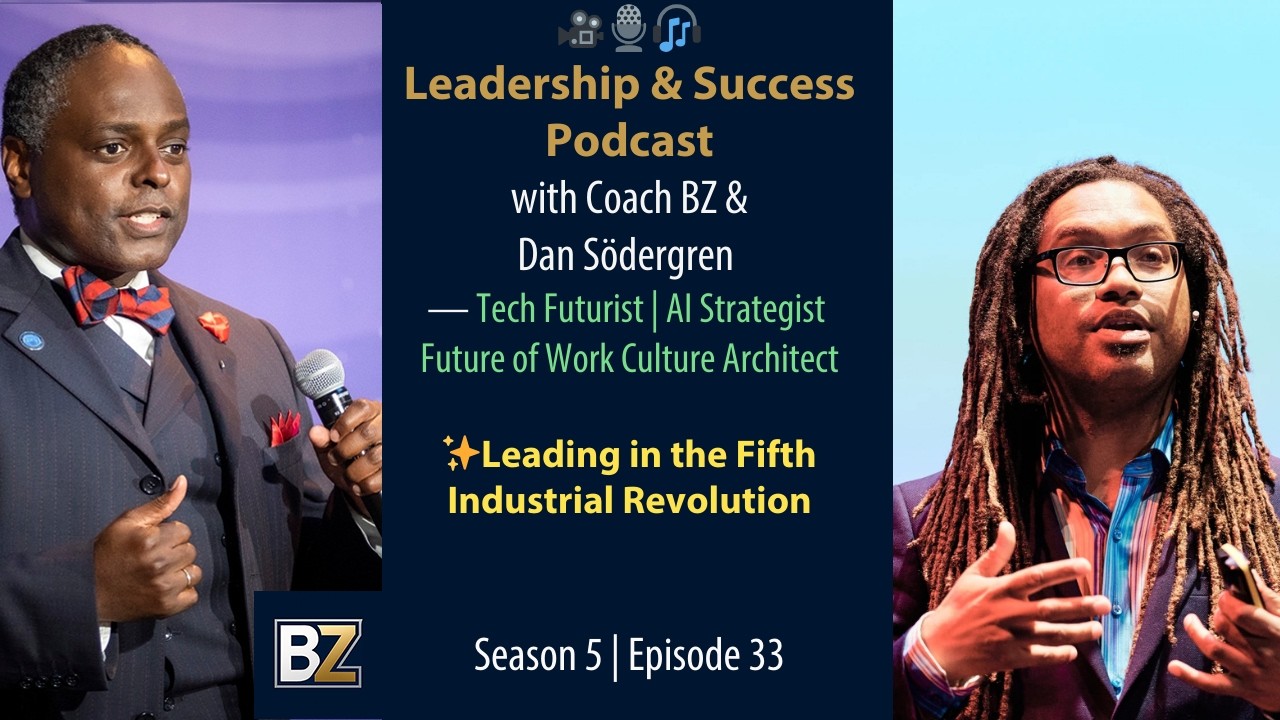
Dan Södergren, an AI strategist and TEDx speaker, discusses 5G as the backbone of the Fifth Industrial Revolution and warns leaders about shadow AI and the lack of AI policies. He emphasizes that emotional intelligence and independent thinking matter more than ever as AI reshapes every industry.
Chapters
Hi, I'm John Maxwell. When the top companies in the world are looking for trainers, speakers, and coaches, there's one name that stands above the rest, and that's Maxwell Leadership. Our certified team members have gotten proven results for companies all over the globe, and our reputation, I'm proud to say, is second to none. Some of our members have risen to the top of their profession, including the one you're going to meet today. I proudly introduce you to my friend Bob Fabien Zinga.
Welcome to the Leadership and Success Podcast with your host, Coach BZ, where we help you lead with purpose and succeed with impact. If you're ready to grow into the kind of leader others want to follow, this podcast is for you. If you're determined to elevate your success and leave a lasting legacy, this podcast is for you. As my mentor, Dr. John C. Maxwell, reminds us, everything rises and falls on leadership. Our goal is simple, to inspire you, challenge you, and equip you with insights that can transform the trajectory of your leadership journey. Welcome aboard to Welcome to another episode of the Leadership and Success Podcast with Coach BZ.
Talk us through the newspapers. Dan Södergren's with us. Dan Södergren is here, who's a marketing expert, technology analyst.
Dan Södergren, who joins us now.
His name is Dan Södergren, who's a digital marketing and technology specialist. Use AI to help you become more productive. Dan Södergren.
Dan Södergren.
I'm Dan Södergren.
How important will 5G be in the future? Well, it's the thing that's going to power the, the next industrial revolution, so it's actually critical for pretty much everything that that's going to be happening in the future. It's the kind of the backbone of it. What artificial intelligence means? Well, that's a really interesting one. In real layman's terms, I must probably not call it artificial intelligence. I'd actually just call it clever computers or computer stuff.
Hello everyone, welcome to another episode of the Leadership and Success Podcast. Thanks so much for joining us today. We have a very special guest waiting in the green room. But before we get started, as is our tradition, we like to start with a moment of gratitude. And for those who have been following me this entire month, we are celebrating Black History Month in the US. So every single day this month, I am really grateful for the contribution of African Americans to America. I believe we really truly have built this country with our bare hands, our sweat, and our blood. And I am so grateful for the contribution of African Americans to this country and the world. And really the American culture, which is pretty much exported all around the world. And I want to welcome all of my friends from the other side of the pond. I've invited all of my friends who live in the UK to be here because I have one of yours I'm gonna be interviewing in just a second. So good afternoon to you guys and good morning to those here in the US. I want to remind everyone, please let us know where you are joining us from, uh, both from the US, what city and state, and from a foreign country, and let us know what city and which country you are joining us from. And also, uh, one thing you are grateful for today. And most importantly, if you do have a question for Dan on LinkedIn or YouTube Live, please type your question in the comments and we will answer your question live. All right, before we get started here, let me see if I can properly introduce our guest today. So today we are speaking to Dan Södergren. He's a globally recognized tech futurist, TEDx speaker, AI strategist, and media commentator who specializes in the Fifth Industrial Revolution, the era where human leadership meets machine intelligence. So from startup founder to BBC technology expert, Dan equips leaders to think strategically about AI, culture, and the evolving workforce. So this conversation is gonna be especially powerful for those who follow me in the military and also cybersecurity and tech executives. So without any further ado, please help me welcome to the Leadership Success Podcast, Dan Sutherland. Hello, good afternoon, Dan. How are you doing today?
Yeah, very well. Thank you for such a lovely intro. And yeah, I felt like I should be doing some kind of dancing as I came on because of your great intro too.
Thank you. No, it's really a great honor to be here. I guess it's been a while, maybe 7, maybe 8 or 9 months we've been trying to make this happen. So I am so, so, so grateful you are right here on my screen. I can't believe it. So maybe to get started then, what is one thing you are grateful for today?
Well, over in the UK it's half term, and so I am a sole parent to my teenage daughter, which is an adventure and teaches me something every day. So I'm going to go— it might seem a little bit of an odd one, but I'm going to go, I'm very grateful for my daughter. I'm also going to be very grateful that she doesn't come in in the next hour, but she might, so you might all meet her. I'm hoping not, because I have prepped her that I'm doing something live on TV, so best not to come in. But I'm very grateful for my daughter.
That is so wonderful. Yeah, I have two daughters and our last one is 18 years old now. So she's in the 12th grade, hopefully starting college in the fall. So we'll see how that goes. Wow, that is so wonderful. And what is something about you that most people may not know when they first meet you?
I suppose that being a sole parent, well, is most probably one of the things, which is why I'm a great believer in flexible work and hybrid work. And I've been talking about it for decades. Maybe that's some people, but maybe people do know that. They might not know that I've had a few tech companies, and that's why I was called a tech futurist, because I had an augmented reality company about 17 years ago before augmented reality really was a thing. Yeah, exactly. Yeah, yeah, yeah. That far ahead of stuff, right? That's why I'd rather be called a billionaire philanthropist rather than tech futurist, but my lot in this life is tech futurist rather than the very rich. So yeah, so I tend to do things a little bit ahead of the curve. I've calmed that down a bit now, but certainly, yeah, I had the joy of being in some of the pioneering communities around AI and technology and data for the last 30 years or so.
That is quite amazing because you've gone from marketing agency owner to tech founder to AI futurist, like you just mentioned. What was the inflection point where you realized the future of work would define your mission?
Well, it's a really interesting one because when I was very, very young— and I'm very, very old now— so I had the joy of helping people start their own businesses. I also had a— but my first company was a co-founder company called THTC, the Hemp Trading Company. So I was an environmentalist and very much in the eco kind of world, made loads of stuff out of hemp before people knew what hemp was, and made hemp paper and cosmetics and clothes and all sorts of things. So certainly my job or my belief that my life is important was always trying to change the world for a positive. But to answer your question around why did I move out of marketing, because I had my own marketing agency and then sold it, went to Mexico, came back and had a marketing training agency, why did I move from that into your flock and HR and tech and AI? Between me and you, I have a friend of mine, very good friend of mine, who's very good friend, is someone very high up in the AI world, a chap called Demis, and Demis, sorry, I'm gonna, I'm going to butcher your second name. I always do. So my apologies and sorry for the name drop, but Demis Hassabis, who is most probably, well, times one of the 10 most, 100 most influential people in the world. But so he runs Google DeepMind. He sold DeepMind to Google, right? If you know Demis, you must probably know how to say Demis's second name better than me. But I've met him a few times over the years. Every conversation I've had with him, and we are talking about since I was 18, so almost, you know, almost, uh, well, 3 decades and a bit. And I've had to— it just changed my life what he said. And it's almost— this is why it's so scary and I'm stumbling with my words, Bob, because it's a bizarre coincidence. It's almost to the day that 10 years ago he said to me, uh, marketing is going to fundamentally change and you need to start looking at AI and marketing. But more importantly, artificial intelligence will make agencies not exist in 10 years. Yes, he wasn't, he wasn't exactly right with that because marketing agencies do still exist. But he was pretty much bang on the money. It was 2 days ago, so my friend's 40th, and that's where we were. And now a decade later, so I moved out of what I was doing in marketing and training. I still train companies in marketing and still train companies in AI marketing, but my focus very much went into company culture. A company that I co-founded called Your Flop, which used HR and data and AI stuff before it was kind of fashionable. And yeah, that's why I changed, because because of— sorry, that's the reason why I changed anyway.
That is wonderful. You are talking about Dennis Asabis, right? I think is it?
Yeah, yeah, that's right.
Sorry, I didn't know it was Dennis. Yeah, world changer for sure. So what leadership lesson did you learn from building and scaling startup that still shape how you are thinking today?
Well, again, it's terrible that my ego is so big that I'll quote myself when I answer this question. It's not really an ego thing, it's just more— in 2015, I was working with a different company called JustTaxi, and JustTaxi was going up, but the CEO didn't know this at the time, which I thought was very amusing, but he wasn't a massive, you know, global tech geek, so to speak. He wasn't looking very— anyway, this thing called Uber was in America. I kept telling him, there's a thing called Uber, and he's like, oh, don't worry, we'll be fine. And I was like, you have to move real quick, right? Because Uber's going to be really good. But then, you know, we were literally selling something that was going up against Uber. Which wasn't a reply. It was basically helping taxi companies have their own version of Uber. We were, you know, X amount of time, a decade or so ahead of the game. If they'd done it, they most probably could have stood up against Uber a little bit better, as some countries did, some cities did. Anyway, it's not about that. So anyway, at the time in 2015, I came up with a quote from one of my keynotes, which was the following, which is, with the right people and the right technology, you can take over the world. Without them, that world takes over you. Wow. And that's where that came from, because it was all about cars and JustTaxi and these things. And that's one of the biggest lessons I've ever learned there, and that you have to have both. You have to have the right people and the right technology. And that is one of the critical things. If you don't have those two things right to start off with, it's likely you're not going to change the world in that world. You're going to be taken over by the world. And so maybe that's the easiest and most succinct way of putting it.
Wow. Now, one thing about being an entrepreneur, we always focus on all of your great successes, and you've had many. What about failure? Was there maybe a failure you are willing to share that kind of reshaped your leadership philosophy?
So many, so many, it's unbelievable really. I mean, this is one of the reasons for YourFlock, which was an HR tech company, which is basically looking at could you codify and use data to work out company culture. And the answer is yes, you can. But because of ChatGPT and the huge rise of AI, we didn't get our third round of funding. But I think if we had done, we'd be really in a good spot now because that's a very, very fashionable place and very good place to be, data and HR, etc. Anyway, as I say, really not making data-driven decisions was some of the worst things I've ever done. Because this thing about intuition is that some people's intuition is amazing. Apparently. I always think data, you know, without data you've just got an opinion. But this is the thing, in the early days of AI sequencing, etc., it was slightly better than intuition. But some of the worst decisions I've made as a leader have been based on gut feelings. And of course it's very tempting, isn't it, to go, ah, I feel this, my life experience says this, and therefore I'll do this. And of course this is why you'll find it, as we all do now, in tech communities, but also in marketing and creative agencies, they are, because they are monocultural, the diversity problem is one of the biggest things that's going to kill them. They cannot think differently and quickly enough for this revolutionary time. And I must confess that I hired people that thought like me, and that's not necessarily the best thing to do. I'm not saying just because of my neurodiversity, don't hire people like me. We can be brilliant. But, you know, I'm not a completer finisher. You know, I'm an ideas person. I move quickly, etc. Sometimes you want the opposite, and that, of course, if you're going with your gut, you might not get that. Does that make sense?
Yes, that is very, very insightful. Thank you so much for sharing that. And many leaders today, they kind of still fear AI and they kind of want to wait to see what it's going to be all about. Definitely in the last couple of years, AI has pretty much taken over every single industry across the globe. And you are quite optimistic about artificial intelligence. Where does that optimism come from?
Well, okay, that's again great. I was worried. It is a great question. Where does my optimism come from? I suppose some of it's innate. I'm just a naturally optimistic kind of person. I think we're very lucky to exist on the planet. I think we're a trillion-to-one bet that we would even just exist. And the fact we can exist through revolutionary times like this is mind-blowing. I mean, I was you know, trying to program a ZX Spectrum. And if you're old enough to remember the ZX Spectrums or Commodores or Amigas, I don't know what the American version may have been, but very basic rubbish, like 10 colors, right? So I was sitting there playing computer games, very excited, and thinking, my goodness, what would happen in the future? Now, all my dreams about computer games have pretty much come true. My first passion was computer games, hence knowing Demis, which— and a lot of people don't realize Demis's background is computer gaming, which of course, you could even argue Artificial intelligence is part of the computer game, but we won't go into that because that'll go too far. But the point being is that I think we're very lucky to live in these times, and we're also very lucky that we've got a chance where we can actually shape the destiny. Now, you were talking about, you know, the great, uh, great Black Afro-Americans that have shaped America. But, you know, 200 years ago, we wouldn't be having this conversation, right?
True.
100 years ago, we wouldn't have been able to have companies. Yeah. 50 years ago, we wouldn't have the technology where we can make a difference. Now, all these things are why I'm optimistic. I'm optimistic because statistically, this is the only time I could have lived to do what I do. And I'll be damned if I'm going to do it in a negative way because, my God, look at the past. Things could have been a lot worse. Yes. My optimism comes from that. The other reason for my optimism around AI, and I've got to put this in, is because not only because I had the joy of talking to some folks who, without me knowing it, became hugely important in this world. But I know their intentions behind this. Some of their intent— well, to be fair, but yeah, their intentions on it and their intentions, I can say for some of the people involved in the AI world are actually really very cool and very funky. They are literally— they are. And if you then look at what AI gives us the potential to become and do, that's amazingly optimistic because because everybody can become more productive, everybody can have more agency, everybody can become brand me PLC, and they can have a series of interns— I like to call AI automated interns— but a series of interns underneath them that basically gives them almost a superpower, which you couldn't have done 5 years ago. So, so I, I get there's, there's negative sides to that as well, but my goodness, we can control the destiny of the world and our own personal world so much more than we could have even 3 years ago. And next, you know, I know it sounds awful, but you ain't seen nothing yet. You know, it's the future is around the corner right now. And the next 3 months, I mean, even the changes in the last week, as you know, Bob Fabien Zinga, the change in the last week with some of these things is mind-blowing. Am I as optimistic as I was? No, because of the speed of the revolution. And I think the speed inherently is a problem. Human beings don't move as quickly as this does. Culture don't change as quickly as this will, and revolutions are not always fair, and revolutions are not always— well, let's just say there's lots of bloody revolutions.
Yes.
And, you know, we could have a situation now very, very soon. I think it's on the horizon— it's not even on the horizon, it's right next to us— where, because we don't— because of course in all revolutions, we talk about this with leadership, the uncertainty factor is so high that you have this moment where employee engagement's dropping at the same time technology rises. We have all the reasons for a revolution. Yeah, the revolution happens, but there's no leadership in the revolution, and then you just have chaos. And I am a little bit worried at the moment because of the geopolitical situation we're in, and there is not a lot of moral leadership at the time when we most probably need it most.
Well, hopefully this website is going to just make a small dent into into that, at least get the people talking and thinking about what's right around the corner. Talking about the next revolution, you talk a lot about the Fifth Industrial Revolution. Can you tell us more about that and how it's different from the four previous industrial revolutions?
Well, I know you have a very clever crowd. I know you're a very clever man yourself, so I'm not going to explain all four industrial revolutions without time. Each one of them was contained by a certain moment, normally a technological trigger. And again, lots of people don't look at, you know, why do we have that revolution? People think— and also same with social revolutions. We had a social revolution for society reasons. Well, actually, normally it's technological and economic reasons. Like if you look at the— you know, you go back as far as the Gutenberg printing press, for example, that created huge amounts of revolution, but actually much deeper than people realize. Like it created the Reformation and things like capitalism. And the concepts underneath all these things that make it work. You can tell because I did psychology and sociology and anthropology. I could go on, but the deeper thing around this is the technological trigger creates that change, right? So each one of them had a technological trigger— steam, water, steam manufacturing, these things. You could argue, and I think this is where people do, they go, oh, 4.0 is about computers and connectivity, etc. And absolutely right, that is the case. The 5th Industrial Revolution, though, is different because AI and artificial intelligence is not just like computers. It isn't just like a manufacturing process. It isn't. And this is why we have to realize this is the fifth industrial revolution. The reason why I use it so much is because it changes the way you look at things. The things you look at change. Wayne Dyer said this brilliantly. And the point being is if you don't call it revolution, then you start blaming yourself. You're like, oh, why is this happening to me? Oh God, it's because I'm too slow. No, it's a revolution. Revolutions aren't fair. Revolutions are amazingly fast. Uncertainty. This is the Fifth Industrial Revolution. This is why we're in the state we're in. This is the tornado that happens. It takes off. If you ever seen The Wizard of Oz, Dorothy gets taken up with this. She has no choice in this. And now as businesses, we have no choice. And if we want, we can argue against it and say, no, we're not going to change. But unfortunately, the world is changing and has changed. So the Fifth Industrial Revolution, I characterize it in the book, there are four different intelligences that we're going to need: artificial intelligence, emotional intelligence, organizational intelligence, and independent intelligence. And that's what's different between the, the last one. The other one I'd say as well, and it's a big difference here, is that the Fifth Industrial Revolution potentially is one where it's a people's revolution.
Yes.
And that is, that has the potential. That's, that's my thought anyway.
But there you go. Well, that is quite insightful. So what do you think will then separate leaders will thrive from those who become completely irrelevant.
One of the things that leadership has to look at more, and again, it's not fair because this revolution is moving so quickly, is emotional intelligence. And it's the emotional intelligence that people have to start considering. Do you have enough emotional intelligence to lead your team or your company? Now, a lot of leaders, because of where they were brought up and because how they were brought up and how they got the job, and sometimes leadership is foisted upon us, We don't necessarily have that emotional intelligence. It's not particularly— it wasn't particularly fashionable 20 years to be teaching people about emotional intelligence. But EQ is going to be more important than IQ because IQ is going to be done by the computers and by artificial intelligence. And the other one I'd say most probably is we have to have more independent intelligence. And again, independent intelligence isn't necessarily something we wanted in the different industrial revolutions. In fact, we vehemently didn't want people to think for themselves in most of the industrial revolutions. We needed them to be automatons and, you know, and to sit in the factory line and do stuff, right? We needed them to do certain things. Now, independent intelligence, to have the courage to think differently, is what we need more than ever. And I think that is one of the things leaders are going to find tricky.
Wow, so it's, uh, quite fascinating. So I did find it, so your website, thefifthindustrialrevolution.co.uk, so that's where they can get a copy of your book, right? The New Intelligence, The Fifth Industrial Revolution. That is quite fascinating. So for the people who are listening right now, because I do care a lot about the next generation of leaders, maybe they are still in school working on their bachelor's degree or whatever, and they're kind of afraid AI may be taking away jobs. What would you advise to a student who is preparing to work, let's say, in the next 4 or 5 years? How are they going to be successful, you think, in this new era of AI?
Well, I mean, number one, say I'll bring it into the four intelligences, right? Number one, they have to have independent intelligence. They have to be self-learning. They can't just say, oh, I'm going to make— my degree is going to be enough because your degree is not going to be enough. The deeper things would be emotional intelligence. How good are you actually collaborating and talking to other human beings and being more human? One of the weird things about the Fifth Industrial Revolution is This is this because of the AI. It actually means human qualities are more important.
Yes.
The soft skills, as they used to be called, will become the hard skills. The soft skills will become the power skills. And this is one of the things that's really tripping up a lot of people because they're like, but I'm a technically brilliant lawyer. Yeah, and you might be, but if AI can do that job, what's your job? Yeah, same with doctors. I'm amazing at being a doctor and doing all this diagnosis stuff. Yeah, but that's what AI will do. They'll do it 10 times quicker and 100 times cheaper. So what's your job? And then of course we then into this weird world where people are like, oh God, my job is actually to talk to patients. Oh no, my job is to be creative thinking. Oh no, my job is to— it goes on and on, right? Now that if you look at what the WAF is saying, you know, AI, yeah, those skills are up there.
Yes.
If you don't know about AI, you don't know about— you haven't learned how to prompt Claude or you don't understand anything about— you're only still using ChatGPT and you have no idea what large language models are out there. You don't know the differences between them, then yeah, that you need to do. You'll need to learn that. I think it was— did some work with Sony. I think it's something like— it's quite ironic because of the number, but it's something like 67% of CEOs won't hire someone without AI skills over the next 1 to 5 years. And the double irony, of course, is that they themselves don't have AI skills. But this is not the first time this has happened, is it? You remember Maybe you were old enough to remember when you went to a boss and someone and they were like, "I don't do emails, but you better do." Yeah. I have a secretary that does that. It's that kind of thing. Same principle, same with in-house servers or mobile phones. Technology always has this same kind of thing that happens in social media. But again, I digress. Those soft skills, as they're called, the extracurricular activities, the ability to collaborate and to co-create, and creatively think and think differently, but also critically think. They're the things that will make the difference because the machines will do the rest. And of course, as a society, we have to fundamentally think what happens in this fifth industrial revolution. Because in the first bit of the industrial revolution, there will be a mass losing of jobs. Now, the problem we have with this industrial revolution, all the interesting facet of it— and as I'll quote Dennis here because he did say it brilliantly, I always talk about it in the keynotes— this is likely to be 10 times bigger than the other industrial revolutions, but just happened 100 times quicker. And that's the difference. So it's not fair that this one's so quick. It's not fair this one's so big. Yes, but it is. And that's what happens. ChatGPT now is— I think it's almost— is it 900 million users? Yeah, yeah. Incredible. ChatGPT. And again, I could bore you with the history of why it's called 3.5. White guy came out of the blue and Sam Altman did this strange move. But again, there's a whole history behind that. Not for now, but, but you know, it hit the 100 million user mark. Um, well, let's put it a different way. The humble telephone took 72 years to get 100 million users. ChatGPT took 72 days.
Yes.
ChatGPT 5.2 took 72 hours, but it got to 800 million.
Incredible.
It's only one, and that is one out of the potential, I know, 8 10 different LLMs that you could use. Yeah, I'm not even here to say that ChatGPT is either good or bad, far from it. It's like the vacuum cleaner of the Hoover world, or whichever way around those are. You might have to say medium in America, but we have got— you vacuum or you Hoover your house in the UK. It's a vacuum cleaner, it's just a brand name. There are hundreds of different brand names of Hoover, right? Or around vacuums. ChatGPT is— I mean, I'm always worried that you know, I think it's something like 95% of people use it for free. Yeah, that should be fundamental. I mean, and people are using it for free for their work. Uh, we did some work with Personio and like 67% of people are doing this thing called shadow AI. I mean, you'll love this from a cybersecurity point of view, shadow AI, right? You know, using, using it outside the AI policy. Then I did some other work with another company and we worked out that only 54% of companies have an AI policy. So And then you think, okay, where's the employee stand at this moment? And of course, you have this horrible thing where it's about 66%, so it's around the '60s and '50s, but 66% of people do not believe they've had decent enough AI training. So you can see why leadership's in turmoil through this revolution, because most of their employees haven't had enough training. They haven't got a leadership— uh, let's put it a different way— they haven't got a policy around that moment anyway. They really have to handle it themselves, and the world's moving quicker every day. If that doesn't say to you revolution, my friend, I don't know what does.
Yeah, no, I guess I'm really excited we are living in this time in history because there is so much potential, right? And I guess some of it can be a little bit scary. I understand why some people are anxious, but they really do need to get into the game. So one thing you've said is AI and emotional intelligence, they really must evolve together. Why is that so critical?
Well, again, this is just between me and you. This is also the people I did talk to in my keynotes and who I train. Without that emotional intelligence, you have a big problem. If you think about it from a leadership point of view, if you're leading through a time of mass uncertainty, which this is, a good friend of mine, Tom Cheesewright, says living through uncertain times, but also the time of high-frequency change. This is a perfect time for high-frequency change. Yeah, which creates mass uncertainty. And as you'll know, even from a neuroscience point of view, it's one of the worst— one of the worst emotions a human being can actually have is uncertainty. It's better to know your fate rather than to be uncertain. Now, loads of people are uncertain at this moment in time. Now, if you're not emotionally intelligent enough to realize that fear creates a certain thing inside people— uncertainty creates fear— and actually you've got to overcome that fear, and you've got to help them, and you've got to lead them to do this. I mean, it's one of these weird things now where leaders are basically saying, right, we need to do this stuff, but I'm not going to do it myself. They're not leading, they're just trying to boss people around. And you can't boss people around in a revolution. You can't say we're going to take— you know, you have to do it from the front. We're going to take the hill together. Great, because it's part of the revolution. That's what happens in revolutions. Now, one of the weirdest things, if you do that without any emotional intelligence, you're in trouble. Because we don't have— and this is the thing, you know, you're there to say You know, complex change, right? The military are brilliant because they get the fact you need to incentivize people. Not only are they paid, it's also a great incentive in not dying, you know, or saving your friend's life. And you know, there's a great moral incentive. There's a great why. You don't have to ask why. But now, of course, businesses are in this, why do we do what we do? What are the incentives we can give our people? Because it's the classic 5 pillars of change. Do you have the vision? Lots of companies have the vision, yes, because they say we want to use AI to make us more productive.
Right.
Have you given the people the skills? Well, 66% of people do not believe they've been given the skills. So that's a mistake. As soon as you haven't given them the skills, that creates anxiety. And that's where we are. People are anxious and that's because you've created it yourself. Then there's things like frustration. How do you make people frustrated? Well, you don't give them the resources. Well, that's because that's why people are using free versions of AI because you haven't given them the licenses. That's insane. That's like turning up to— and they just go, oh, you haven't got a laptop. Oh, you haven't got a mobile phone. But do you crack on?
Yeah, yeah.
I'm old enough to remember when people weren't given a laptop, a mobile phone. Yeah. And then that time very quickly stopped because we realized, you know, technology was going to be important. Then you've got things like this, like my big one. And again, this is about emotional intelligence, but also organizational intelligence. Because of the revolution, because it happened so quickly, we have to change how we did business before. This is not a time of business as usual. One of the big ones is incentives. Like, what is the incentive for the company cultural change that you want to do that has to involve everyone, that you're leading from the front. But what's the actual incentive? So I'll give you a particular example. Let's say someone gets really good at using AI for a particular role. What is their incentive to share that information with the rest of the company and the people doing that job?
Yes.
And right now, in what I would call modern capitalism, or yeah, obviously end-of-stage capitalism, but certainly modern, uh, monopolized— where we are now.
Yes.
I'm not sure. I haven't met a company yet. I ask this quite a lot. I train companies and try to think about it, but we're still not— I mean, not surprising. But remember, 2 years ago, AI wasn't really on the spreadsheets. AI training just got on there. Now I'm asking to incentivize business management around an objective they don't even understand. I mean, it's impossible. But think about it. If you had a centralized database of good prompts that other people could rank and then you could all vote for the different ones. Well, what happens when someone wins? If someone wins the best prompt of the day, what do they get? And please don't say they're not fired. Yes. Just like, you know, in the military, you can't say, oh, we're going to take the hill. Brilliant. Amazing weapons. By the way, if we don't, I'm going to shoot you because there'd be no incentive. My apologies. I realize my military knowledge is nothing. So sorry about that. But you understand.
I get your point.
Yeah. Incentives are going to be the key. And right now, I don't think we have very many answers, apart from very small tech companies. I think that's why very small tech companies are winning, because they can incentivize their people in a different way to maximize the use of technology around them. And that's why we talk about independent intelligence, you know, the ability. Are we, are we letting our, even our young people, are we letting our employees have that sense of courage to self-learn and then come back to the leadership team and say, hi, I've learned this. Yes. I'm not sure, I think, because I talk to a lot of leaders and I'm— I know they say this, they say, oh yes, it's very important. You know, there's great research that's just come out, I think it's only today, Nick Bloom came out, uh, well, it might not be Nick Bloom's report, sorry Nick, it's on LinkedIn. But the CEOs, CIOs, they believe that productivity— I read, I'm amazed by this— that productivity is going— they believe that productivity might double in the next 3 to 5 years.
Wow.
Because of AI. Absolutely. Now, that could be— I mean, I can absolutely guarantee that can be true. Huge company culture change for it to happen. AI has got that potential. Yes. Because in certain roles, you could be 4 times better than you are now because of what we do. But my goodness, you've got to incentivize the people because you're saying we're going to double productivity, but you're not going to share any of the wealth. Why would anyone say yes? The human psychology is so much more important than the AI technology. And that's why I think the Fifth Industrial Revolution is interesting, because it's actually more about us as people. It's actually our psychology, whether we want to go along on this revolution. That's going to be key to whether it's a success.
Wow, that is quite insightful. I've never quite thought of it that way. In that case then, what leadership traits do you think become more important in this era with all of the automation, AI, and I mean, yeah, I mean, if we're talking about, uh, characterizations and kind of abilities, maybe abilities is different.
Um, one of the ones that I always stumble with it because it's very unfashionable, and that is the idea of a servant leader. That is, that is what, that will be the, you know, the, the, the best position to be in. Like, that you look at leadership that you can serve other people so they can become the best versions of themselves. Right, so, um, it proves that I'm a bit of a geek, but, um, apologies to anyone else who isn't a geek and they won't get this at all, but you will because everyone understands the idea of superheroes. If you are managing a load of superheroes, yeah, that is different to managing 1,000 people in the factory. Yeah, they've all got different abilities and different— so, but how do you do it if you don't have a superhero ability? How do you manage superheroes? And that's the big question for us all is How do you manage people who are ridiculously flexible but ridiculously productive? Like on a scale that we never saw before. They are 10 times more productive. Now we used to joke, you know, we say, oh, he's a 10x, you know, coder. And you treated them differently because, oh God, without them the company would go. Or times 100. What happens now if actually if everybody comes at times 10? And if everyone, or maybe 5% of your company becomes a times 10. It's very likely— and people don't like this, it's unfashionable— but it's very likely that in the future companies are going to be smaller, teams are going to be smaller, smaller decentralized teams making decisions quicker. Much more likely to be the case. Now, if all those people— you only got 5 people, let's say, and each one of them's, I don't know, times 10, it's 50 people. But the way you manage those 5 people has to be different, right? It has to be emotional and hands-on and, you know, people management skills and soft skills. And it cannot be anything else. And what happens if one of them leaves? You know, so you see the whole thing changes. It's a bit more like, um, uh, all my, all my analogies are just very blokey, sorry, but it's a bit like managing a soccer team. You'd say football, but even so, or any sports team, it's much smaller teams doing amazing things, and you, and each one of them is a superstar. Now that's going to be an internal issue for any leader. So suddenly you're going to have to have humble leadership. Emotionally intelligent, humble leadership that looks at itself as a service function. Yes, I'm not sure that a lot of leaders like the idea of that, but the ones that do get that are the ones that will not just survive but will thrive, because AI is going to do a lot of it. Now, the other thing to bring in, and you know I would do because it's data and AI, but when you start looking at the data potential and the AI potential around leadership, it is, it is pretty mind-blowing. Whether it gets it right or not is a deeper conversation. Whether it can get it right right now is a very dangerous proposition. I've been arguing against AI in recruitment for at least 7 years. I still argue against it now. I don't think people have cracked it. But if you have the data and you can understand that data is not oil, it's soil, it's soil, how you grow the next bit of your company will be in this data-rich soil. And you can use AI to help you do that. And then you realize you are more like the farmer than anything else. Some things are outside of your control, but if you knew your soil and you knew your crops, you'd be a much better leader. Yeah, I'm not 100% sure, I might be wrong, I'm not 100% sure that was taught in leadership schools and management schools. Yes, and it's— I don't think it was 20 years ago, only because I was kind of there, actually, no, 30 years ago. Gosh, I am old.
Well, still looking on, but it's— everything you say is really fascinating and it really gets people to think. Now, you've appeared on the BBC and major media outlets. What have you learned about communicating complex tech simply?
Ah, that's a really good one. The BBC, they do like to bring me on. They're always like, ah, it's because you make theory, you make really complicated things simple. What they don't know is I'm actually very simple, so I have to make complicated things simple because I don't understand them. So I'm not the brightest pet on the box. So the best way to do it, I always think, is is metaphor and analogy, really, if you can. For example, and again, change the way you look at things, things you look at change. If you look at AI like electricity, you have a sudden realize around it and you go, oh, because electricity can be bad. Yes, it's kind of a— it can be bad, can be good. If you don't train your people not to put their fingers in sockets, they're going to electrocute themselves. But we have to train people to stop doing that. You do still with children now, you make sure there's safeguards, etc.
Yes.
But also the companies that create the electricity have a responsibility. They do. It could be as simple as, we use 240 volts. If you supply 480 volts, then things are going to explode. By the way, proving the point, I don't know that much about electricity. So if anyone does, and I've got all this wrong, what's the metaphor?
Don't know.
But we do have different voltages, right? Now, if you look in the history books, and I'm always surprised when people don't, but it's fascinating that at the time when it first came out, you had like 5 or 6 different companies' lines going to people's houses because everyone was fighting about who was going to provide the electricity, right? And there was different voltages.
It was madness.
Things were falling down and zapping people and everyone was dying. People were like, electricity is going to be like this new communist thing that's going to take over the world. We're all going to be entrapped. Now think about it. That's pretty similar to AI now, isn't it? You know, 4 or 5 main providers, different voltages, different abilities, everyone panicking, everyone saying it's dangerous, everything. And don't get me wrong, I'm not saying that we want just one. But what I do— does make me smile is because the revolution's happened so quickly here.
Yes.
If you look to the past and you use a metaphor or two, then it suddenly opens your mind to where we are. Metaphors are brilliant for doing that. Obviously, they stumble down when you start thinking, well, electricity, that's just not the same as AI, Dan, because AI can think for itself. Yes, I know, but it powers things and that's what it can do now. I think it was some great people said, you know, just like electricity powered the last hundreds of different industries over the last 100 years, now AI will do the same. That's where we are. So I always think if you can use metaphor and you can weigh it up to whether it's good or bad, then I think that's always a good way of simplifying.
Yeah, actually, one thing you mentioned, I think I want to talk a little bit about this, right? The responsibility for those who actually develop AI. Now, another thing I love about this podcast, you are all the way across the pond in the UK, and most people tend to think as in silo. And I kind of know, for example, here in Silicon Valley in the US, we don't really have a lot of laws, regulation, and policy. It's really like a race to the bottom, almost like we really want to be first to get to AGI at any cost, it seems like. And over there, especially European Union, UK is I'm not exactly part of that anymore, but you are pretty, pretty, pretty close. You European, you really think about safety, privacy, ethics, which is extremely important, and we don't do that well here in the US. So what are your thoughts about the role of ethics, safety, security, and privacy as we develop and deploy artificial intelligence?
I knew, I knew, I knew one of the questions would be one of those too big for me. It's 4 minutes and I'm going to answer that. 'Who is the right God? Discuss.' Oh no, that's a bit big. So it does make me smile because I would much rather the UK—
Because I guess another thing that does concern me a little bit, it's been confirmed as an information warfare commander for the first time in history, the US military has actually used AI to enable them to do a surgical strike in Venezuela and capture Maduro. It was really aided by AI. That's never been done before. So what could potentially happen in the future? Who knows? I feel like we definitely need to have some pretty clear guardrails on how to use this technology.
I mean, the idea of not having guardrails, you know, we've all seen Terminator, so let's, let's not get too silly about it. We all have, right? And we all know what happens when the military machine— I mean, that's the whole thing, is that the whole point is we're moving into this new world of robots pretty quickly.
Yeah.
And we start thinking about military When you start thinking about—
Yeah, because you mentioned that in China they just had a huge festival. They had robots doing kung fu, perfect kung fu. Can you believe that? What if they just change their mind and they start killing people? That is possible, right?
Well, that's the whole point about guardrails, right? So I'm always— because otherwise I get too excited myself. So if we can— robots are one thing, AI is definitely another. I understand the AI brain goes in the robot. I'm totally with you. But as you know yourself, they are very, very separate fundamentals. And so is physical ability versus, you know, the other stuff as well, you know, as well. Both need guardrails, by the way. You know, these guardrails that we need to stop misinformation, that's massively important. Social media, etc., just huge. But there aren't them in America now. That's— you should all be worried about that. Just like in industrial revolutions, we know that in the past, industrial revolutions that have no environmental or social guardrails basically destroy part of the world, because they do. You know, Victorians— I mean, if we, if we knew exactly what the Victorians and other people did in the Industrial Revolutions, we'd be appalled. But we don't, because they won. But they, you know, they, they did a lot of bad things, let's be fair.
Because we do have to think about the environment too, right?
Absolutely, the environment too. But there's also the social environment. There's the environment and there's a social environment, and then there's the military stuff, which is almost a different Now, all these things, this is why it's worrying what America is doing. And by the way, when people say America wants to catch up with China, I think you might not quite understand the world globally, that China unfortunately has been ahead of Americans in AI for a while. And I don't think America can catch up. I know no one likes that thing, but just because ChatGPT, I mean, you look at the LLMs, you look at the open source ones, you look at a lot of stuff that's happening and America is not winning. And by the way, hasn't been for quite a while. I was in Shanghai 7 years ago. Yeah, but running there, they were doing amazing things then because they have— and by the way, this is not bashing either side or saying either side's right. But when you have a government that can control most of the data flow and actually say what companies do, that government and society is likely to win. The open market can't beat that. Now, that's a different point. And don't get me wrong, ChatGPT, amazing what they've done, so many users, etc. But they are hemorrhaging cash, right?
Yeah.
If you look at the amount of trillions of dollars that's needed to prop up the American AI economy. And by the way, that's not just prop up the American AI economy, that's propping up just the economy of the American economy. You all know more than I do that the 4500 or whatever is coming, it's something like 90% of the returns are only about 3% of the company. It's like it's— Crazy. Like, it's too big to break, so they have to throw money at it, which is why everyone is changing what they're talking about, especially around AI. And we're doing this whole AGI thing and all these other things. Now, for us normal human beings, we don't have to really be involved in that conversation because your stuff will work almost no matter what. Now, my big thing is, and I've been talking about for maybe 3 years, is that we're missing the trick here because the large language models that everyone's using, which do need guardrails and need ethics and etc., but they won't have very many ethics because it's in the free market and because it's laissez-faire capitalism and they're trying to play a race of the arms race. So it's not likely they're going to become ethical because they're going to say we can't afford to lose the race to China. So they're going to get away with it. Problem here is, and this is the big one for anyone who has a business, is that actually you're missing a trick because it's not the large language models you want to be using. It's actually small language models you want to be using. It's actually not stuff that goes on the internet. It's stuff that you have on your premises. Yes, like the military should— of course, the military is not going to be using Groq or whatever it is. There might be some fundamental technologies underneath it, but they're not going to go online and, oh, what should we do with this? Of course they're not. They've got their own systems. Of course they have. And even those systems, I'm worried— I'd be worried about because of cybersecurity and hacking. Like, you don't want it to be able to be hacked. And who knows if you've got some software for somewhere else. But don't get me started because that's your area of expertise, not mine. All I'll say is, in the Fifth Industrial Revolution, we're missing the point. If I go back to the electricity bit, right now we can actually have our own solar panels and have our own electricity. Yeah. And we don't need to be hooked up to the grid. We don't need to buy it off one supplier. Right now you can download a small language model into your server and start training it as your automated intern with your company information as proprietary datasets.
Yeah.
In a safe sandboxed environment that you would own forever. And yet, Most companies have not touched that with a barge pole, haven't done it. And most employees don't even know conceptually that's an idea. But actually, as a leader, you should, because really you're all CTOs now.
Yes.
Every leader should be saying, what is our— what's our sovereignty? What's our data sovereignty principle here? How can we make sure my team is safe with all their IP? Because we don't want that falling into the wrong hands. But more importantly, we don't want this to be monetized. I'm not saying that Microsoft could do it, but if you read their terms and conditions, they're quite opaque. And if you just said what you just said there, Bob, which is the AI thing in Silicon Valley has real no regulation, why wouldn't they go, oh, we've brought out an accountant 101 now because we've read all the accounting information that they've been putting into Copilot. Yeah, actually, wouldn't it be in their interest? It'd almost be illegal for them not to because it's in the shareholder interest, right?
Yeah, yeah, that's, that's the difference.
I think that's where everyone's gonna start looking is, is in this fifth industrial revolution, giving all the power away to like 3 or 4 companies we know aren't regulated and aren't particularly great morally might not be— it might be what the market says is good practice, but monopolistic capitalism doesn't want it because it doesn't— it's bad for the consumer. We know that, we inherently know that, but then again I thought at one point, Bob, we might fall out about my political reading.
No, thank you so much. This really gets people thinking. I guess that's one thing, one of my objectives with this podcast. I don't have all of the answers. I have experts like you, but at least you get us thinking, maybe what we're doing is not the right thing in the long term because you don't really want to be short-sighted, especially with this technology. It has potential that kind of scares me at times, especially the way it is moving so fast. And sometimes people don't really think about not just first-degree consequences, but like on the second-degree and third-degree consequences after that. So I like to be more strategic than I am tactical. And sometimes I am just concerned just a little bit. But anyway, so we have about 10 minutes left. Let me get into the last segment of the podcast where I try to get into your head and what you've learned, leadership principles that have helped you be as successful as you are. One question I will ask is, what do you believe is the greatest lesson you've learned in life so far? Not just in life in general, in life in general.
Life in general, life in general, without going too deep, I'd say that hurt people hurt people. That is something that it took me a good, oh, I don't know, 45 years to realize. That often when someone does something negative to you, you've got to kind of look at maybe the why. Why did they do that? I think this also moves into the world of organizations and of course in leadership as well. And that's the thing, isn't it? We're in a bit of a world because of this fifth industrial revolution where there's a lot of hurt people. There's a lot of people that feel that they don't have a voice. There's a lot of people that are making some pretty odd decisions around things and fear is one of the biggest multipliers. And that's what we need to get rid of. I'm not going to go as cliché as say love is the answer because it might not be, but certainly fear isn't. I think that's where we are at the moment geographically or geopolitically, should I say. There is a temptation for us to fall into this kind of darkness because of our own fears around change. But change is the only constant. So maybe they're the two things, you know, hurt people hurt people, but change is the only constant. They're my two biggest lessons.
Okay. And what, what has that taught you?
Well, the hurt people hurt people thing is to just be more empathetic. You know, I talk about emotional intelligence being truly important in the Fifth Industrial Revolution. That doesn't mean I'm particularly emotionally intelligent.
Yes.
You know, but I can recognize and understand that it's going to be an important trait and it's something that I need to develop in myself. You know, but I have a kind of inherent kind of growth mindset. I know I'm a work in progress.
Yeah.
But I do know that one of the areas I need to look at more is being more empathetic. And which is why, you know, before I wouldn't think that. Before I'd go, oh, someone's hurt me, I will, you know, I'll hurt them back. This is my— I will get them back. Now that doesn't understand why they might have hurt you. And if you can take a step back and, you know, is it the Japanese account with the 7 whys principle where you ask why 7 times? Same principle again. And the other one I've actually got tattooed to my chest, which is, uh, kaizen, or however you say it. 1% improvement all the time. They're the big things that I've learned. So, you know, it's getting more emotionally intelligent, it's making sure that you're not trying to strain yourself too much and not having burnout. There's a horrible stat coming out, literally, I think it was today, but people who are under 35, it's something like 60-something percent of them, it might not be that high, it might be 55, but are in burnout. Lean-out leaders are in burnout stages as we speak. And that's a lot of people. And I think one of the reasons why there are so many people in burnout, A, because we forget that there is a cognitive load when it comes to using AI, which people haven't quite got yet. You know, the fact that you can have 5 interns suddenly makes you a manager, right? Now, everyone suddenly becomes a manager. That's a different skill set. And actually, there's a different cognitive load. Yes, you can become 20 or 40% more productive, but actually, you might want to work only 4 days a week. Or 3 days. And this is the bit between me and you, Bob. This is why I try to help companies change, because I actually think it's good for society if people didn't spend so much time in the offices. I know with hybrid solutions and things, if we have more time to look after our daughters or look after family, because we're going to have more 80-year-olds than we're going to have 18-year-olds. Yeah. And everyone's saying, oh, what will we do? Well, you won't work as many hours and you'll look after your parents.
Yes.
That's what we'll do. Now, a lot of people who are leaders don't like that because they don't want to look after their parents, but that's a different point.
No, thank you for sharing that. It reminds me during the pandemic, I know Silicon Valley slowed down considerably and I think people kind of reflected back on their priorities because if you're on your dying bed, you're not gonna be like, oh, I wanna go to the office for like 4 more hours or anything. Like that.
Exactly.
We definitely also proven that you could do all of your work at home. You don't even have to leave your house. But things like that.
Isn't it weird? But isn't it weird at that time? A, it's weird because I love the fact you mentioned it because very few people mentioned COVID times, by the way. It proves how psychologically damaging it was for everybody. And it should have been worldwide pandemic. Everyone had to stay indoors for 2 years. Everyone was present. Tremendously damaging, right? And everyone comes back, they're like, I don't know why, but employee engagement's down. It's like, hello, anyone? We all thought we were gonna die. Like, end of the world stuff, we all started prepping. You know, people are like, right, get back into work, get back in the offices. No, thank you.
Why not?
We've proven it, we've proven we don't have to. Ah, yeah, yeah, but we need to get back in the fields 'cause we paid for them. No. I can't believe people are leaving our companies. What? Like, it was just then, for God's sake. Amazingly, people don't talk about it. It proves how traumatic was no one talks about it. That change— this is why I talk about the Hybrid and Happy. I wrote a book, that one as well. But the productivity lift you get from hybrid work is pretty intense and pretty good. But also, people would, you know, you'd rather lose $20,000, $10,000, it may have been more of your wage, than have to go back into the office, right? Now leadership's got to realize that change doesn't go back. Also, leaders are a bit naughty because it's often the leaders who aren't in the offices, right? Yes, they've been doing it, they've been doing it for 2 decades, and then all of a sudden we can all do it. They go, oh no, that's not fair because I'm a leader and it's taken me 10 years to become one. But you like your life? Yeah, I do. Could I like my life? Well, no, because I didn't like it when I was your age.
Yeah, yeah.
I wonder the next generation is a bit frosted.
No, that's, that is great of you sharing that. It really makes, makes you think. So What do you believe is the secret to your success? You've scaled a lot of businesses from marketing to emerging tech, AI, 5G as well, future of work, TEDx talk everywhere. I mean, why do you think you've been so successful?
This was the question I was worried about. Number one, I think that I always know I'm a work in progress. I am very lucky in some respect that because of my neurodiversity, I get very hyperfocused on things. You could also call it a curse, but there you go. Between me and you, Bob, I would not consider myself to be tremendously successful in modern world in the way of finances, etc., because for me, money is not a driver. For me, it's about flexibility. It's about, you know, you can't take the money with you. I don't understand why people get so obsessed with money when everybody knows you die. And every person, you know, living a life well and being able to give time to things I believe in and being innately curious about this amazing thing that we call life. They're all characters or they're all features or characteristics that I just presumed everyone had. So when people are like to me, you know, why have you started so many businesses? My answer is because I could, because I can. And they're like, oh, but then that one failed and it cost you £30,000, £50,000. That's okay. It's okay. I'll just do another one. We'll start again. We'll get investment. We'll do something else. You know, everyone was like, but Dan, you're always interested in this world of AI and what it can do. I'm like, we now have a chance where we can fundamentally change the world. And actually it means that everyone can work less and we can put time back into society more, which is what the world needs. And yet everybody's like, why would— why should I use AI? If you use AI to become more productive, you can spend that 20% or 40% of your time that you save on being either a better leader, being more emotionally intelligent, Giving people time off so they can help the world, but their world become a better place, but also for yourself to give time for charities and other organizations you believe in. This is a tremendous opportunity in the world, and yet we still in this world where we're going, oh, let's make loads more money for people. We can do both. We can actually make more money and make the world a better place and make our employees' lives better and happier at the same time.
Yeah. Yeah, it's, uh, not either or, it could be both.
Well, it's always going to be both, Bob. Absolutely right, it's not equal, it's always got to be a both. And that's the emotional intelligence thing I talk about, is because you— the idea now that we're in this kind of hyper-competitive space still, yeah, where everyone's antagonistic, where everyone's going against each other, it doesn't make any sense when actually the means of production means that the knowledge sector that we have has grown over 100 times. We are no longer in that world. You cannot be in this world. You can be, but if you're not emotionally intelligent enough to realize we've got to collaborate and make the world a better place, then I think then your time might not be done. And don't get me wrong, I'm a futurist, so it might take 5 years, it might take 10, but I would start making those internal changes now. And I can pretty much promise you, as companies, to make— without realizing that your employee happiness is key to your success, those companies, I think, will go much quicker than the others. If you have a culture where everyone has a fixed mindset and you can't change and you don't realize you're in a revolution, I can pretty much guarantee you those companies won't exist.
Wow. Okay. We are almost out of time. Let me ask you this and then I'm going to ask you what we can do to add value back to you. If today was your last day, What would you have liked your final contribution to be?
Last day on Earth? Oh, okay. For me, it's very simple to make sure that my daughter is fine for the rest of her existence and that she's happy or as happy and content as she could be, which I know doesn't sound very social, but I think that charity starts at home and to make sure that she's okay between me and you would be my key thing. If you want me to open that up, then the reason why I do what I do, the reason why I write the books and the reason why I do the trainings and the rest of it, it's all online, etc. Is because that legacy piece to me is pretty important too.
Yeah.
So actually I've done quite a bit already, and so I'm hoping that when I'm gone— can't you make me emotional now? And because there's so much to do, so much to do, Bob. I've got so much to do. And, you know, a lot of that stuff is online, and I'm hoping that people will, you know, take that, read that stuff, learn from that stuff, and then change their businesses because of it. Whether that, um, changes everything from— we have— we're playing against some pretty big players like the likes of Elon Musk, etc. But there's only one way you can change the world, and that is by believing that you can.
Yes. Wow. Really, really insightful. And if you could solve any problem in the world, you had this magic wand and you could do that, what is the one thing you're going to want to solve first thing tomorrow morning?
I'm going to say it sounds ridiculous. I'd say the planet, because without the planet, we don't have anything anyway. You know, it'd be great to say poverty, but poverty wouldn't— you wouldn't solve anything anyway because It's all relative. And so you could, you could bring everyone's thing up. But if you notice, this is the weird thing about life. So many people believe that life's got worse, but actually life has fundamentally always got better on a global scale. Every marker for success and health and all these other things has actually risen. It's not gone down. Yes. Now it might have gone down for the UK, it might have gone down for America, it might even be going down for the West, but not globally. So on that, but if we don't fix the planet then we don't have anywhere else to live. And that is the problem. And this is the weird thing about Elon Musk, etc., those folks, because they believe that we can leave and go to Mars, or leave to go to the moon and then go to Mars. That is a 50-year project, maybe 100-year project. Now don't get wrong, I'm not saying we shouldn't try it. Yes, but we've got to fix the world before we move, right? We've got things to do. Yes. Fix the planet. I don't know how you'd do it.
Yes. All right. Thank you so much for your time, Dan. So grateful you were here. So how can we add value back to you?
Come and follow me on LinkedIn. Listen to some of my rantings and ravings over at LinkedIn. Always happy to have new followers and meet people. And I've got a— I'll send you a link to a newsletter that I have as well, which is around the Friday of work. So it's the Future of Work on a Friday every fortnight. So that's my newsletter and of course my website, which is www.dansogun.com. Of course, the book, The Fifth Industrial Revolution, which you brilliantly put there, which I did. And also, if you've listened to the podcast, I'll do this as a thank you to you, Bob, is anyone who's listened to the podcast and they contact me on LinkedIn, I will send them a discount code to get the book for free.
Wow.
There you go.
Thank you. Thank you. So generous. So generous. All right. Very last question for you. If you could go back and give a piece of advice to your 17-year-old self standing at the edge of this incredible career you've had, what would you say to 17-year-old Dan?
I'm about to give you a particularly very personal and honest answer there. There you go, but very rarely have a filter. I would say, I'd say be careful. Remember that technology comes in waves. And always look at the hype curve before you make a move, and most probably slow yourself down by 5 to 10 years and work on, work on getting to the wave rather than just predicting that it's on the horizon. That's only if I wanted to be richer, which would be just a bit more of a naughty trick.
Nothing wrong with that. Thanks again for sharing. We're pretty much out of time now. Is there a question I should have asked you that I didn't get a chance to ask before We end the show.
I could honestly say no, I think we've covered pretty much everything. I know that you were very interested around the servant leadership points and different things. There's so many questions I have around cybersecurity, etc., but that would be a completely different world. I'd have to be interviewing you. I think there's always the thing about what would happen. I thank you that you didn't ask me in 10 years' time, what should leaders be thinking about? Because I honestly believe if you're a futurist and you're talking about 10 years, You're lying. If you can do 10 months, you're going to be doing pretty lucky, in my opinion. Maybe the fundamentals don't change, but my goodness, the technology is going to.
Yeah, because 15, 20 years ago when we did a cybersecurity roadmap, usually we went 5 years, but today it makes absolutely no sense because things are going to change so drastically, it's going to be completely a big waste of time. Maybe 1 year, 2 years, 3 years at the most, the way technology is just changing. Okay, so I'd like to end with something positive. And what is something that you are feeling optimistic about?
I'm going to be cliché and say the world and AI because I truly am optimistic about it. I think if we do this as a global community and if we are sensible about what we're doing, the opportunity of small language models to fundamentally change businesses is mind-blowing because everybody then gets an extra member of staff for every member of staff.
Wow.
But only when you do it properly with the right data, on-premises, doing it properly, investing the right amount of money, giving people the right amount of resources. And we don't just trust the likes of Copilot and ChatGPT. Yes, because doing so is really quite dangerous. But we can, just like with electricity, we can charge our own businesses and make our own electricity and make our money from using the electricity. What I'm saying is, don't— you don't have to necessarily pay a massive company to supply your electricity when actually you can start supplying it yourself.
Wow. And I love that you said investing because it's not a cost center, it's really an investment into yourself and into the future. Wow.
Powerful. This is it. Well, now you mentioned that, I'd also say this classic one, which is spend 3 times more on the people than you do the technology.
Mm-hmm.
That is something that people are not doing at the moment. They are simply spending money on technology, not training people up, and not spending money on the people. But it's the people that need to use the technology. And please don't get me started about AI agents. No, we are not there yet. Yeah, you're a cybersecurity nightmare. Yeah.
All right, so this is it. Thanks again for your time. You've been super generous. Sorry, we went a little bit over. The very last question, just one word. What is one word that represents our shared experience on this podcast today, all the way from England?
I'd say great.
Fantastic. Thank you so much, Dan, and I am so grateful and so thankful, and I'm really glad that we had a chance to talk. I think this show is probably gonna be one of the most popular for this season. Again, it's already available as a replay on YouTube and LinkedIn, and it should be available on all of the major podcast platforms by the end of today. Thank you so much, Dan. Really appreciate that.
Thank you, Bob.
All right, everyone, this was quite a show. I am so grateful, so grateful to Dan. And later today, I'm gonna have two more interviews. I'm gonna be speaking to a professor Melissa Buree. She's a scientist turned strategist, operational architect, and author. We're gonna be talking about when science meets strategy. And then later today, I will be talking to senior master sergeant, US Air Force retired now, Chauvin Chevy Maxwell. And she's also the selling of a bestselling book, Women Breathe. But of course, I also love to read books about women because I believe what applies to women applies to men and vice versa. But anyway, she's going to be here., and we're going to be talking about Deckplate leadership, but also she helps with the federal, as a federal execution partner. She works with tech founders who want to get federal opportunities here in the US through qualified proposal and core partnership. So it's going to be another great discussion later today. And then I'm going to be back later today. I don't know what time yet, but I'm doing a book study of Proverbs, but we're going to be using artificial intelligence for a recap for Proverbs chapters 16, 17, and 18. So I didn't do it yesterday and the day before, so I am going to catch up and we're going to do all three by the end of today. All right, that's all I have for you. Thank you so much for watching. Again, very, very grateful to my friend Dan Sutherland all the way from the United Kingdom, AI expert and some Thank you so much for sharing this knowledge with us. All right. Bye for now. And for those of you who are going to come back in the next couple of hours, I'll be looking forward to seeing you as we speak to Professor Melissa Bui and also Senior Master Sergeant Chevy. All right. Bye for now.
Thank you for tuning in to the Leadership and Success Podcast with your host, Coach BZ. If today's episode added value to your leadership journey, be sure to subscribe, share, and join us again for more wisdom nuggets on how to lead better and achieve greater success. Remember, leadership is the most critical skill of our time. The world will always need leaders to inspire others, drive innovation, and execute meaningful strategy. So why not count yourself among the bold leaders shaping the 21st century? Until next time, stay inspired, stay committed, and keep leading with excellence.
More from Bob

S250:E4🎙️LIVE 🇺🇸America 250: President Barack Obama Leadership, Service, and the Power of Hope






S5:E157🎙️ LIVE with CMD CMSgt Dennis L. Fritz, USAF (Ret.)(Multi Tracks Audio)



S5:E156🎙️ LIVE 🇪🇸 Leadership Lessons from the FIFA World Cup 2026 Champions (Multi Tracks Audio)

S250:E3🎙️ LIVE Leadership Lessons from America’s First Documented Family of African Descent 🇺🇸📖