S5:E35🎙️ LIVE with SMSgt Shevon “Shevvy” Maxwell, USAF (Ret.)
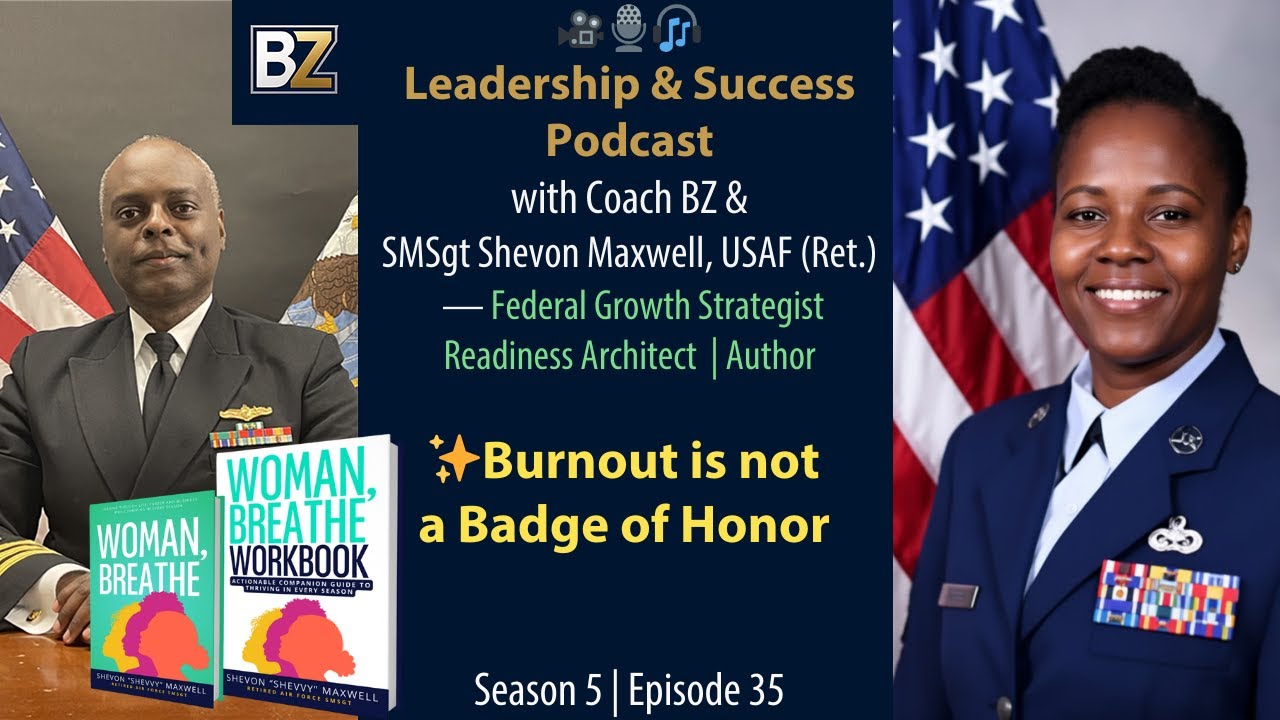
Retired Air Force Senior Master Sergeant Shevon Maxwell spent 22 years leading in the military and now helps founders with federal funding. She contrasts resilience with sustainability, argues that slowing down is strategic, and wrote Women Breathe to teach self-leadership through movement and emotional balance.
Chapters
Hi, I'm John Maxwell. When the top companies in the world are looking for trainers, speakers, and coaches, there's one name that stands above the rest, and that's Maxwell Leadership. Our certified team members have gotten proven results for companies all over the globe, and our reputation, I'm proud to say, is second to none. Some of our members have risen to the top of their profession, including the one you're going to meet today. I proudly introduce you to my friend, Bob Fabien Zinga. Welcome to the Leadership and Success Podcast with your host, Coach BZ. Where we help you lead with purpose and succeed with impact. If you're ready to grow into the kind of leader others want to follow, this podcast is for you. If you're determined to elevate your success and leave a lasting legacy, this podcast is for you. As my mentor, Dr. John C. Maxwell, reminds us, everything rises and falls on leadership. Our goal is simple: to inspire you, challenge you, and equip you with insights that can transform the trajectory of your leadership journey. Welcome aboard to another episode of the Leadership and Success Podcast with Coach BZ. How are you self-managing yourself and how you respond? Because how your response lets you know that, hey, you're not using your executive brain to make decisions and to respond to challenging situations. Because in the military There were some challenging situations, high stress environment, deploying environment where you're getting bombed and mortars and all the things are coming down, but you still have to react without reacting crazy. Okay, reacting on the control.
Oh, that was a word of wisdom from the Senior Master Sergeant, US Air Force, retired. As you guys know, I joined the Navy 21 years ago as an E-1. Seaman recruit. Today I am a commander, but throughout my entire career I have been mentored by Navy chiefs E-7, E-8, and E-9. So I have great, great respect for the anchor because in the Navy they truly, truly run the Navy. We couldn't do anything without them. So it's a great honor today to have somebody I do consider a mentor because they really make a big, big, big difference in the military, especially for the enlisted and the junior officers as well. Okay, before I introduce my guest, let's make sure I see Daniel is already there, an active member of our community joining from Florida. Thanks so much for being here. So let us know where you are joining from, what city, what state, outside of the US, which country. Let us know what you are grateful for. And then if you have a question for my guest, please type it in the comment and we will try to answer those questions. Live. Okay. For a moment of gratitude, for those following me this Black History Month, which is February, Black History Month in the US, I am just grateful for the accomplishment of African Americans in this country. I love this book, African American First. It talks about famous, little-known, and unsung triumphs of Blacks in America. I believe Blacks have built this country and African American history is American history, no matter what anybody tells you. So I just want to acknowledge that and celebrate that every single day this month. Okay. Let me see if I can properly introduce our guest today. Today is going to be quite a podcast. We are going to be speaking to a retired Air Force veteran, business development consultant, and leadership strategist. After more than two decades of leading people and managing operations in high-pressure environments, She created Women Breathe to help women slow down, reconnect, and move forward grounded, whole, and ready. And hopefully everybody is going to have a chance to purchase her bestselling book, Women Breathe, but she also has an accompanying workbook. So we're going to be talking about that. So I'm going to say just one more thing before I bring her on. This is really going to be a great show, right? We are going to be talking— no, this is not going to be like, you know, just another motivational podcast or anything like that, but it's really going to prepare you, right, to get ready. I think it's going to help you in life as well. So without any further ado, let me bring to the Leadership and Success Podcast the one and only Senior Master Sergeant Chevy Maxwell.
Hi!
All right, how are you doing today? It's such a great honor to have you. Just to get started, Senior Master Sergeant, what is one thing you are grateful for today?
I'm grateful for the opportunity to wake up. That is actually one of my good friends and I, you know, we're talking about being grateful, and I was telling her just this morning, like, every day, the first thing as I open my eyes, I'm like, Lord, thank you for waking me up this day. And I tell my kids, you know, you know, my son, he's a teenager, so he's looking like, oh, here we go. Yes, yes. And I tell him all the time, you know, no matter what's happening, you have to be grateful for the little things, you know, your clothes, you're being, you know, brushing your— whatever it is.
Yes, yes.
Just be grateful because it definitely affects the mind.
Yeah. And you being an Air Force veteran, you definitely understand that. Now, as you know, about 21, 22 service members commit suicide every single day in this country. Being in the military is not easy, but definitely having an attitude of gratefulness, I think, makes a big, big, big difference. Thanks again for being here. What is maybe something about you that most people may not know when they first meet you?
Um, they may not know that I was born in South America, and I am— really? Yes.
Wow. Which, which country in South America, if you don't mind? Guyana. Wow, that is amazing. Cool.
Yeah.
All right, so you are a true American.
Fantastic.
Wow. It's, it's, uh, let me maybe start with just a kind of like leadership Foundation. How did you end up joining the Air Force? And most importantly, how did you end up becoming a senior master sergeant in the United States Air Force? That is a big, big deal because when I joined the Navy 21 years ago as an E-1, my goal was to either become an E-7, a chief, or a senior officer commander. So it just happened I had a path to make it to commander. But how did you find your, your way in the Air Force?
Oh, well, first of all, thank you, Coach, uh, BZ, for having me here, and I'm excited to just kind of just have a conversation with you. And honestly, when it comes to joining the Air Force, it was nothing that was like at the front of my mind to say while I was in high school, let me go ahead and join the military. Yeah, but my best friend at the time, during our junior year in high school, she said to me, Siobhan, we should join the military together. And I'm like, girl, no. And I was like, the military? I was like, I don't know. So she's like, can you please, you know, we can probably do the buddy system can you talk to the, you know, talk to the recruiter? So she brought, um, she introduced me to her recruiter, and this was our, again, our junior year in high school. And for me, I always envisioned just going to college, never the military. And she said— so I met that individual, and he did like a pre-test. Staff Sergeant Lennon, I remember his name. That was my recruiter. And he's like, okay, you did well in the pre-test. And I was like, okay, that's nice, you know. You're, you know, 16 years of age, you're like, okay. And, um, I said, well, no thank you, you know. And then I graduated high school school, and then I had a scholarship, um, to go to, um, William Paterson University. And you know, you're young at that— at this time I'm 19, but I had to complete this program in order to fulfill the scholarship requirements. Well, we're young and we silly and we make silly decisions, and I did not complete the program, which, you know, detoured where, you know, my life. And I, you know, ended up in community college because I'm big on education. And then one day I was sitting on my parents' porch in New Jersey And I said to myself, like, I wanted something different for me because I was tired of seeing the same thing and being in Newark, New Jersey at that time, high crime rate, a lot of challenges. And I called up that same recruiter.
Oh, by the way, somebody from New Jersey is ready. I think you know her.
Yes. Samantha.
All right.
Yes. So I called that same recruiter, Staff Sergeant Lennon, and I said, hey, I would like to take the test to join the Air Force. He was like, okay, how soon are you looking to join? I was, no, how soon are you looking to take the test? And I was like, as soon as possible. And that Wednesday he's like, okay, you can take it next Wednesday. I said, okay. So he picked me up from my house, I went there, I took the test. He's like, okay, Siobhan, so what are you doing now? I was like, I guess I'm joining the Air Force. And, um, I called my best friend at the time and I was like, hey, you know, guess what? I'm, I'm going to the military. She was like, you're right. I was like, no, I'm serious. And she couldn't believe it. Her mom couldn't believe it because Again, I was never a vision. And her thing, that the thing that she said to me was like, Siobhan, you're not going to make it because one, you don't like people telling you what to do. And I was like, I don't. But in that environment, I will. I will adjust. And that's how I ended up joining the military in 2000, 2001.
Yes.
Wow.
And before long, you were an E-4, E-5, E-6, E-7, E-8, and you were the one giving the orders. So congratulations. Thank you.
Thank you.
So you served more than what, 22 years, I believe?
Yes, 22 years, um, and almost an additional, uh, 22 years and I think like 23 months.
So yes, how many additional days?
I know, and hours and time and minutes.
No, I know, but once you reach 20 years in the military, I mean, there is nothing that feels as good because then you don't have to worry about all of the nonsense that some, uh, branches of the military want to bring upon you, you can just retire, right? You just give your papers, I'm out, thank you very much. But if you only have 12 years— Yeah, and so few people do, very, very, very few. I've been in 21 years now, so I may be a commander in the Navy, but thank you, but my, my wife is the armed commander and she's ordered me to retire soon, so I'm gonna have to obey her orders. Uh, so 22 years in the Air Force, that's really huge, huge achievement. What leadership lesson did the military burn into your DNA that still shapes how you lead today?
Wow. As I look back on my 22 years of service, through all the challenges, um, I would say the leadership lesson is to continue to show up when life is happening, when the challenges— when you feel like, you know, screaming and yelling and crying, like, still continue to show up because that's being a person, but a great individual in general, whether you're a leader, whether you're a mom, whether you're a dad, is still continuing to show up no matter what is happening.
And by the way, you are making some members of the audience cry of laughter right now. So thank you so much. I really love watching the monitoring the chat because when I first started 5 years ago, it was just me, myself, and I. Nobody was listening. It was just me. But now it's a global audience, people all around the world, and they listen and sometimes they talk to me. So I want to make sure—
No, I love it. I love it.
Please bring the chat in. Uh, what, uh, do you think really makes the difference between leaders who are just okay and those who are transformational, in your opinion?
Wow, you know, great question. Yesterday I was having a conversation with someone and they were sharing with me how this individual was in a high leadership position and the person was emotional because their team that they were leading was complaining, putting in, you know, reports into HR saying this person is doing X, Y, and Z. And automatically I said to the person I was having the conversation with, like, this person is not leading from a people perspective. They were leading based on the position and based on the title. Because I feel that between great leaders and ineffective leaders, because you have leaders who are leading because they have the title and they are in that higher position. But when it comes to the people aspect, they're not truly leading. And that is the challenge with leaders who are just because— making decisions and telling people what to do because they hold the title. And for me, it's about the person. If you focus on people, like truly focus on people, yes, they're going to be challenges. Yes, you're going to have individuals on your team who don't you know, like certain things, but you have to lead with people at the forefront because leading with a position and title, you're not going to get far.
You're not. Well, thank you so much for sharing that because in the Navy we say mission first, people always. I'm sure we stole that from the Army, but it is so true though, because it makes all the difference in the world when people know that as their leader, you really care about them as an individual, not just a member. Of a team to be doing work that you need to get done. What do you think is one mistake that young officers or even non-commissioned officers repeatedly make when stepping into a leadership role?
So from 22 years, I've experienced this myself firsthand, and I had a captain— again, a captain, you know, in the for the Air Force is a new person still, you know, is the O-3. You know, they're still learning the ropes. They're still, you know, really learning about how, you know, identifying how they truly lead. When you have someone who's been in 20 years like myself or like yourself, and then you have this, you know, baby captain, yeah, who you respect because of the position, but they come in with a sense of like— because I'm again going back to the title and position, I'm the leader. You need to do X, Y, and Z. And this one captain kept—
what's the mistake? What the mistake? They don't understand that, uh, they need to be mentored by the E7, E8, and E9.
Yes, I would say some do, um, but this one did not. And I kept telling this individual, um, captain, you know, ma'am, we can't do this because of X, Y, and Z. And that person kept pushing and pushing, and I'm like, again, we can do this, but it doesn't make sense. And it was a waste of time, waste of resource, because at the end, guess what? We couldn't do what they wanted to do because of the regulations and the policy. So I think for whether you're an NCO stepping into that leadership role for the first time, or that, you know, lieutenant or that, um, captain, and you're like, find that person within your organization to say, okay, Who is going to guide me? Who's going to mentor me? Who's going to allow me to still lead but still pull me in when I need some course correction and some feedback that are constructive and not take it as offensive? Because our goal as senior leaders is to help the people that we are overseeing and also who are over us to lead better, lead the organization better. So I would say definitely coming in as if they know it all when they don't.
That is very, very good advice, especially if you just like— no, I guess second lieutenant. First Lieutenant in the Air Force and ensign or JG in the Navy. You have so much to learn. Let's talk about your best-selling book, When Men Breathe. I believe men can read this book too and learn, right? Because I read some extract from the book and I think it is just great. And I think it is timely, especially in a culture like the military where everything is always high tempo and people tend to overwork. So In high-pressure environments, we often glorify resilience, right? But you do talk in this book about sustainability. What's the difference and why is sustainability important?
Yes, great question. And the book is not a bestseller yet, but thanks to you, it will be.
Yes, I speak it into existence. Yes.
And I love that. I would say, because based on what— the reason I wrote the book and I talk about resilience in here, but mainly on the sustainability aspect, because like you said, there's a lot of challenges that we encounter as military individuals, from leadership challenges, um, family challenges, um, you know, uh, physical challenges, mental challenges, a lot of different things. So resilience is all about, okay, how do we move forward? And with the military, it's like, okay, we have to get back to the mission, which is the end goal, and The resilient aspect is like, okay, we're going through these challenges. Okay, I was able to bounce back. But for me, and I've gone through some challenges from anxiety, the vertigo, hospitalization while serving active duty, it was like, okay, after I've gone through this and I'm resilient because I'm still here, how do I sustain these new habits so that I don't go back to that consistently? Because again, if you stay in that resilience cycle, it's like you're just going in that loop. Okay, we're here and now, okay, I'm good. Now I'm back here. But for the sustainability aspect, it's like, okay, now we have things that we have put in place to keep our mental— excuse me, keep our physical, our emotional intact, but still navigate the challenges without losing myself or yourself while we're navigating those things.
Very good. So in the same book, you challenge high performers to slow down. Why is slowing down strategic, not soft, especially for those who are in the military?
Yes. And you know, one part of the question— and then when men can read this book, they can buy for their spouse. Um, it doesn't have to be just for anyone in the military, whether you are in your— you have your own business, whether you have your own, um, you're a leader in the organization, you're stepping into leadership role as a first-time, um, person. But maybe you're a mom and you're like, I have these 2 kids, these 5 kids. I'm, you know, I'm doing all the things. Guess what? This book is not about just slowing down. Honestly, it's really about really reclaiming who you are as you're navigating these challenges. Because as ambitious individuals, we are going to go, we're going to, we're going to execute, we're going to make things happen, and we're going to— even while we're burning out and we see the signs, but we don't really own the signs, we just kind of ignore them. Like, okay, I feel a little headache here, let me continue. But I, I think it's, it's not slowing down, is reclaiming to self and creating that sustainable habit that you can implement, I can implement, whoever's reading this book can implement, and know that these challenges will come. These, you know, life will happen to me, relationship, my marriages will end, my team will not like me, um, I may be thinking I'm, you know, I'm a failure as a leader, as a mom, but how do I sustain myself continuously beyond this, this space that I'm in right now.
Yes. Wow. We, we have, um, more, uh, Samantha says amazing book, but I think she's biased. But definitely everyone please get a copy. And Daniel says Bob Fabien Zinga's, uh, point on ineffective leadership being a title-only game is the cornerstone of Honor Mode. We are shifting the focus back to the people. Yeah. Focusing on the people, that is so, so important. So back to your soon-to-be number one bestselling book on Amazon. I think that is definitely going to happen. So for the leaders who are maybe doing too much, but they still show up for everyone else, and sometimes they feel like, no, they are just being pulled in a thousand directions. What is the first internal shift they must take?
The first internal shift for a leader who feels like they have to show up for every single one every time, and that's in work, that's in life, that's in their community, they have to go inward and ask themselves, why do I feel like I have to be that person even though when I'm tired, even though when I don't have the mental capacity to show up? Why do I feel so? Yes, they have to go inward and really be reflective to understand what is causing them. Past experiences could potentially be that reason, but really go deep to identify why am I still showing up when I don't have the energy or the capacity?
Hmm. So how do we know then when we are operating from strength or from depletion?
Great question. I think this is a perfect example of us right now. In action. You with your podcast, me showing up here sharing what I love, which is, you know, in the sense of not just talking but living and doing the things that I am passionate about, whether it's supporting women, um, impacting organization. And that's how you look at the strength— things that really brings you joy, things that you like. Man, I can do this all day long. I can, you know, sit on this podcast all day long, you know, and you can just continue to interview people. So you have to look at what fuels you. And for me, that is your strength. That is part of it. And when you look at something that's depleting you, your question, like, okay, why am I here today? Do I want to— you know, as soon as that alarm goes off, your question, like, oh, I'm not ready for this team. I'm not ready to— like, you start self-talking and it's not a healthy type of talk. It's more like, oh, it's draining.
Yeah.
You can automatically feel the shift in energy. In the— when you're operating in strength and when you're operating in depletion. Because— and also your mental capacity, there's fog, there's tightness, there's a lot. Because I've been there, I've been there, um, as an instructor for the military. And, you know, when I was going through my own journey and my own challenges— yes, I am, you know, I'm a people person, but during that challenge, I was just showing up just to come, just to do the work. I was not going above And you can tell because my performance dropped. Yes, my ratings dropped because— and I accepted that. But then as I started navigating those, oh, let me get back into my strength. Let me focus back on self. So you can tell it's going to bring you joy, it's going to bring you energy. And when you're depleted, yeah, you just, you just move in.
Well, now, like, like you said, so it says, uh, women breathe, but I think men should buy it too. And buy it for your girlfriend, your wife, your sister, your mother. Your daughters, which says leading through life, career, and business while thriving in every season. So not just the military, but really throughout your entire life. And then when people go to womandbrave.com, they can order not just the book, but the workbook as well. And you said in the green room, you're going to be willing to sign the book for those who ask you to.
Yes.
Yes.
Every book that is ordered through my website, it is signed by me. Yes.
Fantastic. So, Women Brave. So, we remember that. So, one more question I wanna ask about the book then is, what do you do then to recharge yourself? How do you find that sense of peace and rest before you can go back out there and work at a high level again? What do you advise?
Yes. So, my advice, and this is something that I do, and this is something that is in the book, Women Brave, and it, This is a section of sustainability, which is part of my framework, and for me is movement. Um, and when I say movement, I don't care in whatever capacity that you want to move. Movement is going to help you to reset. For me, and I, and I have proven this for myself, um, for other clients I've served when, you know, when I was really focused on wellness, when I— even on active duty, when I was first diagnosed with anxiety and being hospitalized, and I felt like I was losing, like, my identity. Like, I felt like with the thoughts and, you know, parenting two young kids under 5, and, you know, it was a wife at the time, I started running consistently. And for me, that helped me want to shut my, my mind, my thoughts from going left to kind of center. I'm just being real here. And You know, because for me, running resets me. It is my fuel when I am stressed, when I'm overwhelmed with parenting as a mom. I go out for a run. Even while I was on active duty, if I felt just the load of the work, even on deployments, I will be up at 5 in the morning. And my friend, I'm like, hey, Sergeant Prince, I was like running. And he was like, okay, okay, okay, Mac. You know, so definitely as a leader, you have to find what is the thing that that you truly enjoy, that you know that you can make the time for that, even if it's 5 minutes swimming, that could be biking. And that is part of your sustainability, like honestly.
Well, now another thing you do now with federal agency, you know, you work with the Federal Innovation and the SBIR. Pathway. So you actually help founders, right, access SBIR and STTR federal growth opportunities, which I think is so important, especially for women and minority, especially right now, because a lot of women, if you don't know, especially Black women, have been fired from the federal government as of last year, have been looking for help. So why do so many small businesses— and I think a small business may be one way to really be able to help fund and support your family. But why do so many small businesses miss out on federal funding?
Um, one, because of the overwhelm of the process, I would believe. Because when I started this journey of like, hey, I want to learn about the federal opportunity, it's a lot of information out there. And some of the information is okay, and some is very deep, but some is— it's all over the place. And I think people not knowing, not knowing where to start You know, because there's so much on YouTube, there's so many gov, you know, individuals who are sharing different things. And for someone who don't have someone intentionally saying, hey, you know, Coach BZ, here's what you need to focus on, let me, let me hear your, you know, your challenges, let me hear what you're looking to do, and now helping you to create that path. And especially as a military person who has, you know, did 20-plus years and decided to launch a business, and whether that's a tech business We don't have a clue sometimes, including myself in the beginning. And finding, you know, finding, getting the clarity and the guidance, um, will help more people move forward. But a lot of small businesses, one, it's overwhelming, and two, they're not even fully aware of what even CIBER is. Because just in 2024, I never heard of CIBER until it was brought to my attention by another Black woman who has helped other companies in that space. And I was like, what is this thing? And, you know, she told me about it, and I started doing my research. And just like you said, a lot of minorities are not aware because I started having conversation with business owners who looked like me, and they said, what is this? And I'm like, okay, this is a need. And I'm— that's how I got into serving clients into that space, um, because this is free, you know, if you, if you win, because there's nothing guaranteed in the federal space. This is an opportunity for founders, and you don't have to be in the tech space for that. You can have an app, you know, something in education, you can do in for food, you know, USDA, and you can have an innovation or something that you feel that can solve a big problem for the United States and apply. Um, and but again, is doing it the right way, because one thing I've learned while learning and going deep about what is SBIR, what is STTR, which is a Small Business Innovation Research and a small Business Technology Transfer. These are just two different pathways that a founder can utilize to bring their innovation to the market, and they can partner with the university going through the sitter process. But what I learned from having conversations, um, with, you know, managers from— program managers from NASA or Department of Energy, they were telling me— this was in end of 2024— they want to see more diverse people And they said the challenge that they were seeing was like the packages that were coming through was not of quality. And that's what I wanted to fix to make sure that the individuals who are looking to submit submitted merit-worthy proposal. So I know that was long.
No, but this is very, very important though. So again, I believe it's through the Small Business Administration. SBIR, like you say, Small Business Innovation Research, and then STTR, Small Business Technology Transfer. But like you say, it doesn't have to be specifically technology as long as you are helping the US and doing something that is going to help people. So you as a consultant, you can help people kind of go through the process. How can they reach out to you to seek your help and you can maybe be a consultant? For them?
Yes, no, definitely. I, you know, I provide support in 3 areas when it comes to my consulting side of my business, which is J3M, and that is supporting tech founders, um, who are looking— or non-tech founders who are looking for to understand what cyber is through training and development. But also if they're looking for advisory support to say, hey, I don't know where to start, and but I have this, uh, this, um, this idea helping them to navigate how to identify the different agency. And if they're like, hey, Chevy, I know the agency, but I need help with putting it all together so that my package can go through that door. So those are the three pathways that I can support them. And they can just send me a DM right here on LinkedIn, or they can email me at info@j3mconsulting.com.
Yeah. And I believe that's your—
go to the website and Fantastic. Yes.
No, I think many times people, they just are not aware, they don't know, and that is why they are not able to get the information they need so they can be successful. And just to make sure, yeah, this is it. I thought I saw your picture here too, just to make sure this is your site. Maybe, maybe. But definitely, jeffreymconsulting.com. All right, thank you so much for, uh, sharing that because I think it's very, very important, especially in the time we are living in, uh, right now. So I guess another question I, I wanted to, to ask them— it looks like when you talk about, um, leadership, you also bring in, uh, neuroscience, right? You integrate neuroscience into leadership. What does brand-based leadership actually look like in practice? Why do you think that's important when we talk about leadership?
Coach BZ, I will— first of all, great question. And the reason I want to kind of just share the why behind I got into the brain science, as I shared earlier, you know, while on active duty, I, you know, again, you're— when you're able to really manage your mind, you can overcome anything. Truly, truly. And during my challenges, you know, I was, you know, working, you know, seeing a counselor, all the different things, running, exercising, eating better. But I wanted to understand what was going on up here. So I, I learned about Shante Javon Taylor. She's a, um, Black African-American woman who launched her company, uh, the Optimal Institute. And she teaches business owners who are looking to learn about incorporating neuroscience into what they do, whether it's coaching, wellness, and different things. I want to learn this. So I got certified, you know, investment. Again, things that brings you joy and, you know, you're, you're ready to share with the, uh, with other people. And just going through her program and learn about how the brain operates, you know, when it comes to decision making, when it comes to stress, when it comes to your emotional regulations, your amygdala in the back of your brain, and you know what, how your fear brain is, you know, 5 times stronger than your, um, your, uh, your positive side of the brain. So it's just like, and how the, the hippocampus, when, you know, when exercise and how that impacts your, your memory. So it's just like, for me, understanding how we can optimize our brain by understanding how it works, understanding how we process information, understand how we can regulate our emotions. Because, and even when I went through that program, my daughter was 16 at the time, and this is, this is an action leadership You know, neuroscience, brain leadership in action. Again, it's not just for leadership, parenting, business, all the things. And my daughter just got her driver's license, and she had a curfew to be at home by 11 o'clock. And I called her, she's like, I'm on my way. And it was close to time, and I knew she wasn't going to make it, you know. And she came late. And then, you know, she's like, you know, Mommy, I'm so sorry. And then she got a speeding ticket. Because she's trying to make it home. And usually I would respond like, what, you got a ticket? Because I attended that, um, and completed the certification, I was able to respond so differently because I learned when it comes to teenage brains how it is still being developed and different things, how the decision-making is not going to make sense to them but to us. So neuro leadership, neuro, uh, science and bringing that into the leadership aspect for me, it is golden. It is a must for anyone who is looking to lead at the most optimal level because it helps you as a leader to self-regulate, self-understand, so you can lead better in life, business, and career.
So thank you so much for sharing because this really could be life-changing. I know you're in Silicon Valley where I live. Now IQ is pretty much off the chart, but EQ We have a lot of work to do. So what is something people listening right now can do to improve their self-awareness, their emotional intelligence, so they can regulate their emotions more, so they don't just react to what's happening to them, but they can actually think and respond appropriately to whatever might be happening in life? What do you recommend?
You know what, I have a presentation workshop that I do. It's called The Power of Self Leadership. How to Lead Yourself Well to Lead Others. And I delivered this workshop to a nonprofit organization last month, and the focus is self-leadership. For anyone who's looking to be a better person, a better leader, you have to start with self. My book, the first chapter is on self-leadership. So for me, I will tell anyone as they're navigating life, career, business, whatever challenges, um, or questioning things Start with how can you lead yourself better, because that is going to help you to emotionally— well, increase your emotional, uh, quotient, your EQ.
Yes.
But also regulate how you respond to challenges, regulate how you respond to stress, regulate how you respond, you know, in your home life. Like, truly, the power of self-leadership, you have to, you have to tap into that. And I know people saying you don't have time. I, I have a team of 200. You got to make time. I don't care if it's 5 minutes, I don't care if it's 1 minute, you have to make time into self.
Wow. Okay, um, into the last segment of the show, that's where I try to get into your brain to see the leadership principle that have helped you be so successful. Why do you think you've been so successful in the most powerful air force in the world, coming in as an E-1. And I think I have a picture right there. And then retiring as an E-8. What a great achievement that is. And then beyond that, now you are a consultant. You're doing your own business with J3M, like we talked about. You are becoming a best-selling author and all of those things that you are doing. What's the secret of your success?
I would say the secret for my success, as I still continue to grow from, you know, my military career, retiring after 22+ years. I would say it's my belief system. Like, truly, like, being, you know, born in South America, Guyana, um, coming from, oh, you know, living in a one-bedroom house with, you know, 8 siblings, not, you know, plus my mom and dad. And even though we didn't have much, the belief, like, I can do so much more. Yes, again, going back to self. So no matter what happened, whether it was divorce, whether it was, you know, leadership, you know, pressing me, or, you know, because you do have those leaders who are intentionally trying to get you to react. Um, for me is the belief that, you know what, this is happening, I can get through this. Even in my business, because I'm with my businesses, because I have a leadership side of my business, Mac Leadership Academy. And, you know, people looking in, and even siblings, you know, or family say, you know, you invested so much but the growth has not fully— but I'm like, my vision, and I believe, guess what, it's coming. It is coming. So the belief system is, is good for me. It's my belief system.
Wow. So really your mindset, that's how two people can go through the same challenges where one of them is going to thrive and somebody else just going to be destroyed. Yes, by, by it. The way you think. Wow, powerful. So what, what do you think is the greatest lesson you have ever learned, just in general, in life, in leadership?
For me, and when I think about this question, I don't— it's not the words of what people said, is how they showed up. And for me, 3 people come back to me. Um, one was my major, uh, uh, Major, Major Anderson. He was a, you know, in when I was stationed at Minot. And this major, and he was prior enlisted, so I think that made a big difference too.
I think it does too.
It really does. It really does for officers. Um, he showed like he really cared about people. And even, you know, I worked readiness a lot in my military career, and just And he was overseeing readiness and just how he showed up for us, how he showed in action, not just saying, hey, I need you to do X, Y, and Z, but he really was present with us. And I think about Retired Shanice Johnson, again, action. When I got here to Maxwell Air Force Base and having to have surgery and how she showed up, making sure my kids were good, coming every day. That's leadership for me. Yes, that's leadership lesson. And for me, I am the same. I'm about showing up in action and doing what is needed, but also holding you accountable too.
So, yes. Wow, that is quite powerful. So I know that leaders are learners. What are you learning these days?
For me, I am learning how to get better at doing what I do when it comes to supporting consulting in the sense of, you know, writing, you know, better proposal. And also what I'm learning is how to be more present with my kids and also take care of me, because as someone who is, you know, turning 45 this year, I've put so much time and energy into my military career, into my education, into my kids. So for me now, I'm learning how to just give myself the grace and the time needed to enjoy life more fully.
Like, truly powerful. Now, we've talked about all of your successes, but what about failure? How has failure shaped your life?
I would say failure— I would say detours, you know, when it comes to whether it's, you know, you know, because my— I would say my relationship, my marriage ending, that wasn't a failure. That was just a decision that needed to be made. Um, you know, the challenge that I've encountered while on active duty, whether it's like, you know, getting marked down on, you know, um on, uh, on my report, um, not, you know, doing something. Maybe the commander say, hey, Sergeant, you know, Maxwell, this— and I didn't deliver. So for me, they were all lessons that I, that I learned from, um, because I'm that person, you know, yes, I'm gonna feel the feel, I'm— but I'm gonna process, but I'm gonna say, okay, I don't sit in it first. I try not to sit in anything so long that I lose fully control of getting my— getting myself back up from that, that deep of like, oh my goodness, I messed up. So I don't look at failure as just, oh my goodness, I fail, I can't believe. Yes, I do question like, like, why did I do that? You know, why did I not do this? And then, you know, I make— shed a few tears, and then I'm like, okay, let's go, girl, get your ish together, you know.
Yes, yes, yeah.
So that's how I like to approach it.
I guess it goes back to mindset again. Yes. Learning from your failure and then keep moving forward.
100%.
Powerful. All right, uh, if, um, you could choose 3 people to have dinner with, they could be alive, uh, they may have passed away, or even fictitious characters, who would you choose and why?
Oh my goodness, um, I hope I don't cry through this. Um, the first one, my mom. Yeah, because she passed away 2018, and I would love to have dinner with her to have a conversation.
Sorry to hear that.
To laugh. Um, and you know, she was— when I say very, uh, like, you know, she'll make you laugh, but she was very structured. Um, but definitely enjoyed life. You know, we will have parties at our house, we will have— and we will have lots of food. We were always— and we didn't have much. But my mom will be number one, um, because one, she gave me life. Um, number two will be Maya Angelou. Um, because, uh, Angelos, because I love her as a, as a person, as a human being. And as when I was younger, her books, I was, I would just, and I love reading, so I would spend, you know, days and just reading her books over and over. And I love, you know, just her as a person. And then the last, it would be Oprah Winfrey, uh, because of her vision and looking at where she came from, you know, being, you know, from Mississippi and You know, I always hear her share about her grandmother saying, you know, you know, Oprah, you're gonna be washing, you know, these clothes on these, you know, this, uh, scrubbing board. And I grew up in Guyana, you know, scrubbing clothes on scrubbing boards. So, you know, her upbringing was very similar, even if— even though it's in two different countries. But definitely just what she has created because of her belief and knowing that she can do X, Y, and Z. And for me, I— my vision is big, and I I see myself— I, I might— I am Oprah in my own way, I will say that. Yes, I have big dreams.
That is really, really powerful because the truth is Oprah Winfrey, right, her mentor was Maya Angelou. And I really love Maya Angelou, and one of her best, best work is Still I Rise. I mean, that poem, when I read it, it makes me cry. Every single time. It's just amazing. She's passed away for quite a while now, but even though she's not here anymore, like Bible says, though he be dead, yet he speaketh. Because when you can read her work or poem in her books, she's still speaking to you. It's just amazing. Wow. Okay, I'm not gonna cry. This is great. So we are almost out of time. Let me ask you, if you had one and only one day to live, what would you have liked your final contribution to be? Wow.
One day to live, for me, I will love to have my MAC Leadership Academy to be the final contribution because that will be my school. My school where— when I say school, this would be like a school for youth, like young kids who are looking to step into their own leadership roles, step into launching their own businesses, this will be the place where women and young girls can come to really develop themselves as leaders, to know that, hey, whatever they want to achieve and build, yeah, they can make it happen. So yes, it will have to be my school.
Wow, the, uh, Mak Leadership Academy. Uh, this is your site. Man, you really do a lot. Wow, that is really, really good enough.
I will say enough.
No. Yeah.
Okay.
Here's a picture. So this is definitely yours. Wow. This is really, really cool.
Yeah.
I'm going to make sure to add that one to the list of websites for people to follow after this podcast, because I think it really makes a difference, especially when we talk about the next generation, the young people here. Samantha says, taking care of self always. Allows you to fully show up in other areas of your life. And that is so true. Wow. Okay, um, when you wake up in the morning, let's say you had the magic wand and, uh, you could solve any problem at all, which one problem would you like to solve first thing tomorrow morning?
Oh wow, this is a great question. What is the one problem that I would love I think I would like to solve people— like, giving people the opportunity to release fear.
Hmm.
Like, to not have fear, to know that what they want to do in life, whatever that is, whether they want to like launch their school, they want, you know, like, forgo fear itself. It's not even a part of it. It's not part of your vocabulary. It's not part of part of your thinking. And I think that will allow so many people who are thinking about something that they've been thinking about for years, sometimes maybe even decades, that they are afraid to do because of judgment, because of whoever is watching. So that will be my one thing, to remove that completely so more people can dream big but also do the things that they're dreaming about. Wow.
All right, all good things do come to an end. So, uh, how can we add value back to you?
Honestly, um, the way people can add value back to me is one, um, connect me to someone within your organization, um, to come in and deliver, uh, The Power of Self-Leadership. Um, they can order bulk orders of my book along with the workbook to bring into their organization as well too. Um, they can definitely add value by bringing me in to speak as one of their, uh, keynote speaker and trainer.
Wow. So again, we have the book and the workbook, and we can get that on your onemanbrave.com site. And we have the Jeffrey M Consulting, they can get you anything SBR, you're going to be able to help them with that. There is a Mark Leadership Academy, they can reach out there too, and definitely follow you on LinkedIn. Wow, that is powerful. Anything else comes to mind? Oh, what about your podcast? You do have a podcast, right?
Yes, I do. Yes, I have several things. I have my, you know, Lead Like a CEO podcast. And this one is what I started underneath Maklisha Academy, where I used to share all things leadership, because that was focused on helping business owners who are navigating this space and hasn't really truly lead to lead as a CEO by owning their leadership skills. And I do have my Executive Innovation Show that I do every week on LinkedIn, which is all consulting on federal and, you know, innovation. And then my YouTube channel, Lead and Live Well with Shebi, which is all about showing up.
Oh, that's the wrong one. I think you have two YouTube channels. So this one—
yeah, this— yes, yes, yes, yes. So the first one was for the, uh, J3M Consulting, which is the innovation, um, show. And then, um, that one right there. And then I have my Lead and Live Well. This is just me just sharing all things, uh, self-leadership, lifestyle, and what— because for me like the Air Force, we always focus on the whole person concept. That is your mental, your physical, emotional. And these are things that I really enjoy. Like you mentioned about talking about strength. Guess what? Leadership is something that I really focus on. Lifestyle, whether it's spending time with family, enjoying life, doing solo travels, and then wellness. That is the core. Because again, without wellness, without managing my mind and pouring back into me, nothing else matters because that means I can fully show up as a mom, as a business owner, as a consultant, as a friend. So, and it's not easy, of course. So please don't say, think, oh well, everything is easy. No, it takes work. But for me, I'm building sustainability when it comes to my habit and the quality of life that I want and the things that I want to do to impact not only me and my kids but also the people that I'm surrounded by and the people I'm serving.
Yes, that is really, really powerful. I wish we, we had more time. So let me first— is there a question I should have asked you I didn't get a chance to ask? Anything else you wanted to share?
Um, no, that is it. Definitely just connect with me, follow me on, uh, LinkedIn here. Yeah, and, uh, that's all, that's all I have. And thank you so much for having me.
No, sorry, but no, I should have one very, very important question for you. I think you're about 17, 18 years old here, right?
No, I was, uh, 19 when I joined the military. Actually, no, I think it might have been 21, 20, because I turned 20 in basic training.
That is close, close enough. The reason why I showed this picture, I want to ask you— maybe this is the most important question of the show, uh, looking back at your outstanding career and everything you've been able to accomplish What would you say to 17-year-old Chevy? Oh wow.
So what I would say to Chevy, and this age I'm at, I believe I'm 20 because I turned 20 in basic. So I would say to me, um, like, girl, you have come a long way in the sense of your challenges, in the sense of, you know, your relationships. Um, and you know, you should— you could have foregone some of those earlier, but, but honestly, I would, you know, And part of that is, you know, you're a very kind person, but also know that your kindness is, you know, maybe taken, you know, advantage of because of just who you are as a person. And know that you have achieved so much as a woman, as a mom, as an educator, and you go after what you want. Though you were, you know, introverted, you've now, you know, um, stepped more into, uh, extroverted, um, instead of more introverted. So I would say great job, uh, Siobhan.
Wow, thank you. Um, to end, I always like to end on a positive note. What is something you are feeling optimistic about these days?
I am feeling optimistic about enrolling and signing up for my first full marathon. Wow. Yes.
Yeah, I've done one half marathon. I don't think I'm gonna do it again, but congratulations. Good job. That's, that's wonderful. Wow.
Yes, yes, I'm looking forward.
That is, that is really, really, really great. I think people who do that are a little bit crazy, but, uh, it's, it's, it is a great achievement. So definitely rooting for, for you, uh, Senior Master Surgeon. So to end the show, what is one word that represents our shared experience on this podcast today?
I would say joy.
Very good. And I'm just so grateful. I consider you one of my mentors. Like I said, my entire career I've been mentored by E7, E8, and E9. You guys really run the military. Without you, we can do absolutely nothing. Unfortunately, as a commander, sometimes I take all of the credit and all the glory, but I know you and the white hat, junior enlisted really do all of the work. And I used to be junior enlisted, so I know exactly what I'm talking about. So I'm just so very, very grateful for what you do, your service to your country, but what you continue to serve even after you've, uh, taken off the uniform. So thank you so much, uh, Senior Master Sergeant Chevy. I appreciate you being here on the Leadership and Success Podcast, and thank you for being one of our master teachers today.
Yes, thank you so much for having me, Coach BZ, and thank you for your service as well too. And like you said, your wife said it's time to retire. I'm with her.
Yes, I think it is, it is time, especially in this environment we are living in right now. But thank you so much. Thank you.
Bye-bye.
All right everyone, this is one for the book, and thank you for everybody who was active on, on the, uh, comment. Again, uh, follow Senior Master Chief. I have all of her website here. Again, on LinkedIn, she's a business development, uh, CDR consultant. So follow her on LinkedIn, Women Breathe. Get the book and the workbook. Mac Leadership Academy and also Jeffrey M Consulting. So thank you again for watching. And later today, in probably a couple of hours, I am going to go back. We are doing a study on the Book of Proverbs, so we're going to do Proverbs, I believe, 16 and 17. I'm going to be using artificial intelligence to do that. So it's not going to take very, very long and celebrate Black History Month. We are doing this every single day of the month of February. So if you can join us, that will be great. If not, I'm going to be back tomorrow again. We're going to do Proverbs chapter 18. Okay, that's all I have for today. Have a wonderful rest of your day and thanks again for watching the Leadership and Success Podcast. Bye for now.
Thank you for tuning in to the Leadership and Success Podcast with your host, Coach BZ. If today's episode added value to your leadership journey, be sure to subscribe, share, and join us again for more wisdom nuggets on how to lead better and achieve greater success. Remember, leadership is the most critical skill of our time. The world will always need leaders to inspire others, drive innovation, and execute meaningful strategy. So why not count yourself among the bold leaders shaping 21st century. Until next time, stay inspired, stay committed, and keep leading with excellence.
More from Bob

S250:E4🎙️LIVE 🇺🇸America 250: President Barack Obama Leadership, Service, and the Power of Hope






S5:E157🎙️ LIVE with CMD CMSgt Dennis L. Fritz, USAF (Ret.)(Multi Tracks Audio)



S5:E156🎙️ LIVE 🇪🇸 Leadership Lessons from the FIFA World Cup 2026 Champions (Multi Tracks Audio)

S250:E3🎙️ LIVE Leadership Lessons from America’s First Documented Family of African Descent 🇺🇸📖