S5:E4🎙️LIVE with Shauna Springer, Ph.D. (Multi Tracks Audio)
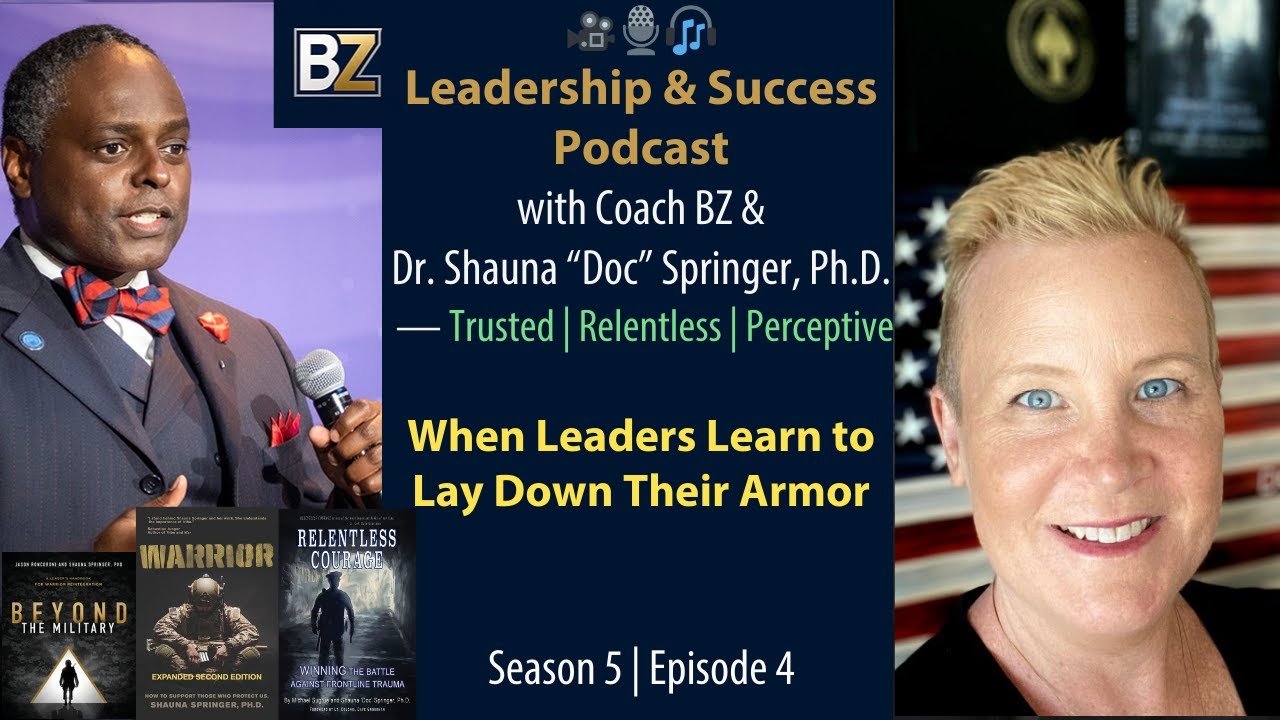
Dr. Shauna Springer, a Harvard-educated psychologist, discusses why about 21 service members die by suicide daily and how reframing trauma as an injury rather than a disorder changes treatment. She argues that psychological safety, leader vulnerability, and confidential pathways to care are essential, and explores new biological treatments like ketamine and stellate ganglion block.
Chapters
Hi, I'm John Maxwell. When the top companies in the world are looking for trainers, speakers, and coaches, there's one name that stands above the rest, and that's Maxwell Leadership. Our certified team members have gotten proven results for companies all over the globe, and our reputation, I'm proud to say, is second to none. Some of our members have risen to the top of their profession, including the one you're going to meet today. I proudly introduce you to my friend Bob Fabien Zinga. Welcome to the Leadership and Success Podcast with your host, Coach BZ, where we help you lead with purpose and succeed with impact. If you're ready to grow into the kind of leader others want to follow, this podcast is for you. If you're determined to elevate your success and leave a lasting legacy, this podcast is for you. As my mentor, Dr. John C. Maxwell, reminds us, everything rises and falls on leadership. Our goal is simple, to inspire you, challenge you, and equip you with insights that can transform the trajectory of your leadership journey. Welcome aboard to another episode of the Leadership and Success Podcast with co-host Coach Beasy. So I would say that my childhood was unusual. I spent a summer sleeping under mosquito nets with kids that had polio. And part of it, I think, was my dad. He got us up when we were 5. 5 years old, we'd go to the track and like run around the track in the dark for several miles and then compete in the local track meet every year, and we were expected to win. It's funny though, because the things that I didn't like also made me unafraid, and, um, I think are reasons why I'm able to relate to people who have served in the military. But I I instinctively understand warriors and I like them and I feel like they're like home to me. So many of them are now like family to me. But no, I didn't plan on this. So I wrote Warrior because of the unique relationship I found myself in with the warriors that have trusted me for the past 10 years. I will never forget that first time I dropped into one of those circles. Wave after wave of rage because I've been like the representation of perhaps the person that maybe didn't understand them. And then I realized that to build that trust, I had to be willing to sit with the discomfort of them misunderstanding me the way that we so often misunderstand them. That they are humans just like you and me, that they are not broken gear and they're not invulnerable heroes either. You know, we really need to understand them as individuals to really see where their hidden pain lies. I think the most important thing that I've learned from working with our strongest and bravest is that human suffering is a universal. When we connect, we survive.
Wow. How profound is that? When we connect, we survive. We need more connection and hopefully this podcast is helping do that. So as is our practice here on the Leadership Success Podcast, we want to take just a moment to reflect and be grateful. So this is, I guess, the fifth time I am doing a live podcast interview today. I'm very grateful for that. So I'm grateful for Today being the new year, 2026, January 2nd, 2026. Really glad to still be alive today. And then also glad for all of the illustrious guests we already have had and we're gonna continue to have for the rest of this season, season 5 on the Leadership Success podcast. So today I'm gonna be speaking about a subject that's very serious and it affects a lot of people, especially in the Military, about 21 service members commit suicide every single day in this country. It's really an epidemic. And that's part of the reason why I do this moment of gratitude every day. You have to be grateful because you cannot be grateful and be suicidal at the same time. You cannot be grateful and be depressed at the same time. You cannot be grateful and have high anxiety at the very same time. So we're going to be talking to the expert. She has written more than 3 books. About this, and it's a very important subject, and I think, you know, literally lives could be saved. She shared— now, she collaborated for one book, and we already talked to her writing collaborator here on the show. I think it was during our first Mental Health Day. You guys will remember. The book is Relentless Courage with Sergeant Michael Suku, where it tells his story. So Dax Pringle writes that story and it is really, you know, potentially a life-changing book. So I definitely want everybody to get a copy of that. So before I bring her on the stage, let me try to introduce her as best as I can, just briefly. So she is known, of course, as a military veteran. And first responder community simply as Doc. Dr. Shona Springer is one of the nation's most trusted voices on trauma, moral injury, suicide prevention, relationships, and warrior reintegration. Harvard-educated psychologist, bestselling author, keynote speaker, nationally recognized expert, Doc Springer has spent more than two decades working alongside those who serve, helping leaders understand the invisible battle that follows high-stakes service and command. She's the co-author of Relentless Courage— well, really the author of Relentless Courage: Winning the Battle Against Frontline Trauma, with the writing collaboration of Sergeant Michael Sugrue. And her work challenges leaders to move beyond surface-level resilience toward culture of trust, connection, and sustained performance. This is a must-listen conversation for military officer, first responder, executive officer, CEOs, founders, really anybody who's out there because we really need to learn how to navigate pressure responsibly and care for our team. All right, without any further ado, please help me welcome to the Leadership and Success Podcast, the one and only Dr. Shona Springa!
Thank you, Bob.
All right, Doc, how you doing today?
Great introduction. That was a really thoughtful— I mean, you went and found videos and pictures. I don't even know where you found half the things that were in that montage. Like, I've never had a podcast kind of find those things and put those things together, so thank you for that.
Thank you. I really do appreciate that. But more than that, I was telling you in the green room, I think the work that you do is really God's work. You are saving a lot of lives. I mean, I can't believe it's 2025, we have the most military in the world, but that's one area we just don't know what to do. Our veterans are dying and we need to do something about that. But let's start with something positive. What are you grateful for today? Today is January 2nd, 2026, the second day of a brand new year. What are you grateful for?
I'm grateful to be in a place where the air smells like sea salt and eucalyptus, um, where the air is just so fresh that you can feel it converting health into your body. I had to drop off my car this morning for some work on my 1999 4Runner that I'm keeping alive, and I walked home because I'd never ride, and it was an amazing walk, just like a wonderful walk. Up the coast side. So, um, that's amazing. Grateful to be here.
Well, thank you, thank you so, so much for sharing that. Sometimes the most precious in life, it looks like, are simple things. They don't even cost any money if people would just take the time to pause and smell, uh, the flowers or the coffee and just enjoy the moment, right? Yeah.
And sometimes if you take care of the things that you have, like my old truck it just continues to give me pleasure. Like, I don't need a new— I don't need a new car. These new car commercials, it just doesn't appeal at all because sometimes the best things are the things with history and story behind them. Yes, they're irreplaceable. So that's my perspective anyway, just like there are people who are irreplaceable, and that's who I want to support and help and walk with. So that they stay with us, stay in the fight.
Yes, yes, yes. Especially, I mean, what we're going to be talking about is pretty heavy. It's pretty serious. I think it's a matter of life or death and in the military in general, but for me in specific, I've been in the Navy for 21 years. When I first joined 21 years ago, it was really taboo for somebody, a sailor, to say, hey, I have some mental problems, some issues, PTSD or whatever, and I need help. And also back then more than today, I think we had that culture of bravado. I'm an alpha male, I am strong, I can do no wrong, and all of this nonsense. So people would really be suffering with mental illness, not even know it, or when they were aware, even when it impeded their work, they would hide it instead of seeking help, which is very, very wrong. And another reason why they did that is because back then I remember you could potentially lose your security clearance because you are seeing a psychiatrist or anything like that. And of course, in the military, if you lose your security clearance, you pretty much have lost your career. You've lost your job. That's no longer the case today. Today we really have a lot of resources and they're really trying to help the veterans. But anyway, it is a very serious issue and I definitely want to spotlight on that. But before we do, let me ask you, Is there something about you that most people may not know about?
Oh, plenty of things. I try not to make the work too much about myself. You know, some of the things people don't know, you captured in the little montage.
Yeah.
That, you know, I was raised in a way that was quasi-military, not specifically military, but growing up felt like being in boot camp. In a lot of ways. And I think it's why I connect with, with warriors and feel so comfortable with them and kind of instinctively feel drawn to people with a warrior spirit. I think working with warriors requires a kind of warrior spirit, different from the kind that maybe people have when they go into combat or they become first responders. But there's a recognition that can happen in those relationships that just puts me at the center of my purpose. Wow.
So let's talk very briefly about your book. Now, many in my audience, they already know about this book, Relentless Courage, because, um, Michael was, was here. He collaborated, uh, with you on that when you wrote this book. But, uh, you have some other books too. Uh, the one I showed in the clip, uh, Warrior, uh, it's really how to support those who protect us. And, uh, you also have, uh, Another book, let me find it. Yeah, here it is. Come on, computer.
I'm seeing Beyond the Military.
Beyond the Military, yeah. There is a delay on my end. I want to make sure issues there. And then your latest book, which came, I believe it was August of last year, Elastic Identity. So you really have done a lot of work into this mental health space, especially for those in the military. So I guess the first question I have for you is, when you wrote Relentless Courage based on the story of Sergeant Michael Sutwig, and the audience here, they know about him, uh, from your perspective, what does relentless courage look like before a leader ever steps into crisis?
So we have to think about what courage means first. Which is not the same thing as being brave. You know, being brave, I think of as taking risks that others wouldn't take.
Yes.
In the service of higher values. Being courageous is not quite the same thing. It comes from having the kind of courage that shows what's on your heart. It comes from the French word for heart. To show people what's in your heart is a harder thing for many of us to do, not just warriors, but many of us. To do than to run into a burning building or run into a firefight. It would be things like taking off your emotional armor with the spouse you love and saying, I really need you. I have so many veterans that would say, I would rather be any day in the kill zone than have to say that to my wife or partner. Because that kind of vulnerability is so terrifying for so many of us, not just veterans. So I think having relentless courage is about having the ability to share what's on your heart, to drop your emotional armor, to know when people are trustworthy, and to be able to lean into your tribe and their strength relentlessly, to not isolate, to not kind of compartmentalize your hidden pain like you were talking about earlier. I talked to Michael often. In fact, he just texted me today and said, hey, we have 890 reviews on our book right now. Wow, which is really amazing. And a lot of those reviews, if you go into Amazon, they're written reviews from people who have read the book. They're not just people going through and saying, you know, 5 stars, you know. I really would encourage people to read what people have written in the reviews because they're people pouring their hearts out about how this is really changing their mind about how first responders are people who are not, you know, just tools, how, you know, human pain is universal, how it resonates with their own stories. It's all kind of coming through the, the reactions and responses to that book. So that was a really wonderful project, my most recent project, but I'm happy to talk about any of my books that you'd like to talk about. Is there anything that's really drawn you that that you've read, Bob, that you want to talk through?
No, I know Relentless Courage is definitely one, and I really do appreciate that. And again, especially for the military, and I know Michael is a veteran of the US Air Force before he joined the police force, but also especially for men, I think that is where we really still have some work to do. And that's something I don't really quite understand because we do get physically injured in the military. It's separate. Tough life. And when we do, there is no shame in going to the doctor, going to the hospital, the emergency room, or whatever, getting treatment for that wound that is visible. But when it comes to your mind and your emotion, people feel like, no, I don't want people to know. It's not gonna make me— it's gonna make me look or feel like, uh, I don't know, someone who's weak or something, which is completely not true, right?
Well, here's what we need to change on that. Thinking is that there's a lot of people who don't understand that thoughts, self-destructive thoughts, suicidal impulses, urges, or thoughts are very common and normal. So the shift needs to be not that there's some outliers that are struggling, but that this is part of the path of being a warrior, protector, or defender. You cannot walk through the mud and not pick up some of that pain, that grit, that dirt, that human suffering. You're steeped in human suffering. You're in the business of life and death stuff. You're going to have the thoughts. And I flatly reject the idea that warriors are not able to open up or they're reluctant to open up. All of this conversation about stigma, To me, with the cultural changes that we've seen, boils down to one thing: it's not safe. They still don't come forward if it's not safe. And if it's not safe, that's logical, right? When it's safe, when they have confidence that they're talking to someone who's truly going to hold their privacy and confidence as a sacred thing, and they have confidence you can help walk them through a trench of mental warfare, They open up, no problem. Wow. They share bravely. I get on phone calls with veterans who are often referred by other veterans, and they just— they open up. They're dying to open up. We don't give them a safe and confidential way to do it often enough. And so that's part of why we're losing irreplaceable people. But it doesn't have to be that way.
Wow. Let's talk about psychological safety for just a moment. As a leader, because unfortunately, I mean, I've gone through a lot of training, especially after I became an officer, leadership training and all of that, but they don't really teach us how to handle our people when it comes to mental health issues. As a leader, as a boss or division officer, whatever your title might be, What do you think leaders listening to the podcast right now need to do in order to create that environment, that psychological safety where their people would be open to share and feel like, you know, whatever they share will stay, you know, comfy, denture is not going to be spilled over in the street so they can really get help?
Well, the leaders have to be consistent with what they say and what they do. If you say, 'Come forward and seek help. It takes courage to seek help.' And that's what you're messaging. And yet the guy or gal that does come forward has career repercussions. That's going to spread like wildfire. So you have to actually do the thing that you're saying you're willing to do for your team, for your people. And I have a friend, you have somebody named Cici Ramon-Cole Lopez, a recently retired SEAC. They need to be more like him. Leaders need to be more like Siak, who is, um, Sisi is somebody who leads from the front. Truly, he's brave and he's courageous. He gets on a public podcast, um, he talks about how he's had times of struggle. He's a public example of somebody that is a warrior's warrior. Yes, people respect. He's truly punched the badass card. Nobody doubts that. And yet he's able to say, because of that, this kind of mental warfare, it's part of warriors.
Yes.
We need to understand how to get traction with it. We need to have trusted advisors. We need to read books that give us insights, that give us ways to move with it, ways to understand it, what to do with it, and to realize that you're not unusual if you have these thoughts. Like, if you think you're the only one, then you're gonna hide it. You're gonna think, I'm different than the others, versus leaders saying, mental warfare, it's part of the path. It's part of this path. Let's expect it. Let's anticipate it. And when it comes, let's figure out how we walk through that together. Now, practically, they need to be able to advise people on what kinds of things can cause a loss of a security clearance and what things cannot. Yes, because if people don't know what their right and left laterals are, they'll just lock it down. So if you say, you know, you can have depression, let's get it treated.
Yes.
Um, and disclose that, then you have to be consistent with that in your behavior and provide an on-ramp, or for people to not get sidelined. That's what they don't want, is to get sidelined. So if leaders can do that, then people will come forward and seek help. And if they don't, then they need to have created, um, safe access to people like myself who are outside of the chain of command, with the chain of command trust, but we're outside the chain of command, to kind of do our best to take care of people and create the safety that maybe can't always happen in a system where psychologists are tapped with two roles. Yes, trying to ensure troop readiness and they're trying to support good mental health. And people don't trust people when they have two masters.
Yes, yes.
So they have to create relationship with people outside the chain of command sometimes.
That is so true. And thank you so much for, uh, mentioning, uh, CZ. It's really, uh, no, it was at the highest level of enlisted leadership. And when troops see somebody like that, who speaks frankly about his own vulnerabilities and challenges, it really goes a very, very long way. Because like, if I look up to this guy and he is talking about his struggle, then no, I definitely have some issues too and I need help. And maybe we can save a life or two.
It's courage and it's honesty. We need leaders to be honest and talk about their own times of struggle. They don't have to go into detail, about times of suicidal crisis, but talking about mental warfare is a part of the path. You will have it. They've had it. They've had times of struggle. And CZ's wife Janet is right there with him as somebody who's brave and bold and is a leader in her own right, who tells people, you know, here's the truth of it. Um, so I have tremendous respect for the two of them as a couple. I think, you know, the way that they talk about Mental Warfare Is What Right Looks Like. And I'm honored to share that CZ's gonna be writing the foreword for my next book, which will be titled Fall Out: 10 Common Beliefs That Are Killing Our Bravest and the Truth That Can Save Them.
Wow. That is just incredible. Now, like I said in the intro, you are called Doc by warriors. What does that title mean to you? And what responsibility does it place on leaders who are entrusted with others' lives and well-being?
Yeah, thank you. First, it's not a title I gave to myself. You can't call yourself a doc until somebody confers that title on you, or enough people do, that it becomes kind of how you're known. And so it means a great deal to me. It means essentially, in private conversations, A lot of times it's a translation of 'I trust you.' Yes. When people say 'Doc,' um, that was how it was explained to me by the original warrior who conferred that name on me. He said, 'You've got, you know, medics, you've got doctors, you call Sir, you know, and then you got Docs, and you know that the Docs are the ones that they will do anything they can, um, within reason to save your life.' Yes. Um, and they're brave in their own way. And so that's what it means to me, a heck of a lot more than Dr. Springer, even though I worked really hard for my degree. You know, I'm proud of how hard I worked for that degree. It's, um, it doesn't say anything about my approach to how I support patients, doesn't say anything about the sacred work I do. Um, a doc is about the trust that I hold with warriors and first responders.
That is so powerful because I joined the Navy 21 years ago. I probably got 3 or 4 different callsigns is what we call it. Everybody gets a nickname because one thing weird when I joined the Navy is everybody was calling me by my last name. I'm like, okay, I am Bob Fabien Zinga, but I just go by Zinga Zinga on my uniform. Everything's Zinga, but I guess that's just the way things are. So eventually when you join a unit, then they kind of find a nickname for you. Yes, Doc definitely means something because there's a difference between being Navy doctors, kind of like what you were saying, they pretty much have two masters, right? Because on one end they do care about you, the individual, but then they also need you to be feeling well so that you can go back to the fight right away, even though you are not 100%, right? So, uh, it's, uh, uh, but, but when, when they go to somebody like you outside of the system, they know that you only have one thing in mind, and it's really their mental welfare.
Get you well, you know, we're going to be Um, we're just going to be relentless about that. We have things we can do. There are biological treatments now available that we can do that can heal you if you have post-traumatic stress injury. There are treatments for depression we didn't have 10 years ago. Um, there are, you know, new things coming down the pipe all the time, so we can do things to get you well. And I'm glad you made that point, Bob, because It is structural. You know, there are some docs in the military. Some of the really good ones I've met are embedded in the military. And it's not their fault that they serve two masters. But the result of that structure makes people kind of say, 'I don't know if I want to share and really open up if you have to report back to my leadership.' So it's structural and how we set it up. And then yes, you have to have the right kind of people with the right kind of qualities and and insights and training. And that's a whole other, other thing that I'm going to be writing about.
Wow. I mean, it's really, really, really important work. And you've also— you often write and talk about mental warfare. Actually, I think one of your books has that title too. So how is mental warfare different from just stress and burnout? And why is that distinction critical for commanders and executive?
Well, mental warfare could include acute and chronic stress and burnout. My point is that, you know, even an armored tank will break down if it's not maintained.
Yes.
And what warriors do, the path they take, does subject them to a much higher level of trauma exposure and moral exhaustion and moral injuries and, you know, survivor guilt and grief and loss. I mean, I have so many veteran friends that have been pallbearers in multiple funerals, or have lost many of their irreplaceable brothers and sisters they would die for to suicide, and they're carrying a disproportionate burden of grief. And so you can't be in this work, you can't be a warrior and do these things and expect that it's not going to impact you. It's going to have a human impact. I think that's what Relentless Courage was partly about. Partly we wanted to write about, through Michael's story, which he shared with me through interviews— so bravely he shared with me his story, so courageously.
Yes.
Um, we wanted to use his story to let people know that it might not be always trauma. You know, mental health professionals were focused on trauma, you know, trauma exposures, anxiety disorders that leave you locked in helplessness or horror. But there's a whole other level of things that can happen when you're doing warrior work, when you're a first responder, when you're a veteran, that are moral injuries. Choices that you have to make without all the information, being helpless to stop someone who's innocent from suffering, not being able to execute on something that's really important to your identity, your moral core. There's things that happen all the time in this work, and that's not the same thing as trauma. It impacts people differently. It can cut much deeper into your identity. And so when I say mental warfare, I'm talking about all of it, recognizing with, with an honest, um, acknowledgement that this work has impact. And we have to have people in there that understand mental warfare. So for example, Bob, did you know that in most graduate schools you're never going to take a course on how to walk someone through grief and loss? I didn't learn that in grad school as a psychologist. Moral injury, not a thing that psychologists see themselves as needing to understand. It's not a diagnosis, and it's left to often, um, you know, people in religious or spiritual capacities, maybe chaplains. Um, psychologists don't often get any training on moral injury. Wow. And yet it's often more related to suicide than trauma exposure.
Hmm. That's really something to think about. And I like the word you use, injury, because, uh, in your book too, I think you use a picture of Michael, who was your riding companion for that. You guys talk about post-stress, PTSD, post-traumatic syndrome, but you guys post-stress traumatic injury. So why is that important to highlight?
I think the definition of a disorder, right, post-traumatic stress disorder, means that it's a chronic condition that you have to manage over time. And what that does psychologically is it makes people feel as if they're broken and they're permanently impacted by exposure to trauma. They can never be fixed. They're broken gear. That's what it makes people feel like. Um, if you say it's an injury, it can be seen on a brain scan. It can be healed with innovative treatments like the Dual Sympathetic Reset Stellate Ganglion Block with you know, ketamine infusions are amazing sometimes for, for moral injuries and trauma. Um, TMS has applications for anxious depression and other treatment-resistant depression. So there's these biological modalities that are now coming to the forefront that are very powerful in treating these things. And so my interest is in helping people evolve their terminology so that psychologically they don't feel like they're permanently broken and permanently under a life sentence of post-traumatic stress. It can be healed. An injury can be healed. Um, and I've seen people get healed, thousands of them, um, the past few years, ever since I've been a co-founder for Stella Mental Health. Thousands of people have gotten healed. Wow.
That is just amazing. So really the perception, right? The mindset. So let's talk a little bit about that moral injury, but with betrayal and trust. Now, in my own experience, I think things have changed a lot. I don't know across the entire military, but definitely for the Navy, from my perspective, 21 years ago when I joined and today, no, completely different. There is a lot more support I can see from my chain of command from the organization as a whole to really help our sailors who come back from combat zone and all of that with a lot of issues, trying to rehabilitate them without really administratively, you know, affecting their career, taking away their secretaries or anything like that. But there are still many service members today and first responders who really describe administrative betrayal. As more damaging than the traumatic event itself. So from your work, what creates that sense of betrayal?
I think there's certain callings, they're not jobs, that tend to evolve in the context of membership in a circle, a circle of trust. People are not coworkers. They talk about each other in a different way as brothers, sisters. They're more like family. Um, yes, you know, Sebastian Junger wrote a powerful book that a lot of people have read called Tribe. He talks about your tribe as the people with whom you would share the last of your food if you're running out of food. And I like that definition, and I've, I've added to it in my book Warrior as, um, people that you also are willing to remove your emotional armor with and talk openly about the kinds of mental warfare that you're struggling with.
Hmm.
So I think a lot of times, you know, in these callings, being part of that tribe is your identity. And there's a lot of promises that are spoken and implied when you become part of that tribe.. And one of those is that your leaders will have your back if you behave in a way that's, you know, honorable or reasonable within, you know, the rules of that society. That your leaders are not going to hang you out to dry. So you have a lot of goodwill leaders that actually aren't intending to betray people. But they don't have good advising and guidance. And they don't always understand that doing nothing is a betrayal. There are really important moments, critical moments as a leader, where doing nothing will be perceived as the greatest administrative betrayal you can imagine. Because a lot of times when people are charged with crimes or if a first responder is under internal investigations, They can't speak for themselves. They don't have the same rights as civilians do, and other people don't know that, so they infer culpability. They look at someone who doesn't speak up as guilty. And so it's up to the leader to step into that breach and at least provide education, um, to people who otherwise misinterpret someone's silence, or to hold you know, kind of a wall of space until an investigation can be completed so that people don't come to the wrong conclusions. And so a lot of leaders, you know, they don't do that, or they don't memorialize people who die by suicide, or they say suicide is selfish. They do these things out of good intentions to hopefully deter others from dying by suicide, but it does the opposite. It creates shame and betrayal and a sense of, um, well, if their life meant nothing, what do you think about me? So a lot of these things are really going to be my focus of my next book, is like these different things that people do with good intentions, I think, and maybe because they don't have advising to say, this is how this will be felt, this betrayal, by those you're leading.
Wow, there is really nothing worse for a commanding officer, someone who's in charge of not just a mission but its people, to be betraying the people you really care a lot about without even knowing it. Wow. So what, what do you think can be done? I guess what type of awareness or maybe training you think might be able to fix this in the future?
I think honestly it's having the humility to know that you don't need to be the expert.
Yes.
And to be a leader and having the humility to seek outside guidance. The best generals have advisors. They have people that can help them see the matrix. Sometimes the unlikely person, somebody like myself who's outside the circle can see things with clarity that people can't see from within the tribe. And so having the wisdom and humility to say, maybe we need to get some advising from somebody. I'm doing this work right now for several really progressive sheriffs. So I'm advising them and their leadership. So for example, I might work with a team, an agency, and advise the jail commander, the 911 director, the deputy, chief deputy, and the sheriff, you know, kind of all of them around stuff that comes up. And one of the resources I created for one of my clients that people are very interested in is 10 ways to harm your people during a critical incident.
Wow. That is quite fascinating. So people could be doing those 10 things and harming their people during the incident but not even realize that they are doing it.
Usually unintentionally.
Wow.
I mean, sometimes you have bad leaders who are, you know, selfish and shouldn't be in a leadership role. But yes, a lot of times it's people that mean well. They just don't— they don't have to be the expert. Wow. They just have to be humble enough to seek advising. Around the things that maybe don't come as naturally.
Yes, I can only speak from my experience, but for the Navy, I think for the most part, everybody is trying to do the right thing. And that's another reason why I have this podcast. And I want people to really be aware of some ideas out there that might potentially save someone's life or help them be better leader, right? Really, really know how to better support the people. I know they do care. About the most. Wow, that is, that is quite something. Now, you also wrote this book, we showed it earlier, about transition, right? Beyond the Military: Leaders' Handbook for Warrior Reintegration. That is such a difficult thing sometimes, especially when you are on active duty in a combat zone where you have no up tempo, it's pretty much 24 7, and then you come back in America and then things are kind of very, very slow. You almost want to go crazy because you are just not used to it. But so you've done extensive work on warrior reintegration. Why is transition such a high-risk period, not just for the individual themselves but for families and organizations as well?
Well, as you said, your life gets thrown into a blender and you fall off a chemical cliff going, you know, 100 miles an hour to nothing. Where if you're a leader like yourself and the phone stops ringing, it's weird, it's really hard. And a lot of times what transition programs have really focused on is not the deeper identity-related and psychological and relationship-related challenges. Yes, they've often focused on benefits, financial supports, retraining, update your resume, all the kind of stuff that is important, but it's woefully insufficient for helping people for whom leaving this tribe feels like an emotional amputation.
Never thought of it. Actually, maybe I did. Because, uh, I think it was in 2017, I was a lieutenant commander, so that was one pay grade ago. The Navy came back and told me I was no longer medically qualified to stay, and, uh, they were gonna kick me out. And I was like, no, I'm not ready to be kicked out of the Navy just yet. I have dreams. I want to be commander, you know. And, and sometimes when I am in uniform, you know, I kind of feel like Superman, right? And then they took my uniform away, and I am Clark Kent, and I can't fly anymore. I'm like, no, Who am I without my job? I am an information warfare officer. I didn't know who Bob Fabien Zinga, the individual, the civilian, the one person out of many was, but I knew who I was within my unit, within our mission and the work we did. So I really lost myself there for a minute. And then I remembered a quote from General Colin Powell, one of his 13 rules, right? Don't let your ego be so close to your position that when your position goes away, your ego goes away with it. But it was really, really a struggle. Now, thank God, I fought the medical hierarchy and all of that. I went through medical board and eventually they found me fit and I came back. So now I am a commander. I've achieved my dream, everything I wanted to do. So now if I retire, I am perfectly fine. I'm not going to lose my mind over it. But again, it was only like, what, 7, 8 years ago? It was like, no, I don't know who I am anymore. I've lost my identity. How do you explain that?
Yeah, I mean, it's— so Jason Roncaroni and I wrote that together. He wrote most of the first 300 pages and I wrote about 100 pages on relationships specifically. I love that project. Jason is brilliant and he just really understands that it's about hitting this identity crisis. And it's— we really wrote that more for the leadership level because the longer you're in, the more that's an identity. And yes, I mean, partly it's ego, but it's not just ego. I mean, you're talking about being a leader of a group that you share all of this history and they know your stories, and you know, there's all this co-development and evolution that you've created together as an interdependent group, which is very different than how it feels in the civilian world for many people who experience You know, camaraderie is, is, I say, love by another name. Yes, it's not romantic love, but it's a kind of intimacy and love that a lot of civilians have a hard time really understanding, and they've never really felt it. And so when you felt that, that's why I describe it as emotional amputation. It's an identity crisis and a loss of attachment to the people and the ethos, the warrior ethos. It takes work to rebuild a life focused on a warrior ethos as a civilian. It isn't easy, it isn't natural. It requires really intentional thought and relationships. Everything gets thrown into a blender around roles and, you know, what the next steps are if you're in a relationship. So there are many unique risks during this phase. And it's also a time when you can really define what is underneath the uniform, you know, what's always existed there that the military maybe facilitated in terms of your core identity, that you can repurpose and discover purpose and meaning in other ways in life beyond the military.
Hmm, that really gives people a lot to think about period of transition, it's really not easy. There's another thing that the military does which is kind of strange for people who are outside of it. We have to move and change jobs like every 3 to 5 years. It's like, it's automatic. So as long as you learn your job and you're really good at it, it's time for you to start all over again. So when you start all over again, you start at the very bottom. So you have these feelings of insecurity. I don't know how to do this. I am still learning. I'm making mistake. I don't want to make mistake. And it's really not a lot, and it goes in cycle over and over and over and over again. So I know I kind of see the strategy why they would want people to go through all of those changes, but it does have a huge toll on you as an individual, though, doesn't it?
It does. You're developing elasticity in your identity, and what holds that together is this social connection fabric, so that even when you meet a totally new, different— new and different group of people, you all have kind of the same values and ethos, enough that there's a recognition and a quick attachment that can happen. So when you leave that whole world and go into the civilian world, it just feels like you're in an alien planet, and people don't think the way you do, they don't value the same things, they don't speak your language. Um, and so another thing that, you know, the military does out of the best of intentions and maybe because, um, there's no better plan right now, is have people who lead transition classes, uh, are the ones who have not usually transitioned. You know, you have— and that's why they're focused on like the benefits and like updating your resume, because those are things that can be trained and taught in those classes. So one of the things I will likely be doing this year is working with the Veteran Mentor Project, is what it's called. And we're going to hopefully be doing a lot of work developing mentors who will help mentor people through transition in a real connected human way. And I will train up that team of mentors and resource them if this project takes off to give that human connection and that bridge through to transition, because it's very, very challenging, especially for leaders sometimes.
Yes, that is so powerful. Actually, tomorrow I'm going to be talking to Colonel Chevy Cook. He is one of the advisors for a military mentoring program. And I think we really need those, especially for those who are in transition, because we talked about it like when you are in the service, especially when you've been with people for a long time, you found that camaraderie. It's more than that. It's almost like brotherhood. I guess we say brothers in arms, but really the person to your right, your shipmate, and person to your left, they are willing to take a bullet for you. I don't know anybody at Microsoft, IBM, or Google who's going to be willing to do that for me ever. So it's a very solid bond. Like even in ancient scripture, they talk about a friend who's closer than a brother, right? Someone who's willing to give his life, no greater love than that life or your friend. It's, it's, it is, it is, um, really a love that I don't think any human being can ever experience unless you are in those type of—
yeah, or there's no civilian. Yes, there are a few, but very few civilian analogues for that.
Yes. Wow. And then when you get out of this environment, all of a sudden you're wearing a suit and you are in an environment where nobody really cares about you the same way. It is quite a challenge. So which leads me, when they do come back home, let's talk about relationship and human connection. Why do high-performing leaders sometimes struggle the most at home? It's kind of strange. You out there, you are Superman, you can do anything, but at home it's like there is a problem. And what can they do differently before damage accrue?
Accumulate? Oh, it's so hard to give kind of blanket advice, right, on like— because every single leader has a different situation, a different challenge. So I want to acknowledge that first of all. I think some of the reasons are that high-performing leaders really get very into that role of being a high-performing leader and begin to become less elastic. With transitioning between two worlds and two sets of values. If we think about, you know, like a high-performing warfighter, commander, first responder, they get really good at being a certain way, communicating a certain way, and navigating challenges in a way that's structured and thoughtful. But you can't really take all of that and bring it home and expect your partner to be happy about it. You get a lot of pushback typically. This, I'm not your recruit, you know.
Yes, I've heard that before.
Hold on, buddy. And you're not God's gift to man, you know. So just like, let's recalibrate, right? The rank in this relationship. And so dropping your rank and becoming elastic and being able to connect with your wife, your kids. Your spouse, your partner in a totally different way. It gets harder almost the better you are at one role. And so it takes like ongoing effort to build that capacity for elasticity. And that's what my book that was authored primarily by Dr. Mitch Javidi has a background as well in working with people in special forces. And so we think, you know, humans are more important than hardware. And we come at it from that mentality. And then our friend Jeff Kingsfield. So the three of us, very short book on the concept of elasticity of identity and how you have to continually build capacity for that or else you tend to get pretty rigid.
Wow, that is really insightful. I know, for example, in my home, I am Commander Zinga, but when I come home, I leave my rank at the door because my wife is Commander Zinga in my home. Yeah, it used to be a little bit frustrating and challenging because, yeah, you are in a place, especially, you know, I am the commanding officer, I am the highest-ranked officer in this unit, in this command, I am the law. And then you come home and children and wifey and it's just a completely different world and you feel like you are still, you know, in that mode of command and control and mission and I tell them all of that. But in reality, no, this is home, these are people.
Control? What control? Right? Yes. And here's another thing. Here's another thing. Like, people with a warrior spirit, I've asked them at keynotes, like, okay, I'm gonna ask you this, Bob. Okay, you can answer this question. Four emotions, four human emotions: anger, sadness, fear— let's make it five— disgust, and helplessness. Which is the most intolerable for someone with a warrior spirit?
Hmm. It looks like all of them.
Fear, disgust, and helplessness.
Definitely don't want to be helpless. Uh, it looks like all of them. May—
that's it, the helpless. Yes, what you said first. Trust your first answer. Yes, 95% of people, helplessness is the most intolerable feeling. If you have a kid or more get used to feeling helpless.
Yes, yes.
Right. It's like, I'm a mom too. And so when I became a mother, I had kind of this identity, right, of Harvard graduate, you know, this PhD, whatever, whatever. And I had these kids and I was like, I don't have this. I don't got it. Right. Yes. It was like a profound helplessness that I found very, very hard And that was the beginning of many years of feeling like, yes, wow, I have a lot less control than I thought I did over a lot of things that I care so much about. Um, and so that's another reason why it can be really hard for, for warriors at home, because there's just a lot of helplessness when you have people growing and developing and moving parts and different roles.
And yeah, that is really insightful because yeah, I think children will definitely change you and it's gonna humble you too. But wow, it's incredible because when you are helpless, basically what you're saying is, I don't know the solution, I don't know what to do, I need help, I need somebody else to help me figure this out. And again, things have changed a lot since I've been in the Navy in last 21 years. But 20 years ago, it's like, no, I am the macho man, I'm in charge, I know everything, I'm strong, Navy strong. All of this nonsense. But, but the truth is, sometimes you just don't know.
Yeah. And then alpha leadership is being honest about it.
Yes.
You know, is being strong enough to be honest about it and seek counsel and seek advice and seek support and lean into your tribe. You know, that gives permission to other people to do the same. So when leaders do that, it's incredibly important. They're clearing space for for other people to be courageous as well.
That is so true. So talking about connection, Manuel, we are almost running out of time. This has really been a very inspirational and insightful conversation. And again, I'm hoping, especially for my junior officers listening and enlisted too, to really take this to heart, right? If you need help, you really need to go there and seek the help you need. There is so many resources out there for service members today. So it just doesn't make sense, like, so many of us are still committing suicide.
Part of the problem though, that's part of the problem. There's a, a sea of goodwill and people are lost in the sauce of all of it. What they need is trusted advising about vetted resources. Otherwise they end up doing nothing because they're overwhelmed by the amount of options without knowing who's trustworthy. Or they end up going to some crazy program or something that two of their friends, you know, told them about, right?
Yes.
And it's got no scientific backing, no, you know, nothing, you know, that you'd want to have in a program. So, um, I think, you know, part of the problem is too many resources without enough human connection to help people understand what's trustworthy.
Wow. So, uh, one thing you've, you've said often is connection is a protective factor. Practically speaking, though, what does that look like inside a unit, a department, or a company?
It looks like, um, many different things. It looks like people being, um, leaders setting the tone and the culture. First, I think leaders create the culture in which mental warfare is addressed directly or is put off and compartmentalized. So when they do that well, then it looks like people being honest about mental warfare being just part of the path. Doesn't make you different, doesn't make you unusual, and you address it together as a group. You don't cut people off when they're suffering and struggling with something. That's when you really need to step in and lean into them, actually, and give them support and let them know they're part of the tribe. So when I say when we connect, we survive, I mean we have to stop this mentality of get thee to a doctor. It has to be okay, there are specialized people that have training that can help you. They can be an extension of your tribe., but not a replacement.
Yes.
For the value of connection, because the way that identity is constructed is communal with people with a warrior spirit. So you have to have that piece, and you have to retain that piece and not make people feel like they're outside of that tribe.
Yes.
When they're going through a period of crisis.
Wow.
There's an on-ramp back on so that they're not permanently sidelined. And then it looks like people who know that there's injuries, not disorders, and injuries can be healed and It looks like people knowing that we, we can innovate to save lives because we have to. And there's already things that we can do to treat people when they have these injuries and get them back on the line. That's a big question.
Yeah. But really, I am hoping things that we talk about today, you know, might potentially even just save or improve the life of one service member, that truly will be worth it. Uh, it is, it is really incredible the, uh, impact you already have and you continue to have on the service member community. Uh, very, very much, uh, appreciated. But I guess, uh, so we're gonna need to, uh, get toward closing now. Uh, one, one thing I have noticed throughout my Navy career, sometimes we have a lot of slogan and things that we say, check boxes. But sometimes I don't think we really know what it really means and how to apply it in real life. For example, bringing warriors all the way home and stuff, getting people excited, it looks like you're doing the right thing, but some people, it seems like, may actually be kind of left behind and feel like they become outsiders and there is really nothing to catch them. I guess my question for you, bringing warriors all the way home, What does that truly mean to you beyond just being a slogan or program?
For me, that means helping people develop the elasticity that will allow their identity to encompass two identities. So warriors are people who walk in two worlds, and you can get really good at walking in one world and then the other one, their connection can atrophy. That's kind of a natural process, actually, if you don't put energy into that system. But if you can build capability of really connecting with other people outside of the military, like what Jason and I wrote about, is, yeah, 1% of the population serves. So if the only people you can really connect with are other military service members, you're going to be really lonely. You need to be able to repurpose your warrior spirit but also learn how to have intimacy and develop it with your spouse or partner at home to that same level. You take a concept of what this camaraderie, this love feels like, and you figure out how do I develop that level of trust and mutual self-sacrifice in my relationship? How do I develop that with other people who are worthy of my trust? How do I extend trust to trusted docs? I'm not the only trusted doc. You know, there's other people throughout the country that I've met that are wonderful. Some of them are working in first responder agencies with veteran-focused organizations.
Yes.
Finding those people so that when times of crisis hit, you don't have to build the trust. It's just there, and you can call those people and kind of walk through it with them. That's another part of bringing warriors all the way home, is developing social net that says you're still in community, still in community, even if you're positioned out of the military. Yeah, this tribe you've created and built truly has your back. And I felt that as a civilian, by the way, going through my own time of struggle. My tribe surrounded me. I have no doubt there were people who were standing with and for me that would make all kinds of sacrifices. Yes, because of the love and the trust that we share together.
Man, it really goes back to connection, doesn't it?
Yeah.
Wow.
When we connect, we survive.
That's really incredible. So we are running out of time, but briefly, this is a very heavy subject, but it's very important and we need to talk about this more and more. We already said, where can people find out more about all of the great work that you are doing?
I do think LinkedIn is probably a place where if people go on there and they say, hey, I listened to your podcast with Bizzy, you know, that would be good. I don't accept like everybody. I'm not trying to build a big network. I want to have people in my network that are mission aligned.
Yes.
Um, so if you have a reason you want to connect with me, just put that in a note to me. How do you want to collaborate? Who are you? Like, where— what drives you? I need a little context. Um, but I'm not, you know, trying to exclude people. I just— I'm not interested in like putting bots into my— or people that have nothing to do with anything I'm working on, or people that are going to try and sell me or my network something. I won't just accept all invitations, but I will accept invitations from mission-driven people who want to do work to support Protectors, Defenders, people in general. Um, so reach out that way. And then I think another request I would have is for people to really just know that I think my next book is going to be an important one. It's about 100 pages, real short. I want it to fit into people's hip pockets. And it's about commonly held beliefs that have really blocked us and have not served us in terms of how we support protectors and defenders and prevent suicide.
Yes. And your website as well?
Yes.
Dr. Shawna Springer.
Dr. Shawna Springer. And if anybody's listening from a first responder agency, I would share thinlineadvisory.com. Thinlineadvisory.com is the consulting and advising work, and that's the platform I use with veteran-focused organizations as well, um, to do sort of specialized advising and consultation as they build programs or want their peer teams trained up and resourced with with a different line of insights than maybe what's conventionally trained. I have a suicide prevention training that I do that's really based on a different line of insights, and I would love to do more of that, um, next year, really get that out.
Well, Willie, thank you. Thanks so much for all of the work you do. I believe this is God's work. It really means a lot to our members in the veteran community. But I— again, this was a very heavy discussion. I want to end in a light not if we can. Let's talk about hope just briefly. What gives you hope right now when you look at the next generation of leaders, especially in the military? For me, especially in the Navy, but, but where, where do you find hope?
I find hope in, in all the generations actually, because a lot of my friends and patients are Vietnam veterans. I'm very close to a group of wonderful Vietnam veterans that are doing amazing things in my community where I work. And they've backed me and gotten behind me. The, you know, Diablo Valley Veterans Foundation has been a strong partner of mine for many years. So I don't think that, you know, it's— we're going to be saved just by the next generation. I think it's— we're going to be saved by the way that we support all of our warriors from all of the eras and by the renewing and transforming of their minds and their models for how to heal, that healing is possible at any age. That no one is beyond the reach of treatments and insights that are on point and that can help heal injuries. So I get a lot of hope from thousands of people I've worked with who have healed and are not broken, who are not under a sentence.
Wow.
So I have a lot of hope. I couldn't do this work without having a commensurate level of hope and just seeing that lives can be saved and lives can be changed.
Wow. So somebody who's listening right now, who's maybe a junior officer, came back from combat, they feel like they are broken and they have this syndrome, and no, there, there, there will be no hope for them. What you're telling them right now is, yes, there is hope.
You're not broken. You're not broken. Feeling broken doesn't mean you are broken. You just need to get the right insights and the right support, including innovative treatments that are incredible. A lot of the people I see for patients, 4 to 6 sessions, and most of them become asymptomatic. Because not just therapy, it's because we're combining biological treatments with therapy and the right insights. So those two things together, these are injuries, and often they can be healed.
Well, well, this is a great high to get off now. Thank you so much, Dr. Springer. Doc, the very last question I have for you, uh, what, uh, if you could choose one word to describe our time together on this podcast, what would it be?
Um, friendly. Like, I, I really think some of the, the best conversations start in friendship and mutual respect, and I appreciate from the intro that you made for me to the the questions that you asked me, to how responsive you've been. I screwed up the timing. We were supposed to do this last time. You were so gracious to me about that. I had to apologize for it. But it's been a very interesting conversation, and I'm grateful to you.
This was definitely worth it. And thank you again. I really appreciate it.
My pleasure.
That was Doc, everyone. Wow. So again, this conversation is extremely important, really dear to my heart. Because there are people out there I know for sure in the military who might have PTSD, but they haven't been diagnosed and they don't even know about it. And sometimes they don't find out that they are really in trouble until something happens. So what I'm saying is we need to do something before something happens, right? So seek for help, right? Go out there and technology has evolved and really get well. We need all of our warriors to get well. All right, that's all I am going to say. We are going to end the show, but just to remind you guys, today in about an hour, I also, I'm doing it, going through the Book of Proverbs. I've been doing this every year since I was about 12, 13 years old. Now we have 31 days in the month, no, the first month of the year. Each day I read one chapter of the Book of Proverbs. There are 31 chapters in that book. So I'm calling this Ancient Wisdom Mentoring from the Book of Proverbs. This is not religious at all. It's just about ancient wisdom and leadership lesson from the Book of Proverbs. Solomon is the one who wrote the book. Some people say the wisest man who's ever lived. So we are going to get to it today. We're doing chapter 2. We did chapter 1 tomorrow. You can watch the replay on LinkedIn or YouTube or your favorite podcast platform. And because this is separate than the current season, season 5, as you can see, I'm calling this season 31. This way you will not be confused. Season 31, episode 1 through 31 when we are done at the end of the month. Okay. And then tomorrow, like I told Doug, I'm going to be interviewing Colonel Chevy Cook, U.S. Army. He's a mentor-in-chief, soldier scholar, and strategist. I'm especially going to be speaking about his mentorship program, which I think helps a lot of people in the military, especially those in transition. I will also have the pleasure next week of speaking with the one and only Admiral Melissa Burt. She was the JAG, the Judge Advocate General, basically the top lawyer for the US Coast Guard, recently retired. She's principled, strategic, empowering, and really a role model for everyone. We're gonna be talking about leadership at the intersection of law, trust, and national security. And another person I'm really excited to be speaking about next week is going to be Charlie Wetzel. He is the writing companion of my primary mentor, Dr. John C. Maxwell. He's written hundreds of books, most of them number one New York Times bestselling author. But what most people don't know is Charlie Wetzel is really the brand behind all of that. He's the one who is really a wordsmith, right? A master craftsman, a faithful steward and multiplier of impact. Nobody may know his name, but he's had a huge impact on millions of people through his writing. So I am really, really excited to put put the spotlight on him. We're also going to be talking to Tembo Awe Stevenson, food justice visionary, cultural engineer, and scholar practitioner. We're going to be talking about leadership with nourishment. Bestselling author of the Wanda series. And I think I have one more person who confirmed. Yeah, he's the chief information officer, Lee Jones. He's actually right here in the Bay Area. We're gonna be speaking about going from legacy to resilience when it comes to cybersecurity and technology. That's going to be a lot of fun. So many more speakers and guests and authors and military members and leaders of industry are going to come on the Leadership Success Podcast, and hopefully this is adding value to you. All right, and great, many, many, many thanks to Michael Segroux. Is the reason why I was able to meet with and connect with Doug. So I am very, very grateful for that connection. All right, this is it for now. And for those who can, I see you in about an hour for Proverbs chapter 2 right here on LinkedIn and YouTube. So season 31, episode 2. But until then and tomorrow, have a wonderful evening.
Bye. Thank you for tuning in to the Leadership and Success Podcast with your your host, Coach BZ. If today's episode added value to your leadership journey, be sure to subscribe, share, and join us again for more wisdom nuggets on how to lead better and achieve greater success. Remember, leadership is the most critical skill of our time. The world will always need leaders to inspire others, drive innovation, and execute meaningful strategy. So why not count yourself among the bold leaders shaping the 21st century. Until next time, stay inspired, stay committed, and keep leading with excellence.
More from Bob

S250:E4🎙️LIVE 🇺🇸America 250: President Barack Obama Leadership, Service, and the Power of Hope






S5:E157🎙️ LIVE with CMD CMSgt Dennis L. Fritz, USAF (Ret.)(Multi Tracks Audio)



S5:E156🎙️ LIVE 🇪🇸 Leadership Lessons from the FIFA World Cup 2026 Champions (Multi Tracks Audio)

S250:E3🎙️ LIVE Leadership Lessons from America’s First Documented Family of African Descent 🇺🇸📖