S5:E40🎙️ LIVE with Olivia J.M. Nunn, USA (Ret.) 🇺🇸✨
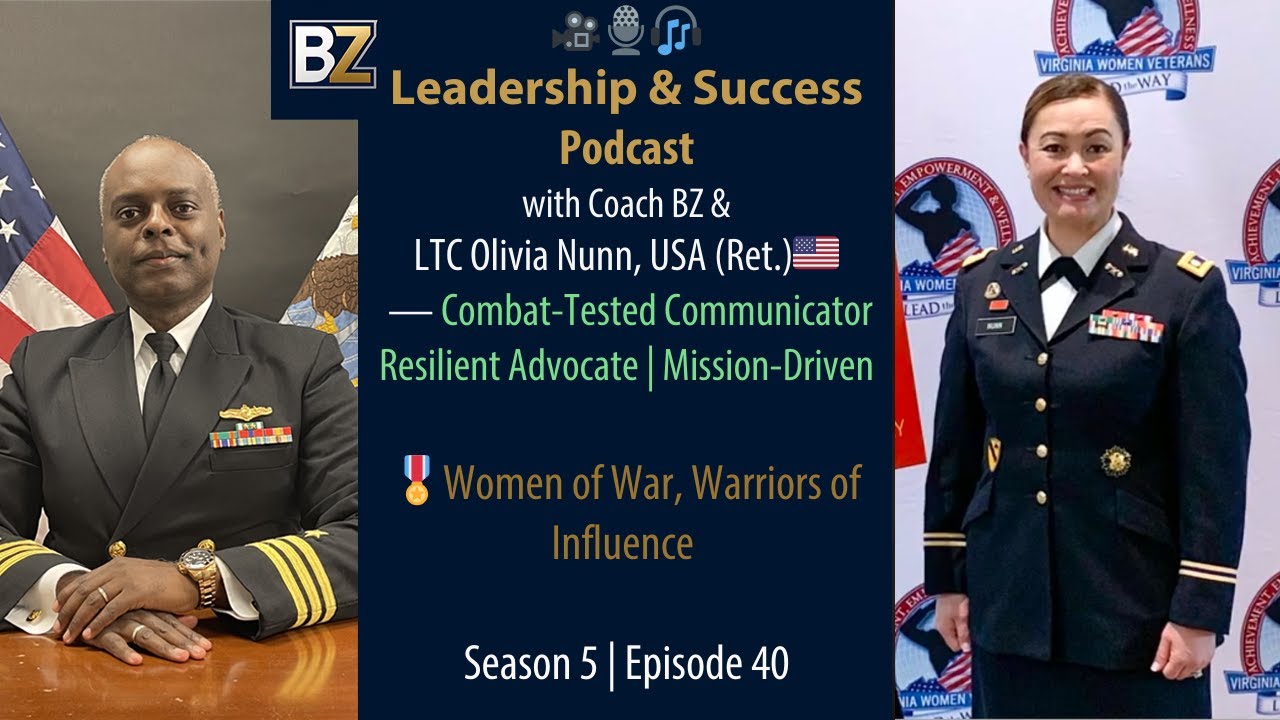
Lieutenant Colonel Olivia J.M. Nunn, a 20-year Army veteran, created two podcasts, Women of War and Unbreakable Storm, to amplify veteran stories and address the mental-health crisis affecting service members. She discusses leading as a woman in the military, personal setbacks including divorce and business failure, and how faith and resilience shaped her path.
Chapters
Hi, I'm John Maxwell. When the top companies in the world are looking for trainers, speakers, and coaches There's one name that stands above the rest, and that's Maxwell Leadership. Our certified team members have gotten proven results for companies all over the globe, and our reputation, I'm proud to say, is second to none. Some of our members have risen to the top of their profession, including the one you're going to meet today. I proudly introduce you to my friend Bob Fabien Zinga.
Welcome to the Leadership and Success Podcast with your host, Coach BZ, where we help you lead with purpose and succeed with impact. If you're ready to grow into the kind of leader others want to follow, this podcast is for you. If you're determined to elevate your success and leave a lasting legacy, this podcast is for you. As my mentor, Dr. John C. Maxwell, reminds us, everything rises and falls on leadership. Our goal is simple: to inspire you, challenge you, and equip you with insights that can transform the trajectory of your leadership journey. Welcome aboard to another episode of the Leadership and Success Podcast with Coach BZ.
Hi, I'm Olivia Nunn, and I've spent years designing and executing meaningful events, and one thing I've learned is that every moment must tell a story, because when a moment connects, it stays. I help organizations and leaders bring their vision to life by creating experiences that inspire, engage, and leave a lasting impact, turning logistics into legacy. But storytelling doesn't end there. Through my podcast, Unbreakable Storm, and Women of War, I use conversation as a bridge. A bridge that connects voices, builds understanding, and reminds us that authentic stories have the power to break barriers and strengthen communities. In more than 15 years in communications and branding, I know how hard it can be to find the right words to represent your mission. That's why I help my clients turn complex ideas into clear, compelling messages that cut through the noise and connect directly with the people they're meant to serve. I've also led teams in high-pressure environments and through times of change, and I understand that communication under stress isn't easy. That's why I work with leaders to strengthen their message, their mindset, and their impact so they can lead with confidence, authenticity, and purpose. I've weathered my own storms too, and I know that transformation begins with your truth. When we embrace our stories, the whole story, we find the courage to lead with honesty and heart. And when that happens, your brand becomes more than a business. It becomes a movement. Because every story, your story, has power.
Alright everyone, welcome to another special edition of the Leadership and Success Podcast. I can't believe this is our 5th season and episode 40, if you can believe that. So we have a very special guest waiting for us in the green room. Before I bring her in, so our moment of Gratitude. As you know, every single day this month, I've been really grateful for Black History Month, right? The contribution, extraordinary contribution of African American in this country. I highly recommend everybody gets a copy of this book, African American First. It's about famous, little-known, and unsung triumphs of Blacks in America. I believe Blacks have built this country, and I believe African American history is American history. All right, let me see if I can do my best to introduce our guests. So we have Lieutenant Colonel Olivia Nunn with us today, and retired from the US Army, 20-year US Army veteran, former troop commander, Pentagon strategic communicator, and now she's the founder and CEO of Olivia Nunn Communications. She's also the creator and host of the powerful podcast series Women of War and Unbreakable Storm. Olivia is a 2023 VA Women Veterans Trailblazer awardee and a nationally recognized speaker, advocate, and communication strategist dedicated to reducing stigma around mental health and bridging the civilian and military divide. She lives her philosophy of service doesn't end with the uniform. So without any further ado, please help me welcome to the Leadership and Success Podcast, the one and only Lieutenant Colonel Olivia Nunn.
Thank you so much. I appreciate it.
Okay, Olivia, I can't hear you, but I can see you. Something happened to your camera.
Oh no.
Hopefully it's just a little button.
I can totally see you.
Yeah, I see the screen, but it's completely black. Let's try this. Maybe turn off the camera. There is a little button at the bottom and then turn it back on. Okay, here we go. Now I can see you.
Yay!
Thank you.
Technology is amazing when it works.
Fantastic. And you are in your studio. I believe that's where you do all of your podcasting, right?
Yes.
That is so wonderful. Thanks again. Thanks again for being here. We are really honored and so grateful that you are here. You're going to be teaching us so much today. So to get started, is there something you are grateful for this day?
You know, I think for me, I'm grateful for the breath of life, especially for somebody who deals with mental health and someone who's very open about it. Every day has its peaks and valleys. And for me, just being here and just with my own struggles, I think I'm just grateful that I can be here.
That's so powerful. And part of the reason why we do this on the Leadership and Success Podcast, as you know, in the military, it's about what, 21, 22 service members and veterans commit suicide every single day. And I think it's not possible to be suicidal and be grateful at the very same time. So I've invited a couple of experts in mental health before, but I think it's one of those things we just don't talk enough about. And I am really grateful that you're going to be willing to share whatever you can or you are willing to because I feel like it's when we bring this to the light, we start sharing our own experiences that other people can really learn and be helped by it. So thank you so much for that. And is there something about you that most people may not know when they first meet you?
You know, I think most people don't realize that I actually do have, I think, a little bit of a sense of humor and that I do cry very easily. I think I've just been very good at locking that down. I think most people say that I'm scary or that really I'm very rigid.
I've done a lot of research on you prior to this. Scary, rigid is not what comes to mind at all.
And the truth is, you know, I— it was a defense mechanism. Mechanism for me. I spent 20 years in the military, and the first part of it in tactical arena was oftentimes the only female. And for me, it was a defense mechanism to be very rigid, very, um, you know, the RBF, right? If, if you couldn't tell how I felt, then it would be easier just to, uh, get through the day and get what I needed to be done. And it also drew a very distinctive line in how you were going to treat me, which was just professionalism. There was no room in terms of, um, any, any informality in terms of how you were going to talk to me. And because I really didn't know how to deal with it, so therefore it was going to be very formal. And I think it was just, it was just easier for me to maintain that for so long. And so now that I've been retired for a little over 4 years, it's trying to remove those layers and try to find, you know, who Olivia really is. Wow.
We have a member of our community, Daniel Young from YouTube, saying good evening from Midland, Florida. All right. How did you get into the US? Army. Why did you join and what was the story behind that?
Yeah, so my father was in the Army. I am first generation Korean American and my dad was actually in the Army and he was enlisted. He was a combat engineer. And I'm the oldest of 3 girls. And ever since the age of 4, I knew that I wanted to be in the Army. I wanted to be just like my dad. Now, what I was going to do or why I was going to, or how long it was going to be, and why I wanted to be in the Army. I had no idea. It was just what my dad was doing, and therefore that's what I was going to do. But what my dad was adamant about, and something that's very cultural for Asians, is that I had to go to college. I had to have a degree. And so my father was like, you're not going to enlist, you're going to be an officer. And telling that to a young girl, I had no idea what that meant. I just knew that the end state was I was going to be in the Army. So I was like, okay, Dad, I'm going to be an officer, whatever that meant. And, um, I was just gonna have my degree, but I just knew that I wanted to be in the Army. And for me, I didn't know how long I was going to be in the Army or what I was going to do. I just knew I wanted to serve, and that journey ended up being 20 years for me.
Wow, that's amazing. Looking back at your early years as a chemical officer and troop commander, what leadership lesson back then did you learn the hard way?
Oh geez, I think there's so many lessons I've learned. Um, you know, I will tell you that my father, you know, instilled in me very early on, and I remember, you know, going to college and being a cadet, you know, the one thing that my dad instilled in me is that entrust in your noncommissioned officers.
They—
the good ones will guide you, they will take you underneath their wing and mentor you. And not only that, you know, seek the counsel of your good NCOs because they're going to make or break you. And the other thing that he taught me was take care of them. If you take care of your soldiers and put soldiers first, they will always go to hell and back for you. And so I lived with that philosophy that I'm not going to know everything. They are the experts. In their craft, and I'm just the general manager. And for all the things that I don't know, they will help guide, nurture, and mentor me in the areas that I was going to be weak at. As long as I put them first, that everything was going to work out.
Yes.
And I was fortunate enough that, you know, my dad instilled that to me early on. And so, you know, I was lucky that I had a great supply sergeant when I was a troop commander. I mean, he made sure that, you know, my butt was covered in everything. So when I ended up giving up command after 19 months in, in a combat zone, I walked away with zero flipples, zero state of loss.
Yes.
You know, he was— Sergeant Allen was my right-hand man. And, um, you know, to this day, if it wasn't for him, you know, I don't I don't think I would have been as successful from an accountability perspective if it wasn't for him. Yes, seriously, a great NCO. And then I had, you know, competent NCOs in every, every single, you know, level of leadership, from the Sergeant Majors to the E8s to the E7s, you know, leading each section. Um, but there's definitely lessons that I learned along the way that um, while I was tenacious— General Funk will tell you that if you look up tenacity, my name was next to it— you don't necessarily have to lead with aggressiveness. He said that oftentimes you can attract, you know, sweetness a little bit more than with, um, than with aggressiveness. But yes, I, you know, what I did learn is that again, when you lean back on leading with heart, leading with people first, you can get so much more done in that way. And I think when I look back, when I would stray from being my true self, that is where I would make more mistakes. And so when I leaned more back on saying, you know what, I don't know everything, and I leaned on my NCOs and asked them for help— which I was very stubborn at asking for help, um, you know, I, I tended to go a little further. And I think for me, asking for help was so hard in everything. In the back of my mind, I— asking for help was so hard for the following things. The things that were constantly in my mind was, you know, they're all gonna laugh at you. You can't make a mistake because you're a woman leading this organization. And, um, if you mess up, there's not going to be another woman that's going to have this opportunity.
Oh no.
Um, you know, everyone's waiting for you to fall and fail, so therefore you cannot fail. And so I just kind of came from the mentality of you have to be perfect in every step, every movement, everything that comes out of my mouth. And so I look back on it saying, if I could have done it again, that instead of having this perfect mentality, that it's okay to be human first. If I could have gone back Man, what a burden to be a trailblazer.
Uh, what did you learn from that experience, and especially the pressure of being the first woman or one of the few to lead?
Um, you know, I think looking back on it now, I realized I wasn't alone. I think when you're in that situation, you feel like you're so alone, but in the truth is, especially Now, as I'm, you know, a podcast host and creator, and I'm speaking to so many women now and sharing their stories, we have so much commonality. And that is the part that I want, you know, people to understand— leaders on both sides, male and females— to understand that there are more commonalities that we have than differences. And you are far less alone than you realize. That we have to be able to set aside our pride, our ego, and our fear and ask for help. That's the sense of Carrie from the movie, right, of they're all gonna laugh at you, is so far from the truth. That if you truly ask for help, whether it's for your mental health or being able to achieve something or to be able just to, you know, do your, your layout correctly, all of those things, that people are willing to help you out because more people want to see you whether you are the first woman to achieve something.
Yes.
Or you are the next in line, whatever the case may be, you are not alone as you think you are. It's more in your head than you realize. And I think that's something I didn't understand until way later on than when you're younger. And so I think that's the thing that I want young leaders to understand is that don't be afraid to reach out, seek guidance. Seek mentorship and counsel early.
Wow.
Also, I was sitting in the green room, like, you have accomplished so much in so many industries. I mean, you are a pageant, you are— you just do so many things. You are even a white belt, right? And here you are kicking somebody, so people better not mess with you, right?
I wouldn't say I'm kicking anybody's butt. I started jiu-jitsu about a year and a half ago. I'm still I'm still totally getting my butt kicked. Um, I started about a year and a half ago. My son does jiu-jitsu. My partner is a black belt in jiu-jitsu. And wow, it was at the urging of, of them that they really wanted me to learn, um, really from a defensive, um, perspective. And, um, you know, to be able to take care of myself. Um, and really it was— and the second reason, my son wanted me to do something that he was doing, something that we could bond over. And so, um, I gave it a try and ended up liking it. And while I think that personally for me I haven't gotten where I wanted to in my own personal journey of jiu-jitsu, um, just because I— of injury, it's hard to start a very physical sport when you're in your late 40s and you have a ton of injuries from your service. But, um, but what I do like about it, it puts you mentally through a bunch of, um, a bunch of rigor to be able to get through it. And, um, it's very humbling to be on the mat and to be able to be in community. And I think that's the important part. And so, um, while I think my journey has been a lot slower than I've wanted it, I do appreciate it. And to be able just to have time with my partner and my son on the mat.
Wow, that is really inspirational. Thank you so much for sharing that. What about, uh, how did combat and deployment shape your leadership philosophy?
You know, it's interesting that now we are in a time in an army where deploying is not as common, right? I grew up in the time of Global War on Terrorism.
Yeah, 9/11.
Very common, right? I actually commissioned in the Army before 9/11 occurred. I was actually at Officer Basic when the towers went down.
Wow.
So the Army shifted literally as I was, you know, very young. And so I spent my 20-year career at war. That's all my, you know, I and my colleagues knew is war. You were prepping to go to war, you were at war. You were in the field. That is the tempo, the op tempo that I knew. And it's interesting now that you see an Army that's not necessarily shaped by that. And what I've learned is the following, that the things that I learned in my cadet years, the things that you learn in textbook, the things that you learn at Officer Basic and Cadets Career Course and all those leadership philosophies,, you know, came to life, if you will. It mattered. And realizing that you are now headed to a combat zone and the decisions that you're making truly do matter. Yes. Whether you are the platoon leader, the company commander, the battalion commander, you know, I served not only at, at, um, a platoon level, a company level, but also at strategic levels. I had the opportunity to see leadership make decisions at some of the strategic level, at division and at corps. And you get to see leadership in action, the decisions that they're making, what they're doing on time, on target with assets. And that is something that, you know, I look back and I'm like, I don't think you could ever learn that via textbook, um, and I appreciate that. And it makes you appreciate life, it makes you appreciate leadership and lessons learned in such a different way, um. And I am also very appreciative of the different opportunities that I had in combat. Everything from being a convoy commander to spending time in a tactical operations cell at the brigade level and at the division level and being able to work the different cells and the information that was handed to me, things that I never would have thought that I as a chemical officer would have had access to or learned about. And that really shaped my understanding of tactical knowledge and experience, and I wouldn't have changed it for the world.
Wow, that is quite fascinating. At what point did you realize that your voice, not just your rank, would become your greatest leadership asset?
You know, I don't know if I really recognized any of that until maybe after I got out. You know, while I did transition from being a chemical officer and I became a public affairs officer, and I went— my first job as a public affairs officer sent me to the United States Military Academy at West Point. I had the opportunity to be an official spokesperson at the academy. I had a great team that I got to work with at the academy. I was able to take cadets, you know, down to New York City and, you know, go on The Tonight Show and in the background go to CNN studios. Um, we were able to meet, um, Medal of Honor recipients. You know, so many dignitaries came onto the academy grounds. Um, HBO, you know, did a, you know, a football story, a documentary while we were there. I mean, all kinds of amazing things while I was there. Um, I was an assistant triathlon coach while I was there, but I don't think I ever during my time looked at my job or my position as, um, as someone who was necessarily making a change or a voice even for the Army. I think it was just more of, this is my duty. And then my next assignment ended up sending me to the Pentagon, where one of my jobs was I was an official spokesperson for the Army, where I was a media spokesperson. I would work with the Pentagon Press Corps. And again, I don't think I ever said 'Wow, I'm representing the Army and I'm a voice for the Army,' or 'I get to use my voice,' because I think the way I looked at it is I am a representative of the Army and my job, my duty is to protect the brand. It wasn't about me, it was protecting the brand. So I think it wasn't until after I got out and taking all those skills that I learned as a public affairs officer and having built a podcast series for the Army at U.S. Army Soldier for Life that realizing the lessons that I've learned, the connections that I've made, and my own walk and lessons that I've learned, especially with my brush with suicide, that I realized this is my opportunity to use my voice, not just as a retired lieutenant colonel but as Olivia. That this is my opportunity to shape what I think is important in the discussion of mental health.
Wow, thank you so much for sharing that because it's really affecting so many people, especially in the military, and I guess first responder community as well, no, higher frequency than the national average. But as a commander, How did you kind of balance strength with empathy?
You know, I don't know if I necessarily did that well per se. Um, I think that's something that when I spent a lot of time in uniform, I think I was just so in, in my head about being a great soldier, and I was in the place of protect the brand. And protecting the brand and being a soldier meant being accountable as a U.S. Army soldier. So what did that mean? That meant showing up at the right time in the right uniform, you know, looking the part, being the part, and creating great relationships with the people in and around that you worked with and for. And when I was with U.S. Army Soldier for Life, you know, I built connections with organizations outside of the military. So I don't know if I necessarily conveyed empathy per se. I think for me it was more of I wanted to create great relationships. So I don't think I looked at it from a situation of empathy. It was more of I wanted to do my job and I wanted to do it well, and I wanted organizations to look at the Army from the position of the Army is a great institution, and they wanted to partner with the Army so that these institutions, whether they're corporate America, nonprofits, education institutions, so that they would give the military community, whether they were spouses or the veteran.
Yes.
Or the soon-to-be transitioning service member the opportunity to succeed, whether it be jobs, going back to school, or credentialing. So that's how I looked at it. I don't think I ever, you know, focused in on the empathetic side of it. It was more of, this is the brand, this is who I am representing, and I needed to put my best foot forward.
Now you have several podcasts, including this one, Women of War. I, I want to focus on that a little bit, but you also have, uh, Unbreakable Storm, uh, which I really love. Now for the Women of War podcast especially, why do you think this podcast needed to be produced?
So Women of War I think to really understand Women of War, I, is to explain the history of it. Women of War was actually gifted to me by a very near and dear friend of mine, Scott Davidson. He is the co-founder of a nonprofit, Veteran Success Resource Group, which a lot of people, you know, know me from, have seen me work in. I, you know, served as the the, um, chief marketing officer. A lot of people recognize me in the work that I've done in Burbiz. It's a play on word bourbon and business. It is a networking event that we have conducted in the DC region and also in Vegas as a comedy show. Wow. And, and he created a series of, um, podcasts many years ago, and they never went anywhere. Um, for a series of reasons. And so it had shuttered. And, uh, last year Scott came to me and said, you know, Olivia, I don't think Women of War is ever going to see light of day unless you take it and run with it. Um, and I think the time is now for the stories of women to be able to be shared, just with everything that's going on. And Women of War, the idea behind it is the duality of, of the war that is being fought both internally and externally. It is the fight that we have seen on the battlefield, but also the war that we are, that we are waging internally. And it's not only just for the women that have worn the nation's cloth, so we're talking about the women that have served in the uniformed services, but it's also women that are nurses, first responders, and law enforcement. To date, I haven't had the opportunity to interview any nurses or first responders or law enforcement. So if anyone's listening, if you fit those three, I would love to be able to interview. But so far I've interviewed all, um, services, and I think that's due largely because of where I've been for 20 years and my network and the number of women that I know. And so the idea is to bring our stories forward. Just with everything that has been going on, women oftentimes are the invisible veteran. I say military veteran, I guarantee you 99.99% of the time, the vision that comes to light in someone's head is a white male, a very tall, beautiful looking white male. You never think that it's, it's a female, and let alone a minority female at that.
Yes.
And the truth is, women have been part of the services all the way back to the Revolutionary War. We have been key and, um, part of every single part of our history. And to say that we're not part of the military or um, or even, uh, a teammate, or, um, the— or part of the warfighter is crazy to me. And so I want to be able to preserve our stories. And there are, there are great nonprofits that are out there that are doing just the same, but I just want to make sure that I'm just, just one small part of that. You know, the Military Women's Memorial, which is at the entrance of Arlington National Cemetery— the president of that nonprofit is Phyllis Wilson. She's a great friend of mine. In fact, she will be on, um, season 2, so look forward to hearing her story. But, you know, her nonprofit, you know, the work that they're doing at, at, at that organization is another great way of preserving our stories, right? So if you're a woman um, or maybe you know a woman whose story that needs to be recorded, be sure to go to a Military Women's Memorial and record their story. There's been countless stories of women that have served our nation.
Yes.
Yet we are the most invisible service member that's out there. And the idea is just Women of War is just to bring to light just a small section of those that have served forward.
Yes. Man, you have done your time, more than 20 years in uniform. Actually, your body was broken for this country, showing your extraordinary service and sacrifice. You've done everything you're supposed to do and beyond. You retired as a Lieutenant Colonel, but still you care so much about the veteran community, especially women. Why? Why do you care so much? Why do you volunteer and you are doing things that you don't even get paid for and still trying to help the next generation of leaders, especially women in the uniformed service in the US?
Good question. You know, I think the military has been such a big part of my life. I mean, my dad served and it's something that I've known for such a long time. And I think the biggest part is, you know, what other community do you know that has given so much of themselves?
Yes.
You know, and asked for so little. And, uh, and when you think about it, what other profession is noble?
Hmm.
Especially those that have given of their, of their sound mind and body. And I'm not just talking about my generation of the global war on terrorism. I think about those that have served in Vietnam. You know, they came home and didn't get a thank you. Yes, the greatest generation, right? World War II, what they've done.
Yeah, I believe, right? Some of our citizens unfortunately called them baby killers, which was crazy. Yeah.
Um, and And when you look at the statistics, 99% of America is not connected to the military. Less than 1% serve. So the actual statistic is 0.45% serve. Wow. On 6 branches of the United States military. So, wow. So we round it up because everybody likes simple math, right?
Yes.
It's not even a full percent.
Hmm.
So we're talking 1%. 50% of America is disconnected from its services, doesn't understand what the military is, and its understanding of the military is based on what they see on the news and by Hollywood standards. 50% of its— of the military bases are in the southern region and also in the middle of nowhere. Well, it makes sense because, you know, we need land space to make things go boom, and I get that, right? Which is, we're not in, in metropolitan areas, so most people don't— are disconnected and don't know what we do. Yes, and it's unfortunate because if you, if you study history, which everybody should, any country that is left defenseless and doesn't understand its history, um, you are doomed to repeat it. And not only are you doomed to repeat it, you are also susceptible to being overtaken. Yes, we are a young nation. While some people will say 200— we're about to celebrate 250 years. 250 years may sound like it's old, but when you look at nations on the other side of the world, they are thousands of years old and they have learned to be able to exist for thousands of years because they have been able to protect what is theirs. And we won't get to thousands of years old if we don't protect our American way of life. You protect your American way of life by having an armed forces. That's what our military does. We fight our battles on foreign soil, not here. So we don't have another 9/11. We fight on foreign soil, and it takes a certain somebody to be able to do that. I think for me, to answer your question, to kind of get around back to that, is to be part of a community that understands that I was part of a tribe a group of people that knew that that calling was something special.
Hmm.
Wow. That's powerful. Thank you so much for sharing because we have a podcast that you host, which is so important, Unbreakable Storm. Why did you have to produce that one? Why was it important?
So Unbreakable Storm, I was actually creating that Um, and Scott had gifted me Woman of War right around the same time that I was coming up with Unbreakable. Unbreakable Storm is really, um, kind of my life in terms of my own lived experience. Unbreakable Storm, the idea is, you know, some of us are going to hit rock bottom, and, and those rock bottom moments for some could take us out. Some of us are going to learn how to ride that storm and be able to put our life back together.
Hmm.
Unbreakable storm for me was I had retired from the military, and that's a life transition. And for anybody who's transitioned out of the military, that is a life-altering event. Good, bad, or indifferent. So I went through one life-altering event, and at the same time that I was transitioning from the military, or retiring, or, you know, divorcing if you will, I was actually going through an unexpected divorce of my— of a marriage at the same time. And so that was another life-altering event. So here I was, wow, retiring from the military, going through an unexpected divorce, I was with my, you know, at that time my husband. We were married for 16 but had been together for 20 years. We spent our whole entire military career together, and now our story was ending. That completely took me out. Um, and imagine— and that for me just sent me to rock bottom. I was able to— and for me, not only did that take me to rock bottom, I talk about this box right? This box of where every single time trauma hits, you just open the box and you shove it in and close the lid. And I had done that throughout my military career. I'd been assaulted, and when I was a platoon leader by my platoon sergeant during combat, I had just shoved that into that box and we didn't talk about it. Um, I had, you know, survived some near-death experiences during my 3 combat tours. I just shoved it in, we didn't talk about it. And a lot of the times I felt guilty for a lot of these situations. Like, you know, my assault was a physical assault, not a sexual assault, so therefore it wasn't bad enough, so we're not going to talk about it. Even though he had, he had done a pretty bad physical assault on me. I mean, I was hurting pretty bad. Um, wow. My near-death experiences were pretty close. But because I felt like I wasn't a door kicker, I wasn't the infantry guy, I wasn't, you know, chasing down the bad guys, we're just not going to talk about it. Because I've survived them, um, I went through an ambush, but again, because I was just a convoy commander moving off the X, we're just not going to talk about it. Um, we're not going to talk about, uh, you know, moral injury, because again, I'm not the infantry guy. So we're just, you know, all these things. I think I just made these excuses.
Hmm.
And then fast forward, you know, I started my company, did really well in this first year. It crashed and burned. And pride and ego come in where it's like, I'm this Lieutenant Colonel, how does a Lieutenant Colonel who builds her company crash and burn to the point where I I'm about to lose everything. I can't even feed my kids. How do you, how do you talk about that? How does a lieutenant colonel who now can't feed her kids talk about that?
Hmm.
So it's all about these life experiences for me. Divorce, transition, losing her, you know, my business just kind of hit rock bottom multiple times. Um, you know, I've been a contractor, a government contractor, and multiple times every single contract I've been on has been taken out by the government just because of all the things that have been going on in the government. Not because I have poor performance, has nothing to do with my performance. It's literally all these contracts are being cut. Sorry, but we have to let you go. Your contract is— there's no money for you. You and your whole team has been wiped out time and time and time again. So that was the idea of Unbreakable Storm, is I know I'm not the only one that has lived through these moments of hitting rock bottom, there has got to be others. And I know that when I share my story, the few times that I do, whether they're on other podcasts or when I have the opportunity to speak when I'm a guest speaker, I always get these messages from people. Olivia, thank you so much for sharing. You've given me the courage to share my story, to be able to be honest with mine. And that's the idea of Unbreakable Storm, is I want people who have been in these rock bottom moments to share theirs so that when people hear these podcast stories, it gives them the breath and space to come to grips with their own story and to share theirs.
Wow.
Thanks a million for sharing that. I think it could help the people who are listening right now, not just women but men also. But where do you think you found the the strength to go through all of that? And what did that teach you?
Faith.
Faith has been a big part, but also, I have to be honest, faith has been a huge, you know, struggle and part of my journey as well. Like, there's been parts of my journey where I thought my faith was really strong, and then there are parts of my journey where I wonder, right? I, I think I asked the same questions of like, why me? Why am I at this part? Why am I finding myself lost again? Why am I at the bottom again? You know, those same, I think, questions I think some— that many would ask themselves if you're struggling with your faith. And then there are other times I'm like, okay, I know that this is gonna be okay. And so, so it's a, it's a, it's a roller coaster for me, but in the back of my mind, um I hold on to every door that closes for me. I know that he will open another. I just struggle, I think, the most with patience. I'm not a patient person, and so I think that's the part that I struggle the most, is like, okay, Lord, I know that you have something in store for me. Could you just hurry it up a little bit? Could you please just send me the next— the next open door? Um, I think that's the part that I really struggle the most with is what is the next thing I'm supposed to be doing?
Well, I must tell you, you are really doing, uh, God's work, Olivia. Unbreakable Storm and Women of War. I want to ask you a couple more questions about that, but before I do, let me play this just 1-minute video. I will ask you a question right after that.
Lieutenant Colonel Olivia Nunn. Lance Corporal Beverly Hernandez Navas.
Second Lieutenant Lisa Steptoe.
Captain Christina Prejean. I am Staff Sergeant Sergeant Sherry Hayes, U.S. Army. Major Rosie Vallis, Commander Amy Suggs-Rosaker, Lieutenant Colonel Nancy Harper, Captain Julie Cordes, Lieutenant Colonel Myrna K.
Myers, U.S. Army, 36 years.
I am a veteran.
I am a veteran. I'm a veteran.
I am a veteran.
I am a veteran. I am a veteran. I am a veteran. I am a veteran.
I am a veteran.
I am a veteran.
I am a veteran.
Now, that's a very simple, straightforward message. Sometimes I even wonder why we still have to say that in 2026. How did that video make you feel, and what did you learn through that? Process.
It is one of my favorite videos. Um, it's actually pinned on my, on my LinkedIn page. Uh, I had the opportunity that, um, Military Women's Memorial asked me to do it. Actually, that's 4 years ago when they asked me to do it. I had— I was just about to retire, and, um, and it hasn't changed. People still don't realize women are veterans. I mean, I've done a news piece with Fox News about women and parking situations. I've been yelled at when I park at the veteran parking spot. Hey, heroes park there. Wait till your husband comes back.
Oh my goodness.
Um, you know, hey honey, that's where real heroes park. You're not a hero. You know, all kinds of stuff. Um, wow, you're right. It is 2026 and we still don't realize that women are veterans.
That's unbelievable. What do you think in society, what can men do to support women veterans better? Or what do you think needs to change?
You know, I will say that majority of the men that I've worked worked with in service were great allies. They were great partners and great leaders and mentors.
Yes.
Um, I would say that the, the part that I believe that was the most lacking is education in the following arena, and I don't— and I think part of it is the way we're wired. Right? This is the core of like men and women, and this is what I'm, what I'm drawing to. Um, when I, when dealing, when men dealing with women in difficult situations, right, in co-ed situations, when it comes to, um, whether it's assault whether it's, um, having to have hard conversations because you have a woman that is in your, uh, in your unit and they now have to leave because they're going to, you know, give birth, and now they're going to come back. Like, these are not easy situations and easy discussions to have. Yes, we need to be able to have these discussions, and we need to be able to, um, train and educate our male leaders to have these discussions and be able to have the emotional discussion. I think we are so wired as soldiers to be, um, you know, just tough it up and drive on. That's such the answer. And emotionally, I think we stunt ourselves as leaders, as great leaders, when we don't confront emotionally to have great discussions. This is what I'm really drawing to. When I was assaulted as a young lieutenant, I know that my leaders wanted to do the right thing. By far. It wasn't that they weren't trying to— they wanted to take care of me. I know what made him uncomfortable was I was crying. I was crying and emotionally shooken up as I stood in front of them that I had been assaulted. That would make anybody uncomfortable. And I think the, you know, the male side, you know, like that, that very protective side came out. And I— so how do you work through that? And case in point, so much was left on my lap of, well, what do you want to do next, Olivia? Because it was such an emotional charge situation. Well, the decision shouldn't have been left to me. The decision should have been governed and guided by the senior leaders. I was a first lieutenant. A very young first lieutenant. I didn't know. I was so naive and so green. It should have been guided by senior leaders who knew the law better than me, who knew the situation better than me, and said, you know what, we got this, Olivia. I understand that you're emotional right now, but you did nothing wrong. We are going to handle this, and we're going to ensure that you're taken care of.
Wow.
Even though this is a hard conversation to have and you are emotional, we're going to have this conversation. And there, I think, are just so many instances that I've seen time and time again throughout my leadership where, where you find yourself in emotional states that I know that, that men have wanted to do the right thing, and they, they do want to do the right thing, that I think sometimes when emotion gets in, that oftentimes they just are just kind of the deer in the headlight. They're just like, uh, I don't know what to 'Or I'm afraid to do something because maybe she'll take it the wrong way,' instead of, 'I'm going to do the right thing.' Yes.
Wow. I am really so sorry to hear that. Just a few weeks back, I had Admiral Melissa Burt. She was here on the show. She used to be the JAG for the US Coast Guard, and she is writing a book on sexual harassment and assault. In the military, and I asked her to come back once the book is published. But I just don't understand how in 2026, 21st century, things like that still happen in the military. And I had the great privilege of being a commanding officer for the Global Network Operations Security Center in Suffolk, Virginia. But my unit, we had absolutely zero tolerance for that type of behavior. So again, I am really sorry to hear things like that, but I wonder, what do you think can really be done, not just as a performative act, but to actually really bring real long-lasting change?
One, the military is a cut of our nation, right? We come from every zip code across America. So we are truly a reflection of society. So we can't just say it's all on the military. We have to understand we are a true reflection of society. It is a— it's going to be a multitude of things. It's vernacular change, right? It's how we are wired and how we think. Here's one example, um, how do we see ourselves as teammates? How do we talk about each other, right? We talk about positivity, right? It like affirmations. So we have to change our vernacular and how we see each other as teammates. Here's an example. We as a society have always said, you hit like a girl.
Hmm.
And we think that's completely okay and normal. Why? What you've just said is that a girl is less than a boy. Why is that okay? You run like a girl. Well, for me, of course I'm going to run like a girl because I am a girl. But when you say— when a, when a boy says that to another boy, you said that it's— that, that boy is less than.
Yes.
Why are you less than? We're just different. You are biologically a boy. I am biologically a girl, and we are biologically different. I'm built differently than you. DNA-wise, we are different. And you know what? That is okay. Just say you run slower, period.
Yes.
Right.
Yes.
Be better.
Be faster. Faster, right? Get better, right? Um, that, that is one. Two, in order to drive that down, we have to make examples, right? You, you have to root out the problem. I— and when somebody is truly found guilty, you have to make that example and totally stamp that out so that, yes, they understand that there is no room. It isn't 'Hey, you get a pass.' There is no hard pass. If we know that this is wrong, there's no black and white to it. It is black and white. Wrong is wrong. If you do this, you're out.
You get—
there's a consequence to it, and you're out. And you protect the victim, right? And the other part, I believe, is, is open communication with that. I under— that part, I think, is the hard part, because when it comes to the victim, right, the victim has part to that, if they— if that's closed communication or open. But I think there's a lot that has to do with the leadership in terms of how you, one, protect the victim, rumor control, things like that. I think that is very important in staying ahead of rumor and making sure that you are protecting the victim and all of those things. But again, you know, you root it out by saying We don't tolerate it. There is no excuse, right? Um, but yeah, it's an ideology that has to get stamped out.
Thanks again for sharing and bringing awareness to this very, very important issue. And I do understand why many people who get violated, they don't want to come forward, they don't want to speak about it, but it's definitely something we absolutely need to improve in. Our society. So thank you for being one of those lights that shines and that just people, everybody, I would include men too, it's not just women, giving them the courage to come forward and speak and really stand in their power, right? Because they didn't do anything wrong to deserve it. Thank you. All right, we are almost out of time if you can believe that. So I only have about 4 or 5 minutes left. So let me see if I can land this plan. Before I do, for the last segment of this podcast, I wanted to ask you, what do you believe is the greatest lesson you have ever learned, whether in life, in leadership, in general?
I would say being afraid is okay, but chase your fear. And be authentically you. Hmm.
It's powerful. I like that. And, uh, like we were saying in the green room, right, you've done so much, you know, from, uh, pageantry, modeling, and now, uh, martial arts. And, uh, I mean, your own business and podcasting and, um, being a, uh, Lieutenant Colonel 05 in the most powerful army in the world, being a woman, being a person of color. So, so much success and you've achieved so much in your life already, in so many areas. What do you believe is the secret of your resilience, your strength, and your success?
You know, I probably have to say that it's, uh, culture. My parents and culture. You know, my parents have instilled in me that the work ethic of you just don't give up, right? You don't give up. Nothing is given to you. You have to earn it. Not because you're a woman, not because you are a minority, not because you're 5'1" either. Like, you're gonna have to work for it. Um, and all of those things just might be that you have to work a little harder, and the odds are going to be stacked against you. You're just gonna have to work.
Wow. Just don't give up. I like that. And as a leader, what are you learning these days?
Education or the thirst for knowledge, right? Never ends. Whether that's in a formal setting or informal setting. And never be afraid to chase whatever it is that you want to learn. Whether it's your passion or maybe it's a new passion that you want to pick up. But I think the thing that's important is, you know, find the, the person that you want to be. Tap into the little girl, the little boy that you once were, and chase the ideas that you thought that would be cool, right? For me, it's like, I want to be a pilot, you know, I want to have a pilot's license. I want to shoot archery. I would like to be a stunt car driver, you know, like, you know, I would like to be in competition shooting. Like all of these things. My big problem is the cash flow issue. So, you know, if anybody feels like, you know, GoFundMe, all of that, that would be fantastic. But, you know, I think all of those things, like, you know, don't let fear stop you.
And I just got your sense of humor. You see, I just got it.
And I think— and the other part is like, don't let age, you know, stop you from that either. Yes, you have one life to live. And I think, wow, embrace it. And chase it.
It goes back to you just don't give up.
Wow.
What a wonderful mantra that is. So if you could choose 3 people to have dinner with, right, they could be alive, dead, or even fictitious character, who would you choose and why?
Ooh, I would— one, I think it would be Jesus because I have a million questions for that man. Like, uh, like a million. Um, just, yeah, I— he probably would get, um, tired of me because I would ask so many questions. Um, uh, you know, I would, I would ask, um, Genghis Khan. I think we don't know a lot about him, and I, I just kind of want to know. Um, just because they talk about him being this great tactician, and I just, I, I just would like to know a little bit more, um, and just kind of deep dive difference between the man versus the myth. And, um, one more, and then I think the other person that I would like to sit down with is, um, man There's so many people that I want to ask a million questions with. I don't know, you know, I, I would say I would love to sit down with Michelle Obama, and here's why. Not from a political aspect at all. Yes, what I would love to sit down with her is the following: she has commanded the stage on a, on, on a global stage. And, um, she has been picked apart in every shape and fashion, not only because she was the First Lady, right? She was the first African-American First Lady. She has been a mother. She's written books. You know, she was, um, you know, successful in her own right, right? She was, uh, just, I think what I would want to sit down with her is how does she handle all of that? How has she been able to gracefully handle all of that pressure?
Yes.
And still just gracefully be herself? Because I know that that cannot be easy. It's easier to want to fight back to the world and say screw you and, and want to say you know, so many different things, but you never hear her do that. Um, and, and I think the other part is, whether you agree or disagree with what her husband has done in office, she has always supported him.
Yeah.
So how do you do that gracefully as a spouse under pressure and still put a smile on your face? And so I think those are the questions that I'd want to ask from, from a leadership perspective. And so not from a political perspective, just as a woman, from a woman to woman.
Yes.
How did you do this? What appeared effortlessly, but I, and I'm sure she was probably like a duck, right? Just like underneath the water, just like paddling away. But from the appearance from the world was that she just had this graceful, beautiful presence. While the world just wanted just to throw her such, you know, crap at her on a daily basis. And I just, I would just love to know how she was able to handle that.
Powerful. I know my favorite quote, right? When they go low, we go high. That's so, so powerful.
Wow.
Is there maybe a song, a book, or even a movie that would be your life's theme or anthem?
Oh, I don't know. I'm kind of an '80s kid. Um, I don't know. I think my favorite song is Take on Me by A-ha, and I kind of feel like that's the song. Just like, I think everything that I want to do is just like, yes, I'm just gonna take it on.
Um, that's very motivational for sure. I— that's why I really love music now. I've been playing the piano since I was I'm 37 years old, but every time I hear a song, it takes me back to a time, a milestone, or some special event that happened like nothing else, or even motivates me to do something I should be doing I don't want to do. There is that, I don't know what you call it, but it is quite powerful. Man, we are running out of time so quickly. I do want to ask you this. If you had one and only one day to live, What would you have liked your final contribution to be?
Oh, you know, if it's— when it's all said and done, I would like for people to remember the work that I've done towards mental health. That I hope that the work that I'm doing, whether it's through my podcast or any, um, any speaking that I'm doing, or the connections that I get to make, whether it's You know, I connected you to somebody or somebody else that I hope that if anybody says anything, that Olivia was able to help make some contribution in the war against mental health.
Wow. And if you had a magic wand, could solve any problem in the world, what is the one thing you'd like to solve first thing tomorrow morning?
It would be mental health. Specifically, I believe with every fiber of my being, and I had this epiphany a few years ago, I truly believe right now we have the people that have the brain power, the know-how, the money, and the equipment. It's all out there. They're just misaligned. If we could just get all of those things in one room talking at the right time at the right place, yeah, we could effectively drive military suicide zero. I, I 100% believe that we are just so misaligned. We've got egos in the wrong places. We've got money going to the wrong places. I truly believe that we just— we have to get rid of the red tape. We have to— yes, we have to be able to open up the different modalities. We have to strip away the barriers. We've got to be able to open up the avenues. We've got to be able to allow the different resources, the availability, and just, just open it up. And I know that if we did that, we can effectively drive our numbers down. I don't know if we can 100% get to zero, but I know that we could get darn near close.
Yeah.
And I believe it with 100% of my being that it is all out there. We're just not talking at the right time, at the right place, with the right people and the right resources, but it's there. I know it's there.
Wow. So if you had the ear of every single female veteran or service member in America right now for like 60 seconds, what would you tell them to do tomorrow morning?
Share your story.
Share your story.
We are the most invisible veteran, but our stories are so powerful. We can inspire the next generation to serve. Yes, we are the changemakers. We make the world go around, whether it's because we're the— we're the veteran or not. But women in totality make and break the world, right? We change economies. We are the life giver and bringer. So yes, veterans, um, share your story. And you, whether that's through my podcast, Women of War, or other women's podcasts, or sharing your story at Military Women's Memorial. Share your story. It matters. Your service mattered. So make sure that you've recorded it somewhere. Be proud of what you've done. Less than 1% has served, um, and you're part of a tribe that has done something admirable and honorable.
Wow, that is powerful. Okay, we are getting to the end of the, um, podcast. I could talk to you for another hour or two. But, uh, what can my audience do, uh, to bring value back to you?
You know, for me, um, share your story, be a powerful ally, um, be an advocate within your community, share your time, your resource, uh, your energy, um, your money. That's important. You know, outside of that, um, you know, I am, I am a business owner, right? I think connections matter. I think it's important to connect people. You know, I, you know, do 1099 work. So if you're in the need of somebody who does communications, whether it's social media or branding or looking for a speaker or helping you put your podcast together, I mean, that's, that's what I do. And I think it's important when you put your network together and you help other veteran businesses that are out there. That I think is super important.
And the easiest way to get in touch with you is on LinkedIn and olivianunn.com, correct?
Correct.
Wow.
That is so, so beautiful. Last question I'm going to ask you. I know we are out of time. If I can just ask one more question.
Sure.
If you could go back and give a piece of advice to your 17-year-old self, standing at the edge of this incredible career you've had in the Army and beyond. What would you say to 17-year-old Olivia?
Don't be afraid. They're not going to laugh at you. Chase what you want to do regardless of other people. And what I mean by that is I think women are quick to hold back on themselves and on their career and decision choices because we love and we love deeply and we love openly and we are the caregivers. So we often choose not to do things because we will sacrifice for our family, for our loved ones, for our spouses. And I know that I'm here where I am because I did make those decisions. But yes, if I could go back in time, I probably would have made other career decisions.
Right.
I wanted to be a helicopter pilot. If I could go back, I would probably not turn that down. Right.
Yes.
Chase those dreams, chase those ones that are big and scary, because you never know where that's going to lead.
Wow. That is powerful. Thank you. Thanks so much. I think you've taught us so much during this 1 hour, but I always like to end with something optimistic and positive. So what is one thing something that you are feeling optimistic about these days?
You know, I think for me is, um, people have really seen how, um, I think crazy the world has been lately.
Yes.
Um, and I— and what I've noticed is that people have realized that it's not the size of your circle, it is the people that really matter to you, right?
Yes.
And so counting, uh, the people that are going to show up for you, I think that's more important. And, um, and I— and so those that matter to you, check on them, right?
Yes.
Call them, text them. You know, um, we say battle— you know, battle buddy checks for a reason. Smiles hide a lot. So check on your buddy. The strong ones are very good at hiding their pain. So just check on your buddy. It never hurts to make sure that they're doing okay. And because that they're part of your inner circle, you know, make sure you ask like, hey, no BS, how are you doing?
In my own experience, that could literally potentially save a life, just checking on someone to really know. How are you really, really doing? Knowing that they are not alone.
Wow.
Okay. So this, this is it. I had more questions, but we completely ran out of time. So the very last question I ask every guest is, what is one word that represents our shared experience, this podcast today?
I think authentic.
Authentic. Well, I am so, so grateful, Lieutenant Colonel Olivia Nunn. Thank you so much for being with us today and being one of our master teachers. Really appreciate that.
No, thank you.
All right, everybody, that is one for the book. What a powerful, powerful, powerful podcast this has been. So the replay will be available immediately on LinkedIn and YouTube, and by the end of today, it should be available on all of the major podcast platforms. So I want to let everybody know I'm going to have two— actually, no, one interview tomorrow. I am interviewing a US Navy captain, and then on Wednesday, a Coast Guard Captain. This is gonna be terrific, and I'm gonna be publishing those on my LinkedIn page later today. And also, I haven't forgotten, I'm still working on Season 31. We are doing a study of the Book of Proverbs. We are doing the artificial intelligence recap on those. So I am going to get back to it. But again, thank you for watching the podcast and thank you for being active and adding the comments. So until tomorrow, have a wonderful rest of your week. Bye for now.
Thank you for tuning in to the Leadership and Success Podcast with your host, Coach BZ. If today's episode added value to your leadership journey, be sure to subscribe, share, and join us again for more wisdom nuggets on how to lead better and achieve greater success. Remember, leadership is the most critical skill of our time. The world will always need leaders to inspire others, drive innovation, and execute meaningful strategy. So why not count yourself among the bold leaders shaping the 21st century? Until next time, stay inspired, stay committed, and keep leading with excellence.
More from Bob

S250:E4🎙️LIVE 🇺🇸America 250: President Barack Obama Leadership, Service, and the Power of Hope






S5:E157🎙️ LIVE with CMD CMSgt Dennis L. Fritz, USAF (Ret.)(Multi Tracks Audio)



S5:E156🎙️ LIVE 🇪🇸 Leadership Lessons from the FIFA World Cup 2026 Champions (Multi Tracks Audio)

S250:E3🎙️ LIVE Leadership Lessons from America’s First Documented Family of African Descent 🇺🇸📖