S5:E44🎙️ Live with M. K. Palmore, USMC (Vet.)🔥 (Multi Tracks Audio)
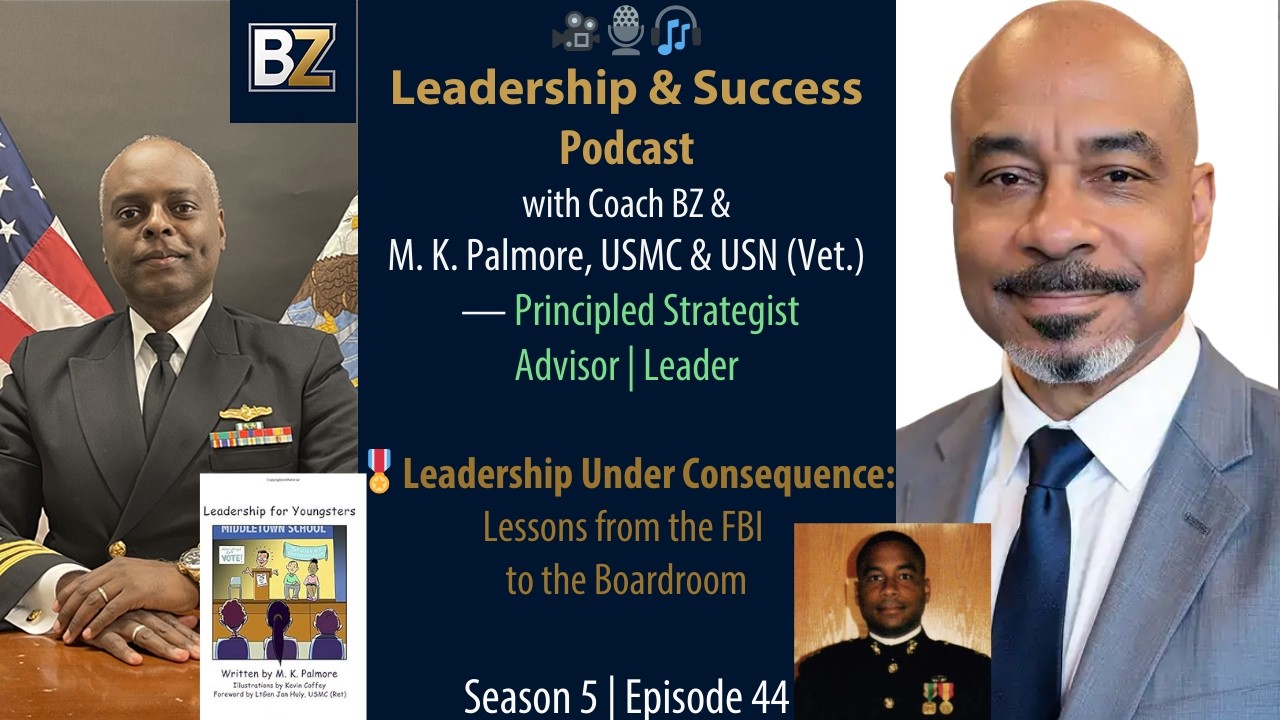
M.K. Palmore, a former Marine officer and 22-year FBI cyber executive, talks about leading teams using the OODA loop and a trust-first approach. He contrasts government budgeting with Silicon Valley's quarterly pressures and explains how to translate cyber risk for boards in business language.
Chapters
Hi, I'm John Maxwell. When the top companies in the world are looking for trainers, speakers, and coaches, there's one name that stands above the rest, and that's Maxwell Leadership. Our certified team members have gotten proven results for companies all over the globe, and our reputation, I'm proud to say, is second to none. Some of our members have risen to the top of their profession including the one you're going to meet today. I proudly introduce you to my friend, Bob Fabien Zinga.
Welcome to the Leadership Success Podcast with your host, Coach BZ, where we help you lead with purpose and succeed with impact. If you're ready to grow into the kind of leader others want to follow, this podcast is for you. If you're determined to elevate your success and leave a lasting legacy, this podcast is for you. As my mentor, Dr. John C. Maxwell, reminds us, everything rises and falls on leadership. Our goal is simple: to inspire you, challenge you, and equip you with insights that can transform the trajectory of your leadership journey. Welcome aboard to another episode of the Leadership Success Podcast with Coach BZ.
Anytime that you, you train for something and you miss the mark, it's like, wow, I gotta go back to the drawing board. And there are numerous instances where You know, my first year trying out for the SWAT team in FBI Los Angeles, I didn't make it. You know, I missed the time or cutoff on a particular evolution and event and had to wait a whole year to try out for that team again. So you have a year to sit within your failure. You have a year to sit within the fact that you didn't make something that you worked real hard to make. And so you got to train. You know, now you've seen a snapshot of what the, what the test looks like. You've seen the test, you failed it the first time. Now you gotta go back and figure out how to meet the mark on the test. And those can be difficult periods. You know, you spend a year trying to make sure that you're doing all the things that you necessarily need to do in order to do better the next go around. And those are good life lessons because not everything's going to pan out immediately the way that you plan on. And if you're lucky, you get an opportunity to not make those same mistakes over again. And I tell people time and again, especially people that I mentor, that, you know, mistakes are going to happen, failures are going to happen. The difference is what you learn from those and what you take from those experiences moving forward is the value of having been, you know, having gone through that experience. And if you can take a failure and turn it into something that you've learned from and ensure that you never make those mistakes again, or at least try very hard not to, then there's value in it. And you learn much more from mistakes any day of the week than you do positive things. I can't remember all the positive things that I've done, the accolades or the awards that I've gotten. But I definitely remember most of the things that stung really hard where I missed the mark.
All right. We have a very special guest on the Leadership and Success podcast today, and I am so excited about our guest, M.K. Palmer. But before I introduce him, Like we do, as is our custom here, we like to start the show with what we call the moment of gratitude. This is where we take just a moment to be grateful for something. Every single time we met, actually, I had an earlier episode, and for those who've been following this month, every single day this month, it's February, Black History Month in the US. So I've been grateful for Black history, for the contribution of African Americans, because I really believe that we've built this country and made America what it is today. And I highly recommend, as you are already aware, this great book African American First. It's by Joan Porter, and she writes about famous, little-known, and unsung triumphs of Blacks in America. Highly, highly recommend this book. Okay, now let me see if I can properly introduce our guest today. Today we are going to be speaking with M.K. Palmore. He is a Marine, the few, the proud, the Marines. He's led Marines, spent 22 years in the FBI, including executive leadership in the cyber branch. He has advised Fortune 500 companies as Field CISO at Palo Alto Network. He served in the office of the CISO at Google Cloud, and today advises boards and executive teams for Apogee Global, helping close the gap between intent and execution. MK doesn't just talk about leadership. He has led in an environment where the stakes were real, national security, cyber threat, and boardroom accountability. So without any further ado, please help me welcome to the Leadership and Success Podcast, the one and only MK Palmer. Hey, MK, how are you doing today?
I'm doing well, Bob. You have a very high-speed operation here. I'm envious right out of the gate.
Thank you. Yeah. And the other thing is I do this live. I've been doing this live since the very beginning. My wife does podcasting too, but she does everything offline and then 2 or 3 weeks later, everything is perfect, and then she publishes it. Mine isn't quite perfect, but it's good enough. At least we try. So really, really excited to have you. I know we pretty much run around the same circles here in the Bay Area. You are definitely one of our most esteemed cybersecurity executives here, and you've contributed so much to the community. Just to get started, what is one thing you are grateful for? Like I say, once a Marine, always a Marine. But one of the reasons why I do this is, as you know, in the military, it's about 21, 22 soldiers, veteran service member commit suicide every single day. And I feel like you can't be suicidal and grateful at the same time. But anyway, one thing you are grateful for today.
Yeah, yeah, you bet. So hopefully we'll get into the topic of our shared status as veterans and talk a little bit about some of the challenges that veterans face in terms of wellness and certainly in transitioning into the commercial workspace. One thing I'm grateful for, to be quite honest, I'm at the stage in my life where I've lost a lot of family members. You know, you're at that— I'm in my late 50s, and so this is a stage in life where you begin to lose family members. But I am thankful and grateful that I and all of my immediate family members, my wife and kids, are all healthy. If you don't have health, you don't have anything, man. So definitely grateful for health.
Thank you for sharing that, and that is so true. Sometimes when you're young, you feel like you're going to live forever. Just get older, you'll find out, right? And what is something about you that most people may not know when they first meet you?
Yeah, so interestingly enough, you know, usually I have a background that shields what's behind me here in my home office, but you see the outlines of an acoustic drum kit. So I'm a drummer. Yeah, most people don't know that, and I've been I've been drumming as a hobby since I was 5 years old. My dad was a professional musician, and so he put me behind a drum kit pretty early in life. In fact, I have the photos to prove it. But it's just a hobby that I've kept throughout most of my adult life as well.
Well, I've been playing the piano since I was 7 years old because of my daddy. He played the guitar and he made all of his boys learn to play the piano. How has music been a part of your life? Sustained you, inspired you, or just inspired you throughout?
No, that's a great question because I am a true, true lover of music. I have very, very eclectic music taste. If folks were to see the playlist, the multiple playlists that I have through the various platforms, I think they would be confused in terms of the back and forth that I experience and what I love in music. I absolutely love music. I am one of those people who gets a— an immediate boost, uh, through hearing music, especially for the first time, uh, music that resonates with me, whether that be a jazz fusion piece, whether it be something from, uh, the rap or hip-hop world, or UK grime, or whether it's classical. I'm really into movie soundtrack music, so folks like Hans Zimmer, anytime he puts out music like that those things resonate with me and I'm always listening to music almost 24/7. So it's definitely a part of my life, part of the backdrop. And, you know, like most people, I have those moments in life that I can take myself back to nearly immediately just by hearing a particular song.
Wow, that is so powerful. The power of music. Sometimes my wife thinks it's a little bit too much for me. Okay, but let me ask you this. What about Avi? Heavy metal. Is that music that you understand?
Yeah, I'm not, I'm not into heavy metal, um, but I mean, I am into some, some aspects of the rock genre. So I mean, I probably eat around the edges of it, and I, I maybe I get close, uh, maybe I get close. I don't know, it's some bands, but yeah, not that particular genre.
Yeah, it might be a black thing, I don't know, because me too, I love all kinds of music. Because to me, it's really, I have to hear the professional, right, when the expert play, whether it is jazz classical music, no matter what it is. Like for this podcast, usually I play the kind of salsa, samba sound. I love South American music. But anyway, heavy metal is the only one. I guess there might be a couple of exceptions, but sometimes some of the guitar riffs are pretty good, but I just wish they would play it with a classical guitar or, you know, and anyway, enough about that. No, I usually ask people late into the podcast, but since you're a musician, let me ask you now. Is there maybe a song, a movie, or a book, or even a TV show that would be like your life's theme or anthem?
Yeah, Love Supreme, John Coltrane.
Coltrane, you can't go wrong with Coltrane.
It connects me to my childhood, my adulthood, and in ways that probably I could take at least a blog to to amplify. But the entire suite of A Love Supreme is— that's my go-to album when I'm feeling nostalgic about certain things. Certainly my dad, he turned me on to John Coltrane as a child. But it takes me through quite a bit.
Wow, that is powerful. Powerful. Yeah, you can't go wrong with Coltrane for sure. All right. So you've said that leadership has been the constant in your life. When did you first realize that leadership wasn't about authority but responsibility?
Yeah, so that's a, that's an interesting question because I feel that those of us that have experienced the leadership discipline, I feel like we're constantly evolving. At least if you're, if you're paying attention and you're reflective, you're constantly revolving as a leader. So the leader that I am today in my late 50s is not the leader that I was in the Marines as a young 20-something-year-old as a first and second lieutenant, and certainly not as a captain. And I feel like I've gotten better over time. And again, that's through failure, through understanding that my perspective on leadership had to change based on some of the situations that I experienced. But I think that it wasn't until my time in the FBI, seeing the need to become much more of an influencer as it relates to leadership. And that's been accentuated throughout the rest of my career as as well, becoming much more of an influencer rather than someone who dictates policy or dictates through a controlling manner how things are supposed to happen. One, people are certainly more responsive with a much more influencing approach, rather than authoritative. And if you are, in terms of how you carry yourself and the decisions that you make, if you have an authoritative tone, usually that authority kind of carries through. You don't have to act in an authoritative manner, But if people, if people have grown to trust your decision-making and know that you're diligent about how you think through problems and that you have people at the center of your decision-making, usually you can, you can develop yourself into that leader of influence rather than someone who dictates through position.
Well, now, I knew that you were in the FBI and that you used to be a Marine officer. But what I didn't know is that you actually were a sailor as well until just last, last week. So when did you actually join the Navy?
Yeah, so interesting. The service academies all have a program, and for the Naval Academy, it's the Naval Academy Prep School. This is where the service academies say you have everything that we're looking for, but we think you might have trouble with our academic program. So we're going to send you to this one-year program polish up your academics a little bit, mostly math and science oriented, to help make sure that you're ready for the academic burden of this 4-year journey. So I was accepted to the Naval Academy Prep School out of high school. I also was accepted directly into West Point. I chose, I chose the Naval Academy Prep School because Annapolis was the only place that I ever wanted to, to go to college. And so as a part, as a part of that program, You're enlisted in the Navy for that one year of academic instruction, and they take you through the paces, and it's like a boot camp scenario in Newport, Rhode Island. You get run around and you get yelled at and all that kind of stuff, and you figure out what it means to be in the military. You're active duty military, but it's, you know, you know that you're on the lowest end of the spectrum of the Navy there.
Yeah, so basically I made you estimate. Was that the Vianney-Vaulois College?
Naval War College, NETC, Newport, Rhode Island.
Yeah, that's where I went for officer school. Yeah. Okay.
Yeah.
Okay. I know exactly what you went through. So how old were you there? Maybe 17, 18?
18 years old.
Wow. That's amazing. All right. So your time as a Marine officer, you left when you were a captain. What did the Marine Corps teach you about leadership that still shapes your executive decisions today?
Yeah, I mean, I have to credit the Marine Corps with laying the foundational pieces, certainly, of everything that I think about leadership. We may get into it later, but, you know, I ended up later, later on in my career writing a book for adolescents around the topic of leadership, and I used the Marine Corps' leadership traits as the, as the core directional piece for how I would write to younger people about the subject of leadership. But the Marine Corps had a profound impact on my understanding of leadership and what it could accomplish under the right circumstances and practicing leadership in a way that ensures outcomes. But my one refrain from that is that I think, you know, the military environment that you and I are so intimately familiar with, it's a little bit artificial because everybody there understands the rank structure, who's in charge. When orders come out of the mouths of officers to the senior enlisted and then down to the junior enlisted, Like people typically do what they're supposed to do and what they're told to do. And so that framework provides—
You talk about Scott Marshall, of course.
Yeah, of course. So that framework provides a bit of an artificial infrastructure that allows you to, quite frankly, to practice leadership. It's not until you get in an environment where you don't have that fallback of the framework, there's no boards on anyone's shoulder or sleeves. That you really begin to exercise what it means to be a leader when it's no longer dictated by what's on the uniform. True.
I definitely had to learn that because in Silicon Valley, influence wins the day every day.
Absolutely.
The first job I had here, it was at Pivotal, senior security engineer. I thought about quitting almost every single day of the first 60 days I was here. But anyway, I had to learn and I did learn. So What was maybe an early leadership failure that changed how you lead today? Because of the video I played, you said how you learn so much more from failure as you do from success. I think it was Jeff K. White who says that success has many favors, but failure is an orphan.
Absolutely.
So what is an early leadership failure that kind of shaped the way you lead now?
Since we were talking about the Marine Corps, I can think of one from the Marines that still sticks with me today. I remember getting on the wrong side of a senior enlisted Marine about a subject that we were dealing with at the time. We were on deployment somewhere, and he and I got our wires crossed on something, and we ended up getting into a little bit of a shouting match. And I remember to this day, one, I'm ashamed at myself. I can't believe I got into a shouting match with a senior enlisted Marine, someone whose opinion I absolutely valued. And I understood that he had under his belt, he'd probably spent more time on the toilet than I had, you know, as a leader of Marines. And there, I could have handled that very differently. And to this day, I, you know, I'm often thinking about how we react to situations in the moment. And I know many of us come away from situations where we don't feel like we're our best selves or that we acted in a way that that aligns with our, our thought process when it comes to leadership, we always want to go back and retrace our steps on that and say, "Oh, if I could do that again, I would act in a different way." And what I learned is that I could have been absolutely right about whatever the situation is that we were in a yelling match about. But I'd certainly handled that in an inappropriate fashion. And I learned from that experience to take a moment, take a beat before you engage, even if you're, even if you're your senses tell you that it's a fight-or-flight situation that require— that requires you to engage in an amplified manner, you can always take a beat, take a breath, maybe even come back to the scenario or situation when you've had an opportunity to gather your thoughts, and then engage, because you can be much more intentional. You can actually be much more thoughtful in terms of your responses to people. And that thoughtfulness is something that I think is missing sometimes from these engagements that— where there's friction.
That is so simple, but so powerful. Really, it's the difference between reaction and response, right? You don't react emotionally, but you actually create the space to come up with the logical and best response to whatever you are facing. Why do you think that's so difficult for people to do?
Yeah. So one, I was a young leader. When that scenario happened. And, you know, maybe there were a handful of recurrences of situations where, again, I probably could have handled them a lot differently. But I think that part of that is an immaturity. That's, that's a part of the, part of the growth process. So, I mean, I don't write it off completely as, you know, "Hey, you're young, don't worry about it." But at the same time, you know, leadership is an evolution. You're continually evolving, you're continually having those experiences. And so you can attribute it to the fact that You're going to learn, again, through failing, through missteps, more so than you do from successes. Because the successes, people are just telling you, you were right about something. That's not, that's not what you tend to remember. What you tend to remember is when you got something wrong, especially if you were, if you were in the wrong, which I'm sure I have been in a situation or two. When you're in the wrong, it definitely gives you something to be reflective about and to think more intently about how you might approach that the next time.
That is quite powerful. Okay, we have our first question from the audience. Daniel from Midland, Florida says, "MK, this Black History Month, we are focused at Honor Mode Press on helping veterans move from executing plans to architecting the mission. What turned tech talent into trusted owners of risk?" Yeah, that's a great question.
Competency is what carries the day. In the tech world, and I'm sure, Bob, you can probably amplify this. People rely heavily on competence in the tech space. And when they recognize that your competence, which is what should be part of your calling card, your virtual calling card should be a person of action, a person of competence. Someone turns to you or makes you a part of a project, they need to know that you're capable of doing and executing your role. And what happens in the tech space is that people become heavily reliant on people who've already been successful before. So if you've shown success, if you've shown competency, people tend to reward you with more opportunities to, more opportunities to execute. And yeah, there's an initiation of trust that has to happen there. Maybe they're giving you the first opportunity to succeed. But you need to look at every opportunity that you're given as a chance to show how competent you are and to show the skills that you're capable of bringing to the table. And so Try as best you can to be successful in those types of opportunities that are presented to you, and that will evolve into the opportunity to be an owner, as the question indicated, of a, of a risk profile.
That is really powerful. Of course, in the Navy, we learn about the 3 C's of leadership, which I think we stole from the Army, but we talk about competence, character, and connection. What does character mean to you?
Character means everything. I think that, you know, certainly, for anyone that served in the military, the whole character piece, I think, is amplified again and again. We, no one's perfect. We can't, we can't be perfect, but we can aspire to, to amplify the attributes of perfection. And that means we're going to be successful, hopefully, if we're paying attention to those things, most of the time. Doesn't mean we're going to be perfect, and it doesn't mean you're not going to falter on some things from time to time, but you got to get back up on that horse. It's like, you know, it's like being a teetotaler. You make a mistake, you recognize, you acknowledge the mistake, and then you get right back into the fight and try and rebuild whatever it is that you, that you happen to falter on. And so character is hugely important. Character is mostly important because your character, what you amplify, what you bring into rooms, when you're with your colleagues and others, your character is part of the trust-building component that they then begin to value your opinions and other things about you when they see that you're a person of high character, high morals, attitude. It helps you in many other areas. And so character is a, character is a huge, huge component of what it means to develop into a potentially great leader.
That is so powerful, really, from the White House to Wall Street all the way to Main Street.
Yeah, all over the world, for sure.
To be people of character. I know I, uh, I had a great privilege of interviewing, uh, General Stan McChrystal. That's really his, uh, purpose right now, making sure we talk about character and that we elevate, right, uh, the national character of this nation. Because if we lose our ways it's going to be very difficult for us to do the right thing.
It'll be impossible for us to lead because folks, folks won't trust in, in the agenda that we've created, right, for ourselves and others. Yeah.
Wow. So let's talk about ICE Tech's leadership in the FBI. Actually, that kind of follows what you did in the Marine Corps too. No, you are leading under consequence. No, you spent 22 years in the FBI. How does leadership change when the consequences are quarterly earning like it is in Silicon Valley, but national security.
Yeah, so the, the, the common thread is you're still dealing with people, you're still dealing with personalities, you're still dealing with personal agendas, but at the same time, when you have a mission in front of you like the one that I, I had the privilege of having as an FBI agent for 22 years, which at the end of the day, let's get this straight, there's one responsibility that FBI agents have, and that's the uphold the Constitution, uh, and support our legal and justice system. That's it. That's the job. Uphold the Constitution, support the legal system and the rule of law. That is the entire responsibility of an FBI agent. Yeah, you get a lot of cool tools, uh, and maybe opportunities to, to exercise that responsibility, but it really boils down to the rule of law and your support of it. Um, so in exercising that role And let me back up for a second. It's interesting, you know, the term special agent, people throw that around and people think that that means something in terms of an elevated status, but it actually means the opposite. The term special, like special counsel, means that your powers are actually limited, not expansive, and limited only to a certain remit. Which is where the term special comes from. So special agent is not some general term. It's a term meant that the individuals imbued with that responsibility have a limited set of responsibilities that they have available to them. And those are the things that they're responsible for investigating, engaging in, and supporting. So in this cadre of people, you, you, one, like the military, you get a high, you get a high-character person. So that helps with the leadership challenges that you may face. So you're not starting with a baseline of folks who are, who come to the table with things that you might find challenging and that you see certainly in the commercial space. So you get a different caliber person that you're leading in the FBI, but you still have challenges that you face as a leader because not everyone's going to agree with your methodologies or your approach to leadership. Although there's a huge concentration of prior military personnel, so that the FBI is rife with veterans. In fact, I don't know what the percentages are. I can only tell you anecdotally from the year that I became a special agent. You know, my class of trainees as a new agent trainee was roughly 53 people, if I remember correctly. Of that 53 people, 26 of us were veterans.
Wow.
So at the time, it was almost close to a 50% marker of the classes that were coming in. So there was a period where the FBI was just hiring veterans, um, uh, ferociously. So I, I obviously, I benefited from that. They were interested in bringing in veterans into the system, uh, because most people don't know it's actually pretty hard to become an FBI agent. In fact, you will go, you, you will go most of your life, most people never even meet an FBI agent throughout the course of their life. And the, the percentages, I think, which are still accurate, is that the FBI only selects 3 to 5%, uh, uh, of its applicants. And so you have essentially a 5% chance of getting selected. So again, the baseline, pretty high. You're dealing with high-caliber individuals, but you still face challenges because guess what? Those people have lives. They're all, um, adults. Every FBI agent comes to the FBI as a second career. This is not something that you, that you become. You don't become an FBI agent just graduating from college. So all of us came to the table with these prior careers. You had doctors, you had nurses, you had attorneys, you had CPAs. Certainly within the past two decades, there's an emphasis on technical and cybersecurity skills. You have people who were tech— technologists in their prior life, maybe had done some time in Silicon Valley. They decide to become FBI agents. So we're pulling from a pretty high lever. There's also testing involved to become an agent and the all-intrusive polygraph, which people have challenge getting through. So high-caliber people, but still challenges in terms of leading. And it's all the basic things. It is because you're dealing with people. People have to be at the center of it. You're dealing with people who have lives, and they bring those, their full selves, the difficulty of the lives they're leading to the table day in and day out. There's marriages, there's kids, there's challenges that they face from a health standpoint. But yet and still, we're expected throughout the course of our days and weeks and months and years with the Bureau to exercise our responsibilities. And so there's a little bit of give and take. It's a very, very demanding career because it is completely inclusive of the entirety of your life. You don't actually get to bifurcate any of your life from being an FBI agent. They become one in the same during the time that you're an agent. And it's actually quite burdensome. It's even more so— you are certainly familiar with this having served in the military. You remember thinking, wow, in the military I'm under an entirely different justice system with the UCMJ. I have these responsibilities in order to maintain my clearance.
And always accountable even off duty.
There you go. Always accountable even off duty. I don't know about you, but I remember even being intimately involved in certain aspects of my Marines' lives. Like, you know, the fact that they were off duty didn't mean I wasn't still responsible for them. So that brings about a whole different thing. It's very similar in the FBI. You know, you Similar, not the same. Every aspect of your life is under scrutiny. An argument with a neighbor can turn into an OPR investigation. So you can't just go about your life when you put the gun and the badge in the safe at night and not recognize that everyone sees you as a special agent of the U.S. government anytime that they come across you. And so again, Leading can be a little bit of a challenge, but at the same time, because you're dealing with high-caliber people, maybe it's a little bit easier, but it's still challenging.
There's really a lot of parallels because, yeah, you could definitely lose your clearance, and if you do, then you are no good to the organization anymore. So the other thing I see parallel is the way we make decisions with incomplete information and limited time. What framework have you used, either in the Marine Corps or the FBI, to make the best decision you could.
So I'll string this actually through even a subject that I'm talking about in the cybersecurity space today. You certainly are familiar with the idea of the OODA loop, something that, something that we're taught in military circles: observe, orient, decide, act.
Yes.
I don't think there's a framework that I've come across that has, that has had such a resounding impact on me, only because I, I really, it really resonates with me. This, I, this idea that even though you don't probably take the steps and, and break them up in the fashion that the, the creator of that methodology did, we all go through those same steps. It's just a matter of how much information you're taking in, what you happen to be doing with that information. How do you summarize it? How do you then synthesize it into who you are? Then what decisions you make which is the determining factor. The decisions that you make are the determining factor in terms of what makes a difference in your life and what makes a difference in the life of the person on the left and right of you. And then the decision to actually act on, on that decision-making process. This is something that we all go through. So I, that framework resonates with me, and it certainly, I feel as though it's something that I do. Some of us do it a little bit faster than others. Take in information, assess it, summarize it, synthesize it, and then we're ready to act. I have always had a bias towards action, so maybe I, maybe I process a little bit faster, but I think all veterans, most veterans, have a bias towards action because we feel a sense of urgency about actually accomplishing what it is that we're responsible for accomplishing. We take that into our personal lives as well.
Yes, and one more parallel between the FBI and the military is the way you build an effective team and kind of build that trust. And sometimes you have to do it pretty quickly, depending on the mission you have. So what process or framework do you use to build trust quickly with a brand new team?
Yeah, I lean in and I offer trust first is the approach that I take. Some, I think, wait to see from their team members that they can trust them. I take the opposite approach, which is I'm going to give you the benefit of the doubt. I'm going to assume that you're capable, you're competent. There's a re— there's a reason that you're here and part of this team. And I'm going to give you the benefit of the doubt and I'm going to lean in and let you, let you do your thing. Tweaking if I need to along the way, but I'm going to assume that you're capable of doing the job that you've been given and that you're responsible for doing until you prove, until you prove otherwise. So I lean in first. I offer trust and I think that's an excellent way to begin building. More often than, more often than not, you're probably right to offer that trust first. But the minute you recognize that that trust has been given and it's probably undeserved, then that's when you start to pay a little bit of extra attention to those individuals who maybe aren't as deserving of that level of trust that you inoculated them with.
Yeah. And one good thing about your background, I believe when you left the FBI, you went to Palo Alto Networks first and then Google. So Fortune 100 tech company. Let's talk about that transition a little bit. What surprised you most when you entered into the tech world after federal service?
Only one thing. I won't even say surprised me, but it definitely hit home. One thing hit home, and it's the one thing I walk away with now as a business owner myself. Revenue is everything. I, you know, you spend— I spent 32 years in the U.S. government. We never— we talked about budgets.
Yes.
Only, only in reference to how much money we would have from year to year to do the things that we are normally responsible for doing. Maybe there are some down years and the budget would be reduced, and maybe you didn't get that extra trip or that extra training, um, but you never were worried from quarter to quarter whether or not you were exercising and doing the things you were supposed to be doing. For the U.S. government, it's a fiscal year, um, and you have 4 quarters to spend the money. If you don't spend it by quarter 4, there's usually a rush to spend what you have so that you can get the same amount, if not more. For the coming year. Completely different driver in the commercial and enterprise space. Quarter to quarter to quarter, your responsibilities are impacted by the company's performance from one quarter to the next. That was a little bit striking for me. It was something I had to get used to, but I certainly am used to it now. As you indicated, I spent time with two, you know, one Fortune 500 company. You know, I spent time in the big leagues. I've seen what the impact of revenue has on people's actions, for sure.
Yes, that is quite amazing. Let's talk about technology versus leadership. You've said, and I do agree, leadership, not technology, will determine whether an organization will fail or adapt. Can you expand that for us?
Yeah. So I would push back a little bit on your use of the term versus. So technology is not an opposing force to leadership. Technology is a tool. Just like it is in any other aspect of life. Technology can be a tool of leadership. Maybe it helps you organize your thoughts. Maybe it helps you in a way that you're able to better synthesize information across the teams that, that you're operating, analyze data points in order to extract value and understand where the team's doing well and maybe where the team needs, needs some improvement. So Technology is a tool. And I think that oftentimes we get wrapped around the idea of technology just being in existence for, you know, for no reason. Like it's just technology is being built for technology's sake. No, technology is being built because we have needs in our lives as humans where we think we want to be more efficient. We think we want to move faster. There are things that we want to accomplish, things that we want to understand. And so we build technology to help help us. And so as leaders, I don't, I don't look at technology as necessarily something that works against leadership. I try and figure out how to use technology to make me a better leader in the human-centered scenarios that I happen to be engaged in. And so technology is a tool, just like anything else. Just like during my career, you know, with the FBI, the technology, to be quite honest, was not It was not at the highest level that it could have been, which is, which is a problem across government. But at the same time, the technology is a tool, just like weapons are a tool, firearms are a tool of the trade in law enforcement, and every other thing that you have available to you are tools that are supposed to enable your ability to do your job. So I look at technology, I look at technology as part of the toolkit that I use as a leader, even today running Apogee.
That is really, really good to know because I think right here in Silicon Valley sometimes we kind of get lost. So many security engineers and software developers, they really get into the cool toys they are producing and creating and all of the features and they kind of forget about why in the world you are doing that. What's the big picture and the impact? Okay, you've advised a lot of boards. When you advise boards, What cyber risk conversation do you have? What do you focus on? What's important? What should be important to a board?
Yeah, so I mean, what's important to a board is understanding what risk any one potential adversarial avenue of approach or tactic may have against your particular enterprise. Part of the study of risk management, I think sometimes we forget risk management was brought to, brought to bear on problems and challenges because not every entity has unlimited resources to address its problems.
Yes.
And so you had, you had to create a methodology that would allow an organization or an entity to assess the landscape, understand what risks are pertinent to them and their operational capacity and capabilities, and then prioritize those risks that are pertinent to you so that you can then make better decisions about how to execute on your strategy as a business or entity. And so boards are uniquely interested. They may not know exactly how to ask the questions, but what they're interested in is, what's going to harm us? What should we be aware of? And how can you help us better avoid the traps that, the traps that our competitors on our left and right are falling into? Because that's the field of space that they care about. And those conversations require security executives like you and I, and I see your CISSP manuals behind you, requires us to adopt a different language than one that we maybe are used to. Boards are not— boards are not interested in going through the 8 domains of the CISSP exam in order to be able to understand the risk to the enterprise. You've got it. You've got to put it in business terms. And so I think part of the challenge for current day security stakeholders and leaders is learning that language of risk and risk management and then being able to convey their technology gaps, vulnerabilities, and concerns in a way that will allow the board the quickest and possible most efficient way to make a decision on supporting their efforts in terms of enabling the enterprise.
That is so powerful. And at Apogee Global, right, you really help kind of close the gap between intent and execution. Can you maybe share about some of the things that you do just at a, at a high level to help executives do that?
Apigee Global's tagline is we take organizations through the people, process, and technology and bring them to the next level. When I think about problem solving, I don't think about just solving for tech. I don't think about just identifying people. I think about people, process, and technology as an ecosystem that deserves to be looked at all together when you're trying to tackle problems or trying to go to the next level. So when I created Apigee Global, the idea was that I could take these experiences that I've had throughout my, the entirety of my career serving in enterprise space and serving in, through the U.S. government, and come to the small, small to medium-sized business market and bring that expertise with me. Now, I don't have, I don't have all of this expertise in my own head. The idea here is to create a team. I call it a pod. Create a pod that has the necessary expertise to help any one particular organization through the problem that they happen to be addressing at the moment and looking into the future. So I, we take a very bespoke approach to helping our clients. We go through long discussions and discovery. We try and make sure we understand exactly what problem it is that they're trying to solve. And then I go about the responsibility of building the team that's going to help them solve problems. Now, there are some stationary roles and positions that we have, like program managers that will go from one engagement to the next. But, you know, one client may need help with security strategy or just at the strategy level. So there's governance, risk and compliance. There's a lot of document creation. They want to walk, they want to walk through the scenario of what they need to look like as a technology organization over the next 3 to 5 years. That's, that's a different problem set than an organization coming to you and saying, hey, we want to get FedRAMP approved, or we want to get CMMC approved. Can you help us go through that process? One is strategic, one is infinitely more tactical, requires a different level of expertise, and may require us to put together a team that's different in terms of component. And so I try and build teams helping out our fellow CISOs who are all sitting on the bench. I don't know about you, but I'm seeing a lot of CISOs who are opening up their own individual practices. They want to do project. They want to do project-based work. People are getting away from this idea of being a long-term security stakeholder. And quite frankly, even the folks who are still in those roles, I will tell you confidently that I have conversations with those folks. They're tired of the day in and day out. They want to do something that they can go in, have impact project-based, and then move on to something else. And that's the whole idea behind Apigee Global. I want to, I want to bring experts, experts together to help our clients and organizations solve problems that they have. We want to bring value and impact, and then we want to move on to the next challenge.
That is quite powerful. Definitely something we need more and more these days. We are not living in the days of my grandparents anymore where you get a high school degree, you never have to open another book and you stay with the company for the 20, 30 years and get the gold watch or something.
Those days are over for sure.
Yeah. Yeah. Wow. Like even my oldest child, I still call her my baby, but she's a young woman now. She got her degree last year on a Bachelor of Science, but having a pretty tough time getting one job. So she has like 3, 4, 5 jobs, driving Uber when she needs to or doing whatever she needs. She's just doing what she needs to do in order to survive, which is pretty admirable to see. So we have about 20 minutes left or so. Let's get into the last half of this, the last segment of the podcast. That's where I try to get into your head and kind of understand the leadership principle you are following to achieve all of the success you've been able to enjoy so far. So let me start by asking maybe, what do you believe is the greatest lesson you have ever learned, whether it's in life, leadership, or just in general?
The greatest lesson that I've learned is that if you concentrate on people, their needs, their value, their wellness, that you will ultimately achieve everything it is that you've set out for yourself from a business or organizational standpoint. And the challenge is, I think we get the— we get that wrong. Oftentimes, as leaders, we go into an engagement thinking, oh, I have to be successful operationally on what it is that we're doing. Yeah, you have to be successful operationally, but flip that around. You have to, you have to be to your team members and team what they need in order to grow themselves professionally, prepare them for their next adventure, pour into them, invest into them. And by doing so, you will automatically accomplish all of of things that you're interested in accomplishing.
But sometimes I hear some pushback. Well, if I invest so much into my people, they're going to leave.
Of course you want them to. To be honest, you want them to— you want them to grow and leave. And I tell you, if they had a wonderful experience with you, they'll probably come back to you. But why? Why would you even think that? You know, I think the agreement that we make with people, as we were just indicating, you know, a couple of seconds ago, we both agreed that the landscape is completely different. This idea that people are going to go work for some entity for 20 years plus is an outdated concept that I think we all need to completely get away from. You have maybe 3 to 5 years with someone. And in that 3 to 5 years, you have a responsibility to help them grow, because they will contribute to the enterprise in a, in a way that's helpful to you in the enterprise outcomes. And then you should expect them to want to grow and move on. If you can't grow them internally, You should expect for them to move on and you should be supportive because that individual will remember that. That gives you cachet with that individual, that, that individual now carries you as part of their network and they go into an engagement. There's probably an opportunity that they become aware of that they then bring back to you because you were so helpful in helping them grow. And I just think, you know, we have to get into this mindset of getting people to where they want to be and need to be. As individuals. And when you're doing that, you cannot go wrong. You absolutely cannot.
Amen to that. That's definitely the mindset we should have. So looking through your background, did very well in the Marine, the FBI, and now in tech, and now you have your own consulting firm. Why do you believe you've been so successful in some of the, you know, highest, uh, most dynamic, and, uh, you know, especially in the FBI, sometimes even dangerous environment. Why, why did you get so much success?
Yeah, I think I've been successful for a couple of reasons. One, um, I had embedded in me as a child the idea that I could be a good leader. I was acknowledged both by my parents and others that were part of my circle through middle school, high school, I was, I was always identified as someone who had leadership potential. And so I, I embraced that. I embraced the idea that I could, that I could be a leader in environments, that I could be someone for whom other people turn to for advice, for guidance, and that I could be, I could be part of an overall solution. And I think it's been hugely important for me because it gives me a perspective on myself that I've always had since being a child. Of, of confidence around my capabilities and what it is that I bring to the table. And I think because of that, I've had great opportunities presented to me throughout my life where I have learned and then created a toolkit for myself that I take into every scenario, which is, which is deep experience at learning and dealing with people. So I've been successful because my dad, my mom, again, teachers and others, especially in the high school years, basically turned to me and they're like, you know, this kid's got something and we're not going to be surprised when we see this guy be successful in life.
Wow. Is that—
it's so, it's so important. It's so important to tell that to kids.
Yes. Having somebody who believes in you, so powerful. All right. So what are you learning these days? I know leaders are learners.
I'm learning how to lead a business. This, this is new territory for me. I'm wearing multiple hats. I'm, I'm the IT guy. Right, right now I'm biz development, although I just brought in a longtime friend and collaborator to help lead business operations. But for a long time, you know, when you, when you decide to become an entrepreneur, I think what you don't realize is how much time and effort it's going to take to get something off the ground. Finding people who understand your vision and who want to come along for the ride is difficult, especially— and you miss the mark a couple of times. Maybe you bring, bring some folks on board and then you realize they don't really understand the vision of what you're trying to accomplish, and that acts as friction, certainly not grease in the, in the wheels. So what I am learning right now is all the things that it takes to get a successful operation off the ground. And it is, you know, in addition to the MBA that I have, it's the best business education that I could have as an adult for sure. Powerful.
Well, God bless you. I know we need more and more businesses like yours, especially in Silicon Valley. It's incredible. So, if you could choose 3 people to have dinner with, they could be alive, dead, or even fictitious characters, who would you choose and why?
Uh, 3 people. Uh, so first of all, Barack Obama. I, I can't— he's my guy.
I can't— yeah.
Uh, Barack Obama. Um, you know, you don't have to say why for that one.
Yeah. Okay.
All right. Um, uh, I, I would say, um, Nelson Mandela.
Yeah, yeah. Madiba. You don't have to say why either. Next.
Then maybe Dr. King.
Um, okay, okay, okay. And I, I feel like you can just end— we can end the interview right now. This, this is powerful, powerful. Yes.
Yeah, I mean, the reasons why should be, should be clear to folks, but, uh, yes, yeah, there's definitely reasons, especially with Nelson Mandela and Dr. King. I, I got lots of questions for them.
Yes, yes. Man, they've literally changed the world by the way they led. Incredible. Okay, so what have you read that we should read as well? Any books you would recommend outside of your own?
I was just commenting to you about that before we got online. I just finished a book called We Are the Bad Guys by another Naval Academy graduate. And I was— I'm at this stage where I'm trying to open my mind to digest as much information as I can. I'll tell you why, why I read that, why I read the book. I am a student of history. I've always been fascinated by history. I think it's history, I think, in fact, that got me interested in a life of service. And I, I'm at the stage in life, like many of us are, where I I probably have to recognize that I don't have the full story on much of the history that I have adopted, both for my, for, for myself. And so I want to better understand that history, and anything that I can read that gives me an alternative perspective, or I should say an additional perspective, to have about world events, the history of the world, I'm interested in sort of understanding that. Because more knowledge is power to me. The more you know, the better you are in them to making decisions.
Wow, that is really powerful. So we have Bad Guys, by Michael Lester, right?
You got it.
Yeah. Wow, that is powerful. I will make sure to add it to our digital bookshelf. We have over 300.
Check it out.
Yeah, that is powerful. Okay, so if you had one and only one day to live, right? What would you have liked your final contribution to be?
If I only had one day, I'd just spend it with my family. I mean, I want to— I want to— I want to spend that day with my wife and kids. I've got 3 children. I tell people that I've been blown away by life 3 times. I remember the dates and times that that happened and only those 3 times. Yes, those are the people that I would want to spend that day with. And if I could do that, I'd be pretty satisfied.
So if you had a magic wand and you could solve any problem at all, what is the one problem you'd like to solve first thing tomorrow morning?
Global conflict. I think I'm really, again, as part of my pursuit being a history buff, I really want to understand why there's so much global conflict around the world. And to all of us who have served, I know that many of us come out on the other end of that wondering why these conflicts happen, what contributes to them, why lives are sometimes unnecessarily lost. There have been whole generations of men and women that have been lost to conflict over the course of time. And I think I'm on a life's mission to really understand why that conflict happens.
Hmm. Powerful.
Or why it evolves to the stage where people feel as though kinetic action is the only way to resolve it.
Yes, sir. Yeah. Powerful. Okay. If you had the ear of every aspiring military, federal, or tech leader in America right now for like 60 seconds, what would you tell them to do tomorrow morning?
I'd tell them to lean into efficiencies like AI. That, that will help productivity, of course, do it safely and securely. But it's high time that our government, I think, took a leading stance in terms of technology adoption rather than a, rather than a lagging stance.
What about those who are afraid AI is going to take away their jobs?
There are some realities that we need to face, and as long as we're having conversations about the reality of that, I think we can plan. If we're being agnostic to it as if it's not going to happen, then I think we're not being honest to it. Or we're not being honest about what everyone is seeing right now. Yes, there are going to be some jobs that are lost due to this onslaught of AI. There are things that you can do today that you could not do a year ago, and it doesn't require you to hire a team of people to do it. I'm sorry, that's revolutionary. We need to get used to that idea. And You need to get in front of it and figure out how to use it to your advantage. That's what, that's what's going to better posture you for what's coming.
That's powerful. So for the young people like Gen Z, they are in college, you know, sophomore or senior, what would you advise them to do right now to be better prepared for this AI-enabled world?
Yeah, I'm actually surprised, you know, while we— if you pay attention to the influencer platforms, you would think that every person of that age is leaning into this technology, and I don't think that's the case. My advice to them would be to lean into this technology and learn how to use it to do the things that you want to do. Because I don't think everyone's doing it as much as everyone thinks. There are certainly groups that are, you know, entrepreneurs and business owners and folks who are, who are leaning into this. But I'm surprised it's not much more part of young people's sort of toolkit, if you will, for identifying how to solve their life's problems or challenges.
Definitely technology. Okay, so we are getting toward the end of the podcast. I think we have about 5 minutes left, and that's when I ask, what can we do to add value back to you?
Yeah, connect with me on LinkedIn. I'm a prolific user of LinkedIn. I do a lot of posting and publishing on LinkedIn, a newsletter, and certainly weekly insights on what we're doing at Apigee Global. So connecting on LinkedIn is probably the best way. And of course, we have a business website that that you're free to go to at apigeeglobalrms.io. That's the company website. My goal is to be fairly disruptive and supportive at the same time of the SMB space as it relates to enterprise risk advisory. I'm trying to, I'm trying to do this in a way that's different from the way most have approached this historically. And again, I'm trying to bring experts to the table to help SMBs solve the problems that they're facing because They may not have the deep pockets that, that the large-scale enterprises have, but they have the same problems, just at a different scale.
Very good. And that's Apigee Global RMS. Yeah, I think this is really, really needed, especially for small and medium-sized businesses in this area. Thank you for doing that. Okay, is there maybe a question I should have asked you I didn't get a chance to ask?
No, this has been a, I think, a good, wide-ranging interview. I appreciate the things that you mentioned at the top of the interview. I hope folks were paying attention to, especially the comment from, it looks like a shared mentor, if you will, in John Maxwell. I am a firm believer in that statement that everything rises and falls on leadership. Everything. It is one of the most prolific leadership statements, I think, that's ever been made. I think people probably don't embrace it as much as they should. But if you have a problem in business that you are tackling, it's probably not just a technology problem. In all likelihood, you might have a leadership challenge on your hands that you need to solve as well.
Because technology is nothing but a tool. People need to be reminded of that. All right. In that case, let me ask you this, probably the most important question. If you could go back and give a piece of advice to your 17-year-old self, standing at the edge of this incredible career you've had in the military, the FBI, and now high tech, What would you say to 17-year-old MK?
I'd say just trust the process. I'm a pretty long-term planner, so everything that has evolved for me has been diligently planned and scoped out, you know, and I had to understand that I was always playing the long game. So I just say trust the process.
Wow. Powerful. Okay, the last couple of minutes, let's do a lightning round. So don't take too long to think. First thing that comes to your mind, one word that defines great leadership.
Integrity.
Okay. Morning routine or practice that keeps you grounded.
Coffee drinking.
Book or quote that changed your life.
Everything rises and falls on leadership.
Maxwell says that. Who inspires you the most today?
That's a good question. Because I'm desperate for inspiration at the moment. I don't have a good answer for that.
Okay, that's okay. Okay. A leadership habit you refuse to compromise on?
A leadership habit? Mm-hmm. Full transparency. I think it's the only way to really solve problems.
What's a question every leader should ask frequently?
Is there something that I'm doing? Is there something I can do to unblock an obstacle for you so that you can be successful.
Man, it's really being a servant leader. Powerful. Okay. What did you want to do when you were a kid?
I wanted to be an astronaut.
Astronaut. Okay. That didn't work out quite well. Okay. What are 3 adjectives describing you as a child?
Serious.
2 more.
Serious.
Grounded.
One more.
And focused.
What about as an adult? I think it's going to be the same.
Yeah, I thought so. Serious, grounded, and focused.
Pretty consistent. Okay. I always like to leave with something optimistic. So what is something you are feeling optimistic about these days?
I have to be optimistic about my children and their ability to succeed in life. That's sort of the last phase for my wife and I, right? To see the success of your children. So you pour into them as a family in an effort to propel them out into the world. And so, you know, as I maintain my health, my only wish is to see them be successful. That's the entirety of what this phase of my life is about.
I say I'd like to end on an optimistic note, positive note. However, I feel like as American, this might be the first generation where our kids don't feel like they're going to do better than their parents. I don't think I said that.
Yeah, I've heard that before as well. I'm not so sure I buy into that just yet.
Really? Because it looks like I was able to live the American dream, buy a house and all that, but my kids right now, there is no way they're going to be able to afford a house in Silicon Valley.
They just have to figure out a way to navigate all of the things that they have a different experience than the experience you and I had., and they have to figure out how to navigate that. And I think that there are wins to be had in this environment that's evolving. They just have to figure out what that looks like for them.
I love the mindset.
Okay.
Very last question. And thank you so much for your time. What is one word that represents our shared experience on this podcast today?
Veteran.
Yes, veteran. Thank you so much, M.K. Palmore, Marine officer. Few, but proud, the Marines. And then You went to an even more exclusive club, the FBI, and now high-level Silicon Valley guy. So thank you so much for your service and for being one of our master teachers today. I really appreciate it.
Bob, thanks for having me. I really appreciate it.
Well, everybody, this is it for now. That was MK Palmore. And again, follow him on LinkedIn. Let me make sure to put his info. So it's on linkedin.com/mkpalmore. You go to Ian M.K. Palmer, very easy. And I also would like for you to get a copy of his book. It's for youngsters, but I think it applies to adults and businessmen also, Leadership for Youngsters. I really do believe that leadership is the most critical skill of the 21st century. Even in the age of AI, with all of the automation and all of that, we still need leaders, people to lead people, to influence people, and to manage projects. So leadership is key. All right. I'm going to be back here tomorrow. I'm gonna be interviewing the one and only Captain Anthony Simmons. So that's going to be tomorrow. And then I have another interview on Sunday with a Maxwell leadership coach. I'm gonna be adding those on my feed on LinkedIn later today. And I believe on Saturday, we are going to reprise, I kind of stopped on day 16, the study of the book of Proverbs. This is not a religious study, we just go back to that book and look for ancient wisdom and leadership lessons from the book of Proverbs. I think we stopped at lesson 15, so we're gonna go through lesson 16 through 26 or 27. I'm planning to do that this Saturday. All right, uh, thanks again for being with us today, and many, many thanks to MK Palmer for being our featured guest today. And until tomorrow, have a wonderful rest of your Bye for now.
Thank you for tuning in to the Leadership Success Podcast with your host, Coach BZ. If today's episode added value to your leadership journey, be sure to subscribe, share, and join us again for more wisdom nuggets on how to lead better and achieve greater success. Remember, leadership is the most critical skill of our time. The world will always need leaders to inspire others, drive innovation, and execute meaningful strategy. So why not count yourself among the bold leaders shaping the 21st century? Until next time, stay inspired, stay committed, and keep leading with excellence.
More from Bob

S250:E4🎙️LIVE 🇺🇸America 250: President Barack Obama Leadership, Service, and the Power of Hope






S5:E157🎙️ LIVE with CMD CMSgt Dennis L. Fritz, USAF (Ret.)(Multi Tracks Audio)



S5:E156🎙️ LIVE 🇪🇸 Leadership Lessons from the FIFA World Cup 2026 Champions (Multi Tracks Audio)

S250:E3🎙️ LIVE Leadership Lessons from America’s First Documented Family of African Descent 🇺🇸📖