S5:E45🎙️ CAPT Anthony L. Simmons, DSL, USN (Ret.) (Multi Tracks Audio)
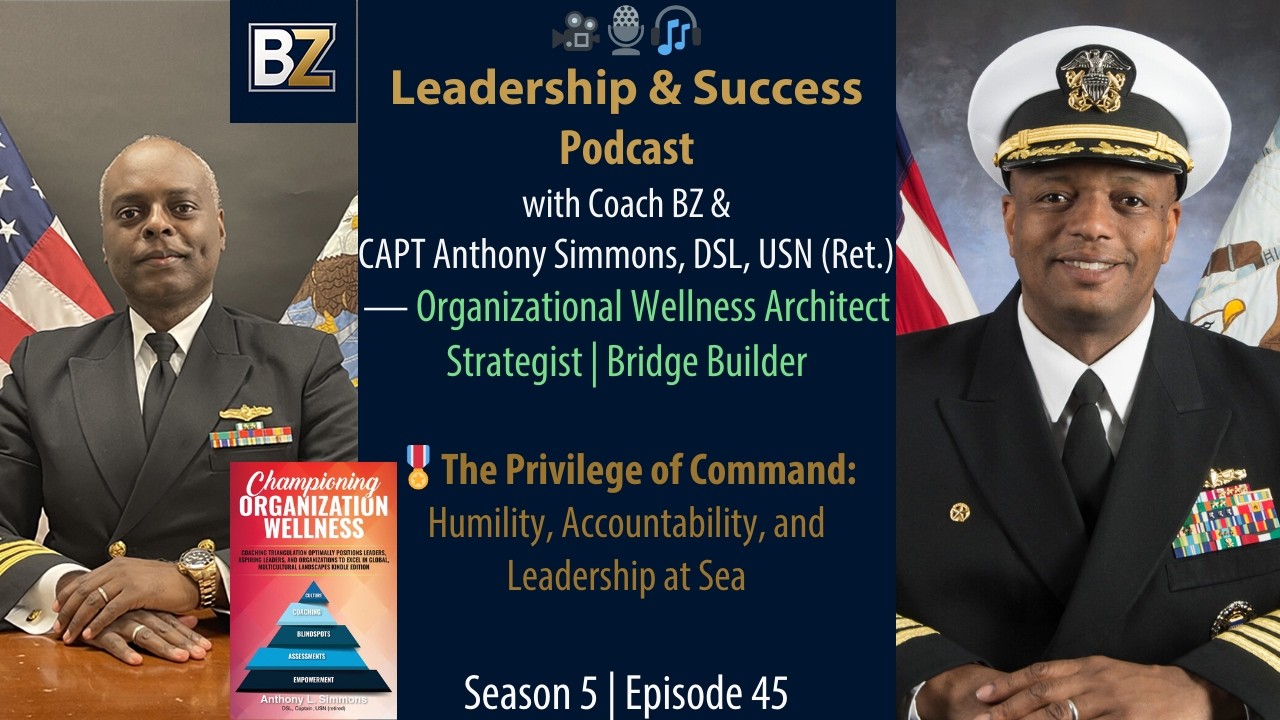
Retired Navy Captain Anthony L. Simmons discusses his "PIE" framework for career advancement (Performance, Image, Exposure) and the "5 D's" of success (Desire, Determination, Dedication, Discipline, Discovery). He shares lessons on rebuilding trust after taking command of a relieved unit, handling toxic leaders, and his upcoming book Leading People to Good Waters.
Chapters
Hi, I'm John Maxwell. When the top companies in the world are looking for trainers, speakers, and coaches, there's one name that stands above the rest, and that's Maxwell Leadership. Our certified team members have gotten proven results for companies all over the globe, and our reputation, I'm proud to say, is second to none. Some of our members have risen to the top of their profession, including the one you're going to meet today. I proudly introduce you to my friend, Bob Fabien Zinga.
Welcome to the Leadership and Success Podcast with your host, Coach BZ, where we help you lead with purpose and succeed with impact. If you're ready to grow into the kind of leader others want to follow, this podcast is for you. If you're determined to elevate your success and leave a lasting legacy, this podcast is for you. As my mentor, Dr. John C. Maxwell, reminds us, everything rises and falls on leadership. Our goal is simple: to inspire you, challenge you, and equip you with insights that can transform the trajectory of your leadership journey. Welcome aboard to another episode of the Leadership and Success Podcast with Coach BZ. Our next guest is a retired Navy captain who served 28 years as a surface warfare officer. He now works in maritime defense and has just completed his new book, Championing Organizational Wellness, as he explores best practices to coach and connect the next generation of leaders across diverse cultures. Dr. Anthony Simmons, thank you so much for being with us.
Thank you. Thank you for having me.
And here is the book here. And talk to me a little bit about what you see today as the most pressing issue to address as far as leadership.
Okay. The book, uh, title Championing Organizational Wellness, as I see the key issue today is actually connecting people, having people to appreciate each other. Mm-hmm. Leadership is upside down in the sense that you have leaders that are really actualizing through their aspiring leaders. So they need to be able to connect with the aspiring leaders where they are in order to help them and reach them.
Okay, understood. So what would you say is your specific skill that helps you to address this particular—
Because I've been there, you know. I call it boots on the ground, you know. There's a lot of skepticism between academia and people who have practical experiences, you know. So I've been out there, you know, having commanded 4 ships and, you know, been over 60 countries, had the opportunity to get out there, you know, with outside get outside the gate as Hebrews did in order to work with these sailors and people across different cultures and generations to bring them together and have them to appreciate each other by meeting them to where they were, you know.
I see.
Yeah, on their grounds, understanding them, you know, having empathy to understand how I needed to reach them, not based on who I am but where they are.
Right, and that is so important in leadership.
All right, I believe this was a dramatic entrance, and I am so, so happy today, overjoyed, because of the person we're gonna be speaking to today. I think this is going to be probably one of the best episodes of the Leadership and Success Podcast. I think this is going to be a masterclass really in humility and servant leadership, and I don't think there's anything more important than that. Okay. So before I introduce my guests, as you all know, we start with a moment of gratitude. And part of the reason why we do that is because 21, 22 service members and veterans commit suicide in America every single day. And I think it's not possible to be suicidal and be grateful at the very same time. So today, like every single day during the Month of February, Black History Month in America. I love to really be grateful for the contribution of African Americans in this country. I believe Blacks have built America, made it what it is today, right? A multiracial democracy. Because believe it or not, when America first started, only white male heterosexual Christians had any rights whatsoever. Not even women could vote. But because of Blacks, now everybody has civil rights. So I am very, very glad and grateful for that. And I want everyone to get a copy of this book. I really love this. African American First: Famous, Little-Known, and Unsung Triumph of Blacks in America. Actually, it wasn't until, what, 1943 where people who had my skin color were allowed to become officers in the US Navy. So there's been a lot of progress, a lot of change, and I am very, very grateful for the great crucial contribution of African Americans in the history of America because African American history, Black history is American history. All right. Let me see if I can properly introduce our guest today. I am really overjoyed. I have adopted him as one of my mentors. I think he's a living legend in the making because today is my great honor to introduce Anthony L. Simmons. He has a doctorate in strategic leadership. So he is a doctor, but he's also a captain, senior officer in the most powerful Navy in the world. Only one promotion away from becoming an admiral. So he's retired now, but a 4-time at-sea commander. Not one, not two, not three, but 4 times. Just to put this in perspective, less than 1% of sailors get to command. I'm very, very lucky I had to command one time, but this guy did it 4 times. My goodness. So he's a strategic leader who served on the staff of the Joint Chief of Staff and the Chief of Naval Operations in the Pentagon, and a trusted executive leadership coach with more than 28 years of naval service, 3 combat tours, and experience leading thousands of sailors across complex global missions, Captain Simmons understands both the privilege and the weight of command. That's something I really didn't get to understand until I was in that seat. It's a real thing, the weight of command. And today, as the founder of Sixth Gear Consulting and author of the bestselling book, Championing Organizational Wellness, he dedicates his work to developing high-performance leaders grounded in humility, emotional intelligence, and accountability. He brings operational credibility, scholarly depth, like I say, he has a doctorate and hard-earned leadership insight to every conversation. And I'm excited for you to hear from him today. So ladies and gentlemen, without any further ado, please help me welcome to the Leadership and Success Podcast, the one and only Captain Anthony Simmons. Here we go. Good afternoon, Captain. How are you doing today, sir?
Fine, fine, Bob Fabien Zinga. How are you doing? It's like Coach BZ, if that's appropriate.
It's, uh, such a great privilege and honor to be talking to you today, sir. I think especially my junior officers who follow me, they're going to be learning so much from your example. And just to get started, sir, um, what is one thing you are grateful for today?
First, I'm grateful for you. I'm gonna start there, okay? I, I look at your example, your accomplishments, your servanthip. I use the word servanthip. I coined that when I was doing my doctorate I don't believe in what they call servant leadership, because I, I, leadership is, I think it's a paradox. So I call it servanthip. You have to serve, but there will have been others before yourself. And also your, your really strong work ethic, and it's really staggering. So I like to say DZ2BZ. Okay, thank you, sir.
Yes, it means a lot coming from you. I do appreciate that. Although my mentor told me The minute you say you are humble, you are no longer humble. But I am really humbled by what you said. Thank you. Thank you, sir. And what is maybe something about you that most people may not know when they first meet you? You are so accomplished.
You know what I often get? I was listening to Tina Bova, and she was like, what's really important? Your superpower is what people think of you. So I really like that question. What do people really think of someone? What I get most often is how humble I am. And I don't say it because it's the operative term, and also the ability to exercise empathy. That's a common word in that day. But I feel I have an empathy gene. I got the empathy DNA. And the guy I even work with now, he's a 20-year business person. And almost every time he talks with me, you know, he was like, I just can't believe how humble you are, you know, after all the things you accomplished. But I put that behind me. I don't look at what I've accomplished. I look at the road ahead. I'm just as eager today to be successful as I was when I first left my hometown of Goodwater, Alabama, which was a town of 3,000 people. And it was a very humble beginning. But I tell people, I was not deprived because I was very enriched by the culture and the surroundings of the people that I had to influence me there in Goodwater. But that's where my humility comes from. Just being from Goodwater, staying grounded in my roots. You know, they said once you cut your roots, you discontinue to grow. But I never disconnected from that beginning. And I still reflect from the day I left until today. So I— you don't know where you are in life, how far you'll come, unless you can measure that from where you really originated from. So I remain grounded in that value system.
Well, I feel like a fellow Alabamian with my crazy accent because When I came from the States, I was 17 years old. I lived in Tuscaloosa, Alabama, Roll Tide Roll. So not too far from where you grew up. And Alabama, California, it's almost like two complete different countries at times. But I definitely learned a lot, good, good people there. They do have a very complicated past over there, but yeah, God bless Alabama for sure. But something you mentioned, about humility and achieving so much. What do you think keeps you grounded? Why do you stay grounded even after everything you've accomplished, not just in the Navy but in academia and best-selling author and everything else you have done in life?
I credit my parents and once again my surroundings. And, you know, life is really about people setting you up, you know, for the future and just having self-confidence and self-assurance. And it goes back to your, your Maslow hierarchy. You know, you have two stages there. You know, you have the foundational piece and the out-of-aggression piece where you got psychological safety piece in Bob, and then you have actualization and progression and esteem. You look at those models there, and I, you know, if you establish in that regard where you got a solid foundation, you have no reason to grandstand. You have no reason to seek out, you know, assurance to others, you know, you're in a position with that foundation to really serve others. And that's the key to being a servant. And so I think it's— I look at myself three-dimensionally, okay? One is having the empathy gene, you know, how do you care? What's your Miles Briggs? How do you assess yourself? What are you really made of intrinsically? Then the next piece is my experience going out there, getting after the opportunities in life. And then part three, is being a scholar practitioner. You know, that's growth, you know, taking advantage of platforms. Looking at my high school, what opportunities are offered, looking at my collegiate days, you know, there even as a college collegiate athlete. So stand in the classroom, stand grounded in education, then joining the Navy, man, what a blast. You know, I mean, just the opportunities to grow and be the person that God meant for me to be. Wow. It's there, you know, just the nature and the laydown of the Navy profession, how it's a graduated process. Becoming a senior officer. So that's what keeps me why I'm there. It was just the maturation process that I experienced and staying grounded in that and just staying hungry and, and looking at your instrumental values, you know, that you have to look at, are you willing to align your instrumental values, doing the things, doing the, they say the ends, you know, justify the means, and putting in the work to get to that next level to reach your terminal value. So that's, that's what keeps me there. And there's still so much to offer, you know, I mean, and I think everything in life happens for a reason. And like in the Navy, you know, I used to— I was one step from making Admiral, you know, I was on a short list, you know, I think it was going really, really well. It only takes, you know, just one condition or just a surrounding sometimes, you know, in my case, I— it has nothing to do with my performance, you know, my behavior, it just distills down to trust and building relationships, you got to build relationships across all groups. But I had some convictions that worked against me. Because, you know, I felt like I was going to stick, you know, what I believed in, just doing right. And if, you know, Colin Powell once said, you know, people don't like him because of his race. That's not his problem. It's their problem. But what I've learned over time, though, we talk about meeting people where they are. I talk about it in my book. And one of the biggest takeaways I want this group to learn, you have to really foster and facilitate relationships. You have to meet people where they are. Across all groups. Okay, some people said— I made a comment when I was working, and I worked human resources also in Milliton, so I had some really powerful leadership experience as a senior officer. I went out and mentored, you know, officers in the fleet. I designed, uh, training pathways for, you know, officers going off to, you know, on the surface fleet there. And so I, I heard a comment once when people say perception is reality. I, I don't believe in that term, and I think that's, uh, inaccurate statement, because you're saying it's okay to stereotype people if you say that. You know, you have to get to know people, where they are. And I have this whole model in life that I embarked on called coaching love. And what that means is just connecting people to know each other. And that's the challenge we have in society now. We don't respect and appreciate people because we don't know people. Wow. And that goes back to, uh, Congressman John Lewis. You know, we had this model. He always talked about DB love community, DB love community. That's a call to action. And, you know, and it hasn't taken place yet. So my call to action is coaching love to establish that love community, to work towards that, getting people to appreciate each other. From the junior officers on this site here and other people you mentor, the big takeaway is let's just make sure we understand how to champion our careers and how to people say, well, we want a level playing field. No, you'll never have a level playing field. You need to be your own equalizer. Wow. Become your own equalizer through preparation, you know, hard work, building relationships. Make mistakes, but learn from those mistakes. That's your equalizer. Take on the tough jobs.
Well, I think we need to just stop the podcast right now. That's, that's— wow, so much wisdom. I want to go back to something you just said, sir. Where did that confidence come from being Black in Alabama? And where did that confidence come from, you think? Because I do believe confidence is the master key to success. If you don't feel confident about what you're about to learn or do, you pretty much already failed. So where did that come from, sir?
That's a powerful question. You know what I like about this conversation? And being a leadership coach, let me just give some context here. Okay. And as a scholar practitioner, as a leadership coach, there's 4—
Dr. Strategic Leadership.
Yeah, there's 4 steps. It's okay. You have to ask powerful questions, then intuitive listening, what you do, you do a good job at it. And then you have to draw out the person introspective. So you're asking these questions, You join up my perspective. So we having a coaching conversation now, what I call inspired motivation. So great, but thanks for that question. Well, first of all, to get to the answer, it was my family structure there in Goodwater, not just my, uh, parents but extended family. Uh, we grew up— I grew up farming in the summer. I did logging in the wintertime. My father kept me engaged, and he came from a background that was not so strong. He moved around quite often. His father was not always, you know, uh, employed. He was in and out of the, uh, penitentiary system. His father was, because, you know, that was just signs of the time, you know, in that era. My father made a commitment to do better by his kids, you know. And so I came from a very solid family structure, and we went from one family farm to the next and worked throughout, you know, that, that era there, uh, as I was a kid. And the one time we did logging, and then the game changer— my father only had an 8th grade education. Not because in that, in the South, you know, once you got old enough where you didn't have to go to school every day, people looked at farmhands, they would have to go to work, you know. So we didn't value education. That was because of some of the shortcomings that we faced, you know, in our society. That's why they call it marginalized, where education was not really valued. It was more work. That's what my father believed in. And so I, uh, my game changer was my high school principal. His name was the late Robert J. Okay, his father was a philanthropist and they was a pretty well-to-do family. His father lived across the street from my parents and Mr. Arm invested in the system there. He was— he taught my parents. He finished the training school in Coosa County in 1854, went off to Fisk University, and his father, being a philanthropist, asked Mr. Arm, could you come back and be an educator? You're real prominent. Done well to come back and pour into the community. So Mr. Armour, he was at the elementary school when I started first grade. We had two buildings, you know, K through 5 and 6 through 12. Good water, small town. So I started out, you know, when they integrated the schools, the first year was 1970. Obviously, most of the minority had a middle school or a junior elementary school. So Mr. Armour got the elementary school and the high school, which was awesome high school, you know, it had the Caucasian principal, Mr. Westbrook, he did a good job, good work, had a really strong system. So I was fortunate when I transitioned over from the 5th grade to the 6th grade, Mr. Almond got the principalship at the high school. And to this day, he's the only African American principal we had in the school system in Coosa County since integration. Can Can you believe that? You know, I often tell my mother, and that was my difference maker, just him pouring into us. And you know, we, we played sports. I was a scholarship football player. I finished, you know, first there in my class, but it was just him really teaching me the value of education. I was a little hardheaded kid, you know, it wasn't really cool to be smart. So I was just, I mean, I had good grades all the way through like the 8th grade, but I was not in the honor society 'cause my conduct grades were so bad. And he would just pull me to the side and pretty much say, hey, you have to get it together. Sims, you have so much potential. You can do— and not just me, he did that with quite a few of the students. And I would spend a lot of time with Mr. Homer. He had a brother that was, uh, Otis Jr., that was, uh, he was doing the, you know, morticians there. They would go down the lake, Lake Martin area. They had the nice boats, and I would get invited, you know, from the time I was like 16, 17, just having that understanding and that appreciation. He would come to my football games off to college. So I just really had really strong support structure that instilled in me. Mr. Armour, and when it came to servanthip, he didn't really care so much about himself. He was really about the students there. And he would tell me, he said, you know, Anthony, he said, wow, that's amazing. He said, my interest is really not myself, is watching you guys excel. And he said, that's what gives me satisfaction. I always tried to model him, you know, because his— how humble he was, how he support back into the community, but I felt it was my responsibility to take things to the next tier. Now I did start a scholarship in his name through his family and some of the leaders there, but I have to do a better job with it. It's the Robert J. Armour Memorial Scholarship.
That's amazing.
And I have to get it moving again. So hopefully this platform will, wow, get me going in that direction again. But no, that's, has a lot to do with my, it's just background.
That's, sorry with that long answer, but I know it is, it is important because those stories is really, um, what helps us remember, and it really connects everything. Because, uh, I've done a little bit of research on you, sir, before the show. Like, I found out one thing you say a lot is you've helped probably hundreds of naval officers now who've also got command at sea, and some of them have even done better than you do, than you. But you are completely okay with that. It's like you're very proud of people that you've mentored who actually go further than you have. That's, that's quite amazing.
Yeah, well, that's the definition of servanthip, you know. You put the well-being of others above that of your own, you know, and you're here to make a difference. Yeah, you've heard this as often. Yeah, what is your legacy? You know, it's when you're gone. And when I have led people in ships, they probably didn't enjoy it as much when I was there, but when I left, man, did they excel. And I felt the same way about Mr. Armour. I didn't want to see him coming, you know. I tried to duck him throughout school. But, and then my father was the same way. He was tough. He taught me hard Mr. Armour taught me the other side, you know, from the academic and importance of our scholarship. So I— and that's just the nature of it. But I get so many calls from people that was there before me. And I have a couple out there now, Israel, in some key places that continue to do great things. I'm just cheering them on from a career perspective. And I'm excited, you know, and I, I'm okay with where I am, where I retired, regardless what, you know, how things transpired, you know, my last assignment, I'm I'm fine with it. It doesn't bother me. God put me where he wanted me to be. I am connecting people.
That is really a powerful, powerful mindset because in my experience here, it seems like all of these leadership principles we talked about, many of what you covered in your book and self-help book and all of that, I mean, you cannot go all the way back even 2,000 years ago, for example, in the book of Proverbs, you're going to see a lot of the same principle. And yeah, I guess most people, they kind of know what those principles are, but the secret I believe is in the execution, right? They know it, but they just don't do it. So when you see someone like you who actually does it, it's very, very refreshing to see because most people just don't do it. Why do you think is that this disconnect between knowing something but actually living it out every day?
You know, you had these questions that just blow me away. You know, I feel like that I'm on the other side talking to someone else. You should be coach. No, that's great. It's every day I learn, okay? I get up, I read my Daily Wisdom for Men. And I started reading that Daily Wisdom when I was in command of the Lassen. It's different. I started— my first command was in 1999. It was the USS Hurricane. I was a senior lieutenant. And I had no clue what I was doing, you know. And then I saw some guys that would go from 03 Command, they would go to Minesweep Command, 04 Command. And I said, you know, I need to go be an XO. I need to learn how to be a commanding officer. So I went and did the executive officer job there in, uh, that's very challenging, in the Chafee. And it was a destroyer, picking different ships, different, you know, skill sets across the sailors. And I had a great captain, retired Admiral John Ailes. Uh, he's a Caucasian, and it was great. And he understood people. And, you know, he always would tell me, you know, Tony, that's what they call me, he said, the world's not colorblind. We have to be realistic. When someone tell you that people are colorblind, that's not being true to you. He said, there's always gonna be stereotypes, and people gonna sometimes not value what you have to offer based on who you are. And he said, you, they're gonna get something different. But he empowered me to be a really good, you know, executive officer. And he taught me how to command the ship. And I still to this day, Thank him for that, you know. So, but the key to is to sharpen it in the salt, and it's continuously in the read. We go through all these pipeline trainings in the Navy. One thing I tell your audience or any young officer, take advantage of every opportunity for training when the Navy— that's one of the, uh, the strengths of the Navy is the pipeline and the training. And read, read, and read more. Uh, we have the Navy Professional Reading List, as I mentioned earlier. The playing field, you become your own equalizer. You have to read. I came from Goodwhite, Alabama, okay? I mean, I didn't, didn't, didn't grow up, you know, prepping, you know, for Ivy League education, what have you. But I never felt that I was inferior to people that came from the top institutions because I was willing to do what it was necessary. When I came to Navy, it was the same way. So I continue to grow. I, I just recently read Travis, uh, Bradberry, uh, Emotional Intelligence. That's the best book I've read recently for is, uh, what you call operationalizing or internalizing, you know, how you go about, you know, improving yourself. So between a devotional reading and emotional intelligence, because you read through there, you see so much stuff. Talk about simple stuff, it's name dropping, it's a little small subtle things, how you interact with people. When I say meet people halfway, we think that it's those people that we are mentoring, lead.
No, it's not those people.
It's the same with the people that you that's your, your seniors, you gotta meet them where they are. That's, that's the relationship piece. I didn't do a good job, you know, as a senior officer. So I spent my last 10 years sort of walking on eggshells where there was really no trust, you know, within the, you know, the people I was working with. And when you get an environment where there's no trust, you know, it's not only does it slow decisions, it makes poor decisions, you become indecisive, you start doing self-preservation. And that's what leads to those, you know, situations what I experienced. So the The key is just to grow your emotional stamina. And you look at these concepts, you have to practice them daily, almost like reading scripture. You have to get better and you have to test yourself. But we have natural genes that, you know, it's called— you look at the 4, uh, skills of emotional intelligence, you know, you had your self-awareness. I mean, that's just the whole, you know, understanding your surroundings, assessing yourself. Do you have self-management? Over the time when Daniel Goldman says self-regulation, you can't really regulate, you can only manage yourself through change and read and getting better, you know, sharpening. And then the other one is the social aspect of which now, uh, Bradbury is— they call it, uh, uh, social awareness, which is empathy. They change the words around here. And then the last piece is social interaction, which is interpersonal relationships. So I spent a lot of time in that space. I followed Daniel Goldman, Harvard Business Review. I read the book Optimal that you saw there, and it talks about, you know, the importance of emotional intelligence, you know, versus IQ, and understand your Myers-Briggs and how that impacts you. Trust and Inspire, how you engage people. Think Again, It's Okay to Be Wrong, Adam Grant. So all those books is— I agree, to generate leadership is important. Bios are important because it's something like stories, but these how-to and self- help books are really, really what makes me who I am and helps me to internalize. So, wow, that's what keeps me in the space I am. And I— and this is— it's a daily process, you know. That's why I call it emotional intelligence stamina.
That is so, so powerful because, you know, I just realized in one generation, from your father's 8th grade education to getting a doctorate in strategic leadership, living in a very poor area in Alabama, to now being only one promotion away from being an admiral in the most powerful navy in the world. In one generation, you've completely changed the family line of your entire, uh, seed, your children, your grandchildren. I mean, they're never going to be the same again. That's really amazing. Wow.
Well, thank you. You know, and that's, that's the plan, you know. I mean, if, you know, I, like I said, I follow a lot of people over time, you know, sometimes a lot of people that even like Charles Barkley, I, I read his book, you know, Who's Afraid of a Large Black Man? Uh, I think it was a really cool book. Yeah. Uh, I may be wrong, but I doubt it. But he talks about the generational change and, you know, like generational wealth and, you know, what particular, you know, cultures, you know, pull back into their, you know, they, uh, yes, they're young people. And he has a lot of true statements in there. And sometimes I, I just try to look at the model, the ones that make more sense. I want my kids, I just feel my, my ceiling should be my kids' floor, you know, they just start from that springboard. So, and I'm sure people heard that, and that's a lot of platitudes out there, but at the end of the day, that's, that's how life feels. And I'm— and I sacrifice for my family. That's just about mine. It's not about me, you know.
Wow.
I've had opportunities, and now it's time for them to shine.
So powerful, powerful. Well, I mean, for those listening right now, I know this wasn't really planned, but, uh, I think it's very important to talk about these things because somebody who might be listening right now might just hear one word from you, sir, and be inspired, get really the insight, the inspiration they need to pretty much change the rest of their lives. It's incredible. So why did you join the Navy? How did that happen? It was a—
I used to always say it was an accident, but one of my mentors, actually my math teacher, said, no, man, it was your destiny. Called Blind Luck. I didn't want to have anything to do with the military. I, when I was in college, I, the ROTC unit, which now brought me into the Military Hall of Fame at Austin Peay. They said, how did we miss you? I was there for the ceremony in 2023. And the guy, uh, that was there, his name was Ted Crozier Jr. He was over the unit. He was an Army officer. His father was Ted Crozier Sr., who happened to be the mayor of Clarksville, Tennessee. Wow. And long story short, uh, reading Colin Powell's book, and he actually was stationed at at Fort Campbell once upon a time, and he worked for Ted Crozier Sr. So when I was there, Ted Crozier Jr. was around. I haven't seen Crozier since 1987, '88, but they was recruiting me. How did we miss you? You didn't miss me. You recruited me, but I didn't want to have anything to do with the military. So I finished up at Austin Peay, and I just didn't, you know, I had a degree.
By the way, by the way, you were inducted in 2023, right?
Yes. Yes. I was a member.
Yeah, that's pretty amazing.
Wow. Yeah, it was the second class. Thank you. Yeah, so it worked out. So after that, I just realized, you know, you play collegiate sports and you, you don't have any work experience. So I was like, man, I was overqualified because I had all this education with no work experience. Then I was talking to someone— I am a member of Kappa Alpha Psi fraternity. I went to a convention down in Tallahassee, and I was talking to a lot of the Kappas from the Redstone Arsenal area up in Huntsville. You know, help out with the military officers. And they was like, wow, join the military at least for 3 or 4 years and get some credentials. And once you get that, you could pretty much write your own check, you know. So I thought, man, why not, you know. I, so I joined the Navy. Uh, I went down to recruiting and they said, well, you qualify for the nuclear engineer program. Wow. Then I was a nuclear recruiter. I had this surface warfare guy, uh, Preston Jenkins was his name, and he had the little black guys. I had 2 recruiters calling me on proper phones there. And I, uh, so it worked out. I had no clue what the surface warfare community meant. And we just had the incident down in Panama, and, uh, Navy was really prone to accidents at sea. And my family was— we landlocked. They didn't have much interest in me going to Navy. So you went to school and now you want to go in the Navy? You could have done that, you know, out of high school. So anyways, I, um, Jenkins, he was a lieutenant, he pretty much, uh, he connected with me. That's the key. Yes, that's why I mentioned the two recruiters. He connected and talked to me about the opportunities there and just shared the different lives. So long story short, 2 months later I was on a plane to— from Goodwater, Alabama to, uh, Newport, Rhode Island, man.
I felt—
I flew into the ocean, you know. I mean, out of water up there. I was like, what have I gotten myself into?
Did you know how to swim before you went to officer school?
Did I say again?
Did you know how to swim before you I knew nothing.
I didn't know how to swim. I'd never seen an aircraft carrier, you name it. So I had to go, I had to go through swim EI, you know, extra instruction. So yeah, every morning, yes, every morning, like at 5 AM, I was like, that is, that is crazy.
I don't know what's, what's up with Black people trying to get in the Navy and we don't know how to swim. But Navy gave me like 12 months. It's like, Seaman Zinga, you're gonna have to learn how to swim or we're gonna kick you out. I'm like, yes sir. So So I had to, I had to learn, but wow, it's incredible. So over 28 years in the Navy, like they say, the rest is history. And you got to command at sea 4 times. You served at high strategic level. What experiences do you think transformed your leadership philosophy the most throughout your career?
You know, I was around some really good people, you know, and you talk about being one tier. The Navy invested in me heavily. I had some great mentors. One was Admiral Dilworth Curtis. He was good. He always— he was tough on me, though. A lot of people didn't go towards Admiral Curtis, even the people that looked like them, because he was so hard. You talk about hard jobs. Uh, Admiral Tony Curta, I worked for him at the— at Millington. He taught me a lot about the command, that experience there, and, uh, in, uh, Chafee. And also, uh, Class of '78, Naval Academy, it was a A very powerful academy. We all have— we have to have coaches or mentors. I used to work coach more so, and I admit, Admiral Ceesar Haney, when I was XO in Chafee, he was out at, uh, was out at, uh, Pearl Harbor. He was one of the squadron commanders for the submarine community there. Just, you know, having that level of leadership and engagement from those gentlemen really, really made a difference, uh, and how you champion your in your career. You know, you look at it where I keep things big picture, you know, where what is success? It's the confluence of opportunity and preparation. I talked about preparation before, you know, General Colin Powell said there's no, there's no secret to success, you know. He said, uh, preparation, hard work, and learn from your mistakes. But what officers got to understand, I had this challenge when I was working at the Bureau and talking with officers about taking tough jobs. Even some of my contemporaries, when they leave, uh, their first sea assignment, they want to take the easy jobs. They, yeah, every day at noon and they're all happy. But I, I just looked at opportunities to grow. I went to Navy Graduate School. I took the tough assignments. I just kept grinding, kept grinding, and it all worked out. So that's— so I say earlier, I say where success is the confluence preparation, opportunity. Preparation is on the individual. You have to, you know, uh, pour into yourself, you know, take tough jobs and build your instrumental values, constant work ethics, all the stuff you're doing. You talk about me and what I'm doing, you're very— I mean, I'm sure I took quite some time to prepare this, you know, this interview. You're mentoring, you pouring back into the people. So preparation is on the individual. Now the hard part is opportunity. That's on the organization. That's where the career championing comes in. And that's what I have from that class of '78 from the Naval Academy. I would go to the NNOA conferences. That's when we really, really grew each other and offered a platform to help, you know, the officers understand. And I was humble. We was humble. We reached out to senior officers and they was there for us. When I was in DC at the Pentagon for 5 years, I was the vice president for NNOA, and I just really couldn't get, you know, some of the junior officers to really come aboard, you know, just to really talk. And maybe it was not their fault, maybe we didn't present the right platform, like join up, you know, just a social set, maybe we didn't connect with them really well. And the Surface Navy Association was really good also, you know, those affinity groups really make a difference. You have to have mentorship across all groups there, uh, you know, the ones look like you and the other group as well, because we have to get into what I call inter- groups. We can't have outgroups and in-groups. People have a tendency to take care of people that have something in common with— it could be the institutions attended, it could be religious-based, it could be your ethnicity, it can be generational-based. But we have to have intergroups. We have to go across groups. So career camping, that's what Admiral Haney would always tell me. And same with the, uh, class of '78. It was not always admirals. I don't want to just get too, you know, flag— I had some, you know, I learned from a lot of '04s 05s, 06s. But the key is make sure I had the right assignments, make sure he was working behind the scenes. I had to do my part, but make sure I got into those positions. Even when I was in ships as a junior officer, I didn't always get the opportunity. I was always behind on my surface qualification because I needed to move around from certain watch to the next. And so I made sure I championed that, you know, for all the officers. And that's one of the challenges I see now with a lot of officers getting qualifications. I'll look across ships and I'll see officers was lagging. But my question was, has the organization put them in positions to be successful? We all know that these organizations put people in positions so they can get qualified, so qualified, so they can get their breakout. They have strategic resource planning. If you look at my book Champion Organizational Wellness, you look at Chapter 8, talks about sustainment. That's what that's really about. You know, we get all these organization development, but they got to look at how you sustain that development. And then you get to Chapter 8, it really talks about the tools tools and the most valuable tools in Chapter 8 are Coach-Protegee Modeling. What did I do by that? What I did, I built my mentorship program, internships, where I had people from different groups mentoring, and I didn't let them pick their mentor. I'm gonna put you with someone you're not comfortable with. If I got a kid from HBCU, I'm gonna put you with a kid from an Ivy League school, someone that's not been, you know, accustomed to your background. You know, if I have someone that's technically crafty, like maybe an LDO or warrant type, I'm gonna put them with someone that may be high in academia. I just knew my people and I aligned that. So I was my coach. Wow. And then I had, uh, what I call intermediate performance, went to the, uh, the midterm counseling. I used those as tools to really sit down and evaluate, uh, sailors and officers. I gave them a mark that was probably a little lower than what they were, you know, really deserved. I brought the mentors into the events when we talked. I taught people how to write. I used those, uh, platforms as teaching tools. So when people got their, uh, performance appraisals or their evals, So it was no surprises. We was engaged, and it was accountability in every regard. So those are two of the tools that was powerful. Then I did what we call cross-core flex. I would take officers and I would put them in engineering, maybe one watch, put them in combat, watch here and there, then rotate them through the bridge, because you can see everything collectively. So you have to have tools internally to champion the careers. And one thing Admiral Haney taught me when I was at DC NNOA, uh, because I stayed connected with him since I was in, uh, uh, out in Hawaii in 2002, and then just transferred over to 2009, and I was working on the Joint Staff. And he said, yeah, what, what does the Admiral have planned for you over there at the Joint Staff? I haven't spoken. How long you been there? I said, about 4 months. He said, you should have been in his office, you know, your first month there. You know, he should have sat down and laid out a strategic plan for you, you know. And so forth. Wow. So those are the tight pieces that— those are what we got from, you know, those affinity groups. That's why I like to tell the young officers, get out there and talk, you know, to— and so you have to champion it. It's not just going to happen by happenstance, so you have to champion your own career. And there's some chapters in that book in Champion Organizational Wellness. It's a lot of lessons I learned, you know, from the Navy that I feel that if junior officers read that book, it really make a difference. Not just junior officers, but those Senior officers and those people across all groups that's in leadership positions. And that's what entire coaching triangulation model is. It really just like, you know, we always shoot triangle navigation, you know, to fix the ship's position. But I put that as if I got an aspiring leader, then I have a leader, then I got the organization, then we all want to walk together, you know, until our apex, you know, through excellence. So that's, that's the key there. And just just bringing development and the sustainment together for organizational wellness.
So, wow, that is really, really powerful. Just reminded me of something else, upside-down leadership, which we talk about in, in your work. But before I get there, actually, you mentioned something else. I'm reminded of Captain Marcus Kennedy. He's in the Coast Guard. He wrote this book, Intrusive Leadership. I had the great pleasure of interviewing him on the podcast. I think it last week. It's really incredible when you meet people you've never met before, but they really get an interest in you. They see a potential in you that you don't even see in yourself. If that's not mentorship, I really don't know what is. But one question I have for you, sir, is let's talk a little bit about command under pressure. What was maybe the toughest leadership challenge you faced in command? And how did you navigate it both cognitively, but also emotionally? And especially for, for men, I think women do it a lot better in my experience than men do. But how was it for you, sir?
You know, as I said, when I came through the ranks, I always watched the person above me and watched how they manage and lead. So I was prepared for most situations. But the key is, For the two aspects you talked there, for dealing with uncertainty, I lead through people, okay? I believe in collective approach intelligence, you know, where I empower people. You know, I was listening to Paul Feinburn and he actually said, what do you see the common thread of some between your college coaches, real successful ones like your Nick Sabans and those really renowned ones? He said they coach their coaches. So I always coach, you know, the officers on the ship and I believe in delegating authority to them so they can help me, you know, have the collective picture. But one mistake I did make when you go through these pipeline schools, especially at command level, they say, you know, every decision is a tough decision, everyone. So you have to trust your sixth senses. And also you got to be the example. So I was once going through that, and this is not really major, but I have a tendency to be over— I was overbearing at times because I was just really passionate. And that's one thing I learned about General Maddox, you know, you can't let your compassion get in the way of, you know, what you're doing right by people and what to do if the environment gets a little more challenging. So I was riding my navigation team pretty hard. This one, I was in Hurricane, as I was telling you, I was, you know, I was doing— so I was going through the harbor and the navigation team wasn't quite ready that morning. And I was just riding them really, really hard, you know, really tough on the team. They didn't have the charts prepared. Everything, things were not laid out. And I just stayed on top of the navigator at the time. It didn't get better, it actually got progressively worse. And I said, man, so I took a step back and said, you know what, I didn't do anything to help the situation. You know, you have to step back and allow people, you know, to do their jobs. So I learned over time, you just got to always execute and empower people and use the sum of the whole approach to leadership. And that's your— and that's your— that's what gives you the flexibility of what I call the leadership agility. When I was in Lassen, man, I tell you, we had a good time out of 7th Fleet. That ship was— it kicked butt. It was a battle. He went out, you know, when I left the next year, I had the most, uh, chiefs promoted while he was there. I had one sailor of the year off a ship, you know, over the entire Pacific Fleet. I mean, they just, you know, just knocked down mountains, and it was all about the crew, man. They would— and I learned how to really just put Matters in their hand and they deliver it every single time. So, and why did I say that? I was in 7th Fleet and y'all always say, what's over the horizon? When you prepared, it doesn't matter what's over the horizon because you got that agility. You're going to flex to what's over— flex to what's over the horizon. So it was through the people, it was through the leaders, through empowering people. You know, one thing Admiral Stavridis always say, man, he said, you know, our sailors are just eye-watering. You know, it doesn't get any better than what we have out there. We just have to put them in a position to be successful. And you do that by putting the resources in place. You know, I had the rope yard advanced, that I made sure I had good food down on the mess deck there, make sure you had good MWR, you know, etc., etc. So that's how you do it through people. And that's how you overcome those challenges. But I really didn't have any just really, really just tough challenges because I, I put— I was really innovative in a lot of ways. And I learned some stuff along the way. I had what I call my 3 triads. I had the legislative triad, which was the captain, XO, and the command master chief.
Okay.
Then the next triad was— had the XO meeting, it was XO, departments, and the command master chief. I was trying to connect my departments and empower them through the CMC. So I had that triad. Then I had the next triad was command master chief, department heads, and the senior LCPOs.
Wow.
You know, and, and I did Because sometimes we get the officers and chiefs, you know, start sort of like, you know, some of the differences there, and you don't want to create that animal there. So alignment was one of the biggest challenges I had, but I put those three triads in place and it became—
yes, I wish I had known that when I was a commanding officer. That would have made a big, big difference. Because I think some junior officers, because most of them, they come out of civilian life, they don't know anything about of the military, and they feel like, oh, on the org chart, I am an ensign or a JG, so I'm an officer, and the chief is like below me, it's just an ensign. But what they don't understand is the chief mess is the one who's mentoring you as a junior officer. They're trying to make sure that you become eventually a senior officer, but sometimes they just kind of miss it.
Yeah.
And wow, that's, uh, something.
It could become a tough relationship, you know, uh, because it's, you know, I I do a lot of consulting, like even with the school system, right? One of the toughest parts, you take a teacher from the classroom and put them into administration and they don't get any training. They used to dealing with students, now they got to deal with principals, board members. It's a little challenging. And even in the fleet, sometimes you have a— you take an E-6 into the chief's mess and all these responsibilities grow. And we do the chief initiation, but we don't continue to give them the level of training they need at times. So I want them department LCPOs and the master chiefs to sort of stay engaged to ensure they train their chiefs. And, and another thing with chiefs, I thought they're just so critically important, you know. And I was a tight captain— goes back to, you know, talk about, you know, the servanthip and serving others. And I didn't require much attention from my chiefs. I said, your responsibility to take care of the sailors, you know, and you're gonna get graded on how well your sailors do. If you come in the chief's mess and talk about how bad one of your sailors— that's your— that's on you. That's reflection of you. And that, and that's another thing I learned from Admiral Seth Reed is he said he was pretty straightforward. I'm gonna rate you on how well your sailors perform. And I kept that model. So, and it worked out, you know, so it was great. I talked to my old Command Master Chief Leon Walker, he went up to Great Lakes, he was pushing boots up, he's such a great guy. And I always talk, you know, probably about once every 2 or 3 months, we just got that lifelong relationship. And you have to be on the same page, understand your roles and responsibility. That's the problem in most organizations. You have to embrace who you are and what your roles and responsibilities are.
Wow, so, so powerful. Now, first question from our live audience. I believe this is my— Captain Joel Rothschild, U.S. Navy retired. He said, so you have talked about what senior officers have taught you. What is the most important thing you learned from a J.O. or enlisted?
Okay, that's, that's a great question. First, you got your sales suggestion box, right? You have to learn, the first thing you'll learn is you have to understand their perspective. It goes back to empathy. You got to lead from their vantage point. You know, so you have to learn what is they, what they need. I mean, that's, that's a great question. But there's no most important thing. You continue to learn and coaches must be coached. You got relationships of co-equals. Now what you have to learn is to listen to them. So it's no one single important. You got to always continuously learn from them, uh, your JOS and your senior enlisted people.
Powerful. One, one thing, when I became a, uh, commanding officer, I think it was Captain Rothschild who told me that what I ended up doing is every month, once a quarter, I will meet with my white hats. No officers in the room, no chief, just, uh, E-6 and, and below, so they can tell me exactly what they've felt, and many times they will tell me what they really, really thought. And then I would meet with just the chief mess, no officers, and then I will meet with my junior officer. Now, senior officer, I didn't care too much. Well, I did care about them, but not as much as the white hat and everybody else in the command.
But this is my model, okay? First of all, I learned that in Gettysburg from Captain Pete Smith when I was a damage control assistant. I had a division in the spotlight, and that Friday when you do the captain's inspection. It's my first time working for 06. He's— all the khakis leave. What's going to happen now? They're gonna tell on me how bad I am. So, but that, in that model, that's something that was really powerful. So I, I always did affinity groups. I would talk to E-3 and below. I'll talk to third class, second class, and first class. I didn't want, you know, I wanted judgment to be suspended, then have an open phone with me. So I, I did do something, you know, very, very similar. But I have this model And like, go back to that question. The problem in a lot of organizations is people say you got 20% of the people doing 80% of the work. That's— and that's what Pareto say, that's his model, you know, 20%. But I got this inverted Pareto I use. It's all about 20% making the 80% better. Say if you go into a classroom in the school, the teacher always point out, this is my top students. Okay, how about the students are struggling? What are you doing with them? So some people in life inclined to be going to be great. Same as on the ship, some sailors going to be great. But what I always felt the need was to take the ones that was great and help the others. We had no peons, you know, in the, in the, in the ships I commanded. And it goes back to my main thing I always call responsibility, accountability, loyalty, and trust. Okay, those are 4 pillars I always use. And responsibility is one way you're junior, you're responsible to your senior, okay. Accountability is two ways. As a captain, it's important for you to hold me accountable. It is me to hold you accountable. So you can always hold me accountable. Use my CEO suggestion box. Fire. I don't— I want feedback. That's all I'm going to get better. I want constant feedback. So that's what I learned. I want it always, okay? I only— I'm going to be able to serve you, okay? Then other one is loyalty. That's one way. That's from top down, you know. You can't expect a person to do well if you don't do right by them. You can't abuse your power, have what I call the bad P. Wow. Power and pay. Okay, those are bad P's. They don't give— they're not good, they're not healthy for you. So you have to relinquish that. It's not about that, it's about being humble. And the last one is trust. It's too often that senior people say, well, I don't trust the younger sailor, I don't trust— you know, do they trust you? That's just equally important. You know, I would always say, if I dock the ship, okay, it's just as important for me to trust that it can be an E-1 or E-2 that's going to get that line over the bollard as it is for him to trust that I'm going to put the ship close enough to the pier so he don't endanger himself. So it's, it's bidirectional. Wow.
Because you talk a lot about upside-down leadership in, in your work, and it really makes a lot of sense when you think about it. Like, even mentorship, right? People always think, okay, your protégé is junior to you and you have a mentor because you are more senior. But sometimes even me as a mentor, I learned a lot from my mentees. It's really crazy, uh, if you are open, open to it.
Wow.
Okay, so let's, let's talk about mentorship just, just a little bit more if we can. So you have developed leaders, you've mentored many officers who later became commanders, which is huge. It's great for you, but this is great for the Navy as well. What do you think is the mindset shift you focus on with emerging leaders?
You got to understand the generation that we in, what's important to them. It's not pay, it's not compensation. They want to be empowered, they want to be developed professionally, they want to be purposeful, they want to make a difference, they want to be heard, they don't want to be lectured to. And that's all in that book, A Different Kind of Diversity, it's in there by Dr. L. Moore. And it's— you're dealing more with trust and inspire environment, even though it's the military. It's command and control doesn't work like it once did. That's a new kind of University. That's the book that I, uh, pulled that from. Trust and Inspire.
By the way, it was on the Leadership and Success Podcast last, last year.
Yes, it's very powerful. You're in the world, like, different between coaching, say mentoring, you know, it's positive psychology. Mentoring is neutral psychology. Uh, coaching is really broad, you know, the mentoring is less broad. Then you got progression, that's what coaching is about, vice facilitating what mentoring does. Then it's co-equals, vice the lead follower. And that's the whole key to trust and inspire. It's just so, you know, inspire me, you breathe life into people. You gotta be more intrinsic, you know, inspirational. Motivation is transactional. And that's the key to this entire Maslow hierarchy of needs and upside-down leadership. People's in that lower stage because they don't self-exude self-confidence or self-assurance. They become transactional. I give you this, you take that. And that, that model does not work. These kids, the young generation, too smart for that. So you got to breathe life into them. So You have to be more inspirational and you got to be perpetual. That's what coaching is about. And once again, it's co-equals. You talk, you learn from each other, and that's a continuous process. And my model always has been a leadership coaching model throughout my old command years. Always listen to people, always, because you got to always learn from people. So I've learned a ton from my— my successes come from junior people, not the senior people. Senior people told me what not to do. The junior people told me what to do.
Hmm, that is powerful. I'm going to get another question from the audience. So this is from Daniel Young. Very active member of our tribe here. He says, okay, Captain Simmons, as I am architecting Arnold Mode Price LLC— that's his business— I am looking at the DSL approach to veteran empowerment. How do we ensure our safe haven infrastructure is built for strategic foresight rather than just tactical survival in this AI-driven world? Because you do have a, a doctorate in strategic leadership, so what's the difference, strategic and tactical?
Okay, it's interesting. Tactical is definitely— that's the enabler for people, for relationships. It's at the tactical level. Teams are at strategic level, long term, but the tactical, we got to look at AI. So you look at— first, I think we're abusing AI for the most part, you know, it's an enhancer, it's a multiplier, it slows the decision cycle, what have you, etc., etc. Okay, and at the technical level, you can use that in order to slow that decision cycle, but from a strategic perspective, you have to keep the man in the loop. You have to have human intervention. When I went through surface warfare school, Captain McDonough, the captain of SWASH, say he told the department, he say, so this will always be analog work, always going to need man in the loop. So you have to use— and I did a complete experimentation. I did a lot of data analytics over Naval Warfare Development Command after I retired. We just misusing AI. We got to have human intervention, got have to have the basic people skills. That's what Sixth Sphere Consulting is about, the sixth sense. And I built that when I was in Joint Forces Staff College, because it's in an organizational relationship, we cannot burn human skills. So hopefully that got it, you know, at the end of the day, it's at the tactical level, you got to have man in the loop, and you got to keep AI, you know, manage it as a multiplier and enhancer, not enabler. Enabler is the human being.
Wow, that is a good way to look at it. Let's talk a little bit more about about your best-selling book, Championing Organization Wellness. Why did this book have to be written?
Because everything I just told you is in that book. Okay, I took my military career, and I just captured in a transcript when I was going, you know, some people go get doctorate degrees, right? And they did. Well, I'm going to school, they go to schools that we call the fly-by-night where just, you know, you get the rubber Stan, you can get that. People, if you give people money, they'll give you a doctorate. Okay, I went to Regent, and some people discouraged me from going there. They gonna work, they gonna work you really hard. And they did work me hard, but that's how I want to learn, you know. I got this leadership, so I want to take my, uh, leadership experience and I wanted to formalize it. And then that book allowed me to do that. If you look at each chapter in that book, what we talked about throughout this podcast here, that, that's, that's not a pyramid. That's, uh, I just put the pieces there as they fit, you know. I talked about, you know, assessments. We have to assess. That's how you do self-awareness, just emotional intelligence, how to get better. When people say location, location, location, I say self-assess, self-assess, self-assess. Know who you are so you can help other people. Then you go through the blind spots, you know, the want self versus the ought self. We want to be who we want to be, what we ought to be, you know. We have to be transparent. We have, you know, have to be impartial. And that's how you have to suppress those blind spots to get to the other side of the training through the coaching conversation. Then you connect with people. And you got that foundation in place, and those are your means. Then your ways is through being culture agnostic. Who cares where you're from? Who cares what generation you're from? You know, the whole nine works. Who cares what gender you are? That's the culture aspect. And then empowerment is by inspiring and encouraging. That's in the center. That's your ways. And once you connect and you go through those ways, you get to the apex, the top of that training, which is organizational wellness. And that's the genesis of the book.
Well, let's talk about organizational wellness for just a minute, because I think for many people people when you say that all they think about, right, is, uh, perks, morale, engagement score. What does that really mean beyond, beyond that?
Okay, what if I took wellness to put excellence? Okay, if you look at niches, right, any leadership coaching, there's 3 niches for coaching. Okay, one is wealth, one is health, one is relationships. Okay, organizational wellness is not health, it's about relationships. So when I do a lot of presentations, I use Excellence. Okay. And if I did it over again, I'd probably call it Organizational Excellence. The reason I did it— well, because it's a confluence of development and sustainment. A lot of organizations come in, they have initiatives, and they don't sustain themselves. You know, they go in there, when the leadership change, and you go back to ground, you're back to where you were with all the initiatives. So if you plug into that book and read Organizational Wellness, it's really the wealth and the health of an organization, you know, from an excellence standpoint, how you achieve excellence.
Wow. Powerful. Okay, uh, let's talk about the practical framework. What frameworks or practices from the book are most essential for leaders to implement right away, you think?
You have to use self-assessment tools, okay? Like the Myers-Briggs, the top personality tests, you know, all the pieces out there, emotional intelligence tests. I went through, uh, emotional intelligence school, uh, senior leadership course in my Navy graduate in 18— what, 2011. And I didn't internalize what I learned about how I was interacting with people. So that's really, really foundational, you know, the self-assessment tools that help you realize where you are. And then at that point, then you just have to get into the conversation, of course, connecting with people. But the most important part in that book, I thought, was assessment tools, and understanding emotional intelligence piece.
I also love how you talk about culture and structure, especially in the military. Military. I think when I joined 21 years ago, it was very much, you know, command and control. That's how all of my CEOs, keepers led. But today I see more and more, especially with this new generation, Gen Z, entering in the military, we are more like I trust, high performance type of approach. So how do you help leaders kind of shift from that, you know, high hierarchical control and command and control-oriented culture to more of the I trust high performance?
It goes back to leaders and managers. I mean, you have to have confidence, you have to be comfortable, you know, delegating and empowering people and sharing information. You know, you're always— you're gonna have— right now you got to do what I call strategic thinking and strategic acting in the same space. Okay. I feel, you know, people, you can't just make the decision to push them out on people. They got to be a part of that concept. I told you earlier that sailors want to be purposeful. They want to be a part of decision making. Okay. So But you got to empower them. You have to educate them. You have to put the tools in place to grow them. You can't keep information close to your vest. So that's how you have to do that, through empowerment. So I call this elevated flat culture, what I talk about in my book there, you know, under the chapter of empowerment. And just some of the terms that came up with when I was in, uh, in my doctoral program there. You have to get some stuff. It's just a flat organization where everyone is involved. They're not empowered, not if they're not informed. They have to be— they have to have access to the same information you have access to, if they're going to make a difference. So that's how you get there.
That, that makes sense. So what about— because I think one big thing that has changed from 20 years ago is now pretty much go to most organizations, you have about 5 generations working together at the same time, right? We have people today who are dying in office as senator, congressman, or whatever. They're like more than 80 years old, they want to be president of the US, which to me makes absolutely no sense, but that's just the world. We are living in now. So I have my daughter who's like in her 20s, just finished college, and she wants to get in the workforce. There is me, and then there are 80-year-olds who are still working. So how— and then on top of that, in America today, all of the diversity, right? You have women, people of color, and different people of background. And so how do you lead in an organization that is so diverse?
I love it. That's love. It's a force multiplier. Different perspectives. First, they got to understand each other. I was in residency at Regent, right? And I had a medical professor, they was talking in the background. You know, I had all this Navy experience. I was sitting there listening and he was like, yeah, the older people arguing with the younger people. I just put them in separate rooms and they won't have to work together. I said, that's a mistake. What do you mean that's a mistake? I say, both have something to offer. They just don't understand each other. So people have to understand in power, this younger generation, we have to meet them where they are and they can offer a lot. They're really smarter than we are. They have have a stronger work ethic than we do. So we just have to put a positive spin on it, you know, and turn those, what we think is challenges into opportunities there. So let's do a SWOT analysis and do a cultural assessment. You know, those are some of the practical tools you asked me earlier that you have to put in place that really make a difference. You can't be afraid to assess your culture, your organization, and learn the truth. And you know, you look at you in a world where it is uncertain, you have 4 culture types, you got a hierarchy, you got a clan, you have a market culture. And then the other one I won't think is a— I think ad hoc is, you know, where you just adapt. You got to do blended cultures now, you know. I mean, market is what business is about. Making money is about numbers and dollars. I was in the gym listening to a doctor talking to one of his older patients. They just happen to run into each other, and the doctor said, y'all get frustrated because all they want to do is look at numbers at the hospital, and I worry about my patients. So it ain't about numbers, it's marketing. Everything is built on numbers now. College coaching, everything. So because they're driven by numbers, that's market culture. Clan is growing people. That's what you got to empower people, and you got to grow them through the clan where everybody learn and grow together. Hierarchy is the old traditional culture you talk about. It doesn't necessarily work anymore. And then the ad hoc is a contingent, you know, it's so dynamic now you can't have anything that's fixed in place. So that's some of my, uh, cultural aspect. You got to understand what culture you have when you do those assessments.
Powerful. And just to remind people, so it was Dr. Tim Elmore. I am from Season 4, Episode 107, his new book, The Future Begins with Z. I kind of like that, Gen Z, Zinga, whatever. Great, great, great book. And the podcast wasn't very long because he's a very busy man. He only gave me 30 minutes, but I'm glad you are giving me so much time today because we can learn so much from your wisdom and everything you say. And it's all in this one book. I mean, it can literally change somebody's life, how you lead, how you show up, and the impact you you have. That is so, so powerful. Let me, let me ask you one more thing about the book, and then we're gonna move on. It's about the ego, right? Because you talk about ego, identity, and leadership. You address ego in leadership in the book. How do leaders monitor and regulate ego without suppressing their confidence?
That's a tough question. That's a real the question. That's who Melody, right? You know, I, I, you know, ego is very interesting. I, I, that's something I got to teach on, like emotional intelligence. You manage that through emotional intelligence, okay? As I said earlier, you know, it's two aspects to success, okay? You got to learn what it, what it takes to be successful. You got to learn how to be successful, keep your ego in check. And I probably was guilty of that myself. That's probably why I let my guards down. And that's why I always tell people, stay stay keenly aware of your environment every day. Understand where you really are and what your responsibilities— I'll give you another aspect of ego. You know, when you come on board a ship, you're the captain of a ship, and you know, you see folks, this is my ship. I always thought it was a sailor ship. I felt I had more responsibility than I had an authority. So that's how you have to manage it. You have to be very careful. But you really— it's about self-management. Just think about that aspect. Self-assess, self-manage, self— you got to constantly do that because we can all get into this ego, you know, perspective there. It goes back to Adam Grant book Think Again. It's okay to be wrong, you know, and that's something we have to work on. And don't let it bother you when people check you on something, you know. Uh, yeah, that's the area that I have to really, you know, work at often. So understand your weaknesses and just drive towards them. So humility is something you have to do yourself, you know, because if you don't you're gonna have some embarrassing moments. You know, one of the pieces of advice I got is when you cross the braille, everyone on the ship, if you don't want to have a humiliating experience, you need to check your ego at the braille, otherwise you will leave that ship humbled that day. So you don't want to get humbled that way, you want to be self-humbling. So it's just something you have to constantly do strategically and conscientiously, you know, and just know your tendencies as a person. You know, I think again, Adam Grant, he talked talk about the imposter syndrome and armchair quarterbacking. You know, he said imposter syndrome is what people have, you know, more competence than they do confidence. And then the armchair quarterbacking is a tough one. You got people got more confidence than they do competence. So you gotta have a balance, man. Life is about balance, really, a balance and staying grounded. That's the biggest advice I can give you. Just stay balanced.
That is quite, quite powerful. Okay. Last question I'm gonna ask before we move on to the last segment because technically we are already out of time, but I asked you earlier, you said you could give me more. So yeah, let me ask you this because I think this is very important, especially in the age of artificial intelligence we are living in now. So many changes and there is a lot of automation and robotics and people are afraid for their jobs for tomorrow. So much uncertainty and ambiguity. How do leaders model integrity in the age we are in right now, when organizational incentive rewards result over values?
I would say this, you know, oftentimes you ask people questions, they feel that they know all the answers. I'm gonna give you the best answer to that question. That's a work in progress. And some of the leadership modeling that we have talked about throughout this whole process ties into how do we do that. First, we have to get our head around what is artificial intelligence compared to the human. We have to value the human being first of all, and we have to know the gaps in artificial intelligence. People get so excited about new tools and new toys, okay? They just want to take it and run with it. They can save the world. I and cut people and this and that, you know, what are the unintended consequences? We have to manage that, we have to do assessments on how we apply these tools. And a lot of people just don't really understand the gaps, you know, with these tools. That's why we had 9/11. We had this information repository, just tons of stuff out there. But how do you apply that? And when I did my thesis when I was at Joint Forces Staff College, I came to this whole 6th Gear consulting, I did inter-organizational relationships. So we had repository information, but we didn't know what to apply. So just because something's available, what's, what's really important for the moment? So you got to have the human aspect, human intervention. So we got to value people. And I'm not saying devalue AI, but we have to understand what the shortcomings are. And it can't just be about the bottom line, no matter what you do in life. So AI is just another what I call an element that we have to manage, you know, so it doesn't get in the way of, you know, the reality and the human. And we'll get back to human. It's just, it's key is how many people are going to, uh, end up in bad places because they thought that they could survive with AI. When is, when this system is going to start breaking? I mean, we did Celeste, we brought the electronic navigation charts onto the ship, you know. Electronics, electronics. I tell the sailors, every 3 or 4 details— we was one of the first electronic ships qualified when I was in 7th Fleet there. And I said, we're going to do paper charts, like every 3 sea details. They said, why? Because you never know when the electronics is going to go down. We don't want to lose that skill set. So you got to keep those old skill sets. Go back and look at World War II. What ships did the best in World War II was one that could still do celestial navigation, vice versa. —this one strictly electronics. So this is— this may be an evolution in technology, AI, but we've been there before. So we just have to go back and study the history of it and understand what's important.
So simple but so powerful, because just like technology in general, right, it's just a tool, it's not a thing in itself. So you pretty much add it in your leadership toolkit, and when you need to use it to be more efficient or Ines, whatever you're doing, then you use it for proper use. But yeah, you have human oversight. Powerful.
Let me ask you a simple question. How many accidents you think take place in vehicles because of cell phones? Huh? How much money you think people spend on repairing their cars because of cell phones? Yeah, that's not a loaded question.
It's a rhetorical question. I know in California it is now illegal to drive and touch your cell phone. I think it's been a couple of months ago. There's definitely a reason for that, especially with younger driver. We get so distracted. Yeah.
Um, so they put permissives in place, right? So that's going to come the same with, uh, this AI. At some point they're going to be permissive. Like, I work for a community college, Navy Community College, right? And one of the biggest challenges we have now with integrity students, you know, using AI to do their work. Yeah. So how do we get to the bottom of that? And I was— I have a friend that's a professor out of Texas, actually, he's a dean. And he was talking about it. You know, as you remember, when you know, you as you're an engineer, we had calculators way back when, right? I was in Monterey, I was doing mechanical engineering. And you could use a calculator for certain problems. But you can use it to take the exam. So we got to take AI the same way. I mean, you have to put— you you got to put governance in place, you got to put operating procedures in place.
Governance, absolutely. Actually, I am writing on my next AI governance article. Hopefully it's going to be published this weekend. We definitely need it now. I think it's really critical, especially in the US. I think the European Union is a little bit ahead of us, but so important because the truth is even AI technically has already caused the death of a couple of teenagers in America. It's really crazy. And think about privacy. Like what I think about as a technologist, and I have kind of like a 5-pillar framework. It starts with governance, security, which is my thing, but safety, privacy, and ethics. And I feel like America right now, we are really behind and hopefully we are going to fix this. But anyway, so Let's get toward the last segment of the show. That's where I kind of try to get into your head, sir, and look at all of the leadership principles you've been able to really live by that have given you all of the success you've been able to enjoy. So starting with, what do you believe is the greatest lesson you have ever learned in life, in leadership, in general?
The importance of relationships and trust.
Hmm. Relationships and trust. Wow. Can you elaborate, sir? Yes.
Look across America, you know, right now, it's relationship problem.
Yes.
It's not DI, it's not merit, it's relationships. People not knowing each other. That's why I said to know is to love. And we have to learn how to— what I call the common act. We have to appreciate, communicate, and trust. And that's my ikigai. That's my purpose in life as I move forward now. And that's the single most thing I felt that has kept me from being where I supposed to be in life. So I call myself the the power of connecting people. Because if you want to find a gap in life, find a gap and see, can you fill it? And just look over time, look at history and see what's been the biggest problem in America. It's not people, you know, it's, it's, it's relationships. People getting to know each other and don't, and you know, not even taking time to know each other, not putting any effort into it. Then without that, you don't have trust. And we talk about team building organizationally, all this, everything at the technical grassroots level is relationships. You cannot build a team in any organization unless you start with individuals and build relationships. People going to push each other to the side, they're going to pick and choose who they comfortable with to put on their teams, and they're not going to empower people throughout the team. So you're going to have that 20% doing 80% of the work. You have to value people. That's what I've done in every ship. And that's been the key to my success. I always have empowered people. And I didn't walk on board the ship to see anyone on that ship that I felt was not a 10 on a scale, you know, from 1 to 10. And I didn't believe in NJP. If you understood, it was something drugs, something beyond my control. I said, all my sailors in this ship are destined to be successful. We're going to do discipline, not punishment. I said, punishment is failed leadership. So it's about discipline, about taking care of each other, you know. And that's the bottom line. A lot of people that make mistakes— I had two first classes got into a fight in CIC once, and some ships had to call them, saying you're gonna get busted and ranked. These two of my top first classes, they just had bad watch. They was friends, stuff happened. So, and I— what else, what are you gonna do? I tried to get the chiefs to keep it at that level, try to get that, so keep this level. They sent it to me anyways. I said, gosh. So I was, okay, you guys go do me a doing they did me a paper of, you know, a paper on the importance of relationships and responsibility. And one of the best lessons I ever had, because I just didn't believe, you know, you know, people are people. So it's just all about building relationships and trust. And just, I mean, that's just who I am, you know, it's just the trust piece, you know, you don't get that without really—
That's powerful. I wish I had a skipper like you when I was a junior officer, man. That would really teach I am pretty sure those two pediopsychiatrists, their life completely changed after that.
Just like those top performers. Oh yes, you can change so many lives. You can change so many lives if you do things for the right reasons, you know. Wow.
Because when you talk about relationship and trust, especially now with our kids, Gen Z, especially male, they tend to be isolated with not just social media, but now AI and all of that. People get radicalized on the internet because you tend only meet with people from the same background as you, people who think like you. And even like when you use social media, YouTube or whatever, you tend to get the same searches or things that would force you or get you to click so they can make a whole bunch of money. And I think it's really, really, really bad. So let me ask you this, with all of the divisions we have now, I came to the US in 1996 and 9/11 9/11 was one of those key element milestones that really, really changed my life, really affected me, part of the reason why I joined the Navy. So that was pretty bad, but 9/12 was one of the best day I had as a resident of the United States of America. So I know it is possible. What do you think made 9/12 one of the most uniting days of our generation when we talk about relationship and trust. You know, nobody was a Democrat, nobody was a Republican, nobody was Black or white or woman. We were one nation. Yeah, yeah.
And you know, it's unfortunate it took, you know, us to get there, and that shouldn't be the case. And you said what, man? You know what, man? You know, the answer to that question is there was a common thread. We face the same challenge. We need to wake up every day in life You know, with that same perspective, we're all in this together. We all want the same thing. We all want to be successful, you know, as people want to have good families and whatever. You need to keep that. We're all human. We're all God's children. And that's why I said my call, you know, is coaching love. And that's what John Lewis talked about. We had the beloved community on that one day, but the problem is we had it because it was in the aftermath of a calamity and it shouldn't take that. For us to have a common thread. We're all Americans, you know, we all from the United States, so we have to understand that common thread without having to experience like 9/11. So that, that, that's the key, I feel. And speaking of relationships, I read this guy Harvey Coleman. There's another book called Empowering Yourself, and he talked about PIE— Pi— Performance, Image, and exposure. Yes. And only 10% of your success is based on performance. Hmm. 30% is based on image. 60% is exposure, what people feel about you. And that's— and that exposure piece, that's the piece I failed at as a naval officer. That's why my last 10 years I was doing self-preservation and I was walking on eggshells, because no matter how well I was performing the mentorship I had. Once it went away in that particular era when leadership changed, people didn't have my best interest in going forward, you know, for the next pay grade. And stuff happens at that point. So that's the key piece there. In the book I'm writing— I'm writing a book now called Leading People to Good Waters, taking you back to my hometown. And it's going to be another how-to book to help officers, most of who look like me, to understand how to navigate and also to teach the importance of scholarship as an athlete. You know, the humble beginnings is one part, talk about my growth in— good— other than as a student collegiate athlete, then my days of junior officer career championing. Then the last part, you know, uh, in the senior officer in the Navy, how you have to understand how to maneuver in a certain space. And then life after the Navy, of course, some of my takeaways and how I'm still making a difference by doing what God intended for me to do. Wow.
And you've mentioned, uh, John Lewis, Congressman at at least 3 times now. I know he was born February 21, 1940. Of course, he passed away. He's a giant. We definitely stand on their shoulders. It's Black History Month here in America. Definitely want to acknowledge him. And it's really powerful when someone passes away, their legacy keeps on.
Can I say something? Please do. He personally gave me a phone call when I told him about the Scars of Scardium 2. He called me, it just blew me away. And the conversation was just so genuine. Now I had a relative that fly Delta flights, he's a pilot there and he would fly congressmen back and forth. And he asked me, he said, yeah, come and visit me whenever you're in Atlanta.
Why did he make time for you? That's just mind-blowing.
He's humble. He's humble. He is so— he was one of the guys, he said in his mind he always— and people took it for granted because he was just so easy going, you know. And I read his book Walking with the Wind, and I just— it was just so, so powerful there. But yeah, he is. And he, uh, he stayed in the same house that he bought in 1870s when— I think like the early '70s he moved to Atlanta. He was still in the same house when he passed away. Yes. And he would always go down to Troy. He really from a town called Clio, Alabama, C-L-I-O, which is smaller than Troy. And he just— he just genuinely— we talked for like 15 minutes. It was not a rush. He just asked me questions and thanking me for my accomplishments in the Navy. That's when I took over Troy Squadron too. And I just finished reading Congressman Jim Clyburn's book, talk about the First Eight. That's a powerful book. I just never knew so much history in South Carolina in the 1860s and '70s.
That's amazing. Yeah. Relationship and trust. Okay, so we're going to need to end the show. The show. So thanks again for giving us extra time, but I could be talking to you for hours and hours and hours. You have so much wisdom. But, uh, what do you believe is the secret to your success? Coming from very humble beginning, now becoming a captain in the Navy and, uh, 4-time CEO at sea and a doctorate in strategic leadership, and now you have your own, uh, um, business consulting firm and Why are you so successful, sir?
I got these, what I call 5 D's. Okay. First is just— and one of them is desire. Okay. Determination, dedication, discipline, and discovery. And discovery is a filter, sharpening the saw, which they have purpose in life. Okay. I haven't changed who I am, you know, as a person. So I still feel like I have so much is to offer. And you, you asked some tough questions earlier. You asked about 9 to 12, how did that come about? You talk about the generational differences. There are certain people in this world that God destined to be a part of these solutions. You talk about, you know, I'm not a politician and never will be a politician, never be a religious leader, but I have my place and it's connecting people. And that's where I still feel like I have a purpose in life. That's why I didn't go to the next pay grade in the Navy, because that was not where I was meant to serve. I was meant to serve elsewhere, and I've been doing that since 2018. And I'm doing stuff that is out of my comfort zone. I'm not a social media person, you know, I don't believe in, you know, all this influence, but this is what I have to do in order to get the message out there. Otherwise, our kids and, uh, potential leaders gonna spend time, you know, listening to stuff that's probably not as enriching and encouraging to them. So we, all the leaders have to stand up, you know, we have to get, we have to be out front, even that means doing what you're not comfortable doing, you know, and that's what I'm doing now. I'm employing myself to get out of my comfort zone and make a difference.
Wow. So simple, but so impactful. All right, sir, I know that leaders are learners. What are you learning these days?
I, every day I do research constantly. I, I study, I, the books on emotional intelligence. I'm writing a performance management book with a colleague that I played college football with. We're really trying to learn how do you get people up? How do you fill this skill gap? You know, that was a time when, you know, Henry Ford was building Ford, you had people outside defense, you know, just, you know, you just trade people out. Nowadays, that there's a, there's a skill gap in society, and we're trying to look how you get from talent, uh, to skill level, the will. Some people have to re-career in this and that. So I'm working that project, and that's that, and it's an empirical process. He was, he was Dr. Gostin is his name. He's, uh, one of the assistant deans out of the University of Texas Arlington. So he and I working that project together. Uh, in fact, I I rescheduled a call with him today. So we're looking at performance management primarily, but I'm constantly keeping my hands on any book that has anything to do with, you know, building emotional intelligence and leadership and a lot of how-to books. And you introduced me to like now this Dr. Yomo book, the Z piece, I'm sure has some different perspectives in there. So I like reading some of his literature as well. And my goal is to read every memoir from every president ever.
Wow. That is quite impactful. Yeah, because that's really why I love books so much. And part of my podcast, I always want to know at least one book I haven't read yet. Please give us some type of recommendation because it could literally change your life. Okay. Let's talk about failure because we talk about success all the time. One of my best people gave me this coin. One side says success, the other side says failure. And it's really success and failure being two sides of the same kind. Even when I look over my own life, all of the successes I've had didn't really teach me much, but failures, oh man, they are great teachers. I think it's JFK who said, uh, failure is an orphan but success has many fathers. But you don't really learn when you succeed all the time. It's when you fail that you do. So the question for you, sir, uh, how has failure shaped your life?
It's opportunity to get better. It's just an indicator that you're not doing everything right. You know, and you know, I always tell people, I talked earlier about mistakes, right? I really, it's two things really hard to define, failure and success. Okay, what is failure? You know, I mean, is it a, is it a state that you identify with? You know, I mean, I think it's episodic for sure. But I more so, I guess I tell people, say if you spill some Milk, right? Yeah, you can't cover that milk. It's done. But if you don't clean up your mess, you probably slip and bust your butt and probably get worse, right? So I always tell people, you know, don't cry over spilled milk, but clean up your mistake. Hmm. Okay, so I like to look at failure more so just as an event. It's a transient condition. The term itself is just, it's just too too condescending for me to identify with. I— it's, it's adversity, but it should make you stronger. Yes. And it's transient, and it should be transient.
Because the thing with it, especially in the military, when we fail as leader, people could actually lose their life. That doesn't happen at Google in Silicon Valley or working for Microsoft, but in the Navy it's definitely a possibility. I was only And then I think we talked in the green room. I remember this, this book here, Commander Scott Waddell. Yes, yes. Come to my school, the University of Alabama, in 2009. I was the intern select. So he shared this, uh, story, a deadly collision. He was the CEO of the submarine USS Greenville, and the Japanese fishing vessel was completely destroyed, uh, and visually marked his life. Even President W. Bush said, uh, this fine American patriot is taking, uh, the hit. That says something about his character. So I feel like your character is revealed when you go through failure. Myself, when I was a commanding officer, I think the number one leadership lesson I learned was really humility in command. So less than 1% of us ever get the privilege of being a commanding officer in the most powerful Navy in the world, and I really know how fragile that privilege is, and I know that being relieved of command could happen to pretty much anyone. Only by the grace of God I made it, and hopefully now I'm gonna be retiring soon. But really, for the listeners, and especially for the junior officers who are listening to us now, one day would like to comment. I'd like to explore, and you already given me permission, sir, you know, with humility from both side of command, stepping into command to relieve someone, which you did, and then later experiencing relief yourself. I guess the question I have for you, sir, I think it was in 2014, you stepped in to relieve CU Exo and CMC during a command climate investigation. The Navy put you in charge. When you leave that command team at sea in 2014, what did that moment teach you about the weight of command? And it's, it's real. I have been there. I have felt it.
Uh, what did that teach you, sir? You know, anything worth doing has risk, okay? And that was really— and I was up close with that one because I was, you know, the person there. But, you know, It's the ultimate responsibility. It's ultimate responsibility. But the thing about being relieved of command, it's almost like I was talking earlier about the non-judicial punishment, it's just at a higher level. And some things are black and white, more so, you know, that requires that to happen. You know, like sailors losing their lives or something along those lines, command climate, I'm at. And then some of them, it's not quite as obvious, you know. But at the end of the day, you get relieved, you get relieved, you know. You just can't— you have to take on that responsibility no matter what the reason is, whether you feel it's justified or not. And as I told my kids, you know, all the greatness you see about your dad and, you know, things he's doing, and you see him on the, you know, the nice shots on TV and all the, uh, accolades, you got to be prepared for the other side as well. And understand that comes, you know, in that regard. And if someone senior to you feel like that you did something that warrants you no longer holding that position, you have to be an adult and mature about it and be humble with it and say, okay, what can I do to make it— to do better going forward? So that, that's the key, you know. We can get into the weeds, and I would never, you So I had opportunity to endorse the captain of that ship afterwards on some work opportunities, you know, and the captain also shared with me that I wish I had met you, you know, 5, 6 years earlier, I could have done things a little different. So the most important part is just learning from that experience. And that's what I told you. I learned from my experience, he learned from his experience, regardless how, what reason it happened. But the key is the takeaway from it and the understanding It is ultimate responsibility. And it's, and it's not a privilege to be there.
So I definitely see the sense of duty. But what kind of went through your mind, though, when you assumed command you knew belonged to another man, from someone who has just been removed?
That was tough. Because at first, that's something that's not something I wanted to do.
Especially if you know them, what you're friendly with them? Because when you get command, like I say, less than 1% of us gets that opportunity. Is a huge occasion, like you are happy. But when you know that somebody else was there and they should have stayed for another year, but then you took over their thing, I'm just wondering if anything in your mind—
you know, I'm gonna say this, it's like being a professional athlete, okay? I'm not comparing that being command, but those guys are different. They work their tail off, they got ungodly talents etc., etc. And as you said, the Navy too, less than 1%, okay? We don't just put anyone in command. We put people in command that, you know, they're different types and they prepare for, you know, and they teach us that throughout the schools, you know. So you have to move forward from it, you know. I mean, and that's just the bottom line, you know. We, we built to be able to take that blow, understand it, you know, the ultimate responsibility we You may— something may happen you may not have any direct control over, but it's under your watch. And it happens under your watch, then, you know, that's part of the job. That's what I tell my kids. And you have to be built different to understand that you can't have a victim's mentality.
So always go back to your sense of duty.
Yes, yes, yes. Wow. Bottom line.
So did that experience deepen your understanding of how quickly confidence can be lost?
No, because I, I've seen so much from that, you know, by the time you get to be a senior officer, you, you have tons and tons of experience, whether you was directly there involved. And we go through a lot of training, you know, lots of legal training. And the Navy really does a good job training its commanding officers. Excuse me. So no, I didn't see anything. You just happen to be the guy that's there at the time. You know, and everything is not ideal. Yes, me, you know, some of the toughest parts of being a commanding officer is you have a lot of days that you just have to bounce back from, you know, every decision you make is a tough decision, you're not always gonna make the right decision. And some of them may be grave, you know, you may not be able to recover from some of them. So that's just one of those decisions that didn't go right, you can't go back and rewind the clock.
But also, I am thinking in a situation like that, Some people, they really liked the former skipper, they were friends with them or whatever, and now there's a new person, they may not really like you, they may kind of be pushing back. Of course, they're gonna obey your order, but they don't like you because you took away their skipper. How were you able to rebuild that trust pretty quickly so that you could be ready for war? How was that, if you're willing to share?
No, I love the question. You're not gonna always build everybody's trust. Everybody back, you know. Uh, you just got to do what's right. In any, in every organization, you have 3 people in 3 phases, right? You got advocates, you got fence sitters, you got detractors. Yes. Okay, you just got to do what's right. And I would tell you this, by every sailor and every ship in the Navy, uh, they might not always perform at the same level, but they all have a sense of responsibility. So whether they like their captain or not, whether they feel different about their captain or not, they still going to do their job. And my job is to be a high-minded leader and stay objective, you know, as I, you know, push out information and just stay away from the negative stuff and just do your job. You know, you have to be above board in those positions. And in the ideal world, I, I don't like to always share direct opinions, but I probably wouldn't, uh, put someone in that position to command a ship when they relieve the person. But, you know, people make decisions, and that's the cards that I was dealt. So I, yes, you know, I managed. So that's what the Navy needed me to do. So it was not ideal. But sometimes in life, we don't get to choose stuff that's ideal. You know, it goes back to what I said, taking the tough jobs. But I appreciate that question, because I haven't really ever expanded on that. Because I do keep a lot of stuff, uh, you know, sort of, um, it's out of respect for some of the leaders I work for. I don't always talk about, you know, a lot of my experiences there, you know. Absolutely. Yeah.
But now, as a commanding officer, I was shocked. I wonder if that ever happened to you during your 4th tour of duty as a CO. Have you ever been unfairly reported on to the IG and investigated for something you didn't do?
Oh, absolutely. That happens.
That really shocked me because the first time it happened to me, I thought I was the only one. I thought I was good. I was like, in what universe can Commander Zinga not follow the rules? Because you feel like, okay, when I was a seaman, I don't care. I just got in the Navy 1 year, 2 years. Okay, kick me out. I don't care. But now I've been in 20 years, 21 years. I see retirement around the corner and everything I've done throughout my entire career is almost like on the line. Now I'm going to be remembered for doing something I actually didn't do. So I couldn't sleep for like a week. I had to talk to my siddhāri, Captain Rofqāl. I'm like, what is going on? And then he told me, oh, I have had a similar experience too. And then I called my other mentor, oh, I've had a similar experience too. So I wasn't the only one, but at the time, like, I was the one and only person in the world who was being unfairly investigated and attacked. How did you get through that? Because it almost made me go crazy to be.
Yeah, you know, like I said, you just have to really, you know, stay keenly aware. You have to have a sort of a little extra toughness about you, to be honest with you. You know, some people don't recover from those situations. But, you know, I had one of my friends call me. He was a fellow '06 that was doing quite well. And he's, you know, Tony, he said, I hate that happened down there. He's, you know, he's one of the most tough guys in Alabama. You can deal with it. So he's so mad, you know, it's no matter how it happened. But, you know, at the end of the day, man, you know, we just can't sit around and think about, you know, some decisions people made, why they make those decisions. We have to, uh, just focus on the mission, look at a higher order. I have a cousin that's a renowned, uh, mogul in the music, uh, his name Darryl Simmons. He and, uh, Kenny Edmonds, Babyface. They, you know, went to high school together, and they've been doing a lot of things in great places for a while. And I would talk to him as one of my sounding boards, and, and he said, stay out of the media, don't get into that, take the high road, you know. So I just got to go to people like that, and, you know, and those guys been there in those environments. So you just got to take the high road and just let it be, you know, and don't let it define who you are, you know who you are as a person. And like I said, some people came to me and said, why don't you get that off the internet and go to Reputation Defender? I said, no, it's part of my history, man. I said, probably it must be the most important part. If someone don't want to affiliate with me, associate with me because of that, and they want to see, you know, the false statement, so be it. It doesn't bother me, not one iota. So it is what it is.
It's history. I really wish I had known that before I took command because like you said, so there are no, the advocate, I love those people, even people on the fence, it's pretty easy to get them on board. But those, in my experience, it was about 2% of my command. They just would not die with me. I don't know what the problem was, maybe my accent, I don't know what their problem was. I was bending over backwards because no part of me wants to be respected and liked, but I mean, I just couldn't do anything for those 2% of people in my command. So I just had to keep focusing on my, on my mission and keep moving forward.
How did you deal with it? I would, I would tell you this. And I know where you're going. We went to these command climate surveys. You know, you got some people, just habitual, you know, complainers, and they don't like— I guess about those people who didn't care about me being there. It doesn't doesn't matter. But when you put those command climate surveys in place, yeah, some people, no matter how objective you are, they're just gonna say bad things about you. So sometimes you just trust that hopefully you got a good leader, you know. When I was out in 7th Fleet, I had a really good, uh, captain I worked for. When I was in command, my Commodore was a really good guy. He would read those surveys and I held people accountable. Some people didn't like it, you know, they didn't like who I was, you know. So he was like, oh yeah, they just complaining because They undermining your leadership, etc., etc. I had a good leader that saw that, you know, so, and that's what you hope for. The problem is when you have someone that you work for who doesn't understand that, is, you know, so that's the key. But most people in top leadership positions, uh, especially sometimes with minority officers, unfortunately have always experienced, you know, IGs. And that's just because sometimes, you know, uh, some of the challenges we have in America when it comes to, you know, working across different groups. And that's why I embarked on, you know, this, this whole thing I call coaching love. And yeah, I'm not gonna get everyone to work together or appreciate each other. No, it doesn't matter. You know, just, that's what I, you know, just try to aim for. So that's what you actually, I felt you saw in a lot of regards. And I, that's why I always, when I talk to certain people, especially people who are upwardly mobile, have good opportunities, as something always be keenly aware, to stay aware. And I let my guards down. And sometimes being a little country boy from Alabama sort of worked against me. I trusted, you know, people to do right, you know, when they had conversations with me. Didn't realize that they was taking that, you know, information to use it against me, you know, as part of the process. So, and, you know, so that's life, you know. So you can't ever second-guess who you are though, no matter what you face.
So I guess for me then, that's why I say the number one lesson I learned was leading with humility because I learned to be very, very humble. And, you know, just going through the IG investigation, talking to Captain, it goes all the way to your one-star Admiral. And then of course they cleared me of everything, but it took almost, I don't know, 4 or 5 weeks before everything was cleared up. But still though, just going through that emotional rollercoaster, that was a lot. At one point I was like, oh, maybe it's time for me to just retire right now and be done with this thing. But, uh, man, it's, uh, it is something. So let me ask you this, sir. What warning signs maybe, uh, should commanding officer pay attention to before a command climate, uh, deteriorates, you think?
Gosh, yeah, that's a tough one. You know, um, I talked to you earlier about having that extra sense, that little spidey sense in the back of your head. There's nothing in particular. I mean, a really good commanding officer sort of keeps to the left of those problems. That's why you have your CO suggestion box. You know, you shouldn't be in this— really, I shouldn't be any surprises when you get your command climate survey. If you do right, you know, and follow your command philosophy, you— what I do when I was in command, reason my commands were successful, I, I took my command philosophy, and it was not just lip service. I operationalized it so my crew can internalize it. If communication was important, I make sure they communicated. Good order and discipline was important, that happened. Professional development was important. I just— and I would bring my command philosophy to disciplinary review boards and say, this is me, this is an open book test, you know, these are my convictions and my vision of command, so we have to follow that. And just, you know, be pretty cut and dry. So if you— and then you should see OC suggestion box open. I really haven't— didn't have any commands that I didn't feel like it was really linked. But I've been in somewhere you can tell. But sometimes, you know, captains sometimes say, I'm the captain, it's my way or the highway. And those are different leaders, though. I mean, and they just live with it. And with what happened in those environments, you may have a high disciplinary rate. That's a good— or punishment rate. That's a good indicator that the ship is a command is not really doing well. You know, you get a lot of redos on your performance. You know, the ship can't get out of its own way. It's just a lot of different— can't pass inspection. So that's— those are some of the telltale tales. But as far as I'm concerned, all my ships that I was in, I felt the sailors really, uh, did what they had to do. And I'm not saying everyone, I'm really careful what, you know, my leadership style, but, uh, but they perform, they did their jobs. And, you know, it's— that's why they Sailors love their ships. And I always try to— every ship I commanded, I look at the model of the ship, and I tried to model that model. And I put that model within my command philosophy, so they can be connected to the ship, not so much connected to me. So wow, that's—
that is very wise. But while you are going through the investigation, what did that moment teach you about the vulnerability of senior leadership?
You know, I will say this, it was not that moment. Senior leadership, I felt from my vantage point, was become challenged for some time. You know, everyone got different models, you know, what we're looking at, you know. Yeah. As I said, I was walking on eggshells. That was not a lot of trust with me and the senior leadership at the time, you know, for what perspective for me, even one of my mentors, it pretty much discouraged me me from taking major command. He asked me to transition to, uh, a different community, you know, which was maybe the acquisition community or installation community. So, but that was all they could tell me. But that told me there that was probably going to be a little testy, but you never know what extent, you know. So, yes, yeah, so it— that's— that was— and I should have been probably a little more aware of everything, but, you know, we can't be perfect in life, you know. I believe in altruism. I believe and mentoring and talking to people. And then you get in a situation where you do self-preservation because there are no, uh, no trust there. And in that model of self-preservation, you, you know, you, uh, you make decisions that's suboptimal, you know, trying to, you know, preserve yourself. And that's not the way to deal with any problem. So that's the big takeaway. Yeah.
But one, one thing I'm thinking about, so I think it's going to benefit the junior officer listening now, is How quickly can one decision outweigh decades of performance? And you could potentially, you know, be— your legacy could become that one mistake or misunderstanding or whatever it might be. Yeah, I see where you're going. In a way, that's not really fair because people are going to forget about all of your achievements, your doctorate. They don't care. It's like this now defines you? How?
What I will say, don't be too proud and go seek mentorship and guidance. You ask good questions, and I have to think about it before I get to the answer. And the final answer, knowing your environment, I always say stay keenly aware. But even that process itself, some way Sometimes the way things shape up, you know, where people not just forward with you, even people who managing the process. So you should sometimes just seek mentors or maybe legal counsel in a timely manner. And I probably trusted the wrong people and I didn't do that. And I'm not understanding that, you know, the situation was set up for me not to go forth, you know, forward. And I I trusted that's that, be that naive Alabama country guy in me, you know, sometimes there's sometimes being too trusting, you know, because I grew up in a community where people was, you know, a little more genuine sometimes in how they approach matters. So I mean, you get caught in that, you just got to align to your environment and always seek, talk to your mentors, stay aligned and seek counsel when it's a— yes, regardless, when you're in those high positions, you have to seek counsel.
And, uh, maybe one last question about this before we talk about the recovery phase is, what did you learn about integrity under pressure?
I mean, integrity is integrity. I mean, you know, sometimes you can't get to the point where you second-guess yourself. I mean, uh, it's self-preservation, you know. Sometimes you have to balance the two, you know. What, what, you know, integrity— you can only question your own integrity as a person, but we all human at the end of the day, and we're going to do what it takes to preserve yourself. So it's— so the big takeaway is, you know, you can't be compromised. Whatever reason you do it, you can't compromise it, and it could always hold, you know, work against you. So that's— that was the difference maker.
And what does rebuilding that credibility require, you think, sir?
Well, just knowing yourself, you know, uh, Truthfully speaking, you know, you have to put a positive spin on life. The glass has to be half full. Okay. And you can't feel like that you are— the word is entitled. You know, that was my ceiling for the Navy. I was not entitled for whatever happened to put me in that position. It was not really. It's just a matter of moving forward, you know, in life. You know, it was, it was painful, but I— it never just made me feel like that I got to start over again, my life is a wreck. I never once said that, you know. One of my friends, hey man, you know, you got your soul back and you got your family back, you got your life back, you know. So you got to look at the positive part of it.
I guess this takes us back to the beginning of the show, sir, because like we say, for a lot of people, that would completely crush them. They're never going to be able to get up again. Some even commit suicide unfortunately in the military. So why, what was it in you that really drove you to stand back up again and achieve, no, even, even more? You got your doctorate, you became, you got into the Military Honor Hall of Fame, and on and on and on and on. What, what was that, that drive, that thing in you that just wouldn't give up?
I had a plan in life. Okay, I knew I wanted to be influence. Okay, I'm a people. And I knew the Navy had gotten to the point was real challenging, you know, just the leadership model. And as I told you earlier, I was— I didn't feel comfortable my last 5 to 7 years in the Navy, you know, I felt I was walking on eggshells, there was no good relationships, there was no trust, you know, so a lot of models that changed, and I felt that I'd done well, and I was probably going on fast track, I I was set up, you know, I was put in the positions, you know, to get, you know, become an admiral, but I was gonna do my minimum time in grade and leave and just do leadership consulting. But when that didn't happen, I, you know, I had a Plan B, you know, I was going to make admiral, become a lawyer, become a— to get my PhD, DSL. So, so I had a plan. So one of them didn't work. So I went to Plan B. So that was that, you know, so it was not, you know, really devastating by any stretch, you know. So I, yeah, so it was, sometimes, you know, quite a few people said that, you know, gosh, man, you know, that you're not in such bad shape after all. And I also considered not taking major command at all, I considered retiring, you know, just because of the you know, the state of the leadership at the time. So it was— but when you take on those decisions, you take the risks along with those decisions. So it was never devastating because I said I never felt entitled. And there are some people out there that experienced a lot worse in life than me, you know, and that was some people that was, that was more qualified to make the next rank that didn't make it than I was. So it, you know, you can't look in the mirror and say, you know, someone jumped in got in my way, uh, you know, I made a mistake of this. No, I don't look at it that way, you know. I mean, I did what I was driven to do it. For whatever reason you do it, you know, that's a— that's the reason behind it. So maybe God was telling me that, you know, you was going down the path that you're not supposed to be on. That's why you compromise your integrity, because that's not what I wanted you to be.
Wow, thank you so much again for, for sharing. I really do appreciate that. I think, um, especially Junior Officer Akel a lot about. They can definitely learn from this. Last question I'm going to ask you: if you had to hear of every aspiring, uh, commanding officer in the Navy, or I guess the other branches of the, of the military as well, for the next 60 seconds, what would you tell all of our junior officers who aspire to command to do, like, let's say tomorrow morning?
Just, just get yourself, you know, uh, this Work out, work out, uh, do some self, uh, enhancement aspects. Take care of your health, eat right, you know, do— have a balance, balance your life. Don't just get too worked up over the Navy. It is a job, you're serving your country. So sort of relax and take care of yourself, take care of your health, your eating and everything, and read.
And I feel like, like I said at the beginning of the show, so too many suicides happening in the military, about 22 veterans every day. What do you recommend for mental health?
I mean, it's not beside anyone. Have good mentors, people you can, you know, confide in, whether it's family or it's your mother, who have you. Just talk to positive people, positive people. That's it. And stay out of social media. Stay away from the toxic stuff, you know. Uh, no matter who is coming from, stay away from it, you know. If it's, uh, it could be the news, just focusing on the positive stuff. And that's what's been really key to success over the last 3 or 4 years. You know, you're, you're only, you're the average of the 5 people you interact with every day. So just remember that and stay positive. And you'll see a big difference in how life, you know, proceeds. I mean, I stopped drinking alcohol 4 years ago. Wow. And yes, just cold turkey. And because it was getting in my way, I was doing it to mask who I was really meant to be in life. So it just— and that's one of those other lessons, you know, from what I experienced in the Navy, you know, that maybe I was, you know, was not doing what was Anthony supposed to be doing. And then that was another one, was removing that from my life. And it took— what, I left the Navy in 2018, and it took to 2022, you know. So we just all have to understand what we are in life and do what it takes to get better.
Yes. Wow. Thank you so much. I really, really appreciate that. So we're gonna need to land this plane soon. We've actually gone almost an extra hour over. This is gonna be the longest Leadership Success podcast in the history of podcasts. But one more question, I believe this is from Captain Joel Rothschild. He says, can you talk briefly about toxic leaders? How do we get them and what should you do if you have one?
It's another top question. You know, that's a tough one. You have to address them. And just be brutally honest with— don't subject yourself to that environment. And once again, this is what Atma— not Atma— John Maddox talks about. Understand why they're toxic, you know, try to understand that, why they behave and have— try to have a conversation with them. And, you know, it's like, be brutally honest. And then if it's not working, they don't get it. I hate to say this, but you, you have to talk to other people that can impact them. It doesn't have to be legally, but, uh, you, you have to get help. There's no one should subject themselves to toxic leaders. It's not good for anyone.
But now, if you are a junior officer, sir, and so far you've had really good fit reps, and this one skipper, for whatever reason, unfairly gives you a bad fit rep, basically you're never going to be to promote, I mean, your career is pretty much done. One person has the power to do that fairly or unfairly. What do you do?
You know, I'm asking this question. When you said unfairly, and what do you do? You got to have your ducks aligned, though. Do you 100% feel it was really unfair? If it's the case, you have to challenge it. You have that right, and you have to document everything you do. But this is the importance of the whole midterm counseling, understanding your situation and where you are. But if someone do wrong by you, you have to speak up for yourself regardless, because that's— that, that could be, you know, yeah, that's why it's important to build relationships. And that happens, and, uh, and you deserve that. You have to champion your own career at times, but I would like to think that you anticipated that before it got to that point and have all, everything you're supposed to do documented and have that paper trail. So when you do get that, you can stand up for yourself. You have, you know, I'm not telling you to go to your congressperson, you don't have to suggest, I mean, seriously, just keep a paper, you can sense when that is building. So just make sure you're in proper line and also ask, request masks. Before, you know, with that, with that leader. But when you— like I said, I don't— I think it's very rare that you get a bad fit rep. You can sense that, you know, within an environment. So I think you should request mash earlier, request, uh, a counsel with that leader, and then request it for that lead. Let that leader know you want to go talk to other leaders outside of the organization. I've done that, you know. I got a rep, man, when I was a lieutenant Hm. I was Chief Engineer, and I just went and told the captain, look, I need a couple days off. I need to go talk with some mentors that can really make a difference because I don't think I'm getting treated fairly in this environment. Wow. And I came back and he pulled another reprimand. That takes courage. Sometimes people can— that's life though, you know, sometimes people see what they can see, what they can get away with. But if people are treating you unfairly, and if you have proof they're treating you unfairly, then, you know, you have to champion your cause, but do it smartly and do it tactfully.
Yes. Wow. Well, thank you. Thank you so much. Okay, we are coming toward the end. If you could choose 3 people to have dinner with, who would you choose and why? They could be alive, dead, or even fictitious characters.
You trying to make me put myself on record now? You know what, I had dinner with this one gentleman when I was at Navy Postgraduate School in 1995. His name was Admiral Mike Mullen. And I would like to do a follow-up.
Chief of Staff.
Yeah, I'd love to do a follow-up with him. Yes.
I think I remember I heard of him when he was a commander. Yes, he was.
Yeah, he was a captain at the time he came out to Monterey for the Surface Navy event. And that's just really the follow-up, you know.
And then he became the CNO. And then before you knew it, it was in the John Chief is pretty— yes, amazing career. Yes.
Then I'll be brutally honest, then next one will be Barack Obama. I was reading about him when he was on the Defense National Convention when he— you don't need to say anymore, sir.
Next.
I've interviewed him. The third one I'm gonna do, I'm a sports fanatic. And this may blow some people away, because sometimes I have mixed perspectives on him. That will be Charles Barkley.
Yeah, it is a little bit controversial, but I can see why.
He's from Alabama. He's from East Alabama. Yes. And I've read all his books. And so I, yeah, very, he's a smart guy. And reason I say him, we have similar personalities.
Very similar. He's quite a character, because I remember when he says, though, I am not your role model. I'm not your dad.
So don't, don't be, don't be, but you know what he's telling people is though, it's only a certain percentage of athletes going to go out there and be rich, you know? And he's pretty much saying, you know, this is not the profession you should put all your stock in. Besides, he was fortunate, you know, he didn't even get recruited. You know, he was going to Gaston State Community College. Wow. You know, and he showed up one of the top players in Alabama, which was 7-foot Bobby Heard at a game. And everyone said, oh man, we want you. He's like, I'm not good enough to go to Auburn. His grandmother was sort of tough. She said, "Boy, take your butt down off and you can do whatever other people do." So yeah. Wow. So yeah.
Incredible.
But so I said earlier, we need a balance, right? Everything can't be all business, you know? So I need to talk with someone with a different background. That's why I put his name out there.
Well, of course, you know, we love books and you've already talked about a lot of his books. So maybe a couple you may want to highlight why we should read them. Okay.
I hope— think again is The key about that book is it's okay to be wrong. It's just a really solid book, you know, in fixing yourself and waking up every day getting better. Talk about confirmation bias. We're such in a world now where, you know, key performance indicators are more emotional intelligence than it is IQ, okay? It's a lot of space we have to maneuver inside of, and sometimes these toxic bosses you're talking about, that's because they're set in their ways. They have confirmation bias, you know, and they're not willing. So sometimes reading these books could help you manage the people that are actually leading you. It's not necessary for you to manage the people that, you know, you're overseeing. So that's why I think Think Again is really important. Travis Bradberry, I think he's a tennis player, he's real practical but sort of high-end, uh, psychologist. And I read these psychologists because they're high academia, but but I'm more the practical aspect of it. He has some practice in with Hills. He's a little more grounded in sports. Uh, Daniel Goldman and, uh, uh, Chernish, they have studied, uh, emotional intelligence for 25 years, and they've taken a lot of these lessons and brought it together. And that's the key to Dr. Elmore, the book You Deserve. That's the same one that got the A Different Kind of Diversity. It's the same author. They are very strong research-based books, and when you read stuff, you're going to understand the underpinning of what you read in there. And that's what I really, uh, subscribe to that book. And then Trust and Inspire, that's just a different model, you know. We— all the leadership schools I went through, they would always give me 7 Habits of Highly Effective People, Steve Covey. But this book, Trust and Inspire, just really, really takes it to a different level. We have one called Speed of Trust, but this is— I think it's a culmination of all the Covey. And this is the son, Stephen Amari Covey. And I just think it really takes it to a different level. And it mirrors the book Optimal that really talks about— it's all— it's more about EQ, not IQ. And then, uh, different kind of diversity leading across generations. Then the Trust and Inspire is sort of brings that full circle. And then emotional intelligence is just the balance down at the scientific level, dealing with the newer science of human beings. Wow. That is— and then Champion Organizational Wellness is just a career that's formalized, it's folded up into what DJO is see out here in the Navy about career championing, especially if you come from, you know, a marginalized group where you have to sort of— I use the word toot your own horn— and making sure that the organization do right by you. Because success is the confluence of, uh, preparation and opportunity. So you can't control the opportunity, that can only be done within that organization. That's why people get sometimes fitness reports that doesn't really measure up, because they haven't had really good jobs, the chance to prove themselves, and Then when it's time to have written reports, I've been in rooms, a lot of rooms I wasn't supposed to be in, and I've heard sometimes the majority of officers say, we're going to— they have strategies in place. I want to make sure I put this guy in this job so he can get his breakout. But that's not always done across all groups. So we have to be aware of that when it comes to career championing.
True. Wow. Powerful, powerful, man. I think junior officers are going to get so much from this. Is there maybe a song, a book, or a movie that would be your life's theme? Or anthem, something that inspires you?
You mean for us reading one or me writing one?
No, no, no, just one out there, just a song that you listen to, a book you read, or a movie.
Gosh, man, you haven't asked me an easy question yet. This is like being at command, you know? You know, I— gosh, man.
Like, is there any music that usually inspires you, or—
not really. I'm a really old, old soul, truthfully speaking. I may go months sometimes without listening to music. I just like the old, you know, uh, music style, you know, the old R&B, you know, the Curtis Mayfield Motown sound. Yes, yeah, the old Motown.
Yeah, yeah, I think that's when music was really great, when music was Yeah, it's just— yeah, yeah, you're right.
But I just have so many books, I, I would just be unfair for me to just pinpoint any particular one.
Now we do have a follow-up of what we were done about the toxic leader. Captain Rothschild wants to know, how do we get toxic leaders in the first place? Do you have an answer, sir? Yes, I, I, you know, I must I'm going to say this because I must say, sir, before you answer, in my experience, because I went to Millington too, joining the board, I think our system is not perfect, but it's pretty, pretty good. I think we usually promote the right people for the right job, but sometimes I guess you can have the wrong person on the wrong seat in the bus. It could happen, but it's rare in my opinion and in my experience. But when it does though, how do we get those toxic leaders? This is a problem we have.
And I don't like to call any names because it could be dangerous. Yes, sir. And it really starts at the top, you know, how we model our entire Defense Department. Okay, true. And people choose people they're comfortable with. And I talk upside-down leadership. You got people— yes, use certain measures, self-serving measures, to get— I use leadership positions, vice leaders, everybody in the leadership positions not a leader. And people surround themselves with people they're comfortable with. Sometimes those people just stand on the shoulders of other people. That's the entire upside-down leadership model. And we probably got into more of that with senior positions in the military, you know, over the last 15 years or so than we ever had, you know. So, and then, you know, within— especially the Navy, I always thought the Navy was renowned for having some of the the top stand-up leaders who spoke up, you know, in any environment, who was diplomats, you know, who was extension of diplomacy. And then we just changed that model, you know, across many organizations where we start getting more of the business models and it's all about the bottom line. And, you know, we'll call, uh, nice, they said some people kiss up and kick, you know, kick down. So, yes, and people choose people they're comfortable with. And when they get there, there's no accountability Absolutely. That's why people are toxic. You put them in a leadership position where they're not held accountable for their actions, then that's what you have. But we get them because who's elected? Yes.
But I like what you said, sir, about standing for yourself and especially having documentation because that is going to help in the long run. Okay, so we are getting toward the end. Last question I'm going to ask you before I ask you what we can do for you. Again, thank you so much for your time, sir. We've learned so much. If you had one and only one day to live, what would you have liked your final contribution to be, sir?
I think I've made it, you know, with my kids, you know, if I— I think I left a legacy. I think they know what to expect because I poured a lot into and I communicate with them quite often. You know, and other leaders just out there. I mean, I just, you know, you talk about Congressman, you know, John Lewis, right? If you stand for something that's larger than yourself, your legacy lives forward. So I— my legacy is the fact that I've served, and I think I poured into the new me, and I tried to build the next me throughout. So my— so what I live is my legacy, you know, what I've done for others to grow and build them and now to carry forward, you know.
Well, you've done a very, very good job, sir, especially in the Navy. All of those commanders and commanding officers, they have a lot to thank. They stand on your shoulders for sure.
Thank you. Thanks for the tough questions and giving me opportunity to really reflect and share those lessons in life, you know. And I don't find out one of those lessons that I had in life to be really negative. I, you know, I like to look at the glass as being perpetually half full.
So yes, but if you did have a magic wand, you could solve any problem in the world. What is the one problem you'd like to solve first thing tomorrow morning?
I said it earlier, you know, just getting people to really value each other. Yes, you know, one another, that means more than one. You got to value one another, get to know one another, just take time, be patient, you know, and it's just, we got some people in the world that don't mean you well, but just influence the ones you can in life. Walk, walk, lead, walk out the door every morning saying, hey, I'm going to be a better person, you know, today, you know, for, for the better good of everyone. And just stay positive.
Yes. All right, we've made history. This is the longest podcast in the history of the Leadership and Success Podcast. We've been over more than 2 hours now. So how can we add value back to you, sir? Please, what can we do for you?
Just follow me at Six Gear Consulting. You know, some of the tools you put out there. I just, you know, want to be able to make a difference. And, you know, my book, open to anyone on this podcast, I can send a signed copy over. And if you coordinate it through BZ here, I'm willing to just send you one, really, give you one and just send it over to the address. If you just contact me there, I will be happy to do that. It's just a matter of really sharing, you know, in marketing, let's ask for a book review. That's only all I would ask for in that regard. Then I also have a feature, and it's gonna be askdranthony.com. It's like askdranthony.com. That site will be coming online within the next couple of days. There you can go ahead and ask any questions of me pertaining to leadership. I'm working with Gorilla Marketing, and they've convinced me that I need to be more influential in the social media world. So subscribe to that, which is not my zone. So that's why I'm grateful for this particular platform. And just visit me on like a 6gearconsultant.com. And that's all I could ask of y'all. Just continue to listen and reach out to me. I will be— I would really feel slighted if you didn't ask me for advice. Yes. Okay.
Well, sir, thank you. Thank you. Thank you. I guess the last question I have for you which is the most important, I think, is, uh, standing at the edge of this incredible career you've had in the Navy, uh, what would you say to your 17-year-old self if you could go back and talk to 17-year-old Anthony?
Just, uh, and I have kids that age, that one kid almost went to the Navy Academy to play basketball. I mean, it's, it's, the Navy is great. I just take advantage of the opportunity that it offers, you know, I mean, it's awesome service. And the opportunity to get— it has offered one of the greatest educations ever, experience, exposure, even if you only do it for a few years, I just embrace it, you know, understand your landscape, you know, understand what it has to offer, and stay positive, you know, just look, it's so different if I went back now than when my time, understand the era you in. I really think it's more opportunities there now than it was when I came. I worked for the Navy Community College, 17-year-olds now getting a chance to get certificates, go work on associate degrees. So take advantage of all the opportunity to grow because now you have to stay competitive as an individual. You have to learn. It's not just a matter of having a degree. I mean, it's really a matter of putting yourself in a position where you have more to offer and more insight and can have more input. And you're only going to do that if you grow yourself. So just grow yourself professionally and, uh, uh, just come full circle. That's what I would offer any 17-year-old, whether you go out of high school into the Navy, go to the Naval Academy, just commit yourself to getting better, anything to grow your instrumental values.
Well, we definitely believe in you here. All right, so this is the end, but I'd like to end on a positive note. Sometimes we talk about some pretty heavy subject and things that may not always be pleasant. So, uh, what is, uh, something you are feeling optimistic about, sir?
Just this show here, it's engaging, um, young officers and even the senior officers on here making a difference, sharing my insights. I— this has really been a pleasant— I, I do some, quite a few podcasts with different, uh, genres, but just to sit down and talk to my Navy family against questions from, you know, some senior officers, uh, on, from the other side. And have you have actually hosted this, what you're doing? I've watched, you know, your work now for, you know, a couple of months here and there, and now an opportunity to get featured here and giving back through this platform is, is exciting. Makes for exciting days. So these are 2 hours well spent.
Well, sir, I must tell you, we don't just have Sarah, we have some substandard soldiers too, but we love them, don't we? Okay, this is it for today. Thank you so much for your time. Again, I really, really appreciate it. I think this is going to be one of the most impactful shows I've done this year for sure. Thank you for being vulnerable and for teaching us from your vast wisdom. Thank you, sir.
Thank you.
All right, everyone, this is one for the book. Definitely the longest podcast we've done ever. So I am going to end it now, but I want to remind everybody tomorrow I'm going to try to come back, we're gonna pick up from the ancient wisdom mentoring from the book of Proverbs. This is not a religious study, but we're just gonna go back to ancient scripture and really focus on ancient wisdom and leadership lessons. So I believe the last time we met, we did Proverbs chapter 15. So we're gonna pick up from there. That's tomorrow, Saturday. And then on Sunday, I will have a great pleasure of having a leadership discussion with somebody who's, she's really like my big sister now. We've never met, but she's also a Maxwell Certified leadership coach. It's Coach Melanie Eick. She's gonna be here on Purpose-Driven, Consistent, and the Bestselling Offer of Everyday Leaders. So we're gonna be talking about everyday leaders changing the world. That's going to be on Sunday afternoon. And we have more shows planned for you next week. And thank you again for being with us. Again, this has been a very long episode, but I felt like the subject we talked about was very important and critical. So thank you so much for watching the Leadership and Success Podcast with your host, Coach BZ. Bye for now.
Thank you for tuning in to the Leadership and Success Podcast with your host, Coach BZ. If today's episode added value to your leadership journey, be sure to subscribe, share, and join us again for more wisdom nuggets on how to lead better and achieve greater success. Remember, leadership is the most critical skill of our time. The world will always need leaders to inspire others, drive innovation, and execute meaningful strategy. So why not count yourself among the bold leaders shaping the 21st century? Until next time, stay inspired, stay committed, and keep leading with excellence.
More from Bob

S250:E4🎙️LIVE 🇺🇸America 250: President Barack Obama Leadership, Service, and the Power of Hope






S5:E157🎙️ LIVE with CMD CMSgt Dennis L. Fritz, USAF (Ret.)(Multi Tracks Audio)



S5:E156🎙️ LIVE 🇪🇸 Leadership Lessons from the FIFA World Cup 2026 Champions (Multi Tracks Audio)

S250:E3🎙️ LIVE Leadership Lessons from America’s First Documented Family of African Descent 🇺🇸📖