S5:E46🎙️ LIVE Good Trouble, Moral Courage & the Legacy of John Lewis
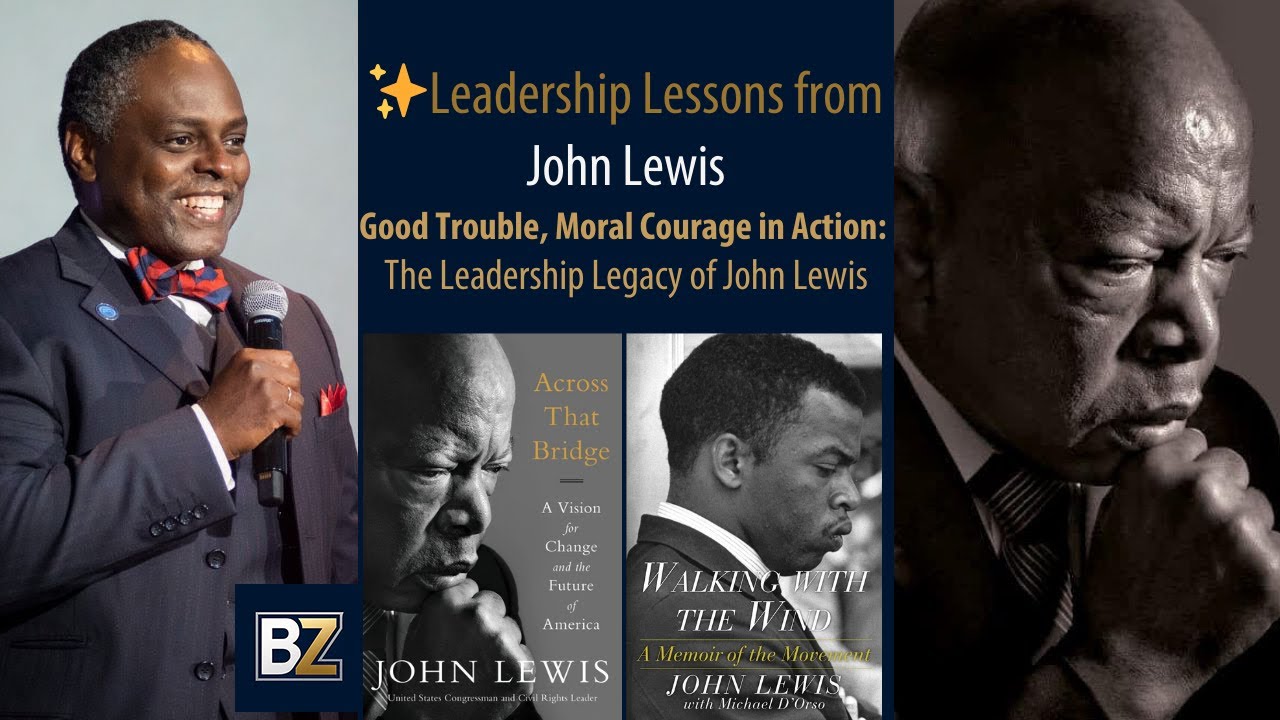
Bob Fabien Zinga and John Maxwell explore John Lewis's legacy through four pillars: moral clarity, strategic discipline, reconciliation, and hope. They trace Lewis's philosophy of "good trouble" from the Freedom Rides and Bloody Sunday to modern challenges in AI, cybersecurity, and military decision-making, arguing that nonviolent protest is a rehearsed discipline, not spontaneous action.
Chapters
Hi, I'm John Maxwell. When the top companies in the world are looking for trainers, speakers, and coaches, there's one name that stands above the rest, and that's Maxwell Leadership. Our certified team members have gotten proven results for companies all over the globe, and our reputation, I'm proud to say, is second to none. Some of our members have risen to the top of their profession, including the one you're going to meet today. I proudly introduce you to my friend, Bob Fabien Zinga.
Welcome to the Leadership and Success Podcast with your host, Coach BZ, where we help you lead with purpose and succeed with impact. If you're ready to grow into the kind of leader others want to follow, this podcast is for you. If you're determined to elevate your success and leave a lasting legacy, this podcast is for you. As my mentor, Dr. John C. Maxwell, reminds us, everything rises and falls on leadership. Our goal is simple, to inspire you, challenge you, and equip you with insights that can transform the trajectory of your leadership journey. Welcome aboard to another episode of the Leadership and Success Podcast with Coach Easy.
All right everyone, welcome to another edition of the Leadership and Success Podcast. This will be a very, uh, special episode. Today is the last day for Black History Month. So, uh, since the last day, I am going to say, like I've said every single day this month, I am grateful for really the contribution of African Americans to the American story. And African Americans have built this country and Black history is American history. So I highly recommend again for everyone to get a copy of his book, African American First. It's the famous, little known and unsung triumph of Blacks in America. Now, today is February 28th, right? And depending if it's a leap year, we may have 28 days or 29 days. Sometimes I wonder why Black History Month is the shortest month in the calendar. But anyway, so for today, I am going to show you two vignettes, one for February 28th, which is today, and then one for February 29th, in case we have 29 days this this bomb. So let me share my screen, um, and what we are going to do— let me get it— I am going to first show, uh, February 28th, what happened. Uh, let me make it bigger. Actually, it may be better if I do it this way. Okay, we are going to talk about, uh, what happened in America on February 28th. 1942. So a white mob riot against racial integration in Detroit. So February 28th, 1942, Black families in Detroit attempted to move into their new homes at the Sojourner Truth Arms Public Housing Project and were met with rocks, rage, and organized mob violence. 1942. And this was during World War II. So they said, we want white tenant in our white community. All right, that was in Detroit, not in the South, not in Alabama, not in Mississippi, but in Detroit. That's what happened, just the racist past history, very, very recent history of America in Detroit. So because again, February could have 29 days, so we also going to celebrate February 29th. On February 29th, which would have been tomorrow, no, depending if it was a leap year or not, 1960, So this is what, 66 years ago, Alabama governor demanded that student organizer be expelled for anti-segregation protest. All the students wanted was to be integrated and they were expelled from the school. But the good things is, I believe it was in 2010, so 50 years later, later they were given an opportunity to actually graduate. So that is pretty, pretty cool how that works out. So I'm going to show you a very short clip about that. It's about 2 minutes long.
On February 29th, 1960, Alabama Governor John Patterson spoke out against an anti-segregation sit-in that was taking place in the Montgomery County Courthouse. Students from Alabama State College, a traditionally black institution in Montgomery, were in the 5th the first day of a sit-in at a segregated lunch counter in the courthouse. Governor Patterson threatened to terminate the school's funding unless it expelled the student organizers. He also warned that someone was likely to be killed if the protest continued. The next day, more than 1,000 Alabama State students marched on the Capitol. Then the following day, The college expelled the 9 student leaders of the courthouse sit-in. With word of the expulsions spreading, more than 1,000 students pledged a mass strike. They also threatened to withdraw from school and continued staging days of demonstrations. 37 students were arrested. Meanwhile, 6 of the 9 expelled students sued to be reinstated, but a federal court upheld the expulsions as "justified and necessary" and barred the students' readmission to the college. It was not unusual for black college officials at state-funded universities, under pressure from state officials, to expel student leaders of the sit-ins. At my own college in Baton Rouge, Southern University officials expelled sit-in leaders, including me, in 1962.
All right, so that's it for the two vignettes for Black History Month, which we celebrated every single day here on the leadership and Success Podcast in 2026. And to end, I have two additional vignettes because I am in the military. I like to talk about some things that happen in the US military, any of the branches. And today we are going to honor our very first, first African American four-star general in the US Army. The other day we talked about the very first four-star general across all of the branches, but today about the US Army specifically. That was General Roscoe Robinson Jr. So we want to remember him, and here is a picture. Again, if you follow me on LinkedIn, you can go and read more about this outstanding achievement. And to end Black History Month today, I had to write as a closing tribute honoring Congressman John Lewis. He was born February 21, 1940. So that's last week. He would have been what, 80, right? 86 years old if he was still alive. So today on the very final day of Black History Month 2026, we honor the life and legacy of John Lewis, freedom rider, civil rights icon, moral compass of a nation. And Barack Obama actually called him a founding father of the civil rights movement. That is very touching. And here I do have his last word. Maybe we should end the program with his last word today. It's about 5 minutes. I will do that. So for the time being, what we are going to do is I wrote an article about John Lewis, leadership lesson from his life and legacy, Good Trouble, Moral Courage in Action. So what we're gonna do now is I'm gonna play the podcast about 20 minutes or so. It's going to be about the life and the legacy of John Lewis. And when you get a chance, read the article. I think it's about 12 or 13 minutes or so to read it, but I'm gonna let you listen to it. And then at the very end, I'm gonna play the last word of John Lewis. He wrote an essay in the New York Times and he said, "Don't publish it until the day of my funeral." And on the day of his funeral, that's when his essay was published. I think it's very poignant for us today. So we are going to listen to it at the very end. Of the podcast today. All right, without any further ado, let's listen to the podcast which is based on this article I just published today about the legendary Congressman John Lewis.
Here we go. Get in good trouble, necessary trouble. It is a phrase that has effectively become a brand at this point. You know, you see it on t-shirts, you see it on tote bags, tote bags, bumper stickers, right? It's a hashtag. It is painted on murals in downtown arts districts. It has almost become cozy, hasn't it? Like a slogan you put on a coffee mug to feel a little bit rebellious while you just sit at your desk job.
It absolutely has. And you know, that is deeply ironic considering the origin of the phrase. We've really domesticated it.
We really have. Because if you stop the tape and actually roll those words around in your mind, good and trouble, it is a paradox.
It's a friction point.
Yeah. An oxymoron. I mean, we spend our entire lives from the moment we are toddlers being told that trouble is the exact opposite of good. Trouble means you broke the rules. Trouble means you're out of line, right?
Trouble means punishment.
Exactly. It means you failed to conform.
Precisely. To modify the word trouble with the adjective good is this linguistic disruption right out of the gate. It forces you to ask a really uncomfortable question. Under what Specific circumstances is disruption actually a moral virtue? And you know, when does rule breaking become a requirement for leadership?
And that is exactly what we are unpacking today. We aren't just looking at a catchphrase, we are doing a deep dive into the operating system, really the leadership philosophy of the man who coined it, John Lewis. But, and here's the twist, we aren't just reading a biography today.
No, we're looking at a very specific analysis, right?
An article titled Good Trouble, Moral Courage and the Legacy of John Lewis, which was written by Bob Fabien Zinga. He goes by BZ.
And the context here is really important for you, the listener, to grasp. This article was published on March 1st, 2026. So we are looking at this retrospective on the very final day of Black History Month in the year 2026.
Yeah. The author notes that Lewis would've been 86 years old at this point.
It's a moment of looking back to look forward.
And the source material has this absolutely fascinating lens. The author, Bob Fabien Zinga, isn't a historian. He's not a politician. He is a US Navy commander and a cybersecurity executive.
Which is where it gets really interesting for me, right?
I mean, you think of John Lewis, you think of the 1960s, the Edmund Pettus Bridge, nonviolence, spirituals, denim overalls. You don't necessarily think of Silicon Valley or AI ethics or cyber warfare.
No, not at all.
So why is a modern military commander looking to a civil rights icon from 60 years ago for guidance?
Because as we'll see in this deep dive, the principles Lewis laid out aren't vintage, they aren't nostalgia. They are what Zinga calls a leadership manifesto for high-stakes environments.
A manifesto.
Exactly. Whether you are leading a platoon or a cybersecurity team defending against a state-sponsored breach or a movement for social change, the mechanics of courage remain exactly the same. We are going to look at Lewis not just as a historical figure, but as President Obama called him in his eulogy, a founding father of a fuller, fairer, better America.
That is a massive title.
Yeah.
Founding father. I mean, that redefines the whole timeline of American history.
It really does.
Usually we reserve that title for the guys in the powdered wigs holding quill pens in Philadelphia.
We do. And by the end of this deep dive, I think you'll understand why that title isn't hyperbole. It's a recognition of architectural weight. He didn't just live in the house. He helped renovate the foundation when it was cracking.
So, let's set the stakes here. Before we get into the manual of his leadership, we need to understand the man himself. The source material gives us this incredible trajectory. He starts in rural Alabama, born in 1940.
Far from the corridors of power. I mean, we are talking about a time and place where the segregation was absolute and the poverty was very, very real.
Yeah.
This isn't just the country. This is sharecropping territory. Yeah. This is a system designed explicitly to keep him and his family powerless.
And he ends up as a revered congressman representing Georgia's 5th District, literally lying in state at the Capitol.
Mm-hmm.
But the path between those two points, it wasn't a straight line. It was a collision course.
It was a series of collisions. And the source highlights a few key touchpoints that define his early leadership. For instance, he was the chairman of the Student Nonviolent Coordinating Committee, or SNCC, from 1963 to 1966.
And he was the youngest speaker at the 1963 March on Washington. I think people forget that.
They absolutely forget it.
We remember Dr. King's "I Have a Dream" speech. Obviously, that's the soundbite history remembers.
Yeah.
But Lewis was there in his early 20s speaking to the exact same crowd.
He was a kid, essentially. He was 23 years old. Imagine that for a second, standing at the Lincoln Memorial, looking out at that sea of people, 23 years old, carrying the weight of a movement on your shoulders.
Incredible.
He was also a key figure in the Freedom Rides of 1961. And this is where the physical danger really becomes apparent in the text. Challenging segregated interstate travel wasn't just a legal argument you make in a courtroom. It was putting your physical body in a bus seat that angry mobs wanted to drag you out of.
But the turning point, the moment that I think defines his legacy more than any other, and the one our source spends the most time analyzing, is Bloody Sunday.
March 7th, 1965.
The Edmund Pettus Bridge in Selma, Alabama.
This is the crucible. This is where the philosophy of good trouble moves from an abstract theory to a harsh reality. Lewis and hundreds of others attempted to march across that bridge to demand voting rights, and they were met by state troopers armed with billy clubs, tear gas, and bullwhips.
And the source is explicit about the physical cost. Lewis suffered a fractured skull.
A fractured skull. I really want us to pause on that because we often sterilize history.
We do.
We see the black and white footage and it feels distant, almost like a movie. But a fractured skull is a brutal, life-altering trauma. The sound of the club hitting his head was audible on the news tapes. He thought he was going to die right there on the asphalt. He didn't just protest, he absorbed violence.
And the strategic outcome of that physical sacrifice was that it catalyzed the Voting Rights Act of 1965. It forced the entire nation to look in the mirror. You couldn't ignore it when it was on the evening news.
Exactly. And from that fire, he transitions. He moves from the activist outside the fence to the legislator inside the building. He serves in Congress from 1987 all the way to 2020. He receives the Presidential Medal of Freedom in 2011. He becomes what his peers called the conscience of the Congress.
That transition is crucial to the deep dive today. Many people can be agitators. Agitation is relatively easy, right? You just have to point out what's wrong and yell about it.
Right.
And many people can be politicians. You just have to manage the system and compromise, but very few can master the art of both. He showed that you can work within a system while still holding it accountable to a higher moral standard.
So that's the life. But we promised you a manual. We promised a dissection of how he actually operated. The source material focuses heavily on a specific book Lewis wrote in 2012 titled Across That Bridge: A Vision for Change and the Future of America.
Right, and Bob Fabien Zinga, the author of our source article, makes a very strong distinction here. He says this isn't your standard political memoir.
He calls it a book that mentors you from the page.
Which is a beautiful way to put it.
It really is. A memoir says, "Look at what I did, aren't I great?" A mentorship book says, Here is how you can do it too. Zinga argues that Across That Bridge is essentially a masterclass in moral leadership. It distills Lewis's life into 7 principles: courage, faith, patience, discipline, truth, reconciliation, and love.
And for our deep dive today, we're gonna focus on the 4 pillars that Zinga extracts from those principles.
Huh.
These are the actionable takeaways that he believes apply just as much to a boardroom or a cyber defense center as they do to a protest line.
Exactly. The source notes that Lewis uses historical events, like the Freedom Rides, purely as case studies. He's not retelling the story just for the sake of logging history. He's analyzing the character traits required to survive the story and push forward. The book isn't about protest. It is about purpose.
So let's unpack Pillar 1. The source defines this as moral clarity and courage.
This starts with a definition of leadership that I think challenges a lot of modern corporate ideas. Lewis's mantra, "Get in good trouble," encapsulates the idea that leaders must disrupt the status quo when justice demands it. Not just manage it, disrupt it.
The source uses the term "moral clarity." I feel like that's a buzzword we hear a lot today, usually from pundits yelling on cable news.
Yeah.
But what does it actually mean in this context?
The article says specifically, "Moral clarity is not loudness," and I love that distinction.
Me too.
In the age of social media, we constantly confuse volume with conviction. We think the person yelling the loudest or using the most caps lock or getting the most retweets has the most moral clarity. But The Source argues that moral clarity is about alignment. It's about alignment with justice, mercy, and humility.
There is a biblical connection here that The Source explicitly cites. Micah 6:8.
To act justly and to love mercy and to walk humbly with your God.
It sounds simple, almost like a greeting card, until you try to actually do all three at once in the real world. The source breaks down how Lewis embodied this triad. Acting justly, that's the confrontation, that's challenging the segregation, that's the trouble part of the equation.
Right.
That's the steel.
Right.
But the loving mercy part, that's the good part. That is refusing to hate the person who is actively oppressing you.
Yeah.
And walking humbly, that means you aren't doing it for your own ego. You aren't doing it to get famous or get a book deal. You are doing it because the cause is bigger than you.
Balancing those three—justice, mercy, humility—is incredibly difficult. Yeah. Usually when we fight for justice, we lose our mercy. We get angry. Or when we are humble, we just keep our heads down and stop fighting for justice. Lewis held them all simultaneously.
He really did. And the source poses a really tough question here regarding courage. It says, courage is not the absence of fear. No.
And Lewis was very open about that. When he stood on that bridge in Selma, he wasn't fearless. He was terrified. He knew violence was coming. He could see the troopers. He could see the gas masks being strapped on. He knew exactly what a billy club felt like.
The source emphasizes that this wasn't spontaneous bravery. It was preparation. He had decided beforehand that the cause was worth the cost.
That leads to the challenge the source throws at the listener. And this is uncomfortable. It asks, "Are you willing to risk reputation for righteousness? Are you willing to endure discomfort for justice?" That's the litmus test.
It's easy to post a hashtag. But in a corporate setting, that might mean speaking up against an unethical practice. Maybe it's a dark pattern in your UX design or a bias in your hiring algorithm. Are you willing to call it out even if it costs you a promotion? Yeah. In a military setting, it might mean making a decision that is incredibly unpopular but protects civilians. The bridge is a metaphor. We all have bridges in our lives where we have to decide, do I turn back to safety or do I walk forward into the trouble?
And if you decide to walk forward, you can't just wing it. That brings us to pillar 2, strategic discipline.
This is perhaps the most misunderstood aspect of the civil rights movement and specifically of Lewis's philosophy. There is a huge misconception that nonviolence just means doing nothing.
Right? That it's passive, that you just stand there and take it because you're a nice person.
But The Source, written by a military commander, refutes that instantly. It calls nonviolence a "strategic discipline." Think about those two words together.
Strategic discipline. It wasn't accidental. It wasn't passive. It was a form of asymmetric warfare. The Source details how the protesters actually rehearsed.
Yeah, this blew my mind when I read it. I knew they organized, but The Source describes actual role-playing.
They treated it like boot camp. They would gather in church basements and community halls in Nashville. They would divide into groups. Some activists would play the role of the aggressors, the white supremacists, the police. They would scream racial slurs. They would blow cigarette smoke right in their faces. They would push them, shove them, pull their hair, spit on them.
And the others?
The others had to practice not reacting. They had to practice looking straight ahead. They had to practice protecting their heads and their vitals without throwing a single punch back.
They practiced emotional control under simulated combat conditions. Precisely.
Because Lewis understood the strategy. If they reacted, if they threw a punch back, if they cursed back, the moral narrative would be instantly lost. The headline the next day would change from "Peaceful Protesters Attacked by Police" to "Riot in Selma." The moral high ground would evaporate.
Lewis understood that their composure was their weapon. It made the brutality of the segregationists undeniable to the rest of the world watching on TV. It acted as a mirror.
The source connects this to another scripture, 1 Corinthians 9:27: "I strike a blow to my body and make it my slave." That is intense imagery.
I beat my body and make it my slave. But the interpretation here isn't about physical self-flagellation; it's about self-mastery. The argument is that leadership collapses when private discipline fails. You have to conquer your own impulses—your impulse to lash out, your impulse to run away, your impulse to save yourself. Before you can ever hope to lead others.
So in a modern context, say cybersecurity, which is Zinga's field, how does this apply?
Think about a major cyberattack. You're under immense pressure. Alarms are going off. The adversary is inside the network exfiltrating data. The natural human reaction is panic or rage or a hasty flailing response where you just start unplugging servers.
Which usually makes it worse.
Exactly. Strategic discipline means you have rehearsed this scenario in tabletop exercises. You don't react emotionally. You execute the incident response plan, you maintain your composure so you can systematically outmaneuver the adversary. It's the exact same muscle as those church basements in Nashville, just a different gym.
The source also talks about the long view here. Lewis saw the struggle as a marathon across generations.
This is a direct critique of our modern attention span. We live in a world of quarterly results. We want the viral hit on social media. We want the policy to change tomorrow morning. Lewis operated on a timeline of decades. He transitioned from the grassroots activist getting beaten on a bridge to the congressman writing laws in the Capitol. That took years, decades.
The source says, "If you are only focused on quarterly results, you will miss generational impact." That hits hard for anyone in business.
It does. It challenges us to ask if the work we are doing is built to last or if it's just built for right now, for the next earnings call. Lewis showed the incredible value of working within systems while challenging them. He didn't just want to burn the house down, he wanted to rebuild it so everyone could live in it. And rebuilding takes a lot longer than burning.
Which is the perfect segue to pillar 3: the beloved community and reconciliation.
This is the destination. If good trouble is the vehicle you drive, the beloved community is where we are trying to go.
This concept is heavily rooted in Dr. King's teachings, but Lewis really carried the torch for the next 50 years. The Source defines the beloved community as a society bound by justice, equality, and love.
And the key mechanism to get there is collaborative leadership. The Source makes a profound point that progress comes from collective action, not singular heroism. We tend to worship the great man theory of history, that one singular guy changed everything, right?
The lone genius or the lone savior.
Exactly. But Lewis always emphasized the group, SNCC, the marchers, the voters, the organizers behind the scenes.
He also spent a huge amount of time mentoring youth. The source mentions he constantly encouraged them to find their own good trouble. He didn't want followers, he wanted more leaders. He understood scalability.
You can't change a massive country by yourself. You need to replicate the leadership DNA in the next generation so the work continues when you're gone. But the hardest part of this pillar, and the source calls it radical reconciliation, is the strict refusal to demonize the opponent.
Blessed are the peacemakers. Matthew 5.9. Right.
But we have to be really careful with the word peacemaker. In this context, it doesn't mean avoiding conflict. It doesn't mean, can't we all just get along? It implies that true peace requires confronting injustice. You can't have peace without justice. That's just quiet oppression.
That's a great way to put it. Quiet oppression.
But, and here is the Lewis paradox again, you confront the injustice while refusing to hate the unjust. The source says, "Peacemaking isn't passive.
It involves confronting injustice but refusing to demonize the opponent." I have to say, that seems almost impossible in today's polarized world. We live in a cancel culture, on both the left and the right. If you disagree with me, you aren't just wrong, you're evil.
You're a monster. It seems impossible, but Lewis actually did it. And remember who he was dealing with. He wasn't dealing with people who posted mean tweets about him or downvoted his posts. He was dealing with people who literally beat him with wooden clubs. He was jailed over 40 times. 40 times. And yet he spoke of his attackers with a kind of sorrowful pity rather than burning rage. The source describes this capacity to love those who harmed him not as a weakness, not as being soft, but as strength at the highest level.
It's the strength to break the cycle of violence. If you hit back, the cycle just continues. If you absorb the blow and offer justice and reconciliation in return, you disrupt the entire system. You short-circuit it.
Exactly. It de-escalates the hate while escalating the issue. That is a masterful strategic move, but it takes an incredible toll on the person doing it.
Which means it requires a fuel source. You can't run an engine like that on empty. Which brings us to Pillar 4: Unwavering hope.
Optimism as a duty. That's the phrase Zinga uses.
Optimism as a duty, not a feeling. Right.
It's not, oh, the sun is shining. I had a good cup of coffee. I feel happy today. It is optimism as a strict discipline. The source quotes Lewis: Ours is not the struggle of one day, one week, or one year. Ours is not the struggle of one judicial appointment or presidential term. Ours is the struggle of a lifetime. Or maybe even many lifetimes, and each one of us in every generation must do our part. And if we believe in the change we seek, then it is easy to commit to doing all we can because the responsibility is ours alone to build a better society and a more peaceful world. He ends it by saying, be hopeful, be optimistic. Why is hope a duty though?
That makes it sound like a chore.
Because without it, you succumb to cynicism, and cynicism is the absolute death of leadership. If you believe that nothing can change, that the system is entirely rigged, that people are inherently evil and selfish, then why bother? Why get in trouble? Why vote? Why organize? Hope is the organizing force that keeps you moving forward when all the empirical evidence suggests you should just quit.
The source connects this to Romans 12:1: Be joyful in hope, patient in affliction.
Patient in affliction. I think that perfectly describes Lewis's entire life. He was patient through the physical and emotional affliction because he had an anchor. The source discusses how his faith actively restrained his bitterness. He truly believed that even his worst adversaries were capable of change.
That is a profound leadership posture. To look at your enemy, someone actively trying to hurt you or destroy your community, and think, "You can be better than this. I believe you can be redeemed." It is.
And honestly, it's the only way a democracy survives in the long run. If we decide our political opponents are irredeemable monsters who cannot be reasoned with, the only logical outcome is war. Lewis believed in the redeemability of the American soul. He believed the country could be saved even when the country was beating him.
So we have these four pillars: moral clarity, strategic discipline, reconciliation, and unwavering hope. Now I want to pivot to the so what of it all. Why does this matter now to you, the listener, in the modern world?
This is where we bring Bob Fabien Zinga back in. Remember, he's writing this as a Navy commander and cyber executive in 2026. He sees these lessons applying directly to modern crises.
He mentions crisis response, ethical dilemmas in AI and cybersecurity, and governance. Let's dig into the AI angle. That feels very relevant to 2026. Think about AI.
We are building systems right now that will make autonomous decisions affecting millions of lives. Who gets a mortgage? Who gets hired for a job? Who gets paroled from prison? The questions we are asking around these models aren't just technical or mathematical. They are is deeply moral. If AI model is trained on biased historical data, it will replicate and scale that bias instantly.
So good trouble in that specific context might mean a developer refusing to ship a product. Exactly.
It means a data scientist or a product manager saying, no, this algorithm is flawed, it's unjust, I won't sign off on it, even if it delays the launch. That requires moral clarity, knowing it's wrong. It requires courage, risking your job or your reputation in the company to say it. And it requires strategic discipline, documenting the bias, presenting the evidence logically, not just flipping a table in a meeting.
And in cybersecurity, where you are constantly under attack from unseen adversaries.
You are. And Zinga creates a hierarchy of importance here. He says systems matter, laws matter, but character matters most. You can have the best firewall in the world. You can have zero trust architecture, but if the person behind the keyboard lacks integrity, if they can be bribed, or if they are just lazy, you are completely vulnerable. You can have the best laws on the books, but if the leaders enforcing them lack mercy and justice, you just have tyranny.
This leads us to the founding father argument. Mm-hmm. The source references President Obama's eulogy for Lewis, where he called him a founding father of that fuller, fairer, better America.
It's a really powerful reframing of how we view history. Think about the original founding fathers, Washington, Jefferson, Madison. They were brilliant men. They articulated the ideals. They wrote the source code for the nation. "All men are created equal." But they didn't actually run the code.
No, they didn't. They owned slaves.
They excluded women. They excluded indigenous people. The promise was there on paper, but the reality was completely missing. The program was incredibly buggy.
So the argument is that Lewis forced America to actually execute its own code, to debug the system. Exactly. Yeah.
The source argues that Lewis helped force America to live closer to those original ideals. And by doing that, he earned his place in the pantheon. He didn't write the Constitution, but he made the Constitution true for millions of people who were previously excluded from its protections. He validated the document with his own blood.
He dented the universe.
That's the exact phrase the source uses. A rare individual who leaves a permanent mark through conviction.
It really puts a completely different perspective on what we consider history. It's not just what happened in 1776. It's what happened in 1965. It's what is happening right now in our own communities.
And that is the challenge for the listener. History isn't over. We are writing the next chapter right now. The source asks us to stop viewing Lewis as a bronze statue in a park and start viewing him as a colleague, a mentor you can learn from today.
So as we wrap up this deep dive, let's look at the final charge. The source quotes John Lewis's final published words, which appeared in an op-ed in The New York Times on the very day of his funeral.
It is a beautiful passage. Walk with the wind, brothers and sisters, and let the spirit of peace and the power of everlasting love be your guide. Walk with the wind.
It sounds so gentle for a man who faced such incredible violence and hostility.
It does, but think about it. Wind is powerful. Wind shapes canyons over millennia. Wind moves massive ships across oceans. Wind is an invisible force that completely changes the landscape over time. That is what he wanted us to be: persistent. Invisible if necessary, but constant.
The source leaves us with 4 actionable takeaways. Let's recap them quickly for the listeners so you can take these with you. These are the things you can actually do tomorrow. Number 1, act when you see injustice.
Don't wait for permission. Don't wait for the perfect time because there is no perfect time. Don't wait for a committee to form and issue a report. If you see something wrong in your office, in your neighborhood, in your code Say something, do something.
That's the trouble. Number 2, cultivate discipline.
Emotional control. Rehearse your response to pressure before the pressure hits. Don't let your anger drive the car. Anger is the fuel, but discipline has to be the steering wheel.
Number 3, build community.
Don't silo yourself. Leadership is a team sport. Reach out even to people you fundamentally disagree with on certain things. Build the coalition. You cannot cross the bridge alone.
And number 4, sustain hope. Keep your eyes on the horizon.
Believe that change is possible even when it's incredibly dark out, especially when it's dark.
And finally, the source, Bob Fabien Zinga, asked 3 questions that I want to leave hanging in the air. These are not for us to answer on this show. These are for you, the listener, to answer for yourself in the quiet of your own commute or your own office. Question 1: What do you stand for? Not what do you vote for or what do you like on social media? What do you actually stand for?
What is your non-negotiable?
Question 2: What are you willing to sacrifice? Are you willing to lose a bonus, a promotion, a friend, your reputation?
Because if you aren't willing to lose anything, you aren't leading. You're just following the path of least resistance.
And question 3: How will history remember your generation? Will we be the ones who let the bridge collapse, or the ones who reinforced it for the next group to cross? Heavy questions, but necessary ones. Indeed. John Lewis showed us that the answers to those questions can literally change the world. He proved it. So go out there, find your purpose, and as the man said, get in some good trouble.
Necessary trouble. Thanks for joining us in this deep dive.
We'll see you next time.
All right, so this is the end of the podcast. Please let us know as you watch the replay, where are you joining us from? And let us also know what you are grateful for today. And as well, what are 3 to 5 takeaways from this episode? What are you going to do with what you've learned today or been reminded of. So what do you stand for? What are your core values? What are you not going to— what are you going to stand on no matter what? Right, there will be no negotiation, right? You stand firmly on that. What is it? And what are you willing to sacrifice? Each and every one of us, we will have to sacrifice something at some point. If something is truly a priority to you, if it's truly a core value, what are you willing to give in exchange? And then how will history remember you or your generation? All right, to end the show, I'm gonna play the last word of Congressman John Lewis. So he wrote an essay which he published to the New York Times, but he didn't allow them to publish it until the day of his funeral. So on the day of his funeral is when this was published. So we're gonna have Morgan Freeman read it for us. And before I do, I want to remind you that tomorrow I will be here at 3:00 PM. I will be interviewing Coach Melanie Eick tomorrow, 3:00 PM California time. So 6:00 PM Washington, DC time. And she's the bestselling author of Everyday Moment. She's going to be here, a purpose-driven coach, consistent. Bestselling offer. We're gonna be talking about Everyday Leader Change the World: The Power of Daily Consistency. You do not want to miss it. I'm gonna have more shows next week and I'm gonna let you know in my LinkedIn feed. And also next month, I guess in March, which starts tomorrow, I haven't forgotten, we're gonna go back to Proverbs chapter 16. We've done 1 through 15 using artificial intelligence and we're gonna start from 16 all the way out. So I will be letting you know exactly when I am going to do this, but we're going to continue and complete from 16 through 31 using artificial intelligence, like a 10-minute AI recap. So I'm going to do this on the days where I don't have interviews, but again, I will let you know. Okay, so now I'm going to let you listen to the final word from John Lewis. This is going to end the podcast. Again, let me know when you watch the replay where you're joining from. What you are grateful for, and 3 to 5 takeaways and something that you are gonna put into practice this week. All right, let's play this last episode. Okay, I love technology. I think I've got it all set up now. So here are the last words of, uh, John Lewis.
John Lewis's last words appeared in The New York Times today in an essay that he wrote shortly before his death, intending it to be published on the day of his funeral. Here is that essay, read for us today by John Lewis's friend and admirer, Morgan Freeman.
While my time here has now come to an end, I want you to know that in the last days and hours of my life, you inspired me. You filled me with hope about the next chapter of the great American story. When you used your power to make a difference in our society. Millions of people motivated simply by human compassion laid down the burdens of division. Around the country and the world, you set aside race, class, age, language, and nationality to demand respect for human dignity. That is why I had to visit Black Lives Matter Plaza in Washington. Though I was admitted to the hospital the following day, I just had to see and feel it for myself, that after many years of silent witness, the truth is still marching on. Emmett Till was my George Floyd. He was my Rayshard Brooks, Sandra Bland, and Breonna Taylor. He was 14 when he was killed. And I was only 15 years old at the time. I will never ever forget the moment when it became so clear that he could easily have been me. In those days, fear constrained us like an imaginary prison, and troubling thoughts of potential brutality committed for no understandable reason were the bars. Though I was surrounded by two loving parents, plenty of brothers, sisters, and cousins, Their love could not protect me from the unholy oppression waiting just outside that family circle. Unchecked, unrestrained violence and government-sanctioned terror had the power to turn a simple stroll to the store for some Skittles or an innocent morning jog down a lonesome country road into a nightmare. If we are to survive as one unified nation, We must discover what so readily takes root in our hearts that could rob Mother Emanuel Church in South Carolina of her brightest and best, shoot unwitting concertgoers in Las Vegas, and choke to death the hopes and dreams of a gifted violinist like Elijah McClain. Like so many young people today, I was searching for a way out, or some might say a way in. And then I heard the voice of Dr. Martin Luther King Jr. on an old radio. He was talking about the philosophy and discipline of nonviolence. He said we are all complicit when we tolerate injustice. He said it is not enough to say it will get better by and by. He said each of us has a moral obligation to stand up, speak up, and speak out. When you see something that is not right, you must say something. You must do something. Democracy is not a state. It is an act. And each generation must do its part to help build what we call the beloved community. A nation and world society at peace with itself. Ordinary people with extraordinary vision can redeem the soul of America. By getting in what I call good trouble, necessary trouble. Voting and participating in the democratic process are key. The vote is the most powerful nonviolent change agent you have in a democratic society. You must use it because it is not guaranteed. You can lose it. You must also study and learn the lessons of history because humanity has been involved in this soul-wrenching existential struggle for a very long time. People on every continent have stood in your shoes through decades and centuries before you. The truth does not change, and that is why the answers worked out long ago can help you find solutions to the challenges of our time. Continue to build union between movements stretching across the globe. Because we must put away our willingness to profit from the exploitation of others. Though I may not be here with you, I urge you to answer the highest calling of your heart and stand up for what you truly believe. In my life, I have done all I can to demonstrate that the way of peace, the way of love and nonviolence, is the more excellent way. Now it is your turn to let freedom ring. When historians pick up their pens to write the story of the 21st century, let them say that it was your generation who laid down the heavy burdens of hate at last, and that peace finally triumphed over violence, aggression, and war. So I say to you, walk with the wind, brothers and sisters. And let the spirit of peace and the power of everlasting love be your guide.
John Lewis gets tonight's last word through the voice of his friend, Morgan Freeman.
Thank you for tuning in to the Leadership and Success Podcast with your host, Coach BZ. If today's episode added value to your leadership journey, be sure to subscribe, share, and join us again for more wisdom nuggets on how to lead better and achieve greater success. Remember, leadership is the most critical skill of our time. The world will always need leaders to inspire, inspire others, drive innovation, and execute meaningful strategy. So why not count yourself among the bold leaders shaping the 21st century? Until next time, stay inspired, stay committed, and keep leading with excellence.
More from Bob

S250:E4🎙️LIVE 🇺🇸America 250: President Barack Obama Leadership, Service, and the Power of Hope






S5:E157🎙️ LIVE with CMD CMSgt Dennis L. Fritz, USAF (Ret.)(Multi Tracks Audio)



S5:E156🎙️ LIVE 🇪🇸 Leadership Lessons from the FIFA World Cup 2026 Champions (Multi Tracks Audio)

S250:E3🎙️ LIVE Leadership Lessons from America’s First Documented Family of African Descent 🇺🇸📖