S5:E5 🎙️LIVE with Dr. Deena C. Brown, PhD (Multi Tracks Audio)
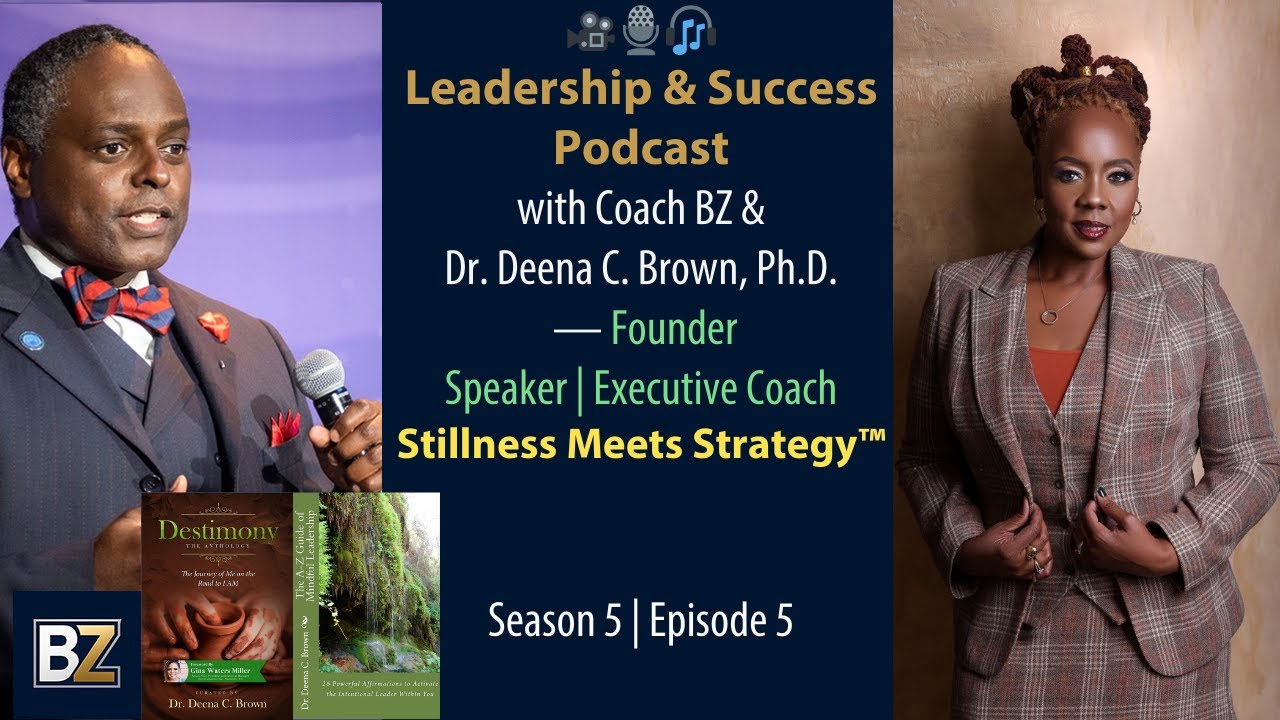
Dr. Deena C. Brown shares her Shift Theorem (Self-awareness, Harmony, Intentionality, Faith, Tenacity) and the "stillness meets strategy" approach to leadership. She walks through concrete practices like 5-minute meditative resets and building a personal board of confidence, plus how to handle imposter syndrome and integrate AI into people-focused work.
Chapters
Hi, I'm John Maxwell. When the top companies in the world are looking for trainers, speakers, and coaches, there's one name that stands above the rest, and that's Maxwell Leadership. Our certified team members have gotten proven results for companies all over the globe, and our reputation, I'm proud to say, is second to none. Some of our members have risen to the top of their profession, including the one you're going to meet today. I proudly introduce you to my friend Bob Fabien Zinga.
Welcome to the Leadership and Success Podcast with your host, Coach BZ, where we help you lead with purpose and succeed with impact. If you're ready to grow into the kind of leader others want to follow, this podcast is for you. If you're determined to elevate your success and leave a lasting legacy, this podcast is for you. As my mentor, Dr. John C. Maxwell, reminds us, everything rises and falls on leadership. Our goal is simple, to inspire you, challenge you, and equip you with insights that can transform the trajectory of your leadership journey. Welcome aboard to another episode of the Leadership and Success Podcast with Coach BZ.
Have you ever believed an AI myth that kept you from taking the next step? Well, that's why I'm here. I am the chief mythbuster, the newest member of Dr. Dena's AI leadership team. And every Friday, I'll be right here to cut through the myths that make AI feel scary, confusing, or completely out of reach. Last week, I talked about the decision you didn't stress test. This week is about what often gets missed before that decision ever reaches the table. Most workforce data is already telling a story. The difference is whether HRBPs are positioned to hear it and translate it before decisions are made. This is where tools like Microsoft Copilot can help, not by making decisions so much.
Well, job success, it all starts with the networking. If you expect to have success, you have to do it because doing it well could, uh, and doing it positively could lead to great potential. On the flip side, it could not only cost you opportunities but also your reputation.
Hmm.
Joining us this morning to teach us how to network like a beast is Dr. Dena, a business coach with DC Brown International.
Good morning, Dr. Dena. Good morning, good morning. Great to be here.
This is a fascinating topic.
Yes.
Yes, let's dive right into it. How do we network effectively?
You must do 3 things. You must prepare, you must practice, and you must be purposeful about your networking. And by purposeful, when you go to a room and go to an event, you're not there to try to tackle everybody in the room if you've already planned and prepared and practiced, you realize there might be 3 key people I need to know because you have to decide, are you trying to grow your business? Are you trying to grow yourself? Or you may be trying to make some spiritual connections and find a mentor. So if you know that, you know who to connect to.
And so what is the biggest mistake you see networkers make?
Okay.
All right, everyone, today is a very special day. Uh, Dr. Brown is, uh, in the green room right now, and I'm gonna bring her in just a moment. But before we get started, we do a moment of gratitude. This is actually the 4th live show we've recorded today for 2026. I can't believe it. As you already know, today I'm grateful for the new year. Today's January 2nd, 2026, but also for the list of illustrious guests like Dr. Brown who are going to be on the show and really sharing their knowledge and the leadership principles they have learned throughout their career to enrich our life. I'm so grateful, grateful for that. So let me see if I can properly introduce the doctor here. I'm gonna try my best. So Dr. Brown is a globally respected executive leader, scholar, practitioner, and human-centered leadership architect. Uh, I really think she's like a Renaissance woman. I wonder if there's anything that she hasn't accomplished yet, right? From classroom to DOD environment to corporate boardroom and global stages, her work centers on one essential truth: leaders must lead with clarity. With confidence and humanity, especially under pressure. So here on the Leadership and Success Podcast, please help me welcome the one and only Dr. Dena C. Brown. Dr. Brown, good morning. How are you?
Good morning. Oh my goodness. I can't believe you went that far back into the archives. I was like, no, In the world, you went back to news clips and— oh, and I used to get heard on NBC and CBS and talk about strategic networking and all that kind of cool stuff.
Yeah. Yes, you've been everywhere. You've affected everything. You've got a long career that's impacted really a lot, which is quite amazing. Maybe we're gonna unpack some of that on the show today. Maybe to get started, Dr. Brown, what is one thing you are grateful for today?
Today I am grateful just for beingness and the fact that I woke up this morning with all of my limbs. Yes, my 5 senses working, my mind, um, active and alert. When so many others have not even made it this far, and some that have been close to me. So truly and honestly, and this is not cliché, I am grateful for breath. Yes, right now moment.
Wow, that is so powerful. So simple but so powerful, because without it, you have absolutely nothing.
Nothing else matters. Everything else is secondary and tertiary. Wow.
Today being the second day of 2026, just think about that. Now, for me personally, most people may not know, but when I was a kid, I was sick a lot, and my doctors and my primary doctor was a military doctor. Maybe part of the reason why I wanted to join the US military. But anyway, they told my parents I wouldn't live beyond 17 years old. I'm in my mid-40s now, and every day I have is really a day of grace, and I'm very, very grateful. For it just to be brave. So thanks so much for sharing that. Is there something about you, Dr. Brown, that most people may not know that you're willing to share?
Most people don't realize I'm heavily introverted, actually.
Really?
I call myself an ambivert. Is that— I'm on stages and I'm going, so I am happy to stand in the space and I own every room. I walk into. But my happy space, like, I can go home on Friday and not leave the house until Monday and not speak to a single person.
Really?
Because when I am out, I give off— someone, a great friend of mine, told me I give off sparks. And so out, I draw a lot of attention, and that takes a lot of energy. Um, you're always pouring out You've got to be able to not only just fill your own cup but brew your own kettle so that you're poured. So for me is that I really thrive in those quiet, still spaces. And I spend probably about 80 to 90% of my time alone when I'm not at work. Wow. It's such a great space to be. But most people think, oh no, you're an extrovert. You talk to people and you do all this stuff. I said, no, two things can be true. And so I am actually more of an ambivert. I'm an introvert with extrovert tendencies.
Wow, that is really fascinating. But I think it's important as a leader to refill your tank. That is so critical. Wow. So you've often described your leadership philosophy as stillness meets strategy. And I think you trademarked that, if I'm not mistaken.
Yes.
Wow.
That's amazing. Amazing. So what does that phrase mean to you personally, and how did it emerge through your lived leadership journey?
It has emerged because we feel that in order to execute, you have to be going. But if you don't have that moment, that pause, that sense of stillness to truly recalibrate, this is just not something that's just nice to say. It's actually brain science. I'm a bit of a neuro nerd. When we think about what happens and what I've seen, not only for myself but other leaders, I feel like— I'm going to get nerdy here for a moment— that our frontal cortex gets inflamed. And so when it does, our ability, our thinking brain starts to go haywire. And then it'll go back to that basal ganglia.
Right.
It'll go back to those habits, those trends of things that either, A, we learned growing up, or that's stored in that cryptkeeper that's in the back. And so you'll go and actually activate habits and behaviors that are not necessarily conducive to the situation right now. So until you can get still and be quiet, then your strategy for your right now moment and execution can never show itself. So that's where that stillness is a part of the strategy. You've got to have— there's power in the pause.
That is really insightful because I think right now today, 2025, there is so much distraction out there, so many signals coming at you from every angle. So how do you find the moment to just be quiet and strategize and really work on what you desire and not be forced to do whatever the advertiser, whatever everybody else wants and not work on your own goals and Strategy. Wow. So was there maybe a specific season in your career when you realized that strategy without stillness was no longer sustainable?
Oh gosh, my whole entire life. To be honest with you, everything I learned about being an intentional, impactful leader, I learned from being Xavier's mom. And Xavier is my son who's now like 23. And I say that because I can go— I didn't have the words and the language that I have now to trademark it, but it's always been an integral, integral aspect of how I showed up when I was a school principal, right? Um, when I became a mom, and I have one, um, visual that comes back to me whenever I feel like I'm starting to go into too many directions. I recall, um, I happened to be, um, in Korea at the time, South Korea, and My son might have been like 11, 12 or so, and I came home from the grocery store and I am barking orders and things. I'm— because my mind is going, I'm still trying to decompress from work. I'm like, put this away, and I'm just barking and just going, going, going, going. And he was trying to do all the different things that I needed him to do. And my mind goes really fast. Not everybody's mind works that same way in their actions. So once things calmed down and then I kind of sat for a minute and I looked around, I went— the milk was in the laundry room, detergent was in the refrigerator, things were all over the place because I was barking orders so quickly and fast. I wasn't taking the time to make sure that he even understood, but he was just trying to move.
Yes.
And so was— I was going, put that there, go there. He was just going, going, going. And that moment, number one, I had a mom moment and I fell, almost fell apart because I thought, what am I doing? What am I doing? I am not even mentally present. Yes.
Wow.
I'm not even focused on what's happening. I am still thinking about what was going on the day at work. I'm still thinking about what I need to do when I get home. I'm thinking about the groceries to put away. And so I was going so many directions that I realized that I went nowhere and everything was a mess. And so from that moment, we talk about that defining moment, I made a commitment to myself.
Yes.
That I will start to be still and take a beat and take a breath and present in the moment that I'm in. And I use tools. I'm a strategist, so, you know, and I use things like Pareto. So I'll say, okay, I got 10, 20 minutes. I'm focusing only on this. Wow. And I realized when I began to do that and have that laser focus, I got so much more done.
Wow.
So many more things that were aligned and so many things, more things were accurate when I did that. So stillness and strategy.
Just, man, that is really powerful. It's really simple, but, uh, very insightful and, uh, could really be impactful. Literally change someone's life. A lot of these leadership lessons and strategies that we talk about on the show, I feel like it's not rocket science. It's not really something that nobody cannot do. But I also have a problem with some people sometimes that listen like, "Oh, I already know that." I'm like, "No, you don't know it because if you did know it, you would be doing it." So because you don't do it, you don't know it. So you're willing to—
They can know it and they opt not to do it and be intentional. So we didn't talk about this, and I don't think I sent this for you, and you didn't bring this up. I wrote a theorem. It's called the Shift Theorem of Align Movement. And when— I don't know if you recall, a couple of years ago, Dave Ramsey came to speak to us at the John Maxwell Team, and he was there and he was showing the Momentum Theorem, right? And I was sitting there and I was thinking about my life and I was jotting down some notes. And I'm looking at his theorem and I realized, wait a minute, People always ask me, how do I go from where I am to where I desire to be? They always would ask, how did you do that? How did you shift from K-12 to go to corporate? How did you move past divorce? How did you move past trauma? How did you move? How did you do all these things? And I realized that I had 5 core principles that I used to move. And so I sat there on a napkin in that room. I don't know if you were there that year.
Yes.
I sat there and I jotted down the 5 core And then I wrote it into a theorem. And then I took it back and I worked with a mathematician. I worked with a neuroscientist. I worked with a numerologist. And I said, does this work? And it did. And so here's what the theorem is. Shift theorem is, and the very core part of the shift theorem is the S, which is self-awareness. Self-awareness. Where are you right now in this moment? And whether you're talking about business or whether you're talking about life, if you do not know where your position and coordinates are, you don't know where you're going.
Wow.
Period. Right. And so the other parts of that— and so I anchor a lot of like the things that you see and you hear me sharing about and the work that I do now in that very first element, that very first factor, which the S. And then the H is harmony, because once you know who you are, you now can begin to identify— it's not about balance, it's about harmony, because harmony says, here's how I have to maneuver and shift things in order to again deal with what's happening now. That's why I used to— but you, if you don't know, you don't know what to add. And so once you know what to add, I is about being intentional, because now I know who do I need to meet, who do I need to connect to, what do I need to add, what do I need to remove, what do I need to start, what do I need to stop. And then we get to the F, and the F is about faith. And it's not the faith about which religion or doctrine you practice. It's about a knowing, a knowing, you know, and to know you have to have knowledge that you can actually see, and that's that movement. Wow. Faith, right?
Yes.
And so once you have a faith, the T is about, um, what was it, um, tenacity.
Hmm.
T is an exponent, is an exponent. And so there's a 2, there's an exponent on the T, and the T has to be greater than 1 for you to move forward. Wow. And if it's not greater than 1, and if it's at 0, you will stay where you are. And if it's negative, you're going to move backwards. And guess what? That movement is not whether you go forward or backwards, it's depending on which season cycle you're in. Yes, it's self-awareness. Hmm, by harmony over intentional action multiplied by exponential tenacious faith. I'll send you what the— there, I trademark that too— the, the theorem is. And so everything you hear and you've seen, whether you went back, if you— again, yes, showed when I talked about networking, that theorem is in there. Awareness. Who do you know? Leadership. So everything that I've done, that I do, it's an integral part of my I AM.
That's really powerful because even in the clip, I didn't show it, but you show the example of someone adding a bunch of business cards with a memo around, but then really not doing anything, not having any impact, right? Intentionality. Wow. That's powerful. So how did your Early leadership experiences, particularly in global and high-pressure environment, shape how you think about clarity and decision-making today?
Whew. Made lots and lots of foxpaws. I don't call them faux pas. I call them foxpaws because they were pretty wily and they were really— they were really learning opportunities because everything I've been through was compost for my growth. I don't take it as a loss. I take it as a learning, right? Sometimes you win, sometimes you learn, right? Sound familiar?
Yes.
And when I think about the times I was moving too fast, I was not paying attention so that I could not give the right attention and intentionality to what I was doing.
Hmm.
Did not have clarity because I was lost and set in confusion. Trying to do all of the things. I think about my early years as a teacher and then moving into school administration as a whole and having to do things by trial and error because you're like, ah, let me— every time I was in a hurry is when I had the most mistakes. And then I thought about what didn't I know? Because in that hurry, I didn't take the necessary time to pause to make sure I had the learning to lead the way. And so that's how it's kind of attached, but my clarity to be able to do that in that knowing. And it's not just a book sense, it's not just a— that it's about a quiet sense to get quiet and say, what is it that I really want? I ask hard questions to myself.
Yes. Wow. When I look for your career, you really emulate confidence in everything you do, right? Like some of the pictures I even showed, but I mean, it is quite powerful. I guess the question I have for you about confidence in leadership is many high-performing leaders sometimes struggle silently with self-doubt. What do leaders misunderstand most about confidence and imposter syndrome?
The very first thing is that there's always going to be somebody smarter than you, prettier than you, wealthier than you, thinner than you, and all of them. So stop competing with external and get clarity on who you are. There's 3 things I call a C3 bullet: clarity, confidence, and consistency.
Wow.
You'll find that as I build those other things in But I will go back to what I spoke to about the shift theorem, and I'm going to expand that. And I want you— something you said has been the anchor for the book I'm working on now, which is Confidence: Unmasking the Imposter Within. Visualize the word confidence. Sitting right in the middle is I-D.
Identity.
Who are you?
Wow.
In the word confidence, if you don't know who you are, How can you show up confident?
Yes.
And then if you really want to kind of dig into like the Freudian aspect, right, and we're talking about the ego, the super id, id, id— what is that? Your core of who you are. And so why people struggle with it is because they're not self-aware.
Wow.
They are showing up as a bastardized version of themselves because they are doing everything humanly possible to be what other people need and want them to be instead of tuning in and being still and quiet to own the core of their I AM.
Wow.
That is powerful. I think you have to say that again because for also people like me who do read the Bible, this I AM keeps showing up in the Old Testament, even Jesus. Brought that up. I think you're bringing it kind of full circle.
Wow.
Absolutely, absolutely. Because here's the thing, and if you can either speak 'I am' or the vice versa of 'am I'— too many leaders 'am I' instead of saying 'I am.' There's—
wow, that's deep.
One's a question, one's a statement.
Wow.
He said examine how it's showing up in your life as a leader. Am I a good parent? Am I a good mom? Am I a good leader? Am I worthy for the job? Am I? Am I? Am I? As I was saying, I am.
Yes.
And whatever follows, right?
That is powerful. I think Angelo Sinowat wrote a book about, about that too. I mean, it's really simple, but it can be so impact. So, uh, your work with executives who are the go-to person for everyone else, um, who supports the leader when they are the strong one, and how should leaders build that support intentionally?
I do. I support those leaders. That's, that's really been the case. And I realized that my calling, what I was called to do, is actually to support those that are always supporting others, to create space for those that are always supporting others. I created the space even in Sanctuary 44 that I always needed because I didn't have that. You're in a senior level leadership space, and I know you have military background. Here I am as a school principal, DoDEA school, the single— the senior leader that represents the educational institution on the installation. So I'm at, you know, our monthly meetings with the general, and I'm here doing our charrettes. I mean, you know, I'm in those spaces of all of that and having to lead, you know, from that space. And who is your confidant? Because everything else is privileged information. Wow. So I said, what do you need? What do I need? And I realized I didn't have. But what I did do, again, I'm a systems thinker and I'm a strategist. So what I did is that I created my own board of confidence. Not board of directors, that's something different. We talk about leadership and who's your champ. Board of confidence. And so for some of my work that I needed to have that release, you have a licensed therapist to be able to have privilege conversations with. So that— so I, I'm 100% proponent of therapy. And then I also have a confidant that is way outside the scope and frame of my business, my work, thousands of miles away. They don't even know any of the whatever. And if I need to exhale in a venting moment, a frustrating moment, or even a query to say, I need you to challenge my thinking, challenge my perspective without knowing all the parts. Wow. And then they can't go deliver and do the telephone game to all the others. And then I always love code names too. But anyway, that's a whole nother story for a whole nother day. But I always make sure that I had a board of confidants. That someone that I could go and be vulnerable with and know that whether it was good, bad, or different, they will hold me to the truth.
Yes.
Okay. Instead of to my trauma.
Wow, that is so powerful. I think I learned this— I believe it was either Brian Tracy or Jim Rohn. I was in my 20s having my own personal board of directors, you know, people I, uh, go to and, uh, kind like a mastermind and play out my ideas. But it really makes sense. Not just people who kind of help you or mentor you or help make decisions, but people who can actually keep a secret, right? People you can talk to frankly, openly, and honestly where you don't have to wear a mask. You can just be who you are and get some frank feedback. That's really powerful. Board of confidence. I love that. Wow. That could change somebody's life for sure.
It does change someone's life. And early on, because I did a lot of work focused especially in women in leadership roles, and I— when I was full-time consulting, I had someone— some, uh, a program called Diva 911. And so what that is, that if you were in a critical meltdown crisis You can text me. This is my inner circle. You can text me and you would just put 911. That means whatever I'm doing, I need to get away and I'm going to answer that call.
Wow, that's powerful.
When I answer the call, there's a couple of critical questions and I ask them, but I also used to speak to this when I used to have my staff come to talk to me. When my son came to talk to me, I would say, do you need me to listen? Do you need me to advise?
Yes.
Or do you need me to act?
Wow.
Tell me which hat you want me to wear, because if you just want me to listen and forget, you can spill all your guts and I'mma click and I am not gonna remember, retain, repeat a word of it. You had a moment, and the moment— let's go ahead and move on. So I'm not gonna bring it up. Ask me, what did I say? I don't know what you said because I wasn't paying attention. I just gave you—
yes.
Space for you. And many leaders don't have one that holds space for them.
Yes.
And that's why I realized that when I began to shift not only how I did executive coaching but creating spaces like Sanctuary 44, is that how do we hold space, that sacred space?
Yes, yes. Wow, man, becoming a first-time father— I have two daughters— I wish I knew that. I wish I was Emmanuel, How to Raise Girls, because generally speaking, at least Initially, every time my girls come with a problem, I am the solver. Here's how you solve it, this is what you do. But like, no, Dad, I don't want you to solve anything, I just need you to listen to me.
And, uh, wow, absolutely. And, and one thing too, like I said, everything I learned about being the leader that I am came from being Xavier's mom, is that I also made a commitment that I'd rather have relationships than to be right.
Yes. Wow.
Because relationship capital is the best investment you can make.
Wow.
It can get you fired, it can get you hired, it can get you funded. Relationship capital. And so children, our children, any children, any other human, if you enter not only just from curiosity, but if you again become very intentional, you're very self-aware. What do I desire? Do I want this relationship? Do I want to be right? Where can I quiet my ego and not allow my ego to get in the way of my excellence?
Wow, you have to say that again. My goodness, I could be talking to you for hours and hours and hours. This is— wow, amazing.
So yes, pretty much relationship over being right, and do not allow your ego to get in the way of your excellence.
Amazing. Wow. That's powerful. That would really, really, really preach. Because it's true, like even in marriages, many, many times, I've been married since 2001, so it's been what, 25 years now. But one of the reasons why we are still married is because I don't have to be right all the time. Even when I am right, I don't have to be because I'd rather have the love and the embrace of my wife than to be right and be lonely. That just doesn't make any sense. So That is so powerful and applicable in many different settings too, even at work, right? Sometimes some of the worst bosses I've ever had in my life, the problem is just their ego is completely out of control. Like, I am the boss, you do it because I am in charge. I mean, that may motivate someone in the short term and they're going to do what you need them to do so they can continue to get paid. But I guarantee you they're looking for another opportunity somewhere else because nobody wants to work with a jerk. But just, wow, that is amazing.
Whew.
Okay, okay, okay. We have to move on. So much wisdom. Let's talk about stillness as a strategic advantage. So for leaders who feel they don't have time to slow down, how do you help them see stillness not as a pause, but as a performance multiplier?
That's where you can have the opportunity to get clarity around delegation. So when you pause, it doesn't mean that work has to stop. It means that you stop and get clarity on where the work needs to go. And so then you leverage delegation in that. And one of the most powerful things any leader can say to their team is, "I don't know." Wow. So too many— often we want to hurry up and have an answer. But if you say, I don't know, you know what you really just did? You not only empowered your team to elevate their leadership lid, right? But guess what? You also— you open the door for infinite possibility.
Wow, that's powerful.
Because you said, I don't know. So guess what? You now have all of these amazing divergent thinkers.
Yes.
Who can continue to move past your limited viewpoint and perspective. So because you stopped to get still, you enacted the strategy. And so we got delegation, empowerment, we have innovation, we have infinite opportunity for something better.
That is amazing. So what does Stillness then look like in practice for leaders operating at high speed, especially in the military or high-tech or crisis-driven environments?
Okay, so what gets scheduled gets done. Yes, I know you've heard that before.
I've heard that.
Yes, if I— you looked at my phone, if you show me your phone, I can tell you what you important to you. And I can tell you if you have been lying to yourself and others. So if I open my phone, you'll see it says 5-minute meditative reset.
Wow.
5 minutes doesn't take 20,000 minutes. 5 minutes scheduled throughout your day to be quiet, to reset. And so one of the things that I do And this is part of my daily routine. And I encourage anyone, um, to reach out if you want me to really kind of provide and like help you dig into that. But I started this maybe about 10+ years ago and been going strong. Every morning I check in with myself because your day is a reflection of your night before.
Wow, you have to say that again. So many wisdom nuggets. I'm gonna have to, uh, listen to this, uh, podcast again very slow and Pause. Please say that one more time.
Your day, your morning, is a reflection of your night before, your purpose and your preparation from the night before. Okay. And so every morning I start with the check-in.
Check in with yourself.
I check in with myself and I say my name.
Wow.
What it looks like, everybody. I'm gonna give you— this is exactly what it looks like. And let me backtrack a little bit. I'm going to show you exactly what it looks like, is that I live my life in seasons. You got to get that self-awareness I told you about, been talking about. What season are you in? Have you paused and be quiet long enough to figure that out? Are you a season of growth? Are you season of, you know, of stillness? Or is the season like You don't have to be doing all of them. What season are you in? So I identify what is the one thing that I am calling— and I'm a woman of faith— or believing God for more in my life right now. What is that one thing? Is it harmony? Is it peace? Is it whatever? But you got to be quiet and still. Yes, on that one thing. And so right now I am in a season of elevation. Wow. So what does that look like? What does it feel like? I use my 5 senses. What does it taste like? And I write it down. I still write it on paper. Yes, I'm a techno nerd, but I— and I write it down. What does it smell like? What does it taste like? What does it feel like? And so I begin to vision cast.
Powerful.
What that is and what that looks like. So Um, the last season I was in a season of harmony. I needed harmony. I needed harmony. Balance is overrated. I need harmony. Some days I'm gonna work long, some days I'm gonna work short. Where am I actually creating that? And so in the morning when I'm asking and checking in, I'm saying, Dina, how do you feel? And I say it out loud. I say your name because your brain recognizes your name. This is brain science now.
Yes, yes.
My name, Dina. How are you feeling? And I check it and I say, on a scale of 1 to 10, how would you score what you're feeling like right now?
Wow.
Say I'm at a 7.
Okay.
I want to be at a 10 every day, but that's not realistic. I'm at a 7. So then I ask myself, self, Dena, what is one thing you will commit to today to get closer to a 10. I didn't say get to 10, I said get close. And I identify that one thing, and that one thing could be taking a walk in the park, that one thing actually making a phone call with a friend, the one thing could be watching my— that one thing could be whatever it is. It doesn't have to be financial. Yes, we could pause. And I identify that, and I use the word I commit So we have to be very intentional about what we speak over our life. That is more than anything. So I said I need more harmony. Okay, what does harmony look like? I've already identified it in those 5 senses. It looks like, you know what, I need to make sure that I have a, a light lunch today. And so I need to make sure that I scheduled that in. I've scheduled that 30 minutes, and then I'm going to take it away from activity. So not that I'm in any work, but I'm— so that would do that. And so then again, I'll have my nighttime routines and do those things. And so then the next day when I do that quick reflection on what happened before, how am I feeling? And then I take— not feeling well because it— did I eat? So then you can go through this whole body scan, a brain scan, emotional scan, and then you commit to something. And I'm very, very, very, very intentional about my work. So you won't hear me say, what am I sacrificing? Yes, who wants to sacrifice? Hmm. But wow, can I commit? Commit is energetic. And when you look at the word commit, because I love words, so y'all take this, write down the word commit. In the middle of the word commit is omit. If I commit, I will omit any barriers or anything to stop me from achieving that Wow.
That is powerful. Okay. So many wisdom nuggets. It is really, really, really powerful what you said. But I think for one thing, it really raises the self-awareness, which I believe is the beginning of emotional intelligence. I'm blessed. I live in Silicon Valley. Right here, our IQ, intelligence quotient is off the chart, but EQ barely registering. And that is really, really sad. But wow, this is powerful. I think that could literally change the life of somebody who's listening right now if they would just put it in practice. You also reminded me another one of my mentors, Brian Tracy. I think he lives in San Diego now. He used to say, you still want to do pen to paper because it does something. It takes something that's abstract, kind of spiritual in the mental woo-woo land and puts it into a physical, realm. And you can see it's very like a process of transformation happening as you write those things down. And that is just so powerful.
There's a brain-hand connection. No, there's neurological, there's a brain-hand connection that is about transference. So you do write it down.
That is really amazing, man. Okay. We already running out of time. I see I'm gonna be in trouble. So let me ask you about this. At least I wanted to talk a little bit about human-centered leadership in an artificial intelligence-driven world. And I'm really glad you have embraced AI. You use it all the time and you're really having an impact with your leadership development. But, and I also showed a couple of clips of how you've been using AI, which is just amazing. But as artificial intelligence accelerates decision-making, what leadership capability becomes more important and not less?
Are you really gonna ask me that?
Yes.
What have I been talking about the whole time? What have I been talking about the whole time? Yeah, still get still. Yes, you got to stop because now—
but what about all of the distraction we, we have now? TV, being on social media and all of that?
No, that's the problem. You are tying into distract— that is a choice you make. It's not happening to you, you are engaging with it. But if you slow down and say, do I need to? The S in the SHIFT Factor, still self-awareness. Where am I? Yes, right now, that harmony— where do I need to kind of create that? Where can I be very intentional? Because AI is an exoskeleton, it's a superpower. So we all wanted those superpowers growing up, little magic rings, Justice League. Yes, we wanted, you know, I wanted Wonder Woman's bracelets. To me, AI is a superpower to be added Okay, not to replace, but to be in a hurry to even deploy it that they don't look at what are the systems and things and the workflows that I'm actually going to leverage AI. Yes, to do. And you're so in a hurry to adopt and put something out, you don't go back and get strategic about the steps. And what part of it, and where does it have this human add, that value add piece, and that human centerpiece? Where does it go in the workflow for security, for safety, for ethical reasons, right? Where do we put that? Because why some people are in too much of a hurry. And so when we think about it, um, it is a partner. So I built two GPTs, right, for HR business partners, and GPTs are designed to slow your thinking. Next question is not a search engine. It is to ask strategic questions to get you to slow down so that you can deploy, go deeper if needed to mitigate risk, and it's going to challenge you to think through and expand. So build a GPT that incorporates that element of stillness and strategy, you know, and that sovereignty as a partner, an additional thinking partner. Sometimes you don't have a person. Remember I told you I had my board of confidants, right? Board of thinkers, those thought partners. Well, what if I can't get a hold of them? Then what if I need to take action? Hmm. Go to GPT to be able to help partners do that. And also, since I work in global operations and supply chain, I built one for frontline leaders as well to do real things that happen on the floor and how to do that too.
Yeah, because I also appreciate the work you did with human, uh, resources. Because, uh, where do you see leaders making the biggest mistake right now when integrating artificial intelligence into people, talent, and culture systems?
Is not meeting people where they're at.
Yes.
And trying to move too fast to put something out to keep up with others that have already built-in systems. So they don't take a comprehensive look at their current system.
Yes.
And they're layering AI on top of defunct and inefficient systems, and then they're putting AI on top of inefficiency instead of slowing down to build more efficient Yes. You know, into the process. Again, where in the workflow can you insert AI for optimization as opposed to saying, oh, we've been doing this time, I'm just gonna tell AI to do it that way. Really?
Wow.
Yeah.
So the, the two books we are promoting right now on the, um, podcast, one of them they can get on, um, on Amazon, right? Via AZ. Guide Mindful Leadership. I recommend everybody to get this. And then this one, you actually sell it on your own, uh, channel, I think Squarespace. And you can actually— I believe you're giving signed copy, right?
Yes, absolutely. Yes.
Yeah. Can you tell us about this testimony? What, what kind of, um, got you to write this?
I came to that when I was thinking about destiny and testimony, because your testimony is the answer key to somebody else's test in life. Wow.
I really like the subtitle. Again, The Journey of Me on the Road to I Am. Powerful.
Yes.
So that's that. And everything I've been talking about today, and you think about, my goodness, and you mentioned it when we were talking like in the green room, all of these different things. I said, no, no, no, it comes down to the one core thing.
Yes.
How do you get to the core of your I Am?
Wow.
Whether it's confidence, your identity, how you lead, how you learn, how you love, how you parent. You've got to have that core sense. And as you are traversing on that journey, where are those opportunities along the way for you to actually decide, do you need to— some people do this, which is a problem, they power through it. Many leaders power through it. They got that idea, might makes right, instead of process through it. Wow. And processing takes slow.
Okay. I have a big problem. I never had this problem before. I only have 5 minutes left and I haven't even asked the questions I really wanted to. So I know I'm going to have to let you cut the top of the hour, but let me ask you, do you think you can give me 10 more minutes? Maybe, maybe.
I can. I can.
Okay. Thank you. Thank you. Thank you. Thank you. Because so much knowledge. We're going to have to have you back. I know you're working on your next number one New York Times bestselling book, and we definitely want to talk about that once it is published. But because, I mean, you are so fascinating. Again, you are this woman of mystery, of Renaissance woman, I guess, as you said at the beginning of the show. You've been everywhere. John Maxwell, TD Jakes, HR, I mean, just all over the place and doing well everywhere. So let me ask you this. What do you think is the secret of your success? Being so successful, reinventing yourself over and over again, and leading at the highest level possible? Why are you so successful? It's like there is nothing that you cannot do.
Yeah, absolutely. I can answer this really clearly. I love me, and if you do, it's a bonus.
Wow, let's see where that confidence comes from. It is, it is really wonderful.
I'm not— I love my imperfections, I love my quirkiness, I love me, and therefore I'm able to extend that outside of me. You cannot give somebody that you don't have for yourself. And so I have worked very long and hard and having clarity about the love I had. Why? Because when I was seeking it externally, man, nothing ever worked. There was no success in sight. I couldn't even see success if it was standing in front of me.
Yes. Wow, that is so powerful because so many people deal with self-doubt and fear, but really loving yourself. I do too.
No, no, I'm not saying that it went away, it got eradicated, but I have a strategy to address it. So fear, I confront fear unless there's a bear on the other side, because what is fear designed to get you to do? You have to have clarity. What is fear designed to get you to do? Anybody know? To move. To move. You can't stay still when you're fearful. So there's not something that's negative around the fear unless you allow it to keep you stagnant. That's— being stagnant is not stillness. I just want you to know, like, stagnance is not still. If you looked at a river or some water, it looks still on the top and there's currents underneath.
Yes.
So I don't know if you think stillness— when I say that, it means you are not moving. Wow.
Powerful. Powerful. No, I definitely need to have you back on the Leadership and Success Podcast. You have so much wisdom. But let me ask you, what do you think is the greatest lesson in life, in leadership in general, that you have ever learned?
Is that I don't need to know everything, but I need to know who knows the thing. Wow.
That is very powerful. Humble, but wow. Okay. All right. I'm going to skip some of the questions I normally ask. I definitely would like to know the answer, but some other time. What are you learning right now? As Papa John says, what are you learning?
I am learning how to build more complex AI agents.
Man, is there anything you cannot do? It keeps coming back on my mind. Wow, this is impressive.
Yes, I'm building it. I think it's exciting. I, I love that. I love that work. I love— yes, um, actually I like optimizing, right? I am a strategist by, by design, and so the way that my brain works and, and being able to have a partner to execute— again, I want to go further faster.
Yes.
Um, I can't do that on my own. How do I begin to do that and leverage that? And what do I need to know so that when I am presenting it to leaders or I'm talking about it with leaders, I need to know what I'm talking about. And so you're asking me these questions and I'm a super nerd. I want to have an answer or know where they can get the answer.
Yes, yes.
And the hottest thing right now is AI agents.
That's powerful. Remind me of an African proverb, right? If you want to go fast, go alone, but if you want to go far, you have to do it in community. So If, uh, you could choose 3 people, dead, alive, or even mythical figure, if you could choose 3 people to have dinner with, who would you choose and why?
My great-grandpa Philip. He was an extraordinary entrepreneur. I love the stories my grandpa, who's 96, talks about. He says I remind him a lot. He said Grandpa Philip could actually make money from a blade of grass. Um, and so the way that he was, you know, he had this tenacity in his wit. So I would love to spend some time with him.
So that must mean that was like what, in the early 1900s? Like then, being a Black man in America. Wow.
Yes, he was a sharecropper, left Arkansas, went to Kansas, and that's amazing. Had some other types of things kind of happen. Um, with the story, we don't have time to go into that.
Wow.
Talk to you about that. Um, the other person that's alive— I can use somebody alive, correct?
Yes, yes, absolutely.
I absolutely love Michelle Obama.
Um, yeah, yeah, I think she's right there.
I would just love to sit and just chop it up like with her. She's an amazing example of an empowered, self-aware woman that is human and approachable. Um, and loves beyond, you know, her leadership lens. Yes, Michelle Obama. And then, uh, one more. I'm trying to think. There's so different, so many. Um, the, the other person that I, I'm thinking of, I don't have their name, but I can tell you what she represents. And I go all the way back to, you know, our our African, like, roots and those women leaders who really keep the village moving. And since I just bought a hobby farm in Minnesota, to talk about how do you, you know, pull all of those things together and work hand in hand with the land, um, in order to really have the most abundant harvest, because my is to be able to not just feed myself, but also be a support for my community.
Yes. Wow. That is really, really powerful. Actually, one of my direct ancestors, Queen Nzinga, sometimes spelled with a J, but I like the spelling with a Z of course. But yeah, she was an incredible woman, a warrior, a princess. She led her people very well, including figuring out how to feed them.
Wow.
That is powerful.
Okay.
What is one book not your own that you would recommend that my audience reads? Um, gosh, I know there are so many.
Oh, if you haven't read The Let Them Theory—
Let Them, okay. My wife gave it to me for Christmas.
I have it here somewhere. One of my favorite, favorite, favorite books.
Yes.
Um, and I'd love to even go back and pull up parts of that. Um, if you haven't read it, you need to read it.
I believe it is already on the Leadership and Success Podcast digital library.
That's one of my favorite books. I read all kinds of different books. Yes. Um, yep.
Okay, is there maybe a song, a book, or a movie that would be your life's theme or anthem?
Me and my best friend have been watching classic movies these last couple of days.
Um, which, which one spoke to you the most?
The Last Dragon. Um, because so much by Time Mac— if you know The Last Dragon from 1985, Barry Gordy— is that you had this, um, young man who was practicing and honing his craft and was really at the top of his game, but he still continued to always keep searching outside, that it had to be another level, it had to be more, it had to be more. But by— and he's battling and he's battling and he's being successful, he's being successful, but he still keeps saying there has to be more. I maybe am not got there yet. And at the very end of the movie, he comes into his own power because he sees it was there the whole time. So he had to see within in order to exert it out.
Wow, that's a powerful message. I think I was a lieutenant general grade when one of my best commanding officers kind of taught me how to watch movies but to look for leadership principles, not just be entertained. Wow, that is, that is quite powerful. Yeah, Mel Robbins, uh, the Let Them Theory, very, very good, good book. Okay, um, if you had one and only one day to live What would you have liked your final contribution to be?
Hmm, right now, like this age, with everything that I have with me, like right now, um, I would like my final contribution to be a love letter to my son and all of his generation.
Powerful. And if you had a magic wand and you could solve any problem at all, what is one problem you'd like to solve tomorrow morning?
Ignorance.
Yes, ignorance isn't based on it.
Uh, why? I'll tell you why. The reason why I put ignorance is because there's a— ignorance is not just about unknowing, it's a lack of knowing and tapping into that. Then if we weren't, then we would be able to leverage things to feed people, right? We would be able to give to people. It's that ignorance that people have. They're making decisions that are not necessarily aligned to what's— and so ignorance means ignore, right? Ignoring what's known and reasonable to do. So if we can get rid of that, then it would actually have a butterfly effect and then impact some of the other Mm, that is so powerful.
So we are getting towards the end of the show. Uh, how can we add value back to you?
You are welcome to follow me on LinkedIn. Um, I'd love for you to do that. If you would love to, you know, have, you know, some time or a consultation, maybe you're sitting there going, how do I begin to architect my next version or improved version of myself? You can go to drdinabrown.com. You can schedule, you know, um, some time there. And, um, whether it's to create like a complete roadmap, strategic roadmap of what your next is, or if it's, you know, one of— I call it like those little power strategy sessions to to help you from— to be able to move from where you are right this moment to get into the, the flow of where you desire to be, um, that you can do that as well. But the best thing that you could do is be kind to yourself. Be kind to you.
Again, that's drdinabrown.com, uh, and, uh, LinkedIn as well. Thank you so much for sharing that. I'm going to try one more time to see if screen share is going to work. If not, that is okay, but they should see it on their, on their screen how to get in touch with you. Okay, is there a question I should have asked you, Dr. Brown, that I didn't get a chance to ask? Anything you wanted to share today?
No, I think we've kind of talked about so many different things in so many versions, things that I didn't think we were going to talk about because I thought we were going to— yes, but it was, it still was very, um, You know, like I said, connected. And you could always Google me. You may be— oh, you didn't ask about my TED Talk that I did on imposter syndrome. Yes. Yes. And so people can go check that out. If you go look on TED site, look up imposter syndrome, put my name in to do that. But there's actually—
I published it yesterday on LinkedIn to promote this podcast.
So yeah, yeah, like I said, you— I, um, no, I, I think you've literally have kind of touched on so many different spaces. But as you can see, I love talking about these things. How could they add value? Tell people, invite me to talk about it with you, whether it is on your podcast or you have a stage or you have a group or you have an opportunity. I miss these opportunities to be able to have these types of conversations.
Wow, powerful. So what, what are you going to be doing next? Because it looks like you've done everything any human being can do, it seems. What, what are your, your goals for 2026, if you can share some?
I am really, um, I told you I bought a hobby farm, 10 acres in Minnesota. My goal is to build a regenerative wellness, um, sanctuary. Um, there's 4 key to Sanctuary44. Stillness.
Powerful.
Sovereignty. Strategy.
Sacred joy. Actually, that is really powerful. I was just thinking, Giselle, next week, right? I am going to have a conversation with someone. I probably need to put her in touch with you. Maybe you already know her. She's very young, but she's already accomplished so much. Let me see if my screen Here we go. Uh, Tembo Awe Stevenson. Uh, let me remove my thing there. Uh, food justice visionary, cultural engineer, and scholar practitioner. She really talks about leadership with nourishment. It's really, uh, amazing going back to our roots and really, you know, not eating junk, junk food, but being self-sustaining. I mean, it's, it's really life-changing. It's, uh, wow. Okay, so So we are at the very end, I guess. One of the last questions I'm going to ask is, if you could go back, thinking about this incredible career you have had, if you could go back to your 17-year-old self, what advice would you have for 17-year-old Dina?
Hmm. The thing that I would tell 17-year-old Dina is that you got this.
You got this.
You do, you do, you do. And sometimes it might look like you are walking alone, sometimes it may look insurmountable, but you do have everything that you need to be the greatest version of yourself. Yes, is already inside of you, like the powerful acorn.
Wow.
And You got this.
Okay. Okay. You don't need to say anymore. So let's take this plan down. Gonna be really quick, less than a minute. We're gonna do what I call lightning round, rapid fire. So don't take too long to think, just whatever comes to your head first. What is one word that defines great leadership? One word.
Compassion.
Okay. Your morning routine or practice that keeps you grounded?
Morning.
Okay, uh, a book or a quote that changed your life?
Um, 15 Invaluable Laws of Growth by John Maxwell.
Yes, I have that one here. Definitely something people should, should read. What, uh, who inspires you the most today?
I do.
You inspire yourself? Wow, I've never had that answer. It's the confidence I'm talking about, Dr. Brown. Wow, you have to write it. This is just incredible. Okay, a leadership habit you refuse to compromise on.
Oh, what was that?
I'm sorry.
A leadership habit you refuse to compromise on.
Kindness.
Kindness. And a question every leader should ask themselves frequently.
Is this about me? That's what they should ask themselves.
Yes.
Is this about me or is this about we?
Oh, powerful. Me or we. Very insightful, man. Every answer you give I could keep you here for another 2 hours, but we don't need that to take this man down. Okay. What did you want to be when you were a kid?
I wanted to be a fighter pilot, a jet fighter pilot for Israel because they allow women to fly fighter planes.
But in America, we allow women to fly too, right?
Well, not yet. Not then. When I was a kid, only Israel allowed women to fly fighter jets.
Because I talked to a couple of, uh, fighter jet pilot women on the podcast.
Yeah, now, not when I was growing up.
Wow, that is amazing. Okay, you have done a lot in your life, but I guess, uh, fighter jet is not one of them. Okay, uh, 3 adjectives describing you as a child.
Gosh, insightful.
Mm-hmm.
Two more.
Sensitive.
One more.
And reflective.
As an adult?
Hmm.
Inspirational, empowering, and transformative.
That's true. And full and full and full of confidence.
Definitely.
Yeah. Okay. This is the very last question. We are landing this plane down finally. And thank you so much for giving me an for 10 minutes. I really do appreciate that. There is so much wisdom coming out of you. This is incredible. Again, once you publish your next book, please, please come back on the show. What is one word that represents our shared experience today on this podcast?
Enchanting.
Well, Dr. Dina Siebrand, thank you. Thank you so much for your time, for your expertise, for your wisdom. And I really appreciate you being on the Leadership Success Podcast. Again, like I say, I think many people will listen to this over and over again and keep pausing it like every 2 minutes. Thank you. Thank you.
Thank you.
Thank you for having me.
All right. All right, everybody. That was Dr. Dena C. Brown. Like I say, there is really nothing that she hasn't done yet, except maybe being a female fighter pilot, but she's done everything else. So thank you so much for watching and Actually, today my last interview will be with Dr. Shauna Springer. We're gonna talking about mental warfare and moral courage. Emotional health is very important, especially military and first responder and the police workforce. And we're gonna be talking about that. I think it's a good thing we do that at the beginning of the year. And then I will also be speaking tomorrow with Colonel Chevy Cook, U.S. Army, is the Mentor-in-Chief. We're going to be talking about Beyond Control. And then next week I'm going to be speaking with Admiral Melissa Burt, U.S. Coast Guard. She was the last JAG officer for the Coast Guard, Judge Advocate General, First and National Security. Like I mentioned, I will also be speaking with the one and only. I am really impressed by her work, if it would show up. Yeah, Tamara Ray Stevenson. So we're going to be talking about nourishment and all of the work she's doing with Wanda. Really, really incredible. Another interview I want to highlight, I will be speaking with Charlie Wetzel. He's not very well known, but he's really the mind behind some of the greatest leaders like Dr. John C. Maxwell. He's really the writing companion of Dr. Maxwell. He's helped him produce and sell hundreds and hundreds of books, millions of them, really the man behind the man. So I am really looking forward to that conversation. Because sometimes the work that you do is very important, but it may not be praised highly and people may not even know your name, but what you do is still very important. Okay, so that is the show for today. And I want to also remind you that I started the study of the Book of Proverbs. This is not religious at all. We just go through the book of Proverbs, looking for ancient wisdom, right? Leadership lessons. And that's gonna continue today. Yesterday, January 1st, we did Proverbs chapter 1. Today we're gonna do Proverbs chapter 2. Tomorrow we're gonna do Proverbs chapter 3. And by the end of the month, we're gonna go through all 31 chapters. So the one we did yesterday, you can replay on YouTube, LinkedIn, or whatever your favorite podcast platform is. And today at 4 PM, California time, 7:00 PM East Coast. We are gonna go through Proverbs chapter 2. Again, nothing religious, just ancient wisdom leadership lesson from the book of Proverbs. Okay, that's all I have for you today. And thanks again for watching, and I will see you again in about an hour for the last interview for today with Dr. Springer. Thank you so much for being with us. Bye for now.
Thank you for tuning in to the Leadership and Success Podcast with your host, Coach BZ. If today's episode added value to your leadership journey, be sure to subscribe, share, and join us again for more wisdom nuggets on how to lead better and achieve greater success. Remember, leadership is the most critical skill of our time. The world will always need leaders to inspire others leaders, drive innovation, and execute meaningful strategy. So why not count yourself among the bold leaders shaping the 21st century? Until next time, stay inspired, stay committed, and keep leading with excellence.
More from Bob

S250:E4🎙️LIVE 🇺🇸America 250: President Barack Obama Leadership, Service, and the Power of Hope






S5:E157🎙️ LIVE with CMD CMSgt Dennis L. Fritz, USAF (Ret.)(Multi Tracks Audio)



S5:E156🎙️ LIVE 🇪🇸 Leadership Lessons from the FIFA World Cup 2026 Champions (Multi Tracks Audio)

S250:E3🎙️ LIVE Leadership Lessons from America’s First Documented Family of African Descent 🇺🇸📖