S5:E55🎙️ LIVE with LCDR Reuben Green, USN (Ret.) (Multi Tracks Audio)
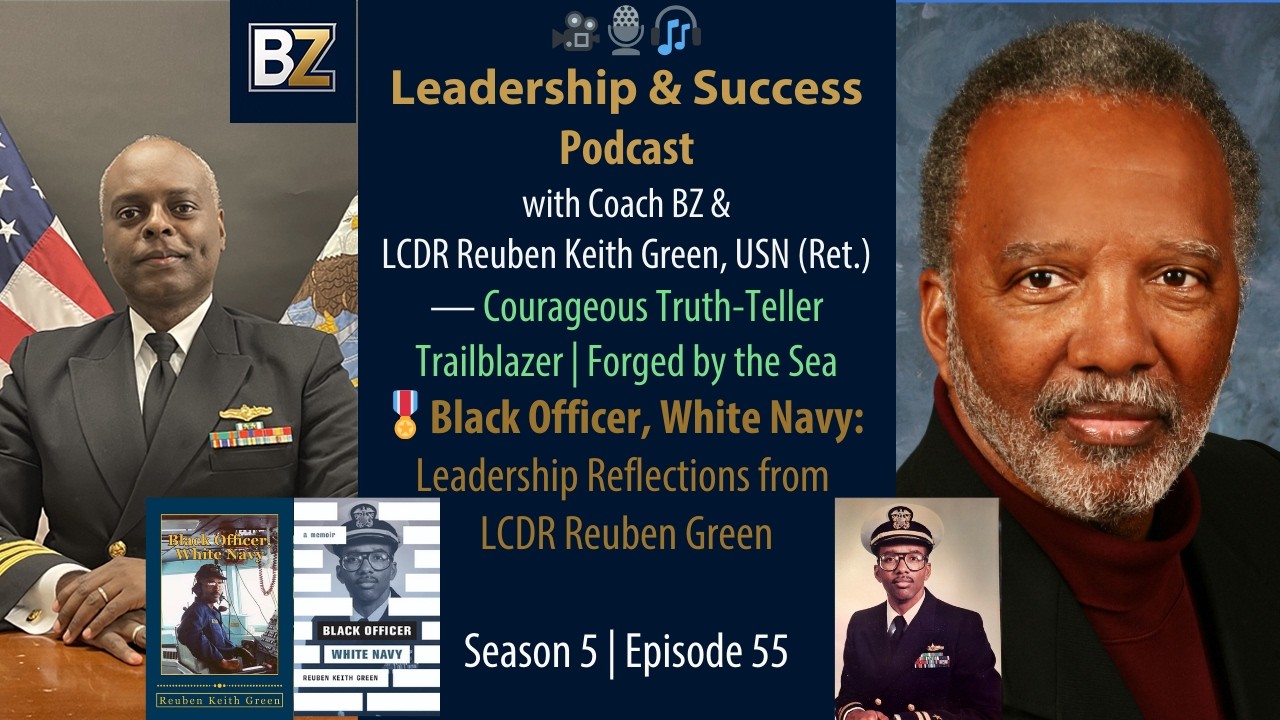
In this episode of the Leadership and Success Podcast, host Bob Fabien Zinga interviews retired Navy Lieutenant Commander Ruben Keith Green, whose life story spans dropping out of high school, earning a Navy Mustang commission, and authoring the memoir Black Officer, White Navy. Green recounts the systemic racism he faced in the Navy, the failure of the Equal‑Opportunity complaint system, and a five‑year battle with the Navy over withheld FOIA records. He shares his personal definition of leadership—doing the right thing when circumstances allow—and highlights the mentorship of Dr. John Cordle, whose forthcoming book on leadership Green helped shape. Throughout the conversation Green offers practical advice for minority service members and leaders, urges listeners to share his story, and invites connection via LinkedIn to continue holding the Navy accountable. The episode closes with gratitude, a reminder of the book, and a brief live‑audience interaction segment.
Chapters
Hi, I'm John Maxwell. When the top companies in the world are looking for trainers, speakers, and coaches, there's one name that stands above the rest, and that's Maxwell Leadership. Our certified team members have gotten proven results for companies all over the globe, and our reputation, I'm proud to say, is second to none. Some of our members have risen to the top of their profession, including the the one you're going to meet today. I proudly introduce you to my friend Bob Fabien Zinga.
Welcome to the Leadership Success Podcast with your host, Coach BZ, where we help you lead with purpose and succeed with impact. If you're ready to grow into the kind of leader others want to follow, this podcast is for you. If you're determined to elevate your success and leave a lasting legacy, this podcast is for you. As my mentor, Dr. John C. Maxwell, reminds us, everything rises and falls on leadership. Our goal is simple: to inspire you, challenge you, and equip you with insights that can transform the trajectory of your leadership journey. Welcome aboard to another episode of the Leadership and Success Podcast with Coach BZ.
First Coast News Stories of Service, sponsored by Duvall Motor Company. Every service member has their own journey through the military. In this week's Stories of Service, we profile a Navy veteran who went from high school dropout to role model for thousands of other sailors. Had I not joined the Navy when I did, I'd probably be dead or in prison right now. Reuben Keith Green was a high school dropout in the mid-'70s before his life took a very specific turn. Serving in the Navy completely changed my life. But joining the Navy was not a decision that was completely out of the blue. Having been raised by a Navy boatswain mate, the transition to military life was not that difficult for me. So once I got into the Navy, I thrived because I was accustomed to the military lifestyle. Green served in the Navy for 22 years before retiring in 1997 as a Lieutenant Commander, a proud achievement and one he feels made him a role model to other young Black sailors. People would stop me and tell me, how proud they were to see a black officer because they didn't— I did the same thing. If I saw a black officer, I'd walk up to them and ask them questions. How did you get here? What did you do? Because it was so rare. That's part of the reason why he wrote a book about his path from high school dropout and then through military life called Black Officer, White Navy. And he's not done writing. I'm trying to get veterans to share their stories because there's a big hole in the literature where the stories of African Americans in the military after the Vietnam War might be. Green continues to write stories for Liberty Life Media about service members and their stories. If you have a story of service that you would like us to profile, send us an email to storiesofservice@firstcoastnews.com.
All right, do we have a very, very special episode of the Leadership and Success Podcast? I think, uh, I've been trying to invite this guest, it's been almost, what, 6 months, almost a year, but he is here and I couldn't be overjoyed. But as you know, before we get started, as is our tradition, we want to take just one moment to be grateful. And part of the reason why we do this is because, as you know, 21 service members commit suicide every single day in this country, and I believe it's not possible to be grateful and be suicidal at the very same time. So if you would maybe close your eyes and put yourself in your happy place, maybe take a deep breath and slow down your nervous system and think about one thing that you are grateful for right now. And for me, like I am many, many days, I am so grateful I stand on the shoulders of giants. Because my story in the US Navy wouldn't be possible if it wasn't for giants like the one we are about to speak to in just a second. So let us know what you are grateful for today. If you would type in the chat, let us know where you are coming from, um, which city, which state, and which country outside of the US. And also let us know if you have a question for my guest, Commander Green, go ahead and type it in the comments and we will answer your questions live. Okay, without any further ado, let me see if I can properly introduce our guest today. Again, you know, it is, it is such a great pleasure and an honor to be able to do that. So welcome back to Leadership and Success podcast and Today I am really honored to introduce a very remarkable naval officer. He's an author and a leader whose story reflects perseverance, integrity, and the power of honest reflection. Lieutenant Commander Ruben Keith Green, United States Navy. I think this is the last time I'm gonna call him Commander, Lieutenant Commander. But, uh, Ruben's journey is one that truly embodies the spirit of transformation and determination. He became his Navy career as an enlisted sailor and through discipline, education, and unwavering commitment rose through the ranks to become a Mustang officer, ultimately retiring as a Lieutenant Commander after decades of service. Throughout his career, he held a wide range of leadership roles from mine man and instructor to communication officer, chief engineer, training officer, and executive officer, shaping sailors and missions along the way. After his Navy career, Commander Green offered powerful memoir, Black Officer, White Navy, a deeply reflective account of his experience navigating leadership, identity, and institutional culture during a pivotal era in the US Navy. His work provides an important historical perspective and offers valuable lessons for leaders about resilience, truth, and the responsibility we have to leave our institutions stronger than we found them. For my audience of naval junior officers aspiring to command one day, and for cybersecurity professionals as well, and engineers transitioning into a leadership role, Commander's Green Journey offers powerful insight about perseverance, courage, and leading with integrity even when the path is not easy. Please join me in welcoming a distinguished Navy veteran, thoughtful author, and leader whose story continues to inspire reflection and growth, Lieutenant Commander Ruben Keith, United States Navy, retired. Please help me in welcoming Commander Green. All right, Commander Green, this is the last time I'm gonna call you Commander. How are you doing today? And we are so glad you are finally here. Good to see you, sir.
I am doing well, and please call me Keith. And thank you for inviting me. I was very hesitant to come on, but I decided it was on my bucket list.
All right, good. We are just so overjoyed you are here. I guess to get started, is there something you are grateful for today?
Yes, I am grateful that I didn't die at age 50 as I expected to, because if I had, no one would have ever heard of me.
Wow, so grateful for life, man. That is quite powerful. I'm sure there is a story there, and we're probably going to get to it in the next hour or so. Is there something about you that most people may not know when they first meet you?
Yes, most people don't know that I'm a very avid reader. I buy books all the time. I read books written by people that I do not agree with because I want to understand their perspective. In order to sharpen my argument, I need to understand their argument. And I read a lot of historical information and a lot of biographies and memoirs, and most people don't know that about me.
Wow, that is a little different, reading on purpose, especially from people you may not agree with. That's That's a, uh, that's quite insightful. Uh, so your journey from enlisted sailor to Lieutenant Commander is quite remarkable. What originally motivated you to join the U.S. Navy, and what did that young sailor really dream his future might look like?
Well, my early motivation was reading, uh, the encyclopedias that I pestered my parents as a kid. I pestered them to buy me a set of encyclopedias when I was a kid in San Diego. And later, what inspired me was reading Admiral Zumwalt's memoir, On Watch, which I read as a 19-year-old seaman in Charleston, South Carolina. And that was a real eye-opener for me. Wow.
Yeah, I guess he's the one who is the author of the Z-gram. He was quite a remarkable figure in the U.S. Navy, especially when it comes to the desegregation. But, uh, I, I guess the next question I have for you is, uh, okay, when you began your career as a high school dropout and later became a commissioned officer, what moment in your early career made you believe that becoming an officer was actually possible?
Well, I went to work for a guy, and I went to Miami Dade School, graduated number 2 in my class, but they lowered my grades to keep me from being on honor roll. I was the only Black student in the class. We started out with like 28 students and I was the only Black one, the only high school dropout and the youngest person there. And they— it was Charleston, South Carolina in 1975. So they lowered my grades to take me off of honor roll and then they told me that I couldn't accept accelerated advancement, which I qualified for because I was a reservist. And that turned out to be a lie. But when I reported to Commander Mobile Mine Assembly Group, I went to work. I was fortunate enough to go to work for a guy that had been the Atlantic Fleet Sailor of the Year the year before. And when I was checking into the admin office, he looked at my record and saw that I could type. He got real excited and said, hey, come on and walk down the passageway with me. Bought me a Coke and he asked me to come to work for him in the admin office. And I said, admin office versus the mine bay where it's cold and hot and wet. 30? I said, sure. So my very first evaluation, I had mentioned to him that I was interested in becoming an officer, and in my very first evaluation he wrote that I had expressed an interest in, uh, become obtaining a commission and that I should be encouraged to do so. So that set me on the path, and, uh, I never forgot that. And I, I called him years and years after I retired, after I wrote the book, and reminded him of that. He went on to become a chief warrant officer, and we spoke after I got commissioned. So the guy that recommended me for commission was calling me sir 20 years later.
Wow, that is quite amazing. And by the way, I know it's not as easy to find anymore, but this is the copy of the book On Watch by Admiral Elmo Zumwalt. I think Amazon may still be able to find you a copy, but it is, it is not very, very easy to, to find anymore. Man, that is, that is really quite, uh, an insightful story, really quite improbable. So for the people who are listening right now, they may not understand, uh, the term. Could you explain what it means to be a Mustang officer in the Navy? And how has that shaped your leadership perspective?
A Mustang officer is typically an officer in any branch of the service that has served at least one tour as an enlisted person, you know, in the military. Typically they have a Good Conduct Medal on their, on their ribbon bar, which means that they're a Mustang. They're pretty easy to spot, and some of them are quite surprising, quite surprising. You see somebody with this big stack of ribbons and there's this Good Conduct Medal, sometimes two, and that's typically what Mustang is. Well, there used to be a website called NavyBuddies.com and, I mean, excuse me, NavyMustang.com, and I looked through that site and pulled some data out and there were only two Lieutenant Commanders in the surface Navy that were Mustang, and I happened to be one of them. So it was like 1 in 30,000. Of those guys. It was a surface warfare officer. Wow.
And what was your last rank as enlisted before you became an incident?
I was a first class yeoman.
Wow.
I went to mine man A school, and then I went to Equal Opportunity Program school. I went to a legal clerk school. But when I became a first class mine man, I had just finished the tour as an Equal Opportunity Program specialist. I made first class in that too, an early selectee, because I studied my tail off to pass that.
That is quite remarkable.
Wow.
Because when you are first class, I mean, you're pretty much one promotion away from being chief. And that anchor, I think, means a lot for those who serve. And I've seen a few chiefs, you know, they must think too, they go from chief to ensign, but I feel like That's more like a demotion than anything else until they become senior officer. But, uh, that is, that is really, really remarkable. So, uh, let's talk about some of the lessons you've learned from the fleet. You really served in many leadership roles, from instructor to executive officer. And EXO is— you really was the second in charge, and that's a very significant leadership position. Which leadership assignment most shaped who you became as a leader?
Well, that's an easy one. As while I was in that tour as an Equal Opportunity Program Specialist, SURFLAND decided to stand up this Mobile Leadership Training Team. It was a 3-day course that was designed to teach leadership to senior petty officers and junior officers. Until they get into the 2-week program, Leadership Management Education and Training program. I was a part of a 2-man team with a Master Chief Daniel Zapiro, who became my boss. And we taught leadership on the waterfront to hundreds of sailors. And that really helped shape my philosophy on leadership because I was talking about it. And listening to people share their problem at— and not being, et cetera, et cetera. So that really shaped, and, uh, uh, I learned the, uh, uh, different leadership styles, which were most effective, which were least effective, which is a coercive style. So that me, uh, as a young officer in determining how I was going to lead. Wow. Sorry about that.
No, that's— no, that's— that is all good. That is all good. Let's, uh, talk about navigating some institutional challenges. Uh, your memoir, Black Officer, White Navy, offers a very honest reflection of your experiences serving as a Black officer in the Navy. What inspired you to write the book?
Well, what really inspired me to write the book was because I realized that I searched and searched for many years for stories about Black veterans and Black servicemen that served after the Vietnam War, and I just couldn't find hardly anything. So I said, if I can't find one, maybe I can write one so that other people that are searching might have something that they can look to I wanted people to see what it was like to go from a full career as a Black person in the military. Half my career was an enlisted man and half of it was an officer. And I understood, I recognized that the Navy didn't really understand its own history about race relations in the, in the, in the military, especially the Navy. So I decided to go ahead and write a book. And I wanted people to understand that just because something is written down on paper, doesn't mean that that's what happens. People think that when Truman issued his executive order desegregating the armed forces that everything became integrated and it was kumbaya and there were no problems. Well, nothing could be further from the truth. So I, in my first book, I did a lot of historical research and recommended a lot of different books for people to read, and I wanted people to just be able to follow one person instead of getting a snippet here and a snippet there I wanted them to, uh, you know, to see what it was like. And another thing that inspired me was reading the story of Lieutenant Commander William S. Norman, who became Zumwalt's minority affairs assistant, in a book called Blood that came out in the late '80s. The book was rejected by over 200 different publishers before it finally got published, and it became a, uh, a bestseller. It was taught in over, uh, a bunch of universities. And his story has never been told, but he inspired me to write my own.
Wow, that is quite fascinating. I can't believe I haven't read that book yet. I will definitely add it to my bookshelf. Wow, that is really amazing. What were some of the biggest leadership challenges you faced while navigating institutional culture in the Navy during your career?
Well, some of the biggest challenges I faced were dealing with people that didn't think I belonged there or that I was qualified to do the job that I was supposed to, that I was, you know, tasked to do. And just, just basically dealing with disrespect. And that was a near constant thing in my career. I'll give you an example. In my last job, the one that drove me out of the Navy, I had just finished my fourth consecutive department head tour, my fourth consecutive sea tour. 3 of those on ship, 1 on the float-going staff, sea-going staff as a training officer. But when I walked into that, I had received a phone call from the flag detailer inquiring about me becoming a flag aide, and I turned that down because, well, I didn't turn it down, but I told them, I said, you need to understand that I cannot shave every day. I use a depilatory powder because it's impossible for me to use a razor on my face every day. I can't shave every day. If you're willing to accept someone that looks scruffy for 2 or 3 days a week, then I'm your man. I never heard back from him again. After serving those 4 consecutive sea tours, I reported to my command, my first shore duty as an officer, and the captain took one look at me and decided I couldn't do the job and assigned me took that job away from me and assigned me to replace an ensign that was in charge of the Total Leadership, uh, Total Quality Leadership, uh, program. And that was without ever having spoken a word to me. The only thing that changed— I just spoke to my sponsor 30 minutes prior to that— the only thing that changed was they realized I was Black. I don't sound Black on the telephone, and Reuben Keith Green, they probably thought I was Jewish till I showed up. So that was, uh, That began a series of about 9 months worth of challenges that culminated in a formal discrimination complaint.
Wow, I am so sorry to hear that. And which year was that?
That was in 1995. I retired in 1997, but my last day wearing a uniform was, I think, January 10th, 1997. But I was on leave and basket leave I wanted to leave there and they wanted me gone. So I had several months of growing my beard, waiting for my first retirement check.
Wow. Actually, that's not that long ago. I remember Bill Clinton was president then, 1995.
Wow.
It's— I know there's been a lot of changes in the Navy and sometimes changes kind of slow, but that is quite remarkable though, in 1995, that some people still, uh, couldn't really accept Blacks being in the Navy when in reality, when you look at our history, we've been really fighting for our country since the very, very beginning, right, from the independence war until today. It's, uh, wow, that is, uh, incredible. What, what did that experience teach you, you think?
Well, it taught me that when I was an Equal Opportunity Program Specialist, I would have people come to me on these various ships when we did inspections and whatnot, or just come to me and say, hey, I'm being abused, mistreated, etc. They're trying to destroy my career. I was Sailor of the Year in my last command, and now I get here and I can't do anything right. And it was hard for me to believe those stories. Well, what I learned from that is that you can be a superstar in one place and, you know, you know what in the next, and it all depends on who's leading you because people bring their beliefs with them into the military. The military is not colorblind and it shouldn't be. So you have people that bring their prejudices with them and they exercise those prejudices because They think they can get away with it. And in most cases, they can. Typically, when someone complains about racism or discrimination, they're labeled as a problem that has to be dealt with. Hmm.
Wow, that is, that is quite remarkable. Now, your journey from high school dropout to unrestricted line officer is quite extraordinary. What internal mindset shift allowed you to transition your life and also pursue leadership in the Navy?
My parents taught me that I was just as good as anybody else, and don't let anybody tell you otherwise. As an enlisted sailor working in the admin office and working as a discipline yeoman, working with prosecutors down in Gitmo as a master yeoman, I typed charge sheets and report sheets. I typed a lot of evaluations too because I did 2 tours on deployment as an independent duty yeoman. And I realized pretty quickly that people handing me papers to type were not as proficient with the English language as I was. So, and I got to deal closely with people, you know, as an administrative guy. And I thought, these guys aren't any smarter than I am. As a matter of fact, I may be smarter than some of them. So if they can do this job, surely I can do it too. And so that was Being up close and personal with the leadership helped me understand that you didn't necessarily have to have the best education. You just had to have common sense and be reasonably smart. So that was part of what made me think I could do it.
Wow. Now, every institution around the world, I believe, they have strength and blind spots. What leadership lesson did you learn about navigating system that are not always fair in your career?
Well, when you talk about blind spots, that's really a sore spot for me because the Navy's blind spot, uh, for me, uh, that I focused on is its, uh, equal opportunity, uh, complaint system. I'll give you an example. Um, Ronald Dellums, uh, forced the Department of Defense to provide military opportunity complaint statistics to Congress on an annual basis after touring military bases when he got all these letters and calls from constituents and people all over the military complaining about discrimination. So he forced the Navy or the DOD to provide an annual report as part of the annual defense report. It was an addendum to the annual defense report. Those statistics really showed that there were serious problems with the entire system. When Donald Rumsfeld became Secretary of Defense the second time, he ended that requirement to report those statistics. Well, I, as part of my research for writing my book, I got copies of all of those reports that were available and looked at them. I was just dumbfounded at what I found. In 1989, when I was chief engineer on deployment in the Persian Gulf, the Navy substantiated zero discrimination complaints out of 156. And this was after the CNO in 1988 reported there was widespread bias and discrimination against Black people in the Navy in promotions and military justice and elsewhere. Task Force One Navy report, uh, found some similar findings, and we all, we know where that wound up, in the same pile as all the rest of them. So the blind spot in DOD and the military, there's a DOD IG report, DOD IG 2023-073, that talks about the dismal state of the military equal opportunity complaint system, and so far no action has been taken on that. And I've been raising hell about it on LinkedIn for a long time, but there's been no action taken on that.
Wow, that is quite incredible. And SecDef Rumsfeld, that was what, in 2004? So that's only one—
2005, the requirement ended in 2005. After I started, after I wrote about those in 2017, all of those statistics magically, magically disappeared from the internet. Uh, because I was telling people, go back and look at these things and look at your own service, look at the years you were in and see what you can see. Well, they were all removed from the internet so nobody could see them. Wow.
That is quite fascinating. Huh? Okay. So that's, that's really something that, you know, as a sailor, it really doesn't make sense. Now we understand the way our country started with slavery and, you know, all of the bias, discrimination. And all of that, but we are talking like in the 21st century, and it's like, how is that even possible?
Well, you know, that's a very good question. With all of this pushback against— I've written numerous articles about what needed to be done to fix this. One of them was making racist behavior a UCMJ offense. The Navy SEAL case from last year really shows why that's necessary, because for more than 2 years these racist memes depicting this Navy SEAL as a monkey and a slave were passed around within his command. Everybody knew about it, including his leadership, but nobody held the people responsible for that accountable until Admiral Milton Sands stepped in after Pete Hex's lawyer, Tim Paletare, stepped in. He was hired by this guy and he cleaned house. He held 18 people accountable and then shortly after that, 7 months after that, he was fired by Secretary Hex without any explanation. 91% of military discrimination complaints are improperly completed. So that system is designed to fail people and rather than update it and fix it, They're just letting it sit there unattended to. Assistant Secretary of Defense Kathleen Hicks wrote a memo with 18 points that were supposed to be addressed based on that report, and so far none of those have been addressed as far as I'm aware.
Wow.
One action that was taken by Secretary Hicks was to warn people that if they submitted false or unverified complaints, they may be subject to disciplinary action. Well, the category was substantiated or unsubstantiated. Now, who's going to file a discrimination complaint under conditions like that? And second of all, who's going to substantiate one? So it was designed to push down or quell any complaints coming from the forces. And I don't know because there's been no reports. There was a report saying that racist incidents are rising in the military, I read that in a newspaper report, but you don't hear any of that from, from the military.
Hmm, that is, uh, quite remarkable. So I am sure for many individuals like myself, you know, generally speaking, you know, when I, when I look back the last 21 years I have been on active duty and then the reserve, uh, I have really not experienced that throughout my career. So I, I guess what I, what I want to get to— not every minority or Black man in this Navy, which is true, it's, it really was a white Navy designed for white people, but Blacks have had such a huge, huge impact on our national security and service. Not every Black man kind of has the same experience. I guess the question I am trying to ask going forward— again, we are in 2026, not in 1960 and not in 1875. So there is a big difference about where our country is or should be, at least what the expectation should be so far as equal opportunity regardless of gender or even religion. What, what do you, what do you think people who are in the service right now on active duty, what do you recommend that they do?
Well, first of all, they have to be alert to any signs that they're being treated different and address those upfront, run towards the roar. If you feel like you're being mistreated or something, first thing you have to do is look at yourself. Is there something that I'm doing that is causing me to be treated this way? And you want to eliminate any possibility of anything else before you think that, well, maybe it's because of the color of my skin or my gender or whatever. But you have to look at yourself, and I always recommend that people keep a goodwill book. Keep notes keep, uh, um, records of what happens to you. I had to, uh, create a spreadsheet when I was getting ready to deploy to the Persian Gulf because my supply officer was slow walking my parts, canceling them, etc., etc. And I was chief engineer. I just had a major fire, an explosion, and I had a month before my deployment and my parts weren't getting ordered, critical parts. I talked to the captain, talked to the XO, talked to the department heads. I got a perfect score in supply management when I was in OCS, so I knew the supply system. I had 12, 14 years in the Navy then. So, but this guy thought it was fun to screw me around. So I created this critical parts spreadsheet showing what was happening with my top 25 parts. And I walked it up, stayed up all night, me and my supply petty officer, and I walked it in and laid it on the captain's desk and I said, If I don't get these parts soon, this ship's not going to deploy on time, and you're going to have to explain that to somebody. I've been asking for help, nobody will help me. Uh, you need to look at this and, and see what you can do about fixing it. And if he hadn't taken any action, I was going to take that list and walk it over to the squadron and tell them, when this ship doesn't deploy on time, you're not going to be able to blame, uh, deploy on time, you're not going to be able to blame me because I've been asking for help I'm not getting it from my own command. Once Captain saw that list and asked all these questions that I couldn't answer, he called the supply officer up and he couldn't answer those questions. So there was a shouting match and I got my parts ordered expeditiously right away. But it took me being able to show on paper what was actually happening because nobody would believe me when I was telling them what was happening. I had to show it on a piece of paper. So nothing counts. It doesn't matter what you believe, it's what you can prove. So you need to be ready to show that things are not happening for you the way they're happening for other people, if that's the case.
Yes, yes. Wow. Now, by reading your book, I think it's a very serious book and everybody should definitely get a copy. However, one thing I did notice is kind of, you know, your sense of humor as well, right? Because despite this being a very serious topic, I think people who would read it would really notice your, again, your sense of humor and storytelling. Why is humor such an important leadership tool when navigating difficult environments?
Humor can be a very effective stress relief tool. My sister, when she read the book, she told me that she would be laughing one minute and crying the next and then laughing again. All on the same page, you know. So I learned that from Richard Pryor. Richard Pryor helped me get through a lot of long drives in the '70s and early '80s. He was very effective at using humor. And so I think humor can both be educational and stress-relieving at the same time. So a lot of people have commented about the humor in the book, and that's just who I am, you know. I'll make fun of stuff that— isn't necessarily funny, but I have to try to find some humor in it to keep from going crazy.
Yes. Now, you retired in 1997, right? So it's been almost 20 years, 19, 20 years since your retirement. Now, looking at today's Navy, what progress have you seen, uh, since the time you served?
Any, anything positive you could, you have noticed I am amazed at the number of Black officers that are in the Navy right now. I never worked for a Black officer. I seldom served with one. I only served with two. One was a doctor and one was an ensign on my first ship. He didn't, he didn't stay on active duty. He went into the reserves. But I never worked for a Black officer. I only worked for one Black chief the whole time I was in the Navy. It's routine for people now to work with Black officers. And when I was at the Naval Academy and in Suffolk, Virginia for some different events, I was just shocked at the number of Black officers walking around. So that's changed quite a bit. I think it's less of a novelty to see a Black officer than it was during my time. When I joined the Navy, 0.5% of the officer corps was Black. So that would be 99 John McCains and 1 Barack Obama. You know, so it was really rare to see a Black officer. So, and what it's also changed is, um, um, Black officers have achieved very high levels within, within the Navy. So that's a very positive thing. And Hispanics too. I had a guy reached out on LinkedIn and connected with me. I said, you're the very first naval officer I've ever met whose first name was Juan. So we got to kick out of that. But there has been a lot of— when they say we don't do diversity, we don't do inclusion, well, all you have to do is look around and see that that's not true. And the equity part is, I think, what was really the sore spot for a lot of people for DEI.
Wow. So what work do you think still remains from the time you retired?
The military needs to understand that culturally it is a white male oriented organization, and you either have to adapt to that or die. And if you push back on that in any way, uh, it can mark you for destruction. So what the military needs to do is— DOD and, uh, and the Navy were on the right track And then all of a sudden this anti-DEI push happened and all of that stuff got scrapped. But meanwhile, people had their hopes up, their high hopes for these changes to be made, et cetera, et cetera. When the CNO said that there is racism in our Navy, CNO Gilday, didn't get a whole lot of public pushback. But when I say it, I'm called a racist and the biggest racist on LinkedIn and some other So you have to recognize the reality that racism does exist. And until you can recognize that, it'll be difficult for you to deal with it effectively.
Sure. So what would be your advice then for a minority naval officer who might be listening right now? They are on active duty in the Navy. What lesson can they really get from your book?
Well, the first thing you need to do if you're a young officer or even a young petty officer, chief, whatever, when you report to a new command, the first thing you want to do is sit down and read all the instructions in your command about how you're supposed to do your job, how things work, etc., etc. You want to read all that, read everything you can that has been written by your CO so that you get to the point where you can write a message that sounds like he wrote it because you know his writing style or her writing style so well. So learning those instructions is key. And then you need to look and see how are these things— they're put in writing, but are they being adhered to? And if they're not, then what is it you can do? What is it you need to do to fix that? Because you don't want to get burned by doing something that everyone else is doing, which is contrary to the instruction, because you stand out more than a lot of other people do. And I've had multiple instances where I, uh, call people out for not following their own instructions. And, uh, it cost me a lot, uh, almost cost me my career when I was there in that Equal Opportunity Program, Bill. But you have to be right, and what they put in writing is what counts. You can't make pronouncements or whatever. You have to go by what you say, this is how we're going to do, do the job. So that's important. As a young ensign, I saved my command $71,000 by reading the instruction on defense reutilization and management stuff. I just— instruction. I went over on my lunch break while the rest of the guys, ensigns, were over there at the club having a liquid lunch. And I signed for 2 truckloads of material, had it delivered to the ship. And it was like I was like ensign Claus. They were— people wrote this stuff. And the XO came down and said, where did you get all this stuff? I said, I just signed for it. Before, when the fit reps came out, guess who was the number one guy there?
Yes. Wow. Well, uh, for Black people, I know that's what I call Black excellence. And, uh, it is— I don't know, I, I guess when I, when I look over my, my own career, there was only one time where, uh, racism was palpable in my career. It's when I jumped from being a first-class petty officer to becoming an ensign. At the time, I was assigned to Bessemer, Alabama, and my CO was a captain, definitely was a racist, didn't like me at all. But the good thing is many decisions in the Navy— I know the CO has a lot to do with your career and your progression, but there are some decisions that the Navy takes completely away from the CO. For example, if you're going to promote from, you know, uh, enlisted to officer. So I made Incentive, I was selected, I was going to become an officer in this White Navy, and there was absolutely nothing my CEO at the time could do about it. So that's, that's just one, really the only experience throughout my, uh, career that was not, uh, quite, uh, fascinating, especially for some of the chiefs, because I was only a third-class petty officer. Basically, I was saluting everybody with a rank I saw. But when I came back to the same command initially, and now I was an officer, and now they were saluting me, so that was a little bit awkward and, uh, different. Like, I also remember the very first time I served in Millington too. I was a recorder. That was the first time where the Navy decided we don't want to show a photograph of the members. I guess they had some concerns. Some people might be racist or might be sexism or whatever it might be. Once they look at the person, like you say, you are Ruben Cave Green. That sounds like a very white name. But then they see your picture. Some people, not everybody, but some people may have unconscious biases or whatnot. So anyway, I was in the middle of the selection board and we got the message, we are not going to show the pictures of the members. So they took that screen down. They just had to look at the paper, at the performance, and then decide. But anyway, having said all that, in my experience, the Navy promotion system, I don't think is perfect, but it's one of the very best ones I have seen, especially when I worked as a recorder. I went there the week before the board was in place. I went over probably 2,000 records in that week. After a while, it was pretty easy for me to tell, okay, this person is definitely absolutely going to get promoted. This one, maybe not. And this person absolutely will not get promoted just based on their fitness report. So it was very— I feel like it's a pretty fair system. I'm sure it can still be improved upon. But it seems like there's been a lot of progress. So I guess I've said all of this to ask you this. For your book strongly, strongly resonates with leaders from underrepresented background, whether it's minorities, females, or gays, or whatever it might be. Like you said, This country, the armed forces really was meant for white male Christian people. That's just our history. It is just a fact. But what I love with America is with time, we have tried to really live out to the aspirational creed of our country, right? All men are created equal. That includes women, that includes Black people, that includes gay people, that includes everybody. So with time, I think, We've really tried to build this nation like President Abraham Lincoln says, of the people, by the people, and for the people. But it took a lot of time. But even throughout those tough times, I know a lot of minorities, like I'm focusing on Black History now on my LinkedIn platform. And it's just amazing what Black people have been able to achieve under all of these very difficult circumstances, wanting to sacrifice their life for the country. And sometimes the country saying, no, I don't want you to die for America. You are not good enough, which is really crazy when they really needed people. And Black men and women really have been excellent at loving their country and sacrificing in spite of all of that. Anyway, having said all of that, what advice would you give to young leaders who may feel like they are outsiders in their organization right now, not just in the Navy, but in the industry and across America?
The advice I would give them is, number one, understand that you belong there. You've earned your right to be there. And number two, act like it. Act like you have a right to be there. I would have young enlisted sailors, sometimes older ones, tell me that right after I got commissioned, Well, Mr. Green, the only reason you're an officer is because of affirmative action. They had made up their mind that I didn't— I wasn't entitled to the position that I held. So I would say, okay, well, let's unpack how I got here. And I would go through, you know, all the things I did, you know, got my bachelor's degree in my spare time while I was working a part-time job 40 hours a week at the country club. I said, and so which part of that was affirmative action? And then they would hang their head and say, well, sir, I didn't know all that. I said, Well, that didn't stop you from making a judgment about whether I belong here or not. So act like you belong there and you have to do better than everybody else. That, you know, gotta twice as much to get half the credit, that's just real, you know? So Black people have been telling their children that. My parents both told me that. Peers told me that. Superiors told me that. I hear it now. You will have to try to outperform everybody that you're competing with if you're a minority. And it will make you a better officer. Wow.
That is really remarkable. You know, one of my personal heroes, General Colin Powell, it's quite amazing, right? The first chairman of the Joint Chiefs of Staff, African American, and first Secretary of State of the United States of America. It is, it is really amazing how in our history, if you are Black, you almost have to be perfect, you know, have PhDs and, and, and, and really perform at the highest level possible sometimes to get the same jobs that the mediocre white male could get. And that's kind of not fair, is it?
Not at all, but it is the reality because the culture allows that to happen. People, you know, former CNO said, "Ducks pick ducks." They pick people that look like them, that share the same, you know, cultural beliefs, like the same music, et cetera, et cetera. And when you are different, you become suspicious. One of my favorite books is a book called "Tribe" by Sebastian Junger. And that book really opened my eyes to some stuff. I cried all the way through it both times I read it.. But it was, you know, I recognized that I was not really a member of the tribe that I was with. So it was very helpful for me to read that and understand it. And people need to understand that the minority experience in an organization like the military is different.
Yes. Well, when people read your book, especially young minority and especially naval officers, what do you want them to get from your book, White Officer— I mean, Black Officer, White Navy? What is the main lesson you want them to get out of it?
What I want them to understand is that they can succeed, but they have to be clear-eyed about what they may face and to be alert for any signs or any indication that they're being treated differently and just address it. You know, I have called people out directly, you know, "What is your problem with me? You seem to have a problem with me. Let's talk it out, figure out what it is so we can move on. And if you can't tell me what the problem is—" One piece of advice I'll give people, as I would do this routinely as a young officer, When I would meet with my boss, my CO, I would ask him— it was always a him— is there anything that I'm doing that you don't want me to do? And is there anything that I'm not doing that you want me to do? And I would get some really good feedback from that. Sometimes I would— and, and I would act immediately on whatever that feedback was because I didn't want any surprises when my fitness report came out. Um, because I always front-loaded it with all of these quantifiable achievements that I made. And I didn't want to read that I was doing something that was annoying to my CEO or whatever. Because, you know, I didn't ask the question. Be— don't be afraid to ask, how am I doing? And act on what it is you're told immediately. You fix whatever the problem is. And then you ask the question again.
Hmm. Wow, that is powerful. Now, if you could go back and speak to seaman recruit, Ruben Keith Green, on his first day in the Navy, what advice would you give him?
I would advise him to keep a written record of all the lessons that he'd learned or would learn along the way. Take good notes, keep a diary, do whatever. One of the things I did after I retired was I created a chronology of events from the time I joined the Navy to the time I was writing the book, things that happened in my career, things that happened in the Navy, and things that happened in the country. And I began to see that there were correlations between how I was treated and how Black people were being treated in the country and in the military. So you can see patterns once you understand what to look for. So I would keep a record. I want people to write their stories. It is much easier to do if you can go back and look at the things that you wrote I had a memo, I have a memo that I wrote in 1980 to the CEO of the Defense Equal Opportunity Management Institute recommending things that needed to be changed or addressed in that curriculum. Don't send a young E-5 with no power like me down there. I had absolutely no power in a maintenance command in Mayport, Florida in 1980 with Confederate flags all over the parking lot on the officer. So I got thrown to the lions, but I volunteered for it. I was too junior for the job, but they sent me anyway, gave me a waiver, and it almost ruined my career. But I would keep a record of all the things that are happening because it will help you understand what's happening to you and what's happening throughout the country.
Wow, that is very, very good advice. And I know even when I was a seamen recruit myself, not chiefs, not the anchors. They really took care of me from the time I was an E-1 all the way up. I was an E-4. So once I became an E-5, I'm like, please, Chief, continue mentoring me, please. Just because I'm a senior officer doesn't mean that I don't need your guidance any longer. But it really does make a difference when you have people who do believe in you, doesn't it?
Absolutely. And there were several that really I wouldn't have made it without them. There are people that really were in my corner. The last one was a good old crusty Navy captain from North Florida named Robert H. Rankin. And he, uh, when I reported to the staff, I was the safety officer. I had a job with no subordinates and nobody really knew what I was supposed to be doing because it was a brand new billet. And after a couple months in that job, He called me in his office and said, I want you to take over the training department. And I said, I've been watching you. I want you to take over the training department. Well, I've been paying attention and that guy was sucking up missiles all over the place from these rate angry COs that he was putting on report who were failing training or not doing this or that. I said, no thanks. I've enrolled in a master's program and I don't want the busiest job on the staff. And he said, Keith, you know how this works. If you don't volunteer for it, you're probably gonna wind up with it anyway. So I said, well, can I sleep on it? And he said yes. So I came in the next morning, of course I volunteered, but it's the best job I ever had. That guy had my back, uh, he was the best boss, uh, best leader I ever had. I got in for cursing out a maintenance officer in his morning meeting in front of his entire staff for not doing his job because they were jerking me around over a, uh, um, mobile wet trainer that I was having built there because we lost funding for the one that was coming to the up and down the East Coast. So I just decided we were going to build our own and we did, but we ran out of expertise and materials. So I asked the Sima Mayport to help us build it. My captain did, and they were dragging their feet, jerking me around. So I decided I needed to get everybody's attention. So I just went over there and just, you know, showed him my rear end. And once I got everybody angry and fired up and I was able to survive the flame spraying by their CO, and once he was done with me, I got to explain my side of the story using all the documentation, all the papers, all the everything. And then he was lied to by his own people right there in front of me. So once he figured that out, Ordered them to work around the clock, 3-day weekend, getting that thing done. And unfortunately, a lot of sailors that should have been spending time with their families were there working on that war wagon. But because I've been jerked around for months and months, and my skipper was beginning to question whether I, whether I was going to pull this off, he was getting frustrated, and I finally just had to create a crisis in order to deal with it.
Wow, I guess that is really great, no, in the end, but that could be quite risky as an individual because your career could have ended right then and there.
Oh, absolutely. I expected to be court-martialed, but I was going to lay out all my stuff on the table because I had a will book that had all these facts in it, and if I was going down, there were some people going down with me. But it wound up that those, uh, that very same two skippers, my chief of staff and that CO, were featured in Surface Warfare Magazine, uh, about this great self-help achievement of this war wagon that was created in Mayport. And they got all these, uh, interviews and stuff, and they wound up spelling my name wrong in the article.
Wow, that is incredible. But, uh, in the Navy, that's the only branch I truly, truly know. But compared to, uh, the industry, I'm sure in the Army, the other branches of the military is the same. Uh, we really, you know, try to live by our core value. At least every sailor knows what our core values are: honor, courage, and commitment. What does courage mean to you?
Well, courage to me means The willingness and ability to stand up for what's right, to speak up against what's wrong, try to do things to make the things that are wrong right. And always being able to tell, look in your people in the eye and tell them the truth. If you lie to your people, they will never forgive you. And they will never trust you. They need to know that when you tell them something, that it's right and it's true. Because you may be ordering someone to do something that can get them killed. Yes. And so it's important that you have integrity with your people. And one of the most important things, being a good leader means sometimes doing things. I disobeyed orders on more than one occasion because it was the wrong thing to do and I was held accountable for it. And sometimes I had a skipper pull me aside on the bridge. We were on our way to the Persian Gulf, or in the Persian Gulf. I was standing, I was the only officer on the ship that was standing watches on the bridge as TAO in combat and as a chief engineer officer of the watch. I was the only one qualified to do that. And I would let him sleep rather than call him for every little nickel and dime thing that I was supposed to call, notify him for. And I kept expecting him to call me down to the stateroom and ask me why I didn't notify him of this contact or that contact or whatever. Sometimes my watchstanders would get mad at me because they knew what the order said. He needed to be rested more than he needed to know about a contact that wasn't going to come within, you know, 12,000 yards of us. So one day he pulled me aside and said, Keith, he said, the only time I can get any sleep is when you're on the bridge. He knew what I was doing, and rather than punish me for it, he thanked me in an indirect way.
Yes. Wow. Now, I must tell you, I guess it was only about 6 years ago. It looks like a long, long time ago, during the George Floyd era, Black Lives Matter and all of that. No, again, we have 3 core values in the Navy: honor, courage, commitment. We almost got the 4th one, respect, and then I guess it didn't go anywhere. What would that have meant to you to have a fourth core value, respect? What does respect mean to you?
It means everything. And Dr. John Cordell, who you had on last, last week, who ordered me to do this. Yes, per your direction. He's a proponent of that. And if you don't respect your people, they will see that in how they're treated, they will see that and their orders are issued or given and how, you know, how they're treated. And if you don't respect the people, it shows. The worst thing you can do as a leader is have contempt for your people. I had a— when I left my engineering tour, I finished my hydrofoil tour, XO on hydrofoil tour, and I was at the Mayport Exchange one day and one of my former sailor walked up to me and said, Mr. Green, I just want you to know that the guy that relieved you would call us in to work on the weekends, and then we would see him walking down the brow with one of his fellow department heads going to play golf. What? He said, I just want you to know that you never did that, and we know that you would never have done that. You were always there with us. You were the last one to leave. Because I respected those guys. Yeah. And they knew it. Got it.
Wow, that is, uh, quite remarkable. So I guess let me ask you this: what characteristic you think really makes the difference between people who just hold the rank and those who are true leaders that every sailor would really follow to the end of the earth? Because I've had quite a few of those outstanding leaders throughout my career. What, what makes an outstanding leader in your, in your view?
What makes an outstanding leader is someone that is willing to push back against things that they know aren't right. The operational necessity will require that you push yourself to the limit. The fleet is pushed to the limit right now. These Sailors that have been out there for months and months under high-stress conditions, unless you've actually lived through that, you don't know the stress and strain it creates for yourself and your family. So sometimes a leader has to make a decision that is not popular with his, his superiors. But it's necessary. You got to be an empathetic leader.
Wow. Powerful. Okay, I know we are 2 minutes out of time. If I can ask you 2 more questions before we end, if you have time. Thank you. So what leadership legacy do you hope your book and your career leave for future generation of sailors?
Well, I want them to be able to look back and say there was someone that tried to warn the Department of Defense and the Navy about what could happen if you did not address these problems that I've been talking about. I wrote about perpetual racism problem in the Navy. I wrote about DOD's unfinished business. I wrote about making Racist Behavior UCMJF offense. And I wrote about the need to rename the USS John C. Stennis. John C. Stennis and his cohorts did a lot to keep Black officers out of the military in all branches of the service. And I also wrote about Lieutenant Garrison Payne, who was the first Black naval officer commissioned in 1917 that no one knew about. I had this white guy from Indiana contact me with this crazy story.. And I didn't believe it at first, but I started looking at all the documents and then I ordered some old books off Amazon, did a bunch of research, and I wrote this article to change the course of Navy history. A lot of people are not happy that the Golden 13 and Dorie Miller have been supplanted as the first of this and first of this, including Admiral Sam Gravely. But the facts are that there was one before that. Yes. And you cannot let history be what you wish it was. But it needs to be what it actually was.
Yes. And thank you so much for bringing this up because, yes, I just found out actually last week because of you. And yes, it's quite remarkable. I guess he was kind of white passing. I believe his mother was white, but he definitely was Black, especially during those times where they said, no, if you just have one drop of blood from a Negro, that makes you Black. And white people would enslave their own children. Which is just tragic. But anyway, you are correct. So he's not only the first one, the first Black to be an officer, not the Golden 13. I have their books right there behind me. And I've always said, no, I do stand on the shoulder of John, but I always felt like the first Black officers were the Golden 13 in 1943, the year where my father was born. And I also felt like the first one to get the Navy Cross was CS3 Doris, right? During Pearl Harbor. And then the first African American to command a combat ship was Admiral Grady. I think I have this book down here somewhere. But yes, great people. But I think this doesn't take anything away from them. But no, history is history. The record is the record. And we definitely need to give the first honor to whomever that person is. And that is, again, this is what I'm talking about, the no. Black History Month, I feel like it's just too short, 28 days, and they give us the shortest month in the entire year, which doesn't make any sense at all. But anyway, so to me, it's Black History Year. This entire year, every single day, I am going to highlight something about Black history and in the Navy and the military. But, but that was quite shocking, and I'm so, so grateful you really brought this to my, uh, attention. Why, why do you think it was pretty much forgotten in history as if it never existed?
Well, I think it was because, this is my personal opinion, that the Navy did not want people to know that when it was absolutely necessary, he was training those crews on those submarine chasers. He was a, you know, a very skilled, competent bosun mate, and when they commissioned him, they commissioned him overseas. He was commissioned in England, so it was commissioned overseas. I'm not even sure President Wilson knew about it. Wow. Uh, so, but it was, it was operational necessity. Nobody cared what, how dark his skin was. In his enlisted records, he's listed as having a ruddy complexion. There's no indication he was white or black. Wow. But so the was that he was white. But you can look at the guy and say, that guy's not not, uh, Caucasian. But it was, it was necessity drove, uh, that. And just like necessity drives, uh, you know, once, uh, the crap hits the fan, nobody really cares what color your skin is. They want the best guy on the job. It's after the, the fires are put out, then all of a sudden the racism resurfaces again.
That, that is really amazing because when I read this, the stories of World War II, again, that's why I think everybody needs to no Black history because it is American history. No, we are talking about the Tuskegee Airmen just now. Remarkable. We talked about, uh, uh, Six Triple Eight. I interviewed somebody yesterday and it was a major magnet. She's like, yeah, this movie is definitely a movie that reflects me. Excellent. They did things that were impossible to do. White people tried, they are failing. Here are niggas, Black people, and they just excel at it. Just remarkable. But then after World War II, No, they are celebrated in Europe, no, they came to liberate them, they love them in France and England, they come back home, they don't even get the same rights and privileges as the other white counterparts, which again doesn't make any sense. They couldn't get any mortgage or GI Bill education that was reserved for white sailors only when they really put their lives on the line. And another thing, now this is my generation, this is just a fact, 2025, I couldn't believe this, our current Secretary of instance, I believe it was in February 2025. As of that time going forward, the Navy decided we are no longer going to enforce this segregation in DOD contractors. So if you're a DOD contractor and you decide in 2025 to segregate spaces for white only or Black only, the Navy says we don't care, we are not going to investigate, we are not going to enforce that one rule. And I just couldn't understand that. Again, it's not 1933, it's not 1875, it's 2025. It's in the 21st century. How in the world is that possible? So, Willie, you know, Blacks, we've gone through a lot, sacrificed a lot, and always gone above and beyond for our country. Let me ask you, what do you think is that thing that propels Black people specifically to excel even in the face of great adversity and really discrimination and unfairness, they keep moving forward and still add value to a country that may not love them back. Where do you think that comes from?
Black people love this country. They are among the most patriotic people, you know, in America. And what propels them forward is the belief that if we prove and show enough and long enough and hard enough that, you know, you know, we deserve the same thing everyone else gets, that they'll get it. But, you know, you know, it's a zero-sum game. People think that if you win, then I lose, and that's just not the case. So, but that mindset is, uh, deeply ingrained in white society. You see it now in, uh, trying to erase the contributions of Black people. I couldn't believe it when I read that the Army Senior Enlisted Academy had been told that they could only feature stories by white people as opposed to minorities or women. So you can't write about Colin Powell at the Senior Enlisted Academy. Someone challenged me on that and I sent them the military.com story about that and they went quiet. They went silent. So writing Black people out of the story is a long tradition in American history. It's happened to me on multiple occasions. But Black people are just resilient. And we are— we've been in this country a lot longer than some of the people that say that we don't deserve what we have. Yes. So we just have to keep pushing forward and staying resilient, but recognizing the reality that we face. Because you will face challenges. And you may be a 4-star admiral, Black admiral, and you can get fired because someone thinks that you don't deserve the job.
Wow. That is really incredible. And I know for some people, they like to talk about the Mayflower and all of that. September, what, 1620, but actually August 20th, 1619, a year prior to that is when the first Black people were brought here, about 100 of them as slaves. Now, my connection to that is my last name is Zinga, and I can trace my ancestor all the way back to Queen Nzinga. She was the queen of the Congo Kingdom with a K. I was born in the Republic of the Congo, with SC, but in any way, my direct ancestors, the very first one of the people who came here came from the Congo Kingdom. That was August 20th, 1619 in Virginia, which later became part of the United States. So that's my connection with the African American struggle. So these were my direct kin ancestors that come to this country before the Mayflower. So, Yeah, again, America I think has a lot more to do, but I'm glad for the progress we've made throughout the years. And again, Black history is American history, and right is right and wrong is wrong. And I really love our core value: honor, courage, commitment. And it really means the world to me. And as an officer, as you know, our oath is not to a man, it is not to an organization, it is to Constitution of the United States of America. And those founding documents, like with the Declaration of Independence, that says that all men, regardless of your race, regardless of your gender, regardless of your sexual orientation, all men are created equal. And that really should mean something, especially in 2026. All right, I've already taken too much of your time, sir. Thank you so much. But before we end, I wanna ask you one last question and I wanna actually read a, testimonial about you. Gary Ramos says, Keith's approach helped my Afro-Latino Army infantry officer son successfully win his fight against this type of action. We are forever grateful for his moral and practical support. The fight was costly financially and psychologically, but we'd do it again. And yes, Keith is working on his book. Wow. Well, if that's not legacy, if that's not impact, I really do not know. What is— any last, last words, sir, before we end the show today?
Yes, uh, I don't share publicly a lot of the people that reach out to me and tell me how I helped them and, uh, and motivated them to fight, but they, they exist. I just got a call yesterday from a guy that told me, uh, and he's told me this repeatedly, you were the only person that stood by me. You gave me great advice. I followed it and it worked out well. The way that you said it was. And I want to tell you, I know exactly who Queen Nzinga was. I read about her as a teenager. I've read books about her stories. That's an amazing story in and of itself. So I'm looking forward to reading your book.
Wow, outstanding. So the very last question I am going to ask you is, what do you I mean, let me put it this way. So leadership is often defined by the decision we make when no one is watching. I think that's really the essence of leadership. What you do in the secret, like people on the Epstein file are starting to find out, nothing remains secret for very long. But what does leadership mean to you today after a lifetime of outstanding honorable service and reflection.
To me, leadership means doing the right thing. I don't necessarily mean, um, doing the right thing regardless of consequences, but when the circumstances permit, do what you know to be right. And sometimes People will just stay quiet knowing what needs to happen. Plenty of people stayed quiet when they saw what was happening to me, and they could have stepped forward and said, hey, this is not right. And but they didn't. You need someone that's going to step forward. Dr. John Cordle epitomizes leadership to me. He's got a book coming out. I had something to do with that because I badgered him and pestered him and, you know, you know, Probably I think he wrote the book just to shut me up, but I highly recommend that you read that book, uh, get yourself a copy of that because he has taken a lot of heat for his friendship with me, um, but he stuck by me and he has been in my corner for, for years now. But he is— there's a lot of good leadership lessons in there, and, uh, I think I would recommend that anybody read it if you want to learn about leadership. I never won any leadership awards. He's got a wall full of them. So if you wanna know about leadership, listen to this old white guy from Rome, Georgia.
Wow. That is really, really, uh, amazing. Okay. All good things do have to come to an end. So, uh, what can we do to add value back to you, sir? Thanks so much for taking the time to speak, uh, to my audience today. We are so grateful. How can we add value back to you?
Well, just connect with me on LinkedIn. I connect most connection requests and just follow what I write about. If you look back through my, my posts, I'm pretty, pretty straightforward on what I think is going on, what needs to happen, and what isn't happening. And I hold the Navy to account because I'm still suffering from some of the things that I dealt with both while I was in the Navy afterwards because a Navy doctor didn't like I was writing about my service. I've got a 5-year battle going on where they're withholding FOIA requests because it's embarrassing to them. All I wanted to know was what have I been accused of and what has been said about me because these things tend to have long legs. I don't want somebody coming forward saying I did this and I did that when I've done everything I stand in the arena. I've got my sword and my spear in hand, and nobody will come out and engage me because they're afraid of what will be revealed. So what you can do to engage me is just share my story.
Well, thank you. Thank you, sir. This is really remarkable. And for everybody who is listening and watching right now, again, The book is Black Officer, White Navy. Well, thank you, sir. This is it. Again, I'm very, very grateful for spending all the time with us today. Last word, is there a question I should have asked you that I didn't get a chance to ask? Anything else you wanted to share before we end the podcast today?
No, I think you covered all the bases. You did a great job, and I appreciate the opportunity Be on the show.
Well, thank you so much. And the final question will be, uh, what is one word that comes to mind, uh, pretty much crystallizing our experience on this podcast today? Um, motivating. Motivating. Well, I am so, so grateful, uh, for your outstanding honorable service to our nation and for keeping to share your wisdom and really helping us make our Navy and our country a better place. Thank you, sir. Appreciate that. Thank you. All right, uh, this is one for the book. Uh, we did talk about a lot of very serious issues, but they are real issues affecting real people. So I am so grateful for that. And, uh, like Commander Green said, right, uh, what you can do as an individual, I think, really has a of impact. Sometimes you may not think like it, especially if you are in a leadership position. It really, really, really matters. Be the best person you can be, be the best leader you can be for all of your people, not just white people, but the Black, the Latino, the women, the gay, everybody else, right? We should all have equal opportunity in this nation, right? It was really engraved in our founding document, and I think it needs to become a reality for all of the citizens of America. Right here, right now, in 2026. So I think if each one of us does something, I think we can really have a huge, huge impact. But yesterday, again, I was talking to Major McGee. One thing she said, one of her best quotes by Maya Angelou: people will, will long forget, right, what you told them, but they will never, never forget the way you make them feel. And you, as a leader, you have a power to decide how your direct reports are going to feel, whether they are Black, they are women, they are gay, or whatever it might be. Those who report directly to you, your sailor, will never forget the way you make them feel. So I want to challenge you to be that kind of a leader because it is never illegal, it is never unethical, it is never immoral to care for people, all people. All right, I am going to stop there. I'm gonna have another interview today with a former Special Forces veteran, and this is a best-selling offer as well. I believe it's scheduled for in about 1 hour or so. I will be back on the Leadership and Success podcast. And let me see if I have a picture of him really quick, just so that you guys know where to come back. It's going to be in about 1 hour. Here is Victor. Yeah, it's Steven Kuhn, Sergeant, U.S. Army veteran, and you do not want to miss it. I think it is really easier, I believe, in the military to become a leader even at the lowest enlisted rank. But we're going to be talking to Sergeant Steven Eugene Kuhn, Special Forces veteran turned leadership mentor, humble Alpha Architect, and best-selling author of, uh, Unleash Your Humble Alpha and also Citizen Servant Leader. He's a Cold War soldier and he's now a global leadership coach. So we're going to be talking about leadership lessons from Army veteran Stephen Eugene Koon in about an hour. Thanks again for watching the Leadership and Success Podcast. See you in an hour. Thank you. Bye. Thank you for tuning in to the Leadership and Success Podcast with your host Coach BZ. If today's episode added value to your leadership journey, be sure to subscribe, share, and join us again for more wisdom nuggets on how to lead better and achieve greater success. Remember, leadership is the most critical skill of our time. The world will always need leaders to inspire others, drive innovation, and execute meaningful strategy. So why not count yourself among the bold leaders shaping 21st century. Until next time, stay inspired, stay committed, and keep leading with excellence.
More from Bob

S250:E4🎙️LIVE 🇺🇸America 250: President Barack Obama Leadership, Service, and the Power of Hope






S5:E157🎙️ LIVE with CMD CMSgt Dennis L. Fritz, USAF (Ret.)(Multi Tracks Audio)



S5:E156🎙️ LIVE 🇪🇸 Leadership Lessons from the FIFA World Cup 2026 Champions (Multi Tracks Audio)

S250:E3🎙️ LIVE Leadership Lessons from America’s First Documented Family of African Descent 🇺🇸📖