S5:E56🎙️ LIVE with SGT Steven Eugene Kuhn, USA (Vet.)
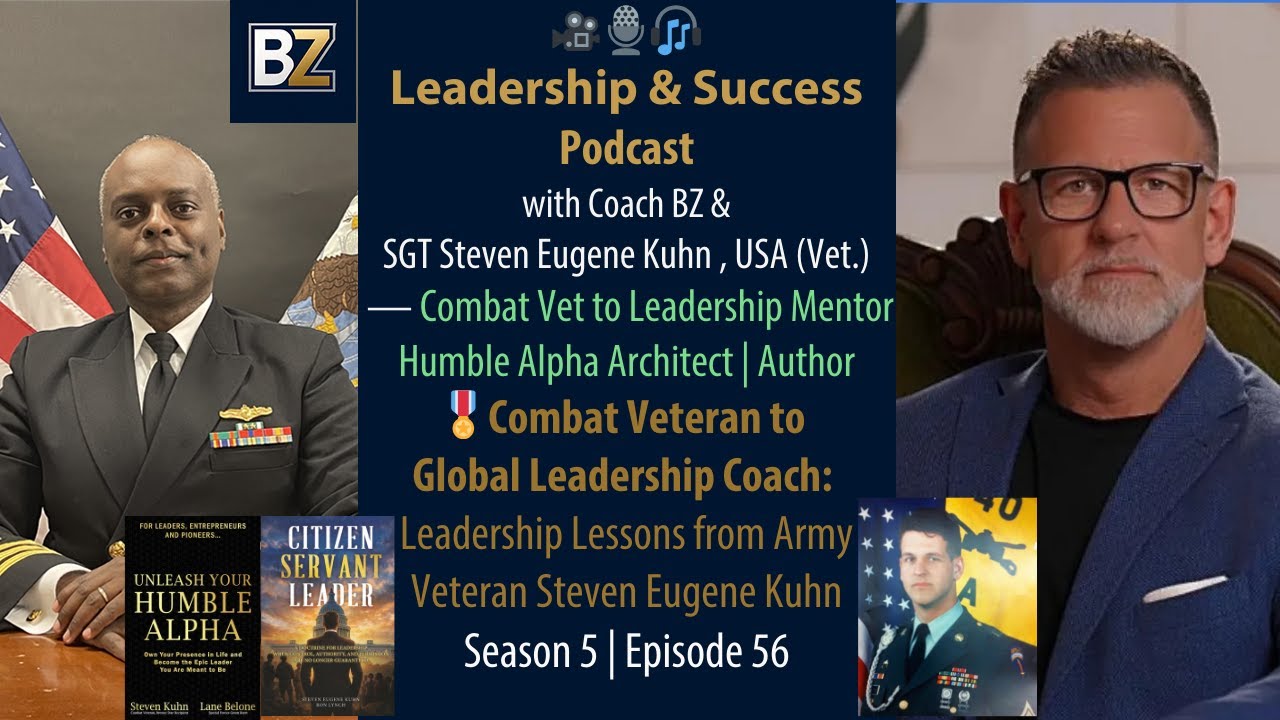
Sergeant Steven Eugene Kuhn, a U.S. Army combat veteran, discusses leadership lessons from Operation Desert Storm and the Battle of '73 Easting. He outlines his "Humble Alpha" and "Citizen-Servant Leader" models, emphasizing mission clarity, trust, and the HIT framework of honesty, integrity, and transparency.
Chapters
Hi, I'm John Maxwell. When the top companies in the world are looking for trainers, speakers, and coaches, there's one name that stands above the rest, and that's Maxwell Leadership. Our certified team members have gotten proven results for companies all over the globe, and our reputation, I'm proud to say, is second to none. Some of our members have risen to the top of their profession, including the one you're going to meet today. I proudly introduce you to my friend, Bob Fabien Zinga.
Welcome to the Leadership and Success Podcast with your host, Coach BZ, where we help you lead with purpose and succeed with impact. If you're ready to grow into the kind of leader others want to follow, this podcast is for you. If you're determined to elevate your success and leave a lasting legacy, this podcast is for you. As my mentor, Dr. John C. Maxwell, reminds us, everything rises and falls on leadership. Our goal is simple, to inspire you, challenge you, and equip you with insights that can transform the trajectory of your leadership journey. Welcome aboard to Welcome to another episode of the Leadership and Success Podcast with Coach B.
You feel it, don't you? Something has shifted. The world that you grew up in, the one that you thought that your kids would inherit, it's slipping away. While you're working, raising your family, trying to keep your footing, people in power, they're making decisions about your life without even asking you. And you know what? They're counting on you staying quiet. And it's not because you're weak. It's because you're busy, you're tired, and you were taught, you know what, this is just how it is. But here's what they forgot. America was not built by politicians. It was built by ordinary citizens who showed up, did the work, and refused to be ruled. You're not wrong for wanting safe streets or wanting merit to matter, and you're not extreme for wanting leaders who actually serve you instead of themselves. That's how America started, where free citizens standing together were the most powerful force on the planet. This isn't about going backwards. It's about moving forward with the principles that actually work: responsibility, service, and earned respect. Here's what's happening right now. We are rebuilding leadership from the ground up, and we're not doing it with career politicians or media figures. We're doing it with citizens who live with the consequences of broken policies. You already know what needs to happen. You've known for a while. And you've been saying it for years, haven't you? The only question left is this: Are you going to keep watching from the sidelines? Or are you going to step in? If you're ready to stop being a spectator in your own country, support Take America Back and go to jointab.us right now. We need your help to build the infrastructure to get the book into as many hands as possible and to get the Citizen Servant Leadership Course certified at the university level so that we can train real citizen servant leaders in every community. This doesn't run on corporate money. It runs on people who refuse to quit. And I know you're one. Let's get to work and join us on joincab.us.
What everyone, what a great joy to be with you again the second time today. So in just a moment, I will be bringing in my special guest. But before we do, as you know, it's our custom here to always have a moment of gratitude every time we meet. Like I said earlier this morning, I am so grateful, so grateful. I stand on the shoulder of giants like the commander we spoke to earlier, this morning. Without them, my story would not be possible. So without any further ado, let me see if I can properly introduce our guest today. This morning we are going to be— actually, it's going to be afternoon for him. He's in Turkey right now, but I'm going to be speaking to Sergeant Stephen Eugene Kuhn, a former US Army combat veteran who transformed his military experience into a global leadership movement. Today, Stephen is known internationally as a leadership strategist, entrepreneur, speaker, author, helping leaders develop authentic presence and purpose through his philosophy known as the Humble Alpha. So he is the author, bestselling author of two powerful leadership books, but actually it's a leadership book series. The first one, Unleash Your Humble Alpha, own your presence in life and become the epic leader you are meant to be. And the first in the series, "Citizen-Servant Leader: A Doctrine for Leadership When Control, Authority, and Permission Are No Longer Guaranteed." And like I say, it's only one of 5 books now, and we're gonna be speaking about it. So I would like to also mention, not only is he a combat vet, not only is he a global, leader, but through his work, Stephen teaches that leaders, uh, teaches leaders how to combine strength with humility, confidence with service, and authority with authenticity. So from the battlefield to the boardroom, his leadership journey offers powerful lessons for military leaders, entrepreneurs, and technology professionals alike. So without any further ado, please help me welcome to the Leadership and Success Podcast, Sergeant Kuo. All right. Hey, Steven, can you hear me? Hold on. Hey, Steven, I cannot see you. Oh, he was just here. Hold on. Hey, Stephen, can you hear me? Oh, here we go. All right, here you are. I lost you there for a second. All right, good to see you again. All right, so how are you doing today? I believe it's evening where you are, right, in Turkey? I can see you and I can hear your keyboard also. Can you hear me?
You're just cutting out. I can't hear anything you're saying.
Okay, I can see you and I can hear you. Audun, let me— I am going to remove you and connect back. Try one more time. Okay, can you hear me now? Okay, this—
can you—
okay, I can hear you. Can you hear me? I can see you.
Keeps getting cut off.
Really?
Okay, that is very strange. Let me try something.
It cuts me off every 10 seconds.
Huh.
Let me try one more thing.
Right, uh, okay, I'm cut off every 10— I'm cut off every 10 seconds. Every 10 seconds it cuts off, puts him back on, cuts off, puts him back on. Not sure why.
Is it better now? I have redone this stage.
Yeah, it seems to be better now. Yeah, it seems to be working now.
Very good. I don't know what that was. So what I'm going to do is, for the live experience, nothing I can do about it. But before I publish it to all of the other podcast platforms, I am going to fix this. Okay, so basically what I was saying is, ladies and gentlemen, it is my great pleasure to present to you Sergeant Steve Kuhn. All right, welcome to the Leadership and Success Podcast. I've been waiting for this for quite a while. That was my fake crowd right there, but some people are watching live on LinkedIn and YouTube. How are you doing today, sir?
I'm doing great. Thank you so much for having me.
And I believe you are still in Turkey, right? So I think it's evening where you are.
Yes, yes, I am. It's almost 20:00 or 8:00 PM.
Yeah, incredible. I can't really believe how global this podcast has been from the time I started, what, 5 years ago where I was the only listener. But anyway, what is one thing you are grateful for today?
Yeah, I'm grateful to be alive. I'll tell you that. All the stuff that I've been through and the places that I've lived and the things that have happened to me. I've had a gun in my mouth. I've had— Wow. I've been broken my eye socket, my nose, my arm. I've been in like 100 fights in my life. It's just crazy, crazy life. Been to war. I'm just grateful to be alive that I can live every day and very grateful for the things in my life like my wife and my kids.
Wow, that is amazing. Has your definition of success changed since you initially joined the Army?
Has my idea of success changed since I joined the Army? Well, I think it better change. If it doesn't change, then, you know, you're going to be stuck in a rut, right? I mean, it's a whole process we go through. You know, they say it's not the goal, it's the journey, or it's not the, you know, the end, it's the journey. And I think as we move forward, the most important things obviously are the failures because that's where we learn the most. And I think that when we are able to look back on things and say, you know what, I hand— how did I handle that? I handled it well. What can I do to avoid that problem in the future? And if I do have a problem, how do I handle it quicker? You know, our, our present is typically dictated by our past experiences. And we try to, you know, when in my life, I try to find new ways to deal with things I've dealt with before.
So, wow. Now, I guess to get started, I also like to ask, is there something about you that most people may not know when they meet you for the first time?
There's a lot of things that people don't know about me when they meet me for the first time. You know, I've lived 10 lives. I've lived in 10 countries. I've worked for multiple governments, multiple world leaders. I've worked for Mick Jagger, Olivia Newton-John, Andrea Bocelli. You know, I've been literally all over the world with— and I've been in rooms where I had no business being in rooms. I've led companies. Like, I had a company where I led 3,500 employees, 87 locations in 9 countries. No business being whatsoever. But because I was operationally and culturally astute, as far as connecting cultures, I always got positions or I got opportunities to step into situations where I had no business being there. So, you know, I always— I'm just almost like a— I don't know, like a way— the way that I've lived my life has always been, yes, assume that if others see something in you that it's already in you and you just embrace that.
Wow. Well, in that case, let us humanize you for just a second. So I guess the next question I'm going to ask is, for those meeting you for the first time, who is Stephen Eugene Kuhn in your own words?
I'm just a normal guy who grew up in central Pennsylvania and knew that there was more to life than central Pennsylvania. We call it Pennsyltucky. Yes. And, uh, and I knew that I wasn't going to stay there. And as soon as high school was out, 10 days later, I left for the U.S. Army. And I went to the U.S. Army, and I was not a very good student. I wasn't very— I didn't have many friends. I didn't like myself. But, um, you know, when I went to the military, I remember when they were shaving my hair off, I said to myself, this is the new you. And from that point on, it it was only going to go upwards no matter what. Now, I failed quite a few times, lost everything a couple of times, had a suicide attempt, lived in a monastery for 8 months in the mountains of Austria to try to recover. You know, been married now 3 times, and it was a hell of a battle. But I wouldn't change anything. It's just gotten me where I am now. And I can stand in front of anybody in any country anywhere and take care of business when I need to.
Wow. Now, you've served in the US Army during the Cold War, so you are a combat veteran.
Yes, I served in Operation Desert Storm.
Yeah, that's quite incredible. So what leadership lesson from that experience still shapes the way you lead today?
I would think there's 3 things stay with me every single day. The first one is mission clarity. You know, in the environments that I operated in, ambiguity is the enemy. You have to know exactly what you're doing, why you're doing it, and what matters most when things go sideways, because they will go sideways, right? Second is trust is the force multiplier. Rank means very little when you're operating at high-stakes decentralized environments, which is always seem to be difficult. But what moves people is credibility. Do you know your job? Do you know what you say? Are and will you protect the people around you? The third is physical and mental readiness. They're not optional. I write about physical readiness as one of my 5 pillars of citizen leadership, citizen servant leadership, because I watched firsthand what happens when a movement, a unit, or an organization is built on exhausted people. It collapses from the inside, and the body carries the mission. Remember that. That lesson never leaves you.
Wow. Now, another thing that is quite extraordinary, I think, with your life, you went from being a combat veteran to now a global leader, but you've also helped a lot of transitioning active duty, uh, military members, including sailors and soldiers become entrepreneurs, successful entrepreneurs. So I think some people listening right now, uh, many veterans, they may kind of struggle with that transition, right? From military life to civilian leadership. What was maybe, uh, your personal transition like and what did it teach you about identity and Purpose?
Well, I think it was, for me, it was disorienting in many ways that I didn't expect and I couldn't fully articulate at the time. You know, the military gives you a clear identity through structure, your rank, your unit, your mission. And when that's gone, you know, we discover that we built our entire sense of something that was external, right? Or the sense of who we were was completely external. When the uniform comes off and suddenly the question is, Who am I? There's no easy answer to that. That experience is actually the foundation of pillar 1 in my Citizen-Servant Leader Doctrine and in The Humble Alpha, which is identity. And I'm not talking about your title. I'm not talking about your position, not your platform. Who are you when no one is watching and when the cost of being that person is real? I had to do that work myself before I could teach it. My transition taught me that purpose isn't given to you by an institution, it has to be decided, written down, and defended, especially when the pressure comes to compromise it, and it will come. Wow.
So what advice would you give to our audience, especially those transitioning from active duty to the civilian sector right now?
The first thing I would say, and honestly, this isn't me plugging my book, but read Humble Alpha, just the first chapter. Hell, I'll send it to you in a PDF. If they want, they can contact me. The first chapter is all about identity. Who are you really? Not your title, not your position, not your platform, nothing. Just who are you really? Because when you find out who you are really, then that gives you presence because you can stand on your own without external validation. And once you have presence, that purpose that crystallizes in front of you will amplify that presence even more and give you— presence comes from being present, and you can be present only when you know who you are. If you're trying to fit yourself into the room and say, let me fit in, it's a business meeting, let me act businessy, it's a veteran meeting, let me act veterany, that's where the true you comes out. So read chapter 1 of Humble Alpha or read chapter 1 of Citizen Leader.
But really, everything you talk about in your books is something you've lived through yourself. It's really based on your experience. And as a combat soldier, I know you've earned the Bronze Star, probably something you don't want to talk about, but if you could, for those listening in, at least at the high level, unclassified, can you tell us kind of what you went through and what the experience was like?
In war?
Well, I was with the 8th Cavalry, the 8th Cavalry Task Force 48, it was called, and we were in the famous Battle of '73 Easting, which was the largest tank battle since the Second World War. We, we were the lead unit, um, for VII Corps. I think, no, it's VII Corps, I think it was. We were attached to, um, 3rd Armored Division, 8th Cavalry. And, uh, we ran out of ammunition after, after about, I get, I think it was about 24 hours of battle with the Tawakhan and Medina Guard version. And during that battle, one of the FOs were hit, one of the forward observers was hit, and that was a friend of mine, Sergeant Young Dillon. And so I ran to him and I was with him when he passed. And there was a moment there where, as he was passing, he looked at me with eyes like, don't screw this up, Koen. Like, this is your chance. Like, don't let my life be in vain, almost. And I've carried that with me to this day. I almost— it's almost my mantra. Like, I'm doing him proud. You know, I'm doing my brother proud. You know, in any situation like that in war, you have to push by it, you have to push past it. And of course, there's a bravado and machoism in the military like crazy. You can't get all emotional and everything. And when you're 23 years old, which I was, you know, you just sort of push it off and move forward. But it just kept hitting me over and over. And then there was a moment with a little girl in the desert where I helped her get bandaged up because she was burnt from head to toe, but— mm-hmm. And, you know, she was in the middle of desert with some woman she didn't really know, and I gave her a piece of candy, butterscotch candy, and she smiled. And that moment hit me because I said, wow, here's a little girl burned from head to toe, bandaged now, in the middle of desert outside of Basra, smiling because a piece of candy, and here I am complaining because I'm sweating.
Wow.
Right?
And it just, it just puts everything in perspective. So Sergeant Dillon and the little girl, uh, changed who I was forever in that very short period of time.
That is really remarkable. Why do you think, because it seems like in the military, it doesn't matter which branch and what your rank, irrespective of rank, leadership is really crucial, especially when we're talking about, you know, death and life type of decision. Why do you think leadership is such a crucial skill?
Oh, well, I mean, leadership, I think most leaders were never taught to build from the inside out.
Right?
Most leadership development focuses on behavior, what to say, how to carry yourself, what frameworks to apply. All that's exterior work. Authentic presence starts with an internal decision. Who am I? What do I stand for? And what will I not trade under any circumstances? When you haven't answered those questions in writing with real specificity, you're always improvising. An improvised identity is readable. People can feel when a leader is performing rather than being who they are. And if you add that to the modern environment, which is engineered to fragment your attention, manipulate your perception, and reward performance over substance, hmm, you get leadership crisis that looks like confidence problem, but it's really an identity problem. So that's why leadership is important, because people seek leaders. Most people aren't natural-born leaders. Leadership can be learned. It's a conscious decision, right? It can be learned, but it's— it can be learned externally, but you'll never become a leader until you are internal with that. Wow.
That is really insightful. And back to your first bestselling book, Unleash Your Humble Alpha: Own Your Presence in Life and Become the Epic Leader You Are Meant to Be. And you just encourage my audience to read chapter 1, especially those who are transitioning from active duty to the civilian life. And I must tell you, I think it was in 2017 when the Navy told me, I was a Lieutenant Commander at the time, they told me, no, 'Lieutenant Commander Zinga, you are no longer qualified to be in the active military, and we are going to pretty much ask you to medically retire.' And I didn't know who I was. I completely lost my entire identity. I'm like, 'Who am I if I am not, you know, a sailor?' It took me almost 3 to 6 months to kind of get through it, but then thank God I found a way to come back on active duty. But I can see how for some people it could be quite Devastating. I guess the first question I want to ask you about this book, why did this book have to be written? Why did you write it?
Well, it's funny you say that because people ask me all the time back then, this was in 2017, 2018, 2019, and they heard about me working with Mick Jagger, Olivia Newton-John, Andrea Bocelli, European Parliament, world leaders, working with the royals. Like, there's some crazy stuff that I never should have been doing, but I did it anyway. And they asked me, how did you do it? What did you do? And I said, I just walked up to them and asked them. And they said, no, come on, it's gotta be more than that, you know? And so I was like, yeah, I don't really know. I just did it. That's just who I am. And they said, well, you need to be able to teach that. And so I went on a journey and I started with Lane Bollone, my co-author. And we started just dissecting my life and his life and looked at the highs and the lows. The things that worked, the things that didn't, what repeated themselves. And then we gave the things that worked out real a model. So there's 5 models in the book that you can live by. And every chapter has a story, a lesson from that story, and the action steps you can take specifically for your life in order to become that epic leader. So it's applied knowledge given to the reader as wisdom, I guess you could say it. Because here's the thing, I have an MBA. Didn't teach me anything I didn't already know. And people who have just knowledge but haven't applied that knowledge don't own it. They don't own it yet. It's like a hard drive in their brain. It doesn't mean anything.
It's just sitting there.
So all the degrees you want, unless you're applying those, you don't own that knowledge. And applied knowledge is where wisdom comes from. Knowledge is— you learn knowledge. Wisdom you get through experience. And now taking that knowledge, applying it to get the wisdom.
Wow, that is powerful. Wisdom applied knowledge. Like, no, some people know this, um, Bible verse, pretty popular. You shall know the truth and the truth shall set you free. But it's the truth that you know, that you apply, that's what makes all of the difference, isn't it? Absolutely.
You're going to know what works. How are you going to know what works? Just because someone told you it works? When I was doing my MBA, I was raising funds for a business in Germany. And I was in the entrepreneurship class. And the professor's up there talking about raising funds and this, that and the other. I said, "No, actually, that's not how it works." "Excuse me?" I said, "I have a call right now, actually raising funds." And on the phone, in the class, I closed a multimillion-dollar deal live, just to prove to him that it's done differently.
Yes, yes.
If you challenge me, I'm a typical D type. If you know DiSC, I'm sure you do. I'm a typical D-type. Challenge a D-type and you know he's gonna take the challenge.
That is really incredible. You are such a legend. I think in the green room right before we started, I believe you were closing a multi-million deal right before the call started. Actually, I am keeping you away from a very important phone call. So I'm so grateful for your time right here, sir, because people need to listen to what you have to say. You make it look so easy, though. It's like, wow.
It is. You know why it's easy? Because the only expectations that I have to listen to are my own. It doesn't matter to me what people think of me. It doesn't matter to me if they think I'm qualified. It doesn't matter. For me, every time someone looks at me critically, I know it's their issue. It's not mine. I just know that. So I'm not worried about it. So once you have that confidence, the certainty I call it, it's more about certainty than it is confidence. You can be overconfident, but you can't be over certain. Right? And that certainty that I have in myself is the certainty in my abilities to deploy my genius in any given situation.
Well, Wow, say that one more time, please. That's profound.
Oops.
Oh, sorry. Yeah, you were—
Okay, we're back.
Yeah, you were talking about certainty. What is going on?
Are we back?
Yes.
No, I just keep getting kicked out again. Here we go again. Get kicked out again.
Hold on, let me refresh the stage. Booted off.
I think I'm here by myself. If you're watching, thank you for watching. Hmm, hopefully Bob will join us in a second.
Here we go. Uh, what this, this was I just refresh the stage. I'm going to fix this for the podcast. You were talking about something really important, certainty and overconfidence.
Yeah, certainty in my abilities to deploy my genius in any given situation. And that means I'm sitting on the Mediterranean right now, I send the door, I know I got it, right? That certainty in your abilities allows you to detach yourself from any expectations or any judgment from anyone else. That's why it's easy. Because it's only hard when you try to be something for everybody, try to fix things for everybody, try to be that one thing. No, be who you are. Stand like an oak tree in the forest in the storm, and people will automatically gravitate to you. And here's the thing, I learned this from a CEO one time, and I said this in the beginning. I had taken over this corporation, 3,500 employees, 87 locations, right? 9 countries. And after 3 weeks, I was like, look, Mark, the CEO. I was like, Mark, I can't deal with this. I was a bartender. I owned cocktail bars in Berlin, Germany at the time. And he was a guest. And he hired me to lead up this corporation. And I was like, why?
I was like, why?
He said, because I see it in you. And so when I, after 3 weeks, I said, look, Mark, I'm done. I quit. And he said, what are you talking about? And I said, look, I can't do this. This isn't me. He goes, Stephen, shut up and listen to me for a second. If I see something in you, That means it's in you. All you need to do is embrace it. And I was like, embrace it? Okay, all right, embrace it. Another challenge, right? So I embraced it, and I broke every revenue record they ever had within 6 months. I had the entire company up and arms like, who is this guy? All of a sudden, just because a leader took the time to talk to me personally, not talk about structure, not talk about what you're supposed to say, how you're supposed to act, what you're supposed to look like, what you're supposed to wear, Yes. He says, Stephen, simple. If I see it in you, it's in you. Embrace it. Done. And that's what taught me a long time ago. It took me a while to implement it. But it taught me a long time ago, man, if you don't know who you are, and I mean really know who you are, your weaknesses, your strengths, and you operate by HIT— Honesty, Integrity, Transparency. And honesty and integrity, let me go through that real quick. HIT— Honesty, Integrity, Transparency. Honesty with yourself, why you do, say, and think like you do. And I mean, be critical of yourself. Yourself, right? And transparency is how you step into the world with that.
Okay, yes, this is very strange, never happened before. We were talking about HIT: honesty, integrity, and transparency. Not again. All right, uh, man, I have so many questions for you and You have so much to teach us.
I think your system's overloaded.
Huh. Okay. It's probably me.
Yeah, it's you, definitely. It's not me.
Very, very, very sorry for that. We have so much to talk about. I don't know if we should push forward or try to—
Yeah, let's keep pushing forward. We're here now.
Let's finish it. Thanks, thanks, thanks. So honesty, integrity, and transparency.
Transparency. Transparency is how you step into the world with that honesty, and integrity is a byproduct. Integrity is real simple. Do what you say you're going to do. Don't do what you say you're not going to do. And if you screw up, fix it, make it better, and apologize. That's integrity. That's it. That's simple. And people find it so difficult to have integrity. Do what you say you're going to do. You say you're going to do it, just do it, right? If you say you're going to write a follow-up mail, if you say you're going to call me, if you're going to say you're writing a text message, then do it, right? If you say you're not going to do this, you're not going to do that, then don't do it. It's that simple, right? But if you do do it and it's not malice and you do it by mistake or something happens, apologize, make it better. Simple. That's integrity. Very simple. Like I said, life can be simple if we don't go into all of the fractals that everyone talks about. You have to be this, you have to do that, you have to say this, you have to say that. I have to sound intelligent when I'm speaking. I must talk like this. All this kind of stuff. Just be who you are. People really appreciate authenticity.
That's really powerful because when we go back to your first book, right? When you say Humble Alpha, I know there are a lot of alpha male in the Navy for sure, but this is so powerful because it seems like it's two ideas that people think are quite opposite, right? So how do you define being humble and alpha at the same time?
Well, first of all, it's about Um, humble on the outside, alpha on the inside, right? It's all your, your nuclear reactor in here, right? And so, and the, the difference is, I, I guess you could say you don't have to project, you don't have to act tough, you don't have to have a title, you don't have to have anything externally when you're square with yourself. You know who you are, you know your way about, you know your identity. That's a humble alpha. Typically is the loudest person in the room gets the most attention. You're actually— aggression is rewarded in many situations, especially in the military, right? And in life, that doesn't work. I actually tried that in civilian life in my first career that I had. I was just getting mad and yelling at people like I used to, like we're taught to do, and it didn't go over very well, I can tell you. So it's, it's very important that we understand who we are, what we are, what we're about, and that we don't need external validation. We need— anyone who talks about themselves, as far as I'm a leader, and I'm this, I'm that, that's them validating to themselves that they're a leader. And subconsciously or consciously, people will hear that and feel that, and they'll know, I don't know if this is too sure that we can follow this guy.
So what are we talking about is authentic presence? Why do you think so many leaders struggle with that today?
Because they're not taught. It's not taught anywhere, Bob. It's taught to— here's a structure, follow it. This is what leadership is. That's how you have to be. You know, you hear someone like Jocko, you have to get up at 4 o'clock in the morning to kill your enemy before he gets up. Okay, that sounds great. And for, you know, hard guys like us from the military, we can relate, relate. But that doesn't work in the civilian world, right? You don't have to kill your enemy. You don't have to kill your enemy. You just got to be quicker. Gotta be better. And if you are really a good leader, you collaborate, right? You collaborate. Competition is something that grows, that helps you grow stronger. And if you're really strong, then you accomplish something with them together and you collaborate to make it something better that neither one of you alone could have gotten.
That's really great. So for people who are listening right now, if someone feels invisible, uncertain about their leadership voice, What is the first step they should take to own their presence, you think?
Don't try to be something you're not. Not everyone's a leader. It's just as simple as that. If you're in a leadership position and you feel like you have to project, you don't. You know what leadership is? It's active listening. Basically active listening. What do your people want? Look, if your people are aligned with the company's mission, that's easy. If they're not aligned with the company's mission, you need to go personal with them. Yes. Where are you at? What are you about? What are you feeling? Why do you feel this way? What do you think you need from me? What, you know, how can I help you get to where you are? You know, an evaluation, whatever you want to call it. But in the end, if their core vision isn't aligned with the company, it's gonna be really difficult with you, you know, getting ahead. But I always followed the rule. My main mission as a leader was to show people that they're capable of doing things that they never thought they could do. And that's typically something better than what I was doing at the moment because I'm just sort of the leader.
Yes.
So when you bring these people to a place where they do things that they never thought they could, their, their presence, their confidence, their certainty grows exponentially. And then they end up taking your position, which was always my goal because I wanted to move on. You know, that's why I lived in 10 countries. I didn't want to stay with one. One career, one position, one contract. So for me, it's always about how do I nurture those around me? How do I grow my garden so that they can grow and thrive and flourish and become the next leader? Leadership isn't something that's owned. Leadership is something that's honed, right, and passed on like the baton.
Powerful. Because in the book, you do talk about leaders becoming the epic leader they were meant to be. What internal barrier typically prevents people from stepping into that version of themselves?
Again, they don't know who they are. And they're trying to fit themselves into a mold that they've been told that they have to be.
Right?
Trying to figure out, okay, I'm a, you know, a leader at this XYZ company, what do they expect of me? I have to embody the position of the company. I have to love the product. I have to, you know, all these different things you need to do. And in the end, you're not a stamp of that company. I mean, when I was living in Switzerland, uh, running this corporation, Apple approached me, right? And they wanted to be what they call a cluster manager, which took care of the DACH region, which was Deutschland— oh, sorry, Germany, Austria, and Switzerland. So I wanted to be a cluster manager for those, all those areas. When I went to these interviews, I went to 12 interviews.
Ridiculous.
Wow.
And first you started at the lower level. Everybody interviewed all the way up. And then this guy came from America, the second in charge or something like that. And he said to me, he said, look, I think you're lying. I said, what do you mean?
I said, what do you mean?
He said, about your resume. How can you own 3 cocktail bars, live in Hungary and in Switzerland at the same time, run this big corporation, and then have these other 2 businesses on top of that? I said, what do you mean? He goes, well, no one can do all that. I said, well, I don't do it. He goes, what do you mean? I said, I delegate the tasks. But not the responsibility. I'm responsible for it. I don't do the work. Right. I don't actually go out there in the field and, you know, dot the I's and cross the T's. And he was like, he was like, write that down, you know, delegate the task and not the responsibility. And yeah, and it was like a cult. It was like a cult. And I could see you had to be an Apple. You couldn't be a leader leader. You had to be an Apple leader. And that's why I turned it down. I was like, no, I'm out. Because they wanted me to like dance around and sing songs and all kinds of crazy stuff. That's not who I am. I'm not going to do it. That's the difference is if you're being forced to mold into a way that they want you to be as a leader. Matter of fact, when I worked for that corporation, when I worked for that corporation, I started out as a general manager. And there was, I think, 35 general managers at the time from different locations. And I did whatever I wanted. Like I wore what I wanted. I wore suits. Everyone else wore like a polo shirt. I did what I wanted. And they kept asking, why do you get to do whatever you want? First of all, I don't ask, right? Second of all, I deliver. I deliver more than anybody else all combined.
Right?
And they said, well, isn't that arrogant? I said, no, that's just who I am. I'm not trying to be.
I'm just—
yeah, this is how I feel comfortable. This is how I feel most powerful. And when I feel like that, I deliver results like nobody else. Simple as that. And the leadership actually agreed to say, look, if you can do what Steven does, then do whatever you want.
Wow, that is so insightful. That leads me to ask the question, how can leaders develop self-awareness and emotional discipline, especially under high pressure? Like, turning down that job from Apple, that must have been something.
Wow. It was huge because it was a lot of money. It was guaranteed trips back. It was an apartment. It was a car. It was a stipend. It was travel. It was everything. It was a big deal. But I know this, as soon as I get excited about something, a position, money or something, that's not the true me. I know that. I turned down a position in Australia for $300K as well one time. And it's just something didn't feel right. I was excited about the money. And I said, if I do this for the money, I'm going to be very sorry. So I looked into the company, looked into the leader, I realized, no, this isn't for me. This is going to end bad. So I turned it down. Of course, he was really pissed. But, um, I think, you know, I think the truth is this: if you're excited about working with somebody because you can learn from them, that's great. If you're excited about working with somebody because you think that you can ride on their coattails, even if it's not conscious, or that, oh, if I work for this company, that's going to look good on my resume— resume days are over. They're still okay, you know, the corporate world, that's still important for a lot of people, but nobody else gives a damn.
Yes, right.
I don't care if you got an MBA, a BA or, you know, a YMCA, you know, I don't care. It's like, you know, you bring me, you bring me your passion, the will to learn, and the will to lead for real as who you are. And we're going to work together. Doesn't matter. I hired a guy in Germany. I hired a guy in Germany. Nobody, no one would hire this guy. He was a convicted criminal, right? And I said, I talked to him and I said, what? And I said, well, if this guy's a criminal, that means he's like, You know, he's got— he's always trying to find a way. So I talked to him and I hired him. We had a deal and I hired him. This guy turned out to be the best sales manager that I made him a general manager, that I made him a regional manager. Right.
Wow.
And this guy was— ended up leading that company for Germany. I was like, who is this guy? Where did he come from? That's the guy you wouldn't hire. It's a guy you wouldn't even look at. So it isn't about what they look— everybody makes mistakes, man. We've all done stupid stuff, right? I mean, I've done a lot of stupid things, right? And, uh, you know, I, I stand up for me. Here's the trick. If you do something stupid, if you have something in your past that you don't want anybody to find out, tell everybody. Because then it's just novel. It's just novel. Then it's like, oh yeah, okay, it's a lesson. That's all it is. It's a lesson.
Yes.
Yes. You don't tell somebody, someone can use it against you. Someone can leverage it against you. Someone can— if you're scared that someone's going to find out something about you, tell them. I had a guy on the phone the other day. He called me and said, Stephen, I want to help you. I want to get into a precinct seat. I want to get into city council. 'But I got charges, federal charges for tax evasion. I'm 45 and it was 19. They charged me when I was 45 for something I did when I was 19 that I didn't know I was doing because I was 19. How do I deal with that?' I said, 'How do you deal with it? Tell everybody. Put it out there. Get it done. Get it over with. It's done. It's not a weapon if everyone knows about it.' True. So, wow, you should never be ashamed of who you are, what you've done. I can sit here and tell— I was in over 120 fights in my life. When I first got to Germany, I got out of the military, I stayed in Europe where I was stationed, and I was a doorman. So what do you do as a doorman? You fight. That's all I did. And then it got to be so bad, people would send guys just to fight with me because they heard I was a tough guy.
Wow.
I have like a titanium eye socket. My nose is broken 3 times. My jaw was broken. My ribs were broken. However, I just kept going, you know. It's like I was just so angry with myself.
Of.
But I tell people that openly and honestly because that's who I was at the time. That was— I thought I'm the badass veteran and I have to prove everybody that I'm badass than they are because this is what happened. I got out, you know, E-5 wasn't a big deal, but I was a sergeant in the military. I went to war, I had a Bronze Star, and you could tell by looking at me, my name, you could see my rank, you could see what awards I've earned, where I was stationed, all these different things. You can see everything from my uniform. I have to say a word. You knew right away, I can respect this guy or not, at least what he's done. So I'm standing at the door of this club, I'm standing at the door of this club, and this 14-year-old comes, wants to come in. I said, sorry, you got to be 18 to get in. And he said, oh, get a real job, old man. You know, I was 28 at the time, you know, and I'm like, oh man, I know, I just exploded. And that's when it hit me, I'm like, my God, this guy has no idea who I am, zero, talking to me like this, you know. And that's when it really hit me, I'm like, God, I better do something because I can't, I can't deal with this. I can't deal with somebody looking at me and not, not knowing who I am. And then that was because I was seeking external validation all the time. That's what the awards are for, that's what the uniform is for, validation. This is real. Oh, look at this guy. Oh, he's a— this is good.
Yes, yes.
So that was, that was for me, that was a big moment in my life. Well, I tell you, 14-year-old kid called me.
Yeah, man, you are really a living example of humble alpha. I think we need more and more humble alpha in the world today. So if I was to ask What is maybe 3 practical habits that leaders can start today to develop humble alpha leadership?
3 practical habits. You got to be self-critical. You know, you got to realize that everything you say that comes out of your mouth is going to leave an impression, whether it's the first or the last. So make sure what you're saying is truth-based. And it's not to manipulate. It's not to coerce. Or to trick anyone. You have to be true to yourself and who you are. And if you don't know, just tell them, "You know what? I don't know that right now. But let me talk to my team. I'll get back to you." Yes.
Wow!
I would say doubt isn't the problem. The doubt is the information that you have, or don't have. It's telling you that you got to take the situation seriously, that you understand the weight of what you're stepping into. And leaders that feel no doubt are usually the ones who should worry about— we should worry about. Mm-hmm. Not despite the doubt, right? And if we start with the doctrine work, answer 3 questions for yourself, build the 5 pillars that we talk about in the 5 books, get physically consistent, get financially sovereign, defend your information environment. Remember, the seat, whatever that leadership seat is that you're meant to occupy, isn't waiting for you to be qualified. Yes. Uh, learning, making mistakes, moving on.
Let, let me re—
I think Bob's having some internet issues here.
Yeah.
I think the platform is probably AWS because we rely on AWS a lot.
It's definitely AWS. It's definitely AWS. AWS is garbage.
Yeah. But this is so important. I think it's a great segue into— I thought it was only one book. It's actually 5 books in the series. Let's talk about this. I think this is critically important. Why did this book need to be written? Citizen, Servant, Leader.
Well, it all started over a year ago when I started making videos. I made one video about my wife, who's Ukrainian, and how the war started. Actually, it was December 24th, and that video went viral. Alex Jones shared it. Jimmy Dore shared it. It went to like 30, 40 million views.
Wow.
And I didn't do anything for a month. And I made another video. That one also went viral.
Right.
Then I said, well, let me do a video a day. And I've been doing a video a day since February of '25. And as this time, as time goes by, I talk about like, everybody's talking about the government, how bad they are, the criminality, Epstein files, all this kind of stuff. I said, look, we are a republic by the people, for the people. Why aren't the people leading? Why aren't we stepping up? I said, let me write the book of what I think would be right for the, for the republic, for the citizen servant leader. And it just started that way. And then it was like, wait, we got to take America back. And that's how the name ended up. And I got like generals on my board. I got like billionaires on my board. And I got all these people that are like, this is amazing, Steve, we have to do this. And it just took off. So these 5 books are the first series ever that are written specifically for citizens in order to step up. You have Citizen, Servant, Leader for leadership. You have Financial Freedom to get legal ways out of debt because debt can be weaponized. And then you have Health, Wellness, and Resilience. You're Health, your body is the vehicle in which you carry your mission, right? So your health, wellness, resilience in your mind. And then you have information warfare, how to battle and disseminate information warfare that's happening all around us. And then the last one is incorruptible because becoming corrupt isn't like, hey, here's $1 million, go do this. That's not corruption, right? Corruption is, hey, come to us. Thank you. We need you right now. You're the most amazing guy in the world. Oh, he meets Senator so-and-so, meet all this kind of stuff. And then when they need a favor, they ask you and you're like, well, no. And they're like, well, who gave you the job? Who introduced you to the senator? Who did this? That's how they get you corrupt. Most of our politicians are corrupt not because they're bad people, but it's because they let themselves be led down with the honeypot, if you will, right?
Yes, yes. I remember the late Senator McCain, former lieutenant, he definitely learned something about that when he first got into power in Congress, and he decided to be different for the rest of his great outstanding service to our nation in that capacity. So what exactly is citizen servant leader? I think it's President Bill Clinton who said citizenship is the most important role in the republic, not president, not congressman, not senator, but being a citizen. So what does that mean to be a citizen servant leader?
That means that you serve your republic so it can serve others. It's real simple. We are a republic by the people, for the people. And right now it's not happening. We are a republic right now by politicians for themselves, right? And we see that everywhere we look. There's, you know, we saw it the other day when Congress voted not to release all of the sexual harassment charges against them because the taxpayer pays the out-of-court costs, right? So millions and millions of dollars settling these sexual harassment things. So that's an obvious fail right now. And I have a tip for everybody. If you want to vote for citizen servant leaders, next time there's an election, whether it's midterms or whatever it is, don't vote for anybody who's ever been in office before. Vote only for citizens. Vote only for citizens. Let's get citizens in charge again. People that have nothing to gain at the moment, right? They have no leverage over them. They're ready to go out, step up, and make it happen. And there's enough of us out there that can do this. I mean, think about it. We're millions and millions and millions more than our leaders. And here we sit. Totally controlled by a few people. That doesn't have to be this way. Even people say, oh, we can't go to war. I'm not saying going to war. Imagine this: you're in your community and you actually read the budget of your city council. Go to your city council meeting with you and 20 friends, and you're calm, you're respectful, you don't swear, you're cordial, and you go through the budget, say, what's this line for? What's this line for? Why is there so much here? Where's this going? Where's this going?
Yes.
And maybe 2 or 3 people won't get much, much much leverage. But you show up with 20, 30, 40, 50 people, after a while you build up. You can start a chat group in your community and say, hey, I'm going to the, you know, I'm going to the city hall, the council meeting. I want to talk about these 5 points. Who wants to talk about the other 5 points? And I say, I can't go this time, I'll go next time. And you start adding it up so you're always present. And presence requires a reaction. If no one shows up, which is usually the case, by the way, precinct seats, city councils, school boards, no one shows up. So anything happens, whatever happens. Not only that, But the activists are the ones who are showing up. The ones trying to ruin our country are the ones actually showing up, taking the time to go to these places to get the seats. You know, there's over 710,000 precinct seats in America. The precinct seat is the highest position in your community. One second. How do I end this? Someone's calling me. It's the highest political position in your community. And it's a voluntary position. It's not paid. They decide who runs for office, who gets the money, right, and who gets the support. They decide that. Wow. And right now, 710 or 720,000 seats, over 100,000 of those seats are empty. And it's very— and most people, you can go to your, your, your city party head, your city party office, Republican, Democrat, doesn't matter, independent, and say, hey, how many vacant seats do we have? Or look in the website. A lot, a lot of them have on a website. And you can step into that seat within a week.
Wow.
Next thing you know, next thing you know, you're a citizen serving leader. And that's why the book exists, because if you don't know what you're doing when you get in there, you're gonna be taken advantage of. And that's why we have this. And so in the last 30 days, 40 days now, we've placed over 40 people in precinct seats.
Wow.
2 people are now, 2 people are now running for Congress. Sorry, 3 people running for Congress, 2 people running for governor, and a slew of people running for, for, you know, city council, school boards, and things like that. Just because they saw one video, just because they read the book and they saw it's their duty, it's a responsibility to step up and save the Republic because no one's going to save it for us and no one's coming to save us. Nobody.
Wow. That is so, so powerful. Now we only have about 7 minutes left, but I know, I believe only 2 of the 5 books are currently available. When will everything else be available? I think they can get everything on Amazon, right?
Yes, on Amazon. Health, Wellness, and Resilience is coming out now. It should be out in the next 2 days. And then after that, probably a week. I've already written them all. It's just publishing.
Fantastic.
Wow. So the middle one there will be coming out by the end of this week, in the next 2 days, and then next week, probably the next one, and the next one after that. But I also have an abridged version of the US Constitution written in plain English so you understand what it's about. You have the constitutional paragraph. Underneath it, you have exactly in plain English what it is. And then you have the precedence case that said that, right? And then I go through the whole, the whole Bill of Rights. It's like 14 pages, but you can pull it out, whip it out. Ah, nope, nope. Got this.
Boom, boom, boom.
You can reference it wherever you want. And we have a Take America Back Citizen Servant Leader Field Manual. That's also only 20 pages. It takes all 5 books, condenses them into statements and quotes that you can go through if you need them and use them on the fly when you're in a meeting or you're at a school board meeting or you need to say something. You pull it out, you can reference it. This is all things that came organically. This is what we're building, and this is why we need support. I've been offered money from big companies, organizations, political parties. I'm not doing it. We can't do it. This is a citizen-led organization owned by the citizens, funded by the citizens. So if anybody wants— it's even like $6 a month, or you give us $500 one time, $100, $10, $5, doesn't matter. JoinTap.us. Go there, check out what you like. The course is going to be on there too. There's a course that we're going to— that we have. It's already written. It's being certified right now where you can be a certified citizen survey leader. So there's a roster a roster that will be run. So when anybody runs for office, or maybe you're a leader in your community, they can look on the roster. Oh, he's TAB certified. Wow, check that out. And you know what's cool about it is that if you're TAB certified, and I want to know what that is, I can read the book, take the course, and I'm at eye level with you. I'm at eye level with you. And I can actually talk to you about what you're leading on, how you're leading on, because it's all based on the Citizen Servant Leader Doctrine.
And there you go. Yeah, that's really, really, really Powerful, man. This is very hopeful. Basically what you're saying is a single citizen can really have an impact because I feel like, especially since last year, many people feel like it's fait accompli. There is not much I can do. I don't have any power. And they're kind of paralyzed in their thinking. But what you're saying is no, you can actually make a difference.
Every citizen can make a difference showing up. That's all it is. Presence. Presence. That's all it is. Just be present. You don't have to lead. You can be present at the school board meetings, read the budget, send some messages to some friends, hey, meet me at the school board meeting, I'm going to talk about these 3 things, support me. You go there, you stand up, they stand beside you, there you go. People like, whoa, what's going on? Why are the citizens starting to move? Then they have to act. And here's what happens. People say like, well, yeah, then you're gonna have backlash or whatever. What if a business leader goes up there and talks to the school board and the school board disses him? I'll be like, okay, from now on, I own a cafe, the only cafe in town, no school board member can eat in my cafe until they address the situation. Thank you very much. You know what I mean? We have ways to get back too. So it isn't— we're not— and I can't stand it when someone says, this is a problem, that's a problem, it's too late, we have to get guns and all this kind of stuff. Look, if you're not looking for a solution, you're part of the problem. Simple as that.
Powerful, powerful. Wow. So grateful for your time. We only have about 4 minutes left. Is there a question I should have asked you I didn't get a chance to ask today?
No, I don't think so. There's, you know, it's just a flow. It was a free flow situation. It was pretty cool.
Fantastic. Now we are coming toward the end of the podcast and I know you have to go. So grateful for your time today. What can we do to add value back to you?
Please go to jointab.us. Look at what we're offering. Look at the books. Look at the course. Sign up for the newsletter. We have, you know, we have a really cool newsletter that we send out with local news and all kinds of stuff. We're setting up the media channel, which hopefully will be a syndicated radio show and then a video. And then we're moving into the brick and mortar. We're going to build a media center as well. We have the state chapters. We're going to start with state chapters as well. And we have TAB International, which is Take Authority Back. And we have two countries wanting this doctrine for their own government. So this is really exploding. Why? It's because it gives the people the power back. That's what it does. It gives the people the power back. Just imagine that we step up and in 3 years, 4 years, 5 years, my dream is to have one community completely TAB certified and that community becomes the example for the rest of the country. That'd be a dream for me. So if there's any communities out there watching or understanding what I'm talking about, let's talk.
That is really amazing. So for the last, I guess, 3 minutes or so we have left, I want to do a rapid fire. But before I do that, I want to go back. I think you were about 17, 18 years old in this picture. What would you tell this young Stephen knowing everything you know now and having this incredible career you've had in the military and in the industry and coaching and leading and having multimillion dollar deals and all of that? What would you tell 17-year-old Stephen?
I would say, Stephen, have faith in who you are. Never let anyone tell you you can't do anything. And you are as good as you have to be. You are as good as you ever believe you have to be, period.
Have faith in who you are. That is so powerful. Okay, for the last 2 minutes, we have really a rapid fire. So don't take too long to think. But what is one word that defines great leadership?
It's a decision you make about who you will be before you know what it costs you.
Hmm. Powerful. Okay. Morning routine or practice that keeps you grounded?
A morning routine or a practice that keeps me grounded? Um, the gym.
Very good. A book or quote that changed your life?
The what?
A book or a quote that changed your life?
Uh, I would say the book that changed my life, um, probably Reality Transurfing by, um, what's his name, Zeland. Yeah, the Reality Transurfing, it's called.
Wow.
And who inspires you most today? Today?
Oh, you know, I think— and this is going to get a lot of hate from people— but Viktor Orbán. Viktor Orbán is the prime minister of Hungary. He's fighting against the entire European Union. He refuses to back down. No matter— you know, every politician is somehow corrupt, it seems like. But he's not stepping down. He's not backing down. He's not stopping. It doesn't matter what they do. They cut the oil off. They cut the gas off. They fine him $1 million a day, right, for not accepting immigrants. But he's like, I'm not backing down.
Okay, what is the leadership habit you refuse to compromise on?
I don't know. I think, I think it's just my integrity. It just, it just won't happen. I just won't sell out. I just won't sell out.
And, uh, what is a question every leader should ask themselves frequently.
Um, have you decided in advance that you're a leader no matter what? No matter what it costs, no matter what it is?
Yes.
Have you decided to be a leader? Wow.
Okay. What did you want to be when you were a kid?
I had no idea. I just wanted to be a soldier and fight. So that's all I wanted to do.
You definitely made that. So congratulations. And 3 adjectives describing you as a child?
As a child? Mm-hmm. Oh, troubled, self-conscious, and no confidence.
As an adult?
Thoughtful, active listening, and always seeking solutions.
All right, so we are at the very end. I like to end with something optimistic. What is something you are feeling optimistic about this year?
I'm feeling optimistic that TAB is going to be the premier leadership organization movement or whatever you want to call it. It isn't like a group. It isn't an organization like, oh, join my— it's not about that. It's about you being empowered. This isn't a me thing. We have a board of ethics. If I ever do something wrong and I can't apologize and make it better, then I'm gone. That's it. I'm out. Someone else takes over the leadership. This is real. This is something that this country has never seen, ever. Yes, this is the first time ever that the citizens are being addressed directly. This is how you lead. This is how you get free. This is how you look at the information warfare. This is how you get fit, eat healthy, and, you know, be resilient in your mind. This is how you become incorruptible, man.
Coming from a combat veteran who really fought for our freedom and defend and support our Constitution. It really, really means a lot. Thank you so much for your contributions. Really a great honor and pleasure to have you here. I'm going to clean up the video for the podcast, but to end, what is one word that represents our shared experience on this podcast today?
Barring the technical difficulties?
Yes.
One word? Enjoyable.
Yeah, that's really the risk I have to run. I refuse to do my podcast like my wife. She does it offline. She takes like 2 to 3 weeks to perfect everything. I want something good enough, but you have a very important message. So we want it out like today. By the end of today, you should be on every imaginable podcast and I'm going to make sure to clean up the video. Thank you so much, Stephen Eugene Kuhn, Sergeant, US Army combat veteran. Thank you so much for your wisdom and for all of the work you continue to do for our country outside of the uniform. Thank you, sir.
Thank you, Bob.
Wow, everybody, this was just incredible. All right, so I want everybody to get a copy of the book, Unleash Your Humble Alpha, especially for those veterans who are transitioning into the industry, making sure you read chapter 1. Now, if you can't afford it, just follow Sergeant Kuhn, he's gonna give you the PDF chapter for free, right? And then I think we should also get Citizen Servant Leader. I think this has a potential to really transform our nation. It is just incredible. All right, so that's all I have for you today. I am going to continue later this week. We are going through the book of Proverbs. I think the next one will be Proverbs chapter 19. We went through every chapter in January, January 1st through January 31st, one chapter a day. And now we're going back through using artificial intelligence for what I call the AI recap. So it gives you a 15 to 20 minutes recap of the hour-long podcast we had for each chapter. And like you guys know, we also continuing on Black History Month, which is now Black History Year because I think 28 days is just not long enough. So later today you will see on my LinkedIn profile, some things that happen on today's date, right? Which is March 11 in American history. And also we're going to be highlighting a scientist or technologist in our history who was African American. So thank you for your support again. Sorry, it looks like Restream is having some issues. It's probably AWS today, but I'm going to clean up this video and it should be available by the end of today on all major podcast platforms. Thanks again for watching and bye for now.
Thank you for tuning in to the Leadership and Success Podcast with your host, Coach BZ. If today's episode added value to your leadership journey, be sure to subscribe, share, and join us again for more wisdom nuggets on how to lead better and achieve greater success. Remember, leadership is the most critical skill of our time. The world will always need leaders to inspire others, drive innovation, and execute meaningful strategy. So why not count yourself among the bold leaders shaping the 21st century? Until next time, stay inspired, stay committed, and keep leading with excellence.
More from Bob

S250:E4🎙️LIVE 🇺🇸America 250: President Barack Obama Leadership, Service, and the Power of Hope






S5:E157🎙️ LIVE with CMD CMSgt Dennis L. Fritz, USAF (Ret.)(Multi Tracks Audio)



S5:E156🎙️ LIVE 🇪🇸 Leadership Lessons from the FIFA World Cup 2026 Champions (Multi Tracks Audio)

S250:E3🎙️ LIVE Leadership Lessons from America’s First Documented Family of African Descent 🇺🇸📖