S5:E57🎙️ Live with LCDR Michael G. McLaughlin, USNR
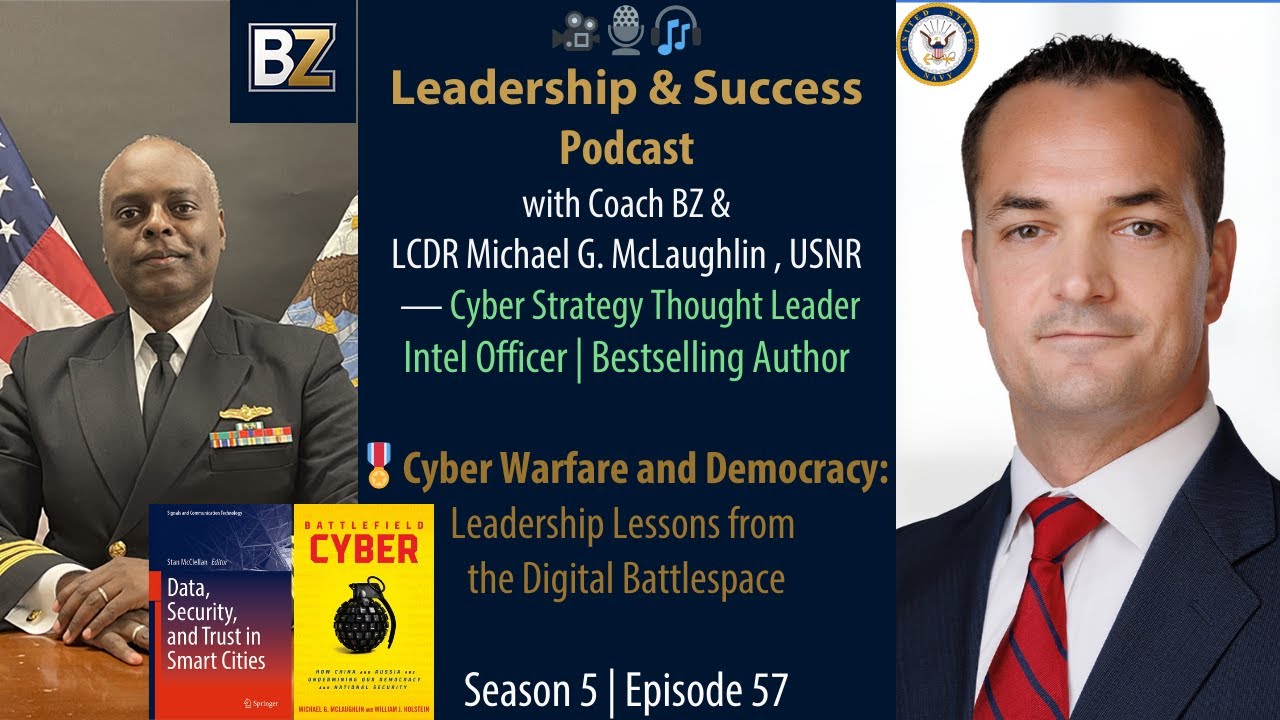
LCDR Michael G. McLaughlin, a naval intelligence officer and cyber strategist, explains why cybersecurity is a national security issue. China, Russia, and Iran use deepfakes, phishing, and data harvesting to attack U.S. infrastructure. He recommends password managers, multi-factor authentication, and a federal data-privacy framework to build organizational resilience.
Chapters
Hi, I'm John Maxwell. When the top companies in the world are looking for trainers, speakers, and coaches, there's one name that stands above the rest, and that's Maxwell Leadership. Our certified team members have gotten proven results for companies all over the globe, and our reputation, I'm proud to say, is second to none. Some of our members have risen to the top of their profession, including the the one you're going to meet today. I proudly introduce you to my friend, Bob Fabien Zinga.
Hey Michael, I'm having a lot of trouble with LinkedIn. YouTube is working, but LinkedIn is not connecting for some reason. So I'm going to change the way I connect on LinkedIn because that's where most of the people who watch the show connect with us. Let me just use a post instead of the event.
Sure.
Sorry for that. I'll be right back.
Hi, I'm John Maxwell. When the top companies in the world are looking for trainers, speakers, and coaches, there's one name that stands above the rest, and that's Maxwell Leadership. Our certified team members have gotten proven results for companies all over the globe, and our reputation, I'm proud to say, is second to none. Some of our members have risen to the top of their profession, including the one you're going to meet today. I proudly introduce you to my friend Bob Fabien Zinga. Welcome to the Leadership Success Podcast with your host, Coach BZ, where we help you lead with purpose and succeed with impact. If you're ready to grow into the kind of leader others want to follow, this podcast is for you. If you're determined to elevate your success and leave a lasting legacy, this podcast is is for you. As my mentor, Dr. John C. Maxwell, reminds us, everything rises and falls on leadership. Our goal is simple: to inspire you, challenge you, and equip you with insights that can transform the trajectory of your leadership journey. Welcome aboard to another episode of the Leadership and Success Podcast with Coach BZ. I remember running around on a track in my hometown with my dad, who came home from work early. We didn't hear a plane in the sky, and then suddenly these F-16s start screeching across, flying CAP over Pittsburgh. And so the combat air patrol is looking for something because there was the plane that had just gone down in Somerset. My guest today is the attorney and cybersecurity author Mike McLaughlin. Mike has spent his career in public service and national security. First as an officer in the United States Navy and now as a leading policy advisor to federal industry. The Chinese aren't just focusing on Lockheed and Northrop and Boeing and, you know, all of the major primes that we think of when you think of defense industrial base. And their requirements may be a widget that goes on to the helmet of a pilot in the F-35. And so it could be a small business that's developing that widget. They're not going to go through Lockheed and their giant sock They don't need to. They go after that small business. Mike recently released his book Battlefield Cyber, which tackles the reality of foreign adversaries and their efforts to undermine American democracy through exploitation in cyberspace. Our conversation spans that topic, his path to public service, and the future of cybersecurity in this brave new world. Cyberspace is just dramatically different from anything we've seen, everything, anything we've dealt with in the past. The reason being is because our adversaries are treating it in a different way. If we were in the traditional physical space, the vast majority of the attacks, they would have required somebody to be physically in our country. The whole reason why you use cyberspace is to stay below the level of armed conflict. It's a fascinating conversation that I'm excited to bring to you. And now, Mike McLaughlin.
Welcome to the special edition of the Leadership and Success Podcast. Do I have a guest for you. Today is going to be a very insightful conversation with Lieutenant Commander Michael McLaughlin. And before I introduce him, as you guys know, we always start our show with our moment of gratitude. So really quickly, what we do is we want to be grateful for one thing every single day. The way I like to do this, maybe close your eyes, take take a deep breath, put yourself in your happy place, and think about one thing you are grateful for today. And today, like many days, I am just grateful to still be alive, to be in the land of the living, because as long as I am alive, there is hope for me. All right. So let me see if I can properly introduce our guest speaker today. So today I will have a really great leadership conversation with Lieutenant Commander Michael McLaughlin, who really brings a rare blend of military service, cyber strategy expertise, and legal insight as well to the national security conversation. As a naval intelligence officer, information warfare in the US Navy Reserve, and the leading voice in cybersecurity policy, he has spent years examining how cyber operations, disinformation campaigns, and emerging technologies are reshaping the global security landscape. He is the co-author of the influential book Battlefield Cyber: How China and Russia are Undermining Our Democracy and National Security. In addition, his scholarship explores the importance of data security, digital trust, and cyber governance in a connected world, including his chapter on Data Insecurity: The Imperative of Trust in the Data Security and Trust in Smart City, bestselling book. So Mike's work sits at the intersection of cyber warfare, national security, and leadership, making this a must-watch conversation for leaders navigating today's digital battle space in the age of AI. All right, without any further ado, please help me welcome to the Leadership and Success Podcast, the one and only Commander Michael McLoughlin. All right. Good morning, Michael. It's really a great, great pleasure to be speaking to you today. But before we get started, what is one thing you are grateful for today?
One thing I'm grateful— there are a lot of things I'm grateful for. And so picking out one thing makes it a little bit difficult, but I would say family primarily. I'm very, very thankful for my family and all the support I get.
That is so, so wonderful. We are really nothing without our family. Is there maybe something about you that most people may not know when they first meet you?
That most people may not know? I can probably eat more Korean barbecue than anybody you know. I think that's the one thing that puts me apart from most.
That is really, really fascinating. And of course, you are an intel officer in the Navy Reserve. I am an IP officer, we are both part of the information warfare community, and it's kind of rare because there are people in the intel community who have absolutely no knowledge on cyber whatsoever. I have worked with them. So it is really great that not only you are a cyber expert, but you are also a lawyer. So you have expertise in the law. How did that come to be? Because that's very unique.
Yeah, it's actually interesting. And so when I was in the Navy, I was standing up a lot of programs for counterintelligence and human intelligence. Intelligence across the Navy. Historically, the Navy has— had not really been involved in CI and HUMINT. As I was coming up, I was standing up what's called the N2X shops, or, or the division within the larger N2 construct, or the intelligence directorate constructs at various fleets, and standing up the N2X programs. A lot of that required the explanation of policies, laws, and regulations to very senior officers, 3, 4-star admirals, so that they would feel comfortable in the fact that I had teams that were deploying to other countries, breaking those countries' laws and doing it intentionally. Uh, those, those admirals were, were a little bit gun-shy when I told them that I was going to have junior sailors that were going to be carrying pretty advanced SIGINT equipment into our partner nations, uh, under, under, uh, clandestine operations or conducting clandestine operations. So I had to become very, very familiar with the laws and policies and be able to spout them off. But I saw the value of, of the law, uh, through that process and the value of being able to articulate it effectively and how that can advance operations and interests. And that really drove me towards using the law for that end and really for that purpose, uh, which also drove me into, into doing cybersecurity law.
That is really fascinating. So you've served as a commander, US Navy Reserve, cybersecurity strategist, attorney, and bestselling author. What originally inspired your passion for national security and cyber strategy? I believe you came through the academy, right?
I did, yeah. And so I went to the Naval Academy, and now, uh, I remember distinctly, and on a number of podcasts, I've talked about this, where I have a very vivid memory where I was running around a track when I was in middle school. And this is when, when the 9/11 attacks occurred. And I remember seeing the Air Force flying combat air patrol over Pittsburgh, where I'm originally from. And that moment really transformed my life. And it was one that changed my, my goals, my passions from focusing on me, focusing on my own aspirations. It really transformed it into something that I wanted to, to do public service, and I wanted to get into, primarily into the military. Um, I, I told my dad at that point I wanted to be a Marine sniper, uh, because that seemed like the coolest job in the world to me. He told me, why don't we go take a look at the Naval Academy? We did, uh, and I had a great time, a really great experience at the Naval Academy. Graduated the academy, got into, uh, the intelligence field, uh, and really enjoyed that. And, and ever since, I've been— I've had great opportunities along the way, and I feel like every time there has been an open door, I've tried to take it, uh, and it's led me to some really interesting experiences.
That is really quite remarkable. So being from the Academy, I bet you can finish this phrase: Go Navy!
Beat Army!
Okay, all of my soldiers, don't get mad, don't get mad, it's okay, it's okay, keep watching, keep watching. I've actually probably interviewed maybe, I don't know, a dozen senior Army officers. None of them have accepted my challenge. I've challenged them to accept a t-shirt from me, I will pay all expenses, no, go Navy, beat Army, I will ship it to them, whatever size, nobody wants it. But anyway, it is all good. Now, uh, another thing you, you mentioned, the, the Marines, they are kind of special. I mean, there is military, but the Marines, they kind of like a different breed, you know, the few, the proud, the Marines.
It's special. Is special is one way of putting it.
Yeah, yeah. Really, I mean, I've been in the Navy, what, 21 years now? I have never in my entire career seen a single fat Marine, not one. Yeah, it's incredible.
God bless the Marines. The Marines have a great ethos. And I graduated the academy with hundreds of Marines, and they are some of the best people in the world. Their mindset is second to none. And quite frankly, the warrior ethos that the Marine Corps has is something to truly be admired and something that all services should aspire to.
Absolutely. And they could probably kill you in a thousand different ways, but God bless them. So for many of our listeners, especially young officers or cybersecurity professionals, What early leadership experiences most shaped your approach to leadership today?
So I would say that I learned very early on that leadership is really about accountability more than it's about authority, or more than it's even about rank or titles. It's really easy to think of leadership about that, about being about rank or position, being a partner in a law firm, being a commander, being a captain in the Navy. In reality, what really shapes you is the situations where people are looking to you for clarity when things are uncertain. Those experiences really teach you pretty quickly that your job is to bring calm, direction and trust in any situation. If you're able to do that, and you're able to articulate your vision while also taking care of the people who are entrusted to you and who are trusting you to lead them, that's real leadership. And I've got innumerable examples where I've seen both good leadership and bad. Unfortunately, you learn more from bad leaders than you do from good. But I think really it's about taking care of people. It's about having vision, understanding, and it's about mission accomplishment.
Now, I know the way the Navy promotes is not perfect, but I think it's one of the best ways they do it. I know I went to Millington when I was an O-4, and I've seen it firsthand. However, in my own experience now, yeah, maybe I've got maybe one or two bad leaders since I was enlisted, but for the most part, people are really great and they really do care. For their sailors. They do live by our leadership mantra, right? Mission first, but people, people always. That is really incredible to see. Can you, um, what leadership lesson from your naval service still guides your decision today as a lawyer?
Uh, there are a couple. Uh, discipline is one of the biggest, and the ability to stay disciplined to, to even when things get hard. Um, and When I say discipline, it's, it's understanding that there are things that are going to take months or years to accomplish, and staying the course on those things is, is one of the most challenging things for anyone to do. I mean, we live in a society where everyone wants instant gratification, but having the discipline to wake up every single day and work towards something that the end state may be months or years off requires a lot of discipline. And that's something that I, I truly value, and it's something I always work towards. I don't want to say I'm perfect at it, but I always work towards that level of discipline. The other thing is just being grounded. A lot of when, you know, you talk about bad leaders, and those bad leaders are the ones that I look at as they fly off the handle very quickly; they lose their temper; they blame people around them. Being able to stay grounded, especially in chaotic situations, that's an area where I also in continuing to work towards, especially in very stressful environments. And then the finest one, final one is just honesty. When, when you are faced with a tough decision, being able to take responsibility for your actions, to stand up and say, "Yeah, I did that," and stand by what you've done or what you've said is a critical component. And that's another area that I really value in other people. And it's another area that I really focus on for my own self- Bro.
Really, all of those align very well with our Navy core value of honor, courage, and commitment. That's so powerful. Let's talk about your best-selling book, Battlefield Cyber, which you co-authored with Bill Austin, How China and Russia are Undermining Our Democracy and National Security. Why did this book have to be written?
So when I was getting out of the Navy, or getting out of active duty, I should say, so last 6 years I was on active duty, I was at US Cyber Command, and I served in various roles, including senior counterintelligence advisor, where I was advising the command on all counterintelligence activities conducted by the Department of War in cyberspace, as well as the chief of counterintelligence and human intelligence for the Cyber National Mission Force, assisting in, in CI human support broadly to the CNMF. In those roles, it was always— I valued it, and I found it to be a blessing because I was able to really peek behind the curtain and understand what the risks, what threats, what the overall battle space truly looked like. What I recognized was that there was a significant disconnect between what the military and the intelligence community understood to be the truly the battle that was raging in our networks and what the private sector saw and what was important to them. So the purpose of the book was to try to bridge that gap and really focus on how do we allow network owners, uh, company executives, board members to see the forest for the trees and understand that there is a, a spectrum of warfare that we primarily look at in the US through a soda straw. And we say, well, you know, cyber warfare is something the equivalent of which in the kinetic space would go boom. Well, that's just not how our adversaries look at it. They use malign influence. They use intellectual property theft. They use proxies and criminal groups all the way up to and including destructive cyber attacks. But that whole spectrum, the only point at which the military is getting involved are those destructive cyber attacks and to defend the private sector. Everything leading up to that point is a really a gray area. Mm-hmm. And, and network owners are, are left to their own devices. We're seeing this play out in real time right now where you've got the Iranian regime targeting major US, uh, medtech companies and targeting critical infrastructure. You've got China targeting critical infrastructure operators and have been for the last 2.5 or 3 years. You've got Russian intelligence services targeting the software supply chain. All of these companies are not protected by the military in the same way as if they— these countries launched a cruise missile, they would be protected by the military. And as a result, companies need to really understand what is the geopolitical landscape, what is this battlefield, and what's their place in it.
That is really powerful. We have an active member of our tribe, Daniel Young from Midland, Florida. He has a question for you. He says, Commander McLaughlin, It's an honor. In your book Battlefield Cyber, you talk about the enemy inside the gates. As a system architect focusing on behavioral infrastructure, I am— let me see— I am focused on how do we train civilian leaders to build a human firewall that is as resilient as the military systems you've advised. Thanks again for your time and support. So how do we do it?
Man, that's a terrific question, and to be honest, that is probably about a $200 million question.
Yes.
Ultimately, we— you can have all of the technology solutions in the world from a cybersecurity perspective. And if one person clicks on a phishing link or puts their credentials into a phishing site, you're going to be compromised. And it really is— the threat actors are simply looking for an opportunity to utilize exposed credentials against you, log right into your environment with those credentials and with those privileges, and then escalate, move laterally, exfiltrate data, or deploy backdoors, as is their intention. That human fabric, that human element is so important. It's so critical. So training across the board is really, really important. These types of training though, and, and I'm, I'm sure we've all gone through cybersecurity training where you're watching a video and you just click next, next, next. You're doing 6 other things at the same time. And then at the very end of it, there's a test or a quiz. And if you fail it, you go right back to the, where it was in that section and you then retake the test or you remember the answer and you essentially brute force the test. That's not valuable training. And so from the military perspective, when we do training, you train in the same way as you fight. And so whenever I'm working with clients from a legal perspective, we do what we call a resilience program. Resilience program is building out, working with the client to build out their incident response plan, their ransomware playbooks, their business email compromise playbooks, and then putting the team through the paces with very tailored training scenarios that are built to the company, built to their team, built to their industry and the threats that they're facing. And then we also include the C-suite. We also include the board. We make sure that they understand what the decisions that they're going to have to make at any given time so that they really have that type of buy-in. Because ultimately, cyber is not just an IT problem, it's an HR problem. And ask anybody who's found North Korean IT workers in their environment. It's very much an HR problem.
Yes.
But ensuring that the entire organization is on board, that's real training. It's not this, the click-through, uh, train as you go. That we've been doing for years. And if you do that, that really helps to safeguard the human layer. But ultimately, humans are going to continue to be the weakest link, especially as we move into more of an AI-based culture or AI-based technology. Yes, humans are going to be the weakest link and we need to continue to train them. We also need to take certain decisions out of their hands and make sure that certain decisions that need to be are either done through multi-factor zero trust architecture or they're done by machines themselves and those machines have very specific protocols that cannot be tricked by social engineering.
That is very, very powerful. Yeah, that's definitely the— I used to say million-dollar question, but you raised it to $200 million question. That is so apropos. So many people, they do think that cyber threats are purely technical. You kind of alluded to that earlier. Why do you argue that cybersecurity is fundamentally a national security and geopolitical issue?
Well, because it's being used as an instrument of power by our adversaries. And just point blank, our adversaries view cyberspace as a battlefield. And again, I know I'm really hammering this book. And so if you want to be the two people that buy it this month, by all means, I will take those $12 in royalties. Now, but really, when we look at cyberspace, we need to begin looking at it through the lens that it's not just an avenue, it's not just a, mechanism for commerce. It is a battlefield because that's how our adversaries are looking at it. And then understanding how our adversaries are utilizing cyber is also critically important. And so when I look at it, when I look at cyberspace, I look at all of the perils and in the way in which our adversaries are using various things. And it's not just cyberattacks, right? It's malign influence. And TikTok is my favorite example of this. TikTok has 160 million— and this actually may be dated information, they may have more than this— now, but 160 million active daily users in the US alone. They are collecting more data than any other social media platform in the world. They are collecting— they're collecting your clipboard data, your contacts. They're taking facial recognition. They're taking your gait from all the dances. And I know, Bob, you're big on the TikTok and you love those dances.
Yes.
But they're taking all that information and they're also understanding where you are geographically. And so TikTok and its parent company ByteDance, ultimately, and this was the risk, they can profile individuals based on all of these different data points. Now that alone, if you're training an AI model, let's say that you are, you're the PRC and you're training an AI model such that you can individually target people either for espionage or for, or for, for subversion or, or other various means. Yes. You've got a great tool to do so. But let's flip that even just a little bit. Let's say that the PRC wanted to change the overall composition of Congress. How would they do it? Well, they would target individuals of specific demographics in key jurisdictions in swing states. And I guarantee just using TikTok and sending very specific messages to these individuals, you can discourage them from voting, you can encourage them to vote and to come out and vote and make sure that it's top of mind for them. But you would be able to change the composition of Congress. You could swing it from a Republican to a Democratic Congress simply by using TikTok and the information that they have. That's cyber warfare, but we don't use it or think about it in that context, and we need to start doing that.
That is really something. I think the first time, uh, I think it was in 2016, right? It wasn't TikTok then, it was, uh, Faiz's book, and there were definitely a lot of proofs that some people may have done so using social media to really direct, almost as if we had become some type of, I don't know, I don't want to say zombie, but they could use your psychographic data to really influence you to vote or not vote, motivate you. They knew you better than you actually knew yourself. That's— isn't that just incredible, the age we live in today?
Yeah, it's incredible. I think there was a study done a few years ago that by clicking like 19 times on Facebook, the Facebook algorithms would know you better than your spouse. Wow.
That is—
if you think about the power that is within the hands of big tech companies, and then you take those big tech companies and number one, here, here's one issue that we have Ad tech and all of the data that's being sold or generated by big tech companies, as they sell that data off to advertisers, that data can also be purchased by other countries. That data can also be purchased by intermediaries and go to directly feed their AI models. So it's not just that TikTok is a threat. Technically, Facebook can be a threat, Instagram can be a threat. It depends on what's happening with that data. But all of those data points can be used for ill and can be used to significantly undermine our national security. That's why it's really critical to understand what What information are you putting out into the ecosystem? What information about yourself? What digital detritus is actually being put out about you or that you're allowing to go out? Because you don't know where that goes. You lose control of that data as soon as it leaves.
Wow. This almost makes you want to turn off your computer and go back to paper and pencil, which we're never going to do. So what do you believe is the solution then, especially with our young people, our teenagers?
What should they do? Really, it's education, um, for teenagers in particular. And there's— it is absolutely terrifying growing up today, um, from, from, from a parent's perspective. And I've got, I've got 3 kids, one of whom is a newly minted teenager, but it's absolutely terrifying. And if you look at social media and the, the influence that social media can have, not only just on— I mean, you take it from one perspective Teenage females in particular are one of the most, one of the most at-risk populations from a psychological perspective on social media. It's body dysmorphia. It's— they're seeing all of these things on Instagram. But not only that, you've got young females and female teens who are being aggressively targeted by malicious actors. And if you've never heard of the group called 472, I highly encourage you to look them up. This is a group that intentionally take— goes through data sets, they breach networks, and they then take information about individuals, primarily targeting young women and young men and teenagers, and try to induce them to engage in self-harm on video through extortion. They've had a number of kids kill themselves on video because of pictures that they have taken through data breaches or that they've found in data breaches or medical records. That they have or histories of self-harm that they have been specifically looking for. And this is a global crisis. But this is something that if you're a parent, being keenly aware of what the risks are to your kids is very important. These aren't like the days when we were going on AOL Instant Messenger and just messaging back and forth with our friends. There are serious and very significant issues that parents need to be aware of. Schools need to be educating kids on the proper use of social media. But also on the risks that are there. And then as we move into AI, wholly different story and we can dive really deep into that. But it's, I would say, the education piece and parent involvement are the two critical aspects of growing up right now.
So what, just at the high level, what do you think is the impact of AI on cyber threat and risk today?
It depends on how it's used, as with anything. And we're going to see adversaries and aggressors adopt technology a lot quicker, and it's therefore going to be to their advantage. I think it was either last year or about 18 months ago that we saw a $25 million wire fraud, wire fraud occur as a result of a deepfake. This was in the Far East, and you had a CFO deepfaked in a video on a Teams call, direct a controller to transfer $25 million. The controller went through all of the right processes of following up and checking, but that deepfake video really did it. And we're gonna see more of that. We're gonna see more adoption of this type of technology. We're seeing incredibly tailored spear phishing emails that are geared towards individuals based on information that you're seeing through their social media. We're having, we're having AI capabilities go through call trees and trying to specifically identify overseas call centers so that they can try to steal data through voice calls that are AI-generated, or so that they can try to elevate their privileges or obtain credentials or reset passwords using AI voice calls, trying to get to the human and get us back to that human layer, trying to get to the human such that they can attack the weakest link and gain unauthorized access to these, these organizations.
Incredible.
Yeah. And so AI, understanding that these risks are just advancing at a pace we've never seen, adopting AI capabilities that are going to combat them is also critically important. And so for network owners, recognizing that we are moving at machine speed, we need to have defenses that are also moving at machine speed.
True. And when we talk about deepfake, I remember maybe, you know, 4 or 5 years ago, it was relatively easy to tell if something was AI-generated or not. Like, most people would have like 6 or 7 fingers or something like that. But today it's almost perfect. I mean, even expert like myself, it's very difficult to tell if I don't have specific tools. It's crazy.
I'll encourage you, and whenever you're done, this is your fun activity or fun homework for the day. Google Will Smith eating spaghetti. It goes back to 2022. AI developers started creating deepfakes of Will Smith eating spaghetti, and when they did it, the fork would go through his mouth and all the way through his head. The spaghetti would be everywhere. It would look like he had two noses. At times back in 2022. You do it now and it's Will Smith having a full-on conversation with someone else explaining the texture of the spaghetti. You would think it was coming from an actual video of Will Smith. That's where we are and that's how fast AI moves.
Believable. Unbelievable. Yeah, because I believe even the chief AI architect of Meta got duped. I think it was a deepfake about about ICE officers in Minneapolis or something. He thought it was a real video, but it was all fake, all about propaganda. And it looks like a platform like X now, used to be Twitter, is extremely bad for misinformation, probably one of the worst ones in America, it seems. So what do you recommend the public, people listening to us now, what can they do as far as cyber hygiene and maybe do better work with their social media data?
There are a number of things. The best thing from an individual perspective, I'll give, I'll give 3 things that I would highly recommend. The first is use a password manager. Don't reuse your password across multiple platforms. Just use a password manager. And there are a lot of free ones that you can get through mobile applications. You can use them if you have an iPhone. Apple automatically has it a password manager that it recommends, but use that password manager to create complex passwords that are unique to each profile that you have. Do not reuse passwords. The second thing is, where multi-factor authentication is available, use it. And this is in your personal life, whether it's your Gmail account, whether it's your financial institution or otherwise. Multi-factor authentication is really important. The vast majority of incidents occur because threat actors or unauthorized parties, hackers, simply log into your account because they have those credentials. Those credentials have been compromised somewhere else, or they're simply able to brute force because it's a weak password. Having strong passwords through a password manager and multifactor really is going to protect you on your personal accounts. The second thing is what— understanding what your overall digital profile looks like. If you're somebody who is constantly on social media, you're posting pictures of your kids out there, you're posting pictures of your vacation. Every time you leave your house, you're taking pictures of the food that you eat in the restaurants that you're at.
That.
If you would go and take the photos, and, and I, and this is another thing I would challenge you to do, take the photos that, that you see online of yourself. Take a photo, put it into ChatGPT, and say, tell me where this photo was taken. That will show the location. So now if you're on Instagram and you're posting things in real time about a restaurant that you are at, and you know, like, maybe it's 40 minutes away from your house, you take that photo, you put it on Instagram, somebody who follows you on Instagram takes that photo puts it into ChatGPT and determines what restaurant or what, what corner you're at or what building you're standing in front of. They now know exactly how long they have to loot your house.
Yes. Yes.
And that's terrifying. And again, this— these are not necessarily cyber threats. They're threats that are perpetuated by, with, and through cyberspace. So those are the types of risks. And then the third thing I'll tell you, do not scan QR codes. Avoid them like the plague. It is the easiest thing in the world for someone to go put a QR code sticker over a parking meter and have you give them their credit card information immediately. And they do— the scammers do this all the time.
That's really terrifying. And that's why, you know, if you have a modern phone, which everybody has these days, whether it's Android or Apple, you can turn off geolocation when you take picture. And my wife used to have a problem with me because every time we went on family vacation, I'm like, no, No, we're not going to talk about it until we come back. Once we are back, then you can go Facebook, Instagram, do whatever you want. But until we come back, absolutely no one in our social media circle would know where we are and what we are doing. Because yeah, if you think about it, by saying, hey, I'm away in Hawaii adding funny stuff, that means you're not at home. That means, oh, maybe I can go there and break into your house and steal some stuff. So it's really crazy that awareness and training, like you said earlier, that is so, so important. So what lesson should policymakers and national security leaders take from the cyber strategies used by adversaries like China and Russia, you think?
Well, I think it's recognizing that their strategy primarily is to undermine not just our military, but undermine our economy. It's to undermine not just our economy, but people's faith in the government itself. And if you look at— and right now, unfortunately, I think we're probably as divided as a society as we have ever been.. And when you consider all of the different things that are going on, but inside our country right now, and then broadly, and it's really disappointing. And when you look at our federal government and the challenges we have legislating, it is, it's a problem. Well, a lot of those flames are fanned by adversaries through malign influence. There is a report of Russian actors who are engaging in a malign influence campaign that actually set up both a protest and a counter-protest in Texas. So you had two sides of the same— two sides of the street, both of which were orchestrated by Russia. And they almost came to blows in the street as a result of these flames of dissent being fanned by the Russians. Recognizing that that's what they're trying to do is really important, but also looking at it from an economic perspective. Now, the US, we don't have cyber actors or our cyber operators at the NSA or at Cyber Command or elsewhere going and targeting Huawei so that we can steal technology and give it to Verizon to advance our 6G capabilities. That's just not how we operate. That is absolutely how the Chinese operate. The Chinese went after Nortel in the, in the early 2000s, stole their 5G technology. The company went bankrupt, went totally under, and as a result, you have Huawei as one of the leading 5G manufacturers in the world directly attributed to Chinese nation-state cyber actors and espionage stealing intellectual property from a private company. And when you think of that in context of this is not military on military, this is government and military on the private sector that our government has no way of defending against. That understanding and shifting that means that we need to use everything in our— at our disposal, the entire dime-filled model in order to counter and in order to respond to aggressive acts in cyberspace. You look at Volt Typhoon and Salt Typhoon. Volt Typhoon targeted our electric grid. Salt Typhoon targeted our telecommunications system. We had the FBI director and the CISA director telling CEOs in this country not to use SMS messaging and instead to use Signal because we couldn't trust our telecommunications infrastructure. Yeah, think about that. Think about what that means. And what did we do in response? There were no sanctions against China. There were certainly no military, military strikes against China in response. And so what is China to think? What's our red line? Because they've now accessed our critical infrastructure in multiple sectors with impunity, and we haven't responded. So allowing other nation states to do that forces them or gives them the understanding or the, maybe the, the true or the false belief that they can continue conducting these operations. And one final thing with, with this, that's not going to stop. And, and China is a really great example, and outside of cyberspace, China is a really great example that if you allow them to take an inch, they will take a mile. And the inch that we've seen, the example as a Navy guy, South China Sea and all of the island building in the South China Sea. When China first started dredging the reefs like Mischief Reef or the Paracel Islands in the South China Sea, you had the Philippines complaining, Indonesia was complaining, Vietnam was complaining. We didn't do anything to stop them as an international community. And now they're hardened bunkers on these, these very large islands, one of which is the size of the Beltway in, in DC or the inner Beltway in DC where we've got, they have advanced weaponry, they've got surface-to-air missile sites, they've got their most capable strike fighters are all located on these islands that they created, that they're now saying this is Chinese territory. Wow. Because we didn't do anything in the early 2000s, they now have military bases in the South China Sea. And what are we going to do now? We're, we're essentially doing freedom of navigation operations, saying we don't, we don't believe in your sovereignty here, and we're going to shake our finger at you as we go by. Yeah, that's not diplomacy, and that's certainly not extending our, our military capability to try to keep an adversary in check. If we're not going to do it in the physical sense, we're certainly not doing it in cyberspace.
Wow, we definitely live in a different, different world. All right, we having too much fun, we are already running out of time. Uh, out of this book here, let me ask you this: what is the most important takeaway you think from the book? If you had one, what would it be?
If I had One takeaway, I would say the biggest takeaway is that cyber conflict, when we think of cyber, people, if you're not technical or if you're not really involved in cybersecurity or in the military, you think of cyber as somebody else's problem or that it's some future scenario. It's gonna be this end of days and it's gonna be a 9/11 or it's gonna be a Pearl Harbor type event. What the biggest takeaway is, we are living in an ongoing war in cyberspace, and at its core, it's a contest over power, over trust, over resilience, and it is an attack on our, our basic infrastructure, the fabric of our society, and we're being undermined on a daily basis. That war is critically important for everyone who accesses the internet. If you connect to the internet, you're part of this battlefield. Understanding and recognizing that is a critical component of citizenship in the 21st century.
Well, with the time we have left, let's talk about your second book because I think this is so critical as well. Data Security and Trust in Smart Cities. You wrote a chapter, Data and Security: The Imperative of Trust. I guess the first question I have for you is, in your chapter, right, what we talk about smart cities. First of all, what exactly is a smart city, but also why does cybersecurity security matters so much in that context.
Yeah, so smart cities— when we built cities going back to, you know, to the Roman days, but certainly modern cities that we started to really construct in the US, and think like 1950s when we started to construct the suburban areas outside of cities and we had the suburban sprawl, we did it based on geographic features, we did it based on the size of the roads and really, really physical infrastructure. As we move into more of the how do we architect cities that are going to be advanced, that we can understand what the flow of traffic is going to be, how do we optimize the flow of traffic, how do we ensure that we reduce congestion or we reduce CO2 emissions or light emissions. All of those things, uh, have to do with data. And so smart cities are a way in which we can control all of these various aspects of operations of cities such that we can gain efficiencies, we can optimize cities through the collection collection of data. So this is— these are the cameras that we're seeing on stoplights or on, on streets. This is the information we're collecting from mobile devices to understand what the population density is at any given time, from vehicles that are traveling the roads themselves, all the way to the roads and having sensors in the road so we can understand what is the breakdown of certain types of asphalt versus in certain areas given weather conditions, given the overall traffic conditions and being able to really gain efficiencies from that, all of which is critically important if we want to make sure within the 21st century that we can advance things like flying cars or autonomous vehicles realistically.
So as cities become more and more connected, it looks like everything found its way to the internet, even people's refrigerator, microwave. It just doesn't make any sense. So transportation system, energy grid, public service, on and on and on and on. What are the biggest security risks, you think?
I, I would say the biggest security risks, biggest security risk that we have in the 21st century is data. Um, and, and bear with me because most people would say, well, the biggest security risk is China, or it's criminal actors, or it's Russia. The reason I say the biggest security risk is data is because in the 21st century, and particularly as we continue to move at pace towards very advanced AI capabilities and really move move towards a large quantum computer, everything that we do is predicated on data. Data itself is— and there's a famous quote that data is the new oil, right? It's that valuable. The challenge that we have is who is going to collect quality data and make it available to AI developers such that they can innovate and allow the US and our Western allies to keep pace with China and win the AI race. Currently, China is collecting more data than anyone else in the world. They've got 1.4 billion people and more cameras in Beijing than any other major metropolitan area. And through China's Belt and Road Initiative, they're exporting these safe smart city technologies to countries and to cities all over the world, all the data of which is being funneled right back to Beijing such that they can advance their AI models. And they're doing this at scale, and they're doing this in a very effective way. We, the US and Western allies, by contrast, are restricting access to data. GDPR makes it very difficult to do anything with personal data if you are, if you're a resident of the EU or if you're a company collecting data from individuals within the EU. And within the US, we've had a number of antitrust and Sherman Act suits brought by Congress against our major hyperscalers. Those are the same companies that have access to that data that are able to advance our innovative capabilities. But it's not enough. Think about all of the research and development that's done in universities and research institutions, commercial entities nationwide. All of that data sits in silos currently. It is not made readily available to AI developers. If AI developers are able to license that data directly from universities, then we can advance our capabilities. And let me be very clear, you're not gonna cure cancer cancer getting drunk on Reddit threads. You're going to cure cancer by going through clinical studies and treatments and photographs and oncology reports. Yes, all of that data needs to be made available through proper licensing channels and in respecting the privacy of individuals and respecting the intellectual property ownership rights of the owners, but licensing that data directly to AI developers so that we innovate at scale and innovate at speed. The one thing that we have over China, because we don't— we're not going to beat them on numbers, we're not going to beat them on the quantity of data. We can beat them on the quality of data because we've been doing research and development into advanced capabilities for decades. China has been stealing our finished technology and reverse engineering it. If we can take all of that research that underpins all of our advanced technologies and use that to train models Imagine what we can unlock.
Wow, that is really remarkable. And also for everyone watching, so I've had two city managers on the podcast already. One of them, my former teacher, Dr. Casey Luscious, and also a former city manager, is a colonel in the Army. I think what we're discussing is very important because pretty much everybody lives in a city now. We are really truly connected. Connected to the internet no matter what we do. Now, you do emphasize the concept of trust in your chapter of the book. Why is trust such a critical component of digital infrastructure?
Trust is a critical component because if data is poisoned or if data is not the quality data that you need, then the model is going to be either— it won't work as you need it to work, The model itself is going to have bad output. And there's always the, the old adage, garbage in, garbage out. And so trust in the data is what's critically important. In October, Cornell University published a report that said as few as 250 documents will destroy a large language model of any size. You can get 0.01% of that data, and if it is poisoned, your model will not work. That decimal dust is something that quality control on data is not going to check. It's not going to find. So making sure that you truly have integrity in your data and like in cybersecurity, we always focus on confidentiality of the CIA triad, right?
Yes.
Mostly. I don't say always, but mostly integrity is the area that we really, really need to start focusing on from a data perspective to ensure that we understand the provenance of that data from the point in which it's collected to the point at which it goes into an AI model.
Wow, that is really something. I guess the last question I'm going to ask you about this chapter of your book is, what about for city leaders and policymakers today? What do you think they should do to ensure secure digital transformation, or at least think more along those lines?
Yeah, they need to build it in from the beginning. Security isn't something that you can just bolt on, and certainly when it comes to AI, If, if we go in and I've had these conversations with a number of, of policymakers at the federal level as well as folks within the executive branch, as we, we continue apace to adopt AI capabilities and new technology and, and software solutions and AI solutions, we are getting to the point where we're starting to have our AI tools, the output of which is training the next AI tool, and you're creating a black box daisy chain chain of data. If you don't have quality data at the outset and you're not able to point to that and say, we have strong procurement standards, we know the provenance of this, then you're going to have 5 years from now when the models are completely falling apart, you're going to have to go back and do a full rip and replace of all of the AI technology, all of the models that you're adopting right now. So right now is really critical. What I will tell you when we say building security from the beginning If everybody's starting from scratch, it would be a lot easier to, to implement to zero trust architectures. The challenge is nobody's starting from scratch, and so everything we're doing is, is a bolt-on for cybersecurity. In AI, we have an opportunity to truly start from scratch and build security and secure by design into our AI models, and it all starts with that data. So my, my push for city leaders, my push for decision makers, is ask the question, where did my data come from. Wow.
That is so powerful. Now, we have about 8 minutes left. For this last segment, I want to understand the leadership principles that have helped you be as successful as you are. I'd like to start with this question. What is one of the greatest lessons you have ever learned, whether it's in leadership, in life, or in general?
Oh, greatest leadership lesson. Don't rush to your doom.
Yeah, I've heard that before.
That is my favorite phrase, and I have used that time and time again. There is always time to pause. There's always time to think clearly through a decision. And sometimes an 80% solution is all you're going to get. But if you're getting from 20% to 80% simply by taking a step back, closing your door, writing it out, that 60% delta can be the difference, in some cases can be the difference between life and death. But don't rush to your doom. Take time to make good decisions. And everybody who works with you, everybody who works for you will greatly benefit.
Wow. Now, what do you believe is the secret to your success, right? You are a Lieutenant Commander in the US Navy, an excellent lawyer, but also a bestselling author. So you've succeeded in so many areas. Why do you think that's the case?
Secret? Now, I just like anybody else, right? If I always hate people that say I'm an expert and then they call themselves expert, I always say like, if you're calling yourself an expert, you probably aren't one. Someone else should be calling you that. I also, I think success is a journey. And so I wouldn't—
I am calling you that for sure. And I have proof, right? I have lots and lots and lots of proof. You are the expert.
Well, I appreciate that, Bob. No, but I think I look at success as a journey, and you're never— your success is never final, right? And I'm going to use a trite phrase: success is never final, failure is never fatal. But success is a journey, and anything you do, love what you do, bring passion. But sometimes passion isn't enough. Taking passion and transforming that into an obsession for what And I would say, and I think my wife and family would agree with this, I truly do become obsessed with things that I'm passionate about. And transitioning from passion to obsession is where the discipline comes in. It's where the focus comes in and allows you to do things that you never thought you could. Wow.
That is a great answer. Thank you. And what type of things are you learning these days? Leaders are learners.
Leaders are learners. Right now I'm really focused on, on understanding the different types of artificial intelligence and the overlap between artificial intelligence training data and then the different forms of AI that come from that. And understanding that, that AI is not just a monolith, that you have neural networks, you've got large language models, you've got GPTs, you've got agentic AI. Each one of them has a different use. Understanding what the different uses are and understanding what the data is that goes into them so that you can secure that data appropriately. And then the other thing I'm looking at is advanced cryptography, primarily post-quantum cryptography, and in preparation, advising clients on how do you best prepare for Q-Day.
Yeah, Q-Day. Actually, I talked to Kat Wang. I believe you know her. I think there's a picture of you and her here. She was on the podcast. A couple of weeks ago, we talked a lot about QDAs. It's kind of scary. It's still one of those things that kind of keeps me awake at night. You mentioned China. I know they have terabytes of our data just waiting for the opportunity to decrypt all of them. So, and that time may be coming sooner than we think.
And that's the scary part.
So I guess you kind of already mentioned that, but as a country, for example, I am I'm extremely concerned that we don't really have even a privacy policy. I think Europe is so far ahead of us. Now, we have the 1974 Privacy Act before we had computers, before we had social media, so it's completely obsolete. So our laws are not tracking with the way we've deployed modern technology today. What— I don't know what I'm thinking, but if there is a policymaker, a congressman, a senator, somebody who who's listening, what do you think Congress should do when it comes to really privacy, serious privacy in this country? I think it's really a matter of national security. That's what I think.
Yeah, and I'll give you two answers. The first answer is we do need a federal data privacy regulation very, very badly. Right now there's a tapestry and there are about 25 states that have individually passed comprehensive data privacy laws. Each one is slightly different. And as a result, every company who's operating in these states and primarily focuses on larger companies who are collecting specific types of data, but every company requires an attorney in order to navigate these things, which is great job security for me. So I can't really complain too much about it. But ultimately, having that tapestry of data privacy regulations does not set us up for success from an AI perspective, because now if you have companies that are trying to navigate all of these different regulations. Most of them, instead of trying to specifically navigate the individual states, they go to the most restrictive one, which is California, by the way. So Bob, you're in good hands there. But they go to the most restrictive one and then they base their, their data privacy policies on that restrictive policy. Well, if you do that, then we're not actually collecting the data that we potentially need in order to train advanced models. Or to share in order to train advanced models. That creates an issue. So we need a federal data privacy regulation, but one that is, that makes sense and that harmonizes the state data privacy regulations or clears the field. And then also has an eye towards AI development and the ability to use specific data under certain circumstances for the purposes of advancing our AI, our innovation through AI. Models. So that's the first thing I would say. The second thing I would say is there needs to be a mandate for training data bills of material in critical infrastructure. If you're using AI in critical infrastructure, you need to know the data that goes into those models. Having a bill of material in the same way as you've got a software bill of material or a cryptographic bill of material is critically important. And that's another area I would love to see Congress legislate.
Powerful, powerful. Hopefully they are listening and they're going to make it a Priority. Now, uh, we've almost run out of time. The last question I'm gonna ask, um, before we ask how much value we can add back to you, outside of your, uh, two books, which I recommend everybody gets a copy today, I saw that you had this on your LinkedIn page, uh, which one of these books would you recommend? Cyber Privacy. Why should my audience read that book by, uh, April Falcon Das?
Oh, so April is a very good friend of She was also my— she was a law school professor of mine, and then she was general counsel for the NSA while I was there. And she's, she's currently Undersecretary of the State of Maryland, Undersecretary of Commerce for the State of Maryland. Wonderful attorney, wonderful person. Her book is fascinating, but really digs into the legalities of data privacy and how that directly impacts individuals. And she goes through various case studies It is a fantastic read, whether you're an attorney, whether you're a technologist or practitioner, or whether you're a layperson, to really understand what are the legal constructs that underpin the data that you share on a daily basis. Phenomenal book.
That is powerful. I will definitely add it to the digital bookshelf of the Leadership and Success podcast. Is there any other book you would recommend? Of course, not one of, one of yours.
I was going to say Battlefield Cyber. Does that one count?
Yeah, yeah, yeah. That one counts.
Well, here, I'll actually— right now I'm also reading The Art of Cyber Warfare, which is an investigator's guide to espionage, ransomware, and organized crime. Much more technical book for those who are more technically inclined. It is also very good, and it's more of a desk manual for forensics and understanding how threat actors conduct their operations, their TTPs, and how to observe them and going through the the whole process. And the final one I'll give you, you're going to get a bonus here, Bob. My favorite cybersecurity book of all time is a book called The Cuckoo's Egg by Cliff Stoll. This is the book I buy for people more than any other. This is the— Cliff Stoll is the godfather of forensics. This is a guy, he, that, uh, he identified Russian cyber activity in a university network and ultimately within the Air Force.
Wow.
Long before anybody was doing cybersecurity, long before anybody was doing forensics. And his story is both interesting, it's told as a story, but it also goes through the forensic process and it is fantastic.
That is powerful. The Cuckoo's Egg: Tracking a Spy Through the Maze of Computer Espionage. Very good. I will make sure to add that. Thank you. Thanks so much. We're definitely out of time. So as we end, how can How can we add value back to you? And thanks so much for speaking to us today.
Absolutely. Certainly, if you're interested in the topics I talk about, follow me on LinkedIn. I'm a frequent poster, but reach out and ask, reach out and ask questions if there's any way I can be of assistance. I am a cybersecurity attorney, and so if you get hit with an incident, please give your attorney the call first. And if you're not your attorney, then I'm happy to represent you. And otherwise, no, just stay engaged. Stay engaged in cyber, stay engaged in AI, make sure that you are, you're staying on top of it. It because that's a national security imperative. We can't have people who are burying their heads in the sand.
Wow, that is so, so true. Okay, is there a question I should have asked you that I didn't get a chance to ask? Anything else you wanted to present today?
My favorite color is red.
Very good. So, uh, you really do what you preach because there is absolutely no information about you on social media anywhere except for LinkedIn, and even that is very, very limited. I am very, very surprised I was able to see, uh, your Defense Military Service Medal there. But, uh, yeah, uh, very, very, uh, difficult to, uh, research even on the Navy portal because you are in the Navy Reserve and I am too, and I couldn't find anything. No picture, nothing. It's like you didn't even exist. So congratulations.
That is very intentional, my friend.
That is very good. I, I love it. So, um, maybe the very last question I'm gonna ask you is what advice would you give to the 17-year-old version of yourself, knowing what you know today and having had the great career you have had in the Navy? What would you say to 17-year-old Mike?
17-year-old Mike, I would say, don't pretend like you know the answer if you don't know it. It's really important to, when you're giving presentations, you're giving advice, say what you know, say what you don't know, and say what you think. Think, but very clearly distinguish between those. Trust is built on people believing what you say because you're, you're honest about it. If you tell somebody something as though you know it for sure and they take you at your word and you're wrong, um, you— trust breaks down. And in the military, there can be significant consequences there. But when you don't have all the answers, that's, that's okay. But that's just when leadership steps in and you have to be honest about what you know, what you don't, and what Thank you.
That's powerful. Going back to humility, I always like to end with something positive. So what is something you are feeling optimistic about? We talk about a lot of doom scenarios today. Something positive, please.
Something positive. So I had the opportunity to speak recently in front of a group of young junior officers. We've heard a lot about how recruiting is down and that you've got— we've got challenges within the military for junior officers and enlisted. And what I can tell you is that the question, the engagement I had with this group of junior officers was absolutely phenomenal. They are all engaged, they're all doing it for the right reason. And so you hear about, you know, Gen Z being a very entitled generation. What I'll tell you is you've got a generation of, of, of young people, and truly you've got a generation of leaders who have been raised on advanced technologies and raised to question those technologies, not just to blindly trust them. So I'm very optimistic that as we continue to grow and as we continue to move forward as a nation, I think our military is in very good hands, as it has been for many, many years. And our leaders need to entrust and empower those young officers.
So powerful. Yeah, I want to look at my daughters. They don't even need the manual. They just figure it out. They start typing and, wow, pretty impressive. Okay, this is it. The last question I'm going to ask you is what is one word that represents our shared experience on this podcast today? And that's the last question.
Powerful.
Well, thank you so much, Commander Michael McLaughlin. I am so, so grateful you took time to speak to us, and I really appreciate what you're doing, not just in uniform but out of uniform too. We do need to keep this country safe, and it keeps me awake at night at times, but, uh, I feel like, uh, no, we're gonna be heading in the right direction. America has to lead. Otherwise, there is— I don't want to think about the alternative. Let me just put it that way. So thank you for all of your service and all of the work and sacrifices. Really appreciate that. Thank you, sir.
I appreciate it. Thanks for having me, Bob.
All right, everybody, this was quite an insightful, very, very powerful podcast, and I am really grateful that Michael took time to be here. Again, get a copy of his best-selling book Battlefield Cyber. I think it's really important, especially for those who are not in national security or the military, to really get an understanding of what's going out there and how it might impact your life, right? And of course, follow him on LinkedIn, LinkedIn, Michael-G. McLaughlin, and also get a copy of the book he co-authored, Data Security and Trust in Smart Cities. Because it affects us all. All right, so to end, uh, the show today, I want to remind you, uh, whenever I get a chance— I think it's going to be probably Sunday— we're gonna go back to the Book of Proverbs. So, uh, we did Proverbs chapter 18 last time. We're gonna do Proverbs chapter 19 this time. So I went through the entire Book of Proverbs from January 1st to the 31st, and now I'm using artificial intelligence to give us a 15-minute summary of the hour-long podcast we had in January. January. So Proverbs 19 will be next. This is not religious at all. It's just about ancient wisdom and leadership lesson from a book written more than 2,000 years ago, how it is still relevant today in the 21st century, 2026. And then the other thing is, as you guys know, we celebrated Black History Month last month. And like I said, 28 days is just not long enough. Not only they give us one month, but it's the shortest month in the year. So I decided we're gonna do Black History Month, right? So that's exactly how we're gonna celebrate it, uh, right here on the Leadership and Success podcast. And the way I am going to do this, I've been doing two vignettes, uh, every day. One about the date, like today, March 12th, what happened on March 12th in our history. And then also a first in, uh, either African American in the military or African American in technology. Right? Those are the two audiences that follow me on the podcast. So for today, it's gonna be one post only, not two, because they are going to merge, right? Today is March 12th, and when I look at my screen, I found out that on March 12th— let me share my screen here. On, just let me give you just a second. There we go. On March 12th, 1999, for the first time in Navy history, a woman was able to actually command a Navy ship. And that's Admiral Michelle Howard. She later became a 4-star admiral. Again, at least the first, she may be the, no, not the only one, but she's definitely the first woman to be a 4-star admiral in the U.S. Navy after, what, 236 years. So it is, it is quite incredible. So we are going to celebrate Admiral Howard today for our Black History or Black History Year celebration. Again, March 12, 1999, she was the first woman to command a naval ship. Ship, and she's also the first woman to be a 4-star admiral in the Navy and also the first woman to command a naval, uh, uh, uh, EUCOM and AFRICOM, the very, very first one to do so. So in our celebration, I'm gonna play a very, very short, uh, video, and that's going to be the end of the podcast today, and What I would ask is if you can type in the comment, you know, 3 to 5 takeaways from today's episode, that's gonna help all of the other members of the tribe to really learn from one another. Again, this is 4-star Admiral Michelle Howard, the very first female 4-star admiral in the US Navy.
History today in the U.S. military as the Navy promoted its first ever female 4-star admiral, the second highest ranking officer. But Admiral Michelle Howard is no stranger to making history. 10News military reporter Bob Lawrence shows us other notable firsts that she had here in San Diego. Michelle Howard was sworn in by Navy Secretary Ray Mabus. Following that, some fumbling in trying to attach the shoulder boards that indicate her rank. If you don't believe today was a first, when I called to order 4-star shoulder boards for women, they didn't exist. Howard is the second highest-ranking officer in the Navy behind Chief of Naval Operations Jonathan Greenert. Ronnie Froman, who also made history as the first female to head San Diego's Navy Region Southwest in 1997, said Howard Howard's appointment was well deserved.
She's a dynamic individual. So not only is she smart and talented and got all of her qualifications, but she's a nice person also.
It's not the first time Howard has made history. She commanded the task force that helped rescue Captain Phillips, taken hostage by Somali pirates in 2009. Though her time here in San Diego was brief, it was notable. Howard was the first woman to ever command an amphibious assault ship in San Diego, the USS Rushmore. This is the Rushmore on deployment 2 years ago. Howard took command in 1999 and was asked by Time magazine about a woman becoming Chief of Naval Operations. She said, quote, "Someday, sure, there will be a female CNO. It will happen of its own accord." She is now certainly close to realizing that possibility, a message she hopes other women in the Navy will hear. My rank today lets them know that they can go. From junior enlisted to MCPO of the Navy or from ensign to admiral. Bob Lawrence, 10News. Howard entered the Navy in 1978, took control of the Rushmore at the age of 39, and at 53 is now the Vice Chief of Naval Operations. Thank you for tuning in to the Leadership and Success Podcast with your host your host, Coach BZ. If today's episode added value to your leadership journey, be sure to subscribe, share, and join us again for more wisdom nuggets on how to lead better and achieve greater success. Remember, leadership is the most critical skill of our time. The world will always need leaders to inspire others, drive innovation, and execute meaningful strategy. So why not count yourself among the bold leaders shaping the 21st century. Until next time, stay inspired, stay committed, and keep leading with excellence.
More from Bob

S250:E4🎙️LIVE 🇺🇸America 250: President Barack Obama Leadership, Service, and the Power of Hope






S5:E157🎙️ LIVE with CMD CMSgt Dennis L. Fritz, USAF (Ret.)(Multi Tracks Audio)



S5:E156🎙️ LIVE 🇪🇸 Leadership Lessons from the FIFA World Cup 2026 Champions (Multi Tracks Audio)

S250:E3🎙️ LIVE Leadership Lessons from America’s First Documented Family of African Descent 🇺🇸📖