S5:E6🎙️ LIVE with Chaveso “Chevy” Cook, Ph.D., U.S. Army (Multi Tracks Audio)
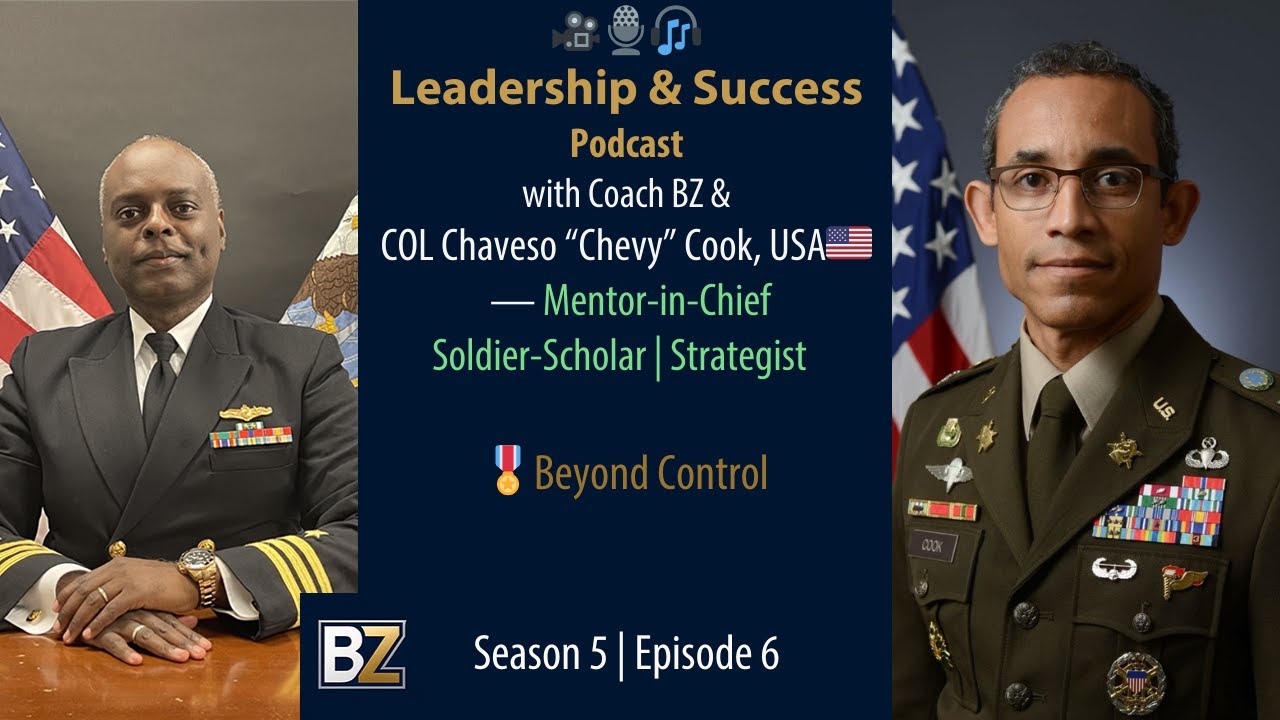
Colonel Chaveso Cook, a U.S. Army officer and co-founder of MilitaryMentors.org, discusses how tracking his reading sparked a voracious habit and why failure is the greatest teacher. He'd have dinner with God, Edgar Allan Poe, and Barack Obama, keeps a bullet journal for gratitude and priorities, and sees himself as an architect of people.
Chapters
Hi, I'm John Maxwell. When the top companies in the world are looking for trainers, speakers, and coaches, there's one name that stands above the rest, and that's Maxwell Leadership. Our certified team members have gotten proven results for companies all over the globe, and our reputation, I'm proud to say, is second to none. Some of our members have risen to the top of their profession, including the one you're going to meet today. I proudly introduce you to my friend Bob Fabien Zinga.
Welcome to the Leadership and Success Podcast with your host, Coach BZ, where we help you lead with purpose and succeed with impact. If you're ready to grow into the kind of leader others want to follow, this podcast is for you. If you're determined to elevate your success and leave a lasting legacy, this podcast is for you. As my mentor, Dr. John C. Maxwell, reminds us, everything rises and falls on leadership. Our goal is simple: to inspire you, challenge you, and equip you with insights that can transform the trajectory of your leadership journey. Welcome aboard to another episode of the Leadership and Success Podcast with Coach BZ.
Do the best you can until you know better. Then when you know better, 'Know better, do better.' Maya Angelou. As I watched increasing media coverage of injustice against men who look like me and been reminded of countless murders of Black people in recent times, I remain torn, as my first thought after utter pain is sadly and selfishly the idea that it could have been me. This violence is not new. It's not a series of isolated events. As an organization committed to improving people and leaders, my team and I at Military Mentors condemn racism, injustice, inequality, intolerance, prejudice, entitlement, and any abuse of power. Military Mentors grips hands with those who have experienced and continue to experience racial violence and oppression. In moments like this, I must ask, are you a leader? Leaders have a responsibility to improve the lives of those around them and make their organizations better. Connecting with, including, and mentoring people who may not look like you will push diversity into places of opportunity at higher levels of leadership, fostering the momentum for much-needed equitable All right, are you a leader?
That's the message from the Colonel. And part of what we do at the Leadership and Success Podcast is to really give us the tools and principles and ways to think about becoming a better human being, a better leader, and also achieving higher level of success. So for those who watch me this morning, uh, I did my moment of gratitude for today, and today I was grateful just to be alive, just the ability to breathe. It's January 3rd, right? 2026, the third day of a brand new calendar year. I am happy I am here, and because I can breathe, because I am alive, and I have hope for tomorrow. All right, we're gonna have a very special guest today. Let me see if I can properly introduce our guest. So we're gonna be talking to the one and only Colonel Treviso, uh, Constant Chevy Cook. He also has a PhD and active duty US Army colonel serving on the Joint Staff at the Pentagon. He's a soldier scholar, a mentor, and nationally recognized thought leader. Colonel Cook brings deep operational experiences from special operations alongside academic rigor and psychology and human development. He is also the co-founder and recently the executive director, but now on the board of militarymentors.org. So I really would like for the people who watch this podcast, who follow me, to, uh, uh, really support this, uh, organization because it is championing mentorship as a strategic leadership imperative. So ladies and gentlemen, without any further ado, please help me welcome Colonel K.V. Cook. Hey, good morning, Colonel. How you doing today?
I'm doing— always doing good. I got, uh, little ones in the house, so I don't have time for bad days, as I've said one or two times in the past.
Good. Thank you so much for being here. What a great privilege it is to be mentored by a colonel on the Leadership and Success Podcast today. So let's get to it. What are you grateful for this morning, sir?
Oh, that's good. So I have a journal, a bullet journal. I write down my gratitude every day. This morning, because the day's not over yet, I just do it at the end of the day, but I'll go with just this morning. This morning I am grateful for, uh, the fact that I got a chance to get up and do a Murph, uh, Workout of the Day, or WOD, CrossFit WOD named after Lieutenant Michael Murphy, who tragically gave his life, uh, heroically gave his life many, many years ago for the Medal of Honor. Navy SEAL in Afghanistan as a part of Operation Red Wing. And I was challenged by a Navy guy who I played football with in high school to do a Murph a month, a Murph a month for 2026. And I'm gonna do it on every first Saturday, uh, of every month this year. And I got up and I was able to do that this morning, and my bones don't creak too bad. I didn't pass out. So this morning, I'll be grateful for that at lunchtime.
That is really awesome, especially in the military service member. We have to be physically fit, but I think mentally fit as well. And I believe having a life of gratitude really, uh, goes a long way. What, what would you think, sir, especially especially for service members, why should we be grateful?
So if you're doing— if you have a gratitude practice, and you think about what you are grateful for, I would assume that it also goes with reflection. I mean, you can flippantly say, like, I'm grateful for, I don't know, the TV in my house or having Wi-Fi or— and I'm not saying those things you shouldn't be grateful for, because there's people who don't have TV, don't have Wi-Fi, who don't have electricity consistently. But a lot of us, if, if, if, if we don't take the extra step to really think through— that's why I do it at the end of the day, because I want to actually like think through what occurred today. Did I have any impact? What did my family do? What did we do at work? What did I read? Who, you know, who did I talk to? I want to think through all of those things. So I think the importance for leaders to have a gratitude practice is it is a forceful reflective process. And the research shows that reflection is a key component of character development, of leader development at an individual and organizational level. So gratitude is about reflection. That's why we should do it as leaders for sure.
That is quite powerful. And is there something about you, sir, that most people may not know about when they first meet you?
I think most people don't know that I'm more of an introvert than not.
Really?
I think because people— yeah, people see an external version, or a version from a distance for sure, of who I am, right? They see all the writing I do, the speaking I do, they see me on podcasts and things like that. Obviously, as a, as a leader in the military, stand up in front of formations, etc., etc. My life has not allowed me to be introverted. Right, so that people make the, the automatic assumption that, uh, that I'm extroverted. Oh no.
Wow.
Very— like, all the— I've taken a number of personality assessments, and truthfully so, uh, the literature will bear out as well, well, not just with me but with a number of men. Men tend to get more introverted over time, more reserved. Uh, so I was just beating that trend when I was like a teenager. I was just like already super— most people don't know I'm actually more introverted than not, which is the proper way to say I'm not an introvert.
Yeah, I'm not.
None of us are introverts or extroverts. You're either more one or less than one, but you're able to go along a span, which means you expend more energy when you have to be extrovert.
So what do you do to recharge, sir? How do you refill the tank?
Uh, it depends. Um, I read this great book a long time ago called The Power of Full Engagement by Tony Schwartz. And, uh, uh, man, I'm, I'm forgetting the, the second author, but it's Tony Schwartz is one of the authors.
Yes.
And, um, this book taught me about different levels of fitness with respect to spiritual, mental, physical, etc., etc.
I think it's Jim Lore, I think is—
Jim Lore is the second author. So what's special about that book is it— what it tells you is you can't manage time, but what you can manage is energy. So for me, it gave me specific practices that I could think about. So it can be just as simple as this. I can go in a room before I got to give a speech or afterward, water, rub on my ears and maybe the back of my head, give me a little self-massage real quick. 30, maybe a minute, and it can completely recharge me if it's completely quiet, lights are— wow, it doesn't command all the time. Other things is I've gotten people around me to help with that, right? So if I had a, a second in charge, like a senior enlisted leader or something, I'd, I'd get them to buy me some time. If I was coming from an engagement, we're going into another, I'd ask them, hey, can you go run interference? Give me 5 minutes so I can take a walk, just so I can be directed with my own thoughts. So I've done a lot of that. My wife has been really good about calling me at work or texting or something and saying like, hey, take a minute for yourself. And just that little— all I need is a little bit. I drive to— I got a very long, uh, and when during my commute, I will— no podcast, no music, no nothing, just complete silence. And some of my commutes are 90 minutes.
Wow.
Just being in there, you know, being very deliberate about gaining silence and coming to myself. There's a book called Leadership as a Relationship. And in it, Mike Irwin talks about there's like 3 places you can be by yourself. Now, one of them is the car, the other is the shower. And I can't— but taking moments like that.
That is pretty amazing. We already got 2 book recommendations. It's not even been 5 minutes yet. Leadership is a relationship. How to put people first in the digital world. Okay, thank you. Thank you so much. This is just awesome. And again, this wasn't planned, but I really like what you are saying, sir. And based on what you've said, another question I have for you. In 2025, 21st century, we have so much distraction now, so many input and things to focus on, right? And I think as leaders, we really get distracted so easily. Social media and all of that. How do you find the time, or which technique do you use to really focus on your own priorities and kind of get rid of all of the distraction out there?
Hmm, that's a good one. Another book suggestion, Cal Newport has a book called Digital Minimalism. I, you know, people see me, I think, people see me on social media, think I'm very engaged. Nope. I am on social media 3 days a week, Tuesday, Thursday, and Saturday, uh, for 40 minutes total. My phone is limited to allow me to do that, which means most of the posts that you see are curated, already written, set up by some other system or app. Wow. So I get to keep myself off of social media. That's, that's one of the ways. Another way is every one of my bullet journals, in the very front of it has my values, my purpose statement written right in the front, my priorities. It's kind of a little diagram that I drew. Every single one of them for years now has had that in the front. And then daily when I bullet journal, I assess my priorities. So I have a kind of stoplight chart as to whether I fulfilled my 3 priorities or not. So that's another way I keep myself kind of honed in and grounded. And then like I told you a little bit before about like the gratitude piece, and the reflection piece and the deliberate time that I take to prepare for an event or a space, it always is grounded in my values. And I am like, I learned a long time ago, we get deep into psychology, there's no such thing as— what is that thing people think they do when you do multiple tasks at once?
Multitasking.
Yeah, multitasking doesn't exist. Yes, it's called diverted attention. So, um, I get in trouble with my wife sometimes because if I'm doing something and she wants me to do something else, I was like, I'll be like, hey, can I get 30 more seconds with this? And then I'll be able to switch to that. She's like, well, just can you— I'm like, sweetie, you know, I don't like to try to attempt to multitask because it just doesn't exist. So I'm very deliberate even in my home about like, while I'm doing this one thing, just let me focus, and then I will shift. Because then I can give my full attention. It's like a— you have a spotlight in your brain, right? Yeah. So when it's over here, yes, lit over here a little bit. But the real light is right here. So I want to be able to lift and shift to those different things each time that I do that.
Actually, so what you just said, there is a book I have, if I can get it. This one, One Thing. Have you read this one?
I have not. That's one— that's the one that I'm gonna steal back from you.
Okay. Yes. This is a great book about what you are talking about because we get so distracted, so many things to do. That's why we don't accomplish much. But if you can just focus on your primary thing, what's important, and it may not be urgent, but important, and just go through your day and accomplish that one thing, your life will change. Wow. That is, that is powerful. So maybe, sir, to get started, we have so much to learn from you, but can you tell us briefly about your leadership journey, how you got to become Colonel Chevy Cook, US Army.
As briefly as I can put it, you know, I was a young kid in a space that wasn't full of great leadership back home. Typical kind of '80s neighborhood, stereotypical in the sense that there was drugs and violence and, you know, not to the extent of some hoods in some places, but our own situations. And I was in an adoptive home. Many people know, have heard me talk about Mama J before. That was my next door neighbor at one point who adopted me. And the basic gist of it is she said, you have to get out of this neighborhood, you have to go to college, and you have to figure out how to pay for it. And when I heard about West Point in high school, I was like, okay, that sounds like a place I want to go. It's free. It's college, it's meet my mom's intent. And I thought this leadership thing, because of sports and other things, was something I could get into. So fast forward, I go to West Point. I came in the Army. I've been in the Army since, uh, on this side of it since 2004, and still would hopefully serve a couple more years. And that's traversed a couple different areas. I was in the conventional Army, a vast majority of it has been a special operations community. I worked at the garrison level. I worked overseas. I've been in academia at West Point. I've been in the Pentagon. I'm in the Pentagon now. I've gotten a chance to do a lot of different things and unique things. I don't have a pretty, you know, stereotypical path. But I think what has really gotten me to, you know, to where I am as a colonel working in the Pentagon, working on the Joint Staff today, is the people that supported me, like Mama J, like Ashley, my wife of now 27 years together, and almost 20— 19 married. She's done a lot for me. And then all those places, whether I was at the Academy, or whether I was in Battalion Command, or whether I was in a classroom, I always had a set of teammates around me that actually did all the hard work. Lifted me up, cut me down when I needed to be chopped down. And that's really how I got to where I am today. And I'm glad to be with you, talk my personal perspective, not represent, you know, the Department of War or the Pentagon Joint Staff or anything, my personal approach today, but glad that I've had the experience to serve America like I have.
Wow, that is really fascinating. That's really what I love about this country, right? Coming from another country, I was born in the Congo, which was a French colony. So Congolese by birth, French by culture, and American by choice. There's just no country like America, right? There is no Congolese dream, there is no African dream, there is no French or European dream, but there is the American dream. Like myself, just looking back, I came here barely speaking English. I joined in as an E-1, seaman recruit, lowest rank in the entire military, and today I am the senior officer in the most powerful Navy in the world. I mean, only in America.
Wow.
But you also mentioned your wife, sir. Uh, if you don't mind, can you kind of share maybe what you believe is the secret of your long marriage and partnership?
Secret?
Um, because especially in the military, right? Because, uh, we get deployed, and especially when parents are in the military, it's very, very difficult to keep a marriage and a family together. So when I see unicorns like you, I want to know what's your secret? What do I need to learn that I don't know yet about marriage and being together for such a long time?
Well, uh, there's a lot of secrets. We have a ton, I think. Um, you know, we both came from divorced homes, you should know that. Um, and we grew up without fathers in the home. So one of our secrets is we're making it up. We're making it up as we go. You can read all the books, you can look for examples and details, or you can just do what feels right in your heart and in your gut and in your mind. And that's what we've done. We've— we didn't have examples of what marriage should look like or what perfect should look like, but we could envision it. And we decided— I mean, we're engaged, we're dating and engaged for 7 years before— wow, people don't do that anymore, right? And I'm not, I'm not bashing anybody's approach or anything. It's just we took a long, deliberate time to do that, and we, we've made it up as, as we went along. We've done what felt natural, um, in our head, our heart, and our gut, right? You know, like the logic piece of it, the emotional piece of it, and then just the, the feeling of it. Another secret is because it came from divorced homes, we don't believe in divorce. Yes. Now I've had a number of used cars, and I know how this works. Right? Yes, I can just go get a new one. Yeah, in this case, I, I don't— there is no new car, right? So I will do everything, patch up the tire, fix the windshield. And I just think, just so we're clear, my wife is not a used car. Yes, she's more like a G5 jet. Very clean and nice, high-end. Yes, but I just— I don't have— we don't have the— listen, if you take divorce off the table And I'm not, I'm not saying if, if your spouse is beating you or denigrating you or doing something else, that you cannot leave. I'm just saying if divorce is not an option, maybe those things don't become options either. Like, I can't hit my spouse because we can't get divorced, right?
Yes.
She can't kill me because then she won't have me anymore. But yeah, I mean, I'm making kind of light of it, but a secret that we have is we simply don't believe in divorce. So every conversation is about figuring it out together. Head, heart, hunch.
Wow, that is amazing.
Just the— just, just this last one, I promise. The last thing for you young men out there is realize that they're your better three-quarters. A lot of us say like, that's my better half. No. Yes, my wife brings way much more to the table than I do. Has all— listen, you don't actually know this, like, she smiles with her eyes. She has a glow about herself. I'm not just like— I say, and people who know me know I say this, like, and people who've met her know, like, she— if you don't like Ashley, there's something wrong with you. She's a real genuine good soul. She, she is a gift giver. She is a person who gives of her time. She is a deep emotional friend. She's committed. She's courageous. She's in shape. There's so many things about her that is just to be liked. And then I get to kind of like be her arm candy when I go places or whatever, because she's my better 3/4 and I may be bringing 25% to the table.
Wow, that is really simple but so impactful and insightful. Thank you so much for sharing. I, I kind of joke with my wife— no, we definitely have that commitment, divorce absolutely out of it, out of the table, right? And sometimes, yeah, we are human, we may get upset And many times we argue about things that don't matter at all, but by the time our heads get hit the pillow at night, we absolutely have to forgive one another and love each other all over again. So one, uh, one joke I have is, no, if she ever decides to leave me, we're gonna leave me with myself. I'm gonna go with her and we're gonna leave me because wherever she goes, I'm going with her.
So we have the same joke. Same joke. If you leave me, I'm leaving too. I'm going right where you Exactly.
And you said she's a, uh, uh, no, free, uh, quarter, your best free quarter. So I am commander in the Navy, but when it comes to my, to my household, Commander Zinga, that's not me, it's my wife Demetria. She's the commander of this house for sure. So, uh, yeah, it was one, one day maybe, I know, I kind of got the big head, no, I got this huge promotion and all that. She's like, okay, you may be all of that to the Navy out there, but in this house I am in charge, so sit down and shut up. I'm like, yes, ma'am. So It's very, very clear. And wow, okay, so maybe, uh, one question I have for you, Vencer, is, uh, so you've served in high-risk operational environment and high-trust, uh, strategic role. Looking back, what moment most fundamentally reshaped how you understand leadership today, not in theory but in practice?
Um, that would probably be, luckily enough, when I was about the time I was a lieutenant. A young lieutenant. So for, for those not in the know, and I'm not in the Navy, so a lieutenant for me is, is second lieutenant, is the very first entry-level officer position. And, you know, I came into the Army out of West Point, uh, cocky for sure, um, overzealous. I wanted to be the best lieutenant, you know, the typical best of the best of the best of the best. Um, and so, uh, I wasn't a big a sharer back then. Like, if I figured out how to do something more efficiently or I made my platoon better in some way, um, I wasn't sharing that. I just didn't do it. I wanted to shine. I wanted recognition. Um, and, uh, what I learned over time from peers mainly was that, um, that didn't make the unit any better. Yeah, it might have made my platoon better, but it didn't make the make the battery or company level better. It didn't make the battalion or the squadron the next level, and on and on and up. I was just worrying about my own little kind of rice bowl or fiefdom.
Yes.
And that is not the way to do business. So what— what— and it really came to fruition like when I had a kid, when I had my oldest daughter, and I finally understood what it meant to really pour into something that's— yeah, it's, it's quote unquote yours, but she's her own person. Yes, you know, when I first started her saying phrases, simple phrases that they say in school, like sharing is caring, then I really got to understand what leadership was about, which was, wow, always making the organization better. I used to kind of say it in a flippant way, saying like, you know, if I was— you pick your best quarterback of all time, Tom Brady, Peyton Manning, Dan Marino, whoever, or you can pick whatever, you know, you can play play the other version of football in other places, basketball player, you name it. I used to say if, if, if, if I was that person and if I was a Tom— if I wanted to be a Tom Brady, the difference here is I would be telling the defense my plays. I'll be telling the linebackers on the field exactly what I'm about to do. I'll tell the defensive coordinator, the other coach. I would tell them all the things that I'm going to do every single play because I'd be sharing. It would be about Yes. Hey, I want everyone to know how I'm trying to be successful. Now, if Tom Brady is that good, or if Michael Jordan is that good, you pick your athlete, they would probably still score, they would probably still do well, even though everyone on the field knows exactly what they're doing. If I was to be that good, then I could still be successful by sharing. And I went as far as making something called the playbook that I handed out. Like, I would orchestrate everything that I did, like, in command. I would orchestrate it. I would, like, lay it out, put the psychological principles and everything behind it. I would show all my cards in the— in the effort with other commanders, with other people. Just say, like, hey, here's how I'm doing this business over here. Can you please share what you're doing with me? Sometimes it was shared back, sometimes it wouldn't. Didn't matter. Yeah, sharing is caring, as my little one used to tell me.
Wow, that is so powerful. Really, servant leadership really makes the difference. Something similar with me when I first joined the Navy, it was, I believe, a first class who told me, do you know what Navy stands for? Seaman Recruit. I'm like, no, first class, what does it stand for? He says, never again volunteer yourself. I think he was joking. I think he was, but I definitely did the complete opposite. You do have to volunteer. You have to add value because that's really how you grow and you help your organization do better. So back into your leadership journey, sir, your personal purpose statement, which is published online, you said, I am purpose-built to serve others. Where did that come from? When did that stop being just an aspiration and really become a lived responsibility for you?
Well, somewhere around the time I was transitioning to a young 30-year-old, you know, I got this brand new kid in the house, um, married a couple years, transitioned over to Special Operations. And, you know, this is prior to me going back to West Point to teach. I, you know, I felt like, you know, people always ask you a leadership philosophy and stuff like that. I got really deeply into reading, and I came across this idea of a purpose statement, and, and I was trying to answer a question for myself. So going back to me being more introverted than not, I was wondering how I could be so paradoxically built. How can I be a person who rather be in a book, rather be quiet, rather be by myself, gets energy from that, but have this, this ability to lead, to speak, to communicate, to connect, to network. Like, it would— I, I felt that was a paradox. And for me, as a— I'm a religious man, I don't want to make this religious, but for me, you know, that had to come from something given to me or written for for me to be, you know, kind of this paradox. And for me, that paradox became my purpose. I felt like I was purpose-built to serve others because I have this ability to connect, but my ability to deeply reflect and be introverted allows me to recharge in a way that just becomes again the cycle coming back out to serve others. Service to others starts in my house. It's with my kids. Those are My wife. So people think your purpose statement or these, like, leadership philosophies about your organization. Yeah, they are. But for me, for mine, and other is everything outside of my body. Wow. Just some years ago, I came across just trying to answer that question for myself. Why am I built this way? And I think I was given that amount, the extreme amount of introvert, inversion, introversion, and reflective the kind of nature I have in order to serve others. So that's where it came from.
Wow. That reminds me again, right now I'm doing the study of the Book of Proverbs. I've been doing that since I was like 12, 13 years old. It's not religious at all, just looking at ancient wisdom and getting all of the leadership lesson from that ancient book, which I believe is still applicable today. But Jesus said that whoever wants to become great among you must be your servant. So the way to greatness is through service. It sounds like a paradox. How in the world? But really, if you want to lead, you have to serve. That's the only path for greatness. Wow.
Yeah, you're absolutely right. Having read the Bible a couple of years ago straight, you know, front to back, I got a chance to read other religious texts like the Quran front to back and And there's a thread through a couple of these different texts, ancient wisdoms, religions, this, this spiritual side of who we are. And it's in like service. We can talk about character as well. And character, when you really think about character, different than personality, right? Personality is kind of this direction. Character is that direction. And it has an interpersonal component that must be done And that comes for me through service to others. And, you know, people say things like service above self and all of those things. For me, it's strictly my purpose. It comes down to purpose. It comes down to, well, what am I here for? And it is to do this for other people, whether that's the kids in my house, that's some large formation, whether it's an extremely high government official that I'm giving direct advice to. Yeah, I get to do this. All day, every day.
Wow.
Doing it right.
That is really amazing because the truth is the way we usually define success, no, it will never, never satisfy. I mean, how many houses can you have? You can only live in one house at a time. How many cars can you have? You can only drive one, one at a time. So at a certain point, once your basic needs are met, money really doesn't mean anything anymore, right? But when you serve, when you add value to other people, I think that's really bringing fulfillment. Even if things you are struggling right now, some of us do at a time, but if you volunteer and you help other people, you're going to see there are many, many people who are having much bigger challenges than you have. You thought you had problem, people really, really have some issues. And I think that really brings us together, our humanity and just building our community. Now, one thing about your career, research I did prior to this, podcasts, you've really always almost chosen the harder path, no, the less conventional path, no, did special operations, psyops, influence work, and so on and so on. So what trade-off did you knowingly accept, and what did they teach you about leading without visibility when nobody knows your name and nobody knows even what you are doing?
So for, uh, for me, the, the biggest kind— what I, what I knew I was giving up is like, let's just take this, the psychological operations community specifically. I came into it when it's a brand new branch, when we didn't have a GO, we still don't have general officers. I knew I was not going to be a general officer. I knew that this was going to cap at lieutenant colonel or colonel. I was, I was giving up kind of that— not to say that I had GO potential or, or wanted to be a flag or general officer, just I knew that, that there was a cap and that the community was small. There were only certain places I could serve, and I knew I was going to sign, you know, non-disclosure agreements. I knew, yes, that a lot of the things that I was going to be doing, what it's going to be behind a veil or behind a system or cutout. I knew all of that going into it.
For the people who are listening who may not know about the military, the Navy or the Army, so he is a colonel, which means one promotion away from being a one-star general. So that's a very big deal. Yes, sir.
And I'm, you know, like I said earlier, here because of a number of teammates, because of my better three-quarters, so many people kind of allowed me to keep pushing along the way. But, you know, I gave up. To your point, I knew that this is where I was going to be. Obviously, this was an aspirational goal. Because this was kind of the top of where my career field could be. And, you know, luckily, along the time, you know, there's been a lot of things that I've been able to be a part of. And I've had great teams that have allowed me to get here. Not easy at all. But I mean, service in any capacity, right, is when, especially when you're in the, in the uniform service, you give up a lot, you give up a lot of your, you give up your voice. And in certain instances, you give up the hairstyles that you might want, or tattoos you might want to have on your face. There's a lot of kind of things like that, that you give up. A lifestyle. I, you know, I don't have what's called a forever home, right? Like, I've lived in a number of homes, you know. I haven't like had my family in one spot for, for long lengths of time. My oldest daughter has been to a number of high schools. There's a lot of things you give up, but for me, um, those sacrifices, uh, have been poured back into a formation, and I've made sure the whole time that I've taken care of my family. All my PCSs since we've had children, a permanent change of station, every time we've moved someplace, my wife was the chooser of that, of that place.
Yes.
Um, those assignments that I was, you know, that were— as I got older, people were allowing me to choose between. Yeah, those went to my wife. Like, yo, did we talking? Yeah, we talking at home first, uh, before I give you an answer. So, you know, that there has been, as, as we've sacrificed, because my family, Lord knows they have. Yes, I've directly engaged him so we could try to find some— I don't do balance, I do integration. Hmm. So some sort of integration along the way.
Let's talk just a little bit about that life-work integration. Can you expand on that, please?
So I was told a long time ago that balance is unachievable. And I was a young captain.
Yeah, actually, my captain, which for you would be a colonel, told me when I was in O-1, if you want balance, is when your wife is against you, your boss is against you, and everybody is mad at you at the same time. That's proper balance.
Right. So, you know, that person also told me about this, this concept of integration, of, you know, trying to bring the spaces to as closely together and integrated as possible. So what that can look like— look, I work in a secure facility in the middle of the Pentagon. And at times I worked, you know, and behind closed doors with swipe access and all that stuff. Like, look, my family can't be in there. I got it. But the flip side of that is when I'm there, I'm there, and I'm doing that. But when I go home, like, guess what? I am not a person who does my military work in I don't have a home office. My wife does because she works at her home. This is not my office that we're in. We're actually in my wife's office. Be clear. So that's the, you know, what I have done though, is when I could, when I did have assignments, when I could go home earlier or go in late, that's what I did. When I was working 1.3 miles away from my house in Battalion Command, I came home for lunch. I took my kids to school. You know, if my wife needed something from the pharmacy, I left work to go get it and bring it home. Even though she just kind of was like, well, you're— can you just swing by the house? I just did it because I could. When I could have a cell phone in my office, I did. And I answered it whenever my wife called, regardless of— I've answered my phone with a general officer in my room before.
Wow.
Yes. And I have said to that general officer, and this person knows who they are, Hey, my wife is calling. There's been times I've been overseas where she could not call me. If you would allow me the chance, let me just call and make sure she's good to go.
Wow.
So I do that. So integration for me can also look like me putting my kid on my back and walking around the formation and giving out cookies on Valentine's Day. Right? That's integration because then they get to see the uniform, they get to see that we're not uptight warriors that are just, you know, out here to kill people. We have a soft side and and compassion and emotional intelligence about ourselves. So that is integration for me too. So there's no balancing the two. There's, there's, let's bring it, uh, in concert as much as possible.
Wow, that is, that is such a very, very important lesson to learn, especially in the military, uh, because, uh, sometimes, I mean, again, I understand, Itempo, you are deployed, you have to do what, what you need to to do, but you have to remember you have a family. And because the Navy, when I joined the Navy, they issued everything, especially when I was enlisted. As an officer, you do have to pay for your own uniform, but they gave me pretty much everything. At one point I'm like, okay, am I gonna get a new wife or something too? Like, it's like everything you need, they just give it to you. But that was a joke. But anyway, so let's be more serious. So you've led during the surge in Iraq, I think, General Petraeus, which I was really humbled and privileged to interview during last season, what he really did to move us forward as a country. But you served during the Arab Spring and counter-ISIS operation and on and on and on. Period of ambiguity and moral friction. So what do leaders consistently misunderstand about decision-making under pressure? I mean, immense pressure, through all of the work you did for the Army.
Most misunderstand the importance of competence in those situations. Hmm. And this might seem intuitive, but it's not. If you go back and actually do the research— I taught a class called Leadership in Combat, it was PL 471 at West Point some years ago. And when you look from the Great Wars all the way forward to the ones you described that I got the privilege to serve in, if you ask, if you interview followers and ask what they're looking for in their leadership. There's 3 things they're looking for. The number 1 thing they're looking for is not courage or bravery. It's actually competence. They want to know that you know what you're talking about, that you know this battle space, that you know if I say go to that X, that's the right X, if I'm making this decision, it's for the right reasons, etc., etc., etc. Looking for confidence. So I think what people misunderstand is that you need to be courageous under pressure. No. Every bit of research says you need to be competent. Mm. Because no one can take that. That's your primary weapon system is your ability to think through a situation. Now, that situation can be rapidly evolving. It can involve fire coming in, it can involve a catastrophic loss or simple loss. It can be loss of equipment, loss of life, limb, or eyesight or livelihood. What you need to be doing, whether that is microseconds or a couple minutes, is thinking and have the competence that goes with it. Now, the second thing right behind is actually character. So not only do you need to have in those high-pressure situations the ability to think, you then need to have a moral compass so that your thinking matches your values, right? So we're doing the right thing while we're thinking about what the right thing is. The third thing that, that people forget and that the research would back up is actually care.
Wow.
Competence, character, and care. They want to know— your soldiers, your formation, the people around you want to know that if you say, I've chosen the right X, it's for the right reasons, that I'm going to the X with you.
Yes.
And if I can't go to the target with you, when you come back from the target, if you're maimed, injured, seen something you haven't— you didn't want to see, or have any problems, issues, challenges, that I'm going to care about you in a way that's not just going to fling you to the wolves or, you know, crap on you or not take the time to help you get through that, whatever that thing may be. So that's what people forget, that you need competence first. People need, need to see that you have character. And people for sure need to know that you care.
Yeah, I think now more and more I realize a lot of the leadership training we get in the Navy, we stole it from the Army and we just put Navy on the top, but we talk about competence, character, and connection. I guess connection, care, it's pretty much the same idea. Let me ask you about this before we go to the last segment. Military Mentor, you are the co-founder, until recently executive director, you now understand on the board of advisor. But the question I have for you, you do have a quote that's pretty popular, but that makes people think. I think you said something like, Mentorship is more important than leadership. That's a little bit controversial. Can you tell us more about that? And why is mentorship so important to you personally?
Well, mentorship for me is the most important outside of maybe the relationship of a father with his kids or a husband or wife with their spouse. Outside of those relationships, mentorship in a leadership capacity is probably the most important relationship you can have because of the legacy that it leaves. And I will break this down very simply with respect to why I think mentors are more— or mentoring is more important than whatever leadership capacity you have is simply because of this. One, in this, in this generation, like leaders leave. You're in the military, I'm in the military, we are going to PCS. I've never been on a duty station for 20 years doing the same job. Doesn't happen. I will move. I don't— it doesn't matter how good you are at that role. You're going to move. That happens in the corporate sector as well. Given the fact that we have things like LinkedIn and like Indeed, like you don't even have to be looking for an opportunity somewhere else. Like opportunity will come find you and for the right amount of compensation or the betterment of your family or maybe a better situation, leaders leave. So mentors don't, right? Really think about it. Mentors don't leave your life. There are general officers who are retired who still connect with me that I've known since they were colonels.
That's incredible. Now, do they ask you to call them by their first name and no longer say General?
Oh, it's a bunch of like, it's a mixed bag. I default to sir with a lot of them. Okay.
Because I have a very, very hard time calling a general, even a colonel, by their first name. Very, very hard time doing that.
But hey, the good thing about the conversations is that they stay around.
Yes. Yes.
And that's why, you know, there's a couple other points I could add to it. But the main one is that, I mean, I, when I think about a person in particular, and I've told this story before, Tom Grimes, when I was in JROTC in high school, yes, he had retired in the '80s, was teaching me in the '90s, and served in Vietnam in the '70s, by the way. And I talked to him a couple of months ago.
That's amazing.
I, I still talk to him, and, and he just— he's so— he retired. He loves calling me sir. I have always called him sir, and he's like, oh, you outrank me now. But he said he's in his 70s, right?
Wow.
That's just like I said, like that legacy, that ability to stay with people. We've never served in uniform at the same time. He's never— he lives in Florida. I haven't lived in Florida since I was a A little young pup. Um, that's my main one is, uh, leaders will leave, mentors don't.
That is really insightful. Well, there's another controversial subject surrounding you, sir. This book here, Start With Why, Simon Sinek, has been recommended on this podcast over probably 12 times or so. I've interviewed about 100 people last year. I mean, even in the Navy, that was a required reading, I think, when I was a lieutenant. Oh yeah. But any Anyway, so let's talk about popular leadership versus really hard leadership reality. So many people turn to Sinek, people like him, because his work feels accessible and inspiring. So do you think there is maybe a risk that leaders prefer comforting narrative over grappling with the hard, ambiguous reality of leadership and why?
So one of the problems I have with Sinek's work is, is this, there's no empirical research behind it. Obviously, I'm a nerd, and I'm not the first person to critique him, by the way. There's been many critiques of him, and that's usually the case when you're as successful as he is. I'm not trying to make my bones about downgrading Sinek. He's a New York Times international bestseller. I can't compete with that. But I do know a couple of things. And just the core message for me, outside of the fact that he doesn't rely on empirical research is, where do his stories come from?
Right?
Stories come from the military. His stories come from, you know, idealistic places. Yes, he's done a lot of consulting.
As far as I know, he's never served in the military.
Yeah, yeah. As a person, I've— what I can tell you from my experience is I can talk and I have referred to a lot of studies and research while we've been talking. And I do have a PhD myself. But I've also— I'm a colonel, I've worked in the Pentagon, I've worked in combat, etc. So I have the real experiences that, that go with it. So I think a lot of his work is kind of— it's a good start. It's a place of idealism. But I think there's a practicality and a realism that has to happen. Look, purpose ain't gonna— starting with why and having a purpose— look, we talked a lot about purpose earlier. Purpose is not going to get you through that truck that's stuck in the mud and 4 flat tires. Like, there's no like, let's sit back and talk about why, let's get deeper to our purpose. Your purpose is to serve others. Right now I needed you to serve me by changing this tire and getting this for— like, there's no time for that. There's, there's a realism that needs to happen in those moments that empirical research or not, addresses the ambiguity that's in front of you. When I talked about character and competence and care earlier, there can be purpose-driven, you know, part of that, and there can be an idealism that— but then there can be brass tacks. Look, when things are happening and I'm just directing you to do something right now, I love it. We don't have time to talk about all the other things. We can get a while later. I need you to get off the X right now because it's dangerous, and I need you to listen. And I just need you to go with my direction. So that's kind of— I also think he kind of oversimplifies organizational behavior, organizational change, how we actually practically do things. You know, his experience comes from consulting organizations, not from actually doing the change himself. And that's the problem I have. I'm not saying you have to be a practitioner. But, you know, I can shoot, but I can also talk about the, you know, the dynamics, the physics of a bullet.
Yes. No, that is really insightful. And also for those who follow me, my mentee listening on the call, I would say, right, you need to have an open mind, at least listen, but ultimately you make the decision, right? You have to be analytical and see what works for you. That's why I love one of my primary mentors in general, Colin Powell. His last book, It Worked for Me, right? Try it out. If it works, keep doing it. If it doesn't, no, you can try something else. So now we only have about 10 minutes or so, but I think I can do it. We're going to go to the final segment of, uh, the show where I try to get into your head to really figure out, uh, what makes you tick and what are the leadership lessons and, uh, principles that have really helped you get to where you are now, especially for my junior officers who are listening. What do you think, sir, is the greatest lesson you have ever learned in general, in leadership, in life?
Wow. That's a very deep question. Greatest lesson I've ever—
oh, one of the greatest.
One of, one of the greatest lessons I've probably learned is the difference between a good decision maker, a prudent decision maker, and someone who practices discernment. They're not synonyms. Those are different levels. For me, it's a decision maker is, can I eat or not? Am I hungry or not? Should I eat or not? That's like toddlers can do that. You can make a good decision whether I want to eat or be hungry. Prudence is a level up from that. Prudence has something to do with time, right? Prudence has something to do with I make good decisions over time. So you can be a prudent thinker. This is a timely thought. You know, I'm hungry, but I'm gonna have a— am I gonna have a late lunch or early lunch because I'm gonna balance out dinner? That's being prudent. The next level up is discernment, and we've all seen it. Most people who make flag officer CEOs, those really deep thinkers, the ones who are in the room who you say think outside the box, they're actually practicing discernment. Discernment is that base layer, good decision making. It's also the time component. But then the next level up is they've done it consistently, habitually for a long time, and it involves wisdom. So they can hear a bunch of the malaise or the different things, the miasma that's in a room,, and they can reach in and they can pull this one thing out. This is the most important thing we need to focus on. Discerning. I've seen that when I work for the Secretary of the Army. I've seen that by our current chairman, General Dan Cain. I've seen it by a number of leaders that I've been around, and that— and you know it when you see it, because it's like no one else is seeing that one thing. And that's so discerning. They can just— this is, this is the problem. This is the actual challenge. This is beneath the table. This is what's not being said. So that's a great lesson. Don't be a good decision maker. Please be prudent. But it takes time. And you really know the difference when someone is discerning.
That is quite powerful. What do you think, sir, is the secret of your success?
That's a great question, too. I think working on humility at all times, being reflective, staying grounded, grounded in my values and my purpose statement, and then realizing that I will take the uniform off. That— I mean, look, I haven't chased down a job in a long time. People have brought stuff to me. Um, yes, I haven't chased after, uh, things outside of my marriage. I come home to it, you know. I haven't tried to make my children into who I am or me. I have chased down what they want to be. So I think those things are maybe my secrets to success. Yeah, yeah. Am I very driven? Am I, you know, habit? Do I practice habits? Do I read a lot? Do I reflect a lot? Do I journal a lot? Yes. But I think all of those are secondary to me being receptive to the world, stepping into a space when it is being asked of me to— I need you to do this job. I need you to perform this role. I need you to do that task. I just only know how to go hard and work hard and try to turn in a professional product. So it doesn't matter. I'd be a great janitor too, I think.
Yes. Yes. Wow, that is powerful. I'm reminded of a speech by MLK. I think I was 7 years old. Of course, everybody knows him about the I Have a Dream speech. But when I was maybe 7 or 8 years old, I heard the speech. He was talking to high school and it says, uh, be the best no matter what you do. Something about, uh, if then if you sweep the street, so do it in such a way that even the angels in heaven will stop and say, there was a man who swept the street like nobody else. And that really, it always stuck with me.
I think another piece of it is people don't really realize that, you know, you can't really— success is a work in progress at the same time. So, you know, my secret is knowing that like I'm nervous about whether I'm doing this thing right at all times. Fatherhood, all of it. So, you know, success is going to be measured when you're sitting at the end of your life, whenever that time is, and it's going to be measured by those around you and not yourself.
Well, we have our first question from the audience. So this is Major Select Contessa Tracy, US Army. Actually, she was on the podcast, I think, last week. So she says discernment is actually my word for the year. Okay, that's wonderful. How would you advise a new field grade officer— she's talking about yourself— and commander to boost their discernment while leading formation? That's a question.
That is a great— that is a great—
Gladiator 6, thank you for the question. I appreciate that.
Thank you, uh, Contessa. I think she also signed up to do this Murph of Month with me, so I hope she's out there.
She has a great future. I see a star, you know.
Oh yeah, this is great. Um, this is a— so this is a good question. Um, Uh, pretty simply, uh, first, I think you need to understand the layers that I talked about. I think a lot of people don't understand what discernment is. They just think it's like thinking outside of the box. And I think it does take time. I, I think people try to push to be discerning. The way to start truly is to be quiet, listen. Uh, there's— I heard it from a poet first, Carvens Lusaint, but it's actually a quote from Gandhi. It is speak only to improve upon the silence. So a discerning person can like, instead of just, well, I gotta say, you know, I gotta be a field grade and I'm S3, or I'm the ops guy or gal or whatever, and I gotta add this one bullet, or I have to say something to start the meeting. No, you don't. You actually don't speak to improve upon the silence. That is discerning. That means you're listening. Okay, what are we not focused on here? Right? I'm taking it all in. I'm parsing and piecing it out. And then I'm okay. Now, if I have nothing, I don't have anything. But if I do, now I'm going to inject this one thing. That's what I would say. You can start with just improve upon the silence when you speak. If not, be quiet.
That's really powerful. So, so let me ask a follow-up then. How do you put a check upon the ego, especially as young men, as junior officer? I see a lot of ego and shenanigans. But as you become one more senior, I realize people keep it more in check and they have a lot more discernment. But, uh, just in your opinion, sir, how would a J.O. put that in?
So read Ego Is the Enemy by Ryan Holiday, uh, practice. Another book, right? Like, that one really talks about the, the practical steps on how to do it, and he's also a great author. Um, that's like kind of just a way you can read about it. But the, the other piece of it is Listen, I'm gonna tell you, I was that lieutenant, as I mentioned very early on, that wanted the spotlight, wanted to shine, and wanted my name on somebody's board or in somebody's mouth. I'll tell you, at this stage and age, especially the work that I do, where I do it, I don't necessarily want to be in those briefings. I don't want to be in that space. I don't want to be known. You don't want the phone calls in the middle of the night from very important people. You don't want to work late hours like you are deployed. When you're in the States. You don't— I'm telling you right now, you don't want those things. And there's a way to balance it where you can be behind the scenes and it can be just as impactful. John Maxwell— there's been many people who have said you could be extremely successful if you don't care who gets the credit. So that's how you keep— yes, for me, the ego in check. Now for me, as, as a person who's struggled with pride and, and things like that over my time, may have to be very deliberate about how I approach life. It's, it's being reflective. It's about speaking only when it's important to speak. It's about not being flashy or kind of in people's faces. There's a, there's a consciousness about managing, um, not your reputation but your character, who you are. Character in the original sense, in the original Greek, it was spelled the exact same way except for the second C had a K. It's a character in the original Greek.
Wow.
Was a, was a mark that you put on a coin. You put certain marks on a, on a piece of metal to denote what it was worth. So think about that. If you think about your character being your marks of your morals, your values, your reputation, all those things, you, you only get to make that mark once because it's in metal, and there's no such thing about making a different mark or crossing it out. So you characterize—
that is really quite insightful. Okay, we know that leaders are learners. What are you learning now, sir?
Um, I'm always reading. I learned a big lesson about myself. For, for since my 30s, I've, you know, since about 29 or 30, I would, uh, write down everything. I, like, I would catalog everything I read for the year. And I had a goal of at least 2 books a year, so 24 books I have to read. I can't do audio and stuff like that. I have to have a physical copy. So for years I've read hundreds of books that way. And, um, last year was the first— 45— last year was the first year I decided not to do that. I was going to read, and I did, but I only read 12 books, like one a month. And two of them really, they were like Father's Day books, and they were like really thin and small, but what I learned by not cataloging what I read, by not always posting about it. What I learned is that I need to do that. So I'm learning that, you know, reading is such an important part of who I am in my journey and my ability to read multiple books all at once. I was just kind of just— I was logging it through last year and just taking it easy is what I that that wasn't good for me. It wasn't healthy for me, actually. Um, and then I need to get back to cataloging it, having a goal, reading multiple books at once and not just one at a time. Like, that— I, I took a year to do that, to figure that out about myself, because I'm willing to do it. Um, I need data.
I need data. Yes.
And now I have the data. I have to— I have to read more voraciously. So that's what I'm learning about myself.
Powerful. Technically, it's time, so can you give us 10 more minutes or no?
Yeah, of course, I'm here with you.
Thank you, thanks so much, because you have so much insight and our J.O.s like Gladiator 6 right there, she's really eating this up and she says she smurfs once a year in May sending out all of your cheers. Thank you so much. I'm sure that is quite a challenge. So what about failure? How has failure shaped your life?
Uh, failure is the number one shaper of anyone's life, in my opinion. But in my particular life, um, because of those early missteps in my career, because of even earlier missteps by others, or maybe, you know, my birth parents' failure in their marriage affected, you know, how I grew up, those things. And not to place blame, just to be realistic, like, for me, failure has been the ultimate shaper of how one learns. For me, if you really think about it, you thought you were going to succeed anyway. Like, really think about what success means. You can pick your poison. Pick graduating from high school, knocking the home run out of the park, picture getting your MBA, PMP, doctorate, whatever that may be. You always pictured yourself doing that. You were already like, ah yeah, that's gonna happen. And when it does happen, You don't sit back. We don't graduate college and be like, I don't want to make it through those 4 years. You don't do that. We don't. None of us do. But man, let you misstep, let you fail a class, let you not get that, let you fail a physical fitness test, let something happen, let your marriage break down, um, and, and, and not work. You will be so reflective in your practice that you'll go back and you'll try to figure the thing out. There's this thing called Bathsheba syndrome. It's in the literature as well. Yeah, it's related to the biblical story, of course. But you know, for me, like, success is just a pedestal that just helps you— but it helps you climb higher and higher. But what it really is, is a column right up under your feet. And the taller it gets, the more wobbly it gets. And then you're going to eventually fail and you learn from the fall. I really do truly.
Wow. That is powerful. Thank you so much for sharing that. I believe it was JFK, right, who said, uh, success has many fathers, whereas failure is an orphan. And I think Bill Gates said, you really don't learn anything from success at all. Uh, all of your learning is really done when you fail. Uh, that is so true. Okay, uh, if you could choose 3 people to have dinner with, who would you choose and why? They could be alive, dead, or even Mythical figures.
3 people I would love to have dinner with. I believe in God, so I would like to have dinner with God. That would— it— that would be neat. Um, obviously neat is like a small word to use, but it would be amazing and impactful. So dinner with God. Um, if we're just talking about humanity, um, it would be really neat to have dinner with Edgar Allan Poe. Um, probably not something on somebody's bucket list, but Edgar Allan Poe is— yeah, I'm into poetry. I— the creativeness, the darkness, um, who he was as a person is kind of interesting and unique to me. He went to West Point for a little bit. Most people don't know that. Did not graduate. Just those stories and how, you know, when I think about like his— all, you know, we are all familiar with his Telltale Heart and so many— The Raven. Uh, this— he, he has a quote, um, everything we see or seem is, is a dream within a dream. Like, those things I would love to have. Wow. I think it would make a good dinner conversation. Like, alive and, uh, just would be fun to have a conversation with is Barack Obama.
Um, oh yeah, is, uh, right there.
Oh yeah. Yeah, I would. It would be interesting. We actually get— I get compared to him a lot. I would just like to tell him that one time, like, sir, you don't know how many times he called me President Obama or has said, you know, we look alike. But also, like, you know, to be able to talk to a president would be very interesting. Oh, just have the conversations about the decisions that are made, the stresses that involve. He has a high-power wife. He has two daughters like I do. Yeah, that would be, I think, a good dinner conversation. And I like basketball. You know, there's a lot of things we potentially have in common. So if anybody can hook me up with Barack Obama, then I would be in super debt to you.
And I know he has— I think, um, um, being my brother's keeper or something in Oakland. I am in San Francisco, so it's not very far from where I am. Some— sometimes I definitely would like to meet him, my forever president, that's for sure. Okay, uh, let me see. Let's talk about books now. So we've already talked about, uh, Start With Why, you know, read it with a grain of salt. And, uh, you've mentioned this one. Why should people read this book, The Daily Stoic?
Well, um, one, I'm a fan of— a couple times I've read books that have like kind of this day-to-day thing Um, where you can kind of, uh, I've read A Calendar of Wisdom by Leo Tolstoy as well, where it's like this daily, like this piece. You can get through these pieces, um, in little, little bites, little chunks over a whole year. It's just a journey. It's a great journey to think about, um, your ego, stoicism in general, the values that are involved in this stuff, virtue ethics, um, the ability to reflect and to really kind of hone in on who you are at the core. And like I said earlier, think about your character with a K. Hmm, that is powerful.
And what about this one? I don't know if you can see it.
Oh, yeah, that's the one I mentioned earlier. Again, their premise that you can't manage energy— I'm sorry, you can't manage time, but you can manage energy. This book changed my life.
Wow.
I'm not even exaggerating. It changed my life as to how I thought about trying to do that integration piece, trying to think about how I engage in this thing called extroversion when I'm very much an introvert. This book is— oh man, it is absolutely priceless. It will change your life, I guarantee it.
Wow, that is really powerful. What about this one that you mentioned as well? Hold on, my computer is a little bit slow. Okay, this one, it's all yellow.
Oh yeah, Digital Minimalism by Cal Newport. So it'll— this is, is actually becoming old now. I mean, this book is 5, 6, 7, 8 years old now. Um, it came out when it was just kind of telling you like how you can do— like Cal Newport at one point like got rid of all social media off, you know, it's still to this day like does not use social media, things like that. If I remember right, but this book will tell you exactly what that subtitle says. But really, it's about managing your digital world in a way that is intuitive, but none of us do. Using the apps, using your screen features. Like, even people don't know you can do this. If you set it up on your phone, you can actually turn your phone— and I don't know if this will show— oop. You don't want to see my USA stuff, let me get that off screen. But, um, it's black and white. You can change the color on the screen so your apps and things like that— this is shown to me through practices like this where none of my apps show any color. And I know that's probably hard to see on the screen, but even you graying out your phone can make the apps themselves less attractive. You won't see the notification bubbles. You can turn notifications off completely. It's things like that, just practical sense by Cal, that is absolutely fantastic. Another guy I would love to have dinner with because I want to know how he becomes a bestseller and doesn't use social media.
Yeah, that is really something. Actually, when I, when I read this book, uh, The One Thing, it really inspired me to get rid of distraction. I use an app now for my email where it blocks my inbox if I go to it I have to do an extra click in order to see it. Because sometimes what happens is, you know, it's not bad, but you get to get one email and it's another email, and before you know it, whatever you had planned to do, you don't get to do it at all. Yeah. So what about this one? Leadership is a Relationship.
So Mike Irwin and Willis Duvall. So this is a great book that just talks about you, you, you, you have to learn a couple different things. Uh, Leading Yourself First is a part of it. Uh, you can't lead anybody else without leading yourself first. And then this book comes along, uh, from them and really talks about the relationships that you build, the mentorship piece of it, um, the connection to others, and the relationship between character and character strengths with your actual, uh, leadership philosophy. Wow.
Ego Is the Enemy by Ryan Holiday.
Again, again, another one. This one actually breaks out the definition for me of per— being purposeful versus passionate. And the book starts talking about how passion is like a fire. If you really think about it, I don't care how you try to mitigate it, once you put that fire in place, an ember blows off into the woods or something like that, and now it's uncontrollable.
And that's the same Ryan Holiday, right?
Oh yeah, same, same gentleman.
And then you just—
the laser. Oh yeah, this is right back here on the shelf too for me. Wow. Uh, this one is, is like the other book where it's— well, this one's different. Calendar of Wisdom by Leo Tolstoy. This one has different quotes from different people over time. So every day you're getting something from— it could be Martin Luther, it could be a Bible verse, you can get some from a poet like Walt Whitman or Edgar Allan Poe. You'll see a lot of different things in that book. And what it does is it'll show the quote, and then it'll kind of give a breakout of what it is about. And I read that. I've read that a couple of times during a couple of different years. You don't want to read them back to back, I don't think.
That's really amazing. So what is the most important book recommendation for today, sir?
Go get a blank journal.
All day.
Like, I can't emphasize— I have a stack of journals back last year at one of my tier shows that I can go back and tell you, because I track stuff like this, I can tell you how many dates I went on with my wife 5 years ago because I have it. I have the data. Um, I can tell you what I was looking for. Uh, I can tell you what my gratitude kind of— my, you know, my gratitude practices honed around all last year. I can tell you how many times I take my kids to the movies because I journal about it. And I think having a blank journal and having some type of bullet journal or gratitude or write it down practice will let you flesh out your ideas. As Joe Brierley has pointed out many a time on From the Green Notebook in his podcast and blogs, he likes to quote this, this quote that says, I can't— I don't know what I think until I can see what I say.
Wow.
Meaning I need to, I need to write it down, right? I need to write it down. I'll probably bastardize that quote a little bit, but the concept, the idea here is powerful, is writing the things down so I can see it, flesh it out. And for me, I have a couple different journals. One of them is just about, it's called Lots of Jots. It's where I flesh out ideas. It is separate from my work journal. It's, you know, my bullet journal, gratitude at the end of the day, where I'm like stoplight charting my priorities, man, the most important book you can have is a blank journal.
That is so powerful. You reminded me of this book from my primary mentor, Dr. John C. Maxwell. It says, uh, The Greatest Story Ever Told. So it's not this one, but when I bought it, I was excited. There's nothing but blank pages. So it says, uh, uh, write your own life story. That is really the greatest story that will be told. Writing, writing, I think it's cathartic, right? It brings healing and it helps you really take all of those thoughts all over the place and organize them. And yeah, thank you so much for sharing that. Okay, we have to— toward the end now, uh, if you had one and only one day to live, sir, what would you have liked your final contribution to be?
One day and one day left to live, my final contribution, um, I would probably want to spend it right here with my kids and my wife.
Yes.
And I would want to tell them stories about our lives, about our family history. Beyond myself, I'm talking about generations. And I will want to hear them share, you know, how they tie into that legacy, or maybe how they would share like a best memory they had with me or with their mom. Um, I think that's what I would want to do. It wouldn't be live streamed, it wouldn't be on Facebook, it wouldn't be on any external connection. It'd be right here in my, in my couch or on the floor, you know. Um, look, looking at pictures. We still have physical pictures on my— I rotate them out on my refrigerator. Yes, we take family pictures every year, and I'd probably just want to do that. I don't want that to be the lasting memory I would leave with those people. They're the simply the most important people in my life. My two daughters and my wife.
Easy. That is powerful. Yeah, I have two daughters too, although my first one is now a young woman. She's pretty much independent now. It's a very hard transition for a father. I didn't think I would miss her that much when she went to college. But anyway, so if you had a magic wand and you woke up tomorrow morning, what is one problem you would like to solve? If you could solve any problem, one problem.
One problem, man, that's a, that's a tough and interesting one as well. You know, I almost defaulted to, I would like, you know, mentoring relationships to be better, but then I'd be out of work. So, you know, I want, I would want to continue to work on that. You know, I don't know if I have a great answer for that, honestly. I don't have one. That would take a lot of, for me, a lot of reflection, a lot of thought to really think through how I could really solve something big. So I actually don't have an answer for that.
Or even small, just something that is close to you. I know my wife and I, we've been talking about homelessness here in the San Francisco Bay Area. I can't believe we have billionaires here. I guess we're going to have a trillionaire very soon, Elon Musk. But they There are people in San Francisco who don't have a place to live. They live in the streets, and I just don't understand that with all of the innovation and the smart we have in this area. It's really incredible. But anyway, so we are coming toward the answer. How can we add value back to you?
Um, the, the, the best thing you can do is, uh, for me, for me personally, I would, I would love for you all to start reading I would love for you all to start writing, to start journaling. I would love for you to start thinking about, you know, reflection and thinking about mentoring and thinking about your leadership journey, thinking about character. Sure, connect. You can connect with me always. You can connect with Military Mentors. You can connect with the Center for Mentoring Excellence. You can connect to anything that I'm connected to. And that would, in a way, let me serve my purpose. And let me serve you. I would love to do that. But really, this, this journey is about— it all starts with you. I know there's a balance of the ego, there's a balance of humility that needs to happen. But I'm telling you right now, you can't lead anybody, you can't do anything for anybody else if your cup isn't full. And if you don't know who you are, when you really start your leadership journey, wherever you are, you could be as old as me and as senior as I am, and you can start your journey at this point too. It's all about like knowing who you are. A lot of people like, well, how do you get a purpose statement? How do you get values? How do you know what your priorities are? Well, first you need to know who you are. And I know who I am, right? Like my title there is Chevesso Chevy Cook. It doesn't say Colonel, it doesn't say doctor, it doesn't say PhD behind it. Now those things might find themselves on LinkedIn or other places, but I am Chevy first and foremost. And I want you to find out, uh, who you are. So serve me by finding who you are. And if you want help with that journey, people who know me know if you reach out, I'm going to reach back. There's no— I don't ignore.
That is powerful. Thank you. Thank you, sir. All right, uh, is there a question I should have asked you that I haven't had a chance to ask yet before we close the show?
So we're good.
Okay, so let me ask you this very important question then, uh, What would you say to your 17-year-old self standing at the edge of this incredible career you've had in the most powerful army in the world? No, one promotion away from being a one-star general. Wow. What would you say to 17-year-old Chevy?
Um, number one, I would tell her, tell that person, um, so you're gonna meet this girl here very shortly. Make sure that that girlfriend you get, you keep next to, because that's going to be your wife and she's going to be the most powerful influence in your life. She's going to give you the kids that you're going to have. So make sure you pay attention to that young lady, um, when you meet her and you, you stay with her. So that's, that's number one I would tell that young 17-year-old. The other thing I would tell that young 17-year-old is I'm gonna tell that person like, hey, you, you're, you're in a crap neighborhood You don't have the best life experiences. You're going to be set up for success here shortly by going to a place called West Point, but you need to be humble quicker, earlier, and more often. And just because you came from an era that was braggadocious and you came from the rap culture where you, you know, you can't really— there's a, there's a banter that goes about it. In the neighborhood I came in, there was no such thing as being humble. Because humble might get you killed, stabbed, shot, hurt because you had to be that kind of braggart. I would tell that, that 17-year-old, hey, tone all of that down before you go to West Point. It'll help you much longer in the future. That's probably the two things, you know, I would, I would tell myself.
All right, so to end the show then, uh, it's gonna take less than a minute, uh, lightning round question. Don't take too long to think. Uh, what is one word that defines defines great leadership? One word.
Discernment.
Morning routine or practice that keeps you grounded?
Prayer.
A book or a quote that changed your life?
Uh, the, uh, the Bible is kind of a default, but my bullet journal. A journal.
Okay. And, uh, who inspired you most today?
My wife. Uh, watching her— so she has her own career, she takes care of me, I'm distant, I'm away, my kids— she does everything. She— that's the number one leadership example and inspiration in my house at all times. Like, he is— she is fantastic though. So I— one of my children is autistic, um, high functioning, uh, but also has ADHD. It's a— it's a wicked, uh, it's a wicked mix. Um, my wife works remotely for the Wharton School, one of the best business schools in the world. My other daughter is a high-performing creative who is in high school, who has all the aspirations in the world. Then she has this joker that she's been with since high school, that she's seen when he was a nobody, that thinks he's a somebody, and, you know, works all the way off at the Pentagon and does podcasts and things like that. She has to deal with all of that while managing her own career. And also being who she is and being helpful and cooking meals and making a home and being loving and leading this family in a way that is ultimately and graciously powerful is the way that is powerful.
It is powerful. Thank you so much for sharing. A leadership habit that you refuse to compromise on?
You know, it's gonna go back to reading and reflecting, those kinds of things. Like, I have to—
Brendon Ling.
I think I'm, I'm ruthlessly habitual. There is, there's no such thing as not working out. There's no such thing as not praying. There's no such thing as not reading. There's no, Like, I'm just— I am doggedly determined with respect to my habits. And I have been for the better part of, you know, 30 years. And I think that's part of where I am.
But that is powerful. I know Dr. Maxwell says the secret to your success is found in your daily routine. And which question do you believe every leader should ask themselves frequently?
Who are you?
Who am I? Oh, what did you want to do when you were a kid?
I actually want to be an architect. I think, I think I'm probably an architect in some ways. I build things, I just build them in different ways. I, I try to be a builder of people, not edifices.
Yeah, I was just gonna say, so as, uh, the founder of the, um, Mentorship Military Mentorship, you are really architecting the future generation.
Uh, I would hope— hopefully, you know, something. But back then, I think it was just more about like drawing and things like that. I see it play out in my oldest, where she wants to be a creative. You know, she's a creative in general. She wants to be a graphic illustrator. She has wicked talent. Wow. But yeah, I wanted to be an architect way back in the day.
And what were 3 adjectives describing you as a child?
3 adjectives as a child? Silly. I still am in a certain way.
Tomorrow.
I think, I think I was, I think people would say I was smart back in the day.
Okay, one more.
Unfortunately, people probably say broken as well. Just this, where I was, what I was going through, the chip that was actually very exposed on my shoulder. People could see through that, um, and I didn't display it well, um, and I got in a lot of fights and was a class clown and things like that. So I would say broken is probably the last one as well, unfortunately.
What about as an adult?
Ooh, um, uh, man, that's a good one. Um, you know, people do call me humble, and I appreciate that. It's a great compliment.
But someone told me the minute you call yourself humble, you're no longer humble.
Yeah, yeah, I, I know, but that's, that's why I said people call me that.
Yes, I completely understand. But I thought it was kind of funny when this guy said it.
Yeah. Um, I think, um, I think people also know you, you are a colonel.
I've spoken to and worked for a lot of flag officers, admirals, and generals. It seems to me like they must be going to some type of humility school before they get their first star because I've never seen a general officer who was proud and arrogant. Like, we're just down to earth. Like, you know, even like General Peterius, like, he just calls me. I'm like, oh my goodness, it's like, damn my God, he's calling me. What is, what is going on? Am I in trouble? But it's just a regular person. No, not the persona, not this big, no, uh, celebrity and, and all, and all of that. Now, I've seen some senior officer, like, no, Lieutenant Colonel and Colonel, who may be a little bit arrogant, but it looks like this. There's got to be some military school they send them to to, uh, get them back down to being just human and nice.
Finishing school, I think they call it finishing school or something like that.
That's amazing. But anyway, uh, so you said humble.
And tomorrow, as an adult, I would, I would hope people would call me caring. Um, I think I do show that in a lot of different ways. I think I connect with others, and, and in deep ways. I would hopeful— hope people would— I would hope people would also say I'm reflective. That, you know, I think deeply, I think before I speak, um, that I try, I try to think about my day, my family, my process, my habits, and all the things about it.
All right, finally, with last question, this is it. What is one word that represents our shared experience on this podcast today?
Hmm, um, I, I jumped a hole, um, Because we, we covered a whole range of topics. We covered a vast majority of my life, my, you know, personal thoughts and personal beliefs. And it came full circle a lot of ways, like starting with my journey and coming to where I am and just kind of walking through like what I wanted to be as a kid. And so circling all the way, kind of full back, I think. And we talked about academia, We've talked about my nonprofit stuff, we talked about the military. Um, so yeah, whole—
well, thank you, thank you so much, Colonel Travis Chavis Cook. Really appreciate your time and being one of our master teachers today on the Leadership and Success Podcast. Thank you, sir.
Take care.
Wow.
All right, everyone, that was the Colonel. All right, I hope you really got something out of it. So tomorrow I will be speaking with Commander William Spears. So that's going to be tomorrow, Sunday afternoon. And then next week I will have CIO Lee Jones, award-winning Chief Information Officer. We're going to be talking about going from legacy to resilience. And then I will have a wonderful leadership conversation with the one and only, doesn't need to be introduced, Admiral Melissa Burt, U.S. Coast Guard. She's the last JAG, Judge Advocate General for the Coast Guard. She's retired now, but she's principled, strategic, and empowering. And I really want to talk about leadership at the intersection of law, trust, and national security. I think this is going to be a timely conversation, but I will also talk after her with Charlie Wetzel. He's been confirmed, he's a master craftsman, faithful steward, and multiplier of impact. Charlie is actually the riding companion of my primary mentor, Dr. John C. Maxwell. You won't see his name as an author of a book, but he's the one that really helped my primary mentor come up with more than 100 books, right? Most of them being New York Times bestselling books, just incredible. And he's also done the same work for other people as well. Like for example, this book Gone Up Faith with Kevin Meyer. So he's really the person in the background that makes everything happen. But anyway, I really want to put the spotlight on him. And after him, I have another confirmation. We're going to be talking with Temboise Ray Stevenson, food justice visionary, cultural engineer, and scholar practitioner. We're going to be talking about leadership with nourishment, and she's the bestselling author of the Wanda series for kids. All right, so that's what we have planned, and I look forward to it. So I will see you again tomorrow. And like I also mentioned, I started in January to do this publicly. So I'm going through the book of Proverbs, Ancient Wisdom Mentoring from the Book of Proverbs, right? We're looking for ancient wisdom leadership lesson from the book of Proverbs. Today is January 3rd, so I did Proverbs chapter 3 this morning. You can watch the replay on LinkedIn and YouTube, and it should be on all of the podcast platforms by the end of today. And tomorrow at some time, I will be back for Proverbs chapter 4. We're gonna do this all month. Again, it's a special edition of the Leadership and Success podcast, so it's season 31. We are currently on season 5 for the regular season. Hopefully you can join me. Again, it's not religious at all, just going through the book of Proverbs to get wisdom that can be applied today for leadership and success. All right, that's all I have for you. I believe there may be one more Chat, let's see. Okay, Gladiator 6 says, thank you both, this was so powerful. Thank you so much for letting us know. And for those who don't know, part of the reason why I really love this feedback is when I first started, what, 5 years ago now, my first podcast, it was the audience of one, me, myself, and I. Nobody was listening to me, and I wasn't even sure if anybody would listen. So now we have a growing audience in America and all around the world, and I really, really love your feedback, and I love learning from you as well.
All right.
See you tomorrow for those who are going to join me for Proverbs chapter 4 study and the interview with Commander Williams. Okay, bye for now.
Thank you for tuning in to the Leadership and Success Podcast with your host, Coach BZ. If today's episode added value to your leadership journey, be sure to subscribe, share, and join us again for more wisdom nuggets on how to lead better and achieve greater success. Remember, leadership is the most critical skill of our time. The world will always need leaders to inspire others, drive innovation, and execute meaningful strategy. So why not count yourself among the bold leaders shaping the 21st century? Until next time, stay inspired, stay committed, and keep leading with excellence.
More from Bob

S250:E4🎙️LIVE 🇺🇸America 250: President Barack Obama Leadership, Service, and the Power of Hope






S5:E157🎙️ LIVE with CMD CMSgt Dennis L. Fritz, USAF (Ret.)(Multi Tracks Audio)



S5:E156🎙️ LIVE 🇪🇸 Leadership Lessons from the FIFA World Cup 2026 Champions (Multi Tracks Audio)

S250:E3🎙️ LIVE Leadership Lessons from America’s First Documented Family of African Descent 🇺🇸📖